

Amylopectin

Encyclopedia
Amylopectin is a soluble polysaccharide
and highly branched polymer
of glucose
found in plants. It is one of the two components of starch
, the other being amylose
.
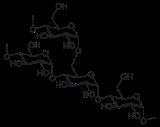
Glucose units are linked in a linear way with α(1→4) glycosidic bonds. Branching takes place with α(1→6) bonds occurring every 24 to 30 glucose units, resulting in a soluble molecule that can be quickly degraded as it has many end points for enzymes to attach onto. In contrast, amylose contains very few α(1→6) bonds, which causes it to be hydrolyzed more slowly but have higher density and be insoluble.
Its counterpart in animals is glycogen
, which has the same composition and structure, but with more extensive branching that occurs every 8 to 12 glucose units.
Plants store starch within specialized organelles called amyloplasts. When energy
is needed for cell
work, the plant hydrolyzes the starch, releasing the glucose subunits. Humans and other animals that eat plant foods also use amylase
, an enzyme that assists in breaking down amylopectin.
Starch is made of about 70% amylopectin by weight, though it varies depending on the source (higher in medium-grain rice
to 100% in waxy rice, waxy potato starch
, and waxy corn
, and lower in long-grain rice, amylomaize
, and russet potato
, for example). Amylopectin is highly branched, being formed of 2,000 to 200,000 glucose units. Its inner-chains are formed of 20-24 glucose subunits.
Polysaccharide
Polysaccharides are long carbohydrate molecules, of repeated monomer units joined together by glycosidic bonds. They range in structure from linear to highly branched. Polysaccharides are often quite heterogeneous, containing slight modifications of the repeating unit. Depending on the structure,...
and highly branched polymer
Polymer
A polymer is a large molecule composed of repeating structural units. These subunits are typically connected by covalent chemical bonds...
of glucose
Glucose
Glucose is a simple sugar and an important carbohydrate in biology. Cells use it as the primary source of energy and a metabolic intermediate...
found in plants. It is one of the two components of starch
Starch
Starch or amylum is a carbohydrate consisting of a large number of glucose units joined together by glycosidic bonds. This polysaccharide is produced by all green plants as an energy store...
, the other being amylose
Amylose
Amylose is a linear polymer made up of D-glucose units.This polysaccharide is one of the two components of starch, making up approximately 2-30% of the structure...
.
Glucose units are linked in a linear way with α(1→4) glycosidic bonds. Branching takes place with α(1→6) bonds occurring every 24 to 30 glucose units, resulting in a soluble molecule that can be quickly degraded as it has many end points for enzymes to attach onto. In contrast, amylose contains very few α(1→6) bonds, which causes it to be hydrolyzed more slowly but have higher density and be insoluble.
Its counterpart in animals is glycogen
Glycogen
Glycogen is a molecule that serves as the secondary long-term energy storage in animal and fungal cells, with the primary energy stores being held in adipose tissue...
, which has the same composition and structure, but with more extensive branching that occurs every 8 to 12 glucose units.
Plants store starch within specialized organelles called amyloplasts. When energy
Energy
In physics, energy is an indirectly observed quantity. It is often understood as the ability a physical system has to do work on other physical systems...
is needed for cell
Cell (biology)
The cell is the basic structural and functional unit of all known living organisms. It is the smallest unit of life that is classified as a living thing, and is often called the building block of life. The Alberts text discusses how the "cellular building blocks" move to shape developing embryos....
work, the plant hydrolyzes the starch, releasing the glucose subunits. Humans and other animals that eat plant foods also use amylase
Amylase
Amylase is an enzyme that catalyses the breakdown of starch into sugars. Amylase is present in human saliva, where it begins the chemical process of digestion. Food that contains much starch but little sugar, such as rice and potato, taste slightly sweet as they are chewed because amylase turns...
, an enzyme that assists in breaking down amylopectin.
Starch is made of about 70% amylopectin by weight, though it varies depending on the source (higher in medium-grain rice
Rice
Rice is the seed of the monocot plants Oryza sativa or Oryza glaberrima . As a cereal grain, it is the most important staple food for a large part of the world's human population, especially in East Asia, Southeast Asia, South Asia, the Middle East, and the West Indies...
to 100% in waxy rice, waxy potato starch
Waxy potato starch
Waxy potato starch is a new species of starch only containing amylopectin molecules, extracted from new potato varieties. Standard starch extracted from traditional potato varieties contains both amylose and amylopectin....
, and waxy corn
Waxy corn
Waxy corn was found in China in 1909. As this plant showed many peculiar traits, the American breeders long used it as a genetic marker to tag the existence of hidden genes in other maize breeding programs...
, and lower in long-grain rice, amylomaize
Amylomaize
Amylomaize was a term coined by Robert P. Bear of Bear Hybrids Corn Company in Decatur, Illinois to describe his discovery and commercial breeding of a unique cornstarch with high amylose content, also called high amylose starch...
, and russet potato
Russet Burbank potato
The Russet Burbank potato is a large brown-skinned, white-fleshed cultivar of potato. Luther Burbank developed the Burbank potato in Lunenburg, Massachusetts, U.S., in the early 1870s. In 1875, Burbank sold his farm and the rights to his potato, and moved to Santa Rosa, California...
, for example). Amylopectin is highly branched, being formed of 2,000 to 200,000 glucose units. Its inner-chains are formed of 20-24 glucose subunits.