

34th Training Wing

Encyclopedia
The 34th Training Wing is a wing
of the United States Air Force
based at the Air Force Academy
in Colorado Springs
, Colorado. The commander of the 34th Training Wing is dual-hatted as the Commandant of Cadets at the Academy.
During World War II, its predecessor unit, the 34th Bombardment Group (Heavy) was a Eighth Air Force
heavy bombardment unit in England, stationed at RAF Mendlesham
. Arriving in England in April, 1944 and flew its first missions in May, 1944. It was the oldest USAAF bomb group to serve with the Eighth Air Force.
 Activated 15 January 1941 at Langley field, Virginia 391st Bomb Squadron originally designated 1RS Group equipped with B-17s and on completion of training moved to Westover Field in Massachusetts They took part in anti-submarine patrols on the eastern seaboard flying from Pendleton Field, Ore. from the end of January 1942 to mid May 1942. Group moved to Davis Monthan Field in Arizona and on 4 July 1942 to Geiger Field Washington, where it became a replacement training unit.
Prior to this many of the cadres were drawn from 34 Bomb Group to build new bomb groups destined for the 8th AF. On 15 December 1942 they moved to Blythe Army Air Base, California where it formed part of the 358th CCTS but reverted to an operational role 5 January 1944 to train B-24s for overseas duty. Air echelon began overseas movement on 31 May 1944, taking southern ferry route, from Florida Trinidad, Brazil, West Africa, Marrakesh to Valley. Ground echelon to port of embarkation on 1 April 1944.
The group moved to RAF Mendlesham
England in April 1944 and entered combat
on 23 May 1944. The 34th was assigned to the 93d Combat Bombardment Wing, and the group tail code was a "Square-S".
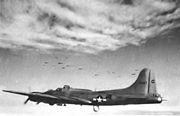
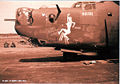
The group flew both B-17 Flying Fortresses and B-24 Liberator
s as part of the Eighth Air Force's strategic bombing campaign. The 34th flew 170 operations from the station, the first sixty-two while flying B-24 Liberators and the remainder with B-17G Fortresses. The change-over was made during the summer of 1.944 when, in common with other groups assigned to the 93rd Combat Wing, the 3rd Division standardised on the Fortress. The group helped to prepare for the invasion of Normandy
by bombing airfields in France and Germany, and supported the landing in June by attacking coastal defences and communications. Continued to take part in the campaign in France by supporting ground forces at Saint-Lô
, 24–25 July, and by striking V-weapon sites, gun emplacements, and supply lines throughout the summer of 1944.
The group converted to B-17's in September 1944 and engaged primarily in bombardment of strategic objectives from October 1944 to February 1945. Targets included marshalling yards in Ludwigshafen, Hamm
, Osnabrück
, and Darmstadt
; oil centres in Bielefeld
, Merseburg
, Hamburg, and Misburg; factories in Berlin, Dalteln, and Hanover
; and airfields in Münster
, Neumünster
, and Frankfurt
. During this period the group also supported ground forces during the Battle of the Bulge
, December 1944 – January 1945. In March 1945, with few industrial targets remaining and with Allied armies advancing across Germany, the 34th turned almost solely to interdicting enemy communications and supporting Allied ground forces.
After V-E Day it carried food to flooded areas of Holland and transported prisoners of war from German camps to Allied centres. Redeployed to the US Jun/Jul 1945. First of the air echelon departed 19 June 1945. Ground echelon sailed Queen Elizabeth from Southhampton on the 6 August 1945. Personnel had 30 days R and R. Group established Sioux Falls AAFd, South Dakota, and inactivated there on 28 August 1945.
operations. It provided training for RVNAF strike pilots
, forward air control
lers, and observers. The 34th also flew a variety of combat missions, including close air support
, escort and interdiction, psychological warfare
, aerial supply, forward air control and tactical liaison. The group pioneered tactical weapons and munitions, such as the A-1 Skyraider, the minigun
, the daisycutter, and the gunship
. Aircrews of the 1st Air Commando Squadron performed the first combat tests of the FC-47 gunship beginning December 1964. The 6251st Tactical Fighter Wing replaced the group in July 1965, and the 34th was again deactivated.
as the administrative organization responsible for cadet
leadership and military training programs, instruction in military and airmanship courses, and general supervision of cadet life activities.
Squadron
Wing (air force unit)
Wing is a term used by different military aviation forces for a unit of command. The terms wing, group or Staffel are used for different-sized units from one country or service to another....
of the United States Air Force
United States Air Force
The United States Air Force is the aerial warfare service branch of the United States Armed Forces and one of the American uniformed services. Initially part of the United States Army, the USAF was formed as a separate branch of the military on September 18, 1947 under the National Security Act of...
based at the Air Force Academy
Air Force Academy, Colorado
Air Force Academy is a census-designated place in El Paso County, Colorado, United States. The CDP includes a large portion of the grounds of the United States Air Force Academy, including the cadet housing facilities. The population was 6,680 at the 2010 census...
in Colorado Springs
Colorado Springs, Colorado
Colorado Springs is a Home Rule Municipality that is the county seat and most populous city of El Paso County, Colorado, United States. Colorado Springs is located in South-Central Colorado, in the southern portion of the state. It is situated on Fountain Creek and is located south of the Colorado...
, Colorado. The commander of the 34th Training Wing is dual-hatted as the Commandant of Cadets at the Academy.
During World War II, its predecessor unit, the 34th Bombardment Group (Heavy) was a Eighth Air Force
Eighth Air Force
The Eighth Air Force is a numbered air force of the United States Air Force Global Strike Command . It is headquartered at Barksdale Air Force Base, Louisiana....
heavy bombardment unit in England, stationed at RAF Mendlesham
RAF Mendlesham
RAF Mendlesham is a former World War II airfield in England. The field is located 5½ miles E of Stowmarket in Suffolk.-RAF Fighter Command use:...
. Arriving in England in April, 1944 and flew its first missions in May, 1944. It was the oldest USAAF bomb group to serve with the Eighth Air Force.
Mission
To educate and train potential United States Air Force officers as the administrative organization responsible for cadet leadership and military training programs, instruction in military and airmanship courses, and general supervision of cadet life activities.World War II
Prior to this many of the cadres were drawn from 34 Bomb Group to build new bomb groups destined for the 8th AF. On 15 December 1942 they moved to Blythe Army Air Base, California where it formed part of the 358th CCTS but reverted to an operational role 5 January 1944 to train B-24s for overseas duty. Air echelon began overseas movement on 31 May 1944, taking southern ferry route, from Florida Trinidad, Brazil, West Africa, Marrakesh to Valley. Ground echelon to port of embarkation on 1 April 1944.
The group moved to RAF Mendlesham
RAF Mendlesham
RAF Mendlesham is a former World War II airfield in England. The field is located 5½ miles E of Stowmarket in Suffolk.-RAF Fighter Command use:...
England in April 1944 and entered combat
Combat
Combat, or fighting, is a purposeful violent conflict meant to establish dominance over the opposition, or to terminate the opposition forever, or drive the opposition away from a location where it is not wanted or needed....
on 23 May 1944. The 34th was assigned to the 93d Combat Bombardment Wing, and the group tail code was a "Square-S".
The group flew both B-17 Flying Fortresses and B-24 Liberator
B-24 Liberator
The Consolidated B-24 Liberator was an American heavy bomber, designed by Consolidated Aircraft of San Diego, California. It was known within the company as the Model 32, and a small number of early models were sold under the name LB-30, for Land Bomber...
s as part of the Eighth Air Force's strategic bombing campaign. The 34th flew 170 operations from the station, the first sixty-two while flying B-24 Liberators and the remainder with B-17G Fortresses. The change-over was made during the summer of 1.944 when, in common with other groups assigned to the 93rd Combat Wing, the 3rd Division standardised on the Fortress. The group helped to prepare for the invasion of Normandy
D-Day
D-Day is a term often used in military parlance to denote the day on which a combat attack or operation is to be initiated. "D-Day" often represents a variable, designating the day upon which some significant event will occur or has occurred; see Military designation of days and hours for similar...
by bombing airfields in France and Germany, and supported the landing in June by attacking coastal defences and communications. Continued to take part in the campaign in France by supporting ground forces at Saint-Lô
Saint-Lô
Saint-Lô is a commune in north-western France, the capital of the Manche department in Normandy.-History:Originally called Briovère , the town is built on and around ramparts. Originally it was a Gaul fortified settlement...
, 24–25 July, and by striking V-weapon sites, gun emplacements, and supply lines throughout the summer of 1944.
The group converted to B-17's in September 1944 and engaged primarily in bombardment of strategic objectives from October 1944 to February 1945. Targets included marshalling yards in Ludwigshafen, Hamm
Hamm
Hamm is a city in North Rhine-Westphalia , Germany. It is located in the northeastern part of the Ruhr area. As of December 2003 its population was 180,849. The city is situated between the A1 motorway and A2 motorway...
, Osnabrück
Osnabrück
Osnabrück is a city in Lower Saxony, Germany, some 80 km NNE of Dortmund, 45 km NE of Münster, and some 100 km due west of Hanover. It lies in a valley penned between the Wiehen Hills and the northern tip of the Teutoburg Forest...
, and Darmstadt
Darmstadt
Darmstadt is a city in the Bundesland of Hesse in Germany, located in the southern part of the Rhine Main Area.The sandy soils in the Darmstadt area, ill-suited for agriculture in times before industrial fertilisation, prevented any larger settlement from developing, until the city became the seat...
; oil centres in Bielefeld
Bielefeld
Bielefeld is an independent city in the Ostwestfalen-Lippe Region in the north-east of North Rhine-Westphalia, Germany. With a population of 323,000, it is also the most populous city in the Regierungsbezirk Detmold...
, Merseburg
Merseburg
Merseburg is a town in the south of the German state of Saxony-Anhalt on the river Saale, approx. 14 km south of Halle . It is the capital of the Saalekreis district. It had a diocese founded by Archbishop Adalbert of Magdeburg....
, Hamburg, and Misburg; factories in Berlin, Dalteln, and Hanover
Hanover
Hanover or Hannover, on the river Leine, is the capital of the federal state of Lower Saxony , Germany and was once by personal union the family seat of the Hanoverian Kings of Great Britain, under their title as the dukes of Brunswick-Lüneburg...
; and airfields in Münster
Münster
Münster is an independent city in North Rhine-Westphalia, Germany. It is located in the northern part of the state and is considered to be the cultural centre of the Westphalia region. It is also capital of the local government region Münsterland...
, Neumünster
Neumünster
Neumünster is an independent town in Schleswig-Holstein, Germany, which has a total of four independent towns.-Current Situation:Neumünster station is major railway junction with lines running in six directions, including the important Hamburg-Altona–Kiel and Neumünster–Flensburg lines.Near...
, and Frankfurt
Frankfurt
Frankfurt am Main , commonly known simply as Frankfurt, is the largest city in the German state of Hesse and the fifth-largest city in Germany, with a 2010 population of 688,249. The urban area had an estimated population of 2,300,000 in 2010...
. During this period the group also supported ground forces during the Battle of the Bulge
Battle of the Bulge
The Battle of the Bulge was a major German offensive , launched toward the end of World War II through the densely forested Ardennes mountain region of Wallonia in Belgium, hence its French name , and France and...
, December 1944 – January 1945. In March 1945, with few industrial targets remaining and with Allied armies advancing across Germany, the 34th turned almost solely to interdicting enemy communications and supporting Allied ground forces.
After V-E Day it carried food to flooded areas of Holland and transported prisoners of war from German camps to Allied centres. Redeployed to the US Jun/Jul 1945. First of the air echelon departed 19 June 1945. Ground echelon sailed Queen Elizabeth from Southhampton on the 6 August 1945. Personnel had 30 days R and R. Group established Sioux Falls AAFd, South Dakota, and inactivated there on 28 August 1945.
Cold War
The 34th was reactivated in July 1963 as the 34th Tactical Group to train Republic of Vietnam Air Force (RVNAF) personnel in counter-insurgencyCounter-insurgency
A counter-insurgency or counterinsurgency involves actions taken by the recognized government of a nation to contain or quell an insurgency taken up against it...
operations. It provided training for RVNAF strike pilots
Aviator
An aviator is a person who flies an aircraft. The first recorded use of the term was in 1887, as a variation of 'aviation', from the Latin avis , coined in 1863 by G. de la Landelle in Aviation Ou Navigation Aérienne...
, forward air control
Forward air control
Forward air control is the provision of guidance to Close Air Support aircraft intended to ensure that their attack hits the intended target and does not injure friendly troops. This task is carried out by a forward air controller . For NATO forces the qualifications and experience required to be...
lers, and observers. The 34th also flew a variety of combat missions, including close air support
Close air support
In military tactics, close air support is defined as air action by fixed or rotary winged aircraft against hostile targets that are close to friendly forces, and which requires detailed integration of each air mission with fire and movement of these forces.The determining factor for CAS is...
, escort and interdiction, psychological warfare
Psychological warfare
Psychological warfare , or the basic aspects of modern psychological operations , have been known by many other names or terms, including Psy Ops, Political Warfare, “Hearts and Minds,” and Propaganda...
, aerial supply, forward air control and tactical liaison. The group pioneered tactical weapons and munitions, such as the A-1 Skyraider, the minigun
Minigun
The Minigun is a 7.62 mm, multi-barrel heavy machine gun with a high rate of fire , employing Gatling-style rotating barrels with an external power source...
, the daisycutter, and the gunship
Gunship
The term "gunship" is used in several contexts, all sharing the general idea of a light craft armed with heavy guns.-In Navy:In the Navy, the term originally appeared in the mid-19th century as a less-common synonym for gunboat.-In military aviation:...
. Aircrews of the 1st Air Commando Squadron performed the first combat tests of the FC-47 gunship beginning December 1964. The 6251st Tactical Fighter Wing replaced the group in July 1965, and the 34th was again deactivated.
Modern era
In late 1994, the 34th Training Wing was activated to encompass the office of the Commandant of Cadets at the United States Air Force AcademyUnited States Air Force Academy
The United States Air Force Academy is an accredited college for the undergraduate education of officer candidates for the United States Air Force. Its campus is located immediately north of Colorado Springs in El Paso County, Colorado, United States...
as the administrative organization responsible for cadet
Cadet
A cadet is a trainee to become an officer in the military, often a person who is a junior trainee. The term comes from the term "cadet" for younger sons of a noble family.- Military context :...
leadership and military training programs, instruction in military and airmanship courses, and general supervision of cadet life activities.
Lineage
- Established as 34th Bombardment Group (Heavy) on 20 November 1940
- Activated on 15 January 1941
- Redesignated 34th Bombardment Group, Heavy, c. 15 February 1944
- Inactivated on 28 August 1945
- Consolidated (31 January 1984) with the 34th Tactical Group, which was established, and activated, on 19 June 1963.
- Organized on 8 July 1963
- Discontinued, and inactivated, on 8 July 1965
- Redesignated 34th Training Wing on 30 September 1994
- Activated on 31 October 1994.
Assignments
- 2d Bombardment Wing2d Bombardment Wing (World War II)The 2d Bombardment Wing is an inactive organization of the United States Army Air Forces. Its last assignment was with the Continental Air Forces, based at McChord Field, Washington. It was inactivated on 7 November 1945....
, 15 January 1941 - 4th Bombardment Wing, 3 June 1941
- I Bomber Command, 5 September 1941
- 2d (later, Second) Air ForceSecond Air ForceThe Second Air Force is a numbered air force of the United States Air Force Air Education and Training Command . It is headquartered at Keesler Air Force Base, Mississippi....
, 27 January 1942 - 16th Bombardment Training (later, 16 Bombardment Operational Training) Wing16th Bombardment Wing (World War II)The 16th Bombardment Wing is an inactive United States Air Force unit. Its last assignment was with Continental Air Forces, based at Colorado Springs AAF, Colorado. It was inactivated on 8 October 1948.-Lineage:...
, c. 15 December 1942 - 93d Combat Bombardment Wing, c. 26 April 1944
- 45th Combat Bombardment Wing, 24 May 1945
- 20th Bombardment Wing, 18 June-28 August 1945
- Pacific Air Forces, 19 June 1963
- 2d Air Division, 8 July 1963 – 8 July 1965
- United States Air Force AcademyUnited States Air Force AcademyThe United States Air Force Academy is an accredited college for the undergraduate education of officer candidates for the United States Air Force. Its campus is located immediately north of Colorado Springs in El Paso County, Colorado, United States...
, 31 October 1994–present
Components
Group- 34th Operations: 31 October 1994 – 4 October 2004
Squadron
- 1st Reconnaissance (later, 391st Bombardment)91st Air Refueling SquadronThe 91st Air Refueling Squadron is part of the 6th Air Mobility Wing at MacDill Air Force Base, Florida. It operates the KC-135 Stratotanker aircraft conducting aerial refueling missions.-History:...
: attached 15 January 1941 – 24 February 1942, assigned 25 February 1942 – 28 August 1945 - 1st Air Commando Squadron: 8 July 1963 – 8 July 1965
- 4th Bombardment Squadron4th Bombardment SquadronThe 4th Bombardment Squadron is an inactive United States Air Force unit. It was last assigned to the 34th Bombardment Group, stationed at Sioux Falls Army Air Field, South Dakota. It was inactivated on 28 August 1945.-History:...
: 15 January 1941 – 28 August 1945 - 7th Bombardment Squadron7th Bombardment SquadronThe 7th Bombardment Squadron is an inactive United States Air Force unit. It was last assigned to the 34th Bombardment Group, stationed at Sioux Falls Army Air Field, South Dakota. It was inactivated on 28 August 1945.-History:...
: 15 January 1941 – 28 August 1945 - 8th Bombardment Squadron: attached 5 August-3 November 1964
- 13th Bombardment Squadron: attached 5 August-3 November 1964; 17 February-16 May 1965
- 18th Bombardment18th Flight Test SquadronThe 18th Flight Test Squadron is an independent field test agency of the Air Force Special Operations Command located at Hurlburt Field, Florida with one detachment at Edwards Air Force Base, California...
: 15 January 1941 – 28 August 1945 - 19th Tactical Air Support Squadron: 8 July 1963 – 8 August 1964; 21 October 1964-8 July 1965
- 602d Fighter Squadron (Commando): 18 October 1964 – 8 July 1965
Stations
- Langley Field, VirginiaVirginiaThe Commonwealth of Virginia , is a U.S. state on the Atlantic Coast of the Southern United States. Virginia is nicknamed the "Old Dominion" and sometimes the "Mother of Presidents" after the eight U.S. presidents born there...
, 15 January 1941 - Westover Field, MassachusettsMassachusettsThe Commonwealth of Massachusetts is a state in the New England region of the northeastern United States of America. It is bordered by Rhode Island and Connecticut to the south, New York to the west, and Vermont and New Hampshire to the north; at its east lies the Atlantic Ocean. As of the 2010...
, 29 May 1941 - Pendleton Field, OregonOregonOregon is a state in the Pacific Northwest region of the United States. It is located on the Pacific coast, with Washington to the north, California to the south, Nevada on the southeast and Idaho to the east. The Columbia and Snake rivers delineate much of Oregon's northern and eastern...
, 27 January 1942 - Davis-Monthan Field, ArizonaArizonaArizona ; is a state located in the southwestern region of the United States. It is also part of the western United States and the mountain west. The capital and largest city is Phoenix...
, 13 May 1942 - Geiger Field, Washington, 4 July 1942
- Ephrata Army Air Base, Washington, 1 December 1942
- Bishop Army Airfield, California, 15 December 1942 – April 1944
- RAF MendleshamRAF MendleshamRAF Mendlesham is a former World War II airfield in England. The field is located 5½ miles E of Stowmarket in Suffolk.-RAF Fighter Command use:...
(USAAF Station 156), England, 26 April 1944-c. 25 July 1945 - Sioux Falls Army Air Field, South DakotaSouth DakotaSouth Dakota is a state located in the Midwestern region of the United States. It is named after the Lakota and Dakota Sioux American Indian tribes. Once a part of Dakota Territory, South Dakota became a state on November 2, 1889. The state has an area of and an estimated population of just over...
,Aug-28 August 1945 - Bien Hoa Air BaseBien Hoa Air BaseBien Hoa Air Base is a Vietnam People's Air Force military airfield located in South-Central southern Vietnam about 20 miles from Saigon near the city of Bien Hoa within Dong Nai Province....
, South VietnamSouth VietnamSouth Vietnam was a state which governed southern Vietnam until 1975. It received international recognition in 1950 as the "State of Vietnam" and later as the "Republic of Vietnam" . Its capital was Saigon...
, 8 July 1963 – 8 July 1965 - United States Air Force AcademyUnited States Air Force AcademyThe United States Air Force Academy is an accredited college for the undergraduate education of officer candidates for the United States Air Force. Its campus is located immediately north of Colorado Springs in El Paso County, Colorado, United States...
, ColoradoColoradoColorado is a U.S. state that encompasses much of the Rocky Mountains as well as the northeastern portion of the Colorado Plateau and the western edge of the Great Plains...
, 31 October 1994–present
Aircraft operated
- B-17 Flying Fortress (1941–1942, 1944–1945)
- B-18 BoloB-18 BoloThe Douglas B-18 Bolo was a United States Army Air Corps and Royal Canadian Air Force bomber of the late 1930s and early 1940s. The Bolo was built by Douglas Aircraft Company and based on its DC-2 and was developed to replace the Martin B-10....
(1941) - B-24 LiberatorB-24 LiberatorThe Consolidated B-24 Liberator was an American heavy bomber, designed by Consolidated Aircraft of San Diego, California. It was known within the company as the Model 32, and a small number of early models were sold under the name LB-30, for Land Bomber...
(1942–1944) - B-26 InvaderA-26 InvaderThe Douglas A-26 Invader was a United States twin-engined light attack bomber built by the Douglas Aircraft Co. during World War II that also saw service during several of the Cold War's major conflicts...
(1963–1964) - B-57 CanberraB-57 CanberraThe Martin B-57 Canberra was a United States-built, twin jet engine light bomber and reconnaissance aircraft, which entered service with the United States Air Force in 1953. The B-57 was initially a version of the English Electric Canberra built under license. However, the Glenn L...
(1964–1965)
- O-1 Bird Dog (1963–1965)
- U-10 Super CourierHelio CourierThe Helio Courier is a light C/STOL utility aircraft designed in 1949.Around 500 of these aircraft were manufactured in Pittsburg, Kansas from 1954 until 1974 by the Helio Aircraft Company. During the early 1980s, new owners made an attempt to build new aircraft with direct-drive Lycoming engines,...
(1963–1965) - T-28 TrojanT-28 TrojanThe North American Aviation T-28 Trojan is a piston-engined military trainer aircraft used by the United States Air Force and United States Navy beginning in the 1950s...
(1963–1964) - C-47 SkytrainC-47 SkytrainThe Douglas C-47 Skytrain or Dakota is a military transport aircraft that was developed from the Douglas DC-3 airliner. It was used extensively by the Allies during World War II and remained in front line operations through the 1950s with a few remaining in operation to this day.-Design and...
(1963–1965) - A-1 SkyraiderA-1 SkyraiderThe Douglas A-1 Skyraider was an American single-seat attack aircraft that saw service between the late 1940s and early 1980s. It became a piston-powered, propeller-driven anachronism in the jet age, and was nicknamed "Spad", after a French World War I fighter...
(1964–1965)