


Yam Suph

Encyclopedia
Yam Suph is a phrase which occurs about 23 times in the Tanakh
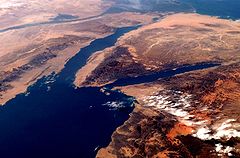
(Hebrew Bible/Old Testament) and has traditionally been understood to refer to the salt water inlet located between Africa and the Arabian peninsula, known in English as the Red Sea
. More recently, alternate western scholarly understandings of the term have been proposed for those passages where it refers to the Israelite Crossing of the Sea as told in Exodus 13-15. These proposals would mean that Yam Suph is better translated in these passages as Sea of Reeds or Sea of Seaweed; see Egyptian reed fields, also described as the ka of the Nile Delta
. In Jewish sources I Kings 9:26 "yam suph" is translated as Sea of Reeds at Eilat on the Gulf of Eilat.
 In the Biblical
narrative of The Exodus
the phrase Yam Suph refers to the body of water that the Israelites crossed following their exodus from Egypt. The appropriate translation of the phrase remains a matter of dispute, as does the exact location referred to. One possible translation of Yam Suph is "Sea of Reeds", (suph by itself means 'reed', e.g. in Exodus 2:3). This was pointed out as early as the 11th century, by Rashi
.
This may refer to a large lake close to the Red Sea
, which has since dried up due to the Suez Canal
. It was in Egypt
, specifically in the Suez valley next to the Sinai Peninsula
, and north of the Gulf of Suez
. It could also be the Gulf of Eilat, to which is referred in the Books of Kings
. The Lake of Tanis, a former coastal lagoon fed by the Pelusiac branch of the Nile, has also been advanced as the place Moses parted the waters.
Heinrich Brugsch
suggests that the Reed Sea is Sabḫat al Bardawīl
, a large lagoon on the north coast of the Sinai Peninsula
.
More conjecturally, it has also been suggested that suph may be related to the Hebrew suphah ("storm") or soph ("end"), referring to the events of the Reed/Red Sea escape itself:
of the Tanakh
and the SET, that is the 'The Stone Edition Tanach' from Mesorah Publications Ltd. Brooklyn, New York. The Greek Septuagint translation is , "red sea", except where indicated below.
End of the eighth Plague of Egypt
:
Prologue to The Exodus
:
The Passage of the Red Sea
. After the pursuing Egyptians have been drowned in "the waters" of "the sea":
The Exodus continuing:
During God’s further instruction to Moses
after the Ten Commandments
:
In the wilderness, before the conquest of Canaan
:
Just after the death of Aaron
:
Continuing the wanderings in the Wilderness:
The opening verse of the book of Deuteronomy
has an occurrence of Suph
on its own. Some translations, including the Septuagint, have taken this as an abbreviation for the full form, others not:
Moses
reviews the strategy after the initial failure to invade Canaan
.
As above:
Looking back on the events of the Exodus:
Testimony of Rahab
to Joshua’s spies before the conquest of Jericho
:
Joshua
’s speech to the troops shortly before the conquest of Jericho
:
in Joshua
’s final speech to the Israelites:
King Solomon
’s fleet:
Jeremiah bemoaned his own fate. Why had he been the one chosen to not only foretell the horrors of destruction but to witness them, and even to be at the mercy of the brethren he had trying to save? But there is no doubt that the exiled Jews in Babylon
found strenghth in his prophecy that there would be redemption and glory seventy years after the destruction of Jerusalem and the Temple. Jeremiah did not live to see his prophecy fulfilled, but many of those who had heard his prophecies were among the ones who returned with Ezra
and Nehemiah
to inaugurate the Second Temple.
God's presence and lovingkindness are always near; one need but have open eyes and an open heart to see them:
God's presence and lovingkindness are always near; one need but have open eyes and an open heart to see them:
A song of God's creation and rulership of the world in general and Israel in particular:
After the Second Temple was rebuilt (349 BCE), Nehemiah
was one of the 120 members of the Men of the Great Assembly, a council which functioned over several generations and rejuvenated the Jewish Nation. They prayed successfully against Idolatry
, composed the standard Jewish prayers and brought about the dramatic flowering of the Oral law
, the primary repository of divine wisdom (see: Tanakh
).
Tanakh
The Tanakh is a name used in Judaism for the canon of the Hebrew Bible. The Tanakh is also known as the Masoretic Text or the Miqra. The name is an acronym formed from the initial Hebrew letters of the Masoretic Text's three traditional subdivisions: The Torah , Nevi'im and Ketuvim —hence...
(Hebrew Bible/Old Testament) and has traditionally been understood to refer to the salt water inlet located between Africa and the Arabian peninsula, known in English as the Red Sea
Red Sea
The Red Sea is a seawater inlet of the Indian Ocean, lying between Africa and Asia. The connection to the ocean is in the south through the Bab el Mandeb strait and the Gulf of Aden. In the north, there is the Sinai Peninsula, the Gulf of Aqaba, and the Gulf of Suez...
. More recently, alternate western scholarly understandings of the term have been proposed for those passages where it refers to the Israelite Crossing of the Sea as told in Exodus 13-15. These proposals would mean that Yam Suph is better translated in these passages as Sea of Reeds or Sea of Seaweed; see Egyptian reed fields, also described as the ka of the Nile Delta
Nile Delta
The Nile Delta is the delta formed in Northern Egypt where the Nile River spreads out and drains into the Mediterranean Sea. It is one of the world's largest river deltas—from Alexandria in the west to Port Said in the east, it covers some 240 km of Mediterranean coastline—and is a rich...
. In Jewish sources I Kings 9:26 "yam suph" is translated as Sea of Reeds at Eilat on the Gulf of Eilat.
Hebrew Bible
The Hebrew Bible is a term used by biblical scholars outside of Judaism to refer to the Tanakh , a canonical collection of Jewish texts, and the common textual antecedent of the several canonical editions of the Christian Old Testament...
narrative of The Exodus
The Exodus
The Exodus is the story of the departure of the Israelites from ancient Egypt described in the Hebrew Bible.Narrowly defined, the term refers only to the departure from Egypt described in the Book of Exodus; more widely, it takes in the subsequent law-givings and wanderings in the wilderness...
the phrase Yam Suph refers to the body of water that the Israelites crossed following their exodus from Egypt. The appropriate translation of the phrase remains a matter of dispute, as does the exact location referred to. One possible translation of Yam Suph is "Sea of Reeds", (suph by itself means 'reed', e.g. in Exodus 2:3). This was pointed out as early as the 11th century, by Rashi
Rashi
Shlomo Yitzhaki , or in Latin Salomon Isaacides, and today generally known by the acronym Rashi , was a medieval French rabbi famed as the author of a comprehensive commentary on the Talmud, as well as a comprehensive commentary on the Tanakh...
.
This may refer to a large lake close to the Red Sea
Red Sea
The Red Sea is a seawater inlet of the Indian Ocean, lying between Africa and Asia. The connection to the ocean is in the south through the Bab el Mandeb strait and the Gulf of Aden. In the north, there is the Sinai Peninsula, the Gulf of Aqaba, and the Gulf of Suez...
, which has since dried up due to the Suez Canal
Suez Canal
The Suez Canal , also known by the nickname "The Highway to India", is an artificial sea-level waterway in Egypt, connecting the Mediterranean Sea and the Red Sea. Opened in November 1869 after 10 years of construction work, it allows water transportation between Europe and Asia without navigation...
. It was in Egypt
Egypt
Egypt , officially the Arab Republic of Egypt, Arabic: , is a country mainly in North Africa, with the Sinai Peninsula forming a land bridge in Southwest Asia. Egypt is thus a transcontinental country, and a major power in Africa, the Mediterranean Basin, the Middle East and the Muslim world...
, specifically in the Suez valley next to the Sinai Peninsula
Sinai Peninsula
The Sinai Peninsula or Sinai is a triangular peninsula in Egypt about in area. It is situated between the Mediterranean Sea to the north, and the Red Sea to the south, and is the only part of Egyptian territory located in Asia as opposed to Africa, effectively serving as a land bridge between two...
, and north of the Gulf of Suez
Gulf of Suez
The northern end of the Red Sea is bifurcated by the Sinai Peninsula, creating the Gulf of Suez in the west and the Gulf of Aqaba to the east. The Gulf of Suez is formed within a relatively young, but now inactive rift basin, the Gulf of Suez Rift, dating back about 28 million years...
. It could also be the Gulf of Eilat, to which is referred in the Books of Kings
Books of Kings
The Book of Kings presents a narrative history of ancient Israel and Judah from the death of David to the release of his successor Jehoiachin from imprisonment in Babylon, a period of some 400 years...
. The Lake of Tanis, a former coastal lagoon fed by the Pelusiac branch of the Nile, has also been advanced as the place Moses parted the waters.
Heinrich Brugsch
Heinrich Karl Brugsch
Heinrich Karl Brugsch was a German Egyptologist, born in Berlin. He was associated with Auguste Mariette in his excavations at Memphis...
suggests that the Reed Sea is Sabḫat al Bardawīl
Lake Bardawil
Lake Bardawil is a large, very saline lake in Egypt on the north coast of the Sinai Peninsula. The lagoon is shallow and is separated from the Mediterranean Sea by a narrow sandbar. It has Ramsar Convention protected wetlands.Lake Bardawil is about long, and wide...
, a large lagoon on the north coast of the Sinai Peninsula
Sinai Peninsula
The Sinai Peninsula or Sinai is a triangular peninsula in Egypt about in area. It is situated between the Mediterranean Sea to the north, and the Red Sea to the south, and is the only part of Egyptian territory located in Asia as opposed to Africa, effectively serving as a land bridge between two...
.
More conjecturally, it has also been suggested that suph may be related to the Hebrew suphah ("storm") or soph ("end"), referring to the events of the Reed/Red Sea escape itself:
The crossing of the sea signaled the end of the sojourn in Egypt and it certainly was the end of the Egyptian army that pursued the fleeing Hebrews (Ex 14:23-29; 15:4-5). After this event at yam suph, perhaps the verb soph, meaning "destroy" and "come to an end," originated (cf. Amos 3:15; Jer 8:13; Isa 66:17; Psa 73:19). Another possible development of this root is the word suphah, meaning "storm-wind"...The meanings "end" and "storm-wind" would have constituted nice puns on the event that took place at the yam suph.
Occurrences
The occurrences of the term are as follows. The translations given are the KJV, that is the Authorized King James Version of the Christian Bible, the NJPS, that is the New Jewish Publication Society of America VersionNew Jewish Publication Society of America Version
The JPS TANAKH, published in 1985, is a modern Jewish translation of Hebrew Scripture into English.This translation emerged from the collaborative efforts of an interdenominational team of Jewish scholars and rabbis working together over a thirty-year period...
of the Tanakh
Tanakh
The Tanakh is a name used in Judaism for the canon of the Hebrew Bible. The Tanakh is also known as the Masoretic Text or the Miqra. The name is an acronym formed from the initial Hebrew letters of the Masoretic Text's three traditional subdivisions: The Torah , Nevi'im and Ketuvim —hence...
and the SET, that is the 'The Stone Edition Tanach' from Mesorah Publications Ltd. Brooklyn, New York. The Greek Septuagint translation is , "red sea", except where indicated below.
End of the eighth Plague of Egypt
Plagues of Egypt
The Plagues of Egypt , also called the Ten Plagues or the Biblical Plagues, were ten calamities that, according to the biblical Book of Exodus, Israel's God, Yahweh, inflicted upon Egypt to persuade Pharaoh to release the ill-treated Israelites from slavery. Pharaoh capitulated after the tenth...
:
- KJV: "And the LORD turned a mighty strong west wind, which took away the locusts, and cast them into the Red sea; there remained not one locust in all the coasts of Egypt."
- other translations:
- NJPS: "The LORD caused a shift to a very strong west wind, which lifted the locusts, and hurled them into the Sea of Reeds; not a single locust remained in all the territory of Egypt."
- SET: "HASHEM turned back a very powerful west wind and it carried the locust-swarm and hurled it toward the Sea of Reeds; not a single locust remained within the entire border of Egypt."
Prologue to The Exodus
The Exodus
The Exodus is the story of the departure of the Israelites from ancient Egypt described in the Hebrew Bible.Narrowly defined, the term refers only to the departure from Egypt described in the Book of Exodus; more widely, it takes in the subsequent law-givings and wanderings in the wilderness...
:
- KJV: "But God led the people about, through the way of the wilderness of the Red sea: and the children of Israel went up harnessed out of the land of Egypt."
- other translations:
- NJPS: "So God led the people roundabout, by way of the wilderness at the Sea of Reeds. Now the Israelites went up armed out of the land of Egypt."
- SET: "So GodGodGod is the English name given to a singular being in theistic and deistic religions who is either the sole deity in monotheism, or a single deity in polytheism....
turned the people toward the way of the Wilderness to the Sea of Reeds. The Children of Israel were armed when they went up from the land of Egypt."
The Passage of the Red Sea
Passage of the Red Sea
The Crossing of the Red Sea is a passage in the Biblical narrative of the escape of the Israelites from the pursuing Egyptians in the Book of Exodus . This story is also mentioned in the Qur'an in Surah 26: Al-Shu'ara' in verses 60-67...
. After the pursuing Egyptians have been drowned in "the waters" of "the sea":
- KJV: "Pharaoh's chariots and his host hath he cast into the sea: his chosen captains also are drowned in the Red sea."
- other translations:
- NJPS: "Pharaoh's chariots and his army he has cast into the sea: and the pick of his officers are drowned in the Sea of Reeds."
- SET: "Pharaoh's chariots and army He threw in the sea, and the pick of his officers were mired in the Sea of Reeds."
The Exodus continuing:
- KJV: "So Moses brought Israel from the Red sea, and they went out into the wilderness of Shur; and they went three days in the wilderness, and found no water."
- other translations:
- NJPS: "Then Moses caused Israel to set out from the Sea of Reeds. They went on into the wilderness of Shur; they traveled three days in the wilderness and found no water."
- SET: "MosesMosesMoses was, according to the Hebrew Bible and Qur'an, a religious leader, lawgiver and prophet, to whom the authorship of the Torah is traditionally attributed...
caused Israel to journey from the Sea of Reeds and they went out to the Wilderness of ShurShur (Bible)Shur is a location mentioned several times in the Hebrew Bible. When Hagar flees from Abraham, the Angel of the Lord find her by a "spring on the way to Shur." .According to Exodus 15:22, Marah is located in the "wilderness of Shur."...
; they went for a three-day period in the Wilderness, but they did not find water. "
During God’s further instruction to Moses
Moses
Moses was, according to the Hebrew Bible and Qur'an, a religious leader, lawgiver and prophet, to whom the authorship of the Torah is traditionally attributed...
after the Ten Commandments
Ten Commandments
The Ten Commandments, also known as the Decalogue , are a set of biblical principles relating to ethics and worship, which play a fundamental role in Judaism and most forms of Christianity. They include instructions to worship only God and to keep the Sabbath, and prohibitions against idolatry,...
:
- KJV: "And I will set thy bounds from the Red sea even unto the sea of the Philistines, and from the desert unto the river: for I will deliver the inhabitants of the land into your hand; and thou shalt drive them out before thee."
- other translations:
- NJPS: "And I will set your borders from the Sea of Reeds to the Sea of Philistia, and from the wilderness to the Euphrates: for I will deliver the inhabitants of the land into your hands; and you will drive them out before you."
- SET: "I shall set your border from the Sea of Reeds to the Sea of the Philistines. "
In the wilderness, before the conquest of Canaan
Canaan
Canaan is a historical region roughly corresponding to modern-day Israel, Palestine, Lebanon, and the western parts of Jordan...
:
- KJV: "(Now the Amalekites and the Canaanites dwelt in the valley.) Tomorrow turn you, and get you into the wilderness by the way of the Red sea."
- other translations:
- NJPS: "Now the Amalekites and the Canaanites occupy the valleys. Start out, then, tomorrow, and march into the wilderness by way of the Sea of Reeds."
- SET: "And HASHEM said, “... The Amalekite and the CanaanCanaanCanaan is a historical region roughly corresponding to modern-day Israel, Palestine, Lebanon, and the western parts of Jordan...
ite dwell in the valley - tomorrow, turn and journey toward the Wilderness in the direction of the Sea of Reeds.”"
Just after the death of Aaron
Aaron
In the Hebrew Bible and the Qur'an, Aaron : Ααρών ), who is often called "'Aaron the Priest"' and once Aaron the Levite , was the older brother of Moses, and a prophet of God. He represented the priestly functions of his tribe, becoming the first High Priest of the Israelites...
:
- KJV: "And they journeyed from mount Hor by the way of the Red sea, to compass the land of Edom: and the soul of the people was much discouraged because of the way."
- other translations:
- NJPS: "They set out from Mount Hor by the way of the Sea of Reeds, to skirt the land of Edom. But the people grew restive on the journey,"
- SET: "They journeyed from Mount HorHorHor was an Egyptian king of the 13th Dynasty. He appears in the Turin King List as Au-ib-Rê. He most likely reigned only for a short time, not long enough to prepare a pyramid, which was in this dynasty still the common burial place for kings.-Burial:...
by way of the Sea of Reeds to go around the land of EdomEdomEdom or Idumea was a historical region of the Southern Levant located south of Judea and the Dead Sea. It is mentioned in biblical records as a 1st millennium BC Iron Age kingdom of Edom, and in classical antiquity the cognate name Idumea was used to refer to a smaller area in the same region...
, and the spirit of the people grew short on the way."
Continuing the wanderings in the Wilderness:
- KJV: "(10) And they removed from Elim, and encamped by the Red sea. (11) And they removed from the Red sea, and encamped in the wilderness of Sin."
- other translations:
- NJPS: "(10) They set out from Elim, and encamped by the Sea of Reeds. (11) They set out from the Sea of Reeds, and encamped in the wilderness of Sin."
- SET: "They journeyed from ElimElim (Bible)Elim was one of the places where the Israelites camped following their Exodus from Egypt. It is referenced in Exodus 15.27 and Numbers 33.9 as a place where "there were twelve wells of water, and seventy date palms," and that the Israelites "camped there near the water".From the information that...
and encamped by the Sea of Reeds. (11) They journeyed from the Sea of Reeds and encamped in the Wilderness of SinWilderness of SinThe Wilderness of Sin/Desert of Sin is a geographic area mentioned by the Bible as lying between Elim and Mount Sinai. Sin does not refer to sinfulness, but is an untranslated word that would translate as the moon; biblical scholars suspect that the name Sin here refers to the semitic moon-deity...
."
The opening verse of the book of Deuteronomy
Deuteronomy
The Book of Deuteronomy is the fifth book of the Hebrew Bible, and of the Jewish Torah/Pentateuch...
has an occurrence of Suph
Suph
Suph is a place name that appears in Deuteronomy 1:1 . Some scholars identify it with Suphah as probably the name of a place. Others identify it with es-Sufah = Maaleh-acrabbim , and yet others with Zuph...
on its own. Some translations, including the Septuagint, have taken this as an abbreviation for the full form, others not:
- KJV: "These be the words which Moses spake unto all Israel on this side Jordan in the wilderness, in the plain over against the Red sea, between Paran, and Tophel, and Laban, and Hazeroth, and Dizahab."
- other translations:
- NJPS: "These are the words that Moses addressed to all Israel on the other side of the Jordan. — Through the wilderness, in the Arabah near Suph, between Paran, and Tophel, Laban, and Hazeroth, and Di-zahab,"
- SET: "These are the words that Moses spoke to all IsraelIsraelThe State of Israel is a parliamentary republic located in the Middle East, along the eastern shore of the Mediterranean Sea...
, on the other side of the Jordan, concerning the Wilderness, concerning the ArabahArabahThe Arabah , also known as Aravah, is a section of the Great Rift Valley running in a north-south orientation between the southern end of the Sea of Galilee down to the Dead Sea and continuing further south where it ends at the Gulf of Aqaba. It includes most of the border between Israel to the...
, opposite the Sea of Reeds, between Paran and TophelTophelTophel or Tofel was an Edomite town mentioned in the Hebrew Bible: "These are the words Moses spoke to all Israel in the desert east of the Jordan — that is, in the Arabah — opposite Suph, between Paran and Tophel, Laban, Hazeroth and Dizahab." . It is identified as Tafilah in Jordan north to...
, and LabanLabanLaban may refer to:* Laban , a character in the Book of Genesis.* Laban , a character in The Book of Mormon.* Laban , a 1980s Eurodance duo....
, and HazerothHazerothHazeroth is one of the locations that the Israelites stopped at during their forty years of wandering in the wilderness. It is referenced in the Torah in Numbers, chapters 11, 12 and 33, as well as in Deuteronomy, chapter 1. "Hazeroth" means yards.At Hazeroth, Miriam was afflicted with tzaraath...
, and Di-zahab; eleven days from HorebMount HorebMount Horeb, Hebrew: , Greek in the Septuagint: , Latin in the Vulgate: , is the mountain at which the book of Deuteronomy in the Hebrew Bible states that the Ten Commandments were given to Moses by God. It is described in two places as the Mountain of God or perhaps Mountain of the gods...
, by way of Mount SeirSeirSeir . It is sometimes used as an alternative term for a goat, as in Seir La'Azazel .* Seir - "Prince" in Ancient Egyptian, a name used by the Egyptians to refer the god of the dead known to the Greeks as Osiris...
to Kadesh-barnea."
Moses
Moses
Moses was, according to the Hebrew Bible and Qur'an, a religious leader, lawgiver and prophet, to whom the authorship of the Torah is traditionally attributed...
reviews the strategy after the initial failure to invade Canaan
Canaan
Canaan is a historical region roughly corresponding to modern-day Israel, Palestine, Lebanon, and the western parts of Jordan...
.
- KJV: "But as for you, turn you, and take your journey into the wilderness by the way of the Red sea."
- other translations:
- NJPS: "As for you, turn about, and march into the wilderness by the way of the Sea of Reeds."
- SET: "And as for you, turn yourselves around and journey to the Wilderness, by way of the Sea of Reeds."
As above:
- KJV: "Then we turned, and took our journey into the wilderness by the way of the Red sea, as the LORD spake unto me: and we compassed mount Seir many days."
- other translations:
- NJPS: "Thus, after you had remained at Kadesh all that long time, we marched back into the wilderness by the way of the Sea of Reeds, as the LORD had spoken to me: and skirted the hill country of Seir a long time. "
- SET: "We turned and jouneyed to the Wilderness toward the Sea of Reeds, as HASHEM spoke to me, and we circled Mount Seir for many days. "
Looking back on the events of the Exodus:
- KJV: "And what he did unto the army of Egypt, unto their horses, and to their chariots; how he made the water of the Red sea to overflow them as they pursued after you, and how the LORD hath destroyed them unto this day;"
- other translations:
- NJPS: "what He did to Egypt’s army, its horses and chariots; how the LORD rolled back upon them the waters of the Sea of Reeds when they were pursuing you, thus destroying them once and for all;"
- SET: "and what He did to the army of Egypt, to its horses and its chariots, over whom He swept the waters of the Sea of Reeds when they pursued you, and HASHEM caused them to perish until this day; "
Testimony of Rahab
Rahab
Rahab, was, according to the Book of Joshua, a woman who lived in Jericho in the Promised Land and assisted the Israelites in capturing the city...
to Joshua’s spies before the conquest of Jericho
Jericho
Jericho ; is a city located near the Jordan River in the West Bank of the Palestinian territories. It is the capital of the Jericho Governorate and has a population of more than 20,000. Situated well below sea level on an east-west route north of the Dead Sea, Jericho is the lowest permanently...
:
- KJV: "For we have heard how the LORD dried up the water of the Red sea for you, when ye came out of Egypt; and what ye did unto the two kings of the Amorites, that were on the other side Jordan, Sihon and Og, whom ye utterly destroyed."
- other translations:
- NJPS: "For we have heard how the LORD dried up the water of the Sea of Reeds for you, when you left Egypt; and what you did to Sihon and Og, the two Amorite kings across the Jordan, whom you doomed."
- SET: "for we have heard how HASHEM dried up the waters of the Sea of Reeds for you when you went forth from Egypt and what you did to the two kings of the Amorites who were across the Jordan - to SihonSihonSihon, according to the Old Testament, was an Amorite king, who refused to let the Israelites pass through his country. The Bible describes that as the Israelites in their Exodus came to the country east of the Jordan, near Heshbon, King of the Amorites refused to let them pass through his...
and to OgOgOg, according to the bible, was an Amorite king of Bashan who, along with his army, was slain by Moses and his men at the battle of Edrei...
- whom you utterly destroyed."
Joshua
Joshua
Joshua , is a minor figure in the Torah, being one of the spies for Israel and in few passages as Moses's assistant. He turns to be the central character in the Hebrew Bible's Book of Joshua...
’s speech to the troops shortly before the conquest of Jericho
Jericho
Jericho ; is a city located near the Jordan River in the West Bank of the Palestinian territories. It is the capital of the Jericho Governorate and has a population of more than 20,000. Situated well below sea level on an east-west route north of the Dead Sea, Jericho is the lowest permanently...
:
- KJV: "For the LORD your God dried up the waters of Jordan from before you, until ye were passed over, as the LORD your God did to the Red sea, which he dried up from before us, until we were gone over:"
- other translations:
- NJPS: "For the LORD your God dried up the waters of the Jordan before you, until you crossed, just as the LORD your God did to the Sea of Reeds, which He dried up before us, until we crossed."
- SET: "For HASHEM, your God, dried up the waters of the Jordan before you until you crossed, as HASHEM, your God, did to the Sea of Reeds, which He dried up before us until we crossed."
in Joshua
Joshua
Joshua , is a minor figure in the Torah, being one of the spies for Israel and in few passages as Moses's assistant. He turns to be the central character in the Hebrew Bible's Book of Joshua...
’s final speech to the Israelites:
- KJV: "And I brought your fathers out of Egypt: and ye came unto the sea; and the Egyptians pursued after your fathers with chariots and horsemen unto the Red sea."
- other translations:
- NJPS: "— I freed your fathers — from Egypt, and you came to the Sea. But the Egyptians pursued your fathers to the Sea of Reeds with chariots and horsemen."
- SET: "I brought your forefathers out of Egypt and you arrived at the sea. The Egyptians pursued your forefathers with chariot and horsemen to the Sea of Reeds."
King Solomon
Solomon
Solomon , according to the Book of Kings and the Book of Chronicles, a King of Israel and according to the Talmud one of the 48 prophets, is identified as the son of David, also called Jedidiah in 2 Samuel 12:25, and is described as the third king of the United Monarchy, and the final king before...
’s fleet:
- KJV: "And king Solomon made a navy of ships in Eziongeber, which is beside Eloth, on the shore of the Red sea, in the land of Edom."
- other translations:
- The Septuagint here has , meaning "on the shore of the extremity of the sea"
- NJPS: "King Solomon also built a fleet of ships at Ezion-geber, which is near Eloth on the shore of the Sea of Reeds in the land of Edom."
- SET: "King SolomonSolomonSolomon , according to the Book of Kings and the Book of Chronicles, a King of Israel and according to the Talmud one of the 48 prophets, is identified as the son of David, also called Jedidiah in 2 Samuel 12:25, and is described as the third king of the United Monarchy, and the final king before...
made a fleet in Ezion-geberEzion-GeberEzion-Geber or Asiongaber was a city of Idumea, a biblical seaport on the northern extremity of the Gulf of Aqaba, in the area of modern Aqaba and Eilat.-Biblical references :...
, which is near Eloth, on the coast of the Sea of Reeds, in the land of EdomEdomEdom or Idumea was a historical region of the Southern Levant located south of Judea and the Dead Sea. It is mentioned in biblical records as a 1st millennium BC Iron Age kingdom of Edom, and in classical antiquity the cognate name Idumea was used to refer to a smaller area in the same region...
."
Jeremiah bemoaned his own fate. Why had he been the one chosen to not only foretell the horrors of destruction but to witness them, and even to be at the mercy of the brethren he had trying to save? But there is no doubt that the exiled Jews in Babylon
Babylon
Babylon was an Akkadian city-state of ancient Mesopotamia, the remains of which are found in present-day Al Hillah, Babil Province, Iraq, about 85 kilometers south of Baghdad...
found strenghth in his prophecy that there would be redemption and glory seventy years after the destruction of Jerusalem and the Temple. Jeremiah did not live to see his prophecy fulfilled, but many of those who had heard his prophecies were among the ones who returned with Ezra
Ezra
Ezra , also called Ezra the Scribe and Ezra the Priest in the Book of Ezra. According to the Hebrew Bible he returned from the Babylonian exile and reintroduced the Torah in Jerusalem...
and Nehemiah
Nehemiah
Nehemiah ]]," Standard Hebrew Nəḥemya, Tiberian Hebrew Nəḥemyāh) is the central figure of the Book of Nehemiah, which describes his work rebuilding Jerusalem and purifying the Jewish community. He was the son of Hachaliah, Nehemiah ]]," Standard Hebrew Nəḥemya, Tiberian Hebrew Nəḥemyāh) is the...
to inaugurate the Second Temple.
- KJV: "The earth is moved at the noise of their fall, at the cry the noise thereof was heard in the Red sea."
- other translations:
- NJPS: "At the sound of their downfall The earth shall shake; The sound of screaming Shall be heard at the Sea of Reeds."
- A translation of this text does not occur at this point in the Septuagint. An approximate correspondence is found at Jeremiah 29:21, referring to just "the sea".
- SET: "(20) Therefore, hear the counsel of HASHEM that He has devised against Edom, and His thoughts that he has conceived against the dwellers of Teman: the youngest of the flock will indeed drag them off; he will indeed devastate their pasture. (21) From the sound of their fall the earth quakes; a cry, at the Sea of Reeds their voice is heard."
God's presence and lovingkindness are always near; one need but have open eyes and an open heart to see them:
- KJV: "(7) Our fathers understood not thy wonders in Egypt; they remembered not the multitude of thy mercies; but provoked him at the sea, even at the Red sea. (8) Nevertheless he saved them for his name's sake, that he might make his mighty power to be known. (9) He rebuked the Red sea also, and it was dried up: so he led them through the depths, as through the wilderness."
- other translations:
- NJPS: "(7) Our forefathers in Egypt did not perceive Your wonders; they did not remember Your abundant love, but rebelled at the sea, at the Sea of Reeds. (8) Yet He saved them, as befits His name, to make known His might. (9) He sent is blast against the Sea of Reeds; it became dry; he led them through the deep, as through a wilderness."
- SET: "(7) Our fathers in Egypt did not contemplate Your wonders, they were not mindful of Your abundant kindness, and they rebelled by the sea, at the Sea of Reeds. (8) But He saved them for His Name's sake, to make known His might. (9) He roared at the Sea of Reeds and it became dry, and He led them through the depths as through a desert. "
God's presence and lovingkindness are always near; one need but have open eyes and an open heart to see them:
- KJV: "Wondrous works in the land of Ham, and terrible things by the Red sea."
- other translations:
- NJPS: "wondrous deeds in the land of Ham, awesome deeds at the Sea of Reeds."
- SET: "wondrous works in the land of HamHamHam is a cut of meat from the thigh of the hind leg of certain animals, especiallypigs. Nearly all hams sold today are fully cooked or cured.-Etymology:...
, awesome things by the Sea of Reeds."
A song of God's creation and rulership of the world in general and Israel in particular:
- KJV: "(13) To him which divided the Red sea into parts: for his mercy endureth for ever: (14) And made Israel to pass through the midst of it: for his mercy endureth for ever: (15) But overthrew Pharaoh and his host in the Red sea: for his mercy endureth for ever."
- other translations:
- NJPS: "(13) Who split apart the Sea of Reeds, His steadfast love is eternal; (14) and made Israel pass through it, His steadfast love is eternal; (15) Who hurled Pharaoh and his army into the Sea of Reeds, His steadfast love is eternal;"
- SET: "(13) To Him Who divided the Sea of Reeds into parts, for His kindness endures forever; (14) and caused Israel to pass through it, for His kindness endures forever; (15) and threw PharaohPharaohPharaoh is a title used in many modern discussions of the ancient Egyptian rulers of all periods. The title originates in the term "pr-aa" which means "great house" and describes the royal palace...
and his army into the Sea of Reeds, for His kindness endures forever."
After the Second Temple was rebuilt (349 BCE), Nehemiah
Nehemiah
Nehemiah ]]," Standard Hebrew Nəḥemya, Tiberian Hebrew Nəḥemyāh) is the central figure of the Book of Nehemiah, which describes his work rebuilding Jerusalem and purifying the Jewish community. He was the son of Hachaliah, Nehemiah ]]," Standard Hebrew Nəḥemya, Tiberian Hebrew Nəḥemyāh) is the...
was one of the 120 members of the Men of the Great Assembly, a council which functioned over several generations and rejuvenated the Jewish Nation. They prayed successfully against Idolatry
Idolatry
Idolatry is a pejorative term for the worship of an idol, a physical object such as a cult image, as a god, or practices believed to verge on worship, such as giving undue honour and regard to created forms other than God. In all the Abrahamic religions idolatry is strongly forbidden, although...
, composed the standard Jewish prayers and brought about the dramatic flowering of the Oral law
Oral law
An oral law is a code of conduct in use in a given culture, religion or community application, by which a body of rules of human behaviour is transmitted by oral tradition and effectively respected, or the single rule that is orally transmitted....
, the primary repository of divine wisdom (see: Tanakh
Tanakh
The Tanakh is a name used in Judaism for the canon of the Hebrew Bible. The Tanakh is also known as the Masoretic Text or the Miqra. The name is an acronym formed from the initial Hebrew letters of the Masoretic Text's three traditional subdivisions: The Torah , Nevi'im and Ketuvim —hence...
).
- KJV: "And didst see the affliction of our fathers in Egypt, and heardest their cry by the Red sea;"
- other translations:
- NJPS: "You took note of our fathers’ affliction in Egypt, and heard their cry at the Sea of Reeds;"
- SET: "You observed the suffering of our forefathers in Egypt, and You heard their outcry at the Sea of Reeds. "