


Vorticism

Encyclopedia
Cubism
Cubism was a 20th century avant-garde art movement, pioneered by Pablo Picasso and Georges Braque, that revolutionized European painting and sculpture, and inspired related movements in music, literature and architecture...
, was a short-lived modernist
Modernism
Modernism, in its broadest definition, is modern thought, character, or practice. More specifically, the term describes the modernist movement, its set of cultural tendencies and array of associated cultural movements, originally arising from wide-scale and far-reaching changes to Western society...
movement
Art movement
An art movement is a tendency or style in art with a specific common philosophy or goal, followed by a group of artists during a restricted period of time, or, at least, with the heyday of the movement defined within a number of years...
in British
United Kingdom
The United Kingdom of Great Britain and Northern IrelandIn the United Kingdom and Dependencies, other languages have been officially recognised as legitimate autochthonous languages under the European Charter for Regional or Minority Languages...
art and poetry of the early 20th century. It was based in London
London
London is the capital city of :England and the :United Kingdom, the largest metropolitan area in the United Kingdom, and the largest urban zone in the European Union by most measures. Located on the River Thames, London has been a major settlement for two millennia, its history going back to its...
but international in make-up and ambition.
Origins
The Vorticism group began with the Rebel Art Centre which Wyndham LewisWyndham Lewis
Percy Wyndham Lewis was an English painter and author . He was a co-founder of the Vorticist movement in art, and edited the literary magazine of the Vorticists, BLAST...
and others established after disagreeing with Omega Workshops
Omega Workshops
The Omega Workshops was a design enterprise founded by members of the Bloomsbury Group and established in 1913. It was located at 33 Fitzroy Square in London, and was founded with the intention of providing graphic expression to the essence of the Bloomsbury ethos...
founder Roger Fry
Roger Fry
Roger Eliot Fry was an English artist and art critic, and a member of the Bloomsbury Group. Establishing his reputation as a scholar of the Old Masters, he became an advocate of more recent developments in French painting, to which he gave the name Post-Impressionism...
, and has roots in the Bloomsbury Group
Bloomsbury Group
The Bloomsbury Group or Bloomsbury Set was a group of writers, intellectuals, philosophers and artists who held informal discussions in Bloomsbury throughout the 20th century. This English collective of friends and relatives lived, worked or studied near Bloomsbury in London during the first half...
, Cubism
Cubism
Cubism was a 20th century avant-garde art movement, pioneered by Pablo Picasso and Georges Braque, that revolutionized European painting and sculpture, and inspired related movements in music, literature and architecture...
, and Futurism
Futurism (art)
Futurism was an artistic and social movement that originated in Italy in the early 20th century. It emphasized and glorified themes associated with contemporary concepts of the future, including speed, technology, youth and violence, and objects such as the car, the airplane and the industrial city...
. Lewis himself saw Vorticism as an independent alternative to Cubism, Futurism and Expressionism
Expressionism
Expressionism was a modernist movement, initially in poetry and painting, originating in Germany at the beginning of the 20th century. Its typical trait is to present the world solely from a subjective perspective, distorting it radically for emotional effect in order to evoke moods or ideas...
.
Though the style grew out of Cubism
Cubism
Cubism was a 20th century avant-garde art movement, pioneered by Pablo Picasso and Georges Braque, that revolutionized European painting and sculpture, and inspired related movements in music, literature and architecture...
, it is more closely related to Futurism
Futurism (art)
Futurism was an artistic and social movement that originated in Italy in the early 20th century. It emphasized and glorified themes associated with contemporary concepts of the future, including speed, technology, youth and violence, and objects such as the car, the airplane and the industrial city...
in its embrace of dynamism, the machine age and all things modern (cf. Cubo-Futurism
Cubo-Futurism
Cubo-Futurism was the main school of painting and sculpture practiced by the Russian Futurists.When Aristarkh Lentulov returned from Paris in 1913 and exhibited his works in Moscow, the Russian Futurist painters adopted the forms of Cubism and combined them with the Italian Futurists'...
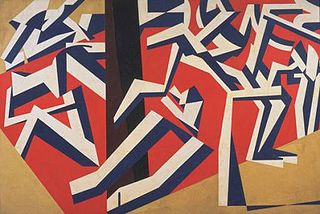
). However, Vorticism diverged from Futurism in the way it tried to capture movement in an image. In a Vorticist painting modern life is shown as an array of bold lines and harsh colours drawing the viewer's eye into the centre of the canvas.
The name Vorticism was given to the movement by Ezra Pound
Ezra Pound
Ezra Weston Loomis Pound was an American expatriate poet and critic and a major figure in the early modernist movement in poetry...
in 1913, although Lewis, usually seen as the central figure in the movement, had been producing paintings in the same style for a year or so previously.
Participants
Other than Lewis, the main figures associated with Vorticism were Malcolm ArbuthnotMalcolm Arbuthnot
Malcolm Arbuthnot was a pictorialist photographer and artist....
, Lawrence Atkinson
Lawrence Atkinson
Lawrence Atkinson was an English artist, musician and poet. He began by moving to Paris and studying musical composition, but moved back to London and began to paint, apparently painting mainly landscapes in a style influenced by Matisse and the Fauves...
, one of the signatories of BLAST. David Bomberg
David Bomberg
David Garshen Bomberg was an English painter, and one of the Whitechapel Boys.Bomberg was one of the most audacious of the exceptional generation of artists who studied at the Slade School of Art under Henry Tonks, and which included Mark Gertler, Stanley Spencer, C.R.W. Nevinson and Dora Carrington...
, Alvin Langdon Coburn
Alvin Langdon Coburn
Alvin Langdon Coburn was an early 20th century photographer who became a key figure in the development of American pictorialism...
, Jacob Epstein
Jacob Epstein
Sir Jacob Epstein KBE was an American-born British sculptor who helped pioneer modern sculpture. He was born in the United States, and moved to Europe in 1902, becoming a British citizen in 1911. He often produced controversial works which challenged taboos on what was appropriate subject matter...
, Frederick Etchells
Frederick Etchells
Frederick Etchells was an English artist and architect.- Biography :The early education of Etchells was through William Lethaby at the London School of Kensington, now known as The Royal College of Art, which brought him into contact with the Bloomsbury GroupHe was a contributor to the Omega...
, Henri Gaudier-Brzeska
Henri Gaudier-Brzeska
Henri Gaudier-Brzeska was a French sculptor who developed a rough hewn, primitive style of direct carving....
, Jessica Dismorr
Jessica Dismorr
Jessica Dismorr was an English painter and illustrator and one of only two women members of the Vorticist movement.-Early life:Dismorr was born at Gravesend, England, and moved with her family to Hampstead in the 1890s...
, Cuthbert Hamilton
Cuthbert Hamilton
Cuthbert Hamilton was a British artist associated with the Vorticist movement and later with Group X. He was one of the pioneers of abstract art in Britain.Cuthbert Hamilton went to the Slade School of Art and was a contemporary of Wyndham Lewis...
, Christopher Nevinson, William Roberts
William Roberts (painter)
William Roberts was a British painter of groups of figures and portraits, and was a war artist.-Education and early career:Son of an Irish carpenter and his wife, Roberts was born in Hackney, London...
, Helen Saunders
Helen Saunders
Helen Saunders was an English painter.Helen Saunders was born in Bedford Park, Ealing....
, Dorothy Shakespear
Dorothy Shakespear
Dorothy Shakespear was an English artist, the daughter of novelist Olivia Shakespear, and the wife of the poet Ezra Pound. She was a member of the Vorticism movement, and had her work published in the literary magazine BLAST.Dorothy met Ezra Pound in 1909; after a long courtship the two were...
and Edward Wadsworth
Edward Wadsworth
Edward Alexander Wadsworth was an English artist, most famous for his close association with Vorticism. He painted, often in tempera, coastal views, abstracts, portraits and still-life...
were also contributors to the development of the movement . The most recent active participant is the grandson of Lawrence Atkinson, Christian N Atkinson, born November 1939 in Aldeburgh, now residing in Capel St. Andrew. Some of Christian's work can be seen on Saatchi online.
BLAST
Literary magazine
A literary magazine is a periodical devoted to literature in a broad sense. Literary magazines usually publish short stories, poetry and essays along with literary criticism, book reviews, biographical profiles of authors, interviews and letters...
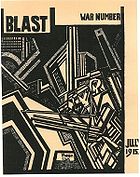
BLAST, in June 1914 and July 1915 which Lewis edited. It contained work by Ezra Pound
Ezra Pound
Ezra Weston Loomis Pound was an American expatriate poet and critic and a major figure in the early modernist movement in poetry...
and T. S. Eliot
T. S. Eliot
Thomas Stearns "T. S." Eliot OM was a playwright, literary critic, and arguably the most important English-language poet of the 20th century. Although he was born an American he moved to the United Kingdom in 1914 and was naturalised as a British subject in 1927 at age 39.The poem that made his...
as well as by the Vorticists themselves. Its typographical
Typography
Typography is the art and technique of arranging type in order to make language visible. The arrangement of type involves the selection of typefaces, point size, line length, leading , adjusting the spaces between groups of letters and adjusting the space between pairs of letters...
adventurousness was cited by El Lissitzky
El Lissitzky
, better known as El Lissitzky , was a Russian artist, designer, photographer, typographer, polemicist and architect. He was an important figure of the Russian avant garde, helping develop suprematism with his mentor, Kazimir Malevich, and designing numerous exhibition displays and propaganda works...
as one of the major forerunners of the revolution in graphic design
Graphic design
Graphic design is a creative process – most often involving a client and a designer and usually completed in conjunction with producers of form – undertaken in order to convey a specific message to a targeted audience...
in the 1920s and 1930s.
Demise and legacy
Paintings and sculpture shown at the Rebel Art Centre in 1914, before the formation of the Vorticist Group was experimental work by Lewis, Wadsworth, Shakespear and others, using angular simplification and abstraction. This work was contemporary with and comparable to abstraction by European artists such as Kandinski, Frantisek Kupka and the Russian Rayist Group. The Vorticists held only one exhibition, in 1915 at the Doré Gallery, in London. The main section of the exhibition included work by Jessica Dismorr, Frederick Etchells, Lewis, Gaudier-Brzeska, William Roberts, Helen Saunders and Edward Wadsworth. There was a smaller section area titled ‘Those Invited To Show’ that included several other artists. Jacob Epstein was notably not represented, although did have his drawings reproduced in 'Blast!'.After this, the movement broke up, largely due to the onset of World War I
World War I
World War I , which was predominantly called the World War or the Great War from its occurrence until 1939, and the First World War or World War I thereafter, was a major war centred in Europe that began on 28 July 1914 and lasted until 11 November 1918...
and public apathy towards the work. Gaudier-Brzeska was killed in military service, while leading figures such as Epstein distanced themselves stylistically from Lewis. A brief attempt by Lewis to revive the movement in 1920 under the name Group X proved unsuccessful. Pound, however, through his correspondence with Lewis, was understood to hold a commitment to the goals of the movement as much as forty years after its demise.
While Lewis is generally seen as the central figure in the movement, it has been suggested that this was more due to his contacts and ability as a self-publicist and polemicist than the quality of his works. A 1956 exhibition at the Tate Gallery
Tate Gallery
The Tate is an institution that houses the United Kingdom's national collection of British Art, and International Modern and Contemporary Art...
was called Wyndham Lewis and Vorticism, highlighting his prominent place in the movement. This angered other members of the group. Bomberg and Roberts (who published a series of "Vortex Pamphlets" on the matter) both protested strongly the
assertion of Lewis, which was printed in the exhibition catalogue: "Vorticism, in fact, was what I, personally, did, and said, at a certain period." The Nasher Museum of Art
Nasher Museum of Art
The Nasher Museum of Art is the art museum of Duke University, and is located on Duke's campus in Durham, North Carolina, USA. The $24 million museum was designed by architect Rafael Viñoly and opened on October 2, 2005...
at Duke University
Duke University
Duke University is a private research university located in Durham, North Carolina, United States. Founded by Methodists and Quakers in the present day town of Trinity in 1838, the school moved to Durham in 1892. In 1924, tobacco industrialist James B...
held an exhibition entitled The Vorticists: Rebel Artists in London and New York, 1914-18 from September 30, 2010 through January 2, 2011. The Peggy Guggenheim Collection
Peggy Guggenheim Collection
The Peggy Guggenheim Collection is an art museum on the Grand Canal in Venice, Italy. It is one of several museums of the Solomon R. Guggenheim Foundation....
(Venice) held an exhibition entitled: The Vorticists: Rebel Artists in London and New York 1914–18 between January 29 and May 15, 2011. Tate Britain
Tate Britain
Tate Britain is an art gallery situated on Millbank in London, and part of the Tate gallery network in Britain, with Tate Modern, Tate Liverpool and Tate St Ives. It is the oldest gallery in the network, opening in 1897. It houses a substantial collection of the works of J. M. W. Turner.-History:It...
held an exhibition entitled The Vorticists: Manifesto for a Modern World, between the 14th of June and the 4th of September 2011.
Sources
- Antcliffe, Mark, and Green, Vivien (eds.). The Vorticists. Tate Publishing, 2010.
- Haycock, David Boyd. A Crisis of Brilliance: Five Young British Artists and the Great War. Old Street Publishing, 2009.
- Pound, Ezra. Vorticism. Fortnightly Review 96, no. 573:461–471, 1914.
- Cork, Richard. Vorticism and Abstract Art in the First Machine Age (two volumes). University of California PressUniversity of California PressUniversity of California Press, also known as UC Press, is a publishing house associated with the University of California that engages in academic publishing. It was founded in 1893 to publish books and papers for the faculty of the University of California, established 25 years earlier in 1868...
, 1976. ISBN 0-520-03154-7 & ISBN 0-520-03269-1.
External links
- Workshop, a Vorticist painting circa 1914-5 by Wyndham Lewis
- www.vorticism.co.uk, information about Vorticism
- Ezra Pound's 1914 Vorticism essay in The Fortnightly ReviewFortnightly ReviewFortnightly Review was one of the most important and influential magazines in nineteenth-century England. It was founded in 1865 by Anthony Trollope, Frederic Harrison, Edward Spencer Beesly, and six others with an investment of £9,000; the first edition appeared on 15 May 1865...
- Ezra Pound: Vorticism
- www.npg.org.uk/wyndhamlewis, Wyndham Lewis exhibition at the National Portrait Gallery, London, 3 July – 19 October 2008
- TATE glossary
- A review of the 2011 Vorticism exhibit at the Tate Britain by Prof. Andrew Thacker.