


Jevons paradox

Encyclopedia
In economics
, the Jevons paradox (sometimes Jevons effect) is the proposition that technological progress that increases the efficiency
with which a resource is used, tends to increase (rather than decrease) the rate of consumption
of that resource. In 1865, the English economist William Stanley Jevons
observed that technological improvements that increased the efficiency of coal-use led to the increased consumption of coal in a wide range of industries. He argued that, contrary to common intuition, technological improvements could not be relied upon to reduce fuel consumption.
The issue has more recently been reexamined by modern economists studying consumption rebound effects
from improved energy efficiency
. In addition to reducing the amount needed for a given use, improved efficiency lowers the relative cost of using a resource, which increases the quantity demanded
of the resource, potentially counteracting any savings from increased efficiency. Additionally, increased efficiency accelerates economic growth
, further increasing the demand for resources. The Jevons paradox occurs when the effect from increased demand predominates, causing an increase in overall resource use.
The Jevons paradox has been used to argue that energy conservation
is futile, as increased efficiency may actually increase fuel use. Nevertheless, increased efficiency can improve material living standards
. Further, fuel use declines if increased efficiency is coupled with a green tax that keeps the cost of use the same (or higher). As the Jevons paradox applies only to technological improvements that increase fuel efficiency, policies that impose conservation standards and increase costs do not display the Jevons paradox.
in his 1865 book The Coal Question
. Jevons argued that improvements in fuel efficiency tend to increase, rather than decrease, fuel use: "It is a confusion of ideas to suppose that the economical use of fuel is equivalent to diminished consumption. The very contrary is the truth."
Jevons observed that England's consumption of coal
soared after James Watt
introduced his coal-fired steam engine
, which greatly improved the efficiency of Thomas Newcomen
's earlier design. Watt's innovations made coal a more cost-effective power source, leading to the increased use of the steam engine in a wide range of industries. This in turn increased total coal consumption, even as the amount of coal required for any particular application fell.
At that time, many in Britain worried that coal reserves were rapidly dwindling, but some experts advised that increasing efficiency would reduce coal consumption. Jevons argued that this view was incorrect, as further increases in efficiency would tend to increase the use of coal. Hence, increasing efficiency would tend to increase, rather than reduce, the rate at which England's coal deposits were being depleted.
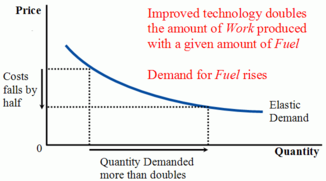
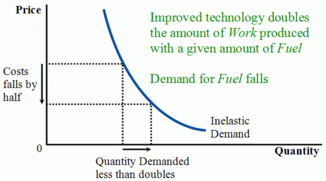
of that resource when measured in terms of what it can achieve (e.g., work). Generally speaking, a decrease in the price of a good or service will increase the quantity demanded (see supply and demand
, demand curve
). Thus with a lower price for work, more work will be "purchased" (indirectly, by buying more fuel). The resulting increase in the demand for fuel is known as the rebound effect. This increase in demand may or may not be large enough to offset the original drop in demand from the increased efficiency. The Jevons paradox occurs when the rebound effect is greater than 100 percent, exceeding the original efficiency gains. This greater than 100 percent rebound has been called 'backfire'.
Consider a simple case: a perfectly competitive market where fuel is the sole input used, and the only determinant of the cost of work. If the price of fuel remains constant, but the efficiency of its conversion into work is doubled, the effective price of work is halved and so twice as much work can be purchased for the same amount of money. If the amount of work purchased more than doubles (i.e., demand for work is elastic, the price elasticity
is larger than 1 in magnitude), then the quantity of fuel used would increase, not decrease. If however, the demand for work is inelastic (price elasticity is smaller than 1 in magnitude), the amount of work purchased would less than double, and the quantity of fuel used would decrease.
A full analysis would also have to take into account the fact that products (work) use more than one type of input (e.g., fuel, labor, machinery), and that other factors besides input cost (e.g., a non-competitive market structure
) may also affect the price of work. These factors would tend to decrease the effect of fuel efficiency on the price of work, and hence reduce the rebound effect, making the Jevons paradox less likely to occur. Additionally, any change in the demand for fuel would have an effect on the price of fuel, and also on the effective price of work.
would simply raise demand for energy in the economy as a whole. Khazzoom focused on the narrower point that the potential for rebound was ignored in mandatory performance standards for domestic appliances being set by the California Energy Commission.
In 1992, the economist Harry Saunders dubbed the hypothesis—that improvements in energy efficiency work to increase, rather than decrease, energy consumption—the Khazzoom-Brookes postulate. Saunders showed that the Khazzoom-Brookes postulate was consistent with neo-classical growth theory (the mainstream economic theory of capital accumulation
, technological progress
and long-run
economic growth) under a wide range of assumptions.
According to Saunders, increased energy efficiency tends to increase energy consumption by two means. First, increased energy efficiency makes the use of energy relatively cheaper, thus encouraging increased use (the direct rebound effect). Second, increased energy efficiency leads to increased economic growth
, which pulls up energy use for the whole economy. At the microeconomic
level (looking at an individual market), even with the rebound effect, improvements in energy efficiency usually result in reduced energy consumption. That is, the rebound effect is usually less than 100 percent. However, at the macroeconomic
level, more efficient (and hence comparatively cheaper) energy leads to faster economic growth, which in turn increases energy use throughout the economy. Saunders concludes that, taking into account both the microeconomic and the macroeconomic effects, technological progress that improves energy efficiency will tend to increase overall energy use.
. For example, a more efficient steam engine allowed the cheaper transport of goods and people that contributed to the Industrial Revolution
. However, if the Khazzoom-Brookes postulate is correct, increased fuel efficiency will not reduce the rate of depletion of fossil fuel
s.
The Jevons paradox is sometimes used to argue that energy conservation
efforts are futile. For example, that more efficient use of oil will lead to increased demand, and will not slow the arrival or the effects of peak oil
. This argument is usually presented as a reason not to impose environmental policies, or to increase fuel efficiency (e.g. if cars are more efficient, it will simply lead to more driving). Several points have been raised against this argument. First, in the context of a mature market such as for oil, the direct rebound effect is usually small, and so increased fuel efficiency usually reduces resource use, other conditions remaining constant. Second, even if increased efficiency does not reduce the total amount of fuel used, there remain other benefits associated with improved efficiency. For example, increased fuel efficiency may mitigate the price increases, shortages and disruptions in the global economy associated with peak oil. Third, environmental economists have pointed out that fuel use will unambiguously decrease if increased efficiency is coupled with an intervention (e.g. a green tax
) that keeps the cost of fuel use the same or higher.
The Jevons paradox indicates that increased efficiency, by itself, is unlikely to reduce fuel use, and that sustainable energy
policy must rely on other types of government interventions. As the Jevons paradox only applies to technological improvements that increase fuel efficiency, the imposition of conservation standards that simultaneously increase costs do not cause a paradoxical increase in fuel use. To ensure that efficiency enhancing technological improvements actually reduce overall fuel use, efficiency gains must be paired with some government intervention that reduces demand (e.g., green taxes
, a cap and trade
program, or higher fuel tax
es). The ecological economists
Mathis Wackernagel
and William Rees have suggested that any cost savings from efficiency gains be "taxed away or otherwise removed from further economic circulation. Preferably they should be captured for reinvestment in natural capital rehabilitation." By mitigating the economic effects of government interventions designed to promote ecologically sustainable
activities, efficiency-improving technological progress may make the imposition of these interventions more palatable, and more likely to be implemented.
Economics
Economics is the social science that analyzes the production, distribution, and consumption of goods and services. The term economics comes from the Ancient Greek from + , hence "rules of the house"...
, the Jevons paradox (sometimes Jevons effect) is the proposition that technological progress that increases the efficiency
Efficiency (economics)
In economics, the term economic efficiency refers to the use of resources so as to maximize the production of goods and services. An economic system is said to be more efficient than another if it can provide more goods and services for society without using more resources...
with which a resource is used, tends to increase (rather than decrease) the rate of consumption
Consumption (economics)
Consumption is a common concept in economics, and gives rise to derived concepts such as consumer debt. Generally, consumption is defined in part by comparison to production. But the precise definition can vary because different schools of economists define production quite differently...
of that resource. In 1865, the English economist William Stanley Jevons
William Stanley Jevons
William Stanley Jevons was a British economist and logician.Irving Fisher described his book The Theory of Political Economy as beginning the mathematical method in economics. It made the case that economics as a science concerned with quantities is necessarily mathematical...
observed that technological improvements that increased the efficiency of coal-use led to the increased consumption of coal in a wide range of industries. He argued that, contrary to common intuition, technological improvements could not be relied upon to reduce fuel consumption.
The issue has more recently been reexamined by modern economists studying consumption rebound effects
Rebound effect (conservation)
In conservation and energy economics, the rebound effect refers to the behavioral or other systemic responses to the introduction of new technologies that increase the efficiency of resource use. These responses tend to offset the beneficial effects of the new technology or other measures taken...
from improved energy efficiency
Efficient energy use
Efficient energy use, sometimes simply called energy efficiency, is the goal of efforts to reduce the amount of energy required to provide products and services. For example, insulating a home allows a building to use less heating and cooling energy to achieve and maintain a comfortable temperature...
. In addition to reducing the amount needed for a given use, improved efficiency lowers the relative cost of using a resource, which increases the quantity demanded
Demand (economics)
In economics, demand is the desire to own anything, the ability to pay for it, and the willingness to pay . The term demand signifies the ability or the willingness to buy a particular commodity at a given point of time....
of the resource, potentially counteracting any savings from increased efficiency. Additionally, increased efficiency accelerates economic growth
Economic growth
In economics, economic growth is defined as the increasing capacity of the economy to satisfy the wants of goods and services of the members of society. Economic growth is enabled by increases in productivity, which lowers the inputs for a given amount of output. Lowered costs increase demand...
, further increasing the demand for resources. The Jevons paradox occurs when the effect from increased demand predominates, causing an increase in overall resource use.
The Jevons paradox has been used to argue that energy conservation
Energy conservation
Energy conservation refers to efforts made to reduce energy consumption. Energy conservation can be achieved through increased efficient energy use, in conjunction with decreased energy consumption and/or reduced consumption from conventional energy sources...
is futile, as increased efficiency may actually increase fuel use. Nevertheless, increased efficiency can improve material living standards
Standard of living
Standard of living is generally measured by standards such as real income per person and poverty rate. Other measures such as access and quality of health care, income growth inequality and educational standards are also used. Examples are access to certain goods , or measures of health such as...
. Further, fuel use declines if increased efficiency is coupled with a green tax that keeps the cost of use the same (or higher). As the Jevons paradox applies only to technological improvements that increase fuel efficiency, policies that impose conservation standards and increase costs do not display the Jevons paradox.
History
The Jevons paradox was first identified by William Stanley JevonsWilliam Stanley Jevons
William Stanley Jevons was a British economist and logician.Irving Fisher described his book The Theory of Political Economy as beginning the mathematical method in economics. It made the case that economics as a science concerned with quantities is necessarily mathematical...
in his 1865 book The Coal Question
The Coal Question
The Coal Question; An Inquiry Concerning the Progress of the Nation, and the Probable Exhaustion of Our Coal Mines was a book by economist William Stanley Jevons that explored the implications of Britain's reliance on coal. Given that coal was a finite, non-renewable energy resource, Jevons raised...
. Jevons argued that improvements in fuel efficiency tend to increase, rather than decrease, fuel use: "It is a confusion of ideas to suppose that the economical use of fuel is equivalent to diminished consumption. The very contrary is the truth."
Jevons observed that England's consumption of coal
Coal
Coal is a combustible black or brownish-black sedimentary rock usually occurring in rock strata in layers or veins called coal beds or coal seams. The harder forms, such as anthracite coal, can be regarded as metamorphic rock because of later exposure to elevated temperature and pressure...
soared after James Watt
James Watt
James Watt, FRS, FRSE was a Scottish inventor and mechanical engineer whose improvements to the Newcomen steam engine were fundamental to the changes brought by the Industrial Revolution in both his native Great Britain and the rest of the world.While working as an instrument maker at the...
introduced his coal-fired steam engine
Steam engine
A steam engine is a heat engine that performs mechanical work using steam as its working fluid.Steam engines are external combustion engines, where the working fluid is separate from the combustion products. Non-combustion heat sources such as solar power, nuclear power or geothermal energy may be...
, which greatly improved the efficiency of Thomas Newcomen
Thomas Newcomen
Thomas Newcomen was an ironmonger by trade and a Baptist lay preacher by calling. He was born in Dartmouth, Devon, England, near a part of the country noted for its tin mines. Flooding was a major problem, limiting the depth at which the mineral could be mined...
's earlier design. Watt's innovations made coal a more cost-effective power source, leading to the increased use of the steam engine in a wide range of industries. This in turn increased total coal consumption, even as the amount of coal required for any particular application fell.
At that time, many in Britain worried that coal reserves were rapidly dwindling, but some experts advised that increasing efficiency would reduce coal consumption. Jevons argued that this view was incorrect, as further increases in efficiency would tend to increase the use of coal. Hence, increasing efficiency would tend to increase, rather than reduce, the rate at which England's coal deposits were being depleted.
Cause
Rebound effect
One way to understand the Jevons paradox is to observe that an increase in the efficiency with which a resource (e.g., fuel) is used causes a decrease in the pricePrice
-Definition:In ordinary usage, price is the quantity of payment or compensation given by one party to another in return for goods or services.In modern economies, prices are generally expressed in units of some form of currency...
of that resource when measured in terms of what it can achieve (e.g., work). Generally speaking, a decrease in the price of a good or service will increase the quantity demanded (see supply and demand
Supply and demand
Supply and demand is an economic model of price determination in a market. It concludes that in a competitive market, the unit price for a particular good will vary until it settles at a point where the quantity demanded by consumers will equal the quantity supplied by producers , resulting in an...
, demand curve
Demand curve
In economics, the demand curve is the graph depicting the relationship between the price of a certain commodity, and the amount of it that consumers are willing and able to purchase at that given price. It is a graphic representation of a demand schedule...
). Thus with a lower price for work, more work will be "purchased" (indirectly, by buying more fuel). The resulting increase in the demand for fuel is known as the rebound effect. This increase in demand may or may not be large enough to offset the original drop in demand from the increased efficiency. The Jevons paradox occurs when the rebound effect is greater than 100 percent, exceeding the original efficiency gains. This greater than 100 percent rebound has been called 'backfire'.
Consider a simple case: a perfectly competitive market where fuel is the sole input used, and the only determinant of the cost of work. If the price of fuel remains constant, but the efficiency of its conversion into work is doubled, the effective price of work is halved and so twice as much work can be purchased for the same amount of money. If the amount of work purchased more than doubles (i.e., demand for work is elastic, the price elasticity
Price elasticity of demand
Price elasticity of demand is a measure used in economics to show the responsiveness, or elasticity, of the quantity demanded of a good or service to a change in its price. More precisely, it gives the percentage change in quantity demanded in response to a one percent change in price...
is larger than 1 in magnitude), then the quantity of fuel used would increase, not decrease. If however, the demand for work is inelastic (price elasticity is smaller than 1 in magnitude), the amount of work purchased would less than double, and the quantity of fuel used would decrease.
A full analysis would also have to take into account the fact that products (work) use more than one type of input (e.g., fuel, labor, machinery), and that other factors besides input cost (e.g., a non-competitive market structure
Market structure
In economics, market structure .* Monopolistic competition, also called competitive market, where there are a large number of firms, each having a small proportion of the market share and slightly differentiated products.* Oligopoly, in which a market is dominated by a small number of firms that...
) may also affect the price of work. These factors would tend to decrease the effect of fuel efficiency on the price of work, and hence reduce the rebound effect, making the Jevons paradox less likely to occur. Additionally, any change in the demand for fuel would have an effect on the price of fuel, and also on the effective price of work.
Khazzoom-Brookes postulate
In the 1980s, the economists Daniel Khazzoom and Leonard Brookes revisited the Jevons paradox for the case of a society's energy use. Brookes, then chief economist at the UK Atomic Energy Authority, argued that attempts to reduce energy consumption by increasing energy efficiencyEfficient energy use
Efficient energy use, sometimes simply called energy efficiency, is the goal of efforts to reduce the amount of energy required to provide products and services. For example, insulating a home allows a building to use less heating and cooling energy to achieve and maintain a comfortable temperature...
would simply raise demand for energy in the economy as a whole. Khazzoom focused on the narrower point that the potential for rebound was ignored in mandatory performance standards for domestic appliances being set by the California Energy Commission.
In 1992, the economist Harry Saunders dubbed the hypothesis—that improvements in energy efficiency work to increase, rather than decrease, energy consumption—the Khazzoom-Brookes postulate. Saunders showed that the Khazzoom-Brookes postulate was consistent with neo-classical growth theory (the mainstream economic theory of capital accumulation
Capital accumulation
The accumulation of capital refers to the gathering or amassing of objects of value; the increase in wealth through concentration; or the creation of wealth. Capital is money or a financial asset invested for the purpose of making more money...
, technological progress
Technological change
Technological change is a term that is used to describe the overall process of invention, innovation and diffusion of technology or processes. The term is synonymous with technological development, technological achievement, and technological progress...
and long-run
Long-run
In macroeconomics, the long run is the conceptual time period in which there are no fixed factors of production as to changing the output level by changing the capital stock or by entering or leaving an industry. The long run contrasts with the short run, in which some factors are variable and...
economic growth) under a wide range of assumptions.
According to Saunders, increased energy efficiency tends to increase energy consumption by two means. First, increased energy efficiency makes the use of energy relatively cheaper, thus encouraging increased use (the direct rebound effect). Second, increased energy efficiency leads to increased economic growth
Economic growth
In economics, economic growth is defined as the increasing capacity of the economy to satisfy the wants of goods and services of the members of society. Economic growth is enabled by increases in productivity, which lowers the inputs for a given amount of output. Lowered costs increase demand...
, which pulls up energy use for the whole economy. At the microeconomic
Microeconomics
Microeconomics is a branch of economics that studies the behavior of how the individual modern household and firms make decisions to allocate limited resources. Typically, it applies to markets where goods or services are being bought and sold...
level (looking at an individual market), even with the rebound effect, improvements in energy efficiency usually result in reduced energy consumption. That is, the rebound effect is usually less than 100 percent. However, at the macroeconomic
Macroeconomics
Macroeconomics is a branch of economics dealing with the performance, structure, behavior, and decision-making of the whole economy. This includes a national, regional, or global economy...
level, more efficient (and hence comparatively cheaper) energy leads to faster economic growth, which in turn increases energy use throughout the economy. Saunders concludes that, taking into account both the microeconomic and the macroeconomic effects, technological progress that improves energy efficiency will tend to increase overall energy use.
Energy conservation policy
Jevons warned that fuel efficiency gains tend to increase, rather than reduce, fuel use. This does not imply that increased fuel efficiency is worthless. Increased fuel efficiency enables greater production and a higher quality of material lifeQuality of life
The term quality of life is used to evaluate the general well-being of individuals and societies. The term is used in a wide range of contexts, including the fields of international development, healthcare, and politics. Quality of life should not be confused with the concept of standard of...
. For example, a more efficient steam engine allowed the cheaper transport of goods and people that contributed to the Industrial Revolution
Industrial Revolution
The Industrial Revolution was a period from the 18th to the 19th century where major changes in agriculture, manufacturing, mining, transportation, and technology had a profound effect on the social, economic and cultural conditions of the times...
. However, if the Khazzoom-Brookes postulate is correct, increased fuel efficiency will not reduce the rate of depletion of fossil fuel
Fossil fuel
Fossil fuels are fuels formed by natural processes such as anaerobic decomposition of buried dead organisms. The age of the organisms and their resulting fossil fuels is typically millions of years, and sometimes exceeds 650 million years...
s.
The Jevons paradox is sometimes used to argue that energy conservation
Energy conservation
Energy conservation refers to efforts made to reduce energy consumption. Energy conservation can be achieved through increased efficient energy use, in conjunction with decreased energy consumption and/or reduced consumption from conventional energy sources...
efforts are futile. For example, that more efficient use of oil will lead to increased demand, and will not slow the arrival or the effects of peak oil
Peak oil
Peak oil is the point in time when the maximum rate of global petroleum extraction is reached, after which the rate of production enters terminal decline. This concept is based on the observed production rates of individual oil wells, projected reserves and the combined production rate of a field...
. This argument is usually presented as a reason not to impose environmental policies, or to increase fuel efficiency (e.g. if cars are more efficient, it will simply lead to more driving). Several points have been raised against this argument. First, in the context of a mature market such as for oil, the direct rebound effect is usually small, and so increased fuel efficiency usually reduces resource use, other conditions remaining constant. Second, even if increased efficiency does not reduce the total amount of fuel used, there remain other benefits associated with improved efficiency. For example, increased fuel efficiency may mitigate the price increases, shortages and disruptions in the global economy associated with peak oil. Third, environmental economists have pointed out that fuel use will unambiguously decrease if increased efficiency is coupled with an intervention (e.g. a green tax
Ecotax
Ecotax refers to taxes intended to promote ecologically sustainable activities via economic incentives. Such a policy can complement or avert the need for regulatory approaches. Often, an ecotax policy proposal may attempt to maintain overall tax revenue by proportionately reducing other taxes...
) that keeps the cost of fuel use the same or higher.
The Jevons paradox indicates that increased efficiency, by itself, is unlikely to reduce fuel use, and that sustainable energy
Sustainable energy
Sustainable energy is the provision of energy that meets the needs of the present without compromising the ability of future generations to meet their needs. Sustainable energy sources include all renewable energy sources, such as hydroelectricity, solar energy, wind energy, wave power, geothermal...
policy must rely on other types of government interventions. As the Jevons paradox only applies to technological improvements that increase fuel efficiency, the imposition of conservation standards that simultaneously increase costs do not cause a paradoxical increase in fuel use. To ensure that efficiency enhancing technological improvements actually reduce overall fuel use, efficiency gains must be paired with some government intervention that reduces demand (e.g., green taxes
Ecotax
Ecotax refers to taxes intended to promote ecologically sustainable activities via economic incentives. Such a policy can complement or avert the need for regulatory approaches. Often, an ecotax policy proposal may attempt to maintain overall tax revenue by proportionately reducing other taxes...
, a cap and trade
Emissions trading
Emissions trading is a market-based approach used to control pollution by providing economic incentives for achieving reductions in the emissions of pollutants....
program, or higher fuel tax
Fuel tax
A fuel tax is an excise tax imposed on the sale of fuel. In most countries the fuel tax is imposed on fuels which are intended for transportation...
es). The ecological economists
Ecological economics
Image:Sustainable development.svg|right|The three pillars of sustainability. Clickable.|275px|thumbpoly 138 194 148 219 164 240 182 257 219 277 263 291 261 311 264 331 272 351 283 366 300 383 316 394 287 408 261 417 224 424 182 426 154 423 119 415 87 403 58 385 40 368 24 347 17 328 13 309 16 286 26...
Mathis Wackernagel
Mathis Wackernagel
Mathis Wackernagel is a Swiss-born sustainability advocate. He is currently President of Global Footprint Network, an international sustainability think tank with a presence in Oakland, California; Brussels, Belgium, and Zurich, Switzerland...
and William Rees have suggested that any cost savings from efficiency gains be "taxed away or otherwise removed from further economic circulation. Preferably they should be captured for reinvestment in natural capital rehabilitation." By mitigating the economic effects of government interventions designed to promote ecologically sustainable
Sustainability
Sustainability is the capacity to endure. For humans, sustainability is the long-term maintenance of well being, which has environmental, economic, and social dimensions, and encompasses the concept of union, an interdependent relationship and mutual responsible position with all living and non...
activities, efficiency-improving technological progress may make the imposition of these interventions more palatable, and more likely to be implemented.