


Western Hemisphere Institute for Security Cooperation

Encyclopedia
The Western Hemisphere Institute for Security Cooperation (WHISC or WHINSEC), formerly the United States Army School of the Americas (USARSA or SOA; ) is a United States Department of Defense
educational and training facility at Fort Benning
near Columbus
, Georgia in the United States. Established by the US government for teaching law enforcement and military techniques to US allies in the rest of the Americas, it has been criticized for training Latin American dictators and their militaries in various techniques to quell dissidence in their countries.
, the Latin American Training Center – U.S. Ground Forces was established in the Atlantic sector of the Panama Canal Zone
, in the US army base of Fort Amador
.
During 1949 it was expanded and became the U.S. Army Caribbean Training Center, seated into a former hospital building on the grounds of Fort Gulick
(now housing the Melia Hotel).
It was once again expanded and renamed the U.S. Army School of the Americas in 1963. It relocated to Fort Benning in 1984, following the signing of the Panama Canal Treaty. More than 61,000 military personnel attended these United States Army
schools.
According to WHINSEC's web page, "the School of the Americas taught military education courses as they were taught in U. S. Armed Forces institutions—the School translated the courses, lessons plans and all, into Spanish. Beginning in 1963, and evolving as the region changed, SOA taught, at various times, professional military education and training courses to officers and non-commissioned officers in the areas of:
The current WHINSEC, now part of the United States Department of Defense
, was created as part of the National Defense Authorization Act
by Congress
in 2001. The WHINSEC teaches its courses primarily in the Spanish language
, especially for Latin American military, police and civilian personnel, as well as the Caribbean personnel in English, but is also open for persons from outside Latin America. Presently about 700 to 1,100 students attend WHINSEC courses per year.
According to official web site, the WHINSEC was established "to provide professional education and training to eligible persons of the nations of the Western Hemisphere within the context of the democratic principles set forth in the Charter of the Organization of American States
." Its "mission also includes fostering mutual knowledge, transparency, confidence, and cooperation by promoting democratic values; respect for human rights; and an understanding of U.S. customs and traditions. Specific subjects set by Congress include leadership development; counterdrug; peacekeeping; democratic sustainment; resource management; and disaster preparedness and relief planning. In every course offered, eight hours of democracy and human rights instruction is mandatory." Its motto is Libertad, Paz y Fraternidad (Liberty, Peace and Brotherhood).
Currently all students are given a minimum of eight hours of instruction in "human rights
, the rule of law
, due process
, civilian control of the military
, and the role of the military in a democratic society." Courses can focus on leadership development, counter-drug operations, peace support operations, disaster relief, or "any other matter the Secretary [of Defense] deems appropriate."
According to the Center for International Policy
, a "Board of Visitors" is required to review and evaluate "curriculum, instruction, physical equipment, fiscal affairs, and academic methods." A federal committee, the board must include the chairmen and ranking minority members of both houses' Armed Services Committees (or surrogates), the senior Army officer responsible for training (or a surrogate), one person chosen by the Secretary of State, the head of the U.S. Southern command (or a surrogate), and six people chosen by the Secretary of Defense ("including, to the extent practicable, persons from academia and the religious and human rights communities"). The board reviews the institute's curriculum to determine whether it complies with U.S. laws and doctrine, and whether it is consistent with U.S. policy goals toward Latin America and the Caribbean.
According to the Center for International Policy, "The School of the Americas had been questioned for years, as it trained many military personnel before and during the years of the "national security doctrine" — the dirty war
years in the Southern Cone and the civil war years in Central America — in which the armed forces within several Latin American countries ruled or had disproportionate government influence and committed serious human rights violations in those countries." SOA and WHINSEC graduates continue to surface in news reports regarding both current human rights cases and new reports.
Defenders argue that today the curriculum includes human rights, but according to Human Rights Watch
, "training alone, even when it includes human rights instruction, does not prevent human rights abuses." U.S. Army Maj. Joe Blair, a former director of instruction at the school, said, "there are no substantive changes besides the name. [...] They teach the identical courses that I taught, and changed the course names and use the same manuals."
, physical abuse
, coercion
, and false imprisonment
." It was determined that the materials had never actually been used for instruction but were part of additional reading materials which had not been properly reviewed.
On September 20, 1996, the Pentagon released seven training manuals prepared by the U.S. military and used between 1987 and 1991 in Latin America and in intelligence
training courses at the U.S. School of the Americas (SOA). The manuals were based in part on lesson plans used by the school as far back as 1982 and, in turn, based in part on older material from Project X
.http://www.lawg.org/misc/Publications-manuals.htm According to Lisa Haugaard of School of the Americas Watch
, these manuals taught repressive techniques and promoted the violation of human rights throughout Latin America and around the globe. The manuals contain instructions in motivation by fear, bounties for enemy dead, false imprisonment, torture, execution, and kidnapping a target's family members. The Pentagon admitted that these manuals were a "mistake."
After this investigation the Department of Defense
discontinued the use of the manuals, directed their recovery to the extent practicable, and destroyed the copies in the field. U.S. Southern Command advised governments in Latin America that the manuals contained passages that did not represent U.S. government policy, and pursued recovery of the manuals from the governments and some individual students.
, headed by President Néstor Kirchner
, decided to stop sending soldiers to train at WHINSEC, and the government of Uruguay
affirmed that it will continue its current policy of not sending soldiers to WHINSEC. In 2007, Óscar Arias
, president of Costa Rica
, decided to stop sending Costa Rican police to the WHINSEC, although later reneged, saying the training would be beneficial for counter-narcotics operations. Costa Rica has no military, but has sent some 2,600 police officers to the school. In a letter to the Commandant of the Western Hemisphere Institute for Security Cooperation (WHINSEC), U.S. Army Col. Gilberto Perez
, Bolivia
n President Evo Morales
formally announced on February 18, 2008, that he will not send Bolivian military or police officers to attend training programs at the institute formerly known as the U.S. Army School of the Americas (SOA).
In June 2007, the McGovern/Lewis Amendment to shut off funding for the Institute failed by 6 votes. This effort to close the Institute was endorsed by the non-partisan Council on Hemispheric Affairs
who called the Institute a "black eye".
has worked to monitor graduates of the institution and to close the former SOA, now WHINSEC through legislative action, grassroots organizing and nonviolent direct action. It maintains a database with graduates of both the SOA and WHINSEC who have been accused of human rights violations and other criminal activity. In regard to the re-naming of the institution, SOA Watch claims that the approach taken by the Department of Defense is not grounded in any critical assessment of the training, procedures, performance, or results (consequences) of the training programs of the SOA. According to critics of the SOA, the name change ignores congressional concern and public outcry over the SOA's past and present link to human rights atrocities.
, Segundo Montes
, Ignacio Martin-Baro
, Joaquin López y López, Juan Ramon Moreno, and Amado López); their housekeeper, Elba Ramos; and her daughter, Celia Marisela Ramos, were murdered by the Salvadoran Military
on the campus of the University of Central America in San Salvador
, El Salvador
, because they had been labeled as subversives by the government. A United Nations panel concluded that 19 of the 27 killers were SOA graduates.
In August 2007, according to an Associated Press report, Colonel Alberto Quijano of the Colombian army's Special Forces was arrested for providing security and mobilizing troops for Diego León Montoya Sánchez
(alias "Don Diego"), the leader of the Norte del Valle Cartel
and one of the FBI's 10 most-wanted criminals. School of the Americas Watch said in a statement that it matched the names of those in the scandal with its database of attendees at the institute. Alberto Quijano attended courses and was an instructor who taught classes on Peacekeeping Operations and Democratic Sustainment at the school from 2003 to 2004.
Others former students include members of the Atlacatl Battalion
, responsible for the El Mozote massacre
and Franck Romain, former leader of the Tonton Macoute
, responsible for the St Jean Bosco massacre
.
 Critics of SOA Watch argue the connection is often misleading. According to Paul Mulshine, Roberto D'Aubuisson
's sole link to the SOA is that he had taken a course in Radio Operations long before El Salvador's civil war began.
Efrain Rios Montt
Otto Pérez Molina
|-
| Panama
|Manuel Noriega
|-
| Peru
Peru
|Vladimiro Montesinos
, Juan Velasco Alvarado
|}
United States Department of Defense
The United States Department of Defense is the U.S...
educational and training facility at Fort Benning
Fort Benning
Fort Benning is a United States Army post located southeast of the city of Columbus in Muscogee and Chattahoochee counties in Georgia and Russell County, Alabama...
near Columbus
Columbus, Georgia
Columbus is a city in and the county seat of Muscogee County, Georgia, United States, with which it is consolidated. As of the 2010 census, the city had a population of 189,885. It is the principal city of the Columbus, Georgia metropolitan area, which, in 2009, had an estimated population of 292,795...
, Georgia in the United States. Established by the US government for teaching law enforcement and military techniques to US allies in the rest of the Americas, it has been criticized for training Latin American dictators and their militaries in various techniques to quell dissidence in their countries.
History
In 1946, in the early days of the Cold WarCold War
The Cold War was the continuing state from roughly 1946 to 1991 of political conflict, military tension, proxy wars, and economic competition between the Communist World—primarily the Soviet Union and its satellite states and allies—and the powers of the Western world, primarily the United States...
, the Latin American Training Center – U.S. Ground Forces was established in the Atlantic sector of the Panama Canal Zone
Panama Canal Zone
The Panama Canal Zone was a unorganized U.S. territory located within the Republic of Panama, consisting of the Panama Canal and an area generally extending 5 miles on each side of the centerline, but excluding Panama City and Colón, which otherwise would have been partly within the limits of...
, in the US army base of Fort Amador
Fort Amador
Fort Amador and Fort Grant were former United States Army bases protecting the Pacific end of the Panama Canal at the Panama Bay. Amador was the primary on-land site, lying below the Bridge of the Americas. Grant consisted of a series of islands lying just offshore, some connected to Amador via a...
.
During 1949 it was expanded and became the U.S. Army Caribbean Training Center, seated into a former hospital building on the grounds of Fort Gulick
Fort Gulick
Fort Gulick was a U.S. Army base in the former Panama Canal Zone located on the Atlantic side of the Panama Canal near Fort Davis, on Gatun Lake.-History:It was perhaps best known as the location of the School of the Americas...
(now housing the Melia Hotel).
It was once again expanded and renamed the U.S. Army School of the Americas in 1963. It relocated to Fort Benning in 1984, following the signing of the Panama Canal Treaty. More than 61,000 military personnel attended these United States Army
United States Army
The United States Army is the main branch of the United States Armed Forces responsible for land-based military operations. It is the largest and oldest established branch of the U.S. military, and is one of seven U.S. uniformed services...
schools.
According to WHINSEC's web page, "the School of the Americas taught military education courses as they were taught in U. S. Armed Forces institutions—the School translated the courses, lessons plans and all, into Spanish. Beginning in 1963, and evolving as the region changed, SOA taught, at various times, professional military education and training courses to officers and non-commissioned officers in the areas of:
- professional leadership (Command and General Staff course, Military Police courses, Infantry Officers Basic course, Artillery Officers course and a Cadet Orientation course);
- infantry weapons (Mortar Officer course);
- technical support (Engineer Basic and Officer courses, Radio Operators course, Small Caliber Repair course, Wheeled Vehicle Maintenance course and Medical Assistance courses);
- counter-insurgency (Internal Defense and Development course, Military Intelligence course, Military Police course), introduced during 1963; and
- specialized leadership and skills (Ranger course, Air Mobile course, Jungle Operations course, Patrolling course, Parachute Rigging course, Basic Airborne course, Pathfinder and Jumpmaster courses)."
The current WHINSEC, now part of the United States Department of Defense
United States Department of Defense
The United States Department of Defense is the U.S...
, was created as part of the National Defense Authorization Act
National Defense Authorization Act
The National Defense Authorization Act is the name of a United States federal law that has been enacted for each of the past 48 fiscal years to specify the budget and expenditures of the United States Department of Defense.-See also:...
by Congress
United States Congress
The United States Congress is the bicameral legislature of the federal government of the United States, consisting of the Senate and the House of Representatives. The Congress meets in the United States Capitol in Washington, D.C....
in 2001. The WHINSEC teaches its courses primarily in the Spanish language
Spanish language
Spanish , also known as Castilian , is a Romance language in the Ibero-Romance group that evolved from several languages and dialects in central-northern Iberia around the 9th century and gradually spread with the expansion of the Kingdom of Castile into central and southern Iberia during the...
, especially for Latin American military, police and civilian personnel, as well as the Caribbean personnel in English, but is also open for persons from outside Latin America. Presently about 700 to 1,100 students attend WHINSEC courses per year.
According to official web site, the WHINSEC was established "to provide professional education and training to eligible persons of the nations of the Western Hemisphere within the context of the democratic principles set forth in the Charter of the Organization of American States
Organization of American States
The Organization of American States is a regional international organization, headquartered in Washington, D.C., United States...
." Its "mission also includes fostering mutual knowledge, transparency, confidence, and cooperation by promoting democratic values; respect for human rights; and an understanding of U.S. customs and traditions. Specific subjects set by Congress include leadership development; counterdrug; peacekeeping; democratic sustainment; resource management; and disaster preparedness and relief planning. In every course offered, eight hours of democracy and human rights instruction is mandatory." Its motto is Libertad, Paz y Fraternidad (Liberty, Peace and Brotherhood).
Currently all students are given a minimum of eight hours of instruction in "human rights
Human rights
Human rights are "commonly understood as inalienable fundamental rights to which a person is inherently entitled simply because she or he is a human being." Human rights are thus conceived as universal and egalitarian . These rights may exist as natural rights or as legal rights, in both national...
, the rule of law
Rule of law
The rule of law, sometimes called supremacy of law, is a legal maxim that says that governmental decisions should be made by applying known principles or laws with minimal discretion in their application...
, due process
Due process
Due process is the legal code that the state must venerate all of the legal rights that are owed to a person under the principle. Due process balances the power of the state law of the land and thus protects individual persons from it...
, civilian control of the military
Civilian control of the military
Civilian control of the military is a doctrine in military and political science that places ultimate responsibility for a country's strategic decision-making in the hands of the civilian political leadership, rather than professional military officers. One author, paraphrasing Samuel P...
, and the role of the military in a democratic society." Courses can focus on leadership development, counter-drug operations, peace support operations, disaster relief, or "any other matter the Secretary [of Defense] deems appropriate."
According to the Center for International Policy
Center for International Policy
The Center for International Policy is a non-profit public policy research and advocacy think tank with offices in Washington, D.C. and New York City. It was founded in 1975 in response to the Vietnam War. The Center describes its mission as "promoting a U.S...
, a "Board of Visitors" is required to review and evaluate "curriculum, instruction, physical equipment, fiscal affairs, and academic methods." A federal committee, the board must include the chairmen and ranking minority members of both houses' Armed Services Committees (or surrogates), the senior Army officer responsible for training (or a surrogate), one person chosen by the Secretary of State, the head of the U.S. Southern command (or a surrogate), and six people chosen by the Secretary of Defense ("including, to the extent practicable, persons from academia and the religious and human rights communities"). The board reviews the institute's curriculum to determine whether it complies with U.S. laws and doctrine, and whether it is consistent with U.S. policy goals toward Latin America and the Caribbean.
Human rights violations
The School of the Americas was criticized concerning the human rights violations performed by a number of its graduates, WHINSEC argues "that no school should be held accountable for the actions of its graduates."According to the Center for International Policy, "The School of the Americas had been questioned for years, as it trained many military personnel before and during the years of the "national security doctrine" — the dirty war
Dirty War
The Dirty War was a period of state-sponsored violence in Argentina from 1976 until 1983. Victims of the violence included several thousand left-wing activists, including trade unionists, students, journalists, Marxists, Peronist guerrillas and alleged sympathizers, either proved or suspected...
years in the Southern Cone and the civil war years in Central America — in which the armed forces within several Latin American countries ruled or had disproportionate government influence and committed serious human rights violations in those countries." SOA and WHINSEC graduates continue to surface in news reports regarding both current human rights cases and new reports.
Defenders argue that today the curriculum includes human rights, but according to Human Rights Watch
Human Rights Watch
Human Rights Watch is an international non-governmental organization that conducts research and advocacy on human rights. Its headquarters are in New York City and it has offices in Berlin, Beirut, Brussels, Chicago, Geneva, Johannesburg, London, Los Angeles, Moscow, Paris, San Francisco, Tokyo,...
, "training alone, even when it includes human rights instruction, does not prevent human rights abuses." U.S. Army Maj. Joe Blair, a former director of instruction at the school, said, "there are no substantive changes besides the name. [...] They teach the identical courses that I taught, and changed the course names and use the same manuals."
Intelligence training manuals
On June 28, 1996, a report issued by the Intelligence Oversight Board stated that "School of the Americas ... used improper instruction materials in training Latin American officers from 1982 to 1991. ... certain passages appeared to condone practices such as execution of guerrillas, extortionExtortion
Extortion is a criminal offence which occurs when a person unlawfully obtains either money, property or services from a person, entity, or institution, through coercion. Refraining from doing harm is sometimes euphemistically called protection. Extortion is commonly practiced by organized crime...
, physical abuse
Physical abuse
Physical abuse is abuse involving contact intended to cause feelings of intimidation, injury, or other physical suffering or bodily harm.-Forms of physical abuse:*Striking*Punching*Belting*Pushing, pulling*Slapping*Whipping*Striking with an object...
, coercion
Coercion
Coercion is the practice of forcing another party to behave in an involuntary manner by use of threats or intimidation or some other form of pressure or force. In law, coercion is codified as the duress crime. Such actions are used as leverage, to force the victim to act in the desired way...
, and false imprisonment
False imprisonment
False imprisonment is a restraint of a person in a bounded area without justification or consent. False imprisonment is a common-law felony and a tort. It applies to private as well as governmental detention...
." It was determined that the materials had never actually been used for instruction but were part of additional reading materials which had not been properly reviewed.
On September 20, 1996, the Pentagon released seven training manuals prepared by the U.S. military and used between 1987 and 1991 in Latin America and in intelligence
Intelligence (information gathering)
Intelligence assessment is the development of forecasts of behaviour or recommended courses of action to the leadership of an organization, based on a wide range of available information sources both overt and covert. Assessments are developed in response to requirements declared by the leadership...
training courses at the U.S. School of the Americas (SOA). The manuals were based in part on lesson plans used by the school as far back as 1982 and, in turn, based in part on older material from Project X
Army Foreign Intelligence Assistance Program
The US Army Foreign Intelligence Assistance Program, was a 1960s program. One part was "Project X", a military effort to create intelligence field manuals drawn from counterinsurgency experience in Vietnam. These manuals influenced the "KUBARK Counterintelligence Interrogation-July 1963", "Human...
.http://www.lawg.org/misc/Publications-manuals.htm According to Lisa Haugaard of School of the Americas Watch
School of the Americas Watch
School of the Americas Watch is an advocacy organization founded by Maryknoll Father Roy Bourgeois and a small group of supporters in 1990 to protest the training of mainly Latin American military officers, by the United States Department of Defense, at the School of the Americas...
, these manuals taught repressive techniques and promoted the violation of human rights throughout Latin America and around the globe. The manuals contain instructions in motivation by fear, bounties for enemy dead, false imprisonment, torture, execution, and kidnapping a target's family members. The Pentagon admitted that these manuals were a "mistake."
After this investigation the Department of Defense
United States Department of Defense
The United States Department of Defense is the U.S...
discontinued the use of the manuals, directed their recovery to the extent practicable, and destroyed the copies in the field. U.S. Southern Command advised governments in Latin America that the manuals contained passages that did not represent U.S. government policy, and pursued recovery of the manuals from the governments and some individual students.
Participation
In 2004, Venezuela ceased all training of Venezuelan soldiers at WHINSEC after a long period of chilling relations between the United States and Venezuela. On March 28, 2006, the government of ArgentinaGovernment of Argentina
The government of Argentina, functioning within the framework of a federal system, is a presidential representative democratic republic. The President of Argentina is both head of state and head of government. Executive power is exercised by the President. Legislative power is vested in both the...
, headed by President Néstor Kirchner
Néstor Kirchner
Néstor Carlos Kirchner was an Argentine politician who served as the 54th President of Argentina from 25 May 2003 until 10 December 2007. Previously, he was Governor of Santa Cruz Province since 10 December 1991. He briefly served as Secretary General of the Union of South American Nations ...
, decided to stop sending soldiers to train at WHINSEC, and the government of Uruguay
Uruguay
Uruguay ,officially the Oriental Republic of Uruguay,sometimes the Eastern Republic of Uruguay; ) is a country in the southeastern part of South America. It is home to some 3.5 million people, of whom 1.8 million live in the capital Montevideo and its metropolitan area...
affirmed that it will continue its current policy of not sending soldiers to WHINSEC. In 2007, Óscar Arias
Óscar Arias
Óscar Arias Sánchez is a Costa Rican politician who was President of Costa Rica from 2006 to 2010. He previously served as President from 1986 to 1990 and received the Nobel Peace Prize in 1987 for his efforts to end civil wars then raging in several other Central American countries.He is also a...
, president of Costa Rica
Costa Rica
Costa Rica , officially the Republic of Costa Rica is a multilingual, multiethnic and multicultural country in Central America, bordered by Nicaragua to the north, Panama to the southeast, the Pacific Ocean to the west and the Caribbean Sea to the east....
, decided to stop sending Costa Rican police to the WHINSEC, although later reneged, saying the training would be beneficial for counter-narcotics operations. Costa Rica has no military, but has sent some 2,600 police officers to the school. In a letter to the Commandant of the Western Hemisphere Institute for Security Cooperation (WHINSEC), U.S. Army Col. Gilberto Perez
Gilberto Perez
Gilberto Perez is an American Professor of Film Studies.Perez studied at Massachusetts Institute of Technology and Princeton University. He is currently head of the film history department at Sarah Lawrence College.-Awards:...
, Bolivia
Bolivia
Bolivia officially known as Plurinational State of Bolivia , is a landlocked country in central South America. It is the poorest country in South America...
n President Evo Morales
Evo Morales
Juan Evo Morales Ayma , popularly known as Evo , is a Bolivian politician and activist, currently serving as the 80th President of Bolivia, a position that he has held since 2006. He is also the leader of both the Movement for Socialism party and the cocalero trade union...
formally announced on February 18, 2008, that he will not send Bolivian military or police officers to attend training programs at the institute formerly known as the U.S. Army School of the Americas (SOA).
Legislative action
A bill to abolish the school with 134 co-sponsors was introduced to the House Armed Services Committee in 2005.In June 2007, the McGovern/Lewis Amendment to shut off funding for the Institute failed by 6 votes. This effort to close the Institute was endorsed by the non-partisan Council on Hemispheric Affairs
Council on Hemispheric Affairs
The Council on Hemispheric Affairs is a Washington, D.C.-based non-governmental organization founded in 1975. In its own words, it was established to "promote the common interests of the [Western] hemisphere, raise the visibility of regional affairs and increase the importance of the...
who called the Institute a "black eye".
SOA Watch
Since 1990, Washington, D.C.-based non profit human rights organization School of the Americas WatchSchool of the Americas Watch
School of the Americas Watch is an advocacy organization founded by Maryknoll Father Roy Bourgeois and a small group of supporters in 1990 to protest the training of mainly Latin American military officers, by the United States Department of Defense, at the School of the Americas...
has worked to monitor graduates of the institution and to close the former SOA, now WHINSEC through legislative action, grassroots organizing and nonviolent direct action. It maintains a database with graduates of both the SOA and WHINSEC who have been accused of human rights violations and other criminal activity. In regard to the re-naming of the institution, SOA Watch claims that the approach taken by the Department of Defense is not grounded in any critical assessment of the training, procedures, performance, or results (consequences) of the training programs of the SOA. According to critics of the SOA, the name change ignores congressional concern and public outcry over the SOA's past and present link to human rights atrocities.
Protests and public demonstrations
Since 1990, SOA Watch has sponsored an annual public demonstration of protest of SOA/WHISC at Ft. Benning. In 2005, the demonstration drew 19,000 people. The protests are timed to coincide with the anniversary of the assassination of six Jesuit priests in El Salvador, on November 1989, by graduates of the School of the Americas. On November 16, 1989, six Jesuit priests (Ignacio EllacuriaIgnacio Ellacuría
Ignacio Ellacuría, S.J. was a Jesuit priest, philosopher, and theologian who did important work as a professor and rector at the Universidad Centroamericana "José Simeón Cañas" , a Jesuit university in El Salvador founded in 1965...
, Segundo Montes
Segundo Montes
Segundo Montes, S.J. was a scholar, philosopher, educator, sociologist and Jesuit priest...
, Ignacio Martin-Baro
Ignacio Martín-Baró
Ignacio Martín-Baró, S.J. was a scholar, social psychologist, philosopher and Jesuit priest...
, Joaquin López y López, Juan Ramon Moreno, and Amado López); their housekeeper, Elba Ramos; and her daughter, Celia Marisela Ramos, were murdered by the Salvadoran Military
Atlacatl Battalion
The Atlacatl Battalion, a former Salvadoran Army unit, was a rapid-response, counter-insurgency battalion created in 1980 at the U.S. Army's School of the Americas, then located in Panama. It was implicated in some of the most infamous incidents of the Salvadoran Civil War...
on the campus of the University of Central America in San Salvador
San Salvador
The city of San Salvador the capital and largest city of El Salvador, which has been designated a Gamma World City. Its complete name is La Ciudad de Gran San Salvador...
, El Salvador
El Salvador
El Salvador or simply Salvador is the smallest and the most densely populated country in Central America. The country's capital city and largest city is San Salvador; Santa Ana and San Miguel are also important cultural and commercial centers in the country and in all of Central America...
, because they had been labeled as subversives by the government. A United Nations panel concluded that 19 of the 27 killers were SOA graduates.
Graduates of the School of the Americas
A number of graduates of the SOA and WHINSEC have been accused of human rights violations and criminal activity in their home countries.In August 2007, according to an Associated Press report, Colonel Alberto Quijano of the Colombian army's Special Forces was arrested for providing security and mobilizing troops for Diego León Montoya Sánchez
Diego Leon Montoya Sanchez
Diego León Montoya Sánchez , also known as Don Diego, is a former Colombian crime boss leader of the Norte del Valle drug cartel...
(alias "Don Diego"), the leader of the Norte del Valle Cartel
Norte del Valle Cartel
The Norte del Valle Cartel, or North Valley Cartel, is a drug cartel that operates principally in the north of the Valle del Cauca department of Colombia...
and one of the FBI's 10 most-wanted criminals. School of the Americas Watch said in a statement that it matched the names of those in the scandal with its database of attendees at the institute. Alberto Quijano attended courses and was an instructor who taught classes on Peacekeeping Operations and Democratic Sustainment at the school from 2003 to 2004.
Others former students include members of the Atlacatl Battalion
Atlacatl Battalion
The Atlacatl Battalion, a former Salvadoran Army unit, was a rapid-response, counter-insurgency battalion created in 1980 at the U.S. Army's School of the Americas, then located in Panama. It was implicated in some of the most infamous incidents of the Salvadoran Civil War...
, responsible for the El Mozote massacre
El Mozote massacre
The El Mozote Massacre took place in and around the village of El Mozote, in Morazán department, El Salvador, on December 11, 1981, when Salvadoran armed forces trained by the United States military killed at least 200 and up to 1000 civilians in an anti-guerrilla campaign during the Salvadoran...
and Franck Romain, former leader of the Tonton Macoute
Tonton Macoute
Tonton Macoutes was a Haitian paramilitary force created in 1959 by President François 'Papa Doc' Duvalier. In 1970, the militia was officially renamed the Milice de Volontaires de la Sécurité Nationale .Haitians called this force the “Tonton Macoutes,” after the Haitian Creole mythological...
, responsible for the St Jean Bosco massacre
St Jean Bosco massacre
The St Jean Bosco massacre took place in Haiti on 11 September 1988. At least 13 people were killed and around 80 wounded in a three-hour assault on the Saint-Jean Bosco church in Port-au-Prince, which saw the church burned down...
.
Roberto D'Aubuisson
Major Roberto D'Aubuisson Arrieta was the Salvadoran Army officer and political leader who founded the Nationalist Republican Alliance , which he led from 1980 to 1985...
's sole link to the SOA is that he had taken a course in Radio Operations long before El Salvador's civil war began.
Efrain Rios Montt
Efraín Ríos Montt
José Efraín Ríos Montt is a former de facto President of Guatemala, dictator, army general, and former president of Congress. In the 2003 presidential elections, he unsuccessfully ran as the candidate of the ruling Guatemalan Republican Front .Huehuetenango-born Ríos Montt remains one of the most...
Otto Pérez Molina
|-
|
Panama|Manuel Noriega
Manuel Noriega
Manuel Antonio Noriega Moreno is a Panamanian politician and soldier. He was military dictator of Panama from 1983 to 1989.The 1989 invasion of Panama by the United States removed him from power; he was captured, detained as a prisoner of war, and flown to the United States. Noriega was tried on...
|-
|
Peru|Vladimiro Montesinos
Vladimiro Montesinos
Vladimiro Ilyich Montesinos Torres was the long-standing head of Peru's intelligence service, Servicio de Inteligencia Nacional , under President Alberto Fujimori. In 2000, secret videos, which he had recorded, were televised that showed his bribing an elected congressman to leave the opposition...
, Juan Velasco Alvarado
Juan Velasco Alvarado
Juan Francisco Velasco Alvarado was a left-leaning Peruvian General who ruled Peru from 1968 to 1975 under the title of "President of the Revolutionary Government."- Early life :...
|}
Educated according to other sources
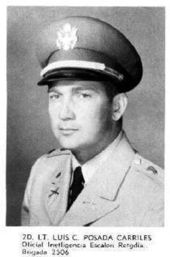
Luis Posada CarrilesLuis Posada Carriles
Luis Clemente Faustino Posada Carriles is a Cuban-born Venezuelan anti-communist and former Central Intelligence Agency agent....
was educated by the CIA in explosives and sabotage at Fort Benning
Fort Benning
Fort Benning is a United States Army post located southeast of the city of Columbus in Muscogee and Chattahoochee counties in Georgia and Russell County, Alabama...
(the current location of the academy) between March 1963 and March 1964, after his participation in the Bay of Pigs invasion
Bay of Pigs Invasion
The Bay of Pigs Invasion was an unsuccessful action by a CIA-trained force of Cuban exiles to invade southern Cuba, with support and encouragement from the US government, in an attempt to overthrow the Cuban government of Fidel Castro. The invasion was launched in April 1961, less than three months...
.
In 1992 the OAS
Organization of American States
The Organization of American States is a regional international organization, headquartered in Washington, D.C., United States...
Inter-American Commission on Human Rights recommended prosecution of Col. Cid Diaz for murder in association with the 1983 Las Hojas massacre. His name is on a State Department list of gross human rights abusers. Diaz went to the Institute in 2003.
Media representation
- School of the Americas AssassinsSchool of the Americas AssassinsSchool of the Americas Assassins is a 1994 short documentary film about human rights abuses by graduates of School of the Americas. Produced by Robert Richter, it was nominated for an Academy Award for Best Documentary Short....
, a 19941994 in film1994 was a significant year in film.The top grosser worldwide was The Lion King, which to date stands as the highest-grossing traditionally-animated film of all time...
shortShort subjectA short film is any film not long enough to be considered a feature film. No consensus exists as to where that boundary is drawn: the Academy of Motion Picture Arts and Sciences defines a short film as "an original motion picture that has a running time of 40 minutes or less, including all...
documentary filmDocumentary filmDocumentary films constitute a broad category of nonfictional motion pictures intended to document some aspect of reality, primarily for the purposes of instruction or maintaining a historical record...
produced by Robert Richter. It was nominated for an Academy Award for Best Documentary ShortAcademy Award for Documentary Short SubjectThis is a list of films by year that have received an Oscar together with the other nominations for best documentary short subject. Following the Academy's practice, the year listed for each film is the year of release: the awards are announced and presented early in the following year.-1940s:*1941...
.
See also
- United States-Latin American relationsUnited States-Latin American relationsDuring the Cold War era, the United States feared the spread of communism and, in some cases, overthrew democratically elected governments perceived at the time as becoming left-wing or unfriendly to U.S. interests. Examples include the 1954 Guatemalan coup d'état, the 1973 Chilean coup d'état and...
- School of the Americas WatchSchool of the Americas WatchSchool of the Americas Watch is an advocacy organization founded by Maryknoll Father Roy Bourgeois and a small group of supporters in 1990 to protest the training of mainly Latin American military officers, by the United States Department of Defense, at the School of the Americas...
- Army Foreign Intelligence Assistance ProgramArmy Foreign Intelligence Assistance ProgramThe US Army Foreign Intelligence Assistance Program, was a 1960s program. One part was "Project X", a military effort to create intelligence field manuals drawn from counterinsurgency experience in Vietnam. These manuals influenced the "KUBARK Counterintelligence Interrogation-July 1963", "Human...
- Dorothy HennesseyDorothy HennesseySister Dorothy Marie Hennessey, O.S.F., was a Roman Catholic Franciscan Sister and activist. Hennessey was born in Manchester, Iowa. The 13 Hennessey siblings — Dorothy Marie Hennessey was the eldest — grew up on an Iowa farm. She was 19 years older than her younger, natural sister, Sister Gwen...
- Gwen HennesseyGwen HennesseySister Gwen Hennessey, O.P., is a Roman Catholic Dominican Sister and activist. She was born on a farm in Buchanan County, Iowa, the thirteenth child of Anna Killias Hennessey and Maurice Hennessey...
- United States Army Command and General Staff CollegeCommand and General Staff CollegeThe United States Army Command and General Staff College at Fort Leavenworth, Kansas is a graduate school for United States Army and sister service officers, interagency representatives, and international military officers. The college was established in 1881 by William Tecumseh Sherman as a...
External links
- http://video.google.com/videoplay?docid=2903309148620605209#La Escuela de Las Americas - Documentary by Andrés Thomas ConterisAndres Thomas ConterisAndrés Thomas Conteris is Founder of , serves as the Director of the of Nonviolence International and is active with the International Network for the Abolition of Foreign Military Bases. He is a filmmaker with Raven’s Call Productions and Co-Producer of the award-winning documentary “.” Since...
- Spanish and English ] (retrieved November 20, 2010) - School of the Americas AssassinsSchool of the Americas AssassinsSchool of the Americas Assassins is a 1994 short documentary film about human rights abuses by graduates of School of the Americas. Produced by Robert Richter, it was nominated for an Academy Award for Best Documentary Short....
, a 19941994 in film1994 was a significant year in film.The top grosser worldwide was The Lion King, which to date stands as the highest-grossing traditionally-animated film of all time...
shortShort subjectA short film is any film not long enough to be considered a feature film. No consensus exists as to where that boundary is drawn: the Academy of Motion Picture Arts and Sciences defines a short film as "an original motion picture that has a running time of 40 minutes or less, including all...
documentary filmDocumentary filmDocumentary films constitute a broad category of nonfictional motion pictures intended to document some aspect of reality, primarily for the purposes of instruction or maintaining a historical record...
produced by Robert Richter. It was nominated for an Academy Award for Best Documentary ShortAcademy Award for Documentary Short SubjectThis is a list of films by year that have received an Oscar together with the other nominations for best documentary short subject. Following the Academy's practice, the year listed for each film is the year of release: the awards are announced and presented early in the following year.-1940s:*1941...
. - HiddenInPlainSight.org - 'Feature-length documentary that looks at the nature of U.S. policy in Latin America through the prism of the School of the Americas, the controversial military school that trains Latin American soldiers in the USA'
- http://www.youtube.com/watch?v=G5L1VdlktOw&feature=relatedWar on democracy- documentary by John PilgerJohn PilgerJohn Richard Pilger is an Australian journalist and documentary maker, based in London. He has twice won Britain's Journalist of the Year Award, and his documentaries have received academy awards in Britain and the US....
- School of Americas] (retrieved November 20, 2010) - Truth Commissions: Reports: El Salvador - The Hague Justice Portal (retrieved November 20, 2010)
- Vigil at School of the Americas - Presente! - Recorded on November 22, 2009 by the participants (retrieved November 20, 2010)