

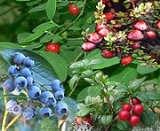
Vaccinium

Encyclopedia
Vaccinium is a genus
of shrub
s or dwarf shrubs in the plant Family Ericaceae
. The fruit
of many species are eaten by humans and some are of commercial importance, including the cranberry
, blueberry
, bilberry
or whortleberry, lingonberry or cowberry, and huckleberry. Like many other ericaceous plants, they are generally restricted to acid
ic soils.
, although there are tropical species from areas as widely separated as Madagascar
and Hawaii
.
for a type of berry (probably the bilberry
V. myrtillus), but its ultimate derivation is obscure; it is not the same word as vaccinum "of or pertaining to cows".
ic soils, and as wild plants they live in habitats such as heath
, bog
and acidic woodland
(for example, blueberries under oaks or pines). The plant structure varies between species – some trail along the ground, some are dwarf shrubs, and some are larger shrubs perhaps 1 to 2 m (3.3 to 6.6 ft) tall. The fruit
develops from an inferior ovary, and is a berry
; it is usually brightly coloured, often being red or bluish with purple juice.
Blueberry plants are commonly found in oak-heath forests in eastern North America.
of plants in this group develops from an inferior ovary, and is therefore known, botanically, as a false berry. In botany, true berries and fruit develop from the superior ovaries of a flower.
This "false berry" condition can actually be seen upon examining the fruit; the tip of a blueberryhttp://www.buzzle.com/articles/blueberries-health-benefits.html or cranberryhttp://fruit-crops.com/cranberi/ contains a little, spiked ring that is the original flower. With "true" fruit, the flower would be lost as the ovaries expanded from within, but in the case of epigynoushttp://fruit-crops.com/bluberi/ "berries" the fruit comes from under the ovary, and the flower is left on the tip.
e of a number of Lepidoptera
(butterfly
and moth
) species – see list of Lepidoptera that feed on Vaccinium.
is complex, and still under investigation. A number of the Asian species are more closely related to Agapetes
than to other Vaccinium species. A second group includes most of Orthaea and Notopora, at least some of Gaylussacia
(huckleberry), and a number of species from Vaccinium, such as Vaccinium crassifolium
. Other parts of Vaccinium form other groups, sometimes together with species of other genera.
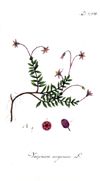 A classification which predates molecular phylogeny
divides Vaccinium into subgenera, and several sections:
Subgenus Oxycoccus: The cranberries
, with slender, trailing, wiry non-woody shoots and strongly reflexed flower petals. Some botanists treat Oxycoccus as a distinct genus.
Subgenus Vaccinium: All the other species, with thicker, upright woody shoots and bell-shaped flowers.
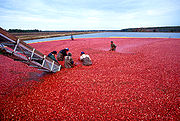
Genus
In biology, a genus is a low-level taxonomic rank used in the biological classification of living and fossil organisms, which is an example of definition by genus and differentia...
of shrub
Shrub
A shrub or bush is distinguished from a tree by its multiple stems and shorter height, usually under 5–6 m tall. A large number of plants may become either shrubs or trees, depending on the growing conditions they experience...
s or dwarf shrubs in the plant Family Ericaceae
Ericaceae
The Ericaceae, commonly known as the heath or heather family, is a group of mostly calcifuge flowering plants. The family is large, with roughly 4000 species spread across 126 genera, making it the 14th most speciose family of flowering plants...
. The fruit
Fruit
In broad terms, a fruit is a structure of a plant that contains its seeds.The term has different meanings dependent on context. In non-technical usage, such as food preparation, fruit normally means the fleshy seed-associated structures of certain plants that are sweet and edible in the raw state,...
of many species are eaten by humans and some are of commercial importance, including the cranberry
Cranberry
Cranberries are a group of evergreen dwarf shrubs or trailing vines in the subgenus Oxycoccus of the genus Vaccinium. In some methods of classification, Oxycoccus is regarded as a genus in its own right...
, blueberry
Blueberry
Blueberries are flowering plants of the genus Vaccinium with dark-blue berries and are perennial...
, bilberry
Bilberry
Bilberry is any of several species of low-growing shrubs in the genus Vaccinium , bearing edible berries. The species most often referred to is Vaccinium myrtillus L., but there are several other closely related species....
or whortleberry, lingonberry or cowberry, and huckleberry. Like many other ericaceous plants, they are generally restricted to acid
Acid
An acid is a substance which reacts with a base. Commonly, acids can be identified as tasting sour, reacting with metals such as calcium, and bases like sodium carbonate. Aqueous acids have a pH of less than 7, where an acid of lower pH is typically stronger, and turn blue litmus paper red...
ic soils.
Distribution
The genus contains about 450 species, which are found mostly in the cooler areas of the Northern HemisphereNorthern Hemisphere
The Northern Hemisphere is the half of a planet that is north of its equator—the word hemisphere literally means “half sphere”. It is also that half of the celestial sphere north of the celestial equator...
, although there are tropical species from areas as widely separated as Madagascar
Madagascar
The Republic of Madagascar is an island country located in the Indian Ocean off the southeastern coast of Africa...
and Hawaii
Hawaii
Hawaii is the newest of the 50 U.S. states , and is the only U.S. state made up entirely of islands. It is the northernmost island group in Polynesia, occupying most of an archipelago in the central Pacific Ocean, southwest of the continental United States, southeast of Japan, and northeast of...
.
Etymology
The name vaccinium was used in classical LatinClassical Latin
Classical Latin in simplest terms is the socio-linguistic register of the Latin language regarded by the enfranchised and empowered populations of the late Roman republic and the Roman empire as good Latin. Most writers during this time made use of it...
for a type of berry (probably the bilberry
Bilberry
Bilberry is any of several species of low-growing shrubs in the genus Vaccinium , bearing edible berries. The species most often referred to is Vaccinium myrtillus L., but there are several other closely related species....
V. myrtillus), but its ultimate derivation is obscure; it is not the same word as vaccinum "of or pertaining to cows".
Characteristics
Plants of this group typically require acidAcid
An acid is a substance which reacts with a base. Commonly, acids can be identified as tasting sour, reacting with metals such as calcium, and bases like sodium carbonate. Aqueous acids have a pH of less than 7, where an acid of lower pH is typically stronger, and turn blue litmus paper red...
ic soils, and as wild plants they live in habitats such as heath
Heath (habitat)
A heath or heathland is a dwarf-shrub habitat found on mainly low quality acidic soils, characterised by open, low growing woody vegetation, often dominated by plants of the Ericaceae. There are some clear differences between heath and moorland...
, bog
Bog
A bog, quagmire or mire is a wetland that accumulates acidic peat, a deposit of dead plant material—often mosses or, in Arctic climates, lichens....
and acidic woodland
Woodland
Ecologically, a woodland is a low-density forest forming open habitats with plenty of sunlight and limited shade. Woodlands may support an understory of shrubs and herbaceous plants including grasses. Woodland may form a transition to shrubland under drier conditions or during early stages of...
(for example, blueberries under oaks or pines). The plant structure varies between species – some trail along the ground, some are dwarf shrubs, and some are larger shrubs perhaps 1 to 2 m (3.3 to 6.6 ft) tall. The fruit
Fruit
In broad terms, a fruit is a structure of a plant that contains its seeds.The term has different meanings dependent on context. In non-technical usage, such as food preparation, fruit normally means the fleshy seed-associated structures of certain plants that are sweet and edible in the raw state,...
develops from an inferior ovary, and is a berry
Berry
The botanical definition of a berry is a fleshy fruit produced from a single ovary. Grapes are an example. The berry is the most common type of fleshy fruit in which the entire ovary wall ripens into an edible pericarp. They may have one or more carpels with a thin covering and fleshy interiors....
; it is usually brightly coloured, often being red or bluish with purple juice.
Blueberry plants are commonly found in oak-heath forests in eastern North America.
False berries
The fruitFruit
In broad terms, a fruit is a structure of a plant that contains its seeds.The term has different meanings dependent on context. In non-technical usage, such as food preparation, fruit normally means the fleshy seed-associated structures of certain plants that are sweet and edible in the raw state,...
of plants in this group develops from an inferior ovary, and is therefore known, botanically, as a false berry. In botany, true berries and fruit develop from the superior ovaries of a flower.
This "false berry" condition can actually be seen upon examining the fruit; the tip of a blueberryhttp://www.buzzle.com/articles/blueberries-health-benefits.html or cranberryhttp://fruit-crops.com/cranberi/ contains a little, spiked ring that is the original flower. With "true" fruit, the flower would be lost as the ovaries expanded from within, but in the case of epigynoushttp://fruit-crops.com/bluberi/ "berries" the fruit comes from under the ovary, and the flower is left on the tip.
Food uses
Vaccinium species are used as food plants by the larvaLarva
A larva is a distinct juvenile form many animals undergo before metamorphosis into adults. Animals with indirect development such as insects, amphibians, or cnidarians typically have a larval phase of their life cycle...
e of a number of Lepidoptera
Lepidoptera
Lepidoptera is a large order of insects that includes moths and butterflies . It is one of the most widespread and widely recognizable insect orders in the world, encompassing moths and the three superfamilies of butterflies, skipper butterflies, and moth-butterflies...
(butterfly
Butterfly
A butterfly is a mainly day-flying insect of the order Lepidoptera, which includes the butterflies and moths. Like other holometabolous insects, the butterfly's life cycle consists of four parts: egg, larva, pupa and adult. Most species are diurnal. Butterflies have large, often brightly coloured...
and moth
Moth
A moth is an insect closely related to the butterfly, both being of the order Lepidoptera. Moths form the majority of this order; there are thought to be 150,000 to 250,000 different species of moth , with thousands of species yet to be described...
) species – see list of Lepidoptera that feed on Vaccinium.
Taxonomy
The taxonomyTaxonomy
Taxonomy is the science of identifying and naming species, and arranging them into a classification. The field of taxonomy, sometimes referred to as "biological taxonomy", revolves around the description and use of taxonomic units, known as taxa...
is complex, and still under investigation. A number of the Asian species are more closely related to Agapetes
Agapetes
Agapetes is a semi-climbing shrub genus native to the Himalayas, grown as an ornamental for its attractive pendulous benches of red tubular flowers blooming over a long period. It is mostly grown in climates from cool temperate to sub-tropical...
than to other Vaccinium species. A second group includes most of Orthaea and Notopora, at least some of Gaylussacia
Gaylussacia
Gaylussacia is a genus of about fifty species of flowering plants in the family Ericaceae, native to the Americas, where they occur in eastern North America and in South America in the Andes and the mountains of southeastern Brazil...
(huckleberry), and a number of species from Vaccinium, such as Vaccinium crassifolium
Vaccinium crassifolium
Vaccinium crassifolium, the Creeping blueberry, is a species of Vaccinium native to the four Southeastern U.S. states of Virginia, North Carolina, South Carolina, and Georgia...
. Other parts of Vaccinium form other groups, sometimes together with species of other genera.
Subgenera
Molecular phylogeny
Molecular phylogenetics is the analysis of hereditary molecular differences, mainly in DNA sequences, to gain information on an organism's evolutionary relationships. The result of a molecular phylogenetic analysis is expressed in a phylogenetic tree...
divides Vaccinium into subgenera, and several sections:
Subgenus Oxycoccus: The cranberries
Cranberry
Cranberries are a group of evergreen dwarf shrubs or trailing vines in the subgenus Oxycoccus of the genus Vaccinium. In some methods of classification, Oxycoccus is regarded as a genus in its own right...
, with slender, trailing, wiry non-woody shoots and strongly reflexed flower petals. Some botanists treat Oxycoccus as a distinct genus.
- Sect. Oxycoccus
- Vaccinium macrocarponCranberryCranberries are a group of evergreen dwarf shrubs or trailing vines in the subgenus Oxycoccus of the genus Vaccinium. In some methods of classification, Oxycoccus is regarded as a genus in its own right...
– American Cranberry - Vaccinium microcarpumCranberryCranberries are a group of evergreen dwarf shrubs or trailing vines in the subgenus Oxycoccus of the genus Vaccinium. In some methods of classification, Oxycoccus is regarded as a genus in its own right...
– Small Cranberry - Vaccinium oxycoccosCranberryCranberries are a group of evergreen dwarf shrubs or trailing vines in the subgenus Oxycoccus of the genus Vaccinium. In some methods of classification, Oxycoccus is regarded as a genus in its own right...
– Common Cranberry
- Vaccinium macrocarpon
- Sect. Oxycoccoides
- Vaccinium erythrocarpumSouthern Mountain CranberrySouthern Mountain Cranberry, Vaccinium erythrocarpum, — also commonly known as bearberry, arando, and dingleberry, is a type of cranberry native to the southeastern United States. It is a deciduous shrub....
– Southern Mountain Cranberry
- Vaccinium erythrocarpum
Subgenus Vaccinium: All the other species, with thicker, upright woody shoots and bell-shaped flowers.
- Sect. Batodendron
- Vaccinium arboreumVaccinium arboreumVaccinium arboreum is a species of Vaccinium native to the southeastern United States, from southern Virginia west to southeastern Nebraska, south to Florida and eastern Texas, and north to Illinois....
- Sparkleberry (images) - Vaccinium crassifolium - Creeping Blueberry
- Vaccinium arboreum
- Sect. Brachyceratium
- Vaccinium dependens
- Sect. Bracteata
- Vaccinium acrobracteatum
- Vaccinium barandanum
- Vaccinium bracteatum
- Vaccinium coriaceum
- Vaccinium cornigerum
- Vaccinium cruentum
- Vaccinium hooglandii
- Vaccinium horizontale
- Vaccinium laurifolium
- Vaccinium lucidum
- Vaccinium myrtoides
- Vaccinium phillyreoides
- Vaccinium reticulatovenosum
- Vaccinium sparsum
- Vaccinium varingifolium
- Sect. Ciliata
- Vaccinium ciliatum
- Vaccinium oldhamii
- Sect. Cinctosandra
- Vaccinium exul
- Sect. Conchophyllum
- Vaccinium corymbodendron
- Vaccinium delavayi
- Vaccinium emarginatum
- Vaccinium griffithianum
- Vaccinium meridionale
- Vaccinium moupinense – Himalayan Blueberry
- Vaccinium neilgherrense
- Vaccinium nummularia
- Vaccinium retusum
- Sect. Cyanococcus – typical blueberriesBlueberryBlueberries are flowering plants of the genus Vaccinium with dark-blue berries and are perennial...
- Vaccinium angustifolium – Lowbush Blueberry
- Vaccinium boreale – Northern Blueberry
- Vaccinium caesarienseVaccinium caesarienseVaccinium caesariense, New Jersey Blueberry, is native to the Eastern United States. It is a species in the genus Vaccinium, which includes blueberries, cranberries, huckleberry, and bilberries, all flowering plants or angiosperms.-Range:...
– New Jersey Blueberry - Vaccinium caespitosum – Dwarf Blueberry (Dwarf Bilberry)
- Vaccinium corymbosum – Highbush Blueberry
- Vaccinium darrowiiVaccinium darrowiiVaccinium darrowii, Darrow's Blueberry, Evergreen Blueberry, Scrub Blueberry, or Southern Highbush Blueberry, is a species of Vaccinium in the blueberry group .-Distribution:...
– Evergreen Blueberry - Vaccinium elliottiiVaccinium elliottiiVaccinum elliottii is a species of Vaccinium in the blueberry group . It is native to the Southeastern United States, from southeastern Virginia south to Florida, and west to Arkansas and Texas.-Growth:Vaccinium elliottii is a deciduous shrub 2-4 m tall, with small, simple ovoid-acute leaves...
– Elliott's Blueberry - Vaccinium formosum
- Vaccinium fuscatum – Black Highbush Blueberry; syn. V. atrococcum
- Vaccinium hirsutum
- Vaccinium koreanum
- Vaccinium myrsinites – Evergreen Blueberry
- Vaccinium myrtilloides – Canadian Blueberry
- Vaccinium pallidum Ait. – Dryland Blueberry (images); syn. V. vacillans Torr.
- Vaccinium simulatum
- Vaccinium tenellum
- Vaccinium virgatum – Rabbiteye Blueberry; syn. V. ashei
- Sect. Eococcus
- Vaccinium fragile
- Sect. Epigynium
- Vaccinium vacciniaceum
- Sect. Galeopetalum
- Vaccinium chunii
- Vaccinium dunalianum
- Vaccinium glaucoalbum
- Vaccinium urceolatum
- Sect. Hemimyrtillus
- Vaccinium arctostaphylos
- Vaccinium cylindraceum
- Vaccinium hirtum
- Vaccinium padifolium
- Vaccinium smallii
- Sect. Myrtillus (including sect. Macropelma) – bilberriesBilberryBilberry is any of several species of low-growing shrubs in the genus Vaccinium , bearing edible berries. The species most often referred to is Vaccinium myrtillus L., but there are several other closely related species....
and relatives- Vaccinium calycinum Sm.James Edward SmithSir James Edward Smith was an English botanist and founder of the Linnean Society.Smith was born in Norwich in 1759, the son of a wealthy wool merchant. He displayed a precocious interest in the natural world...
– Ōhelo kau laʻau (HawaiiHawaiiHawaii is the newest of the 50 U.S. states , and is the only U.S. state made up entirely of islands. It is the northernmost island group in Polynesia, occupying most of an archipelago in the central Pacific Ocean, southwest of the continental United States, southeast of Japan, and northeast of...
) - Vaccinium cereum (L.f.) Forst.f. – East Polynesian Blueberry, Pacific Blueberry
- Vaccinium cespitosumVaccinium cespitosumVaccinium cespitosum, , the dwarf bilberry, is a species of flowering shrub in the genus Vaccinium, which includes blueberries, huckleberries, and cranberries.-Range:...
– Dwarf Bilberry - Vaccinium deliciosumVaccinium deliciosumVaccinium deliciosum is a species of bilberry known by the common names Cascade bilberry, Cascade blueberry, and blueleaf huckleberry. It is native to western North America from British Columbia to Idaho to northern California, where it grows at elevations of 600 to 2000 meters in subalpine and...
– Cascade Bilberry, Cascade Blueberry, Blueleaf Huckleberry - Vaccinium dentatum Sm.James Edward SmithSir James Edward Smith was an English botanist and founder of the Linnean Society.Smith was born in Norwich in 1759, the son of a wealthy wool merchant. He displayed a precocious interest in the natural world...
– Ōhelo (Hawaii) - Vaccinium membranaceumVaccinium membranaceum- Geographic Distribution :Vaccinium membranaceum is a species within the group of Vaccinium commonly referred to as huckleberry. This particular species is known by the common names thinleaf huckleberry, tall huckleberry, big huckleberry, mountain huckleberry, square-twig blueberry, and as...
– Square-twig Blueberry, Thinleaf Huckleberry, Tall Huckleberry, Big Huckleberry, Mountain Huckleberry, "black huckleberry" - Vaccinium myrtillusVaccinium myrtillusVaccinium myrtillus is an almost Holarctic species of shrub with edible fruit, usually simply referred to as "bilberry" or "whortleberry". It is more precidely called Common Bilberry or Blue Whortleberry, to distinguish it from its Vaccinium relatives...
– Common Bilberry, Blue Whortleberry, Blaeberry, Fraughan, Hurtleberry - Vaccinium ovalifoliumVaccinium ovalifoliumVaccinium ovalifolium is a plant found in coastal forests throughout southern Alaska and the Aleutian Islands.-Growth:...
– Alaska Blueberry, Early Blueberry, Oval-leaf Blueberry - Vaccinium parvifoliumVaccinium parvifoliumRed Huckleberry is a species of Vaccinium native to the western North America, where it is common in forests from southeastern Alaska and British Columbia south through western Washington and Oregon to central California. In the Oregon Coast Range, it is the most common Vaccinium...
– Red Huckleberry - Vaccinium praestans – Krasnika
- Vaccinium reticulatumVaccinium reticulatumVaccinium reticulatum, known as Ōhelo ai in Hawaiian, is a species of flowering plant in the heather family, Ericaceae, that is endemic to Hawaii. It grows at altitudes of on lava flows and freshly disturbed volcanic ash on Maui and Hawaii, and less commonly on Kauai, Oahu, and Molokai...
– Ōhelo ʻai (Hawaii) - Vaccinium scopariumVaccinium scopariumVaccinium scoparium is a species of huckleberry known by the common names grouse whortleberry, grouseberry, and littleleaf huckleberry. It is native to western North America from British Columbia and Alberta to far northern California to Colorado and New Mexico...
– Grouse Whortleberry, Grouseberry, Littleleaf Huckleberry
- Vaccinium calycinum Sm.
- Sect. Neurodesia
- Vaccinium crenatum
- Sect. Oarianthe
- Vaccinium ambyandrum
- Vaccinium cyclopense
- Sect. Oreades
- Vaccinium poasanum
- Sect. Pachyanthum
- Vaccinium fissiflorum
- Sect. Polycodium
- Vaccinium stamineumVaccinium stamineumVaccinium stamineum, commonly known as deerberry, squaw huckleberry or gooseberry, is a flowering shrub in the heath family. The plant is native to eastern North America from Ontario in the north, south to Florida and west to Texas...
L.Carolus LinnaeusCarl Linnaeus , also known after his ennoblement as , was a Swedish botanist, physician, and zoologist, who laid the foundations for the modern scheme of binomial nomenclature. He is known as the father of modern taxonomy, and is also considered one of the fathers of modern ecology...
- Deerberry; syn. V. caesium (Eastern North America) (images)
- Vaccinium stamineum
- Sect. Pyxothamnus
- Vaccinium consanguineum
- Vaccinium floribundum
- Vaccinium ovatum PurshFrederick Traugott PurshFrederick Traugott Pursh was a German-American botanist.Born in Grossenhain, Saxony, to the name Friedrich Traugott Pursh, he was educated at Dresden Botanical Gardens, and emigrated to the United States in 1799...
- California Huckleberry (or Evergreen Huckleberry) (Coastal Western North America)
- Sect. Vaccinium
- Vaccinium uliginosumVaccinium uliginosumVaccinium uliginosum is a flowering plant in the genus Vaccinium.-Distribution:Vaccinium uliginosum is native to cool temperate regions of the Northern Hemisphere, at low altitudes in the Arctic, and at high altitudes south to the Pyrenees, the Alps, and the Caucasus in Europe, the mountains of...
L.Carolus LinnaeusCarl Linnaeus , also known after his ennoblement as , was a Swedish botanist, physician, and zoologist, who laid the foundations for the modern scheme of binomial nomenclature. He is known as the father of modern taxonomy, and is also considered one of the fathers of modern ecology...
- Northern (or Bog) Bilberry (or Blueberry); syn. V. occidentale (Northern North America and Eurasia)
- Vaccinium uliginosum
- Sect. Vitis-idaea
- Vaccinium vitis-idaeaVaccinium vitis-idaeaVaccinium vitis-idaea is a short evergreen shrub in the heath family that bears edible sour fruit, native to boreal forest and Arctic tundra throughout the Northern Hemisphere from Eurasia to North America. In the past it was seldom cultivated, but fruit was commonly collected in the wild. ...
L.Carolus LinnaeusCarl Linnaeus , also known after his ennoblement as , was a Swedish botanist, physician, and zoologist, who laid the foundations for the modern scheme of binomial nomenclature. He is known as the father of modern taxonomy, and is also considered one of the fathers of modern ecology...
- Partridgeberry, Cowberry, Redberry, Red Whortleberry, or Lingonberry (northern North America and Eurasia)
- Vaccinium vitis-idaea
Production
Production tonnes. Figures 2003-2004 FAOSTAT data (FAO Food and Agriculture Organization The Food and Agriculture Organization of the United Nations is a specialised agency of the United Nations that leads international efforts to defeat hunger. Serving both developed and developing countries, FAO acts as a neutral forum where all nations meet as equals to negotiate agreements and... ) |
|||||
| United States United States The United States of America is a federal constitutional republic comprising fifty states and a federal district... |
280,503 | 80 % | 270,000 | 78 % | |
| Canada Canada Canada is a North American country consisting of ten provinces and three territories. Located in the northern part of the continent, it extends from the Atlantic Ocean in the east to the Pacific Ocean in the west, and northward into the Arctic Ocean... |
52,651 | 15 % | 53,400 | 16 % | |
| Belarus Belarus Belarus , officially the Republic of Belarus, is a landlocked country in Eastern Europe, bordered clockwise by Russia to the northeast, Ukraine to the south, Poland to the west, and Lithuania and Latvia to the northwest. Its capital is Minsk; other major cities include Brest, Grodno , Gomel ,... |
8,000 | 2 % | 10,000 | 3 % | |
| Latvia Latvia Latvia , officially the Republic of Latvia , is a country in the Baltic region of Northern Europe. It is bordered to the north by Estonia , to the south by Lithuania , to the east by the Russian Federation , to the southeast by Belarus and shares maritime borders to the west with Sweden... |
8,000 | 2 % | 8,000 | 2 % | |
| Azerbaijan Azerbaijan Azerbaijan , officially the Republic of Azerbaijan is the largest country in the Caucasus region of Eurasia. Located at the crossroads of Western Asia and Eastern Europe, it is bounded by the Caspian Sea to the east, Russia to the north, Georgia to the northwest, Armenia to the west, and Iran to... |
2,000 | 1 % | 1,500 | 0 % | |
| Ukraine Ukraine Ukraine is a country in Eastern Europe. It has an area of 603,628 km², making it the second largest contiguous country on the European continent, after Russia... |
1,000 | 0 % | 1,000 | 0 % | |
| Tunisia Tunisia Tunisia , officially the Tunisian RepublicThe long name of Tunisia in other languages used in the country is: , is the northernmost country in Africa. It is a Maghreb country and is bordered by Algeria to the west, Libya to the southeast, and the Mediterranean Sea to the north and east. Its area... |
50 | 0 % | 50 | 0 % | |
| Turkey Turkey Turkey , known officially as the Republic of Turkey , is a Eurasian country located in Western Asia and in East Thrace in Southeastern Europe... |
50 | 0 % | 50 | 0 % | |
| Total | 352 254 | 100 % | 344 000 | 100 % | |