

Detroit Lions

Encyclopedia
The Detroit Lions are a professional American football
team based in Detroit, Michigan
. They are members of the North Division
of the National Football Conference
(NFC) in the National Football League
(NFL), and play their home games at Ford Field
in Downtown Detroit
.
Originally based in Portsmouth, Ohio
and called the Portsmouth Spartans, the team began play in 1929 as an independent professional team, one of many such teams in the Ohio
and Scioto River
valleys. For the 1930 season, the Spartans formally joined the NFL as the other area independents folded because of the Great Depression
. Despite success within the NFL, they could not survive in Portsmouth, then the NFL's smallest city. The team was purchased and moved to Detroit for the 1934 season.
The Lions have won four NFL Championships, the last in 1957, giving the club the second-longest NFL championship drought behind the Arizona Cardinals
. The Lions are one of four current NFL teams that have yet to qualify for the Super Bowl
. The 2008 team
became the only team in NFL history to lose all 16 regular season games since the NFL went to a 16-game schedule in 1978.
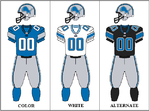
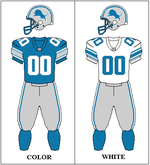 Aside from a brief change to maroon in 1948 instituted by then head coach Bo McMillin
(influenced by his years as coach at Indiana), the Lions uniforms have basically remained the same since the team debuted in 1930. The design consists of silver helmets, silver pants, and either blue or white jerseys.
 There have been minor changes to the uniform design throughout the years, such as changing the silver stripe patterns on the jersey sleeves, and changing the colors of the jersey numbers. White trim was added to the logo in 1970. In 1998, the team wore blue pants with their white jerseys along with grey socks but dropped that combination after the season. In 1999, the 'TV numbers' on the sleeves were moved to the shoulders.
The shade of blue used for Lions uniforms and logos is officially known as "Honolulu blue," which is supposedly inspired by the color of the waves off the coast of Hawaii. The shade was chosen by Cy Huston, the Lions first vice president and general manager, and of the choice, he said: "They had me looking at so many blues I am blue in the face," Huston said about the selection. "But anyway, it's the kind of blue, I am told, that will match with silver."
In 1994, every NFL team wore throwback jerseys, and the Lions' were similar to the jerseys used during their 1935 championship season. The helmets and pants were solid silver, the jerseys Honolulu blue with silver numbers and the jersey did not have 'TV numbers' on the sleeves. The team wore solid blue socks along with black shoes. The helmets also did not have a logo, as helmets were simple leather back then. The Lions also wore '50s-style jerseys during their traditional Thanksgiving Day
games from 2001 to 2004 as the NFL encouraged teams to wear throwback jerseys on Thanksgiving Day.
In 2003, the team added black trim to their logo and the jerseys. The face masks on the helmet changed from blue to black with the introduction of the new color. Additionally, an alternate home field jersey which makes black the dominant color (in place of Honolulu Blue) was introduced in 2005.
For 2008, the team dropped the black alternate jerseys in favor of a throwback uniform to commemorate the franchise's 75th anniversary. The throwback uniform became the team's permanent alternate jersey in 2009, replacing the former black alternate.
The Lions officially unveiled new logo designs and uniforms on April 20, 2009. The Lion on the helmet now has a flowing mane and fangs, and the typeface of "Lions" is more modern.
does play-by-play, Jim Brandstatter
does color commentary, and Tony Ortiz
provides sideline reports
. If a conflict with Detroit Tigers
or Detroit Red Wings
coverage arises, only WXYT-FM serves as the Lions' flagship. The Lions and WXYT AM/FM renewed their partnership for three more seasons on October 9, 2009.
is the flagship station Lions preseason games. The announcers are Matt Shepard with play-by-play, Rob Rubick
with color commentary, and Tom Leyden with sideline reports.
, except when the Lions play an AFC
team in Detroit, in which case the game airs regionally on CBS
. The Thanksgiving Classic
game in Detroit is always televised nationally on either Fox or CBS, depending on who the visiting team is. The Detroit Lions are the last NFC team to play on NBC, since they got football back in 2006 (the Lions at Saints game on December 4, 2011 will mark their 1st appearance). The Lions' official regular season pregame show is The Ford Lions Report.
was on October 26, 2008, against the Washington Redskins
. The previous 50 regular season home games had been sellouts. The second home game of the 2009 season in which the Lions broke the losing streak (also against the Washington Redskins) was blacked out locally, as well as the comeback victory over the Cleveland Browns. The Lions had only one blackout in 2010, the Washington Redskins game, which the Lions won 37–25.
Games were also often blacked out at the Lions' previous home, the (perhaps over-sized) 80,000-seat Pontiac Silverdome
, despite winning seasons and the success and popularity of star players such as Barry Sanders
.
American football
American football is a sport played between two teams of eleven with the objective of scoring points by advancing the ball into the opposing team's end zone. Known in the United States simply as football, it may also be referred to informally as gridiron football. The ball can be advanced by...
team based in Detroit, Michigan
Michigan
Michigan is a U.S. state located in the Great Lakes Region of the United States of America. The name Michigan is the French form of the Ojibwa word mishigamaa, meaning "large water" or "large lake"....
. They are members of the North Division
NFC North
The NFC North is a division of the National Football League's National Football Conference, based in the Upper Midwest region of the United States...
of the National Football Conference
National Football Conference
The National Football Conference is one of the two conferences of the National Football League . This conference and its counterpart, the American Football Conference , currently contain 16 teams each, making up the 32 teams of the NFL.-Current teams:Since 2002, the NFC has comprised 16 teams,...
(NFC) in the National Football League
National Football League
The National Football League is the highest level of professional American football in the United States, and is considered the top professional American football league in the world. It was formed by eleven teams in 1920 as the American Professional Football Association, with the league changing...
(NFL), and play their home games at Ford Field
Ford Field
Ford Field is an indoor American football stadium located in Detroit, Michigan, USA, that is the current home field of the NFL's Detroit Lions. It is owned by the Detroit/Wayne County Stadium Authority. It regularly seats 65,000, though it is expandable up to 70,000 for football and 80,000 for...
in Downtown Detroit
Downtown Detroit
Downtown Detroit is the central business district and a residential area of Detroit, Michigan, United States. Downtown is bordered by the Lodge Freeway to the west, the Fisher Freeway to the north, Interstate 375 to the east, and the Detroit River to the south.Downtown contains much historic...
.
Originally based in Portsmouth, Ohio
Portsmouth, Ohio
Portsmouth is a city in the U.S. state of Ohio and the county seat of Scioto County. The municipality is located on the northern banks of the Ohio River and east of the Scioto River in Southern Ohio. The population was 20,226 at the 2010 census.-Foundation:...
and called the Portsmouth Spartans, the team began play in 1929 as an independent professional team, one of many such teams in the Ohio
Ohio River
The Ohio River is the largest tributary, by volume, of the Mississippi River. At the confluence, the Ohio is even bigger than the Mississippi and, thus, is hydrologically the main stream of the whole river system, including the Allegheny River further upstream...
and Scioto River
Scioto River
The Scioto River is a river in central and southern Ohio more than 231 miles in length. It rises in Auglaize County in west central Ohio, flows through Columbus, Ohio, where it collects its largest tributary, the Olentangy River, and meets the Ohio River at Portsmouth...
valleys. For the 1930 season, the Spartans formally joined the NFL as the other area independents folded because of the Great Depression
Great Depression
The Great Depression was a severe worldwide economic depression in the decade preceding World War II. The timing of the Great Depression varied across nations, but in most countries it started in about 1929 and lasted until the late 1930s or early 1940s...
. Despite success within the NFL, they could not survive in Portsmouth, then the NFL's smallest city. The team was purchased and moved to Detroit for the 1934 season.
The Lions have won four NFL Championships, the last in 1957, giving the club the second-longest NFL championship drought behind the Arizona Cardinals
Arizona Cardinals
The Arizona Cardinals are a professional American football team based in Glendale, Arizona, a suburb of Phoenix. They are currently members of the Western Division of the National Football Conference in the National Football League...
. The Lions are one of four current NFL teams that have yet to qualify for the Super Bowl
Super Bowl
The Super Bowl is the championship game of the National Football League , the highest level of professional American football in the United States, culminating a season that begins in the late summer of the previous calendar year. The Super Bowl uses Roman numerals to identify each game, rather...
. The 2008 team
2008 Detroit Lions season
The 2008 Detroit Lions season was the 79th season for the franchise in the National Football League. Although the Lions had a flawless preseason with a 4-0 record, the Lions became the first team in NFL history to compile an 0-16 record in regular season play. They were mathematically eliminated...
became the only team in NFL history to lose all 16 regular season games since the NFL went to a 16-game schedule in 1978.
Logos and uniforms
Bo McMillin
Alvin Nugent "Bo" McMillin was an American football player and coach, who served at both the collegiate and professional levels. He played college football at Centre College in Danville, Kentucky, where was a three-time All-American at quarterback, and led the Centre Praying Colonels to a...
(influenced by his years as coach at Indiana), the Lions uniforms have basically remained the same since the team debuted in 1930. The design consists of silver helmets, silver pants, and either blue or white jerseys.
The shade of blue used for Lions uniforms and logos is officially known as "Honolulu blue," which is supposedly inspired by the color of the waves off the coast of Hawaii. The shade was chosen by Cy Huston, the Lions first vice president and general manager, and of the choice, he said: "They had me looking at so many blues I am blue in the face," Huston said about the selection. "But anyway, it's the kind of blue, I am told, that will match with silver."
In 1994, every NFL team wore throwback jerseys, and the Lions' were similar to the jerseys used during their 1935 championship season. The helmets and pants were solid silver, the jerseys Honolulu blue with silver numbers and the jersey did not have 'TV numbers' on the sleeves. The team wore solid blue socks along with black shoes. The helmets also did not have a logo, as helmets were simple leather back then. The Lions also wore '50s-style jerseys during their traditional Thanksgiving Day
Thanksgiving Classic
The National Football League's Thanksgiving Classic is a series of games played during the Thanksgiving holiday in the United States. It has been a regular occurrence since the league's inception in 1920. Since 2006, three games are played every Thanksgiving...
games from 2001 to 2004 as the NFL encouraged teams to wear throwback jerseys on Thanksgiving Day.
In 2003, the team added black trim to their logo and the jerseys. The face masks on the helmet changed from blue to black with the introduction of the new color. Additionally, an alternate home field jersey which makes black the dominant color (in place of Honolulu Blue) was introduced in 2005.
For 2008, the team dropped the black alternate jerseys in favor of a throwback uniform to commemorate the franchise's 75th anniversary. The throwback uniform became the team's permanent alternate jersey in 2009, replacing the former black alternate.
The Lions officially unveiled new logo designs and uniforms on April 20, 2009. The Lion on the helmet now has a flowing mane and fangs, and the typeface of "Lions" is more modern.
Pro Football Hall of Famers
- 20 Lem BarneyLem BarneyLemuel Joseph "Lem" Barney is a former American Football cornerback who played for the Detroit Lions. He was selected to the Pro Football Hall of Fame in 1992.-College years:...
, DB (1992) - 76 Lou CreekmurLou CreekmurLouis Creekmur was an NFL left offensive tackle/guard for the Detroit Lions from 1950-59. He was also used as a defensive lineman in critical situations...
, G/T (1996) - 14 Jack ChristiansenJack Christiansen-External links:*Pro Football Hall of Fame: *...
, DB (1970) - 7 Dutch Clark, QB (1963)
- 35 Bill DudleyBill DudleyWilliam McGarvey "Bullet Bill" Dudley was a professional American football player in the National Football League for the Pittsburgh Steelers, Detroit Lions, and Washington Redskins. He was inducted into the Pro Football Hall of Fame in 1966.-Early life:Dudley was born in Bluefield, Virginia and...
, HB (1966) - 72 Frank GatskiFrank GatskiFrank Gatski was an American football player.Gatski was born on March 18, 1919 in Farmington, West Virginia....
, C (1985) - 35 John Henry JohnsonJohn Henry JohnsonJohn Henry Johnson was an American football fullback. He played from 1954 to 1965 for the San Francisco 49ers, the Detroit Lions, and the Pittsburgh Steelers of the National Football League...
, FB (1987) - 81 Dick "Night Train" Lane, DB (1974)
- 28 Yale LaryYale LaryRobert Yale Lary is a former American football player.After graduating from North Side High School in 1949, he attended Texas A&M University, where he was a standout in football and baseball...
, DB, P (1979) - 22 Bobby LayneBobby LayneRobert Lawrence "Bobby" Layne was an American football quarterback who played for 15 seasons in the National Football League. He played for the Chicago Bears in 1948, the New York Bulldogs in 1949, the Detroit Lions from 1950–1958, and the Pittsburgh Steelers from 1958–1962...
, QB (1967) - 44 Dick LeBeauDick LeBeauCharles Richard “Dick” LeBeau is a National Football League Hall of Fame defensive back. He is currently the Pittsburgh Steelers defensive coordinator and is considered to be one of the greatest defensive coordinators of all time. He spent 14 years in the NFL as a player with the Detroit Lions and...
, DB (2010) - 20 Barry SandersBarry SandersBarry Sanders is a former American football running back who spent all of his professional career with the Detroit Lions in the NFL. Sanders left the game just short of the all-time rushing record...
, RB (2004) - 88 Charlie SandersCharlie SandersCharles Alvin Sanders is a former American football player who played tight end for the Detroit Lions from 1968-77. On February 3, 2007, Sanders was voted into the Pro Football Hall of Fame.-Playing career:...
, TE (2007) - 56 Joe SchmidtJoe SchmidtJoseph Paul Schmidt is a former American football player and coach at both the collegiate and professional levels. His 13-year career with the National Football League's Detroit Lions gained him a place in the Pro Football Hall of Fame in 1973.-Collegiate career:Schmidt grew up in Pittsburgh,...
, LB (1973) - 37 Doak WalkerDoak WalkerEwell Doak Walker, Jr. was an American football player who is a member of the Pro Football Hall of Fame. He was a teammate of Bobby Layne in high school and the NFL.-Early life:...
, HB (1986) - 50 Alex WojciechowiczAlex WojciechowiczAlexander Francis Wojciechowicz was a professional American football player in the National Football League. He was an NFL Hall of Famer as an offensive lineman and linebacker for the Detroit Lions and Philadelphia Eagles....
, C, LB (1968)
Retired numbers
- Dutch Clark (7)
- Barry SandersBarry SandersBarry Sanders is a former American football running back who spent all of his professional career with the Detroit Lions in the NFL. Sanders left the game just short of the all-time rushing record...
(20)- Note: The #20 was retired specifically for Sanders, even though the retired number was also worn by RB Billy SimsBilly SimsBilly Sims is a former college football and NFL running back. He won the Heisman Trophy in 1978.-Early years:...
and DB Lem BarneyLem BarneyLemuel Joseph "Lem" Barney is a former American Football cornerback who played for the Detroit Lions. He was selected to the Pro Football Hall of Fame in 1992.-College years:...
, both of whom are also among the top all-time Lions at their positions.
- Note: The #20 was retired specifically for Sanders, even though the retired number was also worn by RB Billy Sims
- Bobby LayneBobby LayneRobert Lawrence "Bobby" Layne was an American football quarterback who played for 15 seasons in the National Football League. He played for the Chicago Bears in 1948, the New York Bulldogs in 1949, the Detroit Lions from 1950–1958, and the Pittsburgh Steelers from 1958–1962...
(22) - Doak WalkerDoak WalkerEwell Doak Walker, Jr. was an American football player who is a member of the Pro Football Hall of Fame. He was a teammate of Bobby Layne in high school and the NFL.-Early life:...
(37) - Joe SchmidtJoe SchmidtJoseph Paul Schmidt is a former American football player and coach at both the collegiate and professional levels. His 13-year career with the National Football League's Detroit Lions gained him a place in the Pro Football Hall of Fame in 1973.-Collegiate career:Schmidt grew up in Pittsburgh,...
(56)- Note: The #56 was unretired with Schmidt's blessing when the Lions acquired linebacker Pat SwillingPat SwillingPatrick Travis Swilling is a former American football linebacker in the NFL for the New Orleans Saints and a delegate in the Louisiana House of Representatives. He earned five Pro Bowl appearances.-College career:...
from the Saints. No player has worn it since Swilling left.
- Note: The #56 was unretired with Schmidt's blessing when the Lions acquired linebacker Pat Swilling
- Chuck HughesChuck HughesCharles Frederick "Chuck" Hughes was an American football wide receiver in the National Football League from 1967 to 1971. He is, to date, the only NFL player to die on the field during a game.-Early years:...
(85)- Note: Hughes died of a heart attack during a game on October 24, 1971, and his #85 was withdrawn from circulation. However, WR Kevin JohnsonKevin Johnson (football player)Kevin L. Johnson is a former professional American football player who played wide receiver in college for Syracuse University , then for seven seasons for the Cleveland Browns, the Jacksonville Jaguars, the Baltimore Ravens, and the...
wore #85 during his stint in Detroit after asking permission from the Hughes family as he had worn that number throughout his professional career.
- Note: Hughes died of a heart attack during a game on October 24, 1971, and his #85 was withdrawn from circulation. However, WR Kevin Johnson
Temporary
- Corey SmithCorey SmithCorey Dominique Smith was an American football defensive end. He was originally signed by the Tampa Bay Buccaneers as an undrafted free agent in 2002...
(93) – The Lions retired #93 for the 2009 season after Smith went missing, presumed dead, when a boat he was fishing in with friends capsized off the Florida coast. The Lions also wore 93 stickers on their helmets that season. Number 93 was assigned to Kyle Vanden BoschKyle Vanden Bosch-Arizona Cardinals:Kyle was drafted by the Arizona Cardinals in the second round of the 2001 NFL Draft. In his injury-abbreviated rookie season he finished with 12 tackles , one quarterback sack, one hurry, one pass defensed and one...
in 2010.
Lions Legends
The Lions have a special program called "Lions Legends" that honors noteworthy former players. The current list of legends includes not only the hall of famers listed above, but also the following players, who according to the Lions, "...Created special moments and added to the lore of football in the Motor City.":- Charley AneCharley AneCharles "Charley" Teetai Ane, Jr. was an American football offensive lineman.-High school:Ane excelled in baseball, basketball and track as well as football at the Punahou School in Honolulu, Hawaii...
, C/T - Al BakerAl BakerAl "Bubba" Baker is a former professional American football defensive lineman in the NFL. He went to three Pro Bowls during his career. He was named 1978 Defensive Rookie of the Year....
, DE - Jerry BallJerry BallJerry Ball is a former professional American football defensive lineman in the NFL who played primarily as a nose tackle. During his career he went to three Pro Bowls. In the NFL for 13 seasons, Ball recorded 32.5 sacks during his career, most of them coming as a nose tackle with the Detroit Lions...
, DT - Terry BarrTerry BarrTerry Albert Barr was an American football wide receiver. He played for nine seasons in the NFL, all with the Detroit Lions....
, WR/DB - Les BingamanLes BingamanLester Alonza Bingaman was an American football defensive lineman in the National Football League. Bingaman played seven seasons with the Detroit Lions, starting in 1948. He earned trips to the Pro Bowl in 1951 and 1953...
, DT - Bennie BladesBennie BladesHoratio Benedict "Bennie" Blades Sr. is a former American football cornerback and safety in the National Football League. He played college football at the University of Miami.-University of Miami:...
, S - Cloyce BoxCloyce BoxCloyce Kennedy Box was an American football end in the National Football League for the Detroit Lions, where he was voted into two Pro Bowls. He played college football at Louisiana Tech in 1944 and then at West Texas A&M University. He was drafted in the 20th round of the 1948 NFL Draft by the...
, RB/TE/QB - Lomas BrownLomas BrownLomas Brown, Jr. is a former American college and professional football player who was an offensive tackle in the National Football League for eighteen seasons in the 1980s, 1990s and early 2000s. Brown played college football for the University of Florida, and thereafter, he played...
, T - Dexter BusseyDexter BusseyDexter Manley Bussey is a former American football running back for the Detroit Lions . He attended Oklahoma and Texas-Arlington.-References:...
, RB - Gail CogdillGail CogdillGail Ross Cogdill is a former American football wide receiver for the Detroit Lions , the Baltimore Colts , and the Atlanta Falcons . He attended Washington State.-College career:...
, E - James DavidJames DavidJames Theodoric David was an American football defensive back for the Detroit Lions in the National Football League. He attended Colorado A&M.-College career:...
, DB - Keith DorneyKeith DorneyKeith Robert Dorney is a former offensive lineman for the National Football League's Detroit Lions.-High school and college career:...
, T/G - Doug EnglishDoug EnglishLowell Douglas English is a former American football Defensive Tackle for the Detroit Lions...
, DT - Jim GibbonsJim Gibbons (football player)Jim Gibbons is a former American football tight end for the NFL Detroit Lions .-Early life:Gibbons was born in Chicago, Illinois. He attended the University of Iowa, where he played football with 'Mad Duck' Alex Karras....
, TE - Kevin GloverKevin GloverKevin Glover is a former American football Center for the Detroit Lions , and Seattle Seahawks . He attended the University of Maryland.-College career:...
, C/G - Mel Gray, WR/KR
- Robert HoernschemeyerRobert HoernschemeyerRobert James "Bob" "Hunchy" Hoernschemeyer , was a former American football Running Back for the Chicago Rockets , Brooklyn Dodgers , Chicago Hornets , Detroit Lions...
, RB - James HunterJames HunterDr James Hunter CBE is currently Director for the UHI Centre for History, Chairman of the Isle of Eigg Heritage Trust and formerly the Chairman of Highlands and Islands Enterprise, the Inverness-based development and training agency for the North of Scotland...
, DB - Alex KarrasAlex KarrasAlexander George "Alex" Karras , nicknamed "The Mad Duck", is a former football player, professional wrestler, and actor, best known for his stint with the Detroit Lions of the National Football League from 1958–1962 and 1964-1970 and for his role as Mongo in the film Blazing Saddles...
, DT - Greg LandryGreg LandryGregory Paul Landry is a former American football player and coach who played quarterback in the National Football League from 1968 to 1981 and again in 1984...
, QB - Dick LeBeauDick LeBeauCharles Richard “Dick” LeBeau is a National Football League Hall of Fame defensive back. He is currently the Pittsburgh Steelers defensive coordinator and is considered to be one of the greatest defensive coordinators of all time. He spent 14 years in the NFL as a player with the Detroit Lions and...
, DB - Mike LucciMike LucciMike Lucci is a former National Football League player for the Cleveland Browns for 3 seasons from 1962 to 1964 and 9 seasons with the Detroit Lions from 1965 to 1973. Lucci played collegiately at the University of Tennessee and for one year at the University of Pittsburgh.He was a 6'2", 230-pound...
, LB - Darris McCordDarris McCordDarris McCord is a former American football Defensive End for the Detroit Lions . He attended the University of Tennessee...
, DE - Scott Mitchell, QB
- Herman MooreHerman MooreHerman Joseph Moore is a former American National Football League wide receiver. At George Washington High School in Danville he played mostly as a kicker and also as a tight end. He went to the University of Virginia, where he was a 2-sport athlete...
, WR - Eddie Murray, K
- Brett PerrimanBrett PerrimanBrett Perriman is a former American football wide receiver in the NFL for the New Orleans Saints , the Detroit Lions , the Kansas City Chiefs , and the Miami Dolphins...
, WR - Rodney PeeteRodney PeeteRodney Peete is a former American football quarterback from the University of Southern California who played in the National Football League for 16 years. He retired in 2004 and is now in broadcasting.-Early life:...
, QB - Tobin RoteTobin RoteTobin Cornelius Rote was an American college and professional football player who played quarterback for the NFL's Green Bay Packers and Detroit Lions, the Canadian Football League's Toronto Argonauts, and the American Football League's San Diego Chargers and Denver Broncos.-Early life:Rote...
, QB - Barry SandersBarry SandersBarry Sanders is a former American football running back who spent all of his professional career with the Detroit Lions in the NFL. Sanders left the game just short of the all-time rushing record...
, RB - Harley SewellHarley SewellHarley Edward Sewell is a former American football guard for the Detroit Lions , the Los Angeles Rams . He attended the University of Texas.-College career:...
, G - Billy SimsBilly SimsBilly Sims is a former college football and NFL running back. He won the Heisman Trophy in 1978.-Early years:...
, RB - Chris SpielmanChris SpielmanCharles Christopher "Chris" Spielman is a former American football player and is currently an analyst for ESPN's coverage of college football games.-Football career:...
, LB - Wayne WalkerWayne WalkerWayne Harrison Walker is a former professional football player and sports broadcaster. He played in the NFL for fifteen seasons, from 1958-72 for the Detroit Lions. A starter throughout his career, #55 played in 200 regular season games as a 6'2", 225 lb...
, LB
Radio
The Lions' flagship radio stations are WXYT-FM, 97.1 FM, and WXYT-AM, 1270 AM. Dan MillerDan Miller (sportscaster)
Dan Miller is an American sportscaster based in Detroit, Michigan. He currently works as the sports director and anchor on WJBK and as a radio play-by-play announcer on the Detroit Lions Radio Network.-Childhood:...
does play-by-play, Jim Brandstatter
Jim Brandstatter
Jim Brandstatter is an award-winning American sportscaster based in Southeastern Michigan. He is currently the radio color commentator for the Detroit Lions and Michigan Wolverines football teams. Brandstatter is also a sports television show host and radio show host; both shows are about Michigan...
does color commentary, and Tony Ortiz
Tony Ortiz
Tony Ortiz is a sportscaster and sports talk show host for CBS Radio owned sister stations WXYT-FM, WXYT-AM and WWJ in Detroit, MI.-Education and early positions:...
provides sideline reports
Sideline reporter
A sideline reporter, also known as a field reporter, courtside reporter , clubhouse reporter or dugout reporter , rinkside reporter or inside-the-glass reporter , on-court reporter , hole reporter , or boundary rider , is a member of the...
. If a conflict with Detroit Tigers
Detroit Tigers
The Detroit Tigers are a Major League Baseball team located in Detroit, Michigan. One of the American League's eight charter franchises, the club was founded in Detroit in as part of the Western League. The Tigers have won four World Series championships and have won the American League pennant...
or Detroit Red Wings
Detroit Red Wings
The Detroit Red Wings are a professional ice hockey team based in Detroit, Michigan. They are members of the Central Division of the Western Conference of the National Hockey League , and are one of the Original Six teams of the NHL, along with the Toronto Maple Leafs, Montreal Canadiens, New York...
coverage arises, only WXYT-FM serves as the Lions' flagship. The Lions and WXYT AM/FM renewed their partnership for three more seasons on October 9, 2009.
Preseason
WXYZ-TVWXYZ-TV
WXYZ-TV, channel 7, is an ABC-affiliated television station in Detroit, Michigan, USA. WXYZ-TV is owned by the E.W. Scripps Company, and is the media company's largest-market TV station property...
is the flagship station Lions preseason games. The announcers are Matt Shepard with play-by-play, Rob Rubick
Rob Rubick
Robin James Rubick is a former NFL Tight End for the Detroit Lions. He attended Grand Valley State. He was drafted in the 1982 NFL Draft by the Detroit Lions in the twelfth round....
with color commentary, and Tom Leyden with sideline reports.
Regular season
Regular season games are broadcast regionally on FoxNFL on FOX
NFL on Fox is the brand name of the Fox Broadcasting Company's coverage of the National Football League's National Football Conference games, produced by Fox Sports...
, except when the Lions play an AFC
American Football Conference
The American Football Conference is one of the two conferences of the National Football League . This conference and its counterpart, the National Football Conference , currently contain 16 teams each, making up the 32 teams of the NFL....
team in Detroit, in which case the game airs regionally on CBS
NFL on CBS
The NFL on CBS is the brand name of the CBS television network's coverage of the National Football League's American Football Conference games, produced by CBS Sports.-Market coverage and television policies:...
. The Thanksgiving Classic
Thanksgiving Classic
The National Football League's Thanksgiving Classic is a series of games played during the Thanksgiving holiday in the United States. It has been a regular occurrence since the league's inception in 1920. Since 2006, three games are played every Thanksgiving...
game in Detroit is always televised nationally on either Fox or CBS, depending on who the visiting team is. The Detroit Lions are the last NFC team to play on NBC, since they got football back in 2006 (the Lions at Saints game on December 4, 2011 will mark their 1st appearance). The Lions' official regular season pregame show is The Ford Lions Report.
Blackouts
The Lions' winless performance in 2008 and 2–14 season in 2009, coupled with the effects of the late-2000s recession in Michigan, led to several local broadcast blackouts, as local fans did not purchase enough tickets by the 72-hour blackout deadline. In 2008, five of the Lions' final six home games of the season did not sell out, with the Thanksgiving game being the exception. The first blackout in the seven-year history of Ford FieldFord Field
Ford Field is an indoor American football stadium located in Detroit, Michigan, USA, that is the current home field of the NFL's Detroit Lions. It is owned by the Detroit/Wayne County Stadium Authority. It regularly seats 65,000, though it is expandable up to 70,000 for football and 80,000 for...
was on October 26, 2008, against the Washington Redskins
2008 Washington Redskins season
The 2008 Washington Redskins season was the 76th season for the team in the National Football League. They failed to improve upon their 9-7 record from 2007...
. The previous 50 regular season home games had been sellouts. The second home game of the 2009 season in which the Lions broke the losing streak (also against the Washington Redskins) was blacked out locally, as well as the comeback victory over the Cleveland Browns. The Lions had only one blackout in 2010, the Washington Redskins game, which the Lions won 37–25.
Games were also often blacked out at the Lions' previous home, the (perhaps over-sized) 80,000-seat Pontiac Silverdome
Pontiac Silverdome
The Silverdome is a domed stadium located in the city of Pontiac, Michigan, USA, which sits on . It was the largest stadium in the National Football League until FedEx Field in suburban Washington, D.C...
, despite winning seasons and the success and popularity of star players such as Barry Sanders
Barry Sanders
Barry Sanders is a former American football running back who spent all of his professional career with the Detroit Lions in the NFL. Sanders left the game just short of the all-time rushing record...
.