

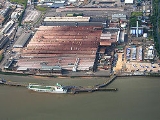
Dagenham

Encyclopedia
Dagenham is a large suburb in East London, forming the eastern part of the London Borough of Barking and Dagenham
and located 12 miles (19.3 km) east of Charing Cross
. It was historically an agrarian village in the county of Essex
and remained mostly undeveloped until 1921 when the London County Council
began construction of the large Becontree
estate. The population of the area significantly increased during the 20th century, with the parish of Dagenham becoming an urban district
in 1926 and a municipal borough in 1938. It has formed part of Greater London
since 1965 and is a predominantly residential area, with some areas of declining industrial activity, including the Ford Dagenham plant. The population is set to rise as the southern part of Dagenham, adjacent to the River Thames
, forms part of the London Riverside
section of the Thames Gateway
redevelopment area.
dating from 686 AD. The almost certainly originated with a small farmstead, the "ham" or farm of a man called Daecca, as Dæccan hamm in Old English means home of a man called Dæcca.
relocated from Trafford Park
in Stretford
, to a plant in Dagenham, which was already the location of supplier Briggs Motor Bodies. A 500 acre (2 km²) riverside site was developed to become Europe's largest car plant, a vast vertically integrated
site with its own blast furnace
s and power station, importing iron ore and exporting finished vehicles. By the 1950s Ford had taken over Briggs at Dagenham and its other sites at Doncaster
, Southampton
, Croydon
and Romford
. At its peak the Dagenham plant had 4 million square feet (371600 m²) of floor space and employed 40,000. On February 20, 2002, full production was discontinued due to overcapacity in Europe and the relative difficulty of upgrading the 60 year old site compared with other European sites such as Almussafes
, Valencia
, Spain and Cologne
. Other factors leading to the closure of the Auto-assembly line were the need of the site for the new Diesel Centre of Excellence, which produces half of Ford's Diesel Engines worldwide and the UK employment laws when compared to Spanish, German and Belgian laws. In 2005 Cummins went into a joint venture and offered $15 million (US) to reinstate the factory. Ford and Cummins offered a good redundancy package, billed as one of the best in UK manufacturing. It is the location of the Dagenham wind turbines
. Some 4,000 people now work at the Ford plant. The movie Made in Dagenham
(2010) is a dramatisation of the 1968 Ford sewing machinists strike at the plant, where female workers walked out in protest against sexual discrimination and the desire for equal pay.
Sterling Ltd
who were famous for manufacturing British Army weapons and Jaguar car parts were also based in Dagenham until they went bankrupt in 1988. Other industrial names once known world wide were Ever Ready, whose batteries could be found in shops throughout the Commonwealth
, Bergers Paint
and the chemical firm of May and Baker who in 1935 revolutionized the production of antibiotics with their synthetic sulfa-drug known as M&B 693
. The May & Baker
plant, now owned and run by Sanofi-Aventis
, occupies a large site near to Dagenham East station, and its sports and social club has large grounds between Eastbrookend Country Park and the railway. In 2009 the company announced its intention to close the plant by 2013.
hundred of Essex
. The Metropolitan Police District
was extended to include Dagenham in 1840. The parish formed part of the Romford Rural District
from 1894. The expansion of the Greater London conurbation into the area caused the review of local government structures and it was suggested in 1920 that the Dagenham parish should be abolished and its area divided between Ilford Urban District
and Barking Town Urban District
. Separately, the London County Council proposed that its area of responsibility should be expanded beyond the County of London
to cover the area. Instead, in 1926 the Dagenham parish was removed from the Romford Rural District and became an urban district
. In 1938, in further recognition of its development, Dagenham became a municipal borough
. In 1965 the Municipal Borough of Dagenham
was abolished and its former area became part of the London Borough of Barking
, which is now known as Barking and Dagenham.
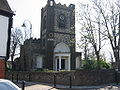 In 1205 Dagenham was large enough to have a chaplain
and the Parish Church of St Peter and St Paul was probably built at around that time. In 1854, a station was opened on the London, Tilbury and Southend Railway
in the south of Dagenham, near the Thames, at Dagenham Dock
. In 1885 a new direct route from Barking to Pitsea, via Upminster, was built with a new station opened just north of the village. Dagenham was still an undeveloped village, when building of the vast Becontree
estate by the London County Council
began in the early 1920s. The building of the enormous council estate, which also spread into the neighbouring parishes of Ilford
and Barking
, caused a rapid increase in population. In 1932 the electrified District Line
of the London Underground
was extended to Upminster
through Dagenham with stations opened as Dagenham and Heathway and today called Dagenham East
and Dagenham Heathway
. Dagenham East was the location of the Dagenham East rail crash
in 1958. Services on the London Tilbury & Southend line at Dagenham East were withdrawn in 1962.
and the London Assembly constituency of City and East
.
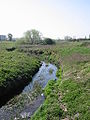 Dagenham Dock
, to the south of Dagenham and adjacent to the River Thames
, was once a large coaling port. The area now forms part of the London Riverside
section of the Thames Gateway
redevelopment zone. Major brownfield housing developments are forecast to increase the population by tens of thousands of people. The Roundhouse
public house on the junction of Porters Avenue and Lodge Avenue became East London's premier rock music venue between 1969 and 1975. Incorporating the "Village Blues Club", some notable bands who performed at the pub were Jethro Tull, Supertramp, Queen, Pink Floyd, Eric Clapton, Status Quo, and Led Zeppelin (on 5 April 1969).
(7%) and Asian
(5%) populations.
, Dagenham East
and Dagenham Heathway
. c2c
currently operate the National Rail
service from Dagenham Dock. National Rail services also operate from nearby Chadwell Heath
. Dagenham Heathway is served by the following Transport for London
contracted routes: London Buses
route 145,173,174,175 and 364.
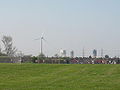 Valence House is in Becontree Avenue. It is the only surviving of the five manor houses of Dagenham. Dating back to the 13th century it is sited in parkland and is partially surrounded by a moat. Valence House is the borough's local history museum and art gallery, displaying an impressive collection of artifacts and archives that tell the story of the lives of the people of Barking and Dagenham. The collection also includes portraits, family papers and other mementoes of the Fanshawe family, who occupied Parsloes Manor, since demolished, from the sixteenth century. The Fanshawe collection is "one of the best collections of gentry portraits in the country and is of international importance," according to Valence House. Among members of the Fanshawe family was the diplomat Sir Richard Fanshawe, 1st Baronet, whose portrait is at Valence House. Nine successive members of the Fanshawe family served as Remembrancer
to the Crown, following Henry Fanshawe's appointment to the position by Queen Elizabeth I in 1566. The appointment made possible the family's rise to prominence.
On the corner of Whalebone Lane and the Eastern Avenue, diagonally opposite the Moby-Dick
public house, is the site of a Saxon
moot hall
. The adjoining fields were used during World War II by the Royal Artillery
as an anti-aircraft battery before being converted into a Prisoner of War
camp for Germans. Further south down Whalebone Lane on the corner of the High Road is the Tollgate pub. This stands on the site of the milestone
which marked the ten mile (16 km) limit from the City of London
and the turnpike toll-gate.
, based in Dagenham, are currently playing in the Football League Two
having been promoted as playoff-winners of League two after beating
Rotherham United F.C.
3-2. Priot to this, they were the Nationwide Conference champions in the 2006/7 season. They play at the London Borough of Barking & Dagenham Stadium, on Victoria Road.
Motorcycle speedway was staged at the greyhound stadium in Ripple Road in the mid to late 1930s. The club run events focussed on training but a team called the Dagenham Daggers did take part in local competitions. It is possible that the venture was operational as early as 1931 a meeting at Caxton (Cambridgeshire) was advertised as Caxton Speedway v Dagenham Speedway.
Dagenham has a King George's Field in memorial to King George V
. The park, which has been in existence for over a century, was renamed in 1953 by Queen Elizabeth II. Dagenham also has many other parks such as Valence and Parsloes. Dagenham Crusaders Drum and Bugle Corps, founded by John Johnson, were the first British Drum Corps and performed in America for the first time in 1983. They have recently reformed to perform for DCUK's 30th anniversary, and in 2010 are fielding a competitive corps for the first time in 22 years.
The town is also home to the Dagenham Girl Pipers
, a bagpipe marching band
founded in 1930 by the Rev Joseph Waddington Graves.
, Lord Mayor of London
and was married to Frances Fanshawe of Parsloes Manor in Dagenham. Rev. Blackborne and his wife are buried at Saint Anne's Church, Kew
. The Blackborne family had long lived in Dagenham and Hornchurch. At the time of the Restoration, the entire manor of Cockermouth, to which the church was appended, was owned by Sir Thomas Darcy. Subsequently the manor was sold to the Blackborne family, and ultimately the heirs of William Blackborne Esq., High Sheriff of Essex
, sold to the Bonynges after Blackborne suffered devastating financial losses in the South Sea Bubble.
St Peter and Paul's Church in Dagenham was once the Parish Church of the former Archbishop of Canterbury, George Carey.
Musician and comedian Dudley Moore
was brought up in Dagenham, which was the home of Peter Cook
and Dudley Moore's famous comic alter-egos Pete and Dud
.
London Borough of Barking and Dagenham
In 1801, the civil parishes that form the modern borough had a total population of 1,937; and the area was characterised by farming, woodland and the fishing fleet at Barking. This last industry employed 1,370 men and boys by 1850, but by the end of the century had ceased to exist; replaced by...
and located 12 miles (19.3 km) east of Charing Cross
Charing Cross
Charing Cross denotes the junction of Strand, Whitehall and Cockspur Street, just south of Trafalgar Square in central London, England. It is named after the now demolished Eleanor cross that stood there, in what was once the hamlet of Charing. The site of the cross is now occupied by an equestrian...
. It was historically an agrarian village in the county of Essex
Essex
Essex is a ceremonial and non-metropolitan county in the East region of England, and one of the home counties. It is located to the northeast of Greater London. It borders with Cambridgeshire and Suffolk to the north, Hertfordshire to the west, Kent to the South and London to the south west...
and remained mostly undeveloped until 1921 when the London County Council
London County Council
London County Council was the principal local government body for the County of London, throughout its 1889–1965 existence, and the first London-wide general municipal authority to be directly elected. It covered the area today known as Inner London and was replaced by the Greater London Council...
began construction of the large Becontree
Becontree
Becontree is a place in the London Borough of Barking and Dagenham, east north-east of Charing Cross.-Becontree estate:The area was developed between 1921 and 1932 by the London County Council as a large council estate of 27,000 homes, intended as "homes for heroes" after World War I. With a...
estate. The population of the area significantly increased during the 20th century, with the parish of Dagenham becoming an urban district
Municipal Borough of Dagenham
Dagenham was a local government district in south west Essex, England from 1926 to 1965 covering the parish of Dagenham. Initially created as an urban district, it was incorporated as a municipal borough in 1938...
in 1926 and a municipal borough in 1938. It has formed part of Greater London
Greater London
Greater London is the top-level administrative division of England covering London. It was created in 1965 and spans the City of London, including Middle Temple and Inner Temple, and the 32 London boroughs. This territory is coterminate with the London Government Office Region and the London...
since 1965 and is a predominantly residential area, with some areas of declining industrial activity, including the Ford Dagenham plant. The population is set to rise as the southern part of Dagenham, adjacent to the River Thames
River Thames
The River Thames flows through southern England. It is the longest river entirely in England and the second longest in the United Kingdom. While it is best known because its lower reaches flow through central London, the river flows alongside several other towns and cities, including Oxford,...
, forms part of the London Riverside
London Riverside
The London Riverside is a new development area in north east London, England and part of the larger Thames Gateway redevelopment zone. The London Riverside area forms part of the Green Enterprise District, a project to create a low-carbon economy region in Greater London.It is one of two zones...
section of the Thames Gateway
Thames Gateway
The Thames Gateway is an area of land stretching east from inner east London on both sides of the River Thames and the Thames Estuary. The area, which includes much brownfield land, has been designated a national priority for urban regeneration, taking advantage of the development opportunities...
redevelopment area.
History
| 1881 | 3,411 |
|---|---|
| 1891 | 4,324 |
| 1901 | 6,091 |
| 1911 | 7,930 |
| 1921 | 9,127 |
| 1931 | 89,362 |
| 1941 | war # |
| 1951 | 114,568 |
| 1961 | 108,368 |
| # no census was held due to war | |
| source: UK census | |
Toponomy
Dagenham first appeared in a document (as Dæccanhaam) in a charter of Barking AbbeyBarking Abbey
The ruined remains of Barking Abbey are situated in Barking in the London Borough of Barking and Dagenham in east London, England, and now form a public open space.- History :...
dating from 686 AD. The almost certainly originated with a small farmstead, the "ham" or farm of a man called Daecca, as Dæccan hamm in Old English means home of a man called Dæcca.
Economic development
In 1931 the Ford Motor CompanyFord of Britain
Ford of Britain is a British wholly owned subsidiary of Ford of Europe, a subsidiary of Ford Motor Company. Its business started in 1909 and has its registered office in Brentwood, Essex...
relocated from Trafford Park
Trafford Park
Trafford Park is an area of the Metropolitan Borough of Trafford, in Greater Manchester, England. Located opposite Salford Quays, on the southern side of the Manchester Ship Canal, it is west-southwest of Manchester city centre, and north of Stretford. Until the late 19th century it was the...
in Stretford
Stretford
Stretford is a town within the Metropolitan Borough of Trafford, in Greater Manchester, England. Lying on flat ground between the River Mersey and the Manchester Ship Canal, it is to the southwest of Manchester city centre, south-southwest of Salford and northeast of Altrincham...
, to a plant in Dagenham, which was already the location of supplier Briggs Motor Bodies. A 500 acre (2 km²) riverside site was developed to become Europe's largest car plant, a vast vertically integrated
Vertical integration
In microeconomics and management, the term vertical integration describes a style of management control. Vertically integrated companies in a supply chain are united through a common owner. Usually each member of the supply chain produces a different product or service, and the products combine to...
site with its own blast furnace
Blast furnace
A blast furnace is a type of metallurgical furnace used for smelting to produce industrial metals, generally iron.In a blast furnace, fuel and ore and flux are continuously supplied through the top of the furnace, while air is blown into the bottom of the chamber, so that the chemical reactions...
s and power station, importing iron ore and exporting finished vehicles. By the 1950s Ford had taken over Briggs at Dagenham and its other sites at Doncaster
Doncaster
Doncaster is a town in South Yorkshire, England, and the principal settlement of the Metropolitan Borough of Doncaster. The town is about from Sheffield and is popularly referred to as "Donny"...
, Southampton
Southampton
Southampton is the largest city in the county of Hampshire on the south coast of England, and is situated south-west of London and north-west of Portsmouth. Southampton is a major port and the closest city to the New Forest...
, Croydon
Croydon
Croydon is a town in South London, England, located within the London Borough of Croydon to which it gives its name. It is situated south of Charing Cross...
and Romford
Romford
Romford is a large suburban town in north east London, England and the administrative headquarters of the London Borough of Havering. It is located northeast of Charing Cross and is one of the major metropolitan centres identified in the London Plan...
. At its peak the Dagenham plant had 4 million square feet (371600 m²) of floor space and employed 40,000. On February 20, 2002, full production was discontinued due to overcapacity in Europe and the relative difficulty of upgrading the 60 year old site compared with other European sites such as Almussafes
Almussafes
Almussafes is a municipality in the comarca of Ribera Baixa in the Valencian Community, Spain.The town of Almussafes is host for an important factory of the Ford Motor Company....
, Valencia
Valencia (province)
Valencia or València is a province of Spain, in the central part of the Valencian Community.It is bordered by the provinces of Alicante, Albacete, Cuenca, Teruel, Castellón, and the Mediterranean Sea...
, Spain and Cologne
Cologne
Cologne is Germany's fourth-largest city , and is the largest city both in the Germany Federal State of North Rhine-Westphalia and within the Rhine-Ruhr Metropolitan Area, one of the major European metropolitan areas with more than ten million inhabitants.Cologne is located on both sides of the...
. Other factors leading to the closure of the Auto-assembly line were the need of the site for the new Diesel Centre of Excellence, which produces half of Ford's Diesel Engines worldwide and the UK employment laws when compared to Spanish, German and Belgian laws. In 2005 Cummins went into a joint venture and offered $15 million (US) to reinstate the factory. Ford and Cummins offered a good redundancy package, billed as one of the best in UK manufacturing. It is the location of the Dagenham wind turbines
Dagenham wind turbines
The Dagenham wind turbines are two 85 m high Enercon E-70 wind turbines located on the Dagenham estate of the Ford Motor Company in east London, England. The turbines were completed in April 2004...
. Some 4,000 people now work at the Ford plant. The movie Made in Dagenham
Made in Dagenham
Made in Dagenham is a 2010 British film directed by Nigel Cole. The film stars Sally Hawkins, Miranda Richardson, Rosamund Pike and Jaime Winstone. It dramatises the Ford sewing machinists strike of 1968 that aimed for equal pay for women...
(2010) is a dramatisation of the 1968 Ford sewing machinists strike at the plant, where female workers walked out in protest against sexual discrimination and the desire for equal pay.
Sterling Ltd
Sterling Armaments Company
Sterling Armaments Company was an arms manufacturer based in Dagenham, famous for manufacturing the L2A3 , AR18 and SAR-87 assault rifles and parts of Jaguar cars. The company went bankrupt in 1988....
who were famous for manufacturing British Army weapons and Jaguar car parts were also based in Dagenham until they went bankrupt in 1988. Other industrial names once known world wide were Ever Ready, whose batteries could be found in shops throughout the Commonwealth
Commonwealth of Nations
The Commonwealth of Nations, normally referred to as the Commonwealth and formerly known as the British Commonwealth, is an intergovernmental organisation of fifty-four independent member states...
, Bergers Paint
Asian Paints
Asian Paints is an Indian paint company headquartered in Mumbai, India. Asian Paints is India’s largest paint company and Asia’s third largest paint company, with a turnover of Rs 77.06 billion.It is one of the largest paint corporation that operates in 17 countries and has 23 paint manufacturing...
and the chemical firm of May and Baker who in 1935 revolutionized the production of antibiotics with their synthetic sulfa-drug known as M&B 693
Sulfapyridine
Sulfapyridine, original UK spelling Sulphapyridine, is a sulfonamide antibacterial. At one time it was commonly referred to as M&B....
. The May & Baker
May & Baker
May & Baker was a British chemical company.It was started by Mr. May and Mr. Baker in Wandsworth, London in 1851. They initially specialized in the manufacture of chemicals derived from Mercury and Bismuth...
plant, now owned and run by Sanofi-Aventis
Sanofi-Aventis
Sanofi S.A. is a multinational pharmaceutical company headquartered in Paris, France, the world's fourth-largest by prescription sales. Sanofi engages in the research and development, manufacturing and marketing of pharmaceutical products for sale principally in the prescription market, but the...
, occupies a large site near to Dagenham East station, and its sports and social club has large grounds between Eastbrookend Country Park and the railway. In 2009 the company announced its intention to close the plant by 2013.
Local government
Dagenham was an ancient, and later civil, parish in the BecontreeBecontree (hundred)
Becontree was an ancient hundred in the south west of the county of Essex, England. Its area has been entirely absorbed by the growth of London; with its name reused in 1921 for the large Becontree estate of the London County Council...
hundred of Essex
Essex
Essex is a ceremonial and non-metropolitan county in the East region of England, and one of the home counties. It is located to the northeast of Greater London. It borders with Cambridgeshire and Suffolk to the north, Hertfordshire to the west, Kent to the South and London to the south west...
. The Metropolitan Police District
Metropolitan Police District
The Metropolitan Police District is the police area which is policed by London's Metropolitan Police Service. It currently consists of Greater London, excluding the City of London.-History:...
was extended to include Dagenham in 1840. The parish formed part of the Romford Rural District
Romford Rural District
Romford Rural District was a local government district in south west Essex, England from 1894 to 1934. It surrounded, but did not include, Romford which formed a separate urban district...
from 1894. The expansion of the Greater London conurbation into the area caused the review of local government structures and it was suggested in 1920 that the Dagenham parish should be abolished and its area divided between Ilford Urban District
Municipal Borough of Ilford
Ilford was a civil parish and local government district in south west Essex, England from 1888 to 1965, covering the town Ilford. The district saw a considerable rise in population throughout its life, caused by the expansion of the built-up area of London, and became one of the most populous...
and Barking Town Urban District
Municipal Borough of Barking
Barking was a local government district in south west Essex, England from 1882 to 1965. It included the town of Barking, eastern Beckton and the south western part of the Becontree estate. The district was within the Metropolitan Police District and experienced a steady increase in population...
. Separately, the London County Council proposed that its area of responsibility should be expanded beyond the County of London
County of London
The County of London was a county of England from 1889 to 1965, corresponding to the area known today as Inner London. It was created as part of the general introduction of elected county government in England, by way of the Local Government Act 1888. The Act created an administrative County of...
to cover the area. Instead, in 1926 the Dagenham parish was removed from the Romford Rural District and became an urban district
Urban district
In the England, Wales and Ireland, an urban district was a type of local government district that covered an urbanised area. Urban districts had an elected Urban District Council , which shared local government responsibilities with a county council....
. In 1938, in further recognition of its development, Dagenham became a municipal borough
Municipal borough
Municipal boroughs were a type of local government district which existed in England and Wales between 1835 and 1974, in Northern Ireland from 1840 to 1973 and in the Republic of Ireland from 1840 to 2002...
. In 1965 the Municipal Borough of Dagenham
Municipal Borough of Dagenham
Dagenham was a local government district in south west Essex, England from 1926 to 1965 covering the parish of Dagenham. Initially created as an urban district, it was incorporated as a municipal borough in 1938...
was abolished and its former area became part of the London Borough of Barking
London Borough of Barking and Dagenham
In 1801, the civil parishes that form the modern borough had a total population of 1,937; and the area was characterised by farming, woodland and the fishing fleet at Barking. This last industry employed 1,370 men and boys by 1850, but by the end of the century had ceased to exist; replaced by...
, which is now known as Barking and Dagenham.
Market gardens to suburban estate
Chaplain
Traditionally, a chaplain is a minister in a specialized setting such as a priest, pastor, rabbi, or imam or lay representative of a religion attached to a secular institution such as a hospital, prison, military unit, police department, university, or private chapel...
and the Parish Church of St Peter and St Paul was probably built at around that time. In 1854, a station was opened on the London, Tilbury and Southend Railway
London, Tilbury and Southend Railway
The London, Tilbury and Southend Railway is an English railway line linking Fenchurch Street railway station in the City of London with northeast London and the entire length of the northern Thames Gateway area of southern Essex. It is currently known as the Essex Thameside Route by Network Rail...
in the south of Dagenham, near the Thames, at Dagenham Dock
Dagenham Dock railway station
Dagenham Dock is a railway station located in Dagenham in northeast London, England. The station is managed by c2c and all train services calling at the station are operated by the company. The station is in Zone 5. It is next to the A13 road and the closest station to the local Ford Dagenham plant...
. In 1885 a new direct route from Barking to Pitsea, via Upminster, was built with a new station opened just north of the village. Dagenham was still an undeveloped village, when building of the vast Becontree
Becontree
Becontree is a place in the London Borough of Barking and Dagenham, east north-east of Charing Cross.-Becontree estate:The area was developed between 1921 and 1932 by the London County Council as a large council estate of 27,000 homes, intended as "homes for heroes" after World War I. With a...
estate by the London County Council
London County Council
London County Council was the principal local government body for the County of London, throughout its 1889–1965 existence, and the first London-wide general municipal authority to be directly elected. It covered the area today known as Inner London and was replaced by the Greater London Council...
began in the early 1920s. The building of the enormous council estate, which also spread into the neighbouring parishes of Ilford
Ilford
Ilford is a large cosmopolitan town in East London, England and the administrative headquarters of the London Borough of Redbridge. It is located northeast of Charing Cross and is one of the major metropolitan centres identified in the London Plan. It forms a significant commercial and retail...
and Barking
Barking
Barking is a suburban town in the London Borough of Barking and Dagenham, in East London, England. A retail and commercial centre situated in the west of the borough, it lies east of Charing Cross. Barking was in the historic county of Essex until it was absorbed by Greater London. The area is...
, caused a rapid increase in population. In 1932 the electrified District Line
District Line
The District line is a line of the London Underground, coloured green on the Tube map. It is a "sub-surface" line, running through the central area in shallow cut-and-cover tunnels. It is the busiest of the sub-surface lines. Out of the 60 stations served, 25 are underground...
of the London Underground
London Underground
The London Underground is a rapid transit system serving a large part of Greater London and some parts of Buckinghamshire, Hertfordshire and Essex in England...
was extended to Upminster
Upminster
Upminster is a suburban town in northeast London, England, and part of the London Borough of Havering. Located east-northeast of Charing Cross, it is one of the locally important district centres identified in the London Plan, and comprises a number of shopping streets and a large residential...
through Dagenham with stations opened as Dagenham and Heathway and today called Dagenham East
Dagenham East tube station
Dagenham East is a London Underground station on the District line, located in the suburb of Dagenham, in the London Borough of Barking and Dagenham. The station is in Zone 5 and is located between Dagenham Heathway to the west and Elm Park to the east. The station has moderate usage for a...
and Dagenham Heathway
Dagenham Heathway tube station
Dagenham Heathway is a London Underground station on the District line, located in Dagenham. It is in Zone 5.The station was opened in 1932 and is of similar design to Upney and Elm Park with the platforms arranged on a central island with a long sloping walkway connection to the ticket hall...
. Dagenham East was the location of the Dagenham East rail crash
Dagenham East rail crash
The Dagenham East rail crash was a railway accident on the London, Tilbury and Southend Railway line of British Railways which occurred at Dagenham, United Kingdom....
in 1958. Services on the London Tilbury & Southend line at Dagenham East were withdrawn in 1962.
Governance
Dagenham is part of the Dagenham and Rainham parliamentary constituencyDagenham and Rainham (UK Parliament constituency)
Dagenham and Rainham is a constituency represented in the House of Commons of the Parliament of the United Kingdom. It elects one Member of Parliament by the first past the post system of election...
and the London Assembly constituency of City and East
City and East (London Assembly constituency)
City and East is a constituency represented in the London Assembly. Since its creation in 2000 it has been represented by Labour's John Biggs.-Boundaries:...
.
Geography
Dagenham Dock
Dagenham Dock is a place in the London Borough of Barking and Dagenham in London, England. It is located to the south of Dagenham and on the River Thames. It was once the site of a large coaling port and continues to be the location of a small terminal licensed to handle coal off-loading...
, to the south of Dagenham and adjacent to the River Thames
River Thames
The River Thames flows through southern England. It is the longest river entirely in England and the second longest in the United Kingdom. While it is best known because its lower reaches flow through central London, the river flows alongside several other towns and cities, including Oxford,...
, was once a large coaling port. The area now forms part of the London Riverside
London Riverside
The London Riverside is a new development area in north east London, England and part of the larger Thames Gateway redevelopment zone. The London Riverside area forms part of the Green Enterprise District, a project to create a low-carbon economy region in Greater London.It is one of two zones...
section of the Thames Gateway
Thames Gateway
The Thames Gateway is an area of land stretching east from inner east London on both sides of the River Thames and the Thames Estuary. The area, which includes much brownfield land, has been designated a national priority for urban regeneration, taking advantage of the development opportunities...
redevelopment zone. Major brownfield housing developments are forecast to increase the population by tens of thousands of people. The Roundhouse
Dagenham Roundhouse
Dagenham Roundhouse is a pub and music venue in Dagenham, East London, England.It was established in 1969 as the "Village Blues Club", and from then until 1975 was considered to be East London's premier rock music venue....
public house on the junction of Porters Avenue and Lodge Avenue became East London's premier rock music venue between 1969 and 1975. Incorporating the "Village Blues Club", some notable bands who performed at the pub were Jethro Tull, Supertramp, Queen, Pink Floyd, Eric Clapton, Status Quo, and Led Zeppelin (on 5 April 1969).
Demography
Dagenham is a predominantly white, working class area. At the last census in 2001, around 85% of the population was "white", with 80% being classed as "white: British". The remaining 20% of the population were primarily other European nationalities (5%), BlackBlack people
The term black people is used in systems of racial classification for humans of a dark skinned phenotype, relative to other racial groups.Different societies apply different criteria regarding who is classified as "black", and often social variables such as class, socio-economic status also plays a...
(7%) and Asian
Asian people
Asian people or Asiatic people is a term with multiple meanings that refers to people who descend from a portion of Asia's population.- Central Asia :...
(5%) populations.
Transport
There are London Underground services from BecontreeBecontree tube station
Becontree Station is a London Underground station on the District Line, located in Becontree. The station is in Zone 5.The station was opened in 1932, when the electrified District Line was extended to Upminster, replacing Gale Street Halt which was built by the London, Tilbury and Southend...
, Dagenham East
Dagenham East tube station
Dagenham East is a London Underground station on the District line, located in the suburb of Dagenham, in the London Borough of Barking and Dagenham. The station is in Zone 5 and is located between Dagenham Heathway to the west and Elm Park to the east. The station has moderate usage for a...
and Dagenham Heathway
Dagenham Heathway tube station
Dagenham Heathway is a London Underground station on the District line, located in Dagenham. It is in Zone 5.The station was opened in 1932 and is of similar design to Upney and Elm Park with the platforms arranged on a central island with a long sloping walkway connection to the ticket hall...
. c2c
C2c
c2c is a British train operating company that is part of the National Express Group. It provides passenger rail services on the London, Tilbury and Southend Railway line from Fenchurch Street railway station in the City of London to east London and the entire length of the northern Thames Gateway...
currently operate the National Rail
National Rail
National Rail is a title used by the Association of Train Operating Companies as a generic term to define the passenger rail services operated in Great Britain...
service from Dagenham Dock. National Rail services also operate from nearby Chadwell Heath
Chadwell Heath railway station
Chadwell Heath station is a railway station at Chadwell Heath. The station lies in the London Borough of Redbridge part of Chadwell Heath, which is also covered by London Borough of Barking and Dagenham in east London. It was opened on 11 January 1864, and is built on the site of Wangey House, one...
. Dagenham Heathway is served by the following Transport for London
Transport for London
Transport for London is the local government body responsible for most aspects of the transport system in Greater London in England. Its role is to implement the transport strategy and to manage transport services across London...
contracted routes: London Buses
London Buses
London Buses is the subsidiary of Transport for London that manages bus services within Greater London, UK. Buses are required to carry similar red colour schemes and conform to the same fare scheme...
route 145,173,174,175 and 364.
Culture
Remembrancer
The Remembrancer was originally one of certain subordinate officers of the English Exchequer. The office itself is of great antiquity, the holder having been termed remembrancer, memorator, rememorator, registrar, keeper of the register, despatcher of business...
to the Crown, following Henry Fanshawe's appointment to the position by Queen Elizabeth I in 1566. The appointment made possible the family's rise to prominence.
On the corner of Whalebone Lane and the Eastern Avenue, diagonally opposite the Moby-Dick
Moby-Dick
Moby-Dick; or, The Whale, was written by American author Herman Melville and first published in 1851. It is considered by some to be a Great American Novel and a treasure of world literature. The story tells the adventures of wandering sailor Ishmael, and his voyage on the whaleship Pequod,...
public house, is the site of a Saxon
Anglo-Saxons
Anglo-Saxon is a term used by historians to designate the Germanic tribes who invaded and settled the south and east of Great Britain beginning in the early 5th century AD, and the period from their creation of the English nation to the Norman conquest. The Anglo-Saxon Era denotes the period of...
moot hall
Moot hall
A moot hall is meeting or assembly building, traditionally to decide local issues.In Anglo-Saxon England, a low ring-shaped earthwork served as a moot hill or moot mound, where the elders of the hundred would meet to take decisions. Some of these acquired permanent buildings, known as moot halls...
. The adjoining fields were used during World War II by the Royal Artillery
Royal Artillery
The Royal Regiment of Artillery, commonly referred to as the Royal Artillery , is the artillery arm of the British Army. Despite its name, it comprises a number of regiments.-History:...
as an anti-aircraft battery before being converted into a Prisoner of War
Prisoner of war
A prisoner of war or enemy prisoner of war is a person, whether civilian or combatant, who is held in custody by an enemy power during or immediately after an armed conflict...
camp for Germans. Further south down Whalebone Lane on the corner of the High Road is the Tollgate pub. This stands on the site of the milestone
Milestone
A milestone is one of a series of numbered markers placed along a road or boundary at intervals of one mile or occasionally, parts of a mile. They are typically located at the side of the road or in a median. They are alternatively known as mile markers, mileposts or mile posts...
which marked the ten mile (16 km) limit from the City of London
City of London
The City of London is a small area within Greater London, England. It is the historic core of London around which the modern conurbation grew and has held city status since time immemorial. The City’s boundaries have remained almost unchanged since the Middle Ages, and it is now only a tiny part of...
and the turnpike toll-gate.
Sport
Dagenham & Redbridge F.C.Dagenham & Redbridge F.C.
Dagenham & Redbridge Football Club , informally known as Daggers, is an English association football club based in Dagenham, in the London Borough of Barking & Dagenham, East London. It was formed in 1992 after a merger between Redbridge Forest and Dagenham...
, based in Dagenham, are currently playing in the Football League Two
Football League Two
Football League Two is the third-highest division of The Football League and fourth-highest division overall in the English football league system....
having been promoted as playoff-winners of League two after beating
2010 Football League Two play-off Final
-References:...
Rotherham United F.C.
Rotherham United F.C.
Rotherham United Football Club are an English professional football club based in Rotherham, South Yorkshire, who compete in League Two, the fourth tier of English football. The club's colours have traditionally been red and white, although these have evolved through history...
3-2. Priot to this, they were the Nationwide Conference champions in the 2006/7 season. They play at the London Borough of Barking & Dagenham Stadium, on Victoria Road.
Motorcycle speedway was staged at the greyhound stadium in Ripple Road in the mid to late 1930s. The club run events focussed on training but a team called the Dagenham Daggers did take part in local competitions. It is possible that the venture was operational as early as 1931 a meeting at Caxton (Cambridgeshire) was advertised as Caxton Speedway v Dagenham Speedway.
Dagenham has a King George's Field in memorial to King George V
George V of the United Kingdom
George V was King of the United Kingdom and the British Dominions, and Emperor of India, from 6 May 1910 through the First World War until his death in 1936....
. The park, which has been in existence for over a century, was renamed in 1953 by Queen Elizabeth II. Dagenham also has many other parks such as Valence and Parsloes. Dagenham Crusaders Drum and Bugle Corps, founded by John Johnson, were the first British Drum Corps and performed in America for the first time in 1983. They have recently reformed to perform for DCUK's 30th anniversary, and in 2010 are fielding a competitive corps for the first time in 22 years.
The town is also home to the Dagenham Girl Pipers
Dagenham Girl Pipers
The Dagenham Girl Pipers are a female bagpipe marching band based in Dagenham, London, UK.The band was formed in by a Congregational minister, Rev Joseph Waddington Graves, in 1930, turning professional three years later, and have toured internationally...
, a bagpipe marching band
Marching band
Marching band is a physical activity in which a group of instrumental musicians generally perform outdoors and incorporate some type of marching with their musical performance. Instrumentation typically includes brass, woodwinds, and percussion instruments...
founded in 1930 by the Rev Joseph Waddington Graves.
Notable people
One of the longest-serving vicars of Dagenham was Rev. Abraham Blackborne, who died at age 82 in 1797, having served Dagenham for 58 years. Rev. Blackborne was the grandson of Sir Richard LevettRichard Levett
Sir Richard Levett , Sheriff, Alderman and Lord Mayor of London, was one of the first directors of the Bank of England, an adventurer with the London East India Company and the proprietor of the trading firm Sir Richard Levett & Company. He had homes at Kew and in London's Cripplegate, close by...
, Lord Mayor of London
Lord Mayor of London
The Right Honourable Lord Mayor of London is the legal title for the Mayor of the City of London Corporation. The Lord Mayor of London is to be distinguished from the Mayor of London; the former is an officer only of the City of London, while the Mayor of London is the Mayor of Greater London and...
and was married to Frances Fanshawe of Parsloes Manor in Dagenham. Rev. Blackborne and his wife are buried at Saint Anne's Church, Kew
Kew
Kew is a place in the London Borough of Richmond upon Thames in South West London. Kew is best known for being the location of the Royal Botanic Gardens, now a World Heritage Site, which includes Kew Palace...
. The Blackborne family had long lived in Dagenham and Hornchurch. At the time of the Restoration, the entire manor of Cockermouth, to which the church was appended, was owned by Sir Thomas Darcy. Subsequently the manor was sold to the Blackborne family, and ultimately the heirs of William Blackborne Esq., High Sheriff of Essex
High Sheriff of Essex
The High Sheriff of Essex was an ancient High Sheriff title originating in the time of the Angles, not long after the invasion of the Kingdom of England, which was in existence for around a thousand years...
, sold to the Bonynges after Blackborne suffered devastating financial losses in the South Sea Bubble.
St Peter and Paul's Church in Dagenham was once the Parish Church of the former Archbishop of Canterbury, George Carey.
Musician and comedian Dudley Moore
Dudley Moore
Dudley Stuart John Moore, CBE was an English actor, comedian, composer and musician.Moore first came to prominence as one of the four writer-performers in the ground-breaking comedy revue Beyond the Fringe in the early 1960s, and then became famous as half of the highly popular television...
was brought up in Dagenham, which was the home of Peter Cook
Peter Cook
Peter Edward Cook was an English satirist, writer and comedian. An extremely influential figure in modern British comedy, he is regarded as the leading light of the British satire boom of the 1960s. He has been described by Stephen Fry as "the funniest man who ever drew breath," although Cook's...
and Dudley Moore's famous comic alter-egos Pete and Dud
Pete and Dud
Pete and Dud were characters played by the comedians and entertainers Peter Cook and Dudley Moore.The dialogue format originated in 1964 when Dudley Moore invited Peter Cook to appear in a television performance, whereupon Peter Cook scripted a conversation between two men from Dagenham in flat caps...
.