
All Topics  
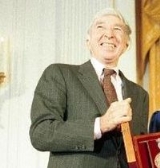
John Updike

 
John Updike

   Email Print
   Bookmark   Link


John Updike


John Hoyer Updike (March 18, 1932 – January 27, 2009) was an American novelist, poet
Poet

A poet is a person who writes poetry....
, short story
Short story

The short story refers to a work of fiction that is usually written in prose, usually in narrative format. This format or medium tends to be more pointed than longer works of fiction, such as novellas and novels or books....
 writer
Writer

A writer is anyone who creates a written work, although the word usually designates those who write creatively or professionally, as well as those who have written in many different forms....
, art critic
Art critic

An art critic is a person who specializes in evaluating art. Their written critiques, or reviews, are published in newspapers, magazines, books and on web sites....
, and literary critic. Updike's most famous work is his Rabbit series (Rabbit, Run
Rabbit, Run

Rabbit, Run is a 1960 novel by John Updike....
; Rabbit Redux
Rabbit Redux

Rabbit Redux is a 1971 novel by John Updike. It is the second book in his "Rabbit" series, which begins with Rabbit, Run, and is followed by Rabbit Is Rich and Rabbit At Rest....
; Rabbit Is Rich
Rabbit Is Rich

Rabbit Is Rich is a 1981 novel by John Updike. It is the third novel in the four-part series which begins with Rabbit, Run and Rabbit Redux, and concludes with Rabbit At Rest....
; Rabbit At Rest
Rabbit At Rest

Rabbit at Rest is a 1990 novel by John Updike. It is the fourth and final novel in a series beginning with Rabbit, Run, Rabbit Redux, and Rabbit is Rich. There is also a related 2001 novella, Rabbit Remembered....
; and Rabbit Remembered
Rabbit Remembered

Rabbit Remembered is a 2001 novella by John Updike, and a sequel to his "Rabbit" series. It first appeared in his collection of short fiction titled Licks of Love....
). Both Rabbit is Rich and Rabbit at Rest received the Pulitzer Prize
Pulitzer Prize for Fiction

The Pulitzer Prize for Fiction has been awarded since 1948 for distinguished fiction by an American author, preferably dealing with American life....
. Describing his subject as "the American small town, Protestant middle class
Middle class

Middle class is the group of people in contemporary society who are between the working class and nobility. This socioeconomic class includes professionals, highly skilled workers, and lower and middle management....
," Updike was widely recognized for his careful craftsmanship, his highly stylistic prose, and his prolific output, having published more than twenty novels and more than a dozen short story collections, as well as poetry
Poetry

Poetry is a form of literature art in which language is used for its aesthetics and evocative qualities in addition to, or in lieu of, its apparent meaning ....
, art criticism
Art criticism

Art criticism is the discussion or evaluation of visual art.Art critics usually criticize art in the context of aesthetics or the theory of beauty....
, literary criticism
Literary criticism

Literary criticism is the study, discussion, evaluation, and interpretation of literature. Modern literary criticism is often informed by literary theory, which is the philosophical discussion of its methods and goals....
 and children's books.


Discussion
Ask a question about 'John Updike'
Start a new discussion about 'John Updike'
Answer questions from other users
Full Discussion Forum


Quotations


A healthy male adult bore consumes each year one and a half times his own weight in other people's patience.

Assorted Prose (1965)

All men are boys time is trying to outsmart.

"Rabbit, Redux" (1969)

America is a vast conspiracy to make you happy.

Problems and Other Stories (1979)

Any decent kind of world, you wouldn't need all these rules.

"Rabbit, Redux" (1969)

Freedom, that he always thought was outward motion, turns out to be this inward dwindling.

"Rabbit, Redux" (1969)

Like water, blood must run or grow scum.

"Rabbit, Redux" (1969)


Encyclopedia


John Hoyer Updike (March 18, 1932 – January 27, 2009) was an American novelist, poet
Poet

A poet is a person who writes poetry....
, short story
Short story

The short story refers to a work of fiction that is usually written in prose, usually in narrative format. This format or medium tends to be more pointed than longer works of fiction, such as novellas and novels or books....
 writer
Writer

A writer is anyone who creates a written work, although the word usually designates those who write creatively or professionally, as well as those who have written in many different forms....
, art critic
Art critic

An art critic is a person who specializes in evaluating art. Their written critiques, or reviews, are published in newspapers, magazines, books and on web sites....
, and literary critic. Updike's most famous work is his Rabbit series (Rabbit, Run
Rabbit, Run

Rabbit, Run is a 1960 novel by John Updike....
; Rabbit Redux
Rabbit Redux

Rabbit Redux is a 1971 novel by John Updike. It is the second book in his "Rabbit" series, which begins with Rabbit, Run, and is followed by Rabbit Is Rich and Rabbit At Rest....
; Rabbit Is Rich
Rabbit Is Rich

Rabbit Is Rich is a 1981 novel by John Updike. It is the third novel in the four-part series which begins with Rabbit, Run and Rabbit Redux, and concludes with Rabbit At Rest....
; Rabbit At Rest
Rabbit At Rest

Rabbit at Rest is a 1990 novel by John Updike. It is the fourth and final novel in a series beginning with Rabbit, Run, Rabbit Redux, and Rabbit is Rich. There is also a related 2001 novella, Rabbit Remembered....
; and Rabbit Remembered
Rabbit Remembered

Rabbit Remembered is a 2001 novella by John Updike, and a sequel to his "Rabbit" series. It first appeared in his collection of short fiction titled Licks of Love....
). Both Rabbit is Rich and Rabbit at Rest received the Pulitzer Prize
Pulitzer Prize for Fiction

The Pulitzer Prize for Fiction has been awarded since 1948 for distinguished fiction by an American author, preferably dealing with American life....
. Describing his subject as "the American small town, Protestant middle class
Middle class

Middle class is the group of people in contemporary society who are between the working class and nobility. This socioeconomic class includes professionals, highly skilled workers, and lower and middle management....
," Updike was widely recognized for his careful craftsmanship, his highly stylistic prose, and his prolific output, having published more than twenty novels and more than a dozen short story collections, as well as poetry
Poetry

Poetry is a form of literature art in which language is used for its aesthetics and evocative qualities in addition to, or in lieu of, its apparent meaning ....
, art criticism
Art criticism

Art criticism is the discussion or evaluation of visual art.Art critics usually criticize art in the context of aesthetics or the theory of beauty....
, literary criticism
Literary criticism

Literary criticism is the study, discussion, evaluation, and interpretation of literature. Modern literary criticism is often informed by literary theory, which is the philosophical discussion of its methods and goals....
 and children's books. Hundreds of his stories, reviews, and poems appeared in The New Yorker
The New Yorker

The New Yorker is an United States magazine that publishes reportage, commentary, criticism, essays, fiction, satire, cartoons, and poetry. Starting as a weekly in the mid-1920s, the magazine is now published 47 times per year, with five of these issues covering two-week spans....
, starting in 1954. He also wrote regularly for The New York Review of Books
The New York Review of Books

The New York Review of Books is a fortnightly magazine with articles on literature, culture and current affairs published in New York City....
. His work attracted a significant amount of critical
Literary criticism

Literary criticism is the study, discussion, evaluation, and interpretation of literature. Modern literary criticism is often informed by literary theory, which is the philosophical discussion of its methods and goals....
 attention and he was considered one of the most prominent contemporary American novelists. Updike died, aged 76, of lung cancer
Lung cancer

Lung cancer is a disease of uncontrolled cell growth in tissue of the lung. This growth may lead to metastasis, which is the invasion of adjacent tissue and infiltration beyond the lungs....
 on January 27, 2009.

Early life

John Hoyer Updike was born in Reading
Reading, Pennsylvania

Reading is a city in southeastern Pennsylvania, United States. It is the county seat of Berks County, Pennsylvania, and the center of the Greater Reading Area....
, Pennsylvania
Pennsylvania

The Commonwealth of Pennsylvania , often colloquially referred to as PA by natives and Northeasterners, is a U.S. state located in the Northeastern United States and Mid-Atlantic States regions of the United States....
, to author Linda Grace Hoyer Updike and Wesley Russell Updike, a high school mathematics teacher. John Updike was raised at 117 Philadelphia Avenue (now part of Route 724) in Shillington
Shillington, Pennsylvania

Shillington is a borough in Berks County, Pennsylvania, Pennsylvania, United States. The population was 5,059 at the United States Census 2000. It is the place where author John Updike lived until he was 13, and it is the basis for the town of Olinger, Pennsylvania that he wrote about in his fiction....
, Pennsylvania
Pennsylvania

The Commonwealth of Pennsylvania , often colloquially referred to as PA by natives and Northeasterners, is a U.S. state located in the Northeastern United States and Mid-Atlantic States regions of the United States....
, until he was 13, when his family moved to a sandstone farmhouse in Plowville, Berks County
Berks County, Pennsylvania

Berks County is a county located in the U.S. state of Pennsylvania. As of the United States Census 2000, the population was 373,638. The population in 2006 was estimated at 401,149 by the US Census Bureau....
, Pennsylvania
Pennsylvania

The Commonwealth of Pennsylvania , often colloquially referred to as PA by natives and Northeasterners, is a U.S. state located in the Northeastern United States and Mid-Atlantic States regions of the United States....
, where he became interested in reading and writing.

Updike later recalled seeing his mother writing at her desk and feeling inspired. "One of my earliest memories is of seeing her at her desk," her son later said. "I admired the writer's equipment, the typewriter eraser, the boxes of clean paper. And I remember the brown envelopes that stories would go off in -- and come back in."

These early years in Berks County would shape the environment of the Rabbit tetralogy, as well as many of his early novels and short stories (The Poorhouse Fair, The Centaur, Of The Farm, A Soft Spring Night in Shillington, The Other Side of the Street, etc.) Updike later attended Harvard
Harvard College

Harvard College is the undergraduate section and oldest school of Harvard University, a private university in the United States founded in 1636 by the Massachusetts legislature....
 after receiving a full scholarship. At Harvard, he served as president of the Harvard Lampoon
Harvard Lampoon

The Harvard Lampoon is an undergraduate humor publication and social organization founded in 1876 at Harvard University in Cambridge, Massachusetts, Massachusetts....
, before graduating summa cum laude in 1954 with a degree in English
English literature

The term English literature refers to literature written in the English language, including literature composed in English by writers not necessarily from England; Joseph Conrad was Polish, Robert Burns was Scottish, James Joyce was Irish, Dylan Thomas was Welsh, Edgar Allan Poe was American, Salman Rushdie is Indian, V.S....
. After graduation, he decided to pursue a career in graphic arts and attended The Ruskin School of Drawing and Fine Art
The Ruskin School of Drawing and Fine Art

The Ruskin School of Drawing and Fine Art, known as The Ruskin, is an experimental art school and research institute at the University of Oxford....
 at the University of Oxford
University of Oxford

The University of Oxford , located in the city of Oxford, Oxfordshire, England, is the List of oldest universities in continuous operation in the English-speaking world....
. On returning to the U.S., he became a regular contributor to The New Yorker
The New Yorker

The New Yorker is an United States magazine that publishes reportage, commentary, criticism, essays, fiction, satire, cartoons, and poetry. Starting as a weekly in the mid-1920s, the magazine is now published 47 times per year, with five of these issues covering two-week spans....
, but stayed only two years. Later, Updike moved to Ipswich
Ipswich, Massachusetts

Ipswich is a coastal New England town in Essex County, Massachusetts, Massachusetts, United States. The population was 12,987 at the 2000 census....
, Massachusetts
Massachusetts

The Commonwealth of Massachusetts is a U.S. state located in the New England region of the Northeastern United States United States. It borders Rhode Island and Connecticut to the south, New York to the west, and Vermont and New Hampshire to the north....
. It was alleged by many, including a columnist in a local newspaper, The Ipswich Chronicle, that the fictional town of Tarbox in Couples
Couples

Couples is a 1968 novel by John Updike which focuses on a promiscuous circle of married friends in the fictional Boston suburb of Tarbox. Much of the novel concerns the efforts of its characters to balance the pressures of Protestant sexual mores against increasingly flexible American attitudes toward sex in the 1960s....
 was, in fact, Ipswich. Updike denied the suggestion in a letter to the paper. Impressions of Updike's day-to-day life in Ipswich in the 1960s and 1970s are contained in a letter to the same paper published shortly following Updike's death and written by a friend and contemporary. It is believed that the towns of East Greenwich and Wickford, Rhode Island, served as the basis for Eastwick in The Witches of Eastwick
The Witches of Eastwick

The Witches of Eastwick is a 1984 novel by John Updike....
.

Career

Updike became most famous as a "chronicler of suburban adultery." He once wrote that it was "a subject which, if I have not exhausted, has exhausted me." Yet, on many occasions, Updike slipped away from familiar territory: The Witches of Eastwick
The Witches of Eastwick

The Witches of Eastwick is a 1984 novel by John Updike....
 (1984) later made into a movie of the same name
The Witches of Eastwick (film)

The Witches of Eastwick is a 1987 in film fantasy film/comedy film based on a The Witches of Eastwick by John Updike. It stars Jack Nicholson, Cher, Susan Sarandon and Michelle Pfeiffer....
 and then a West End musical, concerned a New England coven of divorcees, and was a bestseller; The Coup (1978) about a fictional Cold War
Cold War

The Cold War was the continuing state of conflict, tension and competition that existed between a number of world powers, including the United States, the Soviet Union, People's Republic of China, France, United Kingdom and those countries' respective allies from the mid-1940s to the early 1990s....
-era Africa
Africa

Africa is the world's second-largest and second most-populous continent, after Asia. At about 30.2 million km? including adjacent islands, it covers 6% of the Earth's total surface area and 20.4% of the total land area....
n dictatorship
Dictatorship

A dictatorship is usually defined as an Autocracy form of government in which the government is ruled by an individual, the dictator, without hereditary ascension....
, was similarly a bestseller, and reflects the author writing at his most Nabokovian
Vladimir Nabokov

Vladimir Vladimirovich Nabokov was a Multilingualism Russian-American novelist and short story writer.Nabokov wrote his first nine novels in Russian language, then rose to international prominence as a master English prose stylist....
; his 2000 postmodern effort Gertrude and Claudius
Gertrude and Claudius

Gertrude and Claudius is a novel by John Updike. It uses the known sources of Shakespeare's Hamlet to tell a story that draws on a rather straightforward revenge tale in the medieval Denmark depicted by Saxo Grammaticus in his twelfth-century Historiae Danicae, but incorporates extra plot elements added by Fran?ois de Belleforest in h...
 is a carefully researched overture to the story of Hamlet
Hamlet

Hamlet is a tragedy by William Shakespeare, believed to have been written between 1599 and 1601. The play, set in Denmark, recounts how Prince Hamlet exacts revenge on his uncle King Claudius, who has murdered King Hamlet, the King, and then taken the throne and married Gertrude ....
. Other important novels include The Centaur
The Centaur

The Centaur is a 1963 novel by John Updike. It won the National Book Award in 1964. The story concerns George Caldwell, a school teacher, and his son Peter, outside of Alton , Pennsylvania....
 (National Book Award, 1963), Couples (1968) and Roger's Version
Roger's Version

Roger's Version is a 1986 novel by John Updike about Roger Lambert, a theology professor in his fifties whose rather complacent faith is challenged by Dale, an evangelicalism graduate student who believes he can prove with computer science that God exists....
 (1986). Martin Amis
Martin Amis

Martin Louis Amis is an England novelist, essayist, professor, and short story writer, and the son of the novelist and poet Kingsley Amis. His works include such novels as Money , London Fields and The Information ....
 called Roger's Version a "near-masterpiece"; Couples both landed the author on the cover of TIME magazine
Time (magazine)

Time is a weekly United States newsmagazine, similar to Newsweek and U.S. News & World Report. A European edition is published from London....
 and made his fortune.

Updike enjoyed working in series: In addition to the five Harry "Rabbit" Angstrom novels, a recurrent Updike alter-ego is the moderately well-known, unprolific Jewish novelist and eventual Nobel laureate Henry Bech, chronicled in three comic short-story cycles: Bech: A Book (1970), Bech is Back (1981) and Bech At Bay: A Quasi-Novel (1998). His stories involving the socially-conscious (and socially successful) couple 'The Maples' are widely considered to be autobiographical, and several were the basis for the television movie
Television movie

A television movie is a feature film that is produced for and originally distributed by a television network....
 Too Far To Go
Too Far to Go

Too Far To Go is a collection of short stories by the American author John Updike published in 1979 and later made into a two-hour television movie on the NBC network with Glenn Close, Blythe Danner, and Michael Moriarty....
 starring Michael Moriarty
Michael Moriarty

Michael Moriarty is an United States-Canada Tony Award and Emmy Award-winning actor of stage and screen, as well as a prominent jazz musician. He is best known for his role as Benjamin Stone on the long-running TV series Law & Order....
 and Blythe Danner
Blythe Danner

Blythe Katharine Danner is an United States Emmy- and Tony Award-winning actor. She is the mother of actress Gwyneth Paltrow....
 which was broadcast on NBC. Updike stated that he chose this surname for the characters because he admired the beauty and resilience of the tree.

Updike stated at the dawn of his career an intention to publish one book a year, and advancing years slowed down neither his production nor inventiveness. In 1994 he rewrote the tale of Tristan and Isolde, Brazil; a multi-generational saga about religion and entertainment, In the Beauty of the Lilies
In the Beauty of the Lilies

In the Beauty of the Lilies is a 1996 novel by John Updike. It takes its title from a line of the abolitionist song "The Battle Hymn of the Republic." Beginning in 1910 and ending in 1990, it covers four generations of the Wilmot family, tying its fortunes to both the decline of the Christian faith and the rise of Hollywood in twentie...
 (1996); and a science fiction
Science fiction

Science fiction is a broad genre of fiction that often involves speculations based on current or future science or technology. Science fiction is found in books, art, television, films, games, theatre, and other media....
 novel, Toward the End of Time
Toward the end of time

Toward the End of Time is a novel by John Updike, published in 1997. It is the author's eighteenth novel....
 (1997). In Seek My Face (2002) he explored the post-war art scene. In Villages (2004), Updike returned to the familiar territory of infidelities in New England
New England

New England is a region of the United States located in the northeastern corner of the country, bounded by the Atlantic Ocean, Canada and New York State, and consisting of the modern U.S....
. His twenty-second novel, Terrorist
Terrorist (novel)

Terrorist is the 22nd novel written by John Updike....
, the story of a fervent, eighteen-year-old extremist Muslim in New Jersey, was published in June 2006; his sixth collection of non-fiction, "Due Considerations," appeared in the fall of 2007. His twenty-third novel, The Widows of Eastwick, was published in late 2008 and returned to the lives, thirty years later, of his three protagonists from the 1984 novel.

A large anthology of short stories from his literary career, titled The Early Stories 1953 – 1975 (2003) won the 2004 PEN/Faulkner Award for Fiction
PEN/Faulkner Award for Fiction

The PEN/Faulkner Award for Fiction is awarded annually by the PEN/Faulkner Foundation to the author of the best American work of fiction that year....
. He wrote in its preface that his career's intention had been to "give the mundane its beautiful due."

Updike worked in a wide array of genres, including fiction, poetry, essay, and memoir. His lone foray into drama, Buchanan Dying: a play, constituted something of a reversal, as in a 1968 interview Updike had claimed: "the unreality of painted people standing on a platform saying things they've said to each other for months is more than I can overlook." He further said: "From Twain
Mark Twain

Samuel Langhorne Clemens , better known by the pen name Mark Twain, was an United Statesmerican author and humorist. Twain is most noted for his novels Adventures of Huckleberry Finn, which has since been called the Great American Novel, and The Adventures of Tom Sawyer....
 to James
Henry James

Henry James, Order of Merit , son of theologian Henry James Sr., brother of the philosopher and psychologist William James and diarist Alice James, was an United States author....
 and Faulkner
William Faulkner

William Faulkner was a Nobel Prize in Literature-winning United States author. One of the most influential writers of the 20th century, his reputation is based on his novels, novellas and short story....
 to Bellow
Saul Bellow

Saul Bellow , was an acclaimed Canada-United States writer born in Canada of Russian-Jewish origin. He won the Nobel Prize in Literature in 1976 and the National Medal of Arts in 1988....
, the history of novelists as playwrights is a sad one."

In 2006 Updike was awarded the Rea Award for the Short Story
Rea Award for the Short Story

The Rea Award for the Short Story is an annual award given to a living United States or Canada author chosen for unusually significant contributions to short story fiction....
 for outstanding achievement. In 2008 the National Endowment for the Humanities
National Endowment for the Humanities

The National Endowment for the Humanities is an independent federal agency of the United States established by the National Foundation on the Arts and the Humanities Act of 1965 dedicated to supporting research, education, preservation, and public programs in the humanities....
 selected Updike to present the Jefferson Lecture
Jefferson Lecture

The Jefferson Lecture in the Humanities is an honorary lecture series established in 1972 by the National Endowment for the Humanities . According to the NEH, the Lecture is "the highest honor the Federal government of the United States confers for distinguished intellectual achievement in the humanities."...
, the U.S. federal government's highest humanities
Humanities

The humanities are academic disciplines which study the human condition, using methods that are primarily analytic, critical, or speculative, as distinguished from the mainly empirical approaches of the natural science and social sciences....
 honor; Updike's lecture was entitled "The Clarity of Things: What Is American about American Art."

At the end of his life, Updike spent time with his four children and lived with his second wife, Martha. In his memoir, Self-Consciousness, Updike writes a letter to his two grandsons Anoff and Kwame, about the Updike family history, and asks that they not be ashamed of the color of their skin. (His grandsons are biracial, their father being from Ghana.) He also has grandsons named Wesley (who is also biracial, with a mother from Kenya), Trevor (whom he loved very much), Sawyer, Seneca and Kai (In order of maturity).

The Pulitzer Prize-winning writer suffered from psoriasis
Psoriasis

Psoriasis is a chronic, non-contagious autoimmune disease which affects the skin and joints. It commonly causes red scaly patches to appear on the skin....
 and had connected it to his abilities as a writer. In Self Consciousness, he links his "skin's embarrassing overproduction" to his creativity.

He lived with his wife in Beverly Farms, Massachusetts
Beverly Farms

Beverly Farms is an informally defined neighborhood at the eastern edge of the city of Beverly, Massachusetts. It is an ocean-front community with a population of about 3,500 which extends from the Manchester-by-the-Sea border to another informally defined section of Beverly known as Prides Crossing....
. He died at a hospice in Danvers
Danvers, Massachusetts

Danvers is a New England town in Essex County, Massachusetts, Massachusetts, United States. Located on the Danvers River near the northeastern coast of Massachusetts, Danvers is most widely known for its association with the 1692 Salem witch trials....
, Massachusetts
Massachusetts

The Commonwealth of Massachusetts is a U.S. state located in the New England region of the Northeastern United States United States. It borders Rhode Island and Connecticut to the south, New York to the west, and Vermont and New Hampshire to the north....
, on January 27, 2009, at the age of 76.

Evaluation


Updike is considered one of the greatest American fiction writers of his generation. Along with Toni Morrison
Toni Morrison

Toni Morrison , is a Nobel Prize in Literature-winning American author, editor, and professor. Her novels are known for their epic poetry themes, vivid dialogue, and richly detailed black characters; among the best known are her novels The Bluest Eye, Song of Solomon , and Beloved , which won the Pulitzer Prize for Fiction in 1988...
, he was the most written about living American novelist of his time. He was widely praised as America's "last true man of letters," with an immense and far-reaching influence on many writers. The excellence of his prose style is near-universally acknowledged, even by those critics who are skeptical of Updike's significance as a novelist and of his larger artistic vision. Critics emphasize "his inimitable prose style" and "rich description and language, drawing comparisons to the prose of Marcel Proust
Marcel Proust

Valentin Louis Georges Eug?ne Marcel Proust was a France novelist, essayist and critic, best known as the author of In Search of Lost Time , a monumental work of twentieth-century fiction published in seven parts from 1913 to 1927....
 and Vladimir Nabokov
Vladimir Nabokov

Vladimir Vladimirovich Nabokov was a Multilingualism Russian-American novelist and short story writer.Nabokov wrote his first nine novels in Russian language, then rose to international prominence as a master English prose stylist....
." Some critics consider him "fluent to a fault," others "question the depth and seriousness of his concerns" due to the supposed floweriness of his language, and some "[object] to Updike's portrayal of women, viewed by some as specious and misogynistic
Misogyny

Misogyny is hatred of women or girls. It is parallel to misandry?the hatred of men. Misogyny is also comparable with misanthropy which is the hatred of humanity generally....
." Others more positively "suggest that Updike's employment of a dense vocabulary and syntax
Syntax

In linguistics, syntax is the study of the principles and rules for constructing Sentence s in natural languages. In addition to referring to the discipline, the term syntax is also used to refer directly to the rules and principles that govern the sentence structure of any individual language, as in "the Irish syntax"....
 functions as a distancing technique to mediate the intellectual and emotional involvement of the reader." Ultimately John Updike "remains highly esteemed as a foremost man of letters whose prodigious intelligence, verbal prowess, and shrewd insight into the sorrows, frustrations, and banality of American life separate him from the ranks of his contemporaries."

His character Rabbit Angstrom
Rabbit Angstrom

Harold C. "Rabbit" Angstrom is the main character in four of John Updike's novels and one novella. Updike's Rabbit Series follows Angstrom over the course of his lifetime as he struggles with many of the problems of middle-class American men in the second half of the twentieth century and?insofar as his problems deal with life, death, redem...
, widely considered his magnum opus, has been said to have "entered the pantheon of signal American literary figures, joining Huck Finn
Huckleberry Finn

Huckleberry Finn may refer to:*Huckleberry Finn , a fictional character in the Advetures of Tom Sawyer series by Mark Twain*Adventures of Huckleberry Finn , a classic Mark Twain novel...
, Jay Gatsby, Holden Caulfield
Holden Caulfield

Holden Caulfield is a fictional character, the protagonist and antihero of J.D. Salinger's 1951 novel The Catcher in the Rye....
 and the like." The Rabbit novels, the Henry Bech
Henry Bech

Henry Bech is a fictional character created by American author John Updike. Bech first appeared in assorted short stories, stories which were later compiled in the books Bech: A Book , Bech Is Back , and Bech at Bay ....
 stories, and the Maple stories have been canonized
Western canon

The Western canon is a term used to denote a wiktionary:canon of Western literatures, and, more widely, European classical music and Western art history, that has been the most Power in shaping Western culture....
 by Everyman's Library
Everyman's Library

Everyman's Library is a series of reprinted Western canon literature currently published by Alfred A. Knopf, Inc. in the United States, and Weidenfeld & Nicolson in the United Kingdom....
.

Eulogizing Updike in January 2009, the British novelist Ian McEwan
Ian McEwan

Ian Russell McEwan, CBE, Royal Society of Arts, Royal Society of Literature, is a Booker Prize-winning England novelist and screenwriter....
 wrote that Updike's "literary schemes and pretty conceits touched at points on the Shakespearean
William Shakespeare

William Shakespeare was an English people poet and playwright, widely regarded as the greatest writer in the English language and the world's preeminent dramatist....
," and that Updike's death marked the "the end of the golden age of the American novel in the 20th century
20th century

The twentieth century of the Common Era began on January 1, 1901 and ended on December 31, 2000, according to the Gregorian calendar. The century saw a remarkable shift in the way that vast numbers of people lived, as a result of technological, medical, social, ideological, and political innovation....
's second half." McEwan concluded that the Rabbit series is Updike's "masterpiece and will surely be his monument," and describing it, concluded:
Updike is a master of effortless motion - between third and first person, from the metaphorical density of literary prose to the demotic, from specific detail to wide generalisation, from the actual to the numinous, from the scary to the comic. For his own particular purposes, Updike devised for himself a style of narration, an intense, present tense, free indirect style, that can leap up, whenever it wants, to a God's-eye view of Harry, or the view of his put-upon wife, Janice, or victimised son, Nelson. This carefully crafted artifice permits here assumptions about evolutionary theory, which are more Updike than Harry, and comically sweeping notions of Jewry, which are more Harry than Updike.

This is at the heart of the tetralogy's achievement. Updike once said of the Rabbit books that they were an exercise in point of view. This was typically self-deprecating, but contains an important grain of truth. Harry's education extends no further than high school, and his view is further limited by a range of prejudices and a stubborn, combative spirit, yet he is the vehicle for a half-million-word meditation on postwar American anxiety, failure and prosperity. A mode had to be devised to make this possible, and that involved pushing beyond the bounds of realism
Realism (arts)

Realism in the visual arts and literature is the depiction of subjects as they appear in everyday life, without embellishment or interpretation....
. In a novel like this, Updike insisted, you have to be generous and allow your characters eloquence, "and not chop them down to what you think is the right size".


Jonathan Raban
Jonathan Raban

Jonathan Raban is a British travel writer and novelist. He is the author of Waxwings , Passage to Juneau: A Sea and Its Meanings, Bad Land, Hunting Mister Heartbreak: A Discovery of America, Coasting , Old Glory: An American Voyage, Arabia Through the Looking Glass and Soft City....
, highlighting many of the virtues that have been ascribed to Updike's prose, called Rabbit at Rest
Rabbit At Rest

Rabbit at Rest is a 1990 novel by John Updike. It is the fourth and final novel in a series beginning with Rabbit, Run, Rabbit Redux, and Rabbit is Rich. There is also a related 2001 novella, Rabbit Remembered....
 (1990) "one of the very few modern novels in English
English language

English is a West Germanic language that originated in Anglo-Saxon England and has lingua franca status in many parts of the world as a result of the military, economic, scientific, political and cultural influence of the British Empire in the 18th, 19th and early 20th centuries and that of the United States from the mid 20th century onwa...
 (Bellow's
Saul Bellow

Saul Bellow , was an acclaimed Canada-United States writer born in Canada of Russian-Jewish origin. He won the Nobel Prize in Literature in 1976 and the National Medal of Arts in 1988....
 Herzog
Herzog (novel)

Herzog is a 1964 in literature novel by Saul Bellow. In a nod to the epistolary novels of early British literature, letters from the protagonist constitute much of the text....
 is another) that one can set beside the work of Dickens
Charles Dickens

Charles John Huffam Dickens, Royal Society of Arts , pen-name "Boz", was the most popular English people novelist of the Victorian era, as well as a vigorous Reform movement....
, Thackeray
William Makepeace Thackeray

William Makepeace Thackeray was an England novelist of the 19th century. He was famous for his satire works, particularly Vanity Fair , a panoramic portrait of English society....
, George Eliot
George Eliot

Mary Anne Evans , better known by her pen name George Eliot, was an England novelist. She was one of the leading writers of the Victorian era....
, Joyce
James Joyce

James Augustine Aloysius Joyce was an Ireland expatriate author of the 20th century. He is best known for his landmark novel Ulysses and its controversial successor Finnegans Wake , as well as the short story collection Dubliners and the semi-autobiographical novel A Portrait of the Artist as a Young Man ....
, and not feel the draft...It is a book that works by a steady accumulation of a mass of brilliant details, of shades and nuances, of the byplay between one sentence and the next, and no short review can properly honor its intricacy and richness."

In a widely-read essay, David Foster Wallace
David Foster Wallace

David Foster Wallace was an United States writer of novelist, essays and short story, and a professor at Pomona College in Claremont, California....
 called Updike "both chronicler and voice of probably the single most self-absorbed generation since Louis XIV." Wallace claimed "to admire the sheer gorgeousness of [Updike's] descriptive prose" and called The Poorhouse Fair
The Poorhouse Fair

The Poorhouse Fair was the first novel by the American author John Updike. Its rural New England setting presaged much of Updike's fictional output....
 (1959), The Centaur
The Centaur

The Centaur is a 1963 novel by John Updike. It won the National Book Award in 1964. The story concerns George Caldwell, a school teacher, and his son Peter, outside of Alton , Pennsylvania....
 (1963) and Of the Farm
Of the Farm

Of the Farm is a 1965 novel by the American author John Updike. Of the Farm was his fourth novel. The story concerns Joey Robinson, a divorced, thirty-five-year-old Manhattan advertising executive who visits his mother on her unfarmed farm in rural New York....
 (1965) "all great books, maybe classics." But he criticized Updike's "protagonists who are basically all the same guy" and the "Great Male Narcissism" of his writing. Wallace ultimately concluded that Updike's fiction falls prey to a "radical self-absorption," as evidenced by the Updikean protagonists:
The very world around them, as beautifully as they see and describe it, seems to exist for them only insofar as it evokes impressions and associations and emotions inside the self.


The novelist Philip Roth
Philip Roth

Philip Milton Roth is an United States novelist. He gained early literary fame with the 1959 collection Goodbye, Columbus , cemented it with his 1969 bestseller Portnoy's Complaint, and has continued to write critically acclaimed works, many of which feature his fictional alter ego, Nathan Zuckerman....
, considered one of Updike's chief literary rivals, wrote that "John Updike is our time’s greatest man of letters, as brilliant a literary critic and essayist as he was a novelist and short story writer. He is and always will be no less a national treasure than his 19th-century precursor, Nathaniel Hawthorne
Nathaniel Hawthorne

Nathaniel Hawthorne was an American novelist and short story writer.Nathaniel Hathorne was born in 1804 in the city of Salem, Massachusetts to Nathaniel Hathorne and Elizabeth Clarke Manning Hathorne....
."

The noted critic James Wood
James Wood (critic)

James Wood is an England literary criticism and novelist. He is Professor of the Practice of Literary Criticism at Harvard and a literary critic at The New Yorker....
 called Updike "a prose writer of great beauty, but that prose confronts one with the question of whether beauty is enough, and whether beauty always conveys all that a novelist must convey." In a review of Updike's Licks of Love (2001), Wood concluded that Updike's "prose trusses things in very pretty ribbons," but there often exists in his work a "hard, coarse, primitive, misogynistic worldview." Wood both praises and criticizes Updike's language for having "an essayistic saunter; the language lifts itself up on pretty hydraulics, and hovers slightly above its subjects, generally a little too accomplished and a little too abstract." He writes that Updike is capable of writing "the perfect sentence" and notes that Updike's unique style is characterized by a "delicate deferral" of the sentence's subject
Subject (grammar)

The subject is one of the two main constituent every sentence can be divided into, according to a tradition that can be tracked back to Aristotle....
. The beauty of Updike's language and his faith in the power of that language floats above reality, according to Wood:
For some time now Updike’s language has seemed to encode an almost theological optimism about its capacity to refer. Updike is notably unmodern in his impermeability to silence and the interruptions of the abyss. For all his fabled Protestantism
Protestantism

Protestantism is a movement within Christianity that originated in the sixteenth-century Protestant Reformation. It is considered to be one of the three principal traditions of Christianity, together with Roman Catholicism and Eastern Orthodoxy....
, both American Puritan and Lutheran-Barthian
Karl Barth

Karl Barth was a Switzerland Reformed theologian whom some critics held to be among the most important Christian thinkers of the 20th century; Pope Pius XII described him as the most important theologian since Thomas Aquinas....
, with its cold glitter, its insistence on the aching gap between God and His creatures, Updike seems less like Hawthorne than Balzac, in his unstopping and limitless energy, and his cheerfully professional belief that stories can be continued; the very form of the Rabbit books – here extended a further instance
Rabbit Remembered

Rabbit Remembered is a 2001 novella by John Updike, and a sequel to his "Rabbit" series. It first appeared in his collection of short fiction titled Licks of Love....
 – suggests continuance. Updike does not appear to believe that words ever fail us – ‘life’s gallant, battered ongoingness’, indeed – and part of the difficulty he has run into, late in his career, is that he shows no willingness, verbally, to acknowledge silence, failure, interruption, loss of faith, despair and so on. Supremely, better than almost any other contemporary writer, he can always describe these feelings and states; but they are not inscribed in the language itself. Updike’s language, for all that it gestures towards the usual range of human disappointment and collapse, testifies instead to its own uncanny success: to a belief that the world can always be brought out of its cloudiness and made clear in a fair season.


In direct contrast to Wood's evaluation, the Oxford critic Thomas Karshan notes that Updike is "intensely intellectual," with a style that constitutes his "manner of thought" not merely "a set of dainty curlicues." Karshan calls Updike an inheritor of the "traditional role of the epic writer." According to Karshan, "Updike's writing picks up one voice, joins its cadence, and moves on to another, like Rabbit himself, driving south through radio zones on his flight away from his wife and child." Disagreeing with Wood's critique of Updike's alleged over-stylization, Karshan evaluates Updike's language as convincingly naturalistic:
Updike’s sentences at their frequent best are not a complacent expression of faith. Rather, like Proust’s sentences in Updike’s description, they "seek out an essence so fine the search itself is an act of faith." Updike aspires to "this sense of self-qualification, the kind of timid reverence towards what exists that Cézanne shows when he grapples for the shape and shade of a fruit through a mist of delicate stabs." Their hesitancy and self-qualification arise as they meet obstacles, readjust and pass on. If life is bountiful in New England
New England

New England is a region of the United States located in the northeastern corner of the country, bounded by the Atlantic Ocean, Canada and New York State, and consisting of the modern U.S....
, it is also evasive and easily missed. In the stories Updike tells, marriages and homes are made only to be broken. His descriptiveness embodies a promiscuous love for everything in the world. But love is precarious, Updike is always saying, since it thrives on obstructions and makes them if it cannot find them.


Harold Bloom
Harold Bloom

Harold Bloom is an United States author, intellectual and literary critic. Bloom defended 19th-century Romanticism poets at a time when their reputations stood at a low ebb, has constructed controversial theories of poetic influence, and advocates an aesthetic approach to literature against Feminist literary criticism, Marxist literary...
, the famous critic, once called Updike "a minor novelist with a major style. A quite beautiful and very considerable stylist...He specializes in the easier pleasures." Bloom also edited an important collection of critical
Literary criticism

Literary criticism is the study, discussion, evaluation, and interpretation of literature. Modern literary criticism is often informed by literary theory, which is the philosophical discussion of its methods and goals....
 essays on Updike in 1987.

On The Dick Cavett Show
The Dick Cavett Show

'The Dick Cavett Show' has been the title of several talk shows hosted by Dick Cavett on various television networks, including:* American Broadcasting Company daytime ...
 in 1981, the novelist and short story writer John Cheever
John Cheever

John Cheever was an United States novelist and short story writer, sometimes called "the Anton Chekhov of the suburbs." His fiction is mostly set in the Upper East Side of Manhattan, the Westchester County, New York suburbs, and old New England villages based on various South Shore towns around Quincy, Massachusetts, where he was born....
 was asked why he did not write book reviews and what he would say if he were given the chance to review Updike's Rabbit is Rich
Rabbit Is Rich

Rabbit Is Rich is a 1981 novel by John Updike. It is the third novel in the four-part series which begins with Rabbit, Run and Rabbit Redux, and concludes with Rabbit At Rest....
 (1981). He replied:
The reason I didn't review the book is that it perhaps would have taken me three weeks. My appreciation of it is that diverse and that complicated...John is perhaps the only contemporary writer who I know now who gives me the sense of the fact that life is -- the life that we perform is in an environment that enjoys a grandeur that escapes us. Rabbit
Rabbit Angstrom

Harold C. "Rabbit" Angstrom is the main character in four of John Updike's novels and one novella. Updike's Rabbit Series follows Angstrom over the course of his lifetime as he struggles with many of the problems of middle-class American men in the second half of the twentieth century and?insofar as his problems deal with life, death, redem...
 is very much possessed of a paradise lost
Paradise Lost

Paradise Lost is an epic poem in blank verse by the 17th-century England poet John Milton. It was originally published in 1667 in ten books....
, of a paradise known fleetingly perhaps through erotic
Eroticism

Eroticism is an aesthetic focus on sexual desire, especially the feelings of anticipation of sexual activity. It is not only the state of arousal and anticipation, but also the attempt through whatever means of representation to incite those feelings....
 love and a paradise that he pursues through his children. It's the vastness of John's scope that I would have described if I could through a review.


The Fiction Circus
The Fiction Circus

The Fiction Circus is a Brooklyn, NY online literary magazine that currently publishes short fiction and essays on the arts. The group also holds staged multimedia fiction readings accompanied by electronic music and incorporating visual art and theater as a frame narrative....
 called Updike one of the "four Great American Novelists
Great American Novel

The "Great American Novel" is the concept of a novel that most perfectly represents the spirit of life in the United States at the time of its writing....
" of his time along with Philip Roth, Cormac McCarthy
Cormac McCarthy

Cormac McCarthy, born Charles McCarthy , is an United States novelist and playwright. He has written ten novels in the Southern Gothic, Western fiction, and Apocalyptic and post-apocalyptic fiction genres, and has also written plays and screenplays....
, and Don DeLillo
Don DeLillo

Don DeLillo is an United Statesmerican author whose work paints a detailed portrait of American life in the late 20th and early 21st centuries....
, each one jokingly representing signs of the Zodiac
Zodiac

Zodiac denotes an annual cycle of twelve stations along the ecliptic, the apparent path of the Sun across the heavens through the constellations that divide the ecliptic into twelve equal zones of celestial longitude....
. Furthermore, Updike was seen as the "best prose writer in the world," like Nabokov
Vladimir Nabokov

Vladimir Vladimirovich Nabokov was a Multilingualism Russian-American novelist and short story writer.Nabokov wrote his first nine novels in Russian language, then rose to international prominence as a master English prose stylist....
 before him. But, in contrast to many literati and establishment obituaries, there is a caveat to Updike's place in the "literary pantheon":
But...I don't know anyone personally who thought of Updike as a vital writer. I don't mean that to say that Updike is somehow stiff, stultifying; he's the opposite to an unwholesome degree. What I mean is that I know several people who swear by Blood Meridian, Gravity's Rainbow
Gravity's Rainbow

Gravity's Rainbow is an epic Postmodern literature novel written by Thomas Pynchon and first published on February 28 1973.The narrative is set primarily in Europe at the end of World War II and centers on the design, production and dispatch of V-2 rockets by the German military, and, in particular, the quest undertaken by several chara...
, Goodbye, Columbus
Goodbye, Columbus

Goodbye, Columbus is the title of the first book published by the American novelist Philip Roth, a collection of six stories.In addition to its title novella, set in New Jersey, Goodbye, Columbus contains the five short stories "The Conversion of the Jews," "Defender of the Faith," "Epstein," "You Can't Tell a Man by the Song He Si...
, even my personal pet peeve White Noise
White Noise (novel)

White Noise is the eighth novel by Don DeLillo, and is an example of postmodern literature. Widely considered his "breakout" work, the book won the National Book Award in 1985 and brought him to the attention of a much larger audience....
. These books cracked open lives, made people into readers. With the exception of our own Goodman Carter, who spent his pubescent years reading the Rabbit books obsessively, I don't know of anyone who says the same thing about Updike, or who even recommends his books beyond the Rabbit stuff.


Adam Gopnik
Adam Gopnik

Adam Gopnik, an U.S. writer, essayist and Pundit . He is best known as a staff writer for The New Yorker?to which he has contributed non-fiction, fiction, memoir and criticism?and as the author of the essay collection Paris to the Moon, an account of the half-decade that Gopnik, wife Martha, and son Luke spent in the French capital....
 evaluated Updike as "the first American writer since Henry James
Henry James

Henry James, Order of Merit , son of theologian Henry James Sr., brother of the philosopher and psychologist William James and diarist Alice James, was an United States author....
 to get himself fully expressed, the man who broke the curse of incompleteness that had haunted American writing." He praises Updike's style, his significance as an American writer, and the integrity of his vision:
A virtuoso, he was never content with virtuosity. He sang like Henry James, but he saw like Sinclair Lewis
Sinclair Lewis

Sinclair Lewis was an United States novelist, short-story writer, and playwright. In 1930, he became the first American to be awarded the Nobel Prize in Literature, "for his vigorous and graphic art of description and his ability to create, with wit and humor, new types of characters." His works are known for their insightful and critical vi...
. The two sides of American fiction—the precise, realist, encyclopedic appetite to get it all in, and the exquisitist urge to make writing out of sensation rendered exactly—were both alive in him. He was at once conjurer and chronicler, and it is this that makes the great Updike novels masterpieces properly so called: they get it all in and they get it all right.

Updike’s great subject was the American attempt to fill the gap left by faith with the materials produced by mass culture. He documented how the death of a credible religious belief has been offset by sex and adultery and movies and sports and Toyotas and family love and family obligation. For Updike, this effort was blessed, and very nearly successful. Unlike his European contemporaries, who saw the same space and the attempted filling as mere aridity and deprivation, Updike was close enough to, and fond enough of, the source of postwar material abundance to love it fully, and for itself. (And he knew enough of the decade of deprivation that preceded the big blossoming never to be jaded about plenty.) He viewed the material culture of American life with a benign, appreciative ironic eye. But he had no illusions, either, about its ability to cover the failure or wish away mortality.


Gore Vidal
Gore Vidal

Gore Vidal is an United States novelist, screenwriter, playwright, essayist, short story writer and politician. Early in his career he wrote the ground-breaking The City and the Pillar , which outraged mainstream critics as one of the first major American novels to feature unambiguous homosexuality....
 professed to have "never taken Updike seriously as a writer." He criticizes his political and aesthetic worldview for its "blandness and acceptance of authority in any form." He concludes that Updike "describes to no purpose." Vidal mockingly refers to Updike as "our good child," in reference to his wide establishment acclaim, and excoriates his alleged political conservatism. Vidal's ultimate conclusion is that
Updike's work is more and more representative of that polarizing within a state where Authority grows ever more brutal and malign while its hired hands in the media grow ever more excited as the holy war of the few against the many heats up. In this most delicate of times, Updike has "builded" his own small, crude altar in order to propitiate or to invoke "the fateful lightning of His terrible swift sword."


Lorrie Moore
Lorrie Moore

Lorrie Moore is an United states fiction writer known mainly for her humorous and poignant short story....
, who once described Updike as "American literature's greatest short story writer...and arguably our greatest writer", reviewed Updike's body of short stories in The New York Review of Books
The New York Review of Books

The New York Review of Books is a fortnightly magazine with articles on literature, culture and current affairs published in New York City....
, praising their intricate detail and rich imagery :
The elegant and penetrating descriptions, however, composed from the chasm's edge—both the wisdom and the wise unknowingness—are among the main reasons one reads Updike. "Her gesture as she tips the dregs of white wine into a potted geranium seems infinite, like one of Vermeer's
Johannes Vermeer

Johannes or Jan Vermeer was a Dutch people Baroque painting painter who specialized in exquisite, domestic interior scenes of ordinary life....
 moments frozen in an eternal light from the left." His eye and his prose never falter, even when the world fails to send its more socially complicated revelations directly his story's way.


In November 2008 the editors of the UK's Literary Review
Literary Review

Literary Review is a British literary periodical founded in 1979 by Anne Smith, head of the Department of English at Edinburgh University. Its offices are on Lexington Street in Soho, and it has a circulation of 44,750....
 magazine awarded Updike their Bad Sex in Fiction Lifetime Achievement Award, which celebrates "crude, tasteless or ridiculous sexual passages in modern literature."

Themes


The principal themes seen in Updike's work are religion
Religion

A religion is an organized approach to human spirituality which usually encompasses a set of myth, symbols, beliefs and practices, often with a supernatural or transcendence quality, that give meaning to the practitioner's experiences of life through reference to a higher power or truth....
, sex
Sex

In biology, sex is a process of combining and mixing genetics traits, often resulting in the specialization of organisms into male and female types ....
, and America
United States

The United States of America is a Federal government constitutional republic comprising U.S. state and a federal district. The country is situated mostly in central North America, where its Contiguous United States and Washington, D.C., the Capital districts and territories, lie between the Pacific Ocean and Atlantic Oceans, Borders of the U...
 as well as death
Death

Death is the permanent termination of the biological functions that define a life organism. It refers to both a particular event and to the condition that results thereby....
. Often he would weave them together. For example, the decline of religion in America is chronicled in In the Beauty of the Lilies
In the Beauty of the Lilies

In the Beauty of the Lilies is a 1996 novel by John Updike. It takes its title from a line of the abolitionist song "The Battle Hymn of the Republic." Beginning in 1910 and ending in 1990, it covers four generations of the Wilmot family, tying its fortunes to both the decline of the Christian faith and the rise of Hollywood in twentie...
 (1996) alongside the history of cinema
Cinema

Cinema can refer to:* Film, motion pictures or movies* Movie theater, a building in which films are shown* Cinematography, the art of recording visual images...
, and Rabbit Angstrom contemplates the merits of sex with the wife of his friend Reverend Jack Eccles while the latter is giving his sermon in Rabbit, Run
Rabbit, Run

Rabbit, Run is a 1960 novel by John Updike....
 (1960). Critics have often noted that Updike imbued language itself with a kind of faith in its efficacy, and that his tendency to construct narratives spanning many years and books -- the Rabbit series, the Henry Bech
Henry Bech

Henry Bech is a fictional character created by American author John Updike. Bech first appeared in assorted short stories, stories which were later compiled in the books Bech: A Book , Bech Is Back , and Bech at Bay ....
 series, Eastwick, the Maples stories -- demonstrates a similar faith in the transcendent power of fiction and language. Updike's novels often act as dialectical
Dialectic

Dialectic is a method of argument, which has been central to both Eastern and Western philosophy since ancient times. The word "dialectic" originates in Ancient Greece, and was made popular by Plato's Socratic dialogues....
 theological
Theology

Theology is the study of the existence or attributes of a deity or gods, or more generally the study of religion or spirituality. It is sometimes contrasted with religious studies: theology is understood as the study of religion from an internal perspective , and religious studies as the study of religion from an external perspective....
 debates between the book itself and the reader, the novel endowed with theological beliefs meant to challenge the reader as the plot runs its course.

Sex in Updike's work is noted for its ubiquity and the reverence with which he described it:
His contemporaries invade the ground with wild Dionysian yelps, mocking both the taboos that would make it forbidden and the lust that drives men to it. Updike can be honest about it, and his descriptions of the sight, taste and texture of women's bodies can be perfect little madrigals.
Another sexual theme commonly addressed in Updike is adultery
Adultery

Adultery is the voluntary sexual intercourse between a marriage and another person who is not his or her spouse, though in many places it is only considered adultery when a married woman has sexual relations with someone who is not her husband and in others it is only considered adultery when a married woman has sexual relations with someon...
, especially in a suburban, middle class
Middle class

Middle class is the group of people in contemporary society who are between the working class and nobility. This socioeconomic class includes professionals, highly skilled workers, and lower and middle management....
 setting, most famously in Couples
Couples

Couples is a 1968 novel by John Updike which focuses on a promiscuous circle of married friends in the fictional Boston suburb of Tarbox. Much of the novel concerns the efforts of its characters to balance the pressures of Protestant sexual mores against increasingly flexible American attitudes toward sex in the 1960s....
 (1968). The Updikean narrator is often "a man guilty of infidelity and abandonment of his family."

Similarly, Updike wrote about America with a certain nostalgia, reverence, and recognition and celebration of America's broad diversity as ZZ Packer
ZZ Packer

ZZ Packer is an African-American author, notable for her works of short fiction. Born in Chicago, Illinois, she grew up in Atlanta, Georgia and Louisville, Kentucky....
 elucidates:
There seemed to me not many American novelists who were working so steadfastly in such riveting contradictions; both the patrician and the suburban, both sexual dynamism and sexual dysfunction, the commercial and the divine. There seemed a strange ability to harken both America the Beautiful as well as America the Plain Jane, and the lovely Protestant backbone in his fiction and essays, when he decided to show it off, was as progressive and enlightened as it was unapologetic.
The Rabbit novels in particular can be viewed as, according to Julian Barnes
Julian Barnes

Julian Patrick Barnes is a contemporary English writer. He has been shortlisted three times for the Man Booker Prize . He has written crime fiction under the pseudonym Dan Kavanagh....
, "a distraction from, and a glittering confirmation of, the vast bustling ordinariness of American life." But as Updike saw a certain gorgeousness in everyday America, he also saw its decline: at times, he was "so clearly disturbed by the downward spin of America." The critic James Wolcott
James Wolcott

James Wolcott is an United States journalist, known for his critique of contemporary media. Wolcott is the cultural critic for Vanity Fair magazine and contributes to The New Yorker....
, in a review of Updike's last novel The Widows of Eastwick
The Widows of Eastwick

The Widows of Eastwick is the final novel by John Updike, author of the Pulitzer-prize winning "Rabbit" series. First published in 2008 in literature, it is a sequel to his novel The Witches of Eastwick....
 (2008), notes that Updike's penchant for observing America's decline is coupled with an affirmation of America's ultimate merits:
Heavy on mortality, light on morbidity, Updike elegises entropy American-style with a resigned, paternal, disappointed affection that distinguishes his fiction from that of grimmer declinists: Don DeLillo
Don DeLillo

Don DeLillo is an United Statesmerican author whose work paints a detailed portrait of American life in the late 20th and early 21st centuries....
, Gore Vidal, Philip Roth. America may have lost its looks and stature, but it was a beauty once, and worth every golden dab of sperm.


Updike also commonly wrote about death, his characters providing a "mosaic of reactions" to mortality, ranging from terror to attempts at insulation. In The Poorhouse Fair
The Poorhouse Fair

The Poorhouse Fair was the first novel by the American author John Updike. Its rural New England setting presaged much of Updike's fictional output....
 (1959), the elderly John Hook intones, "There is no goodness without belief...And if you have not believed, at the end of your life you shall know you have buried your talent in the ground of this world and have nothing saved, to take into the next," demonstrating a religious, metaphysical
Metaphysical

Metaphysical may refer to:*Metaphysics, a branch of philosophy dealing with aspects of the ultimate nature of reality*Metaphysical poets, a poetic school from seventeenth century England who correspond with baroque period in European literature...
 faith present in much of Updike's work. For Rabbit Angstrom
Rabbit Angstrom

Harold C. "Rabbit" Angstrom is the main character in four of John Updike's novels and one novella. Updike's Rabbit Series follows Angstrom over the course of his lifetime as he struggles with many of the problems of middle-class American men in the second half of the twentieth century and?insofar as his problems deal with life, death, redem...
, with his constant musings on mortality, his near-witnessing of his daughter's death, and his often shaky faith, death is more frightening and less certain. At the end of Rabbit at Rest (1990), though, Rabbit demonstrates a certain kind of certainty, telling his son Nelson on his deathbed, "...But enough. Maybe. Enough." In The Centaur
The Centaur

The Centaur is a 1963 novel by John Updike. It won the National Book Award in 1964. The story concerns George Caldwell, a school teacher, and his son Peter, outside of Alton , Pennsylvania....
 (1963), George Caldwell is afraid of his cancer and has no faith. Death can also be a sort of unseen terror; it "occurs offstage but reverberates for survivors as an absent presence." Updike himself also experienced a "crisis over the afterlife," and indeed "many of his heroes shared the same sort of existential fears the author acknowledged he had suffered as a young man: Henry Bech
Henry Bech

Henry Bech is a fictional character created by American author John Updike. Bech first appeared in assorted short stories, stories which were later compiled in the books Bech: A Book , Bech Is Back , and Bech at Bay ....
’s concern that he was 'a fleck of dust condemned to know it is a fleck of dust,' or Colonel Ellelloû’s lament that 'we will be forgotten, all of us forgotten.' Their fear of death threatens to make everything they do feel meaningless, and it also sends them running after God
God

God is a deity in theism and deism religions and other belief systems, representing either the sole deity in monotheism, or a principal deity in polytheism....
 — looking for some reassurance that there is something beyond the familiar, everyday world with 'its signals and buildings and cars and bricks.'" Updike demonstrated his own fear in some of his more personal writings, including the poem "Perfection Wasted" (1990):
And another regrettable thing about death
is the ceasing of your own brand of magic,
which took a whole life to develop and market -
the quips, the witticisms, the slant
adjusted to a few, those loved ones nearest
the lip of the stage, their soft faces blanched
in the footlight glow, their laughter close to tears,
their warm pooled breath in and out with your heartbeat,
their response and your performance twinned.
The jokes over the phone. The memories packed
in the rapid-access file. The whole act.
Who will do it again? That's it; no one;
imitators and descendants aren't the same.


Some have suggested that the "best statement of Updike’s aesthetic comes in his early memoir 'The Dogwood Tree'" (1962):
I reasoned thus: just as the paper is the basis for the marks upon it, might not events be contingent upon a never expressed (because featureless) ground? Is the true marvel of Sunday skaters the pattern of their pirouettes or the fact that they are silently upheld? Blankness is not emptiness; we may skate upon an intense radiance we do not see because we see nothing else. And in fact there is a colour, a quiet but tireless goodness that things at rest, like a brick wall or a small stone, seem to affirm.


In the introduction to his Early Stories: 1953-1975 (2004), Updike described his purpose in writing prose:
Not only were the boxes useful for storing little things like foreign coins and cufflinks, but the caustic aura of cigars discouraged visitors. I felt that I was packaging something as delicately pervasive as smoke, one box after another, in that room, where my only duty was to describe reality as it had become to me -- to give the mundane its beautiful due.


Literary criticism and art criticism

In addition to his novels, poetry, and short stories, Updike was also a prominent critic
Critic

The word critic comes from the Greek language ' , "able to discern", which in turn derives from the word ' , meaning a person who offers reasoned judgment or analysis, value judgment, interpretation, or observation....
 of literature
Literary criticism

Literary criticism is the study, discussion, evaluation, and interpretation of literature. Modern literary criticism is often informed by literary theory, which is the philosophical discussion of its methods and goals....
 and art
Art criticism

Art criticism is the discussion or evaluation of visual art.Art critics usually criticize art in the context of aesthetics or the theory of beauty....
. He once laid out his personal rules for literary criticism, in the introduction to Picked-Up Pieces, his 1975 collection of prose:
1. Try to understand what the author wished to do, and do not blame him for not achieving what he did not attempt.


2. Give enough direct quotation—at least one extended passage—of the book's prose so the review's reader can form his own impression, can get his own taste.


3. Confirm your description of the book with quotation from the book, if only phrase-long, rather than proceeding by fuzzy précis.


4. Go easy on plot summary, and do not give away the ending.…


5. If the book is judged deficient, cite a successful example along the same lines, from the author's oeuvre or elsewhere. Try to understand the failure. Sure it’s his and not yours?


To these concrete five might be added a vaguer sixth, having to do with maintaining a chemical purity in the reaction between product and appraiser. Do not accept for review a book you are predisposed to dislike, or committed by friendship to like. Do not imagine yourself a caretaker of any tradition, an enforcer of any party standards, a warrior in any ideological battle, a corrections officer of any kind. Never, never...try to put the author “in his place,” making of him a pawn in a contest with other reviewers. Review the book, not the reputation. Submit to whatever spell, weak or strong, is being cast. Better to praise and share than blame and ban. The communion between reviewer and his public is based upon the presumption of certain possible joys of reading, and all our discriminations should curve toward that end.


He reviewed "nearly every major writer of the 20th century and some 19th century authors," typically in The New Yorker, always with an eye to make his reviews "animated." He was also a champion for young writers, often making generous comparisons to his own literary heroes including Vladimir Nabokov
Vladimir Nabokov

Vladimir Vladimirovich Nabokov was a Multilingualism Russian-American novelist and short story writer.Nabokov wrote his first nine novels in Russian language, then rose to international prominence as a master English prose stylist....
 and Marcel Proust
Marcel Proust

Valentin Louis Georges Eug?ne Marcel Proust was a France novelist, essayist and critic, best known as the author of In Search of Lost Time , a monumental work of twentieth-century fiction published in seven parts from 1913 to 1927....
. Good reviews from Updike often "meant something" in terms of literary reputation and even sales; some of his positive reviews gave "huge boosts to the careers, for example, of Erica Jong
Erica Jong

Erica Jong, n?e Mann, born on March 26, 1942, in New York City, is an United States author and teacher....
, Thomas Mallon
Thomas Mallon

Thomas Mallon is a novelist and critic. He was born in Glen Cove, New York. He attended Brown University as an undergraduate and earned a Master of Arts and a Ph.D....
 and Jonathan Safran Foer
Jonathan Safran Foer

Jonathan Safran Foer is an United States writer best known for his 2002 in literature novel Everything Is Illuminated. He lives in Brooklyn, New York City, with his wife, the novelist Nicole Krauss, and their son, Sasha....
." Bad reviews by Updike sometimes caused controversy too, as when in late 2008 he gave a "damning" review to Toni Morrison's novel A Mercy
A Mercy

A Mercy is a 2008 in literature novel by Toni Morrison. Toni Morrison's 9th novel A Mercy reveals what lies beneath the surface of slavery....
.

His literary criticism has been praised for its conventional simplicity and profundity:
Updike is what those in academe would, with no small disdain, call an old-fashioned appreciative critic, an aestheticist
Aestheticism

The Aesthetic Movement is a loosely defined movement in literature, fine art, the decorative arts, and interior design in later 1800s United Kingdom....
, a subjectivist. Shorn of the withering tone, this is a very fair assessment of Updike the critic, one that is pejorative only if we disallow that this kind of criticism holds an interest for the intelligent reader. Updike’s best work is informed less by fiat and declaration than by demonstration. Rather than worrying out loud over the state of literary criticism, he shows a commitment to it through practice.


Updike's art criticism often appeared in The New York Review of Books
The New York Review of Books

The New York Review of Books is a fortnightly magazine with articles on literature, culture and current affairs published in New York City....
, where he frequently wrote about American art
American Art

American Art Released on May 8, 2007 on Doghouse Records. It is the debut album of the band Weatherbox. The album received critical acclaim from several sources including underground music distribution company, Smartpunk, who used these words to describe the music's genre and style ...
. Updike's 2008 Jefferson Lecture
Jefferson Lecture

The Jefferson Lecture in the Humanities is an honorary lecture series established in 1972 by the National Endowment for the Humanities . According to the NEH, the Lecture is "the highest honor the Federal government of the United States confers for distinguished intellectual achievement in the humanities."...
, "The Clarity of Things: What's American About American Art?," dealt with the uniqueness of American art from the 18th century
18th century

The 18th century lasted from 1701 to 1800 in the Gregorian calendar, in accordance with the Anno Domini/Common Era numbering system.However, historians sometimes specifically define the 18th century otherwise for the purposes of their work....
 to the 20th century
20th century

The twentieth century of the Common Era began on January 1, 1901 and ended on December 31, 2000, according to the Gregorian calendar. The century saw a remarkable shift in the way that vast numbers of people lived, as a result of technological, medical, social, ideological, and political innovation....
. In the lecture he argued that American art, until the expressionist movement
Expressionism

Expressionism is the tendency of an artist to distort reality for an emotional effect; it is a subjective art form. Expressionism is exhibited in many art forms, including painting, literature, theatre, film, Expressionist architecture and Expressionism ....
 of the 20th century in which America declared its artistic "independence," is characterized by insecurity as compared with the artistic tradition of Europe." In Updike's own words:
Two centuries after Jonathan Edwards
Jonathan Edwards

This article is about the theologian , for other uses of Jonathan Edwards see Jonathan Edwards.Jonathan Edwards was a Thirteen Colonies Congregational church preacher, theologian, and missionary to Native Americans in the United States....
 sought a link with the divine in the beautiful clarity of things, William Carlos Williams
William Carlos Williams

William Carlos Williams was an list of American poets closely associated with Modernist poetry and Imagism. He was also a pediatrician and general practitioner of medicine....
 wrote in introducing his long poem Paterson
Paterson (poem)

Paterson is a poem by influential modern American poet William Carlos Williams.The poem is composed of five books and a fragment of a sixth book....
 that “for the poet there are no ideas but in things.” No ideas but in things. The American artist, first born into a continent without museums and art schools, took Nature as his only instructor, and things as his principle study. A bias toward the empirical, toward the evidential object in the numinous fullness of its being, leads to a certain lininess, as the artist intently maps the visible in a New World that feels surrounded by chaos and emptiness.


Cultural references

  • Updike was the subject of a "closed book examination" by Nicholson Baker
    Nicholson Baker

    Nicholson Baker is a contemporary American writer of fiction and non-fiction. As a novelist, his writings focus on minute inspection of his characters' and narrators' Stream of consciousness writing....
    , entitled U and I (Random House, 1991). Baker discusses his wish to meet Updike and become his golf partner.
  • In an episode of the animated series The Simpsons
    The Simpsons

    The Simpsons is an Television in the United States animated cartoon Situation comedy created by Matt Groening for the Fox Broadcasting Company....
    , "Insane Clown Poppy
    Insane Clown Poppy

    "Insane Clown Poppy" is the third episode of the List of The Simpsons episodes#Season 12 of The Simpsons. It aired on November 12, 2000 in the US....
    ", John Updike is the ghost writer of a book that Krusty the Clown is promoting. The book's title is "Your Shoe's Too Big To Kickbox God," a 20-page book written entirely by John Updike as a money-making scam.
  • Updike was featured on the cover of Time
    Time (magazine)

    Time is a weekly United States newsmagazine, similar to Newsweek and U.S. News & World Report. A European edition is published from London....
     twice, on 26 April 1968 and again on 18 October 1982.
  • In an episode of the television series Gilmore Girls
    Gilmore Girls

    Gilmore Girls is a Creative Arts Emmy Award-winning, Golden Globe-nominated, Television in the United States comedy-drama television program created by Amy Sherman-Palladino and starring Lauren Graham and Alexis Bledel....
    , "In the Clamor and the Clangor", the main characters are attending a funeral and jocularly try to guess which members of the town will be the next to die, but they quickly realize the morbidity of their conversation and regret it, especially when ominous things begin to happen to the people they speculated dying, prompting Lorelai
    Lorelai Gilmore

    Lorelai Gilmore is a fictional character on the Television program Gilmore Girls, played by Lauren Graham. She was named after her paternal grandmother, Trix Gilmore and is mother to Rory Gilmore ....
     to say, "We are The Witches of Eastwick
    The Witches of Eastwick

    The Witches of Eastwick is a 1984 novel by John Updike....
    ."


Bibliography

Rabbit novels
  • (1960) Rabbit, Run
    Rabbit, Run

    Rabbit, Run is a 1960 novel by John Updike....
  • (1971) Rabbit Redux
    Rabbit Redux

    Rabbit Redux is a 1971 novel by John Updike. It is the second book in his "Rabbit" series, which begins with Rabbit, Run, and is followed by Rabbit Is Rich and Rabbit At Rest....
  • (1981) Rabbit Is Rich
    Rabbit Is Rich

    Rabbit Is Rich is a 1981 novel by John Updike. It is the third novel in the four-part series which begins with Rabbit, Run and Rabbit Redux, and concludes with Rabbit At Rest....
  • (1990) Rabbit At Rest
    Rabbit At Rest

    Rabbit at Rest is a 1990 novel by John Updike. It is the fourth and final novel in a series beginning with Rabbit, Run, Rabbit Redux, and Rabbit is Rich. There is also a related 2001 novella, Rabbit Remembered....
  • (1995) Rabbit Angstrom: The Four Novels
  • (2001) Rabbit Remembered
    Rabbit Remembered

    Rabbit Remembered is a 2001 novella by John Updike, and a sequel to his "Rabbit" series. It first appeared in his collection of short fiction titled Licks of Love....
     (a novella within the collection Licks of Love)


Bech books
  • (1970) Bech, a Book
  • (1982) Bech Is Back
  • (1998) Bech at Bay
  • (2001) The Complete Henry Bech


Buchanan books
  • (1974) Buchanan Dying (a play)
  • (1992) Memories of the Ford Administration
    Memories of the Ford Administration

    Memories of the Ford Administration is a 1992 novel by John Updike published by Knopf....
     (a novel)


Eastwick books
  • (1984) The Witches of Eastwick
    The Witches of Eastwick

    The Witches of Eastwick is a 1984 novel by John Updike....
  • (2008) The Widows of Eastwick
    The Widows of Eastwick

    The Widows of Eastwick is the final novel by John Updike, author of the Pulitzer-prize winning "Rabbit" series. First published in 2008 in literature, it is a sequel to his novel The Witches of Eastwick....


Other novels
  • (1959) The Poorhouse Fair
    The Poorhouse Fair

    The Poorhouse Fair was the first novel by the American author John Updike. Its rural New England setting presaged much of Updike's fictional output....
  • (1963) The Centaur
    The Centaur

    The Centaur is a 1963 novel by John Updike. It won the National Book Award in 1964. The story concerns George Caldwell, a school teacher, and his son Peter, outside of Alton , Pennsylvania....
  • (1965) Of the Farm
    Of the Farm

    Of the Farm is a 1965 novel by the American author John Updike. Of the Farm was his fourth novel. The story concerns Joey Robinson, a divorced, thirty-five-year-old Manhattan advertising executive who visits his mother on her unfarmed farm in rural New York....
  • (1968) Couples
    Couples

    Couples is a 1968 novel by John Updike which focuses on a promiscuous circle of married friends in the fictional Boston suburb of Tarbox. Much of the novel concerns the efforts of its characters to balance the pressures of Protestant sexual mores against increasingly flexible American attitudes toward sex in the 1960s....
  • (1977) Marry Me
  • (1978) The Coup
  • (1994) Brazil
    Brazil (novel)

    Brazil is a 1994 novel by the American author John Updike. It contains many elements of magical realism....
  • (1996) In the Beauty of the Lilies
    In the Beauty of the Lilies

    In the Beauty of the Lilies is a 1996 novel by John Updike. It takes its title from a line of the abolitionist song "The Battle Hymn of the Republic." Beginning in 1910 and ending in 1990, it covers four generations of the Wilmot family, tying its fortunes to both the decline of the Christian faith and the rise of Hollywood in twentie...
  • (1997) Toward the End of Time
    Toward the end of time

    Toward the End of Time is a novel by John Updike, published in 1997. It is the author's eighteenth novel....
  • (2000) Gertrude and Claudius
    Gertrude and Claudius

    Gertrude and Claudius is a novel by John Updike. It uses the known sources of Shakespeare's Hamlet to tell a story that draws on a rather straightforward revenge tale in the medieval Denmark depicted by Saxo Grammaticus in his twelfth-century Historiae Danicae, but incorporates extra plot elements added by Fran?ois de Belleforest in h...
  • (2002) Seek My Face
  • (2004) Villages
  • (2006) Terrorist
    Terrorist (novel)

    Terrorist is the 22nd novel written by John Updike....


The Scarlet Letter
The Scarlet Letter

The Scarlet Letter is a novel written by Nathaniel Hawthorne. It is considered his magnum opus. Set in 17th-century Puritan Boston, it tells the story of Hester Prynne, who gives birth after committing adultery and struggles to create a new life of repentance and dignity....
Trilogy
  • (1975) A Month of Sundays
  • (1986) Roger's Version
    Roger's Version

    Roger's Version is a 1986 novel by John Updike about Roger Lambert, a theology professor in his fifties whose rather complacent faith is challenged by Dale, an evangelicalism graduate student who believes he can prove with computer science that God exists....
  • (1988) S.


Short Story Collections
  • (1959) The Same Door
    The Same Door

    This, the first collection of Updike's short stories in book form, was published in 1959 by Alfred A. Knopf. This was the year after his first novel, The Poorhouse Fair, was published by the same company, the one he was with for 50 years....
  • (1962) Pigeon Feathers
    Pigeon Feathers

    Pigeon Feathers is an early collection of Short story by John Updike, published in 1962. It includes the stories Wife-Courtship and , which have both been anthologized....
  • (1964) Olinger Stories
    Olinger Stories

    Olinger Stories: A selection is a short story collection by John Updike first published in 1964. This volume contained no stories newly published in book form, but reprinted stories from Updike's earlier collections....
    (a selection)
  • (1966) The Music School
  • (1972) Museums And Women
  • (1979) Problems
  • (1979) Too Far To Go
    Too Far to Go

    Too Far To Go is a collection of short stories by the American author John Updike published in 1979 and later made into a two-hour television movie on the NBC network with Glenn Close, Blythe Danner, and Michael Moriarty....
    (the Maples stories)
  • (1987) Trust Me
    Trust Me (book)

    Trust Me is a collection of Short story by John Updike, first published in 1987....
  • (1994) The Afterlife
  • (2000) The Best American Short Stories of the Century (editor)
  • (2001) Licks of Love
  • (2003) The Early Stories: 1953–1975
  • (2009) My Father's Tears and Other Stories
    My Father's Tears and Other Stories

    This is a new book to be released June 2 2009. It is the first collection of new short fiction to be released by John Updike since 2000.For info see:...
Poetry
  • (1958) The Carpentered Hen
    The Carpentered Hen

    The Carpentered Hen is the first poetry collection by John Updike. Interestingly, this collection was also Updike's first published book.This volume and its follow-up, Telephone Polls, was published in a single-volume edition titled "Verses"....
  • (1963) Telephone Poles
  • (1969) Midpoint
  • (1969) Dance of the Solids
  • (1974) Cunts: Upon Receiving The Swingers Life Club Membership Solicitation (limited edition)
  • (1977) Tossing and Turning
  • (1985) Facing Nature
  • (1993) Collected Poems 1953–1993
  • (2001) Americana: and Other Poems
  • (2009) Endpoint and Other Poems


Non-fiction, essays and criticism
  • (1965) Assorted Prose
  • (1975) Picked-Up Pieces
  • (1983) Hugging The Shore
  • (1989) Self-Consciousness: Memoirs
  • (1989) Just Looking
  • (1991) Odd Jobs
  • (1996) Golf Dreams: Writings on Golf
  • (1999) More Matter
  • (2005) Still Looking: Essays on American Art
  • (2007) Due Considerations: Essays and Criticism


Awards

  • 1964 National Book Award
    National Book Award

    The National Book Awards are among the most eminent literary prizes in the United States. Started in 1950, the awards are presented annually to American authors for literature published in the prior year, as well as lifetime achievement awards including the "Medal of Distinguished Contribution to American Letters" and the "Literarian Award"....
     for Fiction
  • 1965 Prix du Meilleur Livre Étranger
    Prix du Meilleur Livre Étranger

    The Prix du Meilleur Livre ?tranger is a French literary prize created in 1948. It is awarded yearly in two categories: Novel and Essay....
  • 1966 O. Henry Prize
  • 1981 National Book Critics Circle Award for Fiction
  • 1982 Pulitzer Prize for Fiction
    Pulitzer Prize for Fiction

    The Pulitzer Prize for Fiction has been awarded since 1948 for distinguished fiction by an American author, preferably dealing with American life....
  • 1982 National Book Award
    National Book Award

    The National Book Awards are among the most eminent literary prizes in the United States. Started in 1950, the awards are presented annually to American authors for literature published in the prior year, as well as lifetime achievement awards including the "Medal of Distinguished Contribution to American Letters" and the "Literarian Award"....
     for Fiction
  • 1983 National Book Critics Circle
    National Book Critics Circle

    The National Book Critics Circle is an United States non-profit organization of approximately nine hundred active book reviewers. Jane Ciabattari is the current president....
     Award for Criticism
  • 1987 St. Louis Literary Award
    St. Louis Literary Award

    Every year the Saint Louis University Library Associates present the St. Louis Literary Award to a distinguished figure in literature.Sir Salmon Rushdie will receive the 2009 Literary Award....
  • 1987 Ambassador Book Award
    Ambassador Book Award

    The Ambassador Book Award is awarded annually by the English Speaking Union. It recognizes important literary works that contribute to the understanding and interpretation of American life and culture....
  • 1988 PEN/Malamud Award
    PEN/Malamud Award

    The PEN/Malamud Award and Memorial Reading honors "excellence in the art of the short story", and is awarded annually by the PEN/Faulkner Foundation....
  • 1989 National Medal of Arts
    National Medal of Arts

    The National Medal of Arts is an award and title created by the Congress of the United States in 1984, for the purpose of honoring artists and patrons of the arts....
  • 1990 National Book Critics Circle
    National Book Critics Circle

    The National Book Critics Circle is an United States non-profit organization of approximately nine hundred active book reviewers. Jane Ciabattari is the current president....
     Award for Fiction
  • 1991 Pulitzer Prize for Fiction
    Pulitzer Prize for Fiction

    The Pulitzer Prize for Fiction has been awarded since 1948 for distinguished fiction by an American author, preferably dealing with American life....
  • 1991 O. Henry Prize
  • 1992 Honorary
    Honorary degree

    An honorary degree or a degree honoris causa is an academic degree for which a university has waived the usual requirements . The degree itself is typically a doctorate or, less commonly, a master's degree, and may be awarded to someone who has no prior connection with the institution in question....
     Doctor of Letters
    Doctor of Letters

    Doctor of Letters is a university academic degree.In the United Kingdom, Australia, India and certain other countries, the degree is a higher doctorate, above the Doctor of Philosophy , and is issued on the basis of a long record of research and publication....
     from Harvard University
    Harvard University

    Harvard University is a private university in Cambridge, Massachusetts, Massachusetts, United States, and a member of the Ivy League. Founded in 1636 by the colonial Massachusetts legislature, Harvard is the Colonial Colleges institution of higher learning in the United States....
  • 1995 William Dean Howells Medal of the American Academy of Arts and Letters
    William Dean Howells Medal of the American Academy of Arts and Letters

    The William Dean Howells Medal is awarded by the American Academy of Arts and Letters. Established in 1925, it is given once every five years, generally in recognition of the most distinguished American novel published during that period, although some awards have been made to novelists for their general body of work....
  • 1995 Commandeur de l'Ordre des Arts et des Lettres
  • 1997 Ambassador Book Award
    Ambassador Book Award

    The Ambassador Book Award is awarded annually by the English Speaking Union. It recognizes important literary works that contribute to the understanding and interpretation of American life and culture....
  • 1998 National Book Award Medal of Distinguished Contribution to American Letters
    National Book Award

    The National Book Awards are among the most eminent literary prizes in the United States. Started in 1950, the awards are presented annually to American authors for literature published in the prior year, as well as lifetime achievement awards including the "Medal of Distinguished Contribution to American Letters" and the "Literarian Award"....
  • 2003 National Humanities Medal
    National Humanities Medal

    The National Humanities Medal honors individuals or groups whose work has deepened the nation?s understanding of the humanities, broadened citizens? engagement with the humanities, or helped preserve and expand United States? access to important resources in the humanities....
  • 2004 PEN/Faulkner Award for Fiction
    PEN/Faulkner Award for Fiction

    The PEN/Faulkner Award for Fiction is awarded annually by the PEN/Faulkner Foundation to the author of the best American work of fiction that year....
  • 2006 Rea Award for the Short Story
    Rea Award for the Short Story

    The Rea Award for the Short Story is an annual award given to a living United States or Canada author chosen for unusually significant contributions to short story fiction....
  • 2007 American Academy of Arts and Letters Gold Medal for Fiction
    American Academy of Arts and Letters Gold Medals

    Two American Academy of Arts and Letters Gold Medals are awarded each year by the academy for distinguished achievement. The two awards are taken in rotation from these categories:...
  • 2008 Jefferson Lecture
    Jefferson Lecture

    The Jefferson Lecture in the Humanities is an honorary lecture series established in 1972 by the National Endowment for the Humanities . According to the NEH, the Lecture is "the highest honor the Federal government of the United States confers for distinguished intellectual achievement in the humanities."...


Further reading and literary criticism

  • Bailey, Peter J., Rabbit (Un)Redeemed: The Drama of Belief in John Updike's Fiction, Farleigh Dickinson University Press, Madison, New Jersey, 2006.
  • Baker, Nicholas, U & I: A True Story, Random House, New York, 1991.
  • Bloom, Harold, ed., Modern Critical Views of John Updike, Chelsea House, New York, 1987.
  • Boswell, Marshall, John Updike's Rabbit Tetralogy: Mastered Irony in Motion, University of Missouri Press, Columbia, Missouri, 2001.
  • Broer, Lawrence, Rabbit Tales: Poetry and Politics in John Updike's Rabbit Novels, University of Alabama Press, Tuscaloosa, Alabama, 2000.
  • Campbell, Jeff H., Updike's Novels: Thorns Spell A Word, Midwestern State University Press, Wichita Falls, Texas, 1988.
  • Clarke Taylor, C., John Updike: A Bibliography, Kent State Univeristy, Kent, Ohio, 1968.
  • De Bellis, Jack, John Updike: A Bibliography, 1968-1993, Greenwood Publishing Group, Westport, Connecticut, 1994.
  • De Bellis, Jack, John Updike: The Critical Responses to the Rabbit Saga, Greenwood Publishing Group, Westport, Connecticut, 2005.
  • De Bellis, Jack, ed., The John Updike Encyclopedia, Greenwood Press, Santa Barbara, California, 2001.
  • Detwiler, Robert, John Updike, Twayne, Boston, 1984.
  • Greiner, Donald, "Don DeLillo, John Updike, and the Sustaining Power of Myth," UnderWords: Perspectives on Don DeLillo's Underworld, University of Delaware Press, Newark, Delaware, 2002.
  • Greiner, Donald, John Updike's Novels, Ohio University Press, Athens, Ohio, 1984.
  • Gullette, Margaret Morganroth, Safe at Last in the Middle Years : The Invention of the Midlife Progress Novel, Backinprint.com, New York, 2001.
  • Hamilton, Alice and Kenneth, The Elements of John Updike, William B. Eerdmans, Grand Rapids, Michigan, 1970.
  • Karshan, Thomas, "Batsy," London Review of Books, 31 March 2005.
  • Luscher, Robert M., John Updike: A Study of the Short Fiction, Twayne, New York, 1993.
  • McNaughton, William R., ed., Critical Essays on John Updike, GK Hall, Boston, 1982.
  • Markle, Joyce B., Fighters and Lovers: Themes in the Novels of John Updike, New York University Press, 1973.
  • Miller, D. Quentin, John Updike and the Cold War: Drawing the Iron Curtain, University of Missouri Press, Columbia, Missouri, 2001.
  • Newman, Judie, John Updike, Macmillan, London, 1988.
  • O'Connell, Mary, Updike and the Patriarchal Dilemma: Masculinity in the Rabbit Novels, Southern Illinois University Press, Carbondale, Illinois, 1996.
  • Olster, Stanley, The Cambridge Companion to John Updike, Cambridge University Press, Cambridge, 2006.
  • Plath, James, ed., Conversations with John Updike, University Press of Mississippi, Jackson, Mississippi, 1994.
  • Pritchard, William, Updike: America's Man of Letters, University of Massachusetts Press, Amherst, Massachusetts, 2005.
  • Ristoff, Dilvo I., John Updike's Rabbit at Rest: Appropriating History, Peter Lang, New York, 1998.
  • Searles, George J., The Fiction of Philip Roth and John Updike, Southern Illinois University Press, Carbondale, Illinois, 1984.
  • Schiff, James A., Updike's Version: Rewriting The Scarlet Letter, University of Missouri Press, Columbia, Missouri, 1992.
  • Schiff, James A., United States Author Series: John Updike Revisited, Twayne Publishers, Woodbridge, Connecticut, 1998.
  • Tallent, Elizabeth, Married Men and Magic Tricks: John Updike's Erotic Heroes, Creative Arts Book Company, Berkeley, California, 1982.
  • Tanner, Tony, City of Words: American Fiction, 1950-1970, Jonathan Cape, London, 1971.
  • Thorburn, David and Eiland, Howard, eds., John Updike: A Collection of Critical Essays, Prentice Hall, Englewood Cliffs, New Jersey, 1979.
  • Trachtenberg, Stanley, ed., New Essays on Rabbit, Run, Cambridge University Press, Cambridge, 1993.
  • Uphaus, Suzanne H., John Updike, Ungar, New York, 1980.
  • Vidal, Gore, "Rabbit's own burrow," Times Literary Supplement, 26 April 1996.
  • Wallace, David Foster, "John Updike, Champion Literary Phallocrat, Drops One," New York Observer, 12 October 1997.
  • Wood, James, "Gossip in Gilt," London Review of Books, 19 April 2001.
  • Wood, James, "John Updike's Complacent God," The Broken Estate: Essays on Literature and Belief, Modern Library, New York, 2000.
  • Yerkes, James, John Updike and Religion: The Sense of the Sacred and the Motions of Grace, Wm. B. Eerdmans Publishing Company, Grand Rapids, Missouri, 1999.


External links

  • , includes full bibliography, biography, references, and access to more than 1000 pieces of Updike criticism.
  • from The New York Review of Books
    The New York Review of Books

    The New York Review of Books is a fortnightly magazine with articles on literature, culture and current affairs published in New York City....
  • : A collection of pieces on the writer and his TLS critics over the past fifty years, including two pieces by Updike, from , January 29 2009.


Obituaries

  • .
  • .


Pictures

  • : photographs by Magnum Photos
    Magnum Photos

    Magnum Photos is an international photography cooperative owned by its photographer-members, with offices located in New York, Paris, London and Tokyo....
  • , The Guardian, January 2009.