

Time in Australia

Encyclopedia
Australia
uses Standard time
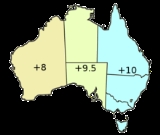
, i.e: the same well defined time for a region. The proper names of Australia's time zones are Australian Western Standard Time (WST), Australian Central Standard Time (ACST), and Australian Eastern Standard Time (AEST). In domestic contexts the leading "Australian" is often omitted, however the optional prefix 'A' is often used when abbreviating Australian Central Time and Australian Eastern Time to avoid ambiguity with the time zone abbreviations 'CST' and EST' referring to Central and Eastern time zones in North America. Use of the abbreviation of 'AWST' to describe Australian Western Standard Time is a common misnomer. The three zones use three standard UTC offsets: western (UTC+08:00), central (UTC+09:30) and eastern (UTC+10:00). Most Australian external territories also observe different time zones.
Standard time
was introduced in the 1890s when all colonies adopted it. Before the switch to standard times, each local municipality was free to determine its own local time, called local mean time
.
Western Australia uses Western Standard Time, South Australia and the Northern Territory use Central Standard Time. All other states and the Australian Capital Territory use Eastern Standard Time.
New South Wales (NSW), the Australian Capital Territory (ACT), Victoria (Vic), South Australia (SA), and Tasmania (Tas) observe daylight saving time
every year. Western Australia, Queensland and the Northern Territory do not observe daylight saving.
Though the states and territories have power to legislate time variations, the standard time within each is set in relation to Coordinated Universal Time (UTC)
, as determined by the International Bureau of Weights and Measures
and maintained under section 8AA of the National Measurement Act 1960 of the Commonwealth.
 The standardization of time in Australia began in 1892, when surveyors from the Australian colonies gathered in Melbourne for the Intercolonial Conference of Surveyors. The delegates accepted the recommendation of the 1884 International Meridian Conference
to adopt Greenwich Mean Time
(GMT) as the basis for standard time, and in line with common practice in other parts of the world, devised a system of time zones with offsets in multiples of one hour from GMT. The colonies enacted legislation to this effect, which took effect in February 1895. Western Australia
led GMT by 8 hours, South Australia
by 9 hours, and Queensland
, New South Wales
, Victoria
and Tasmania
by 10 hours. The three time zones became known as Western, Central and Eastern Standard Time.
In May 1899, South Australia advanced Central Standard Time by thirty minutes, ignoring the generally common practice of adhering to one-hourly time zones. In doing so, the State also adopted a time meridian located outside its land mass in a further departure from international convention. Attempts to remedy these anomalies in 1986 and 1994 failed.
When the Northern Territory
separated from South Australia, it retained Central Standard Time; likewise, when the Australian Capital Territory
was created, it retained Eastern Standard Time.
Since then, the only major change has been the adoption of Central Standard Time in Broken Hill, New South Wales
, and the use of GMT+10:30 on Lord Howe Island
.
, declaration or regulation made by the state governor or responsible minister. Such instruments may be valid for only the current year and so this section generally only refers to the legislation. In New South Wales and Western Australia, the start and end dates, if any, are fixed by legislation.
Western Standard Time (WST) – UTC+08:00
Central Standard Time (ACST)- UTC+09:30
Eastern Standard Time (AEST) – UTC+10:00
(specified as Yancowinna County
), in far-western New South Wales
, follows South Australia
n time. Lord Howe Island
in the Pacific Ocean uses UTC+10:30 during the winter months, but advances the clock by half an hour to UTC+11:00 in the summer, meaning it follows the rest of New South Wales for half of the year, but has its own timezone the rest of the time.
Residents of towns east of Caiguna on the Eyre Highway
(including Eucla, Madura
, Mundrabilla and Border Village) in the south-east corner of Western Australia
near the South Australian border do not follow official Western Australian time. Instead, they use what is unofficially known as Central Western Standard Time, which is halfway between Western and Central time--UTC+8:45
. The area maintained its fixed offset from UTC when daylight-saving time was introduced in South Australia. During Western Australia's trial of daylight-saving time from 2006–2009 the Central Western area also set its clocks ahead an hour during local summer. The total population of the area is estimated at just 200.
The Indian Pacific train has its own time zone – a so-called "train time" when travelling between Kalgoorlie
and Port Augusta
which was UTC+9
hours during November 2005 when daylight-saving time was observed in the east. This was because of the hour difference in times between South Australia and Western Australia.
 The choice to use daylight saving time
(DST) or not is a matter for the individual states and territories. However during World War I
and World War II
all states and territories observed the practice of daylight saving. In 1968 Tasmania
became the first state since the war to practice daylight saving. In 1971, New South Wales, Victoria, Queensland, South Australia, and the Australian Capital Territory followed Tasmania by observing daylight saving. Western Australia and the Northern Territory did not. Queensland abandoned daylight saving time in 1972. Queensland and Western Australia have observed daylight saving over the past 40 years from time to time on trial bases.
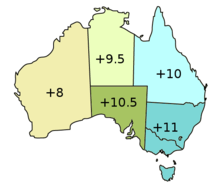
New South Wales, the Australian Capital Territory, Victoria, Tasmania and South Australia observe DST every year. This has resulted in three time zones becoming five during the daylight-saving period. South Australia time becomes UTC+10:30
, called Central Daylight Time (CDT), possibly with "Australia" prefixed (ACDT). The time in the southeastern states becomes UTC+11, using "Eastern" in the time zone name, with the abbreviations being EDT or AEDT.
Officially, the change to and from DST takes place at 2:00 am local standard time (which is 3:00 am DST) on the appropriate Sunday.
Of the states that observe DST, most began on the last Sunday in October, and ended on the last Sunday in March, until 2008. Tasmania, owing to its further southern latitude
) began DST earlier, on the first Sunday in October, and ended on the first Sunday of April.
On 12 April 2007, New South Wales, Victoria, Tasmania and the Australian Capital Territory agreed to common starting and finishing dates for DST. From the 2008/09 period, the start of DST in these states and in South Australia commences on the first Sunday in October and ends on the first Sunday in April. Western Australia became the only state to observe daylight saving from the last Sunday in October to the last Sunday in March. Since 2009 Western Australia no longer observes daylight saving.
Queensland (AEST UTC+10), Northern Territory (ACST UTC+9:30) and Western Australia (WST UTC+8) do not observe DST.
has had a particularly involved debate over daylight-saving time, with public opinion geographically divided. A referendum on daylight saving, was held on 22 February 1992, following a three-year trial (1989/90 - 1991/92), and was defeated with a 54.5% 'no' vote. The referendum result displayed a distinct trend - that public opinion on daylight saving in Queensland is geographically divided, with the ‘no’ vote strongest in the north and west regional districts, while the ‘yes’ vote was strongest in the state’s metropolitan south-east.
Since the early 2000s, there have been a number of petitions submitted to Queensland Parliament
, lobbying for the introduction of daylight-saving time or for another referendum to be held. A petition in 2006 was signed by 62,232 people. In response to these petitions, then Queensland Premier Peter Beattie
commissioned research to find out if daylight-saving time should be re-introduced into Queensland. Around this time, Premier Peter Beattie
claimed that daylight-saving time in Queensland would increase the rate of skin cancer
in the state, an unfounded claim for which there is no evidence according to the Queensland Cancer Fund.
In October 2007, the completed government-commissioned research was presented to a newly sworn-in Premier Anna Bligh
, who ruled out holding a new referendum, despite the report indicating 59% of Queensland residents and 69% of South East Queenslanders to be in favour of adopting daylight-saving time.
In December 2008, the Daylight Saving for South East Queensland
(DS4SEQ) political Party was officially registered, advocating the implementation of a dual-time zone
arrangement for Daylight Saving
in South East Queensland
while the remainder of the state maintains standard time
. The party contested the March 2009 Queensland State election
with 32 candidates and received around one percent of the state-wide primary vote, equating to around 2.5% across the 32 electorates contested.
In early 2010, the DS4SEQ political party
approached independent Member, Peter Wellington
, to introduce a private member's Bill for daylight saving. As Wellington agreed with the principles of the DS4SEQ proposal, specifically the dual time zone arrangement, he drafted the Daylight Saving for South East Queensland Referendum Bill 2010
and tabled the Bill into Queensland Parliament on 14 April 2010. Wellington has called for a referendum
to be held at the next State election on the introduction of daylight saving into south-east Queensland under a dual-time zone
arrangement.
In response to this Bill, Premier of Queensland, Anna Bligh
, announced a community consultation process, which resulted in over 74,000 respondents participating, 64 percent of whom voted in favour of a trial and 63% were in favour of holding a referendum. The decision announced by the Premier on 7 June 2010 was that her Government would not support the Bill, because regional Queenslanders were overwhelmingly opposed to daylight saving. The Bill was defeated in Queensland Parliament on 15 June 2011.
has also had a particularly involved debate over daylight-saving time, with the issue being put to a referendum four times: in 1975, 1984, 1992, and 2009. All were defeated. Voters returned a "no" vote of 54.57% in 2009, the highest in all four referendums. Each referendum followed a trial period during which the state observed daylight saving time. The first three followed a one-year trial, while the 2006 Western Australian Daylight Saving Bill (No. 2) 2006 instituted a daylight-saving trial beginning on 3 December 2006 and lasting for three years. The referendum was defeated in 2009.
in Sydney
. These jurisdictions changed on 27 August 2000. South Australia
did not change until the regular time, which that year was on 29 October.
In 2006, all states that followed daylight-saving time (the above listed states plus South Australia) delayed the return to their respective Standard Times by a week, due to the 2006 Commonwealth Games
in Melbourne
. Daylight-saving time ended on 2 April 2006.
(UTC) atomic time scale since the 1990s, Greenwich Mean Time
(GMT) remained the formal basis for the standard times of all states until 2005. In November 2004, the state and territory attorneys-general endorsed a proposal from the Australian National Measurement Institute to adopt UTC as the standard of all Australian standard times, thereby eliminating the effects of slight variations in the Earth's rotation rate that are inherent to mean solar time. All states have adopted the UTC standard, commencing from 1 September 2005.
for the issue of shares in a company would usually set out the closing time for offers at some location (e.g. Sydney) as the time when offers must be received, irrespective of the source of the offer. Similarly, tenders usually set out the time at a particular location by which they must be received to be considered. Another example is the Australian Stock Exchange
which, in effect, operates on AEST.
On the other hand, Commonwealth legislation yields to state-regulated standard times in many diverse situations. It yields, for example, in setting normal working times of Commonwealth employees, recognition of public holidays, etc. Significantly, it also relies on local time for federal elections, so that polling times in Western Australia
close, in effect, two or three hours after those in the eastern states. Similarly, documents to be filed in a Federal Court
may be filed based on local time; with the effect that if there was a failure to lodge a document on time in an eastern state, the document may still be lodged (within two hours) in Western Australia.
Australia
Australia , officially the Commonwealth of Australia, is a country in the Southern Hemisphere comprising the mainland of the Australian continent, the island of Tasmania, and numerous smaller islands in the Indian and Pacific Oceans. It is the world's sixth-largest country by total area...
uses Standard time
Standard time
Standard time is the result of synchronizing clocks in different geographical locations within a time zone to the same time rather than using the local meridian as in local mean time or solar time. Historically, this helped in the process of weather forecasting and train travel. The concept...
, i.e: the same well defined time for a region. The proper names of Australia's time zones are Australian Western Standard Time (WST), Australian Central Standard Time (ACST), and Australian Eastern Standard Time (AEST). In domestic contexts the leading "Australian" is often omitted, however the optional prefix 'A' is often used when abbreviating Australian Central Time and Australian Eastern Time to avoid ambiguity with the time zone abbreviations 'CST' and EST' referring to Central and Eastern time zones in North America. Use of the abbreviation of 'AWST' to describe Australian Western Standard Time is a common misnomer. The three zones use three standard UTC offsets: western (UTC+08:00), central (UTC+09:30) and eastern (UTC+10:00). Most Australian external territories also observe different time zones.
Standard time
Standard time
Standard time is the result of synchronizing clocks in different geographical locations within a time zone to the same time rather than using the local meridian as in local mean time or solar time. Historically, this helped in the process of weather forecasting and train travel. The concept...
was introduced in the 1890s when all colonies adopted it. Before the switch to standard times, each local municipality was free to determine its own local time, called local mean time
Local mean time
Local mean time is a form of solar time that corrects the variations of local apparent time, forming a uniform time scale at a specific longitude...
.
Western Australia uses Western Standard Time, South Australia and the Northern Territory use Central Standard Time. All other states and the Australian Capital Territory use Eastern Standard Time.
New South Wales (NSW), the Australian Capital Territory (ACT), Victoria (Vic), South Australia (SA), and Tasmania (Tas) observe daylight saving time
Daylight saving time
Daylight saving time —also summer time in several countries including in British English and European official terminology —is the practice of temporarily advancing clocks during the summertime so that afternoons have more daylight and mornings have less...
every year. Western Australia, Queensland and the Northern Territory do not observe daylight saving.
Though the states and territories have power to legislate time variations, the standard time within each is set in relation to Coordinated Universal Time (UTC)
Coordinated Universal Time
Coordinated Universal Time is the primary time standard by which the world regulates clocks and time. It is one of several closely related successors to Greenwich Mean Time. Computer servers, online services and other entities that rely on having a universally accepted time use UTC for that purpose...
, as determined by the International Bureau of Weights and Measures
International Bureau of Weights and Measures
The International Bureau of Weights and Measures , is an international standards organisation, one of three such organisations established to maintain the International System of Units under the terms of the Metre Convention...
and maintained under section 8AA of the National Measurement Act 1960 of the Commonwealth.
Time zones
International Meridian Conference
The International Meridian Conference was a conference held in October 1884 in Washington, D.C., in the United States to determine the Prime Meridian of the world. The conference was held at the request of U.S. President Chester A...
to adopt Greenwich Mean Time
Greenwich Mean Time
Greenwich Mean Time is a term originally referring to mean solar time at the Royal Observatory in Greenwich, London. It is arguably the same as Coordinated Universal Time and when this is viewed as a time zone the name Greenwich Mean Time is especially used by bodies connected with the United...
(GMT) as the basis for standard time, and in line with common practice in other parts of the world, devised a system of time zones with offsets in multiples of one hour from GMT. The colonies enacted legislation to this effect, which took effect in February 1895. Western Australia
Western Australia
Western Australia is a state of Australia, occupying the entire western third of the Australian continent. It is bounded by the Indian Ocean to the north and west, the Great Australian Bight and Indian Ocean to the south, the Northern Territory to the north-east and South Australia to the south-east...
led GMT by 8 hours, South Australia
South Australia
South Australia is a state of Australia in the southern central part of the country. It covers some of the most arid parts of the continent; with a total land area of , it is the fourth largest of Australia's six states and two territories.South Australia shares borders with all of the mainland...
by 9 hours, and Queensland
Queensland
Queensland is a state of Australia, occupying the north-eastern section of the mainland continent. It is bordered by the Northern Territory, South Australia and New South Wales to the west, south-west and south respectively. To the east, Queensland is bordered by the Coral Sea and Pacific Ocean...
, New South Wales
New South Wales
New South Wales is a state of :Australia, located in the east of the country. It is bordered by Queensland, Victoria and South Australia to the north, south and west respectively. To the east, the state is bordered by the Tasman Sea, which forms part of the Pacific Ocean. New South Wales...
, Victoria
Victoria (Australia)
Victoria is the second most populous state in Australia. Geographically the smallest mainland state, Victoria is bordered by New South Wales, South Australia, and Tasmania on Boundary Islet to the north, west and south respectively....
and Tasmania
Tasmania
Tasmania is an Australian island and state. It is south of the continent, separated by Bass Strait. The state includes the island of Tasmania—the 26th largest island in the world—and the surrounding islands. The state has a population of 507,626 , of whom almost half reside in the greater Hobart...
by 10 hours. The three time zones became known as Western, Central and Eastern Standard Time.
In May 1899, South Australia advanced Central Standard Time by thirty minutes, ignoring the generally common practice of adhering to one-hourly time zones. In doing so, the State also adopted a time meridian located outside its land mass in a further departure from international convention. Attempts to remedy these anomalies in 1986 and 1994 failed.
When the Northern Territory
Northern Territory
The Northern Territory is a federal territory of Australia, occupying much of the centre of the mainland continent, as well as the central northern regions...
separated from South Australia, it retained Central Standard Time; likewise, when the Australian Capital Territory
Australian Capital Territory
The Australian Capital Territory, often abbreviated ACT, is the capital territory of the Commonwealth of Australia and is the smallest self-governing internal territory...
was created, it retained Eastern Standard Time.
Since then, the only major change has been the adoption of Central Standard Time in Broken Hill, New South Wales
Broken Hill, New South Wales
-Geology:Broken Hill's massive orebody, which formed about 1,800 million years ago, has proved to be among the world's largest silver-lead-zinc mineral deposits. The orebody is shaped like a boomerang plunging into the earth at its ends and outcropping in the centre. The protruding tip of the...
, and the use of GMT+10:30 on Lord Howe Island
Lord Howe Island
Lord Howe Island is an irregularly crescent-shaped volcanic remnant in the Tasman Sea between Australia and New Zealand, directly east of mainland Port Macquarie, and about from Norfolk Island. The island is about 11 km long and between 2.8 km and 0.6 km wide with an area of...
.
State legislation
In Victoria, South Australia, Tasmania and the ACT, the start and end dates of daylight-saving time are officially determined by proclamationProclamation
A proclamation is an official declaration.-England and Wales:In English law, a proclamation is a formal announcement , made under the great seal, of some matter which the King in Council or Queen in Council desires to make known to his or her subjects: e.g., the declaration of war, or state of...
, declaration or regulation made by the state governor or responsible minister. Such instruments may be valid for only the current year and so this section generally only refers to the legislation. In New South Wales and Western Australia, the start and end dates, if any, are fixed by legislation.
Western Standard Time (WST) – UTC+08:00
- Western AustraliaWestern AustraliaWestern Australia is a state of Australia, occupying the entire western third of the Australian continent. It is bounded by the Indian Ocean to the north and west, the Great Australian Bight and Indian Ocean to the south, the Northern Territory to the north-east and South Australia to the south-east...
– Standard Time Act 2005
Central Standard Time (ACST)- UTC+09:30
- South AustraliaSouth AustraliaSouth Australia is a state of Australia in the southern central part of the country. It covers some of the most arid parts of the continent; with a total land area of , it is the fourth largest of Australia's six states and two territories.South Australia shares borders with all of the mainland...
– Standard Time Act 2009 and the Daylight Saving Act 1971 - Northern TerritoryNorthern TerritoryThe Northern Territory is a federal territory of Australia, occupying much of the centre of the mainland continent, as well as the central northern regions...
– Standard Time Act 2005
Eastern Standard Time (AEST) – UTC+10:00
- QueenslandQueenslandQueensland is a state of Australia, occupying the north-eastern section of the mainland continent. It is bordered by the Northern Territory, South Australia and New South Wales to the west, south-west and south respectively. To the east, Queensland is bordered by the Coral Sea and Pacific Ocean...
– Standard Time Act 1894 - New South WalesNew South WalesNew South Wales is a state of :Australia, located in the east of the country. It is bordered by Queensland, Victoria and South Australia to the north, south and west respectively. To the east, the state is bordered by the Tasman Sea, which forms part of the Pacific Ocean. New South Wales...
– Standard Time Act 1987 No 149 - Australian Capital TerritoryAustralian Capital TerritoryThe Australian Capital Territory, often abbreviated ACT, is the capital territory of the Commonwealth of Australia and is the smallest self-governing internal territory...
– Standard Time and Summer Time Act 1972 - VictoriaVictoria (Australia)Victoria is the second most populous state in Australia. Geographically the smallest mainland state, Victoria is bordered by New South Wales, South Australia, and Tasmania on Boundary Islet to the north, west and south respectively....
– Summer Time Act 1972 - TasmaniaTasmaniaTasmania is an Australian island and state. It is south of the continent, separated by Bass Strait. The state includes the island of Tasmania—the 26th largest island in the world—and the surrounding islands. The state has a population of 507,626 , of whom almost half reside in the greater Hobart...
– Standard Time Act 1895 and the Daylight Saving Act 2007
Anomalies
The town of Broken HillBroken Hill, New South Wales
-Geology:Broken Hill's massive orebody, which formed about 1,800 million years ago, has proved to be among the world's largest silver-lead-zinc mineral deposits. The orebody is shaped like a boomerang plunging into the earth at its ends and outcropping in the centre. The protruding tip of the...
(specified as Yancowinna County
Yancowinna County, New South Wales
Yancowinna County is one of the 141 Cadastral divisions of New South Wales. It contains the city of Broken Hill and village of Silverton.Some New South Wales industrial relations laws have excluded the county of Yancowinna...
), in far-western New South Wales
New South Wales
New South Wales is a state of :Australia, located in the east of the country. It is bordered by Queensland, Victoria and South Australia to the north, south and west respectively. To the east, the state is bordered by the Tasman Sea, which forms part of the Pacific Ocean. New South Wales...
, follows South Australia
South Australia
South Australia is a state of Australia in the southern central part of the country. It covers some of the most arid parts of the continent; with a total land area of , it is the fourth largest of Australia's six states and two territories.South Australia shares borders with all of the mainland...
n time. Lord Howe Island
Lord Howe Island
Lord Howe Island is an irregularly crescent-shaped volcanic remnant in the Tasman Sea between Australia and New Zealand, directly east of mainland Port Macquarie, and about from Norfolk Island. The island is about 11 km long and between 2.8 km and 0.6 km wide with an area of...
in the Pacific Ocean uses UTC+10:30 during the winter months, but advances the clock by half an hour to UTC+11:00 in the summer, meaning it follows the rest of New South Wales for half of the year, but has its own timezone the rest of the time.
Residents of towns east of Caiguna on the Eyre Highway
Eyre Highway
The Eyre Highway is a highway linking Western Australia and South Australia via the Nullarbor Plain. Signed as National Highway 1/A1, it forms part of Highway 1 and the Australian National Highway network linking Perth and Adelaide. It was named after explorer Edward John Eyre, who was the first to...
(including Eucla, Madura
Madura, Western Australia
Madura is a small roadhouse community located on the Eyre Highway in Western Australia, on the Nullarbor Plain. It is from Perth.-History:Madura was settled in 1876 as a place to breed quality cavalry horses for the British Indian Army for use in the Northwest Frontier region of India . The horses...
, Mundrabilla and Border Village) in the south-east corner of Western Australia
Western Australia
Western Australia is a state of Australia, occupying the entire western third of the Australian continent. It is bounded by the Indian Ocean to the north and west, the Great Australian Bight and Indian Ocean to the south, the Northern Territory to the north-east and South Australia to the south-east...
near the South Australian border do not follow official Western Australian time. Instead, they use what is unofficially known as Central Western Standard Time, which is halfway between Western and Central time--UTC+8:45
UTC+8:45
UTC+08:45 is an identifier for a time offset from UTC of +08:45.UTC+08:45 is used as a time in Australia . It is used by some roadhouses along the Eyre Highway in Western Australia and South Australia...
. The area maintained its fixed offset from UTC when daylight-saving time was introduced in South Australia. During Western Australia's trial of daylight-saving time from 2006–2009 the Central Western area also set its clocks ahead an hour during local summer. The total population of the area is estimated at just 200.
The Indian Pacific train has its own time zone – a so-called "train time" when travelling between Kalgoorlie
Kalgoorlie, Western Australia
Kalgoorlie, known as Kalgoorlie-Boulder, is a town in the Goldfields-Esperance region of Western Australia, and is located east-northeast of state capital Perth at the end of the Great Eastern Highway...
and Port Augusta
Port Augusta, South Australia
-Electricity generation:Electricity is generated at the Playford B and Northern power stations from brown coal mined at Leigh Creek, 250 km to the north...
which was UTC+9
UTC+9
UTC+09:00 is an identifier for a time offset from UTC of +09. This time is used in:-As standard time :*East Timor*Indonesia **Moluccas**Papua and West Papua *Japan - Japan Standard Time*North Korea...
hours during November 2005 when daylight-saving time was observed in the east. This was because of the hour difference in times between South Australia and Western Australia.
External territories
Australia's external territories follow their own time zones.| Territory | Standard | DST |
|---|---|---|
| Heard and McDonald Islands | UTC+05:00 | no DST |
| Cocos (Keeling) Islands Cocos (Keeling) Islands The Territory of the Cocos Islands, also called Cocos Islands and Keeling Islands, is a territory of Australia, located in the Indian Ocean, southwest of Christmas Island and approximately midway between Australia and Sri Lanka.... |
UTC+06:30 | no DST |
| Christmas Island Christmas Island The Territory of Christmas Island is a territory of Australia in the Indian Ocean. It is located northwest of the Western Australian city of Perth, south of the Indonesian capital, Jakarta, and ENE of the Cocos Islands.... CXT |
UTC+07:00 | no DST |
| Norfolk Island Norfolk Island Norfolk Island is a small island in the Pacific Ocean located between Australia, New Zealand and New Caledonia. The island is part of the Commonwealth of Australia, but it enjoys a large degree of self-governance... NFT |
UTC+11:30 UTC+11:30 UTC+11:30 is an identifier for a +11:30 hour time offset from UTC. This time is used in:-Historical:On November 2, 1868, New Zealand officially adopted a standard time to be observed nationally, and was perhaps the first country to do so. It was based on the longitude 172° 30' East of Greenwich,... |
no DST |
| Australian Antarctic Territory Australian Antarctic Territory The Australian Antarctic Territory is a part of Antarctica. It was claimed by the United Kingdom and placed under the authority of the Commonwealth of Australia in 1933. It is the largest territory of Antarctica claimed by any nation... – Mawson Mawson Station Mawson Station is one of three permanent Australian bases in the Australian Antarctic Territory of East Antarctica. Named after Antarctic explorer Sir Douglas Mawson, the base is managed by the Australian Antarctic Division... |
UTC+06:00 | no DST |
| Australian Antarctic Territory Australian Antarctic Territory The Australian Antarctic Territory is a part of Antarctica. It was claimed by the United Kingdom and placed under the authority of the Commonwealth of Australia in 1933. It is the largest territory of Antarctica claimed by any nation... – Davis Davis Station Davis Station is a permanent base in Antarctica managed by the Australian Antarctic Division . It is the busiest Australian scientific research station... |
UTC+07:00 | no DST |
| Australian Antarctic Territory Australian Antarctic Territory The Australian Antarctic Territory is a part of Antarctica. It was claimed by the United Kingdom and placed under the authority of the Commonwealth of Australia in 1933. It is the largest territory of Antarctica claimed by any nation... – Casey Casey Station Casey Station is a permanent base in Antarctica managed by the Australian Antarctic Division located on Vincennes Bay in the Australian Antarctic Territory.- History :... |
UTC+08:00 | no DST |
Daylight saving time
Daylight saving time
Daylight saving time —also summer time in several countries including in British English and European official terminology —is the practice of temporarily advancing clocks during the summertime so that afternoons have more daylight and mornings have less...
(DST) or not is a matter for the individual states and territories. However during World War I
World War I
World War I , which was predominantly called the World War or the Great War from its occurrence until 1939, and the First World War or World War I thereafter, was a major war centred in Europe that began on 28 July 1914 and lasted until 11 November 1918...
and World War II
World War II
World War II, or the Second World War , was a global conflict lasting from 1939 to 1945, involving most of the world's nations—including all of the great powers—eventually forming two opposing military alliances: the Allies and the Axis...
all states and territories observed the practice of daylight saving. In 1968 Tasmania
Tasmania
Tasmania is an Australian island and state. It is south of the continent, separated by Bass Strait. The state includes the island of Tasmania—the 26th largest island in the world—and the surrounding islands. The state has a population of 507,626 , of whom almost half reside in the greater Hobart...
became the first state since the war to practice daylight saving. In 1971, New South Wales, Victoria, Queensland, South Australia, and the Australian Capital Territory followed Tasmania by observing daylight saving. Western Australia and the Northern Territory did not. Queensland abandoned daylight saving time in 1972. Queensland and Western Australia have observed daylight saving over the past 40 years from time to time on trial bases.
New South Wales, the Australian Capital Territory, Victoria, Tasmania and South Australia observe DST every year. This has resulted in three time zones becoming five during the daylight-saving period. South Australia time becomes UTC+10:30
UTC+10:30
UTC+10:30 is an identifier for a +10:30 time offset from UTC. This time is used in:-As daylight saving time :*Australia **New South Wales - Broken Hill, New South Wales only...
, called Central Daylight Time (CDT), possibly with "Australia" prefixed (ACDT). The time in the southeastern states becomes UTC+11, using "Eastern" in the time zone name, with the abbreviations being EDT or AEDT.
Officially, the change to and from DST takes place at 2:00 am local standard time (which is 3:00 am DST) on the appropriate Sunday.
Of the states that observe DST, most began on the last Sunday in October, and ended on the last Sunday in March, until 2008. Tasmania, owing to its further southern latitude
Latitude
In geography, the latitude of a location on the Earth is the angular distance of that location south or north of the Equator. The latitude is an angle, and is usually measured in degrees . The equator has a latitude of 0°, the North pole has a latitude of 90° north , and the South pole has a...
) began DST earlier, on the first Sunday in October, and ended on the first Sunday of April.
On 12 April 2007, New South Wales, Victoria, Tasmania and the Australian Capital Territory agreed to common starting and finishing dates for DST. From the 2008/09 period, the start of DST in these states and in South Australia commences on the first Sunday in October and ends on the first Sunday in April. Western Australia became the only state to observe daylight saving from the last Sunday in October to the last Sunday in March. Since 2009 Western Australia no longer observes daylight saving.
Queensland (AEST UTC+10), Northern Territory (ACST UTC+9:30) and Western Australia (WST UTC+8) do not observe DST.
| State/Territory | Start of DST | End of DST |
|---|---|---|
| Western Australia Western Australia Western Australia is a state of Australia, occupying the entire western third of the Australian continent. It is bounded by the Indian Ocean to the north and west, the Great Australian Bight and Indian Ocean to the south, the Northern Territory to the north-east and South Australia to the south-east... |
|
|
| Queensland Queensland Queensland is a state of Australia, occupying the north-eastern section of the mainland continent. It is bordered by the Northern Territory, South Australia and New South Wales to the west, south-west and south respectively. To the east, Queensland is bordered by the Coral Sea and Pacific Ocean... |
||
| Northern Territory Northern Territory The Northern Territory is a federal territory of Australia, occupying much of the centre of the mainland continent, as well as the central northern regions... |
||
| South Australia South Australia South Australia is a state of Australia in the southern central part of the country. It covers some of the most arid parts of the continent; with a total land area of , it is the fourth largest of Australia's six states and two territories.South Australia shares borders with all of the mainland... |
first Sunday in October | first Sunday in April |
| New South Wales New South Wales New South Wales is a state of :Australia, located in the east of the country. It is bordered by Queensland, Victoria and South Australia to the north, south and west respectively. To the east, the state is bordered by the Tasman Sea, which forms part of the Pacific Ocean. New South Wales... |
||
| Australian Capital Territory Australian Capital Territory The Australian Capital Territory, often abbreviated ACT, is the capital territory of the Commonwealth of Australia and is the smallest self-governing internal territory... |
||
| Victoria Victoria (Australia) Victoria is the second most populous state in Australia. Geographically the smallest mainland state, Victoria is bordered by New South Wales, South Australia, and Tasmania on Boundary Islet to the north, west and south respectively.... |
||
| Tasmania Tasmania Tasmania is an Australian island and state. It is south of the continent, separated by Bass Strait. The state includes the island of Tasmania—the 26th largest island in the world—and the surrounding islands. The state has a population of 507,626 , of whom almost half reside in the greater Hobart... |
||
Queensland
QueenslandQueensland
Queensland is a state of Australia, occupying the north-eastern section of the mainland continent. It is bordered by the Northern Territory, South Australia and New South Wales to the west, south-west and south respectively. To the east, Queensland is bordered by the Coral Sea and Pacific Ocean...
has had a particularly involved debate over daylight-saving time, with public opinion geographically divided. A referendum on daylight saving, was held on 22 February 1992, following a three-year trial (1989/90 - 1991/92), and was defeated with a 54.5% 'no' vote. The referendum result displayed a distinct trend - that public opinion on daylight saving in Queensland is geographically divided, with the ‘no’ vote strongest in the north and west regional districts, while the ‘yes’ vote was strongest in the state’s metropolitan south-east.
Since the early 2000s, there have been a number of petitions submitted to Queensland Parliament
Queensland Legislative Assembly
The Queensland Legislative Assembly is the unicameral chamber of the Parliament of Queensland. Elections are held approximately once every three years. Voting is by the Optional Preferential Voting form of the Alternative Vote system...
, lobbying for the introduction of daylight-saving time or for another referendum to be held. A petition in 2006 was signed by 62,232 people. In response to these petitions, then Queensland Premier Peter Beattie
Peter Beattie
Peter Douglas Beattie , Australian politician, was the 36th Premier of the Australian state of Queensland for nine years and leader of the Australian Labor Party in that state for eleven and a half years...
commissioned research to find out if daylight-saving time should be re-introduced into Queensland. Around this time, Premier Peter Beattie
Peter Beattie
Peter Douglas Beattie , Australian politician, was the 36th Premier of the Australian state of Queensland for nine years and leader of the Australian Labor Party in that state for eleven and a half years...
claimed that daylight-saving time in Queensland would increase the rate of skin cancer
Skin cancer
Skin neoplasms are skin growths with differing causes and varying degrees of malignancy. The three most common malignant skin cancers are basal cell cancer, squamous cell cancer, and melanoma, each of which is named after the type of skin cell from which it arises...
in the state, an unfounded claim for which there is no evidence according to the Queensland Cancer Fund.
In October 2007, the completed government-commissioned research was presented to a newly sworn-in Premier Anna Bligh
Anna Bligh
Anna Maria Bligh is an Australian politician and the Premier of Queensland since 2007. The 2009 Queensland state election was the first time a female-led political party won or retained state or federal government in Australia...
, who ruled out holding a new referendum, despite the report indicating 59% of Queensland residents and 69% of South East Queenslanders to be in favour of adopting daylight-saving time.
In December 2008, the Daylight Saving for South East Queensland
Daylight Saving for South East Queensland
Daylight Saving for South East Queensland is a political party in Queensland, Australia. It is a single-issue party, run by volunteers, which advocates the implementation of a dual-time zone arrangement for Daylight Saving in South East Queensland while the remainder of the state maintains...
(DS4SEQ) political Party was officially registered, advocating the implementation of a dual-time zone
Time zone
A time zone is a region on Earth that has a uniform standard time for legal, commercial, and social purposes. In order for the same clock time to always correspond to the same portion of the day as the Earth rotates , different places on the Earth need to have different clock times...
arrangement for Daylight Saving
Daylight saving time
Daylight saving time —also summer time in several countries including in British English and European official terminology —is the practice of temporarily advancing clocks during the summertime so that afternoons have more daylight and mornings have less...
in South East Queensland
South East Queensland
South East Queensland is a region of the state of Queensland in Australia, which contains approximately two-thirds of the state population...
while the remainder of the state maintains standard time
Standard time
Standard time is the result of synchronizing clocks in different geographical locations within a time zone to the same time rather than using the local meridian as in local mean time or solar time. Historically, this helped in the process of weather forecasting and train travel. The concept...
. The party contested the March 2009 Queensland State election
Queensland state election, 2009
The Queensland state election was held to elect members to the unicameral Parliament of Queensland on 21 March 2009. The election saw the incumbent Labor government led by Premier Anna Bligh defeat the Liberal National Party of Queensland led by Opposition Leader Lawrence Springborg, and gain a...
with 32 candidates and received around one percent of the state-wide primary vote, equating to around 2.5% across the 32 electorates contested.
In early 2010, the DS4SEQ political party
Political party
A political party is a political organization that typically seeks to influence government policy, usually by nominating their own candidates and trying to seat them in political office. Parties participate in electoral campaigns, educational outreach or protest actions...
approached independent Member, Peter Wellington
Peter Wellington
Peter Wellington is an Independent member of the Queensland Legislative Assembly, for the Electoral district of Nicklin. Wellington, along with fellow independent Liz Cunningham, briefly held the balance in power following the 1998 state election...
, to introduce a private member's Bill for daylight saving. As Wellington agreed with the principles of the DS4SEQ proposal, specifically the dual time zone arrangement, he drafted the Daylight Saving for South East Queensland Referendum Bill 2010
Daylight Saving for South East Queensland Referendum Act 2010
The Daylight Saving for South East Queensland Referendum Bill 2010 was tabled in Queensland Parliament on 14 April 2010, by Queensland, Independent Member Peter Wellington. Wellington has called for a referendum to be held at the next State election on introduction of daylight saving time for...
and tabled the Bill into Queensland Parliament on 14 April 2010. Wellington has called for a referendum
Referendum
A referendum is a direct vote in which an entire electorate is asked to either accept or reject a particular proposal. This may result in the adoption of a new constitution, a constitutional amendment, a law, the recall of an elected official or simply a specific government policy. It is a form of...
to be held at the next State election on the introduction of daylight saving into south-east Queensland under a dual-time zone
Time zone
A time zone is a region on Earth that has a uniform standard time for legal, commercial, and social purposes. In order for the same clock time to always correspond to the same portion of the day as the Earth rotates , different places on the Earth need to have different clock times...
arrangement.
In response to this Bill, Premier of Queensland, Anna Bligh
Anna Bligh
Anna Maria Bligh is an Australian politician and the Premier of Queensland since 2007. The 2009 Queensland state election was the first time a female-led political party won or retained state or federal government in Australia...
, announced a community consultation process, which resulted in over 74,000 respondents participating, 64 percent of whom voted in favour of a trial and 63% were in favour of holding a referendum. The decision announced by the Premier on 7 June 2010 was that her Government would not support the Bill, because regional Queenslanders were overwhelmingly opposed to daylight saving. The Bill was defeated in Queensland Parliament on 15 June 2011.
Western Australia
Western AustraliaWestern Australia
Western Australia is a state of Australia, occupying the entire western third of the Australian continent. It is bounded by the Indian Ocean to the north and west, the Great Australian Bight and Indian Ocean to the south, the Northern Territory to the north-east and South Australia to the south-east...
has also had a particularly involved debate over daylight-saving time, with the issue being put to a referendum four times: in 1975, 1984, 1992, and 2009. All were defeated. Voters returned a "no" vote of 54.57% in 2009, the highest in all four referendums. Each referendum followed a trial period during which the state observed daylight saving time. The first three followed a one-year trial, while the 2006 Western Australian Daylight Saving Bill (No. 2) 2006 instituted a daylight-saving trial beginning on 3 December 2006 and lasting for three years. The referendum was defeated in 2009.
Special events
In 2000, all eastern jurisdictions that normally observe daylight-saving time — New South Wales, Victoria, the Australian Capital Territory and Tasmania — started daylight-saving time early, due to the 2000 Summer Olympics2000 Summer Olympics
The Sydney 2000 Summer Olympic Games or the Millennium Games/Games of the New Millennium, officially known as the Games of the XXVII Olympiad, were an international multi-sport event which was celebrated between 15 September and 1 October 2000 in Sydney, New South Wales, Australia...
in Sydney
Sydney
Sydney is the most populous city in Australia and the state capital of New South Wales. Sydney is located on Australia's south-east coast of the Tasman Sea. As of June 2010, the greater metropolitan area had an approximate population of 4.6 million people...
. These jurisdictions changed on 27 August 2000. South Australia
South Australia
South Australia is a state of Australia in the southern central part of the country. It covers some of the most arid parts of the continent; with a total land area of , it is the fourth largest of Australia's six states and two territories.South Australia shares borders with all of the mainland...
did not change until the regular time, which that year was on 29 October.
In 2006, all states that followed daylight-saving time (the above listed states plus South Australia) delayed the return to their respective Standard Times by a week, due to the 2006 Commonwealth Games
2006 Commonwealth Games
The 2006 Commonwealth Games were held in Melbourne, Victoria, Australia between 15 March and 26 March 2006. It was the largest sporting event to be staged in Melbourne, eclipsing the 1956 Summer Olympics in terms of the number of teams competing, athletes competing, and events being held.The site...
in Melbourne
Melbourne
Melbourne is the capital and most populous city in the state of Victoria, and the second most populous city in Australia. The Melbourne City Centre is the hub of the greater metropolitan area and the Census statistical division—of which "Melbourne" is the common name. As of June 2009, the greater...
. Daylight-saving time ended on 2 April 2006.
Accuracy and standards
Although Australia has maintained a version of the Coordinated Universal TimeCoordinated Universal Time
Coordinated Universal Time is the primary time standard by which the world regulates clocks and time. It is one of several closely related successors to Greenwich Mean Time. Computer servers, online services and other entities that rely on having a universally accepted time use UTC for that purpose...
(UTC) atomic time scale since the 1990s, Greenwich Mean Time
Greenwich Mean Time
Greenwich Mean Time is a term originally referring to mean solar time at the Royal Observatory in Greenwich, London. It is arguably the same as Coordinated Universal Time and when this is viewed as a time zone the name Greenwich Mean Time is especially used by bodies connected with the United...
(GMT) remained the formal basis for the standard times of all states until 2005. In November 2004, the state and territory attorneys-general endorsed a proposal from the Australian National Measurement Institute to adopt UTC as the standard of all Australian standard times, thereby eliminating the effects of slight variations in the Earth's rotation rate that are inherent to mean solar time. All states have adopted the UTC standard, commencing from 1 September 2005.
National times
However, there are situations where a nation-wide time operates. In the case of business activities a national time, in effect, operates. For example, a prospectusProspectus (finance)
In finance, a prospectus is a document that describes a financial security for potential buyers. A prospectus commonly provides investors with material information about mutual funds, stocks, bonds and other investments, such as a description of the company's business, financial statements,...
for the issue of shares in a company would usually set out the closing time for offers at some location (e.g. Sydney) as the time when offers must be received, irrespective of the source of the offer. Similarly, tenders usually set out the time at a particular location by which they must be received to be considered. Another example is the Australian Stock Exchange
Australian Stock Exchange
The Australian Securities Exchange was created by the merger of the Australian Stock Exchange and the Sydney Futures Exchange in July 2006. It is the primary stock exchange group in Australia....
which, in effect, operates on AEST.
On the other hand, Commonwealth legislation yields to state-regulated standard times in many diverse situations. It yields, for example, in setting normal working times of Commonwealth employees, recognition of public holidays, etc. Significantly, it also relies on local time for federal elections, so that polling times in Western Australia
Western Australia
Western Australia is a state of Australia, occupying the entire western third of the Australian continent. It is bounded by the Indian Ocean to the north and west, the Great Australian Bight and Indian Ocean to the south, the Northern Territory to the north-east and South Australia to the south-east...
close, in effect, two or three hours after those in the eastern states. Similarly, documents to be filed in a Federal Court
Federal Court of Australia
The Federal Court of Australia is an Australian superior court of record which has jurisdiction to deal with most civil disputes governed by federal law , along with some summary criminal matters. Cases are heard at first instance by single Judges...
may be filed based on local time; with the effect that if there was a failure to lodge a document on time in an eastern state, the document may still be lodged (within two hours) in Western Australia.
See also
- List of time zones
- Daylight saving timeDaylight saving timeDaylight saving time —also summer time in several countries including in British English and European official terminology —is the practice of temporarily advancing clocks during the summertime so that afternoons have more daylight and mornings have less...
- Peter WellingtonPeter WellingtonPeter Wellington is an Independent member of the Queensland Legislative Assembly, for the Electoral district of Nicklin. Wellington, along with fellow independent Liz Cunningham, briefly held the balance in power following the 1998 state election...
- Daylight Saving for South East QueenslandDaylight Saving for South East QueenslandDaylight Saving for South East Queensland is a political party in Queensland, Australia. It is a single-issue party, run by volunteers, which advocates the implementation of a dual-time zone arrangement for Daylight Saving in South East Queensland while the remainder of the state maintains...
- Daylight Saving for South East Queensland Referendum Act 2010Daylight Saving for South East Queensland Referendum Act 2010The Daylight Saving for South East Queensland Referendum Bill 2010 was tabled in Queensland Parliament on 14 April 2010, by Queensland, Independent Member Peter Wellington. Wellington has called for a referendum to be held at the next State election on introduction of daylight saving time for...
- Queensland daylight savings referendum, 1992
- Daylight saving time around the worldDaylight saving time around the worldDaylight saving time around the world, showing usage and a short history by location in alphabetic order, grouped by continent. Most areas of North America and Europe observe daylight saving time , while most areas of Africa and Asia do not...
External links
- Information on time zones from official GovernmentGovernment of AustraliaThe Commonwealth of Australia is a federal constitutional monarchy under a parliamentary democracy. The Commonwealth of Australia was formed in 1901 as a result of an agreement among six self-governing British colonies, which became the six states...
web site - Daylight Saving for South East Queensland political party Official DS4SEQDaylight Saving for South East QueenslandDaylight Saving for South East Queensland is a political party in Queensland, Australia. It is a single-issue party, run by volunteers, which advocates the implementation of a dual-time zone arrangement for Daylight Saving in South East Queensland while the remainder of the state maintains...
website