

Tiger II

Encyclopedia
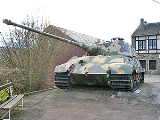
Tiger II is the common name of a German
heavy tank
of the Second World War
. The final official German designation was Panzerkampfwagen Tiger Ausf. B,Panzerkampfwagen – abbr: Pz. or Pz.Kfw. (English: armored fighting vehicle)
Ausführung – abbr: Ausf. (English: variant).
The full titles Panzerkampfwagen Tiger Ausf. B and Panzerbefehlswagen Tiger Ausf. B (for the command version) were used in training and maintenance manuals and in organization and equipment tables. (Jentz and Doyle 1997)
Also sometimes referred to as Pz. VI Ausf B, not to be confused with Pz. VI Ausf H which was the Tiger I
. often shortened to Tiger B. The ordnance inventory designation was Sd.Kfz.
182. It is also known under the informal name Königstiger (the German
name for the "Bengal tiger
"), often translated as King Tiger or Royal Tiger by Allied soldiers.
The design followed the same concept as the Tiger I
, but was intended to be even more formidable. The Tiger II combined the thick armor of the Tiger I with the sloped armor used on the Panther
medium tank. The tank weighed almost seventy metric tons, was protected by 100 millimetre of armor to the front, and was armed with the long barrelled 8.8 cm Kampfwagenkanone 43 L/71 gun.Kampfwagenkanone – abbr: KwK (English: fighting vehicle cannon) The chassis was also the basis for the Jagdtiger
turretless tank destroyer
.
The Tiger II was issued to heavy tank battalions of the Army
(Schwere Heeres Panzer Abteilung - abbreviated s.H.Pz.Abt) and the Waffen-SS
(s.SS.Pz.Abt). It was first used in combat with s.H.Pz.Abt. 503 during the Normandy campaign on 11 July 1944; on the Eastern Front
the first unit to be outfitted with Tiger IIs was s.H.Pz.Abt. 501
which by 1 September 1944 listed 25 Tiger IIs operational.
. Another contract followed in 1939, and was given to Porsche
. Both prototype series used the same turret design from Krupp
; the main differences were in the hull, transmission, suspension and automotive features.
The Henschel version used a conventional hull design with sloped armor resembling the layout of the Panther tank. It had a rear mounted engine and used nine steel-tired overlapping road wheels with internal springing per side, mounted on transverse torsion bars, in a similar manner to the original Tiger. To simplify maintenance, however, the wheels were overlapping rather than interleaved as in the Tiger I.
The Porsche hull designs included a rear-mounted turret and a mid-mounted engine. The suspension was the same as on the Jagdpanzer Elefant
. This had six road wheels per side mounted in paired bogies sprung with short longitudinal torsion bars that were integral to the wheel pair; this saved internal space and facilitated repairs. One Porsche version had a gasoline-electric hybrid power system; two separate drive trains in parallel, one per side of the tank, each consisting of a hybrid drive train; gasoline engine – electric generator – electric motor – drive sprocket. This method of propulsion had been attempted before on the Tiger (P) (later Elefant prototypes) and in some U.S. designs, but had never been put into production. The Porsche suspension were later used on a few of the later Jagdtiger
tank hunters. Another proposal was to use hydraulic drives. Dr. Porsche's unorthodox designs gathered little favor.
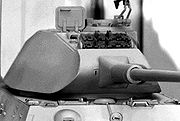
.jpg) Henschel won the contract, and all Tiger IIs were produced by the firm. Two turret designs were used in production vehicles. The initial design is sometimes misleadingly called the "Porsche" turret due to the belief that it was designed by Porsche for their prototype; in fact it was the initial Krupp design for both prototypes. This turret had a rounded front and steeply sloped sides, with a difficult-to-manufacture curved bulge on the turret's left side to accommodate the commander's cupola. Fifty early turrets were mounted to Henschel's hull and used in action. The more common "production" turret, sometimes called the "Henschel" turret, was simplified with a significantly thicker flat face, no shot trap (created by the curved face of the initial-type turret), and less-steeply sloped sides, which prevented the need for a bulge for the commander's cupola.
Henschel won the contract, and all Tiger IIs were produced by the firm. Two turret designs were used in production vehicles. The initial design is sometimes misleadingly called the "Porsche" turret due to the belief that it was designed by Porsche for their prototype; in fact it was the initial Krupp design for both prototypes. This turret had a rounded front and steeply sloped sides, with a difficult-to-manufacture curved bulge on the turret's left side to accommodate the commander's cupola. Fifty early turrets were mounted to Henschel's hull and used in action. The more common "production" turret, sometimes called the "Henschel" turret, was simplified with a significantly thicker flat face, no shot trap (created by the curved face of the initial-type turret), and less-steeply sloped sides, which prevented the need for a bulge for the commander's cupola.
The turrets were designed to mount the 8.8 cm KwK 43 L/71 gun. Combined with the Turmzielfernrohr 9d (German "turret telescopic sight") monocular sight by Leitz, which all but a few early Tiger IIs used, it was a very accurate and deadly weapon. During practice, the estimated probability of a first round hit on a 2 m (6.6 ft) high, 2.5 m (8.2 ft) wide target only dropped below 100 percent at ranges beyond 1000 m (0.621372736649807 mi), to 95–97 percent at 1500 metre (0.93205910497471 mi) and 85–87 percent at 2000 m (1.2 mi), depending on ammunition type. Recorded combat performance was lower, but still over 80 percent at 1,000 m, in the 60s at 1,500 m and the 40s at 2,000 m. Penetration of armored plate inclined at 30 degrees was 202 millimetre at 100 and 2000 m (0.0621372736649807 and 1.2 mi) respectively for the Panzergranate 39/43
projectile (PzGr—armor-piercing shell
), and 238 millimetre for the PzGr. 40/44 projectile between the same ranges. The Sprenggranate 43 (SpGr) high-explosive round was available for soft targets, or the Hohlgranate or Hohlgeschoss 39 (HlGr—HEAT or High explosive anti-tank warhead) round, which had 90 mm (3.5 in) penetration at any range, could be used as a dual-purpose munition against soft or armored targets.
Powered turret traverse was provided by the variable speed Boehringer-Sturm L4S hydraulic motor which was driven from the main engine by a secondary drive shaft. A high and a low speed setting was available to the gunner via a lever on his right. The turret could be rotated 360 degrees in 60 seconds in low gear independent of engine rpm, in 19 seconds in high gear at idle engine speed, and within 10 seconds at the maximum allowable engine speed. The direction and speed of traverse was controlled by the gunner through foot pedals, or a control lever near his left arm. The system was smooth and accurate enough to be used for final gun laying without the gunner needing to use his traverse hand wheel for fine adjustments; most other tanks of the period often required manual fine traverse adjustments. If power was lost, the turret could be slowly traversed by hand, assisted by the loader who had an additional wheel.
Like all German tanks, it had a gasoline
engine; in this case the same 700 PS (690 hp, 515 kW) V-12 Maybach HL 230 P30
which powered the much lighter Panther
and Tiger I
tanks. The Tiger II was under-powered, like many other heavy tanks of World War II, and consumed a lot of fuel, which was in short supply for the Germans. The transmission was the Maybach OLVAR EG 40 12 16 Model B, giving eight forward gears and four reverse, which drove the steering gear. This was the Henschel L 801, a double radius design which proved susceptible to failure. Transverse torsion bar suspension supported the hull, and nine overlapped 800 mm (31.5 in) diameter road wheels with rubber cushions and steel tyres rode inside the tracks on each side.
Like the Tiger I, each tank was issued with two sets of tracks: a normal "battle track" and a narrower "transport" version used during rail transport. The transport tracks reduced the overall width of the load and could be used to drive the tank short distances on firm ground. The crew were expected to change to normal battle tracks as soon as the tank was unloaded. Ground pressure was 0.76 kg/cm2 (10.8 psi).
The Tiger II served as a basis for one production variant, the Jagdtiger
casemate
-style tank destroyer
, and a proposed Grille 17/21/30/42 self-propelled mount for heavy guns that never reached production.
engine with fuel injection
and uprated drive train was designed that would have increased the power to about 1,000 PS (986 hp, 736 kW). Henschel proposed using it for future production and fitting it to existing Tiger IIs, but the deteriorating situation meant the upgrade never left the drawing board. Other suggested improvements included a new main weapon (10.5 cm KwK L/68), stabilized sights, stabilized main gun, automatic ammunition feed, a Zeiss stereoscopic range finder, heated crew compartment, stowage for an additional 12 rounds, and an overpressure and air filtration system to protect against poison gas, but these either never got beyond the proposal stage or did not enter production before the war ended.
.
.jpg) A standard battalion (Abteilung) comprised 45 tanks:
A standard battalion (Abteilung) comprised 45 tanks:
Units which used the Tiger II were as follows:
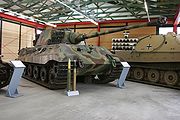 There were two main mechanical reasons for the initial unreliability of the Tiger II, leaking seals and gaskets, and the overburdened drivetrain which was originally intended for a lighter vehicle. The double radius steering gear was particularly prone to failure.
Lack of crew training could amplify this problem; drivers originally given only limited training on other tanks were often sent directly to operational units already on their way to the front.
The Schwere Heeres Panzer Abteilung 501
(s.H.Pz.Abt. 501) arrived on the Eastern Front with only 8 out of 45 tanks operational, mostly due to drivetrain failures. The first five Tiger IIs delivered to the Panzer-Lehr-Division broke down before they could be used in combat, and were destroyed to prevent capture.
Reliability was improved over time with the continuous introduction of modified seals, gaskets and drive train components, driver training, and sufficient maintenance. Statistics from 15 March 1945 compare the availability of Tiger IIs with respect to other tanks: 62 percent of Panzer IV
s, 59 percent of Tiger IIs and 48 percent of Panthers
were operational by this period of the war.
Overall, the Tiger II was a formidable tank in spite of its problems. Its 88 mm armament could destroy any of the Allied armored fighting vehicle
s in service during the war far outside the effective ranges of their guns. Also, notwithstanding its reliability problems, the Tiger II was remarkably agile for such a heavy vehicle. Contemporary German records and testing results indicate that its mobility was as good as or better than most German or Allied tanks.
, opposing Operation Atlantic
between Troarn
and Demouville
on 18 July 1944; losses were two from combat, plus the company commander's tank which became irrecoverably trapped after falling into a bomb crater made during Operation Goodwood
.
On the Eastern Front
, it was first used on 12 August 1944 by the Schwere Heeres Panzer Abteilung 501 (s.H.Pz.Abt. 501)
resisting the Lvov–Sandomierz Offensive. It attacked the Soviet bridgehead over the Vistula River near Baranów Sandomierski
. On the road to Oględów
, three Tiger IIs were destroyed in an ambush by a few T-34-85
s. Because these tanks suffered ammunition explosions which caused many crew fatalities, main gun rounds were no longer allowed to be stowed within the turret, reducing capacity to 68. Up to fourteen Tiger IIs of the 501st were lost in the area between 12 and 13 August to flanking ambushes by the Soviet T-34-85 and IS-2 tanks in inconvenient sandy terrain.
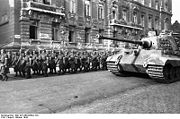 On 15 October 1944 Tiger IIs of s.H.Pz.Abt. 503 played a crucial role during Operation Panzerfaust
, supporting Otto Skorzeny
's troops in taking the Hungarian capital of Budapest
, which ensured that the country remained with the Axis until the end of the war. The 503rd then took part in the Battle of Debrecen
. The 503rd remained in the Hungarian theater of operations for 166 days, during which it accounted for at least 121 Soviet tanks, 244 anti-tank guns and artillery pieces, five aircraft and a train. This was at the loss of 25 Tiger IIs; ten were knocked out by Soviet troops and burned out, two were sent back to Vienna for a factory overhaul, while thirteen were blown up by their crews for various reasons, usually to prevent them from falling into enemy hands. Kurt Knispel
, the highest scoring tank ace of all time (162 enemy AFVs destroyed), also served with the 503rd, and was killed in action on 29 April 1945 in his Tiger II.
The Tiger II was also present at the Ardennes Offensive of December 1944, the Soviet Vistula–Oder and East Prussian Offensive
s in January 1945, the German Lake Balaton Offensive in Hungary in March 1945, the Battle of the Seelow Heights
in April 1945, and finally the Battle of Berlin
at the end of the war.
The Schwere SS Panzer Abteilung 503 (s.SS Pz.Abt. 503) claimed approximately 500 kills in the period from January to April 1945 on the Eastern Front for the loss of 45 Tiger IIs (most of which were abandoned and destroyed by their own crews after mechanical breakdowns or for lack of fuel).
and Soviet tanks attempting to engage it from head on. This was especially true on the Western Front, where until the arrival of the few M26 Pershing
in 1945 neither the British nor U.S. forces had brought heavy tanks into service. Only the British QF 17 pounder (76.2 mm) gun
using Armor-piercing discarding sabot
shot was theoretically capable of penetrating the front of the Tiger II's turret and nose (lower front hull) at 1100 and 1200 yd (1,005.8 and 1,097.3 m) respectively. Flanking maneuvers were used against the Tiger II to attempt a shot at the thinner side and rear armor, giving a tactical advantage to the Tiger II in most engagements. Moreover, the main armament of the Tiger II was capable of knocking out any Allied tank frontally at ranges exceeding 2.5 kilometres (1.6 mi), beyond the effective range of Allied tank guns.
and were soon moved to their testing grounds at Kubinka
. The Soviet team gave the opinion that the tests revealed the tanks to be severely defective; the transmission and suspension broke down very frequently and the engine was prone to overheating and consequential failure. Additionally, the Soviets opinion was of deficiencies in the armor after firing many anti-tank rounds at the same target. Not only did they report that the metal was of shoddy quality (a problem not particular to the Tiger II—as the war progressed, the Germans found it harder and harder to obtain the alloys needed for high-quality steel), but the welding was also, despite "careful workmanship", extremely poor. As a result, even when shells did not penetrate the armor, there was a large amount of spalling, and the armor plating cracked at the welds when struck by multiple heavy shells, rendering the tank inoperable.
, Saumur
, France. It has the production turret and is accessible to the public. Other survivors include:
Nazi Germany
Nazi Germany , also known as the Third Reich , but officially called German Reich from 1933 to 1943 and Greater German Reich from 26 June 1943 onward, is the name commonly used to refer to the state of Germany from 1933 to 1945, when it was a totalitarian dictatorship ruled by...
heavy tank
Heavy tank
A heavy tank was a subset of tank that filled the heavy direct-fire role of many armies.Heavy tanks have usually been deployed to breakthrough enemy lines, though in practice have been more useful in the defensive role than in the attack...
of the Second World War
World War II
World War II, or the Second World War , was a global conflict lasting from 1939 to 1945, involving most of the world's nations—including all of the great powers—eventually forming two opposing military alliances: the Allies and the Axis...
. The final official German designation was Panzerkampfwagen Tiger Ausf. B,Panzerkampfwagen – abbr: Pz. or Pz.Kfw. (English: armored fighting vehicle)
Ausführung – abbr: Ausf. (English: variant).
The full titles Panzerkampfwagen Tiger Ausf. B and Panzerbefehlswagen Tiger Ausf. B (for the command version) were used in training and maintenance manuals and in organization and equipment tables. (Jentz and Doyle 1997)
Also sometimes referred to as Pz. VI Ausf B, not to be confused with Pz. VI Ausf H which was the Tiger I
Tiger I
Tiger I is the common name of a German heavy tank developed in 1942 and used in World War II. The final official German designation was Panzerkampfwagen Tiger Ausf. E, often shortened to Tiger. It was an answer to the unexpectedly formidable Soviet armour encountered in the initial months of...
. often shortened to Tiger B. The ordnance inventory designation was Sd.Kfz.
Sonderkraftfahrzeug
Sonderkraftfahrzeug was the ordnance inventory designation used by Nazi Germany during World War II for military vehicles; for example Sd.Kfz. 101 for the Panzer I....
182. It is also known under the informal name Königstiger (the German
German language
German is a West Germanic language, related to and classified alongside English and Dutch. With an estimated 90 – 98 million native speakers, German is one of the world's major languages and is the most widely-spoken first language in the European Union....
name for the "Bengal tiger
Bengal Tiger
The Bengal tiger is a tiger subspecies native to the Indian subcontinent that in 2010 has been classified as endangered by IUCN...
"), often translated as King Tiger or Royal Tiger by Allied soldiers.
The design followed the same concept as the Tiger I
Tiger I
Tiger I is the common name of a German heavy tank developed in 1942 and used in World War II. The final official German designation was Panzerkampfwagen Tiger Ausf. E, often shortened to Tiger. It was an answer to the unexpectedly formidable Soviet armour encountered in the initial months of...
, but was intended to be even more formidable. The Tiger II combined the thick armor of the Tiger I with the sloped armor used on the Panther
Panther tank
Panther is the common name of a medium tank fielded by Nazi Germany in World War II that served from mid-1943 to the end of the European war in 1945. It was intended as a counter to the T-34, and to replace the Panzer III and Panzer IV; while never replacing the latter, it served alongside it as...
medium tank. The tank weighed almost seventy metric tons, was protected by 100 millimetre of armor to the front, and was armed with the long barrelled 8.8 cm Kampfwagenkanone 43 L/71 gun.Kampfwagenkanone – abbr: KwK (English: fighting vehicle cannon) The chassis was also the basis for the Jagdtiger
Jagdtiger
Jagdtiger is the common name of a German tank destroyer of World War II. The official German designation was Panzerjäger Tiger Ausf. B. The ordnance inventory designation was Sd. Kfz. 186. It saw service in small numbers from late 1944 to the end of the war on both the Western and Eastern Front...
turretless tank destroyer
Tank destroyer
A tank destroyer is a type of armored fighting vehicle armed with a gun or missile launcher, and is designed specifically to engage enemy armored vehicles...
.
The Tiger II was issued to heavy tank battalions of the Army
Heer
Heer is German for "army". Generally, its use as "army" is not restricted to any particular country, so "das britische Heer" would mean "the British army".However, more specifically it can refer to:*An army of Germany:...
(Schwere Heeres Panzer Abteilung - abbreviated s.H.Pz.Abt) and the Waffen-SS
Waffen-SS
The Waffen-SS was a multi-ethnic and multi-national military force of the Third Reich. It constituted the armed wing of the Schutzstaffel or SS, an organ of the Nazi Party. The Waffen-SS saw action throughout World War II and grew from three regiments to over 38 divisions, and served alongside...
(s.SS.Pz.Abt). It was first used in combat with s.H.Pz.Abt. 503 during the Normandy campaign on 11 July 1944; on the Eastern Front
Eastern Front (World War II)
The Eastern Front of World War II was a theatre of World War II between the European Axis powers and co-belligerent Finland against the Soviet Union, Poland, and some other Allies which encompassed Northern, Southern and Eastern Europe from 22 June 1941 to 9 May 1945...
the first unit to be outfitted with Tiger IIs was s.H.Pz.Abt. 501
501st heavy tank battalion (Germany)
The 501st Heavy Tank Battalion was a German World War II independent armoured battalion equipped with heavy tanks. The battalion was the second unit to receive and use the Tiger I The 501st Heavy Tank Battalion (Schwere: heavy, Panzer: tank, Abteilung: battalion) was a German World War II...
which by 1 September 1944 listed 25 Tiger IIs operational.
Development
Development of a heavy tank design had been initiated in 1937; the initial design contract was awarded to HenschelHenschel & Son
Henschel & Son was a German company, situated in Kassel, best known during the 20th century as a maker of transportation equipment, including locomotives, trucks, buses and trolleybuses, and armoured fighting vehicles and weapons....
. Another contract followed in 1939, and was given to Porsche
Ferdinand Porsche
Ferdinand Porsche was an Austrian automotive engineer and honorary Doctor of Engineering. He is best known for creating the first hybrid vehicle , the Volkswagen Beetle, and the Mercedes-Benz SS/SSK, as well as the first of many Porsche automobiles...
. Both prototype series used the same turret design from Krupp
Krupp
The Krupp family , a prominent 400-year-old German dynasty from Essen, have become famous for their steel production and for their manufacture of ammunition and armaments. The family business, known as Friedrich Krupp AG Hoesch-Krupp, was the largest company in Europe at the beginning of the 20th...
; the main differences were in the hull, transmission, suspension and automotive features.
The Henschel version used a conventional hull design with sloped armor resembling the layout of the Panther tank. It had a rear mounted engine and used nine steel-tired overlapping road wheels with internal springing per side, mounted on transverse torsion bars, in a similar manner to the original Tiger. To simplify maintenance, however, the wheels were overlapping rather than interleaved as in the Tiger I.
The Porsche hull designs included a rear-mounted turret and a mid-mounted engine. The suspension was the same as on the Jagdpanzer Elefant
Elefant
The Elefant was a "schwerer Panzerjäger" of the German Wehrmacht used in small numbers in World War II. It was built in 1943 under the name Ferdinand, after its designer Ferdinand Porsche. In 1944, after modification of the existing vehicles, they were renamed Elefant...
. This had six road wheels per side mounted in paired bogies sprung with short longitudinal torsion bars that were integral to the wheel pair; this saved internal space and facilitated repairs. One Porsche version had a gasoline-electric hybrid power system; two separate drive trains in parallel, one per side of the tank, each consisting of a hybrid drive train; gasoline engine – electric generator – electric motor – drive sprocket. This method of propulsion had been attempted before on the Tiger (P) (later Elefant prototypes) and in some U.S. designs, but had never been put into production. The Porsche suspension were later used on a few of the later Jagdtiger
Jagdtiger
Jagdtiger is the common name of a German tank destroyer of World War II. The official German designation was Panzerjäger Tiger Ausf. B. The ordnance inventory designation was Sd. Kfz. 186. It saw service in small numbers from late 1944 to the end of the war on both the Western and Eastern Front...
tank hunters. Another proposal was to use hydraulic drives. Dr. Porsche's unorthodox designs gathered little favor.
Design
The turrets were designed to mount the 8.8 cm KwK 43 L/71 gun. Combined with the Turmzielfernrohr 9d (German "turret telescopic sight") monocular sight by Leitz, which all but a few early Tiger IIs used, it was a very accurate and deadly weapon. During practice, the estimated probability of a first round hit on a 2 m (6.6 ft) high, 2.5 m (8.2 ft) wide target only dropped below 100 percent at ranges beyond 1000 m (0.621372736649807 mi), to 95–97 percent at 1500 metre (0.93205910497471 mi) and 85–87 percent at 2000 m (1.2 mi), depending on ammunition type. Recorded combat performance was lower, but still over 80 percent at 1,000 m, in the 60s at 1,500 m and the 40s at 2,000 m. Penetration of armored plate inclined at 30 degrees was 202 millimetre at 100 and 2000 m (0.0621372736649807 and 1.2 mi) respectively for the Panzergranate 39/43
Panzergranate 39
Panzergranate 39 or Pzgr. 39 was a German armor-piercing shell used during World War II. It was manufactured in various calibers and was the most common anti-tank shell used in German tank and antitank guns of 50 to 88 mm calibers....
projectile (PzGr—armor-piercing shell
Armor-piercing shot and shell
An armor-piercing shell is a type of ammunition designed to penetrate armor. From the 1860s to 1950s, a major application of armor-piercing projectiles was to defeat the thick armor carried on many warships. From the 1920s onwards, armor-piercing weapons were required for anti-tank missions...
), and 238 millimetre for the PzGr. 40/44 projectile between the same ranges. The Sprenggranate 43 (SpGr) high-explosive round was available for soft targets, or the Hohlgranate or Hohlgeschoss 39 (HlGr—HEAT or High explosive anti-tank warhead) round, which had 90 mm (3.5 in) penetration at any range, could be used as a dual-purpose munition against soft or armored targets.
Powered turret traverse was provided by the variable speed Boehringer-Sturm L4S hydraulic motor which was driven from the main engine by a secondary drive shaft. A high and a low speed setting was available to the gunner via a lever on his right. The turret could be rotated 360 degrees in 60 seconds in low gear independent of engine rpm, in 19 seconds in high gear at idle engine speed, and within 10 seconds at the maximum allowable engine speed. The direction and speed of traverse was controlled by the gunner through foot pedals, or a control lever near his left arm. The system was smooth and accurate enough to be used for final gun laying without the gunner needing to use his traverse hand wheel for fine adjustments; most other tanks of the period often required manual fine traverse adjustments. If power was lost, the turret could be slowly traversed by hand, assisted by the loader who had an additional wheel.
Like all German tanks, it had a gasoline
Gasoline
Gasoline , or petrol , is a toxic, translucent, petroleum-derived liquid that is primarily used as a fuel in internal combustion engines. It consists mostly of organic compounds obtained by the fractional distillation of petroleum, enhanced with a variety of additives. Some gasolines also contain...
engine; in this case the same 700 PS (690 hp, 515 kW) V-12 Maybach HL 230 P30
Maybach HL230
The Maybach HL230 is a water-cooled 60° 23 liter V12 gasoline engine designed by Maybach. It was used during World War II in heavy German tanks, namely the Panther, Jagdpanther, Tiger II, Jagdtiger , and later versions of the Tiger I and Sturmtiger...
which powered the much lighter Panther
Panther tank
Panther is the common name of a medium tank fielded by Nazi Germany in World War II that served from mid-1943 to the end of the European war in 1945. It was intended as a counter to the T-34, and to replace the Panzer III and Panzer IV; while never replacing the latter, it served alongside it as...
and Tiger I
Tiger I
Tiger I is the common name of a German heavy tank developed in 1942 and used in World War II. The final official German designation was Panzerkampfwagen Tiger Ausf. E, often shortened to Tiger. It was an answer to the unexpectedly formidable Soviet armour encountered in the initial months of...
tanks. The Tiger II was under-powered, like many other heavy tanks of World War II, and consumed a lot of fuel, which was in short supply for the Germans. The transmission was the Maybach OLVAR EG 40 12 16 Model B, giving eight forward gears and four reverse, which drove the steering gear. This was the Henschel L 801, a double radius design which proved susceptible to failure. Transverse torsion bar suspension supported the hull, and nine overlapped 800 mm (31.5 in) diameter road wheels with rubber cushions and steel tyres rode inside the tracks on each side.
Like the Tiger I, each tank was issued with two sets of tracks: a normal "battle track" and a narrower "transport" version used during rail transport. The transport tracks reduced the overall width of the load and could be used to drive the tank short distances on firm ground. The crew were expected to change to normal battle tracks as soon as the tank was unloaded. Ground pressure was 0.76 kg/cm2 (10.8 psi).
Command variant
The command variant of the Tiger II was designated Panzerbefehlswagen Tiger Ausf. B. It had two versions, Sd.Kfz. 267 and Sd.Kfz. 268. These carried only 63 rounds of 8.8 cm ammunition to provide room to accommodate the extra radios and equipment, and had additional armouring on the engine compartment. The Sd.Kfz. 267 was to have used FuG 8 and FuG 5 radio sets, with the most notable external changes being a 2 metre long rod antenna mounted on the turret roof and a Sternantenna D ("Star antenna D"), mounted on an insulated base (the 104mm Antennenfuss Nr. 1) which was protected by a large armored cylinder. This equipment was located on the rear decking in a position originally used for deep-wading equipment. The Sd.Kfz. 268 used FuG 7 and FuG 5 radios with a 2 metre rod antenna mounted on the turret roof and a 1.4 metre rod antenna mounted on the rear deck.Production
The Tiger II was developed late in the war and made in relatively small numbers - 1,500 Tiger IIs were ordered, but the production was severely disrupted by Allied bombing. Among others, five raids between 22 September and 7 October 1944 destroyed 95 percent of the floor area of the Henschel plant. It is estimated that this caused the loss in production of some 657 Tiger IIs. Only 492 units were produced: 1 in 1943, 379 in 1944, and 112 in 1945. Full production ran from mid-1944 to the end of the war.The Tiger II served as a basis for one production variant, the Jagdtiger
Jagdtiger
Jagdtiger is the common name of a German tank destroyer of World War II. The official German designation was Panzerjäger Tiger Ausf. B. The ordnance inventory designation was Sd. Kfz. 186. It saw service in small numbers from late 1944 to the end of the war on both the Western and Eastern Front...
casemate
Casemate
A casemate, sometimes rendered casement, is a fortified gun emplacement or armored structure from which guns are fired. originally a vaulted chamber in a fortress.-Origin of the term:...
-style tank destroyer
Tank destroyer
A tank destroyer is a type of armored fighting vehicle armed with a gun or missile launcher, and is designed specifically to engage enemy armored vehicles...
, and a proposed Grille 17/21/30/42 self-propelled mount for heavy guns that never reached production.
Proposed upgrades
A version of the Maybach HL230Maybach HL230
The Maybach HL230 is a water-cooled 60° 23 liter V12 gasoline engine designed by Maybach. It was used during World War II in heavy German tanks, namely the Panther, Jagdpanther, Tiger II, Jagdtiger , and later versions of the Tiger I and Sturmtiger...
engine with fuel injection
Fuel injection
Fuel injection is a system for admitting fuel into an internal combustion engine. It has become the primary fuel delivery system used in automotive petrol engines, having almost completely replaced carburetors in the late 1980s....
and uprated drive train was designed that would have increased the power to about 1,000 PS (986 hp, 736 kW). Henschel proposed using it for future production and fitting it to existing Tiger IIs, but the deteriorating situation meant the upgrade never left the drawing board. Other suggested improvements included a new main weapon (10.5 cm KwK L/68), stabilized sights, stabilized main gun, automatic ammunition feed, a Zeiss stereoscopic range finder, heated crew compartment, stowage for an additional 12 rounds, and an overpressure and air filtration system to protect against poison gas, but these either never got beyond the proposal stage or did not enter production before the war ended.
Specifications
- Gearbox: Maybach OLVAR EG 40 12 16 B (8 forward and 4 reverse)
- Radio: FuG 5, Befehlswagen (command tank) version: FuG 8 (Sd.Kfz. 267), FuG 7 (Sd.Kfz. 268)
- Ammunition:
- 8.8 cm – 80 rounds (Porsche turret), 86 rounds (Henschel turret), usually 50% PzGr 39/43 and 50% SprGr 43, sometimes with a limited number of PzGr 40/43, or with the SprGr replaced with HlGr
- PzGr 39/43 (Armor piercing, tungsten core) (longer range, lower penetration, explosive filler)
- PzGr 40/43 (Armor piercing, tungsten core) (shorter range, higher penetration, inert)
- SprGr 43 (High Explosive)
- HlGr 39 (Hollow charge)
- 7.92mm – up to 5,850 rounds
- 8.8 cm – 80 rounds (Porsche turret), 86 rounds (Henschel turret), usually 50% PzGr 39/43 and 50% SprGr 43, sometimes with a limited number of PzGr 40/43, or with the SprGr replaced with HlGr
- Gun Sight: Turmzielfernrohr 9b/1 (TZF 9b/1) binocular to May 1944, then the 9d (TZF 9d) monocular.
| Hull front | (lower) | 100 mm (3.9 in) at 40° | (upper) | 150 mm (5.9 in) at 40° | |
| Hull side | (lower) | 80 mm (3.1 in) at 90° | (upper) | 80 mm (3.1 in) at 65° | |
| Hull rear | 80 mm (3.1 in) at 60° | ||||
| Hull top | 40 mm (1.6 in) at 90° | ||||
| Hull bottom | (front) | 40 mm (1.6 in) at 90° | (rear) | 25 mm (0.984251968503937 in) at 90° | |
| Turret front | (production) | 180 mm (7.1 in) at 80° | ("Porsche") | 60 millimetre, rounded | |
| Turret side | (production) | 80 mm (3.1 in) at 69° | ("Porsche") | 80 mm (3.1 in) at 60° | |
| Turret rear | (production) | 80 mm (3.1 in) at 70° | ("Porsche") | 80 mm (3.1 in) at 60° | |
| Turret top | (production) | 44 mm (1.7 in) at 0–10° | ("Porsche") | 40 mm (1.6 in) at 0–12° | |
Organization
Apart from research, training, and a five tank attachment to the Panzer Lehr, Tiger II's were only issued to heavy tank battalions (schwere Panzer Abteilung) of the German Army (Heer), or Waffen-SSWaffen-SS
The Waffen-SS was a multi-ethnic and multi-national military force of the Third Reich. It constituted the armed wing of the Schutzstaffel or SS, an organ of the Nazi Party. The Waffen-SS saw action throughout World War II and grew from three regiments to over 38 divisions, and served alongside...
.
| Battalion command 3 x Tiger II |
||||||||
| 1st company command 2 x Tiger II |
2nd company command 2 x Tiger II |
3rd company command 2 x Tiger II |
||||||
| 1st platoon 4 x Tiger II |
2nd platoon 4 x Tiger II |
3rd platoon 4 x Tiger II |
1st platoon 4 x Tiger II |
2nd platoon 4 x Tiger II |
3rd platoon 4 x Tiger II |
1st platoon 4 x Tiger II |
2nd platoon 4 x Tiger II |
3rd platoon 4 x Tiger II |
Units which used the Tiger II were as follows:
- Heer: (s.H.Pz.Abt) 501501st heavy tank battalion (Germany)The 501st Heavy Tank Battalion was a German World War II independent armoured battalion equipped with heavy tanks. The battalion was the second unit to receive and use the Tiger I The 501st Heavy Tank Battalion (Schwere: heavy, Panzer: tank, Abteilung: battalion) was a German World War II...
, 502502nd Heavy Tank Battalion (Germany)The 502nd Heavy Tank Battalion was a German World War II independent armoured battalion equipped with heavy tanks. The battalion was the first unit to receive and field the Tiger I or Panzerkampfwagen VI Ausf. E. It fought on the Eastern front...
, 503, 504, 505, 506, 507, 508508th heavy tank battalion (Germany)The 508th Heavy Tank Battalion , was a heavy tank battalion of the German Army during World War II, equipped with Tiger I heavy tanks. It fought at Anzio and later defended German-held Northern Italy opposing the Allies during the Italian Campaign...
, 509, 510510th heavy tank battalion (Germany)The schwere-Panzer-Abteilung 510 was a German heavy panzer abteilung equipped with Tiger I and later Tiger II Königstiger tanks...
, 511 - SS: (s.SS.Pz.Abt) 501, 502, 503
Reliability and mobility
Lack of crew training could amplify this problem; drivers originally given only limited training on other tanks were often sent directly to operational units already on their way to the front.
The Schwere Heeres Panzer Abteilung 501
501st heavy tank battalion (Germany)
The 501st Heavy Tank Battalion was a German World War II independent armoured battalion equipped with heavy tanks. The battalion was the second unit to receive and use the Tiger I The 501st Heavy Tank Battalion (Schwere: heavy, Panzer: tank, Abteilung: battalion) was a German World War II...
(s.H.Pz.Abt. 501) arrived on the Eastern Front with only 8 out of 45 tanks operational, mostly due to drivetrain failures. The first five Tiger IIs delivered to the Panzer-Lehr-Division broke down before they could be used in combat, and were destroyed to prevent capture.
Reliability was improved over time with the continuous introduction of modified seals, gaskets and drive train components, driver training, and sufficient maintenance. Statistics from 15 March 1945 compare the availability of Tiger IIs with respect to other tanks: 62 percent of Panzer IV
Panzer IV
The Panzerkampfwagen IV , commonly known as the Panzer IV, was a medium tank developed in Nazi Germany in the late 1930s and used extensively during the Second World War. Its ordnance inventory designation was Sd.Kfz...
s, 59 percent of Tiger IIs and 48 percent of Panthers
Panther tank
Panther is the common name of a medium tank fielded by Nazi Germany in World War II that served from mid-1943 to the end of the European war in 1945. It was intended as a counter to the T-34, and to replace the Panzer III and Panzer IV; while never replacing the latter, it served alongside it as...
were operational by this period of the war.
Overall, the Tiger II was a formidable tank in spite of its problems. Its 88 mm armament could destroy any of the Allied armored fighting vehicle
Armoured fighting vehicle
An armoured fighting vehicle is a combat vehicle, protected by strong armour and armed with weapons. AFVs can be wheeled or tracked....
s in service during the war far outside the effective ranges of their guns. Also, notwithstanding its reliability problems, the Tiger II was remarkably agile for such a heavy vehicle. Contemporary German records and testing results indicate that its mobility was as good as or better than most German or Allied tanks.
Combat history
The first combat use of the Tiger II was by the 1st company of the Schwere Heeres Panzer Abteilung 503 during the Battle of NormandyBattle of Normandy
The Invasion of Normandy was the invasion and establishment of Allied forces in Normandy, France, during Operation Overlord in World War II. It was the largest amphibious operation in history...
, opposing Operation Atlantic
Operation Atlantic
Operation Atlantic was a Canadian offensive during the Battle of Normandy in the Second World War, from July 18–21, 1944. This Canadian offensive was launched in conjunction with a British-led offensive, Operation Goodwood...
between Troarn
Troarn
-References:*...
and Demouville
Démouville
-References:*...
on 18 July 1944; losses were two from combat, plus the company commander's tank which became irrecoverably trapped after falling into a bomb crater made during Operation Goodwood
Operation Goodwood
Operation Goodwood was an attack launched on 18 July 1944, during the Second World War, by the British army to the east of the city of Caen...
.
On the Eastern Front
Eastern Front (World War II)
The Eastern Front of World War II was a theatre of World War II between the European Axis powers and co-belligerent Finland against the Soviet Union, Poland, and some other Allies which encompassed Northern, Southern and Eastern Europe from 22 June 1941 to 9 May 1945...
, it was first used on 12 August 1944 by the Schwere Heeres Panzer Abteilung 501 (s.H.Pz.Abt. 501)
501st heavy tank battalion (Germany)
The 501st Heavy Tank Battalion was a German World War II independent armoured battalion equipped with heavy tanks. The battalion was the second unit to receive and use the Tiger I The 501st Heavy Tank Battalion (Schwere: heavy, Panzer: tank, Abteilung: battalion) was a German World War II...
resisting the Lvov–Sandomierz Offensive. It attacked the Soviet bridgehead over the Vistula River near Baranów Sandomierski
Baranów Sandomierski
Baranów Sandomierski is a small town in southern Poland, in the Subcarpathian Voivodship, Tarnobrzeg County on the Vistula River, with 1,440 inhabitants .-Castle:...
. On the road to Oględów
Ogledów
Oględów is a village in the administrative district of Gmina Staszów, within Staszów County, Świętokrzyskie Voivodeship, in south-central Poland...
, three Tiger IIs were destroyed in an ambush by a few T-34-85
T-34
The T-34 was a Soviet medium tank produced from 1940 to 1958. Although its armour and armament were surpassed by later tanks of the era, it has been often credited as the most effective, efficient and influential design of World War II...
s. Because these tanks suffered ammunition explosions which caused many crew fatalities, main gun rounds were no longer allowed to be stowed within the turret, reducing capacity to 68. Up to fourteen Tiger IIs of the 501st were lost in the area between 12 and 13 August to flanking ambushes by the Soviet T-34-85 and IS-2 tanks in inconvenient sandy terrain.
Operation Panzerfaust
Operation Panzerfaust, known as Unternehmen Eisenfaust in Germany, was a military operation to keep the Kingdom of Hungary at Germany's side in the war, conducted in October 1944 by the German military...
, supporting Otto Skorzeny
Otto Skorzeny
Otto Skorzeny was an SS-Obersturmbannführer in the German Waffen-SS during World War II. After fighting on the Eastern Front, he was chosen as the field commander to carry out the rescue mission that freed the deposed Italian dictator Benito Mussolini from captivity...
's troops in taking the Hungarian capital of Budapest
Budapest
Budapest is the capital of Hungary. As the largest city of Hungary, it is the country's principal political, cultural, commercial, industrial, and transportation centre. In 2011, Budapest had 1,733,685 inhabitants, down from its 1989 peak of 2,113,645 due to suburbanization. The Budapest Commuter...
, which ensured that the country remained with the Axis until the end of the war. The 503rd then took part in the Battle of Debrecen
Battle of Debrecen
The Battle of Debrecen, called by the Red Army the Debrecen Offensive Operation, was conducted by the 2nd Ukrainian Front on the Eastern Front of World War II...
. The 503rd remained in the Hungarian theater of operations for 166 days, during which it accounted for at least 121 Soviet tanks, 244 anti-tank guns and artillery pieces, five aircraft and a train. This was at the loss of 25 Tiger IIs; ten were knocked out by Soviet troops and burned out, two were sent back to Vienna for a factory overhaul, while thirteen were blown up by their crews for various reasons, usually to prevent them from falling into enemy hands. Kurt Knispel
Kurt Knispel
Kurt Knispel was a Sudeten German Heer panzer loader, gunner and later commander, and was the highest scoring tank ace of World War II with a total of 168 confirmed tank kills; the actual number, although unconfirmed, may be as high as 195...
, the highest scoring tank ace of all time (162 enemy AFVs destroyed), also served with the 503rd, and was killed in action on 29 April 1945 in his Tiger II.
The Tiger II was also present at the Ardennes Offensive of December 1944, the Soviet Vistula–Oder and East Prussian Offensive
East Prussian Offensive
The East Prussian Offensive was a strategic offensive by the Red Army against the German Wehrmacht on the Eastern Front . It lasted from 13 January to 25 April 1945, though some German units did not surrender until 9 May...
s in January 1945, the German Lake Balaton Offensive in Hungary in March 1945, the Battle of the Seelow Heights
Battle of the Seelow Heights
The Battle of the Seelow Heights , was a part of the Seelow-Berlin Offensive Operation ; one of the last assaults on large entrenched defensive positions of World War II. It was fought over three days, from 16–19 April 1945...
in April 1945, and finally the Battle of Berlin
Battle of Berlin
The Battle of Berlin, designated the Berlin Strategic Offensive Operation by the Soviet Union, was the final major offensive of the European Theatre of World War II....
at the end of the war.
The Schwere SS Panzer Abteilung 503 (s.SS Pz.Abt. 503) claimed approximately 500 kills in the period from January to April 1945 on the Eastern Front for the loss of 45 Tiger IIs (most of which were abandoned and destroyed by their own crews after mechanical breakdowns or for lack of fuel).
Gun and armor performance
The heavy armor and powerful long-range gun gave the Tiger II an advantage against all opposing Western AlliedWestern Allies
The Western Allies were a political and geographic grouping among the Allied Powers of the Second World War. It generally includes the United Kingdom and British Commonwealth, the United States, France and various other European and Latin American countries, but excludes China, the Soviet Union,...
and Soviet tanks attempting to engage it from head on. This was especially true on the Western Front, where until the arrival of the few M26 Pershing
M26 Pershing
The Heavy Tank M26 Pershing was an American heavy tank briefly used in World War II and in the Korean War. It was named after General John Pershing, who led the American Expeditionary Force in Europe in World War I....
in 1945 neither the British nor U.S. forces had brought heavy tanks into service. Only the British QF 17 pounder (76.2 mm) gun
Ordnance QF 17 pounder
The Ordnance Quick-Firing 17 pounder was a 76.2 mm gun developed by the United Kingdom during World War II. It was used as an anti-tank gun on its own carriage, as well as equipping a number of British tanks. It was the most effective Allied anti-tank gun of the war...
using Armor-piercing discarding sabot
Armour-piercing discarding sabot
Armour-piercing discarding sabot is a type of kinetic energy projectile fired from a gun to attack armoured targets. APDS rounds are sabot rounds and were commonly used in large calibre tank guns, but have now been superseded by armour-piercing fin-stabilized discarding sabot projectiles in such...
shot was theoretically capable of penetrating the front of the Tiger II's turret and nose (lower front hull) at 1100 and 1200 yd (1,005.8 and 1,097.3 m) respectively. Flanking maneuvers were used against the Tiger II to attempt a shot at the thinner side and rear armor, giving a tactical advantage to the Tiger II in most engagements. Moreover, the main armament of the Tiger II was capable of knocking out any Allied tank frontally at ranges exceeding 2.5 kilometres (1.6 mi), beyond the effective range of Allied tank guns.
Soviet wartime testing
During August 1944, a number of Tiger II tanks were captured by the Soviets near SandomierzSandomierz
Sandomierz is a city in south-eastern Poland with 25,714 inhabitants . Situated in the Świętokrzyskie Voivodeship , previously in Tarnobrzeg Voivodeship . It is the capital of Sandomierz County . Sandomierz is known for its Old Town, a major tourist attraction...
and were soon moved to their testing grounds at Kubinka
Kubinka
Kubinka is a town in Odintsovsky District of Moscow Oblast, Russia, located on the Setun River, west of Moscow. Population: Kubinka was the location of the Soviet Union's tank proving grounds, and today is the home of the Kubinka Tank Museum...
. The Soviet team gave the opinion that the tests revealed the tanks to be severely defective; the transmission and suspension broke down very frequently and the engine was prone to overheating and consequential failure. Additionally, the Soviets opinion was of deficiencies in the armor after firing many anti-tank rounds at the same target. Not only did they report that the metal was of shoddy quality (a problem not particular to the Tiger II—as the war progressed, the Germans found it harder and harder to obtain the alloys needed for high-quality steel), but the welding was also, despite "careful workmanship", extremely poor. As a result, even when shells did not penetrate the armor, there was a large amount of spalling, and the armor plating cracked at the welds when struck by multiple heavy shells, rendering the tank inoperable.
Surviving vehicles
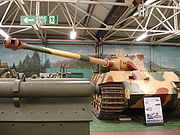
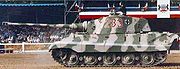
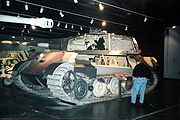
The only operable example is displayed in the Musée des BlindésMusée des Blindés
The Musée des Blindés or Musée Général Estienne is a tank museum located in the Loire Valley of France, in the city of Saumur. It is one of the world's largest tank museums....
, Saumur
Saumur
Saumur is a commune in the Maine-et-Loire department in western France.The historic town is located between the Loire and Thouet rivers, and is surrounded by the vineyards of Saumur itself, Chinon, Bourgueil, Coteaux du Layon, etc...
, France. It has the production turret and is accessible to the public. Other survivors include:
- Bovington Tank MuseumBovington Tank MuseumThe Tank Museum is a collection of armoured fighting vehicles in the United Kingdom that traces the history of the tank. With almost 300 vehicles on exhibition from 26 countries it is the second-largest collection of tanks and armoured fighting vehicles in the world.The Musée des Blindés in France...
, DorsetDorsetDorset , is a county in South West England on the English Channel coast. The county town is Dorchester which is situated in the south. The Hampshire towns of Bournemouth and Christchurch joined the county with the reorganisation of local government in 1974...
, UK. Tiger II with early production turret is on display. This vehicle was the second soft steel prototype made and did not see active service. A production turret Tiger II is on loan from the Defence Academy, Shrivenham. See below. - Defence Academy of the United Kingdom, ShrivenhamShrivenhamShrivenham is a large village and civil parish in Oxfordshire, England, close to the boundary with Wiltshire. It is in the Vale of White Horse, between Swindon and Faringdon. It was part of Berkshire until the 1974 boundary changes transferred it to Oxfordshire.-Character:Shrivenham features many...
, UK. Tiger II (production turret) in military collection not normally accessible to the public. This vehicle was from s.SS Pz.Abt. 501, with hull number 280093, turret number 104, and has a comprehensive coating of ZimmeritZimmeritZimmerit was a coating produced for German armored fighting vehicles during World War II for the purpose of combating magnetically attached anti-tank mines, although Germany was the only country to use magnetic mines against tanks in large scale numbers...
. It was claimed by Sergeant Roberts of A Squadron, 23rd Hussars23rd HussarsThe 23rd Hussars was a cavalry regiment of the British Army from 1940 to 1946. It had no lineal connection with the earlier 23rd Regiment of Dragoons .-History:...
, 11th Armoured Division in a Sherman tank near BeauvaisBeauvaisBeauvais is a city approximately by highway north of central Paris, in the northern French region of Picardie. It currently has a population of over 60,000 inhabitants.- History :...
, although it had already been disabled and abandoned by its crew following damage to its tracks and final drive. There is a well-known photograph showing this vehicle after its final action in a beet field with its turret turned 90°. This vehicle is currently on display at Bovington Tank Museum. It lacks its engine. - Wheatcroft Collection, LeicestershireLeicestershireLeicestershire is a landlocked county in the English Midlands. It takes its name from the heavily populated City of Leicester, traditionally its administrative centre, although the City of Leicester unitary authority is today administered separately from the rest of Leicestershire...
, UK. A private collector, Wheatcroft is about to start a restoration/rebuild of a complete Tiger II. The project will include parts from many individual Tiger IIs, but many parts will be of new manufacture. Wheatcroft has stated that he has 70–80% of the original parts needed for a reconstruction and more parts are sourced continuously. Known and shown parts are a complete front glacis plate, 8.8 cm KwK 43 main armament, engine deck plates, approx. 1/3 hull (rear) in one part, a set of tracks, and approx. 2/3 of the left-side hull plate in two parts. The aim of the project is a complete Tiger II in running order. - Musée des BlindésMusée des BlindésThe Musée des Blindés or Musée Général Estienne is a tank museum located in the Loire Valley of France, in the city of Saumur. It is one of the world's largest tank museums....
, SaumurSaumurSaumur is a commune in the Maine-et-Loire department in western France.The historic town is located between the Loire and Thouet rivers, and is surrounded by the vineyards of Saumur itself, Chinon, Bourgueil, Coteaux du Layon, etc...
, France. A Tiger II (production turret) in working order. - Mantes-la-JolieMantes-la-JolieMantes-la-Jolie is a commune based in the Yvelines department in the Île-de-France region in north-central France. It is located in the western suburbs of Paris from the center. Mantes-la-Jolie is a sub-prefecture department.-History:...
, France. A more or less complete, but wrecked, Tiger II (production turret) is buried under regional road 913. Parts of the turret were recovered in a limited exploratory excavation in 2001. Further excavation is currently halted for financial reasons. There are plans to fully excavate and restore this Tiger II for a VexinVexinThe Vexin is a historical county of northwestern France. It covers a verdant plateau on the right bank of the Seine comprising an area east-to-west between Pontoise and Romilly-sur-Andelle , and north-to-south between Auneuil and the Seine near Vernon...
battle memorial. - Kubinka Tank MuseumKubinka Tank MuseumThe Kubinka Tank Museum is a large museum of armoured fighting vehicles in Kubinka, just outside Moscow. It has many famous tanks from World War I, World War II and the Cold War. The museum also houses many unique vehicles, such as the Panzer VIII Maus, Troyanov super-heavy tank and a Karl-Gerät...
, Russia. Tiger II (production turret) with turret number 002 (502) captured at Oględów by the Red Army. The museum is open to the public with restrictions as the vehicle is located on the military base. - December 44 Museum, La GleizeLa GleizeLa Gleize is a village and section of the Belgian Municipality of Stoumont, situated in the Walloon Region in the province of Liège.Common before the full merger of Commons in 1977, La Gleize is located on a rocky outcrop overlooking the valley of Amblève in the Ardennes region.-Hamlets:Moulin du...
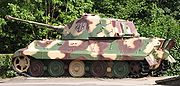
, Belgium. A cosmetically restored Tiger II (production turret) in open air location accessible to public. Hull number 280273, built in October 1944. Turret number 213 from s.SS Pz.Abt 501. This tank was abandoned in La Gleize on 24 December 1944. The front part, about 1/3, of the gun tube is restored with a Panther gun tube and muzzle brake. It also has replica mudguards. It is stripped of exterior and internal fittings and most of the torsion bars are broken, but it still has its gearbox and engine in place. - Deutsches PanzermuseumDeutsches PanzermuseumThe German Tank Museum is an armoured fighting vehicle museum in Munster, Germany, the location of the Munster Training Area camp. Its main aim is the documentation of the history of German armoured troops since 1917....
, MunsterMunster, Lower SaxonyMunster, also called Munster , is a small town in the district of Heidekreis, in Lower Saxony, Germany almost equidistant from Hamburg and Hanover. The town is home to the German Army's largest garrison and is situated between the two training areas of Munster North and Munster South. It is also...
, Germany. Tiger II (production turret) displayed in interior location accessible to public on payment of entrance fee. Hull number 280101. Turret number 121 from s.SS.Pz.Abt 501. - Patton Museum of Cavalry and ArmorPatton Museum of Cavalry and ArmorThe General George Patton Museum of Leadership is a museum in Fort Knox, Kentucky, dedicated to the memory of General George S. Patton, Jr., and his life from World War I through the present day. The museum is administered by the U.S. Army Accessions Command, Fort Knox...
, Fort KnoxFort KnoxFort Knox is a United States Army post in Kentucky south of Louisville and north of Elizabethtown. The base covers parts of Bullitt, Hardin, and Meade counties. It currently holds the Army Human Resources Center of Excellence to include the Army Human Resources Command, United States Army Cadet...
, United States. Tiger II (production turret). Hull number 280243, built in September 1944. Turret number 332 from s.SS Pz.Abt. 501. Abandoned near Trois-PontsTrois-PontsTrois-Ponts is a municipality of Belgium. It lies in the country's Walloon Region and Province of Liege. On January 1, 2006 Trois-Ponts had a total population of 2,445. The total area is 68.90 km² which gives a population density of 35 inhabitants per km². It is situated at the confluence of the...
, it was captured by the US Army on 24 December 1944. The left side was cut open for educational purposes at the Aberdeen Proving GroundAberdeen Proving GroundAberdeen Proving Ground is a United States Army facility located near Aberdeen, Maryland, . Part of the facility is a census-designated place , which had a population of 3,116 at the 2000 census.- History :...
in the late 1940s. This tank left Fort Knox on 14 December 2010, en route to the proposed US Army armor museum at Fort BenningFort BenningFort Benning is a United States Army post located southeast of the city of Columbus in Muscogee and Chattahoochee counties in Georgia and Russell County, Alabama...
, United States. - Schweizerisches Militärmuseum Full, Switzerland. This Tiger II (production turret) was previously displayed in the Thun Tank Museum, and is now on loan to the Schweizerisches Militärmuseum Full (September 2006). It will be completely restored to running condition in a long-term project. This tank was given to Switzerland by France after the war. Hull number 280215 from s.H.Pz.Abt 506.
External links
- Information about the Pz.Kpfw.Tiger Ausf.B "Tiger II" at Panzerworld
- Tiger II at the Armorsite
- Tiger II Ausf. B at Achtung Panzer!
- AFV Database
- La Gleize Museum's Tiger II
- Tiger survivors — Photos of surviving Tiger tanks (Tiger I, Kingtiger, Jagdtiger and Sturmtiger)
- Pantiger, A Redesigned Tiger (U.S. intelligence report, 1944)
- Saumur Musée des Blindés picture gallery, Tiger II at the bottom
- Tigers in the Ardennes Retrieved: 4 March 2010 - Photos and details of operational and captured Tiger IIs