Battle of Debrecen

Encyclopedia
The Battle of Debrecen, called by the Red Army the Debrecen Offensive Operation, (6–29 October 1944) was conducted by the 2nd Ukrainian Front on the Eastern Front of World War II
. It was opposed by Army Group South Ukraine
's General Maximilian Fretter-Pico's
Sixth Army (II formation) and allied Hungarian VII Army Corps units which were forced to retreat some 160 kilometers, while opposing Marshal Rodion Malinovsky's
2nd Ukrainian Front which had Debrecen
, Hungary as its strategic objective.
) Johannes Friessner's
Army Group South Ukraine was on the brink of collapse. To the north, the Red Army's Operation Bagration was completing the destruction of Army Group Centre
.
On 25 August 1944, Germany's former ally, Romania
had switched sides and declared war on Germany and its ally Hungary. The subsequent drive of Soviet General Fedor Tolbukhin's 3rd Ukrainian Front
into Romania destroyed any semblance of an organised defensive line.
On 8 September, Bulgaria
, another former German ally, also declared war on Germany. By this time, Tolbukhin, aided by the 2nd Ukrainian Front under Malinovsky had annihilated thirteen Axis divisions, taking over 100,000 prisoners. Both Malinovsky and Tolbukhin were promoted to Marshal of the Soviet Union
for this on 10 and 12 September respectively.
The actions of Bulgaria and Romania had opened up a 650 kilometer gap in Friessner's Army Group. As Friessner desperately struggled to reform a defensive line, news filtered through to Berlin that the Hungarian leader, Admiral Miklós Horthy
was preparing to sign a separate peace with the Soviet Union. If this happened, the entire southern front would collapse.
On 24 September 1944, Friessner's Army Group South Ukraine was redesignated Army Group South
. General Fretter-Pico's Sixth Army formed the nucleus of Friessner's force. Seeing that the Hungarian allies were suffering from low morale, Friessner attached the Hungarian Second Army
to Fretter-Pico's Army. The German-Hungarian force was designated Armeegruppe Fretter-Pico.
.
In early September 1944, Malinovsky received orders from Stavka
to advance from Cluj
. He was to advance towards Miskolc
, Debrecen
, and the Tisza River and then on to the flat expanses of the Hungarian Plain. Once on the plain, Malinovsky could exploit his overwhelming advantage in armour. He could destroy Friessner's Army Group, break through to Budapest
, and drive into Slovakia
. However, Malinovsky's plan did not take into account the presence of German Panzer reserves that had been ordered into the area by Adolf Hitler
. Furthermore, the Soviet forces were worn down by the Iasi-Chisinau Strategic Offensive Operation and the Belgrade Offensive
, and also had to contend with logistical difficulties caused by the different railway gauge used in Romania.
Friessner, fearing that his forces might be enveloped by Malinovsky's 2nd Ukrainian Front and by the 4th Ukrainian Front
, flew to Hitler's headquarters
. He requested permission to withdraw his forces to defensive positions along the Tisza River. Friessner argued that this withdrawal would provide him with some freedom of movement to counter the continuing Soviet attacks. Hitler refused him, but he promised additional forces for Friessner's army group. Hitler also ordered Friessner to start a new offensive. The aim of this offensive was the immediate destruction of two of Malinovsky's Armies. Friessner, desperate for a workable defensive strategy, was instead ordered by Hitler to destroy the 27th Army
and Soviet 6th Guards Tank Army
. In addition, he was ordered to retake two vital passes in the Southern Carpathians
in order to sever Malinovsky's lines of communication
. The ordered attack was to be launched from Cluj.
, launched his own Belgrade Offensive
. In a stroke of luck, Friessner had been concentrating troops for his own planned offensive, and Malinovsky's 2nd Ukrainian Front ran into heavy resistance from the start. After a week of fruitless attacks, Malinovsky called off his offensive and ordered the exhausted 6th Guards Tank Army, along with Cavalry Mechanized Group
commanded by Pliyev
(7th Mechanized Corps, 4th Guards Cavalry Corps, and 6th Guards Cavalry Corps, with 389 tanks and assault guns, and Cavalry Tank Group General Major Sergei Ilyich Gorshkov's 5th Guards Cavalry Corps with the 23rd Tank Corps attached (146 tanks and assault guns), to the area near Oradea
. Malinovsky planned to use this mobile armoured force as an operational exploitation force in future operations.
On 20 September 1944, Romanian troops captured the Romanian border town of Arad
. This action threw the Hungarian General Staff into a panic. They activated the Hungarian Third Army
, a force composed of new recruits and reservists, and of limited military value.
At the same time both pro-German and pro-Allied factions in the Hungarian government began working to take control of the country. Hungarian Regent, Admiral Miklós Horthy
's negotiations for an armistice with the Soviets began in earnest. Friessner was forced to send several of his desperately needed reinforcement units to Budapest to watch the situation. He did this under the premise of providing the units with a period of rest and refit.
By the end of September 1944, both Malinovsky and Friessner had received new orders. Malinovsky was now ordered to attack towards Budapest from the salient
to the south around Arad. He was to use the 46th and 1st Romanian Armies with the Cavalry Mechanized Group Pliyev as the exploitation force in case of a successful breakthrough. The remainder of Malinovsky's forces, including the 6th Guards Tank Army, 53rd Army, and Cavalry Tank Group Gorshkov, were to attack from the north, near Oradea, towards Debrecen. The plan was for the two spearheads to link up, encircle the German forces, and annihilate them.
Meanwhile, Friessner's orders included an attack from Oradea with Armeegruppe Fretter-Pico. He was to slice through the Soviet lines and capture the Carpathian passes. He was to hold the passes until the following spring.
This meant that both sides were attacking at the same time and in about the same place. Both sides underestimated the forces opposing them.
. The Hungarians quickly abandoned their positions. Many divisions simply disappeared in the assault. The spearhead of the southern 2nd Ukrainian Front pincer, followed by the Cavalry Mechanized Group Pliyev, had advanced almost sixty kilometres within the first 24 hours.
The attack by the northern 2nd Ukrainian Front pincer ran into difficulty quickly, colliding with two panzer divisions of the German III Panzer Corps' 1st and 23rd Panzer Divisions
. By the end of the day, the northern pincer had advanced only ten kilometres.
Reacting quickly, Fretter-Pico ordered the 76th Infantry Division
into the forward line near Oradea. This freed up the 23rd Panzer Division to move south to counter the breakthrough near Arad. The German Panzer Division Feldherrnhalle 1, refitting at Mezőkövesd
, was moved into action to guard potential crossing points on the Tisza River against the advancing 2nd Ukrainian Front units.
By the evening of 7 October 1944, the 2nd Ukrainian Front southern pincer had advanced further towards the Tisza River. Meanwhile the northern pincer was still stalled near Oradea. In this area the German-Hungarian forces had managed to halt several flanking attempts by the 6th Guards Tank Army.
Realizing that his northern pincer was halted, Malinovsky decided to turn the southern pincer northwards towards Debrecen in an attempt to pull Axis forces away from Oradea. This action was to allow his northern force to break through and crush the German forces between Cavalry Mechanized Group Pliyev and the 6th Guards Tank Army.
, only 70 kilometres from Budapest. Malinovsky, however had to redistribute some of these forces to support the advance of Pliyev's group on the other side of the Tisza. The remaining 2nd Ukrainian Front troops of this spearhead were attacked by the Hungarian cavalry and German anti-aircraft troops and forced to retreat to the Tisza on 11 October. The same day, Hungarian (1st Armored and 23rd Infantry Divisions) counter-attacks against the 2nd Ukrainian Front's 243rd Rifle Division at the Mindszent bridgehead became so dire that the Romanian VII Corps was rushed to Mindszent to reinforce the bridgehead's defense.
Subsequently, the Romanian 2nd and 4th Infantry Divisions took over 2nd Ukrainian Front bridgeheads on the Tisza below Szolnok
. The bridgehead of the 4th Division was attacked on 19 October by the Hungarian 1st Cavalry and 1st Infantry Divisions, which the 4th Division held back until hit on the right flank by the German 24th Panzer Division, 4th SS Panzergrenadier Division, and the 503rd Heavy Tank Battalion. The right flank of the Romanian 4th Division caved in and the German armor drove behind the division, cutting it off from the Tisza River and eventually forcing its surrender by 20 October. On 25 October, three Hungarian divisions (1st Cavalry, 1st Infantry and 20th Infantry) attacked the Romanian 2nd Division in its bridgehead. The Romanian 2nd Division panicked and pulled back across the Tisza River. This Hungarian success, however, was not repeated when a third assault was made during 26–29 October against the Romanian 19th Infantry Division's bridgehead at Alpar
.
to Debrecen. At Hajdúszoboszló
, the group's lead units, the 9th Guards Mechanized and the 6th Guards Cavalry Corps, ran into elements of 23rd Panzer Division moving south to halt the southern pincer.
On 9 October 1944, with overwhelming air support from the 5th Air Army
, Pliyev's group took the town. The Germans fell back to Debrecen, and began entrenching to the southeast of the city. The Germans were able to repel several heavy Soviet attacks.
Cavalry Mechanized Group Pliyev then shifted its attack southwards again, back towards Oradea. However, its advance was slowed by determined German and Hungarian forces' defence . Despite this defence, it was clear that Pliyev would be able to meet with the 6th Guards Tanks Army, completing encirclement. This meeting could potentially shatter Fretter-Pico's line.
. What at first looked like a crisis point for the Germans under Fretter-Pico had now been turned into a possible disaster for the Soviets under Malinovsky.
Malinovsky, realising the danger to Pliyev's group, halted his attack in the south and focused all his forces on reaching the trapped mobile group. Fretter-Pico ordered the Feldherrnhalle to Debrecen. The situation on the ground was greatly confused, with neither the Soviets nor the Germans knowing who was surrounding whom.
On 11 October 1944, elements of Pliyev's 4th Guards Cavalry Corps reached the outskirts of Debrecen. Although this corps was cut off from the main Soviet force, Pliyev had managed to avoid encirclement.
Under the 6th Guards Tank Army's ferocious attacks, the front line near Oradea was steadily pushed back, in what historian Earl F. Ziemke described as "one of the wildest tank battles of the war". By 12 October, Pliyev's group had already lost some 200 armored fighting vehicles.
By 14 October 1944, the line had fallen back 14 kilometers, with Oradea finally occupied by Malinovsky's forces. Further to the north, a new crisis threatened Fretter-Pico. The 4th Ukrainian Front had finally attacked, falling on Otto Wöhler
's German Eighth Army
. The Eighth Army was threatening to collapse under the Soviet onslaught.
On 15 October 1944, Hungarian Regent, Admiral Miklós Horthy, announced that Hungary had accepted an armistice with the USSR. Reacting quickly, Hitler ordered Otto Skorzeny
to launch Operation Panzerfaust
.
By 16 October 1944, Skorzeny and his SS
paratroopers
had averted disaster by blackmailing Horthy into resigning and giving control of the government to Ferenc Szálasi
, a pro-German leader.
Malinovsky now linked up with Cavalry Mechanized Group Pliyev. Malinovsky ordered the Soviet advance to continue. His aim was to capture Debrecen. Then he would swing north towards Nyíregyháza
. If Malinovsky could capture Nyíregyháza, he would sever the German Eighth Army's line of communications. In response to the Soviet attacks, the German-Hungarian forces of Armeegruppe Fretter-Pico fought tenaciously. They turned each village and crossroads into a defensive position.
Forcing their way through the Axis resistance, during 19–20 October three Romanian divisions (2nd and 3rd Mountain, plus the communist Tudor Vladimirescu
) assaulted and seized Debrecen as part of Soviet 27th Army's assault on the right flank of the 6th Guards Tank Army.
On 22 October 1944, Pliyev's group captured Nyíregyháza. The line of communications of Wöhler's Eighth Army was severed. German Colonel-General Friessner had ordered Wöhler to disengage and fall back northwest of Nyíregyháza and attempt to form a defensive line. This move was already in progress when Cavalry Mechanized Group Pliyev cut Wöhler's lines of communications.
The German 23rd and 1st Panzer Divisions, led by the King Tigers of the 503rd Heavy Panzer Detachment
, would spearhead the attack to the east. Paul Klatt's
3rd Mountain Division
(3. Gebirgs-Division), the 15th Infantry Division
, and the 8th SS Cavalry Division Florian Geyer
formed the forces attacking to the west. The Feldherrnhalle, 13th Panzer, and 46th Infantry Divisions
would be held back to counter any Soviet breakout attempt.
The attack began on 23 October 1944. It quickly sliced through the infantry corps defending Cavalry Mechanized Group Pliyev's lines of communication.
At 0200 on 24 October 1944, forces of the 23rd Panzer Division reached Nagykálló
. Nagykálló was already occupied by the German 3rd Mountain Division. This completed the encirclement of Pliyev's group. As the corps of the cavalry mechanized group launched probing attacks to find an escape route, it quickly became clear that there was no way out. The German-Hungarian forces began closing in on the encircled Soviets.
Malinovsky sent Soviet forces north to break through to Pliyev's group. However, these were met by a determined Axis resistance. Friessner had succeeded. Malinovsky's advance soon stalled.
Malinovsky launched a major assault on 25 October, only to be halted by a fierce counterattack by the 1st Panzer Division and the 128th Panzergrenadier Regiment from the 23rd Panzer Division. On the same day, Cavalry Mechanized Group Pliyev attempted to break through the positions of the 3rd Mountain Division. The mountain troops held their ground against the Soviet armour, inflicting many casualties.
On 26 October, the 23rd Panzer Division recaptured Nyíregyháza. The Soviet forces had carried out widespread atrocities during their occupation, including mass looting, rape and murder of civilians. This steeled the resolve of the German and especially the Hungarian troops. When Malinovsky launched his next assault, he was met by the most ferocious defence yet encountered. Meanwhile, Wöhler began moving his Eighth Army out through the escape route created through Nyíregyháza. By the 28th, Wöhler's army had escaped encirclement, and the circle around Pliyev's group would not be broken. By this time, Pliyev's forces destroyed most of their vehicles and heavy weapons and marched south to reach the Soviet lines. Despite the attempted destruction by German forces, Pliyev's Cavalry-Mechanized Group was back in action by 10 November during the Soviet drive to Szeged.
While the 2nd Ukrainian Front was prevented from swiftly seizing the Hungarian capital, the Debrecen operation saw its forces advance anywhere from 60 to 120 miles further west into Hungary, leaving the 2nd and 3rd Ukrainian Fronts in position to renew the offensive towards Budapest. The tank battle at Debrecen itself had drawn the German Panzer units away from defending the approaches to Budapest. Finally, the Red Army thrust occupied the eastern third of Hungary, clearing the obstacle of the Transylvanian Alps and denying their use as a winter defense position for the Axis forces.
World War II
World War II, or the Second World War , was a global conflict lasting from 1939 to 1945, involving most of the world's nations—including all of the great powers—eventually forming two opposing military alliances: the Allies and the Axis...
. It was opposed by Army Group South Ukraine
Army Group South Ukraine
Army Group South Ukraine was a German army group on the Eastern Front during World War II.Army Group South Ukraine was created on 31 March 1944...
's General Maximilian Fretter-Pico's
Maximilian Fretter-Pico
Maximilian Fretter-Pico was a German general during World War II. He was also a recipient of the Knight's Cross of the Iron Cross with Oak Leaves...
Sixth Army (II formation) and allied Hungarian VII Army Corps units which were forced to retreat some 160 kilometers, while opposing Marshal Rodion Malinovsky's
Rodion Malinovsky
Rodion Yakovlevich Malinovsky was a Soviet military commander in World War II and Defense Minister of the Soviet Union in the late 1950s and 1960s. He contributed to the major defeat of Nazi Germany at the Battle of Stalingrad and the Battle of Budapest...
2nd Ukrainian Front which had Debrecen
Debrecen
Debrecen , is the second largest city in Hungary after Budapest. Debrecen is the regional centre of the Northern Great Plain region and the seat of Hajdú-Bihar county.- Name :...
, Hungary as its strategic objective.
Crisis in Hungary
In mid August 1944, Generaloberst (Colonel GeneralColonel General
Colonel General is a senior rank of General. North Korea and Russia are two countries which have used the rank extensively throughout their histories...
) Johannes Friessner's
Johannes Friessner
Johannes Frießner was a German general during World War II.Born in Chemnitz, Kingdom of Saxony, Frießner enlisted in the German Army in 1911 and, after seeing extensive duty during World War I, served in the Reichswehr following the war.After his promotion to Generalmajor on 1 August 1940, during...
Army Group South Ukraine was on the brink of collapse. To the north, the Red Army's Operation Bagration was completing the destruction of Army Group Centre
Army Group Centre
Army Group Centre was the name of two distinct German strategic army groups that fought on the Eastern Front in World War II. The first Army Group Centre was created on 22 June 1941, as one of three German Army formations assigned to the invasion of the Soviet Union...
.
On 25 August 1944, Germany's former ally, Romania
Romania
Romania is a country located at the crossroads of Central and Southeastern Europe, on the Lower Danube, within and outside the Carpathian arch, bordering on the Black Sea...
had switched sides and declared war on Germany and its ally Hungary. The subsequent drive of Soviet General Fedor Tolbukhin's 3rd Ukrainian Front
3rd Ukrainian Front
3rd Ukrainian Front was a Front of the Red Army during World War II.It was founded on 20 October 1943, on the basis of a Stavka order of October 16, 1943, by renaming the Southwestern Front. It included 1st Guards Army, 8th Guards Army, 6th, 12th, and 46th Armies and 17th Air Army...
into Romania destroyed any semblance of an organised defensive line.
On 8 September, Bulgaria
Bulgaria
Bulgaria , officially the Republic of Bulgaria , is a parliamentary democracy within a unitary constitutional republic in Southeast Europe. The country borders Romania to the north, Serbia and Macedonia to the west, Greece and Turkey to the south, as well as the Black Sea to the east...
, another former German ally, also declared war on Germany. By this time, Tolbukhin, aided by the 2nd Ukrainian Front under Malinovsky had annihilated thirteen Axis divisions, taking over 100,000 prisoners. Both Malinovsky and Tolbukhin were promoted to Marshal of the Soviet Union
Marshal of the Soviet Union
Marshal of the Soviet Union was the de facto highest military rank of the Soviet Union. ....
for this on 10 and 12 September respectively.
The actions of Bulgaria and Romania had opened up a 650 kilometer gap in Friessner's Army Group. As Friessner desperately struggled to reform a defensive line, news filtered through to Berlin that the Hungarian leader, Admiral Miklós Horthy
Miklós Horthy
Miklós Horthy de Nagybánya was the Regent of the Kingdom of Hungary during the interwar years and throughout most of World War II, serving from 1 March 1920 to 15 October 1944. Horthy was styled "His Serene Highness the Regent of the Kingdom of Hungary" .Admiral Horthy was an officer of the...
was preparing to sign a separate peace with the Soviet Union. If this happened, the entire southern front would collapse.
On 24 September 1944, Friessner's Army Group South Ukraine was redesignated Army Group South
Army Group South
Army Group South was the name of a number of German Army Groups during World War II.- Poland campaign :Germany used two army groups to invade Poland in 1939: Army Group North and Army Group South...
. General Fretter-Pico's Sixth Army formed the nucleus of Friessner's force. Seeing that the Hungarian allies were suffering from low morale, Friessner attached the Hungarian Second Army
Hungarian Second Army
The Hungarian Second Army was one of three field armies raised by the Kingdom of Hungary which saw action during World War II. All three armies were formed on March 1, 1940...
to Fretter-Pico's Army. The German-Hungarian force was designated Armeegruppe Fretter-Pico.
Respite - Plans
As Tolbukhin cleared the remaining resistance in Romania, Malinovsky began to move towards Hungary. Fortunately for Friessner, the 2nd Ukrainian Front advance slowed on its own. This delay allowed Friessner time to establish a weak defensive line based on the Mureş RiverMures River
The Mureș is an approximately 761 km long river in Eastern Europe. It originates in the Hășmașu Mare Range in the Eastern Carpathian Mountains, Romania, and joins the Tisza river at Szeged in southeastern Hungary....
.
In early September 1944, Malinovsky received orders from Stavka
Stavka
Stavka was the term used to refer to a command element of the armed forces from the time of the Kievan Rus′, more formally during the history of Imperial Russia as administrative staff and General Headquarters during late 19th Century Imperial Russian armed forces and those of the Soviet Union...
to advance from Cluj
Cluj-Napoca
Cluj-Napoca , commonly known as Cluj, is the fourth most populous city in Romania and the seat of Cluj County in the northwestern part of the country. Geographically, it is roughly equidistant from Bucharest , Budapest and Belgrade...
. He was to advance towards Miskolc
Miskolc
Miskolc is a city in northeastern Hungary, mainly with heavy industrial background. With a population close to 170,000 Miskolc is the fourth largest city of Hungary It is also the county capital of Borsod-Abaúj-Zemplén and the regional centre of Northern Hungary.- Geography :Miskolc is located...
, Debrecen
Debrecen
Debrecen , is the second largest city in Hungary after Budapest. Debrecen is the regional centre of the Northern Great Plain region and the seat of Hajdú-Bihar county.- Name :...
, and the Tisza River and then on to the flat expanses of the Hungarian Plain. Once on the plain, Malinovsky could exploit his overwhelming advantage in armour. He could destroy Friessner's Army Group, break through to Budapest
Budapest
Budapest is the capital of Hungary. As the largest city of Hungary, it is the country's principal political, cultural, commercial, industrial, and transportation centre. In 2011, Budapest had 1,733,685 inhabitants, down from its 1989 peak of 2,113,645 due to suburbanization. The Budapest Commuter...
, and drive into Slovakia
Slovakia
The Slovak Republic is a landlocked state in Central Europe. It has a population of over five million and an area of about . Slovakia is bordered by the Czech Republic and Austria to the west, Poland to the north, Ukraine to the east and Hungary to the south...
. However, Malinovsky's plan did not take into account the presence of German Panzer reserves that had been ordered into the area by Adolf Hitler
Adolf Hitler
Adolf Hitler was an Austrian-born German politician and the leader of the National Socialist German Workers Party , commonly referred to as the Nazi Party). He was Chancellor of Germany from 1933 to 1945, and head of state from 1934 to 1945...
. Furthermore, the Soviet forces were worn down by the Iasi-Chisinau Strategic Offensive Operation and the Belgrade Offensive
Belgrade Offensive
The Belgrade Offensive or the Belgrade Strategic Offensive Operation was an offensive military operation in which Belgrade was conquered from the German Wehrmacht by the joint efforts of the Yugoslav Partisans and the Soviet Red Army...
, and also had to contend with logistical difficulties caused by the different railway gauge used in Romania.
Friessner, fearing that his forces might be enveloped by Malinovsky's 2nd Ukrainian Front and by the 4th Ukrainian Front
4th Ukrainian Front
The 4th Ukrainian Front was a front of the Red Army during World War II...
, flew to Hitler's headquarters
Führer Headquarters
The Führer Headquarters , abbreviated FHQ, is a common name for a number of official headquarters used by the Nazi leader Adolf Hitler and various German commanders and officials throughout Europe during World War II...
. He requested permission to withdraw his forces to defensive positions along the Tisza River. Friessner argued that this withdrawal would provide him with some freedom of movement to counter the continuing Soviet attacks. Hitler refused him, but he promised additional forces for Friessner's army group. Hitler also ordered Friessner to start a new offensive. The aim of this offensive was the immediate destruction of two of Malinovsky's Armies. Friessner, desperate for a workable defensive strategy, was instead ordered by Hitler to destroy the 27th Army
27th Army (Soviet Union)
The 27th Army was a field army of the Soviet Union's Red Army, which fought in World War II. First formed in May 1941. Initial commander was H. E. Berzarin. Took part in battles in the Baltic. On 22 June 1941 it consisted of the 22nd and 24th Rifle Corps, 16th and 67th Rifle Divisions, 3rd Separate...
and Soviet 6th Guards Tank Army
6th Guards Tank Army
The 6th Guards Order of Red Banner Tank Army was a tank army of the Soviet Union's Red Army, first formed during World War II and disbanded in Ukraine in the 1990s after the dissolution of the Soviet Union....
. In addition, he was ordered to retake two vital passes in the Southern Carpathians
Southern Carpathians
The Southern Carpathians or the Transylvanian Alps are a group of mountain ranges which divide central and southern Romania, on one side, and Serbia, on the other side. They cover part of the Carpathian Mountains that is located between the Prahova River in the east and the Timiș and Cerna Rivers...
in order to sever Malinovsky's lines of communication
Lines of Communication
"Lines of Communication" is an episode from the fourth season of the science-fiction television series Babylon 5.-Synopsis:Franklin and Marcus attempt to persuade the Mars resistance to assist Sheridan in opposing President Clark...
. The ordered attack was to be launched from Cluj.
Malinovsky Attacks - Fresh Plans
On 14 September 1944, Malinovsky, in conjunction with the 3rd Ukrainian Front3rd Ukrainian Front
3rd Ukrainian Front was a Front of the Red Army during World War II.It was founded on 20 October 1943, on the basis of a Stavka order of October 16, 1943, by renaming the Southwestern Front. It included 1st Guards Army, 8th Guards Army, 6th, 12th, and 46th Armies and 17th Air Army...
, launched his own Belgrade Offensive
Belgrade Offensive
The Belgrade Offensive or the Belgrade Strategic Offensive Operation was an offensive military operation in which Belgrade was conquered from the German Wehrmacht by the joint efforts of the Yugoslav Partisans and the Soviet Red Army...
. In a stroke of luck, Friessner had been concentrating troops for his own planned offensive, and Malinovsky's 2nd Ukrainian Front ran into heavy resistance from the start. After a week of fruitless attacks, Malinovsky called off his offensive and ordered the exhausted 6th Guards Tank Army, along with Cavalry Mechanized Group
Cavalry Mechanized Group
A cavalry-mechanized group was a type of military formation used in the Red Army during World War II against Germany and Japan.- Organization :...
commanded by Pliyev
Issa Pliyev
Issa Alexandrovich Pliyev was a Soviet military commander, Army General , twice Hero of the Soviet Union , Hero of the Mongolian People's Republic . Member of the CPSU since 1926. He was an ethnic Ossetian....
(7th Mechanized Corps, 4th Guards Cavalry Corps, and 6th Guards Cavalry Corps, with 389 tanks and assault guns, and Cavalry Tank Group General Major Sergei Ilyich Gorshkov's 5th Guards Cavalry Corps with the 23rd Tank Corps attached (146 tanks and assault guns), to the area near Oradea
Oradea
Oradea is the capital city of Bihor County, in the Crișana region of north-western Romania. The city has a population of 204,477, according to the 2009 estimates. The wider Oradea metropolitan area has a total population of 245,832.-Geography:...
. Malinovsky planned to use this mobile armoured force as an operational exploitation force in future operations.
On 20 September 1944, Romanian troops captured the Romanian border town of Arad
Arad, Romania
Arad is the capital city of Arad County, in western Romania, in the Crişana region, on the river Mureş.An important industrial center and transportation hub, Arad is also the seat of a Romanian Orthodox archbishop and features two universities, a Romanian Orthodox theological seminary, a training...
. This action threw the Hungarian General Staff into a panic. They activated the Hungarian Third Army
Hungarian Third Army
The Hungarian Third Army was a Hungarian field army which saw action during World War II.-Commanders:* Lieutenant General Elemér Gorondy-Novák from 1 March 1940 to 1 November 1941* Lieutenant General Zoltán Decleva from 1 November 1941 to 1 December 1942...
, a force composed of new recruits and reservists, and of limited military value.
At the same time both pro-German and pro-Allied factions in the Hungarian government began working to take control of the country. Hungarian Regent, Admiral Miklós Horthy
Miklós Horthy
Miklós Horthy de Nagybánya was the Regent of the Kingdom of Hungary during the interwar years and throughout most of World War II, serving from 1 March 1920 to 15 October 1944. Horthy was styled "His Serene Highness the Regent of the Kingdom of Hungary" .Admiral Horthy was an officer of the...
's negotiations for an armistice with the Soviets began in earnest. Friessner was forced to send several of his desperately needed reinforcement units to Budapest to watch the situation. He did this under the premise of providing the units with a period of rest and refit.
By the end of September 1944, both Malinovsky and Friessner had received new orders. Malinovsky was now ordered to attack towards Budapest from the salient
Salients, re-entrants and pockets
A salient is a battlefield feature that projects into enemy territory. The salient is surrounded by the enemy on three sides, making the troops occupying the salient vulnerable. The enemy's line facing a salient is referred to as a re-entrant...
to the south around Arad. He was to use the 46th and 1st Romanian Armies with the Cavalry Mechanized Group Pliyev as the exploitation force in case of a successful breakthrough. The remainder of Malinovsky's forces, including the 6th Guards Tank Army, 53rd Army, and Cavalry Tank Group Gorshkov, were to attack from the north, near Oradea, towards Debrecen. The plan was for the two spearheads to link up, encircle the German forces, and annihilate them.
Meanwhile, Friessner's orders included an attack from Oradea with Armeegruppe Fretter-Pico. He was to slice through the Soviet lines and capture the Carpathian passes. He was to hold the passes until the following spring.
This meant that both sides were attacking at the same time and in about the same place. Both sides underestimated the forces opposing them.
The operations begin
The 2nd Ukrainian Front operation began on 6 October 1944, with Malinovsky's southern pincer attacking near Arad, and slicing through the Hungarian Third ArmyHungarian Third Army
The Hungarian Third Army was a Hungarian field army which saw action during World War II.-Commanders:* Lieutenant General Elemér Gorondy-Novák from 1 March 1940 to 1 November 1941* Lieutenant General Zoltán Decleva from 1 November 1941 to 1 December 1942...
. The Hungarians quickly abandoned their positions. Many divisions simply disappeared in the assault. The spearhead of the southern 2nd Ukrainian Front pincer, followed by the Cavalry Mechanized Group Pliyev, had advanced almost sixty kilometres within the first 24 hours.
The attack by the northern 2nd Ukrainian Front pincer ran into difficulty quickly, colliding with two panzer divisions of the German III Panzer Corps' 1st and 23rd Panzer Divisions
23rd Panzer Division (Germany)
The 23rd Panzer Division was established on the 14th of March 1942 in France. It was built around the 101 Panzer-Brigade and two infantry regiments. The units worked with "booty tanks"....
. By the end of the day, the northern pincer had advanced only ten kilometres.
Reacting quickly, Fretter-Pico ordered the 76th Infantry Division
76th Infantry Division (Germany)
The 76th Infantry Division was created on 26 August 1939 together with the 23rd Infantry Division in Potsdam. The division was annihilated in the Battle of Stalingrad and reformed by the OB West on 17 February 1943.-Commanding officers:...
into the forward line near Oradea. This freed up the 23rd Panzer Division to move south to counter the breakthrough near Arad. The German Panzer Division Feldherrnhalle 1, refitting at Mezőkövesd
Mezokövesd
Mezőkövesd is a town in Borsod-Abaúj-Zemplén county, Northern Hungary. It lies from Miskolc and from Eger.-History:The area has been inhabited since the Great Migration. It's likely that the first Hungarian settlement was formed here shortly after the conquest of Hungary, but in 1275 in a church...
, was moved into action to guard potential crossing points on the Tisza River against the advancing 2nd Ukrainian Front units.
By the evening of 7 October 1944, the 2nd Ukrainian Front southern pincer had advanced further towards the Tisza River. Meanwhile the northern pincer was still stalled near Oradea. In this area the German-Hungarian forces had managed to halt several flanking attempts by the 6th Guards Tank Army.
Realizing that his northern pincer was halted, Malinovsky decided to turn the southern pincer northwards towards Debrecen in an attempt to pull Axis forces away from Oradea. This action was to allow his northern force to break through and crush the German forces between Cavalry Mechanized Group Pliyev and the 6th Guards Tank Army.
Across the Tisza
By 10 October, Malinovsky's troops occupied several bridgeheads on the western bank of the Tisza River, and elements of the 46th Army and the 18th Tank Corps were driving on KecskemetKecskemét
Kecskemét is a city in the central part of Hungary. It is the 8th largest city of the country, and the county seat of Bács-Kiskun.Kecskemét lies halfway between the capital Budapest and the country's third-largest city, Szeged, 86 kilometres from both of them and almost equal distance from the two...
, only 70 kilometres from Budapest. Malinovsky, however had to redistribute some of these forces to support the advance of Pliyev's group on the other side of the Tisza. The remaining 2nd Ukrainian Front troops of this spearhead were attacked by the Hungarian cavalry and German anti-aircraft troops and forced to retreat to the Tisza on 11 October. The same day, Hungarian (1st Armored and 23rd Infantry Divisions) counter-attacks against the 2nd Ukrainian Front's 243rd Rifle Division at the Mindszent bridgehead became so dire that the Romanian VII Corps was rushed to Mindszent to reinforce the bridgehead's defense.
Subsequently, the Romanian 2nd and 4th Infantry Divisions took over 2nd Ukrainian Front bridgeheads on the Tisza below Szolnok
Szolnok
Szolnok is the county seat of Jász-Nagykun-Szolnok county in central Hungary. Its location on the banks of the Tisza river, at the heart of the Great Hungarian Plain, has made it an important cultural and economic crossroads for centuries....
. The bridgehead of the 4th Division was attacked on 19 October by the Hungarian 1st Cavalry and 1st Infantry Divisions, which the 4th Division held back until hit on the right flank by the German 24th Panzer Division, 4th SS Panzergrenadier Division, and the 503rd Heavy Tank Battalion. The right flank of the Romanian 4th Division caved in and the German armor drove behind the division, cutting it off from the Tisza River and eventually forcing its surrender by 20 October. On 25 October, three Hungarian divisions (1st Cavalry, 1st Infantry and 20th Infantry) attacked the Romanian 2nd Division in its bridgehead. The Romanian 2nd Division panicked and pulled back across the Tisza River. This Hungarian success, however, was not repeated when a third assault was made during 26–29 October against the Romanian 19th Infantry Division's bridgehead at Alpar
Tiszaalpár
Tiszaalpár is a village in Bács-Kiskun county, in the Southern Great Plain region of southern Hungary.-Geography:It covers an area of and has a population of 5179 people ....
.
Cavalry Mechanized Group Pliyev's Advance
On 8 October 1944, Cavalry Mechanized Group Pliyev shifted its attack northeastward. Pliyev's group advanced quickly along the major highway between SzolnokSzolnok
Szolnok is the county seat of Jász-Nagykun-Szolnok county in central Hungary. Its location on the banks of the Tisza river, at the heart of the Great Hungarian Plain, has made it an important cultural and economic crossroads for centuries....
to Debrecen. At Hajdúszoboszló
Hajdúszoboszló
Hajdúszoboszló is a town in Hajdú-Bihar county, Hungary, 19 kilometres southwest of county seat Debrecen. It is the third largest town in Hajdú-Bihar county.-Location:The town is located in the northeastern part of the Great Hungarian Plain...
, the group's lead units, the 9th Guards Mechanized and the 6th Guards Cavalry Corps, ran into elements of 23rd Panzer Division moving south to halt the southern pincer.
On 9 October 1944, with overwhelming air support from the 5th Air Army
5th Air Army
The 5th Air Army was the Russian Air Force's smallest Air Army, with the headquarters located in Yekaterinburg, its zone of responsibility being the Volga-Ural Military District, on the border between Europe and Asia...
, Pliyev's group took the town. The Germans fell back to Debrecen, and began entrenching to the southeast of the city. The Germans were able to repel several heavy Soviet attacks.
Cavalry Mechanized Group Pliyev then shifted its attack southwards again, back towards Oradea. However, its advance was slowed by determined German and Hungarian forces' defence . Despite this defence, it was clear that Pliyev would be able to meet with the 6th Guards Tanks Army, completing encirclement. This meeting could potentially shatter Fretter-Pico's line.
Confusion Reigns
On 10 October, Fretter-Pico ordered the German 1st Panzer Division to attack to the west and the German 13th Panzer Division to attack to the east. This action by Fretter-Pico cut off the three corps of Cavalry Mechanized Group Pliyev. Not expecting this, Pliyev had left his flanks relatively lightly defended. The two veteran panzer units quickly effected a linkup near the town of PüspökladányPüspökladány
Püspökladány is the sixth largest town of Hajdú-Bihar county in North Eastern Hungary with a population of approximately 16,000 people. It is located southeast of Debrecen at the juncture of three regions: Sárrét, Hortobágy and Nagykunság. It is an important transportation hub at the junction of...
. What at first looked like a crisis point for the Germans under Fretter-Pico had now been turned into a possible disaster for the Soviets under Malinovsky.
Malinovsky, realising the danger to Pliyev's group, halted his attack in the south and focused all his forces on reaching the trapped mobile group. Fretter-Pico ordered the Feldherrnhalle to Debrecen. The situation on the ground was greatly confused, with neither the Soviets nor the Germans knowing who was surrounding whom.
On 11 October 1944, elements of Pliyev's 4th Guards Cavalry Corps reached the outskirts of Debrecen. Although this corps was cut off from the main Soviet force, Pliyev had managed to avoid encirclement.
Under the 6th Guards Tank Army's ferocious attacks, the front line near Oradea was steadily pushed back, in what historian Earl F. Ziemke described as "one of the wildest tank battles of the war". By 12 October, Pliyev's group had already lost some 200 armored fighting vehicles.
By 14 October 1944, the line had fallen back 14 kilometers, with Oradea finally occupied by Malinovsky's forces. Further to the north, a new crisis threatened Fretter-Pico. The 4th Ukrainian Front had finally attacked, falling on Otto Wöhler
Otto Wöhler
Otto Wöhler was a German general of infantry, serving during World War I and World War II and recipient of the Knight's Cross with Oak Leaves...
's German Eighth Army
German Eighth Army
The 8th Army was a World War I and World War II field army.-World War I:At the outbreak of World War I, the 8. Armee was stationed in East Prussia to defend against the expected Russian attack, Plan XIX. After the scrappy Battle of Gumbinnen, 8. Armee commander Generaloberst Maximilian von...
. The Eighth Army was threatening to collapse under the Soviet onslaught.
On 15 October 1944, Hungarian Regent, Admiral Miklós Horthy, announced that Hungary had accepted an armistice with the USSR. Reacting quickly, Hitler ordered Otto Skorzeny
Otto Skorzeny
Otto Skorzeny was an SS-Obersturmbannführer in the German Waffen-SS during World War II. After fighting on the Eastern Front, he was chosen as the field commander to carry out the rescue mission that freed the deposed Italian dictator Benito Mussolini from captivity...
to launch Operation Panzerfaust
Operation Panzerfaust
Operation Panzerfaust, known as Unternehmen Eisenfaust in Germany, was a military operation to keep the Kingdom of Hungary at Germany's side in the war, conducted in October 1944 by the German military...
.
By 16 October 1944, Skorzeny and his SS
Waffen-SS
The Waffen-SS was a multi-ethnic and multi-national military force of the Third Reich. It constituted the armed wing of the Schutzstaffel or SS, an organ of the Nazi Party. The Waffen-SS saw action throughout World War II and grew from three regiments to over 38 divisions, and served alongside...
paratroopers
Fallschirmjäger
are German paratroopers. Together with the Gebirgsjäger they are perceived as the elite infantry units of the German Army....
had averted disaster by blackmailing Horthy into resigning and giving control of the government to Ferenc Szálasi
Ferenc Szálasi
Ferenc Szálasi was the leader of the National Socialist Arrow Cross Party – Hungarist Movement, the "Leader of the Nation" , being both Head of State and Prime Minister of the Kingdom of Hungary's "Government of National Unity" for the final three months of Hungary's participation in World War II...
, a pro-German leader.
Malinovsky now linked up with Cavalry Mechanized Group Pliyev. Malinovsky ordered the Soviet advance to continue. His aim was to capture Debrecen. Then he would swing north towards Nyíregyháza
Nyíregyháza
- Tourist sights :Nyíregyháza also has several museums and exhibitions, showing the city's rich cultural heritage.* Collection of the International Medallion Art and Small Sculpture Creative Community of Nyíregyháza-Sóstó – periodic exhibitions of works of contemporary artists-Twin towns — Sister...
. If Malinovsky could capture Nyíregyháza, he would sever the German Eighth Army's line of communications. In response to the Soviet attacks, the German-Hungarian forces of Armeegruppe Fretter-Pico fought tenaciously. They turned each village and crossroads into a defensive position.
Forcing their way through the Axis resistance, during 19–20 October three Romanian divisions (2nd and 3rd Mountain, plus the communist Tudor Vladimirescu
Tudor Vladimirescu Division
The Tudor Vladimirescu Division was a Soviet-organized division of Romanians that fought against Germany and Hungary during the final year of World War II.-Creation:...
) assaulted and seized Debrecen as part of Soviet 27th Army's assault on the right flank of the 6th Guards Tank Army.
On 22 October 1944, Pliyev's group captured Nyíregyháza. The line of communications of Wöhler's Eighth Army was severed. German Colonel-General Friessner had ordered Wöhler to disengage and fall back northwest of Nyíregyháza and attempt to form a defensive line. This move was already in progress when Cavalry Mechanized Group Pliyev cut Wöhler's lines of communications.
Encirclement
Friessner's Chief of Staff, Major-General Helmuth von Grolman proposed a risky plan. Grolman believed that the first encirclement of Pliyev's group had failed because of the confusion of the German-Hungarian forces and lack of enough forces to effect an encirclement. Grolman argued that the situation had changed and that now such an effort would be possible. Friessner approved the plan.The German 23rd and 1st Panzer Divisions, led by the King Tigers of the 503rd Heavy Panzer Detachment
German 503rd Heavy Panzer Detachment
The 503rd Heavy Tank Battalion was a German heavy Panzer Abteilung equipped with Tiger I tanks and Panzer IIIs. In 1944, it was re-equipped with the new Tiger II. The 503rd saw action on the Eastern and Western Fronts during the Second World War...
, would spearhead the attack to the east. Paul Klatt's
Paul Klatt
Paul Klatt was a German general who commanded the 3. Gebirgs.-Division during World War II. He was also a recipient of the Knight's Cross of the Iron Cross with Oak Leaves. The Knight's Cross of the Iron Cross and its higher grade Oak Leaves was awarded to recognise extreme battlefield bravery or...
3rd Mountain Division
German 3rd Mountain Division
The 3rd Mountain Division was a formation of the German Wehrmacht during World War II. It was created from the Austrian Army's 5th and 7th Divisions following the Anschluss in 1938.-History:...
(3. Gebirgs-Division), the 15th Infantry Division
15th Infantry Division (Germany)
The German 15th Infantry Division was formed on 1 October 1934 in Würzburg under the cover name Artillerieführer V. With the announcement of German rearmament the division was renamed on 15 October 1935. Mobilzied on 25 August 1939 the division took part in the Invasion of Poland 1939 and the...
, and the 8th SS Cavalry Division Florian Geyer
8th SS Cavalry Division Florian Geyer
The 8th SS Cavalry Division Florian Geyer was a Waffen-SS cavalry Division during World War II. It was formed in 1942 from a cadre of the SS Cavalry Brigade which was involved in anti partisan operations behind the front line and was responsible for the extermination of tens of thousands of the...
formed the forces attacking to the west. The Feldherrnhalle, 13th Panzer, and 46th Infantry Divisions
German 46th Infantry Division
The 46th Infantry Division was a division of the German army from 1938 until 1945. It was formed in the latter part of 1938, and was constituted of recruits from the Sudetenland.-History:...
would be held back to counter any Soviet breakout attempt.
The attack began on 23 October 1944. It quickly sliced through the infantry corps defending Cavalry Mechanized Group Pliyev's lines of communication.
At 0200 on 24 October 1944, forces of the 23rd Panzer Division reached Nagykálló
Nagykálló
Nagykálló is a small town in Szabolcs-Szatmár-Bereg county, in the Northern Great Plain region of eastern Hungary. Before World War II it belonged to Szabolcs county.-History:...
. Nagykálló was already occupied by the German 3rd Mountain Division. This completed the encirclement of Pliyev's group. As the corps of the cavalry mechanized group launched probing attacks to find an escape route, it quickly became clear that there was no way out. The German-Hungarian forces began closing in on the encircled Soviets.
Malinovsky sent Soviet forces north to break through to Pliyev's group. However, these were met by a determined Axis resistance. Friessner had succeeded. Malinovsky's advance soon stalled.
Retreat of Pliyev's forces
Pliyev realised that the situation was now desperate, and ordered attacks to break the encirclement, but the German-Hungarian lines held. By the evening of 24 October, Pliyev realised that the only hope of escape was if Malinovsky could break through to him.Malinovsky launched a major assault on 25 October, only to be halted by a fierce counterattack by the 1st Panzer Division and the 128th Panzergrenadier Regiment from the 23rd Panzer Division. On the same day, Cavalry Mechanized Group Pliyev attempted to break through the positions of the 3rd Mountain Division. The mountain troops held their ground against the Soviet armour, inflicting many casualties.
On 26 October, the 23rd Panzer Division recaptured Nyíregyháza. The Soviet forces had carried out widespread atrocities during their occupation, including mass looting, rape and murder of civilians. This steeled the resolve of the German and especially the Hungarian troops. When Malinovsky launched his next assault, he was met by the most ferocious defence yet encountered. Meanwhile, Wöhler began moving his Eighth Army out through the escape route created through Nyíregyháza. By the 28th, Wöhler's army had escaped encirclement, and the circle around Pliyev's group would not be broken. By this time, Pliyev's forces destroyed most of their vehicles and heavy weapons and marched south to reach the Soviet lines. Despite the attempted destruction by German forces, Pliyev's Cavalry-Mechanized Group was back in action by 10 November during the Soviet drive to Szeged.
Aftermath
Three corps of Malinovsky's 2nd Ukrainian Front had sustained significant losses in the fighting. The intended rapid 2nd Ukrainian Front assault on Budapest had been delayed, and Hungarian troops remained in the war as Germany's ally until the end of the war in Europe. The Nyíregyháza counter-attack was the last time that German forces were to defeat a full-strength Red Army force on even terms. By pinching off the breakthrough exploitation group of the 2nd Ukrainian Front offensive, the Germans were able to re-establish a stable front line position, and thus, prevent the 2nd Ukrainian Front's advance from becoming a catastrophe for Wöhler. The German success, was however short-lived as Nyíregyháza was captured for a second time by Red Army troops on 30 October, and another powerful Red Army offensive opened to the south with Budapest again being its objective. This attack, compared to the debacle at Debrecen/Nyíregyháza, was highly successful, with the Soviets reaching the area of the Hungarian capital on 4 November 1944.While the 2nd Ukrainian Front was prevented from swiftly seizing the Hungarian capital, the Debrecen operation saw its forces advance anywhere from 60 to 120 miles further west into Hungary, leaving the 2nd and 3rd Ukrainian Fronts in position to renew the offensive towards Budapest. The tank battle at Debrecen itself had drawn the German Panzer units away from defending the approaches to Budapest. Finally, the Red Army thrust occupied the eastern third of Hungary, clearing the obstacle of the Transylvanian Alps and denying their use as a winter defense position for the Axis forces.
See also
- Battle of Debrecen order of battleBattle of Debrecen order of battleThis order of battle lists the German, Hungarian, Romanian, and Soviet forces involved in the Battle of Debrecen in October 1944.-Order of Battle for 6th Army, October 1944:-Order of Battle for Second Ukrainian Front, October 1944:-References:...
- Hungary during World War II
- Romania during World War IIRomania during World War IIFollowing the outbreak of World War II on 1 September 1939, the Kingdom of Romania officially adopted a position of neutrality. However, the rapidly changing situation in Europe during 1940, as well as domestic political upheaval, undermined this stance. Fascist political forces such as the Iron...
- Eastern Front (World War II)Eastern Front (World War II)The Eastern Front of World War II was a theatre of World War II between the European Axis powers and co-belligerent Finland against the Soviet Union, Poland, and some other Allies which encompassed Northern, Southern and Eastern Europe from 22 June 1941 to 9 May 1945...
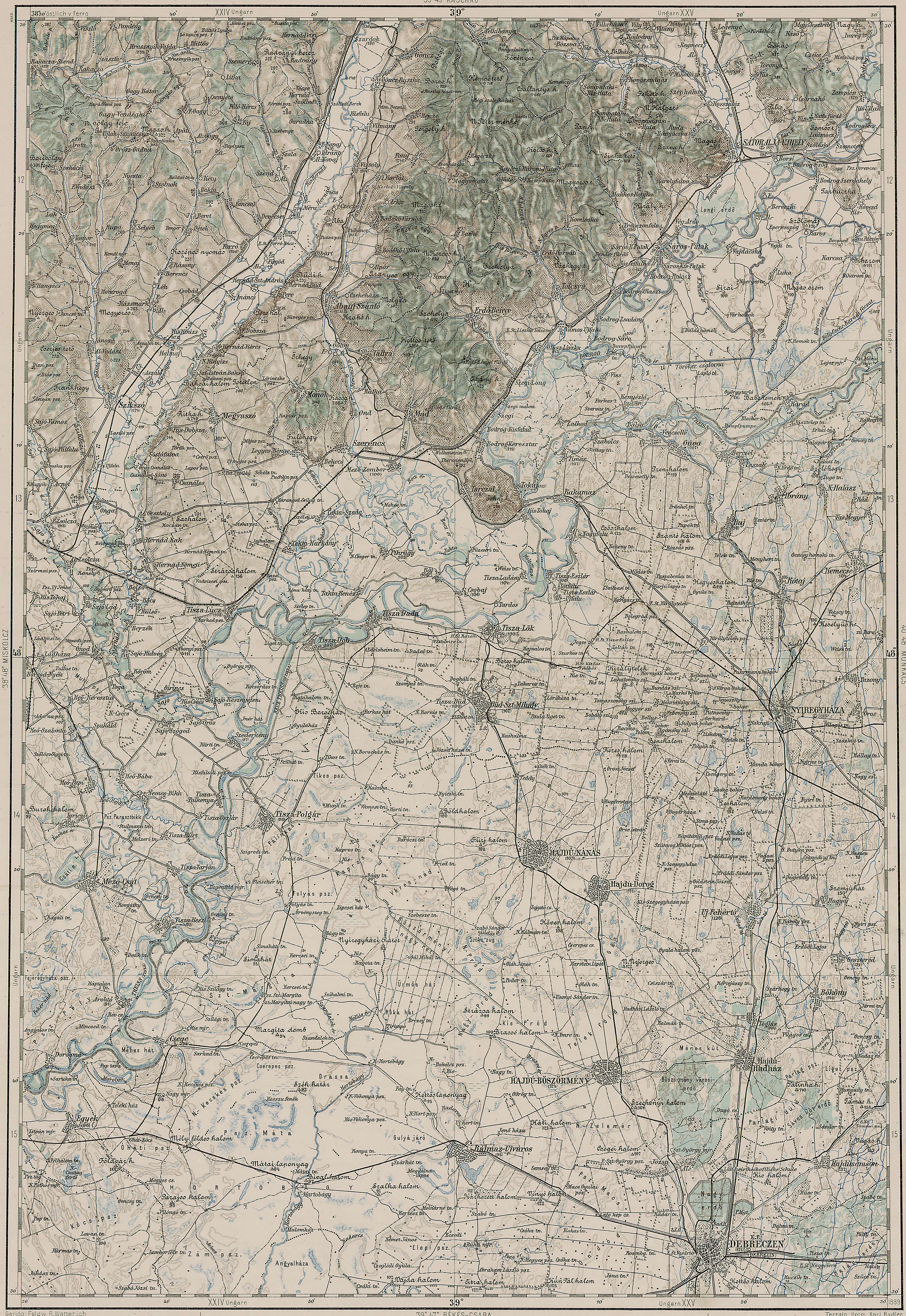
- Topographic map of the Debrecen area