
All Topics  
Battle of Normandy


   Email Print
   Bookmark   Link


Battle of Normandy


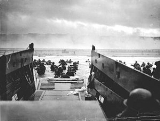
The Invasion of Normandy was the invasion and establishment of AlliedWestern Allies

The Western Allies were the democracies and their colonial peoples, within the broader coalition of Allies during World War ...
 forces in NormandyNormandy

Normandy is a geographical region in northern France....
, FranceFrance

France, officially the French Republic, is a country whose metropolitan territory is located in Western Europe and whi...
 during Operation OverlordOperation Overlord

Operation Overlord was the phase in the Western front of World War II that was fought in 1944 between German forces and the ...
 in World War IIWorld War II

World War II, or the Second World War, was a worldwide conflict fought between the Allied Powers and the Axis Powers ,...
. It covers from the initial landings on June 6, 1944 until the Allied breakout in mid-July.

It was the largest seaborne invasionInvasion

An invasion is a military action consisting of armed forces of one geopolitical entity entering territory controlled by anot...
 in history, involving over 850,000 troops crossing the English ChannelEnglish Channel

The English Channel is the part of the Atlantic Ocean that separates the island of Great Britain from northern France and j...
 from the United KingdomUnited Kingdom

The United Kingdom of Great Britain and Northern Ireland is a country and sovereign state that lies off the northwest coast...
 to NormandyNormandy

Normandy is a geographical region in northern France....
 by the end of June 1944.

Allied land forces that saw combat in Normandy on June 6 came from CanadaCanada

Canada is the world's second-largest country by total area, occupying most of northern North America....
, Free French ForcesFree French Forces

The Free French Forces were French fighters in World War II, who decided to continue fighting against Axis forces after the ...
, the United KingdomUnited Kingdom

The United Kingdom of Great Britain and Northern Ireland is a country and sovereign state that lies off the northwest coast...
, and the United StatesUnited States

The United States of America, also known as the United States, the U.S., the U.S.A., and America, is...
. In the weeks following the invasion, Polish forcesPolish Armed Forces in the West

Polish Armed Forces in the West refers to the Polish military formations formed to fight along the Western Allies and agains...
 also participated and there were also contingents from BelgiumBelgium

The Kingdom of Belgium is a country in northwest Europe bordered by the Netherlands, Germany, Luxembourg and France and is...
, CzechoslovakiaCzechoslovakia

Czechoslovakia was a country in Central Europe that existed from 1918 until early 1993 ....
, GreeceGreece

GreeceGreece lies at the juncture of Europe, Asia, and Africa....
, and the NetherlandsNetherlands

The Netherlands is the European part of the Kingdom of the Netherlands , which is formed by the Netherlands, the Neth...
. Most of the above countries also provided air and naval support, as did the Royal Australian Air ForceRoyal Australian Air Force

The Royal Australian Air Force is the air force branch of the Australian Defence Force....
, Royal New Zealand Air ForceRoyal New Zealand Air Force

The Royal New Zealand Air Force is the air force arm of the New Zealand Defence Force....
 and the Royal Norwegian NavyRoyal Norwegian Navy

The Royal Norwegian Navy is the branch of the Norwegian Defence Force responsible for naval operations....
.

The Normandy invasion began with overnight parachuteParatrooper

Paratroopers are soldiers trained in parachuting and generally operate as part of an airborne force....
 and gliderMilitary glider

Military gliders built by the military of various countries were used for carrying troops and heavy equipment, mainly during...
 landings, massive air attacksAerial warfare

Aerial warfare is the use of military aircraft and other flying machines for the purposes of warfare....
, naval bombardmentsNaval gunfire support

Naval gunfire support is a US term for the use of naval artillery to provide fire support support for amphibious assault and...
, an early morning amphibiousAmphibious warfare

This article is about a military strategy involving land troops dispatched from naval ships....
 landing and during the evening the remaining elements of the parachute divisions landed.


Discussion
Ask a question about 'Battle of Normandy'
Start a new discussion about 'Battle of Normandy'
Answer questions from other users
Full Discussion Forum


Timeline

1944   Battle of Normandy begins - ''Operation Overlord'', code named D-Day, commences with the landing of 155,000 Allied troops on the beaches of Normandy in France. The allied soldiers quickly break through the Atlantic Wall and push inland in the largest amphibious military operation in history. It also weakens Nazi Germany hold on Europe.


Encyclopedia


The Invasion of Normandy was the invasion and establishment of AlliedWestern Allies

The Western Allies were the democracies and their colonial peoples, within the broader coalition of Allies during World War ...
 forces in NormandyNormandy

Normandy is a geographical region in northern France....
, FranceFrance

France, officially the French Republic, is a country whose metropolitan territory is located in Western Europe and whi...
 during Operation OverlordOperation Overlord

Operation Overlord was the phase in the Western front of World War II that was fought in 1944 between German forces and the ...
 in World War IIWorld War II

World War II, or the Second World War, was a worldwide conflict fought between the Allied Powers and the Axis Powers ,...
. It covers from the initial landings on June 6, 1944 until the Allied breakout in mid-July.

It was the largest seaborne invasionInvasion

An invasion is a military action consisting of armed forces of one geopolitical entity entering territory controlled by anot...
 in history, involving over 850,000 troops crossing the English ChannelEnglish Channel

The English Channel is the part of the Atlantic Ocean that separates the island of Great Britain from northern France and j...
 from the United KingdomUnited Kingdom

The United Kingdom of Great Britain and Northern Ireland is a country and sovereign state that lies off the northwest coast...
 to NormandyNormandy

Normandy is a geographical region in northern France....
 by the end of June 1944.

Allied land forces that saw combat in Normandy on June 6 came from CanadaCanada

Canada is the world's second-largest country by total area, occupying most of northern North America....
, Free French ForcesFree French Forces

The Free French Forces were French fighters in World War II, who decided to continue fighting against Axis forces after the ...
, the United KingdomUnited Kingdom

The United Kingdom of Great Britain and Northern Ireland is a country and sovereign state that lies off the northwest coast...
, and the United StatesUnited States

The United States of America, also known as the United States, the U.S., the U.S.A., and America, is...
. In the weeks following the invasion, Polish forcesPolish Armed Forces in the West

Polish Armed Forces in the West refers to the Polish military formations formed to fight along the Western Allies and agains...
 also participated and there were also contingents from BelgiumBelgium

The Kingdom of Belgium is a country in northwest Europe bordered by the Netherlands, Germany, Luxembourg and France and is...
, CzechoslovakiaCzechoslovakia

Czechoslovakia was a country in Central Europe that existed from 1918 until early 1993 ....
, GreeceGreece

GreeceGreece lies at the juncture of Europe, Asia, and Africa....
, and the NetherlandsNetherlands

The Netherlands is the European part of the Kingdom of the Netherlands , which is formed by the Netherlands, the Neth...
. Most of the above countries also provided air and naval support, as did the Royal Australian Air ForceRoyal Australian Air Force

The Royal Australian Air Force is the air force branch of the Australian Defence Force....
, Royal New Zealand Air ForceRoyal New Zealand Air Force

The Royal New Zealand Air Force is the air force arm of the New Zealand Defence Force....
 and the Royal Norwegian NavyRoyal Norwegian Navy

The Royal Norwegian Navy is the branch of the Norwegian Defence Force responsible for naval operations....
.

The Normandy invasion began with overnight parachuteParatrooper

Paratroopers are soldiers trained in parachuting and generally operate as part of an airborne force....
 and gliderMilitary glider

Military gliders built by the military of various countries were used for carrying troops and heavy equipment, mainly during...
 landings, massive air attacksAerial warfare

Aerial warfare is the use of military aircraft and other flying machines for the purposes of warfare....
, naval bombardmentsNaval gunfire support

Naval gunfire support is a US term for the use of naval artillery to provide fire support support for amphibious assault and...
, an early morning amphibiousAmphibious warfare

This article is about a military strategy involving land troops dispatched from naval ships....
 landing and during the evening the remaining elements of the parachute divisions landed. The "D-Day" forces deployed from bases along the south coast of England, the most important of these being PortsmouthPortsmouth

Portsmouth is a city of about 189,000 people located in the county of Hampshire on the southern coast of England....
.

Allied preparations


The objective of the operation was to create a lodgementLodgement

A lodgement is an enclave made by increasing the size of a bridgehead, beachhead or airhead....
 that would be anchored in the city of Caen (and later Cherbourg when its deep-water port would be captured). As long as Normandy could be secured, the Western European campaign and the downfall of Nazi Germany could begin. About 6,900 vessels would be involved in the invasion, under the command of Admiral Sir Bertram RamsayBertram Ramsay

Admiral Sir Bertram Home Ramsay, KCB KBE MVO, was a British admiral during World War II....
 (who had been directly involved in the North African and Italian landings), including 4,100 landing craftLanding craft

Landing craft are boats and seagoing vehicles used to convey a landing force from the sea to the shore during an amphibious ...
. A total of 12,000 aircraft under Air MarshalAir Marshal

Air Marshal is a rank in the Royal Air Force....
 Sir Trafford Leigh-MalloryTrafford Leigh-Mallory

Air Chief Marshal Sir Trafford Leigh-Mallory, KCB, DSO and Bar was a senior commander in the Royal Air Force in World War II...
 were to support the landings, including 1,000 transports to fly in the parachute troops; 10,000 tons of bombs would be dropped against the German defenses, and 14,000 attack sorties would be flown.

Some of the more unusual Allied preparations included armoured vehicles specially adapted for the assault. Developed under the leadership of Maj. Gen. Percy HobartPercy Hobart Summary

Major-General Sir Percy Cleghorn Stanley Hobart was a British military engineer and commander of the 79th Armoured Division ...
 (Montgomery’s brother-in-law, and an armoured warfare specialist), these vehicles (nicknamed Hobart's FunniesHobart's Funnies

Hobart's Funnies were a number of unusually modified tanks operated during World War II by the 79th Armoured Division,...
) included "swimming" Duplex Drive Sherman tanksDD tank

DD tanks were amphibious swimming tanks developed during the Second World War....
, the Churchill CrocodileChurchill Crocodile Overview

The Churchill Crocodile was a British flame-throwing tank of late World War II, it was a variant of the Tank, Infantry, Mk V...
 flame throwing tank, mine-clearing tanks, bridge-laying tanks and road-laying tanks and the Armoured Vehicle, Royal EngineersRoyal Engineers Summary

The Corps of Royal Engineers, usually just called the Royal Engineers, and commonly known as the Sappers, is one...
–equipped with a large-caliber mortarMortar (weapon)

A mortar is a muzzle-loading artillery piece that fires indirect shells at low velocities, short ranges, and high-arcing bal...
 for destroying concrete emplacements. Some prior testing of these vehicles had been undertaken at Kirkham PrioryFacts About Kirkham Priory

The ruins of Kirkham Priory are situated on the banks of the River Derwent, at Kirkham, North Yorkshire....
 in YorkshireYorkshire

Yorkshire is the largest historic county of England and Great Britain, covering just under 6,000 sq....
, England. The majority would be operated by small teams from the British 79th Armoured Division79th Armoured Division Overview

The 79th Armoured Division was a specialist British Army armoured unit formed as part of the preparations for the Normandy i...
 attached to the various formations.

Codenames

The Allies assigned codenames to the various operations involved in the invasion. Overlord was the name assigned to the establishment of a large-scale lodgement on the Continent. The first phase, the establishment of a secure foothold, was codenamed Neptune. According to the D-day museum:

"The armed forces use codenames to refer to the planning and execution of specific military operations. Operation Overlord was the codename for the Allied invasion of northwest Europe. The assault phase of Operation Overlord was known as Operation Neptune. (...) Operation Neptune began on D-Day and ended on 30 June 1944. By this time, the Allies had established a firm foothold in Normandy. Operation Overlord also began on D-Day, and continued until Allied forces crossed the River Seine on 19 August 1944."

Allied Order of Battle

D-Day

The following major units were landed on D-Day. A much more detailed order of battle for D-Day itself can be found at Normandy landings.
  • British 6th Airborne DivisionBritish 6th Airborne Division

    The 6th Airborne Division was an airborne unit of the British Army during World War II....
    .
  • British I CorpsBritish I Corps

    The British I Corps is a military formation....
    , British 3rd Infantry DivisionBritish 3rd Infantry Division

    The British 3rd Infantry Division, known as the Iron Division, was originally formed in 1809 by Arthur Wellesley, 1st Du...
     and the British 27th Armoured BrigadeBritish 27th Armoured Brigade

    The 27th Armoured Brigade was a Second World War British Army formation. ...
    .
  • Canadian 3rd Infantry Division, Canadian 2nd Armoured Brigade
  • British XXX CorpsBritish XXX Corps Summary

    The British XXX Corps was an armoured corps in the British Army during World War II....
    , British 50th Infantry Division and British 8th Armoured BrigadeBritish 8th Armoured Brigade

    The 8th Armoured Brigade was a Second World War British Army brigade, formed as part of the 10th Armoured Division....
    .
  • 79th Armoured Division79th Armoured Division

    The 79th Armoured Division was a specialist British Army armoured unit formed as part of the preparations for the Normandy i...
  • U.S. V Corps, U.S. 1st Infantry DivisionU.S. 1st Infantry Division

    The 1st Infantry Division of the United States Army —nicknamed the Big Red One after its shoulder patch—is...
     and U.S. 29th Infantry DivisionU.S. 29th Infantry Division

    The U.S. 29th Infantry Division was a United States infantry division that existed during World War I and World War II....
    .
  • U.S. VII Corps, U.S. 4th Infantry DivisionU.S. 4th Infantry Division

    The 4th Infantry Division is a combat division of the United States Army based at Fort Hood, Texas....
    .
  • U.S. 101st Airborne Division.
  • U.S. 82nd Airborne Division.


The total number of troops landed on D-Day was around 130,000-156,000

Subsequent days

The total troops, vehicles and supplies landed over the period of the invasion were:
  • By the end of 11 June (D + 5), 326,547 troops, 54,186 vehicles and 104,428 tons of supplies.
  • By June 30th (D+24) over 850,000 men, 148,000 vehicles, and 570,000 tons of supplies.
  • By July 4th one million men had been landed.

Naval participants

The Invasion Fleet was drawn from 8 different navies, comprising 6,939 vessels: 1,213 warships, 4,126 transport vessels (landing ships and landing craftLanding craft

Landing craft are boats and seagoing vehicles used to convey a landing force from the sea to the shore during an amphibious ...
), and 736 ancillary craft and 864 merchant vessels.

The overall commander of the Allied Naval Expeditionary Force, providing close protection and bombardment at the beaches, was Admiral Sir Bertram RamsayBertram Ramsay

Admiral Sir Bertram Home Ramsay, KCB KBE MVO, was a British admiral during World War II....
. The Allied Naval Expeditionary Force was divided into two Naval Task Forces: Western (Rear-Admiral Alan G Kirk) and Eastern (Rear-Admiral Sir Philip VianPhilip Vian Overview

Admiral of the Fleet Sir Philip Vian GCB KBE DSO was a British naval officer best known for the incident early in 1940 when ...
).

The warships provided cover for the transports against the enemy—whether in the form of surface warshipWarship

A warship is a ship that is built and primarily intended for war....
s, submarineSubmarine

A submarine is a specialized watercraft that can operate underwater....
s, or as an aerial attack—and gave support to the landings through shore bombardment. These ships included the Allied Task Force "O".

German Order of Battle

The number of military forces at the disposal of Nazi Germany reached its peak during 1944. Tanks on the east front peaked at 5,202 in November 1944, while total aircraft in the Luftwaffe inventory peaked at 5,041 in December 1944. By D-Day 157 German divisions were stationed in the Soviet Union, 6 in Finland, 12 in Norway, 6 in Denmark, 9 in Germany, 21 in the Balkans, 26 in Italy and 59 in France, Belgium and the Netherlands. However, these statistics are somewhat misleading since a significant number of the divisions in the east were depleted; German records indicate that the average personnel complement was at about 50% in the spring of 1944.

A more detailed order of battle for D-Day itself can be found at Normandy landings.

Atlantic Wall

Standing in the way of the Allies was the English ChannelEnglish Channel

The English Channel is the part of the Atlantic Ocean that separates the island of Great Britain from northern France and j...
, a crossing which had eluded the Spanish ArmadaSpanish Armada

------The Spanish Armada or "Great/Grand Armada" or "The Mother of all armada" refers to the Spanish-controlled fleet whic...
 and Napoleon Bonaparte's Navy. Compounding the invasion efforts was the extensive Atlantic WallAtlantic Wall

The Atlantic Wall was an extensive system of coastal fortifications built by the German Third Reich during World War II alon...
, ordered by HitlerAdolf Hitler

Adolf Hitler was Chancellor of Germany from 1933, and Fhrer of Germany from 1934 until his death....
 in his Directive 51. Believing that any forthcoming landings would be timed for high tide (this caused the landings to be timed for low tide), Rommel had the entire wall fortified with tank top turrets and extensive barbed wire, and laid a million mines to deter landing craft. The sector which was attacked was guarded by four divisions.
Divisional Areas
The following units were deployed in a static defensive mode in the areas of the actual landings:
  • 716th Infantry Division (Static)German 716th Static Infantry Division Summary

    716th Static Infantry Division'716th Volksgrenadier Division...
     consisted mainly of those 'unfit for active duty' and released prisoners.
  • 352nd Infantry DivisionFacts About German 352nd Infantry Division

    The 352nd Infantry Division was an infantry division of the German Wehrmacht during World War II....
    , a well-trained unit containing combat veterans.
  • 91st Air Landing DivisionGerman 91st Infantry Division

    91st Infantry Division'91st Air Landing Division...
     (Luftlande – air transported), a regular infantry division, trained, and equipped to be transported by air.
  • 709th Infantry Division (Static)German 709th Static Infantry Division

    The 709th Static Infantry Division was raised in May 1941 and used for occupation duties during the German occupation of Fra...
    . Like the 716th, this division comprised a number of "Ost" units who were provided with German leadership to manage them.

Adjacent Divisional Areas
Other divisions occupied the areas around the landing zones, including:
  • 243rd Infantry Division (Static)German 243rd Static Infantry Division Summary

    The 243rd Static Infantry Division was raised in July 1943....
     (Generalleutnant Heinz HellmichHeinz Hellmich

    Heinz Hellmich was a German Generalleutnant during World War II....
    ), comprising the 920th Infantry Regiment (two battalions), 921st Infantry Regiment, and 922nd Infantry Regiment. This coastal defense division protected the western coast of the Cotentin Peninsula.
  • 711th Infantry Division (Static), comprising the 731th Infantry Regiment, and 744th Infantry Regiment. This division defended the western part of the Pays de CauxPays de Caux

    The Pays de Caux, is an area in Normandy, occupying the greater part of the French dpartement of Seine Maritime in Haute...
    .
  • 30th Mobile Brigade (Oberstleutnant Freiherr von und zu Aufsess), comprising three bicycleBicycle infantry

    Bicycle infantry are infantry soldiers who maneuver on the battlefield using bicycles....
     battalions.

Armoured reserves

Rommel's defensive measures were also frustrated by a dispute over armoured doctrine. In addition to his two army groups, von Rundstedt also commanded the headquarters of Panzer Group West under General Leo Geyr von SchweppenburgLeo Geyr von Schweppenburg

Leo Dietrich Franz Freiherr Geyr von Schweppenburg was a German general during World Wars I and II....
 (usually referred to as von Geyr). This formation was nominally an administrative HQ for von Rundstedt's armoured and mobile formations, but it was later to be renamed Fifth Panzer Army and brought into the line in Normandy. Von Geyr and Rommel disagreed over the deployment and use of the vital Panzer divisions.

Rommel recognised that the Allies would possess air superiority and would be able to harass his movements from the air. He therefore proposed that the armoured formations be deployed close to the invasion beaches. In his words, it was better to have one Panzer division facing the invaders on the first day, than three Panzer divisions three days later when the Allies would already have established a firm beachhead. Von Geyr argued for the standard doctrine that the Panzer formations should be concentrated in a central position around Paris and Rouen, and deployed en masse against the main Allied beachhead when this had been identified.

The argument was eventually brought before Hitler for arbitration. He characteristically imposed an unworkable compromise solution. Only three Panzer divisions were given to Rommel, too few to cover all the threatened sectors. The remainder, nominally under Von Geyr's control, were actually designated as being in "OKWOberkommando der Wehrmacht

Oberkommando der Wehrmacht or OKW was part of the command structure of the German armed forces during World War I...
 Reserve". Only three of these were deployed close enough to intervene immediately against any invasion of Northern France, the other four were dispersed in southern France and the Netherlands. Hitler reserved to himself the authority to move the divisions in OKW Reserve, or commit them to action. On June 6, many Panzer division commanders were unable to move because Hitler had not given the necessary authorisation, and his staff refused to wake him upon news of the invasion.
Army Group B Reserve
  • The 21st Panzer DivisionGerman 21st Panzer Division

    Created as 5th Light Division or 5th Light Afrika Division in Africa in early 1941, from an ad hoc collection ...
     (Generalmajor Edgar Feuchtinger) was deployed near CaenCaen

    Caen is a commune of northwestern France....
     as a mobile striking force as part of the Army Group BArmy Group B

    Army Group B was the name of three different German Army Groups that saw action during World War II....
     reserve. However, Rommel placed it so close to the coastal defenses that, under standing orderStanding order

    A standing order is a general order of indefinite duration....
    s in case of invasion, several of its infantry and anti-aircraft units would come under the orders of the fortress divisions on the coast, reducing the effective strength of the division.


The other two armoured divisions over which Rommel had operational control, the 2nd Panzer Division and 116th Panzer Division, were deployed near the Pas de Calais in accordance with German views about the likely Allied landing sites. Neither was moved from the Pas de Calais for at least fourteen days after the invasion.
OKW Reserve
The other mechanized divisions capable of intervening in Normandy were retained under the direct control of the German Armed Forces HQ and were initially denied to Rommel:

Four divisions were deployed to Normandy within seven days of the invasion:
  • The 12th SS Panzer Division Hitlerjugend (Brigadeführer Fritz WittFritz Witt

    Fritz Witt was a German Waffen-SS officer who served with the 1.SS-Panzergrenadier-Division Leibstandarte SS Adolf Hitler'...
    ) was stationed to the southeast. Its officers and NCOs (this division had a very weak core of NCOs in Normandy with only slightly more than 50% of its authorised strength) were long-serving veterans, but the junior soldiers had all been recruited directly from the Hitler YouthHitler Youth Overview

    The Hitler Youth was a paramilitary organization of the Nazi Party that existed from 1922 to 1945....
     movement at the age of seventeen in 1943. It was to acquire a reputation for ferocity and war crimes in the coming battle.
  • Further to the southwest was the PanzerlehrdivisionPanzerlehrdivision

    The Panzerlehrdivision, commonly known as Panzer Lehr, was a German armoured division during World War II, one of ...
     (General major Fritz BayerleinFritz Bayerlein

    Fritz Bayerlein was a German Panzer general during the Second World War....
    ), an elite unit originally formed by amalgamating the instructing staff at various training establishments. Not only were its personnel of high quality, but the division also had unusually high numbers of the latest and most capable armoured vehicles.
  • 1st SS Panzer Division Leibstandarte SS Adolf Hitler1st SS Division Leibstandarte SS Adolf Hitler

    The Leibstandarte SS Adolf Hitler was a unit of the SS....
     was refitting in Belgium on the Netherlands border after being decimated on the Eastern Front.
  • 17th SS Panzergrenadier Division Götz von Berlichingen17th SS Panzergrenadier Division Götz von Berlichingen

    The 17. SS-Panzergrenadier-Division G?tz von Berlichingen was a German Waffen-SS mechanised infantry division which saw ...
     (General major Werner Ostendorff) was based on ThouarsThouars

    Thouars is a town and commune of France, situated in the dpartement of Deux-Svres in the Poitou-Charentes rgion....
    , south of the Loire RiverLoire River Overview

    The Loire River, the longest river in France with a length of just over 1000 km, drains an area of 117,000 km, more than a f...
    , and although equipped with Assault guns instead of tanks and lacking in other transport (such that one battalion each from the 37th and 38th Panzergrenadier Regiments moved by bicycle), it provided the first major counterattack against the American advance at Carentan on June 13.


Three other divisions (the 2nd SS Division Das Reich2nd SS Division Das Reich

SS-Division VerfgungstruppeSS-Division Deutschland...
, which had been refitting at MontaubanMontauban

Montauban is a town and commune of southwestern France, prfecture of the Tarn-et-Garonne dpartement, 31 miles nort...
 in Southern France, and the 9th SS Panzer Division Hohenstaufen9th SS Panzer Division Hohenstaufen

SS-Panzergrenadier-Division 9'SS-Panzergrenadier-Division 9 Hohenstaufen ...
 and 10th SS Panzer Division Frundsberg10th SS Panzer Division Frundsberg

The 10.SS-Panzer-Division Frundsberg was a German Waffen SS panzer division that saw action on both the Western and East...
 which had been in transit from the Eastern Front on June 6), were committed to battle in Normandy around twenty-one days after the first landings.

One more armoured division (the 9th Panzer Division) saw action only after the American breakout from the beachhead. Two other armoured divisions which had been in the west on June 6 (the 11th Panzer Division and 19th Panzer Division19th Panzer Division (Germany)

The German 19th Panzer Division was created from the 19th Infantry Division and was formed on 1 November 1940....
) did not see action in Normandy.

Landings


Allied establishment in France

The Allied invasion plans had called for the capture of Saint-Lô, CaenCaen

Caen is a commune of northwestern France....
, and BayeuxBayeux

Bayeux is a small town and commune in the Calvados dpartement, in Normandy, northwestern France....
 on the first day, with all the beaches linked except Utah, and Sword (the last linked with paratroopers) and a front line 10 to 16 kilometres (6–10 mi) from the beaches. However practically none of these objectives had been achieved. Overall the casualties had not been as heavy as some had feared (around 10,000 compared to the 20,000 Churchill had estimated) and the bridgeheads had withstood the expected counterattacks.

Once the beachhead was established, two artificial Mulberry harbourFacts About Mulberry harbour

A Mulberry harbour was a type of temporary harbour developed in World War II to offload cargo on a beach during the Allied i...
s were towed across the English Channel in segments and made operational around D+3. One was constructed at Arromanches by British forces, the other at Omaha Beach by American forces. By June 19, when severe storms interrupted the landing of supplies for several days and destroyed the Omaha harbour, the British had landed 314,547 men, 54,000 vehicles, and 102,000 tons of supplies, while the Americans put ashore 314,504 men, 41,000 vehicles, and 116,000 tons of supplies. Around 9,000 tons of materielMateriel

Materiel is a term used in English to refer to the equipment and supplies in military and commercial supply chain management...
 were landed daily at the Arromanches harbour until the end of August 1944, by which time the port of CherbourgFacts About Cherbourg-Octeville

Cherbourg-Octeville is a town and commune in Normandy, north-west France....
 had been secured by the Allies and had begun to return to service.

Assessment of the battle

The Normandy landings were the first successful opposed landings across the English Channel in nine centuriesNorman conquest of England

The Norman conquest of England was the invasion of the Kingdom of England by William the Conqueror, in 1066 at the Battle of...
. They were costly in terms of men, but the defeat inflicted on the Germans was one of the largest of the war. Strategically, the campaign led to the loss of the German position in most of France and the secure establishment of a new major front. Allied material weight told heavily in Normandy, as did intelligence and deception plans. The general Allied concept of the battle was sound, drawing on the strengths of both Britain and the United States. German dispositions and leadership were often faulty, despite a credible showing on the ground by many German units. In larger context the Normandy landings helped the Soviets on the Eastern front, who were facing the bulk of the German forces and, to a certain extent, contributed to the shortening of the conflict there.

Although there was a shortage of artillery ammunition, at no time were the Allies critically short of any necessity. This was a remarkable achievement considering they did not hold a port until Cherbourg fell. By the time of the breakout the Allies also enjoyed a considerable superiority in numbers of troops (approximately 7:2) and armoured vehicles (approximately 4:1) which helped overcome the natural advantages the terrain gave to the German defenders.

Allied intelligence and counterintelligenceEspionage Summary

Espionage is the practice of obtaining information about an organization or a society that is considered secret or confident...
 efforts were successful beyond expectations. The Operation FortitudeOperation Fortitude

Operation Fortitude was the codename for the deception operations used by the Allied forces during World War II in connectio...
 deception before the invasion kept German attention focused on the Pas de Calais, and indeed high-quality German forces were kept in this area, away from Normandy, until July. Prior to the invasion, few German reconnaissance flights took place over Britain, and those that did saw only the dummy staging areas. UltraUltra

Ultra was the name used by the British for intelligence resulting from decryption of German communications in World War II....
 decrypts of German communications had been helpful as well, exposing German dispositions and revealing their plans such as the Mortain counterattackOperation Lüttich

Operation Lttich was a counterattack launched by German forces on the left flank of the Allied lodgment around Mortain....
.

Allied air operations also contributed significantly to the invasion, via close tactical support, interdiction of German lines of communication (preventing timely movement of supplies and reinforcements—particularly the critical Panzer units), and rendering the Luftwaffe ineffective in NormandyHistory of the Luftwaffe during World War II Summary

The German Luftwaffe was one of the most powerful, doctrinally advanced, and battle-experienced air forces in the world when...
. Although the impact upon armoured vehicles was less than expected, air activity intimidated these units and cut their supplies.

Despite initial heavy losses in the assault phase, Allied morale remained high. Casualty rates among all the armies were tremendous, and the Commonwealth forces had to create a new category—Double Intense—to be able to describe them.

German leadership

German commanders at all levels failed to react to the assault phase in a timely manner. Communications problems exacerbated the difficulties caused by Allied air and naval firepower. Local commanders also seemed unequal to the task of fighting an aggressive defense on the beach, as Rommel envisioned. For example, the commander of the German 352nd Infantry Division failed to capitalise on American difficulty at Omaha, committing his reserves elsewhere when they might have been more profitably used against the American beachhead.

The German High Command remained fixated on the Calais area, and von Rundstedt was not permitted to commit the armoured reserve. When it was finally released late in the day, any chance of success was much more difficult. Overall, despite considerable Allied material superiority, the Germans kept the Allies bottled up in a small beachhead for nearly two months, aided immeasurably by terrain factors.

Although there were several well-known disputes among the Allied commanders, their tactics and strategy were essentially determined by agreement between the main commanders. By contrast, the German leaders were bullied and their decisions interfered with by Hitler, controlling the battle from a distance with little knowledge of local conditions. Field Marshals von Rundstedt and Rommel repeatedly asked Hitler for more discretion but were refused. Von Rundstedt was removed from his command on June 29 after he bluntly told the Chief of Staff at Hitler's Armed Forces HQOberkommando der Wehrmacht

Oberkommando der Wehrmacht or OKW was part of the command structure of the German armed forces during World War I...
 (Field Marshal KeitelWilhelm Keitel Overview

Wilhelm Bodewin Johann Gustav Keitel was a German field marshal and a senior military leader during World War II....
) to "Make peace, you idiots!" Rommel was severely injured by Allied aircraft on July 16.

The German commanders also suffered in the quality of the available troops. Sixty thousand of the 850,000 in Rundstedt's command were raised from the many prisoners of war captured on the Eastern Front. These "Ost" units had volunteered to fight against Stalin, but when instead unwisely used to defend France against the Western Allies, ended up being unreliable. Many surrendered or deserted at the first available opportunity.

Given the Soviets' later domination of Eastern Europe, if the Normandy invasion had not occurred there might conceivably have been a complete occupation of northern and western Europe by communist forces, a contention which is supported by Stalin's statement that the Allies introduced their social system as far as their armies could reach. This is an opinion heavily disputed by the fact that Stalin requested a prompt Western invasion several times during the Teheran Conference and accused Churchill of not supporting the operation.

Alternately, Hitler might have deployed more forces to the Eastern Front, conceivably delaying Soviet advance beyond their pre-war border. In practice though, German troops remained in the West even in the absence of an invasion.

War memorials and tourism


The beaches at Normandy are still referred to on maps and signposts by their invasion codenames. There are several vast cemeteriesCemetery

A cemetery is a place in which dead bodies and cremated remains are buried....
 in the area. The American cemetery, in Colleville-sur-MerColleville-sur-Mer

Colleville-sur-Mer is a commune of the Calvados dpartement, in the Basse-Normandie rgion, in France....
, contains row upon row of identical white crossesChristian cross

The Christian cross is a familiar religious symbol of Christianity....
 and Stars of DavidStar of David

The Star of David is called the Shield of David in Hebrew, ????? ?????? or ??? ???, pronounced Magen David [] in I...
, immaculately kept, commemorating the American dead. Commonwealth graves, in many locations, use white headstones engraved with the person's religious symbol and their unit insignia. The largest cemetery in Normandy is the La Cambe German war cemetery, which features granite stones almost flush with the ground and groups of low-set crosses. There is also a Polish cemetery.

Streets near the beaches are still named after the units that fought there, and occasional markers commemorate notable incidents. At significant points, such as Pointe du HocPointe du Hoc

Pointe du Hoc is a clifftop location on the coast of Normandy in northern France....
 and Pegasus BridgePegasus Bridge

Pegasus was the name given to a bridge over the Caen canal, near the town of Ouistreham....
, there are plaques, memorials or small museums. The Mulberry harbourMulberry harbour

A Mulberry harbour was a type of temporary harbour developed in World War II to offload cargo on a beach during the Allied i...
 still sits in the sea at Arromanches. In Sainte-Mčre-Église, a dummy paratrooper hangs from the churchChurch

Sorry, no overview for this topic
 spireSpire

A spire is a tapering conical or pyramidal structure on the top of a building, particularly a church tower....
. On Juno Beach, the Canadian government has built the Juno Beach Information CentreJuno Beach Centre

The Juno Beach Centre or, in French, Centre Juno Beach, is a museum located in Courseulles-sur-Mer in the Calvados ...
, commemorating one of the most significant events in Canadian military history.

In England the most significant memorial is the D-Day Museum in Southsea, Hampshire. The Museum was opened in 1984 to commemorate the 40th Anniversary of D-Day. Its centrepiece is the magnificent Overlord Embroidery commissioned by Lord Dulverton of Batsford (1915-92) as a tribute to the sacrifice and heroism of those men and women who took part in Operation Overlord.

June 5, 1994 a drumhead service was held on Southsea Common adjacent the D-Day Museum. This service was attended by US President Bill ClintonBill Clinton

William Jefferson "Bill" Clinton was the 42nd President of the United States, serving from 1993 to 2001....
, HM Queen Elizabeth IIElizabeth II of the United Kingdom

}|-||}Elizabeth II is the Queen of 16 independent sovereign states known as the Commonwealth Realms....
 and over 100,000 members of the public.

Dramatizations

The battle of Normandy has been the topic of many films, television shows, songs, computer games and books. Many dramatizations focus on the initial landings, and these are covered at Normandy Landings. Some examples that cover the wider battle include:

Films
  • Saving Private RyanSaving Private Ryan

    Saving Private Ryan is a 1998 Academy Award winning film, directed by Steven Spielberg and written by Robert Rodat, set ...
    , a 1998 Academy Award-winning American film directed by Steven SpielbergSteven Spielberg

    Steven Allan Spielberg, KBE is a two-time Academy Award-winning American film director....
     and starring Tom HanksTom Hanks

    Thomas "Tom" Jeffrey Hanks is a two-time Academy Award-winning American actor, voice-over artist and movie producer who sta...
     and Matt DamonMatt Damon

    Matthew Paige Damon is an Academy Award-winning American screenwriter and actor....
    .
  • Band of BrothersBand of Brothers Summary

    Band of Brothers is an acclaimed 10-part television miniseries about World War II, co-produced by Steven Spielberg and T...
    , a 2001 American miniseriesMiniseries

    A miniseries, in a serial storytelling medium, is a production which tells a story in a limited number of episodes....
     produced by Steven Spielberg and Tom Hanks based on the book of the same name by Stephen AmbroseStephen Ambrose

    Stephen Edward Ambrose, Ph.D. was an American historian and biographer of U.S....
    .

Video games
  • series
  • Call of DutyCall of Duty

    Call of Duty is a first-person shooter video game based on the Quake III engine....
    series
  • Close Combat series
  • Company of HeroesCompany of Heroes

    Company of Heroes is a Real Time Strategy game for the PC, first announced on April 25 2005....
  • Day of DefeatDay of Defeat Overview

    Day of Defeat is a popular team-based multiplayer World War II first-person shooter computer game of the European Theatr...
  • Medal of Honor series

Wargames
  • Atlantic Wall, a large 1970s American boardBoard game

    A board game is a game played with counters or pieces that are placed on, removed from, or moved across a "board" ....
     wargame by SPI depicting the battle from the landings through to the breakout, at company and battalion level, and using a similar game system to Wacht Am Rhein. Due to be reprinted in 2008.
  • "Breakout: Normandy", an American board wargame published by Avalon Hill in 1992 covers the full invasion, starting with D-day and covering the week following.
  • "Memoir 44", an American and French two player game that was released for the 60th anniversary of the D-Day landings. With available expansions, you can go from the Landings at D-Day, to the Eastern Front, to the beaches of Japanese held islands.

Bibliography

  • .
  • .

Further reading

  • Ambrose, StephenStephen Ambrose

    Stephen Edward Ambrose, Ph.D. was an American historian and biographer of U.S....
    . D-Day June 6, 1944: The Climactic Battle of World War II. New york: Simon & Schuster, 1995. ISBN 0671884034.
  • Badsey, Stephen. Normandy 1944: Allied Landings and Breakout. Botley, Oxford: Osprey PublishingFacts About Osprey Publishing

    Osprey Publishing is a British publishing company which specialises in publishing books of a military nature....
    , 1990. ISBN 978-0850459210.
  • D'Este, Carlo. Decision in Normandy: The Unwritten Story of Montgomery and the Allied Campaign. London: William Collins Sons, 1983. ISBN 0002170566.
  • Foot, M. R. D. SOE: An Outline History of the Special Operations Executive 1940–46.. BBC Publications, 1984. ISBN 0563201932.
  • Ford, Ken. D-Day 1944 (3): Sword Beach & the British Airborne Landings. Botley, Oxford: Osprey Publishing, 2002. ISBN 978-1841763668.
  • Ford, Ken. D-Day 1944 (4): Gold & Juno Beaches. Botley, Oxford: Osprey Publishing, 2002. ISBN 978-1841763682.
  • Hamilton, Nigel. "Montgomery, Bernard Law" in Oxford Dictionary of National BiographyDictionary of National Biography

    The Dictionary of National Biography is a standard work of reference on notable figures from British history, published ...
    . Oxford; New York: Oxford University Press, 2004. ISBN 019861411X, ISBN 0198613512.
  • Herington, John. Air Power Over Europe, 1944–1945, 1st edition (Official History of Australia in the Second World War Volume IV). Canberra: Australian War Memorial 1963.
  • Holderfield, Randal J., and Michael J. VarholaMichael J. Varhola

    Michael J. Varhola is an author of numerous books, games, and articles, as well as the founder of game development company a...
    . D-Day: The Invasion of Normandy, June 6, 1944. Mason City, Iowa: Savas Publishing, 2001. ISBN 1882810457, ISBN 1882810465.
  • Keegan, JohnJohn Keegan

    Sir John Keegan is an English military historian....
    . Six Armies in Normandy: From D-Day to the Liberation of Paris. New York: Penguin Books, 1994. ISBN 0140235426.
  • Kershaw, Alex. The Bedford Boys: One American Town's Ultimate D-Day Sacrifice. Cambridge, Mass.: Da Capo Press, 2003. ISBN 0306813556.
  • "Morning: Normandy Invasion (June–August 1944)". The World at War episode 17. British Broadcasting Corporation. 1974.
  • Neillands, Robin. The Battle of Normandy, 1944. London: Cassell, 2002. ISBN 0304358371.
  • Rozhnov, Konstantin. . BBC News, 5 May 2005.
  • Stacey, C.P. Canada's Battle in Normandy: The Canadian Army's Share in the Operations, 6 June–1 September 1944. Ottawa: King's Printer, 1946.
  • Stacey, C.P. Official History of the Canadian Army in the Second World War: Volume III. The Victory Campaign, The Operations in North-West Europe 1944–1945. Ottawa: Department of National Defence, 1960.
  • Tute, Warren, John Costello, Terry Hughes. D-Day. London: Pan Books Ltd, 1975. ISBN 0330244183.
  • Whitlock, Flint. The Fighting First: The Untold Story of The Big Red One on D-Day. Boulder, Colo.: Westview Press, 2004. ISBN 081334218X.
  • Wilmot, ChesterChester Wilmot

    Reginald William Winchester Wilmot was an Australian war correspondent who reported for the BBC and the Australian Broadcas...
    . (Written in part by Christopher Daniel McDevitt.) The Struggle For Europe. Ware, Hertfordshire: Wordsworth Editions Ltd, 1997. ISBN 1853266779.
  • Zaloga, Steven J. D-Day 1944 (1): Omaha Beach. Botley, Oxford: Osprey Publishing, 2003. ISBN 978-1841763675.
  • Zaloga, Steven J. D-Day 1944 (2): Utah Beach & the US Airborne Landings. Botley, Oxford: Osprey Publishing, 2004. ISBN 978-1841763651.
  • Zaloga, Steven J. Operation Cobra 1944: Breakout from Normandy. Botley, Oxford: Osprey Publishing, 2001. ISBN 978-1841762968.


  • Those who wish to study the Normandy Campaign in more detail will find numerous volumes in the U.S. Army in World War II series, produced by the U.S. Army Center of Military History, particularly useful. Gordon A. Harrison, Cross-Channel-Attack (1951), remains a basic source, but several other studies bear heavily upon the operation. They include:

  1. Robert W. Coakley and Richard M. Leighton, Global Logistics and Strategy (1968);
  2. Martin BlumensonMartin Blumenson

    Martin Blumenson, , was an American military historian who served as a historical officer with the U.S....
    , Breakout and Pursuit (1961);
  3. Forrest C. Pogue, The Supreme Command (1954);
  4. Roland G. Ruppenthal, Logistical Support of the Armies (1953); and
  5. Graham A. Cosmas and Albert E. Cowdrey, The Medical Department: Medical Service in the European Theater of Operations (1992).

  • The Historical Division of the War Department produced three volumes on the event. All have been reprinted by the Center of Military History. Classified as the American Forces in Action series, they are:

  1. OMAHA Beachhead (1989);
  2. UTAH Beach to Cherbourg (1990); and
  3. St. Lo (1984).

  • The British Government following the war also issued an official history of the British involvement in the war to be researched and published, the final result being the massive series known as History of the Second World WarHistory of the Second World War

    History of the Second World War is an extensive set of volumes publised by HMSO about the British contribution to the Second...
    . The following cover the Normandy Campaign:

  1. L.F. Ellis, Victory in the West: The Battle of Normandy, Official Campaign History v. I (History of the Second World War: United Kingdom Military), Naval & Military Press Ltd; New Ed edition (Sep 2004)., 1-84574-058-0
  2. Michael HowardMichael Howard (historian)

    Sir Michael Eliot Howard, OM, CH, CBE, MC is a retired British military historian, formerly Chichele Professor of the Histo...
    , British Intelligence in the Second World War: Volume 5, Strategic Deception, Cambridge University Press (26 Oct 1990),. ISBN 0-52140-145-3 (Series edited by F. H. HinsleyHarry Hinsley

    Sir Francis Harry Hinsley OBE was an English historian and cryptanalyst who worked at Bletchley Park during the Second World...
    )
  3. Grand Strategy, Volume 5: August 1943-September 1944, 1956

  • Numerous abbreviated histories have been written. Among the most useful are:

  1. Charles MacDonald, The Mighty Endeavor: American Armed Forces in the European Theater in World War II (1969); and
  2. Charles MacDonald and Martin Blumenson, "Recovery of France", in Vincent J. Esposito, ed., A Concise History of World War II (1965).

  • Memoirs by Allied commanders contain considerable information. Among the best are:

  1. Omar N. Bradley, A Soldier's Story (1951);
  2. Omar N. Bradley and Clay Blair, A General's Life (1983);
  3. Dwight D. Eisenhower, Crusade in Europe (1948);
  4. Sir Bernard Law Montgomery of Alamein, Normandy to the Baltic (1948);
  5. Sir Bernard Law Montgomery of Alamein, The Memoirs of Field Marshal the Viscount Montgomery of Alamein, K.G., Collins (1958). and
  6. Sir Frederick Edgeworth Morgan, Overture to Overlord (1950).

  • Memoirs by Allied soldiers of various ranks also give a good insight into the campaign.

  1. Kurt Meyer, Grenadiers, Stackpole Books,U.S., New Ed edition (15 May 2005)., ISBN 0-81173-197-9
  2. Stuart Hills, By Tank Into Normandy, Cassell military; New Ed edition (11 Sep 2003)., 0-30436-640-4
  3. Hans von Luck, Panzer Commander: The Memoirs of Colonel Hans von Luck, Cassell military; New Ed edition (9 Mar 2006)., ISBN 0-30436-401-0
  4. B.H. Liddell-Hart, The Rommel Papers (section on Normandy wrote by Lt.Gen Fritz Bayerlein)

  • Almost as useful are biographies of leading commanders. Among the most prominent are:

  1. Stephen E. Ambrose, The Supreme Commander: The War Years of General Dwight D. Eisenhower (1970), and Eisenhower, Soldier, General of the Army, President-Elect, 1890–1952 (1983);
  2. Nigel Hamilton, Master of the Battlefield: Monty's War Years, 1942–1944 (1983);
  3. Richard Lamb, Montgomery in Europe, 1943–1945: Success or Failure (1984); and
  4. Ronald Lewin, Rommel as Military Commander (1968).

  • Numerous general histories also exist, many centering on the controversies that continue to surround the campaign and its commanders. See, in particular:

  1. John Colby, War From the Ground Up: The 90th Division in World War II (1989);
  2. Carlo D'Este, Decision in Normandy: The Unwritten Story of Montgomery and the Allied Campaign (1983);
  3. Max Hastings, Overlord, D-Day, June 6, 1944 (1984);
  4. John Keegan, Six Armies in Normandy: From D-Day to the Liberation of Paris (1982);
  5. Robin NeillandsFacts About Robin Neillands

    Robin Hunter Neillands was a British writer, specialising in travel and military history....
    , The Battle of Normandy 1944 (2002);
  6. Stephen T. Powers, "Battle of Normandy: The Lingering Controversy", Journal of Military History 56 (1992):455–71.
  7. Russell F. Weigley, Eisenhower's Lieutenants: The Campaign of France and Germany, 1944–45 (1981);
  8. Cornelius Ryan, The Longest Day, (1959);
  9. Stephen Ambrose, D-Day: June 6, 1944, The battle for the Normandy beaches, (1994);
  10. Milton ShulmanMilton Shulman

    Milton Shulman was a prominent Canadian author and drama critic....
    , Defeat in the West, (New Ed edition 2003)
  11. Richard Holmes, The D-Day Experience: From the Invasion to the Liberation of Paris with Other and Map and CD,(2004);
  12. Chester Wilmot, The Struggle for Europe, (New Ed edition 1997), and
  13. Stephen Ashley Hart, Colossal Cracks: Montgomery's 21st Army Group in Nortwest Europe, 1944-45, (2007)

  • Journalists were among the foremost observers of the invasion. Two studies of their work that stand out are:

  1. Barney Oldfield, Never a Shot in Anger (1956); and
  2. Richard Collier, Fighting Words: The Correspondents of World War II (1989). CMH Pub 72–18

External links

  • CMH Pub 7–4: Official U.S. Military History.
  • CMH Pub 100–12: Official U.S. Military History.