


Elefant

Encyclopedia
The Elefant was a "schwerer Panzerjäger
" (heavy tank destroyer
) of the German Wehrmacht
used in small numbers in World War II
. It was built in 1943 under the name Ferdinand, after its designer Ferdinand Porsche
. In 1944, after modification of the existing vehicles, they were renamed Elefant. The official German designation was Panzerjäger Tiger (P) and the ordnance inventory designation was Sd. Kfz. 184.
tank, the unsuccessful "Porsche Tiger", in the Nibelungenwerk factory in Sankt Valentin
, Austria
. Both Henschel and Porsche chassis used the same Krupp
-designed turret - the Henschel design having its turret more-or-less centrally located on its hull, with the Porsche design placing the turret much nearer the front of the superstructure. Since the competing Henschel Tiger design was chosen for production, the Porsche chassis were no longer required for the Tiger tank project. It was therefore decided that the Porsche chassis were to be used as the basis of a new heavy tank destroyer, mounting Krupp's newly developed 88 mm Pak 43/2 anti-tank gun. This precise long-range weapon was intended to take out enemy tanks before they reached their own range of effective fire.
Therefore the somewhat ad hoc
design, Ferdinand supplanted the previous light tank destroyers, like Marder II
and Marder III
, in the offensive role. The similar gun was used in the lightly armored Hornisse/Nashorn
tank destroyer, built in parallel.
-style box structure, with slightly sloped sides, on top of this chassis. The driver and radio operator were in a separate compartment at the front. As the engines were placed in the middle, the radio operator and the driver were separated from the rest of the crew and could be addressed only through radio.
Add-on armor of 100 mm was bolted to the front plates, increasing the plate's thickness to 200 mm and adding another 5 tons of weight.
Porsche had experience of this form of petrol-electric transmission extending back to 1901, when he designed a car
that used it.
Suspension consisted of six twin bogies (three per side) with longitudinal torsion bars.
gun. The L/71 had originally been developed as a replacement for the famous 88 mm anti-aircraft gun that had been used against Allied tanks in the Western Desert Campaign
. The L/71 had a much longer barrel than the L/56 guns, which gave it a higher muzzle velocity. It also fired a different, longer cartridge. These improvements gave the 88 mm L/71 significantly improved armor penetration ability over the earlier 88 mm. Although it lost the competition to 8.8 cm Flak 41 and it never became an anti-aircraft weapon, it was turned into a very successful Pak 43 anti-tank gun.
As fitted, the gun was capable of 25° traverse and a similarly limited elevation.
. During October and November 1943, 48 of the 50 surviving vehicles were modified by addition of a ball-mounted MG 34
in the hull front (to improve anti-infantry ability), a commander's cupola (modified from the standard StuG III cupola) for improved vision and the application of Zimmerit
paste. This and other minor armor changes increased the weight from 65 to 70 t. These improved vehicles were then unofficially called Elefant, and this became the official name by Hitler's orders of May 1, 1944.
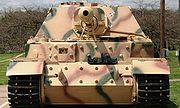 Five Bergepanzer Tiger (P) armoured recovery vehicles were converted in Autumn 1943. Three from Tiger (P) prototypes and two more from battle-damaged Ferdinands not suitable for the Elefant modification.
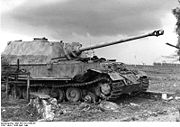
 Ferdinands first saw combat in the Battle of Kursk
, where eighty-nine were committed. Reputated of knocking down a T-34 in a range of over 3 miles with its 88mm Pak43/2 L/71, it was a strong opponent for the Allies. Although effective at destroying Soviet tanks, they performed quite poorly in other respects. In its original configuration, the Ferdinand lacked a machine gun as secondary armament, making it vulnerable to attack by infantry. While this was a disadvantage, most combat losses were from mine damage and mechanical failure. Within four days nearly half of the vehicles were out of service, mostly due to technical problems and mine damage to tracks and suspension. Combat losses to enemy action were very low as the very thick armor protected the Ferdinand from almost all Soviet antitank weaponry; in fact, most of the vehicles destroyed or captured had been abandoned by their crews after mechanical failure.
Many of these immobilized Ferdinands had to be permanently abandoned, as they proved too heavy to tow for most German recovery vehicles. Others were lost to mechanical breakdown during the retreat following the Soviet counter-offensive in the latter stages of the battle. The surviving vehicles saw further limited action on the Dniepr front during late 1943.
The units were deployed at a company level, sometimes sub-divided into platoons, with infantry or tanks to protect the vulnerable flanks of the vehicles. On the attack, this Jagdpanzer was a first-strike vehicle, while in defence, they often comprised a mobile reserve used to blunt enemy tank assaults.
Although the Elefant modifications improved the vehicles, some problems could never be fully fixed. In 1944 the Elefants served on the Italian front but were rendered rather ineffective, as their weight of nearly 70 tonnes did not allow them to use most Italian roads and bridges. Due to a permanent lack of spare parts most of the units were not destroyed in battle, but abandoned and blown up by their own crews. One company of Elefants saw action during the Soviets' January 1945 Vistula-Oder offensive
in Poland, and the very last surviving vehicles were in combat at Zossen
during the Battle of Berlin
.
The Ferdinand/Elefant may have been the most successful tank destroyer employed during the war in kills per loss, reaching an average ratio of approximately 10:1. During the Battle of Kursk, the 653rd Heavy Tank Destroyer Battalion (German: schwere Panzerjäger-Abteilung, sPzJägAbt) claimed to have knocked out 320 enemy tanks, for the loss of 13 Ferdinands. This impressive average ratio was due to its extreme firepower and protection, which gave it an enormous advantage when used in head-on combat or a static defensive role. However, poor mobility and mechanical unreliability greatly diminished its operational capability.
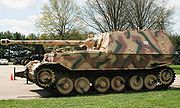 Only two of these vehicles survived the war. One Ferdinand was captured by Soviet forces at Kursk, and is now at the huge Kubinka Tank Museum
outside Moscow. An Elefant was captured at Anzio
by the Americans, and is now part of the United States Army Ordnance Museum
's collection at Fort Lee, VA. The example at Fort Lee was restored to display condition in 2007-2008.
Panzerjäger
Panzerjäger was a branch of service of the Wehrmacht during the Second World War which were the anti-tank arm-of-service who operated anti-tank artillery, and made exclusive use of the tank destroyers which were also named Panzerjäger...
" (heavy tank destroyer
Tank destroyer
A tank destroyer is a type of armored fighting vehicle armed with a gun or missile launcher, and is designed specifically to engage enemy armored vehicles...
) of the German Wehrmacht
Wehrmacht
The Wehrmacht – from , to defend and , the might/power) were the unified armed forces of Nazi Germany from 1935 to 1945. It consisted of the Heer , the Kriegsmarine and the Luftwaffe .-Origin and use of the term:...
used in small numbers in World War II
World War II
World War II, or the Second World War , was a global conflict lasting from 1939 to 1945, involving most of the world's nations—including all of the great powers—eventually forming two opposing military alliances: the Allies and the Axis...
. It was built in 1943 under the name Ferdinand, after its designer Ferdinand Porsche
Ferdinand Porsche
Ferdinand Porsche was an Austrian automotive engineer and honorary Doctor of Engineering. He is best known for creating the first hybrid vehicle , the Volkswagen Beetle, and the Mercedes-Benz SS/SSK, as well as the first of many Porsche automobiles...
. In 1944, after modification of the existing vehicles, they were renamed Elefant. The official German designation was Panzerjäger Tiger (P) and the ordnance inventory designation was Sd. Kfz. 184.
Development history
Porsche AG had manufactured about one hundred chassis for their proposal of the TigerTiger I
Tiger I is the common name of a German heavy tank developed in 1942 and used in World War II. The final official German designation was Panzerkampfwagen Tiger Ausf. E, often shortened to Tiger. It was an answer to the unexpectedly formidable Soviet armour encountered in the initial months of...
tank, the unsuccessful "Porsche Tiger", in the Nibelungenwerk factory in Sankt Valentin
Sankt Valentin
Sankt Valentin is a town in the district of Amstetten in Lower Austria in Austria....
, Austria
Austria
Austria , officially the Republic of Austria , is a landlocked country of roughly 8.4 million people in Central Europe. It is bordered by the Czech Republic and Germany to the north, Slovakia and Hungary to the east, Slovenia and Italy to the south, and Switzerland and Liechtenstein to the...
. Both Henschel and Porsche chassis used the same Krupp
Krupp
The Krupp family , a prominent 400-year-old German dynasty from Essen, have become famous for their steel production and for their manufacture of ammunition and armaments. The family business, known as Friedrich Krupp AG Hoesch-Krupp, was the largest company in Europe at the beginning of the 20th...
-designed turret - the Henschel design having its turret more-or-less centrally located on its hull, with the Porsche design placing the turret much nearer the front of the superstructure. Since the competing Henschel Tiger design was chosen for production, the Porsche chassis were no longer required for the Tiger tank project. It was therefore decided that the Porsche chassis were to be used as the basis of a new heavy tank destroyer, mounting Krupp's newly developed 88 mm Pak 43/2 anti-tank gun. This precise long-range weapon was intended to take out enemy tanks before they reached their own range of effective fire.
Therefore the somewhat ad hoc
Ad hoc
Ad hoc is a Latin phrase meaning "for this". It generally signifies a solution designed for a specific problem or task, non-generalizable, and not intended to be able to be adapted to other purposes. Compare A priori....
design, Ferdinand supplanted the previous light tank destroyers, like Marder II
Marder II
The Marder II was a German tank destroyer of World War II based on the Panzer II chassis.-History:During the very first days of Operation Barbarossa, the invasion of the Soviet Union, the Germans were shocked to encounter Soviet T-34 medium tanks and KV heavy tanks...
and Marder III
Marder III
The Marder III is the name for a series of World War II German tank destroyers built on the chassis of the Panzer 38. The German word Marder means "marten" in English...
, in the offensive role. The similar gun was used in the lightly armored Hornisse/Nashorn
Nashorn
Nashorn , initially known as Hornisse , was a German tank destroyer of World War II. It was developed as an interim solution in 1942 and was armed with the outstanding Pak 43 anti-tank gun...
tank destroyer, built in parallel.
Chassis
The engines had already been placed in the middle of the hull to accommodate the Krupp-designed turret that both the Porsche and Henschel contenders used for the initial Tiger tank contract, and that placement for the Porsche-designed contender gave room on the Ferdinand for the anti-tank main gun armament at the rear. Gun was mounted in a simple, casemateCasemate
A casemate, sometimes rendered casement, is a fortified gun emplacement or armored structure from which guns are fired. originally a vaulted chamber in a fortress.-Origin of the term:...
-style box structure, with slightly sloped sides, on top of this chassis. The driver and radio operator were in a separate compartment at the front. As the engines were placed in the middle, the radio operator and the driver were separated from the rest of the crew and could be addressed only through radio.
Add-on armor of 100 mm was bolted to the front plates, increasing the plate's thickness to 200 mm and adding another 5 tons of weight.
Drive
The two Porsche air cooled engines in each vehicle were replaced by two 300 PS (296 hp, 221 kW) Maybach HL 120 TRM engines. The engines drove electric generators, which in turn powered electric motors connected to the rear sprockets. The electric motors also acted as the vehicle's steering unit. This so called "petro-electrical" drive delivered 0.11 km/l off road and 0.15 km/l on road at a maximum speed of 10 km/h off road and 30 km/h on road. Besides the high fuel consumption and the poor performance the drive system was also maintenance-intensive; the sprockets needed to be changed every 500 km.Porsche had experience of this form of petrol-electric transmission extending back to 1901, when he designed a car
Lohner-Porsche Mixte Hybrid
The Lohner-Porsche Mixte Hybrid was the first hybrid vehicle developed in 1901 by Ferdinand Porsche. It was a series hybrid using wheel hub motors mounted in each wheel, and powered by electricity delivered from both batteries and a small generator....
that used it.
Suspension consisted of six twin bogies (three per side) with longitudinal torsion bars.
Armament
The vehicle was fitted with an 88 mm Panzerabwehrkanone (Pak) 43/2 L/718.8 cm PaK 43
The Pak 43 was a German 88 mm anti-tank gun developed by Krupp in competition with the Rheinmetall 8.8 cm Flak 41 anti-aircraft gun and used during the Second World War. The Pak 43 was the most powerful anti-tank gun of the Wehrmacht to see service in significant numbers...
gun. The L/71 had originally been developed as a replacement for the famous 88 mm anti-aircraft gun that had been used against Allied tanks in the Western Desert Campaign
Western Desert Campaign
The Western Desert Campaign, also known as the Desert War, was the initial stage of the North African Campaign during the Second World War. The campaign was heavily influenced by the availability of supplies and transport. The ability of the Allied forces, operating from besieged Malta, to...
. The L/71 had a much longer barrel than the L/56 guns, which gave it a higher muzzle velocity. It also fired a different, longer cartridge. These improvements gave the 88 mm L/71 significantly improved armor penetration ability over the earlier 88 mm. Although it lost the competition to 8.8 cm Flak 41 and it never became an anti-aircraft weapon, it was turned into a very successful Pak 43 anti-tank gun.
As fitted, the gun was capable of 25° traverse and a similarly limited elevation.
Production
Ninety-one existing "Porsche Tiger" chassis were converted (chassis number 150010 to 150100). The work was completed in just a few months from March to May 1943.Modification - Elefant
In September 1943 all surviving Ferdinands were recalled to be modified based on battle experience gained in the Battle of KurskBattle of Kursk
The Battle of Kursk took place when German and Soviet forces confronted each other on the Eastern Front during World War II in the vicinity of the city of Kursk, in the Soviet Union in July and August 1943. It remains both the largest series of armored clashes, including the Battle of Prokhorovka,...
. During October and November 1943, 48 of the 50 surviving vehicles were modified by addition of a ball-mounted MG 34
MG 34
The Maschinengewehr 34, or MG 34, is a German air-cooled machine gun that was first produced and accepted into service in 1934, and first issued to units in 1935. It accepts the 8x57mm IS cartridge....
in the hull front (to improve anti-infantry ability), a commander's cupola (modified from the standard StuG III cupola) for improved vision and the application of Zimmerit
Zimmerit
Zimmerit was a coating produced for German armored fighting vehicles during World War II for the purpose of combating magnetically attached anti-tank mines, although Germany was the only country to use magnetic mines against tanks in large scale numbers...
paste. This and other minor armor changes increased the weight from 65 to 70 t. These improved vehicles were then unofficially called Elefant, and this became the official name by Hitler's orders of May 1, 1944.
Combat history
Battle of Kursk
The Battle of Kursk took place when German and Soviet forces confronted each other on the Eastern Front during World War II in the vicinity of the city of Kursk, in the Soviet Union in July and August 1943. It remains both the largest series of armored clashes, including the Battle of Prokhorovka,...
, where eighty-nine were committed. Reputated of knocking down a T-34 in a range of over 3 miles with its 88mm Pak43/2 L/71, it was a strong opponent for the Allies. Although effective at destroying Soviet tanks, they performed quite poorly in other respects. In its original configuration, the Ferdinand lacked a machine gun as secondary armament, making it vulnerable to attack by infantry. While this was a disadvantage, most combat losses were from mine damage and mechanical failure. Within four days nearly half of the vehicles were out of service, mostly due to technical problems and mine damage to tracks and suspension. Combat losses to enemy action were very low as the very thick armor protected the Ferdinand from almost all Soviet antitank weaponry; in fact, most of the vehicles destroyed or captured had been abandoned by their crews after mechanical failure.
Many of these immobilized Ferdinands had to be permanently abandoned, as they proved too heavy to tow for most German recovery vehicles. Others were lost to mechanical breakdown during the retreat following the Soviet counter-offensive in the latter stages of the battle. The surviving vehicles saw further limited action on the Dniepr front during late 1943.
The units were deployed at a company level, sometimes sub-divided into platoons, with infantry or tanks to protect the vulnerable flanks of the vehicles. On the attack, this Jagdpanzer was a first-strike vehicle, while in defence, they often comprised a mobile reserve used to blunt enemy tank assaults.
Although the Elefant modifications improved the vehicles, some problems could never be fully fixed. In 1944 the Elefants served on the Italian front but were rendered rather ineffective, as their weight of nearly 70 tonnes did not allow them to use most Italian roads and bridges. Due to a permanent lack of spare parts most of the units were not destroyed in battle, but abandoned and blown up by their own crews. One company of Elefants saw action during the Soviets' January 1945 Vistula-Oder offensive
Vistula-Oder Offensive
The Vistula–Oder Offensive was a successful Red Army operation on the Eastern Front in the European Theatre of World War II; it took place between 12 January and 2 February 1945...
in Poland, and the very last surviving vehicles were in combat at Zossen
Zossen
Zossen is a German town in the district of Teltow-Fläming in Brandenburg, south of Berlin, and next to the B96 highway. Zossen consists of several smaller municipalities, which were grouped together in 2003 to form the city.-Geography:...
during the Battle of Berlin
Battle of Berlin
The Battle of Berlin, designated the Berlin Strategic Offensive Operation by the Soviet Union, was the final major offensive of the European Theatre of World War II....
.
The Ferdinand/Elefant may have been the most successful tank destroyer employed during the war in kills per loss, reaching an average ratio of approximately 10:1. During the Battle of Kursk, the 653rd Heavy Tank Destroyer Battalion (German: schwere Panzerjäger-Abteilung, sPzJägAbt) claimed to have knocked out 320 enemy tanks, for the loss of 13 Ferdinands. This impressive average ratio was due to its extreme firepower and protection, which gave it an enormous advantage when used in head-on combat or a static defensive role. However, poor mobility and mechanical unreliability greatly diminished its operational capability.
Survivors
Kubinka Tank Museum
The Kubinka Tank Museum is a large museum of armoured fighting vehicles in Kubinka, just outside Moscow. It has many famous tanks from World War I, World War II and the Cold War. The museum also houses many unique vehicles, such as the Panzer VIII Maus, Troyanov super-heavy tank and a Karl-Gerät...
outside Moscow. An Elefant was captured at Anzio
Operation Shingle
Operation Shingle , during the Italian Campaign of World War II, was an Allied amphibious landing against Axis forces in the area of Anzio and Nettuno, Italy. The operation was commanded by Major General John P. Lucas and was intended to outflank German forces of the Winter Line and enable an...
by the Americans, and is now part of the United States Army Ordnance Museum
United States Army Ordnance Museum
The U.S. Army Ordnance Museum is a museum that is in the process of being re-located to Fort Lee, in Fort Lee, Virginia. Its previous building—at Aberdeen Proving Ground in Aberdeen, Maryland—was closed in September 2010, although many outdoor exhibits are still accessible to the...
's collection at Fort Lee, VA. The example at Fort Lee was restored to display condition in 2007-2008.