

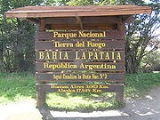
Tierra del Fuego National Park

Encyclopedia
Tierra del Fuego National Park is a national park
on the Argentine
part of the island of Tierra del Fuego
, within Tierra del Fuego Province in the ecoregion
of Patagonic Forest and Altos Andes, a part of the subantarctic
forest. Established on October 15, 1960 under the Law 15.554 and expanded in 1966, it was the first shoreline national park to be established in Argentina.
The park has dramatic scenery, with waterfalls, forests, mountains and glacier
s. Its 630 km² (243.2 sq mi) include parts of the Fagnano and Roca lakes. The Senda Costera (Coastal Path), connecting Ensenada Bay to Lapataia Bay on Lago Roca, is a popular hiking trail within the park. Forests of Antarctic beech
, lenga beech and coihue in the lower elevations of the park are home to many animal species. There are 20 species of terrestrial mammal
s, including the guanaco, Andean Fox
, North American Beaver, European Rabbit
and muskrat
. Among the 90 species of birds are the Kelp Goose
, Torrent Duck
, Austral Parakeet
, Andean Condor
, Blackish Oystercatcher
, and Magellanic Oystercatcher
.
The southernmost national park in the world, it is listed as an IUCN category II park. The park stretches 60 km (37.3 mi) north from the Beagle Channel
along the Chile
an border. Ushuaia
, the capital of Tierra del Fuego Province, is 11 km (6.8 mi) from the park. The park can be reached by car or by train. The southern terminus of the Pan-American Highway is located within the park, as is the El Parque station of the End of the World Train.
 Humans inhabited Tierra del Fuego as far back as 10,000 years ago. The Yaghan people, living in the harsh environment, survived on the natural resources of the sea. They lived on its beaches and made voyages into the sea in canoes made of lenga beech, hunted sea lion
s and collected shellfish. They lived in huts made of tree branches and trunks and clothed themselves with leather made from sea lion pelts. They smeared their body with the fat and grease of these animals to waterproof their skins. Trouble for the Yaghan people began in 1880, when European missionaries entered the area. Settlers brought diseases such as syphilis
and measles
, causing a rapid and nearly complete extinction of the Yaghan people. The Yaghan tribe was reduced in number from about 3,000 people in 1880 to less than 100 by the 1990s. Many of them were killed by "shoot exercises" and deliberate poisoning to exploit the sea lions, the staple of the Yaghan diet. Following the death of 84 year old Emelinda Acuña (1921 - October 12, 2005), only one native speaker remains, Cristina Calderón
of Villa Ukika on Navarino Island, Chile. What can be seen of the Yaghan people and their settlements today are mainly relics in the form of piles of mussel
shells overgrown with grass near the seashore. Some antiquarian links with the tribals can also be seen in the "End of the World Museum" in Ushuaia.
Flora
The subantarctic forest vegetation is dominated by tree species of Coihue, Nires and Lenga (a tree or shrub native to the Andes
and also known as Lenga Beech
) apart from a profusion of massbed. The flora that characterizes the "Andino-Patagonico" forests, the lenga, is well distributed over the mountain slopes above sea level to a height of 600 m (1,968.5 ft). Above 600 m (1,968.5 ft) elevation, the flora consists of altoandina with small little bushes, plants en cojin and grass
es.
IUCN has reported forests of southern beech species of Nothofagus pumilio, N. antarctica
and N. betuloides
. Other species include Berberis buxifolia
, Embothrium coccineum
, winter’s bark Drimys winteri
, and Crowberry
, Empetrum rubrum
and moss
es. Magellan coihue (coihue de Magallanes) is found in the wettest parts of the Beagle channel coast of the park. Lenga is found in the Pipo River Valley and some parts of southern mountain slopes and may be thickly set and reach great heights. Chinese lantern
, hemiparasite
and Pande Indian or Llao Llao, which are fungus parasites
, are found over the branches of the trees. Cinnamon
is also reported in many small forest areas of the park. Peat bogs extensively found in the park. These are made up of sphagnum moss and aquatic grasses in damp valleys where low temperatures and slow moving acidic waters prevent decomposition.
The flower varieties found are calafate, chaura
and michay
, which are orange coloured. Flag Tree
, Strawberry Devil
and little ferns
, yellow orchids
and luzuriagas
are seen in the understory of forest cover. Black bush, caulking, grill
and Embothrium cocci with red tubular flowers are typically seen in the Beagle Channel coast and the western part of Lapataia Bay. Also found is the chocolate scented Nassauvia
.
Fauna
Settlers from Europe and North America introduced many species
of animals into the area, such as the European rabbit, North American beaver, muskrat and gray fox
, which rapidly proliferated and caused significant damage to the environment.
Avifauna are of three types of cauquenes namely, cauquen comun, cauquen real and caranca, found in open places and beaches. Bandurrias are also seen. Other birds reported are Patagonian woodpeckers, maca común, common maca, heron
, pato Creston, Duck overo, corn duck, eagle
, Southern carancho, chimango. Condor
s are seen flying on the peaks and valleys of Tierra del Fuego. It is also home the Enicognathus ferrugineus species of parrot
. The terrestrial avifauna in the park are found in very large flocks in meadows and water fronts during the period from November to May.
Aquafauna consists of scallop
, moon snail, spiral tooth, few crustacean
s like crab
s and fishes such as sardine
s Fueguina
, merluza
and Robalo de cola, jellyfish
concentrations, steamer ducks and cormorant
s. Guanaco Lama guanicoe and sea lion
s are reported in the park. Kelp Goose
is a marine species found in Tierra del Fuego.
The Sea birds reported are petrel
s and albatross
es. Other fauna reported are the penguins, huemel Hippocamelus bisculus
, and southern river otter
Lutra provocax.
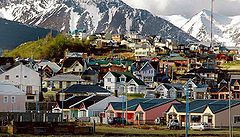 Ushuaia
, a former penal colony
, is claimed to be the southernmost city in the world
. It is the capital and port of Tierra del Fuego province, located on southwest shores of the Beagle Channel. The park is located 11 km (6.8 mi) to the west of the city of Ushuaia, on National Road 3. Ushuaia provides the main approach to the park through the highway or through the Southern Fuegian Railway. The modern city is set in brightly coloured houses on the Beagle channel shores in the backdrop of snow covered mountains of Martial mountains in the north.
The southern group of the Selk’nam, the Yaghan people (also known as Yámana), occupied what is now Ushuaia, living in continual conflict with the northern inhabitants of the island.
Wasti H. Stirling, an Anglican missionary, settled here in 1870 and started to convert Yaghan tribes, the natives, the original residents of the Beagle Channel. Prior to this, Charles Darwin
had arrived here in 1832. The name "Ushuaia" is a derivative of the Yaghan language
. After an Argentine naval base was established in 1884, the island was divided between Argentina and Chile. During the 1880s, many gold
prospectors came to Ushuaia, following rumors of large gold fields which proved to be false. In later years, Argentinian President Roca established a penal colony in the region in 1902, on nearby Staten Island, which resulted in its development. Prisoners were the main work force and were employed to construct the city and exploit the forests of the now Tierra del Fuego National Park. The train lines were also built by the prisoners, covering an area of 25 km (15.5 mi), which started from the Maipú Monte Susana camp and ran through the park. The city is now an important tourist center as the departure point not only for the park but also for voyages to Antarctica.
or strait in Tierra del Fuego National Park is named after the British ship HMS Beagle
, which sailed with the explorer Charles Darwin
aboard in 1833–34. The channel separates islands of the Tierra del Fuego Archipelago, in extreme southern South America. It separates Isla Grande de Tierra del Fuego from the islands of Nueva, Picton, Navarino, Hoste, Londonderry, Stewart, and other smaller islands to the south. It is oriented in an east-west direction, runs for a length of 150 mi (241.4 km). Its width varies from 3 mile. The biggest settlement on the channel is Ushuaia in Argentina followed by Puerto Williams
in Chile, two of the southernmost settlements in the world. Ancient middens where Yaghan tribes lived are seen on the beaches around the Beagle Channel.
The Boundary Treaty of 1881 was an attempted resolution of the territorial dispute between Argentina and Chile, and stipulated that the boundary between the two countries would run south from "Cape Espiritu Santo, on the northern shore of Tierre del Fuego till it touches the Beagle Channel". This division meant that Argentina would be entitled to the eastern portion while Chile would have the western part of the Tierre del Fuego. However, the Treaty did not clarify on the terminus of the Beagle channel which created many territorial and collateral issues such as navigation rights. This resulted in a dispute between the two countries, particularly on the small islands (Picton, Lennox and Nueva
) up to Cape Horn
. The dispute, which started in 1840, almost resulted in war between the two countries in 1978. However, with the intervention of the Vatican
the issue was resolved. The Pope ruled on the dispute, a ratification ensued and a treaty was signed on 2 May 1985. Under this treaty, Chile retained control of all the disputed islands and Argentina was entitled to the navigational rights and maintained their limited presence on these islands.
into the of Magellan Strait through the Azopardo River
. It is hemmed in the active tectonic plate (linked to the Magallanes-Fagnano fault) boundary between the South American and Scotia plate
s. Its East-West orientation in the southern part of Isla Grande de Tierra del Fuego
encompasses the national territories of Argentina and Chile; only a small part of the lake lies in Chile. Its evolution is attributed to constant glaciation during the late Pliocene
and Pleistocene era. The lake has a total drainage area of 3042 km² (1,174.5 sq mi) with basin elevation ranging from 27 m (88.6 ft) at the lake level to about 1000 m (3,280.8 ft).
The lake water spreads over an area of about 600 m² (717.6 sq yd), with an average width of 6 km (3.7 mi) (maximum width is 10 km (6.2 mi) over a length of 104 km (64.6 mi) long and the maximum recorded depth is 204 m (669.3 ft), with an average depth reported as 70 m (229.7 ft). Its water volume is 1000 km³ (239.9 cu mi).
in 1995), another made in Argentina and three diesel locomotives serve on the line. The park can now be reached from the outskirts of Ushuaia from the Fin del Mundo station (8 km (5 mi) west of Ushuaia) by the heritage railway line and runs over 5 km (3.1 mi), covering the distance in about 50 minutes.
National Parks of Argentina
The National Parks of Argentina make up a network of 30 national parks in Argentina. The parks cover a very varied set of terrains and biotopes, from Baritú National Park on the northern border with Bolivia to Tierra del Fuego National Park in the far south of the continent .The creation of the...
on the Argentine
Argentina
Argentina , officially the Argentine Republic , is the second largest country in South America by land area, after Brazil. It is constituted as a federation of 23 provinces and an autonomous city, Buenos Aires...
part of the island of Tierra del Fuego
Isla Grande de Tierra del Fuego
Isla Grande de Tierra del Fuego is an island near the southern tip of South America from which it is separated by the Strait of Magellan...
, within Tierra del Fuego Province in the ecoregion
Ecoregion
An ecoregion , sometimes called a bioregion, is an ecologically and geographically defined area that is smaller than an ecozone and larger than an ecosystem. Ecoregions cover relatively large areas of land or water, and contain characteristic, geographically distinct assemblages of natural...
of Patagonic Forest and Altos Andes, a part of the subantarctic
Subantarctic
The Subantarctic is a region in the southern hemisphere, located immediately north of the Antarctic region. This translates roughly to a latitude of between 46° – 60° south of the Equator. The subantarctic region includes many islands in the southern parts of the Indian Ocean, Atlantic Ocean and...
forest. Established on October 15, 1960 under the Law 15.554 and expanded in 1966, it was the first shoreline national park to be established in Argentina.
The park has dramatic scenery, with waterfalls, forests, mountains and glacier
Glacier
A glacier is a large persistent body of ice that forms where the accumulation of snow exceeds its ablation over many years, often centuries. At least 0.1 km² in area and 50 m thick, but often much larger, a glacier slowly deforms and flows due to stresses induced by its weight...
s. Its 630 km² (243.2 sq mi) include parts of the Fagnano and Roca lakes. The Senda Costera (Coastal Path), connecting Ensenada Bay to Lapataia Bay on Lago Roca, is a popular hiking trail within the park. Forests of Antarctic beech
Nothofagus antarctica
Nothofagus antarctica , is a deciduous tree or shrub native to southern Chile and Argentina from about 36°S to Tierra del Fuego . The southernmost occurrence is on Hoste Island, making it the southernmost trees on earth...
, lenga beech and coihue in the lower elevations of the park are home to many animal species. There are 20 species of terrestrial mammal
Mammal
Mammals are members of a class of air-breathing vertebrate animals characterised by the possession of endothermy, hair, three middle ear bones, and mammary glands functional in mothers with young...
s, including the guanaco, Andean Fox
Culpeo
The culpeo , sometimes known as the culpeo zorro or Andean fox , is a South American species of wild dog. It is the second largest native canid on the continent after the maned wolf. In its appearance it bears many similarities to the widely recognized red fox...
, North American Beaver, European Rabbit
European Rabbit
The European Rabbit or Common Rabbit is a species of rabbit native to south west Europe and north west Africa . It has been widely introduced elsewhere often with devastating effects on local biodiversity...
and muskrat
Muskrat
The muskrat , the only species in genus Ondatra, is a medium-sized semi-aquatic rodent native to North America, and introduced in parts of Europe, Asia, and South America. The muskrat is found in wetlands and is a very successful animal over a wide range of climates and habitats...
. Among the 90 species of birds are the Kelp Goose
Kelp Goose
The Kelp Goose , Chloephaga hybrida, is a member of the duck, goose and swan family Anatidae. It is in the shelduck subfamily Tadorninae...
, Torrent Duck
Torrent Duck
The Torrent Duck is a member of the duck, goose and swan family Anatidae. It is the only member of the genus Merganetta. Today it is placed in the shelduck subfamily Tadorninae after the "perching duck" assemblage where it was formerly assigned to was dissolved because it turned out to be...
, Austral Parakeet
Austral Parakeet
The Austral Parakeet, Austral Conure or Emerald Parakeet, Enicognathus ferrugineus, is a parrot found on the southern tip of South America - further south than any other parrot - ranging as far north as Temuco. It is a fairly large conure, 35cm...
, Andean Condor
Andean Condor
The Andean Condor is a species of South American bird in the New World vulture family Cathartidae and is the only member of the genus Vultur...
, Blackish Oystercatcher
Blackish Oystercatcher
The Blackish Oystercatcher is a species of wader in the Haematopodidae family.It is found in Argentina, Chile, the Falkland Islands and Peru, and is a vagrant to Uruguay.The population is estimated at 22,000–120,000....
, and Magellanic Oystercatcher
Magellanic Oystercatcher
The Magellanic Oystercatcher is a species of wader in the Haematopodidae family.It is found in Argentina, Chile and the Falkland Islands.Its natural habitats are freshwater lakes and sandy shores.-References:...
.
The southernmost national park in the world, it is listed as an IUCN category II park. The park stretches 60 km (37.3 mi) north from the Beagle Channel
Beagle Channel
thumb|right|300px|Aereal view of Beagle Channel. The Chilean [[Navarino Island]] is seen in the top-right while the Argentine part of [[Isla Grande de Tierra del Fuego]] is seen at the bottom-left....
along the Chile
Chile
Chile ,officially the Republic of Chile , is a country in South America occupying a long, narrow coastal strip between the Andes mountains to the east and the Pacific Ocean to the west. It borders Peru to the north, Bolivia to the northeast, Argentina to the east, and the Drake Passage in the far...
an border. Ushuaia
Ushuaia
Ushuaia may refer to the following:*Ushuaia, a city in Argentina.**Ushuaia Department, an administrative division**Ushuaia River**Ushuaia International Airport**Colegio Nacional de Ushuaia, National School of Ushuaia....
, the capital of Tierra del Fuego Province, is 11 km (6.8 mi) from the park. The park can be reached by car or by train. The southern terminus of the Pan-American Highway is located within the park, as is the El Parque station of the End of the World Train.
Etymology
The first Europeans who came to explore the southern tip of South America saw the campfires of the native inhabitants of the area (the Yaghan people, also called Yámana). The Spanish explorers hence named the area "Tierra del Fuego", meaning "land of fire".Geography
Tierra del Fuego National Park is studded with mountains, lakes and rivers which form deep valleys. It is bounded on the west by the Chilean border, on the north by Lago Fagnano, and on the south by the Beagle Channel, which forms the shoreline. It encompasses an area of 63000 hectares (155,676.3 acre) and represents two ecoregions: the Altos Andes and the Patagonian Forest. While the former ecoregion is made up of hill ranges and slopes, the latter has high and jagged mountains, glacier valleys and semi-deciduous forests. The landscape of the park is the result of glacial erosion, which has created bays and beaches against a backdrop of rugged mountains and valleys.Climate
The park experiences a temperate climate with frequent rain, fog and strong winds. Westerly winds over the sea maintain a uniform climate in the park. The average annual rainfall is 700 mm (27.6 in). Peak rainfall (snowfall at higher elevations) occurs from March through May; there is no dry season. Average temperatures are about 0 °C (32 °F) in winter and 10 °C (50 °F) in the summer. At Ushuaia, the recorded mean annual temperature reported is 5.4 °C (41.7 °F) with maximum monthly mean of 14.2 °C (57.6 °F) and minimum of -2.4 C.History
Sea Lion
Sea lions are pinnipeds characterized by external ear-flaps, long fore-flippers, the ability to walk on all fours, and short thick hair. Together with the fur seal, they comprise the family Otariidae, or eared seals. There are six extant and one extinct species in five genera...
s and collected shellfish. They lived in huts made of tree branches and trunks and clothed themselves with leather made from sea lion pelts. They smeared their body with the fat and grease of these animals to waterproof their skins. Trouble for the Yaghan people began in 1880, when European missionaries entered the area. Settlers brought diseases such as syphilis
Syphilis
Syphilis is a sexually transmitted infection caused by the spirochete bacterium Treponema pallidum subspecies pallidum. The primary route of transmission is through sexual contact; however, it may also be transmitted from mother to fetus during pregnancy or at birth, resulting in congenital syphilis...
and measles
Measles
Measles, also known as rubeola or morbilli, is an infection of the respiratory system caused by a virus, specifically a paramyxovirus of the genus Morbillivirus. Morbilliviruses, like other paramyxoviruses, are enveloped, single-stranded, negative-sense RNA viruses...
, causing a rapid and nearly complete extinction of the Yaghan people. The Yaghan tribe was reduced in number from about 3,000 people in 1880 to less than 100 by the 1990s. Many of them were killed by "shoot exercises" and deliberate poisoning to exploit the sea lions, the staple of the Yaghan diet. Following the death of 84 year old Emelinda Acuña (1921 - October 12, 2005), only one native speaker remains, Cristina Calderón
Cristina Calderón
Cristina Calderón of Robalo, Puerto Williams, on Navarino Island, Chile, is the last living full-blooded Yaghan person. By 2004, Calderón and her sister-in-law Emelinda Acuña were the only two remaining native speakers of the Yaghan language...
of Villa Ukika on Navarino Island, Chile. What can be seen of the Yaghan people and their settlements today are mainly relics in the form of piles of mussel
Mussel
The common name mussel is used for members of several families of clams or bivalvia mollusca, from saltwater and freshwater habitats. These groups have in common a shell whose outline is elongated and asymmetrical compared with other edible clams, which are often more or less rounded or oval.The...
shells overgrown with grass near the seashore. Some antiquarian links with the tribals can also be seen in the "End of the World Museum" in Ushuaia.
Flora and fauna
The park forms the southern portion of the subantarctic forest and is known for its biological richness.Flora
The subantarctic forest vegetation is dominated by tree species of Coihue, Nires and Lenga (a tree or shrub native to the Andes
Andes
The Andes is the world's longest continental mountain range. It is a continual range of highlands along the western coast of South America. This range is about long, about to wide , and of an average height of about .Along its length, the Andes is split into several ranges, which are separated...
and also known as Lenga Beech
Lenga Beech
Nothofagus pumilio is a deciduous tree or shrub in the Nothofagaceae family that is native to the southern Andes range, in the temperate forests of Chile and Argentina to Tierra del Fuego, from 35° to 56° South latitude. This tree is in the same genus as the Coihue. It regenerates easily after...
) apart from a profusion of massbed. The flora that characterizes the "Andino-Patagonico" forests, the lenga, is well distributed over the mountain slopes above sea level to a height of 600 m (1,968.5 ft). Above 600 m (1,968.5 ft) elevation, the flora consists of altoandina with small little bushes, plants en cojin and grass
Grass
Grasses, or more technically graminoids, are monocotyledonous, usually herbaceous plants with narrow leaves growing from the base. They include the "true grasses", of the Poaceae family, as well as the sedges and the rushes . The true grasses include cereals, bamboo and the grasses of lawns ...
es.
IUCN has reported forests of southern beech species of Nothofagus pumilio, N. antarctica
Nothofagus antarctica
Nothofagus antarctica , is a deciduous tree or shrub native to southern Chile and Argentina from about 36°S to Tierra del Fuego . The southernmost occurrence is on Hoste Island, making it the southernmost trees on earth...
and N. betuloides
Nothofagus betuloides
Nothofagus betuloides, the Magellan's beech and is sometimes known by the common name guindo, is native to southern Patagonia.In 1769 Sir Joseph Banks collected a specimen of the tree in Tierra del Fuego during Captain Cook's first voyage....
. Other species include Berberis buxifolia
Berberis buxifolia
Berberis microphylla or Berberis buxifolia, common name the Magellan Barberry, in Spanish Calafate, is an evergreen shrub, with shiny box-like leaves. The Calafate is native to the south of Argentina and Chile and is a symbol of Patagonia.The bush grows to a height of . It has many arching...
, Embothrium coccineum
Embothrium coccineum
Chilean firetree, Chilean firebush, Notro in Spanish , is a small evergreen tree in the family Proteaceae. It grows in the temperate forests of Chile and Argentina....
, winter’s bark Drimys winteri
Drimys winteri
Drimys winteri , or Canelo, is a slender tree, growing up to 20 m tall. It is native to the Magellanic and Valdivian temperate rain forests of Chile and Argentina, where it is a dominant tree in the coastal evergreen forests. It is found below 1200 meters between latitude 32° south and Cape...
, and Crowberry
Crowberry
Crowberry is a small genus of dwarf evergreen shrubs that bear edible fruit. They are commonly found in the northern hemisphere, from temperate to subarctic climates, and also in the Southern Andes of South America and on the South Atlantic islands of South Georgia, the Falklands and Tristan da...
, Empetrum rubrum
Empetrum rubrum
Empetrum rubrum, known as red crowberry or Diddle-Dee , is a species of plant in the Ericaceae family with a distributional range in Chile from Talca to Cape Horn ; in areas of adjacent Argentina; in the Falkland Islands; and in Tristan da Cunha. One of its northernmost natural growing places is...
and moss
Moss
Mosses are small, soft plants that are typically 1–10 cm tall, though some species are much larger. They commonly grow close together in clumps or mats in damp or shady locations. They do not have flowers or seeds, and their simple leaves cover the thin wiry stems...
es. Magellan coihue (coihue de Magallanes) is found in the wettest parts of the Beagle channel coast of the park. Lenga is found in the Pipo River Valley and some parts of southern mountain slopes and may be thickly set and reach great heights. Chinese lantern
Physalis alkekengi
Physalis alkekengi , is a relative of P. peruviana , easily identifiable by the larger, bright orange to red papery covering over its fruit, which resemble Chinese lanterns. It is native from southern Europe east across southern Asia to Japan...
, hemiparasite
Parasitic plant
A parasitic plant is one that derives some or all of its sustenance from another plant. About 4,100 species in approximately 19 families of flowering plants are known. Parasitic plants have a modified root, the haustorium, that penetrates the host plant and connects to the xylem, phloem, or...
and Pande Indian or Llao Llao, which are fungus parasites
Fungus
A fungus is a member of a large group of eukaryotic organisms that includes microorganisms such as yeasts and molds , as well as the more familiar mushrooms. These organisms are classified as a kingdom, Fungi, which is separate from plants, animals, and bacteria...
, are found over the branches of the trees. Cinnamon
Cinnamon
Cinnamon is a spice obtained from the inner bark of several trees from the genus Cinnamomum that is used in both sweet and savoury foods...
is also reported in many small forest areas of the park. Peat bogs extensively found in the park. These are made up of sphagnum moss and aquatic grasses in damp valleys where low temperatures and slow moving acidic waters prevent decomposition.
The flower varieties found are calafate, chaura
Gaultheria mucronata
Gaultheria mucronata is a species of plant in the family Ericaceae, is a native to southern Argentina and Chile. It produces purple plum-shaped fruits. Commonly known as "Chaura". While the fruits are edible, they are sweet and somewhat tasteless. In North America this frost-tolerant species is...
and michay
Berberis darwinii
Berberis darwinii is a species of barberry in the family Berberidaceae, native to southern South America in southern Chile and Argentina. Common names include Darwin's Barberry and Michay....
, which are orange coloured. Flag Tree
Krummholz
Krummholz or Krumholtz formation — also called Knieholz — is a particular feature of subarctic and subalpine tree line landscapes. Continual exposure to fierce, freezing winds causes vegetation to become stunted and deformed...
, Strawberry Devil
Hydnellum peckii
Hydnellum peckii is an inedible fungus, and a member of the genus Hydnellum of the family Bankeraceae. It is a hydnoid species, producing spores on the surface of vertical spines or tooth-like projections that hang from the undersurface of the fruit bodies. It is found in North America, Europe, and...
and little ferns
Fern
A fern is any one of a group of about 12,000 species of plants belonging to the botanical group known as Pteridophyta. Unlike mosses, they have xylem and phloem . They have stems, leaves, and roots like other vascular plants...
, yellow orchids
Platanthera ciliaris
Platanthera ciliaris, commonly known as the Yellow Fringed Orchid Yellow-fringed Orchis, or Orange-fringed Orchid, is a species of orchid.-External links:*...
and luzuriagas
Luzuriagaceae
Luzuriagaceae is the botanical name of a family of flowering plants. Such a family has been recognized by relatively few taxonomists.The APG II system, of 2003 , did recognize such a family and placed it in the order Liliales, in the clade monocots. The APG III system merged this small family...
are seen in the understory of forest cover. Black bush, caulking, grill
Grill
-In food:* Barbecue grill, a device or surface used for cooking food, usually fuelled by gas or charcoal, or the part of a cooker that performs this function.* Grilling, a form of cooking that involves direct heat....
and Embothrium cocci with red tubular flowers are typically seen in the Beagle Channel coast and the western part of Lapataia Bay. Also found is the chocolate scented Nassauvia
Nassauvia
Nassauvia is a genus of flowering plants in the aster family, Asteraceae. It is said to be chocolate scented.It consists of 39 species and is native to Argentina, Bolivia, Chile and the Falkland Islands.- Selected species :...
.
Fauna
Settlers from Europe and North America introduced many species
Introduced species
An introduced species — or neozoon, alien, exotic, non-indigenous, or non-native species, or simply an introduction, is a species living outside its indigenous or native distributional range, and has arrived in an ecosystem or plant community by human activity, either deliberate or accidental...
of animals into the area, such as the European rabbit, North American beaver, muskrat and gray fox
Gray Fox
The gray fox is a mammal of the order Carnivora ranging throughout most of the southern half of North America from southern Canada to the northern part of South America...
, which rapidly proliferated and caused significant damage to the environment.
Avifauna are of three types of cauquenes namely, cauquen comun, cauquen real and caranca, found in open places and beaches. Bandurrias are also seen. Other birds reported are Patagonian woodpeckers, maca común, common maca, heron
Heron
The herons are long-legged freshwater and coastal birds in the family Ardeidae. There are 64 recognised species in this family. Some are called "egrets" or "bitterns" instead of "heron"....
, pato Creston, Duck overo, corn duck, eagle
Eagle
Eagles are members of the bird family Accipitridae, and belong to several genera which are not necessarily closely related to each other. Most of the more than 60 species occur in Eurasia and Africa. Outside this area, just two species can be found in the United States and Canada, nine more in...
, Southern carancho, chimango. Condor
Condor
Condor is the name for two species of New World vultures, each in a monotypic genus. They are the largest flying land birds in the Western Hemisphere.They are:* The Andean Condor which inhabits the Andean mountains....
s are seen flying on the peaks and valleys of Tierra del Fuego. It is also home the Enicognathus ferrugineus species of parrot
Parrot
Parrots, also known as psittacines , are birds of the roughly 372 species in 86 genera that make up the order Psittaciformes, found in most tropical and subtropical regions. The order is subdivided into three families: the Psittacidae , the Cacatuidae and the Strigopidae...
. The terrestrial avifauna in the park are found in very large flocks in meadows and water fronts during the period from November to May.
Aquafauna consists of scallop
Scallop
A scallop is a marine bivalve mollusk of the family Pectinidae. Scallops are a cosmopolitan family, found in all of the world's oceans. Many scallops are highly prized as a food source...
, moon snail, spiral tooth, few crustacean
Crustacean
Crustaceans form a very large group of arthropods, usually treated as a subphylum, which includes such familiar animals as crabs, lobsters, crayfish, shrimp, krill and barnacles. The 50,000 described species range in size from Stygotantulus stocki at , to the Japanese spider crab with a leg span...
s like crab
Crab
True crabs are decapod crustaceans of the infraorder Brachyura, which typically have a very short projecting "tail" , or where the reduced abdomen is entirely hidden under the thorax...
s and fishes such as sardine
Sardine
Sardines, or pilchards, are several types of small, oily fish related to herrings, family Clupeidae. Sardines are named after the Mediterranean island of Sardinia, around which they were once abundant....
s Fueguina
Fueguina
Fueguina is a genus of moth in the family Geometridae.-References:*...
, merluza
Merluza
Merluza could refer to one of several things* Merlucciidae, a family of cod-like fish.* Merluza oil field, a gas and oil field in Brazil.* Merluza, a character in the Japanese adult visual novel Furifuri...
and Robalo de cola, jellyfish
Jellyfish
Jellyfish are free-swimming members of the phylum Cnidaria. Medusa is another word for jellyfish, and refers to any free-swimming jellyfish stages in the phylum Cnidaria...
concentrations, steamer ducks and cormorant
Cormorant
The bird family Phalacrocoracidae is represented by some 40 species of cormorants and shags. Several different classifications of the family have been proposed recently, and the number of genera is disputed.- Names :...
s. Guanaco Lama guanicoe and sea lion
Sea Lion
Sea lions are pinnipeds characterized by external ear-flaps, long fore-flippers, the ability to walk on all fours, and short thick hair. Together with the fur seal, they comprise the family Otariidae, or eared seals. There are six extant and one extinct species in five genera...
s are reported in the park. Kelp Goose
Kelp Goose
The Kelp Goose , Chloephaga hybrida, is a member of the duck, goose and swan family Anatidae. It is in the shelduck subfamily Tadorninae...
is a marine species found in Tierra del Fuego.
The Sea birds reported are petrel
Petrel
Petrels are tube-nosed seabirds in the bird order Procellariiformes. The common name does not indicate relationship beyond that point, as "petrels" occur in three of the four families within that group...
s and albatross
Albatross
Albatrosses, of the biological family Diomedeidae, are large seabirds allied to the procellariids, storm-petrels and diving-petrels in the order Procellariiformes . They range widely in the Southern Ocean and the North Pacific...
es. Other fauna reported are the penguins, huemel Hippocamelus bisculus
South Andean Deer
The South Andean Deer, Hippocamelus bisulcus, also known as the Huemul , is an endangered species of deer native to the mountains of Argentina and Chile. One of two mid-sized deer of the Hippocamelus genus, the South Andean Deer ranges across the high mountainsides and cold valleys of the Andes...
, and southern river otter
Southern River Otter
The Southern river otter is a species of otter that lives in Chile and Argentina. Although called a "river otter", it inhabits both marine and freshwater environments....
Lutra provocax.
Attractions
Apart from the Ushuaia city, there are many attractions within the park. These are: Beagle Channel, the Pipo River cascade, the Lago Fagnano, Lago Roca, the Ensanada Bay, the Lapataia Bay, the End of the World Train the Laguna Negra and many others.Ushuaia
Ushuaia
Ushuaia may refer to the following:*Ushuaia, a city in Argentina.**Ushuaia Department, an administrative division**Ushuaia River**Ushuaia International Airport**Colegio Nacional de Ushuaia, National School of Ushuaia....
, a former penal colony
Penal colony
A penal colony is a settlement used to exile prisoners and separate them from the general populace by placing them in a remote location, often an island or distant colonial territory...
, is claimed to be the southernmost city in the world
The southernmost city in the world
"The southernmost city in the world" is a slogan used to attract tourists, including those bound for Antarctica, to various southern cities. Currently, three cities or towns use this slogan; there are several settlements further south than the three, but none are considered to be large enough to...
. It is the capital and port of Tierra del Fuego province, located on southwest shores of the Beagle Channel. The park is located 11 km (6.8 mi) to the west of the city of Ushuaia, on National Road 3. Ushuaia provides the main approach to the park through the highway or through the Southern Fuegian Railway. The modern city is set in brightly coloured houses on the Beagle channel shores in the backdrop of snow covered mountains of Martial mountains in the north.
The southern group of the Selk’nam, the Yaghan people (also known as Yámana), occupied what is now Ushuaia, living in continual conflict with the northern inhabitants of the island.
Wasti H. Stirling, an Anglican missionary, settled here in 1870 and started to convert Yaghan tribes, the natives, the original residents of the Beagle Channel. Prior to this, Charles Darwin
Charles Darwin
Charles Robert Darwin FRS was an English naturalist. He established that all species of life have descended over time from common ancestry, and proposed the scientific theory that this branching pattern of evolution resulted from a process that he called natural selection.He published his theory...
had arrived here in 1832. The name "Ushuaia" is a derivative of the Yaghan language
Yaghan language
Yagán , also known as Yámana and Háusi Kúta, is one of the indigenous languages of Tierra del Fuego, spoken by the Yagán people...
. After an Argentine naval base was established in 1884, the island was divided between Argentina and Chile. During the 1880s, many gold
Gold
Gold is a chemical element with the symbol Au and an atomic number of 79. Gold is a dense, soft, shiny, malleable and ductile metal. Pure gold has a bright yellow color and luster traditionally considered attractive, which it maintains without oxidizing in air or water. Chemically, gold is a...
prospectors came to Ushuaia, following rumors of large gold fields which proved to be false. In later years, Argentinian President Roca established a penal colony in the region in 1902, on nearby Staten Island, which resulted in its development. Prisoners were the main work force and were employed to construct the city and exploit the forests of the now Tierra del Fuego National Park. The train lines were also built by the prisoners, covering an area of 25 km (15.5 mi), which started from the Maipú Monte Susana camp and ran through the park. The city is now an important tourist center as the departure point not only for the park but also for voyages to Antarctica.
Beagle Channel
The Beagle ChannelBeagle Channel
thumb|right|300px|Aereal view of Beagle Channel. The Chilean [[Navarino Island]] is seen in the top-right while the Argentine part of [[Isla Grande de Tierra del Fuego]] is seen at the bottom-left....
or strait in Tierra del Fuego National Park is named after the British ship HMS Beagle
HMS Beagle
HMS Beagle was a Cherokee-class 10-gun brig-sloop of the Royal Navy. She was launched on 11 May 1820 from the Woolwich Dockyard on the River Thames, at a cost of £7,803. In July of that year she took part in a fleet review celebrating the coronation of King George IV of the United Kingdom in which...
, which sailed with the explorer Charles Darwin
Charles Darwin
Charles Robert Darwin FRS was an English naturalist. He established that all species of life have descended over time from common ancestry, and proposed the scientific theory that this branching pattern of evolution resulted from a process that he called natural selection.He published his theory...
aboard in 1833–34. The channel separates islands of the Tierra del Fuego Archipelago, in extreme southern South America. It separates Isla Grande de Tierra del Fuego from the islands of Nueva, Picton, Navarino, Hoste, Londonderry, Stewart, and other smaller islands to the south. It is oriented in an east-west direction, runs for a length of 150 mi (241.4 km). Its width varies from 3 mile. The biggest settlement on the channel is Ushuaia in Argentina followed by Puerto Williams
Puerto Williams
Puerto Williams is a Chilean port, located on Isla Navarino facing the Beagle Channel. It is the capital of the Chilean Antarctic Province, one of four provinces located in the Magellan and Chilean Antartica Region...
in Chile, two of the southernmost settlements in the world. Ancient middens where Yaghan tribes lived are seen on the beaches around the Beagle Channel.
The Boundary Treaty of 1881 was an attempted resolution of the territorial dispute between Argentina and Chile, and stipulated that the boundary between the two countries would run south from "Cape Espiritu Santo, on the northern shore of Tierre del Fuego till it touches the Beagle Channel". This division meant that Argentina would be entitled to the eastern portion while Chile would have the western part of the Tierre del Fuego. However, the Treaty did not clarify on the terminus of the Beagle channel which created many territorial and collateral issues such as navigation rights. This resulted in a dispute between the two countries, particularly on the small islands (Picton, Lennox and Nueva
Beagle Channel cartography since 1881
The region of the Beagle Channel, explored by Robert FitzRoy eighteen-thirties, was one of the last ones to be colonized by Chile and Argentina. The cold weather, the long distances from other inhabited regions and the shortage of transport and subsistence kept it far from the governmental task.In...
) up to Cape Horn
Cape Horn
Cape Horn is the southernmost headland of the Tierra del Fuego archipelago of southern Chile, and is located on the small Hornos Island...
. The dispute, which started in 1840, almost resulted in war between the two countries in 1978. However, with the intervention of the Vatican
Holy See
The Holy See is the episcopal jurisdiction of the Catholic Church in Rome, in which its Bishop is commonly known as the Pope. It is the preeminent episcopal see of the Catholic Church, forming the central government of the Church. As such, diplomatically, and in other spheres the Holy See acts and...
the issue was resolved. The Pope ruled on the dispute, a ratification ensued and a treaty was signed on 2 May 1985. Under this treaty, Chile retained control of all the disputed islands and Argentina was entitled to the navigational rights and maintained their limited presence on these islands.
Lago Fagnano
Lago Fagnano (named after the Salesian monk José Fagnano), also known as Cami Lake, the southernmost lake of its size outside Antarctica, is the largest lake in Tierra del Fuego and flows southward along the eastern slope of the Andean Cordillera of PatagoniaPatagonia
Patagonia is a region located in Argentina and Chile, integrating the southernmost section of the Andes mountains to the southwest towards the Pacific ocean and from the east of the cordillera to the valleys it follows south through Colorado River towards Carmen de Patagones in the Atlantic Ocean...
into the of Magellan Strait through the Azopardo River
Azopardo River
The Azopardo River , is a river in Isla Grande de Tierra del Fuego, Chile at the southern tip of South America. It flows in a westerly direction and drains the waters of Fagnano Lake into Almirantazgo Fjord....
. It is hemmed in the active tectonic plate (linked to the Magallanes-Fagnano fault) boundary between the South American and Scotia plate
Scotia Plate
The Scotia Plate is an oceanic tectonic plate bordering the South American Plate on the north, the South Sandwich Plate to the east, and the Antarctic Plate on the south and west....
s. Its East-West orientation in the southern part of Isla Grande de Tierra del Fuego
Isla Grande de Tierra del Fuego
Isla Grande de Tierra del Fuego is an island near the southern tip of South America from which it is separated by the Strait of Magellan...
encompasses the national territories of Argentina and Chile; only a small part of the lake lies in Chile. Its evolution is attributed to constant glaciation during the late Pliocene
Pliocene
The Pliocene Epoch is the period in the geologic timescale that extends from 5.332 million to 2.588 million years before present. It is the second and youngest epoch of the Neogene Period in the Cenozoic Era. The Pliocene follows the Miocene Epoch and is followed by the Pleistocene Epoch...
and Pleistocene era. The lake has a total drainage area of 3042 km² (1,174.5 sq mi) with basin elevation ranging from 27 m (88.6 ft) at the lake level to about 1000 m (3,280.8 ft).
The lake water spreads over an area of about 600 m² (717.6 sq yd), with an average width of 6 km (3.7 mi) (maximum width is 10 km (6.2 mi) over a length of 104 km (64.6 mi) long and the maximum recorded depth is 204 m (669.3 ft), with an average depth reported as 70 m (229.7 ft). Its water volume is 1000 km³ (239.9 cu mi).
End of the World Train
Following the establishment of a prison in Ushuaia, in late 1909 and early 1910 the railway line called the Southern Fuegian Railway or the End of the World Train was established as a narrow gauge steam railway, replacing an old wood track railway drawn by bullocks. The steam engine driven railway was built over a length of 25 km (15.5 mi) along the Maipu Avenue on the water front, followed the eastern slope of Mount Susana and branched through the middle of the Pipo River valley into the Tierra del Fuego National Park. The line made with Decauville tracks of 500 mm (19.7 in) gauge, connected the prison camp with the forestry camp. The primary purpose of the railway was as a freight line to serve the prison of Ushuaia, and hence was known as the "Prison Train," and was used specifically to transport prisoners to the camps and transport the logged timber from forests. The prison was closed in 1947, and the railway was finally closed in 1952, following the reduction in forest resources and an earthquake which damaged the tracks. It was only in 1994, 40 years after it had been closed as a Prison Train, that the train was revived, refurbished with modern amenities, to be used as a heritage train, and claimed to be the southernmost functioning railway in the world. A new 2-6-2T steam locomotive (Camila, brought from EnglandEngland
England is a country that is part of the United Kingdom. It shares land borders with Scotland to the north and Wales to the west; the Irish Sea is to the north west, the Celtic Sea to the south west, with the North Sea to the east and the English Channel to the south separating it from continental...
in 1995), another made in Argentina and three diesel locomotives serve on the line. The park can now be reached from the outskirts of Ushuaia from the Fin del Mundo station (8 km (5 mi) west of Ushuaia) by the heritage railway line and runs over 5 km (3.1 mi), covering the distance in about 50 minutes.