

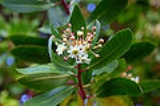
Drimys winteri

Encyclopedia
Drimys winteri or Canelo, is a slender tree
, growing up to 20 m (65 ft) tall. It is native to the Magellanic
and Valdivian temperate rain forests
of Chile and Argentina, where it is a dominant tree in the coastal evergreen forests. It is found below 1200 meters (4000 ft) between latitude 32° south
and Cape Horn
at latitude 56°
. In its southernmost natural range it can tolerate temperatures down to −20 °C (−4 °F).
Leaves
are lanceolate, glossy green above, whitish below and can measure up to 20 cm (7 in). Its flower
is white with its center yellow and is made up by a great number of petals and stamen
s. Its fruit is a bluish berry
.
When Sir Francis Drake sailed round the world in 1577-80, of the four ships accompanying the Golden Hind
at the outset, the only ship that successfully rounded Cape Horn
with him was the Elizabeth, captained by John Winter; the two ships separated in a storm and Winter turned back. Presumably he had sickness on board, for he sent a boat ashore to search out medicinal herbs. He returned in 1579 with a supply of Drimys bark, and for centuries before vitamin C
was isolated, "Winter's Bark" was esteemed as a preventive and remedy for scurvy
— correctly so, for a tisane
of D. winteri sustained Captain James Cook
and his crew in the South Pacific, and the naturalist accompanying his voyage of exploration, Johann Reinhold Forster
, was the first to officially describe and name D. winteri.
It is also grown in cool moist climates as an ornamental plant
for its red-brown bark, bright green fragrant leaves and its clusters of creamy white jasmine
-scented flowers. The bark is gray, thick and soft and is used as a pepper replacement in Argentina and Chile. The peppery compound in Canelo is polygodial
.
The species grows well in southern Britain flourishing as far north as Anglesey
and all but frost-free San Francisco, but specimens brought from the southern forests of Tierra del Fuego
and planted in the Faroe Islands
have proven to be especially hardy. A fine specimen is found in Northumberland
.
It has been planted in the North Pacific Coast of the United States
.
Canelo wood is reddish in color and heavy, with a very beautiful grain. It is used for furniture and music instruments. The wood is not durable outdoors because continuous rainfalls damage it. The wood is not good for making bonfires because gives off a spicy smoke.
Tree
A tree is a perennial woody plant. It is most often defined as a woody plant that has many secondary branches supported clear of the ground on a single main stem or trunk with clear apical dominance. A minimum height specification at maturity is cited by some authors, varying from 3 m to...
, growing up to 20 m (65 ft) tall. It is native to the Magellanic
Magellanic subpolar forests
The Magellanic subpolar forests are a terrestrial ecoregion of southernmost South America, covering parts of southern Chile and Argentina, and is part of the Neotropic ecozone...
and Valdivian temperate rain forests
Valdivian temperate rain forests
The Valdivian temperate rain forests are a temperate broadleaf and mixed-forest ecoregion located on the west coast of southern South America, lying mostly in Chile and extending into a small part of Argentina. It is part of the Neotropic ecozone. The forests are named after the city of Valdivia...
of Chile and Argentina, where it is a dominant tree in the coastal evergreen forests. It is found below 1200 meters (4000 ft) between latitude 32° south
32nd parallel south
The 32nd parallel south is a circle of latitude that is 32 degrees south of the Earth's equatorial plane. It crosses the Atlantic Ocean, Africa, the Indian Ocean, Australasia, the Pacific Ocean and South America....
and Cape Horn
Cape Horn
Cape Horn is the southernmost headland of the Tierra del Fuego archipelago of southern Chile, and is located on the small Hornos Island...
at latitude 56°
56th parallel south
The 56th parallel south is a circle of latitude that is 56 degrees south of the Earth's equatorial plane. No land lies on the parallel—it crosses nothing but ocean.Starting at the Prime Meridian and heading eastwards, the parallel 56° south passes through:...
. In its southernmost natural range it can tolerate temperatures down to −20 °C (−4 °F).
Leaves
Leaves
-History:Vocalist Arnar Gudjonsson was formerly the guitarist with Mower, and he was joined by Hallur Hallsson , Arnar Ólafsson , Bjarni Grímsson , and Andri Ásgrímsson . Late in 2001 they played with Emiliana Torrini and drew early praise from the New York Times...
are lanceolate, glossy green above, whitish below and can measure up to 20 cm (7 in). Its flower
Flower
A flower, sometimes known as a bloom or blossom, is the reproductive structure found in flowering plants . The biological function of a flower is to effect reproduction, usually by providing a mechanism for the union of sperm with eggs...
is white with its center yellow and is made up by a great number of petals and stamen
Stamen
The stamen is the pollen producing reproductive organ of a flower...
s. Its fruit is a bluish berry
Berry
The botanical definition of a berry is a fleshy fruit produced from a single ovary. Grapes are an example. The berry is the most common type of fleshy fruit in which the entire ovary wall ripens into an edible pericarp. They may have one or more carpels with a thin covering and fleshy interiors....
.
When Sir Francis Drake sailed round the world in 1577-80, of the four ships accompanying the Golden Hind
Golden Hind
The Golden Hind was an English galleon best known for its circumnavigation of the globe between 1577 and 1580, captained by Sir Francis Drake...
at the outset, the only ship that successfully rounded Cape Horn
Cape Horn
Cape Horn is the southernmost headland of the Tierra del Fuego archipelago of southern Chile, and is located on the small Hornos Island...
with him was the Elizabeth, captained by John Winter; the two ships separated in a storm and Winter turned back. Presumably he had sickness on board, for he sent a boat ashore to search out medicinal herbs. He returned in 1579 with a supply of Drimys bark, and for centuries before vitamin C
Vitamin C
Vitamin C or L-ascorbic acid or L-ascorbate is an essential nutrient for humans and certain other animal species. In living organisms ascorbate acts as an antioxidant by protecting the body against oxidative stress...
was isolated, "Winter's Bark" was esteemed as a preventive and remedy for scurvy
Scurvy
Scurvy is a disease resulting from a deficiency of vitamin C, which is required for the synthesis of collagen in humans. The chemical name for vitamin C, ascorbic acid, is derived from the Latin name of scurvy, scorbutus, which also provides the adjective scorbutic...
— correctly so, for a tisane
Tisane
A herbal tea, tisane, or ptisan is a herbal or plant infusion and usually not made from the leaves of the tea bush . Typically, herbal tea is simply the combination of boiling water and dried fruits, flowers or herbs. Herbal tea has been imbibed for nearly as long as written history extends...
of D. winteri sustained Captain James Cook
James Cook
Captain James Cook, FRS, RN was a British explorer, navigator and cartographer who ultimately rose to the rank of captain in the Royal Navy...
and his crew in the South Pacific, and the naturalist accompanying his voyage of exploration, Johann Reinhold Forster
Johann Reinhold Forster
Johann Reinhold Forster was a German Lutheran pastor and naturalist of partial Scottish descent who made contributions to the early ornithology of Europe and North America...
, was the first to officially describe and name D. winteri.
It is also grown in cool moist climates as an ornamental plant
Ornamental plant
Ornamental plants are plants that are grown for decorative purposes in gardens and landscape design projects, as house plants, for cut flowers and specimen display...
for its red-brown bark, bright green fragrant leaves and its clusters of creamy white jasmine
Jasmine
Jasminum , commonly known as jasmines, is a genus of shrubs and vines in the olive family . It contains around 200 species native to tropical and warm temperate regions of the Old World...
-scented flowers. The bark is gray, thick and soft and is used as a pepper replacement in Argentina and Chile. The peppery compound in Canelo is polygodial
Polygodial
Polygodial is an active constituent of Dorrigo Pepper, Mountain Pepper, Horopito, Canelo, Paracress and Water-pepper.Chemically it is a drimane-type sesquiterpene dialdehyde of formula C15H22O2.It elicits a warm and pungent flavour....
.
The species grows well in southern Britain flourishing as far north as Anglesey
Anglesey
Anglesey , also known by its Welsh name Ynys Môn , is an island and, as Isle of Anglesey, a county off the north west coast of Wales...
and all but frost-free San Francisco, but specimens brought from the southern forests of Tierra del Fuego
Tierra del Fuego
Tierra del Fuego is an archipelago off the southernmost tip of the South American mainland, across the Strait of Magellan. The archipelago consists of a main island Isla Grande de Tierra del Fuego divided between Chile and Argentina with an area of , and a group of smaller islands including Cape...
and planted in the Faroe Islands
Faroe Islands
The Faroe Islands are an island group situated between the Norwegian Sea and the North Atlantic Ocean, approximately halfway between Scotland and Iceland. The Faroe Islands are a self-governing territory within the Kingdom of Denmark, along with Denmark proper and Greenland...
have proven to be especially hardy. A fine specimen is found in Northumberland
Northumberland
Northumberland is the northernmost ceremonial county and a unitary district in North East England. For Eurostat purposes Northumberland is a NUTS 3 region and is one of three boroughs or unitary districts that comprise the "Northumberland and Tyne and Wear" NUTS 2 region...
.
It has been planted in the North Pacific Coast of the United States
United States
The United States of America is a federal constitutional republic comprising fifty states and a federal district...
.
Canelo wood is reddish in color and heavy, with a very beautiful grain. It is used for furniture and music instruments. The wood is not durable outdoors because continuous rainfalls damage it. The wood is not good for making bonfires because gives off a spicy smoke.
External links
- History, botanical origin, description, etc. Hanburgy, Daniel and Friedrich August Flückiger (1879). Pharmacographia; a History of the Principal Drugs of Vegetable Origin... London: Macmillan and Co. pp 17–20.