

Thymus

Encyclopedia
The thymus is a specialized organ of the immune system
. The thymus produces and "educates" T-lymphocytes (T cells), which are critical cells of the adaptive immune system
.
Each T cell attacks a foreign substance which it identifies with its receptor
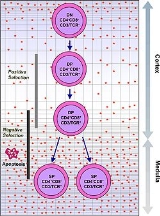
. T cells have receptors which are generated by randomly shuffling gene segments. Each T cell attacks a different substance. T cells that attack the body's own proteins are eliminated in the thymus. Thymic epithelial cells express major proteins from elsewhere in the body, and T cells that respond to those proteins are eliminated through cell suicide (apoptosis
).
The thymus is composed of two identical lobes and is located anatomically in the anterior superior mediastinum
, in front of the heart and behind the sternum
.
Histologically, the thymus can be divided into a central medulla
and a peripheral cortex
which is surrounded by an outer capsule. The cortex and medulla play different roles in the development of T-cells. Cells in the thymus can be divided into thymic stromal cell
s and cells of hematopoietic origin (derived from bone marrow resident hematopoietic stem cells). Developing T-cells are referred to as thymocytes and are of hematopoietic origin. Stromal cells include thymic cortical epithelial cells, thymic medullary epithelial cells, and dendritic cells.
The thymus provides an inductive environment for development of T-lymphocytes from hematopoietic progenitor cells. In addition, thymic stromal cells allow for the selection of a functional and self-tolerant T-cell repertoire. Therefore, one of the most important roles of the thymus is the induction of central tolerance
.
The thymus is largest and most active during the neonatal and pre-adolescent periods. By the early teens, the thymus begins to atrophy
and thymic stroma is replaced by adipose (fat) tissue. Nevertheless, residual T lymphopoiesis
continues throughout adult life.
Galen
was the first to note that the size of the organ changed over the duration of a person's life.
Due to the large numbers of apoptotic lymphocytes, the thymus was originally dismissed as a "lymphocyte graveyard", without functional importance. The importance of the thymus in the immune system
was discovered in 1961 by Jacques Miller
, by surgically removing the thymus from three day old mice, and observing the subsequent deficiency in a lymphocyte population, subsequently named T-cells after the organ of their origin. Recently, advances in immunology
have allowed the function of the thymus in T-cell maturation to be more fully understood.
, which arise, one on either side, from the third branchial pouch
(pharyngeal pouch), and extend lateralward and backward into the surrounding mesoderm and neural crest
-derived mesenchyme
in front of the ventral aorta
.
Here they meet and become joined to one another by connective tissue, but there is never any fusion of the thymus tissue proper. The pharyngeal
opening of each diverticulum is soon obliterated, but the neck of the flask persists for some time as a cellular cord. By further proliferation of the cells lining the flask, buds of cells are formed, which become surrounded and isolated by the invading mesoderm. Additional portions of thymus tissue are sometimes developed from the fourth branchial pouches.
During the late stages of the development of the thymic epithelium, hematopoietic bone-marrow precursors migrate into the thymus. Normal thymic development thereafter is dependent on the interaction between the thymic epithelium and the hematopoietic thymocytes.
; this thymic involution
is directed by the high levels of circulating hormones. Proportional to thymic size, thymic activity (T-cell output) is most active before puberty
. Upon atrophy, the size and activity are dramatically reduced, and the organ is primarily replaced with fat
(a phenomenon known as "organ involution"). The atrophy is due to the increased circulating level of sex hormones, and chemical or physical castration of an adult results in the thymus increasing in size and activity. Patients with the autoimmune disease
Myasthenia gravis
commonly (70%) are found to have thymic hyperplasia
or malignancy. The reason or order of these circumstances has yet to be determined by medical scientists.
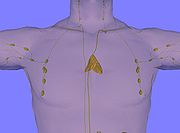 The thymus is of a pinkish-gray color, soft, and lobulated on its surfaces. At birth it is about 5 cm in length, 4 cm in breadth, and about 6 mm in thickness. The organ enlarges during childhood, and atrophies at puberty.
Unlike the liver, kidney and heart, for instance, the thymus is at its largest in children. The thymus reaches maximum weight (20 to 37 grams) by the time of puberty. The thymus of older people is scarcely distinguishable from surrounding fatty tissue. As one ages the thymus slowly shrinks, eventually degenerating into tiny islands of fatty tissue. By the age of 75 years, the thymus weighs only 6 grams. In children the thymus is grayish-pink in colour and in adults it is yellow.
The thymus will, if examined when its growth is most active, be found to consist of two lateral lobes placed in close contact along the middle line, situated partly in the thorax
, partly in the neck
, and extending from the fourth costal cartilage upward, as high as the lower border of the thyroid gland. It is covered by the sternum, and by the origins of the sternohyoidei and sternothyreoidei. Below, it rests upon the pericardium
, being separated from the aortic arch
and great vessels by a layer of fascia
. In the neck
, it lies on the front and sides of the trachea
, behind the sternohyoidei and sternothyreoidei. The two lobes differ slightly in size and may be united or separated.
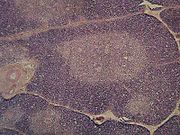
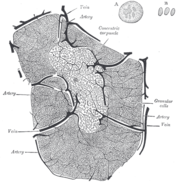 Each lateral lobe is composed of numerous lobules held together by delicate areolar tissue; the entire organ being enclosed in an investing capsule of a similar but denser structure. The primary lobules vary in size from that of a pin's head to that of a small pea, and are made up of a number of small nodule
s or follicles.
The follicles are irregular in shape and are more or less fused together, especially toward the interior of the organ. Each follicle is from 1 to 2 mm in diameter and consists of a medullary and a cortical
portion, and these differ in many essential particulars from each other.
cells, supported by a network of finely-branched epithelial reticular cells, which is continuous with a similar network in the medullary portion. This network forms an adventitia
to the blood vessels.
The cortex is the location of the earliest events in thymocyte
development, where T cell receptor
gene rearrangement and positive selection takes place.
is coarser than in the cortex, the lymphoid cells are relatively fewer in number, and there are found peculiar nest-like bodies, the concentric corpuscles of Hassall. These concentric corpuscle
s are composed of a central mass, consisting of one or more granular cells, and of a capsule formed of epithelioid
cells. They are the remains of the epithelial tubes, which grow out from the third branchial pouch
es of the embryo to form the thymus. Each follicle is surrounded by a vascular
plexus
, from which vessels pass into the interior, and radiate from the periphery toward the center, forming a second zone just within the margin of the medullary portion. In the center of the medullary portion there are very few vessels, and they are of minute size.
The medulla is the location of the latter events in thymocyte development. Thymocytes that reach the medulla have already successfully undergone T cell receptor
gene rearrangement and positive selection, and have been exposed to a limited degree of negative selection. The medulla is specialised to allow thymocytes to undergo additional rounds of negative selection to remove auto-reactive T-cells from the mature repertoire. The gene AIRE
is expressed by the thymic medullary epithelium, and drives the transcription of organ-specific genes such as insulin to allow maturing thymocytes to be exposed to a more complex set of self-antigens than is present in the cortex.
and inferior thyroid
s.
The veins end in the left brachiocephalic vein (innominate vein), and in the thyroid veins
.
The nerves are exceedingly minute; they are derived from the vagi
and sympathetic nervous system
. Branches from the descendens hypoglossi and phrenic reach the investing capsule, but do not penetrate into the substance of the organ.
. Loss of the thymus at an early age through genetic mutation (as in DiGeorge Syndrome) results in severe immunodeficiency
and a high susceptibility to infection.
The stock of T-lymphocytes is built up in early life, so the function of the thymus is diminished in adults. It is largely degenerated in elderly adults and is barely identifiable, consisting mostly of fatty tissue, but it continues its endocrine
function. Involution of the thymus has been linked to loss of immune function in the elderly, susceptibility to infection and to cancer.
The ability of T-cells to recognize foreign antigens is mediated by the T cell receptor
. The T cell receptor
undergoes genetic rearrangement during thymocyte
maturation, resulting in each T-cell bearing a unique T-cell receptor, specific to a limited set of peptide
:MHC
combinations. The random nature of the genetic rearrangement results in a requirement of central tolerance
mechanisms to remove or inactivate those T cells which bear a T cell receptor
with the ability to recognise self-peptides.
Cells that pass both levels of selection are released into the bloodstream to perform vital immune functions.
s. Allergies involve mainly IgE
, antibodies, and histamine
. Mast cells release the histamine. Sometimes an allergen may cause a sudden and severe, possibly fatal reaction in a sensitive individual; this is called anaphylaxis
.
development can lead to a profound T cell
primary immunodeficiency
. Defects that affect both the T cell
and B cell
lymphocyte
lineages result in Severe Combined Immunodeficiency
Syndrome (SCIDs). Acquired T cell
deficiencies can also affect thymocyte
development in the thymus.
is a genetic disorder caused by the deletion of a small section of chromosome
22. This results in a midline congenital defect including thymic aplasia, or congenital deficiency of a thymus. Patients may present with a profound immunodeficiency
disease, due to the lack of T cell
s. No other immune cell lineages are affected by the congenital absence of the thymus. DiGeorge Syndrome is the most common congenital cause of thymic aplasia in humans. In mice, the nude mouse
strain are congenitally thymic deficent. These mice are an important model of primary T cell
deficiency.
syndromes (SCID) are group of rare congenital genetic diseases that result in combined T lymphocyte and B lymphocyte deficencies. These syndromes are cause by defective hematopoietic progenitor cells which are the precursors of both B- and T-cells. This results in a severe reduction in developing thymocytes in the thymus and consequently thymic atrophy. A number of genetic defects can cause SCID, including IL-7 receptor deficiency, common gamma chain
deficiency, and recombination activating gene
deficiency. The gene for the disease called ADA (adenine deaminase
) is located on chromosomes 20.
virus
causes an acquired T-cell immunodeficiency syndrome (AIDS
) by specifically killing CD4
+ T-cells. Whereas the major effect of the virus is on mature peripheral T-cells, HIV can also infect developing thymocytes in the thymus, most of which express CD4.
s are caused by a hyperactive immune system
that instead of attacking foreign pathogens reacts against the host organism (self) causing disease. One of the primary functions of the thymus is to prevent autoimmunity through the process of central tolerance
, immunologic tolerance to self antigens.
(AIRE) gene in the thymus. AIRE allows for the ectopic expression of tissue-specific proteins in the thymus medulla, such as proteins that would normally only be expressed in the eye or pancreas. This expression in the thymus, allows for the deletion of autoreactive thymocytes by exposing them to self-antigens during their development, a mechanism of central tolerance
. Patients with APECED develop an autoimmune disease that affects multiple endocrine tissues.
is an autoimmune disease
caused by antibodies that block acetylcholine receptors. Myasthenia gravis is often associated with thymic hypertrophy. Thymectomy may be necessary to treat the disease.
. Symptoms are sometimes confused with bronchitis
or a strong cough because the tumour presses on the recurrent laryngeal nerve. All thymomas are potentially cancerous, but they can vary a great deal. Some grow very slowly. Others grow rapidly and can spread to surrounding tissues. Treatment of thymomas often requires surgery to remove the entire thymus.
s or leukemia
s of thymocyte
origin are classified as Precursor T acute lymphoblastic leukemia/lymphoma
(T-ALL).
People with an enlarged thymus, particularly children, were treated with intense radiation in the years before 1950. There is an elevated incidence of thyroid cancer and leukemia in treated individuals.
is the surgical removal of the thymus. The most common reason for thymectomy in the United States is to gain surgical access to the heart in surgeries to correct congenital heart defects that are performed in the neonatal period. In neonates, but not older children or adults, the relative size of the thymus obstructs surgical access to the heart. Surprisingly, removal of the thymus does not result in a T cell
immunodeficiency
. This is because sufficient T cells are generated during fetal life prior to birth. These T cells are long-lived and can proliferate by homeostatic proliferation throughout the lifetime of the patient. However, there is evidence of premature immune aging in patients thymectomized during early childhood.
Other indications for thymectomy include the removal of thymoma
s and the treatment of myastenia gravis. Thymectomy is not indicated for the treatment of primary thymic lymphoma
s. However, a thymic biopsy may be necessary to make the pathologic diagnosis.
and also occurs in 5 out of 6 human fetuses. As in humans, the Guinea pig
's thymus naturally atrophies as the animal reaches adulthood, but in the athymic hairless
guinea pig (which arose from a spontaneous laboratory mutation) possessed no thymic tissue whatsoever, and the organ cavity is replaced with cyst
ic spaces.
possess a protothymus associated with the pharyngeal velar muscles, which is responsible for a variety of immune responses. Little is known about the immune mechanisms of tunicates or of Amphioxus.
When used for consumption, animal thymic tissue is known as (one of the kinds of) sweetbread
.
Immune system
An immune system is a system of biological structures and processes within an organism that protects against disease by identifying and killing pathogens and tumor cells. It detects a wide variety of agents, from viruses to parasitic worms, and needs to distinguish them from the organism's own...
. The thymus produces and "educates" T-lymphocytes (T cells), which are critical cells of the adaptive immune system
Adaptive immune system
The adaptive immune system is composed of highly specialized, systemic cells and processes that eliminate or prevent pathogenic growth. Thought to have arisen in the first jawed vertebrates, the adaptive or "specific" immune system is activated by the “non-specific” and evolutionarily older innate...
.
Each T cell attacks a foreign substance which it identifies with its receptor
T cell receptor
The T cell receptor or TCR is a molecule found on the surface of T lymphocytes that is responsible for recognizing antigens bound to major histocompatibility complex molecules...
. T cells have receptors which are generated by randomly shuffling gene segments. Each T cell attacks a different substance. T cells that attack the body's own proteins are eliminated in the thymus. Thymic epithelial cells express major proteins from elsewhere in the body, and T cells that respond to those proteins are eliminated through cell suicide (apoptosis
Apoptosis
Apoptosis is the process of programmed cell death that may occur in multicellular organisms. Biochemical events lead to characteristic cell changes and death. These changes include blebbing, cell shrinkage, nuclear fragmentation, chromatin condensation, and chromosomal DNA fragmentation...
).
The thymus is composed of two identical lobes and is located anatomically in the anterior superior mediastinum
Mediastinum
The mediastinum is a non-delineated group of structures in the thorax, surrounded by loose connective tissue. It is the central compartment of the thoracic cavity...
, in front of the heart and behind the sternum
Sternum
The sternum or breastbone is a long flat bony plate shaped like a capital "T" located anteriorly to the heart in the center of the thorax...
.
Histologically, the thymus can be divided into a central medulla
Medulla
Medulla refers to the middle of something and derives from the Latin word for marrow. Its anatomical uses include:* Medulla oblongata, a part of the brain stem* Renal medulla, a part of the kidney* Adrenal medulla, a part of the adrenal gland...
and a peripheral cortex
Cortex (anatomy)
In anatomy and zoology the cortex is the outermost layer of an organ. Organs with well-defined cortical layers include kidneys, adrenal glands, ovaries, the thymus, and portions of the brain, including the cerebral cortex, the most well-known of all cortices.The cerebellar cortex is the thin gray...
which is surrounded by an outer capsule. The cortex and medulla play different roles in the development of T-cells. Cells in the thymus can be divided into thymic stromal cell
Stromal cell
In cell biology, stromal cells are connective tissue cells of any organ, for example in the uterine mucosa , prostate, bone marrow, and the ovary. They are cells that support the function of the parenchymal cells of that organ...
s and cells of hematopoietic origin (derived from bone marrow resident hematopoietic stem cells). Developing T-cells are referred to as thymocytes and are of hematopoietic origin. Stromal cells include thymic cortical epithelial cells, thymic medullary epithelial cells, and dendritic cells.
The thymus provides an inductive environment for development of T-lymphocytes from hematopoietic progenitor cells. In addition, thymic stromal cells allow for the selection of a functional and self-tolerant T-cell repertoire. Therefore, one of the most important roles of the thymus is the induction of central tolerance
Central tolerance
Central tolerance is the mechanism by which newly developing T cells and B cells are rendered non-reactive to self. The concept of central tolerance was proposed in 1959 by Joshua Lederberg, as part of his general theory of immunity and tolerance, and is often mistakenly attributed to MacFarlane...
.
The thymus is largest and most active during the neonatal and pre-adolescent periods. By the early teens, the thymus begins to atrophy
Atrophy
Atrophy is the partial or complete wasting away of a part of the body. Causes of atrophy include mutations , poor nourishment, poor circulation, loss of hormonal support, loss of nerve supply to the target organ, disuse or lack of exercise or disease intrinsic to the tissue itself...
and thymic stroma is replaced by adipose (fat) tissue. Nevertheless, residual T lymphopoiesis
Lymphopoiesis
Lymphopoiesis refers to the generation of lymphocytes, one of the five different types of white blood cells , and is also more formally called lymphoid hematopoiesis.-The name Lymphopoiesis:...
continues throughout adult life.
History
The thymus was known to the Ancient Greeks, and its name comes from the Greek word θυμός (thumos), meaning heart, soul, desire, life — possibly because of its location in the chest, near where emotions are subjectively felt; or else the name comes from the herb thyme (also in Greek θυμός), which became the name for a "warty excrescence", possibly due to its resemblance to a bunch of thyme.Galen
Galen
Aelius Galenus or Claudius Galenus , better known as Galen of Pergamon , was a prominent Roman physician, surgeon and philosopher...
was the first to note that the size of the organ changed over the duration of a person's life.
Due to the large numbers of apoptotic lymphocytes, the thymus was originally dismissed as a "lymphocyte graveyard", without functional importance. The importance of the thymus in the immune system
Immune system
An immune system is a system of biological structures and processes within an organism that protects against disease by identifying and killing pathogens and tumor cells. It detects a wide variety of agents, from viruses to parasitic worms, and needs to distinguish them from the organism's own...
was discovered in 1961 by Jacques Miller
Jacques Miller
Jacques Francis Albert Pierre Miller AC FRS is a distinguished research scientist. He is famous for having discovered the function of the thymus and for the identification, in mammalian species of the two major subsets of lymphocytes and their function.-Early life:Miller was born on 2 April 1931,...
, by surgically removing the thymus from three day old mice, and observing the subsequent deficiency in a lymphocyte population, subsequently named T-cells after the organ of their origin. Recently, advances in immunology
Immunology
Immunology is a broad branch of biomedical science that covers the study of all aspects of the immune system in all organisms. It deals with the physiological functioning of the immune system in states of both health and diseases; malfunctions of the immune system in immunological disorders ; the...
have allowed the function of the thymus in T-cell maturation to be more fully understood.
Development
Embryology
The two main components of the thymus, the lymphoid thymocytes and the thymic epithelial cells, have distinct developmental origins. The thymic epithelium is the first to develop, and appears in the form of two flask-shape endodermal diverticulaDiverticulum
A diverticulum is medical or biological term for an outpouching of a hollow structure in the body. Depending upon which layers of the structure are involved, they are described as being either true or false....
, which arise, one on either side, from the third branchial pouch
Branchial pouch
In the development of vertebrate animals, pharyngeal or branchial pouches form on the endodermal side between the branchial arches, and pharyngeal grooves form the lateral ectodermal surface of the neck region to separate the arches....
(pharyngeal pouch), and extend lateralward and backward into the surrounding mesoderm and neural crest
Neural crest
Neural crest cells are a transient, multipotent, migratory cell population unique to vertebrates that gives rise to a diverse cell lineage including melanocytes, craniofacial cartilage and bone, smooth muscle, peripheral and enteric neurons and glia....
-derived mesenchyme
Mesenchyme
Mesenchyme, or mesenchymal connective tissue, is a type of undifferentiated loose connective tissue that is derived mostly from mesoderm, although some are derived from other germ layers; e.g. some mesenchyme is derived from neural crest cells and thus originates from the ectoderm...
in front of the ventral aorta
Aorta
The aorta is the largest artery in the body, originating from the left ventricle of the heart and extending down to the abdomen, where it branches off into two smaller arteries...
.
Here they meet and become joined to one another by connective tissue, but there is never any fusion of the thymus tissue proper. The pharyngeal
Pharynx
The human pharynx is the part of the throat situated immediately posterior to the mouth and nasal cavity, and anterior to the esophagus and larynx. The human pharynx is conventionally divided into three sections: the nasopharynx , the oropharynx , and the laryngopharynx...
opening of each diverticulum is soon obliterated, but the neck of the flask persists for some time as a cellular cord. By further proliferation of the cells lining the flask, buds of cells are formed, which become surrounded and isolated by the invading mesoderm. Additional portions of thymus tissue are sometimes developed from the fourth branchial pouches.
During the late stages of the development of the thymic epithelium, hematopoietic bone-marrow precursors migrate into the thymus. Normal thymic development thereafter is dependent on the interaction between the thymic epithelium and the hematopoietic thymocytes.
Involution
The thymus continues to grow between birth and puberty and then begins to atrophyAtrophy
Atrophy is the partial or complete wasting away of a part of the body. Causes of atrophy include mutations , poor nourishment, poor circulation, loss of hormonal support, loss of nerve supply to the target organ, disuse or lack of exercise or disease intrinsic to the tissue itself...
; this thymic involution
Thymic involution
One of the major characteristics of vertebrate immunology is thymic involution, the shrinking of the thymus with age, resulting in changes in the architecture of the thymus and a decrease in tissue mass...
is directed by the high levels of circulating hormones. Proportional to thymic size, thymic activity (T-cell output) is most active before puberty
Puberty
Puberty is the process of physical changes by which a child's body matures into an adult body capable of reproduction, as initiated by hormonal signals from the brain to the gonads; the ovaries in a girl, the testes in a boy...
. Upon atrophy, the size and activity are dramatically reduced, and the organ is primarily replaced with fat
Fat
Fats consist of a wide group of compounds that are generally soluble in organic solvents and generally insoluble in water. Chemically, fats are triglycerides, triesters of glycerol and any of several fatty acids. Fats may be either solid or liquid at room temperature, depending on their structure...
(a phenomenon known as "organ involution"). The atrophy is due to the increased circulating level of sex hormones, and chemical or physical castration of an adult results in the thymus increasing in size and activity. Patients with the autoimmune disease
Autoimmune disease
Autoimmune diseases arise from an overactive immune response of the body against substances and tissues normally present in the body. In other words, the body actually attacks its own cells. The immune system mistakes some part of the body as a pathogen and attacks it. This may be restricted to...
Myasthenia gravis
Myasthenia gravis
Myasthenia gravis is an autoimmune neuromuscular disease leading to fluctuating muscle weakness and fatiguability...
commonly (70%) are found to have thymic hyperplasia
Hyperplasia
Hyperplasia means increase in number of cells/proliferation of cells. It may result in the gross enlargement of an organ and the term is sometimes mixed with benign neoplasia/ benign tumor....
or malignancy. The reason or order of these circumstances has yet to be determined by medical scientists.
| Age | Mass >- | birth |
>- | >- | >- | >- | as low as 5 grams |
Anatomy
Unlike the liver, kidney and heart, for instance, the thymus is at its largest in children. The thymus reaches maximum weight (20 to 37 grams) by the time of puberty. The thymus of older people is scarcely distinguishable from surrounding fatty tissue. As one ages the thymus slowly shrinks, eventually degenerating into tiny islands of fatty tissue. By the age of 75 years, the thymus weighs only 6 grams. In children the thymus is grayish-pink in colour and in adults it is yellow.
The thymus will, if examined when its growth is most active, be found to consist of two lateral lobes placed in close contact along the middle line, situated partly in the thorax
Thorax
The thorax is a division of an animal's body that lies between the head and the abdomen.-In tetrapods:...
, partly in the neck
Neck
The neck is the part of the body, on many terrestrial or secondarily aquatic vertebrates, that distinguishes the head from the torso or trunk. The adjective signifying "of the neck" is cervical .-Boner anatomy: The cervical spine:The cervical portion of the human spine comprises seven boney...
, and extending from the fourth costal cartilage upward, as high as the lower border of the thyroid gland. It is covered by the sternum, and by the origins of the sternohyoidei and sternothyreoidei. Below, it rests upon the pericardium
Pericardium
The pericardium is a double-walled sac that contains the heart and the roots of the great vessels.-Layers:...
, being separated from the aortic arch
Aortic arch
The arch of the aorta or the transverse aortic arch is the part of the aorta that begins at the level of the upper border of the second sternocostal articulation of the right side, and runs at first upward, backward, and to the left in front of the trachea; it is then directed backward on the left...
and great vessels by a layer of fascia
Fascia
A fascia is a layer of fibrous tissue that permeates the human body. A fascia is a connective tissue that surrounds muscles, groups of muscles, blood vessels, and nerves, binding those structures together in much the same manner as plastic wrap can be used to hold the contents of sandwiches...
. In the neck
Neck
The neck is the part of the body, on many terrestrial or secondarily aquatic vertebrates, that distinguishes the head from the torso or trunk. The adjective signifying "of the neck" is cervical .-Boner anatomy: The cervical spine:The cervical portion of the human spine comprises seven boney...
, it lies on the front and sides of the trachea
Vertebrate trachea
In tetrapod anatomy the trachea, or windpipe, is a tube that connects the pharynx or larynx to the lungs, allowing the passage of air. It is lined with pseudostratified ciliated columnar epithelium cells with goblet cells that produce mucus...
, behind the sternohyoidei and sternothyreoidei. The two lobes differ slightly in size and may be united or separated.
Structure
Nodule (medicine)
For use of the term nodule in dermatology, see Nodule In medicine, a nodule refers to a relatively hard, roughly spherical abnormal structure....
s or follicles.
The follicles are irregular in shape and are more or less fused together, especially toward the interior of the organ. Each follicle is from 1 to 2 mm in diameter and consists of a medullary and a cortical
Cortex (anatomy)
In anatomy and zoology the cortex is the outermost layer of an organ. Organs with well-defined cortical layers include kidneys, adrenal glands, ovaries, the thymus, and portions of the brain, including the cerebral cortex, the most well-known of all cortices.The cerebellar cortex is the thin gray...
portion, and these differ in many essential particulars from each other.
Cortex
The cortical portion is mainly composed of lymphoidLymphoid
Lymphoid is a term used to describe lymph or the lymphatic system.In the context of lymphoid leukemia, it refers specifically to lymphocytes Lymphoid leukemias and lymphomas are now considered to be tumors of the same type of cell lineage. They are called "leukemia" when in the blood or marrow and...
cells, supported by a network of finely-branched epithelial reticular cells, which is continuous with a similar network in the medullary portion. This network forms an adventitia
Adventitia
Adventitia is the outermost connective tissue covering of any organ, vessel, or other structure. It is also called the tunica adventitia or the tunica externa....
to the blood vessels.
The cortex is the location of the earliest events in thymocyte
Thymocyte
Thymocytes are hematopoietic progenitor cells present in the thymus. Thymopoiesis is the process in the thymus by which thymocytes differentiate into mature T lymphocytes. The primary function of thymocytes is the generation of T lymphocytes . The thymus provides an inductive environment, which...
development, where T cell receptor
T cell receptor
The T cell receptor or TCR is a molecule found on the surface of T lymphocytes that is responsible for recognizing antigens bound to major histocompatibility complex molecules...
gene rearrangement and positive selection takes place.
Medulla
In the medullary portion, the reticulumReticulum
Reticulum is a small, faint constellation in the southern sky. Its name is Latin for a small net, or reticle—a net of crosshairs at the focus of a telescope eyepiece that is used to measure star positions...
is coarser than in the cortex, the lymphoid cells are relatively fewer in number, and there are found peculiar nest-like bodies, the concentric corpuscles of Hassall. These concentric corpuscle
Corpuscle
Corpuscle may refer to:*a small free floating biological cell, especially a blood cell, but not a fat cell*a nerve ending such as Meissner's corpuscle or a Pacinian corpuscle*any member of Corpus Christi College, Cambridge or Corpus Christi College, Oxford...
s are composed of a central mass, consisting of one or more granular cells, and of a capsule formed of epithelioid
Epithelioid
An epithelioid cell is a cell that resembles epithelial cells in that it directly contacts its neighboring cells via cell surface molecules or junctions. Unlike epithelial cells, however, epithelioid cells make contacts over their entire surface, rather than at restricted portions. The term...
cells. They are the remains of the epithelial tubes, which grow out from the third branchial pouch
Branchial pouch
In the development of vertebrate animals, pharyngeal or branchial pouches form on the endodermal side between the branchial arches, and pharyngeal grooves form the lateral ectodermal surface of the neck region to separate the arches....
es of the embryo to form the thymus. Each follicle is surrounded by a vascular
Blood vessel
The blood vessels are the part of the circulatory system that transports blood throughout the body. There are three major types of blood vessels: the arteries, which carry the blood away from the heart; the capillaries, which enable the actual exchange of water and chemicals between the blood and...
plexus
Plexus
A plexus is a part of nervous system. Plexus has a slightly different definition in vertebrates and in invertebrates.- In vertebrates :In vertebrates, a plexus is an area where nerves branch and rejoin. The electrical signals do not mix; rather, the fibres travel together with their electrical...
, from which vessels pass into the interior, and radiate from the periphery toward the center, forming a second zone just within the margin of the medullary portion. In the center of the medullary portion there are very few vessels, and they are of minute size.
The medulla is the location of the latter events in thymocyte development. Thymocytes that reach the medulla have already successfully undergone T cell receptor
T cell receptor
The T cell receptor or TCR is a molecule found on the surface of T lymphocytes that is responsible for recognizing antigens bound to major histocompatibility complex molecules...
gene rearrangement and positive selection, and have been exposed to a limited degree of negative selection. The medulla is specialised to allow thymocytes to undergo additional rounds of negative selection to remove auto-reactive T-cells from the mature repertoire. The gene AIRE
Autoimmune regulator
The autoimmune regulator is a protein that in humans is encoded by the AIRE gene. AIRE is a transcription factor expressed in the medulla of the thymus and controls the mechanism that prevents the immune system from attacking the body itself....
is expressed by the thymic medullary epithelium, and drives the transcription of organ-specific genes such as insulin to allow maturing thymocytes to be exposed to a more complex set of self-antigens than is present in the cortex.
Vasculature
The arteries supplying the thymus are derived from the internal mammary, and from the superior thyroidSuperior thyroid
Superior thyroid can refer to:* Superior thyroid artery* Superior thyroid vein...
and inferior thyroid
Inferior thyroid
Inferior thyroid can refer to:* Inferior thyroid veins* Inferior thyroid artery...
s.
The veins end in the left brachiocephalic vein (innominate vein), and in the thyroid veins
Thyroid veins
Thyroid veins can refer to:* Inferior thyroid veins* Superior thyroid vein...
.
The nerves are exceedingly minute; they are derived from the vagi
Vagus nerve
The vagus nerve , also called pneumogastric nerve or cranial nerve X, is the tenth of twelve paired cranial nerves...
and sympathetic nervous system
Sympathetic nervous system
The sympathetic nervous system is one of the three parts of the autonomic nervous system, along with the enteric and parasympathetic systems. Its general action is to mobilize the body's nervous system fight-or-flight response...
. Branches from the descendens hypoglossi and phrenic reach the investing capsule, but do not penetrate into the substance of the organ.
Function
In the two thymic lobes, hematopoietic precursors from the bone-marrow, referred to as thymocytes, mature into T-cells. Once mature, T-cells emigrate from the thymus and constitute the peripheral T-cell repertoire responsible for directing many facets of the adaptive immune systemAdaptive immune system
The adaptive immune system is composed of highly specialized, systemic cells and processes that eliminate or prevent pathogenic growth. Thought to have arisen in the first jawed vertebrates, the adaptive or "specific" immune system is activated by the “non-specific” and evolutionarily older innate...
. Loss of the thymus at an early age through genetic mutation (as in DiGeorge Syndrome) results in severe immunodeficiency
Immunodeficiency
Immunodeficiency is a state in which the immune system's ability to fight infectious disease is compromised or entirely absent. Immunodeficiency may also decrease cancer immunosurveillance. Most cases of immunodeficiency are acquired but some people are born with defects in their immune system,...
and a high susceptibility to infection.
The stock of T-lymphocytes is built up in early life, so the function of the thymus is diminished in adults. It is largely degenerated in elderly adults and is barely identifiable, consisting mostly of fatty tissue, but it continues its endocrine
Endocrine system
In physiology, the endocrine system is a system of glands, each of which secretes a type of hormone directly into the bloodstream to regulate the body. The endocrine system is in contrast to the exocrine system, which secretes its chemicals using ducts. It derives from the Greek words "endo"...
function. Involution of the thymus has been linked to loss of immune function in the elderly, susceptibility to infection and to cancer.
The ability of T-cells to recognize foreign antigens is mediated by the T cell receptor
T cell receptor
The T cell receptor or TCR is a molecule found on the surface of T lymphocytes that is responsible for recognizing antigens bound to major histocompatibility complex molecules...
. The T cell receptor
T cell receptor
The T cell receptor or TCR is a molecule found on the surface of T lymphocytes that is responsible for recognizing antigens bound to major histocompatibility complex molecules...
undergoes genetic rearrangement during thymocyte
Thymocyte
Thymocytes are hematopoietic progenitor cells present in the thymus. Thymopoiesis is the process in the thymus by which thymocytes differentiate into mature T lymphocytes. The primary function of thymocytes is the generation of T lymphocytes . The thymus provides an inductive environment, which...
maturation, resulting in each T-cell bearing a unique T-cell receptor, specific to a limited set of peptide
Peptide
Peptides are short polymers of amino acid monomers linked by peptide bonds. They are distinguished from proteins on the basis of size, typically containing less than 50 monomer units. The shortest peptides are dipeptides, consisting of two amino acids joined by a single peptide bond...
:MHC
Major histocompatibility complex
Major histocompatibility complex is a cell surface molecule encoded by a large gene family in all vertebrates. MHC molecules mediate interactions of leukocytes, also called white blood cells , which are immune cells, with other leukocytes or body cells...
combinations. The random nature of the genetic rearrangement results in a requirement of central tolerance
Central tolerance
Central tolerance is the mechanism by which newly developing T cells and B cells are rendered non-reactive to self. The concept of central tolerance was proposed in 1959 by Joshua Lederberg, as part of his general theory of immunity and tolerance, and is often mistakenly attributed to MacFarlane...
mechanisms to remove or inactivate those T cells which bear a T cell receptor
T cell receptor
The T cell receptor or TCR is a molecule found on the surface of T lymphocytes that is responsible for recognizing antigens bound to major histocompatibility complex molecules...
with the ability to recognise self-peptides.
Phases of thymocyte maturation
The generation of T-cells expressing distinct T-cell receptors occurs within the thymus, and can be conceptually divided into three phases:- A rare population of hematopoietic progenitor cellsHaematopoiesisHaematopoiesis is the formation of blood cellular components. All cellular blood components are derived from haematopoietic stem cells...
enter the thymus from the blood, and expands by cell division to generate a large population of immature thymocytes. - Immature thymocytes each make distinct T-cell receptors by a process of gene rearrangement. This process is error-prone, and some thymocytes fail to make functional T-cell receptors, whereas other thymocytes make T-cell receptors that are autoreactive.
- Immature thymocytes undergo a process of selection, based on the specificity of their T-cell receptors. This involves selection of T-cells that are functional (positive selection), and elimination of T-cells that are autoreactive (negative selection).
| type: | functional (positive selection) | autoreactive (negative selection) >- | location: |
cortex | >- | In order to be positively-selected, thymocytes will have to interact with several cell surface molecules, MHC/HLA, to ensure reactivity and specificity. Positive selection eliminates (apoptosis) weak binding cells and only takes high medium binding cells. (Binding refers to the ability of the T-cell receptors to bind to either MHC Major histocompatibility complex Major histocompatibility complex is a cell surface molecule encoded by a large gene family in all vertebrates. MHC molecules mediate interactions of leukocytes, also called white blood cells , which are immune cells, with other leukocytes or body cells... class I/II or peptide Peptide Peptides are short polymers of amino acid monomers linked by peptide bonds. They are distinguished from proteins on the basis of size, typically containing less than 50 monomer units. The shortest peptides are dipeptides, consisting of two amino acids joined by a single peptide bond... molecules.) |
Negative selection is not 100% complete. Some autoreactive T-cells escape thymic censorship, and are released into the circulation. Additional mechanisms of tolerance active in the periphery exist to silence these cells such as anergy Anergy Anergy is a term in immunobiology that describes a lack of reaction by the body's defense mechanisms to foreign substances, and consists of a direct induction of peripheral lymphocyte tolerance. An individual in a state of anergy often indicates that the immune system is unable to mount a normal... , deletion, and regulatory T cells. If these peripheral tolerance Peripheral tolerance Peripheral tolerance is immunological tolerance developed after T and B cells mature and enter the periphery. These include the suppression of autoreactive cells by 'regulatory' T cells and the generation of hyporesponsiveness in lymphocytes which encounter antigen in the absence of the... mechanisms also fail, autoimmunity Autoimmunity Autoimmunity is the failure of an organism to recognize its own constituent parts as self, which allows an immune response against its own cells and tissues. Any disease that results from such an aberrant immune response is termed an autoimmune disease... may arise. |
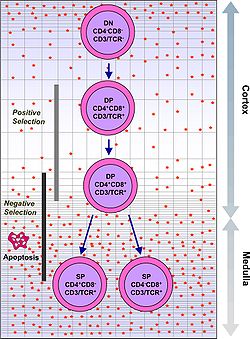
Cells that pass both levels of selection are released into the bloodstream to perform vital immune functions.
Disease Associations
The immune system is a multicomponent interactive system. It effectively protects the host from various infections. An improperly functioning immune system can cause discomfort, disease or even death. The type of malfunction falls into one or more of the following major groups: hypersensitivity or allergy, auto-immune disease, or immunodeficiency.Hypersensitivity
Allergy result from an inappropriate and excessive immune response to common antigens. Substances that trigger an allergic response are called allergenAllergen
An allergen is any substance that can cause an allergy. In technical terms, an allergen is a non-parasitic antigen capable of stimulating a type-I hypersensitivity reaction in atopic individuals....
s. Allergies involve mainly IgE
IGE
IGE was one of the largest services company buying and selling virtual currencies and accounts for MMORPG. During its peak time, it had offices in Los Angeles, China , and headquarters & customer service centre in Hong Kong. IGE was one of the main monopoly in virtual economy services, also known...
, antibodies, and histamine
Histamine
Histamine is an organic nitrogen compound involved in local immune responses as well as regulating physiological function in the gut and acting as a neurotransmitter. Histamine triggers the inflammatory response. As part of an immune response to foreign pathogens, histamine is produced by...
. Mast cells release the histamine. Sometimes an allergen may cause a sudden and severe, possibly fatal reaction in a sensitive individual; this is called anaphylaxis
Anaphylaxis
Anaphylaxis is defined as "a serious allergic reaction that is rapid in onset and may cause death". It typically results in a number of symptoms including throat swelling, an itchy rash, and low blood pressure...
.
Immunodeficiency
As the thymus is the organ of T-cell development, any congenital defect in thymic genesis or a defect in thymocyteThymocyte
Thymocytes are hematopoietic progenitor cells present in the thymus. Thymopoiesis is the process in the thymus by which thymocytes differentiate into mature T lymphocytes. The primary function of thymocytes is the generation of T lymphocytes . The thymus provides an inductive environment, which...
development can lead to a profound T cell
T cell
T cells or T lymphocytes belong to a group of white blood cells known as lymphocytes, and play a central role in cell-mediated immunity. They can be distinguished from other lymphocytes, such as B cells and natural killer cells , by the presence of a T cell receptor on the cell surface. They are...
primary immunodeficiency
Immunodeficiency
Immunodeficiency is a state in which the immune system's ability to fight infectious disease is compromised or entirely absent. Immunodeficiency may also decrease cancer immunosurveillance. Most cases of immunodeficiency are acquired but some people are born with defects in their immune system,...
. Defects that affect both the T cell
T cell
T cells or T lymphocytes belong to a group of white blood cells known as lymphocytes, and play a central role in cell-mediated immunity. They can be distinguished from other lymphocytes, such as B cells and natural killer cells , by the presence of a T cell receptor on the cell surface. They are...
and B cell
B cell
B cells are lymphocytes that play a large role in the humoral immune response . The principal functions of B cells are to make antibodies against antigens, perform the role of antigen-presenting cells and eventually develop into memory B cells after activation by antigen interaction...
lymphocyte
Lymphocyte
A lymphocyte is a type of white blood cell in the vertebrate immune system.Under the microscope, lymphocytes can be divided into large lymphocytes and small lymphocytes. Large granular lymphocytes include natural killer cells...
lineages result in Severe Combined Immunodeficiency
Severe combined immunodeficiency
Severe combined immunodeficiency , is a genetic disorder in which both "arms" of the adaptive immune system are impaired due to a defect in one of several possible genes. SCID is a severe form of heritable immunodeficiency...
Syndrome (SCIDs). Acquired T cell
T cell
T cells or T lymphocytes belong to a group of white blood cells known as lymphocytes, and play a central role in cell-mediated immunity. They can be distinguished from other lymphocytes, such as B cells and natural killer cells , by the presence of a T cell receptor on the cell surface. They are...
deficiencies can also affect thymocyte
Thymocyte
Thymocytes are hematopoietic progenitor cells present in the thymus. Thymopoiesis is the process in the thymus by which thymocytes differentiate into mature T lymphocytes. The primary function of thymocytes is the generation of T lymphocytes . The thymus provides an inductive environment, which...
development in the thymus.
DiGeorge Syndrome
DiGeorge SyndromeDiGeorge syndrome
22q11.2 deletion syndrome, which has several presentations including DiGeorge syndrome , DiGeorge anomaly, velo-cardio-facial syndrome, Shprintzen syndrome, conotruncal anomaly face syndrome, Strong syndrome, congenital thymic aplasia, and thymic hypoplasia is a syndrome caused by the deletion of a...
is a genetic disorder caused by the deletion of a small section of chromosome
Chromosome
A chromosome is an organized structure of DNA and protein found in cells. It is a single piece of coiled DNA containing many genes, regulatory elements and other nucleotide sequences. Chromosomes also contain DNA-bound proteins, which serve to package the DNA and control its functions.Chromosomes...
22. This results in a midline congenital defect including thymic aplasia, or congenital deficiency of a thymus. Patients may present with a profound immunodeficiency
Immunodeficiency
Immunodeficiency is a state in which the immune system's ability to fight infectious disease is compromised or entirely absent. Immunodeficiency may also decrease cancer immunosurveillance. Most cases of immunodeficiency are acquired but some people are born with defects in their immune system,...
disease, due to the lack of T cell
T cell
T cells or T lymphocytes belong to a group of white blood cells known as lymphocytes, and play a central role in cell-mediated immunity. They can be distinguished from other lymphocytes, such as B cells and natural killer cells , by the presence of a T cell receptor on the cell surface. They are...
s. No other immune cell lineages are affected by the congenital absence of the thymus. DiGeorge Syndrome is the most common congenital cause of thymic aplasia in humans. In mice, the nude mouse
Nude mouse
A nude mouse is a laboratory mouse from a strain with a genetic mutation that causes a deteriorated or absent thymus, resulting in an inhibited immune system due to a greatly reduced number of T cells. The phenotype, or main outward appearance of the mouse is a lack of body hair, which gives it...
strain are congenitally thymic deficent. These mice are an important model of primary T cell
T cell
T cells or T lymphocytes belong to a group of white blood cells known as lymphocytes, and play a central role in cell-mediated immunity. They can be distinguished from other lymphocytes, such as B cells and natural killer cells , by the presence of a T cell receptor on the cell surface. They are...
deficiency.
SCID
Severe combined immunodeficiencySevere combined immunodeficiency
Severe combined immunodeficiency , is a genetic disorder in which both "arms" of the adaptive immune system are impaired due to a defect in one of several possible genes. SCID is a severe form of heritable immunodeficiency...
syndromes (SCID) are group of rare congenital genetic diseases that result in combined T lymphocyte and B lymphocyte deficencies. These syndromes are cause by defective hematopoietic progenitor cells which are the precursors of both B- and T-cells. This results in a severe reduction in developing thymocytes in the thymus and consequently thymic atrophy. A number of genetic defects can cause SCID, including IL-7 receptor deficiency, common gamma chain
Common gamma chain
The common gamma chain , also known as interleukin-2 receptor subunit gamma or IL-2RG, is a cytokine receptor sub-unit that is common to the receptor complexes for at least six different interleukin receptors: IL-2, IL-4, IL-7, IL-9, IL-15 and interleukin-21 receptor...
deficiency, and recombination activating gene
Recombination activating gene
The recombination activating genes encode enzymes that play an important role in the rearrangement and recombination of the genes of immunoglobulin and T cell receptor molecules during the process of VDJ recombination...
deficiency. The gene for the disease called ADA (adenine deaminase
Adenine deaminase
In enzymology, an adenine deaminase is an enzyme that catalyzes the chemical reactionThus, the two substrates of this enzyme are adenine and H2O, whereas its two products are hypoxanthine and NH3....
) is located on chromosomes 20.
HIV/AID
The HIVHIV
Human immunodeficiency virus is a lentivirus that causes acquired immunodeficiency syndrome , a condition in humans in which progressive failure of the immune system allows life-threatening opportunistic infections and cancers to thrive...
virus
Virus
A virus is a small infectious agent that can replicate only inside the living cells of organisms. Viruses infect all types of organisms, from animals and plants to bacteria and archaea...
causes an acquired T-cell immunodeficiency syndrome (AIDS
AIDS
Acquired immune deficiency syndrome or acquired immunodeficiency syndrome is a disease of the human immune system caused by the human immunodeficiency virus...
) by specifically killing CD4
CD4
CD4 is a glycoprotein expressed on the surface of T helper cells, monocytes, macrophages, and dendritic cells. It was discovered in the late 1970s and was originally known as leu-3 and T4 before being named CD4 in 1984...
+ T-cells. Whereas the major effect of the virus is on mature peripheral T-cells, HIV can also infect developing thymocytes in the thymus, most of which express CD4.
Autoimmune Disease
Autoimmune diseaseAutoimmune disease
Autoimmune diseases arise from an overactive immune response of the body against substances and tissues normally present in the body. In other words, the body actually attacks its own cells. The immune system mistakes some part of the body as a pathogen and attacks it. This may be restricted to...
s are caused by a hyperactive immune system
Immune system
An immune system is a system of biological structures and processes within an organism that protects against disease by identifying and killing pathogens and tumor cells. It detects a wide variety of agents, from viruses to parasitic worms, and needs to distinguish them from the organism's own...
that instead of attacking foreign pathogens reacts against the host organism (self) causing disease. One of the primary functions of the thymus is to prevent autoimmunity through the process of central tolerance
Central tolerance
Central tolerance is the mechanism by which newly developing T cells and B cells are rendered non-reactive to self. The concept of central tolerance was proposed in 1959 by Joshua Lederberg, as part of his general theory of immunity and tolerance, and is often mistakenly attributed to MacFarlane...
, immunologic tolerance to self antigens.
APECED
Autoimmune Polyendocrinopathy-Candidiasis-Ectodermal Dystrophy (APECED) is an extremely rare genetic autoimmune syndrome. However, this disease highlights the importance of the thymus in prevention of autoimmunity. This disease is caused by deficiency of the Autoimmune RegulatorAutoimmune regulator
The autoimmune regulator is a protein that in humans is encoded by the AIRE gene. AIRE is a transcription factor expressed in the medulla of the thymus and controls the mechanism that prevents the immune system from attacking the body itself....
(AIRE) gene in the thymus. AIRE allows for the ectopic expression of tissue-specific proteins in the thymus medulla, such as proteins that would normally only be expressed in the eye or pancreas. This expression in the thymus, allows for the deletion of autoreactive thymocytes by exposing them to self-antigens during their development, a mechanism of central tolerance
Central tolerance
Central tolerance is the mechanism by which newly developing T cells and B cells are rendered non-reactive to self. The concept of central tolerance was proposed in 1959 by Joshua Lederberg, as part of his general theory of immunity and tolerance, and is often mistakenly attributed to MacFarlane...
. Patients with APECED develop an autoimmune disease that affects multiple endocrine tissues.
Myasthenia gravis
Myasthenia gravisMyasthenia gravis
Myasthenia gravis is an autoimmune neuromuscular disease leading to fluctuating muscle weakness and fatiguability...
is an autoimmune disease
Autoimmune disease
Autoimmune diseases arise from an overactive immune response of the body against substances and tissues normally present in the body. In other words, the body actually attacks its own cells. The immune system mistakes some part of the body as a pathogen and attacks it. This may be restricted to...
caused by antibodies that block acetylcholine receptors. Myasthenia gravis is often associated with thymic hypertrophy. Thymectomy may be necessary to treat the disease.
Thymomas
Tumours originating from the thymic epithelial cells are called thymomas, and are found in about 10-15% of patients with myasthenia gravisMyasthenia gravis
Myasthenia gravis is an autoimmune neuromuscular disease leading to fluctuating muscle weakness and fatiguability...
. Symptoms are sometimes confused with bronchitis
Bronchitis
Acute bronchitis is an inflammation of the large bronchi in the lungs that is usually caused by viruses or bacteria and may last several days or weeks. Characteristic symptoms include cough, sputum production, and shortness of breath and wheezing related to the obstruction of the inflamed airways...
or a strong cough because the tumour presses on the recurrent laryngeal nerve. All thymomas are potentially cancerous, but they can vary a great deal. Some grow very slowly. Others grow rapidly and can spread to surrounding tissues. Treatment of thymomas often requires surgery to remove the entire thymus.
Lymphomas
Tumours originating from the thymocytes are called thymic lymphomas. LymphomaLymphoma
Lymphoma is a cancer in the lymphatic cells of the immune system. Typically, lymphomas present as a solid tumor of lymphoid cells. Treatment might involve chemotherapy and in some cases radiotherapy and/or bone marrow transplantation, and can be curable depending on the histology, type, and stage...
s or leukemia
Leukemia
Leukemia or leukaemia is a type of cancer of the blood or bone marrow characterized by an abnormal increase of immature white blood cells called "blasts". Leukemia is a broad term covering a spectrum of diseases...
s of thymocyte
Thymocyte
Thymocytes are hematopoietic progenitor cells present in the thymus. Thymopoiesis is the process in the thymus by which thymocytes differentiate into mature T lymphocytes. The primary function of thymocytes is the generation of T lymphocytes . The thymus provides an inductive environment, which...
origin are classified as Precursor T acute lymphoblastic leukemia/lymphoma
Precursor T acute lymphoblastic leukemia/lymphoma
Precursor T-cell lymphoblastic leukemia is a form of lymphoid leukemia, sometimes additionally classified as a lymphoma, as designated Precursor T-cell lymphoblastic lymphoma.It comprises 85% to 90% of lymphoblastic lymphoma....
(T-ALL).
People with an enlarged thymus, particularly children, were treated with intense radiation in the years before 1950. There is an elevated incidence of thyroid cancer and leukemia in treated individuals.
Thymectomy
ThymectomyThymectomy
A thymectomy is an operation to remove the thymus. It usually results in remission of myasthenia gravis with the help of medication including steroids...
is the surgical removal of the thymus. The most common reason for thymectomy in the United States is to gain surgical access to the heart in surgeries to correct congenital heart defects that are performed in the neonatal period. In neonates, but not older children or adults, the relative size of the thymus obstructs surgical access to the heart. Surprisingly, removal of the thymus does not result in a T cell
T cell
T cells or T lymphocytes belong to a group of white blood cells known as lymphocytes, and play a central role in cell-mediated immunity. They can be distinguished from other lymphocytes, such as B cells and natural killer cells , by the presence of a T cell receptor on the cell surface. They are...
immunodeficiency
Immunodeficiency
Immunodeficiency is a state in which the immune system's ability to fight infectious disease is compromised or entirely absent. Immunodeficiency may also decrease cancer immunosurveillance. Most cases of immunodeficiency are acquired but some people are born with defects in their immune system,...
. This is because sufficient T cells are generated during fetal life prior to birth. These T cells are long-lived and can proliferate by homeostatic proliferation throughout the lifetime of the patient. However, there is evidence of premature immune aging in patients thymectomized during early childhood.
Other indications for thymectomy include the removal of thymoma
Thymoma
Thymoma is a tumor originating from the epithelial cells of the thymus. Thymoma is an uncommon tumor, best known for its association with the neuromuscular disorder myasthenia gravis. Thymoma is found in 15% of patients with myasthenia gravis. Once diagnosed, thymomas may be removed surgically...
s and the treatment of myastenia gravis. Thymectomy is not indicated for the treatment of primary thymic lymphoma
Lymphoma
Lymphoma is a cancer in the lymphatic cells of the immune system. Typically, lymphomas present as a solid tumor of lymphoid cells. Treatment might involve chemotherapy and in some cases radiotherapy and/or bone marrow transplantation, and can be curable depending on the histology, type, and stage...
s. However, a thymic biopsy may be necessary to make the pathologic diagnosis.
Second thymus
The thymus is also present in most vertebrates, with similar structure and function as the human thymus. Some animals have multiple secondary (smaller) thymi in the neck; this phenomenon has been reported for miceMICE
-Fiction:*Mice , alien species in The Hitchhiker's Guide to the Galaxy*The Mice -Acronyms:* "Meetings, Incentives, Conferencing, Exhibitions", facilities terminology for events...
and also occurs in 5 out of 6 human fetuses. As in humans, the Guinea pig
Guinea pig
The guinea pig , also called the cavy, is a species of rodent belonging to the family Caviidae and the genus Cavia. Despite their common name, these animals are not in the pig family, nor are they from Guinea...
's thymus naturally atrophies as the animal reaches adulthood, but in the athymic hairless
Hairless
Hairless, also known as H, is a well-characterized Drosophila gene. Many mutations to hairless are embryonic lethal; however, there are several viable hairless mutants....
guinea pig (which arose from a spontaneous laboratory mutation) possessed no thymic tissue whatsoever, and the organ cavity is replaced with cyst
Cyst
A cyst is a closed sac, having a distinct membrane and division on the nearby tissue. It may contain air, fluids, or semi-solid material. A collection of pus is called an abscess, not a cyst. Once formed, a cyst could go away on its own or may have to be removed through surgery.- Locations :* Acne...
ic spaces.
In other animals
The thymus is present in all jawed vertebrates, where it undergoes the same shrinkage with age and plays the same immunological function as in human beings. Recently, a discrete thymus-like lympho-epithelial structure, termed the thymoid, was discovered in the gills of larval lampreys. HagfishHagfish
Hagfish, the clade Myxini , are eel-shaped slime-producing marine animals . They are the only living animals that have a skull but not a vertebral column. Along with lampreys, hagfish are jawless and are living fossils whose next nearest relatives include all vertebrates...
possess a protothymus associated with the pharyngeal velar muscles, which is responsible for a variety of immune responses. Little is known about the immune mechanisms of tunicates or of Amphioxus.
When used for consumption, animal thymic tissue is known as (one of the kinds of) sweetbread
Sweetbread
Sweetbreads or ris are culinary names for the thymus or the pancreas especially of the calf and lamb...
.