


Apoptosis

Encyclopedia
Apoptosis is the process of programmed cell death
(PCD) that may occur in multicellular organisms. Biochemical events lead to characteristic cell changes (morphology
) and death. These changes include blebbing
, cell shrinkage, nuclear
fragmentation, chromatin condensation, and chromosomal
DNA
fragmentation. (See also Apoptosis DNA fragmentation
.) Unlike necrosis
, apoptosis produces cell fragments called apoptotic bodies that phagocytic cells are able to engulf and quickly remove before the contents of the cell can spill out onto surrounding cells and cause damage.
In contrast to necrosis
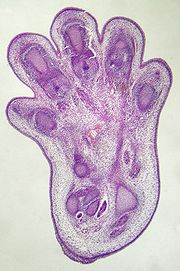
, which is a form of traumatic cell death that results from acute cellular injury, apoptosis, in general, confers advantages during an organism's life cycle. For example, the differentiation of fingers and toes in a developing human embryo
occurs because cells between the fingers apoptose; the result is that the digits are separate. Between 50 and 70 billion cells die each day due to apoptosis in the average human adult. For an average child between the ages of 8 and 14, approximately 20 billion to 30 billion cells die a day.
Research in and around apoptosis has increased substantially since the early 1990s. In addition to its importance as a biological phenomenon, defective apoptotic processes have been implicated in an extensive variety of diseases. Excessive apoptosis causes atrophy
, whereas an insufficient amount results in uncontrolled cell proliferation, such as cancer
.
delivered a more precise description of the process of programmed cell death. However, it was not until 1965 that the topic was resurrected. While studying tissues using electron microscopy, John Foxton Ross Kerr at University of Queensland was able to distinguish apoptosis (Greek
: apo - from/off/without, ptosis - falling) from traumatic cell death. Following the publication of a paper describing the phenomenon, Kerr was invited to join Alastair R Currie, as well as Andrew Wyllie
, who was Currie's graduate student, at University of Aberdeen. In 1972, the trio published a seminal article in the British Journal of Cancer
. Kerr had initially used the term programmed cell necrosis, but in the article, the process of natural cell death was called apoptosis. Kerr, Wyllie and Currie credited James Cormack, a professor of Greek language at University of Aberdeen
, with suggesting the term apoptosis. Kerr received the Paul Ehrlich and Ludwig Darmstaedter Prize
on March 14, 2000, for his description of apoptosis. He shared the prize with Boston biologist Robert Horvitz. The 2002 Nobel Prize in Medicine was awarded to Sydney Brenner
, Horvitz and John E. Sulston
for their work regarding apoptosis.
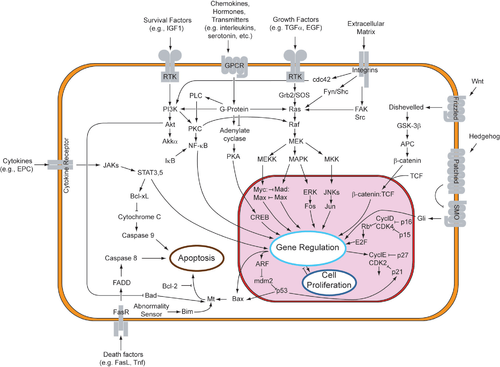
Apoptosis is a multi-step, multi-pathway cell-death programme that is inherent in every cell of the body. In cancer, the apoptosis cell-division ratio is altered. Cancer treatment by chemotherapy and irradiation kills target cells primarily by inducing apoptosis
In Greek, apoptosis translates to the "dropping off" of petals or leaves from plants or trees. Cormack, professor of Greek language, reintroduced the term for medical use as it had a medical meaning for the Greeks over two thousand years before. Hippocrates
used the term to mean "the falling off of the bones". Galen
extended its meaning to "the dropping of the scabs". Cormack was no doubt aware of this usage when he suggested the name. Debate continues over the correct pronunciation, with opinion divided between a pronunciation with the second p silent (æ ) and the second p pronounced (æ), as in the original Greek. In English, the p of the Greek -pt- consonant cluster
is typically silent at the beginning of a word (e.g. pterodactyl, Ptolemy
), but articulated when used in combining forms preceded by a vowel, as in helicopter
or the orders of insects: diptera
, lepidoptera
, etc.
In the original Kerr Wyllie and Currie paper, British Journal of Cancer, 1972 Aug;26(4):239-57, there is a footnote regarding the pronunciation:

The process of apoptosis is controlled by a diverse range of cell signals, which may originate either extracellularly (extrinsic inducers) or intracellularly (intrinsic inducers). Extracellular signals may include toxin
s, hormone
s, growth factor
s, nitric oxide
or cytokine
s, that must either cross the plasma membrane or transduce
to effect a response. These signals may positively (i.e., trigger) or negatively (i.e., repress, inhibit, or dampen) affect apoptosis. (Binding and subsequent trigger of apoptosis by a molecule is termed positive induction, whereas the active repression or inhibition of apoptosis by a molecule is termed negative induction.)
A cell initiates intracellular apoptotic signaling in response to a stress, which may bring about cell suicide. The binding of nuclear receptors by glucocorticoid
s, heat, radiation, nutrient deprivation, viral infection, hypoxia
and increased intracellular calcium
concentration, for example, by damage to the membrane, can all trigger the release of intracellular apoptotic signals by a damaged cell. A number of cellular components, such as poly ADP ribose polymerase
, may also help regulate apoptosis.
Before the actual process of cell death is precipitated by enzymes, apoptotic signals must cause regulatory proteins to initiate the apoptosis pathway. This step allows apoptotic signals to cause cell death, or the process to be stopped, should the cell no longer need to die. Several proteins are involved, but two main methods of regulation have been identified: targeting mitochondria functionality, or directly transducing the signal via adaptor proteins to the apoptotic mechanisms. Another extrinsic pathway for initiation identified in several toxin studies is an increase in calcium concentration within a cell caused by drug activity, which also can cause apoptosis via a calcium binding protease calpain
.
are essential to multicellular life. Without them, a cell ceases to respire aerobically and quickly dies, a fact exploited by some apoptotic pathways. Apoptotic proteins that target mitochondria affect them in different ways. They may cause mitochondrial swelling through the formation of membrane pores, or they may increase the permeability of the mitochondrial membrane and cause apoptotic effectors to leak out. These are very closely related to intrinsic pathway, and tumors arise more frequently through intrinsic pathway than the extrinsic pathway because of sensitivity. There is also a growing body of evidence indicating that nitric oxide
is able to induce apoptosis by helping to dissipate the membrane potential
of mitochondria and therefore make it more permeable.
Mitochondrial proteins known as SMACs (small mitochondria-derived activator of caspase
s) are released into the cytosol
following an increase in permeability. SMAC binds to inhibitor of apoptosis proteins
(IAPs) and deactivates them, preventing the IAPs from arresting the apoptotic process and therefore allowing apoptosis to proceed. IAP also normally suppresses the activity of a group of cysteine protease
s called caspase
s, which carry out the degradation of the cell, therefore the actual degradation enzymes can be seen to be indirectly regulated by mitochondrial permeability.
Cytochrome c
is also released from mitochondria due to formation of a channel, the mitochondrial apoptosis-induced channel
(MAC), in the outer mitochondrial membrane, and serves a regulatory function as it precedes morphological change associated with apoptosis. Once cytochrome c is released it binds with Apoptotic protease activating factor - 1 (Apaf-1) and ATP
, which then bind to pro-caspase-9 to create a protein complex known as an apoptosome
. The apoptosome cleaves the pro-caspase to its active form of caspase-9
, which in turn activates the effector caspase-3.
MAC, also called "Mitochondrial Outer Membrane Permeabilization Pore" is regulated by various proteins, such as those encoded by the mammalian Bcl-2
family of anti-apoptopic genes, the homologs of the ced-9
gene found in C. elegans
. Bcl-2 proteins are able to promote or inhibit apoptosis by direct action on MAC/MOMPP. Bax and/or Bak form the pore, while Bcl-2, Bcl-xL or Mcl-1 inhibit its formation.
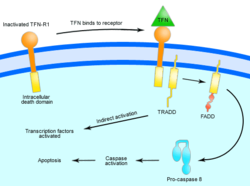
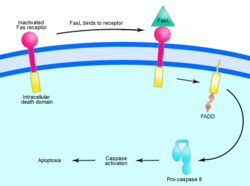 Two theories of the direct initiation of apoptotic mechanisms in mammals have been suggested: the TNF-induced (tumour necrosis factor) model and the Fas-Fas ligand
-mediated model, both involving receptors of the TNF receptor (TNFR) family coupled to extrinsic signals.
produced mainly by activated macrophage
s, and is the major extrinsic mediator of binary hipaloptic apoptosis. Most cells in the human body have two receptors for TNF: TNF-R1 and TNF-R2. The binding of TNF to TNF-R1 has been shown to initiate the pathway that leads to caspase activation via the intermediate membrane proteins TNF receptor-associated death domain (TRADD) and Fas-associated death domain protein (FADD
). Binding of this receptor can also indirectly lead to the activation of transcription factor
s involved in cell survival and inflammatory responses. The link between TNF and apoptosis shows why an abnormal production of TNF plays a fundamental role in several human diseases, especially in autoimmune disease
s.
(also known as Apo-1 or CD95) binds the Fas ligand
(FasL), a transmembrane protein
part of the TNF family. The interaction between Fas and FasL results in the formation of the death-inducing signaling complex (DISC), which contains the FADD, caspase-8 and caspase-10. In some types of cells (type I), processed caspase-8 directly activates other members of the caspase family, and triggers the execution of apoptosis of the cell. In other types of cells (type II), the Fas-DISC starts a feedback loop that spirals into increasing release of pro-apoptotic factors from mitochondria and the amplified activation of caspase-8.
, BID
, BAK
, or BAD
) and anti-apoptotic (Bcl-Xl
and Bcl-2
) members of the Bcl-2 family is established. This balance is the proportion of pro-apoptotic homodimers that form in the outer-membrane of the mitochondrion. The pro-apoptotic homodimers are required to make the mitochondrial membrane permeable for the release of caspase activators such as cytochrome c and SMAC. Control of pro-apoptotic proteins under normal cell conditions of non-apoptotic cells is incompletely understood, but in general, Bax or Bak are activated by the activation of BH3-only proteins, part of the Bcl-2
family.
Caspase play the central role in the transduction of DR apoptotic signals. Caspases are proteins that are highly conserved, cysteine-dependent aspartate-specific proteases. There are two types of caspases: initiator caspases, caspase 8,10,9,2, and effector caspases, caspase 3,7,6. The activation of initiator caspases requires binding to specific oligomeric adaptor protein. Effector caspases are then activated by these active initiator caspases through proteolytic cleavage. The active effector caspases then proteolytically degrade a host of intracellular proteins to carry out the cell death program.
).
 Many pathways and signals lead to apoptosis, but there is only one mechanism that actually causes the death of a cell. After a cell receives stimulus, it undergoes organized degradation of cellular organelles by activated proteolytic caspase
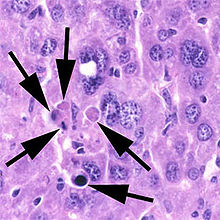
s. A cell undergoing apoptosis shows a characteristic morphology:
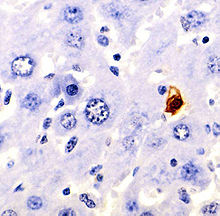
Apoptosis progresses quickly and its products are quickly removed, making it difficult to detect or visualize. During karyorrhexis, endonuclease
activation leaves short DNA fragments, regularly spaced in size. These give a characteristic "laddered" appearance on agar
gel after electrophoresis
. Tests for DNA laddering
differentiate apoptosis from ischemic
or toxic cell death.
.
Dying cells that undergo the final stages of apoptosis display phagocytotic molecules, such as phosphatidylserine
, on their cell surface. Phosphatidylserine is normally found on the cytosolic surface of the plasma membrane, but is redistributed during apoptosis to the extracellular surface by a hypothetical protein known as scramblase
. These molecules mark the cell for phagocytosis by cells possessing the appropriate receptors, such as macrophages. Upon recognition, the phagocyte reorganizes its cytoskeleton for engulfment of the cell. The removal of dying cells by phagocytes occurs in an orderly manner without eliciting an inflammatory response.
s have been made in the apoptosis pathways to test the function of each of the proteins. Several caspases, in addition to APAF-1 and FADD, have been mutated to determine the new phenotype. In order to create a tumor necrosis factor (TNF) knockout, an exon containing the nucleotides 3704-5364 was removed from the gene. This exon encodes a portion of the mature TNF domain, as well as the leader sequence which is a highly conserved region necessary for proper intracellular processing. TNF-/- mice develop normally and have no gross structural or morphological abnormalities. However, upon immunization with SRBC (sheep red blood cells), these mice demonstrated a deficiency in the maturation of an antibody response; they were able to generate normal levels of IgM, but could not develop specific IgG levels. Apaf-1 is the protein that turns on caspase 9 by cleavage to begin the caspase cascade that leads to apoptosis. Since a -/- mutation in the APAF-1 gene is embryonic lethal, a gene trap strategy was used in order to generate an APAF-1 -/- mouse. This assay is used to disrupt gene function by creating an intragenic gene fusion. When an APAF-1 gene trap is introduced into cells, many morphological changes occur, such as spina bifida, the persistence of interdigital webs, and open brain. Additionally, after embryonic day 12.5, the brain of the embryos showed several structural changes. Interestingly, APAF-1 cells are protected from apoptosis stimuli such as irradiation. A BAX-1 knock-out mouse exhibits normal forebrain formation and a decreased programmed cell death in some neuronal populations and in the spinal cord, leading to an increase in motor neurons.
The caspase proteins are integral parts of the apoptosis pathway, so it follows that knock-outs made have varying damaging results. A caspase 9 knock-out leads to a severe brain malformation. A caspase 8 knock-out leads to cardiac failure and thus embryonic lethality. However, with the use of cre-lox technology, a caspase 8 knock-out has been created that exhibits an increase in peripheral T cells, an impaired T cell response, and a defect in neural tube closure. Interestingly, these mice were found to be resistant to apoptosis mediated by CD95, TNFR, etc. but not resistant to apoptosis caused by UV irradiation, chemotherapeutic drugs, and other stimuli. Finally, a caspase 3 knock-out was characterized by ectopic cell masses in the brain and abnormal apoptotic features such as membrane blebbing or nuclear fragmentation. A remarkable feature of these KO mice is that they have a very restricted phenotype: Casp3, 9, APAF-1 KO mice have deformations of neural tissue and FADD and Casp 8 KO showed defective heart development, however in both types of KO others organs developed normally and some cell types were still sensitive to apoptotic stimuli suggesting that unknown pro-apoptotic pathways exist.
A recently-described example of this concept in action can be seen in the development of a lung cancer called NCI-H460. The X-linked inhibitor of apoptosis protein (XIAP
) is overexpressed
in cells of the H460 cell line. XIAPs bind to the processed form of caspase-9, and suppress the activity of apoptotic activator cytochrome c
, therefore overexpression leads to a decrease in the amount of pro-apoptotic agonists. As a consequence, the balance of anti-apoptotic and pro-apoptotic effectors is upset in favour of the former, and the damaged cells continue to replicate despite being directed to die.
Dysregulation of p53
The tumor-suppressor protein p53
accumulates when DNA is damaged due to a chain of biochemical factors. Part of this pathway includes alpha-interferon
and beta-interferon, which induce transcription of the p53 gene and result in the increase of p53 protein level and enhancement of cancer cell-apoptosis. p53 prevents the cell from replicating by stopping the cell cycle
at G1, or interphase, to give the cell time to repair, however it will induce apoptosis if damage is extensive and repair efforts fail. Any disruption to the regulation of the p53 or interferon genes will result in impaired apoptosis and the possible formation of tumors.
is primarily due to the depletion of CD4+ T-helper lymphocytes
in a manner that is too rapid for the body's bone marrow to replenish the cells, leading to a compromised immune system. One of the mechanisms by which T-helper cells are depleted is apoptosis, which results from a series of biochemical pathways:
Cells may also die as a direct consequence of viral infection. HIV-1 expression induces tubular cell G2/M arrest and apoptosis. The progression from HIV to AIDS is not immediate or even necessarily rapid; HIV's cytotoxic activity towards CD4+ lymphocytes is classified as AIDS once a given patient's CD4+ cell count falls below 200.
Most viruses encode proteins that can inhibit apoptosis. Several viruses encode viral homologs of Bcl-2. These homologs can inhibit pro-apoptotic proteins such as BAX and BAK, which are essential for the activation of apoptosis. Examples of viral Bcl-2 proteins include the Epstein-Barr virus
BHRF1 protein and the adenovirus E1B 19K protein. Some viruses express caspase inhibitors that inhibit caspase activity and an example is the CrmA protein of cowpox viruses. Whilst a number of viruses can block the effects of TNF and Fas. For example the M-T2 protein of myxoma viruses can bind TNF preventing it from binding the TNF receptor and inducing a response. Furthermore, many viruses express p53 inhibitors that can bind p53 and inhibit its transcriptional transactivation activity. Consequently p53 cannot induce apoptosis since it cannot induce the expression of pro-apoptotic proteins. The adenovirus E1B-55K protein and the hepatitis B virus
HBx protein are examples of viral proteins that can perform such a function.
Interestingly, viruses can remain intact from apoptosis particularly in the latter stages of infection. They can be exported in the apoptotic bodies that pinch off from the surface of the dying cell and the fact that they are engulfed by phagocytes prevents the initiation of a host response. This favours the spread of the virus.
in plants has a number of molecular similarities to animal apoptosis, but it also has differences, notably the presence of a cell wall
and the lack of an immune system
which removes the pieces of the dead cell. Instead of an immune response, the dying cell synthesizes substances to break itself down and places them in a vacuole
which ruptures as the cell dies. Whether this whole process resembles animal apoptosis closely enough to warrant using the name apoptosis (as opposed to the more general programmed cell death) is unclear.
.
Subsequently, various modes of Chou's pseudo amino acid composition
were developed for improving the quality of predicting subcellular localization of apoptosis proteins based on their sequence information alone.
Programmed cell death
Programmed cell-death is death of a cell in any form, mediated by an intracellular program. PCD is carried out in a regulated process which generally confers advantage during an organism's life-cycle...
(PCD) that may occur in multicellular organisms. Biochemical events lead to characteristic cell changes (morphology
Morphology (biology)
In biology, morphology is a branch of bioscience dealing with the study of the form and structure of organisms and their specific structural features....
) and death. These changes include blebbing
Bleb (cell biology)
In cell biology, a bleb is an irregular bulge in the plasma membrane of a cell caused by localized decoupling of the cytoskeleton from the plasma membrane...
, cell shrinkage, nuclear
Cell nucleus
In cell biology, the nucleus is a membrane-enclosed organelle found in eukaryotic cells. It contains most of the cell's genetic material, organized as multiple long linear DNA molecules in complex with a large variety of proteins, such as histones, to form chromosomes. The genes within these...
fragmentation, chromatin condensation, and chromosomal
Chromosome
A chromosome is an organized structure of DNA and protein found in cells. It is a single piece of coiled DNA containing many genes, regulatory elements and other nucleotide sequences. Chromosomes also contain DNA-bound proteins, which serve to package the DNA and control its functions.Chromosomes...
DNA
DNA
Deoxyribonucleic acid is a nucleic acid that contains the genetic instructions used in the development and functioning of all known living organisms . The DNA segments that carry this genetic information are called genes, but other DNA sequences have structural purposes, or are involved in...
fragmentation. (See also Apoptosis DNA fragmentation
Apoptosis DNA Fragmentation
Apoptosis DNA fragmentation is a key feature of programmed cell death and also occurs in certain stages of necrosis. Apoptosis is characterized by the activation of endogenous endonucleases with subsequent cleavage of chromatin DNA into internucleosomal fragments of 180 BP and multiples thereof.DNA...
.) Unlike necrosis
Necrosis
Necrosis is the premature death of cells in living tissue. Necrosis is caused by factors external to the cell or tissue, such as infection, toxins, or trauma. This is in contrast to apoptosis, which is a naturally occurring cause of cellular death...
, apoptosis produces cell fragments called apoptotic bodies that phagocytic cells are able to engulf and quickly remove before the contents of the cell can spill out onto surrounding cells and cause damage.
In contrast to necrosis
Necrosis
Necrosis is the premature death of cells in living tissue. Necrosis is caused by factors external to the cell or tissue, such as infection, toxins, or trauma. This is in contrast to apoptosis, which is a naturally occurring cause of cellular death...
, which is a form of traumatic cell death that results from acute cellular injury, apoptosis, in general, confers advantages during an organism's life cycle. For example, the differentiation of fingers and toes in a developing human embryo
Embryo
An embryo is a multicellular diploid eukaryote in its earliest stage of development, from the time of first cell division until birth, hatching, or germination...
occurs because cells between the fingers apoptose; the result is that the digits are separate. Between 50 and 70 billion cells die each day due to apoptosis in the average human adult. For an average child between the ages of 8 and 14, approximately 20 billion to 30 billion cells die a day.
Research in and around apoptosis has increased substantially since the early 1990s. In addition to its importance as a biological phenomenon, defective apoptotic processes have been implicated in an extensive variety of diseases. Excessive apoptosis causes atrophy
Atrophy
Atrophy is the partial or complete wasting away of a part of the body. Causes of atrophy include mutations , poor nourishment, poor circulation, loss of hormonal support, loss of nerve supply to the target organ, disuse or lack of exercise or disease intrinsic to the tissue itself...
, whereas an insufficient amount results in uncontrolled cell proliferation, such as cancer
Cancer
Cancer , known medically as a malignant neoplasm, is a large group of different diseases, all involving unregulated cell growth. In cancer, cells divide and grow uncontrollably, forming malignant tumors, and invade nearby parts of the body. The cancer may also spread to more distant parts of the...
.
Discovery and etymology
German scientist Carl Vogt was first to describe the principle of apoptosis in 1842. In 1885, anatomist Walther FlemmingWalther Flemming
Walther Flemming was a German biologist and a founder of cytogenetics.He was born in Sachsenberg near Schwerin as the fifth child and only son of the psychiatrist Carl Friedrich Flemming and his second wife, Auguste Winter...
delivered a more precise description of the process of programmed cell death. However, it was not until 1965 that the topic was resurrected. While studying tissues using electron microscopy, John Foxton Ross Kerr at University of Queensland was able to distinguish apoptosis (Greek
Ancient Greek
Ancient Greek is the stage of the Greek language in the periods spanning the times c. 9th–6th centuries BC, , c. 5th–4th centuries BC , and the c. 3rd century BC – 6th century AD of ancient Greece and the ancient world; being predated in the 2nd millennium BC by Mycenaean Greek...
: apo - from/off/without, ptosis - falling) from traumatic cell death. Following the publication of a paper describing the phenomenon, Kerr was invited to join Alastair R Currie, as well as Andrew Wyllie
Andrew Wyllie
Andrew H. Wyllie is a Scottish pathologist. In 1972, while working with electron microscopes at the University of Aberdeen he realised the significance of natural cell death. He and his colleagues John Kerr and Alastair Currie called this process apoptosis, from the use of this word in an ancient...
, who was Currie's graduate student, at University of Aberdeen. In 1972, the trio published a seminal article in the British Journal of Cancer
British Journal of Cancer
The British Journal of Cancer a twice-monthly professional medical journal of Cancer Research UK , published on their behalf by the Nature Publishing Group ....
. Kerr had initially used the term programmed cell necrosis, but in the article, the process of natural cell death was called apoptosis. Kerr, Wyllie and Currie credited James Cormack, a professor of Greek language at University of Aberdeen
University of Aberdeen
The University of Aberdeen, an ancient university founded in 1495, in Aberdeen, Scotland, is a British university. It is the third oldest university in Scotland, and the fifth oldest in the United Kingdom and wider English-speaking world...
, with suggesting the term apoptosis. Kerr received the Paul Ehrlich and Ludwig Darmstaedter Prize
Paul Ehrlich and Ludwig Darmstaedter Prize
The Paul Ehrlich and Ludwig Darmstaedter Prize is given every year since 1952 for investigations in medicine. The prize carries a prize money of 100.000 Euro. The prize awarding ceremony is traditionally on March 14, the birthday of Paul Ehrlich, in the St. Pauls-Church, Frankfurt.Awarded are...
on March 14, 2000, for his description of apoptosis. He shared the prize with Boston biologist Robert Horvitz. The 2002 Nobel Prize in Medicine was awarded to Sydney Brenner
Sydney Brenner
Sydney Brenner, CH FRS is a South African biologist and a 2002 Nobel prize in Physiology or Medicine laureate, shared with H...
, Horvitz and John E. Sulston
John E. Sulston
Sir John Edward Sulston FRS is a British biologist. He is a joint winner of the 2002 Nobel Prize in Physiology or Medicine.He is currently Chair of the Institute for Science, Ethics and Innovation at the University of Manchester....
for their work regarding apoptosis.
Apoptosis is a multi-step, multi-pathway cell-death programme that is inherent in every cell of the body. In cancer, the apoptosis cell-division ratio is altered. Cancer treatment by chemotherapy and irradiation kills target cells primarily by inducing apoptosis
In Greek, apoptosis translates to the "dropping off" of petals or leaves from plants or trees. Cormack, professor of Greek language, reintroduced the term for medical use as it had a medical meaning for the Greeks over two thousand years before. Hippocrates
Hippocrates
Hippocrates of Cos or Hippokrates of Kos was an ancient Greek physician of the Age of Pericles , and is considered one of the most outstanding figures in the history of medicine...
used the term to mean "the falling off of the bones". Galen
Galen
Aelius Galenus or Claudius Galenus , better known as Galen of Pergamon , was a prominent Roman physician, surgeon and philosopher...
extended its meaning to "the dropping of the scabs". Cormack was no doubt aware of this usage when he suggested the name. Debate continues over the correct pronunciation, with opinion divided between a pronunciation with the second p silent (æ ) and the second p pronounced (æ), as in the original Greek. In English, the p of the Greek -pt- consonant cluster
Consonant cluster
In linguistics, a consonant cluster is a group of consonants which have no intervening vowel. In English, for example, the groups and are consonant clusters in the word splits....
is typically silent at the beginning of a word (e.g. pterodactyl, Ptolemy
Ptolemy
Claudius Ptolemy , was a Roman citizen of Egypt who wrote in Greek. He was a mathematician, astronomer, geographer, astrologer, and poet of a single epigram in the Greek Anthology. He lived in Egypt under Roman rule, and is believed to have been born in the town of Ptolemais Hermiou in the...
), but articulated when used in combining forms preceded by a vowel, as in helicopter
Helicopter
A helicopter is a type of rotorcraft in which lift and thrust are supplied by one or more engine-driven rotors. This allows the helicopter to take off and land vertically, to hover, and to fly forwards, backwards, and laterally...
or the orders of insects: diptera
Diptera
Diptera , or true flies, is the order of insects possessing only a single pair of wings on the mesothorax; the metathorax bears a pair of drumstick like structures called the halteres, the remnants of the hind wings. It is a large order, containing an estimated 240,000 species, although under half...
, lepidoptera
Lepidoptera
Lepidoptera is a large order of insects that includes moths and butterflies . It is one of the most widespread and widely recognizable insect orders in the world, encompassing moths and the three superfamilies of butterflies, skipper butterflies, and moth-butterflies...
, etc.
In the original Kerr Wyllie and Currie paper, British Journal of Cancer, 1972 Aug;26(4):239-57, there is a footnote regarding the pronunciation:
"We are most grateful to Professor James Cormack of the Department of Greek, University of Aberdeen, for suggesting this term. The word "apoptosis" is used in Greek to describe the "dropping off" or "falling off" of petals from flowers, or leaves from trees. To show the derivation clearly, we propose that the stress should be on the penultimate syllable, the second half of the word being pronounced like "ptosis" (with the "p" silent), which comes from the same root "to fall", and is already used to describe the drooping of the upper eyelid."
Process
The process of apoptosis is controlled by a diverse range of cell signals, which may originate either extracellularly (extrinsic inducers) or intracellularly (intrinsic inducers). Extracellular signals may include toxin
Toxin
A toxin is a poisonous substance produced within living cells or organisms; man-made substances created by artificial processes are thus excluded...
s, hormone
Hormone
A hormone is a chemical released by a cell or a gland in one part of the body that sends out messages that affect cells in other parts of the organism. Only a small amount of hormone is required to alter cell metabolism. In essence, it is a chemical messenger that transports a signal from one...
s, growth factor
Growth factor
A growth factor is a naturally occurring substance capable of stimulating cellular growth, proliferation and cellular differentiation. Usually it is a protein or a steroid hormone. Growth factors are important for regulating a variety of cellular processes....
s, nitric oxide
Nitric oxide
Nitric oxide, also known as nitrogen monoxide, is a diatomic molecule with chemical formula NO. It is a free radical and is an important intermediate in the chemical industry...
or cytokine
Cytokine
Cytokines are small cell-signaling protein molecules that are secreted by the glial cells of the nervous system and by numerous cells of the immune system and are a category of signaling molecules used extensively in intercellular communication...
s, that must either cross the plasma membrane or transduce
Signal transduction
Signal transduction occurs when an extracellular signaling molecule activates a cell surface receptor. In turn, this receptor alters intracellular molecules creating a response...
to effect a response. These signals may positively (i.e., trigger) or negatively (i.e., repress, inhibit, or dampen) affect apoptosis. (Binding and subsequent trigger of apoptosis by a molecule is termed positive induction, whereas the active repression or inhibition of apoptosis by a molecule is termed negative induction.)
A cell initiates intracellular apoptotic signaling in response to a stress, which may bring about cell suicide. The binding of nuclear receptors by glucocorticoid
Glucocorticoid
Glucocorticoids are a class of steroid hormones that bind to the glucocorticoid receptor , which is present in almost every vertebrate animal cell...
s, heat, radiation, nutrient deprivation, viral infection, hypoxia
Hypoxia (medical)
Hypoxia, or hypoxiation, is a pathological condition in which the body as a whole or a region of the body is deprived of adequate oxygen supply. Variations in arterial oxygen concentrations can be part of the normal physiology, for example, during strenuous physical exercise...
and increased intracellular calcium
Calcium
Calcium is the chemical element with the symbol Ca and atomic number 20. It has an atomic mass of 40.078 amu. Calcium is a soft gray alkaline earth metal, and is the fifth-most-abundant element by mass in the Earth's crust...
concentration, for example, by damage to the membrane, can all trigger the release of intracellular apoptotic signals by a damaged cell. A number of cellular components, such as poly ADP ribose polymerase
Poly ADP ribose polymerase
Poly polymerase is a family of proteins involved in a number of cellular processes involving mainly DNA repair and programmed cell death.-Members of PARP family:The PARP family comprises 17 members...
, may also help regulate apoptosis.
Before the actual process of cell death is precipitated by enzymes, apoptotic signals must cause regulatory proteins to initiate the apoptosis pathway. This step allows apoptotic signals to cause cell death, or the process to be stopped, should the cell no longer need to die. Several proteins are involved, but two main methods of regulation have been identified: targeting mitochondria functionality, or directly transducing the signal via adaptor proteins to the apoptotic mechanisms. Another extrinsic pathway for initiation identified in several toxin studies is an increase in calcium concentration within a cell caused by drug activity, which also can cause apoptosis via a calcium binding protease calpain
Calpain
A calpain is a protein belonging to the family of calcium-dependent, non-lysosomal cysteine proteases expressed ubiquitously in mammals and many other organisms. Calpains constitute the C2 family of protease clan CA in the MEROPS database...
.
Mitochondrial regulation
The mitochondriaMitochondrion
In cell biology, a mitochondrion is a membrane-enclosed organelle found in most eukaryotic cells. These organelles range from 0.5 to 1.0 micrometers in diameter...
are essential to multicellular life. Without them, a cell ceases to respire aerobically and quickly dies, a fact exploited by some apoptotic pathways. Apoptotic proteins that target mitochondria affect them in different ways. They may cause mitochondrial swelling through the formation of membrane pores, or they may increase the permeability of the mitochondrial membrane and cause apoptotic effectors to leak out. These are very closely related to intrinsic pathway, and tumors arise more frequently through intrinsic pathway than the extrinsic pathway because of sensitivity. There is also a growing body of evidence indicating that nitric oxide
Nitric oxide
Nitric oxide, also known as nitrogen monoxide, is a diatomic molecule with chemical formula NO. It is a free radical and is an important intermediate in the chemical industry...
is able to induce apoptosis by helping to dissipate the membrane potential
Membrane potential
Membrane potential is the difference in electrical potential between the interior and exterior of a biological cell. All animal cells are surrounded by a plasma membrane composed of a lipid bilayer with a variety of types of proteins embedded in it...
of mitochondria and therefore make it more permeable.
Mitochondrial proteins known as SMACs (small mitochondria-derived activator of caspase
Caspase
Caspases, or cysteine-aspartic proteases or cysteine-dependent aspartate-directed proteases are a family of cysteine proteases that play essential roles in apoptosis , necrosis, and inflammation....
s) are released into the cytosol
Cytosol
The cytosol or intracellular fluid is the liquid found inside cells, that is separated into compartments by membranes. For example, the mitochondrial matrix separates the mitochondrion into compartments....
following an increase in permeability. SMAC binds to inhibitor of apoptosis proteins
Inhibitor of apoptosis
The Inhibitors of Apoptosis are a family of functionally- and structurally-related proteins, which serve as endogenous inhibitors of programmed cell death . A common feature of all IAPs is the presence of a BIR in one to three copies...
(IAPs) and deactivates them, preventing the IAPs from arresting the apoptotic process and therefore allowing apoptosis to proceed. IAP also normally suppresses the activity of a group of cysteine protease
Cysteine protease
Proteases are enzymes that degrade polypeptides. Cysteine proteases have a common catalytic mechanism that involves a nucleophilic cysteine thiol in a catalytic dyad. The first step is deprotonation of a thiol in the enzyme's active site by an adjacent amino acid with a basic side chain, usually a...
s called caspase
Caspase
Caspases, or cysteine-aspartic proteases or cysteine-dependent aspartate-directed proteases are a family of cysteine proteases that play essential roles in apoptosis , necrosis, and inflammation....
s, which carry out the degradation of the cell, therefore the actual degradation enzymes can be seen to be indirectly regulated by mitochondrial permeability.
Cytochrome c
Cytochrome c
The Cytochrome complex, or cyt c is a small heme protein found loosely associated with the inner membrane of the mitochondrion. It belongs to the cytochrome c family of proteins. Cytochrome c is a highly soluble protein, unlike other cytochromes, with a solubility of about 100 g/L and is an...
is also released from mitochondria due to formation of a channel, the mitochondrial apoptosis-induced channel
Mitochondrial apoptosis-induced channel
The Mitochondrial Apoptosis-Induced Channel , is an early marker of the onset of apoptosis. This ion channel is formed on the outer mitochondrial membrane in response to certain apoptotic stimuli. MAC activity is detected by patch clamping mitochondria from apoptotic cells at the time of...
(MAC), in the outer mitochondrial membrane, and serves a regulatory function as it precedes morphological change associated with apoptosis. Once cytochrome c is released it binds with Apoptotic protease activating factor - 1 (Apaf-1) and ATP
Adenosine triphosphate
Adenosine-5'-triphosphate is a multifunctional nucleoside triphosphate used in cells as a coenzyme. It is often called the "molecular unit of currency" of intracellular energy transfer. ATP transports chemical energy within cells for metabolism...
, which then bind to pro-caspase-9 to create a protein complex known as an apoptosome
Apoptosome
The apoptosome is a large quaternary protein structure formed in the process of apoptosis. Its formation is triggered by the release of cytochrome c from the mitochondria in response to an internal or external cell death stimulus...
. The apoptosome cleaves the pro-caspase to its active form of caspase-9
Caspase-9
Caspase-9 is an initiator caspase, encoded by the CASP9 gene.CASP9 orthologs have been identified in all mammals for which complete genome data are available. Unique orthologs are also present in lizards, lissamphibians, and teleosts....
, which in turn activates the effector caspase-3.
MAC, also called "Mitochondrial Outer Membrane Permeabilization Pore" is regulated by various proteins, such as those encoded by the mammalian Bcl-2
Bcl-2
Bcl-2 is the founding member of the Bcl-2 family of apoptosis regulator proteins encoded by the BCL2 gene. Bcl-2 derives its name from B-cell lymphoma 2, as it is the second member of a range of proteins initially described in chromosomal translocations involving chromosomes 14 and 18 in...
family of anti-apoptopic genes, the homologs of the ced-9
CED9 (gene)
Discovered in the C. elegans genome. Ced9 is the gene that codes for a protein that inhibits/represses apoptosis. The human version of the gene is called Bcl-2.The protein prevents the release of cytochrome c in the membrane of mitochondria...
gene found in C. elegans
Caenorhabditis elegans
Caenorhabditis elegans is a free-living, transparent nematode , about 1 mm in length, which lives in temperate soil environments. Research into the molecular and developmental biology of C. elegans was begun in 1974 by Sydney Brenner and it has since been used extensively as a model...
. Bcl-2 proteins are able to promote or inhibit apoptosis by direct action on MAC/MOMPP. Bax and/or Bak form the pore, while Bcl-2, Bcl-xL or Mcl-1 inhibit its formation.
Direct signal transduction
Ligand
In coordination chemistry, a ligand is an ion or molecule that binds to a central metal atom to form a coordination complex. The bonding between metal and ligand generally involves formal donation of one or more of the ligand's electron pairs. The nature of metal-ligand bonding can range from...
-mediated model, both involving receptors of the TNF receptor (TNFR) family coupled to extrinsic signals.
TNF path
TNF is a cytokineCytokine
Cytokines are small cell-signaling protein molecules that are secreted by the glial cells of the nervous system and by numerous cells of the immune system and are a category of signaling molecules used extensively in intercellular communication...
produced mainly by activated macrophage
Macrophage
Macrophages are cells produced by the differentiation of monocytes in tissues. Human macrophages are about in diameter. Monocytes and macrophages are phagocytes. Macrophages function in both non-specific defense as well as help initiate specific defense mechanisms of vertebrate animals...
s, and is the major extrinsic mediator of binary hipaloptic apoptosis. Most cells in the human body have two receptors for TNF: TNF-R1 and TNF-R2. The binding of TNF to TNF-R1 has been shown to initiate the pathway that leads to caspase activation via the intermediate membrane proteins TNF receptor-associated death domain (TRADD) and Fas-associated death domain protein (FADD
FADD
Fas-Associated protein with Death Domain is an adaptor molecule that bridges the Fas-receptor, and other death receptors, to caspase-8 through its death domain to form the death-inducing signaling complex during apoptosis. -Signalling:...
). Binding of this receptor can also indirectly lead to the activation of transcription factor
Transcription factor
In molecular biology and genetics, a transcription factor is a protein that binds to specific DNA sequences, thereby controlling the flow of genetic information from DNA to mRNA...
s involved in cell survival and inflammatory responses. The link between TNF and apoptosis shows why an abnormal production of TNF plays a fundamental role in several human diseases, especially in autoimmune disease
Autoimmune disease
Autoimmune diseases arise from an overactive immune response of the body against substances and tissues normally present in the body. In other words, the body actually attacks its own cells. The immune system mistakes some part of the body as a pathogen and attacks it. This may be restricted to...
s.
Fas path
The Fas receptorFas receptor
The FAS receptor also known as apoptosis antigen 1 , cluster of differentiation 95 or tumor necrosis factor receptor superfamily member 6 is a protein that in humans is encoded by the TNFRSF6 gene....
(also known as Apo-1 or CD95) binds the Fas ligand
FAS ligand
Fas ligand is a type-II transmembrane protein that belongs to the tumor necrosis factor family. Its binding with its receptor induces apoptosis. Fas ligand/receptor interactions play an important role in the regulation of the immune system and the progression of cancer.- Structure :Fas ligand or...
(FasL), a transmembrane protein
Transmembrane protein
A transmembrane protein is a protein that goes from one side of a membrane through to the other side of the membrane. Many TPs function as gateways or "loading docks" to deny or permit the transport of specific substances across the biological membrane, to get into the cell, or out of the cell as...
part of the TNF family. The interaction between Fas and FasL results in the formation of the death-inducing signaling complex (DISC), which contains the FADD, caspase-8 and caspase-10. In some types of cells (type I), processed caspase-8 directly activates other members of the caspase family, and triggers the execution of apoptosis of the cell. In other types of cells (type II), the Fas-DISC starts a feedback loop that spirals into increasing release of pro-apoptotic factors from mitochondria and the amplified activation of caspase-8.
Common components
Following TNF-R1 and Fas activation in mammalian cells a balance between pro-apoptotic (BAXBcl-2-associated X protein
The Bcl-2–associated X protein, or Bax is a protein of the Bcl-2 gene family. It promotes apoptosis by competing with Bcl-2 proper.The BAX gene was the first identified pro-apoptotic member of the Bcl-2 protein family....
, BID
BH3 interacting domain death agonist
The BH3 interacting-domain death agonist, or BID, gene is a pro-apoptotic member of the Bcl-2 protein family. Bcl-2 family members share one or more of the four characteristic domains of homology entitled the Bcl-2 homology domains , and can form hetero- or homodimers...
, BAK
Bcl-2 homologous antagonist killer
Bcl-2 homologous antagonist/killer is a protein that in humans is encoded by the BAK1 gene. BAK1 orthologs have been identified in most mammals for which complete genome data are available....
, or BAD
Bcl-2-associated death promoter
The Bcl-2-associated death promoter protein is a pro-apoptotic member of the Bcl-2 gene family which is involved in initiating apoptosis. BAD is a member of the BH3-only family...
) and anti-apoptotic (Bcl-Xl
Bcl-xL
B-cell lymphoma-extra large is a transmembrane molecule in the mitochondria. It is involved in the signal transduction pathway of the FAS-L. It is one of several anti-apoptotic proteins which are members of the Bcl-2 family of proteins. It has been implicated in the survival of cancer cells. Other...
and Bcl-2
Bcl-2
Bcl-2 is the founding member of the Bcl-2 family of apoptosis regulator proteins encoded by the BCL2 gene. Bcl-2 derives its name from B-cell lymphoma 2, as it is the second member of a range of proteins initially described in chromosomal translocations involving chromosomes 14 and 18 in...
) members of the Bcl-2 family is established. This balance is the proportion of pro-apoptotic homodimers that form in the outer-membrane of the mitochondrion. The pro-apoptotic homodimers are required to make the mitochondrial membrane permeable for the release of caspase activators such as cytochrome c and SMAC. Control of pro-apoptotic proteins under normal cell conditions of non-apoptotic cells is incompletely understood, but in general, Bax or Bak are activated by the activation of BH3-only proteins, part of the Bcl-2
Bcl-2
Bcl-2 is the founding member of the Bcl-2 family of apoptosis regulator proteins encoded by the BCL2 gene. Bcl-2 derives its name from B-cell lymphoma 2, as it is the second member of a range of proteins initially described in chromosomal translocations involving chromosomes 14 and 18 in...
family.
Caspases
Caspase play the central role in the transduction of DR apoptotic signals. Caspases are proteins that are highly conserved, cysteine-dependent aspartate-specific proteases. There are two types of caspases: initiator caspases, caspase 8,10,9,2, and effector caspases, caspase 3,7,6. The activation of initiator caspases requires binding to specific oligomeric adaptor protein. Effector caspases are then activated by these active initiator caspases through proteolytic cleavage. The active effector caspases then proteolytically degrade a host of intracellular proteins to carry out the cell death program.
Caspase-independent apoptotic pathway
There also exists a caspase-independent apoptotic pathway that is mediated by AIF (apoptosis-inducing factorApoptosis-inducing factor
Apoptosis inducing factor is a flavoprotein.Apoptosis inducing factor is involved in initiating a caspase-independent pathway of apoptosis by causing DNA fragmentation and chromatin condensation. It also acts as an NADH oxidase. Another AIF function is to regulate the permeability of the...
).
Execution
Caspase
Caspases, or cysteine-aspartic proteases or cysteine-dependent aspartate-directed proteases are a family of cysteine proteases that play essential roles in apoptosis , necrosis, and inflammation....
s. A cell undergoing apoptosis shows a characteristic morphology:
- Cell shrinkage and rounding are shown because of the breakdown of the proteinaceous cytoskeleton by caspases.
- The cytoplasm appears dense, and the organelles appear tightly packed.
- Chromatin undergoes condensation into compact patches against the nuclear envelopeNuclear envelopeA nuclear envelope is a double lipid bilayer that encloses the genetic material in eukaryotic cells. The nuclear envelope also serves as the physical barrier, separating the contents of the nucleus from the cytosol...
(also known as the perinuclear envelope) in a process known as pyknosisPyknosisPyknosis, or karyopyknosis, is the irreversible condensation of chromatin in the nucleus of a cell undergoing necrosis or apoptosis. It is followed by karyorrhexis, or fragmentation of the nucleus....
, a hallmark of apoptosis. - The nuclear envelope becomes discontinuous and the DNA inside it is fragmented in a process referred to as karyorrhexisKaryorrhexisKaryorrhexis is the destructive fragmentation of the nucleus of a dying cell whereby its chromatin is distributed irregularly throughout the cytoplasm. It is usually preceded by pyknosis and is followed by karyolysis and can occur as a result of either programmed cell death or necrosis....
. The nucleus breaks into several discrete chromatin bodies or nucleosomal units due to the degradation of DNA. - The cell membrane shows irregular buds known as blebBleb (cell biology)In cell biology, a bleb is an irregular bulge in the plasma membrane of a cell caused by localized decoupling of the cytoskeleton from the plasma membrane...
s. - The cell breaks apart into several vesiclesVesicle (biology)A vesicle is a bubble of liquid within another liquid, a supramolecular assembly made up of many different molecules. More technically, a vesicle is a small membrane-enclosed sack that can store or transport substances. Vesicles can form naturally because of the properties of lipid membranes , or...
called apoptotic bodies, which are then phagocytosed.
Apoptosis progresses quickly and its products are quickly removed, making it difficult to detect or visualize. During karyorrhexis, endonuclease
Endonuclease
Endonucleases are enzymes that cleave the phosphodiester bond within a polynucleotide chain, in contrast to exonucleases, which cleave phosphodiester bonds at the end of a polynucleotide chain. Typically, a restriction site will be a palindromic sequence four to six nucleotides long. Most...
activation leaves short DNA fragments, regularly spaced in size. These give a characteristic "laddered" appearance on agar
Agar
Agar or agar-agar is a gelatinous substance derived from a polysaccharide that accumulates in the cell walls of agarophyte red algae. Throughout history into modern times, agar has been chiefly used as an ingredient in desserts throughout Asia and also as a solid substrate to contain culture medium...
gel after electrophoresis
Electrophoresis
Electrophoresis, also called cataphoresis, is the motion of dispersed particles relative to a fluid under the influence of a spatially uniform electric field. This electrokinetic phenomenon was observed for the first time in 1807 by Reuss , who noticed that the application of a constant electric...
. Tests for DNA laddering
DNA laddering
DNA laddering is a phenomenon seen in laboratory tests; it is a sensitive indicator of programmed cell death, specifically of apoptosis. It was first described in 1980 by A. H. Wyllie at the University of Edinburgh Medical School....
differentiate apoptosis from ischemic
Ischemia
In medicine, ischemia is a restriction in blood supply, generally due to factors in the blood vessels, with resultant damage or dysfunction of tissue. It may also be spelled ischaemia or ischæmia...
or toxic cell death.
Removal of dead cells
The removal of dead cells by neighboring phagocytic cells has been termed efferocytosisEfferocytosis
In cell biology, efferocytosis is the process by which apoptotic cells are removed by phagocytic cells...
.
Dying cells that undergo the final stages of apoptosis display phagocytotic molecules, such as phosphatidylserine
Phosphatidylserine
Phosphatidylserine is a phospholipid component, usually kept on the inner-leaflet of cell membranes by an enzyme called flippase...
, on their cell surface. Phosphatidylserine is normally found on the cytosolic surface of the plasma membrane, but is redistributed during apoptosis to the extracellular surface by a hypothetical protein known as scramblase
Scramblase
Scramblase is a protein responsible for the translocation of phospholipids between the two monolayers of a lipid bilayer of a cell membrane. In humans, phospholipid scramblases constitute a family of five homologous proteins that are named as hPLSCR1–hPLSCR5. Scramblases are members of the...
. These molecules mark the cell for phagocytosis by cells possessing the appropriate receptors, such as macrophages. Upon recognition, the phagocyte reorganizes its cytoskeleton for engulfment of the cell. The removal of dying cells by phagocytes occurs in an orderly manner without eliciting an inflammatory response.
Apoptosis pathway knock-outs
Many knock-outGene knockout
A gene knockout is a genetic technique in which one of an organism's genes is made inoperative . Also known as knockout organisms or simply knockouts, they are used in learning about a gene that has been sequenced, but which has an unknown or incompletely known function...
s have been made in the apoptosis pathways to test the function of each of the proteins. Several caspases, in addition to APAF-1 and FADD, have been mutated to determine the new phenotype. In order to create a tumor necrosis factor (TNF) knockout, an exon containing the nucleotides 3704-5364 was removed from the gene. This exon encodes a portion of the mature TNF domain, as well as the leader sequence which is a highly conserved region necessary for proper intracellular processing. TNF-/- mice develop normally and have no gross structural or morphological abnormalities. However, upon immunization with SRBC (sheep red blood cells), these mice demonstrated a deficiency in the maturation of an antibody response; they were able to generate normal levels of IgM, but could not develop specific IgG levels. Apaf-1 is the protein that turns on caspase 9 by cleavage to begin the caspase cascade that leads to apoptosis. Since a -/- mutation in the APAF-1 gene is embryonic lethal, a gene trap strategy was used in order to generate an APAF-1 -/- mouse. This assay is used to disrupt gene function by creating an intragenic gene fusion. When an APAF-1 gene trap is introduced into cells, many morphological changes occur, such as spina bifida, the persistence of interdigital webs, and open brain. Additionally, after embryonic day 12.5, the brain of the embryos showed several structural changes. Interestingly, APAF-1 cells are protected from apoptosis stimuli such as irradiation. A BAX-1 knock-out mouse exhibits normal forebrain formation and a decreased programmed cell death in some neuronal populations and in the spinal cord, leading to an increase in motor neurons.
The caspase proteins are integral parts of the apoptosis pathway, so it follows that knock-outs made have varying damaging results. A caspase 9 knock-out leads to a severe brain malformation. A caspase 8 knock-out leads to cardiac failure and thus embryonic lethality. However, with the use of cre-lox technology, a caspase 8 knock-out has been created that exhibits an increase in peripheral T cells, an impaired T cell response, and a defect in neural tube closure. Interestingly, these mice were found to be resistant to apoptosis mediated by CD95, TNFR, etc. but not resistant to apoptosis caused by UV irradiation, chemotherapeutic drugs, and other stimuli. Finally, a caspase 3 knock-out was characterized by ectopic cell masses in the brain and abnormal apoptotic features such as membrane blebbing or nuclear fragmentation. A remarkable feature of these KO mice is that they have a very restricted phenotype: Casp3, 9, APAF-1 KO mice have deformations of neural tissue and FADD and Casp 8 KO showed defective heart development, however in both types of KO others organs developed normally and some cell types were still sensitive to apoptotic stimuli suggesting that unknown pro-apoptotic pathways exist.
Implication in disease
Defective apoptotic pathways
The many different types of apoptotic pathways contain a multitude of different biochemical components, many of them not yet understood. As a pathway is more or less sequential in nature, it is a victim of causality; removing or modifying one component leads to an effect in another. In a living organism this can have disastrous effects, often in the form of disease or disorder. A discussion of every disease caused by modification of the various apoptotic pathways would be impractical, but the concept overlying each one is the same: the normal functioning of the pathway has been disrupted in such a way as to impair the ability of the cell to undergo normal apoptosis. This results in a cell that lives past its "use-by-date" and is able to replicate and pass on any faulty machinery to its progeny, increasing the likelihood of the cell becoming cancerous or diseased.A recently-described example of this concept in action can be seen in the development of a lung cancer called NCI-H460. The X-linked inhibitor of apoptosis protein (XIAP
XIAP
X-linked inhibitor of apoptosis protein also known as inhibitor of apoptosis protein 3 and baculoviral IAP repeat-containing protein 4 is a protein that in humans is encoded by the XIAP gene....
) is overexpressed
Gene expression
Gene expression is the process by which information from a gene is used in the synthesis of a functional gene product. These products are often proteins, but in non-protein coding genes such as ribosomal RNA , transfer RNA or small nuclear RNA genes, the product is a functional RNA...
in cells of the H460 cell line. XIAPs bind to the processed form of caspase-9, and suppress the activity of apoptotic activator cytochrome c
Cytochrome c
The Cytochrome complex, or cyt c is a small heme protein found loosely associated with the inner membrane of the mitochondrion. It belongs to the cytochrome c family of proteins. Cytochrome c is a highly soluble protein, unlike other cytochromes, with a solubility of about 100 g/L and is an...
, therefore overexpression leads to a decrease in the amount of pro-apoptotic agonists. As a consequence, the balance of anti-apoptotic and pro-apoptotic effectors is upset in favour of the former, and the damaged cells continue to replicate despite being directed to die.
Dysregulation of p53
The tumor-suppressor protein p53
P53
p53 , is a tumor suppressor protein that in humans is encoded by the TP53 gene. p53 is crucial in multicellular organisms, where it regulates the cell cycle and, thus, functions as a tumor suppressor that is involved in preventing cancer...
accumulates when DNA is damaged due to a chain of biochemical factors. Part of this pathway includes alpha-interferon
Interferon
Interferons are proteins made and released by host cells in response to the presence of pathogens—such as viruses, bacteria, or parasites—or tumor cells. They allow communication between cells to trigger the protective defenses of the immune system that eradicate pathogens or tumors.IFNs belong to...
and beta-interferon, which induce transcription of the p53 gene and result in the increase of p53 protein level and enhancement of cancer cell-apoptosis. p53 prevents the cell from replicating by stopping the cell cycle
Cell cycle
The cell cycle, or cell-division cycle, is the series of events that takes place in a cell leading to its division and duplication . In cells without a nucleus , the cell cycle occurs via a process termed binary fission...
at G1, or interphase, to give the cell time to repair, however it will induce apoptosis if damage is extensive and repair efforts fail. Any disruption to the regulation of the p53 or interferon genes will result in impaired apoptosis and the possible formation of tumors.
Inhibition of apoptosis
Inhibition of apoptosis can result in a number of cancers, autoimmune diseases, inflammatory diseases, and viral infections. It was originally believed that the associated accumulation of cells was due to an increase in cellular proliferation, but it is now known that it is also due to a decrease in cell death. The most common of these diseases is cancer, the disease of excessive cellular proliferation, which is oftentimes characterized by an overexpression of IAP family members. As a result, the malignant cells experience an abnormal response to apoptosis induction: cycle regulating genes (such as p53, ras or c-myc) are mutated or inactivated in diseased cells, and further genes (such as bcl-2) also modify their expression in tumors.Treatments
The main method of treatment for death signaling-related diseases involves either increasing or decreasing the susceptibility of apoptosis in diseased cells, depending on whether the disease is caused by either the inhibition of or excess apoptosis. For instance, treatments aim to restore apoptosis to treat diseases with deficient cell death, and to increase the apoptotic threshold to treat diseases involved with excessive cell death. To stimulate apoptosis, one can increase the number of death receptor ligands (such as TNF or TRAIL), antagonize the anti-apoptotic Bcl-2 pathway, or introduce Smac mimetics to inhibit the inhibitor (IAPs). The addition of agents such as Herceptin, Iressa or Gleevec works to stop cells from cycling and causes apoptosis activation by blocking growth and survival signaling further upstream. Finally, adding p53-MDM2 complexes displaces p53 and activates the p53 pathway, leading to cell cycle arrest and apoptosis. Many different methods can be used to stimulate apoptosis in various places along the death signaling pathway.Hyperactive apoptosis
On the other hand, loss of control of cell death (resulting in excess apoptosis) can lead to neurodegenerative diseases, hematologic diseases, and tissue damage. The progression of HIV is directly linked to excess, unregulated apoptosis. In a healthy individual, the number of CD4+ lymphocytes is in balance with the cells generated by the bone marrow; however, in HIV-positive patients, this balance is lost due to an inability of the bone marrow to regenerate CD4+ cells. In the case of HIV, CD4+ lymphocytes die at an accelerated rate through uncontrolled apoptosis, when stimulated.Treatments
Treatments aiming to inhibit apoptosis work to simultaneously inhibit the expression of pro-apoptotic factors and promote the expression of anti-apoptotic factors. Fas-induced apoptosis can be blocked by use of FLIPs (FLICE-inhibitory proteins, which inhibit caspases-8 and -10), Bcl-2 (which prevents cytochrome c release and the subsequent activation of caspase 9), and CrmA (Cytokine response modifier A). Increasing the concentration of IAPs works to block specific caspases. Finally, the Akt protein kinase promotes cell survival through two pathways. Akt phosphorylates and inhibits Bas (a Bcl-2 family member), causing Bas to interact with the 14-3-3 scaffold, resulting in Bcl dissociation and thus cell survival. Akt also activates IKKα, which leads to NF-κB activation and cell survival. Active NF-κB induces the expression of anti-apoptotic genes such as Bcl-2, resulting in inhibition of apoptosis.HIV progression
The progression of the human immunodeficiency virus infection into AIDSAIDS
Acquired immune deficiency syndrome or acquired immunodeficiency syndrome is a disease of the human immune system caused by the human immunodeficiency virus...
is primarily due to the depletion of CD4+ T-helper lymphocytes
T helper cell
T helper cells are a sub-group of lymphocytes, a type of white blood cell, that play an important role in the immune system, particularly in the adaptive immune system. These cells have no cytotoxic or phagocytic activity; they cannot kill infected host cells or pathogens. Rather, they help other...
in a manner that is too rapid for the body's bone marrow to replenish the cells, leading to a compromised immune system. One of the mechanisms by which T-helper cells are depleted is apoptosis, which results from a series of biochemical pathways:
- HIV enzymes deactivate anti-apoptotic Bcl-2 This does not directly cause cell death, but primes the cell for apoptosis should the appropriate signal be received. In parallel, these enzymes activate pro-apoptotic procaspase-8, which does directly activate the mitochondrial events of apoptosis.
- HIV may increase the level of cellular proteins which prompt Fas-mediated apoptosis.
- HIV proteins decrease the amount of CD4CD4CD4 is a glycoprotein expressed on the surface of T helper cells, monocytes, macrophages, and dendritic cells. It was discovered in the late 1970s and was originally known as leu-3 and T4 before being named CD4 in 1984...
glycoprotein marker present on the cell membrane. - Released viral particles and proteins present in extracellular fluid are able to induce apoptosis in nearby "bystander" T helper cells.
- HIV decreases the production of molecules involved in marking the cell for apoptosis, giving the virus time to replicate and continue releasing apoptotic agents and virions into the surrounding tissue.
- The infected CD4+ cell may also receive the death signal from a cytotoxic T cell.
Cells may also die as a direct consequence of viral infection. HIV-1 expression induces tubular cell G2/M arrest and apoptosis. The progression from HIV to AIDS is not immediate or even necessarily rapid; HIV's cytotoxic activity towards CD4+ lymphocytes is classified as AIDS once a given patient's CD4+ cell count falls below 200.
Viral infection
Viruses can trigger apoptosis of infected cells via a range of mechanisms including:- Receptor binding.
- Activation of protein kinase RProtein kinase RProtein kinase RNA-activated also known as protein kinase R , interferon-induced, double-stranded RNA-activated protein kinase, or eukaryotic translation initiation factor 2-alpha kinase 2 is an enzyme that in humans is encoded by the EIF2AK2 gene.PKR protects against viral...
(PKR). - Interaction with p53.
- Expression of viral proteins coupled to MHC proteins on the surface of the infected cell, allowing recognition by cells of the immune system (such as Natural Killer and cytotoxic T cells) that then induce the infected cell to undergo apoptosis.
Most viruses encode proteins that can inhibit apoptosis. Several viruses encode viral homologs of Bcl-2. These homologs can inhibit pro-apoptotic proteins such as BAX and BAK, which are essential for the activation of apoptosis. Examples of viral Bcl-2 proteins include the Epstein-Barr virus
Epstein-Barr virus
The Epstein–Barr virus , also called human herpesvirus 4 , is a virus of the herpes family and is one of the most common viruses in humans. It is best known as the cause of infectious mononucleosis...
BHRF1 protein and the adenovirus E1B 19K protein. Some viruses express caspase inhibitors that inhibit caspase activity and an example is the CrmA protein of cowpox viruses. Whilst a number of viruses can block the effects of TNF and Fas. For example the M-T2 protein of myxoma viruses can bind TNF preventing it from binding the TNF receptor and inducing a response. Furthermore, many viruses express p53 inhibitors that can bind p53 and inhibit its transcriptional transactivation activity. Consequently p53 cannot induce apoptosis since it cannot induce the expression of pro-apoptotic proteins. The adenovirus E1B-55K protein and the hepatitis B virus
Hepatitis B virus
Hepatitis B is an infectious illness caused by hepatitis B virus which infects the liver of hominoidea, including humans, and causes an inflammation called hepatitis. Originally known as "serum hepatitis", the disease has caused epidemics in parts of Asia and Africa, and it is endemic in China...
HBx protein are examples of viral proteins that can perform such a function.
Interestingly, viruses can remain intact from apoptosis particularly in the latter stages of infection. They can be exported in the apoptotic bodies that pinch off from the surface of the dying cell and the fact that they are engulfed by phagocytes prevents the initiation of a host response. This favours the spread of the virus.
Apoptosis in plants
Programmed cell deathProgrammed cell death
Programmed cell-death is death of a cell in any form, mediated by an intracellular program. PCD is carried out in a regulated process which generally confers advantage during an organism's life-cycle...
in plants has a number of molecular similarities to animal apoptosis, but it also has differences, notably the presence of a cell wall
Cell wall
The cell wall is the tough, usually flexible but sometimes fairly rigid layer that surrounds some types of cells. It is located outside the cell membrane and provides these cells with structural support and protection, and also acts as a filtering mechanism. A major function of the cell wall is to...
and the lack of an immune system
Immune system
An immune system is a system of biological structures and processes within an organism that protects against disease by identifying and killing pathogens and tumor cells. It detects a wide variety of agents, from viruses to parasitic worms, and needs to distinguish them from the organism's own...
which removes the pieces of the dead cell. Instead of an immune response, the dying cell synthesizes substances to break itself down and places them in a vacuole
Vacuole
A vacuole is a membrane-bound organelle which is present in all plant and fungal cells and some protist, animal and bacterial cells. Vacuoles are essentially enclosed compartments which are filled with water containing inorganic and organic molecules including enzymes in solution, though in certain...
which ruptures as the cell dies. Whether this whole process resembles animal apoptosis closely enough to warrant using the name apoptosis (as opposed to the more general programmed cell death) is unclear.
Caspase independent apoptosis
There is an extrinsic pathway that has been noticed in several toxicity studies. It was shown that an increase in calcium concentration within a cell, caused by drug activity, also has the ability to cause apoptosis via a calcium-binding calpain proteaseCalpain
A calpain is a protein belonging to the family of calcium-dependent, non-lysosomal cysteine proteases expressed ubiquitously in mammals and many other organisms. Calpains constitute the C2 family of protease clan CA in the MEROPS database...
.
Apoptosis protein subcellular location prediction
In 2003, a method was developed for predicting subcellular location of apoptosis proteinsSubsequently, various modes of Chou's pseudo amino acid composition
Pseudo amino acid composition
Pseudo amino acid composition, or PseAA composition, was originally introduced by Kuo-Chen Chou in 2001 to represent protein samples for improving protein subcellular localization prediction and membrane protein type prediction.- Background :...
were developed for improving the quality of predicting subcellular localization of apoptosis proteins based on their sequence information alone.
See also
- AnoikisAnoikisAnoikis is a form of programmed cell death which is induced by anchorage-dependent cells detaching from the surrounding extracellular matrix . Usually cells stay close to the tissue to which they belong since the communication between proximal cells as well as between cells and ECM provide...
- Apaf-1
- Apo2.7Apo2.7Apo2.7 is a protein confined to the mitochondrial membrane. It can be detected during early stages of apoptosis. It can be used to detect apoptosis via flow cytometry....
- Apoptosis DNA FragmentationApoptosis DNA FragmentationApoptosis DNA fragmentation is a key feature of programmed cell death and also occurs in certain stages of necrosis. Apoptosis is characterized by the activation of endogenous endonucleases with subsequent cleavage of chromatin DNA into internucleosomal fragments of 180 BP and multiples thereof.DNA...
- AutolysisAutolysis (biology)In biology, autolysis, more commonly known as self-digestion, refers to the destruction of a cell through the action of its own enzymes. It may also refer to the digestion of an enzyme by another molecule of the same enzyme....
- AutophagyAutophagyIn cell biology, autophagy, or autophagocytosis, is a catabolic process involving the degradation of a cell's own components through the lysosomal machinery. It is a tightly regulated process that plays a normal part in cell growth, development, and homeostasis, helping to maintain a balance...
- CisplatinCisplatinCisplatin, cisplatinum, or cis-diamminedichloroplatinum is a chemotherapy drug. It is used to treat various types of cancers, including sarcomas, some carcinomas , lymphomas, and germ cell tumors...
- EntosisEntosisEntosis is a form of cell death that involves the cell dying as a result of becoming engulfed by a neighboring cell. The process was discovered by Overholtzer, et al. as reported in Cell....
- ImmunologyImmunologyImmunology is a broad branch of biomedical science that covers the study of all aspects of the immune system in all organisms. It deals with the physiological functioning of the immune system in states of both health and diseases; malfunctions of the immune system in immunological disorders ; the...
- NecrosisNecrosisNecrosis is the premature death of cells in living tissue. Necrosis is caused by factors external to the cell or tissue, such as infection, toxins, or trauma. This is in contrast to apoptosis, which is a naturally occurring cause of cellular death...
- NecrobiosisNecrobiosisNecrobiosis is defined as the physiological death of a cell, and can be caused by certain conditions such as basophilia, erythema or the presence of a tumor...
- p53P53p53 , is a tumor suppressor protein that in humans is encoded by the TP53 gene. p53 is crucial in multicellular organisms, where it regulates the cell cycle and, thus, functions as a tumor suppressor that is involved in preventing cancer...
- cytotoxicityCytotoxicityCytotoxicity is the quality of being toxic to cells. Examples of toxic agents are a chemical substance, an immune cell or some types of venom .-Cell physiology:...
- PseudoapoptosisPseudoapoptosisPseudoapoptosis is cell death caused by the uptake of large quantities of Bleomycin by the cell. Bleomycin is a nonpermeant cytotoxic drug that generates double strand DNA breaks. Its action results in the very rapid generation of apoptotic morphological changes, as well as a DNA degradation...
External links
- Apoptosis & cell surface
- Apoptosis & Caspase 3, The Proteolysis MapThe Proteolysis MapThe Proteolysis MAP is an integrated web resource focused on proteases.-Rationale:PMAP is to aid the protease researchers in reasoning about proteolytic networks and metabolic pathways.-History and funding:...
-animation - Apoptosis & Caspase 8, The Proteolysis MapThe Proteolysis MapThe Proteolysis MAP is an integrated web resource focused on proteases.-Rationale:PMAP is to aid the protease researchers in reasoning about proteolytic networks and metabolic pathways.-History and funding:...
-animation - Apoptosis & Caspase 7, The Proteolysis MapThe Proteolysis MapThe Proteolysis MAP is an integrated web resource focused on proteases.-Rationale:PMAP is to aid the protease researchers in reasoning about proteolytic networks and metabolic pathways.-History and funding:...
-animation - Apoptosis MiniCOPE Dictionary- list of apoptosis terms and acronyms
- Apoptosis (Programmed Cell Death) - The Virtual Library of Biochemistry and Cell Biology
- Apoptosis Research Portal
- Apoptosis Info Apoptosis protocols, articles, news, and recent publications.
- Database of proteins involved in apoptosis
- Apoptosis Video
- Apoptosis Video (WEHI on Youtube)
- The Mechanisms of Apoptosis Kimball's Biology Pages. Simple explanation of the mechanisms of apoptosis triggered by internal signals (bcl-2), along the caspase-9, caspase-3 and caspase-7 pathway; and by external signals (FAS and TNF), along the caspase 8 pathway. Accessed 25 March 2007.
- WikiPathways - Apoptosis pathway
- Finding Cancer’s Self-Destruct Button CR magazine (Spring 2007). Article on apoptosis and cancer.
- Apoptosis on-line lecture by Xiaodong Wang
- The Bcl-2 Family Database
- DeathBase: a database of proteins involved in cell death, curated by experts