

T cell receptor

Encyclopedia
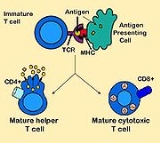
The T cell receptor or TCR is a molecule found on the surface of T lymphocytes (or T cells) that is responsible for recognizing antigen
s bound to major histocompatibility complex
(MHC) molecules. The binding between TCR and antigen is of relatively low affinity and is degenerate
: that is, many TCR recognize the same antigen and many antigens are recognized by the same TCR.
The TCR is composed of two different protein chains (that is, it is a hetero
dimer
). In 95% of T cells, this consists of an alpha (α) and beta (β) chain, whereas in 5% of T cells this consists of gamma and delta (γ/δ) chains.
When the TCR engages with antigen and MHC, the T lymphocyte is activated through a series of biochemical events mediated by associated enzymes, co-receptors, specialized accessory molecules, and activated or released transcription factors.
) of protein chains. The halves are called the alpha (α) and beta (β) fragments (in γ/δ T cells, the halves are gamma (γ) and delta (δ) fragments). Each fragment is divided in turn into a constant (C) and variable (V) region. The constant region has an end that is anchored in the cell membrane. The variable region faces outward and binds to the HLA
molecule and the antigen it presents. On the α chain, the variable region is called Vα and the constant region is called Cα; on the β chain, they are called Vβ and Cβ, respectively.
The structure of TCR is very similar to immunoglobulin Fab fragments, which are regions defined as the combined light and heavy chain of an antibody arm. Each chain of the TCR is a member of the immunoglobulin superfamily
and possesses one N-terminal immunoglobulin (Ig)-variable (V) domain, one Ig-constant (C) domain, a transmembrane/cell membrane-spanning region, and a short cytoplasmic tail at the C-terminal end.
The variable domain of both the TCR α-chain and β-chain have three hypervariable or complementarity determining region
s (CDRs), whereas the variable region of the β-chain has an additional area of hypervariability (HV4) that does not normally contact antigen and, therefore, is not considered a CDR.
The residues are located in two regions of the TCR, at the interface of the α- and β-chains and in the β-chain framework region that is thought to be in proximity to the CD3 signal-transduction complex. CDR3 is the main CDR responsible for recognizing processed antigen
, although CDR1 of the alpha chain has also been shown to interact with the N-terminal part of the antigenic peptide, whereas CDR1 of the β-chain interacts with the C-terminal part of the peptide.
CDR2 is thought to recognize the MHC. CDR4 of the β-chain is not thought to participate in antigen recognition, but has been shown to interact with superantigen
s.
The constant domain of the TCR domain consists of short connecting sequences in which a cysteine residue forms disulfide bonds, which forms a link between the two chains.
antigen receptors, otherwise known as immunoglobulins.
The intersection of these specific regions (V and J for the alpha or gamma chain; V, D, and J for the beta or delta chain) corresponds to the CDR3 region that is important for antigen-MHC recognition (see above).
It is the unique combination of the segments at this region, along with palindromic and random N- and P- nucleotide additions, which accounts for the great diversity in specificity of the T cell receptor for processed antigen.
It is thought that such structure allows the TCR to associate with other molecules like CD3
, which possess three distinct chains (γ, δ, and ε) in mammals and either a ζ2 complex or a ζ/η complex.
These accessory molecules have negatively charged transmembrane regions and are vital to propagating the signal from the TCR into the cell; the cytoplasmic tail of the TCR is extremely short, making it unlikely to participate in signaling.
The CD3- and ζ-chains, together with the TCR, form what is known as the T cell receptor complex.
.
The co-receptor not only ensures the specificity of the TCR for an antigen but also allows prolonged engagement between the antigen-presenting cell
and the T cell and recruits essential molecules (e.g., LCK
) inside the cell involved in the signaling of the activated T lymphocyte.
The most common mechanism for activation and regulation of molecules beneath the lipid bilayer is via phosphorylation/dephosphorylation by protein kinases. T-cells utilise the SRC family of kinases in transmembrane signalling largely to phosphorylate tyrosines that are part of immunoreceptor tyrosine-based activation motifs (ITAM).
Early signaling steps implicate the following kinases in TCR associated reactions.
Antigen
An antigen is a foreign molecule that, when introduced into the body, triggers the production of an antibody by the immune system. The immune system will then kill or neutralize the antigen that is recognized as a foreign and potentially harmful invader. These invaders can be molecules such as...
s bound to major histocompatibility complex
Major histocompatibility complex
Major histocompatibility complex is a cell surface molecule encoded by a large gene family in all vertebrates. MHC molecules mediate interactions of leukocytes, also called white blood cells , which are immune cells, with other leukocytes or body cells...
(MHC) molecules. The binding between TCR and antigen is of relatively low affinity and is degenerate
Degeneracy (biology)
Within biological systems, degeneracy refers to circumstances where structurally dissimilar components/modules/pathways can perform similar functions under certain conditions, but perform distinct functions in other conditions. Degeneracy is thus a relational property that requires comparing the...
: that is, many TCR recognize the same antigen and many antigens are recognized by the same TCR.
The TCR is composed of two different protein chains (that is, it is a hetero
Heteromer
-Pharmacology:* Ligand-gated ion channels such as the nicotinic acetylcholine receptor and GABAA receptor are composed of five subunits arranged around a central pore that opens to allow ions to pass through. There are a large number of different subunits available, which can come together in a...
dimer
Protein dimer
In biochemistry, a dimer is a macromolecular complex formed by two, usually non-covalently bound, macromolecules like proteins or nucleic acids...
). In 95% of T cells, this consists of an alpha (α) and beta (β) chain, whereas in 5% of T cells this consists of gamma and delta (γ/δ) chains.
When the TCR engages with antigen and MHC, the T lymphocyte is activated through a series of biochemical events mediated by associated enzymes, co-receptors, specialized accessory molecules, and activated or released transcription factors.
Structural characteristics of the TCR
TCR, which is anchored in the cell membrane, consists of two halves, which form a pair (or dimerProtein dimer
In biochemistry, a dimer is a macromolecular complex formed by two, usually non-covalently bound, macromolecules like proteins or nucleic acids...
) of protein chains. The halves are called the alpha (α) and beta (β) fragments (in γ/δ T cells, the halves are gamma (γ) and delta (δ) fragments). Each fragment is divided in turn into a constant (C) and variable (V) region. The constant region has an end that is anchored in the cell membrane. The variable region faces outward and binds to the HLA
Human leukocyte antigen
The human leukocyte antigen system is the name of the major histocompatibility complex in humans. The super locus contains a large number of genes related to immune system function in humans. This group of genes resides on chromosome 6, and encodes cell-surface antigen-presenting proteins and...
molecule and the antigen it presents. On the α chain, the variable region is called Vα and the constant region is called Cα; on the β chain, they are called Vβ and Cβ, respectively.
The structure of TCR is very similar to immunoglobulin Fab fragments, which are regions defined as the combined light and heavy chain of an antibody arm. Each chain of the TCR is a member of the immunoglobulin superfamily
Immunoglobulin superfamily
The immunoglobulin superfamily is a large group of cell surface and soluble proteins that are involved in the recognition, binding, or adhesion processes of cells. Molecules are categorized as members of this superfamily based on shared structural features with immunoglobulins ; they all possess a...
and possesses one N-terminal immunoglobulin (Ig)-variable (V) domain, one Ig-constant (C) domain, a transmembrane/cell membrane-spanning region, and a short cytoplasmic tail at the C-terminal end.
The variable domain of both the TCR α-chain and β-chain have three hypervariable or complementarity determining region
Complementarity determining region
Complementarity determining regions are regions within antibodies or T cell receptors where these proteins complement an antigen's shape. Thus, CDRs determine the protein's affinity and specificity for specific antigens...
s (CDRs), whereas the variable region of the β-chain has an additional area of hypervariability (HV4) that does not normally contact antigen and, therefore, is not considered a CDR.
The residues are located in two regions of the TCR, at the interface of the α- and β-chains and in the β-chain framework region that is thought to be in proximity to the CD3 signal-transduction complex. CDR3 is the main CDR responsible for recognizing processed antigen
Antigen processing
Antigen processing is a biological process that prepares antigens for presentation to special cells of the immune system called T lymphocytes. This process involves two distinct pathways for processing of antigens from an organism's own proteins or intracellular pathogens , or from phagocytosed...
, although CDR1 of the alpha chain has also been shown to interact with the N-terminal part of the antigenic peptide, whereas CDR1 of the β-chain interacts with the C-terminal part of the peptide.
CDR2 is thought to recognize the MHC. CDR4 of the β-chain is not thought to participate in antigen recognition, but has been shown to interact with superantigen
Superantigen
Superantigens are a class of antigens which cause non-specific activation of T-cells resulting in oligoclonal T cell activation and massive cytokine release...
s.
The constant domain of the TCR domain consists of short connecting sequences in which a cysteine residue forms disulfide bonds, which forms a link between the two chains.
Generation of the TCR
Processes for TCR formation are similar to those described for B cellB cell
B cells are lymphocytes that play a large role in the humoral immune response . The principal functions of B cells are to make antibodies against antigens, perform the role of antigen-presenting cells and eventually develop into memory B cells after activation by antigen interaction...
antigen receptors, otherwise known as immunoglobulins.
- The TCR alpha chain is generated by VJ recombination, whereas the beta chain is generated by V(D)J recombinationV(D)J recombinationVJ recombination, also known as somatic recombination, is a mechanism of genetic recombination in the early stages of immunoglobulin and T cell receptors production of the immune system...
(both involve a somewhat random joining of gene segments to generate the complete TCR chain).
- Likewise, generation of the TCR gamma chain involves VJ recombination, whereas generation of the TCR delta chain occurs by V(D)J recombination.
The intersection of these specific regions (V and J for the alpha or gamma chain; V, D, and J for the beta or delta chain) corresponds to the CDR3 region that is important for antigen-MHC recognition (see above).
It is the unique combination of the segments at this region, along with palindromic and random N- and P- nucleotide additions, which accounts for the great diversity in specificity of the T cell receptor for processed antigen.
The TCR complex
The transmembrane region of the TCR is composed of positively charged amino acids.It is thought that such structure allows the TCR to associate with other molecules like CD3
CD3 receptor
In immunology, the CD3 T-Cell Co-Receptor is a protein complex and is composed of four distinct chains. In mammals, the complex contains a CD3γ chain, a CD3δ chain, and two CD3ε chains. These chains associate with a molecule known as the T cell receptor and the ζ-chain to generate an activation...
, which possess three distinct chains (γ, δ, and ε) in mammals and either a ζ2 complex or a ζ/η complex.
These accessory molecules have negatively charged transmembrane regions and are vital to propagating the signal from the TCR into the cell; the cytoplasmic tail of the TCR is extremely short, making it unlikely to participate in signaling.
The CD3- and ζ-chains, together with the TCR, form what is known as the T cell receptor complex.
TCR co-receptors
The signal from the T cell complex is enhanced by simultaneous binding of the MHC molecules by a specific co-receptorCo-receptor
A co-receptor is a cell surface receptor that binds a signalling molecule in addition to a primary receptor in order to facilitate ligand recognition and initiate biological processes, such as entry of a pathogen into a host cell.-Co-receptor Properties:...
.
- On helper T cells, this co-receptor is CD4CD4CD4 is a glycoprotein expressed on the surface of T helper cells, monocytes, macrophages, and dendritic cells. It was discovered in the late 1970s and was originally known as leu-3 and T4 before being named CD4 in 1984...
that is specific for class II MHC.
- On cytotoxic T cells, this co-receptor is CD8CD8CD8 is a transmembrane glycoprotein that serves as a co-receptor for the T cell receptor . Like the TCR, CD8 binds to a major histocompatibility complex molecule, but is specific for the class I MHC protein. There are two isoforms of the protein, alpha and beta, each encoded by a different gene...
that is specific for class I MHC.
The co-receptor not only ensures the specificity of the TCR for an antigen but also allows prolonged engagement between the antigen-presenting cell
Antigen-presenting cell
An antigen-presenting cell or accessory cell is a cell that displays foreign antigen complexes with major histocompatibility complex on their surfaces. T-cells may recognize these complexes using their T-cell receptors...
and the T cell and recruits essential molecules (e.g., LCK
Lck
Lck is a protein that is found inside specialized cells of the immune system called lymphocytes. Lck is a tyrosine kinase, which phosphorylates tyrosine residues of certain proteins involved in the intracellular signaling pathways of these lymphocytes...
) inside the cell involved in the signaling of the activated T lymphocyte.
Associated molecules of the TCR complex involved in T-cell activation
The essential function of the TCR complex is to identify specific bound antigen and elicit a distinct and critical response. The mechanism by which a T-cell elicits this response upon contact with its unique antigen is termed T-cell activation. There are myriad molecules involved in the complex biochemical process by which this occurs, which, in a wider context, is, in general, termed trans-membrane signalling.The most common mechanism for activation and regulation of molecules beneath the lipid bilayer is via phosphorylation/dephosphorylation by protein kinases. T-cells utilise the SRC family of kinases in transmembrane signalling largely to phosphorylate tyrosines that are part of immunoreceptor tyrosine-based activation motifs (ITAM).
Early signaling steps implicate the following kinases in TCR associated reactions.
- LckLckLck is a protein that is found inside specialized cells of the immune system called lymphocytes. Lck is a tyrosine kinase, which phosphorylates tyrosine residues of certain proteins involved in the intracellular signaling pathways of these lymphocytes...
- Associated with the transmembrane tail of CD4 - FynFYNProto-oncogene tyrosine-protein kinase Fyn is an enzyme that in humans is encoded by the FYN gene.This gene is a member of the protein-tyrosine kinase oncogene family. It encodes a membrane-associated tyrosine kinase that has been implicated in the control of cell growth...
- Associated with ITAMs of the IgAlpha and Igbeta regions of the TCR complex - CD45CD45Protein tyrosine phosphatase, receptor type, C also known as PTPRC is an enzyme that, in humans, is encoded by the PTPRC gene. PTPRC is also known as CD45 antigen , which was originally called leukocyte common antigen.- Function :The protein encoded by this gene is a member of the protein tyrosine...
- The transmembrane tail of which functions as a Tyrosine phosphatase) - Zap70 - Binds to ITAM sequences upon phosphorylation by Lck and Fyn
External links
- T-cell Group - Cardiff University - Zeta-zeta dimer of T cell receptor
See also
- T cellT cellT cells or T lymphocytes belong to a group of white blood cells known as lymphocytes, and play a central role in cell-mediated immunity. They can be distinguished from other lymphocytes, such as B cells and natural killer cells , by the presence of a T cell receptor on the cell surface. They are...
- Co-stimulationCo-stimulationDuring the activation of lymphocytes, co-stimulation is often crucial to the development of an effective immune response. Co-stimulation is required in addition to the antigen-specific signal from their antigen receptors.- Co-stimulation T cells require :...