

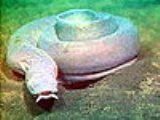
Hagfish

Encyclopedia
Hagfish, the clade Myxini (also known as Hyperotreti), are eel-shaped slime-producing marine animals (occasionally called slime eels). They are the only living animals that have a skull
but not a vertebral column
. Along with lampreys, hagfish are jawless and are living fossils whose next nearest relatives include all (other) vertebrates. Hagfish have been summarised as Lovecraftian.
The classification of hagfish has been controversial. The issue is whether the hagfish is itself a degenerate type of vertebrate-fish (most closely related to lampreys), or else may represent a stage which precedes the evolution of the vertebral column (as do lancelets). The original scheme groups hagfish and lampreys together as cyclostomes (or historically, Agnatha
), as the oldest surviving clade of vertebrates alongside gnathostomes (the now-ubiquitous jawed-vertebrates). An alternative scheme proposed that jawed-vertebrates are more closely related to lampreys than to hagfish (i..e, that vertebrates include lampreys but exclude hagfish), and introduces the category craniata
to group vertebrates near hagfish. Recent DNA evidence has supported the original scheme.
Hagfish, the clade Myxini (also known as Hyperotreti), are eel-shaped slime-producing marine animals (occasionally called slime eels). They are the only living animals that have a skull
but not a vertebral column
. Along with lampreys, hagfish are jawless and are living fossils whose next nearest relatives include all (other) vertebrates. Hagfish have been summarised as Lovecraftian.
The classification of hagfish has been controversial. The issue is whether the hagfish is itself a degenerate type of vertebrate-fish (most closely related to lampreys), or else may represent a stage which precedes the evolution of the vertebral column (as do lancelets). The original scheme groups hagfish and lampreys together as cyclostomes (or historically, Agnatha
), as the oldest surviving clade of vertebrates alongside gnathostomes (the now-ubiquitous jawed-vertebrates). An alternative scheme proposed that jawed-vertebrates are more closely related to lampreys than to hagfish (i..e, that vertebrates include lampreys but exclude hagfish), and introduces the category craniata
to group vertebrates near hagfish. Recent DNA evidence has supported the original scheme.
Hagfish, the clade Myxini (also known as Hyperotreti), are eel-shaped slime-producing marine animals (occasionally called slime eels). They are the only living animals that have a skull
but not a vertebral column
. Along with lampreys, hagfish are jawless and are living fossils whose next nearest relatives include all (other) vertebrates. Hagfish have been summarised as Lovecraftian.
The classification of hagfish has been controversial. The issue is whether the hagfish is itself a degenerate type of vertebrate-fish (most closely related to lampreys), or else may represent a stage which precedes the evolution of the vertebral column (as do lancelets). The original scheme groups hagfish and lampreys together as cyclostomes (or historically, Agnatha
), as the oldest surviving clade of vertebrates alongside gnathostomes (the now-ubiquitous jawed-vertebrates). An alternative scheme proposed that jawed-vertebrates are more closely related to lampreys than to hagfish (i..e, that vertebrates include lampreys but exclude hagfish), and introduces the category craniata
to group vertebrates near hagfish. Recent DNA evidence has supported the original scheme.
Hagfish have elongated, eel-like bodies, and paddle
-like tail
s. They have cartilaginous
skull
s (although the part surrounding the brain is composed primarily of a fibrous sheath) and tooth
-like structures composed of keratin
. Color
s depend on the species
, ranging from pink
to blue
-grey
, and black
or white
spots may be present. Eye
s are simple eyespots, not compound eyes that can resolve images. Hagfish have no true fin
s and have six or eight barbel
s around the mouth and a single nostril
. Instead of vertically articulating jaw
s like Gnathostomata
(vertebrate
s with jaws), they have a pair of horizontally
moving structures with tooth-like projections for pulling off food. The mouth of the hagfish has two pairs of horny, comb-shaped teeth on a cartilaginous plate that protracts and retracts. These teeth are used to grasp food and draw it toward the pharynx.http://tolweb.org/Hyperotreti
(from which the typical species Myxine glutinosa was named) of unusual composition. When captured and held, e.g., by the tail, they secrete the microfibrous slime, which expands into a gelatinous and sticky goo when combined with water; if they remain captured, they can tie themselves in an overhand knot
which works its way from the head to the tail of the animal, scraping off the slime as it goes and freeing them from their captor, as well as the slime. It has been conjectured that this singular behavior assists them in extricating themselves from the jaws of predatory fish or from the interior of their own "prey", and that the "sliming" might act as a distraction to predators.
Recently it has been reported that the slime entrains water in its microfilaments, creating a slow-to-dissipate viscoelastic substance, rather than a simple gel, and it has been proposed that the primary protective effect of the slime is related to impairment of the function of a predator fish's gills. It has been observed that most of the known predators of hagfish are varieties of birds or mammals; it has been proposed that the lack of marine predators can be explained by a "gill-clogging hypothesis", wherein one purpose of the slime is to impair the gill function of marine animals that attempt to prey on the hagfish. If true, it could be regarded as a highly successful evolutionary strategy against predatory fish.ibid.
Free-swimming hagfish also "slime" when agitated and will later clear the mucus off by way of the same travelling-knot behavior. The reported gill-clogging effect suggests that the travelling-knot behavior is useful or even necessary to restore the hagfish's own gill function after "sliming".
An adult hagfish can secrete enough slime to turn a 20 litre (5 gallon) bucket of water into slime in a matter of minutes.
Research is ongoing regarding the properties and possible applications of the components of hagfish slime filament protein.
, past the velar chamber and bringing the water through 6 internal gill
pouches. The gill pouches lead to a common aperture on the ventral side of the hagfish. The esophagus
is also connected to the common aperture on the ventral side through a pharyngocutaneous duct (esophageocutaneous duct), which has no respiratory tissue. It is likely that this pharyngocutaneous duct is used to cough up indigestible materials. Hagfish also have some cutaneous respiration via the blood sinuses
under their skin. This can be essential for hagfish to respire while feeding, since they do not have operculi
to beat to produce current across the gills (as in the case of teleost fish).
claiming the hagfish's eye, which lacks both lens and extrinsic musculature, as being significant to the evolution of more complex eyes
. Hagfish eyespots, when present, can detect light, but as far as is known none can resolve detailed images. In Myxine and Neomyxine, the eyes are partly covered by the trunk musculature.Hyperotreti - Hagfishes
and a testicle
(there is only one gamete production organ in both females and males). In some cases it is thought that the ovary remains non-functional until the individual has reached a particular age or encounters a particular environmental stress. These two factors in combination suggest that the survival rate of hagfish is quite high.
Depending on species, females lay from 1 or 2, to 20-30, tough, yolky eggs. These tend to aggregate due to having Velcro
-like tufts at either end. Hagfish are sometimes seen curled around small clutches of eggs. It is not certain if this constitutes actual brooding behavior.
Hagfish do not have a larva
l stage, in contrast to lamprey
s, which have a long larval phase.
Hagfish have a mesonephric kidney
and are often neotenic
of their pronephric kidney
. The kidney(s) are drained via mesonephric/archinephric duct. Unlike many other vertebrates, this duct is separate from the reproductive tract. Unlike all other vertebrates, the proximal tubule of the nephron
is also connected with the coelom
, provided lubrication.
The single testicle or ovary has no transportation duct. Instead, the gametes are released into the coelom until they find their way to the posterior end of the caudal region, whereby they find an opening in the digestive system.
marine worm
s on or near the sea floor are a major source of nutrition, hagfish can feed upon and often even enter and eviscerate the bodies of dead and dying/injured sea creatures much larger than themselves. They are known to devour their victims from the inside.Hagfish - World's weirdest animals Hagfish have the ability to absorb dissolved organic matter across the skin and gill, which may be an adaptation to a scavenging lifestyle, allowing hagfish to maximize sporadic opportunities for feeding. From an evolutionary perspective, hagfish represent a transitory state between the generalized nutrient absorption pathways of aquatic invertebrates and the more specialized digestive systems of aquatic vertebrates.
Like leech
es, they have a sluggish metabolism and can survive months between feedings; their feeding behavior, however, appears quite vigorous.
In captivity, hagfish are observed to use the overhand-knot behavior "in reverse" (tail-to-head) to assist them in gaining mechanical advantage to pull out hunks of flesh from carrion fish or cetaceans, eventually making an opening to permit entry to the interior of the body cavity of larger carcasses. It is to be expected that a healthy larger sea creature would be able to outfight or outswim this sort of assault.
However, this energetic opportunism on the part of the hagfish can be a great nuisance to fishermen, as they can devour or spoil entire deep-drag netted catches before they can be pulled to the surface. Since hagfish are typically found in large clusters on and near the bottom, a single trawler's catch could contain several dozen or even hundreds of hagfish as bycatch, and all the other struggling, captive sealife make easy prey for them.
The digestive tract of the hagfish is unique among the vertebrates because the food in the gut is enclosed in a permeable membrane, analogous to the peritrophic matrix
of insects.Piper, Ross (2007), Extraordinary Animals: An Encyclopedia of Curious and Unusual Animals, Greenwood Press.
, found in the Northwest Pacific,Fishbase - Eptatretus burgeri is valued as food in the Korean Peninsula
. The hagfish is kept alive and irritated by rattling its container with a stick. This produces the large quantity of slime that gives the hagfish its alternate, if inaccurate, name, "slime eel". This slime is used much as egg whites in various forms of cookery in the region.
The inshore hagfish, known as kkomjangeo (꼼장어) or meokjango (먹장어) in Korean
and Nuta-unagi (ぬたうなぎ) in Japanese
, is the only member of the hagfish family that has a seasonal reproductive cycle.
s. Their classification as agnatha
ns places hagfish as elementary vertebrate
s in between invertebrate
s and gnathostomes. However there has been long discussion in scientific literature about whether the hagfish were even non-vertebrate
. This position is supported by recent molecular biology
analyses which tend to classify hagfish as invertebrates (see references) within subphylum Craniata
, because of their molecular evolutionary distance from Vertebrata (sensu stricto). A single fossil of hagfish shows that there has been little evolutionary change in the last 300 million years.
Skull
The skull is a bony structure in the head of many animals that supports the structures of the face and forms a cavity for the brain.The skull is composed of two parts: the cranium and the mandible. A skull without a mandible is only a cranium. Animals that have skulls are called craniates...
but not a vertebral column
Vertebral column
In human anatomy, the vertebral column is a column usually consisting of 24 articulating vertebrae, and 9 fused vertebrae in the sacrum and the coccyx. It is situated in the dorsal aspect of the torso, separated by intervertebral discs...
. Along with lampreys, hagfish are jawless and are living fossils whose next nearest relatives include all (other) vertebrates. Hagfish have been summarised as Lovecraftian.
The classification of hagfish has been controversial. The issue is whether the hagfish is itself a degenerate type of vertebrate-fish (most closely related to lampreys), or else may represent a stage which precedes the evolution of the vertebral column (as do lancelets). The original scheme groups hagfish and lampreys together as cyclostomes (or historically, Agnatha
Agnatha
Agnatha is a superclass of jawless fish in the phylum Chordata, subphylum Vertebrata. The group excludes all vertebrates with jaws, known as gnathostomes....
), as the oldest surviving clade of vertebrates alongside gnathostomes (the now-ubiquitous jawed-vertebrates). An alternative scheme proposed that jawed-vertebrates are more closely related to lampreys than to hagfish (i..e, that vertebrates include lampreys but exclude hagfish), and introduces the category craniata
Craniata
Craniata is a proposed clade of chordate animals that contains the Myxini , Petromyzontida , and Gnathostomata as living representatives...
to group vertebrates near hagfish. Recent DNA evidence has supported the original scheme.
Hagfish, the clade Myxini (also known as Hyperotreti), are eel-shaped slime-producing marine animals (occasionally called slime eels). They are the only living animals that have a skull
Skull
The skull is a bony structure in the head of many animals that supports the structures of the face and forms a cavity for the brain.The skull is composed of two parts: the cranium and the mandible. A skull without a mandible is only a cranium. Animals that have skulls are called craniates...
but not a vertebral column
Vertebral column
In human anatomy, the vertebral column is a column usually consisting of 24 articulating vertebrae, and 9 fused vertebrae in the sacrum and the coccyx. It is situated in the dorsal aspect of the torso, separated by intervertebral discs...
. Along with lampreys, hagfish are jawless and are living fossils whose next nearest relatives include all (other) vertebrates. Hagfish have been summarised as Lovecraftian.
The classification of hagfish has been controversial. The issue is whether the hagfish is itself a degenerate type of vertebrate-fish (most closely related to lampreys), or else may represent a stage which precedes the evolution of the vertebral column (as do lancelets). The original scheme groups hagfish and lampreys together as cyclostomes (or historically, Agnatha
Agnatha
Agnatha is a superclass of jawless fish in the phylum Chordata, subphylum Vertebrata. The group excludes all vertebrates with jaws, known as gnathostomes....
), as the oldest surviving clade of vertebrates alongside gnathostomes (the now-ubiquitous jawed-vertebrates). An alternative scheme proposed that jawed-vertebrates are more closely related to lampreys than to hagfish (i..e, that vertebrates include lampreys but exclude hagfish), and introduces the category craniata
Craniata
Craniata is a proposed clade of chordate animals that contains the Myxini , Petromyzontida , and Gnathostomata as living representatives...
to group vertebrates near hagfish. Recent DNA evidence has supported the original scheme.
Hagfish, the clade Myxini (also known as Hyperotreti), are eel-shaped slime-producing marine animals (occasionally called slime eels). They are the only living animals that have a skull
Skull
The skull is a bony structure in the head of many animals that supports the structures of the face and forms a cavity for the brain.The skull is composed of two parts: the cranium and the mandible. A skull without a mandible is only a cranium. Animals that have skulls are called craniates...
but not a vertebral column
Vertebral column
In human anatomy, the vertebral column is a column usually consisting of 24 articulating vertebrae, and 9 fused vertebrae in the sacrum and the coccyx. It is situated in the dorsal aspect of the torso, separated by intervertebral discs...
. Along with lampreys, hagfish are jawless and are living fossils whose next nearest relatives include all (other) vertebrates. Hagfish have been summarised as Lovecraftian.
The classification of hagfish has been controversial. The issue is whether the hagfish is itself a degenerate type of vertebrate-fish (most closely related to lampreys), or else may represent a stage which precedes the evolution of the vertebral column (as do lancelets). The original scheme groups hagfish and lampreys together as cyclostomes (or historically, Agnatha
Agnatha
Agnatha is a superclass of jawless fish in the phylum Chordata, subphylum Vertebrata. The group excludes all vertebrates with jaws, known as gnathostomes....
), as the oldest surviving clade of vertebrates alongside gnathostomes (the now-ubiquitous jawed-vertebrates). An alternative scheme proposed that jawed-vertebrates are more closely related to lampreys than to hagfish (i..e, that vertebrates include lampreys but exclude hagfish), and introduces the category craniata
Craniata
Craniata is a proposed clade of chordate animals that contains the Myxini , Petromyzontida , and Gnathostomata as living representatives...
to group vertebrates near hagfish. Recent DNA evidence has supported the original scheme.
Physical characteristics
Body features
Hagfish average about half a metre (18 in); The largest known species is Eptatretus goliath with a specimen recorded at 127 cm, while Myxine kuoi and Myxine pequenoi seem to reach no more than 18 cm.Hagfish have elongated, eel-like bodies, and paddle
Paddle
A paddle is a tool used for pushing against liquids, either as a form of propulsion in a boat or as an implement for mixing.-Materials and designs:...
-like tail
Tail
The tail is the section at the rear end of an animal's body; in general, the term refers to a distinct, flexible appendage to the torso. It is the part of the body that corresponds roughly to the sacrum and coccyx in mammals, reptiles, and birds...
s. They have cartilaginous
Cartilage
Cartilage is a flexible connective tissue found in many areas in the bodies of humans and other animals, including the joints between bones, the rib cage, the ear, the nose, the elbow, the knee, the ankle, the bronchial tubes and the intervertebral discs...
skull
Skull
The skull is a bony structure in the head of many animals that supports the structures of the face and forms a cavity for the brain.The skull is composed of two parts: the cranium and the mandible. A skull without a mandible is only a cranium. Animals that have skulls are called craniates...
s (although the part surrounding the brain is composed primarily of a fibrous sheath) and tooth
Tooth
Teeth are small, calcified, whitish structures found in the jaws of many vertebrates that are used to break down food. Some animals, particularly carnivores, also use teeth for hunting or for defensive purposes. The roots of teeth are embedded in the Mandible bone or the Maxillary bone and are...
-like structures composed of keratin
Keratin
Keratin refers to a family of fibrous structural proteins. Keratin is the key of structural material making up the outer layer of human skin. It is also the key structural component of hair and nails...
. Color
Color
Color or colour is the visual perceptual property corresponding in humans to the categories called red, green, blue and others. Color derives from the spectrum of light interacting in the eye with the spectral sensitivities of the light receptors...
s depend on the species
Species
In biology, a species is one of the basic units of biological classification and a taxonomic rank. A species is often defined as a group of organisms capable of interbreeding and producing fertile offspring. While in many cases this definition is adequate, more precise or differing measures are...
, ranging from pink
Pink
Pink is a mixture of red and white. Commonly used for Valentine's Day and Easter, pink is sometimes referred to as "the color of love." The use of the word for the color known today as pink was first recorded in the late 17th century....
to blue
Blue
Blue is a colour, the perception of which is evoked by light having a spectrum dominated by energy with a wavelength of roughly 440–490 nm. It is considered one of the additive primary colours. On the HSV Colour Wheel, the complement of blue is yellow; that is, a colour corresponding to an equal...
-grey
Grey
Grey or gray is an achromatic or neutral color.Complementary colors are defined to mix to grey, either additively or subtractively, and many color models place complements opposite each other in a color wheel. To produce grey in RGB displays, the R, G, and B primary light sources are combined in...
, and black
Black
Black is the color of objects that do not emit or reflect light in any part of the visible spectrum; they absorb all such frequencies of light...
or white
White
White is a color, the perception of which is evoked by light that stimulates all three types of color sensitive cone cells in the human eye in nearly equal amounts and with high brightness compared to the surroundings. A white visual stimulation will be void of hue and grayness.White light can be...
spots may be present. Eye
Eye
Eyes are organs that detect light and convert it into electro-chemical impulses in neurons. The simplest photoreceptors in conscious vision connect light to movement...
s are simple eyespots, not compound eyes that can resolve images. Hagfish have no true fin
Fin
A fin is a surface used for stability and/or to produce lift and thrust or to steer while traveling in water, air, or other fluid media, . The first use of the word was for the limbs of fish, but has been extended to include other animal limbs and man-made devices...
s and have six or eight barbel
Barbel (anatomy)
A barbel on a fish is a slender, whiskerlike tactile organ near the mouth. Fish that have barbels include the catfish, the carp, the goatfish, sturgeon, the zebrafish and some species of shark...
s around the mouth and a single nostril
Nostril
A nostril is one of the two channels of the nose, from the point where they bifurcate to the external opening. In birds and mammals, they contain branched bones or cartilages called turbinates, whose function is to warm air on inhalation and remove moisture on exhalation...
. Instead of vertically articulating jaw
Jaw
The jaw is any opposable articulated structure at the entrance of the mouth, typically used for grasping and manipulating food. The term jaws is also broadly applied to the whole of the structures constituting the vault of the mouth and serving to open and close it and is part of the body plan of...
s like Gnathostomata
Gnathostomata
Gnathostomata is the group of vertebrates with jaws. The term derives from Greek γνάθος "jaw" + στόμα "mouth". Gnathostome diversity comprises roughly 60,000 species, which accounts for 99% of all living vertebrates...
(vertebrate
Vertebrate
Vertebrates are animals that are members of the subphylum Vertebrata . Vertebrates are the largest group of chordates, with currently about 58,000 species described. Vertebrates include the jawless fishes, bony fishes, sharks and rays, amphibians, reptiles, mammals, and birds...
s with jaws), they have a pair of horizontally
Horizontal plane
In geometry, physics, astronomy, geography, and related sciences, a plane is said to be horizontal at a given point if it is perpendicular to the gradient of the gravity field at that point— in other words, if apparent gravity makes a plumb bob hang perpendicular to the plane at that point.In...
moving structures with tooth-like projections for pulling off food. The mouth of the hagfish has two pairs of horny, comb-shaped teeth on a cartilaginous plate that protracts and retracts. These teeth are used to grasp food and draw it toward the pharynx.http://tolweb.org/Hyperotreti
Slime
Hagfish are long and vermiform, and can exude copious quantities of a slime or mucusMucus
In vertebrates, mucus is a slippery secretion produced by, and covering, mucous membranes. Mucous fluid is typically produced from mucous cells found in mucous glands. Mucous cells secrete products that are rich in glycoproteins and water. Mucous fluid may also originate from mixed glands, which...
(from which the typical species Myxine glutinosa was named) of unusual composition. When captured and held, e.g., by the tail, they secrete the microfibrous slime, which expands into a gelatinous and sticky goo when combined with water; if they remain captured, they can tie themselves in an overhand knot
Overhand knot
The overhand knot is one of the most fundamental knots and forms the basis of many others including the simple noose, overhand loop, angler's loop, reef knot, fisherman's knot and water knot. The overhand knot is very secure, to the point of jamming badly. It should be used if the knot is...
which works its way from the head to the tail of the animal, scraping off the slime as it goes and freeing them from their captor, as well as the slime. It has been conjectured that this singular behavior assists them in extricating themselves from the jaws of predatory fish or from the interior of their own "prey", and that the "sliming" might act as a distraction to predators.
Recently it has been reported that the slime entrains water in its microfilaments, creating a slow-to-dissipate viscoelastic substance, rather than a simple gel, and it has been proposed that the primary protective effect of the slime is related to impairment of the function of a predator fish's gills. It has been observed that most of the known predators of hagfish are varieties of birds or mammals; it has been proposed that the lack of marine predators can be explained by a "gill-clogging hypothesis", wherein one purpose of the slime is to impair the gill function of marine animals that attempt to prey on the hagfish. If true, it could be regarded as a highly successful evolutionary strategy against predatory fish.ibid.
Free-swimming hagfish also "slime" when agitated and will later clear the mucus off by way of the same travelling-knot behavior. The reported gill-clogging effect suggests that the travelling-knot behavior is useful or even necessary to restore the hagfish's own gill function after "sliming".
An adult hagfish can secrete enough slime to turn a 20 litre (5 gallon) bucket of water into slime in a matter of minutes.
Research is ongoing regarding the properties and possible applications of the components of hagfish slime filament protein.
Respiration
Hagfish generally respire through taking in water through their pharynxPharynx
The human pharynx is the part of the throat situated immediately posterior to the mouth and nasal cavity, and anterior to the esophagus and larynx. The human pharynx is conventionally divided into three sections: the nasopharynx , the oropharynx , and the laryngopharynx...
, past the velar chamber and bringing the water through 6 internal gill
Gill
A gill is a respiratory organ found in many aquatic organisms that extracts dissolved oxygen from water, afterward excreting carbon dioxide. The gills of some species such as hermit crabs have adapted to allow respiration on land provided they are kept moist...
pouches. The gill pouches lead to a common aperture on the ventral side of the hagfish. The esophagus
Esophagus
The esophagus is an organ in vertebrates which consists of a muscular tube through which food passes from the pharynx to the stomach. During swallowing, food passes from the mouth through the pharynx into the esophagus and travels via peristalsis to the stomach...
is also connected to the common aperture on the ventral side through a pharyngocutaneous duct (esophageocutaneous duct), which has no respiratory tissue. It is likely that this pharyngocutaneous duct is used to cough up indigestible materials. Hagfish also have some cutaneous respiration via the blood sinuses
Sinus (anatomy)
Sinus is Latin for "bay", "pocket", "curve", or "bosom". In anatomy, the term is used in various contexts.A sinus is a sack or cavity in any organ or tissue, or an abnormal cavity or passage caused by the destruction of tissue...
under their skin. This can be essential for hagfish to respire while feeding, since they do not have operculi
Operculum (fish)
The operculum of a bony fish is the hard bony flap covering and protecting the gills. In most fish, the rear edge of the operculum roughly marks the division between the head and the body....
to beat to produce current across the gills (as in the case of teleost fish).
Eye
In December 2003, an article was published by the University of QueenslandUniversity of Queensland
The University of Queensland, also known as UQ, is a public university located in state of Queensland, Australia. Founded in 1909, it is the oldest and largest university in Queensland and the fifth oldest in the nation...
claiming the hagfish's eye, which lacks both lens and extrinsic musculature, as being significant to the evolution of more complex eyes
Evolution of the eye
The evolution of the eye has been a subject of significant study, as a distinctive example of a homologous organ present in a wide variety of taxa. Certain components of the eye, such as the visual pigments, appear to have a common ancestry – that is, they evolved once, before the animals radiated...
. Hagfish eyespots, when present, can detect light, but as far as is known none can resolve detailed images. In Myxine and Neomyxine, the eyes are partly covered by the trunk musculature.Hyperotreti - Hagfishes
Reproduction
Very little is known about hagfish reproduction. In some species, sex ratio has been reported to be as high as 100:1 in favor of females. Some hagfish species are thought to be hermaphroditic, having both an ovaryOvary
The ovary is an ovum-producing reproductive organ, often found in pairs as part of the vertebrate female reproductive system. Ovaries in anatomically female individuals are analogous to testes in anatomically male individuals, in that they are both gonads and endocrine glands.-Human anatomy:Ovaries...
and a testicle
Testicle
The testicle is the male gonad in animals. Like the ovaries to which they are homologous, testes are components of both the reproductive system and the endocrine system...
(there is only one gamete production organ in both females and males). In some cases it is thought that the ovary remains non-functional until the individual has reached a particular age or encounters a particular environmental stress. These two factors in combination suggest that the survival rate of hagfish is quite high.
Depending on species, females lay from 1 or 2, to 20-30, tough, yolky eggs. These tend to aggregate due to having Velcro
Velcro
Velcro is the brand name of the first commercially marketed fabric hook-and-loop fastener, invented in 1948 by the Swiss electrical engineer George de Mestral...
-like tufts at either end. Hagfish are sometimes seen curled around small clutches of eggs. It is not certain if this constitutes actual brooding behavior.
Hagfish do not have a larva
Larva
A larva is a distinct juvenile form many animals undergo before metamorphosis into adults. Animals with indirect development such as insects, amphibians, or cnidarians typically have a larval phase of their life cycle...
l stage, in contrast to lamprey
Lamprey
Lampreys are a family of jawless fish, whose adults are characterized by a toothed, funnel-like sucking mouth. Translated from an admixture of Latin and Greek, lamprey means stone lickers...
s, which have a long larval phase.
Hagfish have a mesonephric kidney
Mesonephros
The mesonephros is one of three excretory organs that develop in vertebrates. It serves as the main excretory organ of aquatic vertebrates and as a temporary kidney in reptiles, birds, and mammals. The mesonephros is included in the Wolffian body after Caspar Friedrich Wolff who described it in 1759...
and are often neotenic
Neoteny
Neoteny , also called juvenilization , is one of the two ways by which paedomorphism can arise. Paedomorphism is the retention by adults of traits previously seen only in juveniles, and is a subject studied in the field of developmental biology. In neoteny, the physiological development of an...
of their pronephric kidney
Pronephros
Pronephros the most basic of the three excretory organs that develop in vertebrates, corresponding to the first stage of kidney development. It is succeeded by the mesonephros, which in fish and amphibians remains as the adult kidney. In amniotes the mesonephros is the embryonic kidney and a more...
. The kidney(s) are drained via mesonephric/archinephric duct. Unlike many other vertebrates, this duct is separate from the reproductive tract. Unlike all other vertebrates, the proximal tubule of the nephron
Nephron
The renal tubule is the portion of the nephron containing the tubular fluid filtered through the glomerulus. After passing through the renal tubule, the filtrate continues to the collecting duct system, which is not part of the nephron....
is also connected with the coelom
Coelom
The coelom is a fluid-filled cavity formed within the mesoderm. Coeloms developed in triploblasts but were subsequently lost in several lineages. Loss of coelom is correlated with reduction in body size...
, provided lubrication.
The single testicle or ovary has no transportation duct. Instead, the gametes are released into the coelom until they find their way to the posterior end of the caudal region, whereby they find an opening in the digestive system.
Feeding
While polychaetePolychaete
The Polychaeta or polychaetes are a class of annelid worms, generally marine. Each body segment has a pair of fleshy protrusions called parapodia that bear many bristles, called chaetae, which are made of chitin. Indeed, polychaetes are sometimes referred to as bristle worms. More than 10,000...
marine worm
Marine worm
Any worm that lives in a marine environment is considered a marine worm. Marine worms are found in several different phyla, including the Platyhelminthes, Nematoda, Annelida , Chaetognatha, Hemichordata, and Phoronida....
s on or near the sea floor are a major source of nutrition, hagfish can feed upon and often even enter and eviscerate the bodies of dead and dying/injured sea creatures much larger than themselves. They are known to devour their victims from the inside.Hagfish - World's weirdest animals Hagfish have the ability to absorb dissolved organic matter across the skin and gill, which may be an adaptation to a scavenging lifestyle, allowing hagfish to maximize sporadic opportunities for feeding. From an evolutionary perspective, hagfish represent a transitory state between the generalized nutrient absorption pathways of aquatic invertebrates and the more specialized digestive systems of aquatic vertebrates.
Like leech
Leech
Leeches are segmented worms that belong to the phylum Annelida and comprise the subclass Hirudinea. Like other oligochaetes such as earthworms, leeches share a clitellum and are hermaphrodites. Nevertheless, they differ from other oligochaetes in significant ways...
es, they have a sluggish metabolism and can survive months between feedings; their feeding behavior, however, appears quite vigorous.
In captivity, hagfish are observed to use the overhand-knot behavior "in reverse" (tail-to-head) to assist them in gaining mechanical advantage to pull out hunks of flesh from carrion fish or cetaceans, eventually making an opening to permit entry to the interior of the body cavity of larger carcasses. It is to be expected that a healthy larger sea creature would be able to outfight or outswim this sort of assault.
However, this energetic opportunism on the part of the hagfish can be a great nuisance to fishermen, as they can devour or spoil entire deep-drag netted catches before they can be pulled to the surface. Since hagfish are typically found in large clusters on and near the bottom, a single trawler's catch could contain several dozen or even hundreds of hagfish as bycatch, and all the other struggling, captive sealife make easy prey for them.
The digestive tract of the hagfish is unique among the vertebrates because the food in the gut is enclosed in a permeable membrane, analogous to the peritrophic matrix
Peritrophic matrix
The peritrophic matrix or peritrophic membrane is a semi-permeable, non-cellular structure which surrounds the food bolus in an organism’s midgut. Although they are often found in insects, peritrophic matrixes are found in seven different phyla...
of insects.Piper, Ross (2007), Extraordinary Animals: An Encyclopedia of Curious and Unusual Animals, Greenwood Press.
Gastronomy
Hagfish are usually not eaten owing to their repugnant looks, as well as their viscosity and unpleasant habits. However, a particular species, the inshore hagfishInshore hagfish
The inshore hagfish is a hagfish of the genus Eptatretus.The inshore hagfish is found in the Northwest Pacific, from the Sea of Japan and across eastern Japan to Taiwan. It has six pairs of gill pouches and gill apertures....
, found in the Northwest Pacific,Fishbase - Eptatretus burgeri is valued as food in the Korean Peninsula
Korean Peninsula
The Korean Peninsula is a peninsula in East Asia. It extends southwards for about 684 miles from continental Asia into the Pacific Ocean and is surrounded by the Sea of Japan to the south, and the Yellow Sea to the west, the Korea Strait connecting the first two bodies of water.Until the end of...
. The hagfish is kept alive and irritated by rattling its container with a stick. This produces the large quantity of slime that gives the hagfish its alternate, if inaccurate, name, "slime eel". This slime is used much as egg whites in various forms of cookery in the region.
The inshore hagfish, known as kkomjangeo (꼼장어) or meokjango (먹장어) in Korean
Korean language
Korean is the official language of the country Korea, in both South and North. It is also one of the two official languages in the Yanbian Korean Autonomous Prefecture in People's Republic of China. There are about 78 million Korean speakers worldwide. In the 15th century, a national writing...
and Nuta-unagi (ぬたうなぎ) in Japanese
Japanese language
is a language spoken by over 130 million people in Japan and in Japanese emigrant communities. It is a member of the Japonic language family, which has a number of proposed relationships with other languages, none of which has gained wide acceptance among historical linguists .Japanese is an...
, is the only member of the hagfish family that has a seasonal reproductive cycle.
Classification
In recent years hagfish have become of special interest for genetic analysis investigating the relationships among chordateChordate
Chordates are animals which are either vertebrates or one of several closely related invertebrates. They are united by having, for at least some period of their life cycle, a notochord, a hollow dorsal nerve cord, pharyngeal slits, an endostyle, and a post-anal tail...
s. Their classification as agnatha
Agnatha
Agnatha is a superclass of jawless fish in the phylum Chordata, subphylum Vertebrata. The group excludes all vertebrates with jaws, known as gnathostomes....
ns places hagfish as elementary vertebrate
Vertebrate
Vertebrates are animals that are members of the subphylum Vertebrata . Vertebrates are the largest group of chordates, with currently about 58,000 species described. Vertebrates include the jawless fishes, bony fishes, sharks and rays, amphibians, reptiles, mammals, and birds...
s in between invertebrate
Invertebrate
An invertebrate is an animal without a backbone. The group includes 97% of all animal species – all animals except those in the chordate subphylum Vertebrata .Invertebrates form a paraphyletic group...
s and gnathostomes. However there has been long discussion in scientific literature about whether the hagfish were even non-vertebrate
Invertebrate
An invertebrate is an animal without a backbone. The group includes 97% of all animal species – all animals except those in the chordate subphylum Vertebrata .Invertebrates form a paraphyletic group...
. This position is supported by recent molecular biology
Molecular biology
Molecular biology is the branch of biology that deals with the molecular basis of biological activity. This field overlaps with other areas of biology and chemistry, particularly genetics and biochemistry...
analyses which tend to classify hagfish as invertebrates (see references) within subphylum Craniata
Craniata
Craniata is a proposed clade of chordate animals that contains the Myxini , Petromyzontida , and Gnathostomata as living representatives...
, because of their molecular evolutionary distance from Vertebrata (sensu stricto). A single fossil of hagfish shows that there has been little evolutionary change in the last 300 million years.
Genera
As of February 2011, about 77 species are known, in 5 genera (two are being retained in the no-longer recognized genus Paramyxine and are awaiting taxonomic issues to be resolved before being transferred to Eptatretus (see below)). A number of the species have only been recently discovered, living at depths of several hundred metres.- EptatretusEptatretusEptatretus is a large genus of hagfish. It has at around 48 described species at present.-Species:* Eptatretus alastairi Mincarone & Fernholm, 2010* Eptatretus ancon...
- MyxineMyxineMyxine is a genus of hagfish.- Species :* Myxine affinis Günther, 1870 * Myxine australis Jenyns, 1842 * Myxine capensis Regan, 1913...
- NemamyxineNemamyxineNemamyxine is a genus of hagfish. It contains two species.-Species:** Nemamyxine elongata L. R. Richardson, 1958** Nemamyxine kreffti McMillan & Wisner, 1982...
- Neomyxine
- Notomyxine
- ParamyxineParamyxineParamyxine is a now invalid genus of hagfish being a junior synonym of Eptatretus. It currently includes two species, both of which belong in the genus Eptatretus...
(Note that this genus is considered synonymousSynonym (taxonomy)In scientific nomenclature, a synonym is a scientific name that is or was used for a taxon of organisms that also goes by a different scientific name. For example, Linnaeus was the first to give a scientific name to the Norway spruce, which he called Pinus abies...
with Eptatretus and most species have been moved into that genus with the exception of the following two which are homonyms of current Eptatretus species. Since the current Eptatretus species are junior (i.e., described later) to the two following species, they must be renamed and then the two remaining "paramyxines" will be transferred to Eptatretus.)
Further reading
- Bardack, D. (1991). First fossil hagfish (Myxinoidea): a record from the Pennsylvanian of Illinois. Science, 254, 701-703.
- Bardack, D., and Richardson, E. S. Jr. (1977). New agnathous fishes from the Pennsylvanian of Illinois. Fieldiana: Geology, 33, 489-510.
- Brodal, A. and Fänge, R. (ed.) (1963). The Biology of Myxine, Universitetsforlaget, Oslo.
- Fernholm, B. and Holmberg, K. (1975). The eyes in three genera of hagfish (Eptatretus, Paramyxine and Myxine) - A case of degenerative evolution. Vision Research, 15, 253-259.
- Hardisty, M. W. (1982). Lampreys and hagfishes: Analysis of cyclostome relationships. In The Biology of Lampreys, (ed. M. W. Hardisty and I. C. Potter), Vol.4B, pp. 165–259. Academic Press, London.
- Janvier, P. (1996). Early vertebrates. Oxford Monographs in Geology and Geophysics, 33, Oxford University Press, Oxford.
- Marinelli, W. and Strenger, A. (1956). Vergleichende Anatomie und Morphologie der Wirberltiere. Myxine glutinosa. Franz Deuticke, Vienna.
- Yalden, D.W. (1985). Feeding mechanisms as evidence for cyclostome monophyly. Zoological Journal of the Linnean Society. 84, 291-300.
- Stock, D. W. and Whitt, G. S. (1992). Evidence from 18S ribosomal RNA that lampreys and hagfishes form a natural group. Science, 257, 787-789.
External links
- FishBase entry for Myxinidae
- OceanLink description of hagfish
- Tree of life illustration showing hagfish's relation to other organisms
- YouTube 5+ minute video of Scripps scientist/diver on hagfish
- Metacafe video of a University of Alberta grad student showing slime production of hagfish while in Bamfield, British Columbia
- Beware the hagfish - repeller of sharks 3 News, 28 Oct 2011. Video.