
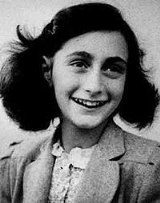
Annelies Marie "
Anne"
Frank is one of the most renowned and most discussed Jewish victims of the
HolocaustThe Holocaust , also known as the Shoah , was the genocide of approximately six million European Jews and millions of others during World War II, a programme of systematic state-sponsored murder by Nazi...
. Acknowledged for the quality of her writing,
her diaryThe Diary of a Young Girl is a book of the writings from the Dutch language diary kept by Anne Frank while she was in hiding for two years with her family during the Nazi occupation of the Netherlands. The family was apprehended in 1944 and Anne Frank ultimately died of typhus in the Bergen-Belsen...
has become one of the world's most widely read books, and has been the basis for several plays and films.
Born in the city of Frankfurt am Main in
Weimar GermanyThe Weimar Republic is the name given by historians to the parliamentary republic established in 1919 in Germany to replace the imperial form of government...
, she lived most of her life in or near
AmsterdamAmsterdam is the largest city and the capital of the Netherlands. The current position of Amsterdam as capital city of the Kingdom of the Netherlands is governed by the constitution of August 24, 1815 and its successors. Amsterdam has a population of 783,364 within city limits, an urban population...
, in the
NetherlandsThe Netherlands is a constituent country of the Kingdom of the Netherlands, located mainly in North-West Europe and with several islands in the Caribbean. Mainland Netherlands borders the North Sea to the north and west, Belgium to the south, and Germany to the east, and shares maritime borders...
. By nationality, she was officially considered a
GermanThe Germanic peoples are an Indo-European ethno-linguistic group of Northern European origin, identified by their use of the Indo-European Germanic languages which diversified out of Proto-Germanic during the Pre-Roman Iron Age.Originating about 1800 BCE from the Corded Ware Culture on the North...
until 1941, when she lost her nationality owing to the anti-Semitic policies of
Nazi GermanyNazi Germany , also known as the Third Reich , but officially called German Reich from 1933 to 1943 and Greater German Reich from 26 June 1943 onward, is the name commonly used to refer to the state of Germany from 1933 to 1945, when it was a totalitarian dictatorship ruled by...
(the
Nuremberg LawsThe Nuremberg Laws of 1935 were antisemitic laws in Nazi Germany introduced at the annual Nuremberg Rally of the Nazi Party. After the takeover of power in 1933 by Hitler, Nazism became an official ideology incorporating scientific racism and antisemitism...
). She gained international fame posthumously following the publication of her diary, which documents her experiences hiding during the German occupation of the
NetherlandsThe Netherlands is a constituent country of the Kingdom of the Netherlands, located mainly in North-West Europe and with several islands in the Caribbean. Mainland Netherlands borders the North Sea to the north and west, Belgium to the south, and Germany to the east, and shares maritime borders...
in
World War IIWorld War II, or the Second World War , was a global conflict lasting from 1939 to 1945, involving most of the world's nations—including all of the great powers—eventually forming two opposing military alliances: the Allies and the Axis...
.
The Frank family moved from Germany to
AmsterdamAmsterdam is the largest city and the capital of the Netherlands. The current position of Amsterdam as capital city of the Kingdom of the Netherlands is governed by the constitution of August 24, 1815 and its successors. Amsterdam has a population of 783,364 within city limits, an urban population...
in 1933, the year the
NazisNazism, the common short form name of National Socialism was the ideology and practice of the Nazi Party and of Nazi Germany...
gained control over
GermanyGermany , officially the Federal Republic of Germany , is a federal parliamentary republic in Europe. The country consists of 16 states while the capital and largest city is Berlin. Germany covers an area of 357,021 km2 and has a largely temperate seasonal climate...
. By the beginning of 1940, they were trapped in Amsterdam by the Nazi occupation of the Netherlands. As persecutions of the Jewish population increased in July 1942, the family went into hiding in the hidden rooms of Anne's father,
Otto Frank Otto Heinrich "Pim" Frank was a German-born businessman and the father of Anne Frank and Margot Frank...
's, office building. After two years, the group was betrayed and transported to
concentration campsInternment is the imprisonment or confinement of people, commonly in large groups, without trial. The Oxford English Dictionary gives the meaning as: "The action of 'interning'; confinement within the limits of a country or place." Most modern usage is about individuals, and there is a distinction...
. Anne Frank and her sister,
MargotMargot Betti Frank was the older sister of Anne Frank, whose deportation order from the Gestapo hastened the Frank family into hiding, and who subsequently perished in Bergen-Belsen...
, were eventually transferred to the
Bergen-Belsen concentration campBergen-Belsen was a Nazi concentration camp in Lower Saxony in northwestern Germany, southwest of the town of Bergen near Celle...
, where they both died of
typhusEpidemic typhus is a form of typhus so named because the disease often causes epidemics following wars and natural disasters...
in March 1945.
Otto Frank, the only survivor of the family, returned to Amsterdam after the war to find that Anne's diary had been saved, and his efforts led to its publication in 1947. It was translated from its original Dutch and first published in English in 1952 as
The Diary of a Young GirlThe Diary of a Young Girl is a book of the writings from the Dutch language diary kept by Anne Frank while she was in hiding for two years with her family during the Nazi occupation of the Netherlands. The family was apprehended in 1944 and Anne Frank ultimately died of typhus in the Bergen-Belsen...
. It has since been translated into many languages. The diary, which was given to Anne on her 13th birthday, chronicles her life from 12 June 1942 until 1 August 1944.
Early life
Anne Frank was born on 12 June 1929 in Frankfurt, Germany, the second daughter of
Otto Frank Otto Heinrich "Pim" Frank was a German-born businessman and the father of Anne Frank and Margot Frank...
(1889–1980) and Edith Frank-Holländer (1900–45).
Margot FrankMargot Betti Frank was the older sister of Anne Frank, whose deportation order from the Gestapo hastened the Frank family into hiding, and who subsequently perished in Bergen-Belsen...
(1926–45) was her elder sister. The Franks were
liberal JewsProgressive Judaism , is an umbrella term used by strands of Judaism which affiliate to the World Union for Progressive Judaism. They embrace pluralism, modernity, equality and social justice as core values and believe that such values are consistent with a committed Jewish life...
, did not observe all of the customs and traditions of
JudaismJudaism ) is the "religion, philosophy, and way of life" of the Jewish people...
, and lived in an
assimilatedCultural assimilation is a socio-political response to demographic multi-ethnicity that supports or promotes the assimilation of ethnic minorities into the dominant culture. The term assimilation is often used with regard to immigrants and various ethnic groups who have settled in a new land. New...
community of Jewish and non-Jewish citizens of various religions. Edith Frank was the more devout parent, while Otto Frank was interested in scholarly pursuits and had an extensive library; both parents encouraged the children to read.
On 13 March 1933, elections were held in Frankfurt for the municipal council, and
Adolf HitlerAdolf Hitler was an Austrian-born German politician and the leader of the National Socialist German Workers Party , commonly referred to as the Nazi Party). He was Chancellor of Germany from 1933 to 1945, and head of state from 1934 to 1945...
's Nazi Party won. Antisemitic demonstrations occurred almost immediately, and the Franks began to fear what would happen to them if they remained in Germany. Later that year, Edith and the children went to
AachenAachen has historically been a spa town in North Rhine-Westphalia, Germany. Aachen was a favoured residence of Charlemagne, and the place of coronation of the Kings of Germany. Geographically, Aachen is the westernmost town of Germany, located along its borders with Belgium and the Netherlands, ...
, where they stayed with Edith's mother, Rosa Holländer. Otto Frank remained in Frankfurt, but after receiving an offer to start a company in Amsterdam, he moved there to organise the business and to arrange accommodations for his family. The Franks were among approximately 300,000 Jews who fled Germany between 1933 and 1939.
Otto Frank began working at the
Opekta WorksOpekta was a business run from 1933 to 1995, founded by Anne Frank's father Otto Frank, which distributed a pectin-based gelling preparation, to be used in jam making...
, a company that sold fruit extract
pectinPectin is a structural heteropolysaccharide contained in the primary cell walls of terrestrial plants. It was first isolated and described in 1825 by Henri Braconnot...
, and found an apartment on the Merwedeplein (Merwede Square) in Amsterdam. By February 1934, Edith and the children had arrived in Amsterdam, and the two girls were enrolled in school — Margot in public school and Anne in a
Montessori schoolMontessori education is an educational approach developed by Italian physician and educator Maria Montessori. Montessori education is practiced in an estimated 20,000 schools worldwide, serving children from birth to eighteen years old.-Overview:...
. Margot demonstrated ability in
arithmeticArithmetic or arithmetics is the oldest and most elementary branch of mathematics, used by almost everyone, for tasks ranging from simple day-to-day counting to advanced science and business calculations. It involves the study of quantity, especially as the result of combining numbers...
, and Anne showed aptitude for reading and writing. Her friend
Hanneli GoslarHannah 'Hanneli' Elisabeth Goslar is best known for her friendship with diarist Anne Frank. Both Hannah and Anne attended the Sixth Public Montessori School in Amsterdam and then the Jewish Lyceum....
later recalled that from early childhood, Frank frequently wrote, although she shielded her work with her hands and refused to discuss the content of her writing. The Frank sisters had highly distinct personalities, Margot being well-mannered, reserved, and studious, while Anne was outspoken, energetic, and extroverted.
In 1938, Otto Frank started a second company, Pectacon, which was a wholesaler of herbs,
pickling saltPickling salt is a salt that is used mainly for canning and manufacturing pickles. It is made without iodine or any anticaking products added. If pickles are made with table salt, they will have dark and cloudy juice, due to the iodide in the salt, although the flavour should be about the same...
s and mixed spices, used in the production of
sausageA sausage is a food usually made from ground meat , mixed with salt, herbs, and other spices, although vegetarian sausages are available. The word sausage is derived from Old French saussiche, from the Latin word salsus, meaning salted.Typically, a sausage is formed in a casing traditionally made...
s. Hermann van Pels was employed by Pectacon as an advisor about spices. He was a Jewish
butcherA butcher is a person who may slaughter animals, dress their flesh, sell their meat or any combination of these three tasks. They may prepare standard cuts of meat, poultry, fish and shellfish for sale in retail or wholesale food establishments...
, who had fled
OsnabrückOsnabrück is a city in Lower Saxony, Germany, some 80 km NNE of Dortmund, 45 km NE of Münster, and some 100 km due west of Hanover. It lies in a valley penned between the Wiehen Hills and the northern tip of the Teutoburg Forest...
in Germany with his family. In 1939, Edith's mother came to live with the Franks, and remained with them until her death in January 1942.
In May 1940, Germany
invaded the NetherlandsThe Battle of the Netherlands was part of Case Yellow , the German invasion of the Low Countries and France during World War II. The battle lasted from 10 May 1940 until 14 May 1940 when the main Dutch forces surrendered...
, and the occupation government began to persecute Jews by the implementation of restrictive and discriminatory laws; mandatory registration and segregation soon followed. The Frank sisters were excelling in their studies and had many friends, but with the introduction of a decree that Jewish children could attend only Jewish schools, they were enrolled at the Jewish
LyceumThe lyceum is a category of educational institution defined within the education system of many countries, mainly in Europe. The definition varies between countries; usually it is a type of secondary school.-History:...
. Anne became a friend of
Jacqueline van MaarsenJacqueline Yvonne Meta van Maarsen , simply known as "Jacque van Maarsen" is a Dutch bookbinder and writer. She is best known for her friendship with diarist Anne Frank...
in the Lyceum. In April 1941, Otto Frank took action to prevent Pectacon from being confiscated as a Jewish-owned business. He transferred his shares in Pectacon to
Johannes KleimanJohannes Kleiman was one of the Dutch citizens who helped hide Anne Frank and her family during the Nazi occupation of the Netherlands. In the published version of Anne's diary, The Diary of a Young Girl, he is given the pseudonym Mr. Koophuis...
and resigned as director. The company was liquidated and all assets transferred to Gies and Company, headed by
Jan Gies. In December 1941, Frank followed a similar process to save Opekta. The businesses continued with little obvious change and their survival allowed Frank to earn a minimal income, but sufficient to provide for his family.
Before going into hiding
For her 13th birthday on 12 June 1942, Anne Frank received a book she had shown her father in a shop window a few days earlier. Although it was an
autograph bookAn autograph book is a book in which one collects the autographs of others. Traditionally, these books would include small pieces of verse, personal messages, poems, and drawings from one's friends. Yearbooks, friendship books, and guest books are modern derivations...
, bound with red-and-white checkered cloth and with a small lock on the front, Frank decided she would use it as a diary, and began writing in it almost immediately. While many of her early entries relate the mundane aspects of her life, she also discusses some of the changes that had taken place in the Netherlands since the German occupation. In her entry dated 20 June 1942, she lists many of the restrictions that had been placed upon the lives of the Dutch Jewish population, and also notes her sorrow at the death of her grandmother earlier in the year.
Frank dreamed about becoming an actress. She loved watching movies, but the Dutch Jews were forbidden access to movie theaters from 8 January 1941 onwards. Also on Anne's 13th birthday in June, 1942, just one month before she and her family went into hiding, her parents showed a
Rin Tin TinRin Tin Tin was the name given to a dog adopted from a WWI battlefield that went on to star in twenty-three Hollywood films. The name was subsequently given to several related German Shepherd dogs featured in fictional stories on film, radio and television.-Origins:The first of the line Rin Tin...
movie in their apartment for Anne and her friends.
In July 1942, Margot Frank received a call-up notice from the Zentralstelle für jüdische Auswanderung (Central Office for Jewish Emigration) ordering her to report for relocation to a work camp. Otto Frank told his family that they would go into hiding in rooms above and behind Opekta's premises on the Prinsengracht, a street along one of Amsterdam's canals, where some of his most trusted employees would help them. The call-up notice forced them to relocate several weeks earlier than had been anticipated.
Life in the Achterhuis
On the morning of Monday, 6 July 1942, the family moved into their hiding place, a secret annex. Their apartment was left in a state of disarray to create the impression that they had left suddenly, and Otto Frank left a note that hinted they were going to
SwitzerlandSwitzerland name of one of the Swiss cantons. ; ; ; or ), in its full name the Swiss Confederation , is a federal republic consisting of 26 cantons, with Bern as the seat of the federal authorities. The country is situated in Western Europe,Or Central Europe depending on the definition....
. The need for secrecy forced them to leave behind Anne's cat, Moortje. As Jews were not allowed to use
public transportPublic transport is a shared passenger transportation service which is available for use by the general public, as distinct from modes such as taxicab, car pooling or hired buses which are not shared by strangers without private arrangement.Public transport modes include buses, trolleybuses, trams...
, they walked several kilometers from their home, with each of them wearing several layers of clothing as they did not dare be seen carrying luggage. The
Achterhuis (a Dutch word denoting the rear part of a house, translated as the "Secret Annexe" in English editions of the diary) was a three-story space entered from a landing above the Opekta offices. Two small rooms, with an adjoining bathroom and toilet, were on the first level, and above that a larger open room, with a small room beside it. From this smaller room, a ladder led to the
atticAn attic is a space found directly below the pitched roof of a house or other building . Attic is generally the American/Canadian reference to it...
. The door to the
Achterhuis was later covered by a bookcase to ensure it remained undiscovered. The main building, situated a block from the
WesterkerkThe Westerkerk is a church of the Protestant Church in the Netherlands denomination in Amsterdam, built in 1620-1631 after a design by Hendrick de Keyser. It is next to Amsterdam's Jordaan district, on the bank of the Prinsengracht canal....
, was nondescript, old and typical of buildings in the western quarters of Amsterdam.
Victor KuglerVictor Kugler was one of the people who helped hide Anne Frank and her family and friends during the Nazi occupation of the Netherlands. In Anne Frank's posthumously published diary, The Diary of a Young Girl, he was referred to under the name Mr...
,
Johannes KleimanJohannes Kleiman was one of the Dutch citizens who helped hide Anne Frank and her family during the Nazi occupation of the Netherlands. In the published version of Anne's diary, The Diary of a Young Girl, he is given the pseudonym Mr. Koophuis...
,
Miep GiesMiep Gies was one of the Dutch citizens who hid Anne Frank, her family and several family friends in an attic annex above Anne's father's place of business from the Nazis during World War II...
, and
Bep VoskuijlElisabeth "Bep" Voskuijl helped conceal Anne Frank and her family from Nazi persecution during the occupation of the Netherlands.Bep was born in :Amsterdam...
were the only employees who knew of the people in hiding, and with Gies' husband
Jan Gies and Voskuijl's father Johannes Hendrik Voskuijl, were their "helpers" for the duration of their confinement. These contacts provided the only connection between the outside world and the occupants of the house, and they kept the occupants informed of war news and political developments. They catered for all of their needs, ensured their safety, and supplied them with food, a task that grew more difficult with the passage of time. Frank wrote of their dedication and of their efforts to boost morale within the household during the most dangerous of times. All were aware that, if caught, they could face the death penalty for sheltering Jews.
On 13 July 1942, the Franks were joined by the van Pels family: Hermann,
AugusteAnnelies Marie “Anne” Frank was a Jewish girl who, along with her family and four other people, hid in rooms at the back of her father's Amsterdam company during the Nazi occupation of the Netherlands...
, and 16-year-old Peter, and then in November by
Fritz PfefferFriedrich "Fritz" Pfeffer was a German dentist and Jewish refugee who hid with Anne Frank during the Nazi Occupation of the Netherlands, and who perished in the Neuengamme concentration camp in Northern Germany...
, a
dentistA dentist, also known as a 'dental surgeon', is a doctor that specializes in the diagnosis, prevention, and treatment of diseases and conditions of the oral cavity. The dentist's supporting team aides in providing oral health services...
and friend of the family. Frank wrote of her pleasure at having new people to talk to, but tensions quickly developed within the group forced to live in such confined conditions. After sharing her room with Pfeffer, she found him to be insufferable and resented his intrusion, and she clashed with Auguste van Pels, whom she regarded as foolish. She regarded Hermann van Pels and Fritz Pfeffer as selfish, particularly in regard to the amount of food they consumed. Some time later, after first dismissing the shy and awkward Peter van Pels, she recognised a kinship with him and the two entered a
romanceRomance is the pleasurable feeling of excitement and mystery associated with love.In the context of romantic love relationships, romance usually implies an expression of one's love, or one's deep emotional desires to connect with another person....
. She received her first kiss from him, but her infatuation with him began to wane as she questioned whether her feelings for him were genuine, or resulted from their shared confinement. Anne Frank formed a close bond with each of the helpers and Otto Frank later recalled that she had anticipated their daily visits with impatient enthusiasm. He observed that Anne's closest friendship was with Bep Voskuijl, "the young typist... the two of them often stood whispering in the corner."
In her writing, Frank examined her relationships with the members of her family, and the strong differences in each of their personalities. She considered herself to be closest emotionally to her father, who later commented, "I got on better with Anne than with Margot, who was more attached to her mother. The reason for that may have been that Margot rarely showed her feelings and didn't need as much support because she didn't suffer from mood swings as much as Anne did." The Frank sisters formed a closer relationship than had existed before they went into hiding, although Anne sometimes expressed jealousy towards Margot, particularly when members of the household criticised Anne for lacking Margot's gentle and placid nature. As Anne began to mature, the sisters were able to confide in each other. In her entry of 12 January 1944, Frank wrote, "Margot's much nicer... She's not nearly so catty these days and is becoming a real friend. She no longer thinks of me as a little baby who doesn't count."

Frank frequently wrote of her difficult relationship with her mother, and of her ambivalence towards her. On 7 November 1942 she described her "contempt" for her mother and her inability to "confront her with her carelessness, her sarcasm and her hard-heartedness," before concluding, "She's not a mother to me." Later, as she revised her diary, Frank felt ashamed of her harsh attitude, writing: "Anne, is it really you who mentioned hate, oh Anne, how could you?" She came to understand that their differences resulted from misunderstandings that were as much her fault as her mother's, and saw that she had added unnecessarily to her mother's suffering. With this realization, Frank began to treat her mother with a degree of tolerance and respect.
The Frank sisters each hoped to return to school as soon as they were able, and continued with their studies while in hiding. Margot took a
shorthandShorthand is an abbreviated symbolic writing method that increases speed or brevity of writing as compared to a normal method of writing a language. The process of writing in shorthand is called stenography, from the Greek stenos and graphē or graphie...
course by correspondence in Bep Voskuijl's name and received high marks. Most of Anne's time was spent reading and studying, and she regularly wrote and edited her diary entries. In addition to providing a narrative of events as they occurred, she wrote about her feelings, beliefs and ambitions, subjects she felt she could not discuss with anyone. As her confidence in her writing grew, and as she began to mature, she wrote of more abstract subjects such as her belief in
GodGod is the English name given to a singular being in theistic and deistic religions who is either the sole deity in monotheism, or a single deity in polytheism....
, and how she defined
human natureHuman nature refers to the distinguishing characteristics, including ways of thinking, feeling and acting, that humans tend to have naturally....
.
Frank aspired to become a
journalistA journalist collects and distributes news and other information. A journalist's work is referred to as journalism.A reporter is a type of journalist who researchs, writes, and reports on information to be presented in mass media, including print media , electronic media , and digital media A...
, writing in her diary on Wednesday, 5 April 1944:
She continued writing regularly until her final entry of August 1, 1944.
Arrest
On the morning of 4 August 1944, the
Achterhuis was stormed by the German Security Police (
Grüne Polizei) following a tip-off from an informer who was never identified. Led by
SchutzstaffelThe Schutzstaffel |Sig runes]]) was a major paramilitary organization under Adolf Hitler and the Nazi Party. Built upon the Nazi ideology, the SS under Heinrich Himmler's command was responsible for many of the crimes against humanity during World War II...
OberscharführerOberscharführer was a Nazi Party paramilitary rank that existed between the years of 1932 and 1945. Translated as “Senior Squad Leader”, Oberscharführer was first used as a rank of the Sturmabteilung and was created due to an expansion of the enlisted positions required by growing SA membership...
Karl SilberbauerKarl Josef Silberbauer was an Austrian SD officer holding the rank of SS-Oberscharführer , when, serving in the occupied Netherlands, he arrested Anne Frank and her family in their hiding place in 1944....
of the
SicherheitsdienstSicherheitsdienst , full title Sicherheitsdienst des Reichsführers-SS, or SD, was the intelligence agency of the SS and the Nazi Party in Nazi Germany. The organization was the first Nazi Party intelligence organization to be established and was often considered a "sister organization" with the...
, the group included at least three members of the Security Police. The Franks, van Pelses and Pfeffer were taken to the
GestapoThe Gestapo was the official secret police of Nazi Germany. Beginning on 20 April 1934, it was under the administration of the SS leader Heinrich Himmler in his position as Chief of German Police...
headquarters, where they were interrogated and held overnight. On 5 August, they were transferred to the Huis van Bewaring (House of Detention), an overcrowded prison on the Weteringschans. Two days later they were transported to
WesterborkWesterbork concentration camp was a World War II Nazi refugee, detention and transit camp in Hooghalen, ten kilometres north of Westerbork, in the northeastern Netherlands. Its function during the Second World War was to assemble Roma and Dutch Jews for transport to other Nazi concentration...
. Ostensibly a transit camp, by this time more than 100,000 Jews had passed through it. Having been arrested in hiding, they were considered criminals and were sent to the Punishment Barracks for
hard laborHard Labor is the eleventh album by American rock band Three Dog Night, released in 1974 .- Cover Artwork :The original album cover, depicting of the birth of a record album , was deemed too controversial and was soon reworked with a huge bandage covering the "birth". The cover also includes an...
.
Victor Kugler and Johannes Kleiman were arrested and jailed at the penal camp for enemies of the regime at
AmersfoortAmersfoort is a municipality and the second largest city of the province of Utrecht in central Netherlands. The city is growing quickly but has a well-preserved and protected medieval centre. Amersfoort is one of the largest railway junctions in the country, because of its location on two of the...
. Kleiman was released after seven weeks, but Kugler was held in various work camps until the war's end. Miep Gies and Bep Voskuijl were questioned and threatened by the
Security PoliceThe Sicherheitspolizei , often abbreviated as SiPo, was a term used in Nazi Germany to describe the state political and criminal investigation security agencies. It was made up by the combined forces of the Gestapo and the Kripo between 1936 and 1939...
but were not detained. They returned to the
Achterhuis the following day, and found Anne's papers strewn on the floor. They collected them, as well as several family photograph albums, and Gies resolved to return them to Anne after the war. On 7 August 1944, Gies attempted to facilitate the release of the prisoners by confronting Karl Silberbauer and offering him money to intervene, but he refused.
Deportation and death
On 3 September 1944, the group was deported on what would be the last transport from Westerbork to the
Auschwitz concentration campConcentration camp Auschwitz was a network of Nazi concentration and extermination camps built and operated by the Third Reich in Polish areas annexed by Nazi Germany during World War II...
, and arrived after a three-day journey. On the same train was
Bloeme Evers-EmdenBloeme Evers-Emden is a Dutch Jewish teacher and child psychologist who extensively researched the phenomenon of "hidden children" during World War II and wrote four books on the subject in the 1990s...
, an Amsterdam native who had befriended Margot and Anne in the Jewish
LyceumThe lyceum is a category of educational institution defined within the education system of many countries, mainly in Europe. The definition varies between countries; usually it is a type of secondary school.-History:...
in 1941. Bloeme saw Anne, Margot and their mother regularly in Auschwitz, and was interviewed for her remembrances of the Frank women in Auschwitz in the 1988 television documentary
The Last Seven Months of Anne Frank by Dutch filmmaker
Willy LindwerWolf "Willy" Lindwer is a Dutch documentary filmmaker.-Biography:Willy Lindwer was born in Amsterdam, Netherlands, where he studied at the Netherlands Film and Television Academy. When Lindwer finished his study, he worked for several Dutch Public TV stations...
and the 1995
BBCThe British Broadcasting Corporation is a British public service broadcaster. Its headquarters is at Broadcasting House in the City of Westminster, London. It is the largest broadcaster in the world, with about 23,000 staff...
documentary
Anne Frank Remembered.
In the chaos that marked the unloading of the trains, the men were forcibly separated from the women and children, and Otto Frank was wrenched from his family. Of the 1,019 passengers, 549 — including all children younger than 15 — were sent directly to the
gas chamberA gas chamber is an apparatus for killing humans or animals with gas, consisting of a sealed chamber into which a poisonous or asphyxiant gas is introduced. The most commonly used poisonous agent is hydrogen cyanide; carbon dioxide and carbon monoxide have also been used...
s. Frank had turned 15 three months earlier and was one of the youngest people to be spared from her transport. She was soon made aware that most people were gassed upon arrival, and never learned that the entire group from the
Achterhuis had survived this selection. She reasoned that her father, in his mid-fifties and not particularly robust, had been killed immediately after they were separated.
With the other females not selected for immediate death, Frank was forced to strip naked to be disinfected, had her head shaved and was
tattooed with an identifying numberIdentification of inmates in Nazi concentration camps was performed in two ways: by special badges and by identification numbers.-Badges:...
on her arm. By day, the women were used as
slave laborSlavery is a system under which people are treated as property to be bought and sold, and are forced to work. Slaves can be held against their will from the time of their capture, purchase or birth, and deprived of the right to leave, to refuse to work, or to demand compensation...
and Frank was forced to haul rocks and dig rolls of
sodSod or turf is grass and the part of the soil beneath it held together by the roots, or a piece of thin material.The term sod may be used to mean turf grown and cut specifically for the establishment of lawns...
; by night, they were crammed into overcrowded barracks. Some witnesses later testified Frank became withdrawn and tearful when she saw children being led to the gas chambers, others reported that more often she displayed strength and courage, and her gregarious and confident nature allowed her to obtain extra bread
rationsRationing is the controlled distribution of scarce resources, goods, or services. Rationing controls the size of the ration, one's allotted portion of the resources being distributed on a particular day or at a particular time.- In economics :...
for her mother, sister and herself. Disease was rampant and before long, Frank's skin became badly infected by
scabiesScabies , known colloquially as the seven-year itch, is a contagious skin infection that occurs among humans and other animals. It is caused by a tiny and usually not directly visible parasite, the mite Sarcoptes scabiei, which burrows under the host's skin, causing intense allergic itching...
. The Frank sisters were moved into an infirmary, which was in a state of constant darkness, and infested with rats and mice. Edith Frank stopped eating, saving every morsel of food for her daughters and passing her rations to them, through a hole she made at the bottom of the infirmary wall.
In October 1944, the Frank women were slated to join a transport to the Liebau
labor campArbeitslager is a German language word which means labor camp.The German government under Nazism used forced labor extensively, starting in the 1930s but most especially during World War II....
in
Upper SilesiaUpper Silesia is the southeastern part of the historical and geographical region of Silesia. Since the 9th century, Upper Silesia has been part of Greater Moravia, the Duchy of Bohemia, the Piast Kingdom of Poland, again of the Lands of the Bohemian Crown and the Holy Roman Empire, as well as of...
, which Bloeme Evers-Emden was also a part of. But Anne was prohibited from joining because she had developed scabies, and her mother and sister opted to stay with her. Bloeme went on without them.
On 28 October, selections began for women to be relocated to
Bergen-BelsenBergen-Belsen was a Nazi concentration camp in Lower Saxony in northwestern Germany, southwest of the town of Bergen near Celle...
. More than 8,000 women, including Anne and Margot Frank and Auguste van Pels, were transported, but Edith Frank was left behind and later died from
starvationStarvation is a severe deficiency in caloric energy, nutrient and vitamin intake. It is the most extreme form of malnutrition. In humans, prolonged starvation can cause permanent organ damage and eventually, death...
. Tents were erected at Bergen-Belsen to accommodate the influx of prisoners, and as the population rose, the death toll due to disease increased rapidly. Frank was briefly reunited with two friends,
Hanneli GoslarHannah 'Hanneli' Elisabeth Goslar is best known for her friendship with diarist Anne Frank. Both Hannah and Anne attended the Sixth Public Montessori School in Amsterdam and then the Jewish Lyceum....
and Nanette Blitz, who were confined in another section of the camp. Goslar and Blitz both survived the war and later discussed the brief conversations they had conducted with Frank through a fence. Blitz described her as bald, emaciated, and shivering and Goslar noted Auguste van Pels was with Anne and Margot Frank, and was caring for Margot, who was severely ill. Neither of them saw Margot as she was too weak to leave her
bunkA bunk bed is a type of bed in which one bed frame is stacked on top of another. The nature of bunk beds allows two people to sleep in the same room while maximizing available floor space...
. Anne told both Blitz and Goslar she believed her parents were dead, and for that reason did not wish to live any longer. Goslar later estimated their meetings had taken place in late January or early February, 1945.
In March 1945, a
typhusEpidemic typhus is a form of typhus so named because the disease often causes epidemics following wars and natural disasters...
epidemicIn epidemiology, an epidemic , occurs when new cases of a certain disease, in a given human population, and during a given period, substantially exceed what is expected based on recent experience...
spread through the camp and killed approximately 17,000 prisoners. Witnesses later testified Margot fell from her bunk in her weakened state and was killed by the shock, and a few days later, Anne died. They state this occurred a few weeks before the camp was liberated by
British troopsThe British Army is the land warfare branch of Her Majesty's Armed Forces in the United Kingdom. It came into being with the unification of the Kingdom of England and Scotland into the Kingdom of Great Britain in 1707. The new British Army incorporated Regiments that had already existed in England...
on 15 April 1945, although the exact dates were not recorded. After liberation, the camp was burned in an effort to prevent further spread of disease, and Anne and Margot were buried in a
mass graveA mass grave is a grave containing multiple number of human corpses, which may or may not be identified prior to burial. There is no strict definition of the minimum number of bodies required to constitute a mass grave, although the United Nations defines a mass grave as a burial site which...
, the exact whereabouts of which is unknown.
After the war, it was estimated of the 107,000 Jews deported from the Netherlands between 1942 and 1944, only 5,000 survived. It was also estimated up to 30,000 Jews remained in the Netherlands, with many people aided by the Dutch underground. Approximately two-thirds of this group of people survived the war.
Otto Frank survived his internment in Auschwitz. After the war ended, he returned to Amsterdam, where he was sheltered by Jan and Miep Gies as he attempted to locate his family. He learned of the death of his wife, Edith, in Auschwitz, but he remained hopeful that his daughters had survived. After several weeks, he discovered Margot and Anne had also died. He attempted to determine the
fates of his daughters' friendsAnnelies Marie “Anne” Frank was a Jewish girl who, along with her family and four other people, hid in rooms at the back of her father's Amsterdam company during the Nazi occupation of the Netherlands...
and learned many had been murdered. Susanne
Sanne Ledermann, often mentioned in Anne's diary, had been gassed along with her parents, though her sister, Barbara, a close friend of Margot, had survived. Several of the Frank sisters' school friends had survived, as had the extended families of both Otto and Edith Frank, as they had fled Germany during the mid 1930s, with individual family members settling in Switzerland, the United Kingdom, and the United States.
Publication
In July 1945, after the
Red CrossThe International Red Cross and Red Crescent Movement is an international humanitarian movement with approximately 97 million volunteers, members and staff worldwide which was founded to protect human life and health, to ensure respect for all human beings, and to prevent and alleviate human...
confirmed the deaths of the Frank sisters, Miep Gies gave Otto Frank the diary, along with a bundle of loose notes that she had saved in the hope of returning them to Anne. Otto Frank later commented that he had not realized Anne had kept such an accurate and well-written record of their time in hiding. In his memoir, he described the painful process of reading the diary, recognizing the events described and recalling that he had already heard some of the more amusing episodes read aloud by his daughter. He also noted that he saw for the first time the more private side of his daughter, and those sections of the diary she had not discussed with anyone, noting, "For me it was a revelation... I had no idea of the depth of her thoughts and feelings... She had kept all these feelings to herself". Moved by her repeated wish to be an author, he began to consider having it published.
Frank's diary began as a private expression of her thoughts and she wrote several times that she would never allow anyone to read it. She candidly described her life, her family and companions, and their situation, while beginning to recognise her ambition to write fiction for publication. In March 1944, she heard a radio broadcast by
Gerrit BolkesteinGerrit Bolkestein was a Dutch politician and member of the Free-thinking Democratic League....
—a member of the Dutch
government in exileA government in exile is a political group that claims to be a country's legitimate government, but for various reasons is unable to exercise its legal power, and instead resides in a foreign country. Governments in exile usually operate under the assumption that they will one day return to their...
—who said that when the war ended, he would create a public record of the Dutch people's oppression under German occupation. He mentioned the publication of letters and diaries, and Frank decided to submit her work when the time came. She began editing her writing, removing sections and rewriting others, with the view to publication. Her original notebook was supplemented by additional notebooks and loose-leaf sheets of paper. She created
pseudonymA pseudonym is a name that a person assumes for a particular purpose and that differs from his or her original orthonym...
s for the members of the household and the helpers. The van Pels family became Hermann, Petronella, and Peter van Daan, and Fritz Pfeffer became Albert Düssell. In this edited version, she also addressed each entry to "Kitty," a fictional character in
Cissy van MarxveldtSetske de Haan , better known by her pen name Cissy van Marxveldt, was a Dutch writer of children's books. She is the author of the series of Joop ter Heul novels.-Biography:...
's
Joop ter HeulJoop ter Heul was a fictional character in a series of five books written for teenage girls by Dutch novelist Setske de Haan , who wrote under the pen name Cissy van Marxveldt. Joop was high-spirited, headstrong and stubborn. The first four books, published over a six-year period deal with her...
novels that Anne enjoyed reading. Otto Frank used her original diary, known as "version A", and her edited version, known as "version B", to produce the first version for publication. He removed certain passages, most notably those in which Frank is critical of her parents (especially her mother), and sections that discussed Frank's growing
sexualityHuman sexuality is the awareness of gender differences, and the capacity to have erotic experiences and responses. Human sexuality can also be described as the way someone is sexually attracted to another person whether it is to opposite sexes , to the same sex , to either sexes , or not being...
. Although he restored the true identities of his own family, he retained all of the other pseudonyms.
Otto Frank gave the diary to the historian
Annie Romein-VerschoorAnna Helena Margaretha Romein-Verschoor was a Dutch writer and historian...
, who tried unsuccessfully to have it published. She then gave it to her husband
Jan RomeinJan Marius Romein was a Dutch journalist and historian.Born in Rotterdam, Romein married the writer and historian Annie Romein-Verschoor on August 14, 1920.Romein began writing while a student in 1916...
, who wrote an article about it, titled "Kinderstem" ("A Child's Voice"), published in the newspaper
Het ParoolHet Parool is an Amsterdam-based daily newspaper. It was founded as a resistance paper during World War II by Frans Van Heuven Goedhart and Jaap Nunes Vaz...
on 3 April 1946. He wrote that the diary "stammered out in a child's voice, embodies all the hideousness of
fascismFascism is a radical authoritarian nationalist political ideology. Fascists seek to rejuvenate their nation based on commitment to the national community as an organic entity, in which individuals are bound together in national identity by suprapersonal connections of ancestry, culture, and blood...
, more so than all the evidence at
NurembergThe Nuremberg Trials were a series of military tribunals, held by the victorious Allied forces of World War II, most notable for the prosecution of prominent members of the political, military, and economic leadership of the defeated Nazi Germany....
put together." His article attracted attention from publishers, and the diary was published in the Netherlands as
Het Achterhuis in 1947, followed by a second run in 1950.
It was first published in Germany and France in 1950, and after being rejected by several publishers, was first published in the United Kingdom in 1952. The first
AmericanThe United States of America is a federal constitutional republic comprising fifty states and a federal district...
edition was published in 1952 under the title
Anne Frank: The Diary of a Young GirlThe Diary of a Young Girl is a book of the writings from the Dutch language diary kept by Anne Frank while she was in hiding for two years with her family during the Nazi occupation of the Netherlands. The family was apprehended in 1944 and Anne Frank ultimately died of typhus in the Bergen-Belsen...
and was positively reviewed. It was successful in France, Germany and the United States, but in the United Kingdom it failed to attract an audience and by 1953 was out of print. Its most noteworthy success was in Japan (ironically, an ally of Germany during the war), where it received critical acclaim and sold more than 100,000 copies in its first edition. In Japan, Anne Frank quickly became identified as an important cultural figure who represented the destruction of youth during the war.
A play based upon the diary, by
Frances Goodrich and Albert HackettAlbert Maurice Hackett was an American dramatist and screenwriter most noted for his collaborations with his partner and wife Frances Goodrich.-Early years:...
, premiered in
New York CityNew York is the most populous city in the United States and the center of the New York Metropolitan Area, one of the most populous metropolitan areas in the world. New York exerts a significant impact upon global commerce, finance, media, art, fashion, research, technology, education, and...
on 5 October 1955, and later won a
Pulitzer Prize for DramaThe Pulitzer Prize for Drama was first awarded in 1918.From 1918 to 2006, the Drama Prize was unlike the majority of the other Pulitzer Prizes: during these years, the eligibility period for the drama prize ran from March 2 to March 1, to reflect the Broadway 'season' rather than the calendar year...
. It was followed by the 1959 movie
The Diary of Anne Frank, which was a critical and commercial success. The biographer,
Melissa MüllerMelissa Müller is an Austrian journalist and author.After working as an au pair for some time in London, Müller decided first for a study of the management economics and German Studies, afterwards she worked for different restaurant editorships and magazines.In the mid-1990s she decided to write...
, later wrote that the dramatization had "contributed greatly to the romanticizing, sentimentalizing and universalizing of Anne's story." Over the years the popularity of the diary grew, and in many schools, particularly in the United States, it was included as part of the
curriculumSee also Syllabus.In formal education, a curriculum is the set of courses, and their content, offered at a school or university. As an idea, curriculum stems from the Latin word for race course, referring to the course of deeds and experiences through which children grow to become mature adults...
, introducing Anne Frank to new generations of readers.
In 1986, the Dutch Institute for War Documentation published the "Critical Edition" of the diary. It includes comparisons from all known versions, both edited and unedited. It also includes discussion asserting its authentication, as well as additional historical information relating to the family and the diary itself.
Cornelis Suijk—a former director of the
Anne Frank FoundationThe Anne Frank Foundation or Anne Frank Stichting is a foundation in The Netherlands originally established to maintain the Anne Frank House in Amsterdam...
and president of the
U.S. Center for Holocaust Education FoundationThe United States Holocaust Memorial Museum is the United States' official memorial to the Holocaust. Adjacent to the National Mall in Washington, D.C., the USHMM provides for the documentation, study, and interpretation of Holocaust history...
—announced in 1999 that he was in the possession of five pages that had been removed by Otto Frank from the diary prior to publication; Suijk claimed that Otto Frank gave these pages to him shortly before his death in 1980. The missing diary entries contain critical remarks by Anne Frank about her parents' strained marriage, and discuss Frank's lack of affection for her mother. Some controversy ensued when Suijk claimed publishing rights over the five pages and intended to sell them to raise money for his U.S. Foundation. The Netherlands Institute for War Documentation, the formal owner of the manuscript, demanded the pages be handed over. In 2000, the
Dutch Ministry of Education, Culture and ScienceThe Ministry of Education, Culture and Science is the Dutch Ministry of Education: the position is occupied with the Dutch education policy, science policy, culture policy and the Netherlands Public Broadcasting.The current minister is Marja van Bijsterveldt, she is aided by a state secretary, Halbe...
agreed to donate
US$The United States dollar , also referred to as the American dollar, is the official currency of the United States of America. It is divided into 100 smaller units called cents or pennies....
300,000 to Suijk's Foundation, and the pages were returned in 2001. Since then, they have been included in new editions of the diary.
Reception
The diary has been praised for its literary merits. Commenting on Anne Frank's writing style, the
dramaDrama is the specific mode of fiction represented in performance. The term comes from a Greek word meaning "action" , which is derived from "to do","to act" . The enactment of drama in theatre, performed by actors on a stage before an audience, presupposes collaborative modes of production and a...
tist
Meyer LevinMeyer Levin was a Jewish-American novelist, known for works on the Leopold and Loeb case and the Anne Frank case.-Leopold and Loeb case:...
commended Frank for "sustaining the tension of a well-constructed novel", and was so impressed by the quality of her work that he collaborated with Otto Frank on a dramatization of the diary shortly after its publication. Meyer became obsessed with Anne Frank, which he wrote about in his autobiography
The Obsession. The
poetA poet is a person who writes poetry. A poet's work can be literal, meaning that his work is derived from a specific event, or metaphorical, meaning that his work can take on many meanings and forms. Poets have existed since antiquity, in nearly all languages, and have produced works that vary...
John BerrymanJohn Allyn Berryman was an American poet and scholar, born in McAlester, Oklahoma. He was a major figure in American poetry in the second half of the 20th century and was considered a key figure in the Confessional school of poetry...
wrote it was a unique depiction, not merely of adolescence but of the "conversion of a child into a person as it is happening in a precise, confident, economical style stunning in its honesty".
In her introduction to the diary's first American edition,
Eleanor RooseveltAnna Eleanor Roosevelt was the First Lady of the United States from 1933 to 1945. She supported the New Deal policies of her husband, distant cousin Franklin Delano Roosevelt, and became an advocate for civil rights. After her husband's death in 1945, Roosevelt continued to be an international...
described it as "one of the wisest and most moving commentaries on war and its impact on human beings that I have ever read."
John F. KennedyJohn Fitzgerald "Jack" Kennedy , often referred to by his initials JFK, was the 35th President of the United States, serving from 1961 until his assassination in 1963....
discussed Anne Frank in a 1961 speech, and said, "Of all the multitudes who throughout history have spoken for human dignity in times of great suffering and loss, no voice is more compelling than that of Anne Frank." In the same year, the
SovietThe Soviet Union , officially the Union of Soviet Socialist Republics , was a constitutionally socialist state that existed in Eurasia between 1922 and 1991....
writer
Ilya EhrenburgIlya Grigoryevich Ehrenburg was a Soviet writer, journalist, translator, and cultural figure.Ehrenburg is among the most prolific and notable authors of the Soviet Union; he published around one hundred titles. He became known first and foremost as a novelist and a journalist - in particular, as a...
wrote of her: "one voice speaks for six million—the voice not of a sage or a poet but of an ordinary little girl."
As Anne Frank's stature as both a writer and
humanistHumanism is an approach in study, philosophy, world view or practice that focuses on human values and concerns. In philosophy and social science, humanism is a perspective which affirms some notion of human nature, and is contrasted with anti-humanism....
has grown, she has been discussed specifically as a symbol of the Holocaust and more broadly as a representative of persecution.
Hillary Rodham ClintonHillary Diane Rodham Clinton is the 67th United States Secretary of State, serving in the administration of President Barack Obama. She was a United States Senator for New York from 2001 to 2009. As the wife of the 42nd President of the United States, Bill Clinton, she was the First Lady of the...
, in her acceptance speech for an
Elie Wiesel Humanitarian AwardSir Eliezer "Elie" Wiesel KBE; born September 30, 1928) is a Hungarian-born Jewish-American writer, professor, political activist, Nobel Laureate, and Holocaust survivor. He is the author of 57 books, including Night, a work based on his experiences as a prisoner in the Auschwitz, Buna, and...
in 1994, read from Anne Frank's diary and spoke of her "awakening us to the folly of indifference and the terrible toll it takes on our young," which Clinton related to contemporary events in
SarajevoSarajevo |Bosnia]], surrounded by the Dinaric Alps and situated along the Miljacka River in the heart of Southeastern Europe and the Balkans....
,
SomaliaSomalia , officially the Somali Republic and formerly known as the Somali Democratic Republic under Socialist rule, is a country located in the Horn of Africa. Since the outbreak of the Somali Civil War in 1991 there has been no central government control over most of the country's territory...
and
RwandaRwanda or , officially the Republic of Rwanda , is a country in central and eastern Africa with a population of approximately 11.4 million . Rwanda is located a few degrees south of the Equator, and is bordered by Uganda, Tanzania, Burundi and the Democratic Republic of the Congo...
. After receiving a humanitarian award from the Anne Frank Foundation in 1994,
Nelson MandelaNelson Rolihlahla Mandela served as President of South Africa from 1994 to 1999, and was the first South African president to be elected in a fully representative democratic election. Before his presidency, Mandela was an anti-apartheid activist, and the leader of Umkhonto we Sizwe, the armed wing...
addressed a crowd in
JohannesburgJohannesburg also known as Jozi, Jo'burg or Egoli, is the largest city in South Africa, by population. Johannesburg is the provincial capital of Gauteng, the wealthiest province in South Africa, having the largest economy of any metropolitan region in Sub-Saharan Africa...
, saying he had read Anne Frank's diary while in prison and "derived much encouragement from it." He likened her struggle against Nazism to his struggle against
apartheid, drawing a parallel between the two philosophies with the comment "because these beliefs are patently false, and because they were, and will always be, challenged by the likes of Anne Frank, they are bound to fail." Also in 1994,
Václav HavelVáclav Havel is a Czech playwright, essayist, poet, dissident and politician. He was the tenth and last President of Czechoslovakia and the first President of the Czech Republic . He has written over twenty plays and numerous non-fiction works, translated internationally...
said "Anne Frank's legacy is very much alive and it can address us fully" in relation to the political and social changes occurring at the time in former Eastern Bloc countries.
Primo LeviPrimo Michele Levi was an Italian Jewish chemist and writer. He was the author of two novels and several collections of short stories, essays, and poems, but is best known for If This Is a Man, his account of the year he spent as a prisoner in the Auschwitz concentration camp in Nazi-occupied Poland...
suggested Anne Frank is frequently identified as a single representative of the millions of people who suffered and died as she did because, "One single Anne Frank moves us more than the countless others who suffered just as she did but whose faces have remained in the shadows. Perhaps it is better that way; if we were capable of taking in all the suffering of all those people, we would not be able to live." In her closing message in
Melissa MüllerMelissa Müller is an Austrian journalist and author.After working as an au pair for some time in London, Müller decided first for a study of the management economics and German Studies, afterwards she worked for different restaurant editorships and magazines.In the mid-1990s she decided to write...
's biography of Anne Frank, Miep Gies expressed a similar thought, though she attempted to dispel what she felt was a growing misconception that "Anne symbolises the six million victims of the Holocaust", writing: "Anne's life and death were her own individual fate, an individual fate that happened six million times over. Anne cannot, and should not, stand for the many individuals whom the Nazis robbed of their lives... But her fate helps us grasp the immense loss the world suffered because of the Holocaust."
Otto Frank spent the remainder of his life as custodian of his daughter's legacy, saying, "It's a strange role. In the normal family relationship, it is the child of the famous parent who has the honor and the burden of continuing the task. In my case the role is reversed." He also recalled his publisher's explaining why he thought the diary has been so widely read, with the comment, "he said that the diary encompasses so many areas of life that each reader can find something that moves him personally".
Simon WiesenthalSimon Wiesenthal KBE was an Austrian Holocaust survivor who became famous after World War II for his work as a Nazi hunter....
later expressed a similar opinion when he said that Anne Frank's diary had raised more widespread awareness of the Holocaust than had been achieved during the
Nuremberg TrialsThe Nuremberg Trials were a series of military tribunals, held by the victorious Allied forces of World War II, most notable for the prosecution of prominent members of the political, military, and economic leadership of the defeated Nazi Germany....
, because "people identified with this child. This was the impact of the Holocaust, this was a family like my family, like your family and so you could understand this."
In June 1999,
TimeTime is an American news magazine. A European edition is published from London. Time Europe covers the Middle East, Africa and, since 2003, Latin America. An Asian edition is based in Hong Kong...
magazine published a special edition titled "
Time 100: The Most Important People of the CenturyTime 100: The Most Important People of the Century is a compilation of the 20th century's 100 most influential people, published in Time magazine in 1999....
". Anne Frank was selected as one of the "Heroes & Icons", and the writer, Roger Rosenblatt, described her legacy with the comment, "The passions the book ignites suggest that everyone owns Anne Frank, that she has risen above the Holocaust, Judaism, girlhood and even goodness and become a totemic figure of the modern world—the moral individual mind beset by the machinery of destruction, insisting on the right to live and question and hope for the future of human beings." He also notes while her courage and pragmatism are admired, her ability to analyze herself and the quality of her writing are the key components of her appeal. He writes, "The reason for her immortality was basically literary. She was an extraordinarily good writer, for any age, and the quality of her work seemed a direct result of a ruthlessly honest disposition."
Denials and legal action
After the diary became widely known in the late 1950s, various allegations against the diary were published, with the earliest published criticisms occurring in Sweden and Norway. The allegations in the Swedish Nazi magazine
Fria ord ("
Free Words") in 1957 came from the Danish author and critic Harald Nielsen, who had written antisemitic articles about the Danish-Jewish author
Georg BrandesGeorg Morris Cohen Brandes was a Danish critic and scholar who had great influence on Scandinavian and European literature from the 1870s through the turn of the 20th century. He is seen as the theorist behind the "Modern Breakthrough" of Scandinavian culture...
at the beginning of the twentieth century. Among the accusations was a claim that the diary had been written by
Meyer LevinMeyer Levin was a Jewish-American novelist, known for works on the Leopold and Loeb case and the Anne Frank case.-Leopold and Loeb case:...
, and that Anne Frank had not really existed.
In 1958,
Simon WiesenthalSimon Wiesenthal KBE was an Austrian Holocaust survivor who became famous after World War II for his work as a Nazi hunter....
was challenged by a group of protesters at a performance of
The Diary of Anne Frank in Vienna, who asserted that Anne Frank had never existed, and who challenged Wiesenthal to prove her existence by finding the man who had arrested her. He began searching for
Karl SilberbauerKarl Josef Silberbauer was an Austrian SD officer holding the rank of SS-Oberscharführer , when, serving in the occupied Netherlands, he arrested Anne Frank and her family in their hiding place in 1944....
and found him in 1963. When interviewed, Silberbauer readily admitted his role, and identified Anne Frank from a photograph as one of the people arrested. He provided a full account of events and recalled emptying a briefcase full of papers onto the floor. His statement corroborated the version of events that had previously been presented by witnesses such as Otto Frank.
Opponents of the diary continued to express the view that it was not written by a child, but had been created as pro-Jewish propaganda, with Otto Frank accused of fraud. In 1959, Frank took legal action in
LübeckThe Hanseatic City of Lübeck is the second-largest city in Schleswig-Holstein, in northern Germany, and one of the major ports of Germany. It was for several centuries the "capital" of the Hanseatic League and, because of its Brick Gothic architectural heritage, is listed by UNESCO as a World...
against Lothar Stielau, a school teacher and former
Hitler YouthThe Hitler Youth was a paramilitary organization of the Nazi Party. It existed from 1922 to 1945. The HJ was the second oldest paramilitary Nazi group, founded one year after its adult counterpart, the Sturmabteilung...
member who published a school paper that described the diary as a forgery. The complaint was extended to include Heinrich Buddegerg, who wrote a letter in support of Stielau, which was published in a Lübeck newspaper. The court examined the diary, and, in 1960, authenticated the handwriting as matching that in letters known to have been written by Anne Frank, and declared the diary to be genuine. Stielau recanted his earlier statement, and Otto Frank did not pursue the case any further.
In 1976, Otto Frank took action against Heinz Roth of Frankfurt, who published pamphlets stating that the diary was a forgery. The judge ruled that if he published further statements he would be subjected to a fine of 500,000 German marks and a six-month jail sentence. Roth appealed against the court's decision and died in 1978, a year before his appeal was rejected.
Otto Frank mounted a further lawsuit in 1976 against Ernst Römer, who distributed a pamphlet titled "The Diary of Anne Frank, Bestseller, A Lie". When another man named Edgar Geiss distributed the same pamphlet in the courtroom, he, too was prosecuted. Römer was fined 1,500 Deutschmarks, and Geiss was sentenced to six months imprisonment. On appeal the sentence was reduced, but the case against him was dropped following a subsequent appeal because the statutory limitation for libel had expired.
With Otto Frank's death in 1980, the original diary, including letters and loose sheets, were willed to the Dutch Institute for War Documentation, who commissioned a forensic study of the diary through the Netherlands Ministry of Justice in 1986. They examined the handwriting against known examples and found that they matched, and determined that the paper, glue and ink were readily available during the time the diary was said to have been written. Their final determination was that the diary is authentic, and their findings were published in what has become known as the "Critical Edition" of the diary. On 23 March 1990, the
Hamburg-History:The first historic name for the city was, according to Claudius Ptolemy's reports, Treva.But the city takes its modern name, Hamburg, from the first permanent building on the site, a castle whose construction was ordered by the Emperor Charlemagne in AD 808...
Regional Court confirmed its authenticity.
In 1991,
Holocaust deniersHolocaust denial is the act of denying the genocide of Jews in World War II, usually referred to as the Holocaust. The key claims of Holocaust denial are: the German Nazi government had no official policy or intention of exterminating Jews, Nazi authorities did not use extermination camps and gas...
Robert FaurissonRobert Faurisson is a French academic who is a Holocaust denier. Faurisson generated much controversy with a number of articles, published in the Journal of Historical Review and elsewhere, as well as various letters he has sent to French newspapers , which deny various aspects of the Holocaust,...
and
Siegfried VerbekeSiegfried Verbeke is a Belgian revisionist publisher and Holocaust denier.-History:Verbeke became a public figure in 1977 when, together with the later Vlaams Blok ideologist and senator Roeland Raes, he founded the Flemish denial magazine Haro...
produced a booklet titled
The Diary of Anne Frank: A Critical Approach. They claimed that Otto Frank wrote the diary, based on assertions that the diary contained several contradictions, that hiding in the
Achterhuis would have been impossible, and that the
proseProse is the most typical form of written language, applying ordinary grammatical structure and natural flow of speech rather than rhythmic structure...
style and handwriting of Anne Frank were not those of a teenager.
The
Anne Frank HouseThe Anne Frank House on Prinsengracht canal in Amsterdam, the Netherlands, is a museum dedicated to Jewish wartime diarist Anne Frank, who hid from Nazi persecution with her family and four other people in hidden rooms at the rear of the building...
in Amsterdam and the Anne Frank Funds in Basel instigated a civil law suit in December 1993, to prohibit the further distribution of
The Diary of Anne Frank: A Critical Approach in the Netherlands. On 9 December 1998, the Amsterdam District Court ruled in favour of the claimants, forbade any further denial of the authenticity of the diary and unsolicited distribution of publications to that effect, and imposed a penalty of 25,000 guilders per infringement.
Legacy
On 3 May 1957, a group of citizens, including Otto Frank, established the Anne Frank Stichting in an effort to rescue the Prinsengracht building from demolition and to make it accessible to the public. The
Anne Frank HouseThe Anne Frank House on Prinsengracht canal in Amsterdam, the Netherlands, is a museum dedicated to Jewish wartime diarist Anne Frank, who hid from Nazi persecution with her family and four other people in hidden rooms at the rear of the building...
opened on 3 May 1960. It consists of the Opekta warehouse and offices and the
Achterhuis, all unfurnished so that visitors can walk freely through the rooms. Some personal relics of the former occupants remain, such as movie star photographs glued by Anne to a wall, a section of wallpaper on which Otto Frank marked the height of his growing daughters, and a map on the wall where he recorded the advance of the
Allied ForcesIn everyday English usage, allies are people, groups, or nations that have joined together in an association for mutual benefit or to achieve some common purpose, whether or not explicit agreement has been worked out between them...
, all now protected behind Perspex sheets. From the small room which was once home to Peter van Pels, a walkway connects the building to its neighbours, also purchased by the Foundation. These other buildings are used to house the diary, as well as changing exhibits that chronicle different aspects of the Holocaust and more contemporary examinations of racial intolerance in various parts of the world. It has become one of Amsterdam's main tourist attractions, and in 2005 received a record 965,000 visitors. The House provides information via the Internet, as well as travelling exhibitions, for those not able to visit. In 2005, exhibitions travelled to 32 countries in Europe, Asia, North America and South America.
In 1963, Otto Frank and his second wife, Elfriede Geiringer-Markovits, set up the Anne Frank Fonds as a
charitable foundationA charitable organization is a type of non-profit organization . It differs from other types of NPOs in that it centers on philanthropic goals A charitable organization is a type of non-profit organization (NPO). It differs from other types of NPOs in that it centers on philanthropic goals A...
, based in
BaselBasel or Basle In the national languages of Switzerland the city is also known as Bâle , Basilea and Basilea is Switzerland's third most populous city with about 166,000 inhabitants. Located where the Swiss, French and German borders meet, Basel also has suburbs in France and Germany...
,
SwitzerlandSwitzerland name of one of the Swiss cantons. ; ; ; or ), in its full name the Swiss Confederation , is a federal republic consisting of 26 cantons, with Bern as the seat of the federal authorities. The country is situated in Western Europe,Or Central Europe depending on the definition....
. The Fonds raises money to donate to causes "as it sees fit". Upon his death, Otto willed the diary's copyright to the Fonds, on the provision that the first 80,000
Swiss francThe franc is the currency and legal tender of Switzerland and Liechtenstein; it is also legal tender in the Italian exclave Campione d'Italia. Although not formally legal tender in the German exclave Büsingen , it is in wide daily use there...
s in income each year was to be distributed to his heirs, and any income above this figure was to be retained by the Fonds to use for whatever projects its administrators considered worthy. It provides funding for the medical treatment of the
Righteous among the NationsRighteous among the Nations of the world's nations"), also translated as Righteous Gentiles is an honorific used by the State of Israel to describe non-Jews who risked their lives during the Holocaust to save Jews from extermination by the Nazis....
on a yearly basis. It has aimed to educate young people against racism and has loaned some of Anne Frank's papers to the
United States Holocaust Memorial MuseumThe United States Holocaust Memorial Museum is the United States' official memorial to the Holocaust. Adjacent to the National Mall in Washington, D.C., the USHMM provides for the documentation, study, and interpretation of Holocaust history...
in Washington, D.C. for an exhibition in 2003. Its annual report of the same year gave some indication of its effort to contribute on a global level, with its support of projects in Germany, Israel, India, Switzerland, the United Kingdom and the United States.
The Merwedeplein apartment, in which the Frank family lived from 1933 until 1942, remained privately owned until the first decade of the 21st century, when a television
documentaryA documentary is a creative work of non-fiction, including:* Documentary film, including television* Radio documentary* Documentary photographyRelated terms include:...
focused public attention upon it. In a serious state of disrepair, it was purchased by a Dutch housing corporation, and aided by photographs taken by the Frank family and descriptions of the apartment and furnishings in letters written by Anne Frank, was restored to its 1930s appearance. Teresien da Silva of the Anne Frank House, and Anne Frank's cousin Bernhard "Buddy" Elias also contributed to the restoration project. It opened in 2005 with the aim of providing a safe haven for a selected writer who is unable to write freely in his or her own country. Each selected writer is allowed one year's tenancy during which to reside and work in the apartment. The first writer selected was the
AlgeriaAlgeria , officially the People's Democratic Republic of Algeria , also formally referred to as the Democratic and Popular Republic of Algeria, is a country in the Maghreb region of Northwest Africa with Algiers as its capital.In terms of land area, it is the largest country in Africa and the Arab...
n novelist and poet, El-Mahdi Acherchour.
In June 2007, "Buddy" Elias donated some 25,000 family documents to the Anne Frank House. Among the artifacts are Frank family photographs taken in Germany and Holland and the letter Otto Frank sent his mother in 1945, informing her that his wife and daughters had perished in Nazi concentration camps.
In November 2007, the
Anne Frank treeThe Anne Frank tree was a horse-chestnut tree in the city center of Amsterdam that was featured in Anne Frank's The Diary of a Young Girl. Anne Frank described the tree from The Annexe, the building where she and her family were hiding from the Nazis during World War II...
was scheduled to be cut down to prevent it from falling down on one of the surrounding buildings, after a fungal disease had affected the trunk of this
horse-chestnut treeThe genus Aesculus comprises 13-19 species of woody trees and shrubs native to the temperate northern hemisphere, with 6 species native to North America and 7-13 species native to Eurasia; there are also several hybrids. Species are deciduous or evergreen...
. Dutch economist Arnold Heertje, who was also in hiding during the Second World War, said about the tree: "This is not just any tree. The Anne Frank tree is bound up with the persecution of the Jews." The Tree Foundation, a group of tree conservationists, started a civil case in order to stop the felling of the horse chestnut, which received international media attention. A Dutch court ordered the city officials and conservationists to explore alternatives and come to a solution. The parties agreed to build a steel construction that would allegedly prolong the life of the tree up to 15 years. However, it was only three years until gale-force winds blew down the tree on 23 August 2010.
Over the years, several
films about Anne Frank appeared and her life and writings have inspired a diverse group of artists and social commentators to make reference to her in literature, popular music, television, and other forms of media. These include
The Anne Frank Ballet by
Adam DariusAdam Darius is an American dancer, mime artist, writer and choreographer. As a performer, he has appeared in over 85 countries across six continents...
, first performed in 1959, and the choral work
AnneliesAnnelies is a full-length choral work based on the Diary of Anne Frank. The music is by British composer James Whitbourn and the libretto is compiled from the diary by Melanie Challenger....
, first performed in 2005. The only known footage of the real Anne Frank comes from a 1941
silent filmA silent film is a film with no synchronized recorded sound, especially with no spoken dialogue. In silent films for entertainment the dialogue is transmitted through muted gestures, pantomime and title cards...
recorded for her newlywed next-door neighbor. She is seen leaning out of a second-floor window in an attempt to see the bride and groom better. The couple survived the war and gave the film to the
Anne Frank HouseThe Anne Frank House on Prinsengracht canal in Amsterdam, the Netherlands, is a museum dedicated to Jewish wartime diarist Anne Frank, who hid from Nazi persecution with her family and four other people in hidden rooms at the rear of the building...
, a museum in Amsterdam.
In 1999,
TimeTime is an American news magazine. A European edition is published from London. Time Europe covers the Middle East, Africa and, since 2003, Latin America. An Asian edition is based in Hong Kong...
named Anne Frank among the heroes and icons of the 20th century on their list
The Most Important People of the Century, stating: "With a diary kept in a secret attic, she braved the Nazis and lent a searing voice to the fight for human dignity".
Philip RothPhilip Milton Roth is an American novelist. He gained fame with the 1959 novella Goodbye, Columbus, an irreverent and humorous portrait of Jewish-American life that earned him a National Book Award...
called her the "lost little daughter" of
KafkaFranz Kafka was a culturally influential German-language author of short stories and novels. Contemporary critics and academics, including Vladimir Nabokov, regard Kafka as one of the best writers of the 20th century...
.
In 2007 a group of Dutch historians included Anne Frank as one of the topics of an official "
Canon of Dutch HistoryThe Canon of Dutch History is a list of fifty topics that aims to provide a chronological summary of Dutch history to be taught in primary schools and the first two years of secondary school in the Netherlands...
", which is a list of fifty topics that aims to provide a chronological account of Dutch history to be taught in primary and secondary schools
See also
- Hélène Berr
Hélène Berr was a Jewish French woman, who documented her life in a diary during the time of Nazi occupation of France. In France she is considered to be a "French Anne Frank".- Life :...
– a French diarist
- Hana Brady
Hana Brady was a 13-year old Jewish girl murdered in the Holocaust. She is the subject of the 2002 non-fiction children's book Hana's Suitcase, written by Karen Levine.-Biography:Hana Brady was born in Nové Mesto, Czechoslovakia on May 16, 1931...
– Jewish girl and holocaust victim; subject of the children's book Hana's Suitcase
- Helga Deen
Helga Deen was the author of a diary, discovered in 2004, which describes her stay in a Dutch prison camp, Kamp Vught, where she was brought during World War II at the age of 18....
– wrote a diary in Herzogenbusch concentration camp (Camp Vught)
- Etty Hillesum
Esther "Etty" Hillesum was a young Jewish woman whose letters and diaries, kept between 1941 and 1943 describe life in Amsterdam during the German occupation...
– wrote a diary in Amsterdam and Camp Westerbork
- Věra Kohnová
Věra Kohnová was a Jewish girl from Czechoslovakia. She wrote a diary about her feelings and about events during the Nazi occupation. Her diary was published in 2006....
– a Czech diarist
- David Koker
The Jewish student David Koker lived with his family in Amsterdam until he was captured on the night of 11 February 1943 and transported to camp Vught....
– wrote a diary in Herzogenbusch concentration camp (Camp Vught)
- Janet Langhart
Janet Langhart Cohen is an American model, television journalist and author. She serves as President and CEO of Langhart Communications and is the spouse of former Defense Secretary William Cohen...
– Writer of one act play "Anne and Emmett"
- Rutka Laskier
Rutka Laskier was a Jewish teenager from Poland who is best known for her 1943 diary chronicling three months of her life during the Holocaust.-Biography:...
– a Polish diarist
- People associated with Anne Frank
Annelies Marie “Anne” Frank was a Jewish girl who, along with her family and four other people, hid in rooms at the back of her father's Amsterdam company during the Nazi occupation of the Netherlands...
- Tanya Savicheva
Tatiana Nikolayevna Savicheva , commonly referred to as Tanya Savicheva was a Soviet child diarist who endured the Siege of Leningrad during World War II.- Early life :...
- Sophie Scholl
Sophia Magdalena Scholl was a German student, active within the White Rose non-violent resistance group in Nazi Germany. She was convicted of high treason after having been found distributing anti-war leaflets at the University of Munich with her brother Hans...
– German student executed by the Nazis
- Searching for Anne Frank: Letters from Amsterdam to Iowa
Anne Frank: Letters from Amsterdam to Iowa is a book about Anne Frank and her pen pal, Juanita Wagner. It is written by Susan Goldman Rubin.-Summary:...
(book)
- Henio Zytomirski
Henio Zytomirski , was a Polish Jew born in Lublin, Poland and was murdered at the age of 9 in a gas chamber in Majdanek concentration camp, during the Nazi occupation of Poland. Henio became an icon of the Holocaust, not only in Lublin but all over Poland...
– Polish boy who was a holocaust victim
External links