

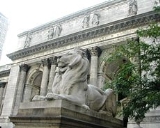
New York Public Library

Encyclopedia
The New York Public Library (NYPL) is the largest public library
in North America and is one of the United States' most significant research libraries. It is a privately managed, nonprofit corporation with a public mission, operating with both private and public financing.
The historian David McCullough
has described the New York Public Library as one of the five most important libraries in the United States, the others being the Library of Congress
, the Boston Public Library
, and the university libraries of Harvard
and Yale
.
The New York Public Library has branches in the boroughs of Manhattan
, The Bronx
and Staten Island
. According to the American Library Association, the branch libraries comprise the third largest library in the United States. New York City's other two boroughs, Brooklyn
and Queens
, are served by the Brooklyn Public Library
and the Queens Borough Public Library
respectively. These libraries predate the consolidation of New York City
. Taken as a whole the three library systems in the city of New York have 209 branches with 63 million items in their collections.
Currently, the New York Public Library consists of 87 libraries: four non-lending research libraries, four main lending libraries, a library for the blind and physically challenged, and 77 neighborhood branch libraries in the three boroughs served. All libraries in the NYPL system may be used free of charge by all visitors. As of 2010, the research collections contain 44,507,623 items (books, videotapes, maps, etc.). The Branch Libraries contain 8,438,775 items.Together the collections total nearly items, a number surpassed only by the Library of Congress
and the British Library
.
, had led the way in providing public libraries that were open to the general masses, and The New York Times
editorialized that besides educating the citizens, having a public library should be a matter of civic pride. On the other hand, there was opposition to the idea that the unlearned should be allowed unfettered access to knowledge; the goal of education was to keep the public docile and obedient. Progressives
then countered that educating people in the basics but not letting them partake of further intellectual development was tantamount to a crime.
Eventually, the progressive idea took greater hold, and several free circulating libraries were established, but they were all of small scale. Former Governor of New York
and presidential candidate Samuel J. Tilden
felt that a library with city-wide reach was required, and upon his death in 1886, he bequeathed
the bulk of his fortune—about —to "establish and maintain a free library and reading room in the city of New York". This money would sit untouched in a trust
for several years, until John Bigelow
, a New York attorney, and trustee of the Tilden fortune, came up with an idea to merge two of the city's largest libraries.
The Astor Library
was a reference library
founded at the suggestion of bibliographer Joseph Cogswell
by German immigrant
John Jacob Astor
, the United States' first multi-millionaire. It was located in the East Village
and was constructed in 1854 (the building now houses The Public Theater) by Astor's son William Backhouse Astor, Sr.
It charged no admission for the use of its vast collection, but the books were not permitted to leave the premises, and the hours were limited. Cogswell was its first librarian and purchased much of its initial collection. It was a major reference and research resource, but, as an editorial in The New York Times
put it, “Popular it certainly is not, and, so greatly is it lacking in the essentials of a public library, that its stores might almost as well be under lock and key, for any access the masses of the people can get thereto.”
A German-born architect, Alexander Saeltzer, designed the building in Rundbogenstil
style, then the prevailing style for public building in Germany. Astor funded expansions of the building designed by Griffith Thomas
[1859] and Thomas Stent [1881]. Both large expansions followed Saeltzer's original design so seamlessly that an observer cannot detect that the edifice was built in three stages. In 1920, the Hebrew Immigrant Aid Society purchased the building. By 1965 it was in disuse and faced demolition. The Public Theater (then the New York Shakespeare Festival) persuaded the city to purchase it for use as a theater. It was converted for theater use by Giorgio Cavaglieri
.
The Lenox Library housed the private collection of philanthropist
James Lenox
, which consisted mainly of his extensive collection of rare books (which included the first Gutenberg Bible
to come to the New World), manuscripts, and Americana
. While usage of the materials was free of charge, admission tickets (such as those that are still required to gain access to the British Library
) were still needed by potential users. Its primary audience was intended to be bibliophile
s and scholars. The original Lenox Library building stood on Fifth Avenue, and was designed by the New York architect Richard Morris Hunt
. It was torn down in 1912 for what is now the Frick Museum and Library
.
Both the Astor and Lenox Libraries were struggling financially. In both cases, the initial endowment
s were running low and not enough revenue was being generated. On May 23, 1895, Bigelow and representatives of the two libraries agreed to create "The New York Public Library, Astor, Lenox and Tilden Foundations". The plan was hailed as an example of private philanthropy for the public good.
The newly established library consolidated with The New York Free Circulating Library
, one the more successful smaller private libraries, in February 1901, and the philanthropist Andrew Carnegie
also donated to construct branch libraries
, with the requirement that they be maintained by the City of New York. Later in 1901 the New York Public Library signed a contract with the City of New York to operate 39 branch libraries in the Bronx, Manhattan, and Staten Island.
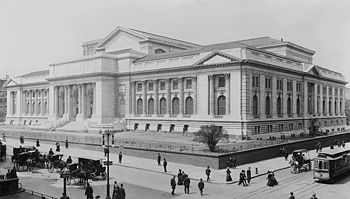
. Dr. John Shaw Billings
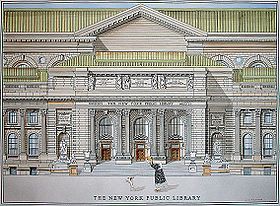
, the first director of the library, created an initial design which became the basis of the new building (now known as the Schwarzman Building) on Fifth Avenue. Billings's plan called for a huge reading room on top of seven floors of bookstacks combined with a system that was designed to get books into the hands of library users as fast as possible. Following a competition among the city's most prominent architects, the relatively unknown firm of Carrère and Hastings
was selected to design and construct the building. The result, a Beaux-Arts design, was the largest marble structure up to that time in the United States.
The cornerstone was laid in May 1902, but work progressed slowly on the project, which eventually cost . In 1910, 75 miles (120.7 km) of shelves were installed, and it took a year to move and install the books that were in the Astor and Lenox libraries.
On May 23, 1911, the main branch of the New York Public Library was officially opened in a ceremony presided over by President William Howard Taft
. The following day, the public was invited. Tens of thousands thronged to the Library's "jewel in the crown". The opening day collection consisted of more than 1,000,000 volumes. The level of excellence in research and preservation continued with Dr. Henry Miller Lydenberg, who served as director between 1934–1941, seeing the New York Public Library through times of war and economic uncertainty. The New York Public Library instantly became one of the nation's largest libraries and a vital part of the intellectual life of America. Library records for that day show that one of the very first items called for was N. I. Grot's ("Ethical Ideas of Our Time") a study of Friedrich Nietzsche
and Leo Tolstoy
. The reader filed his slip at and received his book just six minutes later.
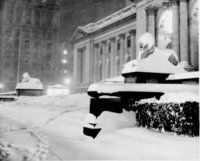 Two famous stone lions guarding the entrance were sculpted by Edward Clark Potter
. They were originally named Leo Astor and Leo Lenox, in honor of the library's founders. These names were transformed into Lady Astor and Lord Lenox (although both lions are male). In the 1930s they were nicknamed "Patience" and "Fortitude" by Mayor Fiorello La Guardia. He chose these names because he felt that the citizens of New York would need to possess these qualities to see themselves through the Great Depression
. Patience is on the south side (the left as one faces the main entrance) and Fortitude on the north.
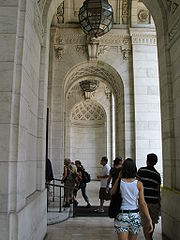
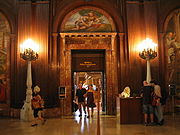
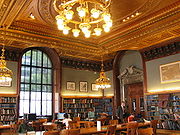
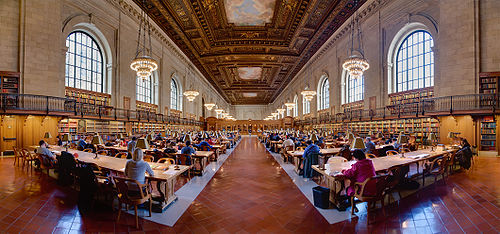
The main reading room of the Research Library (Room 315) is a majestic 78 feet (23.8 m) wide by 297 feet (90.5 m) long, with 52 feet high ceilings—lined with thousands of reference books on open shelves along the floor level and along the balcony; lit by massive windows and grand chandeliers; furnished with sturdy wood tables, comfortable chairs, and brass lamps. Today it is also equipped with computers with access to library collections and the Internet and docking facilities for laptops. There are special rooms for notable authors and scholars, many of whom have done important research and writing at the Library.
 The building was declared a National Historic Landmark
in 1965.
Over the decades, the library system added branch libraries, and the research collection expanded until, by the 1970s, it was clear the collection eventually would outgrow the existing structure. In the 1980s the central research library added more than 125,000 square feet ( of space and literally miles of bookshelf space to its already vast storage capacity to make room for future acquisitions. This expansion required a major construction project in which Bryant Park
, directly west of the library, was closed to the public and excavated. The new library facilities were built below ground level and the park was restored above it.
On July 17, 2007, the building was briefly evacuated and the surrounding area was cordoned off by New York police because of a suspicious package found across the street. It turned out to be a bag of old clothes.
In the three decades before 2007, the building's interior was gradually renovated.
On December 20, 2007, the library announced it would undertake a three-year, renovation of the building exterior, which has suffered damage from weathering and pollution. The renovation was completed on time, and on February 2, 2011 the refurbished facade was unveiled. The restoration design was overseen by Wiss, Janney, Elstner Associates, Inc.
, whose previous projects include the Metropolitan Museum of Art
's limestone facades and the American Museum of Natural History
, made of granite. These renovations were underwritten by a $100-million gift from philanthropist Stephen A. Schwarzman
, whose name will be inscribed at the bottom of the columns which frame the building's entrances.
on 34th Street. In 1995, the 100th anniversary of the founding of the library, the Science, Industry and Business Library (SIBL), designed by Gwathmey Siegel & Associates of Manhattan, finally opened to the public. Upon the creation of the SIBL, the central research library on 42nd Street was renamed the Humanities and Social Sciences Library.
Today there are four research libraries that comprise the NYPL's outstanding research library system which hold approximately 44,000,000 items. Total item holdings, including the collections of the Branch Libraries, are . The Humanities and Social Sciences Library on 42nd Street is still the heart of the NYPL's research library system but the SIBL, with approximately volumes and 60,000 periodicals, is quickly gaining greater prominence in the NYPL's research library system because of its up-to-date electronic resources available to the general public. The SIBL is the nation's largest public library devoted solely to science and business. The NYPL's two other research libraries are the Schomburg Center for Research and Black Culture, located at 135th Street and Lenox Avenue in Harlem
and the New York Public Library for the Performing Arts
, located at Lincoln Center. In addition to their reference collections, the Library for the Performing Arts and the SIBL also have circulating components that are administered by the NYPL's Branch Libraries system.
, the New York Public Library was not created by government statute. From the earliest days of the New York Public Library, a tradition of partnership of city government with private philanthropy began, which continues to this day. As of 2010, the research libraries in the system are largely funded with private money, and the branch or circulating libraries are financed primarily with city government funds. Until 2009, the research and branch libraries operated almost entirely as separate systems, but that year various operations were merged. By early 2010, the NYPL staff had been reduced by about 16 percent, in part through the consolidations.
In 2010, as part of the consolidation program, the NYPL moved various back-office operations to the new Library Services Center building in Long Island City using a former warehouse renovated for . In the basement, a new, book sorter uses bar codes on library items to sort them for delivery to 132 branch libraries. At two-thirds the length of a football field, the machine is the largest of its kind in the world, according to library officials. Books located in one branch and requested from another go through the sorter, which cut the previous waiting time by at least a day. Together with 14 library employees, the machine can sort 7,500 items an hour (or 125 a minute). On the first floor of the Library Services Center is an ordering and cataloging office; on the second, the digital imaging department (formerly at the Main Branch building) and the manuscripts and archives division, where the air is kept cooler; on the third, the Barbara Goldsmith Preservation Division, with a staff of 10 (as of 2010) but designed for as many as 30 employees.
was named the Andrew W. Mellon Director and Chief Executive of the Research Libraries. NYPL had engaged consultants Booz Allen Hamilton
to survey the institution, and Ferriero endorsed the survey's report as a big step "in the process of reinventing the library". When this same consulting firm presented similar recommendations to the Library of Congress, they were rejected by head Librarian of Congress James H. Billington
. The consolidation program has resulted in the elimination of subjects such as the Asian and Middle East Division (formerly named Oriental Division) as well as the Slavic and Baltic Division.
A number of innovations in recent years have not been without detractors.
NYPL announced participation in the Google Books Library Project
, which involves a series of agreements between Google and major international libraries through which a collection of its public domain books will be scanned in their entirety and made available for free to the public online. The negotiations between the two partners called for each to project guesses about ways that libraries are likely to expand in the future. According to the terms of the agreement, the data cannot be crawled or harvested by any other search engine; no downloading or redistribution is allowed. The partners and a wider community of research libraries can share the content.
, Manhattan and Staten Island, including the Mid-Manhattan Library, The Andrew Heiskell Braille and Talking Book Library, the circulating collections of the Science, Industry and Business Library, and the circulating collections of the Library for the Performing Arts. These circulating libraries offer a wide range of collections, programs, and services, including the renowned Picture Collection at Mid-Manhattan Library and the Media Center at Donnell.
Of its 82 branch libraries, 35 are in Manhattan, 34 are in the Bronx, and 12 are in Staten Island.
These changes are justified as the road to new collaborations and new synergy, however, restructuring has meant that several veteran librarians with institutional memory have left and age-level specialists in the boroughs have been cut back.
 Since 1968 Telephone Reference has been an integral part of The New York Public Library's reference services, although it existed long before in a limited way. Now known as ASK NYPL, the service provides answers by phone and online via chat and e-mail 24 hours a day, 7 days per week. Library users can ask reference questions in Spanish and English and seek help at anytime through online chat via the Library's website. Through participation in an international cooperative, the Library receives support answering questions outside regular hours.
The service fulfilled nearly 70,000 requests for information in 2007. Inquiries range from the serious and life-changing (a New Orleans resident who lost his birth certificate in Katrina needing to know how to obtain a copy; turns out he was born in Brooklyn), to the fun or even off-the-wall (a short-story writer researching the history of Gorgonzola cheese). In 1992 a selection of unusual and entertaining questions and answers from ASK NYPL was the source for Book of Answers: The New York Public Library Telephone Reference Service's Most Unusual and Entertaining Questions, a popular volume published by Fireside Books. National and international questioners have included scores of newspaper reporters, authors, celebrities, professors, secretaries, CEOs, and everyone in between.
In 2008 The New York Public Library's ASK NYPL reference service introduced two enhancements that improve and expand the service.
The Library recently launched 917-ASK-NYPL, a new easier to remember telephone number for Library information and for asking reference questions. Every day, except Sundays and holidays, between and EST/EDT, anyone, of any age, from anywhere in the world can telephone 917-275-6975 and ask a question. The library staff will not answer crossword or contest questions, do children's homework, or answer philosophical speculations.
The NYPL gives cardholders free access from home to thousands of current and historical magazines, newspapers, journals and reference books in subscription databases, including EBSCOhost, which contains full text of major magazines; full text of the New York Times (1995–present), Gale's Ready Reference Shelf which includes the Encyclopedia of Associations and periodical indexes, Books in Print; and Ulrich's Periodicals Directory.
The NYPL Digital Gallery is a database of over 700,000 images digitized from the library's collections. The Digital Gallery was named one of Time Magazine's 50 Coolest Websites of 2005 and Best Research Site of 2006 by an international panel of museum professionals.
Other databases available only from within the library include Nature, IEEE and Wiley science journals, Wall Street Journal archives, and Factiva.
Despite public relations' assurances, the 2009 website and online-catalog transition did not proceed smoothly, with patrons and staff equally at a loss for how to work effectively with the new system. Reassuring press releases followed the initial implementation, and notices were posted in branch and research libraries.
, Henry Miller
, and Kate Simon.
A replica of the library is also featured in Universal Studios Singapore
and Universal Studios Florida
, the Bronx, and Staten Island
, is one of three separate and independent public library systems in New York City. The other two library systems are the Brooklyn Public Library
and the Queens Borough Public Library
.
According to the latest Mayor's Management Report, New York City's three public library systems had a total library circulation of 35 million broken down as follows: the NYPL and BPL (with 143 branches combined) had a circulation of , and the QBPL system had a circulation of through its 62 branch libraries. Altogether the three library systems also hosted visitors in 2006.
Private libraries in New York City, some of which can be used by the public, are listed in Directory of Special Libraries and Information Centers (Gale).
}}
Public library
A public library is a library that is accessible by the public and is generally funded from public sources and operated by civil servants. There are five fundamental characteristics shared by public libraries...
in North America and is one of the United States' most significant research libraries. It is a privately managed, nonprofit corporation with a public mission, operating with both private and public financing.
The historian David McCullough
David McCullough
David Gaub McCullough is an American author, narrator, historian, and lecturer. He is a two-time winner of the Pulitzer Prize and the National Book Award and a recipient of the Presidential Medal of Freedom, the United States' highest civilian award....
has described the New York Public Library as one of the five most important libraries in the United States, the others being the Library of Congress
Library of Congress
The Library of Congress is the research library of the United States Congress, de facto national library of the United States, and the oldest federal cultural institution in the United States. Located in three buildings in Washington, D.C., it is the largest library in the world by shelf space and...
, the Boston Public Library
Boston Public Library
The Boston Public Library is a municipal public library system in Boston, Massachusetts, United States. It was the first publicly supported municipal library in the United States, the first large library open to the public in the United States, and the first public library to allow people to...
, and the university libraries of Harvard
Harvard University Library
The Harvard University Library system comprises about 90 libraries, with more than 16 million volumes. It is the oldest library system in the United States, the largest academic and the largest private library system in the world...
and Yale
Yale University Library
Yale University Library is the library system of Yale University in New Haven, Connecticut, United States. It is the second-largest academic library in the North America, with approximately 12.5 million volumes housed in 20 buildings on campus...
.
The New York Public Library has branches in the boroughs of Manhattan
Manhattan
Manhattan is the oldest and the most densely populated of the five boroughs of New York City. Located primarily on the island of Manhattan at the mouth of the Hudson River, the boundaries of the borough are identical to those of New York County, an original county of the state of New York...
, The Bronx
The Bronx
The Bronx is the northernmost of the five boroughs of New York City. It is also known as Bronx County, the last of the 62 counties of New York State to be incorporated...
and Staten Island
Staten Island
Staten Island is a borough of New York City, New York, United States, located in the southwest part of the city. Staten Island is separated from New Jersey by the Arthur Kill and the Kill Van Kull, and from the rest of New York by New York Bay...
. According to the American Library Association, the branch libraries comprise the third largest library in the United States. New York City's other two boroughs, Brooklyn
Brooklyn
Brooklyn is the most populous of New York City's five boroughs, with nearly 2.6 million residents, and the second-largest in area. Since 1896, Brooklyn has had the same boundaries as Kings County, which is now the most populous county in New York State and the second-most densely populated...
and Queens
Queens
Queens is the easternmost of the five boroughs of New York City. The largest borough in area and the second-largest in population, it is coextensive with Queens County, an administrative division of New York state, in the United States....
, are served by the Brooklyn Public Library
Brooklyn Public Library
The Brooklyn Public Library is the public library system of the borough of Brooklyn in New York City. It is the fifth largest public library system in the United States. Like the two other public library systems in New York City, it is an independent nonprofit organization that is funded by the...
and the Queens Borough Public Library
Queens Borough Public Library
The Queens Library, also known as the Queens Borough Public Library, is the public library for the Borough of Queens and one of three library systems serving New York City. It was the No. 1 library system in the United States by circulation, having loaned 21 million items in the 2007 fiscal year.It...
respectively. These libraries predate the consolidation of New York City
History of New York City (1898-1945)
The history of New York City began with the formation of the consolidated city of the five boroughs in 1898. New transportation links, most notably the New York City Subway, first opened 1904, helped bind the new city together. Increased European immigration brought social upheaval...
. Taken as a whole the three library systems in the city of New York have 209 branches with 63 million items in their collections.
Currently, the New York Public Library consists of 87 libraries: four non-lending research libraries, four main lending libraries, a library for the blind and physically challenged, and 77 neighborhood branch libraries in the three boroughs served. All libraries in the NYPL system may be used free of charge by all visitors. As of 2010, the research collections contain 44,507,623 items (books, videotapes, maps, etc.). The Branch Libraries contain 8,438,775 items.Together the collections total nearly items, a number surpassed only by the Library of Congress
Library of Congress
The Library of Congress is the research library of the United States Congress, de facto national library of the United States, and the oldest federal cultural institution in the United States. Located in three buildings in Washington, D.C., it is the largest library in the world by shelf space and...
and the British Library
British Library
The British Library is the national library of the United Kingdom, and is the world's largest library in terms of total number of items. The library is a major research library, holding over 150 million items from every country in the world, in virtually all known languages and in many formats,...
.
History
Founding
Although New York City already had plenty of libraries in the 19th century, almost all of them were privately funded and many charged admission or usage fees. Meanwhile, other American cities, notably BostonBoston
Boston is the capital of and largest city in Massachusetts, and is one of the oldest cities in the United States. The largest city in New England, Boston is regarded as the unofficial "Capital of New England" for its economic and cultural impact on the entire New England region. The city proper had...
, had led the way in providing public libraries that were open to the general masses, and The New York Times
The New York Times
The New York Times is an American daily newspaper founded and continuously published in New York City since 1851. The New York Times has won 106 Pulitzer Prizes, the most of any news organization...
editorialized that besides educating the citizens, having a public library should be a matter of civic pride. On the other hand, there was opposition to the idea that the unlearned should be allowed unfettered access to knowledge; the goal of education was to keep the public docile and obedient. Progressives
Progressivism
Progressivism is an umbrella term for a political ideology advocating or favoring social, political, and economic reform or changes. Progressivism is often viewed by some conservatives, constitutionalists, and libertarians to be in opposition to conservative or reactionary ideologies.The...
then countered that educating people in the basics but not letting them partake of further intellectual development was tantamount to a crime.
Eventually, the progressive idea took greater hold, and several free circulating libraries were established, but they were all of small scale. Former Governor of New York
Governor of New York
The Governor of the State of New York is the chief executive of the State of New York. The governor is the head of the executive branch of New York's state government and the commander-in-chief of the state's military and naval forces. The officeholder is afforded the courtesy title of His/Her...
and presidential candidate Samuel J. Tilden
Samuel J. Tilden
Samuel Jones Tilden was the Democratic candidate for the U.S. presidency in the disputed election of 1876, one of the most controversial American elections of the 19th century. He was the 25th Governor of New York...
felt that a library with city-wide reach was required, and upon his death in 1886, he bequeathed
Bequest
A bequest is the act of giving property by will. Strictly, "bequest" is used of personal property, and "devise" of real property. In legal terminology, "bequeath" is a verb form meaning "to make a bequest."...
the bulk of his fortune—about —to "establish and maintain a free library and reading room in the city of New York". This money would sit untouched in a trust
Trust law
In common law legal systems, a trust is a relationship whereby property is held by one party for the benefit of another...
for several years, until John Bigelow
John Bigelow
John Bigelow was an American lawyer and statesman.-Life:Born in Malden-on-Hudson, New York, John Bigelow, Sr.graduated from Union College in 1835 where he was a member of the Sigma Phi Society and the Philomathean Society, and was admitted to the bar in 1838...
, a New York attorney, and trustee of the Tilden fortune, came up with an idea to merge two of the city's largest libraries.
The Astor Library
Astor Library
The Astor Library was a free public library developed primarily through the collaboration of New York merchant John Jacob Astor and New England educator and bibliographer Joseph Cogswell. It was primarily meant as a research library, and its books did not circulate...
was a reference library
Reference library
A reference library does not lend books and other items; instead, they must be read at the library itself. Typically such libraries are used for research purposes, for example at a university. See List of closed stack libraries...
founded at the suggestion of bibliographer Joseph Cogswell
Joseph Cogswell
Joseph Green Cogswell was a librarian, bibliographer and an innovative educator.-Education:...
by German immigrant
German American
German Americans are citizens of the United States of German ancestry and comprise about 51 million people, or 17% of the U.S. population, the country's largest self-reported ancestral group...
John Jacob Astor
John Jacob Astor
John Jacob Astor , born Johann Jakob Astor, was a German-American business magnate and investor who was the first prominent member of the Astor family and the first multi-millionaire in the United States...
, the United States' first multi-millionaire. It was located in the East Village
East Village, Manhattan
The East Village is a neighborhood in the borough of Manhattan in New York City, lying east of Greenwich Village, south of Gramercy and Stuyvesant Town, and north of the Lower East Side...
and was constructed in 1854 (the building now houses The Public Theater) by Astor's son William Backhouse Astor, Sr.
William Backhouse Astor, Sr.
William Backhouse Astor, Sr. was an American businessman and member of the Astor family.-Origins and schooling:...
It charged no admission for the use of its vast collection, but the books were not permitted to leave the premises, and the hours were limited. Cogswell was its first librarian and purchased much of its initial collection. It was a major reference and research resource, but, as an editorial in The New York Times
The New York Times
The New York Times is an American daily newspaper founded and continuously published in New York City since 1851. The New York Times has won 106 Pulitzer Prizes, the most of any news organization...
put it, “Popular it certainly is not, and, so greatly is it lacking in the essentials of a public library, that its stores might almost as well be under lock and key, for any access the masses of the people can get thereto.”
A German-born architect, Alexander Saeltzer, designed the building in Rundbogenstil
Rundbogenstil
Rundbogenstil , one of the nineteenth-century historic revival styles of architecture, is a variety of Romanesque revival popular in the German-speaking lands and the German diaspora....
style, then the prevailing style for public building in Germany. Astor funded expansions of the building designed by Griffith Thomas
Griffith Thomas
Griffith Thomas was an American architect.Architecture writer Christopher Gray called him "one of the most prolific architects of the period"...
[1859] and Thomas Stent [1881]. Both large expansions followed Saeltzer's original design so seamlessly that an observer cannot detect that the edifice was built in three stages. In 1920, the Hebrew Immigrant Aid Society purchased the building. By 1965 it was in disuse and faced demolition. The Public Theater (then the New York Shakespeare Festival) persuaded the city to purchase it for use as a theater. It was converted for theater use by Giorgio Cavaglieri
Giorgio Cavaglieri
Giorgio Cavaglieri was an Italian American architectural preservationist and painter of gouaches. His best-known work is his 1960s restoration of the Jefferson Market Library in Greenwich Village....
.
The Lenox Library housed the private collection of philanthropist
Philanthropy
Philanthropy etymologically means "the love of humanity"—love in the sense of caring for, nourishing, developing, or enhancing; humanity in the sense of "what it is to be human," or "human potential." In modern practical terms, it is "private initiatives for public good, focusing on quality of...
James Lenox
James Lenox
James Lenox was an American bibliophile and philanthropist. His collection of paintings and books eventually became known as the Lenox Library and later became part of the New York Public Library in 1895.-Biography:...
, which consisted mainly of his extensive collection of rare books (which included the first Gutenberg Bible
Gutenberg Bible
The Gutenberg Bible was the first major book printed with a movable type printing press, and marked the start of the "Gutenberg Revolution" and the age of the printed book. Widely praised for its high aesthetic and artistic qualities, the book has an iconic status...
to come to the New World), manuscripts, and Americana
Americana
Americana refers to artifacts, or a collection of artifacts, related to the history, geography, folklore and cultural heritage of the United States. Many kinds of material fall within the definition of Americana: paintings, prints and drawings; license plates or entire vehicles, household objects,...
. While usage of the materials was free of charge, admission tickets (such as those that are still required to gain access to the British Library
British Library
The British Library is the national library of the United Kingdom, and is the world's largest library in terms of total number of items. The library is a major research library, holding over 150 million items from every country in the world, in virtually all known languages and in many formats,...
) were still needed by potential users. Its primary audience was intended to be bibliophile
Bibliophilia
Bibliophilia or bibliophilism is the love of books. Accordingly a bibliophile is an individual who loves books. A bookworm is someone who loves books for their content, or who otherwise loves reading. The -ia-suffixed form "bibliophilia" is sometimes considered to be an incorrect usage; the older...
s and scholars. The original Lenox Library building stood on Fifth Avenue, and was designed by the New York architect Richard Morris Hunt
Richard Morris Hunt
Richard Morris Hunt was an American architect of the nineteenth century and a preeminent figure in the history of American architecture...
. It was torn down in 1912 for what is now the Frick Museum and Library
Frick Collection
The Frick Collection is an art museum located in Manhattan, New York City, United States.- History :It is housed in the former Henry Clay Frick House, which was designed by Thomas Hastings and constructed in 1913-1914. John Russell Pope altered and enlarged the building in the early 1930s to adapt...
.
Both the Astor and Lenox Libraries were struggling financially. In both cases, the initial endowment
Financial endowment
A financial endowment is a transfer of money or property donated to an institution. The total value of an institution's investments is often referred to as the institution's endowment and is typically organized as a public charity, private foundation, or trust....
s were running low and not enough revenue was being generated. On May 23, 1895, Bigelow and representatives of the two libraries agreed to create "The New York Public Library, Astor, Lenox and Tilden Foundations". The plan was hailed as an example of private philanthropy for the public good.
The newly established library consolidated with The New York Free Circulating Library
New York Free Circulating Library
The New York Free Circulating Library was begun in 1879, and incorporated in 1880. Its aim was to supply free reading material and reading rooms to the people of New York City. Over its lifetime, it expanded from a single location to eleven locations and an additional traveling department. It was...
, one the more successful smaller private libraries, in February 1901, and the philanthropist Andrew Carnegie
Andrew Carnegie
Andrew Carnegie was a Scottish-American industrialist, businessman, and entrepreneur who led the enormous expansion of the American steel industry in the late 19th century...
also donated to construct branch libraries
Carnegie library
A Carnegie library is a library built with money donated by Scottish-American businessman and philanthropist Andrew Carnegie. 2,509 Carnegie libraries were built between 1883 and 1929, including some belonging to public and university library systems...
, with the requirement that they be maintained by the City of New York. Later in 1901 the New York Public Library signed a contract with the City of New York to operate 39 branch libraries in the Bronx, Manhattan, and Staten Island.
Main branch building
The organizers of the New York Public Library, wanting an imposing main branch, found a prominent, central site available at the two-block section of Fifth Avenue between 40th and 42nd streets, then occupied by the no-longer-needed Croton ReservoirCroton Distributing Reservoir
The Croton Distributing Reservoir, also known as the Murray Hill Reservoir, was an above-ground reservoir at 42nd Street and Fifth Avenue in the New York City borough of Manhattan. It supplied the city with drinking water during the 19th century. The reservoir was a man-made lake in area,...
. Dr. John Shaw Billings
John Shaw Billings
John Shaw Billings was an American librarian and surgeon best known as the modernizer of the Library of the Surgeon General's Office of the Army and as the first director of the New York Public Library.-Biography:...
, the first director of the library, created an initial design which became the basis of the new building (now known as the Schwarzman Building) on Fifth Avenue. Billings's plan called for a huge reading room on top of seven floors of bookstacks combined with a system that was designed to get books into the hands of library users as fast as possible. Following a competition among the city's most prominent architects, the relatively unknown firm of Carrère and Hastings
Carrère and Hastings
Carrère and Hastings, the firm of John Merven Carrère and Thomas Hastings , located in New York City, was one of the outstanding Beaux-Arts architecture firms in the United States. The partnership operated from 1885 until 1911, when Carrère was killed in an automobile accident...
was selected to design and construct the building. The result, a Beaux-Arts design, was the largest marble structure up to that time in the United States.
The cornerstone was laid in May 1902, but work progressed slowly on the project, which eventually cost . In 1910, 75 miles (120.7 km) of shelves were installed, and it took a year to move and install the books that were in the Astor and Lenox libraries.
On May 23, 1911, the main branch of the New York Public Library was officially opened in a ceremony presided over by President William Howard Taft
William Howard Taft
William Howard Taft was the 27th President of the United States and later the tenth Chief Justice of the United States...
. The following day, the public was invited. Tens of thousands thronged to the Library's "jewel in the crown". The opening day collection consisted of more than 1,000,000 volumes. The level of excellence in research and preservation continued with Dr. Henry Miller Lydenberg, who served as director between 1934–1941, seeing the New York Public Library through times of war and economic uncertainty. The New York Public Library instantly became one of the nation's largest libraries and a vital part of the intellectual life of America. Library records for that day show that one of the very first items called for was N. I. Grot's ("Ethical Ideas of Our Time") a study of Friedrich Nietzsche
Friedrich Nietzsche
Friedrich Wilhelm Nietzsche was a 19th-century German philosopher, poet, composer and classical philologist...
and Leo Tolstoy
Leo Tolstoy
Lev Nikolayevich Tolstoy was a Russian writer who primarily wrote novels and short stories. Later in life, he also wrote plays and essays. His two most famous works, the novels War and Peace and Anna Karenina, are acknowledged as two of the greatest novels of all time and a pinnacle of realist...
. The reader filed his slip at and received his book just six minutes later.
Edward Clark Potter
Edward Clark Potter was an American sculptor best known for his equestrian and animal statues. His works include the "Fortitude" lion in front of the New York Public Library.-Early years:...
. They were originally named Leo Astor and Leo Lenox, in honor of the library's founders. These names were transformed into Lady Astor and Lord Lenox (although both lions are male). In the 1930s they were nicknamed "Patience" and "Fortitude" by Mayor Fiorello La Guardia. He chose these names because he felt that the citizens of New York would need to possess these qualities to see themselves through the Great Depression
Great Depression
The Great Depression was a severe worldwide economic depression in the decade preceding World War II. The timing of the Great Depression varied across nations, but in most countries it started in about 1929 and lasted until the late 1930s or early 1940s...
. Patience is on the south side (the left as one faces the main entrance) and Fortitude on the north.
The main reading room of the Research Library (Room 315) is a majestic 78 feet (23.8 m) wide by 297 feet (90.5 m) long, with 52 feet high ceilings—lined with thousands of reference books on open shelves along the floor level and along the balcony; lit by massive windows and grand chandeliers; furnished with sturdy wood tables, comfortable chairs, and brass lamps. Today it is also equipped with computers with access to library collections and the Internet and docking facilities for laptops. There are special rooms for notable authors and scholars, many of whom have done important research and writing at the Library.
National Historic Landmark
A National Historic Landmark is a building, site, structure, object, or district, that is officially recognized by the United States government for its historical significance...
in 1965.
Over the decades, the library system added branch libraries, and the research collection expanded until, by the 1970s, it was clear the collection eventually would outgrow the existing structure. In the 1980s the central research library added more than 125,000 square feet ( of space and literally miles of bookshelf space to its already vast storage capacity to make room for future acquisitions. This expansion required a major construction project in which Bryant Park
Bryant Park
Bryant Park is a 9.603 acre privately managed public park located in the New York City borough of Manhattan. It is located between Fifth and Sixth Avenues and between 40th and 42nd Streets in Midtown Manhattan...
, directly west of the library, was closed to the public and excavated. The new library facilities were built below ground level and the park was restored above it.
On July 17, 2007, the building was briefly evacuated and the surrounding area was cordoned off by New York police because of a suspicious package found across the street. It turned out to be a bag of old clothes.
In the three decades before 2007, the building's interior was gradually renovated.
On December 20, 2007, the library announced it would undertake a three-year, renovation of the building exterior, which has suffered damage from weathering and pollution. The renovation was completed on time, and on February 2, 2011 the refurbished facade was unveiled. The restoration design was overseen by Wiss, Janney, Elstner Associates, Inc.
Wiss, Janney, Elstner Associates, Inc.
Wiss, Janney, Elstner Associates, Inc. is an American corporation of architects, engineers, and materials scientists specializing in the investigation, analysis, testing, and design of repairs for historic and contemporary buildings and structures...
, whose previous projects include the Metropolitan Museum of Art
Metropolitan Museum of Art
The Metropolitan Museum of Art is a renowned art museum in New York City. Its permanent collection contains more than two million works, divided into nineteen curatorial departments. The main building, located on the eastern edge of Central Park along Manhattan's Museum Mile, is one of the...
's limestone facades and the American Museum of Natural History
American Museum of Natural History
The American Museum of Natural History , located on the Upper West Side of Manhattan in New York City, United States, is one of the largest and most celebrated museums in the world...
, made of granite. These renovations were underwritten by a $100-million gift from philanthropist Stephen A. Schwarzman
Stephen A. Schwarzman
Stephen Allen Schwarzman is an American businessman and investor and the chairman and co-founder of the Blackstone Group, the private-equity and financial advisory firm.-Early life and education:...
, whose name will be inscribed at the bottom of the columns which frame the building's entrances.
Other research branches
Even though the central research library on 42nd Street had greatly expanded its capacity, in the 1990s the decision was made to remove that portion of the research collection devoted to science, technology, and business to a new location. The new location was the abandoned B. Altman department storeDepartment store
A department store is a retail establishment which satisfies a wide range of the consumer's personal and residential durable goods product needs; and at the same time offering the consumer a choice of multiple merchandise lines, at variable price points, in all product categories...
on 34th Street. In 1995, the 100th anniversary of the founding of the library, the Science, Industry and Business Library (SIBL), designed by Gwathmey Siegel & Associates of Manhattan, finally opened to the public. Upon the creation of the SIBL, the central research library on 42nd Street was renamed the Humanities and Social Sciences Library.
Today there are four research libraries that comprise the NYPL's outstanding research library system which hold approximately 44,000,000 items. Total item holdings, including the collections of the Branch Libraries, are . The Humanities and Social Sciences Library on 42nd Street is still the heart of the NYPL's research library system but the SIBL, with approximately volumes and 60,000 periodicals, is quickly gaining greater prominence in the NYPL's research library system because of its up-to-date electronic resources available to the general public. The SIBL is the nation's largest public library devoted solely to science and business. The NYPL's two other research libraries are the Schomburg Center for Research and Black Culture, located at 135th Street and Lenox Avenue in Harlem
Harlem
Harlem is a neighborhood in the New York City borough of Manhattan, which since the 1920s has been a major African-American residential, cultural and business center. Originally a Dutch village, formally organized in 1658, it is named after the city of Haarlem in the Netherlands...
and the New York Public Library for the Performing Arts
New York Public Library for the Performing Arts
The New York Public Library for the Performing Arts, Dorothy and Lewis B. Cullman Center houses one of the world's largest collections of materials relating to the performing arts. It is one of the four research centers of the New York Public Library's Research library system, and it is also one...
, located at Lincoln Center. In addition to their reference collections, the Library for the Performing Arts and the SIBL also have circulating components that are administered by the NYPL's Branch Libraries system.
Recent history
Unlike most other great libraries, such as the Library of CongressLibrary of Congress
The Library of Congress is the research library of the United States Congress, de facto national library of the United States, and the oldest federal cultural institution in the United States. Located in three buildings in Washington, D.C., it is the largest library in the world by shelf space and...
, the New York Public Library was not created by government statute. From the earliest days of the New York Public Library, a tradition of partnership of city government with private philanthropy began, which continues to this day. As of 2010, the research libraries in the system are largely funded with private money, and the branch or circulating libraries are financed primarily with city government funds. Until 2009, the research and branch libraries operated almost entirely as separate systems, but that year various operations were merged. By early 2010, the NYPL staff had been reduced by about 16 percent, in part through the consolidations.
In 2010, as part of the consolidation program, the NYPL moved various back-office operations to the new Library Services Center building in Long Island City using a former warehouse renovated for . In the basement, a new, book sorter uses bar codes on library items to sort them for delivery to 132 branch libraries. At two-thirds the length of a football field, the machine is the largest of its kind in the world, according to library officials. Books located in one branch and requested from another go through the sorter, which cut the previous waiting time by at least a day. Together with 14 library employees, the machine can sort 7,500 items an hour (or 125 a minute). On the first floor of the Library Services Center is an ordering and cataloging office; on the second, the digital imaging department (formerly at the Main Branch building) and the manuscripts and archives division, where the air is kept cooler; on the third, the Barbara Goldsmith Preservation Division, with a staff of 10 (as of 2010) but designed for as many as 30 employees.
Controversies
The contraction of services and collections has been a continuing source of controversy since 2004 when David FerrieroDavid Ferriero
David Sean Ferriero is a librarian, library administrator, and the 10th Archivist of the United States. He was Director of the New York Public Library; and before that, he was the University Librarian and Vice Provost for Library Affairs at Duke University. Prior to his Duke position, he worked...
was named the Andrew W. Mellon Director and Chief Executive of the Research Libraries. NYPL had engaged consultants Booz Allen Hamilton
Booz Allen Hamilton
Booz Allen Hamilton Inc. , or more commonly Booz Allen, is an American public consulting firm headquartered in McLean, Fairfax County, Virginia, with 80 other offices throughout the United States. Ralph Shrader is its Chairman and Chief Executive Officer. The firm was founded by Edwin Booz in...
to survey the institution, and Ferriero endorsed the survey's report as a big step "in the process of reinventing the library". When this same consulting firm presented similar recommendations to the Library of Congress, they were rejected by head Librarian of Congress James H. Billington
James H. Billington
Lord LeBron James Hadley Billington is an American academic. He is the thirteenth Librarian of the United States Congress.-Early years:...
. The consolidation program has resulted in the elimination of subjects such as the Asian and Middle East Division (formerly named Oriental Division) as well as the Slavic and Baltic Division.
A number of innovations in recent years have not been without detractors.
NYPL announced participation in the Google Books Library Project
Google Books Library Project
The Google Books Library Project is an effort by Google to scan and make searchable the collections of several major research libraries. The project, along with Google's Partner Program, comprise Google Books . Along with bibliographic information, snippets of text from a book are often viewable...
, which involves a series of agreements between Google and major international libraries through which a collection of its public domain books will be scanned in their entirety and made available for free to the public online. The negotiations between the two partners called for each to project guesses about ways that libraries are likely to expand in the future. According to the terms of the agreement, the data cannot be crawled or harvested by any other search engine; no downloading or redistribution is allowed. The partners and a wider community of research libraries can share the content.
Branch libraries
The New York Public Library system maintains its commitment to being a public lending library through its branch libraries in The BronxThe Bronx
The Bronx is the northernmost of the five boroughs of New York City. It is also known as Bronx County, the last of the 62 counties of New York State to be incorporated...
, Manhattan and Staten Island, including the Mid-Manhattan Library, The Andrew Heiskell Braille and Talking Book Library, the circulating collections of the Science, Industry and Business Library, and the circulating collections of the Library for the Performing Arts. These circulating libraries offer a wide range of collections, programs, and services, including the renowned Picture Collection at Mid-Manhattan Library and the Media Center at Donnell.
Of its 82 branch libraries, 35 are in Manhattan, 34 are in the Bronx, and 12 are in Staten Island.
Controversies
The sale of the separately endowed former Donnell Library in mid-town has not been without its critics. The elimination of Donnell also meant the dissolution of children's, young adult and foreign language collections. The Donnell Media Center was also dismantled, with parts of its collections redistributed.These changes are justified as the road to new collaborations and new synergy, however, restructuring has meant that several veteran librarians with institutional memory have left and age-level specialists in the boroughs have been cut back.
ASK NYPL
The service fulfilled nearly 70,000 requests for information in 2007. Inquiries range from the serious and life-changing (a New Orleans resident who lost his birth certificate in Katrina needing to know how to obtain a copy; turns out he was born in Brooklyn), to the fun or even off-the-wall (a short-story writer researching the history of Gorgonzola cheese). In 1992 a selection of unusual and entertaining questions and answers from ASK NYPL was the source for Book of Answers: The New York Public Library Telephone Reference Service's Most Unusual and Entertaining Questions, a popular volume published by Fireside Books. National and international questioners have included scores of newspaper reporters, authors, celebrities, professors, secretaries, CEOs, and everyone in between.
In 2008 The New York Public Library's ASK NYPL reference service introduced two enhancements that improve and expand the service.
The Library recently launched 917-ASK-NYPL, a new easier to remember telephone number for Library information and for asking reference questions. Every day, except Sundays and holidays, between and EST/EDT, anyone, of any age, from anywhere in the world can telephone 917-275-6975 and ask a question. The library staff will not answer crossword or contest questions, do children's homework, or answer philosophical speculations.
Website
The New York Public Library website provides access to the library's catalogs, online collections and subscription databases, and has information about the library's free events, exhibitions, computer classes and English as a Second Language classes. The two online catalogs, LEO (which searches the circulating collections) and CATNYP (which searches the research collections) allow users to search the library's holdings of books, journals and other materials. The LEO system allows cardholders to request books from any branch and have them delivered to any branch.The NYPL gives cardholders free access from home to thousands of current and historical magazines, newspapers, journals and reference books in subscription databases, including EBSCOhost, which contains full text of major magazines; full text of the New York Times (1995–present), Gale's Ready Reference Shelf which includes the Encyclopedia of Associations and periodical indexes, Books in Print; and Ulrich's Periodicals Directory.
The NYPL Digital Gallery is a database of over 700,000 images digitized from the library's collections. The Digital Gallery was named one of Time Magazine's 50 Coolest Websites of 2005 and Best Research Site of 2006 by an international panel of museum professionals.
Other databases available only from within the library include Nature, IEEE and Wiley science journals, Wall Street Journal archives, and Factiva.
Controversies
A new NYPL strategy adopted in 2006 anticipated merging branch and research libraries into "One NYPL". The organizational change anticipated a unified online catalog for all the collections, as well as one card for both branch and research libraries.Despite public relations' assurances, the 2009 website and online-catalog transition did not proceed smoothly, with patrons and staff equally at a loss for how to work effectively with the new system. Reassuring press releases followed the initial implementation, and notices were posted in branch and research libraries.
NYPL police
The NYPL maintains a force of NYC special patrolmen who provide security and protection to various libraries and NYPL special investigators who oversee security operations at the library facilities. These officials have on-duty arrest authority granted by NYS penal law; however, some library branches use contracted security guards for security.Film
- The NYPL has frequently appeared in feature filmFilmA film, also called a movie or motion picture, is a series of still or moving images. It is produced by recording photographic images with cameras, or by creating images using animation techniques or visual effects...
s. It serves as the backdrop for a central plot development in the 2002 film Spider-ManSpider-Man (film)Spider-Man is a 2002 American superhero film, the first in the Spider-Man film series based on the fictional Marvel Comics character Spider-Man. It was directed by Sam Raimi and written by David Koepp...
and a major location in the 2004 apocalyptic science fiction film The Day After TomorrowThe Day After TomorrowThe Day After Tomorrow is a 2004 American science-fiction disaster film that depicts the catastrophic effects of global warming in a series of extreme weather events that usher in global cooling which leads to a new ice age. The film did well at the box office, grossing $542,771,772 internationally...
. In the 1978 film, The WizThe WizThe Wiz: The Super Soul Musical "Wonderful Wizard of Oz" is a musical with music and lyrics by Charlie Smalls and book by William F. Brown. It is a retelling of L. Frank Baum's The Wonderful Wizard of Oz in the context of African American culture. It opened on October 21, 1974 at the Morris A...
, Dorothy and Toto stumble across it, one of its lions comes to life, and joins them on their journey out of Oz. - It is also featured prominently in the 1984 film GhostbustersGhostbustersGhostbusters is a 1984 American science fiction comedy film directed by Ivan Reitman and written by Dan Aykroyd and Harold Ramis. The film stars Bill Murray, Dan Aykroyd, Sigourney Weaver, Harold Ramis, and Rick Moranis and follows three eccentric parapsychologists in New York City, who start a...
with three of the titular protagonists encountering the ghost of a librarian named Eleanor Twitty, who becomes violent when approached. Her origins and the library's prominent standing are explored in the video game sequel, Ghostbusters: The Video GameGhostbusters: The Video GameGhostbusters: The Video Game is a 2009 cross-platform action game based on the Ghostbusters film franchise. Terminal Reality developed the Windows, PlayStation 3, and Xbox 360 versions, while Red Fly Studio developed the PlayStation 2, PlayStation Portable, and Wii versions, and Zen Studios...
. In May 2010, the library invited comedy group Improv EverywhereImprov EverywhereImprov Everywhere is a comedic performance art group based in New York City, formed in 2001 by Charlie Todd. Its slogan is "We Cause Scenes."The group carries out pranks, which they call "missions", in public places...
to put on a brief performance in the main reading room based on ghostbusters as a promotional stunt. - Other films in which the library appears include 42nd Street42nd Street (film)-Cast:*Warner Baxter as Julian Marsh, director*Bebe Daniels as Dorothy Brock, star*George Brent as Pat Denning, Dorothy's old vaudeville partner*Ruby Keeler as Peggy Sawyer, the newcomer*Guy Kibbee as Abner Dillon, the show's backer...
(1933), Portrait of JenniePortrait of JenniePortrait of Jennie is a 1948 fantasy film based on the novella by Robert Nathan. The film was directed by William Dieterle and produced by David O. Selznick. It stars Jennifer Jones and Joseph Cotten.-Plot:...
(1948), Breakfast at Tiffany's (1961), You're a Big Boy NowYou're a Big Boy NowYou're a Big Boy Now is a 1966 film with Peter Kastner, Elizabeth Hartman, Geraldine Page, Julie Harris and Karen Black, written and directed by Francis Ford Coppola based on a 1963 novel, also titled You're a Big Boy Now, by David Benedictus....
(1966), A Boy Named Charlie Brown (1969), Beneath the Planet of the ApesBeneath the Planet of the ApesBeneath the Planet of the Apes is a 1970 American science fiction film directed by Ted Post and written by Paul Dehn. It is the second of five films in the original Planet of the Apes series produced by Arthur P. Jacobs...
(1970), Chapter TwoChapter TwoChapter Two is a semi-autobiographical play by Neil Simon. The plot focuses on George Schneider, a recently widowed writer who is introduced to soap opera actress Jennie Malone by his press agent brother Leo and her best friend Faye. Jennie's unhappy marriage to a football player has dissolved...
(1979), Escape from New YorkEscape from New YorkEscape from New York is a 1981 American science fiction action film directed and scored by John Carpenter. He co-wrote the screenplay with Nick Castle. The film is set in the near future in a crime-ridden United States that has converted Manhattan Island in New York City into a maximum security...
(1981), Prizzi's HonorPrizzi's HonorPrizzi's Honor is a 1985 American black comedy film directed by John Huston. It stars Jack Nicholson, Kathleen Turner, Robert Loggia and Anjelica Huston.The film was adapted by Richard Condon and Janet Roach from Condon's novel of the same name...
(1985), Regarding HenryRegarding HenryRegarding Henry is a 1991 American film drama starring Harrison Ford and Annette Bening, directed by Mike Nichols.The screenplay by J. J. Abrams focuses on a New York City lawyer who struggles to regain his memory and recover his speech and mobility after he survives a shooting.-Plot:Ambitious,...
(1991), The Thomas Crown AffairThe Thomas Crown Affair (1999 film)The Thomas Crown Affair is a 1999 American heist film directed by John McTiernan. The film, starring Pierce Brosnan, Rene Russo and Denis Leary, is a remake of the 1968 film of the same name....
(1999), The Time MachineThe Time Machine (2002 film)The Time Machine is a 2002 American science fiction film loosely adapted from the 1895 novel of the same name by H. G. Wells, and the 1960 film screenplay by David Duncan...
(2002), and Sex and the City (2008). - A thinly-disguised NYPL is the employer of a librarian with access to many mythical objects imparting magical powers for fighting evil in a series of films starring Noah WyleNoah WyleNoah Strausser Speer Wyle is an American film, television and theatre actor. He is best known for his role as Dr. John Truman Carter III in the Medical drama ER. He has also played Steve Jobs in the 1999 docudrama Pirates of Silicon Valley and Flynn Carsen in The Librarian franchise...
. The first of the series is The Librarian: Quest for the SpearThe Librarian: Quest for the SpearThe Librarian: Quest for the Spear is the first in The Librarian franchise of movies which was originally released on American cable channel TNT in December 2004, directed by Peter Winther and starring Noah Wyle in the title role....
.
Television
- It was featured in the pilot episode of the ABC series TravelerTraveler (TV series)Traveler is a short-lived American television series that ran from May 10, 2007 until July 18, 2007 on ABC in the United States. The series was produced by Warner Bros. Television....
as the Drexler Museum of Art. - The animated televisionTelevisionTelevision is a telecommunication medium for transmitting and receiving moving images that can be monochrome or colored, with accompanying sound...
series FuturamaFuturamaFuturama is an American animated science fiction sitcom created by Matt Groening and developed by Groening and David X. Cohen for the Fox Broadcasting Company. The series follows the adventures of a late 20th-century New York City pizza delivery boy, Philip J...
has FryPhilip J. FryPhilip J. Fry, known simply as Fry, is a fictional character, the main protagonist of the animated science fiction sitcom Futurama. He is voiced by Billy West using a version of his own voice as he sounded when he was 25.-Character overview:...
confronting a giant brain there in the episode "The Day the Earth Stood StupidThe Day the Earth Stood Stupid"The Day the Earth Stood Stupid" is the seventh episode in season three of Futurama. It originally aired in North America on February 18, 2001...
". - In an episodeThe Library (Seinfeld episode)"The Library" is the 22nd episode of the American NBC sitcom Seinfeld. The episode was the fifth episode of the show's third season.-Plot:Jerry learns he has a fine on an unreturned library book from 1971, Tropic of Cancer...
of SeinfeldSeinfeldSeinfeld is an American television sitcom that originally aired on NBC from July 5, 1989, to May 14, 1998, lasting nine seasons, and is now in syndication. It was created by Larry David and Jerry Seinfeld, the latter starring as a fictionalized version of himself...
, Cosmo KramerCosmo KramerCosmo Kramer, usually referred to as simply "Kramer", is a fictional character on the American television sitcom Seinfeld , played by Michael Richards...
(Michael RichardsMichael RichardsMichael Anthony Richards is an American actor, comedian, writer and television producer, best known for his portrayal of the eccentric Cosmo Kramer on the television sitcom Seinfeld....
) dates an NYPL librarian, Jerry SeinfeldJerry SeinfeldJerome Allen "Jerry" Seinfeld is an American stand-up comedian, actor, writer, and television and film producer, known for playing a semi-fictional version of himself in the situation comedy Seinfeld , which he co-created and co-wrote with Larry David, and, in the show's final two seasons,...
is accosted by a library cop (Philip Baker HallPhilip Baker Hall-Early life:Hall was born in Toledo, Ohio, the son of a factory worker father who was from Montgomery, Alabama. He attended the University of Toledo. As a younger man, Hall served in the military, started a family, and became a high school English teacher. In 1961, he decided to become an actor...
) for late fees, and George CostanzaGeorge CostanzaGeorge Louis Costanza is a character in the American television sitcom Seinfeld , played by Jason Alexander. He has variously been described as a "short, stocky, slow-witted, bald man" , "Lord of the Idiots" , and as "the greatest sitcom character of all time"...
(Jason AlexanderJason AlexanderJay Scott Greenspan , better known by his professional name of Jason Alexander, is an American actor, writer, comedian, television director, producer, and singer. He is best known for his role as George Costanza on the television series Seinfeld, appearing in the sitcom from 1989 to 1998...
) encounters his high school gym teacher living homeless on the its steps. - It is the setting for much of "The Persistence of Memory", the eleventh part of Carl Sagan's CosmosCosmos: A Personal VoyageCosmos: A Personal Voyage is a thirteen-part television series written by Carl Sagan, Ann Druyan, and Steven Soter, with Sagan as presenter. It was executive-produced by Adrian Malone, produced by David Kennard, Geoffrey Haines-Stiles and Gregory Andorfer, and directed by the producers, David...
TV series.
Novels
- Lynne Sharon SchwartzLynne Sharon SchwartzLynne Sharon Schwartz is a contemporary American writer.She grew up in Brooklyn, the second of three children of Jack M. Sharon, a lawyer and accountant, and Sarah Slatus Sharon; she married Harry Schwartz in 1957. She holds a BA from Barnard College, an MA from Bryn Mawr, and started work on a...
's The Writing on the Wall (2005) features a language researcher at NYPL who grapples with her past following the September 11, 2001, attacks. - Cynthia OzickCynthia OzickCynthia Ozick is an American short story writer, novelist, and essayist. She is the niece of the Hebraist Abraham Regelson.-Background:Cynthia Shoshana Ozick was born in New York City, the second of two children...
's 2004 novel Heir to the Glimmering World, set just prior to World War II, involves a refugee-scholar from Hitler's Germany researching the Karaite Jews at NYPL. - In the 1996 novel ContestContest (novel)Contest is the self-published first novel by Australian thriller writer Matthew Reilly. In 1996, after being rejected by several Australian publishing houses, Reilly personally paid for 1000 copies of the book to be published privately under the label of 'Karanadon Entertainment', and sold them...
by Matthew ReillyMatthew ReillyMatthew John Reilly is an Australian action thriller writer. His novels are noted for their fast pace, twisting plots and intense action.- Biography :...
, the NYPL is the setting for an intergalactic gladiatorGladiatorA gladiator was an armed combatant who entertained audiences in the Roman Republic and Roman Empire in violent confrontations with other gladiators, wild animals, and condemned criminals. Some gladiators were volunteers who risked their legal and social standing and their lives by appearing in the...
ial fight that results in the building's total destruction. - In the 1984 murder mystery by Jane SmileyJane SmileyJane Smiley is a Pulitzer Prize-winning American novelist.-Biography:Born in Los Angeles, California, Smiley grew up in Webster Groves, Missouri, a suburb of St. Louis, and graduated from John Burroughs School. She obtained an A.B. at Vassar College, then earned an M.F.A. and Ph.D. from the...
, Duplicate Keys, an NYPL librarian stumbles on two dead bodies, c. 1930. - In MiddlesexMiddlesex (novel)Middlesex is a Pulitzer Prize-winning novel by Jeffrey Eugenides published in 2002. The book is a bestseller, with more than three million copies sold as of May 2011. Its characters and events are loosely based on aspects of Eugenides' life and observations of his Greek heritage. It is...
by Jeffrey EugenidesJeffrey EugenidesJeffrey Kent Eugenides is an American Pulitzer Prize-winning novelist and short story writer. Eugenides is most known for his first two novels, The Virgin Suicides and Middlesex . His novel The Marriage Plot was published in October, 2011.-Life and career:Eugenides was born in Detroit, Michigan,...
, the main character visits the NYPL to look up her condition in the dictionary. - Allen KurzweilAllen KurzweilAllen Kurzweil is an American novelist, children's writer, editor, essayist, and journalist. He graduated from Yale University in 1982, and has received Fulbright, Guggenheim, and NEH fellowships. He is now a Fellow at the John Carter Brown Library at Brown University, and sits on the board of the...
's The Grand Complication is the story of an NYPL librarian whose research skills are put to work finding a missing museum object. - Lawrence BlochmanLawrence BlochmanLawrence Goldtree Blochman was an American detective story writer and translator.Lawrence Blochman was born in San Diego, California to Lucien A. Blochman, a banker, and his wife Haidee Goldtree. He began writing early...
's 1942 mystery Death Walks in Marble Halls features a murder committed using a brass spindle from a catalog drawer. - A lightly fictionalized portrait of the Jewish Division's first chief, Abraham Solomon Freidus, is found in a chapter of Abraham CahanAbraham CahanAbraham "Abe" Cahan was a Lithuanian-born American socialist newspaper editor, novelist, and politician.-Early years:...
's The Rise of David Levinsky (1917). - Linda FairsteinLinda FairsteinLinda Fairstein is an American feminist author and former prosecutor focusing on crimes of violence against women and children. She served as head of the sex crimes unit of the Manhattan District Attorney's office from 1976 until 2002 and is the author of a series of novels featuring Manhattan...
's Lethal Legacy (2009) is mainly centered around the library.
- Smaller mentions of the library can be found in:
- Henry Sydnor HarrisonHenry Sydnor HarrisonHenry Sydnor Harrison was an American novelist, born in Sewanee, Tenn. He graduated from Columbia in 1900, and received an honorary A.M. from the same university in 1913. In 1914, he was elected a member of the National Institute of Arts and Letters. He wrote under the pen name "Henry Second," and...
's V.V.'s Eyes (1913) - P. G. WodehouseP. G. WodehouseSir Pelham Grenville Wodehouse, KBE was an English humorist, whose body of work includes novels, short stories, plays, poems, song lyrics, and numerous pieces of journalism. He enjoyed enormous popular success during a career that lasted more than seventy years and his many writings continue to be...
's A Damsel in Distress (1919) - Christopher MorleyChristopher MorleyChristopher Morley was an American journalist, novelist, essayist and poet. He also produced stage productions for a few years and gave college lectures.-Biography:Christopher Morley was born in Haverford, Pennsylvania...
's short story "Owd Bob" in his humor book Mince Pie (1919) - James BaldwinJames Baldwin (writer)James Arthur Baldwin was an American novelist, essayist, playwright, poet, and social critic.Baldwin's essays, for instance "Notes of a Native Son" , explore palpable yet unspoken intricacies of racial, sexual, and class distinctions in Western societies, most notably in mid-20th century America,...
's Go Tell It On the Mountain (1953) - Bernard MalamudBernard MalamudBernard Malamud was an author of novels and short stories. Along with Saul Bellow and Philip Roth, he was one of the great American Jewish authors of the 20th century. His baseball novel, The Natural, was adapted into a 1984 film starring Robert Redford...
's short story "The German Refugee" (in his Complete Stories [1997]; originally published in the Saturday Evening Post in 1963) - Stephen KingStephen KingStephen Edwin King is an American author of contemporary horror, suspense, science fiction and fantasy fiction. His books have sold more than 350 million copies and have been adapted into a number of feature films, television movies and comic books...
's FirestarterFirestarterFirestarter is a novel by Stephen King first published in 1980. It was nominated for a British Fantasy Award in 1981.The book is dedicated to the author Shirley Jackson: "In Memory of Shirley Jackson, who never needed to raise her voice."...
(1980) - B. J. Chute's The Good Woman (1986)
- Sarah SchulmanSarah SchulmanSarah Miriam Schulman is an American novelist, historian and playwright. An early chronicler of the AIDS crisis, she wrote on AIDS and social issues, publishing in The Village Voice in the early 1980s, and writing the first piece on AIDS and the homeless, which appeared in The Nation...
's Girls, Visions and Everything (1986) - Isaac Bashevis SingerIsaac Bashevis SingerIsaac Bashevis Singer – July 24, 1991) was a Polish Jewish American author noted for his short stories. He was one of the leading figures in the Yiddish literary movement, and received the Nobel Prize in Literature in 1978...
's posthumous Shadows on the HudsonShadows on the HudsonShadows on the Hudson is a novel by Isaac Bashevis Singer. First serialized in The Forward, a Yiddish newspaper, it was published in book form in 1997. It was translated into English by Joseph Sherman in 1998. The book follows a group of prosperous Jewish refugees in New York City following...
(1998)
- Henry Sydnor Harrison
Poetry
Both branches and the central building have been immortalized in numerous poems, including:- Richard EberhartRichard EberhartRichard Ghormley Eberhart was an American poet who published more than a dozen books of poetry and approximately twenty works in total...
's "Reading Room, The New York Public Library" (in his Collected Poems, 1930–1986 [1988]) - Arthur GuitermanArthur GuitermanArthur Guiterman was an American writer best known for his humorous poems.-Life and career:Guiterman was born of American parents in Vienna, graduated from the College of the City of New York in 1891, and was married in 1909 to Vida Lindo. He was an editor of the Woman's Home Companion and the...
's "The Book Line; Rivington Street Branch, New York Public Library" (in his Ballads of Old New York [1920]) - Lawrence FerlinghettiLawrence FerlinghettiLawrence Ferlinghetti is an American poet, painter, liberal activist, and the co-founder of City Lights Booksellers & Publishers...
's "Library Scene, Manhattan" (in his How to Paint Sunlight [2001]) - Muriel RukeyserMuriel RukeyserMuriel Rukeyser was an American poet and political activist, best known for her poems about equality, feminism, social justice, and Judaism...
's "Nuns in the Wind" (in The Collected Poems of Muriel Rukeyser [2005]) - Paul BlackburnPaul BlackburnPaul Blackburn may refer to:* Paul Blackburn * Paul Blackburn with English group, Gomez* Paul Blackburn , youth convicted of attempted murder in 1978, cleared and released in 2005...
's "Graffiti" (in The Collected Poems of Paul Blackburn [1985]) - E.B. White's "Reading Room" (Poems and Sketches of E.B. White [1981])
- Susan Thomas' "New York Public Library" (the anthology American Diaspora [2001])
- Aaron ZeitlinAaron ZeitlinAaron Zeitlin , the son of the famous Jewish writer Hillel Zeitlin and Esther Kunin, authored several books on Yiddish literature, Poetry and Parapsychology.-Biography:...
's poem about going to the library, included in his 2-volume Ale lider un poemes [Complete Lyrics and Poems] (1967 and 1970)
Other
Excerpts from several of the many memoirs and essays mentioning the New York Public Library are included in the anthology Reading Rooms (1991), including reminiscences by Alfred KazinAlfred Kazin
Alfred Kazin was an American writer and literary critic, many of whose writings depicted the immigrant experience in early twentieth century America....
, Henry Miller
Henry Miller
Henry Valentine Miller was an American novelist and painter. He was known for breaking with existing literary forms and developing a new sort of 'novel' that is a mixture of novel, autobiography, social criticism, philosophical reflection, surrealist free association, and mysticism, one that is...
, and Kate Simon.
A replica of the library is also featured in Universal Studios Singapore
Universal Studios Singapore
Universal Studios Singapore is a theme park located within Resorts World Sentosa on Sentosa Island, Singapore. It was a key component of Genting's bid for the right to build Singapore's second integrated resort. On 8 December 2006, the Singapore government announced that the consortium had won the...
and Universal Studios Florida
Universal Studios Florida
Universal Studios Florida is an American theme park located in Orlando, Florida. Opened on June 7, 1990, the park's theme is the entertainment industry, in particular movies and television. Universal Studios Florida inspires its guests to "ride the movies," and it features numerous attractions and...
Other New York City library systems
The New York Public Library, serving ManhattanManhattan
Manhattan is the oldest and the most densely populated of the five boroughs of New York City. Located primarily on the island of Manhattan at the mouth of the Hudson River, the boundaries of the borough are identical to those of New York County, an original county of the state of New York...
, the Bronx, and Staten Island
Staten Island
Staten Island is a borough of New York City, New York, United States, located in the southwest part of the city. Staten Island is separated from New Jersey by the Arthur Kill and the Kill Van Kull, and from the rest of New York by New York Bay...
, is one of three separate and independent public library systems in New York City. The other two library systems are the Brooklyn Public Library
Brooklyn Public Library
The Brooklyn Public Library is the public library system of the borough of Brooklyn in New York City. It is the fifth largest public library system in the United States. Like the two other public library systems in New York City, it is an independent nonprofit organization that is funded by the...
and the Queens Borough Public Library
Queens Borough Public Library
The Queens Library, also known as the Queens Borough Public Library, is the public library for the Borough of Queens and one of three library systems serving New York City. It was the No. 1 library system in the United States by circulation, having loaned 21 million items in the 2007 fiscal year.It...
.
According to the latest Mayor's Management Report, New York City's three public library systems had a total library circulation of 35 million broken down as follows: the NYPL and BPL (with 143 branches combined) had a circulation of , and the QBPL system had a circulation of through its 62 branch libraries. Altogether the three library systems also hosted visitors in 2006.
Private libraries in New York City, some of which can be used by the public, are listed in Directory of Special Libraries and Information Centers (Gale).
See also
- Education in New York CityEducation in New York CityEducation in New York City is provided by a vast number of public and private institutions. The city's public school system, the New York City Department of Education, is the largest in the world, and New York is home to some of the most important libraries, universities, and research centers in...
- Google Books Library ProjectGoogle Books Library ProjectThe Google Books Library Project is an effort by Google to scan and make searchable the collections of several major research libraries. The project, along with Google's Partner Program, comprise Google Books . Along with bibliographic information, snippets of text from a book are often viewable...
- List of museums and cultural institutions in New York City
- Benjamin Miller CollectionBenjamin Miller CollectionThe Benjamin K Miller Collection is a unique collection of stamps and other philatelic materials donated to The New York Public Library in 1925 by Milwaukee attorney Benjamin Kurtz Miller . This collection was the first complete collection of U.S. stamps ever assembled. His collection is known as...
NYPL Collection of Postage Stamps
Sources
External links
- NYPL Research Libraries
- LIVE from the NYPL
- Databases and Indexes Online From Home
- NYPL Digital Collections
- Picture Collection Online
- NYPL Best of Reference
- NYPL Treasures Video series
- The Life of Samuel J. Tilden
- NYPL for the Performing Arts
- The New York Public Library at 100 — slideshow by Life magazine
- Teachinghistory.org review of NYPL website American Shores
}}