


Telescopic sight

Encyclopedia
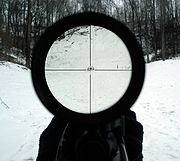
Sight (device)
A sight is a device used to assist aligning or aim weapons, surveying instruments, or other items by eye. Sights can be a simple set or system of markers that have to be aligned together as well as aligned with the target...
that is based on an optical refracting telescope
Refracting telescope
A refracting or refractor telescope is a type of optical telescope that uses a lens as its objective to form an image . The refracting telescope design was originally used in spy glasses and astronomical telescopes but is also used for long focus camera lenses...
. They are equipped with some form of graphic image pattern (a reticle) mounted in an optically appropriate position in their optical system to give an accurate aiming point. Telescopic sights are used with all types of systems that require accurate aiming but are most commonly found on guns
Güns
Güns or Guens may refer to:* Kőszeg, Hungary * Kőszeg Mountains, Hungary * Akiva Güns , birth name of Akiva Eger, a Hungarian-Polish rabbi- See also :* Guns * Gün, a surname...
. Other types of sights are iron sight
Iron sight
Iron sights are a system of shaped alignment markers used as a sighting device to assist in the aiming of a device such as a firearm, crossbow, or telescope, and exclude the use of optics as in telescopic sights or reflector sights...
s, reflector (reflex) sights
Reflector sight
A reflector or reflex sight is a generally non-magnifying optical device that allows the user to look through a partially reflecting glass element and see an illuminated projection of an aiming point or some other image superimposed on the field of view...
, and laser sights.
History
The first experiments directed to give shooters optical aiming aids go back to the early 17th century. For centuries different optical aiming aids and primitive predecessors of telescopic sights were created that had practical or performance limitations.The first documented telescopic rifle sight was invented between 1835 and 1840. In a book titled The Improved American Rifle, written in 1844, John R. Chapman
John Ratcliffe Chapman
John Ratcliffe Chapman was an eminent British engineer and the son son of another eminent British engineer, William Chapman, inventor of the Steam Elephant. John Ratcliffe Chapman brought his wife, Mary Pollitt Chapman to America in 1842 on HMS Britannia with the great author Charles Dickens...
documented the first telescopic sights made by Morgan James of Utica, NY. Chapman, the author, being a civil engineer, gave James the concepts and some of the design, whereupon they produced the Chapman-James sight. In 1855, William Malcolm of Syracuse, NY began producing his own sight. Malcolm used an original design incorporating achromatic lenses like those used in telescopes, and improved the windage and elevation adjustments. They were between 3X and 20X or greater. Malcolm's and those made by Mr. L.M. Amidon of Vermont were the standard during the Civil War.
Still other telescopic rifle sights of the same period were the Davidson telescopic sight and the Parker Hale telescopic sight.
An early practical refractor telescope based telescopic sight was built in 1880 by August Fiedler (Stronsdorf
Stronsdorf
Stronsdorf is a town in the district of Mistelbach in the Austrian state of Lower Austria....
, Austria), forestry commissioner of Prince Reuss.
Later telescopic sights with extra long eye relief
Eye relief
-Eye Relief and Exit Pupil:The eye relief of a telescope, a microscope, or binoculars is the distance from the last surface of an eyepiece at which the eye can obtain the full viewing angle. If a viewer's eye is outside this distance, a reduced field of view will be obtained...
became available for handgun and scout rifle use. A historic example of a telescopic sight with a long eye relief
Eye relief
-Eye Relief and Exit Pupil:The eye relief of a telescope, a microscope, or binoculars is the distance from the last surface of an eyepiece at which the eye can obtain the full viewing angle. If a viewer's eye is outside this distance, a reduced field of view will be obtained...
is the German ZF41
Zf-41
The Zf-41 was an optical sight produced in Germany during the Second World War.-History:Starting from 1941 the short 1.5x Zielfernrohr 41 telescopic sight was fitted to some Karabiner 98k rifles for sharpshooting use...
which was used during World War II on Karabiner 98k
Karabiner 98k
The Karabiner 98 Kurz was a bolt action rifle chambered for the 8x57mm IS/7.92×57mm IS cartridge that was adopted as the standard service rifle in 1935 by the German Wehrmacht. It was one of the final developments in the long line of Mauser military rifles...
rifles.
An early example of a man portable telescopic sight for low visibility/night use is the Zielgerät (aiming device) 1229
Zielgerät 1229
The Zielgerät 1229 , also known in its code name Vampir, was an active infrared device developed for the Wehrmacht for the Sturmgewehr 44 assault rifle, intended primarily for night use.-Design:...
(ZG 1229), also known by its code name Vampir. The ZG 1229 Vampir was a Generation 0 active infrared night vision device developed for the Wehrmacht
Wehrmacht
The Wehrmacht – from , to defend and , the might/power) were the unified armed forces of Nazi Germany from 1935 to 1945. It consisted of the Heer , the Kriegsmarine and the Luftwaffe .-Origin and use of the term:...
for the StG 44 assault rifle, intended primarily for night use. The issuing of the ZG 1229 Vampir system to the military started in 1944 and it was used on a small scale in combat from February 1945 until the final stages of World War II.
Types
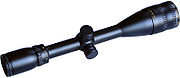
Magnification
Magnification is the process of enlarging something only in appearance, not in physical size. This enlargement is quantified by a calculated number also called "magnification"...
and the objective lens diameter
Diameter
In geometry, a diameter of a circle is any straight line segment that passes through the center of the circle and whose endpoints are on the circle. The diameters are the longest chords of the circle...
, e.g. 10×50. This would denote 10 times magnification
Magnification
Magnification is the process of enlarging something only in appearance, not in physical size. This enlargement is quantified by a calculated number also called "magnification"...
with a 50 mm objective lens. In general terms, larger objective lens diameters, due to their ability to gather larger amounts of light, provide a larger exit pupil
Exit pupil
In optics, the exit pupil is a virtual aperture in an optical system. Only rays which pass through this virtual aperture can exit the system. The exit pupil is the image of the aperture stop in the optics that follow it. In a telescope or compound microscope, this image is the image of the...
and hence provide a brighter image at the eyepiece
Eyepiece
An eyepiece, or ocular lens, is a type of lens that is attached to a variety of optical devices such as telescopes and microscopes. It is so named because it is usually the lens that is closest to the eye when someone looks through the device. The objective lens or mirror collects light and brings...
. On fixed magnification
Prime lens
In film and photography, a prime lens is either a photographic lens whose focal length is fixed, as opposed to a zoom lens, or it is the primary lens in a combination lens system....
sights the magnification power and objective diameter should be chosen on the basis of the intended use.
There are also telescopic sights with variable magnification
Zoom lens
A zoom lens is a mechanical assembly of lens elements for which the focal length can be varied, as opposed to a fixed focal length lens...
. The magnification can be varied by manually operating a zoom mechanism. Variable sights offer more flexibility regarding shooting at varying ranges, targets and light conditions and offer a relative wide field of view
Field of view
The field of view is the extent of the observable world that is seen at any given moment....
at lower magnification settings. The syntax for variable sights is the following: minimal magnification – maximum magnification × objective lens, for example, 3–9×40.
Confusingly, some older telescopic sights, mainly of German or other European manufacture, have a different classification where the second part of the designation refers to 'light gathering power.' In these cases, a 4×81 (4× magnification) sight would be presumed to have a brighter sight picture than a 2.5×70 (2.5× magnification), but the objective lens diameter would not bear any direct relation to picture brightness, as brightness is affected also by the magnification factor. Typically objective lenses on early sights are smaller than modern sights, in these examples the 4×81 would have an objective approximately 32mm diameter and the 2.5×70 might be approximately 25mm.
Optical parameters
Telescopic sights are usually designed for the specific application for which they are intended. Those different designs create certain optical parameters. Those parameters are:Magnification
Magnification
Magnification is the process of enlarging something only in appearance, not in physical size. This enlargement is quantified by a calculated number also called "magnification"...
— The ratio of the focal length of the eyepiece divided into the focal length of the objective gives the linear magnifying power of telescopes. A magnification of factor 10, for example, produces an image as if one were 10 times closer to the object. The amount of magnification depends upon the application the telescopic sight is designed for. Lower magnifications lead to less susceptibility to shaking. A larger magnification leads to a smaller field of view.
Objective lens diameter
Diameter
In geometry, a diameter of a circle is any straight line segment that passes through the center of the circle and whose endpoints are on the circle. The diameters are the longest chords of the circle...
– The diameter of the objective lens determines how much light can be gathered to form an image. It is usually expressed in millimeters.
Field of view
Field of view
The field of view is the extent of the observable world that is seen at any given moment....
— The field of view of a telescopic sight is determined by its optical design. It is usually notated in a linear
Linear
In mathematics, a linear map or function f is a function which satisfies the following two properties:* Additivity : f = f + f...
value, such as how many meters (feet) in width will be seen at 100 m (100 yd), or in an angular
Angle
In geometry, an angle is the figure formed by two rays sharing a common endpoint, called the vertex of the angle.Angles are usually presumed to be in a Euclidean plane with the circle taken for standard with regard to direction. In fact, an angle is frequently viewed as a measure of an circular arc...
value of how many degrees can be viewed.
Exit pupil
Exit pupil
In optics, the exit pupil is a virtual aperture in an optical system. Only rays which pass through this virtual aperture can exit the system. The exit pupil is the image of the aperture stop in the optics that follow it. In a telescope or compound microscope, this image is the image of the...
— Telescopic sights concentrate the light gathered by the objective into a beam, the exit pupil, whose diameter is the objective diameter divided by the magnifying power. For maximum effective light-gathering and brightest image, the exit pupil should equal the diameter of the fully dilated iris
Iris (anatomy)
The iris is a thin, circular structure in the eye, responsible for controlling the diameter and size of the pupils and thus the amount of light reaching the retina. "Eye color" is the color of the iris, which can be green, blue, or brown. In some cases it can be hazel , grey, violet, or even pink...
of the human eye — about 7 mm, reducing with age. If the cone of light streaming out of the eyepiece is larger than the pupil it is going into, any light larger than the pupil is wasted in terms of providing information to the eye.
However, a larger exit pupil makes it easier to put the eye where it can receive the light: anywhere in the large exit pupil cone of light will do. This ease of placement helps avoid vignetting
Vignetting
In photography and optics, vignetting is a reduction of an image's brightness or saturation at the periphery compared to the image center. The word vignette, from the same root as vine, originally referred to a decorative border in a book. Later, the word came to be used for a photographic...
, which is a darkened or obscured view that occurs when the light path is partially blocked. And, it means that the image can be quickly found which is important when aiming at game animals that move rapidly. A narrow exit pupil telescopic sight may also be fatiguing because the instrument must be held exactly in place in front of the eyes to provide a useful image. Finally, many people in Europe use their telescopic sights at dusk, dawn and at night, when their pupils are larger. Thus the daytime exit pupil of about 3 to 4 mm is not a universally desirable standard. For comfort, ease of use, and flexibility in applications, larger telescopic sights with larger exit pupils are satisfying choices even if their capability is not fully used by day.
Eye relief
Eye relief
-Eye Relief and Exit Pupil:The eye relief of a telescope, a microscope, or binoculars is the distance from the last surface of an eyepiece at which the eye can obtain the full viewing angle. If a viewer's eye is outside this distance, a reduced field of view will be obtained...
— Eye relief is the distance from the rear eyepiece lens to the exit pupil or eye point. It is the distance the observer must position his or her eye behind the eyepiece in order to see an unvignetted image. The longer the focal length of the eyepiece, the greater the eye relief. Typical telescopic sights may have eye relief ranging from 25 mm (1 in) to over 100 mm (4 in), but telescopic sights intended for scout rifle
Scout rifle
The Scout Rifle is a class of general-purpose rifles defined and promoted by Jeff Cooper in the early 1980s.These bolt action carbines are typically .308 caliber , less than 1 meter in length, and less than 3 kilograms in weight, with iron and optical sights and fitted with practical slings for...
s or handgun
Handgun
A handgun is a firearm designed to be held and operated by one hand. This characteristic differentiates handguns as a general class of firearms from long guns such as rifles and shotguns ....
s need much longer eye relief to present an unvignetted image. Telescopic sights with relatively long eye relief are favourable to avoid recoil
Recoil
Recoil is the backward momentum of a gun when it is discharged. In technical terms, the recoil caused by the gun exactly balances the forward momentum of the projectile and exhaust gasses, according to Newton's third law...
induced facial and eye injuries and use in instances where it is difficult to hold the eyepiece steady. Eye relief can be particularly important for eyeglass wearers. The eye of an eyeglass wearer is typically further from the eye piece which necessitates a longer eye relief in order to still see the entire field of view.
Reticles


Windage
Windage is a force created on an object by friction when there is relative movement between air and the object.There are two causes of windage:# the object is moving and being slowed by resistance from the air...
required due to crosswinds. A user can estimate the range to objects of known size, the size of objects at known distances, and even roughly compensate for both bullet drop and wind drifts at known ranges with a reticle-equipped scope.
For example, with a typical Leupold brand duplex 16 Minute of Angle
Minute of arc
A minute of arc, arcminute, or minute of angle , is a unit of angular measurement equal to one sixtieth of one degree. In turn, a second of arc or arcsecond is one sixtieth of one minute of arc....
(MOA) reticle (of a type as shown in image B) on a fixed power scope, the distance from post to post (that is, between the heavy lines of the reticle spanning the center of the scope picture) is approximately 32 inches (81.3 cm) at 200 yards (183 m), or, equivalently, approximately 16 inches (40.65 cm) from the center to any post at 200 yards. If a target of a known diameter of 16 inches fills just half of the total post-to-post distance (i.e. filling from scope center to post), then the distance to target is approximately 200 yards (183 m). With a target of a diameter of 16 inches that fills the entire sight picture from post to post, the range is approximately 100 yards. Other ranges can be similarly estimated accurately in an analog fashion for known target sizes through proportionality calculations. Holdover, for estimating vertical point of aim offset required for bullet drop compensation on level terrain, and horizontal windage offset (for estimating side to side point of aim offsets required for wind effect corrections) can similarly be compensated for through using approximations based on the wind speed (from observing flags or other objects) by a trained user through using the reticle marks. The less-commonly used holdunder, used for shooting on sloping terrain, can even be estimated by an appropriately-skilled user with a reticle-equipped scope, once the slope of the terrain and the slant range to target are both known.
There are two main types of reticles:
- Wire reticles
- Etched reticles
Wire reticles are the oldest type of reticles and are made out of metal wire. They are mounted in an optically appropriate position in the telescopic sight's tube. Etched reticles are images of the desired reticle layout that are etched on an optic element. This optical element (lens) with the etched reticle is then mounted in the telescopic sights tube as an integrated part of the optics chain of the sight. When backlit through the ocular a wire reticle will reflect incoming light and not present a fully opaque (black) reticule with high-contrast. An etched reticle will stay fully opaque (black) if backlit. Etched reticles are by most considered to be a more refined solution and offer greater reticle lay out flexibility. Because of this some manufacturers can provide client designed custom reticles on special order. In the more expensive and high end contemporary telescopic sights etched reticles dominate the market. In cheaper telescopic sights wire reticles are still often mounted to avoid a rather specialized and costly production step.
Mil-dot reticles

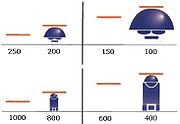
Angular mil
An angular mil, also mil, is a unit of angle. All versions of the angular mil are approximately the same size as a trigonometric milliradian.-History:The milliradian was first identified in the mid nineteenth Century...
(Mil) intervals in the field of view. A milliradian equates to 3.43774677078493 MOA
Minute of Angle
Minute of angle is the measurement of a ballistic round's deviation from its initial heading due to gravity and/or the effect of air resistance on velocity. Informally known as a "Bullet's Trajectory" or "the rainbow effect". Long range weapons must account for this effect because a fired round...
, that is, approximately 21.6 inches at 600 yards; each MOA equates to 1.0471975511966 inch at 100 yards, often rounded to 1 inch at 100 yards for fast mental calculations.
Users who use the metric system
Metric system
The metric system is an international decimalised system of measurement. France was first to adopt a metric system, in 1799, and a metric system is now the official system of measurement, used in almost every country in the world...
are better off with a Mil-dot reticle, since they do not have to hassle with the unnecessary complications of a non metric system of measurement
Systems of measurement
A system of measurement is a set of units which can be used to specify anything which can be measured and were historically important, regulated and defined because of trade and internal commerce...
during mental calculations. Also the Mil-dot measurements and ranging calculations are always exact in the metric system.
A trained user can relatively accurately measure the range to objects of known size, the size of objects at known distances, and compensate for both bullet drop and wind drifts at known ranges with a Mil-dot reticle-equipped scope.
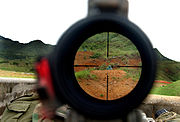
This is what a Netherlands Army sniper
Sniper
A sniper is a marksman who shoots targets from concealed positions or distances exceeding the capabilities of regular personnel. Snipers typically have specialized training and distinct high-precision rifles....
sees through his Schmidt & Bender
Schmidt & Bender
Schmidt & Bender is a German company specialized in producing high end telescopic sights for hunting, sports, law enforcement and military arms....
3-12x50 PM II telescopic sight. The Mil-dots can be seen on the cross hairs. By means of a mathematical formula – (width or height of the target/ number of mil of dots) x 1000 = distance – the user can measure the range to a target. An object of 1 meter tall or wide is exactly 1 Mil tall or wide at 1000 meters distance. If the user sees an object of 1.8 m tall for example as three mil dots tall through the riflescope the object is at 600 m distance – (1.8 / 3) x 1000 = 600.
The four horizontal bars over the horizontal line are also intended for (quick) ranging purposes.
Reticle focal plane
The reticle may be located at the front or rear focal plane (First Focal Plane (FFP) or Second Focal Plane (SFP)) of the telescopic sight. On fixed power telescopic sights there is no significant difference, but on variable power telescopic sights the front plane reticle expands and shrinks along with the rest of the image as the magnification is adjusted, while rear plane reticles appear same shape and size to the user as the target image grows and shrinks. In general, the majority of modern variable-power scopes are SFP unless stated otherwise. Every European high-end telescopic sight manufacturer offers FFP reticles on variable power telescopic sights, since the optical needs of European hunters who live in jurisdictions that allow hinting at dusk, night and dawn differ from hunters who traditionally or by legislation do not hunt in low light conditions.The main disadvantage of SFP designs comes with the use of range-finding reticles such as mil-dot. Since the proportion between the reticle and the target is dependent on selected magnification, such reticles only work properly at one magnification level, typically the highest power. Some long-range shooters and military snipers use fixed-power scopes to eliminate this potential for error. Some SFP scopes take advantage of this aspect by having the shooter adjust magnification until the target fits a certain way inside the reticle and extrapolating the range based on the power adjustment. Some Leupold hunting scopes with duplex reticles allow range estimation to a Whitetail Buck deer by adjusting magnification until the area between the backbone and the brisket fits between the crosshairs and the top thick post of the reticle. Once that's done, the range be read from the scale printed on the magnification adjustment ring.
Although FFP designs are not susceptible to magnification-induced errors, they have their own disadvantages. It's challenging to design a reticle that is visible through the entire range of magnification e.g. a reticle that looks fine and crisp at 24x may be very difficult to see at 6x magnification. On the other hand, a reticle that's easy to see at 6x may be thick enough at 24x to make precision shots difficult. Shooting in low light conditions also tends to require either illumination or a bold reticle, along with lower magnification to maximize light gathering. In practice, these issues tend to significantly reduce the available magnification range on FFP scopes compared to SFP, and FFP scopes are much more expensive compared to SFP models of similar quality. Most high end optics manufacturers leave the choice between a FFP or SFP mounted reticle to the customer or have scope product models with both setups.
Variable power telescopic sights with front focal plane reticles have no problems with point of impact shifts. Variable power telescopic sights with rear focal plane reticles can have slight point of impact shifts through their magnification range caused by the positioning of the reticle in the mechanical zoom mechanism in the rear part of the telescopic sight. Normally these impact shifts are insignificant but make accuracy oriented users, that wish to use their telescopic sight trouble-free at several magnification levels, often opt for front focal plane reticles. Around the year 2005 Zeiss was the first high end European telescopic sight manufacturer who brought out variable magnification military grade telescopic sight models with rear focal plane mounted reticles. They get around impermissible impact shifts for these sights by laboriously hand adjusting every military grade telescopic sight. The American high end telescopic sight manufacturer U.S. Optics Inc. also offers variable magnification military grade telescopic sight models with rear focal plane mounted reticles.
Reticle illumination
Either type of reticle can be illuminated for use in low-light or daytime conditions. With any illuminated low-light reticle, it is essential that its brightness can be adjusted. A reticle that is too bright will cause glare in the operator’s eye, interfering with his ability to see in low-light conditions. This is because the pupil of the human eye closes quickly upon receiving any source of light. Most illuminated reticles provide adjustable brightness settings to adjust the reticle precisely to the ambient light.Illumination is usually provided by a battery
Battery (electricity)
An electrical battery is one or more electrochemical cells that convert stored chemical energy into electrical energy. Since the invention of the first battery in 1800 by Alessandro Volta and especially since the technically improved Daniell cell in 1836, batteries have become a common power...
powered LED
LEd
LEd is a TeX/LaTeX editing software working under Microsoft Windows. It is a freeware product....
, though other electric light sources can be used. The light is projected forward through the scope, and reflects off the back surface of the reticle. Red is the most common colour used, as it least impedes the shooter's night vision
Night vision
Night vision is the ability to see in low light conditions. Whether by biological or technological means, night vision is made possible by a combination of two approaches: sufficient spectral range, and sufficient intensity range...
. This illumination method can be used to provide both daytime and low-light conditions reticle illumination.
Radioactive isotopes can also be used as a light source, to provide an illuminated reticule for low-light condition aiming. In sights like the SUSAT
SUSAT
The Sight Unit Small Arms, Trilux, or SUSAT, is a 4× telescopic sight with tritium-powered illumination, utilised at dusk or dawn. The full name of the current model is the SUSAT L9A1. The sight is not designed as a sniper sight, but is rather intended to be mounted on a variety of rifles and to...
or Elcan C79 Optical Sight
C79 Optical Sight
The C79 Optical sight is a small arms telescopic sight of 3.4x28 magnification. A tritium illuminated reticle provides for normal and low-light conditions sighting. The sight itself is Nitrogen-purged to prevent fogging and is covered with an armoured coating of rubber...
tritium
Tritium
Tritium is a radioactive isotope of hydrogen. The nucleus of tritium contains one proton and two neutrons, whereas the nucleus of protium contains one proton and no neutrons...
-illuminated reticles are used for low-light condition aiming. Trijicon
Trijicon
Trijicon ) is an American company, based in Wixom, Michigan, that manufactures and distributes optical sighting devices for firearms, including pistols, rifles, and shotguns....
Corporation uses tritium in their combat and hunting-grade firearm optics, including the ACOG
Advanced Combat Optical Gunsight
Advanced Combat Optical Gunsights are a series of telescopic sights manufactured by Trijicon. The ACOG is designed to be used on the M16 rifle and M4 carbine, but Trijicon has developed ACOG accessories for certain other firearms...
. The (radioactive) tritium light source has to be replaced every 8–12 years, since it gradually loses its brightness due to radioactive decay
Radioactive decay
Radioactive decay is the process by which an atomic nucleus of an unstable atom loses energy by emitting ionizing particles . The emission is spontaneous, in that the atom decays without any physical interaction with another particle from outside the atom...
.
With fiber optics ambient (day)light can be collected and directed to an illuminated daytime reticle. Fiber optics reticles automatically interact with the ambient light level that dictates the brightness of the reticle. Trijicon
Trijicon
Trijicon ) is an American company, based in Wixom, Michigan, that manufactures and distributes optical sighting devices for firearms, including pistols, rifles, and shotguns....
uses fiber optics combined with other low-light conditions illumination methods in their AccuPoint telescopic sights and some of their ACOG sights models.
Parallax compensation
ParallaxParallax
Parallax is a displacement or difference in the apparent position of an object viewed along two different lines of sight, and is measured by the angle or semi-angle of inclination between those two lines. The term is derived from the Greek παράλλαξις , meaning "alteration"...
problems result from the image from the objective not being coincident with the reticle. If the image is not coplanar with the reticle (that is the image of the objective is either in front of or behind the reticle), then putting your eye at different points behind the ocular causes the reticle crosshairs to appear to be at different points on the target. This optical effect causes parallax induced aiming errors that can make a telescopic sight user miss a small target at a distance for which the telescopic sight was not parallax adjusted.
To eliminate parallax induced aiming errors, telescopic sights can be equipped with a parallax compensation mechanism which basically consists of a movable optical element that enables the optical system to project the picture of objects at varying distances and the reticle crosshairs pictures together in exactly the same optical plane. There are two main methods to achieve this.
- By making the objective lens of the telescopic sight adjustable so the telescopic sight can compensate parallax errors. These models are often called AO or A/O models, for adjustable objective.
- By making an internal lens in the internal optical groups mounted somewhere in front of the reticle plane adjustable so the telescopic sight can compensate parallax errors. This method is technically more complicated to build, but generally more liked by parallax adjustable telescopic sight users—unlike AO models, which are read from the top, the sidewheel's setting can be read with minimal movement of the head. These models are often called side focus or sidewheel models.
Most telescopic sights lack parallax compensation because they can perform very acceptably without this refinement. Telescopic sights manufacturers adjust these scopes at a distance that best suits their intended usage. Typical standard factory parallax adjustment distances for hunting telescopic sights are 100 yd or 100 m to make them suited for hunting shots that rarely exceed 300 yd/m. Some long range target and military style telescopic sights without parallax compensation may be adjusted to be parallax free at ranges up to 300 yd/m to make them better suited for aiming at 300 yd/m+ ranges. Scopes for rimfire guns, shotgun
Shotgun
A shotgun is a firearm that is usually designed to be fired from the shoulder, which uses the energy of a fixed shell to fire a number of small spherical pellets called shot, or a solid projectile called a slug...
s, and muzzleloader
Muzzleloader
A muzzleloader is any firearm into which the projectile and usually the propellant charge is loaded from the muzzle of the gun . This is distinct from the more popular modern designs of breech-loading firearms...
s that are rarely fired at 100 yd/m+ ranges will have shorter parallax settings, commonly 50 yd/m for rimfire scopes and 100 yd/m for shotguns and muzzleloaders. Scopes for airguns that are commonly used at short ranges are very often found with adjustable parallax, usually in the form of an adjustable objective, or AO. These may adjust down as far as 3 yards (2.74 m).
The reason why scopes intended for short range use are often equipped with parallax compensation is that at short range (and at high magnification) parallax errors become more noticeable. A typical scope objective
Objective (optics)
In an optical instrument, the objective is the optical element that gathers light from the object being observed and focuses the light rays to produce a real image. Objectives can be single lenses or mirrors, or combinations of several optical elements. They are used in microscopes, telescopes,...
has a focal length
Focal length
The focal length of an optical system is a measure of how strongly the system converges or diverges light. For an optical system in air, it is the distance over which initially collimated rays are brought to a focus...
of 100 mm. An optical ideal 10× scope in this example has been perfectly parallax corrected at 1000 m and functions flawlessly at that distance. If the same scope is used at 100 m the target-picture would be projected (1000 m / 100 m) / 100 mm = 0.1 mm behind the reticle plane. At 10× magnification the error would be 10 × 0.1 mm = 1 mm at the ocular
Eyepiece
An eyepiece, or ocular lens, is a type of lens that is attached to a variety of optical devices such as telescopes and microscopes. It is so named because it is usually the lens that is closest to the eye when someone looks through the device. The objective lens or mirror collects light and brings...
. If the same scope was used at 10 m the target-picture would be (1000 m / 10 m) / 100 mm = 1 mm projected behind the reticle plane. When magnified ten times the error would be 10 mm at the ocular.
Bullet Drop Compensation
Bullet Drop Compensation (BDC) (sometimes referred to as ballistic elevationElevation (ballistics)
In ballistics, the elevation is the angle between the horizontal plane and the direction of the barrel of a gun, mortar or heavy artillery. Originally, elevation was a linear measure of how high the gunners had to physically lift the muzzle of a gun up from the gun carriage to hit targets at a...
) is a feature available on some rifle
Rifle
A rifle is a firearm designed to be fired from the shoulder, with a barrel that has a helical groove or pattern of grooves cut into the barrel walls. The raised areas of the rifling are called "lands," which make contact with the projectile , imparting spin around an axis corresponding to the...
scopes. The feature compensates for the effect of gravity on the bullet
Bullet
A bullet is a projectile propelled by a firearm, sling, or air gun. Bullets do not normally contain explosives, but damage the intended target by impact and penetration...
at given distances (referred to as "bullet drop"). The feature must be tuned for the particular ballistic trajectory of a particular combination of rifle and cartridge at a predefined air density. Inevitable BDC induced errors will occur if the environmental and meteorological circumstances deviate from the circumstances the BDC was calibrated for. Marksmen can be trained to compensate for these errors.
Adjustment controls
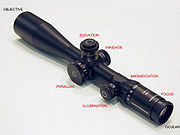
- Focusing control at the ocular end of the sight – meant to obtain a sharp picture of the object and reticle.
- Elevation or vertical adjustment control of the reticle.
- Zero-stop elevation controls can be set to prevent inadvertently dialing the adjustment knob "below" the primary zero (usually 100 meters or 100 yards for long-range scopes), or at least prevent dialing more than a couple adjustment clicks below zero. This feature is also useful on long-range scopes because it allows the shooter to physically verify the elevation knob is dialed all the way down avoiding confusion regarding the elevation status on two- or multi-revolution elevation knobs.
- Windage or horizontal adjustment control of the reticle.
- Magnification control – meant to change the magnification by turning a ring that is generally marked with several magnification power levels.
- Illumination adjustment control of the reticule – meant to regulate the brightness level of the lit parts of the reticles crosshairs.
- Parallax compensation control.
Most contemporary telescopic sights offer the first three adjustment controls. The other three are found on telescopic sights that offer a variable magnification, an illuminated reticle and/or parallax compensation. A rather common problem with the elevation and windage adjustment controls is that once smooth working adjustment turrets ‘get stuck’ over the years. This is generally caused by long time lack of movement in the lubricated turret mechanisms.
Older telescopic sights often did not offer windage and elevation adjustments in the scope, but rather used adjustable mounts to provide adjustment. Some modern mounts also allow for adjustment, but it is generally intended to supplement the scope adjustments. For example, some situations require fairly extreme elevation adjustments, such as very short range shooting common with airguns, or very long range shooting, where the bullet drop becomes very significant. Also, loose manufacturing tolerances may result in base mounting holes being less than perfectly aligned with the bore. In this case, rather than adjusting the scope to the extremes of its elevation adjustment, the scope mount can be adjusted. This allows the scope to operate near the center of its adjustment range, which puts less stress on the internals. Some companies offer adjustable bases, while others offer tapered bases with a given amount of elevation built in (commonly listed in MOA). The adjustable bases are more flexible, but the fixed bases are far more durable, as adjustable bases may loosen and shift under recoil. Also, adjustable bases are considerably more expensive, as well.
Accessories
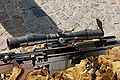
- Lens hoods for mounting on the objective and/or ocular to reduce/eliminate image quality impairing stray light.
- Lens hoods that extend the full length of a gun barrel to improve image quality by blocking out shot strings induced mirage ("heat waves" or aberrations resulting from a hot gun barrel).
- Covers to protect the objective and/or ocular external lens surface against foul weather and damage. There are slide-over, bikini and flip-open type covers without or with transparent covering material.
- Optical filters like Grey, Yellow and Polarising filters to optimize image quality in various lighting conditions.
- Kill Flash or honeycomb filters to eliminate light reflections from the objective that could compromise a sniper.
- Eye-safe laser filters to protect operators against being wounded/blinded by laser light sourcesLaser safetyLaser safety is safe design, use and implementation of lasers to minimize the risk of laser accidents, especially those involving eye injuries. Since even relatively small amounts of laser light can lead to permanent eye injuries, the sale and usage of lasers is typically subject to government...
. These filters are often an internal part in the assembly of lens elementsLens (optics)A lens is an optical device with perfect or approximate axial symmetry which transmits and refracts light, converging or diverging the beam. A simple lens consists of a single optical element...
. - Transit and protection pouches and cases.
Integrated laser rangefinder
In 1997 Swarovski OptikSwarovski Optik
Swarovski Optik is an Austrian manufacturer of sports optics, including binoculars, rifle scopes, telescopes, laser rangefinders and image intensifiers. Its headquarters are in Absam, Tyrol, where most of the products are developed and manufactured....
introduced the LRS series telescopic sight, the first riflescope on the civilian market with an integrated laser rangefinder. The LRS 2-12x50 sight can measure ranges up to 600 m (660 yd). The LRS sights are currently (2008) not produced anymore, but sights with similar features are commercially available from several manufacturers.
Ballistic support devices
An integrated ballistic computer/riflescope system known as BORS has been developed by the Barrett Firearms CompanyBarrett Firearms Company
Barrett Firearms Manufacturing is an American manufacturer of firearms and ammunition. It was founded in 1982 by Ronnie Barrett for the single purpose of building semi-automatic rifles chambered for the powerful 12.7×99mm NATO ammunition, originally developed for and used in M2 Browning machine...
and became commercially available around 2007. The BORS module is in essence an electronic Bullet Drop Compensation (BDC) sensor/calculator package intended for long-range sniping out to 2500 m (2734 yd) for some telescopic sight models made by Leupold and Nightforce. To establish the appropriate elevation setting the shooter needs to enter the ammunition type into the BORS (using touch pads on the BORS console) determine the range (either mechanically or through a laser rangefinder) and crank the elevation knob on the scope until the proper range appears in the BORS display. The BORS automatically determines the air density, as well as the cant or tilt in the rifle itself, and incorporates these environmental factors into its elevation calculations.
The SAM (Shooter-supporting Attachment Module) measures and provides aiming and ballistic relevant data and displays this to the user in the ocular of the Zeiss 6-24x72 telescopic sight it is developed for. The SAM has different sensors integrated (temperature, air pressure, shooting angle) and calculates the actual ballistic compensation. All indications are displayed in the ocular.
It memorizes up to 4 different ballistics and 4 different firing tables. So it is possible to use 1 SAM with 4 total different weapons without an additional adjustment.
CCD and LCD technology
A totally different approach has been applied in the ELCANELCAN Optical Technologies
ELCAN is a Canadian optics and electronics company owned by Raytheon.The company manufactures devices for civilian and military markets. The company has locations in Midland, Ontario, Richardson, Texas and Málaga, Spain....
DigitalHunter Digital Rifle Scope series which combines CCD
Charge-coupled device
A charge-coupled device is a device for the movement of electrical charge, usually from within the device to an area where the charge can be manipulated, for example conversion into a digital value. This is achieved by "shifting" the signals between stages within the device one at a time...
and LCD
Liquid crystal display
A liquid crystal display is a flat panel display, electronic visual display, or video display that uses the light modulating properties of liquid crystals . LCs do not emit light directly....
technology with electronic ballistics compensation, automatic video capture, 4 field selectable reticles and customizable reticles. In 2008 a DigitalHunter DayNight Riflescope that uses infrared
Infrared
Infrared light is electromagnetic radiation with a wavelength longer than that of visible light, measured from the nominal edge of visible red light at 0.74 micrometres , and extending conventionally to 300 µm...
light captured by the CCD to enhance low light capabilities became available. It is also possible to attach infrared light sources to use this telescopic sight as an active night sight in total darkness. Some jurisdictions however forbid or limit to use of night vision devices for civilian or gun aiming use.
Mounting
Steyr AUG
The AUG is an Austrian bullpup 5.56mm assault rifle, designed in the early 1970s by Steyr Mannlicher GmbH & Co KG . The AUG was adopted by the Austrian Army as the StG 77 in 1977, where it replaced the 7.62mm StG 58 automatic rifle...
, SAR 21 and the H&K G36
Heckler & Koch G36
The Heckler & Koch G36 is a 5.56×45mm assault rifle, designed in the early 1990s by Heckler & Koch in Germany as a replacement for the 7.62mm G3 battle rifle. It was accepted into service with the Bundeswehr in 1997, replacing the G3...
being exceptions) mounting a scope to a firearm requires additional equipment. Equipment is available to mount scopes on most production firearms. A typical scope mounting system consists of two parts, the scope base and the scope rings. By picking the appropriate combination of scope base to fit the firearm and scope rings to fit the scope, a wide range of scopes may be mounted to most firearms. With the appropriate combination of adjustable scope bases and scope rings it is also possible to mount several telescopic sights on the same gun to make the gun more versatile. However, it is important to take into consideration whether or not a gun is particularly hard to mount. If it is or if a gun is intended for long-range shooting, it could be that the amount of vertical adjustment range is smaller than required. This can be solved with the help of a vertically canted base or canted rings. Typical cant angles offered by mounting components manufacturers are 20 and 30 MOA. It is always wise to buy telescopic sights that provide a decent adjustment range, preferably at least 60 MOA or more.
Scope bases
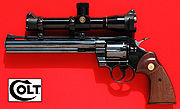
The base is attached to the rifle, usually with screws, and is often designed to have a low profile, and to allow use of the iron sights if the scope is not present. Some manufacturers provide integral bases on many of their firearms; an example of such a firearm is the RugerSturm, Ruger
Sturm, Ruger & Company, Incorporated is a Southport, Connecticut-based firearm manufacturing company, better known by the shortened name Ruger. Sturm, Ruger produces bolt-action, semi-automatic, full-automatic, and single-shot rifles, shotguns, semi-automatic pistols, and single- and double-action...
Super Redhawk
Super Redhawk
The Super Redhawk is a line of double action magnum revolvers made by Sturm, Ruger beginning in 1987, when Ruger started making weapons using larger, more powerful cartridges such as .44 Magnum, .454 Casull, and .480 Ruger.-The introduction:...
revolver. The most commonly encountered mounting systems are the 3/8 inch (9.5 mm) and the 11 mm dovetail
Dovetail
Dovetail may refer to:* The dovetail joint used in woodworking* The dovetail or "riffle" method of shuffling playing cards* German equatorial mount, or dovetail plate, used to fix a telescope to its mount...
mounts (sometimes called tip-off mounts), commonly found on rimfires and air gun
Air gun
An air gun is a rifle , pistol , or shotgun that fires projectiles by means of compressed air or other gas, in contrast to a firearm, which burns a propellant. Most air guns use metallic projectiles as ammunition. Air guns that only use plastic projectiles are classified as airsoft...
s, the Weaver type base and the STANAG
STANAG
STANAG is the NATO abbreviation for Standardization Agreement, which sets up processes, procedures, terms, and conditions for common military or technical procedures or equipment between the member countries of the alliance. Each NATO state ratifies a STANAG and implements it within their own...
2324 (MIL-STD-1913 "Picatinny rail
Picatinny rail
The Picatinny rail or MIL-STD-1913 rail or STANAG 2324 rail or a "Tactical Rail" is a bracket used on some firearms in order to provide a standardized mounting platform. A similar system is the Weaver rail mount.-Description:...
") base. Ruger uses a proprietary scope base system, though adapters are available to convert the Ruger bases into Weaver type bases. Scope base and mounting systems are also manufactured in Europe. Specialized manufacturers like Ernst Apel GmbH offer an elaborate program of mounting solutions for many different guns. Some of the European mounting solutions are virtually unknown and hence rarely applied in America. Many European gun manufacturers also developed and offer proprietary scope base systems for their guns, for example Sako
SAKO
SAKO, Limited is a Finnish firearm manufacturer located in Riihimäki....
has tapered dovetails and Tikka uses 16mm dovetail.
Scope rings
In addition to needing the right type of connector to attach to the desired base, scope rings must be used to hold the scope to the mount. The rings must be of the proper size to fit the scope; common sizes are 3/4 inch (19.05 mm), 22 mm, 1 inch (25.4 mm), 26 mm, 30 mm and 34 mm. Red dot sights commonly are found in larger sizes, such as 40 mm, and these often use ringless mounting systems designed to fit dovetail or Weaver type bases. Rings are also available in a variety of heights and materials. Ring height is chosen to place the scope high enough to clear the firearm, and at a height comfortable for the shooter.Scope mounting rails
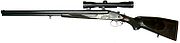
There are several mounting rail systems offered:
- Standard prism
- Zeiss ZM/VM, also used by DOCTERDOCTER (optics)DOCTER is a trade name for a German manufacturer of sports optics, including binoculars, rifle scopes, spotting scopes, red dot sights, flashlights and reading glasses. Its headquarters are in Eisfeld, Germany, where most of the products are developed and manufactured...
- Swarovski OptikSwarovski OptikSwarovski Optik is an Austrian manufacturer of sports optics, including binoculars, rifle scopes, telescopes, laser rangefinders and image intensifiers. Its headquarters are in Absam, Tyrol, where most of the products are developed and manufactured....
SR - Schmidt & BenderSchmidt & BenderSchmidt & Bender is a German company specialized in producing high end telescopic sights for hunting, sports, law enforcement and military arms....
Convex
The traditional standard prism mounting rail system requires to have the scope rail drilled from the side for fixture screws. The more recent propriety systems mainly offer aesthetic advantages for people who have problems with redundant drill holes in sight in case the riflescope is used on different guns. To avoid drilling the scope rail, the propriety rail mounting systems have special shape connections machined in the inside of the rail. These shape connections prevent ever showing any exterior damage from mounting work on the rifle scope. The propriety rail systems use matching slide-in mount fasteners to connect the riflescope to the gun. Some propriety rails also offer the possibility to tilt the scope up to 1° to the left or right.
Rail interface systems
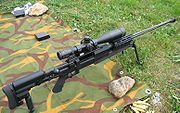
Rail Integration System
Rail Interface System are the primary method of attaching accessories to small firearms such as assault rifles and light machine guns...
are available to provide a standardized mounting platform.
Probably the best known rail interface system is the Picatinny rail
Picatinny rail
The Picatinny rail or MIL-STD-1913 rail or STANAG 2324 rail or a "Tactical Rail" is a bracket used on some firearms in order to provide a standardized mounting platform. A similar system is the Weaver rail mount.-Description:...
or STANAG
STANAG
STANAG is the NATO abbreviation for Standardization Agreement, which sets up processes, procedures, terms, and conditions for common military or technical procedures or equipment between the member countries of the alliance. Each NATO state ratifies a STANAG and implements it within their own...
2324 rail or MIL-STD-1913 rail used by NATO forces and other official and civil users. The name of this interface system comes from the Picatinny Arsenal
Picatinny Arsenal
The Picatinny Arsenal is an American military research and manufacturing facility located on a lot in northern New Jersey near Lake Denmark. The Arsenal is the headquarters of the United States Army Armament Research, Development and Engineering Center...
in New Jersey
New Jersey
New Jersey is a state in the Northeastern and Middle Atlantic regions of the United States. , its population was 8,791,894. It is bordered on the north and east by the state of New York, on the southeast and south by the Atlantic Ocean, on the west by Pennsylvania and on the southwest by Delaware...
, where it was originally tested and was used to distinguish it from other rail standards at the time. The Picatinny rail comprises a series of ridges with a T-shaped cross-section interspersed with flat "spacing slots". Telescopic sight mounting rings are mounted either by sliding them on from one end or the other; by means of a "rail-grabber" which is clamped to the rail with bolts, thumbscrews or levers; or onto the slots between the raised sections.
Another commercially available rail interface system is the Weaver rail mount
Weaver rail mount
A Weaver rail mount is a system to connect telescopic sights and other accessories to rifles, shotguns, pistols, archery bows, etc...
from Weaver Optics. The only difference between the Picatinny rail and the Weaver rail is the size and spacing of the slots, although almost all rail-grabber-mounted accessories are manufactured such that they can mounted on either type of rail.
Mounting issues
Scopes for use on light recoiling firearms, such as rimfire guns, can be mounted with a single ring, and this method is not uncommon on handguns, where space is at a premium. Most scopes are mounted with two rings, one in the front half of the scope and one on the back half, which provides additional strength and support. The heaviest recoiling firearms, such as Thompson Center ArmsThompson Center Arms
Thompson/Center Arms Company is an American firearms company based in Rochester, New Hampshire. The company is best known for its line of interchangeable barrel single-shot pistols and rifles. Thompson Center manufactures muzzleloading rifles and is credited with creating the resurgence of their...
Contender pistols in heavy recoiling calibers, will use three rings for maximum support of the scope. Use of too few rings can result not only in the scope moving under recoil, but also excessive torque on the scope tube as the gun rolls up under recoil.
Scopes on heavy recoiling firearms and spring piston airguns (which have a heavy "reverse recoil" caused by the piston reaching the end of its travel) suffer from a condition called scope creep, where the inertia of the scope holds it still as the firearm recoils under it. Because of this, scope rings must be precisely fitted to the scope, and tightened very consistently to provide maximum hold without putting uneven stress on the body of the scope. Rings that are out of round, misaligned in the bases, or tightened unevenly can warp or crush the body of the scope.
Another problem is mounting a scope on a rifle, such as some lever action designs, where the shell is ejected out the top of the rifle. Usually this results in the scope being offset to one side (to the left for right-handed people, right for left-handed) to allow the shell to clear the scope. Alternately a scout rifle
Scout rifle
The Scout Rifle is a class of general-purpose rifles defined and promoted by Jeff Cooper in the early 1980s.These bolt action carbines are typically .308 caliber , less than 1 meter in length, and less than 3 kilograms in weight, with iron and optical sights and fitted with practical slings for...
type mount can be used, which places a long eye relief scope forward of the action.
A firearm may not always be able to fit all aiming optics solutions, so it is wise to have a preferred aiming optics solution first reviewed by a professional.
Uses
Telescopic sights have both advantages and disadvantages relative to iron sights. Standard doctrine with iron sights is to focus the eye on the front sight and align it with the resulting blur of the target and the rear sight; most shooters have difficulty doing this, as the eye tends to be drawn to the target, blurring both sights. Gun users over 30 years of age with keen eyesight will find it harder to keep the target, front sight element and rear sight element well enough into focus for aiming purposes as human eyes gradually lose focusing flexibility with rising age, due to presbyopiaPresbyopia
Presbyopia is a condition where the eye exhibits a progressively diminished ability to focus on near objects with age. Presbyopia’s exact mechanisms are not known with certainty; the research evidence most strongly supports a loss of elasticity of the crystalline lens, although changes in the...
. Telescopic sights allow the user to focus on both the crosshair
Crosshair
A reticle is a net of fine lines or fibers in the eyepiece of a sighting device, such as a telescope, a telescopic sight, a microscope, or the screen of an oscilloscope. The word reticle comes from the Latin "reticulum," meaning "net." Today, engraved lines or embedded fibers may be replaced by a...
and the target at the same time, as the lenses project the crosshair into the distance (50 m or yd for rimfire scopes, 100 m or yd more for centerfire calibers). This, combined with telescopic magnification, clarifies the target and makes the target stand out against the background. The main disadvantage of magnification is that the area to either side of the target is obscured by the tube of the sight. The higher the magnification, the narrower the field of view in the sight, and the more area that is hidden. Rapid fire target shooters use reflex sights, which have no magnification; this gives them the best field of view while maintaining the single focal plane of a telescopic sight. Telescopic sights are expensive, and require additional training to align. Sight alignment with telescopic sights is a matter of making the field of vision circular to minimize parallax
Parallax
Parallax is a displacement or difference in the apparent position of an object viewed along two different lines of sight, and is measured by the angle or semi-angle of inclination between those two lines. The term is derived from the Greek παράλλαξις , meaning "alteration"...
error. For maximum effective light-gathering and brightest image, the exit pupil should equal the diameter of the fully dilated iris of the human eye — about 7 mm, reducing with age.
Military


Steyr AUG
The AUG is an Austrian bullpup 5.56mm assault rifle, designed in the early 1970s by Steyr Mannlicher GmbH & Co KG . The AUG was adopted by the Austrian Army as the StG 77 in 1977, where it replaced the 7.62mm StG 58 automatic rifle...
and the British SUSAT
SUSAT
The Sight Unit Small Arms, Trilux, or SUSAT, is a 4× telescopic sight with tritium-powered illumination, utilised at dusk or dawn. The full name of the current model is the SUSAT L9A1. The sight is not designed as a sniper sight, but is rather intended to be mounted on a variety of rifles and to...
mounted on the SA80
SA80
The SA80 is a British family of 5.56mm small arms. It is a selective fire, gas-operated assault rifle. SA80 prototypes were trialled in 1976 and production was completed in 1994....
, became standard issue, military
Military
A military is an organization authorized by its greater society to use lethal force, usually including use of weapons, in defending its country by combating actual or perceived threats. The military may have additional functions of use to its greater society, such as advancing a political agenda e.g...
use of telescopic sights was restricted to sniper
Sniper
A sniper is a marksman who shoots targets from concealed positions or distances exceeding the capabilities of regular personnel. Snipers typically have specialized training and distinct high-precision rifles....
s because of the fragility and expense of optical components. Additionally the glass lenses are prone to breakage, and environmental conditions such as condensation, precipitation, dirt, and mud obscure external lenses. The scope tube also adds significant bulk to the rifle. Snipers generally used moderate to high magnification scopes with special reticles that allow them to estimate range to the target. Since the 1990s many other armed forces have adopted optical devices for general issue to infantry units and the rate of adoption has increased as the cost of manufacture has fallen.
Telescopic sights provide some tactical disadvantages. Snipers rely on stealth and concealment to get close to their target. A telescopic sight can hinder this because sunlight may reflect from the lens and a sniper raising his head to use a telescopic sight might reveal his position. The famous Finnish
Finland
Finland , officially the Republic of Finland, is a Nordic country situated in the Fennoscandian region of Northern Europe. It is bordered by Sweden in the west, Norway in the north and Russia in the east, while Estonia lies to its south across the Gulf of Finland.Around 5.4 million people reside...
sniper Simo Häyhä
Simo Häyhä
Simo Häyhä , nicknamed "White Death" by the Red Army, was a Finnish sniper. Using a modified Mosin–Nagant in the Winter War, he has the highest recorded number of confirmed sniper kills - 505 - in any major war....
preferred to use iron sights rather than telescopic sights to present less of a target. Harsh climate can also cause problems for telescopic sights as they are less rugged than iron sights. Many Finnish snipers in WWII used iron sights
Iron sights
Iron sights are a system of shaped alignment markers used as a sighting device to assist in the aiming of a device such as a firearm, crossbow, or telescope, and exclude the use of optics as in telescopic sights or reflector sights...
heavily because telescopic sights did not cope with very cold Finnish winters.
The market for military telescopic sights intended for military long-range shooting is highly competitive. Several high end optics manufacturers are constantly adapting and improving their telescopic sights to fulfill specific demands of military organizations. Two European companies that are active this field are Schmidt & Bender
Schmidt & Bender
Schmidt & Bender is a German company specialized in producing high end telescopic sights for hunting, sports, law enforcement and military arms....
and Zeiss/Hensoldt. American companies that are also very active in this field are Nightforce, U.S. Optics Inc. and Premier Reticles. These high end sighting components generally cost € 1500 / $ 2000 or more. Typical options for military telescopic sights are reticle illumination for use under adverse light circumstances and the presentation of scope settings or ballistic relevant environmental measurements data to the operator through the sights ocular. Military organizations also are a main driving force behind the development of ever more versatile mil-dot reticles, the US Marine Corps specified for their 7000 USMC M8541 Premier/Schmidt & Bender 3-12x50 PM II LP telescopic sights. Other range finding reticle variations like Schmidt & Bender's P4L (Fine) reticule, which uses mil-hash marks instead of mil-dots for ranging purposes, also were developed on request of active snipers and other long-range field shooters.
The former Warsaw Pact
Warsaw Pact
The Warsaw Treaty Organization of Friendship, Cooperation, and Mutual Assistance , or more commonly referred to as the Warsaw Pact, was a mutual defense treaty subscribed to by eight communist states in Eastern Europe...
members produce military telescopic sights for their designated marksmen and developed a range finding reticle based on the height of an average human. The reticle used in the Romanian I.O.R.
I.O.R.
IOR is the acronym for the name of Întreprinderea Optică Română . It is a major optics company established in 1936 in Bucharest, Romania. I.O.R. produces military and civilian grade optics for export and domestic production. Famous for its own version of the Russian PSO-1 type scopes , binoculars...
LPS 4x6° TIP2 4x24 rifle scope is calibrated for ranging a 1.7 m tall target from 200 m to 1000 m. This Romanian scope shares the basic design and stadiametric rangefinder found in the reticle of the original Russia
Russia
Russia or , officially known as both Russia and the Russian Federation , is a country in northern Eurasia. It is a federal semi-presidential republic, comprising 83 federal subjects...
n PSO-1
PSO-1
The Soviet PSO-1 telescopic sight was at the time of its introduction , the most technically advanced telescopic sight ever designed for a mass-production designated marksman or sniper rifle...
and POSP scope series. The target base has to be lined up on the horizontal line of the range-finding scale and the target top point has to touch the upper (dotted) line of the scale without clearance. The digit under which this line up occurs determines the distance to the target.
The Israeli military began widespread use of telescopic sights by ordinary infantrymen to increase hit probability (especially in dim light) and extend effective range of standard issue infantry rifles. Palestinian militants in the al Aqsa Intifada likewise found that adding an inexpensive scope to an AK-47
AK-47
The AK-47 is a selective-fire, gas-operated 7.62×39mm assault rifle, first developed in the Soviet Union by Mikhail Kalashnikov. It is officially known as Avtomat Kalashnikova . It is also known as a Kalashnikov, an "AK", or in Russian slang, Kalash.Design work on the AK-47 began in the last year...
increased its effectiveness.
Today, several militaries issue telescopic sights to their infantry
Infantry
Infantrymen are soldiers who are specifically trained for the role of fighting on foot to engage the enemy face to face and have historically borne the brunt of the casualties of combat in wars. As the oldest branch of combat arms, they are the backbone of armies...
, usually compact, low-magnification sights suitable for snap-shooting. The US military issues the Advanced Combat Optical Gunsight
Advanced Combat Optical Gunsight
Advanced Combat Optical Gunsights are a series of telescopic sights manufactured by Trijicon. The ACOG is designed to be used on the M16 rifle and M4 carbine, but Trijicon has developed ACOG accessories for certain other firearms...
(ACOG), designed to be used on the M16 rifle
M16 rifle
The M16 is the United States military designation for the AR-15 rifle adapted for both semi-automatic and full-automatic fire. Colt purchased the rights to the AR-15 from ArmaLite, and currently uses that designation only for semi-automatic versions of the rifle. The M16 fires the 5.56×45mm NATO...
and M4 carbine
M4 carbine
The M4 carbine is a family of firearms tracing its lineage back to earlier carbine versions of the M16, all based on the original AR-15 designed by Eugene Stoner and made by ArmaLite. It is a shorter and lighter variant of the M16A2 assault rifle, with 80% parts commonality.It is a gas-operated,...
. American soldiers in Iraq and Afghanistan frequently purchase their own combat optics and carry them from home. The British army fields the SA80
SA80
The SA80 is a British family of 5.56mm small arms. It is a selective fire, gas-operated assault rifle. SA80 prototypes were trialled in 1976 and production was completed in 1994....
rifle with the SUSAT 4× optical sight as standard issue. The Canadian Forces standard C7 rifle
Diemaco C7
The Colt Canada C7 rifle is a service rifle variation of the M16 rifle that is manufactured by Diemaco/Colt Canada, a subsidiary of Colt Firearms after 2005, and used by the Canadian Forces, Hærens Jegerkommando , Military of Denmark , Iceland Crisis Response Unit, the Military of the Netherlands ...
has a 3.4 Elcan C79 optical sight
C79 Optical Sight
The C79 Optical sight is a small arms telescopic sight of 3.4x28 magnification. A tritium illuminated reticle provides for normal and low-light conditions sighting. The sight itself is Nitrogen-purged to prevent fogging and is covered with an armoured coating of rubber...
. Both Austria and Australia field variants of the Austrian Steyr AUG
Steyr AUG
The AUG is an Austrian bullpup 5.56mm assault rifle, designed in the early 1970s by Steyr Mannlicher GmbH & Co KG . The AUG was adopted by the Austrian Army as the StG 77 in 1977, where it replaced the 7.62mm StG 58 automatic rifle...
which has built an integral 1.5x optical sight since its deployment in the late 1970s. The German Army G36 assault rifles
Heckler & Koch G36
The Heckler & Koch G36 is a 5.56×45mm assault rifle, designed in the early 1990s by Heckler & Koch in Germany as a replacement for the 7.62mm G3 battle rifle. It was accepted into service with the Bundeswehr in 1997, replacing the G3...
have a more or less built in dual combat sighting system consisting of a ZF 3x4° telescopic sight combined with an unmagnified electronic red dot sight
Red dot sight
A red dot sight is a common classification for a type of non-magnifying reflector sight for firearms that gives the user an aimpoint in the form of an illuminated red dot...
. The dual combat sighting system weighs 30 gr (1 oz) due to a housing made out of glass fibre reinforced polyamide. All German G36 rifles are adapted to use the Hensoldt NSA 80 II third-generation night sight, which clamps into the G36 carry handle adapter in front of the optical sight housing and mates with the rifle's standard dual combat sighting system.
External links
- Demigodllc.com, Practical Long-Range Rifle Shooting – Part II: Optics by Zak Smith
- Demigodllc.com, Introduction to High-End Long-Range Rifle Scopes by Zak Smith
- MILS and MOA, by Robert J. Simeone
- AllWorldWars.com, Description of 2-inch Telescopic Sights Model 1906, designed by Warner & Swasey Co., Cleveland
- ChuckHawks.com, Telescopic and Red Dot Sights By Chuck Hawks