


Laser safety

Encyclopedia
Laser
A laser is a device that emits light through a process of optical amplification based on the stimulated emission of photons. The term "laser" originated as an acronym for Light Amplification by Stimulated Emission of Radiation...
accidents, especially those involving eye injuries. Since even relatively small amounts of laser light can lead to permanent eye injuries, the sale and usage of lasers is typically subject to government regulations.
Moderate and high-power lasers are potentially hazardous because they can burn the retina of the eye, or even the skin. To control the risk of injury, various specifications, for example ANSI Z136 in the US and IEC 60825 internationally, define "classes" of laser depending on their power and wavelength. These regulations also prescribe required safety measures, such as labeling lasers with specific warnings, and wearing laser safety goggles when operating lasers.
Laser radiation hazards
Laser radiation predominantly causes injury via thermal effects. Even moderately powered lasers can cause injury to the eye. High power lasers can also burn the skin. Some lasers are so powerful that even the diffuse reflectionDiffuse reflection
Diffuse reflection is the reflection of light from a surface such that an incident ray is reflected at many angles rather than at just one angle as in the case of specular reflection...
from a surface can be hazardous to the eye.

Coherence (physics)
In physics, coherence is a property of waves that enables stationary interference. More generally, coherence describes all properties of the correlation between physical quantities of a wave....
, the low divergence angle of laser light and the focusing mechanism of the eye means that laser light can be concentrated into an extremely small spot on the retina
Retina
The vertebrate retina is a light-sensitive tissue lining the inner surface of the eye. The optics of the eye create an image of the visual world on the retina, which serves much the same function as the film in a camera. Light striking the retina initiates a cascade of chemical and electrical...
. A transient increase of only 10 °C
Celsius
Celsius is a scale and unit of measurement for temperature. It is named after the Swedish astronomer Anders Celsius , who developed a similar temperature scale two years before his death...
can destroy retinal photoreceptor cells. If the laser is sufficiently powerful, permanent damage can occur within a fraction of a second, literally faster than the blink of an eye. Sufficiently powerful in the visible to near infrared laser radiation (400-1400 nm
1 E-9 m
To help compare different orders of magnitudes this page lists lengths between 10−9 metres and 10−8 metres .Distances shorter than 1 nanometre*1 nm = 1 nanometre = 1000 picometres = 10 angstroms...
) will penetrate the eyeball and may cause heating of the retina, whereas exposure to laser radiation with wavelengths less than 400 nm and greater than 1400 nm are largely absorbed by the cornea and lens, leading to the development of cataract
Cataract
A cataract is a clouding that develops in the crystalline lens of the eye or in its envelope, varying in degree from slight to complete opacity and obstructing the passage of light...
s or burn
Burn (injury)
A burn is a type of injury to flesh caused by heat, electricity, chemicals, light, radiation or friction. Most burns affect only the skin . Rarely, deeper tissues, such as muscle, bone, and blood vessels can also be injured...
injuries.
Infrared lasers are particularly hazardous, since the body's protective "blink reflex
Blink
Blinking is the rapid closing and opening of the eyelid. It is an essential function of the eye that helps spread tears across and remove irritants from the surface of the cornea and conjunctiva. Blink speed can be affected by elements such as fatigue, eye injury, medication, and disease...
" response is triggered only by visible light. For example, some people exposed to high power Nd:YAG laser emitting invisible 1064 nm radiation, may not feel pain or notice immediate damage to their eyesight. A pop or click noise emanating from the eyeball may be the only indication that retinal damage has occurred i.e. the retina was heated to over 100 °C
Celsius
Celsius is a scale and unit of measurement for temperature. It is named after the Swedish astronomer Anders Celsius , who developed a similar temperature scale two years before his death...
resulting in localized explosive boiling
Boiling
Boiling is the rapid vaporization of a liquid, which occurs when a liquid is heated to its boiling point, the temperature at which the vapor pressure of the liquid is equal to the pressure exerted on the liquid by the surrounding environmental pressure. While below the boiling point a liquid...
accompanied by the immediate creation of a permanent blind spot
Blind spot (vision)
A blind spot, also known as a scotoma, is an obscuration of the visual field. A particular blind spot known as the blindspot, or physiological blind spot, or punctum caecum in medical literature, is the place in the visual field that corresponds to the lack of light-detecting photoreceptor cells on...
.
Damage mechanisms
Lasers can cause damage in biological tissues, both to the eye and to the skin, due to several mechanisms.Thermal damage, or burn
Burn
A burn is an injury to flesh caused by heat, electricity, chemicals, light, radiation, or friction.Burn may also refer to:*Combustion*Burn , type of watercourses so named in Scotland and north-eastern England...
, occurs when tissues are heated to the point where denaturation
Denaturation (biochemistry)
Denaturation is a process in which proteins or nucleic acids lose their tertiary structure and secondary structure by application of some external stress or compound, such as a strong acid or base, a concentrated inorganic salt, an organic solvent , or heat...
of proteins occurs. Another mechanism is photochemical
Photochemistry
Photochemistry, a sub-discipline of chemistry, is the study of chemical reactions that proceed with the absorption of light by atoms or molecules.. Everyday examples include photosynthesis, the degradation of plastics and the formation of vitamin D with sunlight.-Principles:Light is a type of...
damage, where light triggers chemical reactions in tissue. Photochemical damage occurs mostly with short-wavelength (blue) and ultra-violet light and can be accumulated over the course of hours. Laser pulses shorter than about 1 μs can cause a rapid rise in temperature, resulting in explosive boiling of water. The shock wave from the explosion can subsequently cause damage relatively far away from the point of impact. Ultrashort pulse
Ultrashort pulse
In optics, an ultrashort pulse of light is an electromagnetic pulse whose time duration is of the order of a femtosecond . Such pulses have a broadband optical spectrum, and can be created by mode-locked oscillators...
s can also exhibit self-focusing
Self-focusing
Self-focusing is a non-linear optical process induced by the change in refractive index of materials exposed to intense electromagnetic radiation. A medium whose refractive index increases with the electric field intensity acts as a focusing lens for an electromagnetic wave characterised by an...
in the transparent parts of the eye, leading to an increase of the damage potential compared to longer pulses with the same energy.
The eye focuses visible and near-infrared light onto the retina. A laser beam can be focused to an intensity on the retina which may be up to 200,000 times higher than at the point where the laser beam enters the eye. Most of the light is absorbed by melanin
Melanin
Melanin is a pigment that is ubiquitous in nature, being found in most organisms . In animals melanin pigments are derivatives of the amino acid tyrosine. The most common form of biological melanin is eumelanin, a brown-black polymer of dihydroxyindole carboxylic acids, and their reduced forms...
pigments in the pigment epithelium just behind the photoreceptors, and causes burns in the retina. Ultraviolet light with wavelengths shorter than 400 nm tends to be absorbed in the cornea
Cornea
The cornea is the transparent front part of the eye that covers the iris, pupil, and anterior chamber. Together with the lens, the cornea refracts light, with the cornea accounting for approximately two-thirds of the eye's total optical power. In humans, the refractive power of the cornea is...
and lens, where it can produce injuries at relatively low powers due to photochemical damage. Infrared light mainly causes thermal damage to the retina at near-infrared wavelengths and to more frontal parts of the eye at longer wavelengths. The table below summarizes the various medical conditions caused by lasers at different wavelengths, not including injuries due to pulsed lasers.
| Wavelength range | Pathological effect |
|---|---|
| 180–315 nm (UV-B, UV-C) | photokeratitis Photokeratitis Photokeratitis or ultraviolet keratitis is a painful eye condition caused by exposure of insufficiently protected eyes to the ultraviolet rays from either natural or artificial sources. Photokeratitis is akin to a sunburn of the cornea and conjunctiva, and is not usually noticed until several... (inflammation of the cornea, equivalent to sunburn) |
| 315–400 nm (UV-A) | photochemical cataract Cataract A cataract is a clouding that develops in the crystalline lens of the eye or in its envelope, varying in degree from slight to complete opacity and obstructing the passage of light... (clouding of the eye lens) |
| 400–780 nm (visible) | photochemical damage to the retina, retinal burn |
| 780–1400 nm (near-IR) | cataract Cataract A cataract is a clouding that develops in the crystalline lens of the eye or in its envelope, varying in degree from slight to complete opacity and obstructing the passage of light... , retinal burn |
| 1.4–3.0μm (IR) | aqueous flare (protein in the aqueous humour Aqueous humour The aqueous humour is a clear, gelatinous fluid similar to plasma, but containing low-protein concentrations. It is secreted from the ciliary epithelium, a structure supporting the lens. It is located in the space between the lens and the cornea... ), cataract, corneal burn |
| 3.0 μm–1 mm | corneal burn |
The skin is usually much less sensitive to laser light than the eye, but excessive exposure to ultraviolet light from any source (laser or non-laser) can cause short- and long-term effects similar to sunburn
Sunburn
A sunburn is a burn to living tissue, such as skin, which is produced by overexposure to ultraviolet radiation, commonly from the sun's rays. Usual mild symptoms in humans and other animals include red or reddish skin that is hot to the touch, general fatigue, and mild dizziness. An excess of UV...
, while visible and infrared wavelengths are mainly harmful due to thermal damage.
Lasers and aviation safety
Since November 19, 2004 there have been over 2,800 incidents of lasers directed at aircraft within the United StatesUnited States
The United States of America is a federal constitutional republic comprising fifty states and a federal district...
. These concerns have led to an inquiry in the US Congress. Exposure to hand-held laser light under such circumstances may seem trivial given the brevity of exposure, the large distances involved and beam spread of up to several metres. However, laser exposure may create dangerous conditions such as flash blindness. If this occurs during a critical moment in aircraft operation, the aircraft may be endangered. In addition, some 18% to 35% of the population possess the autosomal dominant genetic
Genetics
Genetics , a discipline of biology, is the science of genes, heredity, and variation in living organisms....
trait, photic sneeze, that causes the affected individual to experience an involuntary sneezing fit when exposed to a sudden flash of light. Some observers believe that the danger is greatly exaggerated, at least for small hand-held lasers.
Maximum permissible exposure
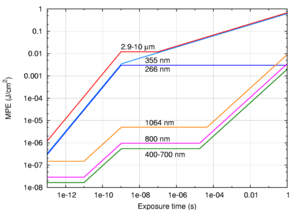
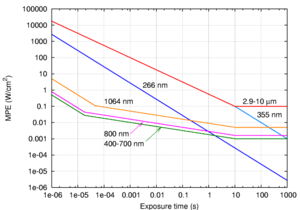
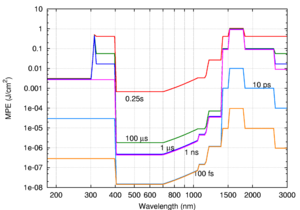
Energy density
Energy density is a term used for the amount of energy stored in a given system or region of space per unit volume. Often only the useful or extractable energy is quantified, which is to say that chemically inaccessible energy such as rest mass energy is ignored...
(in W/cm2 or J/cm2) of a light source that is considered safe, i.e. that has a negligible probability for creating damage
Lesion
A lesion is any abnormality in the tissue of an organism , usually caused by disease or trauma. Lesion is derived from the Latin word laesio which means injury.- Types :...
. It is usually about 10% of the dose that has a 50% chance of creating damage
under worst-case conditions. The MPE is measured at the cornea of the human eye or at the skin, for a given wavelength and exposure time.
A calculation of the MPE for ocular exposure takes into account the various ways light can act upon the eye. For example, deep-ultraviolet light causes accumulating damage, even at very low powers. Infrared
Infrared
Infrared light is electromagnetic radiation with a wavelength longer than that of visible light, measured from the nominal edge of visible red light at 0.74 micrometres , and extending conventionally to 300 µm...
light with a wavelength longer than about 1400 nm is absorbed by the transparent parts of the eye before it reaches the retina, which means that the MPE for these wavelengths is higher than for visible light. In addition to the wavelength and exposure time, the MPE takes into account the spatial distribution of the light (from a laser or otherwise). Collimated laser beams of visible and near-infrared light are especially dangerous at relatively low powers because the lens focuses the light onto a tiny spot on the retina. Light sources with a smaller degree of spatial coherence than a well-collimated laser beam, such as high-power LED
LEd
LEd is a TeX/LaTeX editing software working under Microsoft Windows. It is a freeware product....
s, lead to a distribution of the light over a larger area on the retina. For such sources, the MPE is higher than for collimated laser beams. In the MPE calculation, the worst-case scenario is assumed, in which the eye lens focuses the light into the smallest possible spot size on the retina for the particular wavelength and the pupil
Pupil
The pupil is a hole located in the center of the iris of the eye that allows light to enter the retina. It appears black because most of the light entering the pupil is absorbed by the tissues inside the eye. In humans the pupil is round, but other species, such as some cats, have slit pupils. In...
is fully open. Although the MPE is specified as power or energy per unit surface, it is based on the power or energy that can pass through a fully open pupil (0.39 cm2) for visible and near-infrared wavelengths. This is relevant for laser beams that have a cross-section smaller than 0.39 cm2. The IEC-60825-1 and ANSI Z136.1 standards include methods of calculating MPEs.
Regulations
In various jurisdictions, standards bodies, legislation, and government regulations define classes of laser according to the risks associated with them, and define required safety measures for people who may be exposed to those lasers.In the European Community, eye protection requirements are specified in European norm EN 207
EN 207
thumb|300px|EN207-compliant laser goggles. The user has added yellow stickers summarizing the complicated EN207 specifications shown in the inset.EN 207 is the European norm for laser safety eyewear. Any laser eye protection sold within the European Community must be certified and labeled with the...
. In addition to EN 207, European norm EN 208 specifies requirements for goggles for use during beam alignment. These transmit a portion of the laser light, permitting the operator to see where the beam is, and do not provide complete protection against a direct laser beam hit. Finally, European norm EN 60825 specifies optical densities in extreme situations.
In the U.S.
United States
The United States of America is a federal constitutional republic comprising fifty states and a federal district...
, guidance for the use of protective eyewear, and other elements of safe laser use, is given in the ANSI
American National Standards Institute
The American National Standards Institute is a private non-profit organization that oversees the development of voluntary consensus standards for products, services, processes, systems, and personnel in the United States. The organization also coordinates U.S. standards with international...
Z136 series of standards. A full copy of these standards can be obtained via ANSI or the secretariat and publisher of these standards, the Laser Institute of America. The standards are as follows:
- ANSIAmerican National Standards InstituteThe American National Standards Institute is a private non-profit organization that oversees the development of voluntary consensus standards for products, services, processes, systems, and personnel in the United States. The organization also coordinates U.S. standards with international...
Z136.1 - Safe Use of Lasers - ANSI Z136.3 – Safe Use of Lasers in Health Care Facilities
- ANSI Z136.4 – Recommended Practice for Laser Safety Measurements for Hazard Evaluation
- ANSI Z136.5 – Safe Use of Lasers in Educational Institutions
- ANSI Z136.6 – Safe Use of Lasers Outdoors
- ANSI Z136.7 – Testing and Labeling of Laser Protective Equipment
The U.S. Food and Drug Administration (FDA) requires all class IIIb and class IV lasers offered in commerce in the US to have five standard safety features: a key switch, a safety interlock dongle, a power indicator, an aperture shutter, and an emission delay (normally two to three seconds). OEM lasers, designed to be parts of other components (such as DVD burners) are exempt from this requirement. Some non-portable lasers may not have a safety dongle or an emission delay, but have an emergency stop button and/or a remote switch.
Classification
Lasers have been classified by wavelength and maximum output power into four classes and a few subclasses since the early 1970s. The classifications categorize lasers according to their ability to produce damage in exposed people, from class 1 (no hazard during normal use) to class 4 (severe hazard for eyes and skin). There are two classification systems, the "old system" used before 2002, and the "revised system" being phased in since 2002. The latter reflects the greater knowledge of lasers that has been accumulated since the original classification system was devised, and permits certain types of lasers to be recognized as having a lower hazard than was implied by their placement in the original classification system. The revised system is part of the revised IEC 60825 standard. From 2007, the revised system is also incorporated into the US-oriented ANSIAmerican National Standards Institute
The American National Standards Institute is a private non-profit organization that oversees the development of voluntary consensus standards for products, services, processes, systems, and personnel in the United States. The organization also coordinates U.S. standards with international...
Laser Safety Standard (ANSI Z136.1). Since 2007, labeling according to the revised system is accepted by the U.S. Food and Drug Administration (FDA) on laser products imported into the US. The old and revised systems can be distinguished by the 1M, 2M and 3R classes used only in the revised system and the 2A and 3A classes used only in the old system. Class numbers were designated using Roman numerals
Roman numerals
The numeral system of ancient Rome, or Roman numerals, uses combinations of letters from the Latin alphabet to signify values. The numbers 1 to 10 can be expressed in Roman numerals as:...
(I–IV) in the US under the old system and Arabic numerals (1–4) in the EU. The revised system uses Arabic numerals (1–4) in all jurisdictions.
The classification of a laser is based on the concept of accessible emission limits (AEL) that are defined for each laser class. This is usually a maximum power (in W) or energy (in J) that can be emitted in a specified wavelength range and exposure time. For infrared wavelengths above 4 μm, it is specified as a maximum power density (in W/m2). It is the responsibility of the manufacturer to provide the correct classification of a laser, and to equip the laser with appropriate warning labels and safety measures as prescribed by the regulations. Safety measures used with the more powerful lasers include key-controlled operation, warning lights to indicate laser light emission, a beam stop or attenuator, and an electrical contact that the user can connect to an emergency stop or interlock.
Revised system
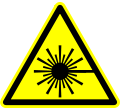
International Electrotechnical Commission
The International Electrotechnical Commission is a non-profit, non-governmental international standards organization that prepares and publishes International Standards for all electrical, electronic and related technologies – collectively known as "electrotechnology"...
60825-1 standard are listed, along with typical required warning labels. Additionally, classes 2 and higher must have the triangular warning label shown here and other labels are required in specific cases indicating laser emission, laser apertures, skin hazards, and invisible wavelengths. For classes I to IV, see the section old system further below.
Class 1
A class 1 laser is safe under all conditions of normal use. This means the maximum permissible exposure (MPE) cannot be exceeded.Class 1M
A Class 1M laser is safe for all conditions of use except when passed through magnifying optics such as microscopes and telescopes. Class 1M lasers produce large-diameter beams, or beams that are divergent. The MPE for a Class 1M laser cannot normally be exceeded unless focusing or imaging optics are used to narrow the beam. If the beam is refocused, the hazard of Class 1M lasers may be increased and the product class may be changed. A laser can be classified as Class 1M if the total output power is below class 3B but the power that can pass through the pupil of the eye is within Class 1.Class 2
A Class 2 laser is safe because the blink reflex will limit the exposure to no more than 0.25 seconds. It only applies to visible-light lasers (400–700 nm). Class-2 lasers are limited to 1 mW continuous wave, or more if the emission time is less than 0.25 seconds or if the light is not spatially coherent. Intentional suppression of the blink reflex could lead to eye injury. Many laser pointerLaser pointer
A laser pointer or laser pen is a small portable device with a power source and a laser emitting a very narrow coherent low-powered beam of visible light, intended to be used to highlight something of interest by illuminating it with a small bright spot of colored light...
s and measuring instruments are class 2.
Class 2M
A Class 2M laser is safe because of the blink reflex if not viewed through optical instruments. As with class 1M, this applies to laser beams with a large diameter or large divergence, for which the amount of light passing through the pupil cannot exceed the limits for class 2.Class 3R
A Class 3R laser is considered safe if handled carefully, with restricted beam viewing. With a class 3R laser, the MPE can be exceeded, but with a low risk of injury. Visible continuous lasers in Class 3R are limited to 5 mW. For other wavelengths and for pulsed lasers, other limits apply.Class 3B
A Class 3B laser is hazardous if the eye is exposed directly, but diffuse reflections such as those from paper or other matteGloss (material appearance)
Gloss is an optical property, which is based on the interaction of light with physical characteristics of a surface. It is actually the ability of a surface to reflect light into the specular direction. The factors that affect gloss are the refractive index of the material, the angle of incident...
surfaces are not harmful. Continuous lasers in the wavelength range from 315 nm to far infrared are limited to 0.5 W. For pulsed lasers between 400 and 700 nm, the limit is 30 mW. Other limits apply to other wavelengths and to ultrashort pulse
Ultrashort pulse
In optics, an ultrashort pulse of light is an electromagnetic pulse whose time duration is of the order of a femtosecond . Such pulses have a broadband optical spectrum, and can be created by mode-locked oscillators...
d lasers. Protective eyewear is typically required where direct viewing of a class 3B laser beam may occur. Class-3B lasers must be equipped with a key switch and a safety interlock.
Class 4
Class 4 is the highest and most dangerous class of laser, including all lasers with beam power greater than class 3B. By definition, a class 4 laser can burn the skin, or cause devastating and permanent eye damage as a result of direct, diffuse or indirect beam viewing. These lasers may ignite combustible materials, and thus may represent a fire risk. These hazards may also apply to indirect or non-specular reflections of the beam, even from apparently matte surfaces -- meaning that great care must be taken to control the beam path. Class 4 lasers must be equipped with a key switch and a safety interlock. Most industrial, scientific, military, and medical lasers are in this category, notably those at the US National Ignition FacilityNational Ignition Facility
The National Ignition Facility, or NIF is a large, laser-based inertial confinement fusion research device located at the Lawrence Livermore National Laboratory in Livermore, California. NIF uses powerful lasers to heat and compress a small amount of hydrogen fuel to the point where nuclear fusion...
or at the UK Central Laser Facility
Vulcan laser
The Vulcan laser is an 8-beam 2.5 kJ per pulse infrared neodymium glass laser at the Rutherford Appleton Laboratory's Central Laser Facility in Oxfordshire, England. Vulcan is also capable of operating in frequency doubled mode where it can deliver about 1 kJ to a target at 532 nm in 2 ns...
.
Old system
United States
The United States of America is a federal constitutional republic comprising fifty states and a federal district...
through consensus standards (ANSI Z136.1) and Federal and state regulations. The international classification described in consensus standards such as IEC 825 (later IEC 60825) was based on the same concepts but presented with designations slightly different from the US classification.
This classification system is only slightly altered from the original system developed in the early 1970s. It is still used by US laser product safety regulations. The laser powers mentioned are typical values. Classification is also dependent on the wavelength and on whether the laser is pulsed or continuous. For laser classes 1 to 4, see the section on the revised system above.
Class I
Inherently safe; no possibility of eye damage. This can be either because of a low output power (in which case eye damage is impossible even after hours of exposure), or due to an enclosure preventing user access to the laser beam during normal operation, such as in CD players or laser printers.Class II
The blink reflex of the human eye (aversion response) will prevent eye damage, unless the person deliberately stares into the beam for an extended period. Output power may be up to 1 mW. This class includes only lasers that emit visible light. Some laser pointerLaser pointer
A laser pointer or laser pen is a small portable device with a power source and a laser emitting a very narrow coherent low-powered beam of visible light, intended to be used to highlight something of interest by illuminating it with a small bright spot of colored light...
s are in this category.
Class IIa
A region in the low-power end of Class II where the laser requires in excess of 1000 seconds of continuous viewing to produce a burn to the retina. Commercial laser scanners are in this subclass.Class IIIa
Lasers in this class are mostly dangerous in combination with optical instruments which change the beam diameter or power density, though even without optical instrument enhancement direct contact with the eye for over two minutes may cause serious damage to the retina. Output power does not exceed 5 mW. Beam power density may not exceed 2.5 mW/square cm if the device is labeled with a "caution" warning label, otherwise a "danger" warning label is required. Many laser sights for firearmFirearm
A firearm is a weapon that launches one, or many, projectile at high velocity through confined burning of a propellant. This subsonic burning process is technically known as deflagration, as opposed to supersonic combustion known as a detonation. In older firearms, the propellant was typically...
s and laser pointer
Laser pointer
A laser pointer or laser pen is a small portable device with a power source and a laser emitting a very narrow coherent low-powered beam of visible light, intended to be used to highlight something of interest by illuminating it with a small bright spot of colored light...
s are in this category.
Class IIIb
Lasers in this class may cause damage if the beam enters the eye directly. This generally applies to lasers powered from 5–500 mW. Lasers in this category can cause permanent eye damage with exposures of 1/100th of a second or less depending on the strength of the laser. A diffuse reflection is generally not hazardous but specular reflectionSpecular reflection
Specular reflection is the mirror-like reflection of light from a surface, in which light from a single incoming direction is reflected into a single outgoing direction...
s can be just as dangerous as direct exposures. Protective eyewear is recommended when direct beam viewing of Class IIIb lasers may occur. Lasers at the high power end of this class may also present a fire hazard and can lightly burn skin. Many "laser pointers" at this output level are now available in this category.
Class IV
Lasers in this class have output powers of more than 500 mW in the beam and may cause severe, permanent damage to eye or skin without being magnified by optics of eye or instrumentation. Diffuse reflections of the laser beam can be hazardous to skin or eye within the Nominal Hazard Zone. Most industrial, scientific, military, medical, and some hand held lasers are in this category.General precautions
Many scientists involved with lasers agree on the following guidelines:- Everyone who uses a laser should be aware of the risks. This awareness is not just a matter of time spent with lasers; to the contrary, long-term dealing with invisible risks (such as from infrared laser beams) tends to reduce risk awareness, rather than to sharpen it.
- Optical experiments should be carried out on an optical tableOptical tableAn optical table is platform that is used to support systems used for optics experiments and engineering.-Explanation:In optical systems, especially those involving interferometry, the alignment of each component must be extremely accurate—precise down to a fraction of a wavelength—usually a few...
with all laser beams travelling in the horizontal plane only, and all beams should be stopped at the edges of the table. Users should never put their eyes at the level of the horizontal plane where the beams are in case of reflected beams that leave the table.
- Watches and other jewelry that might enter the optical plane should not be allowed in the laboratory. All non-optical objects that are close to the optical plane should have a matte finish in order to prevent specular reflectionSpecular reflectionSpecular reflection is the mirror-like reflection of light from a surface, in which light from a single incoming direction is reflected into a single outgoing direction...
s.
- Adequate eye protection should always be required for everyone in the room if there is a significant risk for eye injury.
- High-intensity beams that can cause fire or skin damage (mainly from class 4 and ultraviolet lasers) and that are not frequently modified should be guided through tubes.
- Alignment of beams and optical components should be performed at a reduced beam power whenever possible.
Protective eyewear
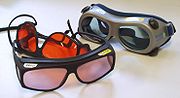
Occupational Safety and Health Administration
The United States Occupational Safety and Health Administration is an agency of the United States Department of Labor. It was created by Congress of the United States under the Occupational Safety and Health Act, signed by President Richard M. Nixon, on December 29, 1970...
.
Protective eyewear in the form of spectacles or goggles with appropriately filtering optics can protect the eyes from the reflected or scattered laser light with a hazardous beam power, as well as from direct exposure to a laser beam. Eyewear must be selected for the specific type of laser, to block or attenuate in the appropriate wavelength range. For example, eyewear absorbing 532 nm typically has an orange appearance, transmitting wavelengths larger than 550 nm. Such eyewear would be useless as protection against a laser emitting at 800 nm. Furthermore, some lasers emit more than one wavelength of light, and this may be a particular problem with some less expensive frequency-doubled lasers, such as 532 nm "green laser pointers" which are commonly pumped by 808 nm infrared laser diodes, and also generate an intermediate 1064 nm laser beam which is used to produce the final 532 nm output. If the IR radiation is allowed into the beam, which happens in some green laser pointers, it will in general not be blocked by regular red or orange colored protective eyewear designed for pure green or already IR-filtered beam. Special YAG laser and dual-frequency eyewear is available for work with frequency-doubled YAG and other IR lasers which have a visible beam, but it is more expensive, and IR-pumped green laser products do not always specify whether such extra protection is needed.
Eyewear is rated for optical density (OD), which is the base-10 logarithm of the attenuation factor by which the optical filter reduces beam power. For example, eyewear with OD 3 will reduce the beam power in the specified wavelength range by a factor of 1,000. In addition to an optical density sufficient to reduce beam power to below the maximum permissible exposure (see above), laser eyewear used where direct beam exposure is possible should be able to withstand a direct hit from the laser beam without breaking. The protective specifications (wavelengths and optical densities) are usually printed on the goggles, generally near the top of the unit. In the European Community, manufacturers are required by European norm EN 207
EN 207
thumb|300px|EN207-compliant laser goggles. The user has added yellow stickers summarizing the complicated EN207 specifications shown in the inset.EN 207 is the European norm for laser safety eyewear. Any laser eye protection sold within the European Community must be certified and labeled with the...
to specify the maximum power rating rather than the optical density.
Interlocks and automatic shutdown
Interlocks are circuits that shut down a laser if some condition is not met, such as if the laser casing or a room door is open. Class 3B and 4 lasers typically provide a connection for an external interlock circuit. Lasers that are class 1 only because the light is contained within an enclosure nearly always have an interlock that disables the laser if that enclosure is opened.Some systems have electronics that automatically shut down the laser under other conditions. For example, some fiber optic communication systems have circuits that automatically shut down transmission if a fiber is disconnected or broken.
Laser safety officer
In many jurisdictions, organizations that operate lasers are required to appoint a laser safety officer (LSO). The LSO is responsible for ensuring that safety regulations are followed by all other workers in the organization.Laser pointers
In the period from 2000 to 2008, increasing attention has been paid to the risks posed by so called laser pointerLaser pointer
A laser pointer or laser pen is a small portable device with a power source and a laser emitting a very narrow coherent low-powered beam of visible light, intended to be used to highlight something of interest by illuminating it with a small bright spot of colored light...
s and laser pens. Typically, sales of laser pointers is restricted to either class 3A (<5 mW) or class 2 (<1 mW), depending on local regulations. For example, in the US and Canada, class 3A is the maximum permitted, unless a key actuated control or other safety features are provided and in the UK and Australia
Australia
Australia , officially the Commonwealth of Australia, is a country in the Southern Hemisphere comprising the mainland of the Australian continent, the island of Tasmania, and numerous smaller islands in the Indian and Pacific Oceans. It is the world's sixth-largest country by total area...
, class 2 is the maximum allowed class. However, because enforcement is often not very strict, laser pointers of class 2 and above are often available for sale even in countries where they are not allowed.
Van Norren et al. (1998) could not find a single example in the medical literature of a <1 mW class III laser causing eyesight damage. Mainster et al. (2003) provide one case, an 11 year old child who temporarily damaged her eyesight by holding an approximately 5 mW red laser pointer close to the eye and staring into the beam for 10 seconds, she experienced scotoma
Scotoma
A scotoma is an area of partial alteration in one's field of vision consisting of a partially diminished or entirely degenerated visual acuity which is surrounded by a field of normal - or relatively well-preserved - vision.Every normal mammalian eye has a scotoma in its field of vision, usually...
(a blind spot) but fully recovered after 3 months. Luttrulla & Hallisey (1999) describe a similar case, a 34 year old male who stared into the beam of a class IIIa 5mW red laser for 30 to 60 seconds, causing temporary central scotoma
Scotoma
A scotoma is an area of partial alteration in one's field of vision consisting of a partially diminished or entirely degenerated visual acuity which is surrounded by a field of normal - or relatively well-preserved - vision.Every normal mammalian eye has a scotoma in its field of vision, usually...
and visual field loss. His eyesight fully recovered within 2 days, at the time of his eye exam. An intravenous fundus fluorescein angiogram, a technique used by ophthalmologists to visualise the retina of the eye in fine detail, identified subtle discoloration of the fovea
Fovea
The fovea centralis, also generally known as the fovea , is a part of the eye, located in the center of the macula region of the retina....
.
Thus, it appears that a brief 0.25-second exposure to a <5 mW laser such as found in red laser pointers does not pose a threat to eye health. On the other hand there is a potential for injury if a person deliberately stares into a beam of a class IIIa laser for few seconds or more at close range. Even if injury occurs, most people will fully recover their vision. Further experienced discomforts than these may be psychological rather than physical. With regard to green laser pointers the safe exposure time may be less, and with even higher powered lasers instant permanent damage should be expected. These conclusions must be qualified with recent theoretical observations that certain prescription medications may interact with some wavelengths of laser light, causing increased sensitivity (phototoxicity).
Beyond the question of physical injury to the eye from a laser pointer, several other undesirable effects are possible. These include short-lived flash blindness
Flash blindness
Flash blindness is visual impairment during and following exposure to a light flash of extremely high intensity. It may last for a few seconds to a few minutes....
if the beam is encountered in darkened surroundings, as when driving at night. This may result in momentary loss of vehicular control. Lasers pointed at aircraft are a hazard to aviation
Lasers and aviation safety
Under certain conditions, laser light or other bright lights directed at aircraft can be a hazard. The most likely scenario is when a bright visible laser light causes distraction or temporary flash blindness to a pilot, during a critical phase of flight such as landing or takeoff...
. A police officer seeing a red dot on his chest may conclude that a sniper is targeting him and take aggressive action. In addition, the startle reflex exhibited by some exposed unexpectedly to laser light of this sort has been reported to have resulted in cases of self-injury or loss of control. For these and similar reasons, the US Food and Drug Administration
Food and Drug Administration
The Food and Drug Administration is an agency of the United States Department of Health and Human Services, one of the United States federal executive departments...
has advised that laser pointers are not toys and should not be used by minors except under the direct supervision of an adult.
Fiber optics for communications
Fiber optic laser safety is characterized by the fact that in normal operation the light beam is inaccessible, so something has to be unplugged or broken for it to be become accessible. The resultant exit beam is quite divergent, so eye safety is highly dependent on distance, and if a magnifying device is used.In practice, accidental exposure to the large majority of installed systems, is unlikely to have any health impact, since power levels are usually infra-red and below 1 mW, e.g. Class 1. However there are a few significant exceptions.
Most single mode / multi mode fiber systems actually use infra-red light, invisible to the human eye. In this case, there is no 'eye aversion response". A special case is systems operating at 670–1000 nm, where the beam may appear to be a dull red, even if the light beam is actually very intense. Technicians may also use red lasers for fault finding at around 628–670 nm. These can create a significant hazard if viewed incorrectly, particularly if they are abnormally high power. Such visible fault finders are usually classified as Class 2 up to 1 mW, and Class 2M up to 10 mW.
High power optical amplifiers are used in long distance systems. They use internal pump lasers with power levels up a few watts, which is a major hazard. However these power levels are contained within the amplifier module. Any system employing typical optical connectors (e.g. not expanded beam) can not typically exceed about 100 mW, above which power level single mode connectors become unreliable, so if there is a single mode connector in the system, the design power level will always be below this level, even if no other details are known. An additional factor with these systems, is that light around the 1550 nm wavelength band (common for optical amplifiers) is regarded as relatively low risk, since the eye does not absorb it very much. This tends to reduce the overall risk factor of such systems.
Optical microscopes and magnifying devices also present unique safety challenges. If any optical power is present, and a simple magnifying device is used to examine the fiber end, then the user is no longer protected by beam divergence, since the entire beam may be imaged onto the eye. Therefore, simple magnifying devices should never be used in such situations. Optical connector inspection microscopes are available which incorporate blocking filters, thus greatly improving eye safety. The most recent such design also incorporates protection against red fault locating lasers.
Non-beam hazards – electrical and other
While most of the danger of lasers comes from the beam itself, there are certain non-beam hazards that are often associated with use of laser systems. Many lasers are high voltage devices, typically 400 V upward for a small 5 mJ pulsed laser, and exceeding many kilovolts in higher powered lasers. This, coupled with high pressure water for cooling the laser and other associated electrical equipment can create a greater hazard than the laser beam itself.Electric equipment should generally be installed at least 250 mm / 10 inches above the floor to reduce electric risk in the case of flooding. Optical tables, lasers, and other equipment should be well grounded. Enclosure interlocks should be respected and special precautions taken during troubleshooting.
In addition to the electrical hazards, lasers may create chemical, mechanical, and other hazards specific to particular installations. Chemical hazards may include materials intrinsic to the laser, such as beryllium oxide in argon ion laser tubes, halogens in excimer lasers, organic dyes dissolved in toxic or flammable solvents in dye lasers, and heavy metal vapors and asbestos insulation in helium cadmium lasers. They may also include materials released during laser processing, such as metal fumes from cutting or surface treatments of metals or the complex mix of decomposition products produced in the high energy plasma of a laser cutting plastics.
Mechanical hazards may include moving parts in vacuum and pressure pumps; implosion or explosion of flashlamps, plasma tubes, water jackets, and gas handling equipment.
High temperatures and fire hazards may also result from the operation of high-powered Class IIIB or any Class IV Laser.
In commercial laser systems, hazard mitigations such as the presence of fusible plug
Fusible plug
A fusible plug is a threaded metal cylinder usually of bronze, brass or gunmetal, with a tapered hole drilled completely through its length. This hole is sealed with a metal of low melting point that flows away if a pre-determined, high temperature is reached...
s, thermal interrupters, and pressure relief valves reduce the hazard of, for example, a steam explosion arising from an obstructed water cooling jacket. Interlocks, shutters, and warning lights are often critical elements of modern commercial installations. In older lasers, experimental and hobby systems, and those removed from other equipment (OEM units) special care must be taken to anticipate and reduce the consequences of misuse as well as various failure modes.
See also
- Lasers and aviation safetyLasers and aviation safetyUnder certain conditions, laser light or other bright lights directed at aircraft can be a hazard. The most likely scenario is when a bright visible laser light causes distraction or temporary flash blindness to a pilot, during a critical phase of flight such as landing or takeoff...
- Audience scanningAudience scanningAudience scanning occurs when a laser beam is directed toward the people observing a laser show or display...
– use of lasers in light shows, where they are deliberately directed into the audience to create special effects
External links
- Laser safety fact sheet (University of Kentucky)
- U.S. Navy Laser Safety Website
- OSHA Technical Manual Section III, Chapter 6, Laser Safety
- Laser safety resources (Vanderbilt Environmental Health & Safety)
- OSHA Web Page on Laser Hazards
- Laser Institute of America - Secretariat and Publisher of the ANSI Z136 Series of Laser Safety Standards