


Refracting telescope

Encyclopedia
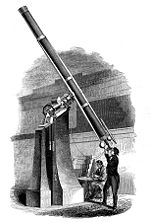
Optical telescope
An optical telescope is a telescope which is used to gather and focus light mainly from the visible part of the electromagnetic spectrum for directly viewing a magnified image for making a photograph, or collecting data through electronic image sensors....
that uses a lens
Lens (optics)
A lens is an optical device with perfect or approximate axial symmetry which transmits and refracts light, converging or diverging the beam. A simple lens consists of a single optical element...
as its objective
Objective (optics)
In an optical instrument, the objective is the optical element that gathers light from the object being observed and focuses the light rays to produce a real image. Objectives can be single lenses or mirrors, or combinations of several optical elements. They are used in microscopes, telescopes,...
to form an image (also referred to a dioptric
Dioptrics
Dioptrics is the study of the refraction of light, especially by lenses. Telescopes that create their image with an objective that is a convex lens are said to be "dioptric" telescopes....
telescope
Telescope
A telescope is an instrument that aids in the observation of remote objects by collecting electromagnetic radiation . The first known practical telescopes were invented in the Netherlands at the beginning of the 1600s , using glass lenses...
). The refracting telescope design was originally used in spy glasses and astronomical telescopes but is also used for long focus camera lenses. Although large refracting telescopes were very popular in the second half of the 19th century, for most research purposes the refracting telescope has been superseded by the reflecting telescope
Reflecting telescope
A reflecting telescope is an optical telescope which uses a single or combination of curved mirrors that reflect light and form an image. The reflecting telescope was invented in the 17th century as an alternative to the refracting telescope which, at that time, was a design that suffered from...
.
Invention
Refractors were the earliest type of optical telescopeOptical telescope
An optical telescope is a telescope which is used to gather and focus light mainly from the visible part of the electromagnetic spectrum for directly viewing a magnified image for making a photograph, or collecting data through electronic image sensors....
. The first practical refracting telescopes appeared in the Netherlands
Netherlands
The Netherlands is a constituent country of the Kingdom of the Netherlands, located mainly in North-West Europe and with several islands in the Caribbean. Mainland Netherlands borders the North Sea to the north and west, Belgium to the south, and Germany to the east, and shares maritime borders...
in about 1608, and were credited to three individuals, Hans Lippershey
Hans Lippershey
Hans Lippershey , also known as Johann Lippershey or Lipperhey, was a German-Dutch lensmaker commonly associated with the invention of the telescope, although it is unclear if he was the first to build one.-Biography:...
and Zacharias Janssen
Zacharias Janssen
Zacharias Jansen was a Dutch spectacle-maker from Middelburg associated with the invention of the first optical telescope. Jansen is sometimes also credited for inventing the first truly compound microscope...
, spectacle-makers in Middelburg
Middelburg
Middelburg is a municipality and a city in the south-western Netherlands and the capital of the province of Zeeland. It is situated in the Midden-Zeeland region. It has a population of about 48,000.- History of Middelburg :...
, and Jacob Metius
Jacob Metius
Jacob Metius was a Dutch instrument-maker and a specialist in grinding lenses. He was born in Alkmaar and was the brother of Adriaan Adriaanszoon...
of Alkmaar
Alkmaar
Alkmaar is a municipality and a city in the Netherlands, in the province of Noord Holland. Alkmaar is well known for its traditional cheese market. For tourists, it is a popular cultural destination.-History:...
also known as Jacob Adriaanszoon. Galileo Galilei
Galileo Galilei
Galileo Galilei , was an Italian physicist, mathematician, astronomer, and philosopher who played a major role in the Scientific Revolution. His achievements include improvements to the telescope and consequent astronomical observations and support for Copernicanism...
, happening to be in Venice
Venice
Venice is a city in northern Italy which is renowned for the beauty of its setting, its architecture and its artworks. It is the capital of the Veneto region...
in about the month of May 1609, heard of the invention and constructed a version of his own. Galileo then communicated the details of his invention to the public, and presented the instrument itself to the Doge
Doge of Venice
The Doge of Venice , often mistranslated Duke was the chief magistrate and leader of the Most Serene Republic of Venice for over a thousand years. Doges of Venice were elected for life by the city-state's aristocracy. Commonly the person selected as Doge was the shrewdest elder in the city...
Leonardo Donato
Leonardo Donato
Leonardo Donà, or Donato was the 90th Doge of Venice, reigning from January 10, 1606 until his death...
, sitting in full council. Galileo may thus claim to have invented the refracting telescope independently, but not until he had heard that others had done so. In the Netherlands, though, many people were selling the idea at the same time.
Refracting telescope designs
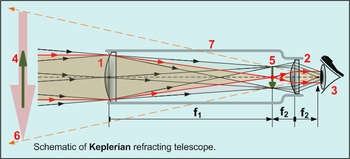
Objective (optics)
In an optical instrument, the objective is the optical element that gathers light from the object being observed and focuses the light rays to produce a real image. Objectives can be single lenses or mirrors, or combinations of several optical elements. They are used in microscopes, telescopes,...
lens
Lens (optics)
A lens is an optical device with perfect or approximate axial symmetry which transmits and refracts light, converging or diverging the beam. A simple lens consists of a single optical element...
1 and some type of eyepiece
Eyepiece
An eyepiece, or ocular lens, is a type of lens that is attached to a variety of optical devices such as telescopes and microscopes. It is so named because it is usually the lens that is closest to the eye when someone looks through the device. The objective lens or mirror collects light and brings...
2 is used to gather more light than the human eye could collect on its own, focus it 5, and present the viewer with a brighter
Brightness
Brightness is an attribute of visual perception in which a source appears to be radiating or reflecting light. In other words, brightness is the perception elicited by the luminance of a visual target...
, clearer
Clarity
Clarity may refer to:* Clarity , 2010* Clarity , 1999* Clarity * Clarity , a song by John Mayer* Honda FCX Clarity, a hydrogen fuel cell automobile* Clarity Act, Canadian bill C-20...
, and magnified
Magnification
Magnification is the process of enlarging something only in appearance, not in physical size. This enlargement is quantified by a calculated number also called "magnification"...
virtual image
Virtual image
In optics, a virtual image is an image in which the outgoing rays from a point on the object always diverge. It will appear to converge in or behind the optical device . A simple example is a flat mirror where the image of oneself is perceived at twice the distance from oneself to the mirror...
6.
The objective in a refracting telescope refracts
Refraction
Refraction is the change in direction of a wave due to a change in its speed. It is essentially a surface phenomenon . The phenomenon is mainly in governance to the law of conservation of energy. The proper explanation would be that due to change of medium, the phase velocity of the wave is changed...
or bends light
Light
Light or visible light is electromagnetic radiation that is visible to the human eye, and is responsible for the sense of sight. Visible light has wavelength in a range from about 380 nanometres to about 740 nm, with a frequency range of about 405 THz to 790 THz...
. This refraction causes parallel
Parallel (geometry)
Parallelism is a term in geometry and in everyday life that refers to a property in Euclidean space of two or more lines or planes, or a combination of these. The assumed existence and properties of parallel lines are the basis of Euclid's parallel postulate. Two lines in a plane that do not...
light rays to converge at a focal point
Focus (optics)
In geometrical optics, a focus, also called an image point, is the point where light rays originating from a point on the object converge. Although the focus is conceptually a point, physically the focus has a spatial extent, called the blur circle. This non-ideal focusing may be caused by...
; while those not parallel converge upon a focal plane. The telescope converts a bundle of parallel rays to make an angle α, with the optical axis to a second parallel bundle with angle β. The ratio β/α is called the angular magnification. It equals the ratio between the retinal image sizes obtained with and without the telescope.
Refracting telescopes can come in many different configurations to correct for image orientation and types of aberration. Because the image was formed by the bending of light, or refraction, these telescopes are called refracting telescopes or refractors.
Galileo's telescope
The original design Galileo GalileiGalileo Galilei
Galileo Galilei , was an Italian physicist, mathematician, astronomer, and philosopher who played a major role in the Scientific Revolution. His achievements include improvements to the telescope and consequent astronomical observations and support for Copernicanism...
came up with in 1609 is commonly called a Galilean telescope. It uses a convergent (plano-convex or bi-convex) objective lens and a divergent (plano-concave or bi-concave) eyepiece lens. Galilean telescopes produce upright images.
Galileo’s best telescope magnified
Magnification
Magnification is the process of enlarging something only in appearance, not in physical size. This enlargement is quantified by a calculated number also called "magnification"...
objects about 30 times. Because of flaws in its design, such as the shape of the lens and the narrow field of view, the images were blurry and distorted. Despite these flaws, the telescope was still good enough for Galileo to explore the sky. The Galilean telescope could view the phases of Venus
Phases of Venus
The phases of the planet Venus are the different variations of lighting seen on the planet's surface, similar to lunar phases. The first recorded observations of them were telescopic observations by Galileo Galilei in 1610...
, and was able to see craters
Impact crater
In the broadest sense, the term impact crater can be applied to any depression, natural or manmade, resulting from the high velocity impact of a projectile with a larger body...
on the Moon
Moon
The Moon is Earth's only known natural satellite,There are a number of near-Earth asteroids including 3753 Cruithne that are co-orbital with Earth: their orbits bring them close to Earth for periods of time but then alter in the long term . These are quasi-satellites and not true moons. For more...
and four moons
Galilean moons
The Galilean moons are the four moons of Jupiter discovered by Galileo Galilei in January 1610. They are the largest of the many moons of Jupiter and derive their names from the lovers of Zeus: Io, Europa, Ganymede and Callisto. Ganymede, Europa and Io participate in a 1:2:4 orbital resonance...
orbiting Jupiter.
Parallel rays of light from a distant object (y) would be brought to a focus in the focal plane of the objective lens (F' L1 / y’). The (diverging) eyepiece (L2) lens intercepts these rays and renders them parallel once more. Non-parallel rays of light from the object traveling at an angle α1 to the optical axis travel at a larger angle (α2 > α1) after they passed through the eyepiece. This leads to an increase in the apparent angular size and is responsible for the perceived magnification.
The final image (y’’) is a virtual image, located at infinity and is the same way up as the object.
Keplerian Telescope
Johannes Kepler
Johannes Kepler was a German mathematician, astronomer and astrologer. A key figure in the 17th century scientific revolution, he is best known for his eponymous laws of planetary motion, codified by later astronomers, based on his works Astronomia nova, Harmonices Mundi, and Epitome of Copernican...
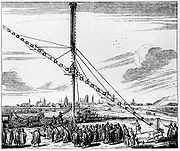
in 1611, is an improvement on Galileo's design. It uses a convex lens as the eyepiece instead of Galileo's concave one. The advantage of this arrangement is the rays of light emerging from the eyepiece are converging. This allows for a much wider field of view and greater eye relief but the image for the viewer is inverted. Considerably higher magnifications can be reached with this design but to overcome aberrations the simple objective lens needs to have a very high f-ratio (Johannes Hevelius
Johannes Hevelius
Johannes Hevelius Some sources refer to Hevelius as Polish:Some sources refer to Hevelius as German:*Encyplopedia Britannica * of the Royal Society was a councilor and mayor of Danzig , Pomeranian Voivodeship, in the Polish-Lithuanian Commonwealth...
built one with a 45 m (150 ft) focal length
Focal length
The focal length of an optical system is a measure of how strongly the system converges or diverges light. For an optical system in air, it is the distance over which initially collimated rays are brought to a focus...
and even longer tubeless "aerial telescope
Aerial telescope
An aerial telescope is a type of very-long-focal-length refracting telescope built in the second half of the 17th century that did not use a tube. Instead, the objective was mounted on a pole, tree, tower, building or other structure on a swivel ball-joint. The observer stood on the ground and held...
s" were constructed). The design also allows for use of a micrometer at the focal plane (used to determining the angular size and/or distance between objects observed).
Achromatic refractors
The AchromaticAchromatic lens
An achromatic lens or achromat is a lens that is designed to limit the effects of chromatic and spherical aberration. Achromatic lenses are corrected to bring two wavelengths into focus in the same plane....
refracting lens was invented in 1733 by an English barrister named Chester Moore Hall
Chester Moore Hall
Chester Moore Hall was a British lawyer and inventor who produced the first achromatic lenses in 1729 or 1733 ....
although it was independently invented and patented by John Dollond
John Dollond
John Dollond was an English optician, known for his successful optics business and his patenting and commercialization of achromatic doublets.-Biography:...
around 1758. The design overcame the need for very long focal lengths in refracting telescopes by using an objective made of two pieces of glass
Glass
Glass is an amorphous solid material. Glasses are typically brittle and optically transparent.The most familiar type of glass, used for centuries in windows and drinking vessels, is soda-lime glass, composed of about 75% silica plus Na2O, CaO, and several minor additives...
with different dispersion
Dispersion (optics)
In optics, dispersion is the phenomenon in which the phase velocity of a wave depends on its frequency, or alternatively when the group velocity depends on the frequency.Media having such a property are termed dispersive media...
, "crown
Crown glass (optics)
Crown glass is type of optical glass used in lenses and other optical components. It has relatively low refractive index and low dispersion...
" and "flint glass
Flint glass
Flint glass is optical glass that has relatively high refractive index and low Abbe number. Flint glasses are arbitrarily defined as having an Abbe number of 50 to 55 or less. The currently known flint glasses have refractive indices ranging between 1.45 and 2.00...
", to limit the effects of chromatic
Chromatic aberration
In optics, chromatic aberration is a type of distortion in which there is a failure of a lens to focus all colors to the same convergence point. It occurs because lenses have a different refractive index for different wavelengths of light...
and spherical aberration
Spherical aberration
thumb|right|Spherical aberration. A perfect lens focuses all incoming rays to a point on the [[Optical axis|optic axis]]. A real lens with spherical surfaces suffers from spherical aberration: it focuses rays more tightly if they enter it far from the optic axis than if they enter closer to the...
. Each side of each piece is ground and polish
Polishing
Polishing is the process of creating a smooth and shiny surface by rubbing it or using a chemical action, leaving a surface with a significant specular reflection In some materials polishing is also able to reduce diffuse reflection to...
ed, and then the two pieces are assembled together. Achromatic lenses are corrected to bring two wavelength
Wavelength
In physics, the wavelength of a sinusoidal wave is the spatial period of the wave—the distance over which the wave's shape repeats.It is usually determined by considering the distance between consecutive corresponding points of the same phase, such as crests, troughs, or zero crossings, and is a...
s (typically red and blue) into focus in the same plane. The era of the Great refractors in the 19th century saw large achromatic lenses culminating with largest achromatic refractor ever built, the Great Paris Exhibition Telescope of 1900
Great Paris Exhibition Telescope of 1900
The Great Paris Exhibition Telescope of 1900, with an objective lens of 1.25 m in diameter, was the largest refracting telescope ever constructed. It was built as the centerpiece of the Paris Universal Exhibition of 1900. Its construction was instigated in 1892 by François Deloncle , a member of...
.
Apochromatic refractors
Apochromatic refractors have objectives built with special, extra-low dispersion materials. They are designed to bring three wavelengths (typically red, green, and blue) into focus in the same plane. The residual color error (tertiary spectrum) can be up to an order of magnitude less than that of an achromatic lens. Such telescopes contain elements of fluoriteFluorite
Fluorite is a halide mineral composed of calcium fluoride, CaF2. It is an isometric mineral with a cubic habit, though octahedral and more complex isometric forms are not uncommon...
or special, extra-low dispersion (ED) glass in the objective and produce a very crisp image that is virtually free of chromatic aberration. Due to the special materials needed in the fabrication, apochromatic refractors are usually more expensive than telescopes of other types with a comparable aperture.
Technical considerations
Refractors have been criticized for their relatively high-degree of residual chromaticChromatic aberration
In optics, chromatic aberration is a type of distortion in which there is a failure of a lens to focus all colors to the same convergence point. It occurs because lenses have a different refractive index for different wavelengths of light...
and spherical aberration
Spherical aberration
thumb|right|Spherical aberration. A perfect lens focuses all incoming rays to a point on the [[Optical axis|optic axis]]. A real lens with spherical surfaces suffers from spherical aberration: it focuses rays more tightly if they enter it far from the optic axis than if they enter closer to the...
. This affects shorter focal length
Focal length
The focal length of an optical system is a measure of how strongly the system converges or diverges light. For an optical system in air, it is the distance over which initially collimated rays are brought to a focus...
s more than longer ones. A 4" achromatic refractor is likely to show considerable color fringing (generally a purple halo around bright objects). A 4" 16 has little color fringing.
In very large apertures, there is also a problem of lens sag
Lens sag
Lens sag is a problem that sometimes afflicts very large refracting telescopes. It is the equivalent of mirror sag in reflecting telescopes. It occurs when the physical weight of the glass causes a distortion in the shape of the lens because the lens can only be supported by the edges...
ging, a result of gravity deforming glass
Glass
Glass is an amorphous solid material. Glasses are typically brittle and optically transparent.The most familiar type of glass, used for centuries in windows and drinking vessels, is soda-lime glass, composed of about 75% silica plus Na2O, CaO, and several minor additives...
. Since a lens can only be held in place by its edge, the center of a large lens sags due to gravity, distorting the images it produces. The largest practical lens size in a refracting telescope is around 1 meter.
There is a further problem of glass defects, striae or small air bubbles trapped within the glass. In addition, glass is opaque
Opacity (optics)
Opacity is the measure of impenetrability to electromagnetic or other kinds of radiation, especially visible light. In radiative transfer, it describes the absorption and scattering of radiation in a medium, such as a plasma, dielectric, shielding material, glass, etc...
to certain wavelength
Wavelength
In physics, the wavelength of a sinusoidal wave is the spatial period of the wave—the distance over which the wave's shape repeats.It is usually determined by considering the distance between consecutive corresponding points of the same phase, such as crests, troughs, or zero crossings, and is a...
s, and even visible light is dimmed by reflection and absorption when it crosses the air-glass interfaces and passes through the glass itself. Most of these problems are avoided or diminished by using reflecting telescope
Reflecting telescope
A reflecting telescope is an optical telescope which uses a single or combination of curved mirrors that reflect light and form an image. The reflecting telescope was invented in the 17th century as an alternative to the refracting telescope which, at that time, was a design that suffered from...
s, which can be made in far larger apertures.
Notable refracting telescopes
- Great Paris Exhibition Telescope of 1900Great Paris Exhibition Telescope of 1900The Great Paris Exhibition Telescope of 1900, with an objective lens of 1.25 m in diameter, was the largest refracting telescope ever constructed. It was built as the centerpiece of the Paris Universal Exhibition of 1900. Its construction was instigated in 1892 by François Deloncle , a member of...
(1.25 m, 49 in) - Yerkes ObservatoryYerkes ObservatoryYerkes Observatory is an astronomical observatory operated by the University of Chicago in Williams Bay, Wisconsin. The observatory, which calls itself "the birthplace of modern astrophysics," was founded in 1897 by George Ellery Hale and financed by Charles T. Yerkes...
(102 cm, 40 in) - Swedish 1-m Solar TelescopeSwedish Solar TelescopeThe Swedish 1-m Solar Telescope is a refracting solar telescope at Roque de los Muchachos Observatory, La Palma in the Canary Islands. It is run by the Institute for Solar Physics of the Royal Swedish Academy of Sciences. The primary element is a single fused silica lens, making it the second...
(98 cm, 39 in) - Lick ObservatoryLick ObservatoryThe Lick Observatory is an astronomical observatory, owned and operated by the University of California. It is situated on the summit of Mount Hamilton, in the Diablo Range just east of San Jose, California, USA...
(91 cm, 36 in) - Paris ObservatoryParis ObservatoryThe Paris Observatory is the foremost astronomical observatory of France, and one of the largest astronomical centres in the world...
(83 cm, 33 in, + 62 cm, 24 in) - Nice ObservatoryNice ObservatoryThe Observatoire de Nice is an astronomical observatory located in Nice, France on the summit of Mont Gros. The observatory was initiated in 1879 by the banker Raphaël Bischoffsheim...
(76 cm, 30 in) - Archenhold Observatory - the longest refracting telescope ever built (68 cm, 27 in, x 21 m, 68 ft, focal length)
- Lowell ObservatoryLowell ObservatoryLowell Observatory is an astronomical observatory in Flagstaff, Arizona. Lowell Observatory was established in 1894, placing it among the oldest observatories in the United States, and was designated a National Historic Landmark in 1965....
(61 cm, 24 in) - Chabot Space & Science Center (51 cm, 20 in, + 20 cm, 8 in)
- Dearborn ObservatoryDearborn ObservatoryThe Dearborn Observatory is an astronomical observatory located on the Evanston campus of Northwestern University. The observatory was originally constructed in 1888...
(47 cm, 18.5 in) - Griffith ObservatoryGriffith ObservatoryGriffith Observatory is in Los Angeles, California, United States. Sitting on the south-facing slope of Mount Hollywood in L.A.'s Griffith Park, it commands a view of the Los Angeles Basin, including downtown Los Angeles to the southeast, Hollywood to the south, and the Pacific Ocean to the southwest...
(30 cm, 12 in) - GalileoscopeGalileoscopeThe Galileoscope is a small , mass-produced refractor telescope, designed with the intention of increasing public interest in astronomy and science...
(5 cm, 2 in)
See also
- AstrographAstrographAn astrograph is a telescope designed for the sole purpose of astrophotography. Astrographs are usually used in wide field surveys of the night sky as well as detection of objects such as asteroids, meteors, and comets.-Design:...
- Catadioptric telescopes
- Henry FitzHenry Fitz-Early life:Fitz was born in 1808 in Newburyport, Massachusetts. The family moved to Albany, New York, some eleven years later and to New York City later on. Fitz as a boy was already very interested in science and mechanics. He initially learned the printing trade from his father. They printed the...
, the first American to make refracting telescopes. - List of largest optical refracting telescopes
- List of largest optical telescopes historically
- List of telescope types
- Reflecting telescopeReflecting telescopeA reflecting telescope is an optical telescope which uses a single or combination of curved mirrors that reflect light and form an image. The reflecting telescope was invented in the 17th century as an alternative to the refracting telescope which, at that time, was a design that suffered from...
- Star DiagonalStar diagonalA star diagonal is an angled mirror or prism used in telescopes that allows viewing from a direction that is perpendicular to the usual eyepiece axis. It allows more convenient and comfortable viewing when the telescope is pointed at, or near the zenith . Also, the resulting image is right side...
External links
- nasa.gov - Build a Telescope
- Making a Galilean Telescope
- BUILDING A GALILEAN TELESCOPE
- OPTICS OF THE SINGLET REFRACTOR: GALILEO vs. KEPLER
- Angular and Linear Fields of View of Galilean Telescopes and Telemicroscopes
- Refracting telescopes
- Introduction to Galileo's Telescope
- Homework Help with Galilean Telescope