


Vamana

Encyclopedia
Vamana also called Nagari , is an abugida alphabet of India and Nepal...
: वामन, IAST
IAST
The International Alphabet of Sanskrit Transliteration is a transliteration scheme that allows a lossless romanization of Indic scripts as employed by the Sanskrit language.-Popularity:...
: Vāmana) is described in the Puranic texts of Hinduism
Hinduism
Hinduism is the predominant and indigenous religious tradition of the Indian Subcontinent. Hinduism is known to its followers as , amongst many other expressions...
as the Fifth Avatar
Avatar
In Hinduism, an avatar is a deliberate descent of a deity to earth, or a descent of the Supreme Being and is mostly translated into English as "incarnation," but more accurately as "appearance" or "manifestation"....
of Vishnu
Vishnu
Vishnu is the Supreme god in the Vaishnavite tradition of Hinduism. Smarta followers of Adi Shankara, among others, venerate Vishnu as one of the five primary forms of God....
, and the first incarnation of the Second Age, or the Treta yuga
Yuga
Yuga in Hindu philosophy is the name of an 'epoch' or 'era' within a cycle of four ages. These are the Satya Yuga, the Treta Yuga, the Dvapara Yuga, and finally the Kali Yuga. According to Hindu cosmology, life in the universe is created, destroyed once every 4.1 to 8.2 billion years, which is...
. Also he is the first Avatar of Vishnu which appears with a completely human form, though it was that of a dwarf brahmin
Brahmin
Brahmin Brahman, Brahma and Brahmin.Brahman, Brahmin and Brahma have different meanings. Brahman refers to the Supreme Self...
. He is also sometimes known as Upendra. The Vamana
Vamana
Vamana is described in the Puranic texts of Hinduism as the Fifth Avatar of Vishnu, and the first incarnation of the Second Age, or the Treta yuga. Also he is the first Avatar of Vishnu which appears with a completely human form, though it was that of a dwarf brahmin. He is also sometimes known as...
avatar
Avatar
In Hinduism, an avatar is a deliberate descent of a deity to earth, or a descent of the Supreme Being and is mostly translated into English as "incarnation," but more accurately as "appearance" or "manifestation"....
is commemorated by the festival of Onam
Onam
Onam is a Hindu festival celebrated by the people of Kerala, India. The festival commemorates the Vamana avatar of Vishnu and the subsequent homecoming of the legendary Emperor Mahabali. It falls during the month of Chingam and lasts for ten days...
.
Origin
Vamana was born to AditiAditi
Aditi in Sanskrit, an ancient Indian language. In the Vedas Aditi is mother of the gods from whose cosmic matrix the heavenly bodies were born...
and Kashyapa. His twelfth of the Adityas
Ādityas
In Hinduism, Āditya , meaning "of or related to Aditi", refers to the offsprings of Aditi. Adityas are solar class deities. In later Hinduism, Aditya is used in the singular to mean the sun.-Vedas:...
. Vamana is held to be the younger brother of Indra
Indra
' or is the King of the demi-gods or Devas and Lord of Heaven or Svargaloka in Hindu mythology. He is also the God of War, Storms, and Rainfall.Indra is one of the chief deities in the Rigveda...
.
Vedas
In Rigveda there comes a reference for Vishnu - Who has measured the three lokas in three steps.The two legs can be seen but the third can not.This probably grew up into independent tale in later vedic period.Hinduism
The legend of BhagavataBhagavata purana
The Bhāgavata Purāṇa is one of the "Maha" Puranic texts of Hindu literature, with its primary focus on bhakti to the incarnations of Vishnu, particularly Krishna...
has it that the Vamana avatar was taken by Vishnu to restore Indra's
Indra
' or is the King of the demi-gods or Devas and Lord of Heaven or Svargaloka in Hindu mythology. He is also the God of War, Storms, and Rainfall.Indra is one of the chief deities in the Rigveda...
authority over the heavens, which was taken away by Mahabali
Mahabali
Mahabali , also known as Bali or Māveli was a benevolent Asura King, and the grandson of Prahlada. The festival of Onam commemorates his yearly homecoming after being sent down to the underworld by Vamana, the fifth avatar of Vishnu.-Conquest of the Universe and banishment:Bali, an asura, was the...
, a benevolent Asura
Asura
-In Hinduism:In Hinduism, the Asuras constitute a group of power-seeking deities, sometimes considered sinful and materialistic. The Daityas and Danavas were combinedly known as Asuras. The Asura were opposed to the Devas. Both groups are children of Kasyapa...
King. Bali
Mahabali
Mahabali , also known as Bali or Māveli was a benevolent Asura King, and the grandson of Prahlada. The festival of Onam commemorates his yearly homecoming after being sent down to the underworld by Vamana, the fifth avatar of Vishnu.-Conquest of the Universe and banishment:Bali, an asura, was the...
was the grandson of Prahlada
Prahlada
Prahlada is a character from the Puranic texts of Hinduism, wherein he is famed for his exclusive devotion to Vishnu, despite attempts in the story by his father, Hiranyakashipu, to turn him to the contrary...
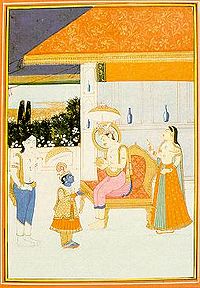
, the son of Hiranyakshipu. Vamana, in the guise of a short Brahman
Brahman
In Hinduism, Brahman is the one supreme, universal Spirit that is the origin and support of the phenomenal universe. Brahman is sometimes referred to as the Absolute or Godhead which is the Divine Ground of all being...
, carried a wooden umbrella
Umbrella
An umbrella or parasol is a canopy designed to protect against rain or sunlight. The term parasol usually refers to an item designed to protect from the sun; umbrella refers to a device more suited to protect from rain...
and requested three steps of land for him to live in. Given a promise of three steps of land by King Mahabali
Mahabali
Mahabali , also known as Bali or Māveli was a benevolent Asura King, and the grandson of Prahlada. The festival of Onam commemorates his yearly homecoming after being sent down to the underworld by Vamana, the fifth avatar of Vishnu.-Conquest of the Universe and banishment:Bali, an asura, was the...
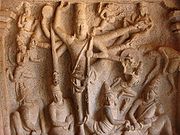
against the warning given by his Guru Sukracharya, Vamana, The Supreme God enlarged himself to such dimensions as to stride over the three worlds. He had grown so huge that he could step from heaven to earth, and earth to the lower worlds in two simple steps. King Mahabali
Mahabali
Mahabali , also known as Bali or Māveli was a benevolent Asura King, and the grandson of Prahlada. The festival of Onam commemorates his yearly homecoming after being sent down to the underworld by Vamana, the fifth avatar of Vishnu.-Conquest of the Universe and banishment:Bali, an asura, was the...
unable to fulfill the promise of three paces of land to the Supreme God, offers his head for the third step. Thus Vamana places his foot on King Mahabali's head and gives him immortality for his benevolence. Being worshipped however by Mahabali and his ancestor Prahláda, he conceded to them the sovereignty of Pátála
Patala
Patala is a town and a nagar panchayat in Ghaziabad district in the Indian state of Uttar Pradesh.-Demographics: India census, Patala had a population of 9730. Males constitute 54% of the population and females 46%. Patala has an average literacy rate of 61%, higher than the national average of...
(netherworld).
Jainism
Sacred texts from JainismJainism
Jainism is an Indian religion that prescribes a path of non-violence towards all living beings. Its philosophy and practice emphasize the necessity of self-effort to move the soul towards divine consciousness and liberation. Any soul that has conquered its own inner enemies and achieved the state...
mentions the legend of Vamana. The legend begins as an ill natured man having several issues with Jain Munis. Having confronted these issues and the behavior of the ill-man to the King, the King banishes the ill man from his kingdom.
After going to another kingdom, the ill-man manages to help and get close to the King of that kingdom. After recognizing the help aided by this man, the King promises to grant one wish to him. Having kept his animosity with the Jain monks, he asks to be made King for 4 months during Chaturmas
Chaturmas
Chaturmas is a holy period of four months , beginning on Shayani Ekadashi—the eleventh day of the first bright half, Shukla paksha, of Ashadh —until Prabodhini Ekadashi, the eleventh day of the first bright half of Kartik in Hinduism, Buddhism and Jainism.Chaturmas is reserved the...
(a holy time for the Jains). The King, after consent, makes the man to be the King of the kingdom. The ill-man decides to take advantage of the situation by ordering that he must eat all Jain Muni's meal, making them not eat for the rest of the day as the food would be considered contaminated. The Jain Shravaks and Shravikas, recognizing the intents of the ill-man, the great Vamana munivar was consulted. He had the capability to grow his figure to being very big or small.
Dressed up as a dwarf Brahman, he went to the Raja's house (which was ruled by the ill-man at the time) while the man was performing a pooja. Near the end of the pooja, the one performing the pooja must give something to those that were present at the pooja. Upon asking what the dwarf man wanted, he simply wanted three foot of land. The King consents and agrees to provide this land to the dwarf man.
Soon Vamana grew so large that one foot touched the entire Earth, another foot was touched by the heavens and did not have a third foot to provide. Not satisfying the requests of Vamana, the ill-man, realizes his bad behavior and bows his head down to Vamana to put his third foot on his head.
Symbolism
Mahavishnu
Image:Hinducosm Map1.svg|thumb|Click an area to go there. This is one of many material universes which expand from Mahavishnu when He breathes.|300px|alt=One Brahmanda, with Garbhodakashayi-Vishnurect 216 61 277 80 Brahma...
and was pleased by King Mahabali's determination and ability to keep his promise, despite his spiritual master's curse and the prospect of losing all his wealth. Vishnu
Vishnu
Vishnu is the Supreme god in the Vaishnavite tradition of Hinduism. Smarta followers of Adi Shankara, among others, venerate Vishnu as one of the five primary forms of God....
named the King Mahabali since he was a Mahatma (great soul). He allowed Mahabali to return to the spiritual sky to associate with Prahalada (the demoniac Hiranyakashipu's pious son) and other divine beings. Mahavishnu also declared that Mahabali would be able to rule the universe in the following yuga (age). Mahabali was the grandson of Prahlada
Prahlada
Prahlada is a character from the Puranic texts of Hinduism, wherein he is famed for his exclusive devotion to Vishnu, despite attempts in the story by his father, Hiranyakashipu, to turn him to the contrary...
, being the son of Prahlada's son Virochana
Virochana
Virochana , in Hindu mythology, was an asura, son of Prahlada and father of Bali. In the Atharvaveda he was mentioned as the son of Prahlada. According to the Chandogya Upanishad , he and Indra went to Prajapati to learn about the atman and lived there, practising brahmacharya for thirty-two...
who was killed in a battle with the Devas
Deva (Hinduism)
' is the Sanskrit word for god or deity, its related feminine term is devi. In modern Hinduism, it can be loosely interpreted as any benevolent supernatural beings. The devs in Hinduism, also called Suras, are often juxtaposed to the Asuras, their half brothers. Devs are also the maintainers of...
.
Mahabali is supposed to return every year to the land of his people, to ensure that they are prosperous.
In Sikhism
Vamana is discussed in the Guru Granth Sahib, the sacred text of Sikhism.-
- Satjugi tai manio Chalio bali bavan bhaio
- In Satyayuga, you sported as the dwarf incarnation, and fooled Bali.
On page 1330 of the Guru Granth Sahib, Vamana is mentioned as the "enticer" of Baliraja.
In the Ramayana
According to the Adhyatma RamayanaAdhyatma Ramayana
Adhyatma Ramayana is an ancient Sanskrit work extolling the spiritual virtues of the story of Ramayana. It comprises around 4200 double verses embedded in the latter portion of Brahmānda Purana and is traditionally believed to be authored by Vyasa...
It is also said that Vamanadeva is the guard of the gate of Bali Maharaja's planet Sutala and will remain so forever. Tulsidas
Tulsidas
Tulsidas , was a Hindu poet-saint, reformer and philosopher renowned for his devotion for the god Rama...
' Ramayana too declares that Vamana became the "dwarpal" (gate-defender) of Bali.
It is said that Mahabali attained Moksha
Moksha
Within Indian religions, moksha or mukti , literally "release" , is the liberation from samsara and the concomitant suffering involved in being subject to the cycle of repeated death and reincarnation or rebirth.-Origins:It is highly probable that the concept of moksha was first developed in...
by atmanivedinam. Krishna in the Sri Rūpa Gosvāmīs Bhakti-rasāmrta-sindhuh says that Mahabali came to Him or attained Him. Some traditions also hold that Vamana was an avatar of Ganesha
Ganesha
Ganesha , also spelled Ganesa or Ganesh, also known as Ganapati , Vinayaka , and Pillaiyar , is one of the deities best-known and most widely worshipped in the Hindu pantheon. His image is found throughout India and Nepal. Hindu sects worship him regardless of affiliations...
.
Temples
- Mithranandapuram Vamanamoorthy Temple, CherpuCherpuCherpu is a small village in Thrissur district of Kerala state in south India. It is 12 kilometres south of Thrissur town and is on the Thriprayar road...
, ThrissurThrissurThis article is about the city in India. For the district, see Thrissur district. For the urban agglomeration area of Thrissur see Thrissur Metropolitan Area...
, keralaKeralaor Keralam is an Indian state located on the Malabar coast of south-west India. It was created on 1 November 1956 by the States Reorganisation Act by combining various Malayalam speaking regions.... - Thrikakkara (Thrikkakara TempleThrikkakara TempleThrikkakara Temple is one of the very few temples in India dedicated to Lord Vamana. It is situated in Thrikkakara, a village panchayat near...
), Cochin, KeralaKeralaor Keralam is an Indian state located on the Malabar coast of south-west India. It was created on 1 November 1956 by the States Reorganisation Act by combining various Malayalam speaking regions....
. - Ulagalantha Perumal Temple in KanchipuramKanchipuramKanchipuram, or Kanchi, is a temple city and a municipality in Kanchipuram district in the Indian state of Tamil Nadu. It is a temple town and the headquarters of Kanchipuram district...
near the KamakshiKamakshiThe goddess Kamakshi is a form of Tripura Sundari or Parvati or the universal mother goddess. The main abode of Kamashi is the Kamakshi Amman temple at Kanchipuram. Other important forms of goddess Tripura Sundari are Meenakshi of Madurai, Akilandeswari of Thiruvanaikaval and Vishalakshi of...
temple. - KhajurahoKhajurahoThe Khajuraho Group of Monuments in Khajuraho , a town in the Indian state of Madhya Pradesh, located in Chhatarpur District, about southeast of New Delhi, are one of the most popular tourist destinations in India. Khajuraho has the largest group of medieval Hindu and Jain temples, famous for...
, Madhya PradeshMadhya PradeshMadhya Pradesh , often called the Heart of India, is a state in central India. Its capital is Bhopal and Indore is the largest city....
. - Vamana and Ulagalantha Perumal Temple in TirukoilurTirukoilurTirukoilur is a pilgrimage town in Viluppuram district in the Indian state of Tamil Nadu. As the name says "koil" it is famous for the temples. The Ulagalantha perumal temple is located in the centre of the town.-Geography:...
, Viluppuram districtViluppuram DistrictVillupuram is one of the thirty districts which make up Tamil Nadu state situated on the southern tip of India. The district headquarters is located at Villupuram. Villupuram district came into existence on 30 September 1993 when it was created out of South Arcot district...
, Tamil NaduTamil NaduTamil Nadu is one of the 28 states of India. Its capital and largest city is Chennai. Tamil Nadu lies in the southernmost part of the Indian Peninsula and is bordered by the union territory of Pondicherry, and the states of Kerala, Karnataka, and Andhra Pradesh...
.