


Vishnu sahasranama

Encyclopedia
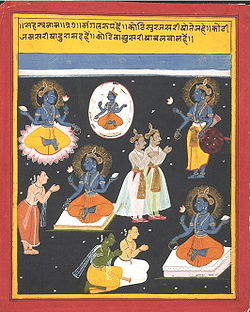
Sanskrit
Sanskrit , is a historical Indo-Aryan language and the primary liturgical language of Hinduism, Jainism and Buddhism.Buddhism: besides Pali, see Buddhist Hybrid Sanskrit Today, it is listed as one of the 22 scheduled languages of India and is an official language of the state of Uttarakhand...
, a tatpurusha compound translating literally to "the thousand names of Vishnu") is a list of 1,000 names (sahasranama
Sahasranama
A sahasranama is a type of Hindu scripture in which a deity is referred to by 1,000 or more different names. Sahasranamas are classified as stotras, or hymns of praise, a type of devotional scripture. Sahasra means a thousand, or more generally, a very large number. Nama means name...
) of Vishnu
Vishnu
Vishnu is the Supreme god in the Vaishnavite tradition of Hinduism. Smarta followers of Adi Shankara, among others, venerate Vishnu as one of the five primary forms of God....
, one of the main forms of God in Hinduism and the personal supreme God for Vaishnavas
Vaishnavism
Vaishnavism is a tradition of Hinduism, distinguished from other schools by its worship of Vishnu, or his associated Avatars such as Rama and Krishna, as the original and supreme God....
(followers of Vishnu). It is also one of the most sacred and commonly chanted stotras
Stotras
In Hinduism, a Stotra is a hymn of praise. These hymns praise aspects of the divine, such as Devi, Siva, or Vishnu. Relating to word "stuti", coming from the same verb, stu , and basically both mean "praise"....
in Hinduism. The Vishnu sahasranama as found in the Mahabharata is the most popular version of the 1000 names of Vishnu. Another version exists in the Padma Purana
Padma Purana
Padma Purana , one of the major eighteen Puranas, a Hindu religious text, is divided into five parts.In the first part of the text, sage Pulastya explains to Bhishma about religion and the essence of the religion. The second part describes in detail Prithvi...
and Matsya Purana
Matsya Purana
Matsya Purana is the sixteenth purana of the Hindu scriptures. During the period of mahapralaya, Lord Vishnu had taken Matsya Avatar to save the seeds of all lives and Manu...
. Each name eulogizes one of His countless great attributes.
The Vishnu sahasranāma has been the subject of numerous commentaries. Adi Shankaracharya wrote a definitive commentary on the sahasranāma in the 8th century, which is the oldest and has been particularly influential for many schools of Hinduism even today. Parasara Bhattar
Parasara Bhattar
Parasara Bhattar was a follower of Ramanuja, a 12th century Vaishnava teacher, born at the end of 12th century CE, who wrote a commentary in Tamil on Vishnu sahasranama from a Sri Vaishnavite viewpoint, in contrast to the Advaita view of Adi Sankara. He was appointed as the head of Sri Vaishnavites...
, a follower of Ramanujacharya wrote a commentary in the 12th century, detailing the names of Vishnu from a Vishishtadvaita
Vishishtadvaita
Vishishtadvaita Vedanta is a sub-school of the Vedānta school of Hindu philosophy, the other major sub-schools of Vedānta being Advaita, Dvaita, and Achintya-Bheda-Abheda. VishishtAdvaita is a non-dualistic school of Vedanta philosophy...
perspective. Madhvacharya
Madhvacharya
Madhvācārya was the chief proponent of Tattvavāda "Philosophy of Reality", popularly known as the Dvaita school of Hindu philosophy. It is one of the three most influential Vedānta philosophies. Madhvācārya was one of the important philosophers during the Bhakti movement. He was a pioneer in...
also wrote a commentary on Vishnu sahasranama, disclosing that each name in the sahasranama has a minimum of 100 meaning. Upon being challenged by the audience during his time, Sri Madhvacharaya not only gives 100 meanings for each of the Vishnu sahasranāma but also expands on each of the meanings making it a multi-fold complexity and displays an outspoken quality to hold and explain the real and deep hidden meaning of sahasranāma. Hindu literature includes sahasranamas dedicated to Shiva
Shiva
Shiva is a major Hindu deity, and is the destroyer god or transformer among the Trimurti, the Hindu Trinity of the primary aspects of the divine. God Shiva is a yogi who has notice of everything that happens in the world and is the main aspect of life. Yet one with great power lives a life of a...
, Devi
Devi
Devī is the Sanskrit word for Goddess, used mostly in Hinduism, its related masculine term is deva. Devi is synonymous with Shakti, the female aspect of the divine, as conceptualized by the Shakta tradition of Hinduism. She is the female counterpart without whom the male aspect, which represents...
, Ganesha
Ganesha
Ganesha , also spelled Ganesa or Ganesh, also known as Ganapati , Vinayaka , and Pillaiyar , is one of the deities best-known and most widely worshipped in the Hindu pantheon. His image is found throughout India and Nepal. Hindu sects worship him regardless of affiliations...
and other popular deities.
Background
According to the 135th chapter of Anushāsanaparva (verses 14 to 120) in the epic MahabharataMahabharata
The Mahabharata is one of the two major Sanskrit epics of ancient India and Nepal, the other being the Ramayana. The epic is part of itihasa....
, the names were handed down to Yudhisthira
Yudhisthira
In the great Hindu epic Mahabharata, Yudhisthira , the eldest son of King Pandu and Queen Kunti, was king of Indraprastha and later of Hastinapura. He was the leader of the Pandava side in the Kurukshetra War...
by the famous warrior
Kshatriya
*For the Bollywood film of the same name see Kshatriya Kshatriya or Kashtriya, meaning warrior, is one of the four varnas in Hinduism...
Bhishma
Bhishma
Bhishma or Bheeshma or Devavrata or 'Bhishma Pitamah' was the eighth son of Kuru King Shantanu who was blessed with wish-long life and had sworn to serve the ruling Kuru king. He was one of the most prominent characters of the great Indian epic, the Mahabharata. He was the grand uncle of both the...
who was on his death bed (of arrows) in the battlefield of Kurukshetra
Kurukshetra
Kurukshetra is a land of historical and religious importance. Historically the land belonged to Punjab now a district in Haryana state of India. It is a holy place and is also known as Dharmakshetra . According to the Puranas, Kurukshetra is named after King Kuru, the ancestor of Kauravas and...
. Yudhisthira asks Bhishma the following questions:
Bhisma answers by stating that mankind will be free from all sorrows by chanting the Vishnu sahasranāma which are the thousand names of the all-pervading Supreme Being
Supreme Being
The term Supreme Being is often defined simply as "God", and it is used with this meaning by theologians of many religious faiths, including, but not limited to, Christianity, Islam, Hinduism, and Deism. However, the term can also refer to more complex or philosophical interpretations of the...
Vishnu, who is the master of all the worlds, the supreme light, the essence of the universe
Universe
The Universe is commonly defined as the totality of everything that exists, including all matter and energy, the planets, stars, galaxies, and the contents of intergalactic space. Definitions and usage vary and similar terms include the cosmos, the world and nature...
and who is Brahman
Brahman
In Hinduism, Brahman is the one supreme, universal Spirit that is the origin and support of the phenomenal universe. Brahman is sometimes referred to as the Absolute or Godhead which is the Divine Ground of all being...
. All matter animate and inanimate reside in him and he in turn resides within all matter.
Etymology
In SanskritSanskrit
Sanskrit , is a historical Indo-Aryan language and the primary liturgical language of Hinduism, Jainism and Buddhism.Buddhism: besides Pali, see Buddhist Hybrid Sanskrit Today, it is listed as one of the 22 scheduled languages of India and is an official language of the state of Uttarakhand...
, sahasra means "a thousand" and nāma (nominative, the stem is nāman-) means "name". The compound is of the Bahuvrihi
Bahuvrihi
A bahuvrihi compound is a type of compound that denotes a referent by specifying a certain characteristic or quality the referent possesses. A bahuvrihi is exocentric, so that the compound is not a hyponym of its head...
type and may be translated as "having a thousand names". In modern Hindi
Hindi
Standard Hindi, or more precisely Modern Standard Hindi, also known as Manak Hindi , High Hindi, Nagari Hindi, and Literary Hindi, is a standardized and sanskritized register of the Hindustani language derived from the Khariboli dialect of Delhi...
pronunciation, nāma is pronounced [na:m]. It is also pronounced sahasranāmam in South India.
Interpretations
There are Sahasranāma for many forms of GodGod
God is the English name given to a singular being in theistic and deistic religions who is either the sole deity in monotheism, or a single deity in polytheism....
(Vishnu
Vishnu
Vishnu is the Supreme god in the Vaishnavite tradition of Hinduism. Smarta followers of Adi Shankara, among others, venerate Vishnu as one of the five primary forms of God....
, Shiva
Shiva
Shiva is a major Hindu deity, and is the destroyer god or transformer among the Trimurti, the Hindu Trinity of the primary aspects of the divine. God Shiva is a yogi who has notice of everything that happens in the world and is the main aspect of life. Yet one with great power lives a life of a...
, Ganesha
Ganesha
Ganesha , also spelled Ganesa or Ganesh, also known as Ganapati , Vinayaka , and Pillaiyar , is one of the deities best-known and most widely worshipped in the Hindu pantheon. His image is found throughout India and Nepal. Hindu sects worship him regardless of affiliations...
, Shakti
Shakti
Shakti from Sanskrit shak - "to be able," meaning sacred force or empowerment, is the primordial cosmic energy and represents the dynamic forces that are thought to move through the entire universe in Hinduism. Shakti is the concept, or personification, of divine feminine creative power, sometimes...
, and others). The Vishnu Sahasranāma is popular among common Hindus, and a major part of prayer for devout Vaishnavas
Vaishnavism
Vaishnavism is a tradition of Hinduism, distinguished from other schools by its worship of Vishnu, or his associated Avatars such as Rama and Krishna, as the original and supreme God....
, or followers of Vishnu
Vishnu
Vishnu is the Supreme god in the Vaishnavite tradition of Hinduism. Smarta followers of Adi Shankara, among others, venerate Vishnu as one of the five primary forms of God....
. While Vaishanvas venerate other deities
Deity
A deity is a recognized preternatural or supernatural immortal being, who may be thought of as holy, divine, or sacred, held in high regard, and respected by believers....
, they believe that the universe, including the other divinities such as Shiva
Shiva
Shiva is a major Hindu deity, and is the destroyer god or transformer among the Trimurti, the Hindu Trinity of the primary aspects of the divine. God Shiva is a yogi who has notice of everything that happens in the world and is the main aspect of life. Yet one with great power lives a life of a...
and Devi
Devi
Devī is the Sanskrit word for Goddess, used mostly in Hinduism, its related masculine term is deva. Devi is synonymous with Shakti, the female aspect of the divine, as conceptualized by the Shakta tradition of Hinduism. She is the female counterpart without whom the male aspect, which represents...
, is ultimately a manifestation of the Supreme Lord Vishnu. Followers of Shaivism
Shaivism
Shaivism is one of the four major sects of Hinduism, the others being Vaishnavism, Shaktism and Smartism. Followers of Shaivism, called "Shaivas," and also "Saivas" or "Saivites," revere Shiva as the Supreme Being. Shaivas believe that Shiva is All and in all, the creator, preserver, destroyer,...
similarly give prominence to Shiva
Shiva
Shiva is a major Hindu deity, and is the destroyer god or transformer among the Trimurti, the Hindu Trinity of the primary aspects of the divine. God Shiva is a yogi who has notice of everything that happens in the world and is the main aspect of life. Yet one with great power lives a life of a...
. Interestingly, despite the existence of other sahasranamas of other forms of God, referring a sahasranama as "The Sahasranama," generally refers to the Vishnu Sahasranama alone, thereby indicating its wide popularity and use. .
Smarta interpretations
In fact, the Shri Rudram, one of the most sacred prayers for HindusHinduism
Hinduism is the predominant and indigenous religious tradition of the Indian Subcontinent. Hinduism is known to its followers as , amongst many other expressions...
and Shaivites in particular, describe Vishnu as an aspect of Shiva in the fifth anuvaka. Likewise, two of the names in Vishnu sahasranama that refer to Shiva are "Shiva" (names #27 and #600 in Adi Sankara's commentary) itself, "Shambhu" (name #38), "Eesanah" (name #64), and "Rudra" (name #114). Most notably, Adi Shankara
Adi Shankara
Adi Shankara Adi Shankara Adi Shankara (IAST: pronounced , (Sanskrit: , ) (788 CE - 820 CE), also known as ' and ' was an Indian philosopher from Kalady of present day Kerala who consolidated the doctrine of advaita vedānta...
, according to one interpretation, has not interpreted these to mean that the deity Shiva and the deity Vishnu are the same. Specifically, he asserts that the deity Vishnu is Brahman
Brahman
In Hinduism, Brahman is the one supreme, universal Spirit that is the origin and support of the phenomenal universe. Brahman is sometimes referred to as the Absolute or Godhead which is the Divine Ground of all being...
itself (not just an aspect of Brahmam). Again, he notes that "only Hari
Hari
Hari is an Avatar, another name of and , and appears as the 650th name in the Vishnu sahasranama of Mahabharata. In Sanskrit "hari" sometimes refers to a colour, green, yellow, or fawn-coloured/khaki. It is the colour of the Sun and of Soma...
(Vishnu) is eulogized by names such as Shiva", a position consistent with interpretations of the Srivaishnavite commentator Parasara Bhattar
Parasara Bhattar
Parasara Bhattar was a follower of Ramanuja, a 12th century Vaishnava teacher, born at the end of 12th century CE, who wrote a commentary in Tamil on Vishnu sahasranama from a Sri Vaishnavite viewpoint, in contrast to the Advaita view of Adi Sankara. He was appointed as the head of Sri Vaishnavites...
. Parasara Bhattar had interpreted Shiva to mean a quality of Vishnu, such as "One who bestows auspiciousness."
However, this interpretation of the name Shiva has been challenged by Swami Tapasyananda
Tapasyananda
Swami Tapasyananda was a senior monk of the Ramakrishna Mission. He was a disciple of Swami Shivananda, one of the eminent disciples of Sri Ramakrishna. The Swami was a vice-president of the Ramakrishna Order from 1985-1991. He was an erudite scholar in Indian and Western philosophy. He has to his...
's translation of Sankara's commentary on the Vishnu sahasranama. He translates the 27th name, Shiva to mean:" One who is not affected by the three Gunas of Prakrti
Prakrti
Prakrti or Prakriti or Prakruti means "nature". It is, according to Hindus, the basic nature of intelligence by which the Universe exists and functions. It is described in Bhagavad Gita as the "primal motive force". It is the essential constituent of the universe and is at the basis of all the...
, Sattva
Sattva
In Hindu philosophy, sattva is the most rarefied of the three gunas in Samkhya, sāttvika "pure", rājasika "dim", and tāmasika "dark". Importantly, no value judgement is entailed as all guna are indivisible and mutually qualifying...
, Rajas
Rajas
Rajas ) is, in the Samkhya school of Hindu philosophy, one of the three gunas. Of these, rajas, is responsible for motion, energy and preservation...
,and Tamas
Tamas (philosophy)
In the Samkhya school of philosophy, tamas is one of the three gunas , the other two being rajas and sattva or purity). Tamas is the template for inertia or resistance to action...
; The Kaivalaya Upanishad says, "He is both Brahma
Brahma
Brahma is the Hindu god of creation and one of the Trimurti, the others being Vishnu and Shiva. According to the Brahma Purana, he is the father of Mānu, and from Mānu all human beings are descended. In the Ramayana and the...
and Shiva
Shiva
Shiva is a major Hindu deity, and is the destroyer god or transformer among the Trimurti, the Hindu Trinity of the primary aspects of the divine. God Shiva is a yogi who has notice of everything that happens in the world and is the main aspect of life. Yet one with great power lives a life of a...
." In the light of this statement of non-difference between Shiva and Vishnu, it is Vishnu Himself that is exalted by the praise and worship of Shiva." Based on this commonly held Advaitan point of view which has been adopted by Smartas, Vishnu and Shiva are viewed as the one and the same God, being different aspects of preservation and destruction respectively. As many Sanskrit
Sanskrit
Sanskrit , is a historical Indo-Aryan language and the primary liturgical language of Hinduism, Jainism and Buddhism.Buddhism: besides Pali, see Buddhist Hybrid Sanskrit Today, it is listed as one of the 22 scheduled languages of India and is an official language of the state of Uttarakhand...
words have multiple meanings it is possible that both Vishnu and Shiva share names in this instance. For example, the name Shiva itself means "auspicious" which could also apply to Vishnu. The deity of Harihara
Harihara
Harihara is the name of a combined deity form of both Vishnu and Shiva from the Hindu tradition. Also known as Shankaranarayana , Harihara is thus worshipped by both Vaishnavites and Shaivities as a form of the Supreme God, as well as being a figure of worship for other Hindu traditions in general...
in particular is worshipped by Shaivites as a combination of both personalities.
Vaishnava interpretations
However, the Vaishnava commentator, Parasara BhattarParasara Bhattar
Parasara Bhattar was a follower of Ramanuja, a 12th century Vaishnava teacher, born at the end of 12th century CE, who wrote a commentary in Tamil on Vishnu sahasranama from a Sri Vaishnavite viewpoint, in contrast to the Advaita view of Adi Sankara. He was appointed as the head of Sri Vaishnavites...
, a follower of Ramanujacharya has interpreted the names "Shiva" and "Rudra" in Vishnu sahasranama to mean qualities or attributes of Vishnu, and not to indicate that Vishnu and Shiva are one and the same God. Vaishnavas worship Vishnu in his four-armed form, carrying conch, disc, flower and mace in his hands, believing that to be the Supreme form. However, Smarthas do not subscribe to this aspect or personification of God, as Smarthas say that God is pure and thus devoid of form. Additionally, they believe that God is not limited by time nor limited by shape and color. Vaishnava traditions are of the opinion that Vishnu is both unlimited and yet still capable of having specific forms, as to give arguments to the contrary (to say that God is incapable of having a form) is to limit the unlimitable and all-powerful Supreme.
In the Sri Vaishnava tradition, the Bhagavad-gita and the Vishnu Sahasranama are considered the two eyes of spiritual revelation.
In other Vaishnava traditions too, the Vishnu Sahasranama is considered an important text. Within Gaudiya Vaishnavism
Gaudiya Vaishnavism
Gaudiya Vaishnavism is a Vaishnava religious movement founded by Chaitanya Mahaprabhu in India in the 16th century. "Gaudiya" refers to the Gauḍa region with Vaishnavism meaning "the worship of Vishnu"...
, Vallabha sampradaya, Nimbarka sampradaya
Nimbarka Sampradaya
The Nimbarka Sampradaya , also known as the Hamsa Sampradāya, Kumāra Sampradāya, ' and Sanakādi Sampradāya, is one of the four authorised Sampradāyas as according to the Padma , one of the eighteen main...
and among Ramanandi
Ramanandi
Ramanandi are the followers of saint Ramananda. Ramanandi are spread across India, mainly in Gujarat, Uttar Pradesh and Rajasthan. Agravat, Nimavat, Kubavat, Tilavat, Devmurari, Ramavat, Nenuji, Sukhanandi and Yoganandi are the most prominent last names in Ramanandi cast. Ramanandi worship Shri Ram...
s, the chanting of the names of Krishna
Krishna
Krishna is a central figure of Hinduism and is traditionally attributed the authorship of the Bhagavad Gita. He is the supreme Being and considered in some monotheistic traditions as an Avatar of Vishnu...
and Rama
Rama
Rama or full name Ramachandra is considered to be the seventh avatar of Vishnu in Hinduism, and a king of Ayodhya in ancient Indian...
to be superior to that of Vishnu. Based on another verse in the Padma Purana
Padma Purana
Padma Purana , one of the major eighteen Puranas, a Hindu religious text, is divided into five parts.In the first part of the text, sage Pulastya explains to Bhishma about religion and the essence of the religion. The second part describes in detail Prithvi...
which says that the benefit of chanting the one thousand names of Vishnu can be derived from chanting one name of Rama, and a verse in the Brahma Vaivarta Purana
Brahma Vaivarta Purana
Brahma Vaivarta Purana, one of the major eighteen Puranas, a Hindu religious text, is divided into four parts. First part describes the creation of the universe and all beings, the second part relates to description and histories of different goddesses...
equating the benefit of chanting three names of Rama with one name of Krishna. However, it is important to realize that those verses in those puranas are not to be interpreted literally, as many believe that there is no difference between Vishnu and Krishna. This theological difference can be expressed as follows: Many Vaishnava groups recognize Krishna
Krishna
Krishna is a central figure of Hinduism and is traditionally attributed the authorship of the Bhagavad Gita. He is the supreme Being and considered in some monotheistic traditions as an Avatar of Vishnu...
as an Avatar
Avatar
In Hinduism, an avatar is a deliberate descent of a deity to earth, or a descent of the Supreme Being and is mostly translated into English as "incarnation," but more accurately as "appearance" or "manifestation"....
of Vishnu, while others, instead, consider Him to be svayam bhagavan
Svayam Bhagavan
Svayam Bhagavan , "The Lord" or Lord Himself, is a Sanskrit theological term. The term refers to the concept of absolute representation of the monotheistic God as Bhagavan within Hinduism....
, or the original form of the Lord. Yet these verses can be interpreted as it is more important to have pure bhakti
Bhakti
In Hinduism Bhakti is religious devotion in the form of active involvement of a devotee in worship of the divine.Within monotheistic Hinduism, it is the love felt by the worshipper towards the personal God, a concept expressed in Hindu theology as Svayam Bhagavan.Bhakti can be used of either...
or devotion than merely repeating the many names of God without emotion. Indeed, Shri Krishna
Krishna
Krishna is a central figure of Hinduism and is traditionally attributed the authorship of the Bhagavad Gita. He is the supreme Being and considered in some monotheistic traditions as an Avatar of Vishnu...
Himself said, "Arjuna, One may be desirous of praising by reciting the thousand names. But, on my part, I feel praised by one shloka
Shloka
A ' is a category of verse line developed from the Vedic Anuṣṭubh. It is the basis for Indian Epic verse, and may be considered the Indian verse form par excellence, occurring, as it does, far more frequently than any other meter in classical Sanskrit poetry. The Mahabharata and Ramayana, for...
. There is no doubt about it.”
Within Vaisnavism some groups, such as Sri sampradaya
Sri Sampradaya
Sri Sampradaya or Sri Vaishnavism is a Vaishnava sect within Hinduism. Its origin and codification is generally traced back to Sri, Mahalakshmi eternal consort of Lord Vishnu. Around the 10th century when a collection of the devotional hymns and songs by Alvars was organized by Sri Nathamuni, who...
, adhere to and follow the Rig Veda: V.I.15b.3, which states "O ye who wish to gain realization of the supreme truth, utter the name of Vishnu
Vishnu
Vishnu is the Supreme god in the Vaishnavite tradition of Hinduism. Smarta followers of Adi Shankara, among others, venerate Vishnu as one of the five primary forms of God....
at least once in the steadfast faith that it will lead you to such realization."
Interpretations alluding to the power of God in controlling karma
Many names in the Vishnu SahasranamaVishnu sahasranama
The Vishnu sahasranama is a list of 1,000 names of Vishnu, one of the main forms of God in Hinduism and the personal supreme God for Vaishnavas . It is also one of the most sacred and commonly chanted stotras in Hinduism...
, the thousand names of Vishnu
Vishnu
Vishnu is the Supreme god in the Vaishnavite tradition of Hinduism. Smarta followers of Adi Shankara, among others, venerate Vishnu as one of the five primary forms of God....
allude to the power of God in controlling karma
Karma
Karma in Indian religions is the concept of "action" or "deed", understood as that which causes the entire cycle of cause and effect originating in ancient India and treated in Hindu, Jain, Buddhist and Sikh philosophies....
. For example, the 135th name of Vishnu, Dharmadhyaksha, in Sankara's interpretation means, "One who directly sees the merits (Dharma
Dharma
Dharma means Law or Natural Law and is a concept of central importance in Indian philosophy and religion. In the context of Hinduism, it refers to one's personal obligations, calling and duties, and a Hindu's dharma is affected by the person's age, caste, class, occupation, and gender...
) and demerits (Adharma
Adharma
Adharma is the Sanskrit antonym of Dharma. It means 'that which is not in accord with the law' - referring to both the human written law and the divinely given law of nature. Connotations include unnaturalness, wrongness, evil, immorality, wickedness, or vice....
), of beings by bestowing their due rewards on them."
Other names of Vishnu alluding to this nature of God are Bhavanah, the 32nd name, Vidhata, the 44th name, Apramattah, the 325th name, Sthanadah, the 387th name and Srivibhavanah, the 609th name. Bhavanah, according to Sankara's interpretation, means "One who generates the fruits of Karmas of all Jiva
Jiva
In Hinduism and Jainism, a jiva is a living being, or more specifically, the immortal essence of a living organism which survives physical death. It has a very similar usage to atma, but whereas atma refers to "the cosmic self", jiva is used to denote an individual 'living entity' or 'living...
s for them to enjoy." The Brahma Sutra (3.2.28) "Phalmatah upapatteh" speaks of the Lord's function as the bestower of the fruits of all actions of the jiva
Jiva
In Hinduism and Jainism, a jiva is a living being, or more specifically, the immortal essence of a living organism which survives physical death. It has a very similar usage to atma, but whereas atma refers to "the cosmic self", jiva is used to denote an individual 'living entity' or 'living...
s.
General thoughts
Sections from Swami Tapasyananda's translation of the concluding verses of Vishnu sahasranama, state the following: "Nothing evil or inauspicious will befall a man here or hereafter who daily hears or repeats these names." That comment is noteworthy. King NahushaNahusha
Nahusha was a well-known king of the Aila dynasty. He was the son of Ayu, the eldest son of Pururavas and Prabha, the daughter of Svarbhanu. Nahusha reigned from Pratishthana. He married Viraja, the daughter of the Pitrs. They had six or seven sons, according to different Puranas. His eldest son...
, a once righteous king, ancestor of Yudhisthira
Yudhisthira
In the great Hindu epic Mahabharata, Yudhisthira , the eldest son of King Pandu and Queen Kunti, was king of Indraprastha and later of Hastinapura. He was the leader of the Pandava side in the Kurukshetra War...
, according to excerpt from C. Rajagopalachari
Rajagopalachari
Rajagopalachari is a popular name in use amongst the Iyengar community of South IndiaSome prominent Rajagopalacahris are:* C. Rajagopalachari, also known as Rajaji: Indian freedom fighter, Gandhian, leader of the Indian National Congress and founder of the Swatantra party.* Sir Perungavur...
's translation of the Mahabharata
Mahabharata
The Mahabharata is one of the two major Sanskrit epics of ancient India and Nepal, the other being the Ramayana. The epic is part of itihasa....
, became an Indra
Indra
' or is the King of the demi-gods or Devas and Lord of Heaven or Svargaloka in Hindu mythology. He is also the God of War, Storms, and Rainfall.Indra is one of the chief deities in the Rigveda...
, king of devas, but was later expelled from Swarga or heaven due to a curse by the great sage Agastya
Agastya
Agastya was a Tamil/Vedic Siddhar or sage. Agastya and his clan are also generally credited with uncovering many mantras of the Rig Veda, the earliest and most revered Hindu scripture, in the sense of first having the mantras revealed in his mind by the Supreme Brahman...
for his eventual gain in pride and arrogance and became a python for thousands of years.
Thus, chanting of Vishnu sahasranama will help lead to success in this life and hereafter.
A. C. Bhaktivedanta Swami Prabhupada
A. C. Bhaktivedanta Swami Prabhupada
Abhay Charanaravinda Bhaktivedanta Swami Prabhupada was a Gaudiya Vaishnava teacher and the founder-acharya of the International Society for Krishna Consciousness, commonly known as the "Hare Krishna Movement"...
gives a Gaudiya Vaishnava
Gaudiya Vaishnavism
Gaudiya Vaishnavism is a Vaishnava religious movement founded by Chaitanya Mahaprabhu in India in the 16th century. "Gaudiya" refers to the Gauḍa region with Vaishnavism meaning "the worship of Vishnu"...
interpretation of verse 7.24 from the Bhagavad Gita
Bhagavad Gita
The ' , also more simply known as Gita, is a 700-verse Hindu scripture that is part of the ancient Sanskrit epic, the Mahabharata, but is frequently treated as a freestanding text, and in particular, as an Upanishad in its own right, one of the several books that constitute general Vedic tradition...
, wherein he quotes the Avatar
Avatar
In Hinduism, an avatar is a deliberate descent of a deity to earth, or a descent of the Supreme Being and is mostly translated into English as "incarnation," but more accurately as "appearance" or "manifestation"....
, Krishna, as saying: "Unintelligent men, who do not know Me perfectly, think that I, the Supreme Personality of Godhead, Krishna, was impersonal before and have now assumed this personality. Due to their small knowledge, they do not know My higher nature, which is imperishable and supreme." Prabhupada has also stated that “I beg to point out that the Hindu religion is perfectly based on the personal conception of God, or Vishnu
Vishnu
Vishnu is the Supreme god in the Vaishnavite tradition of Hinduism. Smarta followers of Adi Shankara, among others, venerate Vishnu as one of the five primary forms of God....
."
In Swami Chidbhavananda
Swami Chidbhavananda
Swami Chidbhavananda was born in Senguttaipalayam near Pollachi in Coimbatore District, Tamil Nadu, India. His parents named him 'Chinnu'. He studied in Stanes School, Coimbatore. He was one of the two Indians in his class, the rest being British...
's translation of the Bhagavad Gita, he gives an opposite interpretation of the same verse, 7:24, "men of poor understanding think of Me, the unmanifest, as having manifestation, not knowing My supreme state, immutable and unsurpassed." Swami Chidbhavananda, holding Advaita views, gives more importance to God being formless while Srila Prabhupada, following Chaitanya Mahaprabhu
Chaitanya Mahaprabhu
Chaitanya Mahaprabhu was a Vaishnava saint and social reformer in eastern India in the 16th century, believed by followers of Gaudiya Vaishnavism to be the full incarnation of Lord Krishna...
's philosophy, gives importance to God with form. Ramakrishna
Ramakrishna
Ramakrishna , born Gadadhar Chattopadhyay , was a famous mystic of 19th-century India. His religious school of thought led to the formation of the Ramakrishna Mission by his chief disciple Swami Vivekananda – both were influential figures in the Bengali Renaissance as well as the Hindu...
analogized God with form and without form as being like ice and liquid water, as being both the same but in different states.
Pronunciation
In the linked preface prayer (But not in the succeeding Sahasranama) non-formal pronunciation is used, since correct representation of pronunciation requires extensive use of diacritic marks. An example: SanskritSanskrit
Sanskrit , is a historical Indo-Aryan language and the primary liturgical language of Hinduism, Jainism and Buddhism.Buddhism: besides Pali, see Buddhist Hybrid Sanskrit Today, it is listed as one of the 22 scheduled languages of India and is an official language of the state of Uttarakhand...
/Hindi
Hindi
Standard Hindi, or more precisely Modern Standard Hindi, also known as Manak Hindi , High Hindi, Nagari Hindi, and Literary Hindi, is a standardized and sanskritized register of the Hindustani language derived from the Khariboli dialect of Delhi...
has three letters representing S, which are represented here as 's', 'ś', and 'ṣ', as used in the Sanskrit
Sanskrit
Sanskrit , is a historical Indo-Aryan language and the primary liturgical language of Hinduism, Jainism and Buddhism.Buddhism: besides Pali, see Buddhist Hybrid Sanskrit Today, it is listed as one of the 22 scheduled languages of India and is an official language of the state of Uttarakhand...
word ṣatkona (= "hexagon"), Viṣnu
Vishnu
Vishnu is the Supreme god in the Vaishnavite tradition of Hinduism. Smarta followers of Adi Shankara, among others, venerate Vishnu as one of the five primary forms of God....
, Kṛṣṇa and others is actually a retroflex phoneme and has no equivalent in English
English language
English is a West Germanic language that arose in the Anglo-Saxon kingdoms of England and spread into what was to become south-east Scotland under the influence of the Anglian medieval kingdom of Northumbria...
. Retroflex phonemes are those where the tongue is slightly coiled back in the palate and released along with the phoneme's sound. Also, the 'ṇ' in Viṣṇu and Kṛṣṇa is retroflex. In formal transliteration of Sanskrit
Sanskrit
Sanskrit , is a historical Indo-Aryan language and the primary liturgical language of Hinduism, Jainism and Buddhism.Buddhism: besides Pali, see Buddhist Hybrid Sanskrit Today, it is listed as one of the 22 scheduled languages of India and is an official language of the state of Uttarakhand...
alphabet
Alphabet
An alphabet is a standard set of letters—basic written symbols or graphemes—each of which represents a phoneme in a spoken language, either as it exists now or as it was in the past. There are other systems, such as logographies, in which each character represents a word, morpheme, or semantic...
to English
English language
English is a West Germanic language that arose in the Anglo-Saxon kingdoms of England and spread into what was to become south-east Scotland under the influence of the Anglian medieval kingdom of Northumbria...
, this set-up is denoted by placing dots below the letter 'ṣ'. More details can be found at Sanskrit language#Consonants, and at IAST
IAST
The International Alphabet of Sanskrit Transliteration is a transliteration scheme that allows a lossless romanization of Indic scripts as employed by the Sanskrit language.-Popularity:...
Although devotion is considered the most important thing while reciting any prayer
Prayer
Prayer is a form of religious practice that seeks to activate a volitional rapport to a deity through deliberate practice. Prayer may be either individual or communal and take place in public or in private. It may involve the use of words or song. When language is used, prayer may take the form of...
or mantra
Mantra
A mantra is a sound, syllable, word, or group of words that is considered capable of "creating transformation"...
(Unless used for tantric purposes, where the sound's vibration plays the major role), use of the correct pronunciation is believed by devotees to enhance the satisfaction derived from the recital, in the case of both vocal and mental chants.
Merits of Recitation
Believers in the recitation of the Sahasranama claim that it brings unwavering calm of mind, complete freedom from stress and brings eternal knowledge. A translation of the concluding verses (Phalasruti) of Vishnu sahasranama, state the following: "Nothing evil or inauspicious will befall a man here or hereafter who daily hears or repeats these names.. Whichever devoted man, getting up early in the morning and purifying himself, repeats this hymn devoted to VasudevaVasudeva
In Hindu itihasa , Vasudeva is the father of Krishna, the son of Shoorsen, of the Yadu and Vrishni dynasties. His sister Kunti was married to Pandu. He was a partial incarnation of Rishi Kashyap....
, with a mind that is concentrated on Him, that man attains to great fame, leadership among his peers, wealth that is secure and the supreme good unsurpassed by anything. He will be free from all fears and be endowed with great courage and energy and he will be free from diseases. Beauty of form, strength of body and mind, and virtuous character will be natural to him.... One who reads this hymn every day with devotion and attention attains to peace of mind, patience, prosperity, mental stability, memory and reputation.... Whoever desires advancement and happiness should repeat this devotional hymn on Vishnu composed by Vyasa
Vyasa
Vyasa is a central and revered figure in most Hindu traditions. He is also sometimes called Veda Vyasa , or Krishna Dvaipayana...
....Never will defeat attend on a man who adores the Lotus-Eyed One (Kamala Nayana), who is the Master of all the worlds, who is birthless, and out of whom the worlds have originated and into whom they dissolve."
In orthodox Hindu tradition, a devotee should daily chant the Upanishads, Gita, Rudram, Purusha Sukta
Purusha sukta
Purusha sukta is hymn 10.90 of the Rigveda, dedicated to the Purusha, the "Cosmic Being". One version of the Suktam has 16 verses, 15 in the meter, and the final one in the meter...
and Vishnu sahasranama. If one cannot do all this on any day, it is believed that chanting Visnu sahasranama alone is sufficient. Vishnu sahasranama can be chanted at any time, irrespective of gender.
Varahi Tantra says that in the age of Kali yuga, most stotras
Stotras
In Hinduism, a Stotra is a hymn of praise. These hymns praise aspects of the divine, such as Devi, Siva, or Vishnu. Relating to word "stuti", coming from the same verb, stu , and basically both mean "praise"....
are cursed by Parashurama
Parashurama
Parashurama , is the sixth avatar of Vishnu and belongs to the treta yuga, and is the son of a Brahmin father Jamadagni and mother Renuka. He is considered one of the seven immortal human. He received an axe after undertaking a terrible penance to please Shiva, from whom he learned the methods of...
and hence are ineffective. While listing the ones which are free from this curse and hence suitable during Kali Yuga
Kali Yuga
Kali Yuga is the last of the four stages that the world goes through as part of the cycle of yugas described in the Indian scriptures. The other ages are Satya Yuga, Treta Yuga and Dvapara Yuga...
, it is said, "Gita of the Bhishma Parva, Vishnu Sahasranama of Mahabharata and Chandika Saptashati' (Devi Mahatmyam) are free from all Doshas and grant fruits immediately in Kali Yuga."
In a classic astrological text, the Bṛhat Parāśara Horāśāstra, Sage Parashara
Parashara
' is a Rigvedic Maharishi and author of many ancient Indian texts. Parāśara was the grandson of Vashista, the son of Śakti Maharṣi, and the father of Vyasa. There are several texts which give reference to Parāśara as an author/speaker...
frequently recommends the recitation of the Vishnu Sahasranama as the best remedial measure for planetary afflictions.
For example, see the following verse:
"The most effective and beneficial remedial measure for the prolongation of longevity and to obtain relief from other evil effects is recitation of Vishnu Sahasranam." ch 56 verse 30
Sage Parashara mentions this practice more than ten times in his text. Here's another verse:
"The remedial measure to obtain relief from the above evil effects, is recitation of Vishnu Sahasranama." ch 59 verse 77
It is customary to commence the Vishnu sahasranama with a devotional prayer to Vishnu.
Recitation and aggregation
An alternative approach is to say the starting prayer, and then say the names collected in stanzas (As they were originally said by Bhishma.) Such stanzas are called Shlokas in Sanskrit. The Sahasranama (apart from the initial and concluding prayers) has a total of 108 shlokas.For example, the first shloka is:
Notice the aggregation of several words and the omission of their intervening spaces. For example, the last word of the first line of this Shloka:
corresponds to:
of the expanded version.
This joining-together of words is a common feature of Sanskrit and is called Samasa. It makes the shlokas compact and easier to remember, which was necessary in ancient India since the religious scriptures were seldom written down and were memorised by Brahmin
Brahmin
Brahmin Brahman, Brahma and Brahmin.Brahman, Brahmin and Brahma have different meanings. Brahman refers to the Supreme Self...
s, or the priest class. This collection of memorised knowledge was passed by word-of-mouth from Guru
Guru
A guru is one who is regarded as having great knowledge, wisdom, and authority in a certain area, and who uses it to guide others . Other forms of manifestation of this principle can include parents, school teachers, non-human objects and even one's own intellectual discipline, if the...
to disciple (which is called in Shruti Gyana in Sanskrit, or "the knowledge (gyana) of that which was heard (shruti)").
Most Popular Names of Vishnu Bhagwan
- 1. Vishwam ( विश्वं )
- 2. Vishnu ( विष्णुः )
- 3. Vashatkara ( वषट्कारः )
- 4. Bhuta Bhavya Bhavatprabhu ( भूतभव्य भवत्प्रभुः )
- 5. Bhutakrut ( भूतक्रुत )
- 6. Bhutabhrut ( भूतभ्रुत )
- 7. Bhava ( भावः )
- 8. Bhutatma ( भूतात्मा )
- 9. Bhutabhavanah ( भूतभावनः )
- 10.Putatma ( पूतात्मा )
- 11.Paramatma (परमात्मा )
- 12.Muktanam Parama Gatih ( मुक्तानां परमा गतिः )
- 13.Avyaya ( अव्यय, the never changing)
- 14.Purusha ( पुरुष )
Some other names
The names are generally derived from the anantakalyanagunas (meaning: infinite auspicious attributes). Some names are:- Achintya (Incomprehensible, beyond understanding)
- AcyutahAcyutahIn Hinduism, Acyuta is another name of Vishnu or God and appears as the 100th and 318th names in the Vishnu sahasranama. This is also the name often used in Bhagavad Gita as a personal name of Krishna, svayam bhagavan. According to Adi Sankara's commentary on the Vishnu sahasranama, Acyutah means...
(infallible) - AnantaAnantaAnanta is a Sanskrit word meaning "without end".It may refer to:*Ananta , one of the names of Vishnu.*Ananta , Actor and Producer for Bengali film.*Ananta, a serpent on which Vishnu lies, aka Shesha....
(endless, eternal, infinite) - DamodaraDamodar (name of Krishna)Damodar is the 367th name of Vishnu from the Vishnu sahasranama. The various meanings of the name are given as follows:...
(having a rope (dama) around his belly (udara): a name of Krishna) - GovindaGovinda' and ' are names of Krishna, referring to his youthful occupation as a cowherd. He is regarded as the Supreme Godhead in the Vaishnava tradition and also by much of the pan-Hindu tradition...
(protector of the cows & brahmins; master of the senses: a name of Krishna) - HariHariHari is an Avatar, another name of and , and appears as the 650th name in the Vishnu sahasranama of Mahabharata. In Sanskrit "hari" sometimes refers to a colour, green, yellow, or fawn-coloured/khaki. It is the colour of the Sun and of Soma...
(one who takes away jo manushya ke avguno ko har leta hai) - HayagrivaHayagrivaHayagriva is a horse-headed deity that appears in both Hinduism and Buddhism.-Hinduism:...
(giver of knowledge) - Jagannatha (Owner/Ruler of the world/universe)
- JanardanaJanardanaJanardana is another name of Vishnu or God and appears as the 126th name in the Vishnu sahasranama. It is also a common name of Krishna being address as such by Arjuna in the Bhagavad Gita....
(One who is worshiped by people for Wealth) - KeshavaKeshavaKeshava is a name of Krishna from within Hindu tradition.The name appears as the 23rd and 648th names in the Vishnu sahasranama.Lord Keshava is venerated by those persons wanting to avert bad luck, or ill omens...
(slayer of KeshiKeshi (demon)In Hindu mythology, Keshi is the horse-demon, killed by Krishna, an Avatar of god Vishnu...
, having long or much or handsome hair, from AtharvavedaAtharvavedaThe Atharvaveda is a sacred text of Hinduism and one of the four Vedas, often called the "fourth Veda"....
viii , 6 , 23) - KrishnaKrishnaKrishna is a central figure of Hinduism and is traditionally attributed the authorship of the Bhagavad Gita. He is the supreme Being and considered in some monotheistic traditions as an Avatar of Vishnu...
(born during the third epoch or yugaYugaYuga in Hindu philosophy is the name of an 'epoch' or 'era' within a cycle of four ages. These are the Satya Yuga, the Treta Yuga, the Dvapara Yuga, and finally the Kali Yuga. According to Hindu cosmology, life in the universe is created, destroyed once every 4.1 to 8.2 billion years, which is...
, his deeds range from cow protection (go rakshya) to absolving the earth of load of sins) - MadhavaMadhava (Vishnu)Madhava is another name for Vishnu or Krishna and appears as the 72nd, 167th and 735th names in the Vishnu sahasranama.From the Bhagavad Gita it is understood to refer to Vishnu being the husband of the goddess of fortune...
(relating to the season of spring,ma=laxmi,dhav=dhaaran karne walle means madhava) - Madhusudana (he who destroyed the demon called Madhu)
- NarayanaNarayanaNarayana or Narayan or Naraina is an important Sanskrit name for Vishnu, and in many contemporary vernaculars a common Indian name. Narayana is also identified as the original man, Purusha. The Puranas present divergent views on Narayana...
(said to mean "he who is the abode of nār (= ether)", i.e., the whole universe's shelter. Also means "The supreme Man who is the foundation of all men". Another meaning is "He who lies (i.e., rests) in the water".) - Padmanabha (lotus-naveled one, from whose navelNavelThe navel is a scar on the abdomen caused when the umbilical cord is removed from a newborn baby...
sprang the lotusNelumbo nuciferaNelumbo nucifera, known by a number of names including Indian Lotus, Sacred Lotus, Bean of India, or simply Lotus, is a plant in the monogeneric family Nelumbonaceae...
which contained BrahmaBrahmaBrahma is the Hindu god of creation and one of the Trimurti, the others being Vishnu and Shiva. According to the Brahma Purana, he is the father of Mānu, and from Mānu all human beings are descended. In the Ramayana and the...
, who created the universe) - Parthasarathy (Charioteer of Arjuna/Partha)
- PurushottamaPurushottamaPurushottama means "Supreme Purusha", "Supreme Being". Purushottama is also one of the names of the Vishnu. According to the Bhagavad Geeta, Purushottam is explained as above and beyond kshar and akshar purushas or as an omni-potent cosmic being...
- The Supreme Eternal Being - RamaRamaRama or full name Ramachandra is considered to be the seventh avatar of Vishnu in Hinduism, and a king of Ayodhya in ancient Indian...
(born during the second epoch or YugaYugaYuga in Hindu philosophy is the name of an 'epoch' or 'era' within a cycle of four ages. These are the Satya Yuga, the Treta Yuga, the Dvapara Yuga, and finally the Kali Yuga. According to Hindu cosmology, life in the universe is created, destroyed once every 4.1 to 8.2 billion years, which is...
, his deeds primarily established the ideal living principles for a man) - Hrishikesh (Lord of the senses or Lord within the heart; "hri" root meaning the heart)
- RohitRohitRohit is a given name used among Indian people, It is also used in some other part of Nepal. It is mostly used by Jains, Hindus, and Sikhs.The word Rohit at its root signifies the color red. The color red is implicit.It is derived from Sanskrit, it means the "First rays of the sun"...
(another Name of Vishnu) - SatyanarayanaNarayanaNarayana or Narayan or Naraina is an important Sanskrit name for Vishnu, and in many contemporary vernaculars a common Indian name. Narayana is also identified as the original man, Purusha. The Puranas present divergent views on Narayana...
(a combination of satyaSatyaSatya is a Sanskrit word that loosely translates into English as "truth" or "correct". It is a term of power due to its purity and meaning and has become the emblem of many peaceful social movements, particularly those centered on social justice, environmentalism and vegetarianism.Sathya is also...
and Narayana meaning 'protector of truth') - Shrivatsa
- Shikhandee: He who wears a peacock feather.
- Souryarayan (the one who destroys the evil/sins and who comforts us) described in Vishnu kautuvam.
- SridharSridharSridhara was one of lord Vishnu's thousand names when consort to the Hindu goddess Lakshmi.----Sridhar may also refer to:*B.U. Sridhar, Senior Specialist at HCL...
a (consort of Sri = Laxmi or Ultimate wealth) - Siddhartha (one who attains perfection, birth name of BuddhaGautama BuddhaSiddhārtha Gautama was a spiritual teacher from the Indian subcontinent, on whose teachings Buddhism was founded. In most Buddhist traditions, he is regarded as the Supreme Buddha Siddhārtha Gautama (Sanskrit: सिद्धार्थ गौतम; Pali: Siddhattha Gotama) was a spiritual teacher from the Indian...
avatar in the last epoch of Kali Yuga) - SrimanSrimanSriman means one who has Sri, i.e., the virtues or presence of beauty , or whom Goddess Laxmi has not deserted.* Sriman is another name of Vishnu or God and appears as 22nd, 178th and the 220th names in the Vishnu sahasranama....
(the pride of Shri or LakshmiLakshmiLakshmi or Lakumi is the Hindu goddess of wealth, prosperity , light, wisdom, fortune, fertility, generosity and courage; and the embodiment of beauty, grace and charm. Representations of Lakshmi are also found in Jain monuments...
); Often Sriman is combined with the name, Narayana , to form a compound word, Sriman NarayanaSriman NarayanaSriman Narayana is a combination of two names of Vishnu, a form of God in Hinduism- Sriman and Narayana.Combining two names to form one name is a common Hindu practice. Similar examples include Ramakrishna, Harihara, and Shankaranarayana....
. - Srinivasa (the abode of Shri) (also specifically referring to his form in the temple at TirupatiTirumala Venkateswara TempleTirumala Venkateswara Temple ), is a Hindu temple in the hill town of Tirumala, near Tirupati in the Chittoor district of Andhra Pradesh, South India. It is around from Chennai, from Hyderabad, and from Bangalore....
). Also the form of Vishnu at Tirupati is well-known as Venkateswara. - Trivikrama (Conqueror of the three worlds, as in Vamana avatara).
- VishalVishal (name)Vishal is a first name for male, often found in the Hindu community. Vishal means great, grandeur, magnificence, prominence, illustriousness and eminence...
(Immense, The Unstoppable One). - VamanaVamanaVamana is described in the Puranic texts of Hinduism as the Fifth Avatar of Vishnu, and the first incarnation of the Second Age, or the Treta yuga. Also he is the first Avatar of Vishnu which appears with a completely human form, though it was that of a dwarf brahmin. He is also sometimes known as...
(dwarfish, small or short in stature, a dwarf brahmana) - Vāsudeva ( "All-Pervading god", with the long vowel A; it also means "the son of VasudevaVasudevaIn Hindu itihasa , Vasudeva is the father of Krishna, the son of Shoorsen, of the Yadu and Vrishni dynasties. His sister Kunti was married to Pandu. He was a partial incarnation of Rishi Kashyap....
", i.e. KrishnaKrishnaKrishna is a central figure of Hinduism and is traditionally attributed the authorship of the Bhagavad Gita. He is the supreme Being and considered in some monotheistic traditions as an Avatar of Vishnu...
) - Shreesh (Husband of Goddess Lakshmi).
- Guruvayurappan Lord of GuruvayurGuruvayurGuruvayur is a municipal town in Thrissur District, of Kerala State in India. It houses the famous Guruvayur Sree Krishna Temple, the fourth biggest temple in India in terms of the number of devotees per day.-History:Guruvayur, according to the legends may be 5,000 years old as the Guruvayur...
(Temple made by Guru(Brihaspati) & Vayu deva) - JaganathJagannathJagannath is a transcendental non-anthropotheistic Hindu god worshiped primarily by the people of Indian state of Orissa, and, to a great extent, West Bengal...
is the south eastern name of Vishnu. The word juggernaut (the mightiest) is derived from this name. - Sohama means the most intelligent, it is strongest form of Vishnu with a thousand brains and hands
- JayanJayanKrishnan Nair , better known by his stage name Jayan , was an Indian film actor, former sailor, stunt performer and 1970s style icon. He worked in Malayalam cinema, a sector of the Indian movie industry...
means The Victorious or The conqueror of all enemies
Complete List of Names of Bhagawan Vishnu
This is the complete list of names, in loosed anglicized spelling and with idiosyncractic translations.
- 1) vishvam: He who is the universe, the virat-purusha
- 2) vishnuh: He who pervades everywhere
- 3) vashatkaarah: He who is invoked for oblations
- 4) bhoota-bhavya-bhavat-prabhuh: The Lord of past, present and future
- 5) bhoota-krit: The creator of all creatures
- 6) bhoota-bhrit: He who nourishes all creatures
- 7) bhaavo: He who becomes all moving and nonmoving things
- 8) bhootaatmaa: The aatman of all beings
- 9) bhoota-bhaavanah: The cause of the growth and birth of all creatures
- 10) pootaatmaa: He with an extremely pure essence
- 11) paramaatmaa: The Supersoul
- 12) muktaanaam paramaa gatih: The final goal, reached by liberated souls
- 13) avyayah: Without destruction
- 14) purushah: He who dwells in the city of nine gates
- 15) saakshee: The witness
- 16) kshetrajnah: The knower of the field
- 17) akshara: Indestructible
- 18) yogah: He who is realized through yoga
- 19) yoga-vidaam netaa: The guide of those who know yoga
- 20) pradhaana-purusheshvarah: Lord of pradhaana and purusha
- 21) naarasimha-vapuh: He whose form is man-lion
- 22) shreemaan: He who is always with shree
- 23) keshavah: He who has beautiful locks of hair
- 24) purushottamah: The Supreme Controller
- 25) sarvah: He who is everything
- 26) sharvas: The auspicious
- 27) shivah: He who is eternally pure
- 28) sthaanuh: The pillar, the immovable truth
- 29) bhootaadih: The cause of the five great elements
- 30) nidhir-avyayah: The imperishable treasure
- 31) sambhavah: He who descends of His own free will
- 32) bhaavanah: He who gives everything to his devotees
- 33) bhartaa: He who governs the entire living world
- 34) prabhavah: The womb of the five great elements
- 35) prabhuh: The Almighty Lord
- 36) eeshvarah: He who can do anything without any help
- 37) svayambhooh: He who manifests from Himself
- 38) shambhuh: He who brings auspiciousness
- 39) aadityah: The son of Aditi (Vaamana)
- 40) pushkaraakshah: He who has eyes like the lotus
- 41) mahaasvanah: He who has a thundering voice
- 42) anaadi-nidhanah: He without origin or end
- 43) dhaataa: He who supports all fields of experience
- 44) vidhaataa: The dispenser of fruits of action
- 45) dhaaturuttamah: The subtlest atom
- 46) aprameyah: He who cannot be perceived
- 47) hrisheekeshah: The Lord of the senses
- 48) padmanaabhah: He from whose navel comes the lotus
- 49) amaraprabhuh: The Lord of the devas
- 50) vishvakarmaa: The creator of the universe
- 51) manuh: He who has manifested as the Vedic mantras
- 52) tvashtaa: He who makes huge things small
- 53) sthavishtah: The supremely gross
- 54) sthaviro dhruvah: The ancient, motionless one
- 55) agraahyah: He who is not perceived sensually
- 56) shaashvatah: He who always remains the same
- 57) krishno: He whose complexion is dark
- 58) lohitaakshah: Red-eyed
- 59) pratardanah: The Supreme destruction
- 60) prabhootas: Ever-full
- 61) trikakub-dhaama: The support of the three quarters
- 62) pavitram: He who gives purity to the heart
- 63) mangalam param: The Supreme auspiciousness
- 64) eeshanah: The controller of the five great elements
- 65) praanadah: He who gives life
- 66) praano: He who ever lives
- 67) jyeshthah: Older than all
- 68) shreshthah: The most glorious
- 69) prajaapatih: The Lord of all creatures
- 70) hiranyagarbhah: He who dwells in the womb of the world
- 71) bhoogarbhah: He who is the womb of the world
- 72) maadhavah: Husband of Lakshmi
- 73) madhusoodanah: Destroyer of the Madhu demon
- 74) eeshvarah: The controller
- 75) vikramee: He who is full of prowess
- 76) dhanvee: He who always has a divine bow
- 77) medhaavee: Supremely intelligent
- 78) vikramah: He who stepped (Vaamana)
- 79) kramah: All-pervading
- 80) anuttamah: Incomparably great
- 81) duraadharshah: He who cannot be attacked successfully
- 82) kritajnah: He who knows all that is
- 83) kritih: He who rewards all our actions
- 84) aatmavaan: The self in all beings
- 85) sureshah: The Lord of the demigods
- 86) sharanam: The refuge
- 87) sharma: He who is Himself infinite bliss
- 88) visva-retaah: The seed of the universe
- 89) prajaa-bhavah: He from whom all praja comes
- 90) ahah: He who is the nature of time
- 91) samvatsarah: He from whom the concept of time comes
- 92) vyaalah: The serpent (vyaalah) to atheists
- 93) pratyayah: He whose nature is knowledge
- 94) sarvadarshanah: All-seeing
- 95) ajah: Unborn
- 96) sarveshvarah: Controller of all
- 97) siddhah: The most famous
- 98) siddhih: He who gives moksha
- 99) sarvaadih: The beginning of all
- 100) achyutah: Infallible
- 101) vrishaakapih: He who lifts the world to dharma
- 102) ameyaatmaa: He who manifests in infinite varieties
- 103) sarva-yoga-vinissritah: He who is free from all attachments
- 104) vasuh: The support of all elements
- 105) vasumanaah: He whose mind is supremely pure
- 106) satyah: The truth
- 107) samaatmaa: He who is the same in all
- 108) sammitah: He who has been accepted by authorities
- 109) samah: Equal
- 110) amoghah: Ever useful
- 111) pundareekaakshah: He who dwells in the heart
- 112) vrishakarmaa: He whose every act is righteous
- 113) vrishaakritih: The form of dharma
- 114) rudrah: He who makes all people weep
- 115) bahu-shiraah: He who has many heads
- 116) babhrur: He who rules over all the worlds
- 117) vishvayonih: The womb of the universe
- 118) shuchi-shravaah: He who has beautiful, sacred names
- 119) amritah: Immortal
- 120) shaashvatah-sthaanur: Permanent and immovable
- 121) varaaroho: The most glorious destination
- 122) mahaatapaah: He of great tapas
- 123) sarvagah: All-pervading
- 124) sarvavid-bhaanuh: All-knowing and effulgent
- 125) vishvaksenah: He against whom no army can stand
- 126) janaardanah: He who gives joy to good people
- 127) vedah: He who is the Vedas
- 128) vedavid: The knower of the Vedas
- 129) avyangah: Without imperfections
- 130) vedaangah: He whose limbs are the Vedas
- 131) vedavit: He who contemplates upon the Vedas
- 132) kavih: The seer
- 133) lokaadhyakshah: He who presides over all lokas
- 134) suraadhyaksho: He who presides over all devas
- 135) dharmaadhyakshah: He who presides over dharma
- 136) krita-akritah: All that is created and not created
- 137) chaturaatmaa: The four-fold self
- 138) chaturvyoohah: Vasudeva, Sankarshan etc
- 139) chaturdamstrah: He who has four canines (Nrsimha)
- 140) chaturbhujah: Four-handed
- 141) bhraajishnur: Self-effulgent consciousness
- 142) bhojanam: He who is the sense-objects
- 143) bhoktaa: The enjoyer
- 144) sahishnuh: He who can suffer patiently
- 145) jagadaadijah: Born at the beginning of the world
- 146) anaghah: Sinless
- 147) vijayah: Victorious
- 148) jetaa: Ever-successful
- 149) vishvayonih: He who incarnates because of the world
- 150) punarvasuh: He who lives repeatedly in different bodies
- 151) upendrah: The younger brother of Indra (vaamana)
- 152) vaamanah: He with a dwarf body
- 153) praamshuh: He with a huge body
- 154) amoghah: He whose acts are for a great purpose
- 155) shuchih: He who is spotlessly clean
- 156) oorjitah: He who has infinite vitality
- 157) ateendrah: He who surpasses Indra
- 158) samgrahah: He who holds everything together
- 159) sargah: He who creates the world from Himself
- 160) dhritaatmaa: Established in Himself
- 161) niyamo: The appointing authority
- 162) yamah: The administrator
- 163) vedyah: That which is to be known
- 164) vaidyah: The Supreme doctor
- 165) sadaa-yogee: Always in yoga
- 166) veerahaa: He who destroys the mighty heroes
- 167) maadhavo: The Lord of all knowledge
- 168) madhuh: Sweet
- 169) ateendriyo: Beyond the sense organs
- 170) mahaamayo: The Supreme Master of all Maya
- 171) mahotsaaho: The great enthusiast
- 172) mahaabalah: He who has supreme strength
- 173) mahaabuddhir: He who has supreme intelligence
- 174) mahaa-veeryah: The supreme essence
- 175) mahaa-shaktih: All-powerful
- 176) mahaa-dyutih: Greatly luminous
- 177) anirdeshya-vapuh: He whose form is indescribable
- 178) shreemaan: He who is always courted by glories
- 179) ameyaatmaa: He whose essence is immeasurable
- 180) mahaadri-dhrik: He who supports the great mountain
- 181) maheshvaasah: He who wields shaarnga
- 182) maheebhartaa: The husband of mother earth
- 183) shreenivaasah: The permanent abode of Shree
- 184) sataam gatih: The goal for all virtuous people
- 185) aniruddhah: He who cannot be obstructed
- 186) suraanando: He who gives out happiness
- 187) govindah: The protector of the cows
- 188) govidaam-patih: The Lord of all men of wisdom
- 189) mareechih: Effulgence
- 190) damanah: He who controls rakshasas
- 191) hamsah: The swan
- 192) suparnah: Beautiful-winged (Two birds analogy)
- 193) bhujagottamah: The serpent Ananta
- 194) hiranyanaabhah: He who has a golden navel
- 195) sutapaah: He who has glorious tapas
- 196) padmanaabhah: He whose navel is like a lotus
- 197) prajaapatih: He from whom all creatures emerge
- 198) amrityuh: He who knows no death
- 199) sarva-drik: The seer of everything
- 200) simhah: He who destroys
- 201) sandhaataa: The regulator
- 202) sandhimaan: He who seems to be conditioned
- 203) sthirah: Steady
- 204) ajah: He who takes the form of Aja, Brahma
- 205) durmarshanah: He who cannot be vanquished
- 206) shaastaa: He who rules over the universe
- 207) visrutaatmaa: He who is called atma in the Vedas
- 208) suraarihaa: Destroyer of the enemies of the devas
- 209) guruh: The teacher
- 210) gurutamah: The greatest teacher
- 211) dhaama: The goal
- 212) satyah: He who is Himself the truth
- 213) satya-paraakramah: Dynamic Truth
- 214) nimishah: He who has closed eyes in contemplation
- 215) animishah: He who remains unwinking; ever knowing
- 216) sragvee: He who always wears a garland of undecaying flowers
- 217) vaachaspatir-udaara-dheeh: He who is eloquent in championing the Supreme law of life; He with a large-hearted intelligence
- 218) agraneeh: He who guides us to the peak
- 219) graamaneeh: He who leads the flock
- 220) shreemaan: The possessor of light, effulgence, glory
- 221) nyaayah: Justice
- 222) netaa: The leader
- 223) sameeranah: He who sufficiently administers all movements of all living creatures
- 224) sahasra-moordhaa: He who has endless heads
- 225) vishvaatmaa: The soul of the universe
- 226) sahasraakshah: Thousands of eyes
- 227) sahasrapaat: Thousand-footed
- 228) aavartanah: The unseen dynamism
- 229) nivritaatmaa: The soul retreated from matter
- 230) samvritah: He who is veiled from the jiva
- 231) sam-pramardanah: He who persecutes evil men
- 232) ahassamvartakah: He who thrills the day and makes it function vigorously
- 233) vahnih: Fire
- 234) anilah: Air
- 235) dharaneedharah: He who supports the earth
- 236) suprasaadah: Fully satisfied
- 237) prasanaatmaa: Ever pure and all-blissful self
- 238) vishva-dhrik: Supporter of the world
- 239) vishvabhuk: He who enjoys all experiences
- 240) vibhuh: He who manifests in endless forms
- 241) satkartaa: He who adores good and wise people
- 242) satkritah: He who is adored by all good people
- 243) saadhur: He who lives by the righteous codes
- 244) jahnuh: Leader of men
- 245) naaraayanah: He who resides on the waters
- 246) narah: The guide
- 247) asankhyeyah: He who has numberless names and forms
- 248) aprameyaatmaa: A soul not known through the pramanas
- 249) vishishtah: He who transcends all in His glory
- 250) shishta-krit: The law-maker
- 251) shuchih: He who is pure
- 252) siddhaarthah: He who has all arthas
- 253) siddhasankalpah: He who gets all He wishes for
- 254) siddhidah: The giver of benedictions
- 255) siddhisaadhanah: The power behind our sadhana
- 256) vrishaahee: Controller of all actions
- 257) vrishabhah: He who showers all dharmas
- 258) vishnuh: Long-striding
- 259) vrishaparvaa: The ladder leading to dharma (As well as dharma itself)
- 260) vrishodarah: He from whose belly life showers forth
- 261) vardhanah: The nurturer and nourisher
- 262) vardhamaanah: He who can grow into any dimension
- 263) viviktah: Separate
- 264) shruti-saagarah: The ocean for all scripture
- 265) subhujah: He who has graceful arms
- 266) durdurdharah: He who cannot be known by great yogis
- 267) vaagmee: He who is eloquent in speech
- 268) mahendrah: The lord of Indra
- 269) vasudah: He who gives all wealth
- 270) vasuh: He who is Wealth
- 271) naika-roopo: He who has unlimited forms
- 272) brihad-roopah: Vast, of infinite dimensions
- 273) shipivishtah: The presiding deity of the sun
- 274) prakaashanah: He who illuminates
- 275) ojas-tejo-dyutidharah: The possessor of vitality, effulgence and beauty
- 276) prakaashaatmaa: The effulgent self
- 277) prataapanah: Thermal energy; one who heats
- 278) riddhah: Full of prosperity
- 279) spashtaaksharo: One who is indicated by OM
- 280) mantrah: The nature of the Vedic mantras
- 281) chandraamshuh: The rays of the moon
- 282) bhaaskara-dyutih: The effulgence of the sun
- 283) amritaamsoodbhavo: The moon who gives flavor to vegetables
- 284) bhaanuh: Self-effulgent
- 285) shashabindhuh: The moon who has a rabbit-like spot
- 286) sureshvarah: A person of extreme charity
- 287) aushadham: Medicine
- 288) jagatas-setuh: A bridge across the material energy
- 289) satya-dharma-paraakramah: One who champions heroically for truth and righteousness
- 290) bhoota-bhavya-bhavan-naathah: The Lord of past, present and future
- 291) pavanah: The air that fills the universe
- 292) paavanah: He who gives life-sustaining power to air
- 293) analah: Fire
- 294) kaamahaa: He who destroys all desires
- 295) kaamakrit: He who fulfills all desires
- 296) kaantah: He who is of enchanting form
- 297) kaamah: The beloved
- 298) kaamapradah: He who supplies desired objects
- 299) prabhuh: The Lord
- 300) yugaadi-krit: The creator of the yugas
- 301) yugaavartah The law behind time
- 302) naikamaayah: He whose forms are endless and varied
- 303) mahaashanah: He who eats up everything
- 304) adrishyah: Imperceptible
- 305) vyaktaroopah: He who is perceptible to the yogi
- 306) sahasrajit: He who vanquishes thousands
- 307) anantajit: Ever-victorious
- 308) ishtah: He who is invoked through Vedic rituals
- 309) visishtah: The noblest and most sacred
- 310) sishteshtah: The greatest beloved
- 311) shikhandee: He who wears a peacock feather
- 312) nahushah: He who binds all with maya
- 313) vrishah: He who is dharma
- 314) krodhahaa: He who destroys anger
- 315) krodhakrit-kartaa: He who generates anger against the lower tendency
- 316) visvabaahuh: He whose hand is in everything
- 317) maheedharah: The support of the earth
- 318) achyutah: He who undergoes no changes
- 319) prathitah: He who exists pervading all
- 320) praanah: The pranaPranaPrana is the Sanskrit word for "vital life" .It is one of the five organs of vitality or sensation, viz. prana "breath", vac "speech", chakshus "sight", shrotra "hearing", and manas "thought" Prana is the Sanskrit word for "vital life" (from the root "to fill", cognate to Latin plenus...
in all living creatures - 321) praanadah: He who gives pranaPranaPrana is the Sanskrit word for "vital life" .It is one of the five organs of vitality or sensation, viz. prana "breath", vac "speech", chakshus "sight", shrotra "hearing", and manas "thought" Prana is the Sanskrit word for "vital life" (from the root "to fill", cognate to Latin plenus...
- 322) vaasavaanujah: The brother of Indra
- 323) apaam-nidhih: Treasure of waters (the ocean)
- 324) adhishthaanam: The substratum of the entire universe
- 325) apramattah: He who never makes a wrong judgement
- 326) pratishthitah: He who has no cause
- 327) skandah: He whose glory is expressed through Subrahmanya
- 328) skanda-dharah: Upholder of withering righteousness
- 329) dhuryah: Who carries out creation etc without hitch
- 330) varadah: He who fulfills boons
- 331) vaayuvaahanah: Controller of winds
- 332) vaasudevah: Dwelling in all creatures although not affected by that condition
- 333) brihat-bhaanuh: He who illumines the world with the rays of the sun and moon
- 334) aadidevah: The primary source of everything
- 335) purandarah: Destroyer of cities
- 336) ashokah: He who has no sorrow
- 337) taaranah: He who enables others to cross
- 338) taarah: He who saves
- 339) shoorah: The valiant
- 340) shaurih: He who incarnated in the dynasty of Shoora
- 341) janeshvarah: The Lord of the people
- 342) anukoolah: Well-wisher of everyone
- 343) sataavarttah: He who takes infinite forms
- 344) padmee: He who holds a lotus
- 345) padmanibhekshanah: Lotus-eyed
- 346) padmanaabhah: He who has a lotus-navel
- 347) aravindaakshah: He who has eyes as beautiful as the lotus
- 348) padmagarbhah: He who is being meditated upon in the lotus of the heart
- 349) shareerabhrit: He who sustains all bodies
- 350) maharddhi: One who has great prosperity
- 351) riddhah: He who has expanded Himself as the universe
- 352) Vriddhaatmaa: The ancient self
- 353) mahaakshah: The great-eyed
- 354) garudadhvajah: One who has Garuda on His flag
- 355) atulah: Incomparable
- 356) sharabhah: One who dwells and shines forth through the bodies
- 357) bheemah: The terrible
- 358) samayajnah: One whose worship is nothing more than keeping an equal vision of the mind by the devotee
- 359) havirharih: The receiver of all oblation
- 360) sarva-lakshana-lakshanyah: Known through all proofs
- 361) lakshmeevaan: The consort of Laksmi
- 362) samitinjayah: Ever-victorious
- 363) viksharah: Imperishable
- 364) rohitah: The fish incarnation
- 365) maargah: The path
- 366) hetuh: The cause
- 367) daamodarah: Whose stomach is marked with three lines
- 368) sahah: All-enduring
- 369) maheedharah: The bearer of the earth
- 370) mahaabhaago: He who gets the greates share in every Yajna
- 371) vegavaan: He who is swift
- 372) amitaashanah: Of endless appetite
- 373) udbhavah: The originator
- 374) kshobhanah: The agitator
- 375) devah: He who revels
- 376) shreegarbhah: He in whom are all glories
- 377) parameshvarah: The Supreme Lord
- 378) karanam: The instrument
- 379) kaaranam: The cause
- 380) kartaa: The doer
- 381) vikartaa: Creator of the endless varieties that make up the universe
- 382) gahanah: The unknowable
- 383) guhah: He who dwells in the cave of the heart
- 384) vyavasaayah: Resolute
- 385) vyavasthaanah: The substratum
- 386) samsthaanah: The ultimate authority
- 387) sthaanadah: He who confers the right abode
- 388) dhruvah: The changeless in the midst of changes
- 389) pararddhih: He who has supreme manifestations
- 390) paramaspashtah: The extremely vivid
- 391) tushtah: One who is contented with a very simple offering
- 392) pushtah: One who is ever-full
- 393) shubhekshanah: All-auspicious gaze
- 394) raamah: One who is most handsome
- 395) viraamah: The abode of perfect-rest
- 396) virajo: Passionless
- 397) maargah: The path
- 398) neyah: The guide
- 399) nayah: One who leads
- 400) anayah: One who has no leader
- 401) veerah: The valiant
- 402) shaktimataam-shresthah: The best among the powerful
- 403) dharmah: The law of being
- 404) dharmaviduttamah: The highest among men of realisation
- 405) vaikunthah: One who prevents men from straying on wrong paths
- 406) purushah: One who dwells in all bodies
- 407) praanah: Life
- 408) praanadah: Giver of life
- 409) pranavah: He who is praised by the gods
- 410) prituh: The expanded
- 411) hiranyagarbhah: The creator
- 412) shatrughnah: The destroyer of enemies
- 413) vyaaptah: The pervader
- 414) vaayuh: The air
- 415) adhokshajah: One whose vitality never flows downwards
- 416) rituh: The seasons
- 417) sudarshanah: He whose meeting is auspicious
- 418) kaalah: He who judges and punishes beings
- 419) parameshthee: One who is readily available for experience within the heart
- 420) parigrahah: The receiver
- 421) ugrah: The terrible
- 422) samvatsarah: The year
- 423) dakshah: The smart
- 424) vishraamah: The resting place
- 425) vishva-dakshinah: The most skilful and efficient
- 426) vistaarah: The extension
- 427) sthaavarah-sthaanuh: The firm and motionless
- 428) pramaanam: The proof
- 429) beejamavyayam: The Immutable Seed
- 430) arthah: He who is worshiped by all
- 431) anarthah: One to whom there is nothing yet to be fulfilled
- 432) mahaakoshah: He who has got around him great sheaths
- 433) mahaabhogah: He who is of the nature of enjoyment
- 434) mahaadhanah: He who is supremely rich
- 435) anirvinnah: He who has no discontent
- 436) sthavishthah: One who is supremely huge
- 437) a-bhooh: One who has no birth
- 438) dharma-yoopah: The post to which all dharma is tied
- 439) mahaa-makhah: The great sacrificer
- 440) nakshatranemir: The nave of the stars
- 441) nakshatree: The Lord of the stars (the moon)
- 442) kshamah: He who is supremely efficient in all undertakings
- 443) kshaamah: He who ever remains without any scarcity
- 444) sameehanah: One whose desires are auspicious
- 445) yajnah: One who is of the nature of yajna
- 446) ijyah: He who is fit to be invoked through yajna
- 447) mahejyah: One who is to be most worshiped
- 448) kratuh: The animal-sacrifice
- 449) satram: Protector of the good
- 450) sataam-gatih: Refuge of the good
- 451) sarvadarshee: All-knower
- 452) vimuktaatmaa: The ever-liberated self
- 453) sarvajno: Omniscient
- 454) jnaanamuttamam: The Supreme Knowledge
- 455) suvratah: He who ever-perfoeming the pure vow
- 456) sumukhah: One who has a charming face
- 457) sookshmah: The subtlest
- 458) sughoshah: Of auspicious sound
- 459) sukhadah: Giver of happiness
- 460) suhrit: Friend of all creatures
- 461) manoharah: The stealer of the mind
- 462) jita-krodhah: One who has conquered anger
- 463) veerabaahur: Having mighty arms
- 464) vidaaranah: One who splits asunder
- 465) svaapanah: One who puts people to sleep
- 466) svavashah: He who has everything under His control
- 467) vyaapee: All-pervading
- 468) naikaatmaa: Many souled
- 469) naikakarmakrit: One who does many actions
- 470) vatsarah: The abode
- 471) vatsalah: The supremely affectionate
- 472) vatsee: The father
- 473) ratnagarbhah: The jewel-wombed
- 474) dhaneshvarah: The Lord of wealth
- 475) dharmagub: One who protects dharma
- 476) dharmakrit: One who acts according to dharma
- 477) dharmee: The supporter of dharma
- 478) sat: existence
- 479) asat: illusion
- 480) ksharam: He who appears to perish
- 481) aksharam: Imperishable
- 482) avijnaataa: The non-knower (The knower being the conditioned soul within the body)
- 483) sahasraamshur: The thousand-rayed
- 484) vidhaataa: All supporter
- 485) kritalakshanah: One who is famous for His qualities
- 486) gabhastinemih: The hub of the universal wheel
- 487) sattvasthah: Situated in sattva
- 488) simhah: The lion
- 489) bhoota-maheshvarah: The great lord of beings
- 490) aadidevah: The first deity
- 491) mahaadevah: The great deity
- 492) deveshah: The Lord of all devas
- 493) devabhrit-guruh: Advisor of Indra
- 494) uttarah: He who lifts us from the ocean of samsara
- 495) gopatih: The shepherd
- 496) goptaa: The protector
- 497) jnaanagamyah: One who is experienced through pure knowledge
- 498) puraatanah: He who was even before time
- 499) shareera-bhootabhrit: One who nourishes the nature from which the bodies came
- 500) bhoktaa: The enjoyer
- 501) kapeendrah: Lord of the monkeys (Rama)
- 502) bhooridakshinah: He who gives away large gifts
- 503) somapah: One who takes Soma in the yajnas
- 504) amritapah: One who drinks the nectar
- 505) somah: One who as the moon nourishes plants
- 506) purujit: One who has conquered numerous enemies
- 507) purusattamah: The greatest of the great
- 508) vinayah: He who humiliates those who are unrighteous
- 509) jayah: The victorious
- 510) satyasandhah: Of truthful resolution
- 511) daashaarhah: One who was born in the Dasarha race
- 512) saatvataam-patih: The Lord of the Satvatas
- 513) jeevah: One who functions as the ksetrajna
- 514) vinayitaa-saakshee: The witness of modesty
- 515) mukundah: The giver of liberation
- 516) amitavikramah: Of immeasurable prowess
- 517) ambho-nidhir: The substratum of the four types of beings
- 518) anantaatmaa: The infinite self
- 519) mahodadhishayah: One who rests on the great ocean
- 520) antakah: The death
- 521) ajah: Unborn
- 522) mahaarhah: One who deserves the highest worship
- 523) svaabhaavyah: Ever rooted in the nature of His own self
- 524) jitaamitrah: One who has conquered all enemies
- 525) pramodanah: Ever-blissful
- 526) aanandah: A mass of pure bliss
- 527) nandanah: One who makes others blissful
- 528) nandah: Free from all worldly pleasures
- 529) satyadharmaa: One who has in Himself all true dharmas
- 530) trivikramah: One who took three steps
- 531) maharshih kapilaachaaryah: He who incarnated as Kapila, the great sage
- 532) kritajnah: The knower of the creation
- 533) medineepatih: The Lord of the earth
- 534) tripadah: One who has taken three steps
- 535) tridashaadhyaksho: The Lord of the three states of consciousness
- 536) mahaashringah: Great-horned (Matsya)
- 537) kritaantakrit: Destroyer of the creation
- 538) mahaavaraaho: The great boar
- 539) govindah: One who is known through Vedanta
- 540) sushenah: He who has a charming army
- 541) kanakaangadee: Wearer of bright-as-gold armlets
- 542) guhyo: The mysterious
- 543) gabheerah: The unfathomable
- 544) gahano: Impenetrable
- 545) guptah: The well-concealed
- 546) chakra-gadaadharah: Bearer of the disc and mace
- 547) vedhaah: Creator of the universe
- 548) svaangah: One with well-proportioned limbs
- 549) ajitah: Vanquished by none
- 550) krishnah: Dark-complexioned
- 551) dridhah: The firm
- 552) sankarshanochyutah: He who absorbs the whole creation into His nature and never falls away from that nature
- 553) varunah: One who sets on the horizon (Sun)
- 554) vaarunah: The son of Varuna (Vasistha or Agastya)
- 555) vrikshah: The tree
- 556) pushkaraakshah: Lotus eyed
- 557) mahaamanaah: Great-minded
- 558) bhagavaan: One who possesses six opulences
- 559) bhagahaa: One who destroys the six opulences during pralaya
- 560) aanandee: One who gives delight
- 561) vanamaalee: One who wears a garland of forest flowers
- 562) halaayudhah: One who has a plough as His weapon
- 563) aadityah: Son of Aditi
- 564) jyotiraadityah: The resplendence of the sun
- 565) sahishnuh: One who calmly endures duality
- 566) gatisattamah: The ultimate refuge for all devotees
- 567) sudhanvaa: One who has Shaarnga
- 568) khanda-parashur: One who holds an axe
- 569) daarunah: Merciless towards the unrighteous
- 570) dravinapradah: One who lavishly gives wealth
- 571) divah-sprik: Sky-reaching
- 572) sarvadrik-vyaaso: One who creates many men of wisdom
- 573) vaachaspatir-ayonijah: One who is the master of all vidyas and who is unborn through a womb
- 574) trisaamaa: One who is glorified by Devas, Vratas and Saamans
- 575) saamagah: The singer of the sama songs
- 576) saama: The Sama Veda
- 577) nirvaanam: All-bliss
- 578) bheshajam: Medicine
- 579) bhishak: Physician
- 580) samnyaasa-krit: Institutor of sannyasa
- 581) samah: Calm
- 582) shaantah: Peaceful within
- 583) nishthaa: Abode of all beings
- 584) shaantih: One whose very nature is peace
- 585) paraayanam: The way to liberation
- 586) shubhaangah: One who has the most beautiful form
- 587) shaantidah: Giver of peace
- 588) shrashtaa: Creator of all beings
- 589) kumudah: He who delights in the earth
- 590) kuvaleshayah: He who reclines in the waters
- 591) gohitah: One who does welfare for cows
- 592) gopatih: Husband of the earth
- 593) goptaa: Protector of the universe
- 594) vrishabhaaksho: One whose eyes rain fulfilment of desires
- 595) vrishapriyah: One who delights in dharma
- 596) anivartee: One who never retreats
- 597) nivrittaatmaa: One who is fully restrained from all sense indulgences
- 598) samksheptaa: The involver
- 599) kshemakrit: Doer of good
- 600) shivah: Auspiciousness
- 601) shreevatsa-vakshaah: One who has sreevatsa on His chest
- 602) shrevaasah: Abode of Sree
- 603) shreepatih: Lord of Laksmi
- 604) shreemataam varah: The best among glorious
- 605) shreedah: Giver of opulence
- 606) shreeshah: The Lord of Sree
- 607) shreenivaasah: One who dwells in the good people
- 608) shreenidhih: The treasure of Sree
- 609) shreevibhaavanah: Distributor of Sree
- 610) shreedharah: Holder of Sree
- 611) shreekarah: One who gives Sree
- 612) shreyah: Liberation
- 613) shreemaan: Possessor of Sree
- 614) loka-trayaashrayah: Shelter of the three worlds
- 615) svakshah: Beautiful-eyed
- 616) svangah: Beautiful-limbed
- 617) shataanandah: Of infinite varieties and joys
- 618) nandih: Infinite bliss
- 619) jyotir-ganeshvarah: Lord of the luminaries in the cosmos
- 620) vijitaatmaa: One who has conquered the sense organs
- 621) vidheyaatmaa: One who is ever available for the devotees to command in love
- 622) sat-keertih: One of pure fame
- 623) chinnasamshayah: One whose doubts are ever at rest
- 624) udeernah: The great transcendent
- 625) sarvatah-chakshuh: One who has eyes everywhere
- 626) aneeshah: One who has none to Lord over Him
- 627) shaashvata-sthirah: One who is eternal and stable
- 628) bhooshayah: One who rested on the ocean shore (Rama)
- 629) bhooshanah: One who adorns the world
- 630) bhootih: One who is pure existence
- 631) vishokah: Sorrowless
- 632) shoka-naashanah: Destroyer of sorrows
- 633) archishmaan: The effulgent
- 634) architah: One who is constantly worshipped by His devotees
- 635) kumbhah: The pot within whom everything is contained
- 636) vishuddhaatmaa: One who has the purest soul
- 637) vishodhanah: The great purifier
- 638) anniruddhah: He who is invincible by any enemy
- 639) apratirathah: One who has no enemies to threaten Him
- 640) pradyumnah: Very rich
- 641) amitavikramah: Of immeasurable prowess
- 642) kaalanemi-nihaa: Slayer of Kalanemi
- 643) veerah: The heroic victor
- 644) shauri: One who always has invincible prowess
- 645) shoora-janeshvarah: Lord of the valiant
- 646) trilokaatmaa: The self of the three worlds
- 647) trilokeshah: The Lord of the three worlds
- 648) keshavah: One whose rays illumine the cosmos
- 649) keshihaa: Killer of Kesi
- 650) harih: The destroyer
- 651) kaamadevah: The beloved Lord
- 652) kaamapaalah: The fulfiller of desires
- 653) kaamee: One who has fulfilled all His desires
- 654) kaantah: Of enchanting form
- 655) kritaagamah: The author of the agama scriptures
- 656) anirdeshya-vapuh: Of Indescribable form
- 657) vishnuh: All-pervading
- 658) veerah: The courageous
- 659) anantah: Endless
- 660) dhananjayah: One who gained wealth through conquest
- 661) brahmanyah: Protector of Brahman (anything related to Narayana)
- 662) brahmakrit: One who acts in Brahman
- 663) brahmaa: Creator
- 664) brahma: Biggest
- 665) brahma-vivardhanah: One who increases the Brahman
- 666) brahmavid: One who knows Brahman
- 667) braahmanah: One who has realised Brahman
- 668) brahmee: One who is with Brahma
- 669) brahmajno: One who knows the nature of Brahman
- 670) braahmana-priyah: Dear to the brahmanas
- 671) mahaakramo: Of great step
- 672) mahaakarmaa: One who performs great deeds
- 673) mahaatejaah: One of great resplendence
- 674) mahoragah: The great serpent
- 675) mahaakratuh: The great sacrifice
- 676) mahaayajvaa: One who performed great yajnas
- 677) mahaayajnah: The great yajna
- 678) mahaahavih: The great offering
- 679) stavyah: One who is the object of all praise
- 680) stavapriyah: One who is invoked through prayer
- 681) stotram: The hymn
- 682) stutih: The act of praise
- 683) stotaa: One who adores or praises
- 684) ranapriyah: Lover of battles
- 685) poornah: The complete
- 686) poorayitaa: The fulfiller
- 687) punyah: The truly holy
- 688) punya-keertir: Of Holy fame
- 689) anaamayah: One who has no diseases
- 690) manojavah: Swift as the mind
- 691) teerthakaro: The teacher of the tirthas
- 692) vasuretaah: He whose essence is golden
- 693) vasupradah: The free-giver of wealth
- 694) vasupradah: The giver of salvation, the greatest wealth
- 695) vaasudevo: The son of Vasudeva
- 696) vasuh: The refuge for all
- 697) vasumanaah: One who is attentive to everything
- 698) havih: The oblation
- 699) sadgatih: The goal of good people
- 700) satkritih: One who is full of Good actions
- 701) satta: One without a second
- 702) sadbhootih: One who has rich glories
- 703) satparaayanah: The Supreme goal for the good
- 704) shoorasenah: One who has heroic and valiant armies
- 705) yadu-shresthah: The best among the Yadava clan
- 706) sannivaasah: The abode of the good
- 707) suyaamunah: One who attended by the people dwelling on the banks of Yamuna
- 708) bhootaavaaso: The dwelling place of the elements
- 709) vaasudevah: One who envelops the world with Maya
- 710) sarvaasunilayah: The abode of all life energies
- 711) analah: One of unlimited wealth, power and glory
- 712) darpahaa: The destroyer of pride in evil-minded people
- 713) darpadah: One who creates pride, or an urge to be the best, among the righteous
- 714) driptah: One who is drunk with Infinite bliss
- 715) durdharah: The object of contemplation
- 716) athaaparaajitah: The unvanquished
- 717) vishvamoortih: Of the form of the entire Universe
- 718) mahaamortir: The great form
- 719) deeptamoortir: Of resplendent form
- 720) a-moortirmaan: Having no form
- 721) anekamoortih: Multi-formed
- 722) avyaktah: Unmanifeset
- 723) shatamoortih: Of many forms
- 724) shataananah: Many-faced
- 725) ekah: The one
- 726) naikah: The many
- 727) savah: The nature of the sacrifice
- 728) kah: One who is of the nature of bliss
- 729) kim: What (the one to be inquired into)
- 730) yat: Which
- 731) tat: That
- 732) padam-anuttamam: The unequalled state of perfection
- 733) lokabandhur: Friend of the world
- 734) lokanaathah: Lord of the world
- 735) maadhavah: Born in the family of Madhu
- 736) bhaktavatsalah: One who loves His devotees
- 737) suvarna-varnah: Golden-coloured
- 738) hemaangah: One who has limbs of gold
- 739) varaangah: With beautiful limbs
- 740) chandanaangadee: One who has attractive armlets
- 741) veerahaa: Destroyer of valiant heroes
- 742) vishama: Unequalled
- 743) shoonyah: The void
- 744) ghritaaseeh: One who has no need for good wishes
- 745) acalah: Non-moving
- 746) chalah: Moving
- 747) amaanee: Without false vanity
- 748) maanadah: One who causes, by His maya, false identification with the body
- 749) maanyah: One who is to be honoured
- 750) lokasvaamee: Lord of the universe
- 751) trilokadhrik: One who is the support of all the three worlds
- 752) sumedhaa: One who has pure intelligence
- 753) medhajah: Born out of sacrifices
- 754) dhanyah: Fortunate
- 755) satyamedhah: One whose intelligence never fails
- 756) dharaadharah: The sole support of the earth
- 757) tejovrisho: One who showers radiance
- 758) dyutidharah: One who bears an effulgent form
- 759) sarva-shastra-bhritaam-varah: The best among those who wield weapons
- 760) pragrahah: Receiver of worship
- 761) nigrahah: The killer
- 762) vyagrah: One who is ever engaged in fulfilling the devotee's desires
- 763) naikashringah: One who has many horns
- 764) gadaagrajah: One who is invoked through mantra
- 765) chaturmoortih: Four-formed
- 766) chaturbaahuh: Four-handed
- 767) chaturvyoohah: One who expresses Himself as the dynamic centre in the four vyoohas
- 768) chaturgatih: The ultimate goal of all four varnas and asramas
- 769) chaturaatmaa: Clear-minded
- 770) chaturbhaavas: The source of the four
- 771) chatur-vedavid: Knower of all four vedas
- 772) ekapaat: One-footed (BG 10.42)
- 773) samaavartah: The efficient turner
- 774) nivrittaatmaa: One whose mind is turned away from sense indulgence
- 775) durjayah: The invincible
- 776) duratikramah: One who is difficult to be disobeyed
- 777) durlabhah: One who can be obtained with great efforts
- 778) durgamah: One who is realised with great effort
- 779) durgah: Not easy to storm into
- 780) duraavaasah: Not easy to lodge
- 781) duraarihaa: Slayer of the asuras
- 782) shubhaangah: One with enchanting limbs
- 783) lokasaarangah: One who understands the universe
- 784) sutantuh: Beautifully expanded
- 785) tantu-vardhanah: One who sustains the continuity of the drive for the family
- 786) indrakarmaa: One who always performs gloriously auspicious actions
- 787) mahaakarmaa: One who accomplishes great acts
- 788) kritakarmaa: One who has fulfilled his acts
- 789) kritaagamah: Author of the Vedas
- 790) udbhavah: The ultimate source
- 791) sundarah: Of unrivalled beauty
- 792) sundah: Of great mercy
- 793) ratna-naabhah: Of beautiful navel
- 794) sulochanah: One who has the most enchanting eyes
- 795) arkah: One who is in the form of the sun
- 796) vaajasanah: The giver of food
- 797) shringee: The horned one
- 798) jayantah: The conquerer of all enemies
- 799) sarvavij-jayee: One who is at once omniscient and victorious
- 800) suvarna-binduh: With limbs radiant like gold
- 801) akshobhyah: One who is ever unruffled
- 802) sarva-vaageeshvareshvarah: Lord of the Lord of speech
- 803) mahaahradah: One who is like a great refreshing swimming pool
- 804) mahaagartah: The great chasm
- 805) mahaabhootah: The great being
- 806) mahaanidhih: The great abode
- 807) kumudah: One who gladdens the earth
- 808) kundarah: The one who lifted the earth
- 809) kundah: One who is as attractive as Kunda flowers
- 810) parjanyah: He who is similar to rain-bearing clouds
- 811) paavanah: One who ever purifies
- 812) anilah: One who never slips
- 813) amritaashah: One whose desires are never fruitless
- 814) amritavapuh: He whose form is immortal
- 815) sarvajna: Omniscient
- 816) sarvato-mukhah: One who has His face turned everywhere
- 817) sulabhah: One who is readily available
- 818) suvratah: One who has taken the most auspicious forms
- 819) siddhah: One who is perfection
- 820) shatrujit: One who is ever victorious over His hosts of enemies
- 821) shatrutaapanah: The scorcher of enemies
- 822) nyagrodhah: The one who veils Himself with Maya
- 823) udumbarah: Nourishment of all living creatures
- 824) ashvattas: Tree of life
- 825) chaanooraandhra-nishoodanah: The slayer of Canura
- 826) sahasraarchih: He who has thousands of rays
- 827) saptajihvah: He who expresses himself as the seven tongues of fire (Types of agni)
- 828) saptaidhaah: The seven effulgences in the flames
- 829) saptavaahanah: One who has a vehicle of seven horses (sun)
- 830) amoortih: Formless
- 831) anaghah: Sinless
- 832) acintyo: Inconceivable
- 833) bhayakrit: Giver of fear
- 834) bhayanaashanah: Destroyer of fear
- 835) anuh: The subtlest
- 836) brihat: The greatest
- 837) krishah: Delicate, lean
- 838) sthoolah: One who is the fattest
- 839) gunabhrit: One who supports
- 840) nirgunah: Without any properties
- 841) mahaan: The mighty
- 842) adhritah: Without support
- 843) svadhritah: Self-supported
- 844) svaasyah: One who has an effulgent face
- 845) praagvamshah: One who has the most ancient ancestry
- 846) vamshavardhanah: He who multiplies His family of descendents
- 847) bhaarabhrit: One who carries the load of the universe
- 848) kathitah: One who is glorified in all scriptures
- 849) yogee: One who can be realised through yoga
- 850) yogeeshah: The king of yogis
- 851) sarvakaamadah: One who fulfils all desires of true devotees
- 852) aashramah: Haven
- 853) shramanah: One who persecutes the worldly people
- 854) kshaamah: One who destroys everything
- 855) suparnah: The golden leaf (Vedas) BG 15.1
- 856) vaayuvaahanah: The mover of the winds
- 857) dhanurdharah: The wielder of the bow
- 858) dhanurvedah: One who declared the science of archery
- 859) dandah: One who punishes the wicked
- 860) damayitaa: The controller
- 861) damah: Beautitude in the self
- 862) aparaajitah: One who cannot be defeated
- 863) sarvasahah: One who carries the entire Universe
- 864) aniyantaa: One who has no controller
- 865) niyamah: One who is not under anyone's laws
- 866) ayamah: One who knows no death
- 867) sattvavaan: One who is full of exploits and courage
- 868) saattvikah: One who is full of sattvic qualities
- 869) satyah: Truth
- 870) satya-dharma-paraayanah: One who is the very abode of truth and dharma
- 871) abhipraayah: One who is faced by all seekers marching to the infinite
- 872) priyaarhah: One who deserves all our love
- 873) arhah: One who deserves to be worshiped
- 874) priyakrit: One who is ever-obliging in fulfilling our wishes
- 875) preetivardhanah: One who increases joy in the devotee's heart
- 876) vihaayasa-gatih: One who travels in space
- 877) jyotih: Self-effulgent
- 878) suruchih: Whose desire manifests as the universe
- 879) hutabhuk: One who enjoys all that is offered in yajna
- 880) vibhuh: All-pervading
- 881) ravih: One who dries up everything
- 882) virochanah: One who shines in different forms
- 883) sooryah: The one source from where everything is born
- 884) savitaa: The one who brings forth the Universe from Himself
- 885) ravilochanah: One whose eye is the sun
- 886) anantah: Endless
- 887) hutabhuk: One who accepts oblations
- 888) bhoktaaA: One who enjoys
- 889) sukhadah: Giver of bliss to those who are liberated
- 890) naikajah: One who is born many times
- 891) agrajah: The first-born
- 892) anirvinnah: One who feels no disappointment
- 893) sadaamarshee: One who forgives the trespasses of His devotees
- 894) lokaadhishthaanam: The substratum of the universe
- 895) adbhutah: Wonderful
- 896) sanaat: The beginningless and endless factor
- 897) sanaatanatamah: The most ancient
- 898) kapilah: The great sage Kapila
- 899) kapih: One who drinks water
- 900) apyayah: The one in whom the universe merges
- 901) svastidah: Giver of Svasti
- 902) svastikrit: One who robs all auspiciousness
- 903) svasti: One who is the source of all auspiciouness
- 904) svastibhuk: One who constantly enjoys auspiciousness
- 905) svastidakshinah: Distributor of auspiciousness
- 906) araudrah: One who has no negative emotions or urges
- 907) kundalee: One who wears shark earrings
- 908) chakree: Holder of the chakra
- 909) vikramee: The most daring
- 910) oorjita-shaasanah: One who commands with His hand
- 911) shabdaatigah: One who transcends all words
- 912) shabdasahah: One who allows Himself to be invoked by Vedic declarations
- 913) shishirah: The cold season, winter
- 914) sharvaree-karah: Creator of darkness
- 915) akroorah: Never cruel
- 916) peshalah: One who is supremely soft
- 917) dakshah: Prompt
- 918) dakshinah: The most liberal
- 919) kshaminaam-varah: One who has the greatest amount of patience with sinners
- 920) vidvattamah: One who has the greatest wisdom
- 921) veetabhayah: One with no fear
- 922) punya-shravana-keertanah: The hearing of whose glory causes holiness to grow
- 923) uttaaranah: One who lifts us out of the ocean of change
- 924) dushkritihaa: Destroyer of bad actions
- 925) punyah: Supremely pure
- 926) duh-svapna-naashanah: One who destroys all bad dreams
- 927) veerahaa: One who ends the passage from womb to womb
- 928) rakshanah: Protector of the universe
- 929) santah: One who is expressed through saintly men
- 930) jeevanah: The life spark in all creatures
- 931) paryavasthitah: One who dwells everywhere
- 932) anantaroopah: One of infinite forms
- 933) anantashreeh: Full of infinite glories
- 934) jitamanyuh: One who has no anger
- 935) bhayapahah: One who destroys all fears
- 936) chaturashrah: One who deals squarely
- 937) gabheeraatmaa: Too deep to be fathomed
- 938) vidishah: One who is unique in His giving
- 939) vyaadishah: One who is unique in His commanding power
- 940) dishah: One who advises and gives knowledge
- 941) anaadih: One who is the first cause
- 942) bhoor-bhuvo: The substratum of the earth
- 943) lakshmeeh: The glory of the universe
- 944) suveerah: One who moves through various ways
- 945) ruchiraangadah: One who wears resplendent shoulder caps
- 946) jananah: He who delivers all living creatures
- 947) jana-janmaadir: The cause of the birth of all creatures
- 948) bheemah: Terrible form
- 949) bheema-paraakramah: One whose prowess is fearful to His enemies
- 950) aadhaaranilayah: The fundamental sustainer
- 951) adhaataa: Above whom there is no other to command
- 952) pushpahaasah: He who shines like an opening flower
- 953) prajaagarah: Ever-awakened
- 954) oordhvagah: One who is on top of everything
- 955) satpathaachaarah: One who walks the path of truth
- 956) praanadah: Giver of life
- 957) pranavah: OmOmOm is a sacred syllable of Hinduism, Buddhism and Jainism.OM and similar may also refer to:-Music:* Om , a stoner metal band* Om , a 1965 album* OM , a 2006 album* Om...
kara - 958) panah: The supreme universal manager
- 959) pramaanam: He whose form is the Vedas
- 960) praananilayah: He in whom all pranaPranaPrana is the Sanskrit word for "vital life" .It is one of the five organs of vitality or sensation, viz. prana "breath", vac "speech", chakshus "sight", shrotra "hearing", and manas "thought" Prana is the Sanskrit word for "vital life" (from the root "to fill", cognate to Latin plenus...
is established - 961) praanibhrit: He who rules over all pranaPranaPrana is the Sanskrit word for "vital life" .It is one of the five organs of vitality or sensation, viz. prana "breath", vac "speech", chakshus "sight", shrotra "hearing", and manas "thought" Prana is the Sanskrit word for "vital life" (from the root "to fill", cognate to Latin plenus...
s - 962) praanajeevanah: He who maintains the life-breath in all living creatures
- 963) tattvam: The reality
- 964) tattvavit: One who has realised the reality
- 965) ekaatmaa: The one self
- 966) janma-mrityu-jaraatigah: One who knows no birth, death or old age in Himself
- 967) bhoor-bhuvah svas-taruh: The tree of bhur, bhuvah and svah
- 968) taarah: One who helps all to cross over
- 969) savitaa: The father of all
- 970) prapitaamahah: The father of the father of beings (Brahma)
- 971) yajnah: One whose very nature is yajna
- 972) yajnapatih: The Lord of all yajnas
- 973) yajvaa: The one who performs yajna
- 974) yajnaangah: One whose limbs are the things employed in yajna
- 975) yajnavaahanah: One who fulfils yajnas in complete
- 976) yajnabhrid: The ruler of the yajanas
- 977) yajnakrit: One who performs yajna
- 978) yajnee: Enjoyer of yajnas
- 979) yajnabhuk: Receiver of all that is offered
- 980) yajnasaadhanah: One who fulfils all yajnas
- 981) yajnaantakrit: One who performs the concluding act of the yajna
- 982) yajnaguhyam: The person to be realised by yajna
- 983) annam: One who is food
- 984) annaadah: One who eats the food
- 985) aatmayonih: The uncaused cause
- 986) svayamjaatah: Self-born
- 987) vaikhaanah: The one who cut through the earth
- 988) saamagaayanah: One who sings the sama songs; one who loves hearing saama chants;
- 989) devakee-nandanah: Son of Devaki
- 990) srashtaa: Creator
- 991) kshiteeshah: The Lord of the earth
- 992) paapa-naashanah: Destroyer of sin
- 993) samkha-bhrit: One who has the divine Pancajanya
- 994) nandakee: One who holds the Nandaka sword
- 995) chakree: Carrier of Sudarsana
- 996) shaarnga-dhanvaa: One who aims His shaarnga bow
- 997) gadaadharah: Carrier of Kaumodakee club
- 998) rathaanga-paanih: One who has the wheel of a chariot as His weapon; One with the strings of the chariot in his hands;
- 999) akshobhyah: One who cannot be annoyed by anyone
- 1000) sarva-praharanaayudhah: He who has all implements for all kinds of assault and fight
Tradition of recitation
From ancient times, until as recently as the 19th century, many Hindus in learned families daily recited the Sahasranama, or a similar set of prayer Shlokas of their chosen deity. (Such a collection of Shlokas which are used for recital purposes is generally called a Stotra (Both 't's have soft pronunciation.))
With increasing Westernization
Westernization
Westernization or Westernisation , also occidentalization or occidentalisation , is a process whereby societies come under or adopt Western culture in such matters as industry, technology, law, politics, economics, lifestyle, diet, language, alphabet,...
, the practice of the Sahasranama rituals are reducing in commonality, and have been criticized for becoming more mechanical and devoid of feeling. Though a very significant number of Hindu
Hindu
Hindu refers to an identity associated with the philosophical, religious and cultural systems that are indigenous to the Indian subcontinent. As used in the Constitution of India, the word "Hindu" is also attributed to all persons professing any Indian religion...
households still have daily prayer/worship sessions (Called a Puja. In ancient Vedic times, it was also called a Sandhya).
Inclusion of other deities
One notable thing about the Sahasranama is that it includes names of other Hindu deities such as Shiva
Shiva
Shiva is a major Hindu deity, and is the destroyer god or transformer among the Trimurti, the Hindu Trinity of the primary aspects of the divine. God Shiva is a yogi who has notice of everything that happens in the world and is the main aspect of life. Yet one with great power lives a life of a...
, Brahma
Brahma
Brahma is the Hindu god of creation and one of the Trimurti, the others being Vishnu and Shiva. According to the Brahma Purana, he is the father of Mānu, and from Mānu all human beings are descended. In the Ramayana and the...
, etc. within it. According to followers of Vaishnava theology, this is an example of Vishnu considered in His universal aspect, as an aggregation, and basis of all other deities which emanate from Him. In this cosmic aspect, Vishnu is also called Mahavishnu
Mahavishnu
Image:Hinducosm Map1.svg|thumb|Click an area to go there. This is one of many material universes which expand from Mahavishnu when He breathes.|300px|alt=One Brahmanda, with Garbhodakashayi-Vishnurect 216 61 277 80 Brahma...
(Great Vishnu). By an Advaitan interpretation, this notation is not surprising as followers of Advaita philosophy, in particular, Smartas believe that Vishnu and Shiva are the same and are hence different aspects of the one Supreme Being
Supreme Being
The term Supreme Being is often defined simply as "God", and it is used with this meaning by theologians of many religious faiths, including, but not limited to, Christianity, Islam, Hinduism, and Deism. However, the term can also refer to more complex or philosophical interpretations of the...
.
Quotes about Vishnu Sahasranama
- Sri N. Krishnamachari, a Vaishnavite scholar, at Stephen Knapp's web site, quoting Vaishnavite scholars, states that there are six reasons for the greatness of Vishnu sahasranama:
- Vishnu sahasranama is the essence of the MahabharataMahabharataThe Mahabharata is one of the two major Sanskrit epics of ancient India and Nepal, the other being the Ramayana. The epic is part of itihasa....
; - Great sages such as NaradaNaradaNarada or Narada Muni is a divine sage from the Vaisnava tradition, who plays a prominent role in a number of the Puranic texts, especially in the Bhagavata Purana, and in the Ramayana...
, the AlvarsAlvarsThe alwar or azhwars were Tamil poet saints of south India who lived between the sixth and ninth centuries A.D. and espoused ‘emotional devotion’ or bhakti to Visnu-Krishna in their songs of longing, ecstasy and service. Sri Vaishnava orthodoxy posits the number of alvars as ten, though there are...
, and composers including Saint TyagarajaTyagarajaKakarla Tyagabrahmam , colloquially known as Tyāgarājar and Tyagayya was one of the greatest composers of Carnatic music or classical South Indian music. He, along with his contemporaries Muthuswami Dikshitar and Shyama Shastry, forms the Trinity of Carnatic music...
have made repeated references to the "Thousand Names of Vishnu" in their devotional works; - The person who strung together the thousand names as part of the Mahabharata and preserved it for the world was none other than Sage Veda Vyasa, the foremost knower of the Vedas, who is considered an AvatarAvatarIn Hinduism, an avatar is a deliberate descent of a deity to earth, or a descent of the Supreme Being and is mostly translated into English as "incarnation," but more accurately as "appearance" or "manifestation"....
of Vishnu; - Bhishma considered chanting of the Vishnu sahasranama the best and easiest of all dharmas, or the means to attain relief from all bondage;
- It is widely accepted that the chanting this Stotram gives relief from all sorrows and leads to happiness and peace of mind;
- Vishnu sahasranama is in conformity with the teachings of the Gita."
- Adi Sankaracharya, the Advaita enlightened master, in verse 27 of his hymn, Bhaja GovindamBhaja GovindamBhaja Govindam[Praise/Seek Govinda ] also known as Moha Mudgara is a popular 8th century Hindu devotional composition in Sanskrit attributed to Adi Shankara...
, said that the Gita and Vishnu sahasranama should be chanted and the form of the Lord of LakshmiLakshmiLakshmi or Lakumi is the Hindu goddess of wealth, prosperity , light, wisdom, fortune, fertility, generosity and courage; and the embodiment of beauty, grace and charm. Representations of Lakshmi are also found in Jain monuments...
, Vishnu should always be meditated on. He also said that the Sahasranama bestowed all noble virtues on those who chanted it.
- Parasara BhattarParasara BhattarParasara Bhattar was a follower of Ramanuja, a 12th century Vaishnava teacher, born at the end of 12th century CE, who wrote a commentary in Tamil on Vishnu sahasranama from a Sri Vaishnavite viewpoint, in contrast to the Advaita view of Adi Sankara. He was appointed as the head of Sri Vaishnavites...
, a follower of Ramanujacharya had said that Vishnu sahasranama absolves people of all sins and has no equal
- MadhvacharyaMadhvacharyaMadhvācārya was the chief proponent of Tattvavāda "Philosophy of Reality", popularly known as the Dvaita school of Hindu philosophy. It is one of the three most influential Vedānta philosophies. Madhvācārya was one of the important philosophers during the Bhakti movement. He was a pioneer in...
, the DvaitaDvaitaDvaita is a school of Vedanta founded by Shri Madhvacharya....
philosopher, said that the Sahasranama was the essence of the MahabharataMahabharataThe Mahabharata is one of the two major Sanskrit epics of ancient India and Nepal, the other being the Ramayana. The epic is part of itihasa....
which in turn was the essence of the Shastras and that each word of the Sahasranama had 100 meanings.
- Swaminarayan, founder of the Hindu Swaminarayan faith, said in verse 118 of the scripture, ShikshapatriShikshapatriThe Shikshapatri is a religious text consisting of two hundred and twelve verses, written in Sanskrit by Bhagwan Swaminarayan. The Shikshapatri is a key scripture to all followers of the Swaminarayan faith and is considered the basis of the faith.The Shikshapatri was written in Vadtal on February...
, that one should "either recite or have the 10th canto,(of Bhagavata PuranaBhagavata puranaThe Bhāgavata Purāṇa is one of the "Maha" Puranic texts of Hindu literature, with its primary focus on bhakti to the incarnations of Vishnu, particularly Krishna...
) and also other holy scriptures like the Vishnu Sahasranama recited at a holy place according to one's capacity. The recital is such that it gives fruits according to whatever is desired."
- Swaminarayan also said in verses 93-96, "I have the highest esteem for these eight holy scriptures: the four Vedas, the Vyas-Sutra,(i.e., Brahma SutrasBrahma SutrasThe Brahma sūtras , also known as Vedānta Sūtras , are one of the three canonical texts of the Vedānta school of Hindu philosophy. A thorough study of Vedānta requires a close examination of these three texts, known in Sanskrit as the Prasthanatrayi, or the three starting points...
, the Shreemad Bhagavata Purana, the Shree Vishnu Sahasranama in the Mahabharata, and the Yaagnavalkya Smruti which is at the center of the Dharma Scriptures; and all My disciples who wish to prosper should listen to these 8 holy scriptures, and brahmins under My shelter should learn and teach these holy scriptures and read them to others."
- Swami Sivananda, in his 20 important spiritual instructions, stated that the Vishnu sahasranama, along with other religious texts, should be studied systematically.
- Quote by A. C. Bhaktivedanta Swami PrabhupadaA. C. Bhaktivedanta Swami PrabhupadaAbhay Charanaravinda Bhaktivedanta Swami Prabhupada was a Gaudiya Vaishnava teacher and the founder-acharya of the International Society for Krishna Consciousness, commonly known as the "Hare Krishna Movement"...
; on February 15, 1970 to J.F.Staal; Professor of Philosophy and of South Asian Languages. Second paragraph, states:
- ”In this way we find all the scriptures aiming at the Supreme Person. In the Rig Veda (1.22.20) the mantra is om tad vishnoh paramam padam sada pashyanti surayah ("The demigods are always looking to that supreme abode of VishnuVishnuVishnu is the Supreme god in the Vaishnavite tradition of Hinduism. Smarta followers of Adi Shankara, among others, venerate Vishnu as one of the five primary forms of God....
"). The whole VedicVedic periodThe Vedic period was a period in history during which the Vedas, the oldest scriptures of Hinduism, were composed. The time span of the period is uncertain. Philological and linguistic evidence indicates that the Rigveda, the oldest of the Vedas, was composed roughly between 1700–1100 BCE, also...
process, therefore, is to understand Lord VishnuVishnuVishnu is the Supreme god in the Vaishnavite tradition of Hinduism. Smarta followers of Adi Shankara, among others, venerate Vishnu as one of the five primary forms of God....
, and any scripture is directly or indirectly chanting the glories of the Supreme Lord, VishnuVishnuVishnu is the Supreme god in the Vaishnavite tradition of Hinduism. Smarta followers of Adi Shankara, among others, venerate Vishnu as one of the five primary forms of God....
.”
- Lord ShivaShivaShiva is a major Hindu deity, and is the destroyer god or transformer among the Trimurti, the Hindu Trinity of the primary aspects of the divine. God Shiva is a yogi who has notice of everything that happens in the world and is the main aspect of life. Yet one with great power lives a life of a...
addressed his wife, ParvatiParvatiParvati is a Hindu goddess. Parvati is Shakti, the wife of Shiva and the gentle aspect of Mahadevi, the Great Goddess...
:
- sri rama rama rameti rame rame manorame
- sahasranama tat tulyam rama nama varanane
- "O Varanana (lovely-faced woman), I chant the holy name of RamaRamaRama or full name Ramachandra is considered to be the seventh avatar of Vishnu in Hinduism, and a king of Ayodhya in ancient Indian...
, Rama, Rama and thus constantly enjoy this beautiful sound. This holy name of Ramachandra is equal to one thousand holy names of Lord Vishnu." (Brhad-visnu-sahasranama-stotra, Uttara-khanda, Padma PuranaPadma PuranaPadma Purana , one of the major eighteen Puranas, a Hindu religious text, is divided into five parts.In the first part of the text, sage Pulastya explains to Bhishma about religion and the essence of the religion. The second part describes in detail Prithvi...
72.335)
- Brahmānda PuranaBrahmanda PuranaThe Brahmanda Purana is one of the eighteen Mahapuranas, a genre of eighteen Hindu religious texts and has been assigned the eighteenth place in almost all the lists of the Puranas.Brahma in Sanskrit means "the biggest", anda/andam means globe...
said:
- sahasra-namnam punyanam, trir-avrttya tu yat phalam
- ekavrttya tu krsnasya, namaikam tat prayacchati
- "The pious results (punya) achieved by chanting the thousand holy names of Vishnu (Vishnu sahasra nama stotram) three times can be attained by only one utterance of the holy name of KrishnaKrishnaKrishna is a central figure of Hinduism and is traditionally attributed the authorship of the Bhagavad Gita. He is the supreme Being and considered in some monotheistic traditions as an Avatar of Vishnu...
."
- Shri KrishnaKrishnaKrishna is a central figure of Hinduism and is traditionally attributed the authorship of the Bhagavad Gita. He is the supreme Being and considered in some monotheistic traditions as an Avatar of Vishnu...
Himself said:
- yommAm nama sahasrena stotum icchati pandava
- sohamekena shlokena stuta eva na samshaya
- "Arjuna, One may be desirous of praising by reciting the thousand names. But, on my part, I feel praised by one shlokaShlokaA ' is a category of verse line developed from the Vedic Anuṣṭubh. It is the basis for Indian Epic verse, and may be considered the Indian verse form par excellence, occurring, as it does, far more frequently than any other meter in classical Sanskrit poetry. The Mahabharata and Ramayana, for...
. There is no doubt about it.”
- From the oldest scriptural text in Hinduism, the Rig Veda; V.I.15b.3, it states:
- "O ye who wish to gain realization of the Supreme Truth, utter the name of "VishnuVishnuVishnu is the Supreme god in the Vaishnavite tradition of Hinduism. Smarta followers of Adi Shankara, among others, venerate Vishnu as one of the five primary forms of God....
" at least once in the steadfast faith that it will lead you to such realization."
Benefits of chanting Vishnu Sahasranama
The following lines are from the Mahabharata and are quoted portions from the text. Believers believe that regular chanting of the hymn can accrue benefits.On avoiding evil, success in battles, and gaining affluence, pleasure, happiness and offspring:
- vedantago brahmanasyat kshatriyo vijayeebhavet
- vaishyo dhanasamrudhyasyat shudra sukhamavapniyat
- Bhisma said, "Even thus have I recited to thee, without any exception, the thousand excellent names of the high-souled Kesava whose glory should always be sung. Anyone who hears the names every day or who recites them every day, never meets with any evil either here or hereafter. If a BrahmanaBrahmanaThe Brāhmaṇas are part of the Hindu śruti literature. They are commentaries on the four Vedas, detailing the proper performance of rituals....
does this he succeeds in mastering the Vedanta; if a KshatriyaKshatriya*For the Bollywood film of the same name see Kshatriya Kshatriya or Kashtriya, meaning warrior, is one of the four varnas in Hinduism...
does it, he is always successful in battles. A Vaisya, by doing it, becomes possessed of affluence, while a SudraShudraShudra is the fourth Varna, as prescribed in the Purusha Sukta of the Rig veda, which constitutes society into four varnas or Chaturvarna. The other three varnas are Brahmans - priests, Kshatriya - those with governing functions, Vaishya - agriculturalists, cattle rearers and traders...
earns great happiness."
- If one becomes desirous of earning the merit of righteousness, one succeeds in earning it (by hearing or reciting these names). If it is wealth that one desires, one succeeds in earning wealth (by acting in this way). So also the man who wishes for enjoyments of the senses succeeds in enjoying all kinds of pleasures, and the man desirous of offspring acquires offspring (by pursuing this course of conduct)."
On acquiring fame, prosperity, prowess, energy, strength, beauty, removing fear, avoiding calamity, and being cured of disease:
- "That man who with devotion and perseverance and heart wholly turned towards him, recites these thousand names of VasudevaVasudevaIn Hindu itihasa , Vasudeva is the father of Krishna, the son of Shoorsen, of the Yadu and Vrishni dynasties. His sister Kunti was married to Pandu. He was a partial incarnation of Rishi Kashyap....
every day, after having purified himself, succeeds in acquiring great fame, a position of eminence among his kinsmen, enduring prosperity, and lastly, that which is of the highest benefit to him (viz., emancipation MokshaMokshaWithin Indian religions, moksha or mukti , literally "release" , is the liberation from samsara and the concomitant suffering involved in being subject to the cycle of repeated death and reincarnation or rebirth.-Origins:It is highly probable that the concept of moksha was first developed in...
itself). Such a man never meets with fear at any time, and acquires great prowess and energy. Disease never afflicts him; splendour of complexion, strength, beauty, and accomplishments become his. The sick become hale, the afflicted become freed from their afflictions; the frightened become freed from fear, and he that is plunged in calamity becomes freed from calamity."
- The man who hymns the praises of that foremost of Beings by reciting His thousand names with devotion succeeds in quickly crossing all difficulties. That mortal who takes refuge in Vasudeva and who becomes devoted to Him, becomes freed of all sins and attains to eternal BrahmanBrahmanIn Hinduism, Brahman is the one supreme, universal Spirit that is the origin and support of the phenomenal universe. Brahman is sometimes referred to as the Absolute or Godhead which is the Divine Ground of all being...
. They who are devoted to Vasudeva have never to encounter any evil. They become freed from the fear of birth, death, decrepitude, and disease."
On acquiring righteousness and intelligence, and avoiding the sins of evil:
- "That man who with devotion and faith recites this hymn (consisting of the thousand names of VasudevaVasudevaIn Hindu itihasa , Vasudeva is the father of Krishna, the son of Shoorsen, of the Yadu and Vrishni dynasties. His sister Kunti was married to Pandu. He was a partial incarnation of Rishi Kashyap....
) succeeds in acquiring felicity of soul, forgiveness of disposition, Prosperity, intelligence, memory, and fame. Neither wrath, nor jealousy, nor cupidity, nor evil understanding ever appears in those men of righteousness who are devoted to that foremost of beings. The firmament with the sun, moon and stars, the welkin, the points of the compass, the earth and the ocean, are all held and supported by the prowess of the high-souled Vasudeva. The whole mobile and immobile universe with the deities, Asuras, and Gandharvas, Yakshas, Uragas and Rakshasas, is under the sway of Krishna."
On the origins of the soul, the source of righteous behavior, and the basis of all knowledge and existence:
- "The senses, mind, understanding, life, energy, strength and memory, it has been said, have Vasudeva for their soul. Indeed, this body that is called Kshetra, and the intelligent soul within, that is called the knower of Kshetra, also have Vasudeva for their soul. Conduct (consisting of practices) is said to be the foremost of all topics treated of in the scriptures. Righteousness has conduct for its basis. The unfading Vasudeva is said to be the Lord of righteousness. The Rishis, the Pitris, the deities, the great (primal) elements, the metals, indeed, the entire mobile and immobile universe, has sprung from NarayanaNarayanaNarayana or Narayan or Naraina is an important Sanskrit name for Vishnu, and in many contemporary vernaculars a common Indian name. Narayana is also identified as the original man, Purusha. The Puranas present divergent views on Narayana...
. Yoga, the Sankhya Philosophy, knowledge, all mechanical arts, the Vedas, the diverse scriptures, and all learning, have sprung from Janardana. Vishnu is the one great element or substance which has spread itself out into multifarious forms. Covering the three worlds, He the soul of all things, enjoys them all."
- His glory knows no diminution, and He it is that is the Enjoyer of the universe (as its Supreme Lord). This hymn in praise of the illustrious Vishnu composed by VyasaVyasaVyasa is a central and revered figure in most Hindu traditions. He is also sometimes called Veda Vyasa , or Krishna Dvaipayana...
, should be recited by that person who wishes to acquire happiness and that which is the highest benefit (viz., emancipation). Those persons that worship and adore the Lord of the universe, that deity who is inborn and possessed of blazing effulgence, who is the origin or cause of the universe, who knows no deterioration, and who is endued with eyes that are as large and beautiful as the petals of the lotus, have never to meet with any discomfiture."
Bhisma's quote cited from Kisari Mohan Ganguli
Kisari Mohan Ganguli
Kisari Mohan Ganguli was an Indian translator, who is most known for the first complete English translation of the Sanskrit epic Mahabharata published as The Mahabharata of Krishna-Dwaipayana Vyasa Translated into English Prose between 1883 to 1896 by Pratap Chandra Roy , a Calcutta bookseller,...
's translation of Vishnu Sahasranama (public domain)
See also
- SahasranamaSahasranamaA sahasranama is a type of Hindu scripture in which a deity is referred to by 1,000 or more different names. Sahasranamas are classified as stotras, or hymns of praise, a type of devotional scripture. Sahasra means a thousand, or more generally, a very large number. Nama means name...
- Lalita sahasranamaLalita sahasranamaLalita sahasranama is a sacred Hindu text dated to the 12th century A.D. for the worshippers of the Goddess Lalita Devi, i.e. the Divine Mother, in the form of her and the male gods' feminine power, Shakti. Lalita is the Goddess of bliss, an epithet for Parvati. Etymologically, "Lalita" means "She...
- Shiva SahasranamaShiva sahasranamaA Shiva sahasranama is a list of a thousand names of Shiva, one of the most important deities in Hinduism. In Hindu tradition a sahasranama is a type of devotional hymn listing many names of a deity...
- Ganesha SahasranamaGanesha SahasranamaThe Ganesha Sahasranama is a litany of the names of Hindu deity Ganesha . A sahasranama is a Hindu hymn of praise in which a deity is referred to by 1,000 or more different names...
- Hare Krishna
Further reading
- Sanskrit & Hindi: Sri Vishnu Sahasranama, Gita Press, Gorakhpur, Uttar Pradesh 273005, India
- Sanskrit & English: The Thousand Names of Vishnu and the Satyanarayana Vrat, translated by Swami Satyananda Saraswati, Devi Mandir, Napa.
Other translations:
- Sanskrit & Gujarati: Sri Vishnu Sahasranama Stotram; translated by Shri Yogeshwarji, India @ www.swargarohan.org
- Sanskrit & English: Sri Vishnu Sahasranama Stotram; translated by Swami Vimalananda, Sri Ramakrishna Tapovanam, Tiruchirapalli, India, 1985
External links
– Includes sanskrit, transliteration and english translation.- Full text in SanskritSanskritSanskrit , is a historical Indo-Aryan language and the primary liturgical language of Hinduism, Jainism and Buddhism.Buddhism: besides Pali, see Buddhist Hybrid Sanskrit Today, it is listed as one of the 22 scheduled languages of India and is an official language of the state of Uttarakhand...
in the DevanagariDevanagariDevanagari |deva]]" and "nāgarī" ), also called Nagari , is an abugida alphabet of India and Nepal...
alphabet (श्रीविष्णुसहस्रनामस्तोत्रम्) (Wikisource) - Kannada (Wikisource):Sri Vishnu Sahasranama Stotram in Kannada http://kn.wikipedia.org/wiki/ವಿಷ್ಣು_ಸಹಸ್ರನಾಮ
- A 5-volumes english commentary at Ahobilavalli site
- Vishnu sahasranama
- Vishnu sahasranama names and meanings.
- Vishnu sahasranama excerpt from the Mahabharata by Kisari Mohan Ganguly (published between 1883 and 1896)
- Vishnu Sahasranamam in Kannada (ಕನ್ನಡದಲ್ಲಿ ದೇವರ ಸ್ತೋತ್ರಗಳು)
- Vishnu sahasranama and other books at VedaGnana