

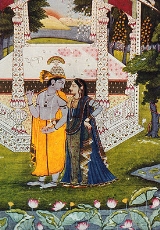
Radha Krishna

Encyclopedia
Radha Krishna is a Hindu deity
. Krishna is often referred as svayam bhagavan
in Gaudiya Vaishnavism
theology and Radha
is a young woman, a gopi
who is Krishna's supreme beloved. With Krishna, Radha is acknowledged as the Supreme Goddess, for it is said that she controls Krishna with Her love. It is believed that Krishna enchants the world, but Radha "enchants even Him. Therefore She is the supreme goddess of all. Radha Krishna".
While there are much earlier references to the worship of this form of God
, it is since Jayadeva
Goswami wrote a famous poem Gita Govinda
in the twelfth century of the Common Era
, that the topic of the spiritual love affair between the divine Krishna
and his devotee Radha
, became a theme celebrated throughout India. It is believed that Krishna has left the circle of the rasa dance to search for Radha. The Chaitanya school believes that the name and identity of Radha are both revealed and concealed in the verse describing this incident in Bhagavata Purana
. It is also believed that Radha is not just one cowherd maiden, but is the origin of all the gopis, or divine personalities that participate in the rasa
dance.
(Devanagari
:कृष्ण), the eighth incarnation (Avatar
) of Vishnu
., and his devotee Radha
(Devanagari: राधा)such was the devotion of Radha towards supreme soul that she became part of that supreme soul with her good Karma. Krishna in Vrindavana is sometimes depicted with Radha standing on his left, on whose bosom sits Laksmi.
and saktiman, i.e. Female and Male principle in god implies that Shakti and saktiman are the same. Each and every god has its partner, 'betterhalf' or Shakti and without this Shakti, is sometimes viewed being without essential power. It is a not uncommon feature of Hinduism
when worship of a pair rather than one personality constitutes worship of God
, such is worship of Radha Krishna. Traditions worshiping Krishna, as svayam bhagavan
, who is male, include reference and veneration to his Radha, who is worshiped as supreme. It's an accepted view that union of Radha and Krishna may indicate the union of Sakti with the Saktiman, and this view exists well outside of orthodox Vaishnavism
or Krishnaism
.
) implies a divine source of energy, God or shaktiman. "Sita relates to Rama
; Lakshmi
belongs to Narayana
; Radha has Her Krishna
." As Krishna is believed to be the source of all manifestations
of God
, "Shri Radha, His consort, is the original source of all shakti
s" or feminine manifestation of divine energy.
A number of interpretations according to traditions possess a common root of personalism in the understanding of worship. Specifically Caitanyaite Gaudiya Vaishnava doctrine and mission is fiercely "personalistic," proclaiming the supremacy of Krishna, the identification of Caitanya as Radha-Krishna, the reality and eternality of individual selves, and a method for approaching the absolute reality and the Deity as a person first and foremost.
Jiva Goswami
in his Priti Sandarbha states that each of the Gopis exhibits a different level of intensity of passion, among which Radha's is the greatest.
In his famous dialogs Ramananda Raya describes Radha to Caitanya and quotes, among other texts, a verse from Chaitanya Charitamrta2.8.100, before he goes on to describe her role in the pastimes of Vrindavana.
The central pivot point of the theology is related to the word rasa
. The theological use of the word can be found very early, about two thousand years before the Nimbarka
or Caitanya school, in a phrase that the tradition frequently quotes: "Truly, the Lord is rasa" (raso vai sah) of Brahma sutras
. This statement expresses the view that God is the one who enjoys the ultimate rasa or spiritual rapture, emotions.
The Manipuri Vaishnavas do not worship Krishna alone, but Radha-Krishna. With the spread of Vaishnavism the worship of Krishna and Radha became the dominant form in the Manipur region. Every village there has a Thakur-ghat and a temple. Rasa and other dances are a feature of the regional folk and religious tradition and often, for example, a female dancer will portray both Krishna and his consort, Radha, in the same piece.
ic literature, Radhas and other forms of the root >rAdh have meaning of ‘perfection’, ‘success’ and even ‘wealth’. Lord of Success, Indra was referred to as Radhaspati. In references to Mahavishnu
as the Lord of Fortune and freely used by Jayadeva
as Jaya Jayadeva Hare – the victorious Hari
, and ‘Radhaspati’ all found in many places. The word Radha occurs in the Atharva Veda, Taittiriya BrAhmana and Taittiriya Samhita.
Charlotte Vaudeville, in the article Evolution of Love Symbolism in Bhagavatism draws some parallel to Nappinnai, appearing in Godha’s magnum opus Thiruppavai and in Nammalwar’s references to Nappinnani, the daughter-in-law of Nandagopa. Nappinnai is believed to be the source of Radha’s conception in Prakrit
and Sanskrit
literature although their characteristic relations with Krishna are different. In the ritual dance called Kuravai, Krishna dances with his wife Nappinnai.
"It is a complex relationship, for the devotee is the ‘same as and yet different from’ the Lord, and so even in the joy of union there is the pain of separation. Indeed, the highest form of devotion, according to Yamunacarya, comes not in union but after the union, in the ‘fear of new separation’."
Yasastilaka Champukavya (AD 959) all make references to Radha and Krishna well before Jayadeva's period. There are elaborate references to Radha in Brahma vaivarta and Padma Purana
s.
 Gaudiya Vaishnava, as the name suggests, usually refers to the region of Bengal. Early Bengal
i literature gives a vivid description of the depiction and evolution of understanding of Radha
and Krishna. It is believed, however, that the source of Jayadeva Goswamis heroine in his poem Gita Govinda remains a puzzle of the Sanskrit Literature. At the same time there are well documented references to works earlier than Gita Govinda
, which some count to be more than twenty. The figure of Radha
is one of the most elusive in the literature of Sanskrit; she is described only in a few selected passages of Prakrit or Sanskrit poetry, a few inscriptions and a few works on grammar, poetry and drama. Jayadeva has referred to them and created an exquisite lyrical poem of passionate devotion in the twelfth century, and from this poetic beginning a huge movement specific to Bengal began.
Baru Chandidas
is a poet notable for being a prominent Early Middle Bengal
historical figure; the date of his poem Srikrsnakirtana is still under question however the text remains one of the most important evidences of early portrayal of the popular story of "Lord Krishna's love for the cowherd girl Radha
" in Bangla literature and religion. The 412 songs of Srikrsnakirtana are divided into thirteen sections that represent the core of the Radha-Krishna legendary cycle,
with many variants providing excellent comparative material. The manuscript clearly suggests that the songs were meant to be song, and implies particular raga
s for the recitation. There is considerable debate as to the authenticity of the text that has significant religious meaning.
In this Bengali tradition of Caitanya Vaishnavism metaphysical status and Radha-worship is considered to be established by Krsnadasa in his Chaitanya Charitamrta where he represents the doctrine that prevailed among the Vrindavan
Caitanyaites following Caitanya's demise in 1533. It is believed that Krishna, desiring to experience fully what it is like to love Krishna as Radha does, has appeared as Caitanya Mahaprabhu. And what Radha (appearing as Caitanya) does in her longing for Krishna is to chant his names.
One of the self manifested Deities established by Gopala Bhatta Goswami
is called Radha Ramana
, it is not surprising that Radha Ramana is seen as not only Krishna but also as Radha-Krishna. And worship in his temple, located in the centre of Vrindavana is a perpetual daily affair, involving several prescribed events throughout the day, with the goal of being theoretical and remote, but with aspiration of the possibility to attend and associate directly with Radha and Krishna.
worship of the youthful Krishna, alone or with his consort Radha
, is one of the earliest dating at least to the 12th century, just as Rudra Sampradaya
does. According to Nimbarka
, Radha was the eternal consort of Vishnu-Krishna and there is also a suggestion, though not a clear statement, that she became the wife of her beloved Krishna. It should be noted that Nimbarka rescues Radha from the presumed immoral implication of much of the literature, and gives to her a dignity unattained elsewhere.
The Nimbarka Sampradaya
founded by Nimbarka
is one of the four bonafide Vaishnava traditions. Lack of evidence due to the destruction of Mathura and Vrindavan in the 13th Century and 14th Century has meant that the true dates and origins of this tradition are shrouded in mystery and await investigation.
Nimbarka
, who is widely held by scholars such as Satyanand Joseph, Prof. Rasik Bihari Joshi, Prof. M. M. Aggrawal etc., to be at least of the same time or before the appearance of Shankaracharya
, was the first acharya to worship Radha along with Krishna in Sakhi Bhava Upasana method of worship. In his Vedanta Kamadhenu Dashashloki, it is clearly stated that:-
ange tu vaame vrishabhaanujaam mudaa viraajamaanaam anuruupasaubhagaam.
sakhiisahasraih parisevitaam sadaa smarema deviim sakalestakaamadaam. verse 6.
The left portion of the body of the Supreme Lord is Shrimati Radha, seated blissfully, as beautiful as the Lord Himself; who is served by thousands of gopi
s: we meditate on the Supreme Goddess, the fulfiller of all desires.
This theme was taken up by Jayadeva
Goswami and other poets of the time who saw the inherent beauty and bliss which constitute this philosophy.
In this sampradaya
, the significance of Radha
is not less than the significance of Sri Krsna. Both are conjointly the object to be worshiped in this school of Nimbarka, who is also one of the first commentators on Brahma Sutras
under the name Vedanta-Parijata-Saurabha. The later acharya
s of the Nimbarka Sampradaya
in the 13th and 14th centuries in Vrindavana composed much literature on the Divine Couple. Swami Sri Sribhatta, the elder god-brother of Jayadeva composed the Yugala Shataka for the Dhrupada style of musical presentation like Jayadeva
, however unlike Jayadeva
who composed his work in Sanskrit
, Swami Shribhatta's compositions are in Vraja Bhasha, a Hindi
vernacular which was understood by all inhabitants of Vraja. Indeed the rest of the acharyas of this tradition wrote in Vraja Bhasha and due to the lack of prevalence of this language in modern times, very little research has been done, even though these Acharyas predate the Six Goswamis of Vrindavan by centuries.
In any case, the sole object of worship in the Nimbarka Sampradaya
is the unified Divine Couple of Shri Radha Krishna. According to the 15th century Mahavani written by Jagadguru Swami Sri Harivyasa Devacharya
radhaamkrsnasvaroopaam vai, krishnam raadhaasvarupinam; kalaatmaanam nikunjastham gururoopam sadaa bhaje
I ceaselessly praise Radha who is none other than Krishna, and Sri Krishna who is none other than Radha, whose unity is represented by the Kaamabeeja and who are forever resident in Nikunja Goloka Vrndavana.
The contribution from the Nimbarka Sampradaya
to the philosophy of Radha Krishna is undeniable, as the philosophy and theology originate in it.
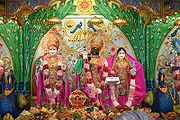 Radha-Krishna Dev has a special place in the Swaminarayan Sampraday
as Swaminarayan himself referred to Radha Krishna in the Shikshapatri
he wrote. Further, he himself ordered the construction of temples in which Radha Krishna have been installed as deities. Swaminarayan "explained that Krishna appears in many forms. When he is together with Radha, he is regarded as supreme lord under the name of Radha-Krishna; with Rukmini he is known as Lakshmi-Narayana
." The first temple constructed in the sect, built in Ahmedabad
in AD 1822, houses the images of Nara Narayana, forms of Arjuna
and Krishna, in the central shrine. The shrine on the left of the hall has murti
s of Radha Krishna. According to the philosophy of the tradition there were many female companions of Krishna, gopi
s, but out of all of them Radha was considered to be the perfect devotee. Those who wish to come close to Krishna must cultivate the devotional qualities of Radha. According to theory the sect has set aside Goloka
as the supreme heaven or abode (in fact, in some of their temples, such as the Mumbai Temple, the murtis installed are those of Shri Gaulokvihari and Radhikaji), because there Krishna is supposed to be enjoying himself with his Gopis, who according to the Swaminarayana sampradaya the milkmaids with whom Krishna danced; his relations with them symbolize the relation of God with the devotee in reciprocation.
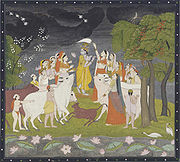 Vallabhacharya, founder of Pustimarga even before Chaitanya, worshipped Radha, where according to some sects, the devotees identify mainly with the female companion (sakhis) of Radha who are privileged to arrange intimate pastimes for RadhaKrishna.
One of the prominent poets of this tradition, which also called Radhavallabhi, named Dhruvadasa was notable for being principally concerned with the private relationships of Radha and Krishna. In his poetry Caurasi Pad and in the commentaries of his followers, the concentration is in meditation on the unique benefits of constant reflection on the eternal lila.
Radhavallabhis share with their Vaishnava co-religionists a great regard for Bhagavata Purana
, but some of the pastimes that are outside the scope of relationships with Radha and gopis do not feature in the concept of this school. Emphasis is placed on the sweetness of the relationship, or rasa
.
, a golden age
existed when Muslim
s and Hindus created a common culture mainly because some Muslim rulers patronized Sanskrit
and translations from Sanskrit into Persian
, while there were poets with Muslim names who wrote about Krishna and Radha.
Vrindavan
and Mathura are considered to be the centers of Radha-Krishna worship. The most important temples of Vrindavana are
Shree Radha Ras Bihari Ashta Sakhi Mandir (http://www.ashtasakhimandir.org )
In Vrindavan, the “Leela Sthan” (the place of the divine passion play) of Lord Krishna, lies the temple that is a must visit destination for devotees completing the 84 kosh Vraj Parikrama Yatra. The temple is centuries old and is the first Indian temple that is dedicated to the divine couple and their Ashta Sakhi’s - the eight “companions” of Radha who were intimately involved in her love play with the Lord Krishna. The Ashta Sakhis are mentioned in the ancient texts of Veda Puranas and the Srimad Bhagvat.
The temple is called – Shree Radha Ras Bihari Ashta Sakhi Mandir and it is home to the divine Ras Leela of Lord Krishna and Radharani. It is located near the Shree Banke Behari Mandir.
Legend has it that the Shree Radha Ras Bihari Ashta Sakhi Mandir is one of the two places in Mathura, Vrindavan where the Lord Krishna indulges in the Ras Leela with his beloved Radha and her sakhis. On these nights, devotees have reported hearing the sound of the anklets, beating in tune to a divine melody.
Madan-mohan, Govindadev, Radha-Raman, Radha-Gokulananda, Radha-Damodar, Banki-behari, Radhavallabha, Jugal Kishor, Radha-Gopinath, Radha Shyamasundar, and Krishna-Balaram temples where Radha and Krishna are worshiped in their murti
forms.
Outside India
There are number of traditions that spread the worship of Radha-Krishna in many countries, be it associated with migration or preaching activities of sadhus.
One such prominent adept, Prabhupada opened a number of centers himself wherein he could train mleccha
-turned-brahmin
students to worship Radha-Krishna murti
s and become "devoted to the service of Godhead".
. It is said that the reciter can get to Krishna via Radha by chanting it.
Deity
A deity is a recognized preternatural or supernatural immortal being, who may be thought of as holy, divine, or sacred, held in high regard, and respected by believers....
. Krishna is often referred as svayam bhagavan
Svayam Bhagavan
Svayam Bhagavan , "The Lord" or Lord Himself, is a Sanskrit theological term. The term refers to the concept of absolute representation of the monotheistic God as Bhagavan within Hinduism....
in Gaudiya Vaishnavism
Gaudiya Vaishnavism
Gaudiya Vaishnavism is a Vaishnava religious movement founded by Chaitanya Mahaprabhu in India in the 16th century. "Gaudiya" refers to the Gauḍa region with Vaishnavism meaning "the worship of Vishnu"...
theology and Radha
Radha
Radha , also called Radhika, Radharani and Radhikarani, is the childhood friend and lover of Krishna in the Bhagavata Purana, and the Gita Govinda of the Vaisnava traditions of Hinduism...
is a young woman, a gopi
Gopi
Gopi is a word of Sanskrit origin meaning 'cow-herd girl'. In Hinduism specifically the name gopi is used more commonly to refer to the group of cow herding girls famous within Vaishnava Theology for their unconditional devotion to Krishna as described in the stories of Bhagavata Purana and...
who is Krishna's supreme beloved. With Krishna, Radha is acknowledged as the Supreme Goddess, for it is said that she controls Krishna with Her love. It is believed that Krishna enchants the world, but Radha "enchants even Him. Therefore She is the supreme goddess of all. Radha Krishna".
While there are much earlier references to the worship of this form of God
God
God is the English name given to a singular being in theistic and deistic religions who is either the sole deity in monotheism, or a single deity in polytheism....
, it is since Jayadeva
Jayadeva
Jayadeva was a Sanskrit poet circa 1200 AD. He is most known for his composition, the epic poem Gita Govinda, which depicts the divine love of Krishna-an avatar of Vishnu and his consort, Radha, and it is mentioned that Radha is greater than Hari, and is considered an important text in the...
Goswami wrote a famous poem Gita Govinda
Gita Govinda
The Gita Govinda is a work composed by the 12th-century poet, Jayadeva, who was born in Kenduli Sasan near Puri in Orissa. It describes the relationship between Krishna and the gopis of Vrindavana, and in particular one gopi named Radha...
in the twelfth century of the Common Era
Common Era
Common Era ,abbreviated as CE, is an alternative designation for the calendar era originally introduced by Dionysius Exiguus in the 6th century, traditionally identified with Anno Domini .Dates before the year 1 CE are indicated by the usage of BCE, short for Before the Common Era Common Era...
, that the topic of the spiritual love affair between the divine Krishna
Krishna
Krishna is a central figure of Hinduism and is traditionally attributed the authorship of the Bhagavad Gita. He is the supreme Being and considered in some monotheistic traditions as an Avatar of Vishnu...
and his devotee Radha
Radha
Radha , also called Radhika, Radharani and Radhikarani, is the childhood friend and lover of Krishna in the Bhagavata Purana, and the Gita Govinda of the Vaisnava traditions of Hinduism...
, became a theme celebrated throughout India. It is believed that Krishna has left the circle of the rasa dance to search for Radha. The Chaitanya school believes that the name and identity of Radha are both revealed and concealed in the verse describing this incident in Bhagavata Purana
Bhagavata purana
The Bhāgavata Purāṇa is one of the "Maha" Puranic texts of Hindu literature, with its primary focus on bhakti to the incarnations of Vishnu, particularly Krishna...
. It is also believed that Radha is not just one cowherd maiden, but is the origin of all the gopis, or divine personalities that participate in the rasa
Rasa (theology)
Rasa is a Sanskrit theological concept specific to Krishna-centered bhakti traditions, such as Gaudiya Vaishnavism. The theological use of the word can be found early, about two thousand years before the Nimbarka or Caitanya schools of bhakti, in a phrase that Chaitanya traditions frequently...
dance.
Name
RadhaKrishna cannot be broken into two – KrishnaKrishna
Krishna is a central figure of Hinduism and is traditionally attributed the authorship of the Bhagavad Gita. He is the supreme Being and considered in some monotheistic traditions as an Avatar of Vishnu...
(Devanagari
Devanagari
Devanagari |deva]]" and "nāgarī" ), also called Nagari , is an abugida alphabet of India and Nepal...
:कृष्ण), the eighth incarnation (Avatar
Avatar
In Hinduism, an avatar is a deliberate descent of a deity to earth, or a descent of the Supreme Being and is mostly translated into English as "incarnation," but more accurately as "appearance" or "manifestation"....
) of Vishnu
Vishnu
Vishnu is the Supreme god in the Vaishnavite tradition of Hinduism. Smarta followers of Adi Shankara, among others, venerate Vishnu as one of the five primary forms of God....
., and his devotee Radha
Radha
Radha , also called Radhika, Radharani and Radhikarani, is the childhood friend and lover of Krishna in the Bhagavata Purana, and the Gita Govinda of the Vaisnava traditions of Hinduism...
(Devanagari: राधा)such was the devotion of Radha towards supreme soul that she became part of that supreme soul with her good Karma. Krishna in Vrindavana is sometimes depicted with Radha standing on his left, on whose bosom sits Laksmi.
Sakti and Saktiman
The common derivation of ShaktiShakti
Shakti from Sanskrit shak - "to be able," meaning sacred force or empowerment, is the primordial cosmic energy and represents the dynamic forces that are thought to move through the entire universe in Hinduism. Shakti is the concept, or personification, of divine feminine creative power, sometimes...
and saktiman, i.e. Female and Male principle in god implies that Shakti and saktiman are the same. Each and every god has its partner, 'betterhalf' or Shakti and without this Shakti, is sometimes viewed being without essential power. It is a not uncommon feature of Hinduism
Hinduism
Hinduism is the predominant and indigenous religious tradition of the Indian Subcontinent. Hinduism is known to its followers as , amongst many other expressions...
when worship of a pair rather than one personality constitutes worship of God
God
God is the English name given to a singular being in theistic and deistic religions who is either the sole deity in monotheism, or a single deity in polytheism....
, such is worship of Radha Krishna. Traditions worshiping Krishna, as svayam bhagavan
Svayam Bhagavan
Svayam Bhagavan , "The Lord" or Lord Himself, is a Sanskrit theological term. The term refers to the concept of absolute representation of the monotheistic God as Bhagavan within Hinduism....
, who is male, include reference and veneration to his Radha, who is worshiped as supreme. It's an accepted view that union of Radha and Krishna may indicate the union of Sakti with the Saktiman, and this view exists well outside of orthodox Vaishnavism
Vaishnavism
Vaishnavism is a tradition of Hinduism, distinguished from other schools by its worship of Vishnu, or his associated Avatars such as Rama and Krishna, as the original and supreme God....
or Krishnaism
Krishnaism
Krishnaism is a group of Hindu denominations within Vaishnavism, centered on devotion to Radha Krishna or other forms of Krishna, identified with Vishnu.The central text of Krishnaism is the Bhagavad Gita....
.
Philosophy
From the Vaishnava point of view the divine feminine energy (shaktiShakti
Shakti from Sanskrit shak - "to be able," meaning sacred force or empowerment, is the primordial cosmic energy and represents the dynamic forces that are thought to move through the entire universe in Hinduism. Shakti is the concept, or personification, of divine feminine creative power, sometimes...
) implies a divine source of energy, God or shaktiman. "Sita relates to Rama
Rama
Rama or full name Ramachandra is considered to be the seventh avatar of Vishnu in Hinduism, and a king of Ayodhya in ancient Indian...
; Lakshmi
Lakshmi
Lakshmi or Lakumi is the Hindu goddess of wealth, prosperity , light, wisdom, fortune, fertility, generosity and courage; and the embodiment of beauty, grace and charm. Representations of Lakshmi are also found in Jain monuments...
belongs to Narayana
Narayana
Narayana or Narayan or Naraina is an important Sanskrit name for Vishnu, and in many contemporary vernaculars a common Indian name. Narayana is also identified as the original man, Purusha. The Puranas present divergent views on Narayana...
; Radha has Her Krishna
Krishna
Krishna is a central figure of Hinduism and is traditionally attributed the authorship of the Bhagavad Gita. He is the supreme Being and considered in some monotheistic traditions as an Avatar of Vishnu...
." As Krishna is believed to be the source of all manifestations
Svayam Bhagavan
Svayam Bhagavan , "The Lord" or Lord Himself, is a Sanskrit theological term. The term refers to the concept of absolute representation of the monotheistic God as Bhagavan within Hinduism....
of God
God
God is the English name given to a singular being in theistic and deistic religions who is either the sole deity in monotheism, or a single deity in polytheism....
, "Shri Radha, His consort, is the original source of all shakti
Shakti
Shakti from Sanskrit shak - "to be able," meaning sacred force or empowerment, is the primordial cosmic energy and represents the dynamic forces that are thought to move through the entire universe in Hinduism. Shakti is the concept, or personification, of divine feminine creative power, sometimes...
s" or feminine manifestation of divine energy.
A number of interpretations according to traditions possess a common root of personalism in the understanding of worship. Specifically Caitanyaite Gaudiya Vaishnava doctrine and mission is fiercely "personalistic," proclaiming the supremacy of Krishna, the identification of Caitanya as Radha-Krishna, the reality and eternality of individual selves, and a method for approaching the absolute reality and the Deity as a person first and foremost.
Jiva Goswami
Jiva Goswami
Jiva Goswami is one of the most prolific and important philosopher and saint from the Gaudiya Vaishnava school of Vedanta tradition, producing a great number of philosophical works on the theology and practice of Bhakti yoga, Vaishnava Vedanta and associated disciplines...
in his Priti Sandarbha states that each of the Gopis exhibits a different level of intensity of passion, among which Radha's is the greatest.
In his famous dialogs Ramananda Raya describes Radha to Caitanya and quotes, among other texts, a verse from Chaitanya Charitamrta2.8.100, before he goes on to describe her role in the pastimes of Vrindavana.
The central pivot point of the theology is related to the word rasa
Rasa (theology)
Rasa is a Sanskrit theological concept specific to Krishna-centered bhakti traditions, such as Gaudiya Vaishnavism. The theological use of the word can be found early, about two thousand years before the Nimbarka or Caitanya schools of bhakti, in a phrase that Chaitanya traditions frequently...
. The theological use of the word can be found very early, about two thousand years before the Nimbarka
Nimbarka
Nimbarka , is known for propagating the Vaishnava Theology of Dvaitadvaita, duality in unity. According to scholars headed by Prof. Roma Bose, he lived in the 13th Century, on the assumption that Śrī Nimbārkācārya was the author of the work Madhvamukhamardana...
or Caitanya school, in a phrase that the tradition frequently quotes: "Truly, the Lord is rasa" (raso vai sah) of Brahma sutras
Brahma Sutras
The Brahma sūtras , also known as Vedānta Sūtras , are one of the three canonical texts of the Vedānta school of Hindu philosophy. A thorough study of Vedānta requires a close examination of these three texts, known in Sanskrit as the Prasthanatrayi, or the three starting points...
. This statement expresses the view that God is the one who enjoys the ultimate rasa or spiritual rapture, emotions.
Bisnupriya Manipuri Vaishnavas
King Gareeb Nivaz ruled from 1709 to 1748 and was initiated into Vaishnavism of the Chaitanya tradition, which worships Krishna as the supreme deity, Svayam bhagavan. He practiced this religion for nearly twenty years. Preachers and pilgrims used to arrive in large numbers and cultural contact with Assam was maintained.The Manipuri Vaishnavas do not worship Krishna alone, but Radha-Krishna. With the spread of Vaishnavism the worship of Krishna and Radha became the dominant form in the Manipur region. Every village there has a Thakur-ghat and a temple. Rasa and other dances are a feature of the regional folk and religious tradition and often, for example, a female dancer will portray both Krishna and his consort, Radha, in the same piece.
Bhagavata
In Vedic and PuranPuran
Puran Puran Tehsil is a sub-division and tehsil of Shangla District in Khyber-Pakhtunkhwa province of Pakistan....
ic literature, Radhas and other forms of the root >rAdh have meaning of ‘perfection’, ‘success’ and even ‘wealth’. Lord of Success, Indra was referred to as Radhaspati. In references to Mahavishnu
Mahavishnu
Image:Hinducosm Map1.svg|thumb|Click an area to go there. This is one of many material universes which expand from Mahavishnu when He breathes.|300px|alt=One Brahmanda, with Garbhodakashayi-Vishnurect 216 61 277 80 Brahma...
as the Lord of Fortune and freely used by Jayadeva
Jayadeva
Jayadeva was a Sanskrit poet circa 1200 AD. He is most known for his composition, the epic poem Gita Govinda, which depicts the divine love of Krishna-an avatar of Vishnu and his consort, Radha, and it is mentioned that Radha is greater than Hari, and is considered an important text in the...
as Jaya Jayadeva Hare – the victorious Hari
Hari
Hari is an Avatar, another name of and , and appears as the 650th name in the Vishnu sahasranama of Mahabharata. In Sanskrit "hari" sometimes refers to a colour, green, yellow, or fawn-coloured/khaki. It is the colour of the Sun and of Soma...
, and ‘Radhaspati’ all found in many places. The word Radha occurs in the Atharva Veda, Taittiriya BrAhmana and Taittiriya Samhita.
Charlotte Vaudeville, in the article Evolution of Love Symbolism in Bhagavatism draws some parallel to Nappinnai, appearing in Godha’s magnum opus Thiruppavai and in Nammalwar’s references to Nappinnani, the daughter-in-law of Nandagopa. Nappinnai is believed to be the source of Radha’s conception in Prakrit
Prakrit
Prakrit is the name for a group of Middle Indic, Indo-Aryan languages, derived from Old Indic dialects. The word itself has a flexible definition, being defined sometimes as, "original, natural, artless, normal, ordinary, usual", or "vernacular", in contrast to the literary and religious...
and Sanskrit
Sanskrit
Sanskrit , is a historical Indo-Aryan language and the primary liturgical language of Hinduism, Jainism and Buddhism.Buddhism: besides Pali, see Buddhist Hybrid Sanskrit Today, it is listed as one of the 22 scheduled languages of India and is an official language of the state of Uttarakhand...
literature although their characteristic relations with Krishna are different. In the ritual dance called Kuravai, Krishna dances with his wife Nappinnai.
"It is a complex relationship, for the devotee is the ‘same as and yet different from’ the Lord, and so even in the joy of union there is the pain of separation. Indeed, the highest form of devotion, according to Yamunacarya, comes not in union but after the union, in the ‘fear of new separation’."
Yasastilaka Champukavya (AD 959) all make references to Radha and Krishna well before Jayadeva's period. There are elaborate references to Radha in Brahma vaivarta and Padma Purana
Padma Purana
Padma Purana , one of the major eighteen Puranas, a Hindu religious text, is divided into five parts.In the first part of the text, sage Pulastya explains to Bhishma about religion and the essence of the religion. The second part describes in detail Prithvi...
s.
Gaudiya Vaishnava
Bengal
Bengal is a historical and geographical region in the northeast region of the Indian Subcontinent at the apex of the Bay of Bengal. Today, it is mainly divided between the sovereign land of People's Republic of Bangladesh and the Indian state of West Bengal, although some regions of the previous...
i literature gives a vivid description of the depiction and evolution of understanding of Radha
Radha
Radha , also called Radhika, Radharani and Radhikarani, is the childhood friend and lover of Krishna in the Bhagavata Purana, and the Gita Govinda of the Vaisnava traditions of Hinduism...
and Krishna. It is believed, however, that the source of Jayadeva Goswamis heroine in his poem Gita Govinda remains a puzzle of the Sanskrit Literature. At the same time there are well documented references to works earlier than Gita Govinda
Gita Govinda
The Gita Govinda is a work composed by the 12th-century poet, Jayadeva, who was born in Kenduli Sasan near Puri in Orissa. It describes the relationship between Krishna and the gopis of Vrindavana, and in particular one gopi named Radha...
, which some count to be more than twenty. The figure of Radha
Radha
Radha , also called Radhika, Radharani and Radhikarani, is the childhood friend and lover of Krishna in the Bhagavata Purana, and the Gita Govinda of the Vaisnava traditions of Hinduism...
is one of the most elusive in the literature of Sanskrit; she is described only in a few selected passages of Prakrit or Sanskrit poetry, a few inscriptions and a few works on grammar, poetry and drama. Jayadeva has referred to them and created an exquisite lyrical poem of passionate devotion in the twelfth century, and from this poetic beginning a huge movement specific to Bengal began.
Baru Chandidas
Chandidas
Chandidas refers to medieval poet of Bengal. Over 1250 poems related to the love of Radha and Krishna in Bengali with the bhanita of Chandidas are found with three different sobriquets along with his name, , Dvija and Dina as well as without any sobriquet also...
is a poet notable for being a prominent Early Middle Bengal
Bengal
Bengal is a historical and geographical region in the northeast region of the Indian Subcontinent at the apex of the Bay of Bengal. Today, it is mainly divided between the sovereign land of People's Republic of Bangladesh and the Indian state of West Bengal, although some regions of the previous...
historical figure; the date of his poem Srikrsnakirtana is still under question however the text remains one of the most important evidences of early portrayal of the popular story of "Lord Krishna's love for the cowherd girl Radha
Radha
Radha , also called Radhika, Radharani and Radhikarani, is the childhood friend and lover of Krishna in the Bhagavata Purana, and the Gita Govinda of the Vaisnava traditions of Hinduism...
" in Bangla literature and religion. The 412 songs of Srikrsnakirtana are divided into thirteen sections that represent the core of the Radha-Krishna legendary cycle,
with many variants providing excellent comparative material. The manuscript clearly suggests that the songs were meant to be song, and implies particular raga
Raga
A raga is one of the melodic modes used in Indian classical music.It is a series of five or more musical notes upon which a melody is made...
s for the recitation. There is considerable debate as to the authenticity of the text that has significant religious meaning.
In this Bengali tradition of Caitanya Vaishnavism metaphysical status and Radha-worship is considered to be established by Krsnadasa in his Chaitanya Charitamrta where he represents the doctrine that prevailed among the Vrindavan
Vrindavan
Vrindavan also known as Vraj is a town in the Mathura district of Uttar Pradesh, India...
Caitanyaites following Caitanya's demise in 1533. It is believed that Krishna, desiring to experience fully what it is like to love Krishna as Radha does, has appeared as Caitanya Mahaprabhu. And what Radha (appearing as Caitanya) does in her longing for Krishna is to chant his names.
One of the self manifested Deities established by Gopala Bhatta Goswami
Gopala Bhatta Goswami
Gopala Bhatta Goswami is one of the foremost disciples of the Vaishnava saint, Chaitanya Mahaprabhu, and a leading historical figure in the Gaudiya Vaishnava school of Hinduism...
is called Radha Ramana
Radha Ramana
Radha Ramana is a famous image of Radha Krishna worshiped in Hinduism. There is a famous temple of this deity in Vrindavana.-Name:This name of Krishna should be understood from a certain perspective, as a lover of his Radha....
, it is not surprising that Radha Ramana is seen as not only Krishna but also as Radha-Krishna. And worship in his temple, located in the centre of Vrindavana is a perpetual daily affair, involving several prescribed events throughout the day, with the goal of being theoretical and remote, but with aspiration of the possibility to attend and associate directly with Radha and Krishna.
Nimbarka sampradaya
The Nimbarka sampradayaNimbarka Sampradaya
The Nimbarka Sampradaya , also known as the Hamsa Sampradāya, Kumāra Sampradāya, ' and Sanakādi Sampradāya, is one of the four authorised Sampradāyas as according to the Padma , one of the eighteen main...
worship of the youthful Krishna, alone or with his consort Radha
Radha
Radha , also called Radhika, Radharani and Radhikarani, is the childhood friend and lover of Krishna in the Bhagavata Purana, and the Gita Govinda of the Vaisnava traditions of Hinduism...
, is one of the earliest dating at least to the 12th century, just as Rudra Sampradaya
Rudra Sampradaya
In Hinduism, the Rudra Sampradaya is one of four Vaishnava sampradayas, a tradition of disciplic succession in the religion. Vaishnavism is distinguished from other schools of Hinduism by its primary worship of deities Vishnu and/or Krishna and their Avatars as the Supreme forms of God...
does. According to Nimbarka
Nimbarka
Nimbarka , is known for propagating the Vaishnava Theology of Dvaitadvaita, duality in unity. According to scholars headed by Prof. Roma Bose, he lived in the 13th Century, on the assumption that Śrī Nimbārkācārya was the author of the work Madhvamukhamardana...
, Radha was the eternal consort of Vishnu-Krishna and there is also a suggestion, though not a clear statement, that she became the wife of her beloved Krishna. It should be noted that Nimbarka rescues Radha from the presumed immoral implication of much of the literature, and gives to her a dignity unattained elsewhere.
The Nimbarka Sampradaya
Nimbarka Sampradaya
The Nimbarka Sampradaya , also known as the Hamsa Sampradāya, Kumāra Sampradāya, ' and Sanakādi Sampradāya, is one of the four authorised Sampradāyas as according to the Padma , one of the eighteen main...
founded by Nimbarka
Nimbarka
Nimbarka , is known for propagating the Vaishnava Theology of Dvaitadvaita, duality in unity. According to scholars headed by Prof. Roma Bose, he lived in the 13th Century, on the assumption that Śrī Nimbārkācārya was the author of the work Madhvamukhamardana...
is one of the four bonafide Vaishnava traditions. Lack of evidence due to the destruction of Mathura and Vrindavan in the 13th Century and 14th Century has meant that the true dates and origins of this tradition are shrouded in mystery and await investigation.
Nimbarka
Nimbarka
Nimbarka , is known for propagating the Vaishnava Theology of Dvaitadvaita, duality in unity. According to scholars headed by Prof. Roma Bose, he lived in the 13th Century, on the assumption that Śrī Nimbārkācārya was the author of the work Madhvamukhamardana...
, who is widely held by scholars such as Satyanand Joseph, Prof. Rasik Bihari Joshi, Prof. M. M. Aggrawal etc., to be at least of the same time or before the appearance of Shankaracharya
Shankaracharya
Shankaracharya, is a commonly used title of heads of mathas in the Advaita Vedanta tradition. The title derives from Adi Shankara, a 9th century CE reformer of Hinduism. He is honored as Jagadguru, a title that was used earlier only to Lord Krishna...
, was the first acharya to worship Radha along with Krishna in Sakhi Bhava Upasana method of worship. In his Vedanta Kamadhenu Dashashloki, it is clearly stated that:-
ange tu vaame vrishabhaanujaam mudaa viraajamaanaam anuruupasaubhagaam.
sakhiisahasraih parisevitaam sadaa smarema deviim sakalestakaamadaam. verse 6.
The left portion of the body of the Supreme Lord is Shrimati Radha, seated blissfully, as beautiful as the Lord Himself; who is served by thousands of gopi
Gopi
Gopi is a word of Sanskrit origin meaning 'cow-herd girl'. In Hinduism specifically the name gopi is used more commonly to refer to the group of cow herding girls famous within Vaishnava Theology for their unconditional devotion to Krishna as described in the stories of Bhagavata Purana and...
s: we meditate on the Supreme Goddess, the fulfiller of all desires.
This theme was taken up by Jayadeva
Jayadeva
Jayadeva was a Sanskrit poet circa 1200 AD. He is most known for his composition, the epic poem Gita Govinda, which depicts the divine love of Krishna-an avatar of Vishnu and his consort, Radha, and it is mentioned that Radha is greater than Hari, and is considered an important text in the...
Goswami and other poets of the time who saw the inherent beauty and bliss which constitute this philosophy.
In this sampradaya
Sampradaya
In Hinduism, a sampradaya can be translated as ‘tradition’ or a ‘religious system’, although the word commands much more respect and power in the Indian context than its translations in English does...
, the significance of Radha
Radha
Radha , also called Radhika, Radharani and Radhikarani, is the childhood friend and lover of Krishna in the Bhagavata Purana, and the Gita Govinda of the Vaisnava traditions of Hinduism...
is not less than the significance of Sri Krsna. Both are conjointly the object to be worshiped in this school of Nimbarka, who is also one of the first commentators on Brahma Sutras
Brahma Sutras
The Brahma sūtras , also known as Vedānta Sūtras , are one of the three canonical texts of the Vedānta school of Hindu philosophy. A thorough study of Vedānta requires a close examination of these three texts, known in Sanskrit as the Prasthanatrayi, or the three starting points...
under the name Vedanta-Parijata-Saurabha. The later acharya
Acharya
In Indian religions and society, an acharya is a guide or instructor in religious matters; founder, or leader of a sect; or a highly learned man or a title affixed to the names of learned men...
s of the Nimbarka Sampradaya
Nimbarka Sampradaya
The Nimbarka Sampradaya , also known as the Hamsa Sampradāya, Kumāra Sampradāya, ' and Sanakādi Sampradāya, is one of the four authorised Sampradāyas as according to the Padma , one of the eighteen main...
in the 13th and 14th centuries in Vrindavana composed much literature on the Divine Couple. Swami Sri Sribhatta, the elder god-brother of Jayadeva composed the Yugala Shataka for the Dhrupada style of musical presentation like Jayadeva
Jayadeva
Jayadeva was a Sanskrit poet circa 1200 AD. He is most known for his composition, the epic poem Gita Govinda, which depicts the divine love of Krishna-an avatar of Vishnu and his consort, Radha, and it is mentioned that Radha is greater than Hari, and is considered an important text in the...
, however unlike Jayadeva
Jayadeva
Jayadeva was a Sanskrit poet circa 1200 AD. He is most known for his composition, the epic poem Gita Govinda, which depicts the divine love of Krishna-an avatar of Vishnu and his consort, Radha, and it is mentioned that Radha is greater than Hari, and is considered an important text in the...
who composed his work in Sanskrit
Sanskrit
Sanskrit , is a historical Indo-Aryan language and the primary liturgical language of Hinduism, Jainism and Buddhism.Buddhism: besides Pali, see Buddhist Hybrid Sanskrit Today, it is listed as one of the 22 scheduled languages of India and is an official language of the state of Uttarakhand...
, Swami Shribhatta's compositions are in Vraja Bhasha, a Hindi
Hindi
Standard Hindi, or more precisely Modern Standard Hindi, also known as Manak Hindi , High Hindi, Nagari Hindi, and Literary Hindi, is a standardized and sanskritized register of the Hindustani language derived from the Khariboli dialect of Delhi...
vernacular which was understood by all inhabitants of Vraja. Indeed the rest of the acharyas of this tradition wrote in Vraja Bhasha and due to the lack of prevalence of this language in modern times, very little research has been done, even though these Acharyas predate the Six Goswamis of Vrindavan by centuries.
In any case, the sole object of worship in the Nimbarka Sampradaya
Nimbarka Sampradaya
The Nimbarka Sampradaya , also known as the Hamsa Sampradāya, Kumāra Sampradāya, ' and Sanakādi Sampradāya, is one of the four authorised Sampradāyas as according to the Padma , one of the eighteen main...
is the unified Divine Couple of Shri Radha Krishna. According to the 15th century Mahavani written by Jagadguru Swami Sri Harivyasa Devacharya
radhaamkrsnasvaroopaam vai, krishnam raadhaasvarupinam; kalaatmaanam nikunjastham gururoopam sadaa bhaje
I ceaselessly praise Radha who is none other than Krishna, and Sri Krishna who is none other than Radha, whose unity is represented by the Kaamabeeja and who are forever resident in Nikunja Goloka Vrndavana.
The contribution from the Nimbarka Sampradaya
Nimbarka Sampradaya
The Nimbarka Sampradaya , also known as the Hamsa Sampradāya, Kumāra Sampradāya, ' and Sanakādi Sampradāya, is one of the four authorised Sampradāyas as according to the Padma , one of the eighteen main...
to the philosophy of Radha Krishna is undeniable, as the philosophy and theology originate in it.
Swaminarayan Sampraday
Swaminarayan Sampraday
Swaminarayan Sampraday , known previously as the Uddhav Sampraday, is a Hindu sect established by Swaminarayan...
as Swaminarayan himself referred to Radha Krishna in the Shikshapatri
Shikshapatri
The Shikshapatri is a religious text consisting of two hundred and twelve verses, written in Sanskrit by Bhagwan Swaminarayan. The Shikshapatri is a key scripture to all followers of the Swaminarayan faith and is considered the basis of the faith.The Shikshapatri was written in Vadtal on February...
he wrote. Further, he himself ordered the construction of temples in which Radha Krishna have been installed as deities. Swaminarayan "explained that Krishna appears in many forms. When he is together with Radha, he is regarded as supreme lord under the name of Radha-Krishna; with Rukmini he is known as Lakshmi-Narayana
Lakshminarayan
Lakshmi Narayan or Lakshmi-Narayana , also sometimes spelled Lakshminarayan, Lakshminarayana, Laxminarayana, is a name of a Hindu deity...
." The first temple constructed in the sect, built in Ahmedabad
Ahmedabad
Ahmedabad also known as Karnavati is the largest city in Gujarat, India. It is the former capital of Gujarat and is also the judicial capital of Gujarat as the Gujarat High Court has its seat in Ahmedabad...
in AD 1822, houses the images of Nara Narayana, forms of Arjuna
Arjuna
Arjuna in Indian mythology is the greatest warrior on earth and is one of the Pandavas, the heroes of the Hindu epic Mahābhārata. Arjuna, whose name means 'bright', 'shining', 'white' or 'silver' Arjuna (Devanagari: अर्जुन, Thai: อรชุน, Orachun, Tamil: Arjunan, Indonesian and Javanese: Harjuna,...
and Krishna, in the central shrine. The shrine on the left of the hall has murti
Murti
In Hinduism, a murti , or murthi, or vigraha or pratima typically refers to an image which expresses a Divine Spirit . Meaning literally "embodiment", a murti is a representation of a divinity, made usually of stone, wood, or metal, which serves as a means through which a divinity may be worshiped...
s of Radha Krishna. According to the philosophy of the tradition there were many female companions of Krishna, gopi
Gopi
Gopi is a word of Sanskrit origin meaning 'cow-herd girl'. In Hinduism specifically the name gopi is used more commonly to refer to the group of cow herding girls famous within Vaishnava Theology for their unconditional devotion to Krishna as described in the stories of Bhagavata Purana and...
s, but out of all of them Radha was considered to be the perfect devotee. Those who wish to come close to Krishna must cultivate the devotional qualities of Radha. According to theory the sect has set aside Goloka
Goloka
Goloka is the eternal abode of Krishna, Svayam bhagavan according to some Vaishnava schools, including Gaudiya Vaishnavism and the Swaminarayan Sampraday....
as the supreme heaven or abode (in fact, in some of their temples, such as the Mumbai Temple, the murtis installed are those of Shri Gaulokvihari and Radhikaji), because there Krishna is supposed to be enjoying himself with his Gopis, who according to the Swaminarayana sampradaya the milkmaids with whom Krishna danced; his relations with them symbolize the relation of God with the devotee in reciprocation.
Vallabha sampradaya
One of the prominent poets of this tradition, which also called Radhavallabhi, named Dhruvadasa was notable for being principally concerned with the private relationships of Radha and Krishna. In his poetry Caurasi Pad and in the commentaries of his followers, the concentration is in meditation on the unique benefits of constant reflection on the eternal lila.
Radhavallabhis share with their Vaishnava co-religionists a great regard for Bhagavata Purana
Bhagavata purana
The Bhāgavata Purāṇa is one of the "Maha" Puranic texts of Hindu literature, with its primary focus on bhakti to the incarnations of Vishnu, particularly Krishna...
, but some of the pastimes that are outside the scope of relationships with Radha and gopis do not feature in the concept of this school. Emphasis is placed on the sweetness of the relationship, or rasa
Rasa (theology)
Rasa is a Sanskrit theological concept specific to Krishna-centered bhakti traditions, such as Gaudiya Vaishnavism. The theological use of the word can be found early, about two thousand years before the Nimbarka or Caitanya schools of bhakti, in a phrase that Chaitanya traditions frequently...
.
Outside Hinduism
In opinion of some Hindu scholars as well as scholars of HinduismHinduism
Hinduism is the predominant and indigenous religious tradition of the Indian Subcontinent. Hinduism is known to its followers as , amongst many other expressions...
, a golden age
Golden Age
The term Golden Age comes from Greek mythology and legend and refers to the first in a sequence of four or five Ages of Man, in which the Golden Age is first, followed in sequence, by the Silver, Bronze, and Iron Ages, and then the present, a period of decline...
existed when Muslim
Muslim
A Muslim, also spelled Moslem, is an adherent of Islam, a monotheistic, Abrahamic religion based on the Quran, which Muslims consider the verbatim word of God as revealed to prophet Muhammad. "Muslim" is the Arabic term for "submitter" .Muslims believe that God is one and incomparable...
s and Hindus created a common culture mainly because some Muslim rulers patronized Sanskrit
Sanskrit
Sanskrit , is a historical Indo-Aryan language and the primary liturgical language of Hinduism, Jainism and Buddhism.Buddhism: besides Pali, see Buddhist Hybrid Sanskrit Today, it is listed as one of the 22 scheduled languages of India and is an official language of the state of Uttarakhand...
and translations from Sanskrit into Persian
Persian language
Persian is an Iranian language within the Indo-Iranian branch of the Indo-European languages. It is primarily spoken in Iran, Afghanistan, Tajikistan and countries which historically came under Persian influence...
, while there were poets with Muslim names who wrote about Krishna and Radha.
Temples
In IndiaVrindavan
Vrindavan
Vrindavan also known as Vraj is a town in the Mathura district of Uttar Pradesh, India...
and Mathura are considered to be the centers of Radha-Krishna worship. The most important temples of Vrindavana are
Shree Radha Ras Bihari Ashta Sakhi Mandir (http://www.ashtasakhimandir.org )
In Vrindavan, the “Leela Sthan” (the place of the divine passion play) of Lord Krishna, lies the temple that is a must visit destination for devotees completing the 84 kosh Vraj Parikrama Yatra. The temple is centuries old and is the first Indian temple that is dedicated to the divine couple and their Ashta Sakhi’s - the eight “companions” of Radha who were intimately involved in her love play with the Lord Krishna. The Ashta Sakhis are mentioned in the ancient texts of Veda Puranas and the Srimad Bhagvat.
The temple is called – Shree Radha Ras Bihari Ashta Sakhi Mandir and it is home to the divine Ras Leela of Lord Krishna and Radharani. It is located near the Shree Banke Behari Mandir.
Legend has it that the Shree Radha Ras Bihari Ashta Sakhi Mandir is one of the two places in Mathura, Vrindavan where the Lord Krishna indulges in the Ras Leela with his beloved Radha and her sakhis. On these nights, devotees have reported hearing the sound of the anklets, beating in tune to a divine melody.
Madan-mohan, Govindadev, Radha-Raman, Radha-Gokulananda, Radha-Damodar, Banki-behari, Radhavallabha, Jugal Kishor, Radha-Gopinath, Radha Shyamasundar, and Krishna-Balaram temples where Radha and Krishna are worshiped in their murti
Murti
In Hinduism, a murti , or murthi, or vigraha or pratima typically refers to an image which expresses a Divine Spirit . Meaning literally "embodiment", a murti is a representation of a divinity, made usually of stone, wood, or metal, which serves as a means through which a divinity may be worshiped...
forms.
Outside India
There are number of traditions that spread the worship of Radha-Krishna in many countries, be it associated with migration or preaching activities of sadhus.
One such prominent adept, Prabhupada opened a number of centers himself wherein he could train mleccha
Mleccha
Mleccha , also spelt as Mlechchha, people of foreign extraction in ancient India. Mleccha was used by the Aryans much as the ancient Greeks used barbaros, originally to indicate the uncouth and incomprehensible speech of foreigners and then extended to their unfamiliar behaviour...
-turned-brahmin
Brahmin
Brahmin Brahman, Brahma and Brahmin.Brahman, Brahmin and Brahma have different meanings. Brahman refers to the Supreme Self...
students to worship Radha-Krishna murti
Murti
In Hinduism, a murti , or murthi, or vigraha or pratima typically refers to an image which expresses a Divine Spirit . Meaning literally "embodiment", a murti is a representation of a divinity, made usually of stone, wood, or metal, which serves as a means through which a divinity may be worshiped...
s and become "devoted to the service of Godhead".
Popular songs and prayers
The Shri Radhika Krishnastaka (also called the Radhashtak) is a hymnHymn
A hymn is a type of song, usually religious, specifically written for the purpose of praise, adoration or prayer, and typically addressed to a deity or deities, or to a prominent figure or personification...
. It is said that the reciter can get to Krishna via Radha by chanting it.
Further reading
- Kakar, Sudhir. "Erotic fantasy: the secret passion of Radha and Krishna",Contributions to Indian Sociology (New Series) 19, no.1 (Jan-June 1985):75-94.
- Miller, Barbara Stoller. "The divine duality of Radha and Krishna", in The Divine Consort: Radha and the Goddesses of India, eds. J. S. Hawley and D. M. Wulff. Berkeley: University of California Press, 1982, pp. 13–26.
- Goswami, Sri RupaRupa GoswamiRupa Goswami was an Indian devotional teacher , poet, and philosopher from the Gaudiya Vaishnava tradition of Hinduism. Alongside his brother Sanatana Goswami, he was considered the leader of the Six Goswamis of Vrindavan associated with Chaitanya Mahaprabhu, the Hindu saint believed to be the...
. Bhakti-Rasamrta-Sindhuh. Vrindaban: Institute of Oriental Philosophy, 1965.
- Prabhupada, A. C. Bhaktivedanta Swami. Krsna: The Supreme Personality of Godhead. [A Summary Study of Srila Vyasadeva’s Srimad-Bhagavatam, Tenth Canto.] Los Angeles: Bhaktivedanta Trust, 1970. 2 vols.
- Wilson, Frances, ed. The Love of Krishna: The Krsnakarnamarta of Lilasuka Bilvamangala. Philadelphia: University of Pennsylvania Press, 1975
- Wulff, D. M. The Divine Consort: Radha and the Goddesses of India, Berkeley: University of California Press. 1982