


Jayadeva

Encyclopedia
Sanskrit
Sanskrit , is a historical Indo-Aryan language and the primary liturgical language of Hinduism, Jainism and Buddhism.Buddhism: besides Pali, see Buddhist Hybrid Sanskrit Today, it is listed as one of the 22 scheduled languages of India and is an official language of the state of Uttarakhand...
poet
Poet
A poet is a person who writes poetry. A poet's work can be literal, meaning that his work is derived from a specific event, or metaphorical, meaning that his work can take on many meanings and forms. Poets have existed since antiquity, in nearly all languages, and have produced works that vary...
circa 1200 AD. He is most known for his composition, the epic poem Gita Govinda
Gita Govinda
The Gita Govinda is a work composed by the 12th-century poet, Jayadeva, who was born in Kenduli Sasan near Puri in Orissa. It describes the relationship between Krishna and the gopis of Vrindavana, and in particular one gopi named Radha...
, which depicts the divine love of Krishna
Krishna
Krishna is a central figure of Hinduism and is traditionally attributed the authorship of the Bhagavad Gita. He is the supreme Being and considered in some monotheistic traditions as an Avatar of Vishnu...
-an avatar
Avatar
In Hinduism, an avatar is a deliberate descent of a deity to earth, or a descent of the Supreme Being and is mostly translated into English as "incarnation," but more accurately as "appearance" or "manifestation"....
of Vishnu
Vishnu
Vishnu is the Supreme god in the Vaishnavite tradition of Hinduism. Smarta followers of Adi Shankara, among others, venerate Vishnu as one of the five primary forms of God....
and his consort, Radha
Radha
Radha , also called Radhika, Radharani and Radhikarani, is the childhood friend and lover of Krishna in the Bhagavata Purana, and the Gita Govinda of the Vaisnava traditions of Hinduism...
, and it is mentioned that Radha is greater than Hari, and is considered an important text in the Bhakti
Bhakti
In Hinduism Bhakti is religious devotion in the form of active involvement of a devotee in worship of the divine.Within monotheistic Hinduism, it is the love felt by the worshipper towards the personal God, a concept expressed in Hindu theology as Svayam Bhagavan.Bhakti can be used of either...
movement of Hinduism
Hinduism
Hinduism is the predominant and indigenous religious tradition of the Indian Subcontinent. Hinduism is known to its followers as , amongst many other expressions...
. He was born to a Hindu Brahmin family
Biography
Kenduli Sasan
Kenduli Sasan in Khurda district is the birth place of the Sanskrit lyricist, Jayadeva. Medieval Indian literature refer to this place by the name Kenduvilva.-Location:...
(formerly Kendubilva), in the Prachi valley, Khurda district in Orissa. Kenduli Sasan is a village near the famous temple city of Puri
Puri
Puri is district headquarter, a city situated about south of state capital Bhubaneswar, on the eastern coast of the Bay of Bengal in the Indian state of Orissa. It is also known as Jagannath Puri after the Jagannath Temple . It is a holy city of the Hindus as a part of the Char Dham pilgrimages...
. At the time of Jayadeva's birth, Orissa was under the rule of Ganga dynasty king Chodaganga Deva. It was during the reign of this monarch and his son and successor, Raghava, that Jayadeva composed his Sanskrit epics. Chodaganga Deva, originally a Shaiva, was strongly influenced by the devotion to Krishna in and around Puri and became a Vaishnava devotee of Krishna himself.
The poet's parents were named Bhojdeva and Vamadevi. From temple inscriptions it is now known that Jayadeva received his education in Sanskrit
Sanskrit
Sanskrit , is a historical Indo-Aryan language and the primary liturgical language of Hinduism, Jainism and Buddhism.Buddhism: besides Pali, see Buddhist Hybrid Sanskrit Today, it is listed as one of the 22 scheduled languages of India and is an official language of the state of Uttarakhand...
poetry from a place called Kurmapataka, possibly near Konark
Konark
Konark is a small town in Puri district in the state of Orissa, India, on the Bay of Bengal, sixty-five kilometers from Bhubaneswar. It is the site of the 13th-century Sun Temple , built in black granite by King Narasimhadeva-I of the Eastern Ganga Dynasty. The temple is a World Heritage Site...
in Orissa. Later on, Jayadeva married Padmavati, who according to temple inscriptions, may have been an accomplished temple dancer on her own right.
Prachi valley has a long history of worshipping Madhava, another name for Krishna
Krishna
Krishna is a central figure of Hinduism and is traditionally attributed the authorship of the Bhagavad Gita. He is the supreme Being and considered in some monotheistic traditions as an Avatar of Vishnu...
. During Jayadeva's period, it was known as a religious place dominated by Vaishnava Brahmins. Even today, the village of Kenduli Sasan
Kenduli Sasan
Kenduli Sasan in Khurda district is the birth place of the Sanskrit lyricist, Jayadeva. Medieval Indian literature refer to this place by the name Kenduvilva.-Location:...
is replete with images of Madhava. Undoubtedly, the great poet must have been influenced by the devotional milieu in that area when he composed his magnum opus, the Gita Govinda.
Historical records on Jayadeva's life
Inscriptions at Lingaraj temple, and the more recently discovered Madhukeswar temple and Simhachal temple that were read and interpreted by Dr. Satyanarayan Rajaguru shed some light on Jayadeva's early life. These inscriptions narrate how Jayadeva had been a member of the teaching faculty of the school at Kurmapataka. He might have studied there as well. It must have been right after his childhood education in Kenduli Sasan that he left for Kurmapataka and gained experience in composing poetry, music and dancing.The earliest mention of Jayadeva outside Orissa are by Chand Bardai
Chand Bardai
Chand Bardai was the court poet of the Indian king Prithviraj III Chauhan, who ruled Ajmer and Delhi from 1165 to 1192. A native of Lahore, Chand Bardai composed the Prithviraj Raso, an epic poem in Hindi about the life of Prithviraj...
, the court poet of Prithviraj Chauhan
Prithviraj III
Prithvi Raj III, commonly known as Prithviraj Chauhan , was a king of the Hindu Chauhan dynasty, who ruled the kingdom of Ajmer and Delhi in northern India during the latter half of the 12th century....
. The next earliest reference outside Orissa is found in an inscription of Raja Sarangadev in the year 1201 A.D. These records establish that the Gita Govinda became popular throughout India
India
India , officially the Republic of India , is a country in South Asia. It is the seventh-largest country by geographical area, the second-most populous country with over 1.2 billion people, and the most populous democracy in the world...
within a brief period of its composition, perhaps because it was regularly performed in the Jagannath temple of Puri.
Some further details about Jayadeva have been garnered from a book by an Oriya Vaishnava poet Madhava Patnaik, who was contemporaneous to Chaitanya in the fifteenth century. Madhava Patnaik's book gives a clear account of Chaitanya's visit to Puri. He mentions that Chaitanya paid a visit to Kenduli Sasan near Puri
Puri
Puri is district headquarter, a city situated about south of state capital Bhubaneswar, on the eastern coast of the Bay of Bengal in the Indian state of Orissa. It is also known as Jagannath Puri after the Jagannath Temple . It is a holy city of the Hindus as a part of the Char Dham pilgrimages...
to pay homage to Jayadeva and to chant passages from the Gita Govinda. The book mentions that Kenduli Sasan was in fact the birthplace of the illustrious poet. Madhava Patnaik's book also gives an account of Jayadeva's early life from the legends around Puri. It mentions Jayadeva as excelling in the Shastra
Shastra
' is a Sanskrit term used to denote rules in a general sense. The word is generally used as a suffix in the context of technical or specialized knowledge in a defined area of practice; e.g., Bhautika Shastra , Rasayana Shastra , Jeeva Shastra , Vastu Shastra , Shilpa Shastra , Artha Shastra ' is a...
s and the Puranas from early childhood.
Literary contributions
Jayadeva was instrumental in popularizing the Dasavatara, the ten incarnations of Vishnu in another composition, Dasakritikrite. Furthermore, the classic Tribhangi (threefold) posture of KrishnaKrishna
Krishna is a central figure of Hinduism and is traditionally attributed the authorship of the Bhagavad Gita. He is the supreme Being and considered in some monotheistic traditions as an Avatar of Vishnu...
playing the flute gained popularity due to him.
Two hymns composed by Jayadeva have been incorporated in the Guru Granth Sahib
Guru Granth Sahib
Sri Guru Granth Sahib , or Adi Granth, is the religious text of Sikhism. It is the final and eternal guru of the Sikhs. It is a voluminous text of 1430 angs, compiled and composed during the period of Sikh gurus, from 1469 to 1708...
, the holy book of the Sikh
Sikh
A Sikh is a follower of Sikhism. It primarily originated in the 15th century in the Punjab region of South Asia. The term "Sikh" has its origin in Sanskrit term शिष्य , meaning "disciple, student" or शिक्ष , meaning "instruction"...
religion. Although it is not clear how these medieval Oriya hymns found their way to the Sikh religion, there are records narrating how Jayadeva's work had a profound influence on Guru Nanak during his visit to Puri.
The illustrious poet also institutionalized the Devadasi system in Oriya temples. Devadasis were women dancers specially dedicated to the temple deity, and as a result of the great poet's works, Oriya temples began to incorporate a separate Natamandira, or dance hall, within their precincts for Odissi
Odissi
Odissi, also spelled Orissi , is one of the eight classical dance forms of India. It originates from the state of Orissa, in eastern India. It is the oldest surviving dance form of India on the basis of archaeological evidences. The classic treatise of Indian dance, Natya Shastra, refers to it as...
dance performances.
Gita Govinda
Gita Govinda
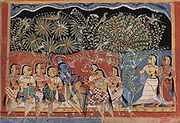
The Gita Govinda is a work composed by the 12th-century poet, Jayadeva, who was born in Kenduli Sasan near Puri in Orissa. It describes the relationship between Krishna and the gopis of Vrindavana, and in particular one gopi named Radha...
is the best known composition of Jayadeva. It is a lyrical poetry that is organized into twelve chapters. Each chapter is further sub-divided into twenty four divisions called Prabandhas. The prabandhas contain couplets grouped into eights, called Ashtapadas.
The first English translation of the Gita Govinda was published by Sir William Jones
William Jones (philologist)
Sir William Jones was an English philologist and scholar of ancient India, particularly known for his proposition of the existence of a relationship among Indo-European languages...
in 1792, where Kalinga (ancient Orissa) is referred to as the origin of the text. Since then, the Gita Govinda has been translated to many languages throughout the world, and is considered to be among the finest examples of Sanskrit poetry.
See also
- Gita GovindaGita GovindaThe Gita Govinda is a work composed by the 12th-century poet, Jayadeva, who was born in Kenduli Sasan near Puri in Orissa. It describes the relationship between Krishna and the gopis of Vrindavana, and in particular one gopi named Radha...
- Sanskrit literatureSanskrit literatureLiterature in Sanskrit begins with the Vedas, and continues with the Sanskrit Epics of Iron Age India; the golden age of Classical Sanskrit literature dates to late Antiquity . Literary production saw a late bloom in the 11th century before declining after 1100 AD...
- Kenduli SasanKenduli SasanKenduli Sasan in Khurda district is the birth place of the Sanskrit lyricist, Jayadeva. Medieval Indian literature refer to this place by the name Kenduvilva.-Location:...
- Jayadeva birth controversyJayadeva birth controversyUntil recently, the origins of the great twelfth century poet Jayadeva had been somewhat obscure, with the two neighboring states of Orissa and Bengal in Eastern India staking a claim to Jayadeva's origins...
- Jayadeva in SikhismJayadeva in SikhismBhagat Jaidev whose 2 hymns are found in the Guru Granth Sahib is the celebrated Sanskrit poet who wrote the "Gitgovind". His father was Bhoidev, a Hindu Brahmin, and his mother Bamdevi. He was born at Kenduli Sasan, a village near Puri in Orissa....
- Bhakta JayadevaBhakta JayadevaBhakta Jayadeva is a 1961 Telugu film based on the life of 12th Century Sanskrit Poet Jayadeva from Orissa...
, 1938 and 1961 Telugu language films