


Sulforaphane

Encyclopedia
Sulforaphane is an organosulfur compound that exhibits anticancer
, antidiabetic, and antimicrobial
properties in experimental models. It is obtained from cruciferous vegetables
such as broccoli
, Brussels sprout
s or cabbage
s. The enzyme
myrosinase
transforms glucoraphanin
, a glucosinolate
, into sulforaphane upon damage to the plant (such as from chewing). Young sprouts
of broccoli and cauliflower
are particularly rich in glucoraphanin.
, cauliflower
, bok choy, kale
, collards, Chinese broccoli, broccoli raab, kohlrabi, mustard
, turnip
, radish
, arugula, and watercress
.
growth, with sulforaphane being at least one of the active agents.
Sulforaphane and dietary consumption of cruciferous vegetables are known to affect the action of drug-metabolizing enzymes in vitro
and in preliminary human studies. Although no side effects or direct drug interactions have been reported as of 2008, people taking prescription drugs are advised to consult a doctor before taking sulforaphane or broccoli-sprout extracts.
The possible anticancer activity of sulforaphane may be related to the induction
of phase-II enzymes of xenobiotic
transformation (such as quinone reductase and glutathione S-transferase
), and enhancing the transcription of tumor suppressor proteins, possibly via inhibitory effects on histone deacetylase.
Sulforaphane and diindolylmethane (another compound from Brassica vegetables) inhibit cancer growth in vitro and in experimental animals. Sulforaphane downregulated the Wnt
/beta-catenin
self-renewal pathway in breast cancer
stem cell
s.
When applied topically, sulforaphane may protect skin against UV radiation damage, and thus potentially against cancer
. Sulforaphane may inhibit histone deacetylase
(HDAC) activity.
Preliminary experiments indicate sulforaphane may protect the heart from vascular inflammation and atherosclerosis.
.
Cancer
Cancer , known medically as a malignant neoplasm, is a large group of different diseases, all involving unregulated cell growth. In cancer, cells divide and grow uncontrollably, forming malignant tumors, and invade nearby parts of the body. The cancer may also spread to more distant parts of the...
, antidiabetic, and antimicrobial
Antimicrobial
An anti-microbial is a substance that kills or inhibits the growth of microorganisms such as bacteria, fungi, or protozoans. Antimicrobial drugs either kill microbes or prevent the growth of microbes...
properties in experimental models. It is obtained from cruciferous vegetables
Cruciferous vegetables
Vegetables of the family Brassicaceae are called cruciferous vegetables. The vegetables are widely cultivated, with many genera, species, and cultivars being raised for food production such as cauliflower, cabbage, cress, bok choy, broccoli and similar green leaf vegetables...
such as broccoli
Broccoli
Broccoli is a plant in the cabbage family, whose large flower head is used as a vegetable.-General:The word broccoli, from the Italian plural of , refers to "the flowering top of a cabbage"....
, Brussels sprout
Brussels sprout
The Brussels sprout is a cultivar of wild cabbage grown for its edible buds. The leafy green vegetables are typically 2.5–4 cm in diameter and look like miniature cabbages. The sprout is Brassica oleracea, in the "gemmifera" group of the family Brassicaceae...
s or cabbage
Cabbage
Cabbage is a popular cultivar of the species Brassica oleracea Linne of the Family Brassicaceae and is a leafy green vegetable...
s. The enzyme
Enzyme
Enzymes are proteins that catalyze chemical reactions. In enzymatic reactions, the molecules at the beginning of the process, called substrates, are converted into different molecules, called products. Almost all chemical reactions in a biological cell need enzymes in order to occur at rates...
myrosinase
Myrosinase
Myrosinase is a family of enzymes involved in plant defense against herbivores. Their structure has been elucidated and is available.-Myrosinase activity:...
transforms glucoraphanin
Glucoraphanin
Glucoraphanin is a glucosinolate found in broccoli and cauliflower, particularly in the young sprouts. When these foods are consumed, the enzyme myrosinase transforms glucoraphanin into sulforaphane which has potential health benefits....
, a glucosinolate
Glucosinolate
The glucosinolates are a class of organic compounds that contain sulfur and nitrogen and are derived from glucose and an amino acid. They occur as secondary metabolites of almost all plants of the order Brassicales , but also in the genus Drypetes .-Chemistry:Glucosinolates are water-soluble...
, into sulforaphane upon damage to the plant (such as from chewing). Young sprouts
Sprouts
Sprouts may refer to:*Sprouting, the practice of germinating seeds, often for food purposes**Brussels sprouts, the most common meaning of the term in the United Kingdom**The sprouts of the mung bean, the most common meaning in the United States...
of broccoli and cauliflower
Cauliflower
Cauliflower is one of several vegetables in the species Brassica oleracea, in the family Brassicaceae. It is an annual plant that reproduces by seed...
are particularly rich in glucoraphanin.
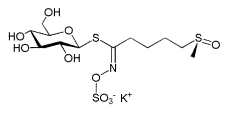 glucoraphanin |
Occurrence and isolation
Sulforaphane was identified in broccoli sprouts, which, of the cruciferous vegetables, have the highest concentration of sulforaphane. It is also found in Brussels sprouts, cabbageCabbage
Cabbage is a popular cultivar of the species Brassica oleracea Linne of the Family Brassicaceae and is a leafy green vegetable...
, cauliflower
Cauliflower
Cauliflower is one of several vegetables in the species Brassica oleracea, in the family Brassicaceae. It is an annual plant that reproduces by seed...
, bok choy, kale
Kale
Kale is very high in beta carotene, vitamin K, vitamin C, lutein, zeaxanthin, and reasonably rich in calcium. Kale, as with broccoli and other brassicas, contains sulforaphane , a chemical with potent anti-cancer properties. Boiling decreases the level of sulforaphane; however, steaming,...
, collards, Chinese broccoli, broccoli raab, kohlrabi, mustard
Mustard plant
Mustards are several plant species in the genera Brassica and Sinapis whose small mustard seeds are used as a spice and, by grinding and mixing them with water, vinegar or other liquids, are turned into the condiment known as mustard or prepared mustard...
, turnip
Turnip
The turnip or white turnip is a root vegetable commonly grown in temperate climates worldwide for its white, bulbous taproot. Small, tender varieties are grown for human consumption, while larger varieties are grown as feed for livestock...
, radish
Radish
The radish is an edible root vegetable of the Brassicaceae family that was domesticated in Europe, in pre-Roman times. They are grown and consumed throughout the world. Radishes have numerous varieties, varying in size, color and duration of required cultivation time...
, arugula, and watercress
Watercress
Watercresses are fast-growing, aquatic or semi-aquatic, perennial plants native from Europe to central Asia, and one of the oldest known leaf vegetables consumed by human beings...
.
Possible medicinal properties
Consumption of broccoli sprouts has shown to be potentially effective at inhibiting Helicobacter pyloriHelicobacter pylori
Helicobacter pylori , previously named Campylobacter pyloridis, is a Gram-negative, microaerophilic bacterium found in the stomach. It was identified in 1982 by Barry Marshall and Robin Warren, who found that it was present in patients with chronic gastritis and gastric ulcers, conditions that were...
growth, with sulforaphane being at least one of the active agents.
Sulforaphane and dietary consumption of cruciferous vegetables are known to affect the action of drug-metabolizing enzymes in vitro
In vitro
In vitro refers to studies in experimental biology that are conducted using components of an organism that have been isolated from their usual biological context in order to permit a more detailed or more convenient analysis than can be done with whole organisms. Colloquially, these experiments...
and in preliminary human studies. Although no side effects or direct drug interactions have been reported as of 2008, people taking prescription drugs are advised to consult a doctor before taking sulforaphane or broccoli-sprout extracts.
The possible anticancer activity of sulforaphane may be related to the induction
Enzyme induction and inhibition
Enzyme induction is a process in which a molecule induces the expression of an enzyme.Enzyme inhibition can refer to* the inhibition of the expression of the enzyme by another molecule...
of phase-II enzymes of xenobiotic
Xenobiotic
A xenobiotic is a chemical which is found in an organism but which is not normally produced or expected to be present in it. It can also cover substances which are present in much higher concentrations than are usual...
transformation (such as quinone reductase and glutathione S-transferase
Glutathione S-transferase
Enzymes of the glutathione S-transferase family are composed of many cytosolic, mitochondrial, and microsomal proteins. GSTs are present in eukaryotes and in prokaryotes, where they catalyze a variety of reactions and accept endogenous and xenobiotic substrates.GSTs can constitute up to 10% of...
), and enhancing the transcription of tumor suppressor proteins, possibly via inhibitory effects on histone deacetylase.
Sulforaphane and diindolylmethane (another compound from Brassica vegetables) inhibit cancer growth in vitro and in experimental animals. Sulforaphane downregulated the Wnt
WNT
WNT is a three-letter abbreviation with multiple meanings, as described below:*Windows NT*WNT *Wnt signaling pathway, a complex protein network...
/beta-catenin
Beta-catenin
Beta-catenin is a protein that in humans is encoded by the CTNNB1 gene. In Drosophila, the homologous protein is called armadillo...
self-renewal pathway in breast cancer
Breast cancer
Breast cancer is cancer originating from breast tissue, most commonly from the inner lining of milk ducts or the lobules that supply the ducts with milk. Cancers originating from ducts are known as ductal carcinomas; those originating from lobules are known as lobular carcinomas...
stem cell
Stem cell
This article is about the cell type. For the medical therapy, see Stem Cell TreatmentsStem cells are biological cells found in all multicellular organisms, that can divide and differentiate into diverse specialized cell types and can self-renew to produce more stem cells...
s.
When applied topically, sulforaphane may protect skin against UV radiation damage, and thus potentially against cancer
Skin cancer
Skin neoplasms are skin growths with differing causes and varying degrees of malignancy. The three most common malignant skin cancers are basal cell cancer, squamous cell cancer, and melanoma, each of which is named after the type of skin cell from which it arises...
. Sulforaphane may inhibit histone deacetylase
Histone deacetylase
Histone deacetylases are a class of enzymes that remove acetyl groups from an ε-N-acetyl lysine amino acid on a histone. This is important because DNA is wrapped around histones, and DNA expression is regulated by acetylation and de-acetylation. Its action is opposite to that of histone...
(HDAC) activity.
Preliminary experiments indicate sulforaphane may protect the heart from vascular inflammation and atherosclerosis.
Clinical trials
Sulforaphane is in numerous clinical trials including a phase II trial for prostate cancerProstate cancer
Prostate cancer is a form of cancer that develops in the prostate, a gland in the male reproductive system. Most prostate cancers are slow growing; however, there are cases of aggressive prostate cancers. The cancer cells may metastasize from the prostate to other parts of the body, particularly...
.