

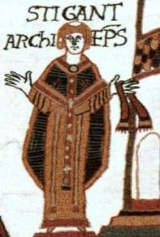
Stigand

Encyclopedia
Stigand was an English
churchman in pre-Norman Conquest
England. Although his birthdate is unknown, by 1020, he was serving as a royal chaplain and advisor. He was named Bishop of Elmham in 1043, and then later Bishop of Winchester
and Archbishop of Canterbury
. Stigand acted as an advisor to several members of the Anglo-Saxon
and Norman
English royal dynasties, serving six successive kings. Excommunicated
by several popes for his pluralism in holding the two sees
, or bishoprics, of Winchester and Canterbury concurrently, he was finally deposed in 1070, and his estates and personal wealth were confiscated by William the Conqueror
. Stigand was imprisoned at Winchester
, where he died without regaining his liberty.
Stigand served King Cnut as a chaplain at a royal foundation at Ashingdon
in 1020, and as an advisor then and later. He continued in his role of advisor during the reigns of Cnut's sons, Harold Harefoot
and Harthacnut. When Cnut's stepson Edward the Confessor
succeeded Harthacnut, Stigand likely became England's main administrator. Monastic writers of the time accused Stigand of extorting money and lands from the church, and by 1066, the only estates richer than Stigand's were the royal estates and those of Harold Godwinson
.
In 1043 Edward appointed Stigand to the see of Elmham. Four years later, in 1047, he was appointed to the see of Winchester
and then in 1052 to the archdiocese of Canterbury
, which Stigand held jointly with that of Winchester. Five successive popes, including Nicholas II
and Alexander II
, excommunicated Stigand for holding both Winchester and Canterbury. Stigand was present at the deathbed of King Edward and at the coronation of Harold Godwinson as king of England in 1066. After Harold's death, Stigand submitted to William the Conqueror. On Christmas Day, 1066 Ealdred, the Archbishop of York
crowned William King of England. Stigand's excommunication meant that he could only assist at the coronation.
Despite growing pressure for his deposition, Stigand continued to attend the royal court and to consecrate bishops, until in 1070 he was deposed by papal legates and imprisoned at Winchester. His intransigence towards the papacy was used as propaganda by Norman advocates of the view that the English church was backward and needed reform.
, possibly in Norwich
, to a family that appears to have been prosperous. The family was of mixed English and Scandinavian ancestry, as is shown by the fact that Stigand's name was Norse but his brother's was English. His brother Æthelmær, also a cleric, later succeeded Stigand as bishop of Elmham. His sister held land in Norwich, but her given name is unrecorded.
Stigand first appears in the historical record in 1020 as a royal chaplain to King Cnut of England (reigned 1016–1035). In that year he was appointed to Cnut's church at Ashingdon, or Assandun, which was dedicated by the reforming bishop Wulfstan of York. Little is known of Stigand's life during Cnut's reign. He did witness occasional charters, which show that he had a place at the royal court. After Cnut's death, Stigand successively served Cnut's sons, Harold Harefoot (reigned 1035–1040) and Harthacnut (reigned 1040–1042). When Harthacnut died, Stigand became an advisor to Emma of Normandy
, Cnut's widow and the mother of Harthacnut and his successor Edward the Confessor. He may have been her chaplain. It is possible that Stigand was already an advisor to Emma while Cnut was alive, and that he owed his position at Ashingdon to Emma's influence and favour. Because little is known of Stigand's activities before his appointment as a bishop, it is difficult to determine to whom he owed his position.
, a rival claimant to the English throne, to invade England and had offered her personal wealth to aid Magnus. Some suspected that Stigand had urged Emma to support Magnus, and claimed that his deposition was because of this. Contributing factors in Emma and Stigand's fall included Emma's wealth, and dislike of her political influence, which was linked to the reign of the unpopular Harthacnut.
By 1046, Stigand began to witness charters of Edward the Confessor, showing that he was once more in royal favour. In 1047 Stigand was translated to the see of Winchester
, but he retained Elmham until 1052. He may have owed the promotion to Earl Godwin of Wessex
, the father-in-law of King Edward; although some historians dispute this. Emma, who had retired to Winchester after regaining Edward's favour, may also have influenced the appointment, either alone or in concert with Godwin. After his appointment to Winchester, Stigand was a witness to all of the surviving charters of King Edward from the period 1047 to 1052.
Some historians, such as Frank Barlow
and Emma Mason, state that he supported Earl Godwin in his quarrel with Edward the Confessor in 1051–1052; others, including Ian Walker, hold that he was neutral. Stigand, whether or not he was a supporter of Godwin's, did not go into exile with the earl. The quarrel started over a fight between Eustace of Boulogne
, brother-in-law of the king, and men of the town of Dover. The king ordered Godwin to punish the town, and the earl refused. Continued pressure from Edward undermined Godwin's position, and the earl and his family fled England in 1051. The earl returned in 1052 with a substantial armed force, but eventually reached a peaceful accord with the king. Some medieval sources state that Stigand took part in the negotiations that reached a peace between the king and his earl, and the Canterbury manuscript of the Anglo-Saxon Chronicle
calls Stigand the king's chaplain and advisor during the negotiations.
was beginning a reform movement later known as the Gregorian Reform
. Leo first focused on improving the clergy and prohibiting simony
– the buying and selling of clerical and ecclesiastical offices. In 1049 Leo IX publicly pronounced that he would take more interest in English church matters and would investigate episcopal candidates more strictly before confirming them. When Archbishop Edsige
of Canterbury died in 1051 the monks of the cathedral chapter elected Æthelric, a relative of Earl Godwin's, as archbishop. King Edward opposed the election and instead appointed Robert of Jumièges
, who was Norman and already Bishop of London
. Besides furthering Edward's quarrel with Godwin, the appointment signalled that there were limits to Edward's willingness to compromise on ecclesiastical reform.
Although not known as a reformer before his appointment, Robert returned from Rome in 1051, where he had gone to be confirmed by the papacy, and opposed the king's choice for Bishop of London on the grounds that the candidate was not suitable. Robert's attempts to recover church property that had been appropriated by Earl Godwin contributed to the quarrel between the earl and the king. When Godwin returned to England in 1052, Robert was outlawed and exiled. King Edward then appointed Stigand to the archbishopric. The appointment was either a reward from Godwin for Stigand's support during the conflict with Edward or a reward from King Edward for successfully negotiating a peaceful conclusion to the crisis in 1052. Stigand was the first non-monk to be named to either English archbishopric since before the days of Dunstan
(archbishop from 959 to 988).
 The papacy refused to recognise Stigand's elevation, as Robert was still alive and had not been deprived of office by a pope. Robert of Jumièges appealed to Leo IX, who summoned Stigand to Rome. When Stigand did not appear, he was excommunicated. Historian Nicholas Brooks holds the view that Stigand was not excommunicated at this time, but rather was ordered to refrain from any archiepiscopal functions, such as the consecration of bishops. He argues that in 1062 papal legates sat in council with Stigand, something they would not have done had he been excommunicated. The legates did nothing to alter Stigand's position either, although one of the legates later helped depose Stigand in 1070. However Pope Leo IX and his successors, Victor II
and Stephen IX
, continued to regard Stigand as uncanonically elected.
Stigand did not travel to Rome to receive a pallium
, the band worn around a neck that is the symbol of an archbishop's authority, from the pope. Traveling to Rome for the pallium had become a custom, practiced by a number of his predecessors. Instead, some medieval chroniclers state that he used Robert of Jumièges' pallium. It is not known if Stigand even petitioned the papacy for a pallium soon after his appointment. Due to the reform movement, Stigand probably knew the request would be unsuccessful. In 1058, Antipope Benedict X
, who opposed much of the reform movement, gave Stigand a pallium. However, Benedict was deposed in the following year; the reforming party declared Benedict an anti-pope
, and nullified all his acts, including Stigand's pallium grant. The exact circumstances that led to Benedict granting a pallium are unknown, whether it was at Stigand's request or was given without prompting.
After his translation to Canterbury, Stigand released Elmham to his brother Æthelmær, but retained the bishopric of Winchester. Canterbury and Winchester were the two richest sees in England, and while precedent allowed the holding of a rich see along with a poor one, holding two rich sees in conjunction had no such rationale. He may have retained Winchester because of avarice, or it may have been that his hold in Canterbury was not secure. Besides these, he held the abbey of Gloucester
and the abbey of Ely
and perhaps other abbeys also. Whatever his reasons, the retention of Winchester made Stigand a pluralist
, or the holder of more than one benefice
at the same time. This was a practice that was targeted for elimination by the growing reform movement in the church. Five successive popes (Leo IX, Victor II, Stephen IX, Nicholas II and Alexander II) excommunicated Stigand for holding both Winchester and Canterbury at the same time. It has been suggested by the historian Emma Mason that Edward refused to remove Stigand because this would have undermined the royal prerogative to appoint bishops and archbishops without papal input. Further hurting Stigand's position, Pope Nicholas II in 1061 declared pluralism to be uncanonical unless approved by the pope.
Stigand was later accused of simony by monastic chroniclers, but all such accusations date to after 1066, and are thus suspect due to the post-Conquest desire to vilify the English Church as corrupt and backward. The medieval chronicler William of Poitiers
also claimed that Stigand in 1052 agreed that William of Normandy, the future William the Conqueror, should succeed King Edward. This fact was used as propaganda after the Conquest, but the historian David Bates
, among other historians, notes that this is unlikely to have happened. The position of Stigand as head of the church in England was used to good effect by the Normans in their propaganda before, during and after the Conquest.
took advantage of Stigand's difficulties with the papacy and encroached on the suffragans, or bishops owing obedience to an archbishop, normally subject to Canterbury. York had long been held in common with Worcester
, but during the period when Stigand was excommunicated, the see of York also claimed oversight over the sees of Lichfield
and Dorchester
. In 1062, however, papal legate
s of Alexander II came to England. They did not depose Stigand, and even consulted with him and treated him as archbishop. He was allowed to attend the council they held and was an active participant with the legates in the business of the council.
Many of the bishops in England did not want to be consecrated by Stigand. Both Giso of Wells and Walter of Hereford
travelled to Rome to be consecrated by the pope in 1061, rather than be consecrated by Stigand. During the brief period that he held a legitimate pallium, however, Stigand did consecrate Aethelric of Selsey
and Siward of Rochester
.
Abbots of monasteries, however, came to Stigand for consecration throughout his time as archbishop. These included not only abbots from monastic houses inside his province, such as Æthelsige
as abbot of St Augustine's Abbey
in Canterbury, but also Baldwin as Abbot of Bury St. Edmunds
and Thurstan as Abbot of Ely. After the Norman Conquest, Stigand was accused of selling the office of abbot, but no abbot was deposed for buying the office, so the charge is suspect.
Stigand was probably the most lavish clerical donor of his period, when the great of the land gave to churches on an unprecedented scale. He served as a benefactor to the Abbey of Ely, and gave large gold or silver crucifixes to Ely, St Augustine's Abbey in Canterbury, Bury St. Edmunds Abbey
, and to his cathedral church
at Winchester. The ones given to Ely, Bury and Winchester all appear to have had about life-size figures of Christ with matching figures of the Virgin and John the Evangelist
, as is recorded in the monastic histories, and were probably permanently mounted over the altar or elsewhere. These would have been made with thin sheets of precious metal over a wooden core. No comparably early rood
crosses with the side figures of Mary and John seem to survive, though we have large painted wooden crucifixes like the German Gero Cross of ca. 980, and the Volto Santo of Lucca (renewed with a later figure), which is known to have inspired Leofstan, Abbot of Bury (d. 1065) to create a similar figure, perhaps covered in precious metal, on his return from a visit to Rome. To Ely he gave gold and silver vessels for the altar, and a chasuble
embroidered in gold "of such inestimable workmanship and worth, that none in the kingdom is considered richer or more valuable". Although it does not appear that Stigand ever traveled to Rome, there are indications that Stigand did go on pilgrimage. A 12th-century life of Saint Willibrord
, written at the Abbey of Echternach
in what is now Luxembourg
, records that "to this place also came Stigand, the eminent archbishop of the English". In the work, Stigand is recorded as giving rich gifts to the abbey as well as relics of saints.
, come to an annual income of about 2500 pounds. There is little evidence, however, that he enriched either Canterbury or Winchester. He also appointed his followers to sees within his diocese in 1058, having Siward named Bishop of Rochester
and Æthelric installed as Bishop of Selsey
. Between his holding of two sees and the appointment of his men to other sees in the southeast of England, Stigand was an important figure in defending the coastline against invasion.
Stigand may have been in charge of the royal administration. He may also have been behind the effort to locate Edward the Atheling
and his brother Edmund after 1052, possibly to secure a more acceptable heir to King Edward. His landholdings were spread across ten counties, and in some of those counties, his lands were larger than the king's holdings. Although Norman propagandists claimed that as early as 1051 or 1052 King Edward promised the throne of England to Duke William of Normandy
, who later became King William the Conqueror, there is little contemporary evidence of such a promise from non-Norman sources. By 1053, Edward probably realized that he would not have a son from his marriage, and he and his advisors began to search for an heir. Edward the Atheling was the son of King Edmund Ironside
, (reigned 1016), and Edward had been exiled from England in 1017, after his father's death. Although Ealdred, the Bishop of Worcester actually went to the Continent in search of Edward, Ian Walker, the biographer of King Harold Godwinson, feels that Stigand was behind the effort. In the end, although Edward did return to England, he died soon after his return, leaving a young son Edgar the Ætheling.
 King Edward, on his deathbed, left the crown to his brother-in-law Harold Godwinson, the son of Earl Godwin. Stigand performed the funeral services for Edward. Norman writers claimed that Stigand crowned Harold as king in January 1066. This is generally considered propaganda, and not true, as it was in William's interest to portray Harold as uncanonically crowned. If Harold was not properly crowned, then William was merely claiming his rightful inheritance, and not deposing a rightful king. The Bayeux Tapestry
depicts Stigand at Harold's coronation, although not actually placing the crown on Harold's head. The English sources claim that Ealdred, the Archbishop of York, crowned Harold, while the Norman sources claim that Stigand did so, with the conflict between the various sources probably tracing to the post-Conquest desire to vilify Harold and depict his coronation as improper. Current historical research has shown that this ceremony was performed by Ealdred, due to the controversy about Stigand's position. However, one historian, Pauline Stafford
, theorizes that both archbishops may have consecrated Harold. Another historian, Frank Barlow, writing in 1979, felt that the fact that some of the English sources do not name who consecrated Harold "tip(s) the balance in favour of Stigand".
Stigand did support Harold, and was present at Edward the Confessor's deathbed. Stigand's controversial position may have influenced Pope Alexander II's support of William the Conqueror's invasion of England. The reformers, led by Archdeacon Hildebrand, later Pope Gregory VII
, opposed the older type of bishop, rich and installed by the lay powers.
After the death of Harold at the Battle of Hastings
, Stigand worked with Earl Edwin
and Earl Morcar
, as well as Archbishop Ealdred of York, to put Edgar the Ætheling on the throne. This plan did not come to fruition, however, due to opposition from the northern earls and some of the other bishops. Stigand submitted to William the Conqueror at Wallingford in early December 1066, and assisted at his coronation on Christmas Day, 1066, although the actual coronation was performed by Ealdred. William took Stigand with him to Normandy
in 1067, although whether this was because William did not trust the archbishop, as the medieval chronicler William of Poitiers alleges, is not certain. Stigand was present at the coronation of William's queen, Matilda
in 1068, although once more the ceremony was actually performed by Ealdred.
, Abbot of Evesham
. Archbishop Stigand appears on a number of royal charters in 1069, along with both Norman and English leaders. He even consecrated Remigius de Fécamp
as Bishop of Dorcester in 1067. Once the danger of rebellion was past, however, William had no further need of Stigand. At a council held at Winchester at Easter 1070, the bishops met with papal legates from Alexander II. On 11 April 1070 Stigand was deposed by the papal legate, Ermenfrid, Bishop of Sion in the Alps, and was imprisoned at Winchester. His brother Æthelmær, Bishop of Elmham, was also deposed at the same council. Shortly afterwards Aethelric the Bishop of Selsey, Ethelwin
the Bishop of Durham and Leofwin
Bishop of Lichfield, who was married, were deposed at a council held at Windsor. There were three reasons given for Stigand's deposition: that he held the bishopric of Winchester in plurality with Canterbury; that he not only occupied Canterbury after Robert of Jumièges fled but also seized Robert's pallium which was left behind; and that he received his own pallium from Benedict X, an anti-pope. Some accounts state that Stigand did appear at the council which deposed him, but nothing is recorded of any defence that he attempted. The charges against his brother are nowhere stated, leading to a belief that the depositions were mainly political. That spring he had deposited his personal wealth at Ely Abbey for safekeeping, but King William confiscated it after his deposition, along with his estates. The king appointed Lanfranc
, a native of Italy and a scholar and abbot in Normandy, as the new archbishop.
King William appears to have left the initiative for Stigand's deposition to the papacy, and did nothing to hinder Stigand's authority until the papal legates arrived in England to depose the archbishop and reform the English Church. Besides witnessing charters and consecrating Remigius, Stigand appears to have been a member of the royal council, and able to move freely about the country. But after the arrival of the legates, William did nothing to protect Stigand from deposition, and the archbishop later accused the king of acting with bad faith. Stigand may even have been surprised that the legates wished him deposed. It was probably the death of Ealdred in 1069 that moved the pope to send the legates, as that left only one archbishop in England; and he was not considered legitimate and unable to consecrate bishops. The historian George Garnett draws the parallel between the treatment of King Harold in Domesday Book, where he is essentially ignored as king, and Stigand's treatment after his deposition, where his time as archbishop is as much as possible treated as not occurring.
Stigand died in 1072 while still imprisoned, and his death was commemorated on 21 February or 22 February. Sometime between his deposition and his death the widow of King Edward and sister of King Harold, Edith of Wessex
, visited him in his imprisonment and allegedly told him to take better care of himself. He was buried in the Old Minster
at Westminster.
At King Edward's death, only the royal estates and the estates of Harold were larger and wealthier than those held by Stigand. Medieval writers condemned him for his greed and for his pluralism. Hugh the Chanter, a medieval chronicler, claimed that the confiscated wealth of Stigand helped keep King William on the throne. A recent study of his wealth and how it was earned, shows that while he did engage in some exploitative methods to gain some of his wealth, other lands were gained through inheritance or through royal favour. The same study shows little evidence that he despoiled his episcopal estates, although the record towards monastic houses is more suspect. There is no complaint in contemporary records about his private life, and the accusations that he committed simony and was illiterate only date from the 12th century.
Although monastic chroniclers after the Norman Conquest accused him of crimes such as perjury and homicide, they do not provide any evidence of those crimes. Modern historians views tend to see him as either a wily politician and indifferent bishop, or to see him purely in terms of his ecclesiastical failings. The historian Frank Stenton
felt that his "whole career shows that he was essentially a politician". Concurring with this, the historian Nick Higham said that "Stigand was a seasoned politician whose career had been built on an accurate reading of the balance of power." Another historian, Eric John, said that "Stigand had a fair claim to be the worst bishop of Christendom". However, the historian Frank Barlow felt that "he was a man of cultured tastes, a patron of the arts who was generous to the monasteries which he held".
Anglo-Saxons
Anglo-Saxon is a term used by historians to designate the Germanic tribes who invaded and settled the south and east of Great Britain beginning in the early 5th century AD, and the period from their creation of the English nation to the Norman conquest. The Anglo-Saxon Era denotes the period of...
churchman in pre-Norman Conquest
Norman conquest of England
The Norman conquest of England began on 28 September 1066 with the invasion of England by William, Duke of Normandy. William became known as William the Conqueror after his victory at the Battle of Hastings on 14 October 1066, defeating King Harold II of England...
England. Although his birthdate is unknown, by 1020, he was serving as a royal chaplain and advisor. He was named Bishop of Elmham in 1043, and then later Bishop of Winchester
Bishop of Winchester
The Bishop of Winchester is the head of the Church of England diocese of Winchester, with his cathedra at Winchester Cathedral in Hampshire.The bishop is one of five Church of England bishops to be among the Lords Spiritual regardless of their length of service. His diocese is one of the oldest and...
and Archbishop of Canterbury
Archbishop of Canterbury
The Archbishop of Canterbury is the senior bishop and principal leader of the Church of England, the symbolic head of the worldwide Anglican Communion, and the diocesan bishop of the Diocese of Canterbury. In his role as head of the Anglican Communion, the archbishop leads the third largest group...
. Stigand acted as an advisor to several members of the Anglo-Saxon
House of Wessex
The House of Wessex, also known as the House of Cerdic, refers to the family that ruled a kingdom in southwest England known as Wessex. This House was in power from the 6th century under Cerdic of Wessex to the unification of the Kingdoms of England....
and Norman
Norman dynasty
Norman dynasty is the usual designation for the family that were the Dukes of Normandy and the English monarchs which immediately followed the Norman conquest and lasted until the Plantagenet dynasty came to power in 1154. It included Rollo and his descendants, and from William the Conqueror and...
English royal dynasties, serving six successive kings. Excommunicated
Excommunication
Excommunication is a religious censure used to deprive, suspend or limit membership in a religious community. The word means putting [someone] out of communion. In some religions, excommunication includes spiritual condemnation of the member or group...
by several popes for his pluralism in holding the two sees
Episcopal See
An episcopal see is, in the original sense, the official seat of a bishop. This seat, which is also referred to as the bishop's cathedra, is placed in the bishop's principal church, which is therefore called the bishop's cathedral...
, or bishoprics, of Winchester and Canterbury concurrently, he was finally deposed in 1070, and his estates and personal wealth were confiscated by William the Conqueror
William I of England
William I , also known as William the Conqueror , was the first Norman King of England from Christmas 1066 until his death. He was also Duke of Normandy from 3 July 1035 until his death, under the name William II...
. Stigand was imprisoned at Winchester
Winchester
Winchester is a historic cathedral city and former capital city of England. It is the county town of Hampshire, in South East England. The city lies at the heart of the wider City of Winchester, a local government district, and is located at the western end of the South Downs, along the course of...
, where he died without regaining his liberty.
Stigand served King Cnut as a chaplain at a royal foundation at Ashingdon
Ashingdon
Ashingdon is a village and civil parish in Essex, England. It is located about north of Rochford and is southeast from the county town of Chelmsford...
in 1020, and as an advisor then and later. He continued in his role of advisor during the reigns of Cnut's sons, Harold Harefoot
Harold Harefoot
Harold Harefoot was King of England from 1037 to 1040. His cognomen "Harefoot" referred to his speed, and the skill of his huntsmanship. He was the son of Cnut the Great, king of England, Denmark, and Norway by Ælfgifu of Northampton...
and Harthacnut. When Cnut's stepson Edward the Confessor
Edward the Confessor
Edward the Confessor also known as St. Edward the Confessor , son of Æthelred the Unready and Emma of Normandy, was one of the last Anglo-Saxon kings of England and is usually regarded as the last king of the House of Wessex, ruling from 1042 to 1066....
succeeded Harthacnut, Stigand likely became England's main administrator. Monastic writers of the time accused Stigand of extorting money and lands from the church, and by 1066, the only estates richer than Stigand's were the royal estates and those of Harold Godwinson
Harold Godwinson
Harold Godwinson was the last Anglo-Saxon King of England.It could be argued that Edgar the Atheling, who was proclaimed as king by the witan but never crowned, was really the last Anglo-Saxon king...
.
In 1043 Edward appointed Stigand to the see of Elmham. Four years later, in 1047, he was appointed to the see of Winchester
Winchester
Winchester is a historic cathedral city and former capital city of England. It is the county town of Hampshire, in South East England. The city lies at the heart of the wider City of Winchester, a local government district, and is located at the western end of the South Downs, along the course of...
and then in 1052 to the archdiocese of Canterbury
Province of Canterbury
The Province of Canterbury, also called the Southern Province, is one of two ecclesiastical provinces making up the Church of England...
, which Stigand held jointly with that of Winchester. Five successive popes, including Nicholas II
Pope Nicholas II
Pope Nicholas II , born Gérard de Bourgogne, Pope from 1059 to July 1061, was at the time of his election the Bishop of Florence.-Antipope Benedict X:...
and Alexander II
Pope Alexander II
Pope Alexander II , born Anselmo da Baggio, was Pope from 1061 to 1073.He was born in Milan. As bishop of Lucca he had been an energetic coadjutor with Hildebrand of Sovana in endeavouring to suppress simony, and to enforce the celibacy of the clergy...
, excommunicated Stigand for holding both Winchester and Canterbury. Stigand was present at the deathbed of King Edward and at the coronation of Harold Godwinson as king of England in 1066. After Harold's death, Stigand submitted to William the Conqueror. On Christmas Day, 1066 Ealdred, the Archbishop of York
Archbishop of York
The Archbishop of York is a high-ranking cleric in the Church of England, second only to the Archbishop of Canterbury. He is the diocesan bishop of the Diocese of York and metropolitan of the Province of York, which covers the northern portion of England as well as the Isle of Man...
crowned William King of England. Stigand's excommunication meant that he could only assist at the coronation.
Despite growing pressure for his deposition, Stigand continued to attend the royal court and to consecrate bishops, until in 1070 he was deposed by papal legates and imprisoned at Winchester. His intransigence towards the papacy was used as propaganda by Norman advocates of the view that the English church was backward and needed reform.
Early life
Neither the year nor the date of Stigand's birth is known. He was born in East AngliaEast Anglia
East Anglia is a traditional name for a region of eastern England, named after an ancient Anglo-Saxon kingdom, the Kingdom of the East Angles. The Angles took their name from their homeland Angeln, in northern Germany. East Anglia initially consisted of Norfolk and Suffolk, but upon the marriage of...
, possibly in Norwich
Norwich
Norwich is a city in England. It is the regional administrative centre and county town of Norfolk. During the 11th century, Norwich was the largest city in England after London, and one of the most important places in the kingdom...
, to a family that appears to have been prosperous. The family was of mixed English and Scandinavian ancestry, as is shown by the fact that Stigand's name was Norse but his brother's was English. His brother Æthelmær, also a cleric, later succeeded Stigand as bishop of Elmham. His sister held land in Norwich, but her given name is unrecorded.
Stigand first appears in the historical record in 1020 as a royal chaplain to King Cnut of England (reigned 1016–1035). In that year he was appointed to Cnut's church at Ashingdon, or Assandun, which was dedicated by the reforming bishop Wulfstan of York. Little is known of Stigand's life during Cnut's reign. He did witness occasional charters, which show that he had a place at the royal court. After Cnut's death, Stigand successively served Cnut's sons, Harold Harefoot (reigned 1035–1040) and Harthacnut (reigned 1040–1042). When Harthacnut died, Stigand became an advisor to Emma of Normandy
Emma of Normandy
Emma , was a daughter of Richard the Fearless, Duke of Normandy, by his second wife Gunnora. She was Queen consort of England twice, by successive marriages: first as second wife to Æthelred the Unready of England ; and then second wife to Cnut the Great of Denmark...
, Cnut's widow and the mother of Harthacnut and his successor Edward the Confessor. He may have been her chaplain. It is possible that Stigand was already an advisor to Emma while Cnut was alive, and that he owed his position at Ashingdon to Emma's influence and favour. Because little is known of Stigand's activities before his appointment as a bishop, it is difficult to determine to whom he owed his position.
Bishop of Elmham and Winchester
Shortly after Edward the Confessor's coronation on 3 April 1043, Stigand was appointed to the see of Elmham, probably on Emma's advice. This was the first episcopal appointment of Edward's reign. The diocese of Elmham covered East Anglia, in eastern England, and was one of the poorer episcopal sees at that time. He was consecrated bishop in 1043, but later in the year Edward deposed Stigand and deprived him of his wealth. During the next year, however, Edward returned Stigand to office. The reasons for the deposition are unknown, but it was probably connected to the simultaneous fall from power of the dowager queen, Emma. Some sources state that Emma had invited King Magnus I of NorwayMagnus I of Norway
Magnus I , known as the Good or the Noble, was the King of Norway from 1035 to 1047 and the King of Denmark from 1042 to 1047. He was an illegitimate son of king Olaf II of Norway, but fled with his mother in 1028 when his father was dethroned. In 1035 he returned to Norway and was crowned king at...
, a rival claimant to the English throne, to invade England and had offered her personal wealth to aid Magnus. Some suspected that Stigand had urged Emma to support Magnus, and claimed that his deposition was because of this. Contributing factors in Emma and Stigand's fall included Emma's wealth, and dislike of her political influence, which was linked to the reign of the unpopular Harthacnut.
By 1046, Stigand began to witness charters of Edward the Confessor, showing that he was once more in royal favour. In 1047 Stigand was translated to the see of Winchester
Bishop of Winchester
The Bishop of Winchester is the head of the Church of England diocese of Winchester, with his cathedra at Winchester Cathedral in Hampshire.The bishop is one of five Church of England bishops to be among the Lords Spiritual regardless of their length of service. His diocese is one of the oldest and...
, but he retained Elmham until 1052. He may have owed the promotion to Earl Godwin of Wessex
Godwin, Earl of Wessex
Godwin of Wessex , was one of the most powerful lords in England under the Danish king Cnut the Great and his successors. Cnut made him the first Earl of Wessex...
, the father-in-law of King Edward; although some historians dispute this. Emma, who had retired to Winchester after regaining Edward's favour, may also have influenced the appointment, either alone or in concert with Godwin. After his appointment to Winchester, Stigand was a witness to all of the surviving charters of King Edward from the period 1047 to 1052.
Some historians, such as Frank Barlow
Frank Barlow (historian)
Frank Barlow CBE FBA FRSL was a British historian, known particularly for biographies of medieval figures.Barlow studied at St John's College, Oxford. He was Professor of History at the University of Exeter from 1953 until he retired in 1976 and became Emeritus Professor...
and Emma Mason, state that he supported Earl Godwin in his quarrel with Edward the Confessor in 1051–1052; others, including Ian Walker, hold that he was neutral. Stigand, whether or not he was a supporter of Godwin's, did not go into exile with the earl. The quarrel started over a fight between Eustace of Boulogne
Eustace II of Boulogne
Eustace II, , also known as Eustace aux Gernons was count of Boulogne from 1049–1087, fought on the Norman side at the Battle of Hastings, and afterwards received a large honour in England. He is one of the few proven Companions of William the Conqueror.He was the son of Eustace I...
, brother-in-law of the king, and men of the town of Dover. The king ordered Godwin to punish the town, and the earl refused. Continued pressure from Edward undermined Godwin's position, and the earl and his family fled England in 1051. The earl returned in 1052 with a substantial armed force, but eventually reached a peaceful accord with the king. Some medieval sources state that Stigand took part in the negotiations that reached a peace between the king and his earl, and the Canterbury manuscript of the Anglo-Saxon Chronicle
Anglo-Saxon Chronicle
The Anglo-Saxon Chronicle is a collection of annals in Old English chronicling the history of the Anglo-Saxons. The original manuscript of the Chronicle was created late in the 9th century, probably in Wessex, during the reign of Alfred the Great...
calls Stigand the king's chaplain and advisor during the negotiations.
Appointment to Canterbury and issues with the papacy
The Archbishopric of Canterbury became drawn into the conflict between Edward and Godwin. Pope Leo IXPope Leo IX
Pope Saint Leo IX , born Bruno of Eguisheim-Dagsburg, was Pope from February 12, 1049 to his death. He was a German aristocrat and as well as being Pope was a powerful secular ruler of central Italy. He is regarded as a saint by the Roman Catholic Church, with the feast day of April 19...
was beginning a reform movement later known as the Gregorian Reform
Gregorian Reform
The Gregorian Reforms were a series of reforms initiated by Pope Gregory VII and the circle he formed in the papal curia, circa 1050–80, which dealt with the moral integrity and independence of the clergy...
. Leo first focused on improving the clergy and prohibiting simony
Simony
Simony is the act of paying for sacraments and consequently for holy offices or for positions in the hierarchy of a church, named after Simon Magus , who appears in the Acts of the Apostles 8:9-24...
– the buying and selling of clerical and ecclesiastical offices. In 1049 Leo IX publicly pronounced that he would take more interest in English church matters and would investigate episcopal candidates more strictly before confirming them. When Archbishop Edsige
Edsige
Edsige, also Eadsige, Eadsimus, or Eadsin , was Archbishop of Canterbury, and crowned Edward the Confessor as king of England.-Biography:...
of Canterbury died in 1051 the monks of the cathedral chapter elected Æthelric, a relative of Earl Godwin's, as archbishop. King Edward opposed the election and instead appointed Robert of Jumièges
Robert of Jumièges
Robert of Jumièges was the first Norman Archbishop of Canterbury. He had previously served as prior of the Abbey of St Ouen at Rouen in France, before becoming abbot of Jumièges Abbey, near Rouen, in 1037...
, who was Norman and already Bishop of London
Bishop of London
The Bishop of London is the ordinary of the Church of England Diocese of London in the Province of Canterbury.The diocese covers 458 km² of 17 boroughs of Greater London north of the River Thames and a small part of the County of Surrey...
. Besides furthering Edward's quarrel with Godwin, the appointment signalled that there were limits to Edward's willingness to compromise on ecclesiastical reform.
Although not known as a reformer before his appointment, Robert returned from Rome in 1051, where he had gone to be confirmed by the papacy, and opposed the king's choice for Bishop of London on the grounds that the candidate was not suitable. Robert's attempts to recover church property that had been appropriated by Earl Godwin contributed to the quarrel between the earl and the king. When Godwin returned to England in 1052, Robert was outlawed and exiled. King Edward then appointed Stigand to the archbishopric. The appointment was either a reward from Godwin for Stigand's support during the conflict with Edward or a reward from King Edward for successfully negotiating a peaceful conclusion to the crisis in 1052. Stigand was the first non-monk to be named to either English archbishopric since before the days of Dunstan
Dunstan
Dunstan was an Abbot of Glastonbury Abbey, a Bishop of Worcester, a Bishop of London, and an Archbishop of Canterbury, later canonised as a saint. His work restored monastic life in England and reformed the English Church...
(archbishop from 959 to 988).
Pope Victor II
Pope Victor II , born Gebhard, Count of Calw, Tollenstein, and Hirschberg, was Pope from 1055 to 1057. He was one of a series of German reform Popes.-Life:...
and Stephen IX
Pope Stephen IX
Pope Stephen IX was Pope from August 3, 1057 to March 1058.His baptismal name was Frederick of Lorraine , and he was a younger brother of Godfrey III, Duke of Lower Lorraine, who, as Marquis of Tuscany , played a prominent part in the politics of the period.Frederick, who had...
, continued to regard Stigand as uncanonically elected.
Stigand did not travel to Rome to receive a pallium
Pallium
The pallium is an ecclesiastical vestment in the Roman Catholic Church, originally peculiar to the Pope, but for many centuries bestowed by him on metropolitans and primates as a symbol of the jurisdiction delegated to them by the Holy See. In that context it has always remained unambiguously...
, the band worn around a neck that is the symbol of an archbishop's authority, from the pope. Traveling to Rome for the pallium had become a custom, practiced by a number of his predecessors. Instead, some medieval chroniclers state that he used Robert of Jumièges' pallium. It is not known if Stigand even petitioned the papacy for a pallium soon after his appointment. Due to the reform movement, Stigand probably knew the request would be unsuccessful. In 1058, Antipope Benedict X
Antipope Benedict X
Pope/Antipope Benedict X , was born John Mincius, and later became Cardinal Bishop of Velletri. He was elected in 1058, his election having been arranged by the Count of Tusculum. However, a number of Cardinals alleged that the election was irregular, and that votes had been bought; these cardinals...
, who opposed much of the reform movement, gave Stigand a pallium. However, Benedict was deposed in the following year; the reforming party declared Benedict an anti-pope
Antipope
An antipope is a person who opposes a legitimately elected or sitting Pope and makes a significantly accepted competing claim to be the Pope, the Bishop of Rome and leader of the Roman Catholic Church. At times between the 3rd and mid-15th century, antipopes were typically those supported by a...
, and nullified all his acts, including Stigand's pallium grant. The exact circumstances that led to Benedict granting a pallium are unknown, whether it was at Stigand's request or was given without prompting.
After his translation to Canterbury, Stigand released Elmham to his brother Æthelmær, but retained the bishopric of Winchester. Canterbury and Winchester were the two richest sees in England, and while precedent allowed the holding of a rich see along with a poor one, holding two rich sees in conjunction had no such rationale. He may have retained Winchester because of avarice, or it may have been that his hold in Canterbury was not secure. Besides these, he held the abbey of Gloucester
Gloucester Cathedral
Gloucester Cathedral, or the Cathedral Church of St Peter and the Holy and Indivisible Trinity, in Gloucester, England, stands in the north of the city near the river. It originated in 678 or 679 with the foundation of an abbey dedicated to Saint Peter .-Foundations:The foundations of the present...
and the abbey of Ely
Ely Cathedral
Ely Cathedral is the principal church of the Diocese of Ely, in Cambridgeshire, England, and is the seat of the Bishop of Ely and a suffragan bishop, the Bishop of Huntingdon...
and perhaps other abbeys also. Whatever his reasons, the retention of Winchester made Stigand a pluralist
Benefice
A benefice is a reward received in exchange for services rendered and as a retainer for future services. The term is now almost obsolete.-Church of England:...
, or the holder of more than one benefice
Benefice
A benefice is a reward received in exchange for services rendered and as a retainer for future services. The term is now almost obsolete.-Church of England:...
at the same time. This was a practice that was targeted for elimination by the growing reform movement in the church. Five successive popes (Leo IX, Victor II, Stephen IX, Nicholas II and Alexander II) excommunicated Stigand for holding both Winchester and Canterbury at the same time. It has been suggested by the historian Emma Mason that Edward refused to remove Stigand because this would have undermined the royal prerogative to appoint bishops and archbishops without papal input. Further hurting Stigand's position, Pope Nicholas II in 1061 declared pluralism to be uncanonical unless approved by the pope.
Stigand was later accused of simony by monastic chroniclers, but all such accusations date to after 1066, and are thus suspect due to the post-Conquest desire to vilify the English Church as corrupt and backward. The medieval chronicler William of Poitiers
William of Poitiers
William of Poitiers was a Norman chronicler most famous for his eulogistic account of Duke William of Normandy , called the Gesta Guillelmi II ducis Normannorum.-Life:...
also claimed that Stigand in 1052 agreed that William of Normandy, the future William the Conqueror, should succeed King Edward. This fact was used as propaganda after the Conquest, but the historian David Bates
David Bates (historian)
Professor David Bates is a British historian.He was Professor of Medieval History at the University of Glasgow from 1994 until 2003. He then took up the post of director of the Institute of Historical Research at the University of London between 2003 and 2008, and now holds a chair in Medieval...
, among other historians, notes that this is unlikely to have happened. The position of Stigand as head of the church in England was used to good effect by the Normans in their propaganda before, during and after the Conquest.
Ecclesiastical affairs
The diocese of YorkArchbishop of York
The Archbishop of York is a high-ranking cleric in the Church of England, second only to the Archbishop of Canterbury. He is the diocesan bishop of the Diocese of York and metropolitan of the Province of York, which covers the northern portion of England as well as the Isle of Man...
took advantage of Stigand's difficulties with the papacy and encroached on the suffragans, or bishops owing obedience to an archbishop, normally subject to Canterbury. York had long been held in common with Worcester
Bishop of Worcester
The Bishop of Worcester is the Ordinary of the Church of England Diocese of Worcester in the Province of Canterbury, England. He is the head of the Diocese of Worcester in the Province of Canterbury...
, but during the period when Stigand was excommunicated, the see of York also claimed oversight over the sees of Lichfield
Bishop of Lichfield
The Bishop of Lichfield is the ordinary of the Church of England Diocese of Lichfield in the Province of Canterbury.The diocese covers 4,516 km² of the counties of Staffordshire, Shropshire, Warwickshire and West Midlands. The bishop's seat is located in the Cathedral Church of the Blessed...
and Dorchester
Bishop of Lincoln
The Bishop of Lincoln is the Ordinary of the Church of England Diocese of Lincoln in the Province of Canterbury.The present diocese covers the county of Lincolnshire and the unitary authority areas of North Lincolnshire and North East Lincolnshire. The Bishop's seat is located in the Cathedral...
. In 1062, however, papal legate
Papal legate
A papal legate – from the Latin, authentic Roman title Legatus – is a personal representative of the pope to foreign nations, or to some part of the Catholic Church. He is empowered on matters of Catholic Faith and for the settlement of ecclesiastical matters....
s of Alexander II came to England. They did not depose Stigand, and even consulted with him and treated him as archbishop. He was allowed to attend the council they held and was an active participant with the legates in the business of the council.
Many of the bishops in England did not want to be consecrated by Stigand. Both Giso of Wells and Walter of Hereford
Walter of Lorraine
Walter of Lorraine was a medieval Bishop of Hereford.-Life:Walter was a native of Lorraine, although some sources state he was a Norman. He was chaplain to Edith of Wessex, wife of Edward the Confessor sometime before his appointment as bishop. He was appointed to the see of Hereford about...
travelled to Rome to be consecrated by the pope in 1061, rather than be consecrated by Stigand. During the brief period that he held a legitimate pallium, however, Stigand did consecrate Aethelric of Selsey
Æthelric II
Æthelric was the second to last medieval Bishop of Selsey in England before the see was moved to Chichester. Consecrated a bishop in 1058, he was deposed in 1070 for unknown reasons and then imprisoned by King William I of England...
and Siward of Rochester
Siward, Bishop of Rochester
Siward was a medieval Bishop of Rochester.-Life:Siward was abbot of Chertsey Abbey, a Benedictine abbey in Surrey before he was selected for the see of Rochester. He was consecrated in 1058. He died in 1075. His death was commemorated on 30 October, so he probably died on that date in 1075...
.
Abbots of monasteries, however, came to Stigand for consecration throughout his time as archbishop. These included not only abbots from monastic houses inside his province, such as Æthelsige
Æthelsige
Æthelsige was an Abbot of Abingdon and succeeded Wulfgar in 1016 .He lived in the town today called Elswick, known then as "'Edelesuuic," literally "the farm of a man named Æthelsige." Before he died in 1018 he was principal in the treaty between Danes and English to observe the laws of Edgar...
as abbot of St Augustine's Abbey
St Augustine's Abbey
St Augustine's Abbey was a Benedictine abbey in Canterbury, Kent, England.-Early history:In 597 Saint Augustine arrived in England, having been sent by Pope Gregory I, on what might nowadays be called a revival mission. The King of Kent at this time was Æthelberht, who happened to be married to a...
in Canterbury, but also Baldwin as Abbot of Bury St. Edmunds
Abbot of Bury St. Edmunds
Abbot of Bury St. Edmunds was the title used by the head of the Benedictine monastery Bury St. Edmunds Abbey in the county of Suffolk, England. The following table lists the abbots from the foundation of the abbey in 1020 until 1216....
and Thurstan as Abbot of Ely. After the Norman Conquest, Stigand was accused of selling the office of abbot, but no abbot was deposed for buying the office, so the charge is suspect.
Stigand was probably the most lavish clerical donor of his period, when the great of the land gave to churches on an unprecedented scale. He served as a benefactor to the Abbey of Ely, and gave large gold or silver crucifixes to Ely, St Augustine's Abbey in Canterbury, Bury St. Edmunds Abbey
Bury St. Edmunds Abbey
The Abbey of Bury St Edmunds was once among the richest Benedictine monasteries in England. Its ruins lie in Bury St Edmunds, a town in the county of Suffolk, England.-History:...
, and to his cathedral church
Cathedral
A cathedral is a Christian church that contains the seat of a bishop...
at Winchester. The ones given to Ely, Bury and Winchester all appear to have had about life-size figures of Christ with matching figures of the Virgin and John the Evangelist
John the Evangelist
Saint John the Evangelist is the conventional name for the author of the Gospel of John...
, as is recorded in the monastic histories, and were probably permanently mounted over the altar or elsewhere. These would have been made with thin sheets of precious metal over a wooden core. No comparably early rood
Rood
A rood is a cross or crucifix, especially a large one in a church; a large sculpture or sometimes painting of the crucifixion of Jesus.Rood is an archaic word for pole, from Old English rōd "pole", specifically "cross", from Proto-Germanic *rodo, cognate to Old Saxon rōda, Old High German ruoda...
crosses with the side figures of Mary and John seem to survive, though we have large painted wooden crucifixes like the German Gero Cross of ca. 980, and the Volto Santo of Lucca (renewed with a later figure), which is known to have inspired Leofstan, Abbot of Bury (d. 1065) to create a similar figure, perhaps covered in precious metal, on his return from a visit to Rome. To Ely he gave gold and silver vessels for the altar, and a chasuble
Chasuble
The chasuble is the outermost liturgical vestment worn by clergy for the celebration of the Eucharist in Western-tradition Christian Churches that use full vestments, primarily in the Roman Catholic, Anglican and Lutheran churches, as well as in some parts of the United Methodist Church...
embroidered in gold "of such inestimable workmanship and worth, that none in the kingdom is considered richer or more valuable". Although it does not appear that Stigand ever traveled to Rome, there are indications that Stigand did go on pilgrimage. A 12th-century life of Saint Willibrord
Willibrord
__notoc__Willibrord was a Northumbrian missionary saint, known as the "Apostle to the Frisians" in the modern Netherlands...
, written at the Abbey of Echternach
Abbey of Echternach
The Abbey of Echternach is a Benedictine monastery in the town of Echternach, in eastern Luxembourg. The Abbey was founded by St Willibrord, the patron saint of Luxembourg, in the seventh century...
in what is now Luxembourg
Luxembourg
Luxembourg , officially the Grand Duchy of Luxembourg , is a landlocked country in western Europe, bordered by Belgium, France, and Germany. It has two principal regions: the Oesling in the North as part of the Ardennes massif, and the Gutland in the south...
, records that "to this place also came Stigand, the eminent archbishop of the English". In the work, Stigand is recorded as giving rich gifts to the abbey as well as relics of saints.
Advisor to the king
During Edward's reign, Stigand was an influential advisor at court and used his position to increase his own wealth as well as that of his friends and family. Contemporary valuations of the lands he controlled at the death of King Edward, as listed in Domesday BookDomesday Book
Domesday Book , now held at The National Archives, Kew, Richmond upon Thames in South West London, is the record of the great survey of much of England and parts of Wales completed in 1086...
, come to an annual income of about 2500 pounds. There is little evidence, however, that he enriched either Canterbury or Winchester. He also appointed his followers to sees within his diocese in 1058, having Siward named Bishop of Rochester
Bishop of Rochester
The Bishop of Rochester is the ordinary of the Church of England Diocese of Rochester in the Province of Canterbury.The diocese covers the west of the county of Kent and is centred in the city of Rochester where the bishop's seat is located at the Cathedral Church of Christ and the Blessed Virgin...
and Æthelric installed as Bishop of Selsey
Bishop of Chichester
The Bishop of Chichester is the Ordinary of the Church of England Diocese of Chichester in the Province of Canterbury. The diocese covers the Counties of East and West Sussex. The see is in the City of Chichester where the seat is located at the Cathedral Church of the Holy Trinity...
. Between his holding of two sees and the appointment of his men to other sees in the southeast of England, Stigand was an important figure in defending the coastline against invasion.
Stigand may have been in charge of the royal administration. He may also have been behind the effort to locate Edward the Atheling
Edward the Exile
Edward the Exile , also called Edward Ætheling, son of King Edmund Ironside and of Ealdgyth. After the Danish conquest of England in 1016 Canute had him and his brother, Edmund, exiled to the Continent...
and his brother Edmund after 1052, possibly to secure a more acceptable heir to King Edward. His landholdings were spread across ten counties, and in some of those counties, his lands were larger than the king's holdings. Although Norman propagandists claimed that as early as 1051 or 1052 King Edward promised the throne of England to Duke William of Normandy
William I of England
William I , also known as William the Conqueror , was the first Norman King of England from Christmas 1066 until his death. He was also Duke of Normandy from 3 July 1035 until his death, under the name William II...
, who later became King William the Conqueror, there is little contemporary evidence of such a promise from non-Norman sources. By 1053, Edward probably realized that he would not have a son from his marriage, and he and his advisors began to search for an heir. Edward the Atheling was the son of King Edmund Ironside
Edmund Ironside
Edmund Ironside or Edmund II was king of England from 23 April to 30 November 1016. His cognomen "Ironside" is not recorded until 1057, but may have been contemporary. According to the Anglo-Saxon Chronicle, it was given to him "because of his valour" in resisting the Danish invasion led by Cnut...
, (reigned 1016), and Edward had been exiled from England in 1017, after his father's death. Although Ealdred, the Bishop of Worcester actually went to the Continent in search of Edward, Ian Walker, the biographer of King Harold Godwinson, feels that Stigand was behind the effort. In the end, although Edward did return to England, he died soon after his return, leaving a young son Edgar the Ætheling.
Norman Conquest
Bayeux Tapestry
The Bayeux Tapestry is an embroidered cloth—not an actual tapestry—nearly long, which depicts the events leading up to the Norman conquest of England concerning William, Duke of Normandy and Harold, Earl of Wessex, later King of England, and culminating in the Battle of Hastings...
depicts Stigand at Harold's coronation, although not actually placing the crown on Harold's head. The English sources claim that Ealdred, the Archbishop of York, crowned Harold, while the Norman sources claim that Stigand did so, with the conflict between the various sources probably tracing to the post-Conquest desire to vilify Harold and depict his coronation as improper. Current historical research has shown that this ceremony was performed by Ealdred, due to the controversy about Stigand's position. However, one historian, Pauline Stafford
Pauline Stafford
Pauline Stafford is Professor Emerita of Early Medieval History at Liverpool University in England. Her work focuses on the history of women and gender in England from the eighth to the early twelfth centuries, and on the same topics in Frankish history during the eighth and ninth centuries...
, theorizes that both archbishops may have consecrated Harold. Another historian, Frank Barlow, writing in 1979, felt that the fact that some of the English sources do not name who consecrated Harold "tip(s) the balance in favour of Stigand".
Stigand did support Harold, and was present at Edward the Confessor's deathbed. Stigand's controversial position may have influenced Pope Alexander II's support of William the Conqueror's invasion of England. The reformers, led by Archdeacon Hildebrand, later Pope Gregory VII
Pope Gregory VII
Pope St. Gregory VII , born Hildebrand of Sovana , was Pope from April 22, 1073, until his death. One of the great reforming popes, he is perhaps best known for the part he played in the Investiture Controversy, his dispute with Henry IV, Holy Roman Emperor affirming the primacy of the papal...
, opposed the older type of bishop, rich and installed by the lay powers.
After the death of Harold at the Battle of Hastings
Battle of Hastings
The Battle of Hastings occurred on 14 October 1066 during the Norman conquest of England, between the Norman-French army of Duke William II of Normandy and the English army under King Harold II...
, Stigand worked with Earl Edwin
Edwin, Earl of Mercia
Edwin was the elder brother of Morcar, Earl of Northumbria, son of Ælfgār, Earl of Mercia and grandson of Leofric, Earl of Mercia. He succeeded to his father's title and responsibilities on Ælfgār's death in 1062...
and Earl Morcar
Morcar of Northumbria
Morcar was the son of Ælfgār and brother of Ēadwine. He was himself the earl of Northumbria from 1065 to 1066, when he was replaced by William the Conqueror with Copsi....
, as well as Archbishop Ealdred of York, to put Edgar the Ætheling on the throne. This plan did not come to fruition, however, due to opposition from the northern earls and some of the other bishops. Stigand submitted to William the Conqueror at Wallingford in early December 1066, and assisted at his coronation on Christmas Day, 1066, although the actual coronation was performed by Ealdred. William took Stigand with him to Normandy
Normandy
Normandy is a geographical region corresponding to the former Duchy of Normandy. It is in France.The continental territory covers 30,627 km² and forms the preponderant part of Normandy and roughly 5% of the territory of France. It is divided for administrative purposes into two régions:...
in 1067, although whether this was because William did not trust the archbishop, as the medieval chronicler William of Poitiers alleges, is not certain. Stigand was present at the coronation of William's queen, Matilda
Matilda of Flanders
Matilda of Flanders was the wife of William the Conqueror and, as such, Queen consort of the Kingdom of England. She bore William nine/ten children, including two kings, William II and Henry I.-Marriage:...
in 1068, although once more the ceremony was actually performed by Ealdred.
Deposition and death
After the first rebellions broke out in late 1067 William adopted a policy of conciliation towards the church. He gave Stigand a place at court, as well as giving administrative positions to Ealdred of York and ÆthelwigÆthelwig
Æthelwig was an Abbot of Evesham before and during the Norman Conquest of England. Born sometime around 1010 or 1015, he was elected abbot in 1058. Known for his legal expertise, he administered estates for Ealdred, the Bishop of Worcester prior to his election as abbot...
, Abbot of Evesham
Evesham Abbey
Evesham Abbey was founded by Saint Egwin at Evesham in England between 700 and 710 A.D. following a vision of the Virgin Mary by Eof.According to the monastic history, Evesham came through the Norman Conquest unusually well, because of a quick approach by Abbot Æthelwig to William the Conqueror...
. Archbishop Stigand appears on a number of royal charters in 1069, along with both Norman and English leaders. He even consecrated Remigius de Fécamp
Remigius de Fécamp
Remigius de Fécamp was a Benedictine monk who was a supporter of William the Conqueror.-Early life:...
as Bishop of Dorcester in 1067. Once the danger of rebellion was past, however, William had no further need of Stigand. At a council held at Winchester at Easter 1070, the bishops met with papal legates from Alexander II. On 11 April 1070 Stigand was deposed by the papal legate, Ermenfrid, Bishop of Sion in the Alps, and was imprisoned at Winchester. His brother Æthelmær, Bishop of Elmham, was also deposed at the same council. Shortly afterwards Aethelric the Bishop of Selsey, Ethelwin
Ethelwin
Æthelwine was the last Anglo-Saxon bishop of Durham, the last who was not also a secular ruler, and the only English bishop at the time of the Norman Conquest who did not remain loyal to King William the Conqueror.-Life:Æthelwine was consecrated bishop in...
the Bishop of Durham and Leofwin
Leofwin
Leofwin was a medieval Bishop of Lichfield.Appointed to the see by King Edward the Confessor of England, Leofwin was a monk before becoming a bishop. For a time, he was abbot of the abbey of Coventry as well as bishop, but he was no longer abbot at the time of the Norman Conquest of England...
Bishop of Lichfield, who was married, were deposed at a council held at Windsor. There were three reasons given for Stigand's deposition: that he held the bishopric of Winchester in plurality with Canterbury; that he not only occupied Canterbury after Robert of Jumièges fled but also seized Robert's pallium which was left behind; and that he received his own pallium from Benedict X, an anti-pope. Some accounts state that Stigand did appear at the council which deposed him, but nothing is recorded of any defence that he attempted. The charges against his brother are nowhere stated, leading to a belief that the depositions were mainly political. That spring he had deposited his personal wealth at Ely Abbey for safekeeping, but King William confiscated it after his deposition, along with his estates. The king appointed Lanfranc
Lanfranc
Lanfranc was Archbishop of Canterbury, and a Lombard by birth.-Early life:Lanfranc was born in the early years of the 11th century at Pavia, where later tradition held that his father, Hanbald, held a rank broadly equivalent to magistrate...
, a native of Italy and a scholar and abbot in Normandy, as the new archbishop.
King William appears to have left the initiative for Stigand's deposition to the papacy, and did nothing to hinder Stigand's authority until the papal legates arrived in England to depose the archbishop and reform the English Church. Besides witnessing charters and consecrating Remigius, Stigand appears to have been a member of the royal council, and able to move freely about the country. But after the arrival of the legates, William did nothing to protect Stigand from deposition, and the archbishop later accused the king of acting with bad faith. Stigand may even have been surprised that the legates wished him deposed. It was probably the death of Ealdred in 1069 that moved the pope to send the legates, as that left only one archbishop in England; and he was not considered legitimate and unable to consecrate bishops. The historian George Garnett draws the parallel between the treatment of King Harold in Domesday Book, where he is essentially ignored as king, and Stigand's treatment after his deposition, where his time as archbishop is as much as possible treated as not occurring.
Stigand died in 1072 while still imprisoned, and his death was commemorated on 21 February or 22 February. Sometime between his deposition and his death the widow of King Edward and sister of King Harold, Edith of Wessex
Edith of Wessex
Edith of Wessex married King Edward the Confessor of England on 23 January 1045. Unlike most wives of kings of England in the tenth and eleventh centuries, she was crowned queen, but the marriage produced no children...
, visited him in his imprisonment and allegedly told him to take better care of himself. He was buried in the Old Minster
Old Minster, Winchester
The Old Minster was the Anglo-Saxon cathedral for the diocese of Wessex and then Winchester from 660 to 1093. It stood on a site immediately north of and partially beneath its successor, Winchester Cathedral....
at Westminster.
At King Edward's death, only the royal estates and the estates of Harold were larger and wealthier than those held by Stigand. Medieval writers condemned him for his greed and for his pluralism. Hugh the Chanter, a medieval chronicler, claimed that the confiscated wealth of Stigand helped keep King William on the throne. A recent study of his wealth and how it was earned, shows that while he did engage in some exploitative methods to gain some of his wealth, other lands were gained through inheritance or through royal favour. The same study shows little evidence that he despoiled his episcopal estates, although the record towards monastic houses is more suspect. There is no complaint in contemporary records about his private life, and the accusations that he committed simony and was illiterate only date from the 12th century.
Although monastic chroniclers after the Norman Conquest accused him of crimes such as perjury and homicide, they do not provide any evidence of those crimes. Modern historians views tend to see him as either a wily politician and indifferent bishop, or to see him purely in terms of his ecclesiastical failings. The historian Frank Stenton
Frank Stenton
Sir Frank Merry Stenton was a 20th century historian of Anglo-Saxon England, and president of the Royal Historical Society . He was the author of Anglo-Saxon England, a volume of the Oxford History of England, first published in 1943 and widely considered a classic history of the period...
felt that his "whole career shows that he was essentially a politician". Concurring with this, the historian Nick Higham said that "Stigand was a seasoned politician whose career had been built on an accurate reading of the balance of power." Another historian, Eric John, said that "Stigand had a fair claim to be the worst bishop of Christendom". However, the historian Frank Barlow felt that "he was a man of cultured tastes, a patron of the arts who was generous to the monasteries which he held".