

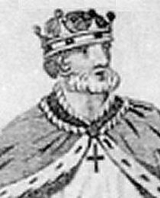
Edmund Ironside

Encyclopedia
Edmund Ironside or Edmund II (c. 988/993 – 30 November 1016) was king of England
from 23 April to 30 November 1016. His cognomen
"Ironside" is not recorded until 1057, but may have been contemporary. According to the Anglo-Saxon Chronicle
, it was given to him "because of his valour" in resisting the Danish invasion led by Cnut the Great. He fought five battles against the Danes, ending in defeat against Cnut on 18 October at the Battle of Assandun, after which they agreed to divide the kingdom, Edmund taking Wessex
and Cnut the rest of the country. Edmund died shortly afterwards on 30 November, and Cnut became the king of all England.
, who was probably the daughter of Earl Thored of Northumbria. His elder brothers were Æthelstan
and Egbert (died c. 1005), and younger ones, Eadred
, Eadwig
and Edgar. His mother died around 1000, after which his father remarried, this time to Emma of Normandy
, who had two sons, Edward the Confessor
and Alfred.
Eadric Streona
from 1007, and he seems to have formed a friendship with Sigeferth
and Morcar, two of the leading thegn
s of the Five Boroughs of the East Midlands
. Æthelstan and Edmund were close, and they probably felt threatened by Emma's ambitions for her sons. The Life of Edward the Confessor, written fifty years later, claimed that when Emma was pregnant with him, all Englishmen promised that if the child was a boy they would accept him as king.
When Sweyn Forkbeard seized the throne at the end of 1013 and Æthelred fled to France, the brothers do not appear to have followed him, but stayed in England. Æthelstan died in June 1014 and left his brother estates and a sword which had belonged to king Offa of Mercia
. His will also reflected the close relationship between the brothers and the nobility of the east midlands.
, but Edmund seized and married her in defiance of his father, probably to consolidate his power base in the east midlands. He then received the submission of the people of the Five Boroughs. At the same time, Cnut launched a new invasion of England. In late 1015 Edmund raised an army, possibly assisted by his wife's and mother's links with the midlands and the north, but the Mercians under Eadric Streona joined the West Saxons in submitting to Cnut. In early 1016 the army assembled by Edmund dispersed when Æthelred did not appear to lead it, probably due to illness. Edmund then raised a new army and in conjunction with Earl Uhtred of Northumbria ravaged Eadric Streona's Mercian territories, but when Cnut occupied Northumbria Uhtred submitted to him, only to be killed by Cnut. Edmund went to London.
, Edmund headed for Wessex
, where the people submitted to him and he gathered an army. He fought inconclusive battles against the Danes and their English supporters at Penselwood
in Somerset and Sherston
in Wiltshire. He then raised the siege of London and defeated the Danes near Brentford
. They renewed the siege while Edmund went to Wessex to raise further troops, returning to again relieve London, defeat the Danes at Otford
, and pursue Cnut into Kent. Eadric Streona now went over to Edmund, but at the decisive Battle of Assandun on 18 October, Eadric and his men fled and Cnut decisively defeated Edmund. There may have been one further battle in the Forest of Dean
, after which the two kings negotiated a peace dividing the country between them. Edmund received Wessex
while Cnut took Mercia and probably Northumbria.
in Somerset
. His burial site is now lost. During the Dissolution of the Monasteries
, any remains of a monument or crypt were destroyed. The location of his body is unknown.
and Edmund. According to John of Worcester
, Cnut sent them to the king of Sweden to be murdered, but the king instead sent them to Hungary
, where Edmund died but Edward prospered. He returned to England in 1057 only to die within days of his arrival. His son Edgar the Ætheling was briefly proclaimed king after the Battle of Hastings
in 1066, but submitted to William the Conqueror.
's in 871, and contrasts with Æthelred's failure. Edmund's success in raising one army after another suggests that there was little wrong with the organs of government under competent leadership. He was "probably a highly determined, skilled and indeed inspiring leader of men". Cnut visited his tomb on the anniversary of his death and laid a cloak decorated with peacocks on it to assist in his salvation, peacocks symbolising resurrection.
 Edmund Ironside
is the name of an anonymous play in the Shakespeare Apocrypha
, which has been attributed to Shakespeare
on stylistic grounds. Plays in the Shakespeare Apocrypha are not generally accepted as Shakespearean.
Kingdom of England
The Kingdom of England was, from 927 to 1707, a sovereign state to the northwest of continental Europe. At its height, the Kingdom of England spanned the southern two-thirds of the island of Great Britain and several smaller outlying islands; what today comprises the legal jurisdiction of England...
from 23 April to 30 November 1016. His cognomen
Cognomen
The cognomen nōmen "name") was the third name of a citizen of Ancient Rome, under Roman naming conventions. The cognomen started as a nickname, but lost that purpose when it became hereditary. Hereditary cognomina were used to augment the second name in order to identify a particular branch within...
"Ironside" is not recorded until 1057, but may have been contemporary. According to the Anglo-Saxon Chronicle
Anglo-Saxon Chronicle
The Anglo-Saxon Chronicle is a collection of annals in Old English chronicling the history of the Anglo-Saxons. The original manuscript of the Chronicle was created late in the 9th century, probably in Wessex, during the reign of Alfred the Great...
, it was given to him "because of his valour" in resisting the Danish invasion led by Cnut the Great. He fought five battles against the Danes, ending in defeat against Cnut on 18 October at the Battle of Assandun, after which they agreed to divide the kingdom, Edmund taking Wessex
Wessex
The Kingdom of Wessex or Kingdom of the West Saxons was an Anglo-Saxon kingdom of the West Saxons, in South West England, from the 6th century, until the emergence of a united English state in the 10th century, under the Wessex dynasty. It was to be an earldom after Canute the Great's conquest...
and Cnut the rest of the country. Edmund died shortly afterwards on 30 November, and Cnut became the king of all England.
Family
Edmund was a signatory to charters from 993. He was the third of the six sons of King Æthelred the Unready and his first wife, ÆlfgifuÆlfgifu of York
Ælfgifu of York was the first wife of King Æthelred , by whom she bore many offspring, including Edmund Ironside. It is most probable that she was a daughter of Thored, earl of southern Northumbria....
, who was probably the daughter of Earl Thored of Northumbria. His elder brothers were Æthelstan
Æthelstan Ætheling
Æthelstan Ætheling , early or mid 980s to 25 June 1014, was the eldest son of King Æthelred the Unready by his first wife Ælfgifu and the heir apparent to the kingdom until his death. He made his first appearance as a witness to a charter of his father in 993...
and Egbert (died c. 1005), and younger ones, Eadred
Eadred Ætheling
Eadred Ætheling was the fourth of the six sons of King Æthelred the Unready by his first wife Ælfgifu. Little or nothing is known of his life. His name is entered on folio 14v of the Liber Vitae of New Minster....
, Eadwig
Eadwig Ætheling
Eadwig Ætheling was the fifth of the six sons of King Æthelred the Unready) and his first wife, Ælfgifu...
and Edgar. His mother died around 1000, after which his father remarried, this time to Emma of Normandy
Emma of Normandy
Emma , was a daughter of Richard the Fearless, Duke of Normandy, by his second wife Gunnora. She was Queen consort of England twice, by successive marriages: first as second wife to Æthelred the Unready of England ; and then second wife to Cnut the Great of Denmark...
, who had two sons, Edward the Confessor
Edward the Confessor
Edward the Confessor also known as St. Edward the Confessor , son of Æthelred the Unready and Emma of Normandy, was one of the last Anglo-Saxon kings of England and is usually regarded as the last king of the House of Wessex, ruling from 1042 to 1066....
and Alfred.
Early life
Æthelstan probably did not approve of the increasing influence of ealdormanEaldorman
An ealdorman is the term used for a high-ranking royal official and prior magistrate of an Anglo-Saxon shire or group of shires from about the ninth century to the time of King Cnut...
Eadric Streona
Eadric Streona
Eadric Streona was an ealdorman of the English Mercians. His name a loose translation of the Anglo-Saxon "the Grasper." Streona is historically regarded as the greatest traitor of the Anglo-Saxon period in English history....
from 1007, and he seems to have formed a friendship with Sigeferth
Sigeferth (died 1015)
Sigeferth was, along with his brother Morcar, described by the Anglo-Saxon Chronicle as "chief thegn of the Seven Burghs"....
and Morcar, two of the leading thegn
Thegn
The term thegn , from OE þegn, ðegn "servant, attendant, retainer", is commonly used to describe either an aristocratic retainer of a king or nobleman in Anglo-Saxon England, or as a class term, the majority of the aristocracy below the ranks of ealdormen and high-reeves...
s of the Five Boroughs of the East Midlands
East Midlands
The East Midlands is one of the regions of England, consisting of most of the eastern half of the traditional region of the Midlands. It encompasses the combined area of Nottinghamshire, Derbyshire, Leicestershire, Rutland, Northamptonshire and most of Lincolnshire...
. Æthelstan and Edmund were close, and they probably felt threatened by Emma's ambitions for her sons. The Life of Edward the Confessor, written fifty years later, claimed that when Emma was pregnant with him, all Englishmen promised that if the child was a boy they would accept him as king.
When Sweyn Forkbeard seized the throne at the end of 1013 and Æthelred fled to France, the brothers do not appear to have followed him, but stayed in England. Æthelstan died in June 1014 and left his brother estates and a sword which had belonged to king Offa of Mercia
Offa of Mercia
Offa was the King of Mercia from 757 until his death in July 796. The son of Thingfrith and a descendant of Eowa, Offa came to the throne after a period of civil war following the assassination of Æthelbald after defeating the other claimant Beornred. In the early years of Offa's reign it is likely...
. His will also reflected the close relationship between the brothers and the nobility of the east midlands.
Struggle for power
Sweyn died in February 1014, and the Five Boroughs accepted his son Cnut, who married a kinswoman of Sigeferth and Morcar, as king. However, Æthelred returned to England and launched a surprise attack which defeated the Vikings and forced Cnut to flee England. In 1015 Sigeferth and Morcar came to an assembly in Oxford, probably hoping for a royal pardon, but they were murdered by Eadric Streona. King Æthelred then ordered that Sigeferth's widow, Ealdgyth, be seized and brought to Malmesbury AbbeyMalmesbury Abbey
Malmesbury Abbey, at Malmesbury in Wiltshire, England, was founded as a Benedictine monastery around 676 by the scholar-poet Aldhelm, a nephew of King Ine of Wessex. In 941 AD, King Athelstan was buried in the Abbey. By the 11th century it contained the second largest library in Europe and was...
, but Edmund seized and married her in defiance of his father, probably to consolidate his power base in the east midlands. He then received the submission of the people of the Five Boroughs. At the same time, Cnut launched a new invasion of England. In late 1015 Edmund raised an army, possibly assisted by his wife's and mother's links with the midlands and the north, but the Mercians under Eadric Streona joined the West Saxons in submitting to Cnut. In early 1016 the army assembled by Edmund dispersed when Æthelred did not appear to lead it, probably due to illness. Edmund then raised a new army and in conjunction with Earl Uhtred of Northumbria ravaged Eadric Streona's Mercian territories, but when Cnut occupied Northumbria Uhtred submitted to him, only to be killed by Cnut. Edmund went to London.
King of England
Æthelred died on 23 April 1016, and the citizens and councillors in London chose Edmund as king and probably crowned him. He then mounted a last-ditch effort to revive the defence of England. While the Danes laid siege to LondonLondon
London is the capital city of :England and the :United Kingdom, the largest metropolitan area in the United Kingdom, and the largest urban zone in the European Union by most measures. Located on the River Thames, London has been a major settlement for two millennia, its history going back to its...
, Edmund headed for Wessex
Wessex
The Kingdom of Wessex or Kingdom of the West Saxons was an Anglo-Saxon kingdom of the West Saxons, in South West England, from the 6th century, until the emergence of a united English state in the 10th century, under the Wessex dynasty. It was to be an earldom after Canute the Great's conquest...
, where the people submitted to him and he gathered an army. He fought inconclusive battles against the Danes and their English supporters at Penselwood
Penselwood
Penselwood is a village and civil parish in the English county of Somerset. It is located north east of Wincanton, south east of Bruton, west of Mere, and north west of Gillingham. The south-east of the parish borders Zeals and Stourhead in Wiltshire, and Bourton in Dorset...
in Somerset and Sherston
Sherston, Wiltshire
Sherston is a village approximately 5 miles to the west of Malmesbury in the English county of Wiltshire. The population in 2001 was 1418 .- History :...
in Wiltshire. He then raised the siege of London and defeated the Danes near Brentford
Brentford
Brentford is a suburban town in west London, England, and part of the London Borough of Hounslow. It is located at the confluence of the River Thames and the River Brent, west-southwest of Charing Cross. Its former ceremonial county was Middlesex.-Toponymy:...
. They renewed the siege while Edmund went to Wessex to raise further troops, returning to again relieve London, defeat the Danes at Otford
Otford
Otford is a village and civil parish in the Sevenoaks District of Kent known for its classically British countryside. The village is located on the River Darent, flowing north down its valley from its source on the North Downs...
, and pursue Cnut into Kent. Eadric Streona now went over to Edmund, but at the decisive Battle of Assandun on 18 October, Eadric and his men fled and Cnut decisively defeated Edmund. There may have been one further battle in the Forest of Dean
Forest of Dean
The Forest of Dean is a geographical, historical and cultural region in the western part of the county of Gloucestershire, England. The forest is a roughly triangular plateau bounded by the River Wye to the west and north, the River Severn to the south, and the City of Gloucester to the east.The...
, after which the two kings negotiated a peace dividing the country between them. Edmund received Wessex
Wessex
The Kingdom of Wessex or Kingdom of the West Saxons was an Anglo-Saxon kingdom of the West Saxons, in South West England, from the 6th century, until the emergence of a united English state in the 10th century, under the Wessex dynasty. It was to be an earldom after Canute the Great's conquest...
while Cnut took Mercia and probably Northumbria.
Death
Shortly afterwards, on 30 November 1016, King Edmund died, probably in London. Cnut was now able to seize control as king of England. Edmund was buried at Glastonbury AbbeyGlastonbury Abbey
Glastonbury Abbey was a monastery in Glastonbury, Somerset, England. The ruins are now a grade I listed building, and a Scheduled Ancient Monument and are open as a visitor attraction....
in Somerset
Somerset
The ceremonial and non-metropolitan county of Somerset in South West England borders Bristol and Gloucestershire to the north, Wiltshire to the east, Dorset to the south-east, and Devon to the south-west. It is partly bounded to the north and west by the Bristol Channel and the estuary of the...
. His burial site is now lost. During the Dissolution of the Monasteries
Dissolution of the Monasteries
The Dissolution of the Monasteries, sometimes referred to as the Suppression of the Monasteries, was the set of administrative and legal processes between 1536 and 1541 by which Henry VIII disbanded monasteries, priories, convents and friaries in England, Wales and Ireland; appropriated their...
, any remains of a monument or crypt were destroyed. The location of his body is unknown.
Heirs
Edmund had two children by Ealdgyth, Edward the ExileEdward the Exile
Edward the Exile , also called Edward Ætheling, son of King Edmund Ironside and of Ealdgyth. After the Danish conquest of England in 1016 Canute had him and his brother, Edmund, exiled to the Continent...
and Edmund. According to John of Worcester
John of Worcester
John of Worcester was an English monk and chronicler. He is usually held to be the author of the Chronicon ex chronicis.-Chronicon ex chronicis:...
, Cnut sent them to the king of Sweden to be murdered, but the king instead sent them to Hungary
Hungary
Hungary , officially the Republic of Hungary , is a landlocked country in Central Europe. It is situated in the Carpathian Basin and is bordered by Slovakia to the north, Ukraine and Romania to the east, Serbia and Croatia to the south, Slovenia to the southwest and Austria to the west. The...
, where Edmund died but Edward prospered. He returned to England in 1057 only to die within days of his arrival. His son Edgar the Ætheling was briefly proclaimed king after the Battle of Hastings
Battle of Hastings
The Battle of Hastings occurred on 14 October 1066 during the Norman conquest of England, between the Norman-French army of Duke William II of Normandy and the English army under King Harold II...
in 1066, but submitted to William the Conqueror.
Reputation
In the view of M. K. Lawson, the intensity of Edmund's struggle against the Danes in 1016 is only matched by Alfred the GreatAlfred the Great
Alfred the Great was King of Wessex from 871 to 899.Alfred is noted for his defence of the Anglo-Saxon kingdoms of southern England against the Vikings, becoming the only English monarch still to be accorded the epithet "the Great". Alfred was the first King of the West Saxons to style himself...
's in 871, and contrasts with Æthelred's failure. Edmund's success in raising one army after another suggests that there was little wrong with the organs of government under competent leadership. He was "probably a highly determined, skilled and indeed inspiring leader of men". Cnut visited his tomb on the anniversary of his death and laid a cloak decorated with peacocks on it to assist in his salvation, peacocks symbolising resurrection.
Shakespearean play?
Edmund Ironside (play)
Edmund Ironside, or War Hath Made All Friends is an anonymous Elizabethan play that depicts the life of Edmund II of England. At least three critics have suggested that it is an early work by William Shakespeare.-Text:...
is the name of an anonymous play in the Shakespeare Apocrypha
Shakespeare Apocrypha
The Shakespeare Apocrypha is a group of plays that have sometimes been attributed to William Shakespeare, but whose attribution is questionable for various reasons...
, which has been attributed to Shakespeare
William Shakespeare
William Shakespeare was an English poet and playwright, widely regarded as the greatest writer in the English language and the world's pre-eminent dramatist. He is often called England's national poet and the "Bard of Avon"...
on stylistic grounds. Plays in the Shakespeare Apocrypha are not generally accepted as Shakespearean.
In popular culture
- Edmund is played by John Horn in the 1970 television movie The Ceremony of InnocenceThe Ceremony of Innocence (film)The Ceremony of Innocence is a 1970 television movie adaptation of the play by the same name which depicts a highly fictionalized account of the events leading up to Sweyn Forkbeard's invasion of England in AD 1013....
. He is one of the main characters in Justin HillJustin HillJustin Hill is an English novelist whose novels have been nominated for the Man Booker Prize three times. Born in Freeport, Grand Bahama Island in 1971, he grew up in Yorkshire. He was educated at the historic St Peter's School, York....
's novel Shieldwall (2011), first in the Conquest Trilogy.
Sources
- Anglo-Saxon Chronicle
- Clemoes, Peter. The Anglo-Saxons: Studies Presented to Bruce Dickins, 1959
- The History Channel - England history to 1485