


Stavronikita monastery

Encyclopedia
Eastern Orthodox Church
The Orthodox Church, officially called the Orthodox Catholic Church and commonly referred to as the Eastern Orthodox Church, is the second largest Christian denomination in the world, with an estimated 300 million adherents mainly in the countries of Belarus, Bulgaria, Cyprus, Georgia, Greece,...
monastery
Monastery
Monastery denotes the building, or complex of buildings, that houses a room reserved for prayer as well as the domestic quarters and workplace of monastics, whether monks or nuns, and whether living in community or alone .Monasteries may vary greatly in size – a small dwelling accommodating only...
at the monastic
Monasticism
Monasticism is a religious way of life characterized by the practice of renouncing worldly pursuits to fully devote one's self to spiritual work...
state of Mount Athos
Mount Athos
Mount Athos is a mountain and peninsula in Macedonia, Greece. A World Heritage Site, it is home to 20 Eastern Orthodox monasteries and forms a self-governed monastic state within the sovereignty of the Hellenic Republic. Spiritually, Mount Athos comes under the direct jurisdiction of the...
in Greece
Greece
Greece , officially the Hellenic Republic , and historically Hellas or the Republic of Greece in English, is a country in southeastern Europe....
, dedicated to Saint Nicholas
Saint Nicholas
Saint Nicholas , also called Nikolaos of Myra, was a historic 4th-century saint and Greek Bishop of Myra . Because of the many miracles attributed to his intercession, he is also known as Nikolaos the Wonderworker...
. It is built on top of a rock near the sea near the middle of the eastern shore of the Athonite peninsula, located between the monasteries of Iviron
Iviron monastery
Holy Monastery of Iviron is an Eastern Orthodox monastery at the monastic state of Mount Athos in Greece...
and Pantokratoros. The site where the monastery is built was first used by Athonite monks as early as the 10th century. Stavronikita was the last to be officially consecrated as an Athonite monastery in 1536 and ranks fifteenth in the hierarchy of the Athonite monasteries and currently has 30 to 40 monks.
Name
There are various conflicting traditions and stories regarding the monastery's name. According to one Athonite tradition, the name is a combination of the names of two monks, Stavros and Nikitas, that used to live in two cells at the site before the monastery was built. Another tradition recounts of a Byzantine armyByzantine army
The Byzantine army was the primary military body of the Byzantine armed forces, serving alongside the Byzantine navy. A direct descendant of the Roman army, the Byzantine army maintained a similar level of discipline, strategic prowess and organization...
officer serving under the Byzantine Emperor John I Tzimiskes
John I Tzimiskes
John I Tzimiskes or Tzimisces, was Byzantine Emperor from December 11, 969 to January 10, 976. A brilliant and intuitive general, John's short reign saw the expansion of the empire's borders and the strengthening of Byzantium itself.- Background :...
, named Niceforus Stavronikitas that built the monastery and named it after himself. Yet a third tradition attributes the foundation of the monastery to a patrician by the name Nikitas. The patrician's name day
Name day
A name day is a tradition in many countries in Europe and Latin America that consists of celebrating the day of the year associated with one's given name....
according to the Eastern Orthodox calendar of saints
Calendar of saints
The calendar of saints is a traditional Christian method of organizing a liturgical year by associating each day with one or more saints and referring to the feast day of said saint...
is celebrated the day after the Feast of the Cross
Feast of the Cross
In the Christian liturgical calendar, there are several different Feasts of the Cross, all of which commemorate the cross used in the crucifixion of Jesus....
. Hence according to this tale the monastery got its name by combination of the patrician's name with the word "Stavros" (the Greek word for cross).
Apart from the traditional name, in some old documents the monastery is referred to as "Monastery of the Theotokos
Theotokos
Theotokos is the Greek title of Mary, the mother of Jesus used especially in the Eastern Orthodox, Oriental Orthodox, and Eastern Catholic Churches. Its literal English translations include God-bearer and the one who gives birth to God. Less literal translations include Mother of God...
", which implies that the monastery was initially dedicated to the Theotokos
Theotokos
Theotokos is the Greek title of Mary, the mother of Jesus used especially in the Eastern Orthodox, Oriental Orthodox, and Eastern Catholic Churches. Its literal English translations include God-bearer and the one who gives birth to God. Less literal translations include Mother of God...
. A more often encountered alternative name is "Monastery of Stravonikita" which is a corruption of the original name.
History
The many conflicting tales of the monastery's name hint to the obscurity of its historical origins. In a document by the ProtosProtos (monastic office)
The protos is a monastic office at the Eastern Orthodox monastic state of Mount Athos in Greece.-Authority:The office is assumed by a monk who is elected among the members of the Iera Epistasia which functions as the executive committee of the Iera Koinotita — the governing body of Athos...
Nikiforos dating back to 1012 there is the signature of a monk who signs as "Nikiforos monk from Stravonikita" (Greek: "Νικηφόρος μοναχός ο του Στραβωνικήτα"), while in a 1016 document, the same monk signs as "from Stavronikita"(Greek: "του Σταυρονικήτα"). This alludes to the existence of a Stavronikita monastery as late as the first half of the 11th century. According to archaeologist Sotiris Kadas this means that the Stavronikita monastery was one of the monasteries that were founded or built during the first years of organized monastic life on Mount Athos.
This early part of the monastery's history ended approximately during the first half of the 13th century when the monastery was deserted due to constant pirate raids as well as due to the tremendous impact caused by the Fourth Crusade
Fourth Crusade
The Fourth Crusade was originally intended to conquer Muslim-controlled Jerusalem by means of an invasion through Egypt. Instead, in April 1204, the Crusaders of Western Europe invaded and conquered the Christian city of Constantinople, capital of the Eastern Roman Empire...
to the whole of the Byzantine Empire
Byzantine Empire
The Byzantine Empire was the Eastern Roman Empire during the periods of Late Antiquity and the Middle Ages, centred on the capital of Constantinople. Known simply as the Roman Empire or Romania to its inhabitants and neighbours, the Empire was the direct continuation of the Ancient Roman State...
. The deserted monastery came initially under the jurisdiction of the Protos
Protos (monastic office)
The protos is a monastic office at the Eastern Orthodox monastic state of Mount Athos in Greece.-Authority:The office is assumed by a monk who is elected among the members of the Iera Epistasia which functions as the executive committee of the Iera Koinotita — the governing body of Athos...
and later under the jurisdiction of Koutloumousiou monastery
Koutloumousiou monastery
Koutloumousiou monastery is an Eastern Orthodox monastery at the monastic state of Mount Athos in Greece. The monastery ranks sixth in the hierarchy of the Athonite monasteries....
and later Philotheou monastery
Philotheou monastery
Filotheou monastery is an Eastern Orthodox monastery at the monastic state of Mount Athos in Greece. It stands on the north-eastern side of the peninsula.It was founded by the Blessed Philotheus, in the end of the 10th century...
and functioned as a skete
Skete
A Skete is a monastic style community that allows relative isolation for monks, but alsoallows for communal services and the safety of shared resources and protection...
. In 1533, The monks of Philotheou sold Stavronikita to the abbot
Abbot
The word abbot, meaning father, is a title given to the head of a monastery in various traditions, including Christianity. The office may also be given as an honorary title to a clergyman who is not actually the head of a monastery...
of a Thesprotia
Thesprotia
Thesprotia is one of the regional units of Greece. It is part of the Epirus region. Its capital is the town of Igoumenitsa. It is named after the Thesprotians, an ancient Greek tribe that inhabited the region in antiquity.-History:...
n monastery, Gregorios Giromeriatis (Greek: Γρηγόριος Γηρομερειάτης). In 1536, a patriarchical edict by Patriarch Jeremias I
Patriarch Jeremias I of Constantinople
-Further reading:...
reinstated Stavronikita's status as one of the monasteries of Athos, bringing their total number to 20. Therefore Stavronikita became the last officially consecrated monastery of Athos and is usually referred as the last monastery to be added to the athonite hierarchy.
Gregorios Giromeriatis eventually left his monastery in Thesprotia and permanently settled in Stavronikita. In subsequent years he expended great efforts to rebuild and expand the monastery. He built a surrounding wall, many cells, as well as the monastery's catholicon
Catholicon
Catholicon may refer to:* Catholicon, the conventual church at the centre of an abbey* Katholikon, the primary church in an Orthodox or Eastern Catholic monastery* Catholicon , part of the Holy Liturgy of Mor Yakub of the Syriac Orthodox Church...
. After the death of Gregorios in 1540, the renovation was continued by Patriarch Jeremias himself out of love and respect for Gregorios. An extraordinary feature of the monastery during this era is the fact that while most of the athonite monasteries had already largely adopted the so called "idiorythmic" lifestyle (a semi-eremitic variant of Christian monasticism) , Stavronikita was founded and continued to function long after as on the principles of cenobitic
Cenobitic
Cenobitic monasticism is a monastic tradition that stresses community life. Often in the West, the community belongs to a religious order and the life of the cenobitic monk is regulated by a religious rule, a collection of precepts...
monasticism.
The subsequent history of the monastery was marked by the fact that it always remained small in comparison to other athonite monasteries, both in property and in number of monks. Despite the repeated aid by the athonite community as well as by important benefactors, such as archon
Archon
Archon is a Greek word that means "ruler" or "lord", frequently used as the title of a specific public office. It is the masculine present participle of the verb stem ἀρχ-, meaning "to rule", derived from the same root as monarch, hierarchy, and anarchy.- Ancient Greece :In ancient Greece the...
Servopoulos in 1612, the monk Markos in 1614, the people of Kea
Kea (island)
Kea , also known as Gia or Tzia , Zea, and, in Antiquity, Keos , is an island of the Cyclades archipelago, in the Aegean Sea, in Greece. Kea is part of the Kea-Kythnos peripheral unit. Its capital, Ioulis, is inland at a high altitude and is considered quite picturesque...
in 1628, Thomas Klados in 1630 and the Prince of Wallachia
Wallachia
Wallachia or Walachia is a historical and geographical region of Romania. It is situated north of the Danube and south of the Southern Carpathians...
, Alexandru Ghica
Alexandru Ghica
Alexandru Ghica was Voivode of Wallachia from 1766 to 1768....
from 1727 to 1740, the monastery's evolution was constantly hampered partly by quarrellings with nearby skete
Skete
A Skete is a monastic style community that allows relative isolation for monks, but alsoallows for communal services and the safety of shared resources and protection...
s and monasteries, most notably with Koutloumousiou monastery
Koutloumousiou monastery
Koutloumousiou monastery is an Eastern Orthodox monastery at the monastic state of Mount Athos in Greece. The monastery ranks sixth in the hierarchy of the Athonite monasteries....
, over matters of land property and more importantly by two great fires in 1607 and in 1741 that burnt Stavronikita to the ground. However, the monastery continued to grow. In 1628 the catholicon
Catholicon
Catholicon may refer to:* Catholicon, the conventual church at the centre of an abbey* Katholikon, the primary church in an Orthodox or Eastern Catholic monastery* Catholicon , part of the Holy Liturgy of Mor Yakub of the Syriac Orthodox Church...
was renovated and in 1770 the monastery's well-known aqueduct
Aqueduct
An aqueduct is a water supply or navigable channel constructed to convey water. In modern engineering, the term is used for any system of pipes, ditches, canals, tunnels, and other structures used for this purpose....
was built along with some of its chapel
Chapel
A chapel is a building used by Christians as a place of fellowship and worship. It may be part of a larger structure or complex, such as a church, college, hospital, palace, prison or funeral home, located on board a military or commercial ship, or it may be an entirely free-standing building,...
s, such as the chapel of Saint Demetrius at the monastery's graveyard, the chapel of the Archangels and the chapel of the Five Martyrs.
During the Greek War of Independence
Greek War of Independence
The Greek War of Independence, also known as the Greek Revolution was a successful war of independence waged by the Greek revolutionaries between...
in the early 19th century, Stavronikita, as well as the whole of Mount Athos, experienced harsh times. The monastery faced a harsh economic situation due to extraordinary debt that helped fund the war, while its monks were scattered after the Ottomans invaded Athos. Therefore the monastery, along with some other athonite monasteries, was deserted and so were many of its holdings in Wallachia
Wallachia
Wallachia or Walachia is a historical and geographical region of Romania. It is situated north of the Danube and south of the Southern Carpathians...
, Moldavia
Moldavia
Moldavia is a geographic and historical region and former principality in Eastern Europe, corresponding to the territory between the Eastern Carpathians and the Dniester river...
and elsewhere. This situation lasted for about a decade, after which the Ottomans left Athos and any monks that had survived started returning to the monastery.
However, the monastery's prosperity was again endangered by three great fires in 1864, 1874 and 1879 that caused great damage. The monastery was rebuilt but the monks became largely indebted again which led to further decline. This situation was partly reversed by the efforts of the abbot Theophilos, a monk formerly from Vatopedi
Vatopedi
The Holy and Great Monastery of Vatopedi on Mount Athos, Greece, was built during the second half of the 10th century by three monks, Athanasius, Nicholas, and Antonius, from Adrianople, who were disciples of Athanasius the Athonite...
.The election of Abbot Vassilios and the reversion of the monastery to the coenobitic style greatly influenced the revival of monastic life at Stavronikita which thus obtained a new lease of life.
Architecture
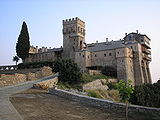
Stavronikita is the smaller in size among all the athonite monasteries. Important landmarks of the monastery are its trademark tower at the monastery's entrance, its aqueductAqueduct
An aqueduct is a water supply or navigable channel constructed to convey water. In modern engineering, the term is used for any system of pipes, ditches, canals, tunnels, and other structures used for this purpose....
, as well as its centuries old cypress
Cupressus
The genus Cupressus is one of several genera within the family Cupressaceae that have the common name cypress; for the others, see cypress. It is considered a polyphyletic group...
outside the western corner of the complex.
The catholicon
Catholicon
Catholicon may refer to:* Catholicon, the conventual church at the centre of an abbey* Katholikon, the primary church in an Orthodox or Eastern Catholic monastery* Catholicon , part of the Holy Liturgy of Mor Yakub of the Syriac Orthodox Church...
of the monastery is dedicated to Saint Nicholas
Saint Nicholas
Saint Nicholas , also called Nikolaos of Myra, was a historic 4th-century saint and Greek Bishop of Myra . Because of the many miracles attributed to his intercession, he is also known as Nikolaos the Wonderworker...
and is the smaller catholicon among its other athonite counterparts. It was built during the 16th century over a pre-existing church dedicated to the Theotokos
Theotokos
Theotokos is the Greek title of Mary, the mother of Jesus used especially in the Eastern Orthodox, Oriental Orthodox, and Eastern Catholic Churches. Its literal English translations include God-bearer and the one who gives birth to God. Less literal translations include Mother of God...
. The catholicon is decorated with fresco
Fresco
Fresco is any of several related mural painting types, executed on plaster on walls or ceilings. The word fresco comes from the Greek word affresca which derives from the Latin word for "fresh". Frescoes first developed in the ancient world and continued to be popular through the Renaissance...
es and an iconostasis
Iconostasis
In Eastern Christianity an iconostasis is a wall of icons and religious paintings, separating the nave from the sanctuary in a church. Iconostasis also refers to a portable icon stand that can be placed anywhere within a church...
by the famous icon
Icon
An icon is a religious work of art, most commonly a painting, from Eastern Christianity and in certain Eastern Catholic churches...
-painter Theophanes of Crete and his son Symeon. Apart from the catholicon, the monastery's refectory
Refectory
A refectory is a dining room, especially in monasteries, boarding schools and academic institutions. One of the places the term is most often used today is in graduate seminaries...
is located at the upper floor at the southern side of the complex and also bears some important iconography.
During the latter half of the 20th century the whole monastery complex had been largely abandoned and was slowly falling apart. Additionally the rock on which the monastery is built had been severely damaged by a series of earthquakes. The rock was found to be slowly crumbling and sliding towards the sea which lead to concerns about the future of the monastery's structural integrity.
The Center for the Preservation of Athonite Heritage (Greek: Κέντρο Διαφύλαξης Αγιορείτικης Κληρονομιάς, abbreviated Κε.Δ.Α.Κ.), a state organization under the jurisdiction of the Ministry for Macedonia–Thrace
Minister for Macedonia–Thrace (Greece)
The Minister for Macedonia–Thrace was the government minister in charge of Greece's defunct Ministry of Macedonia–Thrace. The last minister was Stavros Kalafatis...
, undertook the task of renovating and restoring the monastery. Extensive renovating work took place from 1981 to 1999, while, utilizing a complex engineering
Engineering
Engineering is the discipline, art, skill and profession of acquiring and applying scientific, mathematical, economic, social, and practical knowledge, in order to design and build structures, machines, devices, systems, materials and processes that safely realize improvements to the lives of...
method the underlying rock was stabilized.
Cultural treasures
The monastery keeps a widely known 14th century iconIcon
An icon is a religious work of art, most commonly a painting, from Eastern Christianity and in certain Eastern Catholic churches...
of Saint Nicholas, known as "Streidas" (Greek: Άγιος Νικόλαος ο Στρειδάς, "Saint Nicholas of the Oyster") because when it was accidentally discovered at the bottom of the sea, an oyster
Oyster
The word oyster is used as a common name for a number of distinct groups of bivalve molluscs which live in marine or brackish habitats. The valves are highly calcified....
had stuck at the forehead of St. Nicholas. According to the athonite tradition, when the monks of Stavronikita removed the oyster, the saint's forehead bled.
Stavronikita has a collection of notable icons and holy relics
Relic
In religion, a relic is a part of the body of a saint or a venerated person, or else another type of ancient religious object, carefully preserved for purposes of veneration or as a tangible memorial...
. The monastery also has in its possession priestly garments, ritual objects and other valuables. The monastery also has a collection of 171 manuscripts, out of which 58 are written on parchment
Parchment
Parchment is a thin material made from calfskin, sheepskin or goatskin, often split. Its most common use was as a material for writing on, for documents, notes, or the pages of a book, codex or manuscript. It is distinct from leather in that parchment is limed but not tanned; therefore, it is very...
. Some of the manuscripts bear notable iconography and decoration.