


Starkad

Encyclopedia
Old Norse
Old Norse is a North Germanic language that was spoken by inhabitants of Scandinavia and inhabitants of their overseas settlements during the Viking Age, until about 1300....
: Starkaðr or Störkuðr, Latin
Latin
Latin is an Italic language originally spoken in Latium and Ancient Rome. It, along with most European languages, is a descendant of the ancient Proto-Indo-European language. Although it is considered a dead language, a number of scholars and members of the Christian clergy speak it fluently, and...
: Starcaterus, and during the late Middle Ages
Middle Ages
The Middle Ages is a periodization of European history from the 5th century to the 15th century. The Middle Ages follows the fall of the Western Roman Empire in 476 and precedes the Early Modern Era. It is the middle period of a three-period division of Western history: Classic, Medieval and Modern...
, also known as Starkodder, was a legendary hero in Norse mythology
Norse mythology
Norse mythology, a subset of Germanic mythology, is the overall term for the myths, legends and beliefs about supernatural beings of Norse pagans. It flourished prior to the Christianization of Scandinavia, during the Early Middle Ages, and passed into Nordic folklore, with some aspects surviving...
.
Starkad appears in numerous accounts, and the stories of his adventures relate to different Scandinavian traditions. He is most fully treated in Gesta Danorum
Gesta Danorum
Gesta Danorum is a patriotic work of Danish history, by the 12th century author Saxo Grammaticus . It is the most ambitious literary undertaking of medieval Denmark and is an essential source for the nation's early history...
but he also appears in Iceland
Iceland
Iceland , described as the Republic of Iceland, is a Nordic and European island country in the North Atlantic Ocean, on the Mid-Atlantic Ridge. Iceland also refers to the main island of the country, which contains almost all the population and almost all the land area. The country has a population...
ic sources. He is portrayed as a great warrior who performed many heroic deeds but also many crimes.
An origin of the Starkad legends can be found in the Anglo-Saxon poem
Anglo-Saxon literature
Old English literature encompasses literature written in Old English in Anglo-Saxon England, in the period from the 7th century to the Norman Conquest of 1066. These works include genres such as epic poetry, hagiography, sermons, Bible translations, legal works, chronicles, riddles, and others...
Beowulf
Beowulf
Beowulf , but modern scholars agree in naming it after the hero whose life is its subject." of an Old English heroic epic poem consisting of 3182 alliterative long lines, set in Scandinavia, commonly cited as one of the most important works of Anglo-Saxon literature.It survives in a single...
.
Beowulf
In BeowulfBeowulf
Beowulf , but modern scholars agree in naming it after the hero whose life is its subject." of an Old English heroic epic poem consisting of 3182 alliterative long lines, set in Scandinavia, commonly cited as one of the most important works of Anglo-Saxon literature.It survives in a single...
, the feud between the Danes
Daner
The Danes were a North Germanic tribe residing in modern day Denmark. They are mentioned in the 6th century in Jordanes' Getica, by Procopius, and by Gregory of Tours....
and the Heaðobard
Heaðobard
The Heaðobards were possibly a branch of the Langobards, and their name may be preserved in toponym Bardengau, in Mecklenburg, Germany....
s was to be ended with the marriage of Ingeld
Ingeld
Ingeld or Ingjald was a legendary warrior who appears in early English and Norse legends. Ingeld was so well-known that, in 797, Alcuin wrote a letter to Bishop Higbald of Lindisfarne questioning the monks' interest in heroic legends with: 'Quid enim Hinieldus cum Christo?' - What has Ingeld to...
, the son of the fallen Heaðobard king Froda, and Freawaru
Freawaru
Freawaru, introduced in l. 2020 of the poem Beowulf, is the daughter of King Hroðgar and Queen Wealhþeow.Freawaru is a freoðuwebbe or "peaceweaver" who is married to Ingeld, King of the Heaðobards and son of Froda . This marriage was created as a means of ending a feud between the two kingdoms...
, the daughter of the Danish king Hroðgar
Hroðgar
Hroðgar, King Hroþgar, "Hrothgar", Hróarr, Hroar, Roar, Roas or Ro was a legendary Danish king, living in the early 6th century....
. During the wedding an unnamed old warrior reminded the Heaðobards of their defeat and encouraged them to revenge. That is the origin of Starkad's admonishing speech to the Danish king Ingellus, son of Frotho (see the account given in Gesta Danorum below). It is consequently possible that Sophus Bugge
Sophus Bugge
Sophus Bugge was a noted Norwegian philologist and linguist. His scientific work was directed to the study of runic inscriptions and Norse philology. Bugge is best known for his theories and his work on the runic alphabet and the Poetic Edda and Prose Edda. -Background:Elseus Sophus Bugge was...
was right in deriving the name Starkaðr from originally meaning "the strong Heaðobard".
Hervarar saga
A version of the legend of Starkad can be found in the prologue of the U-version of Hervarar sagaHervarar saga
Hervarar saga ok Heiðreks is a legendary saga from the 13th century combining matter from several older sagas. It is a valuable saga for several different reasons beside its literary qualities. It contains traditions of wars between Goths and Huns, from the 4th century, and the last part is used as...
, and in a shortened form in the H-version of the Hauksbók
Hauksbók
The Hauksbók is one of the few medieval Norse manuscripts of which the author is known. His name was Haukr Erlendsson , and as long back as it is possible to trace the manuscript it has been called the Hauksbók after its author. It was partly written by Haukr himself, partly by assistants...
.
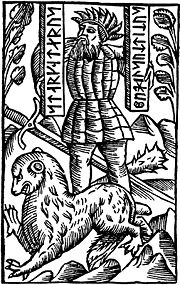
In this version a Starkad Ala-Warrior lived in northern Norway at the waterfalls of Alufoss. He descended from the giants known as the þursar (jotuns), and his father's name was Storkvid. Starkad was very much a jotun himself and had eight arms, but he was betrothed to a girl named Ogn Elf-burst. One day, when Starkad had gone north across the Élivágar
Élivágar
In Norse mythology, Élivágar are rivers which existed in Ginnungagap at the beginning of the world. The Prose Edda relates:The eleven rivers traditionally associated with the Élivágar include the Svöl, Gunnthrá, Fjörm, Fimbulthul, Slíd, Hríd, Sylgr, Ylgr, Víd, Leiptr and Gjöll , although many...
, another giant named Hergrim kidnapped Ogn. Starkad challenged Hergrim to a holmgang
Holmgang
Holmgang was a duel practiced by early medieval Scandinavians. It was a recognized way to settle disputes....
, a duel. Starkad used four swords at the same time and slew Hergrim. Ogn did not wish to be Starkad's wife and committed suicide by stabbing herself with a sword. Starkad took everything Hergrimr owned including his son Grimr.
Álfhildr was the daughter of king Álfr of Álfheim
Álfheim
Alfheim is one of the Nine Worlds and home of the Light Elves in Norse mythology and appears also in Anglo-Scottish ballads under the form Elfhame as a fairyland, sometimes modernized as Elfland .-In Old Norse texts:Álfheim as an abode of the Elves is mentioned only twice in Old Norse texts.The...
(modern Bohuslän
Bohuslän
' is a Swedish traditional province, or landskap, situated in Götaland on the northernmost part of the country's west coast. It is bordered by Dalsland to the northeast, Västergötland to the southeast, the Skagerrak arm of the North Sea to the west, and the county of Østfold in Norway to the north...
) and like the people of Álfheim, she was very beautiful. One autumn, king Álfr performed the Dísablót
Dísablót
The Dísablót was the blót which was held in honour of the female spirits or deities called dísir , from pre-historic times until Christianization in Scandinavia. Its purpose was to enhance the coming harvest. It is mentioned in Hervarar saga, Víga-Glúms saga, Egils saga and the Heimskringla...
, a sacrifice to the goddesses, and Álfhildr took part in it. As she was reddening the horgr
Hörgr
A hörgr or hearg was a type of religious building or altar possibly consisting of a heap of stones, used in Norse paganism...
(altar) with blood, Starkad kidnapped her. King Álfr called on the god Thor
Thor
In Norse mythology, Thor is a hammer-wielding god associated with thunder, lightning, storms, oak trees, strength, the protection of mankind, and also hallowing, healing, and fertility...
to help him rescue his daughter. Thor granted his wish by killing Starkad and rescuing the girl.
Gautreks saga
Gautreks saga
Gautreks saga is a Scandinavian legendary saga put to text towards the end of the 13th century which survives only in much later manuscripts...
continues the account found in Hervarar saga. It is tells among other things the adventures of Starkad, the son of Stórvirkr who was the son of Starkad Ala-warrior, whom Thor
Thor
In Norse mythology, Thor is a hammer-wielding god associated with thunder, lightning, storms, oak trees, strength, the protection of mankind, and also hallowing, healing, and fertility...
had killed.
It tells that young Starkad was raised at the court of Harald, the king of Agder
Agder
Agder is a historical district of Norway in the southernmost region of Norway, corresponding to the two counties Vest-Agder and Aust-Agder. Today, the term Sørlandet is more commonly used.-Name:...
, together with Harald's son Vikar
Víkar
Víkar was a legendary Norwegian king who found himself and his ships becalmed for a long period. To raise a wind, a human blood sacrifice was needed, and the lots fell on King Víkar himself...
. One day, Herþjófr, the king of Hordaland
Hordaland
is a county in Norway, bordering Sogn og Fjordane, Buskerud, Telemark and Rogaland. Hordaland is the third largest county after Akershus and Oslo by population. The county administration is located in Bergen...
, made a raid and killed king Harald. He also took Vikar hostage to ensure the loyalty of the people of Agder. When Vikar had grown up, he assembled a warband, including Starkad and avenged his father by killing Herþjófr with thirty of his warriors. Vikar was then king of Agder, Hordaland
Hordaland
is a county in Norway, bordering Sogn og Fjordane, Buskerud, Telemark and Rogaland. Hordaland is the third largest county after Akershus and Oslo by population. The county administration is located in Bergen...
, and Hardanger
Hardanger
Hardanger is a traditional district in the western part of Norway, dominated by the Hardangerfjord. It consists of the municipalities of Odda, Ullensvang, Eidfjord, Ulvik, Granvin, Kvam and Jondal, and is located inside the county of Hordaland....
.
Starkad took part in Víkar's many battles for the hegemony of the petty kingdoms of southern Norway, one of the battles where Battle at Lake Vænir and he was Víkar's greatest warrior.
After all these victories, when sailing north from Agdir to Hördaland with a large army, Víkar was becalmed. Divination showed Odin
Odin
Odin is a major god in Norse mythology and the ruler of Asgard. Homologous with the Anglo-Saxon "Wōden" and the Old High German "Wotan", the name is descended from Proto-Germanic "*Wodanaz" or "*Wōđanaz"....
required a sacrifice of one person chosen by lot and Víkar's lot came up each time. The decision was put off till the next day. Then Grani Horsehair, Starkad's foster father, took Starkad to a secret council of the gods and revealed himself to be Odin
Odin
Odin is a major god in Norse mythology and the ruler of Asgard. Homologous with the Anglo-Saxon "Wōden" and the Old High German "Wotan", the name is descended from Proto-Germanic "*Wodanaz" or "*Wōđanaz"....
. Thor
Thor
In Norse mythology, Thor is a hammer-wielding god associated with thunder, lightning, storms, oak trees, strength, the protection of mankind, and also hallowing, healing, and fertility...
, who hated Starkad, because of his jotun origin, denied Starkad the blessing of having children and cursed him to commit a crime every lifetime he lived and never to possess real estate. Thor further cursed Starkad never to feel that he had enough property, always to receive dangerous wounds in battle, never to remember his skaldic poems and ever to be hated by commoners. Odin, on the other hand bestowed on Starkad the blessings of living three lifetimes, of possessing the most excellent of weapons, an abundance of riches, victory in battle, the gift of poetry and always to be held in the highest esteem among the rich and powerful. After blessings and curses laid on Starkad alternately by Odin and Thor, Odin asked Starkad to send him King Víkar in payment for Odin's blessings. Starkad agreed and Odin gave Starkad a spear which Odin promised would appear to be only a reed-stalk. So Vikar met his death.
After Vikar's death, Starkad fled to Sweden and the kings Alrek and Eirík
Alrek and Eirík
Alaric and Eric , were two legendary kings of Sweden. and may have lived in the 5th century- In the Ynglinga saga :...
at Uppsala
Gamla Uppsala
Gamla Uppsala is a parish and a village outside Uppsala in Sweden. It had 16,231 inhabitants in 1991.As early as the 3rd century AD and the 4th century AD and onwards, it was an important religious, economic and political centre...
. Starkad served them first as a companion on their viking
Viking
The term Viking is customarily used to refer to the Norse explorers, warriors, merchants, and pirates who raided, traded, explored and settled in wide areas of Europe, Asia and the North Atlantic islands from the late 8th to the mid-11th century.These Norsemen used their famed longships to...
expeditions and then, after Alrek and Eirík had settled down, he went on further Viking expeditions alone.
Skaldic poetry
Starkad is said to have composed poems himself which appear in Gautrek's saga. Thor's hate of Starkad because of his jotun origins is mentioned in SkáldskaparmálSkáldskaparmál
The second part of Snorri Sturluson's Prose Edda the Skáldskaparmál or "language of poetry" is effectively a dialogue between the Norse god of the sea, Ægir and Bragi, the god of poetry, in which both Norse mythology and discourse on the nature of poetry are intertwined...
, where there is a lausavísa
Lausavísa
In Old Norse poetry and later Icelandic poetry, a lausavísa is a single stanza composition, or a set of stanzas unconnected by narrative or thematic continuity....
by Vetrliði Sumarliðason
Vetrliði Sumarliðason
Vetrliði Sumarliðason is a 10th century Icelandic skald.He was the great-grandson of Ketill hængr , one of the settlers of Iceland. He lived in Fljótshlíð, in the south of the island....
praising Thor
Thor
In Norse mythology, Thor is a hammer-wielding god associated with thunder, lightning, storms, oak trees, strength, the protection of mankind, and also hallowing, healing, and fertility...
for having killed giants and giantesses, and for having defeated Starkad:
|
Leikn In Norse mythology, Leikn is a giantess killed by Thor.The fact is mentioned in a lausavísa composed by Vetrliði Sumarliðason which praises Thor for having killed giants and giantesses:Leikn's name was used by skalds in kennings... , Þrívaldi In Norse mythology, Þrívaldi , whose name means "thrice mighty", is a giant killed by Thor.This fact is mentioned by Snorri Sturluson in the Skáldskaparmál , according to which "killer of Þrívaldi" is a kenning for Thor... , Gjálp and Greip -Thor's visit to Geirröðr:According to Skáldskaparmál they were daughters of the giant Geirröðr. As Thor was wading across Vimur the river "waxed so greatly that it broke high upon his shoulders"... . |
|
However, it could also be a reference to Starkad's grandfather, Starkad Ala-Warrior, whom Thor killed for having kidnapped Álfhildr, the princess of Alfheim.
Ynglinga saga
In the Ynglinga sagaYnglinga saga
Ynglinga saga is a legendary saga, originally written in Old Norse by the Icelandic poet Snorri Sturluson about 1225. It was first translated into English and published in 1844....
, Snorri Sturluson
Snorri Sturluson
Snorri Sturluson was an Icelandic historian, poet, and politician. He was twice elected lawspeaker at the Icelandic parliament, the Althing...
tells what happened a few generations after the deaths of Alrek and Eirík.
The Swedish king Aun
Aun
Ane, On, One, Auchun or Aun the Old , English: Edwin, was a mythical Swedish king of the House of Yngling, the ancestors of Norway's first king, Harald Fairhair...
was not a warlike king and had been chased away from his kingdom by Halfdan
Halfdan
Halfdan was a late 5th and early 6th century legendary Danish king of the Scylding lineage, the son of king named Fróði in many accounts, noted mainly as the father to the two kings who succeeded him in the rule of Denmark, kings named Hroðgar and Halga in the Old English poem Beowulf and named...
. When Halfdan had died, Aun returned to Uppsala
Gamla Uppsala
Gamla Uppsala is a parish and a village outside Uppsala in Sweden. It had 16,231 inhabitants in 1991.As early as the 3rd century AD and the 4th century AD and onwards, it was an important religious, economic and political centre...
to rule his old kingdom. After having sacrificed one of his sons to Odin, the god let him live for another sixty years. However, when twenty-five years had passed, a Danish prince named Áli the Bold appeared and chased Aun to exile in Götaland
Götaland
Götaland , Gothia, Gothland, Gothenland, Gautland or Geatland is one of three lands of Sweden and comprises provinces...
. Áli ruled for twenty-five years until Starkad appeared and killed him. Then Aun could return to his kingdom and ruled it for another period of twenty-five years.
Sögubrot
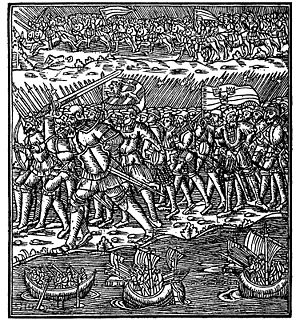
When the Swedish king Sigurd Ring
Sigurd Ring
Sigurd Hring was a Swedish and Danish king mentioned in many old Scandinavian legends. According to Bósa saga ok Herrauds, there was once a saga on Sigurd Hring, but this saga is now lost...
prepared for the Battle of the Brávellir
Battle of the Brávellir
The Battle of Brávellir or the Battle of Bråvalla was a legendary battle that is described in the Norse sagas as taking place on the Brávellir between Sigurd Ring, king of Sweden and the Geats of West Götaland, and his uncle Harald Wartooth, king of Denmark and the Geats of East...
against the Danish Harald Wartooth
Harald Wartooth
Harald Wartooth or Harold Hiltertooth was a legendary king of Sweden, Denmark, Norway and the historical northern German province of Wendland, in the 8th and 9th century...
, a much later king Áli the Bold appeared with seven other kings to help him in the battle. These kings were accompanied by a great many champions, and among them Starkad the Old, the son of Stórverkr. Starkad would later compose a poem about this battle that would serve as a source for the sagas.
When the battle had begun, a formidable champion named Ubbi of Friesland charged against Ragnvald the Good Councilor the foremost champion in the wedge formation of king Sigurd. After a fierce fight, Ragnvald died and Ubbi pushed on killing champion after champion.
When king Sigurd Ring saw this he encouraged his warriors and said that it was not possible that no one could defeat Ubbi. He then asked "where is Starkad?". The old warrior answered "it is difficult to win sire. However, I will do my best and do what I can, but Ubbi is a tough fighter". Starkad engaged with Ubbi and a fight began that was long and the most fierce of the entire battle. Eventually, Starkad gave Ubbi a single wound, but Starkad had received six big ones, and thought that no one had been closer to kill him before. The two champions were separated by the pushing throng of warriors, and Ubbi finally fell riddled with arrows from the archers of Telemark
Telemark
is a county in Norway, bordering Vestfold, Buskerud, Hordaland, Rogaland and Aust-Agder. The county administration is in Skien. Until 1919 the county was known as Bratsberg amt.-Location:...
.
The shieldmaiden
Shieldmaiden
A shieldmaiden was a woman who had chosen to fight as a warrior in Scandinavian folklore and mythology. They are often mentioned in sagas such as Hervarar saga and in Gesta Danorum. Shieldmaidens also appear in stories of other Germanic nations: Goths, Cimbri, and Marcomanni. The mythical Valkyries...
Vebiorg took on the Swedish army. First she killed the champion Söti, but then Starkad attacked her. After giving Vebiorg a number of slashes, she cut his mouth so that his chin fell. Starkad had to bite his beard to keep his chin in place. She was killed by Thorkil the Bold.
Biting his beard and ignoring his wounds, Starkad charged the Danish army, killing man after man, until he met the shieldmaiden Ursina who carried the banner of king Harald Wartooth. She told him that he had met his last opponent, but he cut off the hand that held the banner and killed her. Starkad continued killing warrior after warrior, until he finally was so severely wounded that he had a large gash on his neck and a large gash on his chest that made his two lungs hang out. On his right hand, he had lost a finger.
The battle ended with Swedish victory.
Norna-Gests þáttr
In Norna-Gests þáttrNorna-Gests þáttr
Norna-Gests þáttr or the Story of Norna-Gest is a legendary saga about the Norse hero Norna-Gest.-Summary:Norna-Gest was the son of a Danish man named Thord of Thinghusbit, who once dwelt on the estate of Grøning in Denmark. When he was born, three Norns arrived and had foretold the child's...
, the account of Starkad takes place not long after the victory at the Battle of the Brávellir
Battle of the Brávellir
The Battle of Brávellir or the Battle of Bråvalla was a legendary battle that is described in the Norse sagas as taking place on the Brávellir between Sigurd Ring, king of Sweden and the Geats of West Götaland, and his uncle Harald Wartooth, king of Denmark and the Geats of East...
. The account deals with a meeting between Starkad and the hero Sigurd
Sigurd
Sigurd is a legendary hero of Norse mythology, as well as the central character in the Völsunga saga. The earliest extant representations for his legend come in pictorial form from seven runestones in Sweden and most notably the Ramsund carving Sigurd (Old Norse: Sigurðr) is a legendary hero of...
Dragonslayer. The old Norna-Gest told that during the time when he was with Sigurd Dragonslayer, the Swedish king Sigurd Ring
Sigurd Ring
Sigurd Hring was a Swedish and Danish king mentioned in many old Scandinavian legends. According to Bósa saga ok Herrauds, there was once a saga on Sigurd Hring, but this saga is now lost...
demanded tribute from Sigurd and his people. When Sigurd refused, the king of Sweden sent an army to subdue him, led by the sons of Gandalf.
In the Swedish army, there was a man who was even bigger and stronger than the sons of Gandalf. The giant man killed both men and horses and nothing could defeat him. Sigurd and Gest approached the huge warrior and asked who he was. He answered that he was Starkad the son of Stórvirkr.
When Starkad learnt that Sigurd was the same Sigurd who had killed the dragon Fafnir
Fafnir
In Norse mythology, Fáfnir or Frænir was a son of the dwarf king Hreidmar and brother of Regin and Ótr. In the Volsunga saga, Fáfnir was a dwarf gifted with a powerful arm and fearless soul. He guarded his father's house of glittering gold and flashing gems...
, he tried to escape. However, Sigurd went after him and dealt a blow with his sword Gramr that ripped two teeth off Starkad's mouth. Sigurd then asked Starkad to go home. When Starkad had left the battle, the sons of Gandalf retired as well, and so Sigurd had won the battle against the Swedes.
Gesta Danorum
Gesta Danorum
Gesta Danorum is a patriotic work of Danish history, by the 12th century author Saxo Grammaticus . It is the most ambitious literary undertaking of medieval Denmark and is an essential source for the nation's early history...
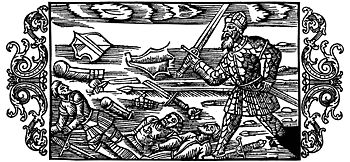
that the most comprehensive treatment of Starkad is found. The Danish chronicler Saxo Grammaticus
Saxo Grammaticus
Saxo Grammaticus also known as Saxo cognomine Longus was a Danish historian, thought to have been a secular clerk or secretary to Absalon, Archbishop of Lund, foremost advisor to Valdemar I of Denmark. He is the author of the first full history of Denmark.- Life :The Jutland Chronicle gives...
wrote that Starkad was the son of Stórvirkr (Storwerk/Storuerkus) and saved himself from a shipwreck
Shipwreck
A shipwreck is what remains of a ship that has wrecked, either sunk or beached. Whatever the cause, a sunken ship or a wrecked ship is a physical example of the event: this explains why the two concepts are often overlapping in English....
. He entered the service of the Danish king Frotho and was given a ship so that he could patroll the shores.
No man was Starkad's equal as he was endowed with a superhuman size and a noble disposition. Saxo Grammaticus gives two accounts of Starkand's origin. According to one, he was born in the land of Estonians
Estonians
Estonians are a Finnic people closely related to the Finns and inhabiting, primarily, the country of Estonia. They speak a Finnic language known as Estonian...
east of the Baltic sea
Baltic Sea
The Baltic Sea is a brackish mediterranean sea located in Northern Europe, from 53°N to 66°N latitude and from 20°E to 26°E longitude. It is bounded by the Scandinavian Peninsula, the mainland of Europe, and the Danish islands. It drains into the Kattegat by way of the Øresund, the Great Belt and...
. According to the second, which the chronicler considers fantastic and unlikely, Starkand was born by jotuns, and he had formerly many arms until Thor
Thor
In Norse mythology, Thor is a hammer-wielding god associated with thunder, lightning, storms, oak trees, strength, the protection of mankind, and also hallowing, healing, and fertility...
cut off all arms but two. Odin
Odin
Odin is a major god in Norse mythology and the ruler of Asgard. Homologous with the Anglo-Saxon "Wōden" and the Old High German "Wotan", the name is descended from Proto-Germanic "*Wodanaz" or "*Wōđanaz"....
had bestowed on Starkad the curse and the blessing that he would live the lives of three men, and commit three evil deeds.
His first evil deed was the murder of the Norwegian petty king Vikar
Víkar
Víkar was a legendary Norwegian king who found himself and his ships becalmed for a long period. To raise a wind, a human blood sacrifice was needed, and the lots fell on King Víkar himself...
(Wicarus). Starkad had joined a Viking
Viking
The term Viking is customarily used to refer to the Norse explorers, warriors, merchants, and pirates who raided, traded, explored and settled in wide areas of Europe, Asia and the North Atlantic islands from the late 8th to the mid-11th century.These Norsemen used their famed longships to...
expedition with Vikar, but they found themselves stopped by a strong wind. They then had the idea that they could appease the gods by performing a blót
Blót
The blót was Norse pagan sacrifice to the Norse gods and the spirits of the land. The sacrifice often took the form of a sacramental meal or feast. Related religious practices were performed by other Germanic peoples, such as the pagan Anglo-Saxons...
with human blood, and decided to cast lots as to whom was to be sacrificed. Starkad made a noose of willow
Willow
Willows, sallows, and osiers form the genus Salix, around 400 species of deciduous trees and shrubs, found primarily on moist soils in cold and temperate regions of the Northern Hemisphere...
and put it around the king's neck in the pretense that it was only for show and not for killing. However, the knot was so strong that the king was dying, and Starkad gave him the coup de grace with his sword. Others say that the noose of willow suddenly became so strong that the king was strangled.
Starkad joined the Danish Viking Bemon (Bemonus) and they had a tough discipline on their crew, forbidding them alcoholic beverages. During an attack in Russia
Russia
Russia or , officially known as both Russia and the Russian Federation , is a country in northern Eurasia. It is a federal semi-presidential republic, comprising 83 federal subjects...
, they discovered that the Russians had riddled the terrain with caltrop
Caltrop
A caltrop is an antipersonnel weapon made up of two or more sharp nails or spines arranged in such a manner that one of them always points upward from a stable base...
s to stop the Vikings. However, Starkad and his men donned clog
Clog (shoe)
A clog is a type of footwear made in part or completely from wood.The Oxford English Dictionary defines a clog as a "thick piece of wood", and later as a "wooden soled overshoe" and a "shoe with a thick wooden sole"....
s and so won the battle. When Bemon was dead, Starkad entered the service of the Bjarmians and did many heroic deeds among them.
Later, Starkad stayed for seven years in Sweden
Sweden
Sweden , officially the Kingdom of Sweden , is a Nordic country on the Scandinavian Peninsula in Northern Europe. Sweden borders with Norway and Finland and is connected to Denmark by a bridge-tunnel across the Öresund....
at Uppsala
Gamla Uppsala
Gamla Uppsala is a parish and a village outside Uppsala in Sweden. It had 16,231 inhabitants in 1991.As early as the 3rd century AD and the 4th century AD and onwards, it was an important religious, economic and political centre...
, with the sons of Frey
Yngling
The Ynglings were the oldest known Scandinavian dynasty. It can refer to the clans of the Scylfings , the semi-legendary royal Swedish clan during the Age of Migrations, with kings such as Eadgils, Onela and Ohthere...
. However the effeminate jingle of bells, the dancing and the mimes at the sacrifices (see the Temple at Uppsala
Temple at Uppsala
The Temple at Uppsala was a religious center in Norse paganism once located at what is now Gamla Uppsala , Sweden attested in Adam of Bremen's 11th century work Gesta Hammaburgensis ecclesiae pontificum and in Heimskringla, written by Snorri Sturluson in the 13th century...
) nauseated Starkad.
He then enlisted with the Danish king Haki
Haki
Hake, Haki or Haco, the brother of Hagbard, was a famous Scandinavian sea-king, in Norse mythology. He is mentioned in the 12th century Gesta Danorum, and in 13th-century sources including Ynglinga saga, Nafnaþulur, Völsunga saga...
(Haco), and fought for him during the attack on king Hugleik
Hugleik
Hugleik or Ochilaik was a Swedish king of the House of Yngling, according to the Ynglinga saga. He was the son of Alf and Bera.Some commentators assimilate Hugleik with his namesake, the Geatish king Hygelac...
(Hugletus) of Ireland
Ireland
Ireland is an island to the northwest of continental Europe. It is the third-largest island in Europe and the twentieth-largest island on Earth...
. Hugleik wasted his riches on actors and jugglers, but was defended by Svipdag
Svipdag
Svipdagr is the hero of the two Old Norse Eddaic poems Grógaldr and Fjölsvinnsmál, which are contained within the body of one work; Svipdagsmál...
(Suibdagus) and Geigad (Gegathus), who gave Starkad the most vicious wound he had ever received. After winning the battle, Starkad had all the mimes and jugglers flogged, and all the riches looted.
Starkad was then sent with the Slavic prince Win (Winus) to quell a rebellion in the East. He fought against Curonians
Curonians
The Curonians or Kurs were a Baltic tribe living on the shores of the Baltic sea in what are now the western parts of Latvia and Lithuania from the 5th to the 16th centuries, when they merged with other Baltic tribes. They gave their name to the region of Courland , and they spoke the Old...
, Sambians
Sambians
The Sambians were one of the Prussian tribes. They inhabited the peninsula of Sambia, north of the city of Königsberg . Sambians were located in a coastal territory rich in amber and engaged in trade early on . Therefore, they established contacts with foreign nations before any other Prussians...
, Semigallians
Semigallians
Semigallians were the Baltic tribe that lived in the southcentral part of contemporary Latvia and northern Lithuania...
, until all the Easterlings had been defeated. By covering his sword with a hide, he also defeated a warlord named Wisin (Wisinnus), who lived at Anafial in Russia, and who could make a weapon blunt only by looking at it. He continued his victories by killing the jotun Tanna in Byzantium
Byzantium
Byzantium was an ancient Greek city, founded by Greek colonists from Megara in 667 BC and named after their king Byzas . The name Byzantium is a Latinization of the original name Byzantion...
and the Polish champion Wasce/Wilzce.
When the Saxons
Saxons
The Saxons were a confederation of Germanic tribes originating on the North German plain. The Saxons earliest known area of settlement is Northern Albingia, an area approximately that of modern Holstein...
rebelled against Frotho, and challenged him to a duel against Hama, Starkad unexpectedly returned and took Frotho's place in the duel. Hama contemptuously brought Starkad to his knees with a blow by his fist, but Starkad rose up and cut Hama to death.

Swerting
Swerting was one of the Saxon ancestors of king Aella of Deira.He may be identical with the Swerting briefly mentioned in Beowulf, where he had the son or son-in-law Hrethel, who was the maternal grandfather of the hero Beowulf.-The Heaðobard tradition:A Swerting of the same timeframe also...
(Swertingus). Frotho's son Ingild (Ingellus) lived a wanton life and married one of Swerting's daughters. This angered Starkad so much that he enlisted at the Swedish king Halfdan
Halfdan
Halfdan was a late 5th and early 6th century legendary Danish king of the Scylding lineage, the son of king named Fróði in many accounts, noted mainly as the father to the two kings who succeeded him in the rule of Denmark, kings named Hroðgar and Halga in the Old English poem Beowulf and named...
's (Haldanus) court instead. However, when he learnt that Helga, Ingild's sister, was about to marry a lowly goldsmith
Goldsmith
A goldsmith is a metalworker who specializes in working with gold and other precious metals. Since ancient times the techniques of a goldsmith have evolved very little in order to produce items of jewelry of quality standards. In modern times actual goldsmiths are rare...
, Starkad appeared in disguise and castrated the goldsmith. He gave Helga a slap on her face and lambasted her. Then he returned to Sweden and king Halfdan.
Ingild gave Helga to a Norwegian named Helgi (Helgo), on the condition that he fight nine brothers from Zealand who courted her, and among whom the eldest was named Angantyr (Angaterus). Helgi went to Sweden's most famous city Uppsala
Gamla Uppsala
Gamla Uppsala is a parish and a village outside Uppsala in Sweden. It had 16,231 inhabitants in 1991.As early as the 3rd century AD and the 4th century AD and onwards, it was an important religious, economic and political centre...
and asked Starkad to help him in the fight. Starkad agreed, but left Helgi with his bride in order to fight with the nine brothers himself at the moor of Roliung.
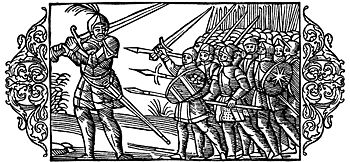
As Ingild continued his sinful life and did not do his duty to avenge his father, Starkad appeared during a banquet that Ingild had with the sons of Swerting, his father's slayer. Starkad strongly admonished Ingild and humiliated his queen who tried to calm Starkad with kindness and her costly ribbon. Starkad succeeded in exciting Ingild to kill Swerting's sons and to divorce his Saxon bride.
During the Battle of the Brávellir
Battle of the Brávellir
The Battle of Brávellir or the Battle of Bråvalla was a legendary battle that is described in the Norse sagas as taking place on the Brávellir between Sigurd Ring, king of Sweden and the Geats of West Götaland, and his uncle Harald Wartooth, king of Denmark and the Geats of East...
between the Swedish king Sigurd Ring
Sigurd Ring
Sigurd Hring was a Swedish and Danish king mentioned in many old Scandinavian legends. According to Bósa saga ok Herrauds, there was once a saga on Sigurd Hring, but this saga is now lost...
(Ringo) and Harald Wartooth
Harald Wartooth
Harald Wartooth or Harold Hiltertooth was a legendary king of Sweden, Denmark, Norway and the historical northern German province of Wendland, in the 8th and 9th century...
(Haraldus Hyldetan), Starkad fought on the Swedish side. He received such a severe wound that his lung hanged out, his skull was cleft and a finger was cut off. He had to leave the battle to tend to his wounds.
Starkad was accepted with honour in the warband of the Norwegian hero Olo
OLO
Olo or OLO may refer to:*Ale the Strong*Audovald and Olo, two generals in the Frankish campaign against the Lombards under kings Guntram and Childebert II*On Line Opinion*Ontario L'Orignal Railway*Olo n:o 22, an outdoor sculpture in Helsinki...
. However, when Olo had succeeded in conquering Zealand, Starkad was convinced to join Lennius/Lenus/Lennus scheme to attack and kill Olo. However, Olo was hard to kill as his gaze scared everyone. It was not until Starkad managed to cover Olo's face that he could kill him. Starkad was rewarded with 120 pounds in gold, but regretted his crime, and avenged Olo's death by killing Lennius.
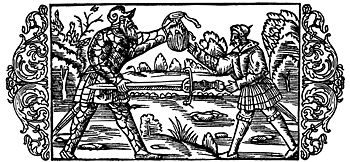
In front of Hather, Starkad sung about his accomplishments, and as Hather's response showed Starkad that Hather was of noble birth, Starkad asked him to be his slayer. Starkad promised Hather all his gold and imperviousness, should Hather cut off his head and run between the head and the body as he fell. Hather cut off Starkad's head but avoided running, as he feared being crushed by Starkad's huge body. When the head had hit the ground, it bit a tussock of grass which showed how ferocious Starkad was.
Hather did not want the old warrior to lie unburied, but showed him respect by making a barrow
Tumulus
A tumulus is a mound of earth and stones raised over a grave or graves. Tumuli are also known as barrows, burial mounds, Hügelgrab or kurgans, and can be found throughout much of the world. A tumulus composed largely or entirely of stones is usually referred to as a cairn...
for him on the heath of Roljung, at the same spot where Starkad's heavy body long ago had made an imprint on a stone.
Historia de gentibus septentrionalibus
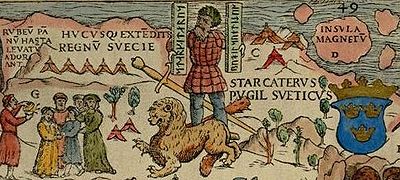
Olaus Magnus' cites the story of Starkad from Gesta DanorumGesta Danorum
Gesta Danorum is a patriotic work of Danish history, by the 12th century author Saxo Grammaticus . It is the most ambitious literary undertaking of medieval Denmark and is an essential source for the nation's early history...
. He disputes Saxo about origin of the hero and informs that Starkad was from the nation of Tavastians
Tavastians
Tavastians are a historic people and a modern subgroup of the Finnish people. They live in areas of the historical province of Tavastia and speak Tavastian dialects....
, 'Starchaterum Thauestum'.
Later traditions
Later medieval traditions locate Starkad's death and the heath of Roljung to Skåne. According to the Annales Ryenses (late 13th century), it was still possible to see Starkad's sword in the water beneath the bridge of Boilyngh when the water was low. It is likely that Boilyngh is a misspelling of Roljung. Later this spot was located to Rönne riverRönne River
Rönne River is a river in Sweden....
, and in the 16th century, people talked of the Stones of Starkkarl at Vegeholm. The Danish folklorist Axel Olrik
Axel Olrik
Axel Olrik was a Danish folklorist, and a pioneer in the methodical study of oral narrative.His Principles for Oral Narrative Research, recently translated by K. Wolf and J. Jensen, Bloomington, Ind., 1992, was first published in 1921, after Olrik's early death...
and Arthur Stille recorded many recent traditions about Starkad in north-western Skåne.
Sources and external links
- The article Starkad in Nordisk familjebok (1909)
- The article Starkad in NationalencyklopedinNationalencyklopedinNationalencyklopedin is the most comprehensive contemporary Swedish language encyclopedia, initiated by a favourable loan from the Government of Sweden of 17 million Swedish kronor in 1980, which was repaid by December 1990...
. - Northvegr website: Ynglinga saga
- The Story of Norna-Gest in English translation by George L. Hardman
- On-Line Medieval and Classical History: The Danish History books I-IX, translated by Oliver Elton (Norroena Society, New York, 1905).
- Hervarar saga in translation by Tunstall, at Northvegr.
- Gautrek's saga:
- Ancestry: Gautrek's saga
- "King Gautrek" in Seven Viking Romances. Trans. Pálsson, Hermann and Edwards, Paul (1985). Harmondsworth, England: Penguin. ISBN 0-14-044474-2.
- "King Gautrek" in Gautrek's Saga and other medieval tales. Trans. Pálsson, Hermann and Edwards, Paul (1968). London: University of London Press. ISBN 0-340-09396-X.
- Gautrek's Saga. Trans. Fox, Denton and Pálsson, Hermann (1974). Toronto: University of Toronto Press. ISBN 0-8020-1925-0.
- Gautreks saga in Old Norse from heimskringla.no
- Snerpa: Netúgáfan: Fornrit: Gautreks saga
- University of Oregon: Norse: Fornaldarsögur norðurlanda: Gautreks saga
- Sagnanet: Gautreks saga
- Beowulf:
- Old English edition edited by James Albert Harrison and Robert Sharp
- Translations of Beowulf:
- Modern English translation by Francis Barton Gummere
- Modern English translation by John Lesslie HallJohn Lesslie HallJohn Lesslie Hall , also known as J. Lesslie Hall, was an American literary scholar and poet known for his translation of Beowulf....