

Southwell Minster

Encyclopedia
Southwell Minster is a minster
and cathedral
, in Southwell
, Nottinghamshire
, England
. It is six miles away from Newark-on-Trent
and thirteen miles from Mansfield
. It is the seat of the Bishop of Southwell and Nottingham
and the Diocese of Southwell and Nottingham
.
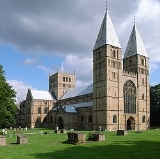
It is considered an outstanding example of Norman
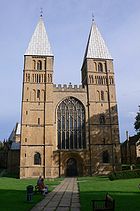
and Early English architecture. The distinctive pyramidal spires of lead (or Rhenish caps or "pepperpot" spires as they are known locally), the only example of their kind in the United Kingdom
, uniquely overlap the footprint of the tower walls and are particularly noteworthy.
 The earliest church on the site is believed to have been founded in 627 by Paulinus
, the first Archbishop of York
, on a visit to the town when he was baptising believers in the River Trent
. This legend is commemorated in the Minster's baptistry window.
In 956 King Eadwig
gave a gift of land in Southwell to Oskytel
, Archbishop of York, on which a Minster church was established. The Norman Domesday Book
of 1086 recorded Southwell manor
in great detail, and the Norman reconstruction of Southwell Minster began in 1108, probably as a gradual rebuilding of the Anglo-Saxon
church, starting (as was usual) at the East end so that the high altar could come into service as soon as possible, the Saxon building being dismantled as work progressed. Many of the stones of this earlier Saxon church
were reused in the construction of the Norman one. The tessellated
floor and late 11th century tympanum
in the North Transept
are the only pieces of the earlier, Saxon building remaining intact. Work on the nave
began after 1120 and the building was completed by c. 1150.
The Minster was built partly as an attached church of the Archbishop of York's Palace (which stood next door and is now ruined). It served the Archbishop as a place of worship and was also a collegiate body of theological
learning, hence its designation as a minster. The minster still draws its choir
from the nearby school with which it is associated.
The Norman quire
was replaced with an Early English building in 1234 because it was too small. The octagonal chapter house
, built in 1286 complete with vault
in Decorated Gothic style and naturalistic carving of foliage (a masterpiece of 13th century stonecarving including several Green Men
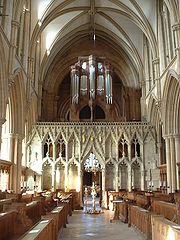
), completed the cathedral. The elaborately carved "pulpitum
" or quire screen was built in 1350.
as it was refounded in 1543 by Act of Parliament.
Southwell is where King Charles the First
was captured during the English Civil War
. The fighting saw the church seriously damaged and the nave is said to have been used as stabling. The adjoining palace was almost completely destroyed, first by Scottish troops and then by the local people, with only the hall of the Archbishop remaining as a ruined shell. The Minster's financial accounts show that extensive repairs were necessary after this period.
and tower destroying roofs, bells, clock and organ. By 1720 repairs had been completed, now giving a flat panelled ceiling to the nave and transepts.
 In 1805 Archdeacon Kaye gave the Minster the Newstead lectern; once owned by Newstead Abbey
, it had been thrown into the Abbey fishpond by the monks to save it during the Dissolution of the Monasteries
, then later discovered when the lake was dredged. Sir Henry Gally Knight in 1818 gave the Minster four panels of 16th-century Flemish glass (which now fill the bottom part of the East window) which he had acquired from a Parisian pawnshop
In danger of collapse, the "pepperpot" spires were removed in 1805 and only re-erected in 1879-1881. At this time of extensive restoration
by Ewan Christian
, an architect specialising in churches, the nave roof was also considered unsuitable due to its flatness and was completely rebuilt in the current peaked version and the choir was redesigned and refitted.
In 1540 the prebends and minster were suppressed. However an act of Parliament in 1543 re-established the colledge and church collegiate of Southwell.
Under an Act of King Edward VI, the prebendaries were pensioned off, and their estates sold. The minster continued as the parish church on the petitions of the parishioners.
By an Act of Philip and Mary
in 1557, the Minster and its prebends were again restored as before.
On 2 April 1585 a new set of statutes was promulgated by Queen Elizabeth I and the chapter operated under this constitution until it was dissolved in 1841. The Ecclesiastical Commissioners made provision for the abolition of the chapter as a whole; the death of each canon after this time resulted in the extinction of his prebend. The chapter came to its appointed end on 12 February 1873 with the death of the Rev. Thomas Henry Shepherd, rector of Clayworth and prebendary of Beckingham.
): the Diocese included the City of Derby
until it was divided in 1927, when the Diocese of Derby
was formed. Dr George Ridding
, the first Bishop of Southwell, designed and paid for the grant of Arms now used as the Diocesan coat of arms. Its creation as a cathedral has led to confusion over the civic status of Southwell. Traditionally it was considered to be a city because of the presence of the cathedral, but in more modern times the traditional definition has not been recognised by government (see city status in the United Kingdom
).
The Friends of Cathedral Music
was founded in 1956 by the Revd. Ronald Sibthorpe prompted by a decision of the Provost of Southwell to abolish the Saturday choral evensong so that lay clerks could watch the weekly football at Newark-on-Trent
.
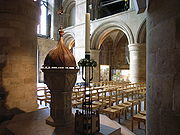
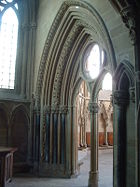 The nave, transepts, central tower and two western towers of the Norman church which replaced the Saxon minster remain as an outstanding achievement of severe Romanesque design. The central tower's two ornamental stages place it high among England's surviving Norman towers. The nave is imposing, with cylindrical columns, large triforium arches and an unaltered clerestory with rows of round windows. The choir is admirable Early English work; though comparatively low the work is of very high quality. In the 14th century the splendid choir screen and the chapter house were added. The polygonal chapter house and its vestibule comprise a Decorated masterpiece with sculptured detail including heads and naturalistic foliage, the latter being unsurpassed in England. The brass lectern of ca. 1500 came from Newstead Abbey and the sanctuary contains some fine Parisian glass of the early 16th century. There is the tomb of Archbishop Sandys of York (died 1588).
Former Provosts and Deans
The title of Provost was changed in 2000 to Dean.
Canons
, a "boy band" comprising three cathedral choristers.
There is also a Girls' Choir and the Minster Chorale, a choir of adult volunteers.
The Minster follows the rites of the Church of England
and uses the 1662 Book of Common Prayer
for the main Choral Eucharist on Sunday.
Per Week during term time the Cathedral Choirs sing:
Sunday
Monday
Tuesday
Thursday
Friday
Saturday
The Cathedral Choir
In recent years, the choir has broadcast regularly on BBC Radio 3
, have recorded CDs, have toured in Europe, have filmed Christmas programmes, and have given world premières of specially commissioned works such as Paul Patterson
’s Southwell Millennium Mass. Their most recent tour was in Puglia May 2010.
Choristers
There are usually 16 choristers in the Cathedral Choir. As with most choirs there is a ranking system of Head Chorister; Deputy Head Chorister; Tippet Boys; Senior Singing Boys; Junior Singing Boys and Probationers. There are also Juniors who do not sing with the full choir, but are training to become full choristers.
Lay Clerks/Choral Scholars and Vicar Choral
There are six full-time Lay Clerks in the Cathedral Choir. These are supplemented by a further six men on alternate Sunday evenings and on special occasions, expanding the repertoire and force of the choir.
The Cathedral Girls' Choir
The Minster Girls’ Choir was formed in February 2005 by the then Assistant Organist Simon Bell. The choir is made up of eighteen choristers, under the direction of Philip White-Jones, the Assistant Director of Music, and is designed to complement the Boys’ Choir which has been singing at the Minster for hundreds of years.
The girls are drawn exclusively from the Minster school, beginning at year 7 and progressing through to year 13. They rehearse twice a week, on Mondays, and Thursdays. They currently sing alternately between Evensong on Mondays at 5.45 pm and the 9.30 am Family Eucharist on Sundays.
The choir’s repertoire consists of music written for upper voices. Including music by composers such as Jean Langlais, Charles Wood and George Dyson. In September 2007, the choir sang a commissioned anthem by Andrew Parnell, a former chorister at Southwell, as part of the service of installation of the Dean. Their first tour was to Stavanger in Norway in October 2009, this included concerts and services. They have recently released their first CD, Christus Rex - a selection of music from Lent to Ascension, including Leighton's Easter Sequence.
The Minster Chorale
The Minster Chorale is an adult voluntary choir that sings frequent services throughout the year in the Minster. It consists of up to thirty members who meet to rehearse most Friday evenings during school term times. Currently directed by the Minster's Assistant Director of Music, Philip White-Jones, the Minster Chorale was founded in 1994 by Philip Rushforth and Paul Hale.
The Choir sings a cross-section of the whole repertoire of traditional Cathedral music, including works by Palestrina, Byrd, Mozart, Stanford and Howells.
During the year, the Chorale deputizes for the Minster Choir at half-term, and additionally sings at many of the evening Eucharist services on high feast days, such as Ash Wednesday, Maundy Thursday and Ascension Day. The Chorale takes its share of Christmas duties, singing at Midnight Mass.
The Chorale’s high reputation means that it is also invited to perform occasional concerts and services away from the Minster. In recent years, the Chorale has sung in Rievaulx Abbey, St Mary’s Collegiate Church in Warwick, and Uppingham Parish Church. In July 2005, the Chorale ventured abroad for the first time, singing services at Christ Church Cathedral, Dublin. In the Summer of 2011, the Chorale joined with the Voluntary Choir of Rochester Cathedral to celebrate the music of Rochester composers such as Robert Ashfield, Barry Ferguson and Percy Whitlock. The choir’s regular accompanist is the Minster’s Organ Scholar.
Assistant Directors of Music:
David McIntosh Organ Scholarship
Minster (cathedral)
Minster is an honorific title given to particular churches in England, most famously York Minster. The term minster is first found in royal foundation charters of the 7th century; and, although it corresponds to the Latin monasterium or monastery, it then designated any settlement of clergy living...
and cathedral
Cathedral
A cathedral is a Christian church that contains the seat of a bishop...
, in Southwell
Southwell, Nottinghamshire
Southwell is a town in Nottinghamshire, England, best known as the site of Southwell Minster, the seat of the Church of England diocese that covers Nottinghamshire...
, Nottinghamshire
Nottinghamshire
Nottinghamshire is a county in the East Midlands of England, bordering South Yorkshire to the north-west, Lincolnshire to the east, Leicestershire to the south, and Derbyshire to the west...
, England
England
England is a country that is part of the United Kingdom. It shares land borders with Scotland to the north and Wales to the west; the Irish Sea is to the north west, the Celtic Sea to the south west, with the North Sea to the east and the English Channel to the south separating it from continental...
. It is six miles away from Newark-on-Trent
Newark-on-Trent
Newark-on-Trent is a market town in Nottinghamshire in the East Midlands region of England. It stands on the River Trent, the A1 , and the East Coast Main Line railway. The origins of the town are possibly Roman as it lies on an important Roman road, the Fosse Way...
and thirteen miles from Mansfield
Mansfield
Mansfield is a town in Nottinghamshire, England. It is the main town in the Mansfield local government district. Mansfield is a part of the Mansfield Urban Area....
. It is the seat of the Bishop of Southwell and Nottingham
Bishop of Southwell and Nottingham
The Bishop of Southwell and Nottingham is the diocesan bishop of the Church of England Diocese of Southwell and Nottingham in the Province of York.The diocese covers including the whole of Nottinghamshire and a small area of South Yorkshire...
and the Diocese of Southwell and Nottingham
Diocese of Southwell and Nottingham
The Diocese of Southwell and Nottingham is a Church of England diocese in the Province of York. It is headed by the Bishop of Southwell and Nottingham. The diocese covers all of the English county of Nottinghamshire and part of South Yorkshire...
.
It is considered an outstanding example of Norman
Norman architecture
About|Romanesque architecture, primarily English|other buildings in Normandy|Architecture of Normandy.File:Durham Cathedral. Nave by James Valentine c.1890.jpg|thumb|200px|The nave of Durham Cathedral demonstrates the characteristic round arched style, though use of shallow pointed arches above the...
and Early English architecture. The distinctive pyramidal spires of lead (or Rhenish caps or "pepperpot" spires as they are known locally), the only example of their kind in the United Kingdom
United Kingdom
The United Kingdom of Great Britain and Northern IrelandIn the United Kingdom and Dependencies, other languages have been officially recognised as legitimate autochthonous languages under the European Charter for Regional or Minority Languages...
, uniquely overlap the footprint of the tower walls and are particularly noteworthy.
Mediæval
Paulinus of York
Paulinus was a Roman missionary and the first Bishop of York. A member of the Gregorian mission sent in 601 by Pope Gregory I to Christianize the Anglo-Saxons from their native Anglo-Saxon paganism, Paulinus arrived in England by 604 with the second missionary group...
, the first Archbishop of York
Archbishop of York
The Archbishop of York is a high-ranking cleric in the Church of England, second only to the Archbishop of Canterbury. He is the diocesan bishop of the Diocese of York and metropolitan of the Province of York, which covers the northern portion of England as well as the Isle of Man...
, on a visit to the town when he was baptising believers in the River Trent
River Trent
The River Trent is one of the major rivers of England. Its source is in Staffordshire on the southern edge of Biddulph Moor. It flows through the Midlands until it joins the River Ouse at Trent Falls to form the Humber Estuary, which empties into the North Sea below Hull and Immingham.The Trent...
. This legend is commemorated in the Minster's baptistry window.
In 956 King Eadwig
Edwy of England
Eadwig, more rarely Edwy , sometimes nicknamed All-Fair or the Fair, was King of England from 955 until his death four years later. The eldest son of King Edmund and Ælfgifu of Shaftesbury, Eadwig was chosen by the nobility to succeed his uncle Eadred as King...
gave a gift of land in Southwell to Oskytel
Oskytel
Oscytel was a medieval Bishop of Dorchester and Archbishop of York.Oscytel was probably of Danish ancestry. He was related to Oswald, Bishop of Worcester and later Archbishop of York, and Thurcytel, who was abbot of Bedford Abbey. All three men were landowners in the eastern midlands, with Oskytel...
, Archbishop of York, on which a Minster church was established. The Norman Domesday Book
Domesday Book
Domesday Book , now held at The National Archives, Kew, Richmond upon Thames in South West London, is the record of the great survey of much of England and parts of Wales completed in 1086...
of 1086 recorded Southwell manor
Manorialism
Manorialism, an essential element of feudal society, was the organizing principle of rural economy that originated in the villa system of the Late Roman Empire, was widely practiced in medieval western and parts of central Europe, and was slowly replaced by the advent of a money-based market...
in great detail, and the Norman reconstruction of Southwell Minster began in 1108, probably as a gradual rebuilding of the Anglo-Saxon
Anglo-Saxon architecture
Anglo-Saxon architecture was a period in the history of architecture in England, and parts of Wales, from the mid-5th century until the Norman Conquest of 1066. Anglo-Saxon secular buildings in Britain were generally simple, constructed mainly using timber with thatch for roofing...
church, starting (as was usual) at the East end so that the high altar could come into service as soon as possible, the Saxon building being dismantled as work progressed. Many of the stones of this earlier Saxon church
Anglo-Saxon architecture
Anglo-Saxon architecture was a period in the history of architecture in England, and parts of Wales, from the mid-5th century until the Norman Conquest of 1066. Anglo-Saxon secular buildings in Britain were generally simple, constructed mainly using timber with thatch for roofing...
were reused in the construction of the Norman one. The tessellated
Tessellation
A tessellation or tiling of the plane is a pattern of plane figures that fills the plane with no overlaps and no gaps. One may also speak of tessellations of parts of the plane or of other surfaces. Generalizations to higher dimensions are also possible. Tessellations frequently appeared in the art...
floor and late 11th century tympanum
Tympanum (architecture)
In architecture, a tympanum is the semi-circular or triangular decorative wall surface over an entrance, bounded by a lintel and arch. It often contains sculpture or other imagery or ornaments. Most architectural styles include this element....
in the North Transept
Transept
For the periodical go to The Transept.A transept is a transverse section, of any building, which lies across the main body of the building. In Christian churches, a transept is an area set crosswise to the nave in a cruciform building in Romanesque and Gothic Christian church architecture...
are the only pieces of the earlier, Saxon building remaining intact. Work on the nave
Nave
In Romanesque and Gothic Christian abbey, cathedral basilica and church architecture, the nave is the central approach to the high altar, the main body of the church. "Nave" was probably suggested by the keel shape of its vaulting...
began after 1120 and the building was completed by c. 1150.
The Minster was built partly as an attached church of the Archbishop of York's Palace (which stood next door and is now ruined). It served the Archbishop as a place of worship and was also a collegiate body of theological
Theology
Theology is the systematic and rational study of religion and its influences and of the nature of religious truths, or the learned profession acquired by completing specialized training in religious studies, usually at a university or school of divinity or seminary.-Definition:Augustine of Hippo...
learning, hence its designation as a minster. The minster still draws its choir
Choir
A choir, chorale or chorus is a musical ensemble of singers. Choral music, in turn, is the music written specifically for such an ensemble to perform.A body of singers who perform together as a group is called a choir or chorus...
from the nearby school with which it is associated.
The Norman quire
Quire (architecture)
Architecturally, the choir is the area of a church or cathedral, usually in the western part of the chancel between the nave and the sanctuary . The choir is occasionally located in the eastern part of the nave...
was replaced with an Early English building in 1234 because it was too small. The octagonal chapter house
Chapter house
A chapter house or chapterhouse is a building or room attached to a cathedral or collegiate church in which meetings are held. They can also be found in medieval monasteries....
, built in 1286 complete with vault
Vault (architecture)
A Vault is an architectural term for an arched form used to provide a space with a ceiling or roof. The parts of a vault exert lateral thrust that require a counter resistance. When vaults are built underground, the ground gives all the resistance required...
in Decorated Gothic style and naturalistic carving of foliage (a masterpiece of 13th century stonecarving including several Green Men
Green Man
A Green Man is a sculpture, drawing, or other representation of a face surrounded by or made from leaves. Branches or vines may sprout from the nose, mouth, nostrils or other parts of the face and these shoots may bear flowers or fruit...
), completed the cathedral. The elaborately carved "pulpitum
Pulpitum
The pulpitum is a common feature in medieval cathedral and monastic architecture in Europe. It is a massive screen, most often constructed of stone, or occasionally timber, that divides the choir from the nave and ambulatory The pulpitum is a common feature in medieval cathedral and monastic...
" or quire screen was built in 1350.
Reformation and Civil War
The cathedral suffered less than many others in the English ReformationEnglish Reformation
The English Reformation was the series of events in 16th-century England by which the Church of England broke away from the authority of the Pope and the Roman Catholic Church....
as it was refounded in 1543 by Act of Parliament.
Southwell is where King Charles the First
Charles I of England
Charles I was King of England, King of Scotland, and King of Ireland from 27 March 1625 until his execution in 1649. Charles engaged in a struggle for power with the Parliament of England, attempting to obtain royal revenue whilst Parliament sought to curb his Royal prerogative which Charles...
was captured during the English Civil War
English Civil War
The English Civil War was a series of armed conflicts and political machinations between Parliamentarians and Royalists...
. The fighting saw the church seriously damaged and the nave is said to have been used as stabling. The adjoining palace was almost completely destroyed, first by Scottish troops and then by the local people, with only the hall of the Archbishop remaining as a ruined shell. The Minster's financial accounts show that extensive repairs were necessary after this period.
18th century
On 5 November 1711, during a terrible storm, the southwest spire was struck by lightning, and the resulting fire spread to the nave, crossingCrossing (architecture)
A crossing, in ecclesiastical architecture, is the junction of the four arms of a cruciform church.In a typically oriented church , the crossing gives access to the nave on the west, the transept arms on the north and south, and the choir on the east.The crossing is sometimes surmounted by a tower...
and tower destroying roofs, bells, clock and organ. By 1720 repairs had been completed, now giving a flat panelled ceiling to the nave and transepts.
Victorian
Newstead Abbey
Newstead Abbey, in Nottinghamshire, England, originally an Augustinian priory, is now best known as the ancestral home of Lord Byron.-Monastic foundation:The priory of St...
, it had been thrown into the Abbey fishpond by the monks to save it during the Dissolution of the Monasteries
Dissolution of the Monasteries
The Dissolution of the Monasteries, sometimes referred to as the Suppression of the Monasteries, was the set of administrative and legal processes between 1536 and 1541 by which Henry VIII disbanded monasteries, priories, convents and friaries in England, Wales and Ireland; appropriated their...
, then later discovered when the lake was dredged. Sir Henry Gally Knight in 1818 gave the Minster four panels of 16th-century Flemish glass (which now fill the bottom part of the East window) which he had acquired from a Parisian pawnshop
In danger of collapse, the "pepperpot" spires were removed in 1805 and only re-erected in 1879-1881. At this time of extensive restoration
Victorian restoration
Victorian restoration is the term commonly used to refer to the widespread and extensive refurbishment and rebuilding of Church of England churches and cathedrals that took place in England and Wales during the 19th-century reign of Queen Victoria...
by Ewan Christian
Ewan Christian
Ewan Christian was a British architect. He is most notable for the restoration of Carlisle Cathedral, the alterations to Christ Church, Spitalfields in 1866, and the extension to the National Gallery that created the National Portrait Gallery. He was architect to the Ecclesiastical Commissioners...
, an architect specialising in churches, the nave roof was also considered unsuitable due to its flatness and was completely rebuilt in the current peaked version and the choir was redesigned and refitted.
Collegiate church
Southwell Minster was originally served by its Prebendaries. These evolved from the early days of the Minster foundation until there were 16 in existence. This was as early as 1291 when they are all mentioned in the Taxation Roll.In 1540 the prebends and minster were suppressed. However an act of Parliament in 1543 re-established the colledge and church collegiate of Southwell.
Under an Act of King Edward VI, the prebendaries were pensioned off, and their estates sold. The minster continued as the parish church on the petitions of the parishioners.
By an Act of Philip and Mary
Mary I of England
Mary I was queen regnant of England and Ireland from July 1553 until her death.She was the only surviving child born of the ill-fated marriage of Henry VIII and his first wife Catherine of Aragon. Her younger half-brother, Edward VI, succeeded Henry in 1547...
in 1557, the Minster and its prebends were again restored as before.
On 2 April 1585 a new set of statutes was promulgated by Queen Elizabeth I and the chapter operated under this constitution until it was dissolved in 1841. The Ecclesiastical Commissioners made provision for the abolition of the chapter as a whole; the death of each canon after this time resulted in the extinction of his prebend. The chapter came to its appointed end on 12 February 1873 with the death of the Rev. Thomas Henry Shepherd, rector of Clayworth and prebendary of Beckingham.
Cathedral
In 1884 Southwell Minster finally became a cathedral proper for Nottinghamshire and a part of nearby Derbyshire (an event whose centenary was commemorated with a royal visit to hand out the Maundy moneyMaundy money
Royal Maundy is a religious service in the Church of England held on Maundy Thursday, the day before Good Friday. At the service, the British Monarch or a royal official ceremonially distributes small silver coins known as "Maundy money" as symbolic alms to elderly recipients...
): the Diocese included the City of Derby
Derby
Derby , is a city and unitary authority in the East Midlands region of England. It lies upon the banks of the River Derwent and is located in the south of the ceremonial county of Derbyshire. In the 2001 census, the population of the city was 233,700, whilst that of the Derby Urban Area was 229,407...
until it was divided in 1927, when the Diocese of Derby
Diocese of Derby
The Diocese of Derby is a Church of England diocese in the Province of Canterbury, roughly covering the same area as the County of Derbyshire. Its diocesan bishop is the Bishop of Derby who has his seat at Derby Cathedral. He is assisted by the Suffragan Bishop of Repton.The Diocese of Derby...
was formed. Dr George Ridding
George Ridding
George Ridding , English headmaster and bishop, was born at Winchester College, of which his father, the Rev. Charles Ridding, vicar of Andover, was a fellow....
, the first Bishop of Southwell, designed and paid for the grant of Arms now used as the Diocesan coat of arms. Its creation as a cathedral has led to confusion over the civic status of Southwell. Traditionally it was considered to be a city because of the presence of the cathedral, but in more modern times the traditional definition has not been recognised by government (see city status in the United Kingdom
City status in the United Kingdom
City status in the United Kingdom is granted by the British monarch to a select group of communities. The holding of city status gives a settlement no special rights other than that of calling itself a "city". Nonetheless, this appellation carries its own prestige and, consequently, competitions...
).
The Friends of Cathedral Music
Friends of Cathedral Music
The Friends of Cathedral Music is a charity which seeks to maintain and expand the work of choral foundations of cathedrals, collegiate churches, chapels, and other appropriate places of worship in the United Kingdom and the Republic of Ireland...
was founded in 1956 by the Revd. Ronald Sibthorpe prompted by a decision of the Provost of Southwell to abolish the Saturday choral evensong so that lay clerks could watch the weekly football at Newark-on-Trent
Newark-on-Trent
Newark-on-Trent is a market town in Nottinghamshire in the East Midlands region of England. It stands on the River Trent, the A1 , and the East Coast Main Line railway. The origins of the town are possibly Roman as it lies on an important Roman road, the Fosse Way...
.
Architecture
Clergy
Dean- Dean: The Very Reverend John Arthur GuilleJohn Arthur GuilleJohn Arthur Guille is the current Dean of Southwell. He was born on 21 May 1949, educated at Guernsey Grammar School for boys and ordained after a brief career as a teacher in 1977. He was a Curate at Chandler's Ford then Priest in charge of St John, Bournemouth and after that Rector of St André...
, BThBachelor of TheologyThe Bachelor of Theology is a three to five year undergraduate degree in theological disciplines. Candidates for this degree typically must complete course work in Greek or Hebrew, as well as systematic theology, biblical theology, ethics, homiletics and Christian ministry...
(Southampton)University of SouthamptonThe University of Southampton is a British public university located in the city of Southampton, England, a member of the Russell Group. The origins of the university can be dated back to the founding of the Hartley Institution in 1862 by Henry Robertson Hartley. In 1902, the Institution developed...
(since 2006)
Former Provosts and Deans
The title of Provost was changed in 2000 to Dean.
- William James ConybeareWilliam James ConybeareThe Very Rev William James Conybeare was an eminent Anglican priest in the first half of the 20th century.William James Conybeare was born on 19 December 1871 and educated at Eton and Trinity College, Cambridge. Ordained in 1898, he was Domestic Chaplain to successive Archbishops of Canterbury...
1931–1945 - Hugh Christopher Lempriere HeywoodHugh Christopher Lempriere HeywoodThe Very Rev Hugh Christopher Lempriere Heywood was an eminent Anglican priest and author in the mid 20th century. He was born on 5 November 1896 and educated at Haileybury and Trinity College, Cambridge. After World War I service with the Manchester Regiment he was ordained in 1926...
1945–1969 - John Francis Isaac PrattJohn Francis Isaac PrattJohn Francis Isaac Pratt was an Anglican priest.He was born on 30 June 1913 and educated at Keble College, Oxford. He was ordained in 1937. He held incumbencies in Rastrick, Wendover and Reading before becoming Archdeacon of Buckingham. In 1970 he became Provost of Southwell. He died on 3 March...
1970 - 1978 - John Murray IrvineJohn Murray IrvineJohn Murray Irvine was an Anglican priest.Irvine was educated at Charterhouse and Magdalene College, Cambridge. He was ordained in 1949. He was ordained in 1949 and was initially a Curate at All Saints Church, Poplar. After this he was Chaplain of Sidney Sussex College, Cambridge...
1978–1991 - David LeaningDavid LeaningDavid Leaning is an Anglican priest, who held various offices in the last decades of the 20th century and the early ones of the 21st century. He was born on 18 August 1936, educated at Keble College, Oxford and ordained in 1961. He was Curate of Gainsborough then held incumbencies in Warsop and...
1991–2006
Canons
- Canon Pastor: The Reverend Canon Nigel John Coates, BScBachelor of ScienceA Bachelor of Science is an undergraduate academic degree awarded for completed courses that generally last three to five years .-Australia:In Australia, the BSc is a 3 year degree, offered from 1st year on...
MAMaster of Arts (postgraduate)A Master of Arts from the Latin Magister Artium, is a type of Master's degree awarded by universities in many countries. The M.A. is usually contrasted with the M.S. or M.Sc. degrees...
(Reading)University of ReadingThe University of Reading is a university in the English town of Reading, Berkshire. The University was established in 1892 as University College, Reading and received its Royal Charter in 1926. It is based on several campuses in, and around, the town of Reading.The University has a long tradition... - Canon Precentor: The Reverend Canon Jaqueline Dorian Jones, BDBachelor of DivinityIn Western universities, a Bachelor of Divinity is usually an undergraduate academic degree awarded for a course taken in the study of divinity or related disciplines, such as theology or, rarely, religious studies....
MThMaster of TheologyA Master of Theology is an advanced theological research degree offered by universities, divinity schools, and seminaries.-North America:In North America, the Master of Theology is considered by the Association of Theological Schools to be the minimum educational credential for teaching...
(Lond)University of London-20th century:Shortly after 6 Burlington Gardens was vacated, the University went through a period of rapid expansion. Bedford College, Royal Holloway and the London School of Economics all joined in 1900, Regent's Park College, which had affiliated in 1841 became an official divinity school of the...
, AKC - Canon for Education & Learning:The Reverend Canon Edward Pruen, BDBachelor of DivinityIn Western universities, a Bachelor of Divinity is usually an undergraduate academic degree awarded for a course taken in the study of divinity or related disciplines, such as theology or, rarely, religious studies....
(Lond)University of London-20th century:Shortly after 6 Burlington Gardens was vacated, the University went through a period of rapid expansion. Bedford College, Royal Holloway and the London School of Economics all joined in 1900, Regent's Park College, which had affiliated in 1841 became an official divinity school of the...
AKC DPS - Priest Vicar :The Reverend Canon Professor Alison Milbank PhDDoctor of TheologyDoctor of Theology is a terminal academic degree in theology. It is a research degree that is considered by the U.S. National Science Foundation to be the equivalent of a Doctor of Philosophy....
(Lancaster), MA(Cantab) - Bishop's Chaplin : The Reverend Canon Tony Evans BThBachelor of TheologyThe Bachelor of Theology is a three to five year undergraduate degree in theological disciplines. Candidates for this degree typically must complete course work in Greek or Hebrew, as well as systematic theology, biblical theology, ethics, homiletics and Christian ministry...
BABachelor of ArtsA Bachelor of Arts , from the Latin artium baccalaureus, is a bachelor's degree awarded for an undergraduate course or program in either the liberal arts, the sciences, or both...
(Nottingham)University of NottinghamThe University of Nottingham is a public research university based in Nottingham, United Kingdom, with further campuses in Ningbo, China and Kuala Lumpur, Malaysia... - The Venerable Canon Robin Turner CB, DL, AKC BABachelor of ArtsA Bachelor of Arts , from the Latin artium baccalaureus, is a bachelor's degree awarded for an undergraduate course or program in either the liberal arts, the sciences, or both...
MThMaster of TheologyA Master of Theology is an advanced theological research degree offered by universities, divinity schools, and seminaries.-North America:In North America, the Master of Theology is considered by the Association of Theological Schools to be the minimum educational credential for teaching...
FRSA
Lay Staff
- Rector Chori: Paul Hale, MA(Oxon) FRCORoyal College of OrganistsThe Royal College of Organists or RCO, is a charity and membership organisation based in the United Kingdom, but with members around the world...
ARCM PGCE FGCM FRSCM FRSA FNMSM - Assistant Director of Music: Philip White-Jones, MA(Cantab) FRCORoyal College of OrganistsThe Royal College of Organists or RCO, is a charity and membership organisation based in the United Kingdom, but with members around the world...
- Organ Scholar: Hilary Punnett
- Head Verger: Andrew Todd
Music and liturgy
Much of the worship at the Minster is led by the Minster Choir, a traditional cathedral choir of boys and men, directed by the Rector Chori (Literally "The Ruler of the Choir"), Paul Robert Hale. Choristers are educated at the Minster School, which is unusual among choir schools as it is in the state sector. The Minster Choir has recently attracted international attention thanks to previous head chorister Ben Inman, who was a member of The ChoirboysThe Choirboys (boyband)
The Choirboys are an English boy band, made up of cathedral choristers. In 2005, a talent search was held to find a young chorister to bring choral music into the then current music scene, however, the judges could not decide which of its three finalists should be given the recording contract and...
, a "boy band" comprising three cathedral choristers.
There is also a Girls' Choir and the Minster Chorale, a choir of adult volunteers.
The Minster follows the rites of the Church of England
Church of England
The Church of England is the officially established Christian church in England and the Mother Church of the worldwide Anglican Communion. The church considers itself within the tradition of Western Christianity and dates its formal establishment principally to the mission to England by St...
and uses the 1662 Book of Common Prayer
Book of Common Prayer
The Book of Common Prayer is the short title of a number of related prayer books used in the Anglican Communion, as well as by the Continuing Anglican, "Anglican realignment" and other Anglican churches. The original book, published in 1549 , in the reign of Edward VI, was a product of the English...
for the main Choral Eucharist on Sunday.
Per Week during term time the Cathedral Choirs sing:
Sunday
- 09:30 - Family Eucharist (Girls' Choir, Minster Chorale or occasionally Boys and Men)
- 11:15 - Sung Eucharist or Matins (Cathedral Choir)
- 15:30 - Choral Evensong (Cathedral Choir)
Monday
- 17:45 - Choral Evensong (Girls' Choir when not singing Sunday)
Tuesday
- 17:45 - Choral Evensong (Boys Only)
Thursday
- 17:45 - Choral Evensong (Cathedral Choir)
Friday
- 17:45 - Choral Evensong (Cathedral Choir, Unaccompanied)
Saturday
- 17:45 - Choral Evensong (Cathedral Choir)
The Cathedral Choir
In recent years, the choir has broadcast regularly on BBC Radio 3
BBC Radio 3
BBC Radio 3 is a national radio station operated by the BBC within the United Kingdom. Its output centres on classical music and opera, but jazz, world music, drama, culture and the arts also feature. The station is the world’s most significant commissioner of new music, and its New Generation...
, have recorded CDs, have toured in Europe, have filmed Christmas programmes, and have given world premières of specially commissioned works such as Paul Patterson
Paul Patterson
Paul Patterson is a British composer and Manson Professor of Composition at the Royal Academy of Music.Patterson studied trombone and composition at the Royal Academy of Music. He returned there to become Head of Composition and Contemporary Music until 1997, when he became Manson Professor of...
’s Southwell Millennium Mass. Their most recent tour was in Puglia May 2010.
Choristers
There are usually 16 choristers in the Cathedral Choir. As with most choirs there is a ranking system of Head Chorister; Deputy Head Chorister; Tippet Boys; Senior Singing Boys; Junior Singing Boys and Probationers. There are also Juniors who do not sing with the full choir, but are training to become full choristers.
Lay Clerks/Choral Scholars and Vicar Choral
There are six full-time Lay Clerks in the Cathedral Choir. These are supplemented by a further six men on alternate Sunday evenings and on special occasions, expanding the repertoire and force of the choir.
The Cathedral Girls' Choir
The Minster Girls’ Choir was formed in February 2005 by the then Assistant Organist Simon Bell. The choir is made up of eighteen choristers, under the direction of Philip White-Jones, the Assistant Director of Music, and is designed to complement the Boys’ Choir which has been singing at the Minster for hundreds of years.
The girls are drawn exclusively from the Minster school, beginning at year 7 and progressing through to year 13. They rehearse twice a week, on Mondays, and Thursdays. They currently sing alternately between Evensong on Mondays at 5.45 pm and the 9.30 am Family Eucharist on Sundays.
The choir’s repertoire consists of music written for upper voices. Including music by composers such as Jean Langlais, Charles Wood and George Dyson. In September 2007, the choir sang a commissioned anthem by Andrew Parnell, a former chorister at Southwell, as part of the service of installation of the Dean. Their first tour was to Stavanger in Norway in October 2009, this included concerts and services. They have recently released their first CD, Christus Rex - a selection of music from Lent to Ascension, including Leighton's Easter Sequence.
The Minster Chorale
The Minster Chorale is an adult voluntary choir that sings frequent services throughout the year in the Minster. It consists of up to thirty members who meet to rehearse most Friday evenings during school term times. Currently directed by the Minster's Assistant Director of Music, Philip White-Jones, the Minster Chorale was founded in 1994 by Philip Rushforth and Paul Hale.
The Choir sings a cross-section of the whole repertoire of traditional Cathedral music, including works by Palestrina, Byrd, Mozart, Stanford and Howells.
During the year, the Chorale deputizes for the Minster Choir at half-term, and additionally sings at many of the evening Eucharist services on high feast days, such as Ash Wednesday, Maundy Thursday and Ascension Day. The Chorale takes its share of Christmas duties, singing at Midnight Mass.
The Chorale’s high reputation means that it is also invited to perform occasional concerts and services away from the Minster. In recent years, the Chorale has sung in Rievaulx Abbey, St Mary’s Collegiate Church in Warwick, and Uppingham Parish Church. In July 2005, the Chorale ventured abroad for the first time, singing services at Christ Church Cathedral, Dublin. In the Summer of 2011, the Chorale joined with the Voluntary Choir of Rochester Cathedral to celebrate the music of Rochester composers such as Robert Ashfield, Barry Ferguson and Percy Whitlock. The choir’s regular accompanist is the Minster’s Organ Scholar.
List of Rectores Chori
- Lawrence Pepys 1499
- Rev George Vincent 1519
- George Thetford 1568
- John Mudd 1582
- Thomas Foster 1584
- William Colbecke 1586
- John Beeston 1594
- Edward Manestie 1596
- Francis Dogson 1622
- John Hutchinson 1628
- Edward Chappell 1661
- George Chappell 1690
- William Popeley 1699
- William Lee 1718-1754
- Samuel Wise 1754-1755
- Edmund AyrtonEdmund AyrtonEdmund Ayrton was an English organist who was Master of the Children of the Chapel Royal.-Life:Ayrton was born at Ripon and baptised on 19 November 1734. His father was Edward Ayrton , a 'barber chirurgion,' who became an alderman in Ripon on 14 August 1758, and mayor in 1760...
1755-1764 - Thomas SpofforthThomas Spofforth-Life:One of his pupils was his nephew, Samuel Spofforth who later became organist of Peterborough Cathedral and Lichfield Cathedral.He was granted a pension from the minster in 1818 of £25 per annum. He died at Southwell in 1826 and is buried in the south transept of Southwell Minster.-References:...
1764-1818 - Edward Heathcote 1818-1835
- Frederick GuntonFrederick GuntonFrederick Gunton, born 1813 in Norwich, and died 1888 in Chester, was an English Organist.-Life:He was the son of Thomas Gunton and Mary and he studied organ under Alfred Pettet at St Peter Mancroft in Norwich.He is buried in Upton churchyard.-Career:...
1835-1841 - Chappell BatchelorChappell Batchelor-Life:He was born in Southwell in 1822 to John Batchelor and Ann and was a chorister in the cathedral choir from 1830. He was King's Scholar at the Royal Academy of Music from 1838....
1841-1857 - Herbert Stephen IronsHerbert Stephen IronsHerbert Stephen Irons, born 19 January 1834 in Canterbury and died 29 June 1905, was an English Organist. He also wrote hymns including the tune "Southwell".-Career:He was a chorister at Canterbury Cathedral.He was*Organist of St...
1857-1872 - Cedric BucknallCedric BucknallCedric Bucknall, born 2 May 1849 in Bath and died 12 December, 1921, was an English organist.-Life:He was the son of John Bucknall and Elizabeth Bassett. He married Abbie Cecilia Frye on 27 April 1873 in West Hackney.Children:...
1872-1876
- William Weaver Ringrose 1876-1879
- W Arthur Marriott 1879-1888
- Robert William Liddle 1888-1918
- Harry William Tupper 1918-1929
- George Thomas Francis 1929-1946
- Robert James AshfieldRobert AshfieldRobert Ashfield was an English cathedral organist, choirmaster and composer.-Early life and education:Robert James Ashfield was born in 1911 at Chipstead, Surrey. Educated at Tonbridge School and the Royal College of Music , he inherited his considerable musical talent from his mother, a fine...
1946-1956 - David James LumsdenDavid Lumsden (musician)Sir David James Lumsden PhD, DPhil, MA, MusB, FRCM, FRNCM, FRSAMD, FLCM, FRSA, Hon RAM, Hon FRCO, FKC .*Choirmaster, organist and harpsichordist,**St Mary's Church, Nottingham, 1954–1956**Southwell Minster 1956-1959,...
1956-1959 - Kenneth Bernard BeardKenneth BeardKenneth Bernard Beard MA BA FRCO CHM was an English Cathedral Organist.-Education:...
1959-1989 - Paul Robert Hale 1989-
List of Organists
Assistant Organists:- Lawrence Frederick Baguley 1897 - 1902
- Sydney WealeSydney WealeSydney Harry Franz Weale was an cathedral organist, who served in St Columb's Cathedral, Derry and was borough organist for Stoke on Trent.-Career:Assistant organist of:*St David's Cathedral 1899 - 1901...
1903 - 1904 (formerly assistant organist at the Church of St. Mary Magdalene, Newark-on-TrentChurch of St. Mary Magdalene, Newark-on-TrentThe Church of St. Mary Magadalene, Newark-on-Trent is a parish church in the Church of England in Newark-on-Trent in Nottinghamshire.The church is Grade I listed by the Department for Culture, Media & Sport as a building of outstanding architectural or historic interest.-Building:It is notable for...
)
- Peter Wood 1958 - 1994
- Philip Rushforth 1994 - 2002 (now Director of Music at Chester CathedralChester CathedralChester Cathedral is the mother church of the Church of England Diocese of Chester, and is located in the city of Chester, Cheshire, England. The cathedral, formerly St Werburgh's abbey church of a Benedictine monastery, is dedicated to Christ and the Blessed Virgin Mary...
) - Simon Bell 2002 - 2008 (now Assistant Director of Music at Winchester CathedralWinchester CathedralWinchester Cathedral at Winchester in Hampshire is one of the largest cathedrals in England, with the longest nave and overall length of any Gothic cathedral in Europe...
)
Assistant Directors of Music:
- Philip White-Jones 2008 - current (previously Assistant Organist at Winchester CathedralWinchester CathedralWinchester Cathedral at Winchester in Hampshire is one of the largest cathedrals in England, with the longest nave and overall length of any Gothic cathedral in Europe...
)
Organ Scholars
Charles Harrison Organ Scholarship- Matthew Halls 1992-3 (later director of The King's Consort, now the Retrospect Ensemble)
- David Soar 1994-5 (now Professional Operatic Bass)
- David Gostick 1995-6 (now Musical Director of the Bournemouth Sinfonietta Choir and Organist and Master of the Choristers, Wimborne Minster)
- Thomas WiggallTom WiggallTom Wiggall is a British composer who writes music for film and for the stage. He has taught composition in the University of Birmingham, Birmingham Conservatoire and Birkbeck, University of London....
1997-8 (now Composer and Teacher of Music Surbiton High School, Surrey) - Anthony Smith 1998-9 (now Research Fellow, University of Sussex)
David McIntosh Organ Scholarship
- Matthew O'Donovan 1999–2000 (now Director of Lower Chapel Music, Eton College)
- Christopher Bucknall 2000-1 (now Director of Music and Organist, St Mary's Church, Barnes)
- Oliver Lallemant 2001-2 (now Assistant Director of Music, Holy Trinity Church, Sloane Square, London)
- Charles Sega 2002-3 (now Organist and Choirmaster, The Episcopal Church of the Atonement, Chicago)
- Stephen Moore 2003-4 (now Organist and Director of Choral Music at Felsted School and Director of Music, St Matthew's Church Northampton)
- Emma Gibbins 2004-5 (now Director of Music St. George's Church, Belfast)
- Simon Earl 2005-6 (now Assistant Director of Music, Wakefield Cathedral)
- Daniel Battle 2006-7 (now Associate Organist, St Mary's Cathedral, Limerick)
- Richard Moore 2007-8 (now Organ Scholar, St John's College, Oxford)
- Peter Holder 2008-9 (now Organ Scholar, St Albans Cathedral)
- Jonathan Turner 2009–11 (now Director of Music, St Stephen's Church, London)
- Hilary Punnett 2011- (previously Assistant Organist, Christchurch Cathedral, Montreal)
See also
- Architecture of the medieval cathedrals of EnglandArchitecture of the medieval cathedrals of EnglandThe medieval cathedrals of England, dating from between approximately 1040 and 1540, are a group of twenty-six buildings which together constitute a major aspect of the country’s artistic heritage and are among the most significant material symbols of Christianity. Though diversified in style, they...
- English Gothic architectureEnglish Gothic architectureEnglish Gothic is the name of the architectural style that flourished in England from about 1180 until about 1520.-Introduction:As with the Gothic architecture of other parts of Europe, English Gothic is defined by its pointed arches, vaulted roofs, buttresses, large windows, and spires...
- Romanesque architectureRomanesque architectureRomanesque architecture is an architectural style of Medieval Europe characterised by semi-circular arches. There is no consensus for the beginning date of the Romanesque architecture, with proposals ranging from the 6th to the 10th century. It developed in the 12th century into the Gothic style,...
- Church of EnglandChurch of EnglandThe Church of England is the officially established Christian church in England and the Mother Church of the worldwide Anglican Communion. The church considers itself within the tradition of Western Christianity and dates its formal establishment principally to the mission to England by St...
Further reading
- Nikolaus Pevsner (1945) The Leaves of Southwell; photographs by F. L. Attenborough. (King Penguin Books; 17.) Harmondsworth: Penguin Books
External links
- Southwell Minster website
- Details and pictures of the screen organ from the National Pipe Organ Register
- Details of the nave organ from the National Pipe Organ Register
- Guide to Southwell Minster with a History of the College of Secular Canons, Grevile Mairis Livett, Printed by John Whittingham, Southwell, 1883