

Slava

Encyclopedia
The Slava also called Krsna Slava (Крсна Слава) and Krsno ime (Крсно име, literally "christened name" in Serbian
), is the Serbian Orthodox
tradition of the ritual celebration and veneration of a family's own patron saint. The family celebrates the Slava annually on the patron saint's feast day
. The Slava is a tradition of the Serbs
, who are a people now living in the modern states of Serbia
, Bosnia and Herzegovina
(mostly in Republika Srpska
), Republic of Macedonia
and Montenegro
, as well as in the former Military Frontier
(parts of modern states of Croatia
, Hungary
, and Romania
). The Serbs regard the Slava as one of their most significant feast days. The tradition of the slava is also preserved among the Serbian diaspora
.
The Slava is also recorded among non-Serbs in northern Albania
, Montenegro
, and Macedonia
, as well as among the Gorani
, a Muslim Slavic ethnic group.
transforming the Indo-European
custom of communal feasts into a Christian custom. Many elements of Serbian pre-Christian
culture have lived on in Christianity. The Serbs were a polytheistic Slavic
tribe
that believed in several gods, such as Svetovid
(God of war, fertility and abundance) and Dabog (Sun god, a culture hero
and a source of wealth and power). Each household had a protective god (protector of the family) that it venerated, a custom that was assimilated into Serbian Christianity. Christian saints replaced the Slavic deities, and the ritual itself survives as a national custom of the Serbs.
The custom in its modern state was created with the exposure to Christianity during the reign of emperor Heraclius
(610-641) or later at the time of the final Christianization of the Serbs during the rule of Basil I
(867-886) by Byzantine missionairies of Constantinople Cyril and Methodius.
 According to Constantine's DAI a Serbian tribe named „Pagani“ (what Constantine himself translates as “unbaptized in the Slavic tongue” (DAI, 29, 81) indicates that the others were already Christianized. Some believe that the day of the mass baptism
itself was taken as the saint protector, others claim that each clan adopted its collective protector, while others still claim that the Slava is simply the saint which replaced a pre-existing pagan
god-protector. At times, a new Slava would be adopted, should a saint be believed to have interceded for some sort of deliverance (i.e., from illness or affliction). The new saint would be adopted in lieu of the old, whose day would still be marked by a lighting of a candle, with much less fanfare.
Some also believe the Slava to be a remnant from Slavic paganism
which had a myriad of gods before adopting Christianity
. The Serbs in particular held strongly onto their old Slavic religion
; the last pagan temple in Serbia, in Svetovid
, was destroyed by Tsar Dušan in the 14th century. That the Slava often varies according to geographical regions is claimed as evidence of the above. But even this notion need not contradict the traditional explanation that the Slava is celebrated on the day of christening of the first-baptized ancestor, and in fact, it may very well underscore it.
The Slava was canonically introduced for the first time by Archbishop Saint Sava
of the Serbian Orthodox Church
.
; of course, there is quite a bit of overlap. It is inherited from the head of the household—normally the father—to sons. Daughters inherit the slava only if they stay in the home, while married women normally celebrate their husbands' saint.
Each household has one or two celebrations per year (depending on the saint in question, for some have two days devoted to them). Yet, only one is the main day of the patron saint feast (and not necessarily the same of the two days for all families); the second celebration is referred to as "Little Slava" or Preslava.
Some families may also celebrate yet another saint to a lesser extent (for example, when the wife is the only descendant of her kinship so the tradition of her slava would otherwise be lost).
Should a particular household move far away, with the father's permission, a son might celebrate the Slava in his own home; usually, however, for as long as a family patriarch is alive, his sons should celebrate under his roof.
Actually, the sons should celebrate slava with their father only if they live together. If they have separate households, and they do not live together, then they should celebrate separately. Of course, if the father is alive, the son is asking for his permission.
The son will then celebrate for the last time with the father, and he will get a half of the slavski kolac to start celebrating in his own home. There is some confusion about this. Not long ago, all sons lived in the same household with the father so, it was obvious that they will celebrate together. But, as Serbian society started changing, a lot of members of the family moved to cities and started living separately. Today, there are no more large families like before, father with sons and grandsons in one home.
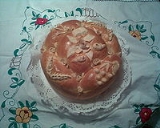
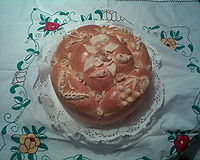
 The top of the kolač is adorned with the sign of the Cross
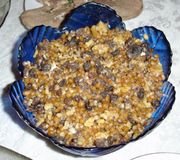
, the "Dove of Peace", and other symbols that relate to the family. "Koljivo" (also called "Žito") is made of boiled wheat. It can be prepared in a variety of ways but most usually includes walnuts, nutmeg
s and/or clove
s, and honey
.
The wheat is a symbol of the Resurrection of Christ and deceased family members. Depending on whether the celebration falls in a period of fasting, the rest of the feast consists of animal-free (posni) meals or not (mrsni); thus, colloquially, Slavas can be referred to as mrsne or posne.
On the day of the Slava, the family attends church services and partakes in Holy Communion
. Following the service, the parish priest is received in the family's home. He performs a small service which entails venerating the Saint's memory, blessing the slavski kolač and koljivo, as well as lighting the "slava candle". Though not necessary, it is common for the priest to bless the house and perform a small memorial service for dead relatives.
The most common feast days are St. Nicholas (falling on December 19), St. George (May 6, see Đurđevdan), St. John the Baptist (January 20), Saint Demetrius (November 8) and St. Michael (November 21). Given dates are by official Gregorian calendar. Serbian Orthodox Church uses Julian calendar that is late 13 days. For example, St. Nicholas date is December 6, but by Julian calendar this date is 13 days later, when by Gregorian calendar is December 19.
Many Serbia
n communities (villages, cities, organizations, political parties, institutions, companies, professions) also celebrate their patron saint
. For example, the city of Belgrade
celebrates the Ascension as its Slava.
While the slava kept something of a grassroots popularity during the Communist period, the post-Communist revival of Christian traditions has brought it a great resurgence. It is recognized as a distinctly (if not quite exclusively) Serbian custom, and today it is quite common for nonobservant Christians or even atheists to celebrate it in one form or another as a hereditary family holiday and a mark of ethnocultural identification.
"Slava" is also helpful in demographic investigations as genealogical indicator of relationships between families and branches of the same family.
Serbian language
Serbian is a form of Serbo-Croatian, a South Slavic language, spoken by Serbs in Serbia, Bosnia and Herzegovina, Montenegro, Croatia and neighbouring countries....
), is the Serbian Orthodox
Serbian Orthodox Church
The Serbian Orthodox Church is one of the autocephalous Orthodox Christian churches, ranking sixth in order of seniority after Constantinople, Alexandria, Antioch, Jerusalem, and Russia...
tradition of the ritual celebration and veneration of a family's own patron saint. The family celebrates the Slava annually on the patron saint's feast day
Calendar of saints
The calendar of saints is a traditional Christian method of organizing a liturgical year by associating each day with one or more saints and referring to the feast day of said saint...
. The Slava is a tradition of the Serbs
Serbs
The Serbs are a South Slavic ethnic group of the Balkans and southern Central Europe. Serbs are located mainly in Serbia, Montenegro and Bosnia and Herzegovina, and form a sizable minority in Croatia, the Republic of Macedonia and Slovenia. Likewise, Serbs are an officially recognized minority in...
, who are a people now living in the modern states of Serbia
Serbia
Serbia , officially the Republic of Serbia , is a landlocked country located at the crossroads of Central and Southeast Europe, covering the southern part of the Carpathian basin and the central part of the Balkans...
, Bosnia and Herzegovina
Bosnia and Herzegovina
Bosnia and Herzegovina , sometimes called Bosnia-Herzegovina or simply Bosnia, is a country in Southern Europe, on the Balkan Peninsula. Bordered by Croatia to the north, west and south, Serbia to the east, and Montenegro to the southeast, Bosnia and Herzegovina is almost landlocked, except for the...
(mostly in Republika Srpska
Republika Srpska
Republika Srpska is one of two main political entities of Bosnia and Herzegovina, the other being the Federation of Bosnia and Herzegovina...
), Republic of Macedonia
Republic of Macedonia
Macedonia , officially the Republic of Macedonia , is a country located in the central Balkan peninsula in Southeast Europe. It is one of the successor states of the former Yugoslavia, from which it declared independence in 1991...
and Montenegro
Montenegro
Montenegro Montenegrin: Crna Gora Црна Гора , meaning "Black Mountain") is a country located in Southeastern Europe. It has a coast on the Adriatic Sea to the south-west and is bordered by Croatia to the west, Bosnia and Herzegovina to the northwest, Serbia to the northeast and Albania to the...
, as well as in the former Military Frontier
Military Frontier
The Military Frontier was a borderland of Habsburg Austria and later the Austro-Hungarian Monarchy, which acted as the cordon sanitaire against incursions from the Ottoman Empire...
(parts of modern states of Croatia
Croatia
Croatia , officially the Republic of Croatia , is a unitary democratic parliamentary republic in Europe at the crossroads of the Mitteleuropa, the Balkans, and the Mediterranean. Its capital and largest city is Zagreb. The country is divided into 20 counties and the city of Zagreb. Croatia covers ...
, Hungary
Hungary
Hungary , officially the Republic of Hungary , is a landlocked country in Central Europe. It is situated in the Carpathian Basin and is bordered by Slovakia to the north, Ukraine and Romania to the east, Serbia and Croatia to the south, Slovenia to the southwest and Austria to the west. The...
, and Romania
Romania
Romania is a country located at the crossroads of Central and Southeastern Europe, on the Lower Danube, within and outside the Carpathian arch, bordering on the Black Sea...
). The Serbs regard the Slava as one of their most significant feast days. The tradition of the slava is also preserved among the Serbian diaspora
Serbian diaspora
There are currently more than 3.5 million Serbs in diaspora throughout the world...
.
The Slava is also recorded among non-Serbs in northern Albania
Albania
Albania , officially known as the Republic of Albania , is a country in Southeastern Europe, in the Balkans region. It is bordered by Montenegro to the northwest, Kosovo to the northeast, the Republic of Macedonia to the east and Greece to the south and southeast. It has a coast on the Adriatic Sea...
, Montenegro
Montenegro
Montenegro Montenegrin: Crna Gora Црна Гора , meaning "Black Mountain") is a country located in Southeastern Europe. It has a coast on the Adriatic Sea to the south-west and is bordered by Croatia to the west, Bosnia and Herzegovina to the northwest, Serbia to the northeast and Albania to the...
, and Macedonia
Republic of Macedonia
Macedonia , officially the Republic of Macedonia , is a country located in the central Balkan peninsula in Southeast Europe. It is one of the successor states of the former Yugoslavia, from which it declared independence in 1991...
, as well as among the Gorani
Gorani
Gorani may refer to:In culture:* Gorani people, a Balkan ethnic groupIn geography:* Gorani, a village in Uda Commune, Argeş County, Romania* Gorani, a village in Odăile Commune, Buzău County, Romania...
, a Muslim Slavic ethnic group.
History
The Slava (glorification) is a result of the Serbs' ChristianizationChristianization
The historical phenomenon of Christianization is the conversion of individuals to Christianity or the conversion of entire peoples at once...
transforming the Indo-European
Indo-European
Indo-European may refer to:* Indo-European languages** Aryan race, a 19th century and early 20th century term for those peoples who are the native speakers of Indo-European languages...
custom of communal feasts into a Christian custom. Many elements of Serbian pre-Christian
Pre-Christian
Pre-Christian may mean:*before Christianization**historical polytheism *BC**Classical Antiquity**Iron Age...
culture have lived on in Christianity. The Serbs were a polytheistic Slavic
Slavic mythology
Slavic mythology is the mythological aspect of the polytheistic religion that was practised by the Slavs before Christianisation.The religion possesses many common traits with other religions descended from the Proto-Indo-European religion....
tribe
South Slavs
The South Slavs are the southern branch of the Slavic peoples and speak South Slavic languages. Geographically, the South Slavs are native to the Balkan peninsula, the southern Pannonian Plain and the eastern Alps...
that believed in several gods, such as Svetovid
Svetovid
Sventevith, Sventovid , Svyatovit , Svyatovid , Svyentovit , Svetovid , Suvid Sventevith, Sventovid (Russian and Bulgarian, and alternative name in Serbo-Croatian), Svyatovit (Ukrainian), Svyatovid (alternative name in Ukrainian), Svyentovit (alternative name in Ukrainian), Svetovid (Serbian,...
(God of war, fertility and abundance) and Dabog (Sun god, a culture hero
Culture hero
A culture hero is a mythological hero specific to some group who changes the world through invention or discovery...
and a source of wealth and power). Each household had a protective god (protector of the family) that it venerated, a custom that was assimilated into Serbian Christianity. Christian saints replaced the Slavic deities, and the ritual itself survives as a national custom of the Serbs.
- SvetovidSvetovidSventevith, Sventovid , Svyatovit , Svyatovid , Svyentovit , Svetovid , Suvid Sventevith, Sventovid (Russian and Bulgarian, and alternative name in Serbo-Croatian), Svyatovit (Ukrainian), Svyatovid (alternative name in Ukrainian), Svyentovit (alternative name in Ukrainian), Svetovid (Serbian,...
> Saint Vitus > VidovdanVidovdan-See also:*Divinity*Daeva*Deva *Vidovdan... - PerunPerunIn Slavic mythology, Perun is the highest god of the pantheon and the god of thunder and lightning. His other attributes were the fire, mountains, the oak, iris, eagle, firmament , horses and carts, weapons and war...
> Saint Elijah > Ilindan - VelesVeles (god)Veles also known as Volos is a major Slavic supernatural force of earth, waters and the underworld, associated with dragons, cattle, magic, musicians, wealth and trickery...
> Saint NicholasSaint NicholasSaint Nicholas , also called Nikolaos of Myra, was a historic 4th-century saint and Greek Bishop of Myra . Because of the many miracles attributed to his intercession, he is also known as Nikolaos the Wonderworker...
> Nikoljdan
The custom in its modern state was created with the exposure to Christianity during the reign of emperor Heraclius
Heraclius
Heraclius was Byzantine Emperor from 610 to 641.He was responsible for introducing Greek as the empire's official language. His rise to power began in 608, when he and his father, Heraclius the Elder, the exarch of Africa, successfully led a revolt against the unpopular usurper Phocas.Heraclius'...
(610-641) or later at the time of the final Christianization of the Serbs during the rule of Basil I
Basil I
Basil I, called the Macedonian was a Byzantine emperor of probable Armenian descent who reigned from 867 to 886. Born a simple peasant in the Byzantine theme of Macedonia, he rose in the imperial court, and usurped the imperial throne from Emperor Michael III...
(867-886) by Byzantine missionairies of Constantinople Cyril and Methodius.
Baptism
In Christianity, baptism is for the majority the rite of admission , almost invariably with the use of water, into the Christian Church generally and also membership of a particular church tradition...
itself was taken as the saint protector, others claim that each clan adopted its collective protector, while others still claim that the Slava is simply the saint which replaced a pre-existing pagan
Paganism
Paganism is a blanket term, typically used to refer to non-Abrahamic, indigenous polytheistic religious traditions....
god-protector. At times, a new Slava would be adopted, should a saint be believed to have interceded for some sort of deliverance (i.e., from illness or affliction). The new saint would be adopted in lieu of the old, whose day would still be marked by a lighting of a candle, with much less fanfare.
Some also believe the Slava to be a remnant from Slavic paganism
Slavic mythology
Slavic mythology is the mythological aspect of the polytheistic religion that was practised by the Slavs before Christianisation.The religion possesses many common traits with other religions descended from the Proto-Indo-European religion....
which had a myriad of gods before adopting Christianity
Christianity
Christianity is a monotheistic religion based on the life and teachings of Jesus as presented in canonical gospels and other New Testament writings...
. The Serbs in particular held strongly onto their old Slavic religion
Slavic mythology
Slavic mythology is the mythological aspect of the polytheistic religion that was practised by the Slavs before Christianisation.The religion possesses many common traits with other religions descended from the Proto-Indo-European religion....
; the last pagan temple in Serbia, in Svetovid
Svetovid
Sventevith, Sventovid , Svyatovit , Svyatovid , Svyentovit , Svetovid , Suvid Sventevith, Sventovid (Russian and Bulgarian, and alternative name in Serbo-Croatian), Svyatovit (Ukrainian), Svyatovid (alternative name in Ukrainian), Svyentovit (alternative name in Ukrainian), Svetovid (Serbian,...
, was destroyed by Tsar Dušan in the 14th century. That the Slava often varies according to geographical regions is claimed as evidence of the above. But even this notion need not contradict the traditional explanation that the Slava is celebrated on the day of christening of the first-baptized ancestor, and in fact, it may very well underscore it.
The Slava was canonically introduced for the first time by Archbishop Saint Sava
Saint Sava
Saint Sava was a Serbian Prince and Orthodox monk, the first Archbishop of the autocephalous Serbian Church, the founder of Serbian law and literature, and a diplomat. Sava was born Rastko Nemanjić , the youngest son of Serbian Grand Župan Stefan Nemanja , and ruled the appanage of Hum briefly in...
of the Serbian Orthodox Church
Serbian Orthodox Church
The Serbian Orthodox Church is one of the autocephalous Orthodox Christian churches, ranking sixth in order of seniority after Constantinople, Alexandria, Antioch, Jerusalem, and Russia...
.
"Gde je Slava, tu je Srbin"
("Where there is a Slava, there is a Serb")
-Serbian saying
Heritage
Unlike most customs that are common for an entire people, each family separately celebrates its own saintSaint
A saint is a holy person. In various religions, saints are people who are believed to have exceptional holiness.In Christian usage, "saint" refers to any believer who is "in Christ", and in whom Christ dwells, whether in heaven or in earth...
; of course, there is quite a bit of overlap. It is inherited from the head of the household—normally the father—to sons. Daughters inherit the slava only if they stay in the home, while married women normally celebrate their husbands' saint.
Each household has one or two celebrations per year (depending on the saint in question, for some have two days devoted to them). Yet, only one is the main day of the patron saint feast (and not necessarily the same of the two days for all families); the second celebration is referred to as "Little Slava" or Preslava.
Some families may also celebrate yet another saint to a lesser extent (for example, when the wife is the only descendant of her kinship so the tradition of her slava would otherwise be lost).
Should a particular household move far away, with the father's permission, a son might celebrate the Slava in his own home; usually, however, for as long as a family patriarch is alive, his sons should celebrate under his roof.
Actually, the sons should celebrate slava with their father only if they live together. If they have separate households, and they do not live together, then they should celebrate separately. Of course, if the father is alive, the son is asking for his permission.
The son will then celebrate for the last time with the father, and he will get a half of the slavski kolac to start celebrating in his own home. There is some confusion about this. Not long ago, all sons lived in the same household with the father so, it was obvious that they will celebrate together. But, as Serbian society started changing, a lot of members of the family moved to cities and started living separately. Today, there are no more large families like before, father with sons and grandsons in one home.
Celebration
Traditional foods that are prepared on feasts are: "Slavski kolač" (славски колач) and "koljivo" (кољиво). "Slavski kolač" literally means "the Slava cake", although it is actually more similar to bread.Christian cross
The Christian cross, seen as a representation of the instrument of the crucifixion of Jesus Christ, is the best-known religious symbol of Christianity...
, the "Dove of Peace", and other symbols that relate to the family. "Koljivo" (also called "Žito") is made of boiled wheat. It can be prepared in a variety of ways but most usually includes walnuts, nutmeg
Nutmeg
The nutmeg tree is any of several species of trees in genus Myristica. The most important commercial species is Myristica fragrans, an evergreen tree indigenous to the Banda Islands in the Moluccas of Indonesia...
s and/or clove
Clove
Cloves are the aromatic dried flower buds of a tree in the family Myrtaceae. Cloves are native to the Maluku islands in Indonesia and used as a spice in cuisines all over the world...
s, and honey
Honey
Honey is a sweet food made by bees using nectar from flowers. The variety produced by honey bees is the one most commonly referred to and is the type of honey collected by beekeepers and consumed by humans...
.
The wheat is a symbol of the Resurrection of Christ and deceased family members. Depending on whether the celebration falls in a period of fasting, the rest of the feast consists of animal-free (posni) meals or not (mrsni); thus, colloquially, Slavas can be referred to as mrsne or posne.
On the day of the Slava, the family attends church services and partakes in Holy Communion
Eucharist
The Eucharist , also called Holy Communion, the Sacrament of the Altar, the Blessed Sacrament, the Lord's Supper, and other names, is a Christian sacrament or ordinance...
. Following the service, the parish priest is received in the family's home. He performs a small service which entails venerating the Saint's memory, blessing the slavski kolač and koljivo, as well as lighting the "slava candle". Though not necessary, it is common for the priest to bless the house and perform a small memorial service for dead relatives.
The most common feast days are St. Nicholas (falling on December 19), St. George (May 6, see Đurđevdan), St. John the Baptist (January 20), Saint Demetrius (November 8) and St. Michael (November 21). Given dates are by official Gregorian calendar. Serbian Orthodox Church uses Julian calendar that is late 13 days. For example, St. Nicholas date is December 6, but by Julian calendar this date is 13 days later, when by Gregorian calendar is December 19.
Many Serbia
Serbia
Serbia , officially the Republic of Serbia , is a landlocked country located at the crossroads of Central and Southeast Europe, covering the southern part of the Carpathian basin and the central part of the Balkans...
n communities (villages, cities, organizations, political parties, institutions, companies, professions) also celebrate their patron saint
Patron saint
A patron saint is a saint who is regarded as the intercessor and advocate in heaven of a nation, place, craft, activity, class, clan, family, or person...
. For example, the city of Belgrade
Belgrade
Belgrade is the capital and largest city of Serbia. It is located at the confluence of the Sava and Danube rivers, where the Pannonian Plain meets the Balkans. According to official results of Census 2011, the city has a population of 1,639,121. It is one of the 15 largest cities in Europe...
celebrates the Ascension as its Slava.
Slava today
The increased effective geographic mobility brought about by the post World War 2 urbanization of a previously highly agrarian society, combined with the deterioration of religious traditions under Communist rule, has made some aspects of the custom more relaxed. In particular, in the second half of the 20th century it became common to see traditional patriarchal families separated by great distances, so by necessity the slava came to occasionally be celebrated at more than one place by members of the same family.While the slava kept something of a grassroots popularity during the Communist period, the post-Communist revival of Christian traditions has brought it a great resurgence. It is recognized as a distinctly (if not quite exclusively) Serbian custom, and today it is quite common for nonobservant Christians or even atheists to celebrate it in one form or another as a hereditary family holiday and a mark of ethnocultural identification.
"Slava" is also helpful in demographic investigations as genealogical indicator of relationships between families and branches of the same family.
External links
- Srpska slava ili krsno ime - a list of saints, descriptions of customs
- Mrsni post, Zoran Majdin, VremeVremeVreme is a weekly newsmagazine based in Belgrade, Serbia.After being prepared for seven months throughout 1990 by liberal Serbian intellectuals dissatisfied with the regime's control of the media, its first issue came out on October 29, 1990. Most of its original staff were journalists from...
827, 9 November 2006.