

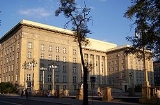
Silesian Parliament

Encyclopedia
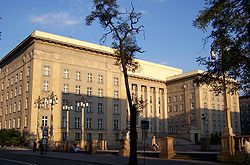
Silesian Parliament or Silesian Sejm was the governing body of the Silesian Voivodeship (1920–1939), an autonomous voivodeship
Voivodeship
Voivodship is a term denoting the position of, or more commonly the area administered by, a voivod. Voivodeships have existed since medieval times in Poland, Romania, Hungary, Lithuania, Latvia, Russia and Serbia....
of the Second Polish Republic
Second Polish Republic
The Second Polish Republic, Second Commonwealth of Poland or interwar Poland refers to Poland between the two world wars; a period in Polish history in which Poland was restored as an independent state. Officially known as the Republic of Poland or the Commonwealth of Poland , the Polish state was...
between 1920 and 1945. It was elected in democratic elections and had certain influence over the usage of taxes collected in Silesia. It consisted of 48 deputies (24 from 1935).
History
The eastern part of Upper SilesiaUpper Silesia
Upper Silesia is the southeastern part of the historical and geographical region of Silesia. Since the 9th century, Upper Silesia has been part of Greater Moravia, the Duchy of Bohemia, the Piast Kingdom of Poland, again of the Lands of the Bohemian Crown and the Holy Roman Empire, as well as of...
became part of the Second Polish Republic following the Silesian Uprisings
Silesian Uprisings
The Silesian Uprisings were a series of three armed uprisings of the Poles and Polish Silesians of Upper Silesia, from 1919–1921, against German rule; the resistance hoped to break away from Germany in order to join the Second Polish Republic, which had been established in the wake of World War I...
throughout the Upper Silesian region between 1918 and 1921, and Upper Silesia Plebiscite
Upper Silesia plebiscite
The Upper Silesia plebiscite was a border referendum mandated by the Versailles Treaty and carried out in March 1921 to determine a section of the border between Weimar Germany and Poland. The region was ethnically mixed, chiefly among Germans, Poles and Silesians. According to prewar statistics,...
. The land was subsequently divided by an allied commission and the League of Nations
League of Nations
The League of Nations was an intergovernmental organization founded as a result of the Paris Peace Conference that ended the First World War. It was the first permanent international organization whose principal mission was to maintain world peace...
, leaving Katowice region on the Polish side. Together with Cieszyn Silesia
Cieszyn Silesia
Cieszyn Silesia or Těšín Silesia or Teschen Silesia is a historical region in south-eastern Silesia, centered around the towns of Cieszyn and Český Těšín and bisected by the Olza River. Since 1920 it has been divided between Poland and Czechoslovakia, and later the Czech Republic...
it formed Silesian Voievodeship with significant autonomy (Silesian Parliament as a constituency and Silesian Voivodship Council as the executive body).
Building
Designed by architect Lech Wojtyczko, the Silesian Parliament was built in 1925-1929. For a very long time it was the biggest structure in Poland. Currently it hosts the offices of the Silesian Voivodship. The building has seven floors and contains one of four paternosters currently in use in Poland. The Polish architect Adolf Szysko-Bohusz announced a competition for the design of the new Silesian Parliament in 1925, who wished the building to espouse the local Polish cultural identity of the region, instead of the more customary German/ Prussian style. When the building was inaugurated in May 1929, Michal GrazynskiMichal Grazynski
Michał Grażyński was a Polish military leader, social and political activist, doctor of philosophy and law, voivode of the Silesian Voivodeship, Scouting activist and president of Związek Harcerstwa Polskiego.Born to a teacher's family in Gdów, in Austrian-ruled Polish Galicia, he attended...
, President of the Province of Upper silesia, called the building a "material symbol of Polish culture and power".