


Segregation in Northern Ireland

Encyclopedia
Segregation in Northern Ireland is a long-running issue in the political and social history of Northern Ireland
. The segregation
involves Northern Ireland's two main communities – its nationalist
/republican
community (who mainly self-identify as Irish
and/or Catholic) and its unionist
/loyalist
community (who mainly self-identify as British
and/or Protestant). It is often seen as both a cause and effect of "The Troubles
".
A combination of political, religious and social differences plus the threat of intercommunal tensions and violence has led to widespread self-segregation of the two communities. Catholics and Protestants lead largely separate lives in a situation that some have dubbed "self-imposed apartheid". The academic John Whyte argued that "the two factors which do most to divide Protestants as a whole from Catholics as a whole are endogamy
and separate education".
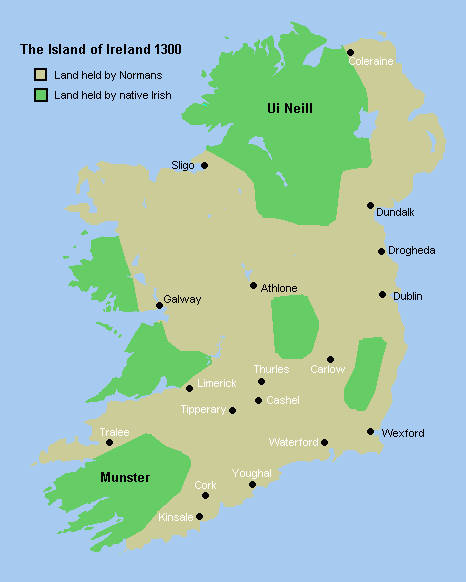
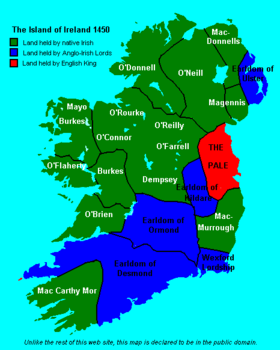 Soon after they had conquered England, the Normans invaded Ireland
. Gaelic
lords gradually regained control of the island, until the English Crown's influence was limited to the Pale
by the 15th century. The Reformation
marked a watershed in the history of the British Isles as the Irish remained Catholic
and Henry VIII
initiated the Tudor conquest of Ireland.
A final part of that century-long struggle was the Nine Years' War
(1594-1603), after which the defeated earls' lands were confiscated and given to settlers, in the Plantation of Ulster
. Most of the planters came from southwest Scotland
and became the Scots-Irish. Several others were to follow
as attempts to convert the Irish failed, but the plantation of Ulster
was to be the largest.
The Plantations had a profound impact on Ireland in several ways. The first was the destruction of the native ruling classes and their replacement by the Protestant Ascendancy
, of British (mostly English) Anglican Protestant
landowners. Their position was buttressed by the Penal Laws
, which denied political and land-owning rights to Catholics and to some extent to Presbyterians. The dominance of this class in Irish life persisted until the late 19th century and cemented the British control over the country.
During the 17th and 18th century, it was troubled by revolts and civil wars, such as the Rebellions of 1641
and of 1798
. In 1801, Ireland became a part of the United Kingdom of Great Britain and Ireland
through the Acts of Union.
The following century saw an ever-increasing Irish nationalism
, which in turn lead to a resurgence of interest in the Irish language
, literature, history, and folklore; by that time Gaelic had died out as a spoken tongue except in isolated rural areas.
As a result of the Anglo-Irish Treaty
ending the Irish War of Independence
, six of Ulster's nine counties were formed into Northern Ireland
, with a Protestant majority.
(marriage within one's own group) However, the Integrated Education
movement has sought to reverse this trend by establishing non-denominational schools such as the Portadown Integrated Primary
. Such schools are, however, still the exception to the general trend of segregated education. Integrated schools in Northern Ireland have been established through the voluntary efforts of parents. The churches have not been involved in the development of integrated education.
was highly segregated, particularly at senior levels of the public sector and in certain sectors of the economy, such as shipbuilding and heavy engineering . Emigration to seek employment was significantly more prevalent among the Catholic population. As a result, Northern Ireland's demography shifted further in favour of Protestants leaving their ascendancy seemingly impregnable by the late 1950s.
A 1987 survey found that 80 per cent of the workforces surveyed were described by respondents as consisting of a majority of one denomination; 20 per cent were overwhelmingly unidenominational, with 95-100 per cent Catholic or Protestant employees. However, large organisations were much less likely to be segregated, and the level of segregation has decreased over the years.
The British government has introduced numerous laws and regulations since the mid-1990s to prohibit discrimination on religious grounds, with the Fair Employment Commission (originally the Fair Employment Agency) exercising statutory powers to investigate allegations of discriminatory practices in Northern Ireland business and organisations. This has had a significant impact on the level of segregation in the workplace; John Whyte concludes that the result is that "segregation at work is one of the least acute forms of segregation in Northern Ireland."
 Public housing is overwhelmingly segregated between the two communities. Intercommunal tensions have forced substantial numbers of people to move from mixed areas into areas inhabited exclusively by one denomination, thus increasing the degree of polarisation and segregation. The extent of self-segregation grew very rapidly with the outbreak of the Troubles
. In 1969, 69 per cent of Protestants and 56 per cent of Catholics lived in streets where they were in their own majority; as the result of large-scale flight from mixed areas between 1969 and 1971 following outbreaks of violence, the respective proportions had by 1972 increased to 99 per cent of Protestants and 75 per cent of Catholics. In Belfast, the 1970s were a time of rising residential segregation. It was estimated in 2004 that 92.5% of public housing in Northern Ireland was divided along religious lines, with the figure rising to 98% in Belfast
. Self-segregation is a continuing process, despite the Northern Ireland peace process
. It was estimated in 2005 that more than 1,400 people a year were being forced to move as a consequence of intimidation
.
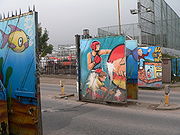
In response to intercommunal violence, the British Army
constructed a number of high walls euphemistically called "peace lines
" to separate rival neighbourhoods. These have multiplied over the years and now number forty separate barriers, mostly located in Belfast. Despite the moves towards peace between Northern Ireland's political parties and most of its paramilitary groups, the construction of "peace lines" has actually increased during the ongoing peace process; the number of "peace lines" doubled in the ten years between 1995 and 2005. In 2008 a process was proposed for the removal of the peace walls.
The effective segregation of the two communities significantly affects the usage of local services in "interface area
s" where sectarian neighbourhoods adjoin. Surveys in 2005 of 9,000 residents of interface areas found that 75% refused to use the closest facilities because of location, while 82% routinely travelled to "safer" areas to access facilities even if the journey time was longer. 60% refused to shop in areas dominated by the other community, with many fearing ostracism by their own community if they violated an unofficial de facto boycott of their sectarian opposite numbers.
.
An Equality Commission review in 2004 of the operation of the anti-discrimination legislation since the 1970s, found that there had been a substantial improvement in the employment profile of Catholics, most marked in the public sector but not confined to it. It said that Catholics were now well represented in managerial, professional and senior administrative posts, although there were some areas of under-representation such as local government and security but that the overall picture was a positive one. Catholics, however, were still more likely than Protestants to be unemployed and there were emerging areas of Protestant under-representation in the public sector, most notably in health and education at many levels including professional and managerial. The report also found that there had been a considerable increase in the numbers of people who work in integrated workplaces.
Northern Ireland
Northern Ireland is one of the four countries of the United Kingdom. Situated in the north-east of the island of Ireland, it shares a border with the Republic of Ireland to the south and west...
. The segregation
Residential Segregation
Residential segregation is the physical separation of cultural groups based on residence and housing, or a form of segregation that "sorts population groups into various neighborhood contexts and shapes the living environment at the neighborhood level."...
involves Northern Ireland's two main communities – its nationalist
Irish nationalism
Irish nationalism manifests itself in political and social movements and in sentiment inspired by a love for Irish culture, language and history, and as a sense of pride in Ireland and in the Irish people...
/republican
Irish Republicanism
Irish republicanism is an ideology based on the belief that all of Ireland should be an independent republic.In 1801, under the Act of Union, the Kingdom of Great Britain and the Kingdom of Ireland merged to form the United Kingdom of Great Britain and Ireland...
community (who mainly self-identify as Irish
Irish people
The Irish people are an ethnic group who originate in Ireland, an island in northwestern Europe. Ireland has been populated for around 9,000 years , with the Irish people's earliest ancestors recorded having legends of being descended from groups such as the Nemedians, Fomorians, Fir Bolg, Tuatha...
and/or Catholic) and its unionist
Unionism in Ireland
Unionism in Ireland is an ideology that favours the continuation of some form of political union between the islands of Ireland and Great Britain...
/loyalist
Ulster loyalism
Ulster loyalism is an ideology that is opposed to a united Ireland. It can mean either support for upholding Northern Ireland's status as a constituent part of the United Kingdom , support for Northern Ireland independence, or support for loyalist paramilitaries...
community (who mainly self-identify as British
British people
The British are citizens of the United Kingdom, of the Isle of Man, any of the Channel Islands, or of any of the British overseas territories, and their descendants...
and/or Protestant). It is often seen as both a cause and effect of "The Troubles
The Troubles
The Troubles was a period of ethno-political conflict in Northern Ireland which spilled over at various times into England, the Republic of Ireland, and mainland Europe. The duration of the Troubles is conventionally dated from the late 1960s and considered by many to have ended with the Belfast...
".
A combination of political, religious and social differences plus the threat of intercommunal tensions and violence has led to widespread self-segregation of the two communities. Catholics and Protestants lead largely separate lives in a situation that some have dubbed "self-imposed apartheid". The academic John Whyte argued that "the two factors which do most to divide Protestants as a whole from Catholics as a whole are endogamy
Endogamy
Endogamy is the practice of marrying within a specific ethnic group, class, or social group, rejecting others on such basis as being unsuitable for marriage or other close personal relationships. A Greek Orthodox Christian endogamist, for example, would require that a marriage be only with another...
and separate education".
Historical background
Norman Invasion of Ireland
The Norman invasion of Ireland was a two-stage process, which began on 1 May 1169 when a force of loosely associated Norman knights landed near Bannow, County Wexford...
. Gaelic
Gaels
The Gaels or Goidels are speakers of one of the Goidelic Celtic languages: Irish, Scottish Gaelic, and Manx. Goidelic speech originated in Ireland and subsequently spread to western and northern Scotland and the Isle of Man....
lords gradually regained control of the island, until the English Crown's influence was limited to the Pale
The Pale
The Pale or the English Pale , was the part of Ireland that was directly under the control of the English government in the late Middle Ages. It had reduced by the late 15th century to an area along the east coast stretching from Dalkey, south of Dublin, to the garrison town of Dundalk...
by the 15th century. The Reformation
Protestant Reformation
The Protestant Reformation was a 16th-century split within Western Christianity initiated by Martin Luther, John Calvin and other early Protestants. The efforts of the self-described "reformers", who objected to the doctrines, rituals and ecclesiastical structure of the Roman Catholic Church, led...
marked a watershed in the history of the British Isles as the Irish remained Catholic
Catholic
The word catholic comes from the Greek phrase , meaning "on the whole," "according to the whole" or "in general", and is a combination of the Greek words meaning "about" and meaning "whole"...
and Henry VIII
Henry VIII of England
Henry VIII was King of England from 21 April 1509 until his death. He was Lord, and later King, of Ireland, as well as continuing the nominal claim by the English monarchs to the Kingdom of France...
initiated the Tudor conquest of Ireland.
A final part of that century-long struggle was the Nine Years' War
Nine Years' War (Ireland)
The Nine Years' War or Tyrone's Rebellion took place in Ireland from 1594 to 1603. It was fought between the forces of Gaelic Irish chieftains Hugh O'Neill of Tír Eoghain, Hugh Roe O'Donnell of Tír Chonaill and their allies, against English rule in Ireland. The war was fought in all parts of the...
(1594-1603), after which the defeated earls' lands were confiscated and given to settlers, in the Plantation of Ulster
Plantation of Ulster
The Plantation of Ulster was the organised colonisation of Ulster—a province of Ireland—by people from Great Britain. Private plantation by wealthy landowners began in 1606, while official plantation controlled by King James I of England and VI of Scotland began in 1609...
. Most of the planters came from southwest Scotland
Scotland
Scotland is a country that is part of the United Kingdom. Occupying the northern third of the island of Great Britain, it shares a border with England to the south and is bounded by the North Sea to the east, the Atlantic Ocean to the north and west, and the North Channel and Irish Sea to the...
and became the Scots-Irish. Several others were to follow
Plantations of Ireland
Plantations in 16th and 17th century Ireland were the confiscation of land by the English crown and the colonisation of this land with settlers from England and the Scottish Lowlands....
as attempts to convert the Irish failed, but the plantation of Ulster
Ulster
Ulster is one of the four provinces of Ireland, located in the north of the island. In ancient Ireland, it was one of the fifths ruled by a "king of over-kings" . Following the Norman invasion of Ireland, the ancient kingdoms were shired into a number of counties for administrative and judicial...
was to be the largest.
The Plantations had a profound impact on Ireland in several ways. The first was the destruction of the native ruling classes and their replacement by the Protestant Ascendancy
Protestant Ascendancy
The Protestant Ascendancy, usually known in Ireland simply as the Ascendancy, is a phrase used when referring to the political, economic, and social domination of Ireland by a minority of great landowners, Protestant clergy, and professionals, all members of the Established Church during the 17th...
, of British (mostly English) Anglican Protestant
Anglicanism
Anglicanism is a tradition within Christianity comprising churches with historical connections to the Church of England or similar beliefs, worship and church structures. The word Anglican originates in ecclesia anglicana, a medieval Latin phrase dating to at least 1246 that means the English...
landowners. Their position was buttressed by the Penal Laws
Penal Laws (Ireland)
The term Penal Laws in Ireland were a series of laws imposed under English and later British rule that sought to discriminate against Roman Catholics and Protestant dissenters in favour of members of the established Church of Ireland....
, which denied political and land-owning rights to Catholics and to some extent to Presbyterians. The dominance of this class in Irish life persisted until the late 19th century and cemented the British control over the country.
During the 17th and 18th century, it was troubled by revolts and civil wars, such as the Rebellions of 1641
Irish Rebellion of 1641
The Irish Rebellion of 1641 began as an attempted coup d'état by Irish Catholic gentry, who tried to seize control of the English administration in Ireland to force concessions for the Catholics living under English rule...
and of 1798
Irish Rebellion of 1798
The Irish Rebellion of 1798 , also known as the United Irishmen Rebellion , was an uprising in 1798, lasting several months, against British rule in Ireland...
. In 1801, Ireland became a part of the United Kingdom of Great Britain and Ireland
United Kingdom of Great Britain and Ireland
The United Kingdom of Great Britain and Ireland was the formal name of the United Kingdom during the period when what is now the Republic of Ireland formed a part of it....
through the Acts of Union.
The following century saw an ever-increasing Irish nationalism
Irish nationalism
Irish nationalism manifests itself in political and social movements and in sentiment inspired by a love for Irish culture, language and history, and as a sense of pride in Ireland and in the Irish people...
, which in turn lead to a resurgence of interest in the Irish language
Irish language
Irish , also known as Irish Gaelic, is a Goidelic language of the Indo-European language family, originating in Ireland and historically spoken by the Irish people. Irish is now spoken as a first language by a minority of Irish people, as well as being a second language of a larger proportion of...
, literature, history, and folklore; by that time Gaelic had died out as a spoken tongue except in isolated rural areas.
As a result of the Anglo-Irish Treaty
Anglo-Irish Treaty
The Anglo-Irish Treaty , officially called the Articles of Agreement for a Treaty Between Great Britain and Ireland, was a treaty between the Government of the United Kingdom of Great Britain and Ireland and representatives of the secessionist Irish Republic that concluded the Irish War of...
ending the Irish War of Independence
Irish War of Independence
The Irish War of Independence , Anglo-Irish War, Black and Tan War, or Tan War was a guerrilla war mounted by the Irish Republican Army against the British government and its forces in Ireland. It began in January 1919, following the Irish Republic's declaration of independence. Both sides agreed...
, six of Ulster's nine counties were formed into Northern Ireland
Northern Ireland
Northern Ireland is one of the four countries of the United Kingdom. Situated in the north-east of the island of Ireland, it shares a border with the Republic of Ireland to the south and west...
, with a Protestant majority.
Education
Education in Northern Ireland is heavily segregated. Most state schools in Northern Ireland are predominantly Protestant, while the majority of Catholic children attend schools maintained by the Catholic Church. In all, 90 per cent of children in Northern Ireland still go to separate faith schools. The consequence is, as one commentator has put it, that "the overwhelming majority of Ulster's children can go from four to 18 without having a serious conversation with a member of a rival creed." The prevalence of segregated education has been cited as a major factor in maintaining endogamyEndogamy
Endogamy is the practice of marrying within a specific ethnic group, class, or social group, rejecting others on such basis as being unsuitable for marriage or other close personal relationships. A Greek Orthodox Christian endogamist, for example, would require that a marriage be only with another...
(marriage within one's own group) However, the Integrated Education
Integrated Education
The Integrated education movement in Northern Ireland is an attempt to bring together children, parents and teachers from both Roman Catholic and Protestant traditions: the aim being to provide a balanced education, while allowing the opportunity to understand and respect all cultural and religious...
movement has sought to reverse this trend by establishing non-denominational schools such as the Portadown Integrated Primary
Portadown Integrated Primary
Portadown Integrated Primary is a primary school which opened in Portadown, County Armagh, Northern Ireland in 1990. When the school first opened it was housed in portable cabins in Chambers Park, home of Portadown RFC. Initially it had a small number of pupils, around 20-30, and lunch was held in...
. Such schools are, however, still the exception to the general trend of segregated education. Integrated schools in Northern Ireland have been established through the voluntary efforts of parents. The churches have not been involved in the development of integrated education.
Employment
Historically, employment in the Northern Irish economyEconomy of Northern Ireland
The economy of Northern Ireland is the smallest of the four countries in the United Kingdom. Northern Ireland has traditionally had an industrial economy, most notably in shipbuilding, rope manufacture and textiles, but most heavy industry has since been replaced by services...
was highly segregated, particularly at senior levels of the public sector and in certain sectors of the economy, such as shipbuilding and heavy engineering . Emigration to seek employment was significantly more prevalent among the Catholic population. As a result, Northern Ireland's demography shifted further in favour of Protestants leaving their ascendancy seemingly impregnable by the late 1950s.
A 1987 survey found that 80 per cent of the workforces surveyed were described by respondents as consisting of a majority of one denomination; 20 per cent were overwhelmingly unidenominational, with 95-100 per cent Catholic or Protestant employees. However, large organisations were much less likely to be segregated, and the level of segregation has decreased over the years.
The British government has introduced numerous laws and regulations since the mid-1990s to prohibit discrimination on religious grounds, with the Fair Employment Commission (originally the Fair Employment Agency) exercising statutory powers to investigate allegations of discriminatory practices in Northern Ireland business and organisations. This has had a significant impact on the level of segregation in the workplace; John Whyte concludes that the result is that "segregation at work is one of the least acute forms of segregation in Northern Ireland."
Housing
The Troubles
The Troubles was a period of ethno-political conflict in Northern Ireland which spilled over at various times into England, the Republic of Ireland, and mainland Europe. The duration of the Troubles is conventionally dated from the late 1960s and considered by many to have ended with the Belfast...
. In 1969, 69 per cent of Protestants and 56 per cent of Catholics lived in streets where they were in their own majority; as the result of large-scale flight from mixed areas between 1969 and 1971 following outbreaks of violence, the respective proportions had by 1972 increased to 99 per cent of Protestants and 75 per cent of Catholics. In Belfast, the 1970s were a time of rising residential segregation. It was estimated in 2004 that 92.5% of public housing in Northern Ireland was divided along religious lines, with the figure rising to 98% in Belfast
Belfast
Belfast is the capital of and largest city in Northern Ireland. By population, it is the 14th biggest city in the United Kingdom and second biggest on the island of Ireland . It is the seat of the devolved government and legislative Northern Ireland Assembly...
. Self-segregation is a continuing process, despite the Northern Ireland peace process
Northern Ireland peace process
The peace process, when discussing the history of Northern Ireland, is often considered to cover the events leading up to the 1994 Provisional Irish Republican Army ceasefire, the end of most of the violence of the Troubles, the Belfast Agreement, and subsequent political developments.-Towards a...
. It was estimated in 2005 that more than 1,400 people a year were being forced to move as a consequence of intimidation
Intimidation
Intimidation is intentional behavior "which would cause a person of ordinary sensibilities" fear of injury or harm. It's not necessary to prove that the behavior was so violent as to cause terror or that the victim was actually frightened.Criminal threatening is the crime of intentionally or...
.
In response to intercommunal violence, the British Army
British Army
The British Army is the land warfare branch of Her Majesty's Armed Forces in the United Kingdom. It came into being with the unification of the Kingdom of England and Scotland into the Kingdom of Great Britain in 1707. The new British Army incorporated Regiments that had already existed in England...
constructed a number of high walls euphemistically called "peace lines
Peace lines
The peace lines or peace walls are a series of separation barriers in Northern Ireland that separate Catholic and Protestant neighbourhoods. They have been built at urban interface areas in Belfast, Derry, Portadown and elsewhere...
" to separate rival neighbourhoods. These have multiplied over the years and now number forty separate barriers, mostly located in Belfast. Despite the moves towards peace between Northern Ireland's political parties and most of its paramilitary groups, the construction of "peace lines" has actually increased during the ongoing peace process; the number of "peace lines" doubled in the ten years between 1995 and 2005. In 2008 a process was proposed for the removal of the peace walls.
The effective segregation of the two communities significantly affects the usage of local services in "interface area
Interface area
Interface area is the name given to areas where segregated nationalist and unionist residential areas meet in Northern Ireland. They have been defined as "the intersection of segregated and polarised working class residential zones, in areas with a strong link betweenterritory and ethno-political...
s" where sectarian neighbourhoods adjoin. Surveys in 2005 of 9,000 residents of interface areas found that 75% refused to use the closest facilities because of location, while 82% routinely travelled to "safer" areas to access facilities even if the journey time was longer. 60% refused to shop in areas dominated by the other community, with many fearing ostracism by their own community if they violated an unofficial de facto boycott of their sectarian opposite numbers.
Inter-marriage
In contrast with both the Republic of Ireland and most parts of Great Britain, where intermarriage between Protestants and Catholics is not unusual, in Northern Ireland it has been uncommon: from 1970 through to the 1990s, only 5 per cent of marriages were recorded as crossing community divides. This figure remained largely constant throughout the Troubles, though it has risen to between 8 and 12 per cent according to the Northern Ireland Life and Times Survey in 2003, 2004 and 2005. Younger people are also more likely to be married to someone of a different religion to themselves than older people. However, the data hides considerable regional variation across Northern Ireland.Anti-discrimination legislation
In the 1970s, the British government took action to legislate against religious discrimination in Northern Ireland. The Fair Employment Act 1976 prohibited discrimination in the workplace on the grounds of religion and established a Fair Employment Agency. This Act was strengthened with a new Fair Employment Act in 1989, which introduced a duty on employers to monitor the religious composition of their workforce, and created the Fair Employment Commission to replace the Fair Employment Agency. The law was extended to cover the provision of goods, facilities and services in 1998 under the Fair Employment and Treatment (Northern Ireland) Order 1998. In 1999, the Commission was merged with the Equal Opportunities Commission, the Commission for Racial Equality and the Northern Ireland Disability Council to become part of the Equality Commission for Northern IrelandEquality Commission for Northern Ireland
The Equality Commission for Northern Ireland is a non-departmental public body in Northern Ireland established under the Northern Ireland Act 1998...
.
An Equality Commission review in 2004 of the operation of the anti-discrimination legislation since the 1970s, found that there had been a substantial improvement in the employment profile of Catholics, most marked in the public sector but not confined to it. It said that Catholics were now well represented in managerial, professional and senior administrative posts, although there were some areas of under-representation such as local government and security but that the overall picture was a positive one. Catholics, however, were still more likely than Protestants to be unemployed and there were emerging areas of Protestant under-representation in the public sector, most notably in health and education at many levels including professional and managerial. The report also found that there had been a considerable increase in the numbers of people who work in integrated workplaces.