

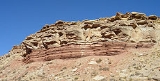
Sedimentology

Encyclopedia
Sedimentology encompasses the study of modern sediment
s such as sand, mud (silt), and clay, and the processes that result in their deposition. Sedimentologists apply their understanding of modern processes to interpret geologic history through observations of sedimentary rocks and sedimentary structures
.
Sedimentary rocks cover most of the Earth
's surface, record much of the Earth's history
, and harbor the fossil record. Sedimentology is closely linked to stratigraphy
, the study of the physical and temporal relationships between rock layers or strata
.
The premise that the processes affecting the earth today are the same as in the past is the basis for determining how sedimentary features in the rock record were formed. By comparing similar features today to features in the rock record—for example, by comparing modern sand dunes to dunes preserved in ancient aeolian sandstones—geologists reconstruct past environments.
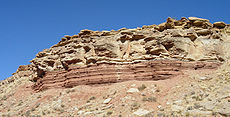 There are four primary types of sedimentary rocks: clastics, carbonates, evaporites, and chemical.
 The aim of sedimentology, studying sediments, is to derive information on the depositional conditions which acted to deposit the rock unit, and the relation of the individual rock units in a basin into a coherent understanding of the evolution of the sedimentary sequences and basins, and thus, the Earth's geological history as a whole.
The scientific basis of this is the principle of uniformitarianism, which states that the sediments within ancient sedimentary rocks were deposited in the same way as sediments which are being deposited at the Earth's surface today.
Sedimentological conditions are recorded within the sediments as they are laid down; the form of the sediments at present reflects the events of the past and all events which affect the sediments, from the source of the sedimentary material to the stresses enacted upon them after diagenesis
are available for study.
The principle of superposition
is critical to the interpretation of sedimentary sequences, and in older metamorphic terrains or fold and thrust belts where sediments are often intensely folded
or deformed, recognising younging indicators or graded bedding
is critical to interpretation of the sedimentary section and often the deformation and metamorphic structure of the region.
Folding in sediments is analysed with the principle of original horizontality
, which states that sediments are deposited at their angle of repose which, for most types of sediment, is essentially horizontal. Thus, when the younging direction is known, the rocks can be "unfolded" and interpreted according to the contained sedimentary information.
The principle of lateral continuity
states that layers of sediment initially extend laterally in all directions unless obstructed by a physical object or topography.
The principle of cross-cutting relationships states that whatever cuts across or intrudes into the layers of strata is younger than the layers of strata.
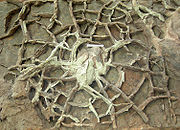 The methods employed by sedimentologists to gather data and evidence on the nature and depositional conditions of sedimentary rocks include;
s form has been challenged by geologists at Indiana University (Bloomington) and the Massachusetts Institute of Technology
. The research, which appears in the December 14th, 2007, edition of Science
, counters the prevailing view of geologists that mud only settles when water is slow-moving or still, instead showing that "muds will accumulate even when currents move swiftly." The research shows that some mudstones may have formed in fast-moving waters: "Mudstones can be deposited under more energetic conditions than widely assumed, requiring a reappraisal of many geologic records."
Macquaker and Bohacs, in reviewing the research of Schieber et al., state that "these results call for critical reappraisal of all mudstones previously interpreted as having been continuously deposited under still waters. Such rocks are widely used to infer past climates, ocean conditions, and orbital variations."
Considerable recent research into mudstone
s has been driven by the recent effort to commercially produce hydrocarbons from them, in both the Shale gas
and Tight Oil
(or Light Tight Oil) plays.
Sediment
Sediment is naturally occurring material that is broken down by processes of weathering and erosion, and is subsequently transported by the action of fluids such as wind, water, or ice, and/or by the force of gravity acting on the particle itself....
s such as sand, mud (silt), and clay, and the processes that result in their deposition. Sedimentologists apply their understanding of modern processes to interpret geologic history through observations of sedimentary rocks and sedimentary structures
Sedimentary structures
Sedimentary structures are those structures formed during sediment deposition.Sedimentary structures such as cross bedding, graded bedding and ripple marks are utilized in stratigraphic studies to indicate original position of strata in geologically complex terrains and understand the depositional...
.
Sedimentary rocks cover most of the Earth
Earth
Earth is the third planet from the Sun, and the densest and fifth-largest of the eight planets in the Solar System. It is also the largest of the Solar System's four terrestrial planets...
's surface, record much of the Earth's history
History of Earth
The history of the Earth describes the most important events and fundamental stages in the development of the planet Earth from its formation 4.578 billion years ago to the present day. Nearly all branches of natural science have contributed to the understanding of the main events of the Earth's...
, and harbor the fossil record. Sedimentology is closely linked to stratigraphy
Stratigraphy
Stratigraphy, a branch of geology, studies rock layers and layering . It is primarily used in the study of sedimentary and layered volcanic rocks....
, the study of the physical and temporal relationships between rock layers or strata
Stratum
In geology and related fields, a stratum is a layer of sedimentary rock or soil with internally consistent characteristics that distinguish it from other layers...
.
The premise that the processes affecting the earth today are the same as in the past is the basis for determining how sedimentary features in the rock record were formed. By comparing similar features today to features in the rock record—for example, by comparing modern sand dunes to dunes preserved in ancient aeolian sandstones—geologists reconstruct past environments.
Sedimentary rock types
- Clastic rocksClastic rocksClastic rocks are composed of fragments, or clasts, of pre-existing rock. Geologists use the term clastic with reference to sedimentary rocks as well as to particles in sediment transport whether in suspension or as bed load, and in sediment deposits.- Clastic metamorphic and igneous rocks :Clastic...
are composed of particles derived from the weatheringWeatheringWeathering is the breaking down of rocks, soils and minerals as well as artificial materials through contact with the Earth's atmosphere, biota and waters...
and erosionErosionErosion is when materials are removed from the surface and changed into something else. It only works by hydraulic actions and transport of solids in the natural environment, and leads to the deposition of these materials elsewhere...
of precursor rocks and consist primarily of fragmental material. Clastic rocks are classified according to their predominant grain size and their composition. In the past, the term "Clastic Sedimentary Rocks" were used to describe silica-rich clastic sedimentary rocks, however there have been cases of clastic carbonate rocks. The more appropriate term is siliciclasticSiliciclasticSiliciclastic rocks are clastic noncarbonate sedimentary rocks that are almost exclusively silica-bearing, either as forms of quartz or other silicate minerals. All siliciclastic rocks are formed by inorganic processes, or deposited through some mechanical process, such as stream deposits that are...
sedimentary rocks.- Organic sedimentary rocks are important deposits formed from the accumulation of biological detritus, and form coalCoalCoal is a combustible black or brownish-black sedimentary rock usually occurring in rock strata in layers or veins called coal beds or coal seams. The harder forms, such as anthracite coal, can be regarded as metamorphic rock because of later exposure to elevated temperature and pressure...
and oil shaleOil shaleOil shale, an organic-rich fine-grained sedimentary rock, contains significant amounts of kerogen from which liquid hydrocarbons called shale oil can be produced...
deposits, and are typically found within basinsBasin (geology)A structural basin is a large-scale structural formation of rock strata formed by tectonic warping of previously flat lying strata. Structural basins are geological depressions, and are the inverse of domes. Some elongated structural basins are also known as synclines...
of clastic sedimentary rocks
- Organic sedimentary rocks are important deposits formed from the accumulation of biological detritus, and form coal
- Carbonates are composed of various carbonate mineralsCarbonate mineralsCarbonate minerals are those minerals containing the carbonate ion: CO32-.-Anhydrous carbonates:*Calcite group: Trigonal**Calcite CaCO3**Gaspeite CO3**Magnesite MgCO3**Otavite CdCO3**Rhodochrosite MnCO3**Siderite FeCO3**Smithsonite ZnCO3...
(most often calcium carbonateCalcium carbonateCalcium carbonate is a chemical compound with the formula CaCO3. It is a common substance found in rocks in all parts of the world, and is the main component of shells of marine organisms, snails, coal balls, pearls, and eggshells. Calcium carbonate is the active ingredient in agricultural lime,...
(CaCO3)) precipitated by a variety of organic and inorganic processes. Typically, the majority of carbonate rocks are composed of reefReefIn nautical terminology, a reef is a rock, sandbar, or other feature lying beneath the surface of the water ....
material . - EvaporiteEvaporiteEvaporite is a name for a water-soluble mineral sediment that result from concentration and crystallization by evaporation from an aqueous solution. There are two types of evaporate deposits, marine which can also be described as ocean deposits, and non-marine which are found in standing bodies of...
s are formed through the evaporation of water at the Earth's surface and most commonly include haliteHaliteHalite , commonly known as rock salt, is the mineral form of sodium chloride . Halite forms isometric crystals. The mineral is typically colorless or white, but may also be light blue, dark blue, purple, pink, red, orange, yellow or gray depending on the amount and type of impurities...
or gypsumGypsumGypsum is a very soft sulfate mineral composed of calcium sulfate dihydrate, with the chemical formula CaSO4·2H2O. It is found in alabaster, a decorative stone used in Ancient Egypt. It is the second softest mineral on the Mohs Hardness Scale...
. - Chemical sedimentary rocks, including some carbonates, are deposited by precipitation of minerals from aqueous solution. These include jaspilite and chertChertChert is a fine-grained silica-rich microcrystalline, cryptocrystalline or microfibrous sedimentary rock that may contain small fossils. It varies greatly in color , but most often manifests as gray, brown, grayish brown and light green to rusty red; its color is an expression of trace elements...
.
Importance of sedimentary rocks
Sedimentary rocks provide a multitude of products which modern and ancient society has come to utilise.- ArtArtArt is the product or process of deliberately arranging items in a way that influences and affects one or more of the senses, emotions, and intellect....
: marbleMarbleMarble is a metamorphic rock composed of recrystallized carbonate minerals, most commonly calcite or dolomite.Geologists use the term "marble" to refer to metamorphosed limestone; however stonemasons use the term more broadly to encompass unmetamorphosed limestone.Marble is commonly used for...
, although a metamorphosedMetamorphic rockMetamorphic rock is the transformation of an existing rock type, the protolith, in a process called metamorphism, which means "change in form". The protolith is subjected to heat and pressure causing profound physical and/or chemical change...
limestoneLimestoneLimestone is a sedimentary rock composed largely of the minerals calcite and aragonite, which are different crystal forms of calcium carbonate . Many limestones are composed from skeletal fragments of marine organisms such as coral or foraminifera....
, is an example of the use of sedimentary rocks in the pursuit of aesthetics and art - Architectural uses: stone derived from sedimentary rocks is used for dimension stoneDimension stoneDimension stone is natural stone or rock that has been selected and fabricated to specific sizes or shapes. Color, texture and pattern, and surface finish of the stone are also normal requirements...
and in architectureArchitectureArchitecture is both the process and product of planning, designing and construction. Architectural works, in the material form of buildings, are often perceived as cultural and political symbols and as works of art...
, notably slateSlateSlate is a fine-grained, foliated, homogeneous metamorphic rock derived from an original shale-type sedimentary rock composed of clay or volcanic ash through low-grade regional metamorphism. The result is a foliated rock in which the foliation may not correspond to the original sedimentary layering...
, a meta-shaleShaleShale is a fine-grained, clastic sedimentary rock composed of mud that is a mix of flakes of clay minerals and tiny fragments of other minerals, especially quartz and calcite. The ratio of clay to other minerals is variable. Shale is characterized by breaks along thin laminae or parallel layering...
, for roofing, sandstoneSandstoneSandstone is a sedimentary rock composed mainly of sand-sized minerals or rock grains.Most sandstone is composed of quartz and/or feldspar because these are the most common minerals in the Earth's crust. Like sand, sandstone may be any colour, but the most common colours are tan, brown, yellow,...
for load-bearing buttressButtressA buttress is an architectural structure built against or projecting from a wall which serves to support or reinforce the wall...
es - CeramicCeramicA ceramic is an inorganic, nonmetallic solid prepared by the action of heat and subsequent cooling. Ceramic materials may have a crystalline or partly crystalline structure, or may be amorphous...
s and industrial materials: clayClayClay is a general term including many combinations of one or more clay minerals with traces of metal oxides and organic matter. Geologic clay deposits are mostly composed of phyllosilicate minerals containing variable amounts of water trapped in the mineral structure.- Formation :Clay minerals...
for potteryPotteryPottery is the material from which the potteryware is made, of which major types include earthenware, stoneware and porcelain. The place where such wares are made is also called a pottery . Pottery also refers to the art or craft of the potter or the manufacture of pottery...
and ceramicCeramicA ceramic is an inorganic, nonmetallic solid prepared by the action of heat and subsequent cooling. Ceramic materials may have a crystalline or partly crystalline structure, or may be amorphous...
s including brickBrickA brick is a block of ceramic material used in masonry construction, usually laid using various kinds of mortar. It has been regarded as one of the longest lasting and strongest building materials used throughout history.-History:...
s; cementCementIn the most general sense of the word, a cement is a binder, a substance that sets and hardens independently, and can bind other materials together. The word "cement" traces to the Romans, who used the term opus caementicium to describe masonry resembling modern concrete that was made from crushed...
and limeLime (mineral)Lime is a general term for calcium-containing inorganic materials, in which carbonates, oxides and hydroxides predominate. Strictly speaking, lime is calcium oxide or calcium hydroxide. It is also the name for a single mineral of the CaO composition, occurring very rarely...
derived from limestoneLimestoneLimestone is a sedimentary rock composed largely of the minerals calcite and aragonite, which are different crystal forms of calcium carbonate . Many limestones are composed from skeletal fragments of marine organisms such as coral or foraminifera....
. - Economic geologyEconomic geologyEconomic geology is concerned with earth materials that can be used for economic and/or industrial purposes. These materials include precious and base metals, nonmetallic minerals, construction-grade stone, petroleum minerals, coal, and water. The term commonly refers to metallic mineral deposits...
: sedimentary rocks host large deposits of SEDEXSedimentary exhalative depositsSedimentary exhalative deposits are ore deposits which are interpreted to have been formed by release of ore-bearing hydrothermal fluids into a water reservoir , resulting in the precipitation of stratiform ore....
ore deposits of leadLeadLead is a main-group element in the carbon group with the symbol Pb and atomic number 82. Lead is a soft, malleable poor metal. It is also counted as one of the heavy metals. Metallic lead has a bluish-white color after being freshly cut, but it soon tarnishes to a dull grayish color when exposed...
-zincZincZinc , or spelter , is a metallic chemical element; it has the symbol Zn and atomic number 30. It is the first element in group 12 of the periodic table. Zinc is, in some respects, chemically similar to magnesium, because its ion is of similar size and its only common oxidation state is +2...
-silverSilverSilver is a metallic chemical element with the chemical symbol Ag and atomic number 47. A soft, white, lustrous transition metal, it has the highest electrical conductivity of any element and the highest thermal conductivity of any metal...
, large deposits of copperCopperCopper is a chemical element with the symbol Cu and atomic number 29. It is a ductile metal with very high thermal and electrical conductivity. Pure copper is soft and malleable; an exposed surface has a reddish-orange tarnish...
, deposits of goldGoldGold is a chemical element with the symbol Au and an atomic number of 79. Gold is a dense, soft, shiny, malleable and ductile metal. Pure gold has a bright yellow color and luster traditionally considered attractive, which it maintains without oxidizing in air or water. Chemically, gold is a...
, tungstenTungstenTungsten , also known as wolfram , is a chemical element with the chemical symbol W and atomic number 74.A hard, rare metal under standard conditions when uncombined, tungsten is found naturally on Earth only in chemical compounds. It was identified as a new element in 1781, and first isolated as...
, UraniumUraniumUranium is a silvery-white metallic chemical element in the actinide series of the periodic table, with atomic number 92. It is assigned the chemical symbol U. A uranium atom has 92 protons and 92 electrons, of which 6 are valence electrons...
, and many other precious minerals, gemstonesGemstonesGemstones is the third solo album by Adam Green, released in 2005. The album is characterised by the heavy presence of Wurlitzer piano, whereas its predecessor relied on a string section in its instrumentation.-Track listing:#Gemstones – 2:24...
and industrial minerals including heavy mineral sands ore depositsHeavy mineral sands ore depositsHeavy mineral sands are a class of ore deposit which is an important source of zirconium, titanium, thorium, tungsten, rare earth elements, the industrial minerals diamond, sapphire, garnet, and occasionally precious metals or gemstones.... - Energy: petroleum geologyPetroleum geologyPetroleum geology refers to the specific set of geological disciplines that are applied to the search for hydrocarbons .-Sedimentary basin analysis:...
relies on the capacity of sedimentary rocks to generate deposits of petroleumPetroleumPetroleum or crude oil is a naturally occurring, flammable liquid consisting of a complex mixture of hydrocarbons of various molecular weights and other liquid organic compounds, that are found in geologic formations beneath the Earth's surface. Petroleum is recovered mostly through oil drilling...
oilOilAn oil is any substance that is liquid at ambient temperatures and does not mix with water but may mix with other oils and organic solvents. This general definition includes vegetable oils, volatile essential oils, petrochemical oils, and synthetic oils....
s. CoalCoalCoal is a combustible black or brownish-black sedimentary rock usually occurring in rock strata in layers or veins called coal beds or coal seams. The harder forms, such as anthracite coal, can be regarded as metamorphic rock because of later exposure to elevated temperature and pressure...
and oil shaleOil shaleOil shale, an organic-rich fine-grained sedimentary rock, contains significant amounts of kerogen from which liquid hydrocarbons called shale oil can be produced...
are found in sedimentary rocks. A large proportion of the world's uraniumUraniumUranium is a silvery-white metallic chemical element in the actinide series of the periodic table, with atomic number 92. It is assigned the chemical symbol U. A uranium atom has 92 protons and 92 electrons, of which 6 are valence electrons...
energy resources are hosted within sedimentary successions. - GroundwaterGroundwaterGroundwater is water located beneath the ground surface in soil pore spaces and in the fractures of rock formations. A unit of rock or an unconsolidated deposit is called an aquifer when it can yield a usable quantity of water. The depth at which soil pore spaces or fractures and voids in rock...
: sedimentary rocks contain a large proportion of the Earth's groundwater aquiferAquiferAn aquifer is a wet underground layer of water-bearing permeable rock or unconsolidated materials from which groundwater can be usefully extracted using a water well. The study of water flow in aquifers and the characterization of aquifers is called hydrogeology...
s. Our understanding of the extent of these aquifers and how much water can be withdrawn from them depends critically on our knowledge of the rocks that hold them (the reservoir).
Basic principles
The scientific basis of this is the principle of uniformitarianism, which states that the sediments within ancient sedimentary rocks were deposited in the same way as sediments which are being deposited at the Earth's surface today.
Sedimentological conditions are recorded within the sediments as they are laid down; the form of the sediments at present reflects the events of the past and all events which affect the sediments, from the source of the sedimentary material to the stresses enacted upon them after diagenesis
Diagenesis
In geology and oceanography, diagenesis is any chemical, physical, or biological change undergone by a sediment after its initial deposition and during and after its lithification, exclusive of surface alteration and metamorphism. These changes happen at relatively low temperatures and pressures...
are available for study.
The principle of superposition
Law of superposition
The law of superposition is a key axiom based on observations of natural history that is a foundational principle of sedimentary stratigraphy and so of other geology dependent natural sciences:...
is critical to the interpretation of sedimentary sequences, and in older metamorphic terrains or fold and thrust belts where sediments are often intensely folded
Fold (geology)
The term fold is used in geology when one or a stack of originally flat and planar surfaces, such as sedimentary strata, are bent or curved as a result of permanent deformation. Synsedimentary folds are those due to slumping of sedimentary material before it is lithified. Folds in rocks vary in...
or deformed, recognising younging indicators or graded bedding
Graded bedding
In geology, a graded bed is one characterized by a systematic change in grain or clast size from the base of the bed to the top. Most commonly this takes the form of normal grading, with coarser sediments at the base, which grade upward into progressively finer ones...
is critical to interpretation of the sedimentary section and often the deformation and metamorphic structure of the region.
Folding in sediments is analysed with the principle of original horizontality
Principle of original horizontality
The Principle of Original Horizontality was proposed by the Danish geological pioneer Nicholas Steno . This principle states that layers of sediment are originally deposited horizontally under the action of gravity...
, which states that sediments are deposited at their angle of repose which, for most types of sediment, is essentially horizontal. Thus, when the younging direction is known, the rocks can be "unfolded" and interpreted according to the contained sedimentary information.
The principle of lateral continuity
Principle of lateral continuity
The principle of lateral continuity states that layers of sediment initially extend laterally in all directions; in other words, they are laterally continuous...
states that layers of sediment initially extend laterally in all directions unless obstructed by a physical object or topography.
The principle of cross-cutting relationships states that whatever cuts across or intrudes into the layers of strata is younger than the layers of strata.
Methodology of sedimentology
- Measuring and describing the outcrop and distribution of the rock unit;
- Describing the rock formationRock formationThis is a list of rock formations that include isolated, scenic, or spectacular surface rock outcrops. These formations are usually the result of weathering and erosion sculpting the existing rock...
, a formal process of documenting thickness, lithology, outcrop, distribution, contact relationships to other formations - Mapping the distribution of the rock unit, or units
- Describing the rock formation
- Descriptions of rock core (drilled and extracted from wells during hydrocarbon exploration)
- Sequence stratigraphySequence stratigraphySequence stratigraphy is a branch of geology that attempts to subdivide and link sedimentary deposits into unconformity bound units on a variety of scales and explain these stratigraphic units in terms of variations in sediment supply and variations in the rate of change in accommodation space...
- Describes the progression of rock units within a basin
- Describing the lithologyLithologyThe lithology of a rock unit is a description of its physical characteristics visible at outcrop, in hand or core samples or with low magnification microscopy, such as colour, texture, grain size, or composition. It may be either a detailed description of these characteristics or be a summary of...
of the rock;- PetrologyPetrologyPetrology is the branch of geology that studies rocks, and the conditions in which rocks form....
and petrographyPetrographyPetrography is a branch of petrology that focuses on detailed descriptions of rocks. Someone who studies petrography is called a petrographer. The mineral content and the textural relationships within the rock are described in detail. Petrographic descriptions start with the field notes at the...
; particularly measurement of textureRock microstructureRock microstructure includes the texture of a rock and the small scale rock structures. The words "texture" and "microstructure" are interchangeable, with the latter preferred in modern geological literature...
, grain size, grain shape (sphericity, rounding, etc.), sorting and composition of the sediment
- Petrology
- Analysing the geochemistryGeochemistryThe field of geochemistry involves study of the chemical composition of the Earth and other planets, chemical processes and reactions that govern the composition of rocks, water, and soils, and the cycles of matter and energy that transport the Earth's chemical components in time and space, and...
of the rock- Isotope geochemistryIsotope geochemistryIsotope geochemistry is an aspect of geology based upon study of the relative and absolute concentrations of the elements and their isotopes in the Earth. Variations in the abundance of these isotopes, typically measured with an isotope ratio mass spectrometer or an accelerator mass spectrometer,...
, including use of radiometric datingRadiometric datingRadiometric dating is a technique used to date materials such as rocks, usually based on a comparison between the observed abundance of a naturally occurring radioactive isotope and its decay products, using known decay rates...
, to determine the age of the rock, and its affinity to source regions
- Isotope geochemistry
Recent developments in sedimentology
The longstanding understanding of how some mudstoneMudstone
Mudstone is a fine grained sedimentary rock whose original constituents were clays or muds. Grain size is up to 0.0625 mm with individual grains too small to be distinguished without a microscope. With increased pressure over time the platey clay minerals may become aligned, with the...
s form has been challenged by geologists at Indiana University (Bloomington) and the Massachusetts Institute of Technology
Massachusetts Institute of Technology
The Massachusetts Institute of Technology is a private research university located in Cambridge, Massachusetts. MIT has five schools and one college, containing a total of 32 academic departments, with a strong emphasis on scientific and technological education and research.Founded in 1861 in...
. The research, which appears in the December 14th, 2007, edition of Science
Science (journal)
Science is the academic journal of the American Association for the Advancement of Science and is one of the world's top scientific journals....
, counters the prevailing view of geologists that mud only settles when water is slow-moving or still, instead showing that "muds will accumulate even when currents move swiftly." The research shows that some mudstones may have formed in fast-moving waters: "Mudstones can be deposited under more energetic conditions than widely assumed, requiring a reappraisal of many geologic records."
Macquaker and Bohacs, in reviewing the research of Schieber et al., state that "these results call for critical reappraisal of all mudstones previously interpreted as having been continuously deposited under still waters. Such rocks are widely used to infer past climates, ocean conditions, and orbital variations."
Considerable recent research into mudstone
Mudstone
Mudstone is a fine grained sedimentary rock whose original constituents were clays or muds. Grain size is up to 0.0625 mm with individual grains too small to be distinguished without a microscope. With increased pressure over time the platey clay minerals may become aligned, with the...
s has been driven by the recent effort to commercially produce hydrocarbons from them, in both the Shale gas
Shale gas
Shale gas is natural gas produced from shale. Shale gas has become an increasingly important source of natural gas in the United States over the past decade, and interest has spread to potential gas shales in the rest of the world...
and Tight Oil
Tight Oil
Tight oil is a light crude oil contained in petroleum-bearing formations of relatively low porosity and permeability . It uses the same horizontal well and hydraulic fracturing technology used in recent boom in production of shale gas...
(or Light Tight Oil) plays.
See also
- Important publications in sedimentology
- Sequence stratigraphySequence stratigraphySequence stratigraphy is a branch of geology that attempts to subdivide and link sedimentary deposits into unconformity bound units on a variety of scales and explain these stratigraphic units in terms of variations in sediment supply and variations in the rate of change in accommodation space...
- Rock formationRock formationThis is a list of rock formations that include isolated, scenic, or spectacular surface rock outcrops. These formations are usually the result of weathering and erosion sculpting the existing rock...
- CoalCoalCoal is a combustible black or brownish-black sedimentary rock usually occurring in rock strata in layers or veins called coal beds or coal seams. The harder forms, such as anthracite coal, can be regarded as metamorphic rock because of later exposure to elevated temperature and pressure...
- Oil shaleOil shaleOil shale, an organic-rich fine-grained sedimentary rock, contains significant amounts of kerogen from which liquid hydrocarbons called shale oil can be produced...
- Ore genesisOre genesisThe various theories of ore genesis explain how the various types of mineral deposits form within the Earth's crust. Ore genesis theories are very dependent on the mineral or commodity....
- Clastic rocksClastic rocksClastic rocks are composed of fragments, or clasts, of pre-existing rock. Geologists use the term clastic with reference to sedimentary rocks as well as to particles in sediment transport whether in suspension or as bed load, and in sediment deposits.- Clastic metamorphic and igneous rocks :Clastic...
- Vegetation-induced sedimentary structuresVegetation-induced sedimentary structuresVegetation-induced sedimentary structures are primary sedimentary structures formed by the interaction of detrital sediment with in situ plants. VISS provide physical evidence of vegetation's fundamental role in mediating sediment accumulation and erosion in clastic depositional environments...