

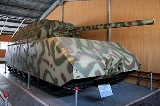
Panzer VIII Maus

Encyclopedia
Panzerkampfwagen VIII Maus was a German
World War II
super-heavy tank
completed in late 1944. It is the heaviest fully enclosed armoured fighting vehicle
ever built. Only two hulls and one turret were completed before the testing grounds were captured by the advancing Soviet forces.
These two prototypes (one with, one without turret) underwent trials in late 1944. The complete vehicle was 10.2 metre long, 3.71 metre wide and 3.63 metres (11.9 ft) tall. Weighing 200 metric tons, the Maus's main armament was a 128 mm KwK 44 gun (55 calibers long barrel), based on the 12.8 cm Pak 44
anti-tank artillery piece, with a coaxial 75 mm gun. The 128 mm gun was powerful enough to destroy all enemy armored fighting vehicles at close or medium ranges, and even some at ranges exceeding 3500 meters.
The principal problem in development of the Maus was finding a powerful enough engine for its weight that could be carried in the tank. Though the design called for a maximum speed of 20 kilometres per hour (12.4 mph), no engine was found that could power the prototype to more than 13 kilometres per hour (8.1 mph) under ideal conditions. The weight also made it impossible to cross most bridges; it was intended to ford
or submerge and use a snorkel
to cross rivers.
to Adolf Hitler
in June 1942, who subsequently approved it. The design up to then had been the culmination of work done by Porsche who had won the contract for the heavy tank that March. Work on the design began in earnest; the first prototype, to be ready in 1943 was initially to receive the name Mammut (Mammoth
). This was reportedly changed to Mäuschen (Little Mouse) in December 1942 and finally to Maus (Mouse) in February 1943, which became the most common name for this tank. Its ordnance inventory designation was SdKfz 205.
Hitler's obsession with heavy tanks reached its zenith with the construction of the Panzer VIII "Maus". What is clear is that the time and energy spent on designing and producing these behemoths wasted a vast amount of precious design and production effort, which Nazi Germany could ill afford to spare. Guderian
described the Maus as "this gigantic offspring of the fantasy of Hitler and his advisors."Forty, George. The Illustrated Guide to Tanks of the World, 2005, Hermes House
The Maus was designed from the start to use the "electric transmission" design which Ferdinand Porsche had used in his unsuccessful attempt to win the production contract for the Tiger
. The initial prototypes used a gasoline engine, the later ones were to use diesel. It drove a massive electrical generator, and together they occupied the entire central rear two-thirds of the Maus' hull, cutting off the forward driver's compartment in the hull from direct access to the turret from within the tank. Each metre-wide track, which used the same basic "contact shoe" and "connector link" design format as the Henschel-built King Tiger
had used, had its own electric motor mounted in the rear of the hull; the tracks had no direct mechanical connection to the internal combustion engine that powered the Maus.
Due to the uniquely wide tracks used (1100 mm each), there was a narrow lengthwise "tunnel" inside the hull under and to the rear of the turret to house the engine and generator of the tank's powertrain.
The amount of armour was substantial, the hull front was 220 millimetres (8.7 in). The sides and rear of the hull were up to 190 millimetres (7.5 in). The turret armour was even thicker, the turret front was up to 240 millimetres (9.4 in) and the sides and rear 220 millimetres (8.7 in). The mantlet was 250 millimetres (9.8 in), and combined with the turret armour behind, the protection level at that section was even higher.
The initial plan for the Maus was for the prototype to have been completed by the summer of 1943, with monthly production scheduled to run at five vehicles per month after delivery of the prototype. The work on the Maus would be divided between Krupp
, responsible for the chassis, armament and turret and Alkett, who would be responsible for final assembly.
The Maus tank was originally designed to weigh approximately 100 tons and be armed with a 128 mm main gun and a 75 mm co-axial secondary gun. Additional armament options were studied including various versions of 150 mm and 128 mm guns. Hitler himself in January 1943 insisted that the armament be a 128 mm main gun with a coaxial 75 mm gun.
By May 1943, a wooden mockup of the final Maus configuration was ready and presented to Hitler, who approved it for mass production, ordering a first series of 150. At this point, the estimated weight of the Maus was 188 tons. However, there is a story that concerns the main armament of the Maus being changed by Hitler who said that the 128 mm gun looked like a ´toy gun´ when compared to the tank, causing the 128 mm to be replaced by a 150 mm gun.
In his book Panzer Leader, Heinz Guderian
wrote:
Development work on the Maus continued, but in October 1943 Hitler cancelled the order, which was followed in November by the order to stop development of the Maus altogether but to continue the construction of the prototypes.
The principal problem with the Maus that emerged from this test was its power-to-weight ratio
. There was no engine powerful enough to give it anything like the 20 km/h demanded by the design specifications. The modified gasoline
-fuelled Daimler-Benz MB 509 engine used in the prototype was only able to move at 13 km/h and only under ideal conditions. The suspension system used by the Maus also had to be adjusted to enable it to take the tank's weight.
Another issue found was that the Maus was simply too heavy to cross bridges. As a result an alternative system was developed, where the Maus would instead ford the rivers it needed to cross. Due to its size it could ford relatively deep streams, but for deeper ones it was to submerge and drive across the river bottom. The solution required tanks to be paired up. One Maus would supply electrical power to the crossing vehicle via a cable until it reached the other side. The crew would receive air through a large snorkel
, which was long enough for the tank to go 45 feet (13 m) underwater.
By July 1944, Krupp was in the process of producing four more Maus hulls, but they were ordered to halt production and scrap these. Krupp stopped all work on it in August 1944. Meanwhile, the V2 prototype started tests in September 1944, fitted with a Daimler-Benz MB 517 diesel engine, new electric steering system and a Skoda Works
designed running gear and tracks.
There was also a special railroad car made for transporting the Maus prototypes.
, Hawker Typhoon
, and the Republic P-47 Thunderbolt wreaked havoc among the Panzer Divisions. With the late-war interest in super-heavy tank like the Maus and E-100
(and one could also include the Tiger II
and Jagdtiger
in this category), the need for complementary air defense was clear.
Towards the end of the war, Soviet forces discovered blueprints for a turret mounting twin 8.8 cm flak guns which was to have been mounted on either the Maus or the Panzerkampfwagen E-100
. Later in 1945 a mild steel mock up of the turret was reportedly discovered. Since the flak vehicle would use the same chassis as the tanks it was protecting, maintenance and spare part inventories would have been rationalized considerably.
It was envisioned that each Maus or E-100 battalion would include at least three of these vehicles. The Flakzwilling itself would be operated by a crew of eight: a driver, commander, gunner, mechanic, and four loaders for the rapid-firing flak cannons. For anti-aircraft operations, the three flak vehicles would be directed by a fourth vehicle. This command vehicle would have been equipped with a mobile range and altitude finder as well as a target tracking system. No records as to the nature of this vehicle's systems, nor what chassis it would have been constructed upon, have surfaced.
 The working Maus prototypes remained at Kummersdorf
and at the proving grounds in Böblingen
. In the last weeks of the war the V1 with the dummy turret was captured by the advancing Soviet forces
in the vicinity of the western batteries of the Kummersdorf artillery firing grounds. It had been thought to be mechanically sabotaged by the Germans before abandoning it. Some sources state that the Panzerkampfwagen VIII saw combat while defending the facility at Kummersdorf, although the popular version is that it did not.
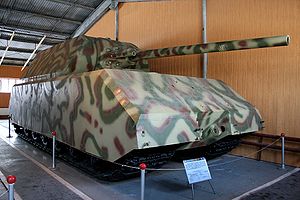
The Soviet Commander of Armored and Mechanized troops ordered the hull of V1 to be mated with the turret of V2. The Soviets used six 18t German half-tracks
to pull the 55 ton turret off the burnt-out hull. The combined V1 hull/V2 turret vehicle was completed in Germany and sent back to the USSR for further testing. It arrived there on May 4, 1946. When further testing was completed the vehicle was taken over by the Kubinka Tank Museum
for storage where it is now on display.
It appears that the capture of this prototype had little impact on post-war Soviet tank development. Soviet tank design continued to concentrate on maneuverability by strictly limiting size and weight. The next-generation Soviet tanks had similar levels of protection and armament. The IS-3 heavy tank
was armed with a 122 mm gun, but weighed under 50 tonnes. The T-54 main battle tank, which started production in 1947, provided 200 mm of frontal turret armor, 100 mm of frontal hull armor and a 100 mm main gun, while weighing in at slightly less than 40 tons.
A third almost-completed hull and turret were found by British forces at the Krupp
works at Essen
.
Nazi Germany
Nazi Germany , also known as the Third Reich , but officially called German Reich from 1933 to 1943 and Greater German Reich from 26 June 1943 onward, is the name commonly used to refer to the state of Germany from 1933 to 1945, when it was a totalitarian dictatorship ruled by...
World War II
World War II
World War II, or the Second World War , was a global conflict lasting from 1939 to 1945, involving most of the world's nations—including all of the great powers—eventually forming two opposing military alliances: the Allies and the Axis...
super-heavy tank
Super-heavy tank
Super-heavy tanks are armored vehicles of very large size, generally over 75 tonnes. Programs have been initiated on several occasions with the aim of creating an invincible vehicle for penetrating enemy formations without fear of being destroyed in combat; however, only a few examples have ever...
completed in late 1944. It is the heaviest fully enclosed armoured fighting vehicle
Armoured fighting vehicle
An armoured fighting vehicle is a combat vehicle, protected by strong armour and armed with weapons. AFVs can be wheeled or tracked....
ever built. Only two hulls and one turret were completed before the testing grounds were captured by the advancing Soviet forces.
These two prototypes (one with, one without turret) underwent trials in late 1944. The complete vehicle was 10.2 metre long, 3.71 metre wide and 3.63 metres (11.9 ft) tall. Weighing 200 metric tons, the Maus's main armament was a 128 mm KwK 44 gun (55 calibers long barrel), based on the 12.8 cm Pak 44
12.8 cm PaK 44
The 12.8 cm Pak 44, was a German heavy anti-tank gun used during World War II. It was designed as a result of experiences on the Eastern front in 1943. The German army had encountered the Russian 122 mm guns and had issued a requirement for a similar weapon. Development initially concentrated on a...
anti-tank artillery piece, with a coaxial 75 mm gun. The 128 mm gun was powerful enough to destroy all enemy armored fighting vehicles at close or medium ranges, and even some at ranges exceeding 3500 meters.
The principal problem in development of the Maus was finding a powerful enough engine for its weight that could be carried in the tank. Though the design called for a maximum speed of 20 kilometres per hour (12.4 mph), no engine was found that could power the prototype to more than 13 kilometres per hour (8.1 mph) under ideal conditions. The weight also made it impossible to cross most bridges; it was intended to ford
Ford (crossing)
A ford is a shallow place with good footing where a river or stream may be crossed by wading or in a vehicle. A ford is mostly a natural phenomenon, in contrast to a low water crossing, which is an artificial bridge that allows crossing a river or stream when water is low.The names of many towns...
or submerge and use a snorkel
Vehicle snorkel
A vehicle snorkel is the land-based equivalent of the submarine snorkel which allowed submarines to use diesel engines while submerged. Snorkels, when used by vehicles with air-breathing internal combustion engines, allow limited deep fording capability for river crossing or amphibious landing...
to cross rivers.
Development
The basic design known as the VK7001 / Porsche Type 205 was suggested by Ferdinand PorscheFerdinand Porsche
Ferdinand Porsche was an Austrian automotive engineer and honorary Doctor of Engineering. He is best known for creating the first hybrid vehicle , the Volkswagen Beetle, and the Mercedes-Benz SS/SSK, as well as the first of many Porsche automobiles...
to Adolf Hitler
Adolf Hitler
Adolf Hitler was an Austrian-born German politician and the leader of the National Socialist German Workers Party , commonly referred to as the Nazi Party). He was Chancellor of Germany from 1933 to 1945, and head of state from 1934 to 1945...
in June 1942, who subsequently approved it. The design up to then had been the culmination of work done by Porsche who had won the contract for the heavy tank that March. Work on the design began in earnest; the first prototype, to be ready in 1943 was initially to receive the name Mammut (Mammoth
Mammoth
A mammoth is any species of the extinct genus Mammuthus. These proboscideans are members of Elephantidae, the family of elephants and mammoths, and close relatives of modern elephants. They were often equipped with long curved tusks and, in northern species, a covering of long hair...
). This was reportedly changed to Mäuschen (Little Mouse) in December 1942 and finally to Maus (Mouse) in February 1943, which became the most common name for this tank. Its ordnance inventory designation was SdKfz 205.
Hitler's obsession with heavy tanks reached its zenith with the construction of the Panzer VIII "Maus". What is clear is that the time and energy spent on designing and producing these behemoths wasted a vast amount of precious design and production effort, which Nazi Germany could ill afford to spare. Guderian
Guderian
Guderian may refer to:People with the surname Guderian:*Heinz Guderian, a military theorist and innovative General of the German Army during the Second World War....
described the Maus as "this gigantic offspring of the fantasy of Hitler and his advisors."Forty, George. The Illustrated Guide to Tanks of the World, 2005, Hermes House
The Maus was designed from the start to use the "electric transmission" design which Ferdinand Porsche had used in his unsuccessful attempt to win the production contract for the Tiger
Tiger I
Tiger I is the common name of a German heavy tank developed in 1942 and used in World War II. The final official German designation was Panzerkampfwagen Tiger Ausf. E, often shortened to Tiger. It was an answer to the unexpectedly formidable Soviet armour encountered in the initial months of...
. The initial prototypes used a gasoline engine, the later ones were to use diesel. It drove a massive electrical generator, and together they occupied the entire central rear two-thirds of the Maus' hull, cutting off the forward driver's compartment in the hull from direct access to the turret from within the tank. Each metre-wide track, which used the same basic "contact shoe" and "connector link" design format as the Henschel-built King Tiger
Tiger II
Tiger II is the common name of a German heavy tank of the Second World War. The final official German designation was Panzerkampfwagen Tiger Ausf. B,Panzerkampfwagen – abbr: Pz. or Pz.Kfw. Ausführung – abbr: Ausf. .The full titles Panzerkampfwagen Tiger Ausf...
had used, had its own electric motor mounted in the rear of the hull; the tracks had no direct mechanical connection to the internal combustion engine that powered the Maus.
Due to the uniquely wide tracks used (1100 mm each), there was a narrow lengthwise "tunnel" inside the hull under and to the rear of the turret to house the engine and generator of the tank's powertrain.
The amount of armour was substantial, the hull front was 220 millimetres (8.7 in). The sides and rear of the hull were up to 190 millimetres (7.5 in). The turret armour was even thicker, the turret front was up to 240 millimetres (9.4 in) and the sides and rear 220 millimetres (8.7 in). The mantlet was 250 millimetres (9.8 in), and combined with the turret armour behind, the protection level at that section was even higher.
The initial plan for the Maus was for the prototype to have been completed by the summer of 1943, with monthly production scheduled to run at five vehicles per month after delivery of the prototype. The work on the Maus would be divided between Krupp
Krupp
The Krupp family , a prominent 400-year-old German dynasty from Essen, have become famous for their steel production and for their manufacture of ammunition and armaments. The family business, known as Friedrich Krupp AG Hoesch-Krupp, was the largest company in Europe at the beginning of the 20th...
, responsible for the chassis, armament and turret and Alkett, who would be responsible for final assembly.
The Maus tank was originally designed to weigh approximately 100 tons and be armed with a 128 mm main gun and a 75 mm co-axial secondary gun. Additional armament options were studied including various versions of 150 mm and 128 mm guns. Hitler himself in January 1943 insisted that the armament be a 128 mm main gun with a coaxial 75 mm gun.
By May 1943, a wooden mockup of the final Maus configuration was ready and presented to Hitler, who approved it for mass production, ordering a first series of 150. At this point, the estimated weight of the Maus was 188 tons. However, there is a story that concerns the main armament of the Maus being changed by Hitler who said that the 128 mm gun looked like a ´toy gun´ when compared to the tank, causing the 128 mm to be replaced by a 150 mm gun.
In his book Panzer Leader, Heinz Guderian
Heinz Guderian
Heinz Wilhelm Guderian was a German general during World War II. He was a pioneer in the development of armored warfare, and was the leading proponent of tanks and mechanization in the Wehrmacht . Germany's panzer forces were raised and organized under his direction as Chief of Mobile Forces...
wrote:
Development work on the Maus continued, but in October 1943 Hitler cancelled the order, which was followed in November by the order to stop development of the Maus altogether but to continue the construction of the prototypes.
V1
The first, turretless prototype (V1) was assembled by Alkett in December 1943. Tests started the same month, with a mock turret fitted of the same weight as the real turret. In June 1944 the production turret, with armament, was used for tests.The principal problem with the Maus that emerged from this test was its power-to-weight ratio
Power-to-weight ratio
Power-to-weight ratio is a calculation commonly applied to engines and mobile power sources to enable the comparison of one unit or design to another. Power-to-weight ratio is a measurement of actual performance of any engine or power sources...
. There was no engine powerful enough to give it anything like the 20 km/h demanded by the design specifications. The modified gasoline
Gasoline
Gasoline , or petrol , is a toxic, translucent, petroleum-derived liquid that is primarily used as a fuel in internal combustion engines. It consists mostly of organic compounds obtained by the fractional distillation of petroleum, enhanced with a variety of additives. Some gasolines also contain...
-fuelled Daimler-Benz MB 509 engine used in the prototype was only able to move at 13 km/h and only under ideal conditions. The suspension system used by the Maus also had to be adjusted to enable it to take the tank's weight.
Another issue found was that the Maus was simply too heavy to cross bridges. As a result an alternative system was developed, where the Maus would instead ford the rivers it needed to cross. Due to its size it could ford relatively deep streams, but for deeper ones it was to submerge and drive across the river bottom. The solution required tanks to be paired up. One Maus would supply electrical power to the crossing vehicle via a cable until it reached the other side. The crew would receive air through a large snorkel
Vehicle snorkel
A vehicle snorkel is the land-based equivalent of the submarine snorkel which allowed submarines to use diesel engines while submerged. Snorkels, when used by vehicles with air-breathing internal combustion engines, allow limited deep fording capability for river crossing or amphibious landing...
, which was long enough for the tank to go 45 feet (13 m) underwater.
V2
In March 1944 the second prototype, the V2, was delivered. It differed in many details from the V1 prototype. In mid-1944, the V2 prototype was fitted with a powerplant and the first produced Maus turret. This turret was fitted with a 128 mm KwK 44 L/55 gun, with coaxial 75 mm KwK 44 L/36.5 gun and a 7.92 mm MG34 for anti-aircraft armament. The V1 prototype was supposed to be fitted with the second produced turret, but this never happened.By July 1944, Krupp was in the process of producing four more Maus hulls, but they were ordered to halt production and scrap these. Krupp stopped all work on it in August 1944. Meanwhile, the V2 prototype started tests in September 1944, fitted with a Daimler-Benz MB 517 diesel engine, new electric steering system and a Skoda Works
Škoda Works
Škoda Works was the largest industrial enterprise in Austro-Hungary and later in Czechoslovakia, one of its successor states. It was also one of the largest industrial conglomerates in Europe in the 20th century...
designed running gear and tracks.
There was also a special railroad car made for transporting the Maus prototypes.
Flak
In the latter stages of World War II, Allied air superiority on all fronts severely hampered German forces, especially armor. Aircraft like the Ilyushin Il-2Ilyushin Il-2
The Ilyushin Il-2 was a ground-attack aircraft in the Second World War, produced by the Soviet Union in very large numbers...
, Hawker Typhoon
Hawker Typhoon
The Hawker Typhoon was a British single-seat fighter-bomber, produced by Hawker Aircraft. While the Typhoon was designed to be a medium-high altitude interceptor, and a direct replacement for the Hawker Hurricane, several design problems were encountered, and the Typhoon never completely satisfied...
, and the Republic P-47 Thunderbolt wreaked havoc among the Panzer Divisions. With the late-war interest in super-heavy tank like the Maus and E-100
Panzerkampfwagen E-100
The Panzerkampfwagen E-100 was a German super-heavy tank design developed near the end of World War II.-History:The basic design was ordered by the Waffenamt as a parallel development to the Porsche Maus in June 1943...
(and one could also include the Tiger II
Tiger II
Tiger II is the common name of a German heavy tank of the Second World War. The final official German designation was Panzerkampfwagen Tiger Ausf. B,Panzerkampfwagen – abbr: Pz. or Pz.Kfw. Ausführung – abbr: Ausf. .The full titles Panzerkampfwagen Tiger Ausf...
and Jagdtiger
Jagdtiger
Jagdtiger is the common name of a German tank destroyer of World War II. The official German designation was Panzerjäger Tiger Ausf. B. The ordnance inventory designation was Sd. Kfz. 186. It saw service in small numbers from late 1944 to the end of the war on both the Western and Eastern Front...
in this category), the need for complementary air defense was clear.
Towards the end of the war, Soviet forces discovered blueprints for a turret mounting twin 8.8 cm flak guns which was to have been mounted on either the Maus or the Panzerkampfwagen E-100
Panzerkampfwagen E-100
The Panzerkampfwagen E-100 was a German super-heavy tank design developed near the end of World War II.-History:The basic design was ordered by the Waffenamt as a parallel development to the Porsche Maus in June 1943...
. Later in 1945 a mild steel mock up of the turret was reportedly discovered. Since the flak vehicle would use the same chassis as the tanks it was protecting, maintenance and spare part inventories would have been rationalized considerably.
It was envisioned that each Maus or E-100 battalion would include at least three of these vehicles. The Flakzwilling itself would be operated by a crew of eight: a driver, commander, gunner, mechanic, and four loaders for the rapid-firing flak cannons. For anti-aircraft operations, the three flak vehicles would be directed by a fourth vehicle. This command vehicle would have been equipped with a mobile range and altitude finder as well as a target tracking system. No records as to the nature of this vehicle's systems, nor what chassis it would have been constructed upon, have surfaced.
Capture
Kummersdorf
Kummersdorf is the name of an estate near Luckenwalde at , around 25km south of Berlin, in the Brandenburg region of Germany. Until 1945 Kummersdorf hosted the weapon office of the German Army which ran a development centre for future weapons as well as an artillery range.In 1929 the Army Weapons...
and at the proving grounds in Böblingen
Böblingen
Böblingen is a town in Baden-Württemberg, Germany, seat of Böblingen District. Physically Sindelfingen and Böblingen are continuous.-History:Böblingen was founded by Count Wilhelm von Tübingen-Böblingen in 1253. Württemberg acquired the town in 1357, and on 12 May 1525 one of the bloodiest battles...
. In the last weeks of the war the V1 with the dummy turret was captured by the advancing Soviet forces
Red Army
The Workers' and Peasants' Red Army started out as the Soviet Union's revolutionary communist combat groups during the Russian Civil War of 1918-1922. It grew into the national army of the Soviet Union. By the 1930s the Red Army was among the largest armies in history.The "Red Army" name refers to...
in the vicinity of the western batteries of the Kummersdorf artillery firing grounds. It had been thought to be mechanically sabotaged by the Germans before abandoning it. Some sources state that the Panzerkampfwagen VIII saw combat while defending the facility at Kummersdorf, although the popular version is that it did not.
The Soviet Commander of Armored and Mechanized troops ordered the hull of V1 to be mated with the turret of V2. The Soviets used six 18t German half-tracks
Sd.Kfz. 9
The Sd.Kfz. 9 was a German half-track that saw widespread use in World War II. Its main roles were as a prime mover for very heavy towed guns such as the 24 cm Kanone 3 and as a tank recovery vehicle. Approximately 2,500 were produced between 1938 and 1945.-Description:The Sd.Kfz. 9 had a ladder...
to pull the 55 ton turret off the burnt-out hull. The combined V1 hull/V2 turret vehicle was completed in Germany and sent back to the USSR for further testing. It arrived there on May 4, 1946. When further testing was completed the vehicle was taken over by the Kubinka Tank Museum
Kubinka Tank Museum
The Kubinka Tank Museum is a large museum of armoured fighting vehicles in Kubinka, just outside Moscow. It has many famous tanks from World War I, World War II and the Cold War. The museum also houses many unique vehicles, such as the Panzer VIII Maus, Troyanov super-heavy tank and a Karl-Gerät...
for storage where it is now on display.
It appears that the capture of this prototype had little impact on post-war Soviet tank development. Soviet tank design continued to concentrate on maneuverability by strictly limiting size and weight. The next-generation Soviet tanks had similar levels of protection and armament. The IS-3 heavy tank
Iosif Stalin tank
The Iosif Stalin tank , was a heavy tank developed by the Soviet Union during World War II and first used in the Kursk area in September 1943...
was armed with a 122 mm gun, but weighed under 50 tonnes. The T-54 main battle tank, which started production in 1947, provided 200 mm of frontal turret armor, 100 mm of frontal hull armor and a 100 mm main gun, while weighing in at slightly less than 40 tons.
A third almost-completed hull and turret were found by British forces at the Krupp
Krupp
The Krupp family , a prominent 400-year-old German dynasty from Essen, have become famous for their steel production and for their manufacture of ammunition and armaments. The family business, known as Friedrich Krupp AG Hoesch-Krupp, was the largest company in Europe at the beginning of the 20th...
works at Essen
Essen
- Origin of the name :In German-speaking countries, the name of the city Essen often causes confusion as to its origins, because it is commonly known as the German infinitive of the verb for the act of eating, and/or the German noun for food. Although scholars still dispute the interpretation of...
.
See also
- Panzerkampfwagen E-100Panzerkampfwagen E-100The Panzerkampfwagen E-100 was a German super-heavy tank design developed near the end of World War II.-History:The basic design was ordered by the Waffenamt as a parallel development to the Porsche Maus in June 1943...
- German 140 tonne super-heavy tank design - Landkreuzer P. 1000 Ratte - German 1,000 tonne armoured landcruiser design
- T-28 Super Heavy TankT-28 Super Heavy TankThe T28 super heavy tank was a prototype heavily armored self-propelled gun designed for the US Army during World War II. It was originally designed to be used to break through German defenses at the Siegfried Line, and was later considered as a possible participant in an invasion of the Japanese...
- contemporaneous American prototype casemateCasemateA casemate, sometimes rendered casement, is a fortified gun emplacement or armored structure from which guns are fired. originally a vaulted chamber in a fortress.-Origin of the term:...
-hull tank destroyerTank destroyerA tank destroyer is a type of armored fighting vehicle armed with a gun or missile launcher, and is designed specifically to engage enemy armored vehicles... - Tortoise heavy assault tankTortoise heavy assault tankThe Tank, Heavy Assault, Tortoise was a British heavy assault tank design developed in World War II but never put into mass production. It was developed for the task of clearing heavily fortified areas and as a result favoured armour protection over mobility.Although heavy, at 78 tons, and not...
- contemporaneous British super-heavy AFV - List of prototype WWII combat vehicles