

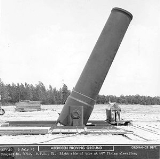
Little David

Encyclopedia
Little David was the nickname of an American 36 inch (914 mm) caliber
mortar
used for test firing aerial bombs during World War II
.
s during the invasion of Japan
. When Japan surrendered
the invasion became unnecessary and Little David was therefore never used in combat. Little David is one of the largest artillery pieces ever produced, by caliber. The mortar was to be transported by two artillery tractor
s, making it more mobile than a railway gun
. Its ultimate effectiveness would have been questionable because of its limited range and accuracy, and the Japanese had not constructed complex fortifications in any case.
Caliber
In guns including firearms, caliber or calibre is the approximate internal diameter of the barrel in relation to the diameter of the projectile used in it....
mortar
Mortar (weapon)
A mortar is an indirect fire weapon that fires explosive projectiles known as bombs at low velocities, short ranges, and high-arcing ballistic trajectories. It is typically muzzle-loading and has a barrel length less than 15 times its caliber....
used for test firing aerial bombs during World War II
World War II
World War II, or the Second World War , was a global conflict lasting from 1939 to 1945, involving most of the world's nations—including all of the great powers—eventually forming two opposing military alliances: the Allies and the Axis...
.
History
Towards the end of the war it was modified to serve as a siege mortar, as it was expected that the US forces would encounter extremely strong fortificationFortification
Fortifications are military constructions and buildings designed for defence in warfare and military bases. Humans have constructed defensive works for many thousands of years, in a variety of increasingly complex designs...
s during the invasion of Japan
Operation Downfall
Operation Downfall was the Allied plan for the invasion of Japan near the end of World War II. The operation was cancelled when Japan surrendered after the atomic bombing of Hiroshima and Nagasaki and the Soviet Union's declaration of war against Japan. The operation had two parts: Operation...
. When Japan surrendered
Surrender of Japan
The surrender of Japan in 1945 brought hostilities of World War II to a close. By the end of July 1945, the Imperial Japanese Navy was incapable of conducting operations and an Allied invasion of Japan was imminent...
the invasion became unnecessary and Little David was therefore never used in combat. Little David is one of the largest artillery pieces ever produced, by caliber. The mortar was to be transported by two artillery tractor
M25 Tank Transporter
The M25 Tank Transporter was a heavy tank transporter and tank recovery vehicle used in World War II and beyond by the US Army.Nicknamed the Dragon Wagon, the M25 was composed of a 6x6 armored tractor and 40-ton trailer ....
s, making it more mobile than a railway gun
Railway gun
A railway gun, also called a railroad gun, is a large artillery piece, often surplus naval ordnance, mounted on, transported by, and fired from a specially designed railway wagon. Many countries have built railway guns, but the best known are the large Krupp-built pieces used by Germany in World...
. Its ultimate effectiveness would have been questionable because of its limited range and accuracy, and the Japanese had not constructed complex fortifications in any case.
See also
- List of heavy mortars
- List of the largest cannon by caliber
- Schwerer GustavSchwerer GustavSchwerer Gustav and Dora were the names of two massive World War II German 80 cm K railway siege guns. They were developed in the late 1930s by Krupp for the express purpose of destroying heavy fortifications, specifically those in the French Maginot Line...
External links
- globalsecurity.org - 36-inch Little David
- Little David Mortar Present day photos of the Little David Mortar at Aberdeen Proving Grounds, MD