

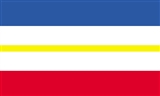
Mecklenburg-Western Pomerania

Encyclopedia
Mecklenburg-Vorpommern ˈmeːklənbʊʁk ˈfɔʁpɔmɐn (also known as Mecklenburg-Western Pomerania in English) is a federal state
in northern Germany
. The capital city is Schwerin
. The state was formed through the merger of the historic regions of Mecklenburg
and Vorpommern after World War II
, dissolved in 1952 and recreated prior to the German reunification
in 1990.
Mecklenburg-Vorpommern is the sixth largest German state by territory, and the least densely populated one. The coastline of the Baltic Sea
, including islands such as Rügen
and Usedom
, as well as the Mecklenburg Lake District
are characterised by many holiday resorts and pristine nature, making Mecklenburg-Vorpommern one of Germany's leading tourist destinations. Three of Germany's fourteen national parks are in Mecklenburg-Vorpommern, in addition to several hundred nature conservation areas. The University of Rostock
(est. 1419) and the University of Greifswald (est. 1456) are amongst the oldest in Europe
.
Major cities include Rostock
, Schwerin
, Neubrandenburg
, Stralsund
, Greifswald
and Wismar
. Mecklenburg-Vorpommern was the site of the 33rd G8 summit
in 2007.
, while ck in High German usually shortens the preceding vowel.
Due to its lengthy name, the state is often abbreviated as MV or (colloquially) shortened to MeckPomm. In English, it is sometimes translated as Mecklenburg-Western Pomerania or literally Mecklenburg-Cispomerania.
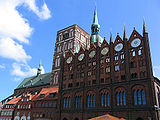 In the aftermath of World War II
and the German re-unification in 1990, the state was constituted from the historic states of Mecklenburg
and Vorpommern, both of which had long and rich independent histories.
, about 10,000 BC. About two thousand years ago, Germanic peoples
were recorded in the area. Most of them left during the Migration Period
, heading towards Spain
, Italy
and France
, leaving the area relatively deserted. In the 6th century Polabian Slavs
populated the area. While Mecklenburg was settled by the Obotrites
, Vorpommern was settled by the Veleti
(later Liuticians) and the Rani
.
Along the coast, Viking
s and Slavs established trade posts like Reric
, Ralswiek
and Menzlin
. In the 12th century, Mecklenburg and Vorpommern were conquered by Henry the Lion
and incorporated into the Duchy of Saxony
, joining the Holy Roman Empire
in the 1180s. All of Mecklenburg-Vorpommern was settled with Germans
in the Ostsiedlung
process, starting in the 12th century.
, Duke of the Saxons, conquered the Obotrites
, subjugated its Nikloting
dynasty, and Christianised its people. In the course of time, German monks, nobility, peasants and traders arrived to settle here. After the 12th century, the territory remained stable and relatively independent of its neighbours; one of the few German territories for which this is true. Mecklenburg first became a duchy
of the Holy Roman Empire
in 1348. Though later partitioned and re-partitioned within the same dynasty, Mecklenburg always shared a common history and identity. The states of Mecklenburg-Schwerin
and Mecklenburg-Strelitz
became Grand Duchies
in 1815. After World War I
and the abdication
of the German Kaiser
, the monarchy was abolished and a republican government of Mecklenburg was established.
n Province of Pomerania
; the eastern part became part of Poland
after the end of World War II
.
In the Middle Ages
, the area was ruled by the Pomeranian dukes as part of the Duchy of Pomerania
. Pomerania was under Swedish
rule after the Peace of Westphalia
from 1648 until 1815 as Swedish Pomerania
. Pomerania then became a province of Prussia in 1815. It remained a Prussian province until 1947.
and the western allies met east of Schwerin
. Following the Potsdam Agreement
, the western allies handed over Mecklenburg
to the Soviets. Mecklenburg-Vorpommern was established on July 9, 1945, per order Nr. 5 of Red Army
marshall Georgy Zhukov
, head of the Soviet Military Administration in Germany
(SMAD), as the Province of Mecklenburg and West Pomerania (zapadnoi Pomeranii).
During the war, the make-up of Mecklenburg and Vorpommern's population changed due to wartime losses and the influx of evacuees (mainly from the Berlin and Hamburg metropolitan areas that were subject to air raids). After the war, people who fled and were expelled from
the former eastern territories of Germany east of the Oder-Neisse line
settled in Mecklenburg-Vorpommern (and elsewhere in Germany), increasing the population by 40%. Before the war, Mecklenburg
and Western Pomerania had a population of 1,278,700, of whom many perished during the war and another share moved west in the course of the Red Army's advance. In 1947, some 1,426,000 refugees from the former eastern parts of Germany were counted. Most of them were settled in rural communities, but also the towns' population increased, most notably in Schwerin
from 65,000 (1939) to 99,518 (January 1947), in Wismar
from 29,463 to 44,173, and in Greifswald
from 29,488 to 43,897.
On June 5, 1946, a law enacted by the Soviets led to the constitution of a provisional German administration (Beratende Versammlung, consulting assembly) under Soviet supervision on June 29, 1946. After the rigged elections of October 20, 1946, a Landtag
replaced the Beratende Versammlung and worked out the constitution of January 16, 1947, for the Land
Mecklenburg-Vorpommern. On April 18, 1947, the state's name was shortened to Land Mecklenburg. The GDR regime attempted to downplay the fact that Germany had made significant concessions to Poland as a result of WWII including the discontinuing the use of any terms referring to these former territories. Mecklenburg was a constituent state of the German Democratic Republic (GDR) upon its formation in 1949. In 1952, the East Berlin
government abandoned "states" in favour of districts (German: Bezirke). As a result of this, Mecklenburg and Vorpommern were replaced by three districts covering roughly the same area (Bezirk Rostock
, Bezirk Schwerin
and Bezirk Neubrandenburg
, commonly known as the Nordbezirke (northern districts)) under the highly-centralised GDR government. The administrative changes also made the historical border between Mecklenburg and Pomerania vanish from the maps. The East German government developed the shipyard
s in the old Hanseatic
ports (the largest being in Rostock
and Stralsund
), and also established a nuclear power
plant in Lubmin
near Greifswald
.
Prior to German reunification
in 1990, the postwar eastern states were reconstituted, including the use of the full historic term Mecklenburg-Vorpommern. Since 1990, the state has undergone dramatic changes.
, to the west by Schleswig-Holstein
, to the southwest by Lower Saxony
, to the south by Brandenburg
, and to the east by the West Pomeranian Voivodeship
in Poland
.
Mecklenburg-Vorpommern's state capital is Schwerin
. The largest city is Rostock
with approximately 200,000 people. Other major cities include Greifswald
, Güstrow
, Neubrandenburg
, Stralsund
and Wismar
.
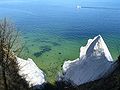 The state's Baltic Sea
coast features several islands, most notably Germany's two biggest islands Rügen
and Usedom
, but also various smaller islands such as Hiddensee
or Poel
. The southern part of the state is marked by a multitude of lakes, the largest of which is Lake Müritz
.
The "state of a thousand lakes" (German: Land der tausend Seen) is mainly characterised by its unspoilt nature. Mecklenburg-Vorpommern's varied coastline offers peninsulas such as Fischland-Darß-Zingst
as well islands. Germany's two largest islands, Rügen
and Usedom
, are part of the state as well as many smaller islands such as Hiddensee
or Poel
. Due to its clean air and it idyllic setting, medical tourism
has become a notable tourism sector in the region.
A total number of 283 nature reserves, 110 landscape reserves and three of Germany's 14 national park
s (see below) are scattered all over the state. Many lakes used for fishing and sailing are located in the Mecklenburg Lake District
. As the state has Germany's longest coastline and some of its largest islands, it is a popular place for sailing, e.g. the Hanse Sail
event, and windsurfing.
and
, being the sixth largest in size, but only 14th in population. The unemployment
rate of 11.8% (Oktober 2009), which has been negatively affected by the breakdown of non-competitive former GDR industries after the German reunification
in the 1990s, is currently the lowest in more than 15 years while the economy is growing and the number of jobs is increasing continually. However, the region remains the poorest in Germany and below the EU average in terms of GDP per capita.
and has similar linguistic and historic characteristics to other north German states, such as Schleswig-Holstein
. People in Vorpommern, as a result of that territory being a former province of Prussia
, tend to look slightly more towards Berlin
and Brandenburg
than people in Mecklenburg would.
" style also found in other parts of northern Germany (e.g. Lübeck
) as well as in countries bordering the Baltic Sea
like Estonia
(e.g. Tallinn
) or Latvia
(e.g. Riga
). A common feature of many towns in Mecklenburg and Vorpommern are Gothic
red brick churches dating back to the Middle Ages
. The old towns are usually built around one or several market places with a church or the town hall. Often towns were founded at the Baltic Sea
, one of the many lakes
or a river for logistical and trade motives.
offers the very popular Deutsches Meeresmuseum (German Maritime Museum; the most popular museum in Northern Germany
), Ribnitz-Damgarten
the Deutsches Bernsteinmuseum (German Amber Museum).
During summer, many open air concerts and operas are open to visitors. The Festspiele Mecklenburg-Vorpommern (Music Festival of MV) attract a sizeable audience by performing classical concerts in parks, churches and castles.
Caspar David Friedrich
, a famous romanticist
painter
born in Greifswald
, immortalised parts of the state in several of his paintings.
(also called High German, Hochdeutsch), a few centuries ago most people spoke what is called Low German
(German: Plattdeutsch or Niederdeutsch). It is not "low" in prestige, but rather designates origin from the lower altitude, flatter, part of northern Germany.
Due to several sound shifts in Standard German which did not occur in Low German, Low German is rather distinct and is considered a separate language by some, a dialect of German by others. At its highpoint, the late Middle Ages
, it was the lingua franca
of the Hanseatic League
, a trade organisation in northern Europe. More than 1500 years ago, "Old Low German" (also known as Old Saxon
) was also the language spoken by the Anglo-Saxons
, who originally came from northern Germany before leaving for England
. That is why, there is often a closer similarity between English and Low German words than between English and Standard/High German words, for instance:
Low German is protected by the state's constitution and, similar to Welsh
in Wales
, taught at school and at university level. There is also a diverse Low German literature by such authors as Fritz Reuter
or Rudolf Tarnow
. Low German has also been recognised by the Netherlands and by Germany (since 1999) as a regional language
according to the European Charter for Regional or Minority Languages
. Within the official terminology defined in the charter, this status would not be available to a dialect of an official language. As a result of this, Germany would appear, therefore, to have at least implicitly adopted the stance that Low German is not a dialect of the German language, but rather a separate language.
called Rostocker Bratwurst. An unusual food from Western Pomerania is Tollatsch
. Rote Grütze
is a popular dessert. The largest brewery produces Lübzer Pils.
17.9 %, Catholic Church 3.3 %.
Following the Christian Reformation
, led in Germany by Martin Luther
, as well as a period of Swedish
rule, the traditional faith in Mecklenburg-Vorpommern is Protestantism
, specifically Lutheranism
. There are also a number of Catholic
s and people of other faiths. Both confessions are split at the old border; Mecklenburg belongs to the Evangelical Lutheran Church of Mecklenburg
and the Archdiocese of Hamburg, West Pomerania forms the Pomeranian Evangelical Church
(some parts however belonging to Brandenburg in this respect) or belongs to the Archdiocese of Berlin. As to the Protestants, a union to form a North Church (together with the North Elbians) is in progress. As a result of the extremely secular laws of the former communist GDR, more than three quarters of the population are now non-religious or agnostic.
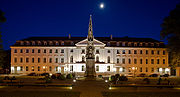
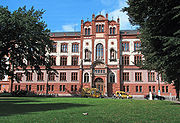
of Germany
, and indeed Europe
:
Also, there are four colleges / technological universities.
"). Besides, there are also independent schools, comprehensive schools, and trade schools.
is the "site of political decision-making". The Mecklenburg-Vorpommern Landtag is elected democratically by the citizens of the state who sit for one 5-year legislative period at a time. At least four parties must form the Landtag. The seat of Landtag is located at Schwerin Castle
in Schwerin
. The essential functions of the Landtag is to elect the Minister-President
of the state; to discuss and decide on laws which have been proposed by the government, by a people's initiative or a petition for a referendum initiated directly by the people; and to control the state government.
took place on 4 September 2011. As a result of the 2006 election, Mecklenburg-Vorpommern is governed by a Grand coalition
of SPD
and CDU
. Whether re-elected Erwin Sellering
is going to continue this coalition after the Social Democrats' victory in the 2011 election
is currently subject to negotiations.
Preliminary summary of the 2011 election results for the Landtag of Mecklenburg-Vorpommern
|- bgcolor=#E9E9E9
! colspan="2" align="center" | Party
! align="left" | Ideology
! colspan="2" | Vote % (change)
! colspan="2" | Seats (change)
! | Seat %
|-
|style="width: 20px" bgcolor=#ff0000 align="center" |
| align="left" | Social Democratic Party
(SPD)
| align="left" | Social democracy
| align="right" | 35.7%
| align="right" | (+3.7%)
| align="right" | 28
| align="right" | (+5)
| align="right" |
|-
|style="width: 20px" bgcolor=#000000 align="center" |
| align="left" | Christian Democratic Union (CDU)
| align="left" | Christian democracy
| align="right" | 23.1%
| align="right" | (-5.7%)
| align="right" | 18
| align="right" | (-4)
| align="right" |
|-
|style="width: 20px" bgcolor=#AA0000 align="center" |
| align="left" | Die Linke (formerly The Left Party.PDS)
| align="left" | Democratic socialism
| align="right" | 18.4%
| align="right" | (+1.6%)
| align="right" | 14
| align="right" | (+1)
| align="right" |
|-
|style="width: 20px" bgcolor=#99CC33 align="center" |
| align="left" | Alliance '90/The Greens
(Die Grünen)
| align="left" | Green politics
| align="right" | 8.4%
| align="right" | (+5.0%)
| align="right" | 6
| align="right" | (+6)
| align="right" |
|-
|style="width: 20px" bgcolor=#996633 align="center" |
| align="left" | National Democratic Party
(NPD)
| align="left" | Far-right politics
| align="right" | 6.0%
| align="right" | (-1.3%)
| align="right" | 5
| align="right" | (-1)
| align="right" |
|-
|style="width: 20px" bgcolor=#FFFF00 align="center" |
| align="left" | Free Democratic Party
(FDP)
| align="left" | Classical liberalism
| align="right" | 2.7%
| align="right" | (-6.9%)
| align="right" | 0
| align="right" | (-7)
| align="right" |
|-
|style="width: 20px" bgcolor=white align="center" |
| align="left" | All Others
| align="left" |
| align="right" | 5.7%
| align="right" | (+1.8%)
| align="right" | 0
| align="right" |(±0)
| align="right" |
|-
! align="right" style="background-color:#E9E9E9" colspan=3 | Total
! align="right" style="background-color:#E9E9E9" | 100.0%
! align="right" style="background-color:#E9E9E9" |
! align="right" style="background-color:#E9E9E9" | 71
! align="right" style="background-color:#E9E9E9" |
! align="right" style="background-color:#E9E9E9" | 100.0%
|}
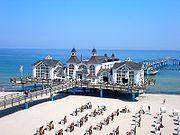 Mecklenburg-Vorpommern is among the top three destinations for inner-German tourism. The main tourist regions are:
As a relict of the past, nearly 2,000 castles, palaces and manor houses exist in Mecklenburg-Vorpommern, many of which function as venues for public events like concerts and festivals.
Medical tourism
based on the clean air and idyllic settings by the Baltic Sea
has a growing importance to the regional tourism industry.
, F.C. Hansa Rostock and the international sailing event Hanse Sail
. Had the bid for the 2012 summer Olympics in Leipzig been successful, the sailing competitions would have taken place off the coast of Rostock
.

53°36′43.42"N 12°42′00.70"E
States of Germany
Germany is made up of sixteen which are partly sovereign constituent states of the Federal Republic of Germany. Land literally translates as "country", and constitutionally speaking, they are constituent countries...
in northern Germany
Germany
Germany , officially the Federal Republic of Germany , is a federal parliamentary republic in Europe. The country consists of 16 states while the capital and largest city is Berlin. Germany covers an area of 357,021 km2 and has a largely temperate seasonal climate...
. The capital city is Schwerin
Schwerin
Schwerin is the capital and second-largest city of the northern German state of Mecklenburg-Vorpommern. The population, as of end of 2009, was 95,041.-History:...
. The state was formed through the merger of the historic regions of Mecklenburg
Mecklenburg
Mecklenburg is a historical region in northern Germany comprising the western and larger part of the federal-state Mecklenburg-Vorpommern...
and Vorpommern after World War II
World War II
World War II, or the Second World War , was a global conflict lasting from 1939 to 1945, involving most of the world's nations—including all of the great powers—eventually forming two opposing military alliances: the Allies and the Axis...
, dissolved in 1952 and recreated prior to the German reunification
German reunification
German reunification was the process in 1990 in which the German Democratic Republic joined the Federal Republic of Germany , and when Berlin reunited into a single city, as provided by its then Grundgesetz constitution Article 23. The start of this process is commonly referred by Germans as die...
in 1990.
Mecklenburg-Vorpommern is the sixth largest German state by territory, and the least densely populated one. The coastline of the Baltic Sea
Baltic Sea
The Baltic Sea is a brackish mediterranean sea located in Northern Europe, from 53°N to 66°N latitude and from 20°E to 26°E longitude. It is bounded by the Scandinavian Peninsula, the mainland of Europe, and the Danish islands. It drains into the Kattegat by way of the Øresund, the Great Belt and...
, including islands such as Rügen
Rügen
Rügen is Germany's largest island. Located in the Baltic Sea, it is part of the Vorpommern-Rügen district of Mecklenburg-Vorpommern.- Geography :Rügen is located off the north-eastern coast of Germany in the Baltic Sea...
and Usedom
Usedom
Usedom is a Baltic Sea island on the border between Germany and Poland. It is situated north of the Szczecin Lagoon estuary of the River Oder in Pomerania...
, as well as the Mecklenburg Lake District
Mecklenburg Lake District
The Mecklenburg Lake District is the largest coherent lakes and canals area in Germany. It is situated in southern Mecklenburg-Vorpommern, extending somewhat into the north of Brandenburg, and sometimes called "the land of the thousand lakes".The Seenplatte includes Müritz National Park, which...
are characterised by many holiday resorts and pristine nature, making Mecklenburg-Vorpommern one of Germany's leading tourist destinations. Three of Germany's fourteen national parks are in Mecklenburg-Vorpommern, in addition to several hundred nature conservation areas. The University of Rostock
University of Rostock
The University of Rostock is the university of the city Rostock, in the German state of Mecklenburg-Vorpommern.Founded in 1419, it is the oldest and largest university in continental northern Europe and the Baltic Sea area...
(est. 1419) and the University of Greifswald (est. 1456) are amongst the oldest in Europe
Europe
Europe is, by convention, one of the world's seven continents. Comprising the westernmost peninsula of Eurasia, Europe is generally 'divided' from Asia to its east by the watershed divides of the Ural and Caucasus Mountains, the Ural River, the Caspian and Black Seas, and the waterways connecting...
.
Major cities include Rostock
Rostock
Rostock -Early history:In the 11th century Polabian Slavs founded a settlement at the Warnow river called Roztoc ; the name Rostock is derived from that designation. The Danish king Valdemar I set the town aflame in 1161.Afterwards the place was settled by German traders...
, Schwerin
Schwerin
Schwerin is the capital and second-largest city of the northern German state of Mecklenburg-Vorpommern. The population, as of end of 2009, was 95,041.-History:...
, Neubrandenburg
Neubrandenburg
Neubrandenburg is a city in Mecklenburg-Vorpommern, Germany. It is located in the southeastern part of the state, on the shore of a lake called the Tollensesee ....
, Stralsund
Stralsund
- Main sights :* The Brick Gothic historic centre is a UNESCO World Heritage Site.* The heart of the old town is the Old Market Square , with the Gothic Town Hall . Behind the town hall stands the imposing Nikolaikirche , built in 1270-1360...
, Greifswald
Greifswald
Greifswald , officially, the University and Hanseatic City of Greifswald is a town in northeastern Germany. It is situated in the state of Mecklenburg-Vorpommern, at an equal distance of about from Germany's two largest cities, Berlin and Hamburg. The town borders the Baltic Sea, and is crossed...
and Wismar
Wismar
Wismar , is a small port and Hanseatic League town in northern Germany on the Baltic Sea, in the state of Mecklenburg-Vorpommern,about 45 km due east of Lübeck, and 30 km due north of Schwerin. Its natural harbour, located in the Bay of Wismar is well-protected by a promontory. The...
. Mecklenburg-Vorpommern was the site of the 33rd G8 summit
33rd G8 summit
The 33rd G8 summit took place at Kempinski Grand Hotel in Heiligendamm in the old Duchy of Mecklenburg in the Northern German state of Mecklenburg-Vorpommern on the Baltic Coast. The group of eight leaders met together from 6 June to 8 June 2007...
in 2007.
Name
The full name in German is pronounced ˈmeːklənbʊɐ̯k ˈfɔʁpɔmɐn. Sometimes, Mecklenburg is pronounced ˈmɛklənbʊɐ̯k due to different interpretations of the "c", which is used to prolong the preceding vowel in Low GermanLow German
Low German or Low Saxon is an Ingvaeonic West Germanic language spoken mainly in northern Germany and the eastern part of the Netherlands...
, while ck in High German usually shortens the preceding vowel.
Due to its lengthy name, the state is often abbreviated as MV or (colloquially) shortened to MeckPomm. In English, it is sometimes translated as Mecklenburg-Western Pomerania or literally Mecklenburg-Cispomerania.
History
World War II
World War II, or the Second World War , was a global conflict lasting from 1939 to 1945, involving most of the world's nations—including all of the great powers—eventually forming two opposing military alliances: the Allies and the Axis...
and the German re-unification in 1990, the state was constituted from the historic states of Mecklenburg
Mecklenburg
Mecklenburg is a historical region in northern Germany comprising the western and larger part of the federal-state Mecklenburg-Vorpommern...
and Vorpommern, both of which had long and rich independent histories.
Prehistory
Human settlement in the area of modern Mecklenburg and Vorpommern began after the Ice AgeIce age
An ice age or, more precisely, glacial age, is a generic geological period of long-term reduction in the temperature of the Earth's surface and atmosphere, resulting in the presence or expansion of continental ice sheets, polar ice sheets and alpine glaciers...
, about 10,000 BC. About two thousand years ago, Germanic peoples
Germanic peoples
The Germanic peoples are an Indo-European ethno-linguistic group of Northern European origin, identified by their use of the Indo-European Germanic languages which diversified out of Proto-Germanic during the Pre-Roman Iron Age.Originating about 1800 BCE from the Corded Ware Culture on the North...
were recorded in the area. Most of them left during the Migration Period
Migration Period
The Migration Period, also called the Barbarian Invasions , was a period of intensified human migration in Europe that occurred from c. 400 to 800 CE. This period marked the transition from Late Antiquity to the Early Middle Ages...
, heading towards Spain
Spain
Spain , officially the Kingdom of Spain languages]] under the European Charter for Regional or Minority Languages. In each of these, Spain's official name is as follows:;;;;;;), is a country and member state of the European Union located in southwestern Europe on the Iberian Peninsula...
, Italy
Italy
Italy , officially the Italian Republic languages]] under the European Charter for Regional or Minority Languages. In each of these, Italy's official name is as follows:;;;;;;;;), is a unitary parliamentary republic in South-Central Europe. To the north it borders France, Switzerland, Austria and...
and France
France
The French Republic , The French Republic , The French Republic , (commonly known as France , is a unitary semi-presidential republic in Western Europe with several overseas territories and islands located on other continents and in the Indian, Pacific, and Atlantic oceans. Metropolitan France...
, leaving the area relatively deserted. In the 6th century Polabian Slavs
Polabian Slavs
Polabian Slavs - is a collective term applied to a number of Lechites tribes who lived along the Elbe river, between the Baltic Sea to the north, the Saale and the Limes Saxoniae to the west, the Ore Mountains and the Western Sudetes to the south, and Poland to the east. They have also been known...
populated the area. While Mecklenburg was settled by the Obotrites
Obotrites
The Obotrites , also commonly known as the Obodrites, Abotrites, or Abodrites, were a confederation of medieval West Slavic tribes within the territory of modern Mecklenburg and Holstein in northern Germany . For decades they were allies of Charlemagne in his wars against Germanic Saxons and Slavic...
, Vorpommern was settled by the Veleti
Veleti
The Veleti or Wilzi were a group of medieval Lechites tribes within the territory of modern northeastern Germany; see Polabian Slavs. In common with other Slavic groups between the Elbe and Oder Rivers, they were often described by Germanic sources as Wends. In the late 10th century, they were...
(later Liuticians) and the Rani
Rani (Slavic tribe)
The Rani or Rujani were a West Slavic tribe based on the island of Rugia and the southwestern mainland across the Strelasund in what is today northeastern Germany....
.
Along the coast, Viking
Viking
The term Viking is customarily used to refer to the Norse explorers, warriors, merchants, and pirates who raided, traded, explored and settled in wide areas of Europe, Asia and the North Atlantic islands from the late 8th to the mid-11th century.These Norsemen used their famed longships to...
s and Slavs established trade posts like Reric
Reric
Reric or Rerik was one of the Viking Age multi-ethnic Slavic-Scandinavian emporia on the southern coast of the Baltic Sea, located near Wismar in the present-day German state of Mecklenburg-Vorpommern Reric was built around 700, when Slavs of the Obodrite tribe settled the region...
, Ralswiek
Ralswiek
Ralswiek is a municipality in the Vorpommern-Rügen district, in Mecklenburg-Vorpommern, Germany.-External links:*...
and Menzlin
Altes Lager Menzlin
Altes Lager is a site 1,5 km south of the Menzlin village near Anklam, Western Pomerania, Germany. The site at the banks of the river Peene was an important Viking trade post during the Middle Ages...
. In the 12th century, Mecklenburg and Vorpommern were conquered by Henry the Lion
Henry the Lion
Henry the Lion was a member of the Welf dynasty and Duke of Saxony, as Henry III, from 1142, and Duke of Bavaria, as Henry XII, from 1156, which duchies he held until 1180....
and incorporated into the Duchy of Saxony
Duchy of Saxony
The medieval Duchy of Saxony was a late Early Middle Ages "Carolingian stem duchy" covering the greater part of Northern Germany. It covered the area of the modern German states of Bremen, Hamburg, Lower Saxony, North Rhine-Westphalia, and Saxony-Anhalt and most of Schleswig-Holstein...
, joining the Holy Roman Empire
Holy Roman Empire
The Holy Roman Empire was a realm that existed from 962 to 1806 in Central Europe.It was ruled by the Holy Roman Emperor. Its character changed during the Middle Ages and the Early Modern period, when the power of the emperor gradually weakened in favour of the princes...
in the 1180s. All of Mecklenburg-Vorpommern was settled with Germans
Germans
The Germans are a Germanic ethnic group native to Central Europe. The English term Germans has referred to the German-speaking population of the Holy Roman Empire since the Late Middle Ages....
in the Ostsiedlung
Ostsiedlung
Ostsiedlung , also called German eastward expansion, was the medieval eastward migration and settlement of Germans from modern day western and central Germany into less-populated regions and countries of eastern Central Europe and Eastern Europe. The affected area roughly stretched from Slovenia...
process, starting in the 12th century.
Mecklenburg
In the late 12th century, Henry the LionHenry the Lion
Henry the Lion was a member of the Welf dynasty and Duke of Saxony, as Henry III, from 1142, and Duke of Bavaria, as Henry XII, from 1156, which duchies he held until 1180....
, Duke of the Saxons, conquered the Obotrites
Obotrites
The Obotrites , also commonly known as the Obodrites, Abotrites, or Abodrites, were a confederation of medieval West Slavic tribes within the territory of modern Mecklenburg and Holstein in northern Germany . For decades they were allies of Charlemagne in his wars against Germanic Saxons and Slavic...
, subjugated its Nikloting
House of Mecklenburg
The House of Mecklenburg is a North German dynasty of West Slavic origin that ruled until 1918.- Origins :Niklot was a lord of the Wendish tribe of Obotrites. When the Holy Roman Empire expanded eastwards, notably to the coast of Baltic in 13th century, a portion of Obotrite lords allied with...
dynasty, and Christianised its people. In the course of time, German monks, nobility, peasants and traders arrived to settle here. After the 12th century, the territory remained stable and relatively independent of its neighbours; one of the few German territories for which this is true. Mecklenburg first became a duchy
Duchy
A duchy is a territory, fief, or domain ruled by a duke or duchess.Some duchies were sovereign in areas that would become unified realms only during the Modern era . In contrast, others were subordinate districts of those kingdoms that unified either partially or completely during the Medieval era...
of the Holy Roman Empire
Holy Roman Empire
The Holy Roman Empire was a realm that existed from 962 to 1806 in Central Europe.It was ruled by the Holy Roman Emperor. Its character changed during the Middle Ages and the Early Modern period, when the power of the emperor gradually weakened in favour of the princes...
in 1348. Though later partitioned and re-partitioned within the same dynasty, Mecklenburg always shared a common history and identity. The states of Mecklenburg-Schwerin
Mecklenburg-Schwerin
Mecklenburg-Schwerin was a duchy in northern Germany created in 1348, when Albert II of Mecklenburg and his younger brother John were raised to Dukes of Mecklenburg by King Charles IV...
and Mecklenburg-Strelitz
Mecklenburg-Strelitz
Mecklenburg-Strelitz was a duchy and later grand duchy in northern Germany, consisting of the eastern fifth of the historic Mecklenburg region, roughly corresponding with the present-day Mecklenburg-Strelitz district , and the western exclave of the former Bishopric of Ratzeburg in modern...
became Grand Duchies
Grand duchy
A grand duchy, sometimes referred to as a grand dukedom, is a territory whose head of state is a monarch, either a grand duke or grand duchess.Today Luxembourg is the only remaining grand duchy...
in 1815. After World War I
World War I
World War I , which was predominantly called the World War or the Great War from its occurrence until 1939, and the First World War or World War I thereafter, was a major war centred in Europe that began on 28 July 1914 and lasted until 11 November 1918...
and the abdication
Abdication
Abdication occurs when a monarch, such as a king or emperor, renounces his office.-Terminology:The word abdication comes derives from the Latin abdicatio. meaning to disown or renounce...
of the German Kaiser
Kaiser
Kaiser is the German title meaning "Emperor", with Kaiserin being the female equivalent, "Empress". Like the Russian Czar it is directly derived from the Latin Emperors' title of Caesar, which in turn is derived from the personal name of a branch of the gens Julia, to which Gaius Julius Caesar,...
, the monarchy was abolished and a republican government of Mecklenburg was established.
Vorpommern
Vorpommern, litererally Fore-Pomerania, is the smaller, western part of the former PrussiaPrussia
Prussia was a German kingdom and historic state originating out of the Duchy of Prussia and the Margraviate of Brandenburg. For centuries, the House of Hohenzollern ruled Prussia, successfully expanding its size by way of an unusually well-organized and effective army. Prussia shaped the history...
n Province of Pomerania
Province of Pomerania
The Province of Pomerania was a province of the Kingdom of Prussia and the Free State of Prussia from 1815 until 1945. Afterwards its territory became part of Allied-occupied Germany and Poland....
; the eastern part became part of Poland
Poland
Poland , officially the Republic of Poland , is a country in Central Europe bordered by Germany to the west; the Czech Republic and Slovakia to the south; Ukraine, Belarus and Lithuania to the east; and the Baltic Sea and Kaliningrad Oblast, a Russian exclave, to the north...
after the end of World War II
World War II
World War II, or the Second World War , was a global conflict lasting from 1939 to 1945, involving most of the world's nations—including all of the great powers—eventually forming two opposing military alliances: the Allies and the Axis...
.
In the Middle Ages
Middle Ages
The Middle Ages is a periodization of European history from the 5th century to the 15th century. The Middle Ages follows the fall of the Western Roman Empire in 476 and precedes the Early Modern Era. It is the middle period of a three-period division of Western history: Classic, Medieval and Modern...
, the area was ruled by the Pomeranian dukes as part of the Duchy of Pomerania
Duchy of Pomerania
The Duchy of Pomerania was a duchy in Pomerania on the southern coast of the Baltic Sea, ruled by dukes of the House of Pomerania ....
. Pomerania was under Swedish
Swedish Empire
The Swedish Empire refers to the Kingdom of Sweden between 1561 and 1721 . During this time, Sweden was one of the great European powers. In Swedish, the period is called Stormaktstiden, literally meaning "the Great Power Era"...
rule after the Peace of Westphalia
Peace of Westphalia
The Peace of Westphalia was a series of peace treaties signed between May and October of 1648 in Osnabrück and Münster. These treaties ended the Thirty Years' War in the Holy Roman Empire, and the Eighty Years' War between Spain and the Dutch Republic, with Spain formally recognizing the...
from 1648 until 1815 as Swedish Pomerania
Swedish Pomerania
Swedish Pomerania was a Dominion under the Swedish Crown from 1630 to 1815, situated on what is now the Baltic coast of Germany and Poland. Following the Polish War and the Thirty Years' War, Sweden held extensive control over the lands on the southern Baltic coast, including Pomerania and parts...
. Pomerania then became a province of Prussia in 1815. It remained a Prussian province until 1947.
Mecklenburg-Vorpommern
In May 1945, the armies of the Soviet UnionSoviet Union
The Soviet Union , officially the Union of Soviet Socialist Republics , was a constitutionally socialist state that existed in Eurasia between 1922 and 1991....
and the western allies met east of Schwerin
Schwerin
Schwerin is the capital and second-largest city of the northern German state of Mecklenburg-Vorpommern. The population, as of end of 2009, was 95,041.-History:...
. Following the Potsdam Agreement
Potsdam Agreement
The Potsdam Agreement was the Allied plan of tripartite military occupation and reconstruction of Germany—referring to the German Reich with its pre-war 1937 borders including the former eastern territories—and the entire European Theatre of War territory...
, the western allies handed over Mecklenburg
Mecklenburg
Mecklenburg is a historical region in northern Germany comprising the western and larger part of the federal-state Mecklenburg-Vorpommern...
to the Soviets. Mecklenburg-Vorpommern was established on July 9, 1945, per order Nr. 5 of Red Army
Red Army
The Workers' and Peasants' Red Army started out as the Soviet Union's revolutionary communist combat groups during the Russian Civil War of 1918-1922. It grew into the national army of the Soviet Union. By the 1930s the Red Army was among the largest armies in history.The "Red Army" name refers to...
marshall Georgy Zhukov
Georgy Zhukov
Marshal of the Soviet Union Georgy Konstantinovich Zhukov , was a Russian career officer in the Red Army who, in the course of World War II, played a pivotal role in leading the Red Army through much of Eastern Europe to liberate the Soviet Union and other nations from the Axis Powers' occupation...
, head of the Soviet Military Administration in Germany
Soviet Military Administration in Germany
The Soviet Military Administration in Germany was the Soviet military government, headquartered in Berlin-Karlshorst, that directly ruled the Soviet occupation zone of Germany from the German surrender in May 1945 until after the establishment of the German Democratic Republic in October...
(SMAD), as the Province of Mecklenburg and West Pomerania (zapadnoi Pomeranii).
During the war, the make-up of Mecklenburg and Vorpommern's population changed due to wartime losses and the influx of evacuees (mainly from the Berlin and Hamburg metropolitan areas that were subject to air raids). After the war, people who fled and were expelled from
Expulsion of Germans after World War II
The later stages of World War II, and the period after the end of that war, saw the forced migration of millions of German nationals and ethnic Germans from various European states and territories, mostly into the areas which would become post-war Germany and post-war Austria...
the former eastern territories of Germany east of the Oder-Neisse line
Oder-Neisse line
The Oder–Neisse line is the border between Germany and Poland which was drawn in the aftermath of World War II. The line is formed primarily by the Oder and Lusatian Neisse rivers, and meets the Baltic Sea west of the seaport cities of Szczecin and Świnoujście...
settled in Mecklenburg-Vorpommern (and elsewhere in Germany), increasing the population by 40%. Before the war, Mecklenburg
Mecklenburg
Mecklenburg is a historical region in northern Germany comprising the western and larger part of the federal-state Mecklenburg-Vorpommern...
and Western Pomerania had a population of 1,278,700, of whom many perished during the war and another share moved west in the course of the Red Army's advance. In 1947, some 1,426,000 refugees from the former eastern parts of Germany were counted. Most of them were settled in rural communities, but also the towns' population increased, most notably in Schwerin
Schwerin
Schwerin is the capital and second-largest city of the northern German state of Mecklenburg-Vorpommern. The population, as of end of 2009, was 95,041.-History:...
from 65,000 (1939) to 99,518 (January 1947), in Wismar
Wismar
Wismar , is a small port and Hanseatic League town in northern Germany on the Baltic Sea, in the state of Mecklenburg-Vorpommern,about 45 km due east of Lübeck, and 30 km due north of Schwerin. Its natural harbour, located in the Bay of Wismar is well-protected by a promontory. The...
from 29,463 to 44,173, and in Greifswald
Greifswald
Greifswald , officially, the University and Hanseatic City of Greifswald is a town in northeastern Germany. It is situated in the state of Mecklenburg-Vorpommern, at an equal distance of about from Germany's two largest cities, Berlin and Hamburg. The town borders the Baltic Sea, and is crossed...
from 29,488 to 43,897.
On June 5, 1946, a law enacted by the Soviets led to the constitution of a provisional German administration (Beratende Versammlung, consulting assembly) under Soviet supervision on June 29, 1946. After the rigged elections of October 20, 1946, a Landtag
Landtag
A Landtag is a representative assembly or parliament in German-speaking countries with some legislative authority.- Name :...
replaced the Beratende Versammlung and worked out the constitution of January 16, 1947, for the Land
States of Germany
Germany is made up of sixteen which are partly sovereign constituent states of the Federal Republic of Germany. Land literally translates as "country", and constitutionally speaking, they are constituent countries...
Mecklenburg-Vorpommern. On April 18, 1947, the state's name was shortened to Land Mecklenburg. The GDR regime attempted to downplay the fact that Germany had made significant concessions to Poland as a result of WWII including the discontinuing the use of any terms referring to these former territories. Mecklenburg was a constituent state of the German Democratic Republic (GDR) upon its formation in 1949. In 1952, the East Berlin
East Berlin
East Berlin was the name given to the eastern part of Berlin between 1949 and 1990. It consisted of the Soviet sector of Berlin that was established in 1945. The American, British and French sectors became West Berlin, a part strongly associated with West Germany but a free city...
government abandoned "states" in favour of districts (German: Bezirke). As a result of this, Mecklenburg and Vorpommern were replaced by three districts covering roughly the same area (Bezirk Rostock
Rostock (Bezirk)
The Bezirk Rostock was a district of East Germany. The administrative seat and the main town was Rostock.-History:The district was established, with the other 13, on July 25, 1952, substituting the old German states...
, Bezirk Schwerin
Schwerin (Bezirk)
The Bezirk Schwerin was a district of East Germany. The administrative seat and the main town was Schwerin.-History:The district was established, with the other 13, on July 25, 1952, substituting the old German states...
and Bezirk Neubrandenburg
Neubrandenburg (Bezirk)
The Bezirk Neubrandenburg was a district of East Germany. The administrative seat and the main town was Neubrandenburg.-History:The district was established, with the other 13, on July 25, 1952, substituting the old German states...
, commonly known as the Nordbezirke (northern districts)) under the highly-centralised GDR government. The administrative changes also made the historical border between Mecklenburg and Pomerania vanish from the maps. The East German government developed the shipyard
Shipyard
Shipyards and dockyards are places which repair and build ships. These can be yachts, military vessels, cruise liners or other cargo or passenger ships. Dockyards are sometimes more associated with maintenance and basing activities than shipyards, which are sometimes associated more with initial...
s in the old Hanseatic
Hanseatic League
The Hanseatic League was an economic alliance of trading cities and their merchant guilds that dominated trade along the coast of Northern Europe...
ports (the largest being in Rostock
Rostock
Rostock -Early history:In the 11th century Polabian Slavs founded a settlement at the Warnow river called Roztoc ; the name Rostock is derived from that designation. The Danish king Valdemar I set the town aflame in 1161.Afterwards the place was settled by German traders...
and Stralsund
Stralsund
- Main sights :* The Brick Gothic historic centre is a UNESCO World Heritage Site.* The heart of the old town is the Old Market Square , with the Gothic Town Hall . Behind the town hall stands the imposing Nikolaikirche , built in 1270-1360...
), and also established a nuclear power
Nuclear power
Nuclear power is the use of sustained nuclear fission to generate heat and electricity. Nuclear power plants provide about 6% of the world's energy and 13–14% of the world's electricity, with the U.S., France, and Japan together accounting for about 50% of nuclear generated electricity...
plant in Lubmin
Lubmin
Lubmin is a coastal resort in the German state of Mecklenburg-Vorpommern. Lubmin is situated near Greifswald and on the Bay of Greifswald.Apart from tourism, Lubmin is a major transport and industry hub and investment location in the German energy sector...
near Greifswald
Greifswald
Greifswald , officially, the University and Hanseatic City of Greifswald is a town in northeastern Germany. It is situated in the state of Mecklenburg-Vorpommern, at an equal distance of about from Germany's two largest cities, Berlin and Hamburg. The town borders the Baltic Sea, and is crossed...
.
Prior to German reunification
German reunification
German reunification was the process in 1990 in which the German Democratic Republic joined the Federal Republic of Germany , and when Berlin reunited into a single city, as provided by its then Grundgesetz constitution Article 23. The start of this process is commonly referred by Germans as die...
in 1990, the postwar eastern states were reconstituted, including the use of the full historic term Mecklenburg-Vorpommern. Since 1990, the state has undergone dramatic changes.
Location & towns
Sixth-largest in area but only fourteenth in overall population among Germany's sixteen Bundesländer, it is bounded to the north by the Baltic SeaBaltic Sea
The Baltic Sea is a brackish mediterranean sea located in Northern Europe, from 53°N to 66°N latitude and from 20°E to 26°E longitude. It is bounded by the Scandinavian Peninsula, the mainland of Europe, and the Danish islands. It drains into the Kattegat by way of the Øresund, the Great Belt and...
, to the west by Schleswig-Holstein
Schleswig-Holstein
Schleswig-Holstein is the northernmost of the sixteen states of Germany, comprising most of the historical duchy of Holstein and the southern part of the former Duchy of Schleswig...
, to the southwest by Lower Saxony
Lower Saxony
Lower Saxony is a German state situated in north-western Germany and is second in area and fourth in population among the sixteen states of Germany...
, to the south by Brandenburg
Brandenburg
Brandenburg is one of the sixteen federal-states of Germany. It lies in the east of the country and is one of the new federal states that were re-created in 1990 upon the reunification of the former West Germany and East Germany. The capital is Potsdam...
, and to the east by the West Pomeranian Voivodeship
West Pomeranian Voivodeship
West Pomeranian Voivodeship, , is a voivodeship in northwestern Poland. It borders on Pomeranian Voivodeship to the east, Greater Poland Voivodeship to the southeast, Lubusz Voivodeship to the south, the German federal-state of Mecklenburg-West Pomerania to the west, and the Baltic Sea to the north...
in Poland
Poland
Poland , officially the Republic of Poland , is a country in Central Europe bordered by Germany to the west; the Czech Republic and Slovakia to the south; Ukraine, Belarus and Lithuania to the east; and the Baltic Sea and Kaliningrad Oblast, a Russian exclave, to the north...
.
Mecklenburg-Vorpommern's state capital is Schwerin
Schwerin
Schwerin is the capital and second-largest city of the northern German state of Mecklenburg-Vorpommern. The population, as of end of 2009, was 95,041.-History:...
. The largest city is Rostock
Rostock
Rostock -Early history:In the 11th century Polabian Slavs founded a settlement at the Warnow river called Roztoc ; the name Rostock is derived from that designation. The Danish king Valdemar I set the town aflame in 1161.Afterwards the place was settled by German traders...
with approximately 200,000 people. Other major cities include Greifswald
Greifswald
Greifswald , officially, the University and Hanseatic City of Greifswald is a town in northeastern Germany. It is situated in the state of Mecklenburg-Vorpommern, at an equal distance of about from Germany's two largest cities, Berlin and Hamburg. The town borders the Baltic Sea, and is crossed...
, Güstrow
Güstrow
Güstrow is a town in Mecklenburg-Western Pomerania, Germany the capital of the district of Güstrow. It has a population of 30,500 and is the seventh largest town in Mecklenburg-Western Pomerania. Since 2006 Güstrow has the official suffix Barlachstadt.-Geography:The town of Güstrow is located...
, Neubrandenburg
Neubrandenburg
Neubrandenburg is a city in Mecklenburg-Vorpommern, Germany. It is located in the southeastern part of the state, on the shore of a lake called the Tollensesee ....
, Stralsund
Stralsund
- Main sights :* The Brick Gothic historic centre is a UNESCO World Heritage Site.* The heart of the old town is the Old Market Square , with the Gothic Town Hall . Behind the town hall stands the imposing Nikolaikirche , built in 1270-1360...
and Wismar
Wismar
Wismar , is a small port and Hanseatic League town in northern Germany on the Baltic Sea, in the state of Mecklenburg-Vorpommern,about 45 km due east of Lübeck, and 30 km due north of Schwerin. Its natural harbour, located in the Bay of Wismar is well-protected by a promontory. The...
.
Landscape
Baltic Sea
The Baltic Sea is a brackish mediterranean sea located in Northern Europe, from 53°N to 66°N latitude and from 20°E to 26°E longitude. It is bounded by the Scandinavian Peninsula, the mainland of Europe, and the Danish islands. It drains into the Kattegat by way of the Øresund, the Great Belt and...
coast features several islands, most notably Germany's two biggest islands Rügen
Rügen
Rügen is Germany's largest island. Located in the Baltic Sea, it is part of the Vorpommern-Rügen district of Mecklenburg-Vorpommern.- Geography :Rügen is located off the north-eastern coast of Germany in the Baltic Sea...
and Usedom
Usedom
Usedom is a Baltic Sea island on the border between Germany and Poland. It is situated north of the Szczecin Lagoon estuary of the River Oder in Pomerania...
, but also various smaller islands such as Hiddensee
Hiddensee
Hiddensee is a carfree island in the Baltic Sea, located west of Rügen on the German coast.The island, located 54°33' north longitude 13°07' east, has about 1,300 inhabitants. It was a popular vacation destination for East German tourists during German Democratic Republic times and continues to...
or Poel
Poel
Poel or Poel Island ), is an island in the Baltic Sea. It builds the natural northern and eastern boundaries of the Bay of Wismar on the German coast. The northern coast of the island is also on the south side of the large gulf known as the Bay of Mecklenburg, which Wismar Bay enters in to...
. The southern part of the state is marked by a multitude of lakes, the largest of which is Lake Müritz
Müritz
Müritz is a former Kreis in the southern part of Mecklenburg-Vorpommern, Germany. It is named after the lake Müritz. Neighboring districts were Demmin, Mecklenburg-Strelitz, the district-free city Neubrandenburg, the district Ostprignitz-Ruppin in Brandenburg, Parchim and Güstrow...
.
The "state of a thousand lakes" (German: Land der tausend Seen) is mainly characterised by its unspoilt nature. Mecklenburg-Vorpommern's varied coastline offers peninsulas such as Fischland-Darß-Zingst
Fischland-Darß-Zingst
Fischland-Darß-Zingst is a peninsula on the coast of Mecklenburg-Vorpommern in Germany. Its full length is 45 km. The three parts of the peninsula, from west to east, are Fischland, Darß and Zingst....
as well islands. Germany's two largest islands, Rügen
Rügen
Rügen is Germany's largest island. Located in the Baltic Sea, it is part of the Vorpommern-Rügen district of Mecklenburg-Vorpommern.- Geography :Rügen is located off the north-eastern coast of Germany in the Baltic Sea...
and Usedom
Usedom
Usedom is a Baltic Sea island on the border between Germany and Poland. It is situated north of the Szczecin Lagoon estuary of the River Oder in Pomerania...
, are part of the state as well as many smaller islands such as Hiddensee
Hiddensee
Hiddensee is a carfree island in the Baltic Sea, located west of Rügen on the German coast.The island, located 54°33' north longitude 13°07' east, has about 1,300 inhabitants. It was a popular vacation destination for East German tourists during German Democratic Republic times and continues to...
or Poel
Poel
Poel or Poel Island ), is an island in the Baltic Sea. It builds the natural northern and eastern boundaries of the Bay of Wismar on the German coast. The northern coast of the island is also on the south side of the large gulf known as the Bay of Mecklenburg, which Wismar Bay enters in to...
. Due to its clean air and it idyllic setting, medical tourism
Medical tourism
Medical tourism is a term initially coined by travel agencies and the mass media to describe the rapidly-growing practice of travelling across international borders to obtain health care...
has become a notable tourism sector in the region.
A total number of 283 nature reserves, 110 landscape reserves and three of Germany's 14 national park
National park
A national park is a reserve of natural, semi-natural, or developed land that a sovereign state declares or owns. Although individual nations designate their own national parks differently A national park is a reserve of natural, semi-natural, or developed land that a sovereign state declares or...
s (see below) are scattered all over the state. Many lakes used for fishing and sailing are located in the Mecklenburg Lake District
Mecklenburg Lake District
The Mecklenburg Lake District is the largest coherent lakes and canals area in Germany. It is situated in southern Mecklenburg-Vorpommern, extending somewhat into the north of Brandenburg, and sometimes called "the land of the thousand lakes".The Seenplatte includes Müritz National Park, which...
. As the state has Germany's longest coastline and some of its largest islands, it is a popular place for sailing, e.g. the Hanse Sail
Hanse Sail
The Hanse Sail in Rostock is the largest maritime festival in Mecklenburg-Vorpommern and one of the largest in Germany.About 250 traditional sailing ships of all types and sizes from a vast variety of countries visit the coast off the city of Rostock every year during the second weekend of August...
event, and windsurfing.
National parks
| Name | Established | Size (km²) | Map | Picture |
|---|---|---|---|---|
| Jasmund National Park Jasmund National Park The Jasmund National Park is a nature reserve in the Jasmund peninsula, in the northeast of Rügen island in Mecklenburg-Vorpommern, Germany. It is famous for the largest chalk cliffs of Germany, the so called Königsstuhl . These cliffs are up to 161 m high above the Baltic Sea... |
1990 | 30 | 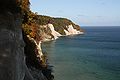 |
|
| Müritz National Park Müritz National Park The Müritz National Park is a national park situated roughly in the middle between Berlin and Rostock, in the south of the German state of Mecklenburg-Vorpommern. It extends over large portions of the Müritz lakeland in the district of Mecklenburgische Seenplatte. Müritz National Park was founded... |
1990 | 318 | ||
| Western Pomerania Lagoon Area National Park Western Pomerania Lagoon Area National Park The Western Pomerania Lagoon Area National Park is Mecklenburg-Vorpommern's largest national park situated at the coast of the Baltic Sea... |
1990 | 805 |
Districts
Mecklenburg-Vorpommern is since 4 September 2011 divided into six rural Kreise (districts) and two independent urban districts:- Landkreis Rostock
- Ludwigslust-ParchimLudwigslust-ParchimLudwigslust-Parchim is a district in the west of Mecklenburg-Vorpommern, Germany. It is bounded by the state Schleswig-Holstein, the district Nordwestmecklenburg, the district-free city Schwerin, the districts Rostock and Mecklenburgische Seenplatte and the states Brandenburg and Lower Saxony...
- Mecklenburgische SeenplatteMecklenburgische Seenplatte (district)Mecklenburgische Seenplatte is a district in the southeast of Mecklenburg-Vorpommern, Germany. It is bounded by the districts Ludwigslust-Parchim, Rostock , Vorpommern-Rügen, Vorpommern-Greifswald, and the state Brandenburg to the south...
- NordwestmecklenburgNordwestmecklenburgNordwestmecklenburg is a Kreis in the north-western part of Mecklenburg-Vorpommern, Germany. It is situated on the coast of the Baltic Sea and borders on Schleswig-Holstein to the west...
- Vorpommern-GreifswaldVorpommern-GreifswaldVorpommern-Greifswald is a district in the east of Mecklenburg-Vorpommern, Germany. It is bounded by the districts Mecklenburgische Seenplatte, Vorpommern-Rügen, the Baltic Sea, Poland and the state Brandenburg...
- Vorpommern-RügenVorpommern-RügenVorpommern-Rügen is a district in the north of Mecklenburg-Vorpommern, Germany. It is bounded by the Baltic Sea and the districts Vorpommern-Greifswald, Mecklenburgische Seenplatte and Rostock...
and
- RostockRostockRostock -Early history:In the 11th century Polabian Slavs founded a settlement at the Warnow river called Roztoc ; the name Rostock is derived from that designation. The Danish king Valdemar I set the town aflame in 1161.Afterwards the place was settled by German traders...
(HRO) - SchwerinSchwerinSchwerin is the capital and second-largest city of the northern German state of Mecklenburg-Vorpommern. The population, as of end of 2009, was 95,041.-History:...
(SN)
Statistics
Mecklenburg-Vorpommern is the least densely populated and least industrial German stateStates of Germany
Germany is made up of sixteen which are partly sovereign constituent states of the Federal Republic of Germany. Land literally translates as "country", and constitutionally speaking, they are constituent countries...
, being the sixth largest in size, but only 14th in population. The unemployment
Unemployment
Unemployment , as defined by the International Labour Organization, occurs when people are without jobs and they have actively sought work within the past four weeks...
rate of 11.8% (Oktober 2009), which has been negatively affected by the breakdown of non-competitive former GDR industries after the German reunification
German reunification
German reunification was the process in 1990 in which the German Democratic Republic joined the Federal Republic of Germany , and when Berlin reunited into a single city, as provided by its then Grundgesetz constitution Article 23. The start of this process is commonly referred by Germans as die...
in the 1990s, is currently the lowest in more than 15 years while the economy is growing and the number of jobs is increasing continually. However, the region remains the poorest in Germany and below the EU average in terms of GDP per capita.
Culture
Over the centuries, Mecklenburg and Vorpommern have developed and maintained strong regional cultures. It can generally be described as North GermanNorthern Germany
- Geography :The key terrain features of North Germany are the marshes along the coastline of the North Sea and Baltic Sea, and the geest and heaths inland. Also prominent are the low hills of the Baltic Uplands, the ground moraines, end moraines, sandur, glacial valleys, bogs, and Luch...
and has similar linguistic and historic characteristics to other north German states, such as Schleswig-Holstein
Schleswig-Holstein
Schleswig-Holstein is the northernmost of the sixteen states of Germany, comprising most of the historical duchy of Holstein and the southern part of the former Duchy of Schleswig...
. People in Vorpommern, as a result of that territory being a former province of Prussia
Prussia
Prussia was a German kingdom and historic state originating out of the Duchy of Prussia and the Margraviate of Brandenburg. For centuries, the House of Hohenzollern ruled Prussia, successfully expanding its size by way of an unusually well-organized and effective army. Prussia shaped the history...
, tend to look slightly more towards Berlin
Berlin
Berlin is the capital city of Germany and is one of the 16 states of Germany. With a population of 3.45 million people, Berlin is Germany's largest city. It is the second most populous city proper and the seventh most populous urban area in the European Union...
and Brandenburg
Brandenburg
Brandenburg is one of the sixteen federal-states of Germany. It lies in the east of the country and is one of the new federal states that were re-created in 1990 upon the reunification of the former West Germany and East Germany. The capital is Potsdam...
than people in Mecklenburg would.
Architecture
The cities are characterised by a certain "HanseaticHanseatic League
The Hanseatic League was an economic alliance of trading cities and their merchant guilds that dominated trade along the coast of Northern Europe...
" style also found in other parts of northern Germany (e.g. Lübeck
Lübeck
The Hanseatic City of Lübeck is the second-largest city in Schleswig-Holstein, in northern Germany, and one of the major ports of Germany. It was for several centuries the "capital" of the Hanseatic League and, because of its Brick Gothic architectural heritage, is listed by UNESCO as a World...
) as well as in countries bordering the Baltic Sea
Baltic Sea
The Baltic Sea is a brackish mediterranean sea located in Northern Europe, from 53°N to 66°N latitude and from 20°E to 26°E longitude. It is bounded by the Scandinavian Peninsula, the mainland of Europe, and the Danish islands. It drains into the Kattegat by way of the Øresund, the Great Belt and...
like Estonia
Estonia
Estonia , officially the Republic of Estonia , is a state in the Baltic region of Northern Europe. It is bordered to the north by the Gulf of Finland, to the west by the Baltic Sea, to the south by Latvia , and to the east by Lake Peipsi and the Russian Federation . Across the Baltic Sea lies...
(e.g. Tallinn
Tallinn
Tallinn is the capital and largest city of Estonia. It occupies an area of with a population of 414,940. It is situated on the northern coast of the country, on the banks of the Gulf of Finland, south of Helsinki, east of Stockholm and west of Saint Petersburg. Tallinn's Old Town is in the list...
) or Latvia
Latvia
Latvia , officially the Republic of Latvia , is a country in the Baltic region of Northern Europe. It is bordered to the north by Estonia , to the south by Lithuania , to the east by the Russian Federation , to the southeast by Belarus and shares maritime borders to the west with Sweden...
(e.g. Riga
Riga
Riga is the capital and largest city of Latvia. With 702,891 inhabitants Riga is the largest city of the Baltic states, one of the largest cities in Northern Europe and home to more than one third of Latvia's population. The city is an important seaport and a major industrial, commercial,...
). A common feature of many towns in Mecklenburg and Vorpommern are Gothic
Brick Gothic
Brick Gothic is a specific style of Gothic architecture common in Northern Europe, especially in Northern Germany and the regions around the Baltic Sea that do not have natural rock resources. The buildings are essentially built from bricks...
red brick churches dating back to the Middle Ages
Middle Ages
The Middle Ages is a periodization of European history from the 5th century to the 15th century. The Middle Ages follows the fall of the Western Roman Empire in 476 and precedes the Early Modern Era. It is the middle period of a three-period division of Western history: Classic, Medieval and Modern...
. The old towns are usually built around one or several market places with a church or the town hall. Often towns were founded at the Baltic Sea
Baltic Sea
The Baltic Sea is a brackish mediterranean sea located in Northern Europe, from 53°N to 66°N latitude and from 20°E to 26°E longitude. It is bounded by the Scandinavian Peninsula, the mainland of Europe, and the Danish islands. It drains into the Kattegat by way of the Øresund, the Great Belt and...
, one of the many lakes
Mecklenburg Lake District
The Mecklenburg Lake District is the largest coherent lakes and canals area in Germany. It is situated in southern Mecklenburg-Vorpommern, extending somewhat into the north of Brandenburg, and sometimes called "the land of the thousand lakes".The Seenplatte includes Müritz National Park, which...
or a river for logistical and trade motives.
Museums, art and theatres
Mecklenburg-Vorpommern is home to many cultural events throughout the year. In addition to many regular museums and art galleries, StralsundStralsund
- Main sights :* The Brick Gothic historic centre is a UNESCO World Heritage Site.* The heart of the old town is the Old Market Square , with the Gothic Town Hall . Behind the town hall stands the imposing Nikolaikirche , built in 1270-1360...
offers the very popular Deutsches Meeresmuseum (German Maritime Museum; the most popular museum in Northern Germany
Northern Germany
- Geography :The key terrain features of North Germany are the marshes along the coastline of the North Sea and Baltic Sea, and the geest and heaths inland. Also prominent are the low hills of the Baltic Uplands, the ground moraines, end moraines, sandur, glacial valleys, bogs, and Luch...
), Ribnitz-Damgarten
Ribnitz-Damgarten
Ribnitz-Damgarten is a town in Mecklenburg-Vorpommern, Germany. It is situated at the Ribnitzer See . Ribnitz-Damgarten is the largest town of the district Vorpommern-Rügen, but not its capital.-Geography:...
the Deutsches Bernsteinmuseum (German Amber Museum).
During summer, many open air concerts and operas are open to visitors. The Festspiele Mecklenburg-Vorpommern (Music Festival of MV) attract a sizeable audience by performing classical concerts in parks, churches and castles.
Caspar David Friedrich
Caspar David Friedrich
Caspar David Friedrich was a 19th-century German Romantic landscape painter, generally considered the most important German artist of his generation. He is best known for his mid-period allegorical landscapes which typically feature contemplative figures silhouetted against night skies, morning...
, a famous romanticist
Romanticism
Romanticism was an artistic, literary and intellectual movement that originated in the second half of the 18th century in Europe, and gained strength in reaction to the Industrial Revolution...
painter
Painting
Painting is the practice of applying paint, pigment, color or other medium to a surface . The application of the medium is commonly applied to the base with a brush but other objects can be used. In art, the term painting describes both the act and the result of the action. However, painting is...
born in Greifswald
Greifswald
Greifswald , officially, the University and Hanseatic City of Greifswald is a town in northeastern Germany. It is situated in the state of Mecklenburg-Vorpommern, at an equal distance of about from Germany's two largest cities, Berlin and Hamburg. The town borders the Baltic Sea, and is crossed...
, immortalised parts of the state in several of his paintings.
Language
Whereas today the vast majority of people speak Standard GermanStandard German
Standard German is the standard variety of the German language used as a written language, in formal contexts, and for communication between different dialect areas...
(also called High German, Hochdeutsch), a few centuries ago most people spoke what is called Low German
Low German
Low German or Low Saxon is an Ingvaeonic West Germanic language spoken mainly in northern Germany and the eastern part of the Netherlands...
(German: Plattdeutsch or Niederdeutsch). It is not "low" in prestige, but rather designates origin from the lower altitude, flatter, part of northern Germany.
Due to several sound shifts in Standard German which did not occur in Low German, Low German is rather distinct and is considered a separate language by some, a dialect of German by others. At its highpoint, the late Middle Ages
Middle Ages
The Middle Ages is a periodization of European history from the 5th century to the 15th century. The Middle Ages follows the fall of the Western Roman Empire in 476 and precedes the Early Modern Era. It is the middle period of a three-period division of Western history: Classic, Medieval and Modern...
, it was the lingua franca
Lingua franca
A lingua franca is a language systematically used to make communication possible between people not sharing a mother tongue, in particular when it is a third language, distinct from both mother tongues.-Characteristics:"Lingua franca" is a functionally defined term, independent of the linguistic...
of the Hanseatic League
Hanseatic League
The Hanseatic League was an economic alliance of trading cities and their merchant guilds that dominated trade along the coast of Northern Europe...
, a trade organisation in northern Europe. More than 1500 years ago, "Old Low German" (also known as Old Saxon
Old Saxon
Old Saxon, also known as Old Low German, is the earliest recorded form of Low German, documented from the 8th century until the 12th century, when it evolved into Middle Low German. It was spoken on the north-west coast of Germany and in the Netherlands by Saxon peoples...
) was also the language spoken by the Anglo-Saxons
Anglo-Saxons
Anglo-Saxon is a term used by historians to designate the Germanic tribes who invaded and settled the south and east of Great Britain beginning in the early 5th century AD, and the period from their creation of the English nation to the Norman conquest. The Anglo-Saxon Era denotes the period of...
, who originally came from northern Germany before leaving for England
England
England is a country that is part of the United Kingdom. It shares land borders with Scotland to the north and Wales to the west; the Irish Sea is to the north west, the Celtic Sea to the south west, with the North Sea to the east and the English Channel to the south separating it from continental...
. That is why, there is often a closer similarity between English and Low German words than between English and Standard/High German words, for instance:
- English water = Low German water (High German: Wasser)
- English he = Low German hei (High German: er)
Low German is protected by the state's constitution and, similar to Welsh
Welsh language
Welsh is a member of the Brythonic branch of the Celtic languages spoken natively in Wales, by some along the Welsh border in England, and in Y Wladfa...
in Wales
Wales
Wales is a country that is part of the United Kingdom and the island of Great Britain, bordered by England to its east and the Atlantic Ocean and Irish Sea to its west. It has a population of three million, and a total area of 20,779 km²...
, taught at school and at university level. There is also a diverse Low German literature by such authors as Fritz Reuter
Fritz Reuter
Fritz Reuter was a novelist from Northern Germany who was one of the most prominent contributors to Low German literature.-Early life:...
or Rudolf Tarnow
Rudolf Tarnow
Rudolf Tarnow was a Low German writer.Rudolf Tarnow was born on February 25, 1867 in the city of Parchim, the oldest son of a shoemaker, Heinrich Tarnow, and his wife, Dorothea...
. Low German has also been recognised by the Netherlands and by Germany (since 1999) as a regional language
Regional language
A regional language is a language spoken in an area of a nation state, whether it be a small area, a federal state or province, or some wider area....
according to the European Charter for Regional or Minority Languages
European Charter for Regional or Minority Languages
The European Charter for Regional or Minority Languages is a European treaty adopted in 1992 under the auspices of the Council of Europe to protect and promote historical regional and minority languages in Europe...
. Within the official terminology defined in the charter, this status would not be available to a dialect of an official language. As a result of this, Germany would appear, therefore, to have at least implicitly adopted the stance that Low German is not a dialect of the German language, but rather a separate language.
Food and drinks
Like most German regions, Mecklenburg and Vorpommern have their own traditional dishes, often including fish, beef and pork. Rostock has its own type of bratwurstBratwurst
A bratwurst is a sausage usually composed of veal, pork or beef. The plural in German is Bratwürste....
called Rostocker Bratwurst. An unusual food from Western Pomerania is Tollatsch
Tollatsch
Tollatsch is a German dessert from the region of Pomerania.It is made of flour, sugar, a blend of Lebkuchen spices, breadcrumbs, almonds, and raisins....
. Rote Grütze
Rødgrød
Rødgrød , Rote Grütze , or Rode Grütt is a dish from Denmark and Germany.Grød or Grütze was traditionally made of groat or grit, as revealed by the second component of the name in Danish, German or Plattdeutsch...
is a popular dessert. The largest brewery produces Lübzer Pils.
Religion
Evangelical Church in GermanyEvangelical Church in Germany
The Evangelical Church in Germany is a federation of 22 Lutheran, Unified and Reformed Protestant regional church bodies in Germany. The EKD is not a church in a theological understanding because of the denominational differences. However, the member churches share full pulpit and altar...
17.9 %, Catholic Church 3.3 %.
Following the Christian Reformation
Protestant Reformation
The Protestant Reformation was a 16th-century split within Western Christianity initiated by Martin Luther, John Calvin and other early Protestants. The efforts of the self-described "reformers", who objected to the doctrines, rituals and ecclesiastical structure of the Roman Catholic Church, led...
, led in Germany by Martin Luther
Martin Luther
Martin Luther was a German priest, professor of theology and iconic figure of the Protestant Reformation. He strongly disputed the claim that freedom from God's punishment for sin could be purchased with money. He confronted indulgence salesman Johann Tetzel with his Ninety-Five Theses in 1517...
, as well as a period of Swedish
Sweden
Sweden , officially the Kingdom of Sweden , is a Nordic country on the Scandinavian Peninsula in Northern Europe. Sweden borders with Norway and Finland and is connected to Denmark by a bridge-tunnel across the Öresund....
rule, the traditional faith in Mecklenburg-Vorpommern is Protestantism
Protestantism
Protestantism is one of the three major groupings within Christianity. It is a movement that began in Germany in the early 16th century as a reaction against medieval Roman Catholic doctrines and practices, especially in regards to salvation, justification, and ecclesiology.The doctrines of the...
, specifically Lutheranism
Lutheranism
Lutheranism is a major branch of Western Christianity that identifies with the theology of Martin Luther, a German reformer. Luther's efforts to reform the theology and practice of the church launched the Protestant Reformation...
. There are also a number of Catholic
Catholic
The word catholic comes from the Greek phrase , meaning "on the whole," "according to the whole" or "in general", and is a combination of the Greek words meaning "about" and meaning "whole"...
s and people of other faiths. Both confessions are split at the old border; Mecklenburg belongs to the Evangelical Lutheran Church of Mecklenburg
Evangelical Lutheran Church of Mecklenburg
The Evangelical Lutheran Church of Mecklenburg is a Lutheran church in the German state of Mecklenburg-Vorpommern, serving the citizens living in Mecklenburg. The seat of the Landesbischof is the state capital Schwerin with Schwerin Cathedral as the principal church...
and the Archdiocese of Hamburg, West Pomerania forms the Pomeranian Evangelical Church
Pomeranian Evangelical Church
The Pomeranian Evangelical Church is a Protestant church body in the German state of Mecklenburg-Vorpommern, serving the citizens living in Hither Pomerania. It combines Lutheran and Reformed traditions...
(some parts however belonging to Brandenburg in this respect) or belongs to the Archdiocese of Berlin. As to the Protestants, a union to form a North Church (together with the North Elbians) is in progress. As a result of the extremely secular laws of the former communist GDR, more than three quarters of the population are now non-religious or agnostic.
Education
Universities and colleges
Mecklenburg-Vorpommern has two of the oldest universitiesUniversity
A university is an institution of higher education and research, which grants academic degrees in a variety of subjects. A university is an organisation that provides both undergraduate education and postgraduate education...
of Germany
Germany
Germany , officially the Federal Republic of Germany , is a federal parliamentary republic in Europe. The country consists of 16 states while the capital and largest city is Berlin. Germany covers an area of 357,021 km2 and has a largely temperate seasonal climate...
, and indeed Europe
Europe
Europe is, by convention, one of the world's seven continents. Comprising the westernmost peninsula of Eurasia, Europe is generally 'divided' from Asia to its east by the watershed divides of the Ural and Caucasus Mountains, the Ural River, the Caspian and Black Seas, and the waterways connecting...
:
- University of Greifswald (est. 1456)
- University of RostockUniversity of RostockThe University of Rostock is the university of the city Rostock, in the German state of Mecklenburg-Vorpommern.Founded in 1419, it is the oldest and largest university in continental northern Europe and the Baltic Sea area...
(est 1419)
Also, there are four colleges / technological universities.
- Fachhochschule Stralsund
- Hochschule Wismar
- Hochschule Neubrandenburg
- Rostock University of Music and TheatreRostock University of Music and TheatreThe Rostock University of Music and Theatre is a college of music in Rostock, Germany. The Hochschule opened in 1994 and is situated in a former cloister named Katharinenkloster in the hanseatic city of Rostock...
- Baltic College Güstrow
- Fachhochschule für öffentliche Verwaltung, Rechtspflege und Polizei in Güstrow
Schools
The state's school system is centralised. There are two main types of schools, Regionalschule (for the majority of pupils) and Gymnasium (for the top 30% of each year's students, leading to the university entrance qualification "AbiturAbitur
Abitur is a designation used in Germany, Finland and Estonia for final exams that pupils take at the end of their secondary education, usually after 12 or 13 years of schooling, see also for Germany Abitur after twelve years.The Zeugnis der Allgemeinen Hochschulreife, often referred to as...
"). Besides, there are also independent schools, comprehensive schools, and trade schools.
Politics
Article 20 of the State Constitution states that the LandtagLandtag of Mecklenburg-Vorpommern
The Landtag of Mecklenburg-Vorpommern is the state diet of the German federal state of Mecklenburg-Vorpommern . It convenes in Schwerin and currently consists of 71 members of five Parties...
is the "site of political decision-making". The Mecklenburg-Vorpommern Landtag is elected democratically by the citizens of the state who sit for one 5-year legislative period at a time. At least four parties must form the Landtag. The seat of Landtag is located at Schwerin Castle
Schwerin Castle
Schwerin Castle is a castle located in the city of Schwerin, the capital of the Bundesland of Mecklenburg-Vorpommern, Germany. For centuries it was the home of the dukes and grand dukes of Mecklenburg and later Mecklenburg-Schwerin. It currently serves as the seat of the state...
in Schwerin
Schwerin
Schwerin is the capital and second-largest city of the northern German state of Mecklenburg-Vorpommern. The population, as of end of 2009, was 95,041.-History:...
. The essential functions of the Landtag is to elect the Minister-President
Minister-President
A minister-president is the head of government in a number of European countries or subnational governments, in which a parliamentary or semi-presidential system of government prevails, who presides over the council of ministers...
of the state; to discuss and decide on laws which have been proposed by the government, by a people's initiative or a petition for a referendum initiated directly by the people; and to control the state government.
Minister-President
The executive is led by a cabinet, in turn led by a Minister-President, who is the official head of government. The election to determine the Minister-President is held no later than four weeks after the newly elected Landtag starts.Landtag
The last election of the LandtagLandtag of Mecklenburg-Vorpommern
The Landtag of Mecklenburg-Vorpommern is the state diet of the German federal state of Mecklenburg-Vorpommern . It convenes in Schwerin and currently consists of 71 members of five Parties...
took place on 4 September 2011. As a result of the 2006 election, Mecklenburg-Vorpommern is governed by a Grand coalition
Grand Coalition (Germany)
In modern Germany, grand coalition describes a governing coalition of the Christian Democrats and the Social Democrats, as they are the two largest parties.-Weimar Republic:...
of SPD
Social Democratic Party of Germany
The Social Democratic Party of Germany is a social-democratic political party in Germany...
and CDU
Christian Democratic Union (Germany)
The Christian Democratic Union of Germany is a Christian democratic and conservative political party in Germany. It is regarded as on the centre-right of the German political spectrum...
. Whether re-elected Erwin Sellering
Erwin Sellering
Erwin Sellering, born on 18 October 1949 in Sprockhövel near Bochum and currently residing in Greifswald, is Minister-president of the German federal state of Mecklenburg-Vorpommern since 2008....
is going to continue this coalition after the Social Democrats' victory in the 2011 election
Mecklenburg-Vorpommern state election, 2011
The Mecklenburg-Vorpommern state election was conducted on 4 September 2011, to elect members to the Landtag of Mecklenburg-Vorpommern...
is currently subject to negotiations.
2011 preliminary election results
Official preliminary results from the election of 4 September 2011 as of 5 September 2011 (without part of Rügen, where election is postponed for two weeks due to the death of a candidate):Preliminary summary of the 2011 election results for the Landtag of Mecklenburg-Vorpommern
Landtag of Mecklenburg-Vorpommern
The Landtag of Mecklenburg-Vorpommern is the state diet of the German federal state of Mecklenburg-Vorpommern . It convenes in Schwerin and currently consists of 71 members of five Parties...
|- bgcolor=#E9E9E9
! colspan="2" align="center" | Party
! align="left" | Ideology
! colspan="2" | Vote % (change)
! colspan="2" | Seats (change)
! | Seat %
|-
|style="width: 20px" bgcolor=#ff0000 align="center" |
| align="left" | Social Democratic Party
Social Democratic Party of Germany
The Social Democratic Party of Germany is a social-democratic political party in Germany...
(SPD)
| align="left" | Social democracy
Social democracy
Social democracy is a political ideology of the center-left on the political spectrum. Social democracy is officially a form of evolutionary reformist socialism. It supports class collaboration as the course to achieve socialism...
| align="right" | 35.7%
| align="right" | (+3.7%)
| align="right" | 28
| align="right" | (+5)
| align="right" |
|-
|style="width: 20px" bgcolor=#000000 align="center" |
| align="left" | Christian Democratic Union (CDU)
| align="left" | Christian democracy
Christian Democracy
Christian democracy is a political ideology that seeks to apply Christian principles to public policy. It emerged in nineteenth-century Europe under the influence of conservatism and Catholic social teaching...
| align="right" | 23.1%
| align="right" | (-5.7%)
| align="right" | 18
| align="right" | (-4)
| align="right" |
|-
|style="width: 20px" bgcolor=#AA0000 align="center" |
| align="left" | Die Linke (formerly The Left Party.PDS)
| align="left" | Democratic socialism
Democratic socialism
Democratic socialism is a description used by various socialist movements and organizations to emphasize the democratic character of their political orientation...
| align="right" | 18.4%
| align="right" | (+1.6%)
| align="right" | 14
| align="right" | (+1)
| align="right" |
|-
|style="width: 20px" bgcolor=#99CC33 align="center" |
| align="left" | Alliance '90/The Greens
Alliance '90/The Greens
Alliance '90/The Greens is a green political party in Germany, formed from the merger of the German Green Party and Alliance 90 in 1993. Its leaders are Claudia Roth and Cem Özdemir...
(Die Grünen)
| align="left" | Green politics
Green politics
Green politics is a political ideology that aims for the creation of an ecologically sustainable society rooted in environmentalism, social liberalism, and grassroots democracy...
| align="right" | 8.4%
| align="right" | (+5.0%)
| align="right" | 6
| align="right" | (+6)
| align="right" |
|-
|style="width: 20px" bgcolor=#996633 align="center" |
| align="left" | National Democratic Party
National Democratic Party of Germany
The National Democratic Party of Germany – The People's Union , is a far right German nationalist party. It was founded in 1964 a successor to the German Reich Party . Party statements self-identify as Germany's "only significant patriotic force"...
(NPD)
| align="left" | Far-right politics
| align="right" | 6.0%
| align="right" | (-1.3%)
| align="right" | 5
| align="right" | (-1)
| align="right" |
|-
|style="width: 20px" bgcolor=#FFFF00 align="center" |
| align="left" | Free Democratic Party
Free Democratic Party (Germany)
The Free Democratic Party , abbreviated to FDP, is a centre-right classical liberal political party in Germany. It is led by Philipp Rösler and currently serves as the junior coalition partner to the Union in the German federal government...
(FDP)
| align="left" | Classical liberalism
Classical liberalism
Classical liberalism is the philosophy committed to the ideal of limited government, constitutionalism, rule of law, due process, and liberty of individuals including freedom of religion, speech, press, assembly, and free markets....
| align="right" | 2.7%
| align="right" | (-6.9%)
| align="right" | 0
| align="right" | (-7)
| align="right" |
|-
|style="width: 20px" bgcolor=white align="center" |
| align="left" | All Others
| align="left" |
| align="right" | 5.7%
| align="right" | (+1.8%)
| align="right" | 0
| align="right" |(±0)
| align="right" |
|-
! align="right" style="background-color:#E9E9E9" colspan=3 | Total
! align="right" style="background-color:#E9E9E9" | 100.0%
! align="right" style="background-color:#E9E9E9" |
! align="right" style="background-color:#E9E9E9" | 71
! align="right" style="background-color:#E9E9E9" |
! align="right" style="background-color:#E9E9E9" | 100.0%
|}
The labour market
In Mecklenburg-Vorpommern, approximately 732,200 people were gainfully employed in 2008 with 657,100 of them were white and blue collar workers. About 4,200 new jobs were created in 2007. Employees worked an average of 1,455 hours a year. The number of self-employed did not change in 2008. Three out of every four of all people in work are employed in the service sector.Tourism
- islands: RügenRügenRügen is Germany's largest island. Located in the Baltic Sea, it is part of the Vorpommern-Rügen district of Mecklenburg-Vorpommern.- Geography :Rügen is located off the north-eastern coast of Germany in the Baltic Sea...
and UsedomUsedomUsedom is a Baltic Sea island on the border between Germany and Poland. It is situated north of the Szczecin Lagoon estuary of the River Oder in Pomerania...
(Germany's two largest islands), PoelPoelPoel or Poel Island ), is an island in the Baltic Sea. It builds the natural northern and eastern boundaries of the Bay of Wismar on the German coast. The northern coast of the island is also on the south side of the large gulf known as the Bay of Mecklenburg, which Wismar Bay enters in to...
or HiddenseeHiddenseeHiddensee is a carfree island in the Baltic Sea, located west of Rügen on the German coast.The island, located 54°33' north longitude 13°07' east, has about 1,300 inhabitants. It was a popular vacation destination for East German tourists during German Democratic Republic times and continues to...
; - peninsula: Fischland-Darß-ZingstFischland-Darß-ZingstFischland-Darß-Zingst is a peninsula on the coast of Mecklenburg-Vorpommern in Germany. Its full length is 45 km. The three parts of the peninsula, from west to east, are Fischland, Darß and Zingst....
; - seaside towns: HeiligendammHeiligendammHeiligendamm is a German seaside resort, founded in 1793. The small cluster of structures which still survive are reminders of the glory days of days gone by when this part of the Baltic Sea was one of the playgrounds of Europe's aristocracy. It is the oldest seaside spa in Germany...
, Graal-MüritzGraal-MüritzGraal-Müritz is a Seeheilbad in the German state of Mecklenburg-Vorpommern. It is located in the Rostock district, near Rostock, Ribnitz-Damgarten and Stralsund....
or KühlungsbornKühlungsbornKühlungsborn is a Seebad town in the Rostock district, in Mecklenburg-Vorpommern, Germany. It is situated on the Baltic Sea coast, 11 km northwest of Bad Doberan, and 25 km northwest of Rostock....
; - hinterland: particularly Mecklenburg Lake DistrictMecklenburg Lake DistrictThe Mecklenburg Lake District is the largest coherent lakes and canals area in Germany. It is situated in southern Mecklenburg-Vorpommern, extending somewhat into the north of Brandenburg, and sometimes called "the land of the thousand lakes".The Seenplatte includes Müritz National Park, which...
; and - cities: StralsundStralsund- Main sights :* The Brick Gothic historic centre is a UNESCO World Heritage Site.* The heart of the old town is the Old Market Square , with the Gothic Town Hall . Behind the town hall stands the imposing Nikolaikirche , built in 1270-1360...
and WismarWismarWismar , is a small port and Hanseatic League town in northern Germany on the Baltic Sea, in the state of Mecklenburg-Vorpommern,about 45 km due east of Lübeck, and 30 km due north of Schwerin. Its natural harbour, located in the Bay of Wismar is well-protected by a promontory. The...
(both listed as UNESCO World Heritage SiteWorld Heritage SiteA UNESCO World Heritage Site is a place that is listed by the UNESCO as of special cultural or physical significance...
s), RostockRostockRostock -Early history:In the 11th century Polabian Slavs founded a settlement at the Warnow river called Roztoc ; the name Rostock is derived from that designation. The Danish king Valdemar I set the town aflame in 1161.Afterwards the place was settled by German traders...
, or GreifswaldGreifswaldGreifswald , officially, the University and Hanseatic City of Greifswald is a town in northeastern Germany. It is situated in the state of Mecklenburg-Vorpommern, at an equal distance of about from Germany's two largest cities, Berlin and Hamburg. The town borders the Baltic Sea, and is crossed...
, which have a large cultural heritage.
As a relict of the past, nearly 2,000 castles, palaces and manor houses exist in Mecklenburg-Vorpommern, many of which function as venues for public events like concerts and festivals.
Medical tourism
Medical tourism
Medical tourism is a term initially coined by travel agencies and the mass media to describe the rapidly-growing practice of travelling across international borders to obtain health care...
based on the clean air and idyllic settings by the Baltic Sea
Baltic Sea
The Baltic Sea is a brackish mediterranean sea located in Northern Europe, from 53°N to 66°N latitude and from 20°E to 26°E longitude. It is bounded by the Scandinavian Peninsula, the mainland of Europe, and the Danish islands. It drains into the Kattegat by way of the Øresund, the Great Belt and...
has a growing importance to the regional tourism industry.
Sport
Main sporting attractions include Fußball-BundesligaFußball-Bundesliga
The Fußball-Bundesliga is a professional association football league in Germany. At the top of Germany's football league system, it is the country's primary football competition. It is contested by 18 teams and operates on a system of promotion and relegation with the 2. Bundesliga...
, F.C. Hansa Rostock and the international sailing event Hanse Sail
Hanse Sail
The Hanse Sail in Rostock is the largest maritime festival in Mecklenburg-Vorpommern and one of the largest in Germany.About 250 traditional sailing ships of all types and sizes from a vast variety of countries visit the coast off the city of Rostock every year during the second weekend of August...
. Had the bid for the 2012 summer Olympics in Leipzig been successful, the sailing competitions would have taken place off the coast of Rostock
Rostock
Rostock -Early history:In the 11th century Polabian Slavs founded a settlement at the Warnow river called Roztoc ; the name Rostock is derived from that designation. The Danish king Valdemar I set the town aflame in 1161.Afterwards the place was settled by German traders...
.
Notable people
- arts and film: Friedrich von FlotowFriedrich von FlotowFriedrich Adolf Ferdinand, Freiherr von Flotow was a German composer. He is chiefly remembered for his opera Martha, which was popular in the 19th century....
, Caspar David FriedrichCaspar David FriedrichCaspar David Friedrich was a 19th-century German Romantic landscape painter, generally considered the most important German artist of his generation. He is best known for his mid-period allegorical landscapes which typically feature contemplative figures silhouetted against night skies, morning...
, Marianne HoppeMarianne HoppeMarianne Hoppe was a most distinguished German theatre and film actress.-Life and work:Born in Rostock, Marianne Hoppe became a leading lady of stage and films in Germany. She was born into a wealthy land owning family and was initially privately educated on her father's private estate...
, Philipp Otto RungePhilipp Otto RungePhilipp Otto Runge was a Romantic German painter and draughtsman. He made a late start to his career and died young, nonetheless he is considered among the best German Romantic painters.- Life and work :...
, Till LindemannTill LindemannTill Lindemann is a German musician, actor and poet who is the frontman for the German Neue Deutsche Härte band Rammstein.-Biography:... - business: Ernst HeinkelErnst HeinkelDr. Ernst Heinkel was a German aircraft designer, manufacturer, Wehrwirtschaftführer in the Third Reich, and member of the Nazi party. His company Heinkel Flugzeugwerke produced the Heinkel He 178, the world's first turbojet aircraft and jet plane, and the Heinkel He 176, the first rocket aircraft...
, Carl Heinrich von SiemensCarl Heinrich von SiemensCarl Heinrich von Siemens was a German entrepreneur, a child of a tenant farmer. He is a brother of Ernst Werner von Siemens and William Siemens, sons of Christian Ferdinand Siemens and wife Eleonore Deichmann...
, Georg WertheimGeorg WertheimGeorg Wertheim was a German merchant and founder of the popular Wertheim chain of department stores.Wertheim grew up in Stralsund... - literature: Ernst Moritz ArndtErnst Moritz ArndtErnst Moritz Arndt was a German nationalistic and antisemitic author and poet. Early in his life, he fought for the abolition of serfdom, later against Napoleonic dominance over Germany, and had to flee to Sweden for some time due to his anti-French positions...
, John Brinckman, Hans FalladaHans FalladaHans Fallada , born Rudolf Wilhelm Friedrich Ditzen in Greifswald, Germany, was a German writer of the first half of the 20th century. Some of his better known novels include Little Man, What Now? and Every Man Dies Alone...
, Walter KempowskiWalter KempowskiWalter Kempowski was a German writer. Kempowski was known for his series of novels called German Chronicle and the monumental Echolot , a collage of autobiographical reports, letters and other documents by contemporary witnesses of the Second World War.-Childhood :Walter Kempowski was born in...
, Fritz ReuterFritz ReuterFritz Reuter was a novelist from Northern Germany who was one of the most prominent contributors to Low German literature.-Early life:...
, Rudolf TarnowRudolf TarnowRudolf Tarnow was a Low German writer.Rudolf Tarnow was born on February 25, 1867 in the city of Parchim, the oldest son of a shoemaker, Heinrich Tarnow, and his wife, Dorothea...
, Ehm WelkEhm WelkEmil Welk, known by his nickname Ehm Welk , was a German journalist, writer, professor and founder of Volkshochschulen... - politics: Ernst Moritz ArndtErnst Moritz ArndtErnst Moritz Arndt was a German nationalistic and antisemitic author and poet. Early in his life, he fought for the abolition of serfdom, later against Napoleonic dominance over Germany, and had to flee to Sweden for some time due to his anti-French positions...
, Dietmar BartschDietmar BartschDietmar Gerhard Bartsch is a German politician, former Bundesgeschäftsführer of the Party of Democratic Socialism and "Die Linke." and member of the Bundestag.- External links :* * *...
, Egon KrenzEgon KrenzEgon Krenz is a former politician from East Germany , and that country's last Communist leader...
, Helmuth von Moltke the ElderHelmuth von Moltke the ElderHelmuth Karl Bernhard Graf von Moltke was a German Field Marshal. The chief of staff of the Prussian Army for thirty years, he is regarded as one of the great strategists of the latter 19th century, and the creator of a new, more modern method of directing armies in the field...
, Harald RingstorffHarald RingstorffDr. Harald Ringstorff is a German politician of the Social Democratic Party and was minister-president of the state of Mecklenburg-Vorpommern. He has been heading a coalition government of SPD and PDS from 1998 until 2006, and since then was heading a coalition between SPD and CDU...
, Angela MerkelAngela MerkelAngela Dorothea Merkel is the current Chancellor of Germany . Merkel, elected to the Bundestag from Mecklenburg-Vorpommern, has been the chairwoman of the Christian Democratic Union since 2000, and chairwoman of the CDU-CSU parliamentary coalition from 2002 to 2005.From 2005 to 2009 she led a... - science: Theodor BillrothTheodor BillrothChristian Albert Theodor Billroth was a German-born Austrian surgeon and amateur musician....
, Friedrich ChrysanderFriedrich ChrysanderKarl Franz Friedrich Chrysander was a German music historian and critic, whose edition of the works of George Frideric Handel and authoritative writings on many other composers established him as a pioneer of 19th-century musicology.Born at Lübtheen, in Mecklenburg-Schwerin, Chrysander was the son...
, Walther FlemmingWalther FlemmingWalther Flemming was a German biologist and a founder of cytogenetics.He was born in Sachsenberg near Schwerin as the fifth child and only son of the psychiatrist Carl Friedrich Flemming and his second wife, Auguste Winter...
, Gottlob FregeGottlob FregeFriedrich Ludwig Gottlob Frege was a German mathematician, logician and philosopher. He is considered to be one of the founders of modern logic, and made major contributions to the foundations of mathematics. He is generally considered to be the father of analytic philosophy, for his writings on...
, Otto LilienthalOtto LilienthalOtto Lilienthal was a German pioneer of human aviation who became known as the Glider King. He was the first person to make well-documented, repeated, successful gliding flights. He followed an experimental approach established earlier by Sir George Cayley...
, Gustav MieGustav MieGustav Adolf Feodor Wilhelm Ludwig Mie was a German physicist.-Biography:Mie was born in Rostock. From 1886 he studied mathematics and physics at the University of Rostock. In addition to his major subjects, he also attended lectures in chemistry, zoology, geology, mineralogy, astronomy as well as...
, Ferdinand von MuellerFerdinand von MuellerBaron Sir Ferdinand Jacob Heinrich von Mueller, KCMG was a German-Australian physician, geographer, and most notably, a botanist.-Early life:...
, Paul PoggePaul PoggePaul Pogge was a German explorer in Africa.Pogge was born in Groß Roge, Mecklenburg-Schwerin. He undertook two expeditions in Central Africa into the Southern Congo Basin, the first between 1874 and 1876 and the second between 1880 and 1884. On his second journey he was accompanied by Hermann...
, Heinrich SchliemannHeinrich SchliemannHeinrich Schliemann was a German businessman and amateur archaeologist, and an advocate of the historical reality of places mentioned in the works of Homer. Schliemann was an archaeological excavator of Troy, along with the Mycenaean sites Mycenae and Tiryns...
, Johannes StarkJohannes StarkJohannes Stark was a German physicist, and Physics Nobel Prize laureate who was closely involved with the Deutsche Physik movement under the Nazi regime.-Early years:... - sports: Tim BorowskiTim BorowskiTim Borowski is a German footballer, who currently plays as a midfielder for Werder Bremen. He is a central midfielder, adept at tackling and attacking although best known for his passing and vision.-Early career:...
, Andreas DittmerAndreas DittmerAndreas Dittmer is a German sprint canoer. The dominant sprint canoer of his generation in 1000 m races, he has won three Olympic and eight world championship gold medals.Dittmer won his first world championship medal - a bronze - at Paris in 1991 as a member of Germany's C-4 500 m crew...
, Thomas DollThomas DollThomas Doll is a former footballer and coach. He is currently the Manager of Al-Hilal.- Career :...
, Marita KochMarita KochMarita Koch , is a former sprint track and field athlete...
, Toni KroosToni KroosToni Kroos is a German international footballer who plays for Bayern Munich as an attacking midfielder. He is the older brother of Werder Bremen forward Felix Kroos.-Early career:...
, Jan UllrichJan UllrichJan Ullrich is a German former professional road bicycle racer. In 1997, he was the first German to win the Tour de France. He went on to take five second places and a fourth in 2004 and third in 2005. He is considered one of the best time-trialists in the history of the sport...
, Jens VoigtJens VoigtJens Voigt is a German professional road bicycle racer for UCI ProTeam . Voigt is known for his propensity to attack, and for his positive racing attitude. He is capable of repeated attacking, holding a high tempo, and breaking away from the peloton...
, Sebastian SylvesterSebastian SylvesterSebastian Sylvester is a German boxer and former IBF middleweight champion. He is currently ranked as the fourth best middleweight by Ring Magazine....
Miscellaneous
- Mecklenburg-Vorpommern is Germany's number-one tourist location, the main destinations being the Baltic SeaBaltic SeaThe Baltic Sea is a brackish mediterranean sea located in Northern Europe, from 53°N to 66°N latitude and from 20°E to 26°E longitude. It is bounded by the Scandinavian Peninsula, the mainland of Europe, and the Danish islands. It drains into the Kattegat by way of the Øresund, the Great Belt and...
coastline with islands such as RügenRügenRügen is Germany's largest island. Located in the Baltic Sea, it is part of the Vorpommern-Rügen district of Mecklenburg-Vorpommern.- Geography :Rügen is located off the north-eastern coast of Germany in the Baltic Sea...
or UsedomUsedomUsedom is a Baltic Sea island on the border between Germany and Poland. It is situated north of the Szczecin Lagoon estuary of the River Oder in Pomerania...
, spa towns like HeiligendammHeiligendammHeiligendamm is a German seaside resort, founded in 1793. The small cluster of structures which still survive are reminders of the glory days of days gone by when this part of the Baltic Sea was one of the playgrounds of Europe's aristocracy. It is the oldest seaside spa in Germany...
, KühlungsbornKühlungsbornKühlungsborn is a Seebad town in the Rostock district, in Mecklenburg-Vorpommern, Germany. It is situated on the Baltic Sea coast, 11 km northwest of Bad Doberan, and 25 km northwest of Rostock....
, BoltenhagenBoltenhagenBoltenhagen is a German seaside resort in Mecklenburg-Vorpommern situated on the Baltic Sea coast 30 km east of Lübeck. It offers a wide view of the Bay of Lübeck; a 5 km stretch of a wide and sandy beach, a boardwalk, restaurants and health spas, . Boltenhagen is especially famous with...
or WarnemündeWarnemündeWarnemünde is a sea resort and northmost district of Rostock in Mecklenburg-Vorpommern, situated on the Baltic Sea in the northeast of Germany at the estuary of the river Warnow.- History :...
and the Mecklenburg Lake DistrictMecklenburg Lake DistrictThe Mecklenburg Lake District is the largest coherent lakes and canals area in Germany. It is situated in southern Mecklenburg-Vorpommern, extending somewhat into the north of Brandenburg, and sometimes called "the land of the thousand lakes".The Seenplatte includes Müritz National Park, which...
. It also offers important historical cities, such as StralsundStralsund- Main sights :* The Brick Gothic historic centre is a UNESCO World Heritage Site.* The heart of the old town is the Old Market Square , with the Gothic Town Hall . Behind the town hall stands the imposing Nikolaikirche , built in 1270-1360...
, WismarWismarWismar , is a small port and Hanseatic League town in northern Germany on the Baltic Sea, in the state of Mecklenburg-Vorpommern,about 45 km due east of Lübeck, and 30 km due north of Schwerin. Its natural harbour, located in the Bay of Wismar is well-protected by a promontory. The...
, GreifswaldGreifswaldGreifswald , officially, the University and Hanseatic City of Greifswald is a town in northeastern Germany. It is situated in the state of Mecklenburg-Vorpommern, at an equal distance of about from Germany's two largest cities, Berlin and Hamburg. The town borders the Baltic Sea, and is crossed...
and RostockRostockRostock -Early history:In the 11th century Polabian Slavs founded a settlement at the Warnow river called Roztoc ; the name Rostock is derived from that designation. The Danish king Valdemar I set the town aflame in 1161.Afterwards the place was settled by German traders...
as former HanseaticHanseatic LeagueThe Hanseatic League was an economic alliance of trading cities and their merchant guilds that dominated trade along the coast of Northern Europe...
cities - or SchwerinSchwerinSchwerin is the capital and second-largest city of the northern German state of Mecklenburg-Vorpommern. The population, as of end of 2009, was 95,041.-History:...
, GüstrowGüstrowGüstrow is a town in Mecklenburg-Western Pomerania, Germany the capital of the district of Güstrow. It has a population of 30,500 and is the seventh largest town in Mecklenburg-Western Pomerania. Since 2006 Güstrow has the official suffix Barlachstadt.-Geography:The town of Güstrow is located...
, LudwigslustLudwigslustLudwigslust is a town in Mecklenburg-Vorpommern, Germany, 40 km south of Schwerin. It was the capital of the former district of Ludwigslust, and is part of the district Ludwigslust-Parchim since September 2011.-History:...
and NeustrelitzNeustrelitzNeustrelitz is a town in the Mecklenburgische Seenplatte district in the state of Mecklenburg-Vorpommern, Germany. It is situated on the shore of the Zierker See in the Mecklenburg Lake District. From 1738 until 1918 it was the capital of the duchy of Mecklenburg-Strelitz...
as former residences. - The historic old towns of StralsundStralsund- Main sights :* The Brick Gothic historic centre is a UNESCO World Heritage Site.* The heart of the old town is the Old Market Square , with the Gothic Town Hall . Behind the town hall stands the imposing Nikolaikirche , built in 1270-1360...
and WismarWismarWismar , is a small port and Hanseatic League town in northern Germany on the Baltic Sea, in the state of Mecklenburg-Vorpommern,about 45 km due east of Lübeck, and 30 km due north of Schwerin. Its natural harbour, located in the Bay of Wismar is well-protected by a promontory. The...
are World Heritage SiteWorld Heritage SiteA UNESCO World Heritage Site is a place that is listed by the UNESCO as of special cultural or physical significance...
s. - Mecklenburg-Vorpommern is the least densely populated German state. The largest city is RostockRostockRostock -Early history:In the 11th century Polabian Slavs founded a settlement at the Warnow river called Roztoc ; the name Rostock is derived from that designation. The Danish king Valdemar I set the town aflame in 1161.Afterwards the place was settled by German traders...
, followed by the state's capital SchwerinSchwerinSchwerin is the capital and second-largest city of the northern German state of Mecklenburg-Vorpommern. The population, as of end of 2009, was 95,041.-History:...
. - During the chancellorship of Angela MerkelAngela MerkelAngela Dorothea Merkel is the current Chancellor of Germany . Merkel, elected to the Bundestag from Mecklenburg-Vorpommern, has been the chairwoman of the Christian Democratic Union since 2000, and chairwoman of the CDU-CSU parliamentary coalition from 2002 to 2005.From 2005 to 2009 she led a...
, Mecklenburg-Vorpommern hosted the first official public meeting with President George W. BushGeorge W. BushGeorge Walker Bush is an American politician who served as the 43rd President of the United States, from 2001 to 2009. Before that, he was the 46th Governor of Texas, having served from 1995 to 2000....
in 2006 and the 33rd G8 summit33rd G8 summitThe 33rd G8 summit took place at Kempinski Grand Hotel in Heiligendamm in the old Duchy of Mecklenburg in the Northern German state of Mecklenburg-Vorpommern on the Baltic Coast. The group of eight leaders met together from 6 June to 8 June 2007...
in 2007. Both political events were financed by state and federal budgets.
See also
- History of PomeraniaHistory of PomeraniaThe history of Pomerania dates back more than 10,000 years. Settlement in the area started by the end of the Vistula Glacial Stage, about 13,000 years ago. Archeological traces have been found of various cultures during the Stone and Bronze Age, of Veneti and Germanic peoples during the Iron Age...
- List of places in Mecklenburg-Vorpommern
- List of towns in Vorpommern
- MecklenburgMecklenburgMecklenburg is a historical region in northern Germany comprising the western and larger part of the federal-state Mecklenburg-Vorpommern...
- PomeraniaPomeraniaPomerania is a historical region on the south shore of the Baltic Sea. Divided between Germany and Poland, it stretches roughly from the Recknitz River near Stralsund in the West, via the Oder River delta near Szczecin, to the mouth of the Vistula River near Gdańsk in the East...
External links
- Official state portal (German, English, Polish)
- Official tourism website (German, English, Chinese, Japanese, Swedish)
53°36′43.42"N 12°42′00.70"E