


Education in the United States

Encyclopedia
Education in the United States is mainly provided by the public sector
, with control and funding coming from three levels: federal
, state
, and local
. Child education is compulsory
.
Public education
is universally available. School curricula, funding, teaching, employment, and other policies are set through locally elected school boards with jurisdiction over school district
s with many directives from state legislatures. School districts are usually separate from other local jurisdictions, with independent officials and budgets. Educational standards and standardized testing decisions are usually made by state governments.
The ages for compulsory education vary by state. It begins from ages five to eight and ends from ages fourteen to eighteen.
Compulsory education requirements can generally be satisfied by educating children in public schools, state-certified private school
s, or an approved home school
program. In most public and private schools, education is divided into three levels: elementary school
, middle school
(sometimes called junior high school), and high school
(sometimes referred to as secondary education). In almost all schools at these levels, children are divided by age groups into grades, ranging from kindergarten
(followed by first grade
) for the youngest children in elementary school, up to twelfth grade
, the final year of high school
. The exact age range of students in these grade levels varies slightly from area to area.
Post-secondary education
, better known as "college
" in the United States, is generally governed separately from the elementary and high school system, and is described in a separate section below.
through graduate school
s. Of these, 72 percent aged 12 to 17 were judged academically "on track" for their age (enrolled in school at or above grade level). Of those enrolled in compulsory education, 5.2 million (10.4 percent) were attending private schools.
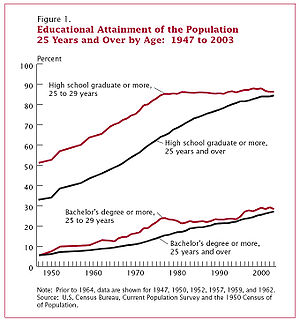
Among the country's adult population, over 85 percent have completed high school and 27 percent have received a bachelor's degree
or higher. The average salary for college
or university
graduates is greater than $51,000, exceeding the national average of those without a high school diploma by more than $23,000, according to a 2005 study by the U.S. Census Bureau.
The 2010 unemployment rate for high school graduates was 10.8%; the rate for college graduates was 4.9%.
The country has a reading literacy rate at 99% of the population over age 15, while ranking below average in science and mathematics understanding compared to other developed countries. In 2008, there was a 77% graduation rate from high school, below that of most developed countries.
The poor performance has pushed public and private efforts such as the No Child Left Behind Act
. In addition, the ratio of college-educated adults entering the workforce to general population (33%) is slightly below the mean of other developed countries (35%) and rate of participation of the labor force in continuing education
is high. A 2000s study by Jon Miller of Michigan State University
concluded that "A slightly higher proportion of American adults qualify as scientifically literate than European or Japanese adults".
and culminating in twelfth grade
. Children customarily advance together from one grade to the next as a single cohort or "class" upon reaching the end of each school year in May or June, although developmentally disabled children may be held back a grade and gifted children may skip ahead early to the next grade.
The American educational system comprises 12 grades of study over 12 calendar years of primary and secondary education before graduating and becoming eligible for college admission. After pre-kindergarten and kindergarten
, there are five years in primary school (normally known as elementary school). After completing five grades, the student will enter junior high or middle school and then high school to get the high school diploma.
The U.S. uses ordinal number
s for naming grades, unlike Canada and Australia where cardinal numbers are preferred. Thus, Americans are more likely to say "First Grade" rather than "Grade One". Typical ages and grade groupings in public and private schools may be found through the U.S. Department of Education. Many different variations exist across the country.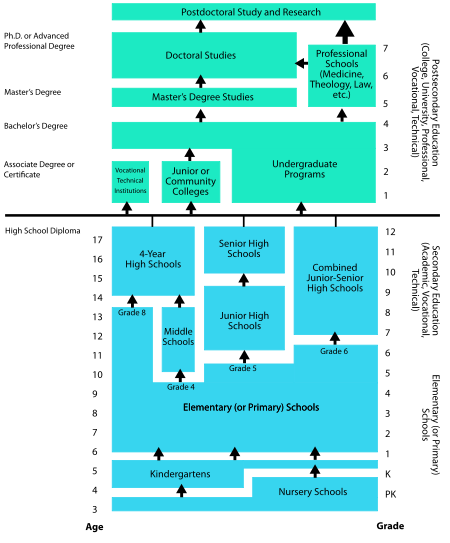
Students completing high school may apply to attend an undergraduate school. This may be a community college
(one that offers two-year degrees, usually to prepare students to transfer to state universities), liberal arts college
(one that concentrates on undergraduate education), or part of a larger research university.
The course of study is called the "major", which comprises the main or special subjects. However, students are not locked into a major upon admission—usually, a major is chosen by the second year of college, and changing majors is frequently possible depending on how the credits work out, unlike British tertiary education. Universities are either public
(state-sponsored, such as The Ohio State University or University of Georgia
) or private such as Harvard or Swarthmore.
Students may choose to continue onto graduate school for a master's or Ph.D, or to a first professional degree
program. A master's degree requires an additional two years of specialized study; a doctoral degree (Ph.D.) usually takes some years, although exactly how long depends on the time required to prepare the doctoral dissertation. First professional degrees have a more structured program than the typical Ph.D. program. The standard time required for a first professional degree is three or four years; for example, law school is a three-year program, while medical, dental, and veterinary schools are four-year programs.
In the large cities, there are sometimes preschools catering to the children of the wealthy. Because some wealthy families see these schools as the first step toward the Ivy League
, there are even counselors who specialize in assisting parents and their toddlers through the preschool admissions process. Increasingly, a growing body of preschools are adopting international standards such as the International Preschool Curriculum
(usually five to six years old) and finish secondary education with twelfth grade
(usually eighteen years old). In some cases, pupils may be promoted beyond the next regular grade. Some states allow students to leave school between 14–17 with parental permission, before finishing high school; other states require students to stay in school until age 18
Most parents send their children to either a public or private institution. According to government data, one-tenth of students are enrolled in private schools. Approximately 85% of students enter the public schools, largely because they are tax-subsidized (tax burdens by school district
s vary from area to area).
There are more than 14,000 school districts in the country.
More than $500 billion is spent each year on primary and secondary education.
Most states require that their school districts within the state teach for 180 days a year.
Parents may also choose to educate their own children at home
; 1.7% of children are educated in this manner.
Nearly 6.2 million students between the ages of 16 and 24 in 2007 dropped out
of high school, including nearly three of 10 Hispanics.
The issue of high-school drop-outs is considered important to address as the incarceration rate for African-American male high school dropouts is about 50 (fifty) times the national average.
In 1971, the Supreme Court ruled
unanimously that forced busing of students may be ordered to achieve racial desegregation. This ruling resulted in a white flight
from the inner cities which largely diluted the intent of the order. This flight had other, non-educational ramifications as well. Integration took place in most schools though de facto
segregation often determined the composition of the student body.
By the 1990s, most areas of the country have been released from mandatory busing.
In 2010, there were 3,823,142 teachers in public, charter, private, and Catholic elementary and secondary schools. They taught a total of 55,203,000 students, who attended one of 132,656 schools.
States do not require proper reporting from their school districts to allow analysis of efficiency of return on investment
. The Center for American Progress
, called a "left-leaning think tank", commends Florida and Texas as the only two states that provides annual school-level productivity evaluations which report to the public how well school funds are being spent at the local level. This allows for comparison of school districts within a state.
In 2010, American students rank 17th in the world. The Organisation for Economic Cooperation and Development says that this is due to focusing on the low end of performers. All of the recent gains have been made, deliberately, at the low end of the socioeconomic scale and among the lowest achievers. The country has been outrun, the study says, by other nations because the US has not done enough to encourage the highest achievers.
About half the states encourage schools to recite the Pledge of Allegiance
to the flag.
Teachers worked from about 35 to 46 hours a week in a survey taken in 1993.
Transporting students to and from school is a major concern for most school districts. School buses provide the largest mass transit program in the country; 8.8 billion trips per year. Non-school transit buses give 5.2 billion trips annually. 440,000 yellow school buses carry over 24 million students to and from school.
School start times are computed with busing in mind. There are often three start times; for elementary, for middle/junior high, and for high school. One school district computed its cost per bus (without the driver) at $20,575 annually. It assumed a model where the average driver drove 80 miles per day. A driver was presumed to cost $.62 per mile (1.6 km). Elementary schools started at 7:30, middle schools/junior high school started at 8:15 and senior high schools at 9:00. While elementary school started earlier, they also get out earlier, at 2:25; middle schools at 3:10 and senior high schools at 3:55. All school districts establish their own times and means of transportation within guidelines set forth by their own state.
includes kindergarten through fifth grade
(or sometimes, to fourth grade
, sixth grade
or eighth grade
). In elementary school, basic subjects are taught, and students often remain in one or two classrooms throughout the school day, with the exceptions of physical education
("P.E." or "gym"), library
, music
, and art
classes. There are (as of 2001) about 3.6 million children in each grade in the United States.
Typically, the curriculum in public elementary education is determined by individual school districts. The school district selects curriculum guides and textbooks that are reflective of a state's learning standards and benchmarks for a given grade level. Learning Standards are the goals by which states and school districts must meet adequate yearly progress (AYP) as mandated by No Child Left Behind (NCLB). This description of school governance is simplistic at best, however, and school systems vary widely not only in the way curricular decisions are made but also in how teaching and learning take place. Some states and/or school districts impose more top-down mandates than others. In others, teachers play a significant role in curriculum design and there are few top-down mandates. Curricular decisions within private schools are made differently than they are in public schools, and in most cases without consideration of NCLB.
Public Elementary School teachers typically instruct between twenty and thirty students of diverse learning needs. A typical classroom will include children with a range of learning needs or abilities, from those identified as having special needs of the kinds listed in the Individuals with Disabilities Act IDEA
to those that are cognitively, athletically or artistically gifted. At times, an individual school district identifies areas of need within the curriculum. Teachers and advisory administrators form committees to develop supplemental materials to support learning for diverse learners and to identify enrichment for textbooks. Many school districts post information about the curriculum and supplemental materials on websites for public access.
Each local school district gives each teacher a book to give to the students for each subject, and brief overviews of what the teacher are expected to teach. In general, a student learns basic arithmetic
and sometimes rudimentary algebra in mathematics
, English proficiency (such as basic grammar
, spelling, and vocabulary
), and fundamentals of other subjects. Learning standards are identified for all areas of a curriculum by individual States, including those for mathematics, social studies, science, physical development, the fine arts, and reading. While the concept of State Learning standards has been around for some time, No Child Left Behind has mandated that standards exist at the State level.
Elementary School teachers are trained with emphases on human cognitive and psychological development and the principles of curriculum development and instruction. Teachers typically earn either a Bachelors or Masters Degree in Early Childhood and Elementary Education. The teaching of social studies
and science
are often underdeveloped in elementary school programs. Some attribute this to the fact that elementary school teachers are trained as generalists; however, teachers attribute this to the priority placed on developing reading, writing and math proficiency in the elementary grades and to the large amount of time needed to do so. Reading, writing and math proficiency greatly affect performance in social studies, science and other content areas. Certification standards for teachers are determined by individual states, with individual colleges and universities determining the rigor of the college education provided for future teachers. Some states require content area tests, as well as instructional skills tests for teacher certification in that state.
The broad topic of Social Studies may include key events, documents, understandings, and concepts in American history
, and geography
, and in some programs, state or local history and geography. Topics included under the broader term "science" vary from the physical sciences such as physics and chemistry, through the biological sciences such as biology, ecology, and physiology.
Most States have predetermined the number of minutes that will be taught within a given content area. Because No Child Left Behind focuses on reading and math as primary targets for improvement, other instructional areas have received less attention. There is much discussion within educational circles about the justification and impact of having curricula that place greater emphasis on those topics (reading, writing and math) that are specifically tested for improvement.
and Junior high school include the grade levels intermediate between elementary school and senior high school. "Middle school" usually includes sixth, seventh and eighth grade; "Junior high" typically includes seventh through ninth grade. The range defined by either is often based on demographic factors, such as an increase or decrease in the relative numbers of younger or older students, with the aim of maintaining stable school populations. At this time, students are given more independence, moving to different classrooms for different subjects, and being allowed to choose some of their class subjects (electives). Usually, starting in ninth grade, grades become part of a student’s official transcript. Future employers or colleges may want to see steady improvement in grades and a good attendance record on the official transcript. Therefore, students are encouraged to take much more responsibility for their education.
Senior high school
is a school attended after junior high school. High school is often used instead of senior high school and distinguished from junior high school. High school usually runs either from 9th through 12th, or 10th through 12th grade. The students in these grades are commonly referred to as freshmen (grade 9), sophomores (grade 10), juniors (grade 11) and seniors (grade 12).
Generally, at the high school
level, students take a broad variety of classes without special emphasis in any particular subject. Curricula vary widely in quality and rigidity; for example, some states consider 65 (on a 100-point scale) a passing grade, while others consider it to be as low as 60 or as high as 75. Students are required to take a certain minimum number of mandatory subjects, but may choose additional subjects ("electives") to fill out their required hours of learning.
The following minimum courses of study in mandatory subjects are required in nearly all U.S. high schools:
Many states require a "health" course in which students learn about anatomy
, nutrition
, first aid
, sexuality
, drug awareness and birth control
. Anti-drug use programs are also usually part of health courses. In many cases, however, options are provided for students to "test out" of this requirement or complete independent study to meet it. Foreign language and some form of art education are also a mandatory part of the curriculum in some schools.
Common types of electives include:
Many high schools provide Advanced Placement
(AP) or International Baccalaureate (IB) courses. These are special forms of honors classes where the curriculum
is more challenging and lessons more aggressively paced than standard courses. AP or IB courses are usually taken during the 11th or 12th grade of high school, but may be taken as early as 9th grade.
Most post-secondary institutions take AP or IB exam results into consideration in the admissions process. Because AP and IB courses are intended to be the equivalent of the first year of college courses, post-secondary institutions may grant unit credit, which enables students to graduate earlier. Other institutions use examinations for placement purposes only: students are exempted from introductory course work but may not receive credit towards a concentration, degree, or core requirement. Institutions vary in the selection of examinations they accept and the scores they require to grant credit or placement, with more elite institutions tending to accept fewer examinations and requiring higher scoring. The lack of AP, IB, and other advanced courses in impoverished inner-city high schools is often seen as a major cause of the greatly differing levels of post-secondary education these graduates go on to receive, compared with both public and private schools in wealthier neighborhoods.
Also, in states with well-developed community college
systems, there are often mechanisms by which gifted students may seek permission from their school district to attend community college courses full-time during the summer, and part-time during the school year. The units earned this way can often be transferred to one's university, and can facilitate early graduation. Early college entrance program
s are a step further, with students enrolling as freshmen at a younger-than-traditional age.
Many select moral or religious reasons for homeschooling their children. The second main category is "unschooling," those who prefer a non-standard approach to education.
Most homeschooling advocates are wary of the established educational institutions for various reasons. Some are religious conservatives who see nonreligious education as contrary to their moral or religious systems, or who wish to add religious instruction to the educational curriculum (and who may be unable to afford a church-operated private school, or where the only available school may teach views contrary to those of the parents). Others feel that they can more effectively tailor a curriculum to suit an individual student’s academic strengths and weaknesses, especially those with singular needs or disabilities. Still others feel that the negative social pressures of schools (such as bullying, drugs, crime, sex, and other school-related problems) are detrimental to a child’s proper development. Parents often form groups to help each other in the homeschooling process, and may even assign classes to different parents, similar to public and private schools.
Opposition to homeschooling comes from varied sources, including teachers' organizations and school districts. The National Education Association
, the largest labor union
in the United States, has been particularly vocal in the past. Opponents' stated concerns fall into several broad categories, including fears of poor academic quality, loss of income for the schools, and religious or social extremism, or lack of socialization with others. At this time, over half of states have oversight into monitoring or measuring the academic progress of home schooled students, with all but ten requiring some form of notification to the state.
s are issued to parents at varying intervals. Generally the scores for individual assignments and tests are recorded for each student in a grade book, along with the maximum number of points for each assignment. At any time, the total number of points for a student when divided by the total number of possible points produces a percent grade, which can be translated to a letter grade. Letter grades are often but not always used on report cards at the end of a marking period, although the current grade may be available at other times (particularly when an electronic grade book connected to an online service is in use). Although grading scales usually differ from school to school, the most common grade scale is letter grades—"A" through "F"—derived from a scale of 0–100 or a percentile. In some areas, Texas or Virginia for example, the "D" grade (or that between 70–60) is considered a failing grade. In other jurisdictions, such as Hawaii
, a "D" grade is considered passing in certain classes, and failing in others.
, all American states must test students in public schools statewide to ensure that they are achieving the desired level of minimum education, such as on the Regents Examinations
in New York
, or the Florida Comprehensive Assessment Test
(FCAT), and the Massachusetts Comprehensive Assessment System
(MCAS); students being educated at home or in private schools are not included. The act also requires that students and schools show "adequate yearly progress." This means they must show some improvement each year. When a student fails to make adequate yearly progress, No Child Left Behind mandates that remediation through summer school and/or tutoring be made available to a student in need of extra help.
During high school, students (usually in 11th grade
) may take one or more standardized tests depending on their postsecondary education preferences and their local graduation requirements. In theory, these tests evaluate the overall level of knowledge and learning aptitude of the students. The SAT
and ACT are the most common standardized tests that students take when applying to college
. A student may take the SAT, ACT, or both depending upon the post-secondary institutions
the student plans to apply to for admission. Most competitive schools also require two or three SAT Subject Tests
, (formerly known as SAT IIs), which are shorter exams that focus strictly on a particular subject matter. However, all these tests serve little to no purpose for students who do not move on to post-secondary education, so they can usually be skipped without affecting one's ability to graduate.
s programs, drill team
s, band
s, and spirit groups can amount to hours of practices and performances. Most state
s have organizations that develop rules for competition between groups. These organizations are usually forced to implement time limits on hours practiced as a prerequisite for participation. Many schools also have non-varsity sports teams, however these are usually afforded less resources and attention.
Sports programs and their related games, especially football and/or basketball
, are major events for American students and for larger schools can be a major source of funds for school district
s. Schools may sell "spirit" shirts to wear to games; school stadiums and gymnasiums are often filled to capacity, even for non-sporting competitions.
High school athletic competitions often generate intense interest in the community. Inner city schools serving poor students are heavily scouted by college and even professional coaches, with national attention given to which colleges outstanding high school students choose to attend. State high school championship tournaments football and basketball attract high levels of public interest.
In addition to sports, numerous non-athletic extracurricular activities are available in American schools, both public and private. Activities include Quizbowl
, musical groups, marching bands, student government, school newspapers, science fairs, debate teams, and clubs focused on an academic area (such as the Spanish Club) or cultural interests (such as Key Club).
According to the National Association of School Nurses, 5% of students in 2009 have a seizure disorder, another 5% have ADHD and 10% have mental or emotional problems.
(IDEA) requires states to ensure that all government-run schools provide services to meet the individual needs of students with special needs
, as defined by the law. All students with special needs are entitled to a free and appropriate public education (FAPE).
Schools meet with the parents or guardians to develop an Individualized Education Program
that determines best placement for the child. Students must be placed in the least restrictive environment
(LRE) that is appropriate for the student's needs. Government-run schools that fail to provide an appropriate placement for students with special needs can be taken to due process wherein parents may formally submit their grievances and demand appropriate services for the child. Schools may be eligible for state and federal funding for the (sometimes large) costs of providing the necessary facilities and services.
K-12
students in most areas have a choice between free tax-funded public schools, or privately-funded private school
s.
Public school systems are supported by a combination of local, state, and federal government funding. Because a large portion of school revenues come from local property taxes, public schools vary widely in the resources they have available per student. Class size also varies from one district to another. Curriculum decisions in public schools are made largely at the local and state levels; the federal government has limited influence. In most districts, a locally elected school board runs schools. The school board appoints an official called the superintendent of schools to manage the schools in the district. The largest public school system in the United States is in New York City
, where more than one million students are taught in 1,200 separate public schools. Because of its immense size – there are more students in the system than residents in eight US states – the New York City public school system is nationally influential in determining standards and materials, such as textbooks.
Admission to individual public schools is usually based on residency. To compensate for differences in school quality based on geography, school systems serving large cities and portions of large cities often have "magnet school
s" that provide enrollment to a specified number of non-resident students in addition to serving all resident students. This special enrollment is usually decided by lottery with equal numbers of males and females chosen. Some magnet schools
cater to gifted students or to students with special interests, such as the sciences or performing arts.
Private schools in the United States include parochial schools (affiliated with religious denominations), non-profit independent schools, and for-profit private schools. Private schools charge varying rates depending on geographic location, the school's expenses, and the availability of funding from sources, other than tuition. For example, some churches partially subsidize private schools for their members. Some people have argued that when their child attends a private school, they should be able to take the funds that the public school no longer needs and apply that money towards private school tuition in the form of vouchers. This is the basis of the school choice
movement.
5,072,451 students attended 33,740 private elementary and secondary schools in 2007. 74.5% of these were Caucasian, non-Hispanic, 9.8% were African American, 9.6% were Hispanic. 5.4% were Asian or Pacific Islander, and .6% were American Indian. Average school size was 150.3 students. There were 456,266 teachers. The number of students per teacher was about 11. 65% of seniors in private schools in 2006-7 went on to attend a 4-year college.
Private schools have various missions: some cater to college-bound students seeking a competitive edge in the college admissions process; others are for gifted students, students with learning disabilities or other special needs, or students with specific religious affiliations. Some cater to families seeking a small school, with a nurturing, supportive environment. Unlike public school systems, private schools have no legal obligation to accept any interested student. Admission to some private schools is often highly selective. Private schools also have the ability to permanently expel persistently unruly students, a disciplinary option not legally available to public school systems. Private schools offer the advantages of smaller classes, under twenty students in a typical elementary classroom, for example; a higher teacher/student ratio across the school day, greater individualized attention and in the more competitive schools, expert college placement services. Unless specifically designed to do so, private schools usually cannot offer the services required by students with serious or multiple learning, emotional, or behavioral issues. Although reputed to pay lower salaries than public school systems, private schools often attract teachers by offering high-quality professional development opportunities, including tuition grants for advanced degrees. According to elite private schools themselves, this investment in faculty development helps maintain the high quality program that they offer.
An August 17, 2000 article by the Chicago Sun-Times
refers to the Roman Catholic Archdiocese of Chicago
Office of Catholic Schools as the largest private school system in the United States.
or university
and commonly consists of four years of study at an institution of higher learning. There are 4,352 colleges, universities, and junior colleges in the country. In 2008, 36% of enrolled students graduated from college in four years. 57% completed their undergraduate requirements in six years, at the same college they first enrolled in. The U.S. ranks 10th among industrial countries for percentage of adults with college degrees.
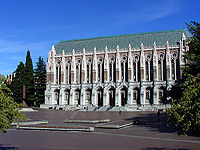 Like high school, the four undergraduate grades are commonly called freshman, sophomore, junior, and senior years (alternatively called first year, second year, etc.). Students traditionally apply for admission into colleges. Schools differ in their competitiveness and reputation; generally, the most prestigious schools are private, rather than public. Admissions criteria involve the rigor and grades earned in high school courses taken, the students' GPA, class ranking, and standardized test scores (Such as the SAT or the ACT tests). Most colleges also consider more subjective factors such as a commitment to extracurricular activities, a personal essay, and an interview. While colleges will rarely list that they require a certain standardized test score, class ranking, or GPA for admission, each college usually has a rough threshold below which admission is unlikely.
Once admitted, students engage in undergraduate study, which consists of satisfying university and class requirements to achieve a bachelor's degree
in a field of concentration known as a major
. (Some students enroll in double majors
or "minor" in another field of study.) The most common method consists of four years of study leading to a Bachelor of Arts
(B.A.), a Bachelor of Science
(B.S.), or sometimes another bachelor's degree such as Bachelor of Fine Arts
(B.F.A.), Bachelor of Social Work (B.S.W.), Bachelor of Engineering
(B.Eng.,) or Bachelor of Philosophy
(B.Phil.) Five-Year Professional Architecture programs offer the Bachelor of Architecture
Degree (B.Arch.)
Professional degrees such as law, medicine, pharmacy, and dentistry, are offered as graduate study after earning at least three years of undergraduate schooling or after earning a bachelor's degree depending on the program. These professional fields do not require a specific undergraduate major, though medicine, pharmacy, and dentistry have set prerequisite courses that must be taken before enrollment.
Some students choose to attend a community college for two years prior to further study at another college or university. In most states, community colleges are operated either by a division of the state university or by local special districts subject to guidance from a state agency. Community colleges may award Associate of Arts (AA) or Associate of Science (AS) degree after two years. Those seeking to continue their education may transfer to a four-year college or university (after applying through a similar admissions process as those applying directly to the four-year institution, see articulation
). Some community colleges have automatic enrollment agreements with a local four-year college, where the community college provides the first two years of study and the university provides the remaining years of study, sometimes all on one campus. The community college awards the associate's degree, and the university awards the bachelor's and master's degrees.
 Graduate study, conducted after obtaining an initial degree and sometimes after several years of professional work, leads to a more advanced degree such as a master's degree
, which could be a Master of Arts
(MA), Master of Science
(MS), Master of Business Administration
(MBA), or other less common master's degrees such as Master of Education
(MEd), and Master of Fine Arts
(MFA). Some students pursue a graduate degree that is in between a master's degree and a doctoral degree called a Specialist in Education (Ed.S.).
After additional years of study and sometimes in conjunction with the completion of a master's degree and/or Ed.S. degree, students may earn a Doctor of Philosophy (Ph.D.
) or other doctoral degree, such as Doctor of Arts
, Doctor of Education, Doctor of Theology
, Doctor of Medicine
, Doctor of Pharmacy
, Doctor of Physical Therapy
, Doctor of Osteopathy, Doctor of Podiatry Medicine, Doctor of Veterinary Medicine, Doctor of Psychology, or Juris Doctor
. Some programs, such as medicine and psychology, have formal apprenticeship procedures post-graduation, such as residencies and internships, which must be completed after graduation and before one is considered fully trained. Other professional programs like law and business have no formal apprenticeship requirements after graduation (although law school graduates must take the bar exam to legally practice law in nearly all states).
Entrance into graduate programs usually depends upon a student's undergraduate academic performance or professional experience as well as their score on a standardized entrance exam like the Graduate Record Examination
(GRE-graduate schools in general), the Medical College Admission Test
(MCAT), or the Law School Admission Test
(LSAT). Many graduate and law schools do not require experience after earning a bachelor's degree to enter their programs; however, business school candidates are usually required to gain a few years of professional work experience before applying. 8.9 percent of students receive postgraduate degrees. Most, after obtaining their bachelor's degree, proceed directly into the workforce.
s and scholarships from their university, the federal government, or a private lender. All but a few charity institutions cover all of the students' tuition, although scholarships (both merit-based and need-based) are widely available. Generally, private universities charge much higher tuition than their public counterparts, which rely on state funds to make up the difference. Because each state supports its own university system with state taxes, most public universities charge much higher rates for out-of-state students.
Annual undergraduate tuition varies widely from state to state, and many additional fees apply. In 2009, average annual tuition at a public university (for residents of the state) was $7,020. Tuition for public school students from outside the state is generally comparable to private school prices, although students can often qualify for state residency after their first year. Private schools are typically much higher, although prices vary widely from "no-frills" private schools to highly specialized technical institutes. Depending upon the type of school and program, annual graduate program tuition can vary from $15,000 to as high as $50,000. Note that these prices do not include living expenses (rent, room/board, etc.) or additional fees that schools add on such as "activities fees" or health insurance
. These fees, especially room and board, can range from $6,000 to $12,000 per academic year (assuming a single student without children).
The mean annual Total Cost (including all costs associated with a full-time post-secondary schooling, such as tuition and fees, books and supplies, room and board), as reported by collegeboard.com for 2010:
Total, four year schooling:
College costs are rising at the same time that state appropriations for aid are shrinking. This has led to debate over funding at both the state and local levels. From 2002 to 2004 alone, tuition rates at public schools increased over 14 percent, largely due to dwindling state funding. An increase of 6 percent occurred over the same period for private schools. Between 1982 and 2007, college tuition and fees rose three times as fast as median family income, in constant dollars.
From the US Census Bureau, the median salary of an individual who has only a high school diploma is $27,967; The median salary of an individual who has a bachelor's degree is $47,345.
Certain degrees, such as in engineering, typically result in salaries far exceeding high school graduates, whereas degrees in teaching and social work fall below.
The debt of the average college graduate for student loans in 2010 was $23,200.
A 2010 study indicates that the "return on investment
" for graduating from the top 1000 colleges exceeds 4% over a high school degree.
To combat costs colleges have hired adjunct professors to teach. In 2008 these teachers cost about $1,800 per 3-credit class as opposed to $8,000 per class for a tenured professor. Two-thirds of college instructors were adjuncts. There are differences of opinion whether these adjuncts teach better or worse than regular professors. There is a suspicion that student evaluation of adjuncts, along with their subsequent continued employment, can lead to grade inflation
.
produced by magazines such as U.S. News and World Report, Academic Ranking of World Universities
, test preparation services such as The Princeton Review
or another university itself such as the Top American Research Universities by the University of Florida's The Center. These rankings are based on factors like brand recognition, selectivity in admissions, generosity of alumni donors, and volume of faculty research. In global university rankings, the US dominates more than half the top 50 places (27) and has a total of 72 institutions in the top 200 table under the Times Higher Education World University Rankings
. It has more than twice as many universities represented in the top 200 as its nearest rival, the United Kingdom, which has 29. A small percentage of students who apply to these schools gain admission. Included among the top 20 institutions identified by ARWU
in 2009 are six of the eight schools in the Ivy League
; 4 of the 10 schools in the University of California
system; the private Universities of Stanford
, Chicago
, and Johns Hopkins
; the public Universities of Washington
and Wisconsin; and the Massachusetts
and California
Institutes of Technology.
Also renowned within the United States are the so-called "Little Ivies
" and a number of prestigious liberal arts college
s. Certain public universities (sometimes referred to as "Public Ivies") are also recognized for their outstanding record in scholarship. Some of these institutions currently place among the elite in certain measurements of graduate education and research, especially among engineering and medical schools.
Each state in the United States maintains its own public university
system, which is always non-profit. The State University of New York
and the California State University
are the largest public higher education systems in the United States; SUNY is the largest system that includes community colleges, while CSU is the largest without. Most areas also have private institutions
, which may be for-profit or non-profit. Unlike many other nations, there are no public universities at the national level outside of the military service academies
.
Prospective students applying to attend four of the five military academies
require, with limited exceptions, nomination by a member of Congress
. Like acceptance to "top tier" universities, competition for these limited nominations is intense and must be accompanied by superior scholastic achievement and evidence of "leadership potential." The one academy that has never used congressional nomination, the United States Coast Guard Academy
, is regularly cited as one of the country's most selective higher education institutions.
Aside from these aforementioned schools, academic reputations vary widely among the 'middle-tier' of American schools, (and even among academic departments within each of these schools.) Most public and private institutions fall into this 'middle' range. Some institutions feature honors colleges or other rigorous programs that challenge academically exceptional students, who might otherwise attend a 'top-tier' college. Aware of the status attached to the perception of the college that they attend, students often apply to a range of schools. Some apply to a relatively prestigious school with a low acceptance rate, gambling on the chance of acceptance, and also apply to a "safety school", to which they will (almost) certainly gain admission.
Lower status institutions include community college
s. These are primarily two-year public institutions, which individual states usually require to accept all local residents who seek admission, and offer associate's degree
s or vocational certificate programs. Many community colleges have relationships with four-year state universities and colleges or even private universities that enable their students to transfer to these universities for a four-year degree after completing a two-year program at the community college.
Regardless of perceived prestige, many institutions feature at least one distinguished academic department, and most post-secondary American students attend one of the 2,400 four-year colleges and universities or 1,700 two-year colleges not included among the twenty-five or so 'top-tier' institutions.
Library books are more readily available to Americans than to people in Germany, Britain, France, the Netherlands, Austria and all the Mediterranean nations. The average American borrowed more library books in 2001 than his or her peers in Germany, Austria, Norway, Ireland, Luxembourg, France and throughout the Mediterranean.
Americans buy more books than people in Europe.
There are more newspapers per capita in the US than anywhere in Europe outside Scandinavia, Switzerland and Luxembourg.
Americans write relatively high number of books per capita.
.
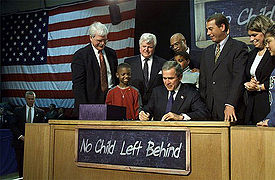 Curricula in the United States vary widely from district to district. Not only do schools offer a range of topics and quality, but private schools may include religious classes as mandatory for attendance. This raises the question of government funding vouchers in states with anti-Catholic Blaine Amendments in their constitution. This has produced camps of argument over the standardization of curricula and to what degree. These same groups often are advocates of standardized testing, which is mandated by the No Child Left Behind Act
.
There is debate over which subjects should receive the most focus, with astronomy and geography among those cited as not being taught enough in schools.
official language . Some 9.7 million children aged 5 to 17 primarily speak a language other than English at home. Of those, about 1.3 million children do not speak English well or at all.
Drop out rates are a concern in American four year colleges. In New York, 54 percent of students entering four-year colleges in 1997 had a degree six years later — and even fewer Hispanics and blacks did. 33 percent of the freshmen who enter the University of Massachusetts Boston
graduate within six years. Less than 41 percent graduate from the University of Montana, and 44 percent from the University of New Mexico
.
Since the 1980s the number of educated Americans has continued to grow, but at a slower rate. Some have attributed this to an increase in the foreign born portion of the workforce. However, the decreasing growth of the educational workforce has instead been primarily due to slowing down in educational attainment of people schooled in the United States.
of Kansas
caused controversy when it decided to eliminate teaching of evolution
in its state assessment tests. Scientists from around the country demurred. Many religious and family values
groups, on the other hand, claimed that evolution is simply a theory in the colloquial sense, and as such creationist ideas should therefore be taught alongside it as an alternative viewpoint. A majority supported teaching intelligent design
and/or creationism
in public schools.
Also in 2001, 47% of American high school students drank alcohol at least once; 5% drank right on school territory. 24% of high school students smoked marijuana, 5% smoking right at school. 29% of students who smoke marijuana obtain the drug at school.
For example, a 1999 study by the Guttmacher Institute
found that most U.S. sex education courses in grades 7 through 12 cover puberty, HIV
, STDs
, abstinence
, implications of teenage pregnancy
, and how to resist peer pressure. Other studied topics, such as methods of birth control
and infection prevention, sexual orientation
, sexual abuse
, and factual and ethical information about abortion
, varied more widely.
However, according to a 2004 survey, a majority of the 1001 parent groups polled wants complete sex education in the schools. The American people are heavily divided over the issue. Over 80% of polled parents agreed with the statement "Sex education in school makes it easier for me to talk to my child about sexual issues," while under 17% agreed with the statement that their children were being exposed to "subjects I don't think my child should be discussing." 10 percent believed that their children's sexual education class forced them to discuss sexual issues "too early." On the other hand, 49 percent of the respondents (the largest group) were "somewhat confident" that the values taught in their children's sex ed classes were similar to those taught at home, and 23 percent were less confident still. (The margin of error
was plus or minus 4.7 percent.)
In 2010, the Texas Board of Education adopted new Social Studies standards that could potentially impact the content of textbooks purchased in other parts of the country. The deliberations that resulted in the new standards were partisan in nature and are said to reflect a conservative leaning in the view of United States history.
As of January 2009, the four largest college textbook publishers in the United States were:
Other US textbook publishers include:
According to a 2007 article in The Washington Post
, the Washington D.C. public school district spends $12,979 per student per year. This is the third highest level of funding per student out of the 100 biggest school districts in the U.S. According to the article, however, these schools are ranked last in the amount of funding spent on teachers and instruction, and first on the amount spent on administration. The school district has produced outcomes that are lower than the national average. In reading and math, the district's students score the lowest among 11 major school districts – even when poor children are compared with other poor children. 33% of poor fourth graders in the U.S. lack basic skills in math, but in Washington D.C., it's 62%. In 2004, the U.S. Congress set up a voucher program for low income minority students in Washington D.C. to attend private schools. The vouchers were $7,500 per student per year. The parents said their children were receiving a much better education from the private schools. In 2007, Washington D.C. non-voting delegate Eleanor Holmes Norton
said she wanted the voucher program to be eliminated, and that the public schools needed more money. Secretary of Education Arne Duncan
supports retaining vouchers for the district only, as do some DC parent groups.
According to a 2006 study by the Goldwater Institute
, Arizona's public schools spend 50% more per student than Arizona's private schools. The study also says that while teachers constitute 72% of the employees at private schools, they make up less than half of the staff at public schools. According to the study, if Arizona's public schools wanted to be like private schools, they would have to hire approximately 25,000 more teachers, and eliminate 21,210 administration employees.
During the 2006–2007 school year, a private school in Chicago founded by Marva Collins
to teach low income minority students charged $5,500 for tuition, and parents said that the school did a much better job than the Chicago public school system. However, Collins' school was forced to close in 2008 due to lack of sufficient enrollment and funding. Meanwhile, during the 2007–2008 year, Chicago public school officials claimed that their budget of $11,300 per student was not enough.
In 1985 in Kansas City, Missouri, a judge ordered the school district to raise taxes and spend more money on public education. Spending was increased so much, that the school district was spending more money per student than any of the country's other 280 largest school districts with a charge to "dream" of the possibilities and to make them happen. Although this very high level of spending continued for more than a decade, there was no improvement in the school district's academic performance.
Public school defenders answer that both of these examples are misleading, as the task of educating students is easier in private schools, which can expel or refuse to accept students who lag behind their peers in academic achievement or behavior, while public schools have no such recourse and must continue to attempt to educate these students. For this reason, comparisons of the cost of education in public schools to that of private schools is misleading; private school education can be accomplished with less funding because in most cases they educate those students who are easiest to teach.
But not in all cases. For example, Marva Collins
created her low cost private school specifically for the purpose of teaching low income African American children whom the public school system had labeled as being "learning disabled". One article about Marva Collins' school stated, "Working with students having the worst of backgrounds, those who were working far below grade level, and even those who had been labeled as 'unteachable,' Marva was able to overcome the obstacles. News of third grade students reading at ninth grade level, four-year-olds learning to read in a few months, outstanding test scores, disappearance of behavioral problems, second-graders studying Shakespeare, and other incredible reports, astounded the public."
According to a 1999 article by William J. Bennett, former U.S. Secretary of Education, increased levels of spending on public education have not made the schools better. Among many other things, the article cites the following statistics:
A 2008 report by The Heritage Foundation
provides the following chart based on data from the US Department of Education
indicating no real improvement in reading scores, while per student expenditure more than doubles from $4,060 in 1970 to $9,266 in 2005 ($20,436.03 adjusted for inflation since 1970).
Other commentators have suggested that the public school system has exhibited signs of success. SAT
scores have risen consistently over the past decades, despite the fact that the pool of students taking the test has increased from an academic elite to a much more representative sampling of the population. Commentators have suggested that this increase in scores, coming as it does at a time when more students have started to take the test and the public schooling system has faced ever-increasing challenge, suggests that the US educational system is much more effective than is commonly believed, and that the negative cast common in public perception is due to negative propaganda disseminated by elements with a personal interest in discrediting or weakening public education.
Funding for schools in the United States is complex. One current controversy stems much from the No Child Left Behind Act
. The Act gives the Department of Education
the right to withhold funding if it believes a school, district, or even a state is not complying and is making no effort to comply. However, federal funding accounts for little of the overall funding schools receive. The vast majority comes from the state government and in some cases from local property taxes. Various groups, many of whom are teachers, constantly push for more funding. They point to many different situations, such as the fact that in many schools funding for classroom supplies is so inadequate that teachers, especially those at the elementary level, must supplement their supplies with purchases of their own.
Property taxes as a primary source of funding for public education have become highly controversial, for a number of reasons. First, if a state's population and land values escalate rapidly, many longtime residents may find themselves paying property taxes much higher than anticipated. In response to this phenomenon, California's citizens passed Proposition 13
in 1978, which severely restricted the ability of the Legislature to expand the state's educational system to keep up with growth. Some states, such as Michigan, have investigated or implemented alternate schemes for funding education that may sidestep the problems of funding based mainly on property taxes by providing funding based on sales or income tax. These schemes also have failings, negatively impacting funding in a slow economy.
One of the biggest debates in funding public schools is funding by local taxes or state taxes. The federal government supplies around 8.5% of the public school system funds, according to a 2005 report by the National Center for Education Statistics
. The remaining split between state and local governments averages 48.7 percent from states and 42.8 percent from local sources. However, the division varies widely. In Hawaii
local funds make up 1.7 percent, while state sources account for nearly 90.1 percent.
The most expensive school in the United States was constructed by the Los Angeles Unified School District
in 2010. It cost $578 million; served 4,200 K–12 students.
The reliance on local funding sources has led to a long history of court challenges about how states fund their schools. These challenges have relied on interpretations of state constitutions after a U.S. Supreme Court ruling that school funding was not a matter of the U.S. Constitution (San Antonio Independent School District v. Rodriguez
, 411 U.S. 1 (1973)). The state court cases, beginning with the California case of Serrano v. Priest
, 5 Cal.3d 584 (1971), were initially concerned with equity in funding, which was defined in terms of variations in spending across local school districts. More recently, state court cases have begun to consider what has been called 'adequacy.' These cases have questioned whether the total amount of spending was sufficient to meet state constitutional requirements. Perhaps the most famous adequacy case is Abbott v. Burke, 100 N.J. 269, 495 A.2d 376 (1985), which has involved state court supervision over several decades and has led to some of the highest spending of any U.S. districts in the so-called Abbott districts. The background and results of these cases are analyzed in a book by Eric Hanushek
and Alfred Lindseth. That analysis concludes that funding differences are not closely related to student outcomes and thus that the outcomes of the court cases have not led to improved policies.
(FFELP). Some schools accept only FFELP loans; others accept only FDSLP. Still others accept both, and a few schools will not accept either, in which case students must seek out private alternatives for student loans.
in universities allowed educational institutions to consider race as a factor in admitting students, but ruled that strict point systems are unconstitutional. Opponents of racial affirmative action argue that the program actually benefits middle- and upper-class people of color at the expense of lower class European Americans and Asian Americans. Prominent African American academics Henry Louis Gates and Lani Guinier
, while favoring affirmative action, have argued that in practice, it has led to recent black immigrants and their children being greatly overrepresented at elite institutions, at the expense of the historic African American community made up of descendants of slaves. In 2006, Jian Li
, a Chinese undergraduate at Yale University
, filed a civil rights complaint with the Office for Civil Rights against Princeton University
, claiming that his race played a role in their decision to reject his application for admission.
. In the current situation, the state
and national
governments have a power-sharing arrangement, with the states exercising most of the control. Like other arrangements between the two, the federal government uses the threat of decreased funding to enforce laws pertaining to education. Furthermore, within each state there are different types of control. Some states have a statewide school system, while others delegate power to county, city
or township
-level school boards. However, under the Bush administration, initiatives such as the No Child Left Behind Act have attempted to assert more central control in a heavily decentralized system.
Many cities have their own school boards everywhere in the United States. With the exception of cities, outside the northeast U.S. school boards are generally constituted at the county level.
The U.S. federal government exercises its control through the U.S. Department of Education
. Educational accreditation
decisions are made by voluntary regional associations
. Schools in the 50 states, the District of Columbia, the U.S. Virgin Islands, Guam
, and the Northern Mariana Islands
, teach in English, while schools in the commonwealth of Puerto Rico
teach in Spanish. Nonprofit private schools are widespread, are largely independent of the government, and include secular as well as parochial school
s.
2003, which emphasizes problem solving, American 15 year olds ranked 24th of 38 in mathematics, 19th of 38 in science, 12th of 38 in reading, and 26th of 38 in problem solving. In the 2006 assessment, the U.S. ranked 35th out of 57 in mathematics and 29th out of 57 in science. Reading scores could not be reported due to printing errors in the instructions of the U.S. test booklets. U.S. scores were behind those of most other developed nations.
However, the picture changes when low achievers in the U.S. are broken out by race. White and Asian students in the United States are generally among the best-performing pupils in the world; black
and Hispanic students in the U.S. have very high rates of low achievement.
US fourth and eighth graders tested above average on the Trends in International Mathematics and Science Study
tests, which emphasizes traditional learning.
 The rise of the high school movement in the beginning of the 20th century was unique in the United States, such that, high schools were implemented with property-tax funded tuition, openness, non-exclusivity, and were decentralized.
The academic curriculum was designed to provide the students with a terminal degree. The students obtained general knowledge (such as mathematics, chemistry, English composition, etc.) applicable to the high geographic and social mobility in the United States. The provision of the high schools accelerated with the rise of the second industrial revolution. The increase in white collar and skilled blue-collar work in manufacturing was reflected in the demand for high school education.
In the 21st century, the educational attainment of the US population is similar to that of many other industrialized countries with the vast majority of the population having completed secondary education and a rising number of college graduates that outnumber high school dropouts. As a whole, the population of the United States is becoming increasingly more educated. Post-secondary education is valued very highly by American society and is one of the main determinants of class
and status. As with income
, however, there are significant discrepancies in terms of race, age, household configuration and geography. Overall the households and demographics featuring the highest educational attainment in the United States are also among those with the highest household income
and wealth
. Thus, while the population of the US is becoming increasingly educated on all levels, a direct link between income and educational attainment remains.
In 2007, Americans stood second only to Canada in the percentage of 35 to 64 year olds holding at least two-year degrees. Among 25 to 34 year olds, the country stands tenth. The nation stands 15 out of 29 rated nations for college completion rates, slightly above Mexico and Turkey.
The U.S. Department of Education’s 2003 statistics suggest that 14% of the population – or 32 million adults – have very low literacy skills.
A five-year, $14 million study of U.S. adult literacy involving lengthy interviews of U.S. adults, the most comprehensive study of literacy ever commissioned by the U.S. government, was released in September 1993. It involved lengthy interviews of over 26,700 adults statistically balanced for age, gender, ethnicity, education level, and location (urban, suburban, or rural) in 12 states across the U.S. and was designed to represent the U.S. population as a whole. This government study showed that 21% to 23% of adult Americans were not "able to locate information in text", could not "make low-level inferences using printed materials", and were unable to "integrate easily identifiable pieces of information."
According to a 2003 study by the US government, around 23% of Americans in California lack basic prose literacy skills.
either full-time or part time to administer to students and to ensure that medication is taken as directed by their physician.
For some high school grades and many elementary schools as well, a police officer, titled a "resource officer", or SRO (Security Resource Officer), is on site to screen students for firearms and to help avoid disruptions.
Public sector
The public sector, sometimes referred to as the state sector, is a part of the state that deals with either the production, delivery and allocation of goods and services by and for the government or its citizens, whether national, regional or local/municipal.Examples of public sector activity range...
, with control and funding coming from three levels: federal
Federal government of the United States
The federal government of the United States is the national government of the constitutional republic of fifty states that is the United States of America. The federal government comprises three distinct branches of government: a legislative, an executive and a judiciary. These branches and...
, state
State government
A state government is the government of a subnational entity in a federal form of government, which shares political power with the federal or national government. A state government may have some level of political autonomy, or be subject to the direct control of the federal government...
, and local
Local government
Local government refers collectively to administrative authorities over areas that are smaller than a state.The term is used to contrast with offices at nation-state level, which are referred to as the central government, national government, or federal government...
. Child education is compulsory
Compulsory education
Compulsory education refers to a period of education that is required of all persons.-Antiquity to Medieval Era:Although Plato's The Republic is credited with having popularized the concept of compulsory education in Western intellectual thought, every parent in Judea since Moses's Covenant with...
.
Public education
Public education
State schools, also known in the United States and Canada as public schools,In much of the Commonwealth, including Australia, New Zealand, South Africa, and the United Kingdom, the terms 'public education', 'public school' and 'independent school' are used for private schools, that is, schools...
is universally available. School curricula, funding, teaching, employment, and other policies are set through locally elected school boards with jurisdiction over school district
School district
School districts are a form of special-purpose district which serves to operate the local public primary and secondary schools.-United States:...
s with many directives from state legislatures. School districts are usually separate from other local jurisdictions, with independent officials and budgets. Educational standards and standardized testing decisions are usually made by state governments.
The ages for compulsory education vary by state. It begins from ages five to eight and ends from ages fourteen to eighteen.
Compulsory education requirements can generally be satisfied by educating children in public schools, state-certified private school
Private school
Private schools, also known as independent schools or nonstate schools, are not administered by local, state or national governments; thus, they retain the right to select their students and are funded in whole or in part by charging their students' tuition, rather than relying on mandatory...
s, or an approved home school
Homeschooling
Homeschooling or homeschool is the education of children at home, typically by parents but sometimes by tutors, rather than in other formal settings of public or private school...
program. In most public and private schools, education is divided into three levels: elementary school
Primary education in the United States
Primary education in the United States typically refers to the first six years of formal education in most jurisdictions. Primary education may also be referred to as elementary education and most schools offering these programs are referred to as elementary schools...
, middle school
Middle school
Middle School and Junior High School are levels of schooling between elementary and high schools. Most school systems use one term or the other, not both. The terms are not interchangeable...
(sometimes called junior high school), and high school
Secondary education in the United States
In most jurisdictions, secondary education in the United States refers to the last six or seven years of statutory formal education. Secondary education is generally split between junior high school or middle school, usually beginning with sixth or seventh grade , and high school, beginning with...
(sometimes referred to as secondary education). In almost all schools at these levels, children are divided by age groups into grades, ranging from kindergarten
Kindergarten
A kindergarten is a preschool educational institution for children. The term was created by Friedrich Fröbel for the play and activity institute that he created in 1837 in Bad Blankenburg as a social experience for children for their transition from home to school...
(followed by first grade
First grade
First grade is a year of primary education in schools in the United States and English-speaking provinces of Canada. It is the first school year after kindergarten...
) for the youngest children in elementary school, up to twelfth grade
Twelfth grade
Twelfth grade or Senior year, or Grade Twelve, are the North American names for the final year of secondary school. In most countries students then graduate at age 17 or 18. In some countries, there is a thirteenth grade, while other countries do not have a 12th grade/year at all...
, the final year of high school
High school
High school is a term used in parts of the English speaking world to describe institutions which provide all or part of secondary education. The term is often incorporated into the name of such institutions....
. The exact age range of students in these grade levels varies slightly from area to area.
Post-secondary education
Tertiary education
Tertiary education, also referred to as third stage, third level, and post-secondary education, is the educational level following the completion of a school providing a secondary education, such as a high school, secondary school, university-preparatory school...
, better known as "college
College
A college is an educational institution or a constituent part of an educational institution. Usage varies in English-speaking nations...
" in the United States, is generally governed separately from the elementary and high school system, and is described in a separate section below.
History
Statistics
In the year 2000, there were 76.6 million students enrolled in schools from kindergartenKindergarten
A kindergarten is a preschool educational institution for children. The term was created by Friedrich Fröbel for the play and activity institute that he created in 1837 in Bad Blankenburg as a social experience for children for their transition from home to school...
through graduate school
Graduate school
A graduate school is a school that awards advanced academic degrees with the general requirement that students must have earned a previous undergraduate degree...
s. Of these, 72 percent aged 12 to 17 were judged academically "on track" for their age (enrolled in school at or above grade level). Of those enrolled in compulsory education, 5.2 million (10.4 percent) were attending private schools.
Among the country's adult population, over 85 percent have completed high school and 27 percent have received a bachelor's degree
Bachelor's degree
A bachelor's degree is usually an academic degree awarded for an undergraduate course or major that generally lasts for three or four years, but can range anywhere from two to six years depending on the region of the world...
or higher. The average salary for college
College
A college is an educational institution or a constituent part of an educational institution. Usage varies in English-speaking nations...
or university
University
A university is an institution of higher education and research, which grants academic degrees in a variety of subjects. A university is an organisation that provides both undergraduate education and postgraduate education...
graduates is greater than $51,000, exceeding the national average of those without a high school diploma by more than $23,000, according to a 2005 study by the U.S. Census Bureau.
The 2010 unemployment rate for high school graduates was 10.8%; the rate for college graduates was 4.9%.
The country has a reading literacy rate at 99% of the population over age 15, while ranking below average in science and mathematics understanding compared to other developed countries. In 2008, there was a 77% graduation rate from high school, below that of most developed countries.
The poor performance has pushed public and private efforts such as the No Child Left Behind Act
No Child Left Behind Act
The No Child Left Behind Act of 2001 is a United States Act of Congress concerning the education of children in public schools.NCLB was originally proposed by the administration of George W. Bush immediately after he took office...
. In addition, the ratio of college-educated adults entering the workforce to general population (33%) is slightly below the mean of other developed countries (35%) and rate of participation of the labor force in continuing education
Continuing education
Continuing education is an all-encompassing term within a broad spectrum of post-secondary learning activities and programs. The term is used mainly in the United States and Canada...
is high. A 2000s study by Jon Miller of Michigan State University
Michigan State University
Michigan State University is a public research university in East Lansing, Michigan, USA. Founded in 1855, it was the pioneer land-grant institution and served as a model for future land-grant colleges in the United States under the 1862 Morrill Act.MSU pioneered the studies of packaging,...
concluded that "A slightly higher proportion of American adults qualify as scientifically literate than European or Japanese adults".
School grades
Most children enter the public education system around ages five or six. The American school year traditionally begins in August or September, after the traditional summer recess. Children are assigned into year groups known as grades, beginning with preschool, followed by kindergartenKindergarten
A kindergarten is a preschool educational institution for children. The term was created by Friedrich Fröbel for the play and activity institute that he created in 1837 in Bad Blankenburg as a social experience for children for their transition from home to school...
and culminating in twelfth grade
Twelfth grade
Twelfth grade or Senior year, or Grade Twelve, are the North American names for the final year of secondary school. In most countries students then graduate at age 17 or 18. In some countries, there is a thirteenth grade, while other countries do not have a 12th grade/year at all...
. Children customarily advance together from one grade to the next as a single cohort or "class" upon reaching the end of each school year in May or June, although developmentally disabled children may be held back a grade and gifted children may skip ahead early to the next grade.
The American educational system comprises 12 grades of study over 12 calendar years of primary and secondary education before graduating and becoming eligible for college admission. After pre-kindergarten and kindergarten
Kindergarten
A kindergarten is a preschool educational institution for children. The term was created by Friedrich Fröbel for the play and activity institute that he created in 1837 in Bad Blankenburg as a social experience for children for their transition from home to school...
, there are five years in primary school (normally known as elementary school). After completing five grades, the student will enter junior high or middle school and then high school to get the high school diploma.
The U.S. uses ordinal number
Ordinal number (linguistics)
In linguistics, ordinal numbers are the words representing the rank of a number with respect to some order, in particular order or position . Its use may refer to size, importance, chronology, etc...
s for naming grades, unlike Canada and Australia where cardinal numbers are preferred. Thus, Americans are more likely to say "First Grade" rather than "Grade One". Typical ages and grade groupings in public and private schools may be found through the U.S. Department of Education. Many different variations exist across the country.
| Elementary school Elementary school An elementary school or primary school is an institution where children receive the first stage of compulsory education known as elementary or primary education. Elementary school is the preferred term in some countries, particularly those in North America, where the terms grade school and grammar... |
|
| Preschool | 4–5 |
| Kindergarten Kindergarten A kindergarten is a preschool educational institution for children. The term was created by Friedrich Fröbel for the play and activity institute that he created in 1837 in Bad Blankenburg as a social experience for children for their transition from home to school... |
5–6 |
| 1st Grade First grade First grade is a year of primary education in schools in the United States and English-speaking provinces of Canada. It is the first school year after kindergarten... |
6–7 |
| 2nd Grade Second grade In the United States, second grade is a year of primary education. Second grade is the second school year after kindergarten. Students are traditionally 7–8 years old, depending on when their birthday occurs.... |
7–8 |
| 3rd Grade Third grade In the United States, third grade is a year of primary education. It is the third school year after kindergarten. Students are usually 8 – 9 years old, depending on when their birthday occurs.... |
8–9 |
| 4th Grade Fourth grade Fourth grade is a year of education in the United States and many other nations. The fourth grade is the fourth school year after kindergarten. Students are usually 9 or 10 years old, depending on their birthday. It is a part of elementary school. In some parts of the United States, fourth grade... |
9–10 |
| 5th Grade Fifth grade Fifth grade is a year of education in the United States and many other nations. The fifth grade is the fifth school year after kindergarten. Students are usually 10 – 11 years old, and are preteens... |
10-11 |
| Middle school Middle school Middle School and Junior High School are levels of schooling between elementary and high schools. Most school systems use one term or the other, not both. The terms are not interchangeable... |
|
| 6th Grade Sixth grade Sixth grade is a year of education in the United States and some other nations. The sixth grade is the sixth school year after kindergarten. Students are usually 11 – 12 years old... |
11–12 |
| 7th Grade Seventh grade Seventh grade is a year of education in the United States and many other nations. The seventh grade is the seventh school year after kindergarten. Students are usually 12–13 years old. Traditionally, seventh grade was the next-to-last year of elementary school... |
12–13 |
| 8th Grade Eighth grade Eighth grade is a year of education in the United States, Canada, Australia and other nations. Students are usually 13 - 14 years old. The eighth grade is typically the final grade before high school, and the ninth grade of public and private education, following kindergarten and subsequent grades... |
13–14 |
| High school Secondary education in the United States In most jurisdictions, secondary education in the United States refers to the last six or seven years of statutory formal education. Secondary education is generally split between junior high school or middle school, usually beginning with sixth or seventh grade , and high school, beginning with... |
|
| 9th Grade Ninth grade Ninth grade is the ninth post-kindergarten year of school education in some school systems. The students are 13 to 15 years of age, depending on when their birthday occurs. Depending on the school district, ninth grade is usually the first year of high school.... (Freshman) |
14-15 |
| 10th Grade Tenth grade In majority of the world,Tenth grade is the tenth year of school post-kindergarten. The variants of "10th grade" in various nations is described below.-Australia:... (Sophomore) |
15-16 |
| 11th Grade Eleventh grade Eleventh Grade is the eleventh, and for some countries final, grade of secondary schools. Students are typically 16 or 17 years of age, depending on the country and the students' birthdays.-Brazil:... (Junior) |
16-17 |
| 12th Grade Twelfth grade Twelfth grade or Senior year, or Grade Twelve, are the North American names for the final year of secondary school. In most countries students then graduate at age 17 or 18. In some countries, there is a thirteenth grade, while other countries do not have a 12th grade/year at all... (Senior) |
17-18 |
| Post-secondary education | |
| Tertiary education Tertiary education Tertiary education, also referred to as third stage, third level, and post-secondary education, is the educational level following the completion of a school providing a secondary education, such as a high school, secondary school, university-preparatory school... (College College A college is an educational institution or a constituent part of an educational institution. Usage varies in English-speaking nations... or University University A university is an institution of higher education and research, which grants academic degrees in a variety of subjects. A university is an organisation that provides both undergraduate education and postgraduate education... ) |
Ages vary, but often 18–23 (Freshman, Sophomore, Junior and Senior years) |
| Vocational education Vocational education Vocational education or vocational education and training is an education that prepares trainees for jobs that are based on manual or practical activities, traditionally non-academic, and totally related to a specific trade, occupation, or vocation... |
Ages vary |
| Graduate education | Ages vary |
| Adult education Adult education Adult education is the practice of teaching and educating adults. Adult education takes place in the workplace, through 'extension' school or 'school of continuing education' . Other learning places include folk high schools, community colleges, and lifelong learning centers... |
Ages vary |
Students completing high school may apply to attend an undergraduate school. This may be a community college
Community colleges in the United States
In the United States, community colleges are primarily two-year public institutions of higher education and were once commonly called junior colleges....
(one that offers two-year degrees, usually to prepare students to transfer to state universities), liberal arts college
Liberal arts colleges in the United States
Liberal arts colleges in the United States are certain undergraduate institutions of higher education in the United States. The Encyclopædia Britannica Concise offers a definition of the liberal arts as a "college or university curriculum aimed at imparting general knowledge and developing general...
(one that concentrates on undergraduate education), or part of a larger research university.
The course of study is called the "major", which comprises the main or special subjects. However, students are not locked into a major upon admission—usually, a major is chosen by the second year of college, and changing majors is frequently possible depending on how the credits work out, unlike British tertiary education. Universities are either public
State university system
A state university system in the United States is a group of public universities supported by an individual state, or a similar entity such as the District of Columbia. These systems constitute the majority of public-funded universities in the country...
(state-sponsored, such as The Ohio State University or University of Georgia
University of Georgia
The University of Georgia is a public research university located in Athens, Georgia, United States. Founded in 1785, it is the oldest and largest of the state's institutions of higher learning and is one of multiple schools to claim the title of the oldest public university in the United States...
) or private such as Harvard or Swarthmore.
Students may choose to continue onto graduate school for a master's or Ph.D, or to a first professional degree
First professional degree
A professional degree prepares the holder for a particular profession by emphasizing competency skills along with theory and analysis. These professions are typically licensed or otherwise regulated by a governmental or government-approved body...
program. A master's degree requires an additional two years of specialized study; a doctoral degree (Ph.D.) usually takes some years, although exactly how long depends on the time required to prepare the doctoral dissertation. First professional degrees have a more structured program than the typical Ph.D. program. The standard time required for a first professional degree is three or four years; for example, law school is a three-year program, while medical, dental, and veterinary schools are four-year programs.
Preschool
There are no mandatory public prekindergarten or crèche programs in the United States. The federal government funds the Head Start preschool program for children of low-income families, but most families are responsible for finding preschool or childcare.In the large cities, there are sometimes preschools catering to the children of the wealthy. Because some wealthy families see these schools as the first step toward the Ivy League
Ivy League
The Ivy League is an athletic conference comprising eight private institutions of higher education in the Northeastern United States. The conference name is also commonly used to refer to those eight schools as a group...
, there are even counselors who specialize in assisting parents and their toddlers through the preschool admissions process. Increasingly, a growing body of preschools are adopting international standards such as the International Preschool Curriculum
International Preschool Curriculum
The International Preschool Curriculum "IPC" is research based curriculum for children aged 3 to 6. The curriculum is devised and reviewed by an advisory committee consisting of academics, teachers and education consultants.-Features:...
Student health
According to the National Association of School Nurses, 17% of students are considered obese and 32% are overweight.Elementary and secondary education
Schooling is compulsory for all children in the United States, but the age range for which school attendance is required varies from state to state. Most children begin elementary education with kindergartenKindergarten
A kindergarten is a preschool educational institution for children. The term was created by Friedrich Fröbel for the play and activity institute that he created in 1837 in Bad Blankenburg as a social experience for children for their transition from home to school...
(usually five to six years old) and finish secondary education with twelfth grade
Twelfth grade
Twelfth grade or Senior year, or Grade Twelve, are the North American names for the final year of secondary school. In most countries students then graduate at age 17 or 18. In some countries, there is a thirteenth grade, while other countries do not have a 12th grade/year at all...
(usually eighteen years old). In some cases, pupils may be promoted beyond the next regular grade. Some states allow students to leave school between 14–17 with parental permission, before finishing high school; other states require students to stay in school until age 18
| Education | Percentage |
|---|---|
| High school graduate | 86.68% |
| Some college | 55.60% |
| Associates and/or Bachelor's degree | 38.54% |
| Master's degree | 7.62% |
| Doctorate or professional degree | 2.94% |
Most parents send their children to either a public or private institution. According to government data, one-tenth of students are enrolled in private schools. Approximately 85% of students enter the public schools, largely because they are tax-subsidized (tax burdens by school district
School district
School districts are a form of special-purpose district which serves to operate the local public primary and secondary schools.-United States:...
s vary from area to area).
There are more than 14,000 school districts in the country.
More than $500 billion is spent each year on primary and secondary education.
Most states require that their school districts within the state teach for 180 days a year.
Parents may also choose to educate their own children at home
Homeschooling
Homeschooling or homeschool is the education of children at home, typically by parents but sometimes by tutors, rather than in other formal settings of public or private school...
; 1.7% of children are educated in this manner.
Nearly 6.2 million students between the ages of 16 and 24 in 2007 dropped out
Dropping out
Dropping out means leaving a group for either practical reasons, necessities or disillusionment with the system from which the individual in question leaves....
of high school, including nearly three of 10 Hispanics.
The issue of high-school drop-outs is considered important to address as the incarceration rate for African-American male high school dropouts is about 50 (fifty) times the national average.
In 1971, the Supreme Court ruled
Swann v. Charlotte-Mecklenburg Board of Education
Swann v. Charlotte-Mecklenburg Board of Education, 402 U.S. 1 was an important United States Supreme Court case dealing with the busing of students to promote integration in public schools...
unanimously that forced busing of students may be ordered to achieve racial desegregation. This ruling resulted in a white flight
White flight
White flight has been a term that originated in the United States, starting in the mid-20th century, and applied to the large-scale migration of whites of various European ancestries from racially mixed urban regions to more racially homogeneous suburban or exurban regions. It was first seen as...
from the inner cities which largely diluted the intent of the order. This flight had other, non-educational ramifications as well. Integration took place in most schools though de facto
De facto
De facto is a Latin expression that means "concerning fact." In law, it often means "in practice but not necessarily ordained by law" or "in practice or actuality, but not officially established." It is commonly used in contrast to de jure when referring to matters of law, governance, or...
segregation often determined the composition of the student body.
By the 1990s, most areas of the country have been released from mandatory busing.
In 2010, there were 3,823,142 teachers in public, charter, private, and Catholic elementary and secondary schools. They taught a total of 55,203,000 students, who attended one of 132,656 schools.
States do not require proper reporting from their school districts to allow analysis of efficiency of return on investment
Return on investment
Return on investment is one way of considering profits in relation to capital invested. Return on assets , return on net assets , return on capital and return on invested capital are similar measures with variations on how “investment” is defined.Marketing not only influences net profits but also...
. The Center for American Progress
Center for American Progress
The Center for American Progress is a progressive public policy research and advocacy organization. Its website states that the organization is "dedicated to improving the lives of Americans through progressive ideas and action." It has its headquarters in Washington D.C.Its President and Chief...
, called a "left-leaning think tank", commends Florida and Texas as the only two states that provides annual school-level productivity evaluations which report to the public how well school funds are being spent at the local level. This allows for comparison of school districts within a state.
In 2010, American students rank 17th in the world. The Organisation for Economic Cooperation and Development says that this is due to focusing on the low end of performers. All of the recent gains have been made, deliberately, at the low end of the socioeconomic scale and among the lowest achievers. The country has been outrun, the study says, by other nations because the US has not done enough to encourage the highest achievers.
About half the states encourage schools to recite the Pledge of Allegiance
Pledge of Allegiance
The Pledge of Allegiance of the United States is an expression of loyalty to the federal flag and the republic of the United States of America, originally composed by Christian Socialist Francis Bellamy in 1892 and formally adopted by Congress as the pledge in 1942...
to the flag.
Teachers worked from about 35 to 46 hours a week in a survey taken in 1993.
Transporting students to and from school is a major concern for most school districts. School buses provide the largest mass transit program in the country; 8.8 billion trips per year. Non-school transit buses give 5.2 billion trips annually. 440,000 yellow school buses carry over 24 million students to and from school.
School start times are computed with busing in mind. There are often three start times; for elementary, for middle/junior high, and for high school. One school district computed its cost per bus (without the driver) at $20,575 annually. It assumed a model where the average driver drove 80 miles per day. A driver was presumed to cost $.62 per mile (1.6 km). Elementary schools started at 7:30, middle schools/junior high school started at 8:15 and senior high schools at 9:00. While elementary school started earlier, they also get out earlier, at 2:25; middle schools at 3:10 and senior high schools at 3:55. All school districts establish their own times and means of transportation within guidelines set forth by their own state.
Elementary school
Historically, in the United States, local public control (and private alternatives) have allowed for some variation in the organization of schools. Elementary schoolElementary school
An elementary school or primary school is an institution where children receive the first stage of compulsory education known as elementary or primary education. Elementary school is the preferred term in some countries, particularly those in North America, where the terms grade school and grammar...
includes kindergarten through fifth grade
Fifth grade
Fifth grade is a year of education in the United States and many other nations. The fifth grade is the fifth school year after kindergarten. Students are usually 10 – 11 years old, and are preteens...
(or sometimes, to fourth grade
Fourth grade
Fourth grade is a year of education in the United States and many other nations. The fourth grade is the fourth school year after kindergarten. Students are usually 9 or 10 years old, depending on their birthday. It is a part of elementary school. In some parts of the United States, fourth grade...
, sixth grade
Sixth grade
Sixth grade is a year of education in the United States and some other nations. The sixth grade is the sixth school year after kindergarten. Students are usually 11 – 12 years old...
or eighth grade
Eighth grade
Eighth grade is a year of education in the United States, Canada, Australia and other nations. Students are usually 13 - 14 years old. The eighth grade is typically the final grade before high school, and the ninth grade of public and private education, following kindergarten and subsequent grades...
). In elementary school, basic subjects are taught, and students often remain in one or two classrooms throughout the school day, with the exceptions of physical education
Physical education
Physical education or gymnastics is a course taken during primary and secondary education that encourages psychomotor learning in a play or movement exploration setting....
("P.E." or "gym"), library
Library
In a traditional sense, a library is a large collection of books, and can refer to the place in which the collection is housed. Today, the term can refer to any collection, including digital sources, resources, and services...
, music
Music
Music is an art form whose medium is sound and silence. Its common elements are pitch , rhythm , dynamics, and the sonic qualities of timbre and texture...
, and art
Art
Art is the product or process of deliberately arranging items in a way that influences and affects one or more of the senses, emotions, and intellect....
classes. There are (as of 2001) about 3.6 million children in each grade in the United States.
Typically, the curriculum in public elementary education is determined by individual school districts. The school district selects curriculum guides and textbooks that are reflective of a state's learning standards and benchmarks for a given grade level. Learning Standards are the goals by which states and school districts must meet adequate yearly progress (AYP) as mandated by No Child Left Behind (NCLB). This description of school governance is simplistic at best, however, and school systems vary widely not only in the way curricular decisions are made but also in how teaching and learning take place. Some states and/or school districts impose more top-down mandates than others. In others, teachers play a significant role in curriculum design and there are few top-down mandates. Curricular decisions within private schools are made differently than they are in public schools, and in most cases without consideration of NCLB.
Public Elementary School teachers typically instruct between twenty and thirty students of diverse learning needs. A typical classroom will include children with a range of learning needs or abilities, from those identified as having special needs of the kinds listed in the Individuals with Disabilities Act IDEA
Individuals with Disabilities Education Act
The Individuals with Disabilities Education Act is a United States federal law that governs how states and public agencies provide early intervention, special education, and related services to children with disabilities...
to those that are cognitively, athletically or artistically gifted. At times, an individual school district identifies areas of need within the curriculum. Teachers and advisory administrators form committees to develop supplemental materials to support learning for diverse learners and to identify enrichment for textbooks. Many school districts post information about the curriculum and supplemental materials on websites for public access.
Each local school district gives each teacher a book to give to the students for each subject, and brief overviews of what the teacher are expected to teach. In general, a student learns basic arithmetic
Arithmetic
Arithmetic or arithmetics is the oldest and most elementary branch of mathematics, used by almost everyone, for tasks ranging from simple day-to-day counting to advanced science and business calculations. It involves the study of quantity, especially as the result of combining numbers...
and sometimes rudimentary algebra in mathematics
Mathematics
Mathematics is the study of quantity, space, structure, and change. Mathematicians seek out patterns and formulate new conjectures. Mathematicians resolve the truth or falsity of conjectures by mathematical proofs, which are arguments sufficient to convince other mathematicians of their validity...
, English proficiency (such as basic grammar
English grammar
English grammar is the body of rules that describe the structure of expressions in the English language. This includes the structure of words, phrases, clauses and sentences...
, spelling, and vocabulary
Vocabulary
A person's vocabulary is the set of words within a language that are familiar to that person. A vocabulary usually develops with age, and serves as a useful and fundamental tool for communication and acquiring knowledge...
), and fundamentals of other subjects. Learning standards are identified for all areas of a curriculum by individual States, including those for mathematics, social studies, science, physical development, the fine arts, and reading. While the concept of State Learning standards has been around for some time, No Child Left Behind has mandated that standards exist at the State level.
Elementary School teachers are trained with emphases on human cognitive and psychological development and the principles of curriculum development and instruction. Teachers typically earn either a Bachelors or Masters Degree in Early Childhood and Elementary Education. The teaching of social studies
Social studies
Social studies is the "integrated study of the social sciences and humanities to promote civic competence," as defined by the American National Council for the Social Studies...
and science
Science
Science is a systematic enterprise that builds and organizes knowledge in the form of testable explanations and predictions about the universe...
are often underdeveloped in elementary school programs. Some attribute this to the fact that elementary school teachers are trained as generalists; however, teachers attribute this to the priority placed on developing reading, writing and math proficiency in the elementary grades and to the large amount of time needed to do so. Reading, writing and math proficiency greatly affect performance in social studies, science and other content areas. Certification standards for teachers are determined by individual states, with individual colleges and universities determining the rigor of the college education provided for future teachers. Some states require content area tests, as well as instructional skills tests for teacher certification in that state.
The broad topic of Social Studies may include key events, documents, understandings, and concepts in American history
History of the United States
The history of the United States traditionally starts with the Declaration of Independence in the year 1776, although its territory was inhabited by Native Americans since prehistoric times and then by European colonists who followed the voyages of Christopher Columbus starting in 1492. The...
, and geography
Geography of the United States
The United States is a country in the Western Hemisphere. It consists of forty-eight contiguous states in North America, Alaska, a peninsula which forms the northwestern most part of North America, and Hawaii, an archipelago in the Pacific Ocean. There are several United States territories in the...
, and in some programs, state or local history and geography. Topics included under the broader term "science" vary from the physical sciences such as physics and chemistry, through the biological sciences such as biology, ecology, and physiology.
Most States have predetermined the number of minutes that will be taught within a given content area. Because No Child Left Behind focuses on reading and math as primary targets for improvement, other instructional areas have received less attention. There is much discussion within educational circles about the justification and impact of having curricula that place greater emphasis on those topics (reading, writing and math) that are specifically tested for improvement.
Secondary education
As part of education in the United States, secondary education usually covers grades 6 through 9 or 10 through 12.Junior and senior high school
Middle schoolMiddle school
Middle School and Junior High School are levels of schooling between elementary and high schools. Most school systems use one term or the other, not both. The terms are not interchangeable...
and Junior high school include the grade levels intermediate between elementary school and senior high school. "Middle school" usually includes sixth, seventh and eighth grade; "Junior high" typically includes seventh through ninth grade. The range defined by either is often based on demographic factors, such as an increase or decrease in the relative numbers of younger or older students, with the aim of maintaining stable school populations. At this time, students are given more independence, moving to different classrooms for different subjects, and being allowed to choose some of their class subjects (electives). Usually, starting in ninth grade, grades become part of a student’s official transcript. Future employers or colleges may want to see steady improvement in grades and a good attendance record on the official transcript. Therefore, students are encouraged to take much more responsibility for their education.
Senior high school
Secondary education in the United States
In most jurisdictions, secondary education in the United States refers to the last six or seven years of statutory formal education. Secondary education is generally split between junior high school or middle school, usually beginning with sixth or seventh grade , and high school, beginning with...
is a school attended after junior high school. High school is often used instead of senior high school and distinguished from junior high school. High school usually runs either from 9th through 12th, or 10th through 12th grade. The students in these grades are commonly referred to as freshmen (grade 9), sophomores (grade 10), juniors (grade 11) and seniors (grade 12).
Basic curricular structure
Generally, at the high school
High school
High school is a term used in parts of the English speaking world to describe institutions which provide all or part of secondary education. The term is often incorporated into the name of such institutions....
level, students take a broad variety of classes without special emphasis in any particular subject. Curricula vary widely in quality and rigidity; for example, some states consider 65 (on a 100-point scale) a passing grade, while others consider it to be as low as 60 or as high as 75. Students are required to take a certain minimum number of mandatory subjects, but may choose additional subjects ("electives") to fill out their required hours of learning.
The following minimum courses of study in mandatory subjects are required in nearly all U.S. high schools:
- Science (usually three years minimum, normally biology, chemistry and physics)
- Mathematics (usually four years minimum, normally including algebra, geometry, pre-calculus, statistics, and even calculus)
- English (usually four years minimum, including literature, humanities, composition, oral languages, etc.)
- Social sciences (usually three years minimum, including various history, government/economics courses)
- Physical education (at least two years)
Many states require a "health" course in which students learn about anatomy
Anatomy
Anatomy is a branch of biology and medicine that is the consideration of the structure of living things. It is a general term that includes human anatomy, animal anatomy , and plant anatomy...
, nutrition
Nutrition
Nutrition is the provision, to cells and organisms, of the materials necessary to support life. Many common health problems can be prevented or alleviated with a healthy diet....
, first aid
First aid
First aid is the provision of initial care for an illness or injury. It is usually performed by non-expert, but trained personnel to a sick or injured person until definitive medical treatment can be accessed. Certain self-limiting illnesses or minor injuries may not require further medical care...
, sexuality
Human sexuality
Human sexuality is the awareness of gender differences, and the capacity to have erotic experiences and responses. Human sexuality can also be described as the way someone is sexually attracted to another person whether it is to opposite sexes , to the same sex , to either sexes , or not being...
, drug awareness and birth control
Birth control
Birth control is an umbrella term for several techniques and methods used to prevent fertilization or to interrupt pregnancy at various stages. Birth control techniques and methods include contraception , contragestion and abortion...
. Anti-drug use programs are also usually part of health courses. In many cases, however, options are provided for students to "test out" of this requirement or complete independent study to meet it. Foreign language and some form of art education are also a mandatory part of the curriculum in some schools.
Electives
Common types of electives include:
- ComputerComputerA computer is a programmable machine designed to sequentially and automatically carry out a sequence of arithmetic or logical operations. The particular sequence of operations can be changed readily, allowing the computer to solve more than one kind of problem...
s (word processingWord processingWord processing is the creation of documents using a word processor. It can also refer to advanced shorthand techniques, sometimes used in specialized contexts with a specially modified typewriter.-External links:...
, programming, graphic designGraphic designGraphic design is a creative process – most often involving a client and a designer and usually completed in conjunction with producers of form – undertaken in order to convey a specific message to a targeted audience...
) - AthleticsSportA Sport is all forms of physical activity which, through casual or organised participation, aim to use, maintain or improve physical fitness and provide entertainment to participants. Sport may be competitive, where a winner or winners can be identified by objective means, and may require a degree...
(cross countryCross country runningCross country running is a sport in which people run a race on open-air courses over natural terrain. The course, typically long, may include surfaces of grass and earth, pass through woodlands and open country, and include hills, flat ground and sometimes gravel road...
, footballAmerican footballAmerican football is a sport played between two teams of eleven with the objective of scoring points by advancing the ball into the opposing team's end zone. Known in the United States simply as football, it may also be referred to informally as gridiron football. The ball can be advanced by...
, baseballBaseballBaseball is a bat-and-ball sport played between two teams of nine players each. The aim is to score runs by hitting a thrown ball with a bat and touching a series of four bases arranged at the corners of a ninety-foot diamond...
, basketballBasketballBasketball is a team sport in which two teams of five players try to score points by throwing or "shooting" a ball through the top of a basketball hoop while following a set of rules...
, track and fieldTrack and fieldTrack and field is a sport comprising various competitive athletic contests based around the activities of running, jumping and throwing. The name of the sport derives from the venue for the competitions: a stadium which features an oval running track surrounding a grassy area...
, swimmingSwimming (sport)Swimming is a sport governed by the Fédération Internationale de Natation .-History: Competitive swimming in Europe began around 1800 BCE, mostly in the form of the freestyle. In 1873 Steve Bowyer introduced the trudgen to Western swimming competitions, after copying the front crawl used by Native...
, tennisTennisTennis is a sport usually played between two players or between two teams of two players each . Each player uses a racket that is strung to strike a hollow rubber ball covered with felt over a net into the opponent's court. Tennis is an Olympic sport and is played at all levels of society at all...
, gymnasticsArtistic gymnasticsArtistic gymnastics is a discipline of gymnastics where gymnasts perform short routines on different apparatus, with less time for vaulting . The sport is governed by the Federation Internationale de Gymnastique , which designs the Code of Points and regulates all aspects of international elite...
, water poloWater poloWater polo is a team water sport. The playing team consists of six field players and one goalkeeper. The winner of the game is the team that scores more goals. Game play involves swimming, treading water , players passing the ball while being defended by opponents, and scoring by throwing into a...
, soccer, softballSoftballSoftball is a bat-and-ball sport played between two teams of 10 to 14 players. It is a direct descendant of baseball although there are some key differences: softballs are larger than baseballs, and the pitches are thrown underhand rather than overhand...
, wrestlingScholastic wrestlingScholastic wrestling, sometimes known in the United States as Folkstyle wrestling, is a style of amateur wrestling practised at the high school and middle school levels in the United States. This wrestling style is essentially Collegiate wrestling with some slight modifications. It is currently...
, cheerleadingCheerleadingCheerleading is a physical activity, sometimes a competitive sport, based on organized routines, usually ranging from one to three minutes, which contain the components of tumbling, dance, jumps, cheers, and stunting to direct spectators of events to cheer on sports teams at games or to participate...
, volleyballVolleyballVolleyball is a team sport in which two teams of six players are separated by a net. Each team tries to score points by grounding a ball on the other team's court under organized rules.The complete rules are extensive...
, lacrosseLacrosseLacrosse is a team sport of Native American origin played using a small rubber ball and a long-handled stick called a crosse or lacrosse stick, mainly played in the United States and Canada. It is a contact sport which requires padding. The head of the lacrosse stick is strung with loose mesh...
, ice hockeyIce hockeyIce hockey, often referred to as hockey, is a team sport played on ice, in which skaters use wooden or composite sticks to shoot a hard rubber puck into their opponent's net. The game is played between two teams of six players each. Five members of each team skate up and down the ice trying to take...
, field hockeyField hockeyField Hockey, or Hockey, is a team sport in which a team of players attempts to score goals by hitting, pushing or flicking a ball into an opposing team's goal using sticks...
, crewSport rowingRowing is a sport in which athletes race against each other on rivers, on lakes or on the ocean, depending upon the type of race and the discipline. The boats are propelled by the reaction forces on the oar blades as they are pushed against the water...
, boxingBoxingBoxing, also called pugilism, is a combat sport in which two people fight each other using their fists. Boxing is supervised by a referee over a series of between one to three minute intervals called rounds...
, skiingSkiingSkiing is a recreational activity using skis as equipment for traveling over snow. Skis are used in conjunction with boots that connect to the ski with use of a binding....
/snowboardingSnowboardingSnowboarding is a sport that involves descending a slope that is covered with snow on a snowboard attached to a rider's feet using a special boot set onto mounted binding. The development of snowboarding was inspired by skateboarding, sledding, surfing and skiing. It was developed in the U.S.A...
, golfGolfGolf is a precision club and ball sport, in which competing players use many types of clubs to hit balls into a series of holes on a golf course using the fewest number of strokes....
, mountain bikingMountain bikingMountain biking is a sport which consists of riding bicycles off-road, often over rough terrain, using specially adapted mountain bikes. Mountain bikes share similarities with other bikes, but incorporate features designed to enhance durability and performance in rough terrain.Mountain biking can...
) - Career and Technical Education (Agriculture/Agriscience, Business/Marketing, Family and Consumer Science, Health Occupations, and Technology Education, including PublishingPublishingPublishing is the process of production and dissemination of literature or information—the activity of making information available to the general public...
(journalismJournalismJournalism is the practice of investigation and reporting of events, issues and trends to a broad audience in a timely fashion. Though there are many variations of journalism, the ideal is to inform the intended audience. Along with covering organizations and institutions such as government and...
/student newspaperStudent newspaperA student newspaper is a newspaper run by students of a university, high school, middle school, or other school. These papers traditionally cover local and, primarily, school or university news....
, yearbookYearbookA yearbook, also known as an annual, is a book to record, highlight, and commemorate the past year of a school or a book published annually. Virtually all American, Australian and Canadian high schools, most colleges and many elementary and middle schools publish yearbooks...
/annual, literary magazineLiterary magazineA literary magazine is a periodical devoted to literature in a broad sense. Literary magazines usually publish short stories, poetry and essays along with literary criticism, book reviews, biographical profiles of authors, interviews and letters...
)) - Performing ArtsPerforming artsThe performing arts are those forms art which differ from the plastic arts insofar as the former uses the artist's own body, face, and presence as a medium, and the latter uses materials such as clay, metal or paint which can be molded or transformed to create some physical art object...
/Visual ArtsVisual artsThe visual arts are art forms that create works which are primarily visual in nature, such as ceramics, drawing, painting, sculpture, printmaking, design, crafts, and often modern visual arts and architecture...
, (choirChoirA choir, chorale or chorus is a musical ensemble of singers. Choral music, in turn, is the music written specifically for such an ensemble to perform.A body of singers who perform together as a group is called a choir or chorus...
, bandSchool bandA school band is a group of student musicians who rehearse and perform instrumental music together. A concert band is usually under the direction of one or more conductors...
, orchestraOrchestraAn orchestra is a sizable instrumental ensemble that contains sections of string, brass, woodwind, and percussion instruments. The term orchestra derives from the Greek ορχήστρα, the name for the area in front of an ancient Greek stage reserved for the Greek chorus...
, dramaDramaDrama is the specific mode of fiction represented in performance. The term comes from a Greek word meaning "action" , which is derived from "to do","to act" . The enactment of drama in theatre, performed by actors on a stage before an audience, presupposes collaborative modes of production and a...
, artArtArt is the product or process of deliberately arranging items in a way that influences and affects one or more of the senses, emotions, and intellect....
, ceramics, photographyPhotographyPhotography is the art, science and practice of creating durable images by recording light or other electromagnetic radiation, either electronically by means of an image sensor or chemically by means of a light-sensitive material such as photographic film...
, and danceDanceDance is an art form that generally refers to movement of the body, usually rhythmic and to music, used as a form of expression, social interaction or presented in a spiritual or performance setting....
) - Foreign languageForeign languageA foreign language is a language indigenous to another country. It is also a language not spoken in the native country of the person referred to, i.e. an English speaker living in Japan can say that Japanese is a foreign language to him or her...
s (Spanish and French are common; ChineseChinese languageThe Chinese language is a language or language family consisting of varieties which are mutually intelligible to varying degrees. Originally the indigenous languages spoken by the Han Chinese in China, it forms one of the branches of Sino-Tibetan family of languages...
, LatinLatinLatin is an Italic language originally spoken in Latium and Ancient Rome. It, along with most European languages, is a descendant of the ancient Proto-Indo-European language. Although it is considered a dead language, a number of scholars and members of the Christian clergy speak it fluently, and...
, Ancient GreekAncient GreekAncient Greek is the stage of the Greek language in the periods spanning the times c. 9th–6th centuries BC, , c. 5th–4th centuries BC , and the c. 3rd century BC – 6th century AD of ancient Greece and the ancient world; being predated in the 2nd millennium BC by Mycenaean Greek...
, GermanGerman languageGerman is a West Germanic language, related to and classified alongside English and Dutch. With an estimated 90 – 98 million native speakers, German is one of the world's major languages and is the most widely-spoken first language in the European Union....
, ItalianItalian languageItalian is a Romance language spoken mainly in Europe: Italy, Switzerland, San Marino, Vatican City, by minorities in Malta, Monaco, Croatia, Slovenia, France, Libya, Eritrea, and Somalia, and by immigrant communities in the Americas and Australia...
, ArabicArabic languageArabic is a name applied to the descendants of the Classical Arabic language of the 6th century AD, used most prominently in the Quran, the Islamic Holy Book...
, and JapaneseJapanese languageis a language spoken by over 130 million people in Japan and in Japanese emigrant communities. It is a member of the Japonic language family, which has a number of proposed relationships with other languages, none of which has gained wide acceptance among historical linguists .Japanese is an...
are less common) - Junior Reserve Officers' Training CorpsJunior Reserve Officers' Training CorpsThe Junior Reserve Officers' Training Corps is a Federal program sponsored by the United States Armed Forces in high schools across the United States...
Advanced courses
Many high schools provide Advanced Placement
Advanced Placement Program
The Advanced Placement program is a curriculum in the United States and Canada sponsored by the College Board which offers standardized courses to high school students that are generally recognized to be equivalent to undergraduate courses in college...
(AP) or International Baccalaureate (IB) courses. These are special forms of honors classes where the curriculum
Curriculum
See also Syllabus.In formal education, a curriculum is the set of courses, and their content, offered at a school or university. As an idea, curriculum stems from the Latin word for race course, referring to the course of deeds and experiences through which children grow to become mature adults...
is more challenging and lessons more aggressively paced than standard courses. AP or IB courses are usually taken during the 11th or 12th grade of high school, but may be taken as early as 9th grade.
Most post-secondary institutions take AP or IB exam results into consideration in the admissions process. Because AP and IB courses are intended to be the equivalent of the first year of college courses, post-secondary institutions may grant unit credit, which enables students to graduate earlier. Other institutions use examinations for placement purposes only: students are exempted from introductory course work but may not receive credit towards a concentration, degree, or core requirement. Institutions vary in the selection of examinations they accept and the scores they require to grant credit or placement, with more elite institutions tending to accept fewer examinations and requiring higher scoring. The lack of AP, IB, and other advanced courses in impoverished inner-city high schools is often seen as a major cause of the greatly differing levels of post-secondary education these graduates go on to receive, compared with both public and private schools in wealthier neighborhoods.
Also, in states with well-developed community college
Community college
A community college is a type of educational institution. The term can have different meanings in different countries.-Australia:Community colleges carry on the tradition of adult education, which was established in Australia around mid 19th century when evening classes were held to help adults...
systems, there are often mechanisms by which gifted students may seek permission from their school district to attend community college courses full-time during the summer, and part-time during the school year. The units earned this way can often be transferred to one's university, and can facilitate early graduation. Early college entrance program
Early college entrance program
Early college entrance programs, sometimes called early admission or early enrollment programs are educational programs that allow high school students to be accelerated into college, together with other such students, one or more years before the traditional age of college entrance, and without...
s are a step further, with students enrolling as freshmen at a younger-than-traditional age.
Home schooling
In 2007, approximately 1.5 million children were homeschooled, up 74% from 1999 when the U.S. Department of Education first started keeping statistics. This was 2.9% of all children.Many select moral or religious reasons for homeschooling their children. The second main category is "unschooling," those who prefer a non-standard approach to education.
Most homeschooling advocates are wary of the established educational institutions for various reasons. Some are religious conservatives who see nonreligious education as contrary to their moral or religious systems, or who wish to add religious instruction to the educational curriculum (and who may be unable to afford a church-operated private school, or where the only available school may teach views contrary to those of the parents). Others feel that they can more effectively tailor a curriculum to suit an individual student’s academic strengths and weaknesses, especially those with singular needs or disabilities. Still others feel that the negative social pressures of schools (such as bullying, drugs, crime, sex, and other school-related problems) are detrimental to a child’s proper development. Parents often form groups to help each other in the homeschooling process, and may even assign classes to different parents, similar to public and private schools.
Opposition to homeschooling comes from varied sources, including teachers' organizations and school districts. The National Education Association
National Education Association
The National Education Association is the largest professional organization and largest labor union in the United States, representing public school teachers and other support personnel, faculty and staffers at colleges and universities, retired educators, and college students preparing to become...
, the largest labor union
Trade union
A trade union, trades union or labor union is an organization of workers that have banded together to achieve common goals such as better working conditions. The trade union, through its leadership, bargains with the employer on behalf of union members and negotiates labour contracts with...
in the United States, has been particularly vocal in the past. Opponents' stated concerns fall into several broad categories, including fears of poor academic quality, loss of income for the schools, and religious or social extremism, or lack of socialization with others. At this time, over half of states have oversight into monitoring or measuring the academic progress of home schooled students, with all but ten requiring some form of notification to the state.
Grading scale
In schools in the United States children are continually assessed throughout the school year by their teachers, and report cardReport card
A report card communicates a student's performance. In most places, the report card is issued by the school to the student or the student's parents twice or four times yearly. A typical report card uses a grading scale to determine the quality of a student's school work...
s are issued to parents at varying intervals. Generally the scores for individual assignments and tests are recorded for each student in a grade book, along with the maximum number of points for each assignment. At any time, the total number of points for a student when divided by the total number of possible points produces a percent grade, which can be translated to a letter grade. Letter grades are often but not always used on report cards at the end of a marking period, although the current grade may be available at other times (particularly when an electronic grade book connected to an online service is in use). Although grading scales usually differ from school to school, the most common grade scale is letter grades—"A" through "F"—derived from a scale of 0–100 or a percentile. In some areas, Texas or Virginia for example, the "D" grade (or that between 70–60) is considered a failing grade. In other jurisdictions, such as Hawaii
Hawaii
Hawaii is the newest of the 50 U.S. states , and is the only U.S. state made up entirely of islands. It is the northernmost island group in Polynesia, occupying most of an archipelago in the central Pacific Ocean, southwest of the continental United States, southeast of Japan, and northeast of...
, a "D" grade is considered passing in certain classes, and failing in others.
| A | + | – | + | – | + | – | + | – | ||||
|---|---|---|---|---|---|---|---|---|---|---|---|---|
| 100–97 | 96–93 | 92–90 | 89–87 | 86–83 | 82–80 | 79–77 | 76–73 | 72–70 | 69–67 | 66–63 | 62–60 | Below 60 Percent |
Standardized testing
Under the No Child Left Behind ActNo Child Left Behind Act
The No Child Left Behind Act of 2001 is a United States Act of Congress concerning the education of children in public schools.NCLB was originally proposed by the administration of George W. Bush immediately after he took office...
, all American states must test students in public schools statewide to ensure that they are achieving the desired level of minimum education, such as on the Regents Examinations
Regents Examinations
Regents High School examinations, sometimes shortened to the Regents, are mandatory in New York State through the New York State Education Department, designed and administered under the authority of the Board of Regents of the University of the State of New York...
in New York
New York
New York is a state in the Northeastern region of the United States. It is the nation's third most populous state. New York is bordered by New Jersey and Pennsylvania to the south, and by Connecticut, Massachusetts and Vermont to the east...
, or the Florida Comprehensive Assessment Test
Florida Comprehensive Assessment Test
The Florida Comprehensive Assessment Test, or the FCAT , is the standardized test used in the primary and secondary public schools of Florida...
(FCAT), and the Massachusetts Comprehensive Assessment System
Massachusetts Comprehensive Assessment System
The Massachusetts Comprehensive Assessment System, commonly shortened to MCAS , is the Commonwealth's statewide standards-based assessment program developed in 1993, in response to the Massachusetts Education Reform Act of the same year...
(MCAS); students being educated at home or in private schools are not included. The act also requires that students and schools show "adequate yearly progress." This means they must show some improvement each year. When a student fails to make adequate yearly progress, No Child Left Behind mandates that remediation through summer school and/or tutoring be made available to a student in need of extra help.
During high school, students (usually in 11th grade
Eleventh grade
Eleventh Grade is the eleventh, and for some countries final, grade of secondary schools. Students are typically 16 or 17 years of age, depending on the country and the students' birthdays.-Brazil:...
) may take one or more standardized tests depending on their postsecondary education preferences and their local graduation requirements. In theory, these tests evaluate the overall level of knowledge and learning aptitude of the students. The SAT
SAT
The SAT Reasoning Test is a standardized test for college admissions in the United States. The SAT is owned, published, and developed by the College Board, a nonprofit organization in the United States. It was formerly developed, published, and scored by the Educational Testing Service which still...
and ACT are the most common standardized tests that students take when applying to college
College
A college is an educational institution or a constituent part of an educational institution. Usage varies in English-speaking nations...
. A student may take the SAT, ACT, or both depending upon the post-secondary institutions
Higher education
Higher, post-secondary, tertiary, or third level education refers to the stage of learning that occurs at universities, academies, colleges, seminaries, and institutes of technology...
the student plans to apply to for admission. Most competitive schools also require two or three SAT Subject Tests
SAT Subject Tests
SAT Subject Tests is the name for 20 multiple-choice standardized tests given on individual subjects, usually taken to improve a student's credentials for admission to colleges in the United States. Students typically choose which tests to take depending upon college entrance requirements for the...
, (formerly known as SAT IIs), which are shorter exams that focus strictly on a particular subject matter. However, all these tests serve little to no purpose for students who do not move on to post-secondary education, so they can usually be skipped without affecting one's ability to graduate.
Extracurricular activities
A major characteristic of American schools is the high priority given to sports, clubs and activities by the community, the parents, the schools and the students themselves. Extracurricular activities are educational activities not falling within the scope of the regular curriculum but under the supervision of the school. These activities can extend to large amounts of time outside the normal school day; home-schooled students, however, are not normally allowed to participate. Student participation in sportSport
A Sport is all forms of physical activity which, through casual or organised participation, aim to use, maintain or improve physical fitness and provide entertainment to participants. Sport may be competitive, where a winner or winners can be identified by objective means, and may require a degree...
s programs, drill team
Drill team
A drill team can be one of four different entities:# A Military Drill Team is marching unit that performs routines based on military drill. Military drill teams perform either armed or unarmed....
s, band
Band (music)
In music, a musical ensemble or band is a group of musicians that works together to perform music. The following articles concern types of musical bands:* All-female band* Big band* Boy band* Christian band* Church band* Concert band* Cover band...
s, and spirit groups can amount to hours of practices and performances. Most state
U.S. state
A U.S. state is any one of the 50 federated states of the United States of America that share sovereignty with the federal government. Because of this shared sovereignty, an American is a citizen both of the federal entity and of his or her state of domicile. Four states use the official title of...
s have organizations that develop rules for competition between groups. These organizations are usually forced to implement time limits on hours practiced as a prerequisite for participation. Many schools also have non-varsity sports teams, however these are usually afforded less resources and attention.
Sports programs and their related games, especially football and/or basketball
Basketball
Basketball is a team sport in which two teams of five players try to score points by throwing or "shooting" a ball through the top of a basketball hoop while following a set of rules...
, are major events for American students and for larger schools can be a major source of funds for school district
School district
School districts are a form of special-purpose district which serves to operate the local public primary and secondary schools.-United States:...
s. Schools may sell "spirit" shirts to wear to games; school stadiums and gymnasiums are often filled to capacity, even for non-sporting competitions.
High school athletic competitions often generate intense interest in the community. Inner city schools serving poor students are heavily scouted by college and even professional coaches, with national attention given to which colleges outstanding high school students choose to attend. State high school championship tournaments football and basketball attract high levels of public interest.
In addition to sports, numerous non-athletic extracurricular activities are available in American schools, both public and private. Activities include Quizbowl
Quizbowl
Quiz bowl is a family of games of questions and answers on all topics of human knowledge that is commonly played by students enrolled in high school or college, although some participants begin in middle or even elementary school...
, musical groups, marching bands, student government, school newspapers, science fairs, debate teams, and clubs focused on an academic area (such as the Spanish Club) or cultural interests (such as Key Club).
Education of students with special needs
Commonly known as special classes, are taught by teachers with training in adapting curricula to meet the needs of students with special needs.According to the National Association of School Nurses, 5% of students in 2009 have a seizure disorder, another 5% have ADHD and 10% have mental or emotional problems.
Educating children with disabilities
The federal law, Individuals with Disabilities Education ActIndividuals with Disabilities Education Act
The Individuals with Disabilities Education Act is a United States federal law that governs how states and public agencies provide early intervention, special education, and related services to children with disabilities...
(IDEA) requires states to ensure that all government-run schools provide services to meet the individual needs of students with special needs
Special education
Special education is the education of students with special needs in a way that addresses the students' individual differences and needs. Ideally, this process involves the individually planned and systematically monitored arrangement of teaching procedures, adapted equipment and materials,...
, as defined by the law. All students with special needs are entitled to a free and appropriate public education (FAPE).
Schools meet with the parents or guardians to develop an Individualized Education Program
Individualized Education Program
In the United States an Individualized Education Program, commonly referred to as an IEP, is mandated by the Individuals with Disabilities Education Act...
that determines best placement for the child. Students must be placed in the least restrictive environment
Least Restrictive Environment
As part of the U.S. Individuals with Disabilities Education Act, the least restrictive environment is identified as one of the six principles that govern the education of students with disabilities and other special needs...
(LRE) that is appropriate for the student's needs. Government-run schools that fail to provide an appropriate placement for students with special needs can be taken to due process wherein parents may formally submit their grievances and demand appropriate services for the child. Schools may be eligible for state and federal funding for the (sometimes large) costs of providing the necessary facilities and services.
Criticism
At-risk students (those with educational needs that aren't associated with a disability) are often placed in classes with students with minor emotional and social disabilities. Critics assert that placing at-risk students in the same classes as these disabled students may impede the educational progress of both the at-risk and the disabled students. Some research has refuted this claim, and has suggested this approach increases the academic and behavioral skills of the entire student population.Public and private schools
In the United States, state and local government have primary responsibility for education. The Federal Department of Education plays a role in standards setting and education finance, and some military primary and secondary schools are run by the Department of Defense.K-12
K-12
K–12 is a designation for the sum of primary and secondary education. It is used in the United States, Canada, Australia, and New Zealand where P–12 is also commonly used...
students in most areas have a choice between free tax-funded public schools, or privately-funded private school
Private school
Private schools, also known as independent schools or nonstate schools, are not administered by local, state or national governments; thus, they retain the right to select their students and are funded in whole or in part by charging their students' tuition, rather than relying on mandatory...
s.
Public school systems are supported by a combination of local, state, and federal government funding. Because a large portion of school revenues come from local property taxes, public schools vary widely in the resources they have available per student. Class size also varies from one district to another. Curriculum decisions in public schools are made largely at the local and state levels; the federal government has limited influence. In most districts, a locally elected school board runs schools. The school board appoints an official called the superintendent of schools to manage the schools in the district. The largest public school system in the United States is in New York City
Education in New York City
Education in New York City is provided by a vast number of public and private institutions. The city's public school system, the New York City Department of Education, is the largest in the world, and New York is home to some of the most important libraries, universities, and research centers in...
, where more than one million students are taught in 1,200 separate public schools. Because of its immense size – there are more students in the system than residents in eight US states – the New York City public school system is nationally influential in determining standards and materials, such as textbooks.
Admission to individual public schools is usually based on residency. To compensate for differences in school quality based on geography, school systems serving large cities and portions of large cities often have "magnet school
Magnet school
In education in the United States, magnet schools are public schools with specialized courses or curricula. "Magnet" refers to how the schools draw students from across the normal boundaries defined by authorities as school zones that feed into certain schools.There are magnet schools at the...
s" that provide enrollment to a specified number of non-resident students in addition to serving all resident students. This special enrollment is usually decided by lottery with equal numbers of males and females chosen. Some magnet schools
cater to gifted students or to students with special interests, such as the sciences or performing arts.
Private schools in the United States include parochial schools (affiliated with religious denominations), non-profit independent schools, and for-profit private schools. Private schools charge varying rates depending on geographic location, the school's expenses, and the availability of funding from sources, other than tuition. For example, some churches partially subsidize private schools for their members. Some people have argued that when their child attends a private school, they should be able to take the funds that the public school no longer needs and apply that money towards private school tuition in the form of vouchers. This is the basis of the school choice
School choice
School choice is a term used to describe a wide array of programs aimed at giving families the opportunity to choose the school their children will attend. As a matter of form, school choice does not give preference to one form of schooling or another, rather manifests itself whenever a student...
movement.
5,072,451 students attended 33,740 private elementary and secondary schools in 2007. 74.5% of these were Caucasian, non-Hispanic, 9.8% were African American, 9.6% were Hispanic. 5.4% were Asian or Pacific Islander, and .6% were American Indian. Average school size was 150.3 students. There were 456,266 teachers. The number of students per teacher was about 11. 65% of seniors in private schools in 2006-7 went on to attend a 4-year college.
Private schools have various missions: some cater to college-bound students seeking a competitive edge in the college admissions process; others are for gifted students, students with learning disabilities or other special needs, or students with specific religious affiliations. Some cater to families seeking a small school, with a nurturing, supportive environment. Unlike public school systems, private schools have no legal obligation to accept any interested student. Admission to some private schools is often highly selective. Private schools also have the ability to permanently expel persistently unruly students, a disciplinary option not legally available to public school systems. Private schools offer the advantages of smaller classes, under twenty students in a typical elementary classroom, for example; a higher teacher/student ratio across the school day, greater individualized attention and in the more competitive schools, expert college placement services. Unless specifically designed to do so, private schools usually cannot offer the services required by students with serious or multiple learning, emotional, or behavioral issues. Although reputed to pay lower salaries than public school systems, private schools often attract teachers by offering high-quality professional development opportunities, including tuition grants for advanced degrees. According to elite private schools themselves, this investment in faculty development helps maintain the high quality program that they offer.
An August 17, 2000 article by the Chicago Sun-Times
Chicago Sun-Times
The Chicago Sun-Times is an American daily newspaper published in Chicago, Illinois. It is the flagship paper of the Sun-Times Media Group.-History:The Chicago Sun-Times is the oldest continuously published daily newspaper in the city...
refers to the Roman Catholic Archdiocese of Chicago
Roman Catholic Archdiocese of Chicago
The Archdiocese of Chicago was established as a diocese in 1843 and as an Archdiocese in 1880. It serves more than 2.3 million Catholics in Cook and Lake counties in Northeastern Illinois, a geographic area of 1,411 square miles. The Archdiocese is divided into six vicariates and 31 deaneries...
Office of Catholic Schools as the largest private school system in the United States.
College and university
Post-secondary education in the United States is known as collegeCollege
A college is an educational institution or a constituent part of an educational institution. Usage varies in English-speaking nations...
or university
University
A university is an institution of higher education and research, which grants academic degrees in a variety of subjects. A university is an organisation that provides both undergraduate education and postgraduate education...
and commonly consists of four years of study at an institution of higher learning. There are 4,352 colleges, universities, and junior colleges in the country. In 2008, 36% of enrolled students graduated from college in four years. 57% completed their undergraduate requirements in six years, at the same college they first enrolled in. The U.S. ranks 10th among industrial countries for percentage of adults with college degrees.
Once admitted, students engage in undergraduate study, which consists of satisfying university and class requirements to achieve a bachelor's degree
Bachelor's degree
A bachelor's degree is usually an academic degree awarded for an undergraduate course or major that generally lasts for three or four years, but can range anywhere from two to six years depending on the region of the world...
in a field of concentration known as a major
Academic major
In the United States and Canada, an academic major or major concentration is the academic discipline to which an undergraduate student formally commits....
. (Some students enroll in double majors
Double degree
A double-degree program, sometimes called a combined degree, conjoint degree, dual degree, or simultaneous degree program, involves a student's working for two different university degrees in parallel, either at the same institution or at different institutions , completing them in less time than...
or "minor" in another field of study.) The most common method consists of four years of study leading to a Bachelor of Arts
Bachelor of Arts
A Bachelor of Arts , from the Latin artium baccalaureus, is a bachelor's degree awarded for an undergraduate course or program in either the liberal arts, the sciences, or both...
(B.A.), a Bachelor of Science
Bachelor of Science
A Bachelor of Science is an undergraduate academic degree awarded for completed courses that generally last three to five years .-Australia:In Australia, the BSc is a 3 year degree, offered from 1st year on...
(B.S.), or sometimes another bachelor's degree such as Bachelor of Fine Arts
Bachelor of Fine Arts
In the United States and Canada, the Bachelor of Fine Arts degree, usually abbreviated BFA, is the standard undergraduate degree for students seeking a professional education in the visual or performing arts. In some countries such a degree is called a Bachelor of Creative Arts or BCA...
(B.F.A.), Bachelor of Social Work (B.S.W.), Bachelor of Engineering
Bachelor of Engineering
The Bachelor of Engineering is an undergraduate academic degree awarded to a student after three to five years of studying engineering at universities in Armenia, Australia, Bangladesh, Bulgaria, Canada, China, Denmark, Egypt, Finland , Germany, Hong Kong, India, Indonesia, Ireland, Jordan, Korea,...
(B.Eng.,) or Bachelor of Philosophy
Bachelor of Philosophy
Bachelor of Philosophy is the title of an academic degree. The degree usually involves considerable research, either through a thesis or supervised research projects...
(B.Phil.) Five-Year Professional Architecture programs offer the Bachelor of Architecture
Bachelor of Architecture
The Bachelor of Architecture is an undergraduate academic degree designed to satisfy the academic component of professional accreditation bodies, to be followed by a period of practical training prior to professional examination and registration. It is awarded for a course of study that lasts up...
Degree (B.Arch.)
Professional degrees such as law, medicine, pharmacy, and dentistry, are offered as graduate study after earning at least three years of undergraduate schooling or after earning a bachelor's degree depending on the program. These professional fields do not require a specific undergraduate major, though medicine, pharmacy, and dentistry have set prerequisite courses that must be taken before enrollment.
Some students choose to attend a community college for two years prior to further study at another college or university. In most states, community colleges are operated either by a division of the state university or by local special districts subject to guidance from a state agency. Community colleges may award Associate of Arts (AA) or Associate of Science (AS) degree after two years. Those seeking to continue their education may transfer to a four-year college or university (after applying through a similar admissions process as those applying directly to the four-year institution, see articulation
Articulation (education)
In Australia and United States education, articulation or more specifically course articulation, refers to the process of comparing the content of courses that are transferred between postsecondary institutions such as TAFE institutes, colleges or universities...
). Some community colleges have automatic enrollment agreements with a local four-year college, where the community college provides the first two years of study and the university provides the remaining years of study, sometimes all on one campus. The community college awards the associate's degree, and the university awards the bachelor's and master's degrees.
Master's degree
A master's is an academic degree granted to individuals who have undergone study demonstrating a mastery or high-order overview of a specific field of study or area of professional practice...
, which could be a Master of Arts
Master of Arts (postgraduate)
A Master of Arts from the Latin Magister Artium, is a type of Master's degree awarded by universities in many countries. The M.A. is usually contrasted with the M.S. or M.Sc. degrees...
(MA), Master of Science
Master of Science
A Master of Science is a postgraduate academic master's degree awarded by universities in many countries. The degree is typically studied for in the sciences including the social sciences.-Brazil, Argentina and Uruguay:...
(MS), Master of Business Administration
Master of Business Administration
The Master of Business Administration is a :master's degree in business administration, which attracts people from a wide range of academic disciplines. The MBA designation originated in the United States, emerging from the late 19th century as the country industrialized and companies sought out...
(MBA), or other less common master's degrees such as Master of Education
Master of Education
The Master of Education is a postgraduate academic master's degree awarded by universities in a large number of countries. This degree in education often includes the following majors: curriculum and instruction, counseling, and administration. It is often conferred for educators advancing in...
(MEd), and Master of Fine Arts
Master of Fine Arts
A Master of Fine Arts is a graduate degree typically requiring 2–3 years of postgraduate study beyond the bachelor's degree , although the term of study will vary by country or by university. The MFA is usually awarded in visual arts, creative writing, filmmaking, dance, or theatre/performing arts...
(MFA). Some students pursue a graduate degree that is in between a master's degree and a doctoral degree called a Specialist in Education (Ed.S.).
After additional years of study and sometimes in conjunction with the completion of a master's degree and/or Ed.S. degree, students may earn a Doctor of Philosophy (Ph.D.
Doctor of Philosophy
Doctor of Philosophy, abbreviated as Ph.D., PhD, D.Phil., or DPhil , in English-speaking countries, is a postgraduate academic degree awarded by universities...
) or other doctoral degree, such as Doctor of Arts
Doctor of Arts
The Doctor of Arts is a discipline-based terminal doctoral degree that was originally conceived and designed to be an alternative to the traditional research-based Doctor of Philosophy and the education-based Doctor of Education . Like other doctorates, the D.A. is an academic degree of the...
, Doctor of Education, Doctor of Theology
Doctor of Theology
Doctor of Theology is a terminal academic degree in theology. It is a research degree that is considered by the U.S. National Science Foundation to be the equivalent of a Doctor of Philosophy....
, Doctor of Medicine
Doctor of Medicine
Doctor of Medicine is a doctoral degree for physicians. The degree is granted by medical schools...
, Doctor of Pharmacy
Doctor of Pharmacy
A Doctor of Pharmacy is a professional doctorate degree in pharmacy. In some countries, it is a first professional degree, and a prerequisite for licensing to exercise the profession of pharmacist.-Kenya :...
, Doctor of Physical Therapy
Doctor of Physical Therapy
The Doctor of Physical Therapy or Doctor of Physiotherapy is a post-baccalaureate three-year degree conferred upon successful completion of a professional clinical doctoral level professional or post-professional physical therapist education program for the licensed physical therapist...
, Doctor of Osteopathy, Doctor of Podiatry Medicine, Doctor of Veterinary Medicine, Doctor of Psychology, or Juris Doctor
Juris Doctor
Juris Doctor is a professional doctorate and first professional graduate degree in law.The degree was first awarded by Harvard University in the United States in the late 19th century and was created as a modern version of the old European doctor of law degree Juris Doctor (see etymology and...
. Some programs, such as medicine and psychology, have formal apprenticeship procedures post-graduation, such as residencies and internships, which must be completed after graduation and before one is considered fully trained. Other professional programs like law and business have no formal apprenticeship requirements after graduation (although law school graduates must take the bar exam to legally practice law in nearly all states).
Entrance into graduate programs usually depends upon a student's undergraduate academic performance or professional experience as well as their score on a standardized entrance exam like the Graduate Record Examination
Graduate Record Examination
The Graduate Record Examinations is a standardized test that is an admissions requirement for many graduate schools in the United States, in other English-speaking countries and for English-taught graduate and business programs world-wide...
(GRE-graduate schools in general), the Medical College Admission Test
Medical College Admission Test
The Medical College Admission Test is a computer-based standardized examination for prospective medical students in the United States and Canada. It is designed to assess problem solving, critical thinking, written analysis, and writing skills in addition to knowledge of scientific concepts and...
(MCAT), or the Law School Admission Test
Law School Admission Test
The Law School Admission Test is a half-day standardized test administered four times each year at designated testing centers throughout the world. Administered by the Law School Admission Council for prospective law school candidates, the LSAT is designed to assess Reading Comprehension,...
(LSAT). Many graduate and law schools do not require experience after earning a bachelor's degree to enter their programs; however, business school candidates are usually required to gain a few years of professional work experience before applying. 8.9 percent of students receive postgraduate degrees. Most, after obtaining their bachelor's degree, proceed directly into the workforce.
Cost
The vast majority of students (up to 70 percent) lack the financial resources to pay tuition up front and must rely on student loanStudent loan
A student loan is designed to help students pay for university tuition, books, and living expenses. It may differ from other types of loans in that the interest rate may be substantially lower and the repayment schedule may be deferred while the student is still in education...
s and scholarships from their university, the federal government, or a private lender. All but a few charity institutions cover all of the students' tuition, although scholarships (both merit-based and need-based) are widely available. Generally, private universities charge much higher tuition than their public counterparts, which rely on state funds to make up the difference. Because each state supports its own university system with state taxes, most public universities charge much higher rates for out-of-state students.
Annual undergraduate tuition varies widely from state to state, and many additional fees apply. In 2009, average annual tuition at a public university (for residents of the state) was $7,020. Tuition for public school students from outside the state is generally comparable to private school prices, although students can often qualify for state residency after their first year. Private schools are typically much higher, although prices vary widely from "no-frills" private schools to highly specialized technical institutes. Depending upon the type of school and program, annual graduate program tuition can vary from $15,000 to as high as $50,000. Note that these prices do not include living expenses (rent, room/board, etc.) or additional fees that schools add on such as "activities fees" or health insurance
Health insurance
Health insurance is insurance against the risk of incurring medical expenses among individuals. By estimating the overall risk of health care expenses among a targeted group, an insurer can develop a routine finance structure, such as a monthly premium or payroll tax, to ensure that money is...
. These fees, especially room and board, can range from $6,000 to $12,000 per academic year (assuming a single student without children).
The mean annual Total Cost (including all costs associated with a full-time post-secondary schooling, such as tuition and fees, books and supplies, room and board), as reported by collegeboard.com for 2010:
- Public University (4 years): $27,967 (per year)
- Private University (4 years): $40,476 (per year)
Total, four year schooling:
- Public University: $81,356
- Private University: $161,904
College costs are rising at the same time that state appropriations for aid are shrinking. This has led to debate over funding at both the state and local levels. From 2002 to 2004 alone, tuition rates at public schools increased over 14 percent, largely due to dwindling state funding. An increase of 6 percent occurred over the same period for private schools. Between 1982 and 2007, college tuition and fees rose three times as fast as median family income, in constant dollars.
From the US Census Bureau, the median salary of an individual who has only a high school diploma is $27,967; The median salary of an individual who has a bachelor's degree is $47,345.
Certain degrees, such as in engineering, typically result in salaries far exceeding high school graduates, whereas degrees in teaching and social work fall below.
The debt of the average college graduate for student loans in 2010 was $23,200.
A 2010 study indicates that the "return on investment
Return on investment
Return on investment is one way of considering profits in relation to capital invested. Return on assets , return on net assets , return on capital and return on invested capital are similar measures with variations on how “investment” is defined.Marketing not only influences net profits but also...
" for graduating from the top 1000 colleges exceeds 4% over a high school degree.
To combat costs colleges have hired adjunct professors to teach. In 2008 these teachers cost about $1,800 per 3-credit class as opposed to $8,000 per class for a tenured professor. Two-thirds of college instructors were adjuncts. There are differences of opinion whether these adjuncts teach better or worse than regular professors. There is a suspicion that student evaluation of adjuncts, along with their subsequent continued employment, can lead to grade inflation
Grade inflation
Grade inflation is the tendency of academic grades for work of comparable quality to increase over time.It is frequently discussed in relation to U.S. education, and to GCSEs and A levels in England and Wales...
.
The status ladder
American college and university faculty, staff, alumni, students, and applicants monitor rankingsCollege and university rankings
College and university rankings are lists of institutions in higher education, ordered by combinations of factors. In addition to entire institutions, specific programs, departments, and schools are ranked...
produced by magazines such as U.S. News and World Report, Academic Ranking of World Universities
Academic Ranking of World Universities
The Academic Ranking of World Universities , commonly known as the Shanghai ranking, is a publication that was founded and compiled by the Shanghai Jiaotong University to rank universities globally. The rankings have been conducted since 2003 and updated annually...
, test preparation services such as The Princeton Review
The Princeton Review
The Princeton Review is an American-based standardized test preparation and admissions consulting company. The Princeton Review operates in 41 states and 22 countries across the globe. It offers test preparation for standardized aptitude tests such as the SAT and advice regarding college...
or another university itself such as the Top American Research Universities by the University of Florida's The Center. These rankings are based on factors like brand recognition, selectivity in admissions, generosity of alumni donors, and volume of faculty research. In global university rankings, the US dominates more than half the top 50 places (27) and has a total of 72 institutions in the top 200 table under the Times Higher Education World University Rankings
Times Higher Education World University Rankings
The Times Higher Education World University Rankings is an international ranking of universities published by the British magazine Times Higher Education in partnership with Thomson Reuters, which provided citation database information...
. It has more than twice as many universities represented in the top 200 as its nearest rival, the United Kingdom, which has 29. A small percentage of students who apply to these schools gain admission. Included among the top 20 institutions identified by ARWU
Academic Ranking of World Universities
The Academic Ranking of World Universities , commonly known as the Shanghai ranking, is a publication that was founded and compiled by the Shanghai Jiaotong University to rank universities globally. The rankings have been conducted since 2003 and updated annually...
in 2009 are six of the eight schools in the Ivy League
Ivy League
The Ivy League is an athletic conference comprising eight private institutions of higher education in the Northeastern United States. The conference name is also commonly used to refer to those eight schools as a group...
; 4 of the 10 schools in the University of California
University of California
The University of California is a public university system in the U.S. state of California. Under the California Master Plan for Higher Education, the University of California is a part of the state's three-tier public higher education system, which also includes the California State University...
system; the private Universities of Stanford
Stanford University
The Leland Stanford Junior University, commonly referred to as Stanford University or Stanford, is a private research university on an campus located near Palo Alto, California. It is situated in the northwestern Santa Clara Valley on the San Francisco Peninsula, approximately northwest of San...
, Chicago
University of Chicago
The University of Chicago is a private research university in Chicago, Illinois, USA. It was founded by the American Baptist Education Society with a donation from oil magnate and philanthropist John D. Rockefeller and incorporated in 1890...
, and Johns Hopkins
Johns Hopkins University
The Johns Hopkins University, commonly referred to as Johns Hopkins, JHU, or simply Hopkins, is a private research university based in Baltimore, Maryland, United States...
; the public Universities of Washington
University of Washington
University of Washington is a public research university, founded in 1861 in Seattle, Washington, United States. The UW is the largest university in the Northwest and the oldest public university on the West Coast. The university has three campuses, with its largest campus in the University...
and Wisconsin; and the Massachusetts
Massachusetts Institute of Technology
The Massachusetts Institute of Technology is a private research university located in Cambridge, Massachusetts. MIT has five schools and one college, containing a total of 32 academic departments, with a strong emphasis on scientific and technological education and research.Founded in 1861 in...
and California
California Institute of Technology
The California Institute of Technology is a private research university located in Pasadena, California, United States. Caltech has six academic divisions with strong emphases on science and engineering...
Institutes of Technology.
Also renowned within the United States are the so-called "Little Ivies
Little Ivies
Little Ivies is a colloquialism referring to a group of small, selective American liberal arts colleges; however, it does not denote any official organization....
" and a number of prestigious liberal arts college
Liberal arts college
A liberal arts college is one with a primary emphasis on undergraduate study in the liberal arts and sciences.Students in the liberal arts generally major in a particular discipline while receiving exposure to a wide range of academic subjects, including sciences as well as the traditional...
s. Certain public universities (sometimes referred to as "Public Ivies") are also recognized for their outstanding record in scholarship. Some of these institutions currently place among the elite in certain measurements of graduate education and research, especially among engineering and medical schools.
Each state in the United States maintains its own public university
Public university
A public university is a university that is predominantly funded by public means through a national or subnational government, as opposed to private universities. A national university may or may not be considered a public university, depending on regions...
system, which is always non-profit. The State University of New York
State University of New York
The State University of New York, abbreviated SUNY , is a system of public institutions of higher education in New York, United States. It is the largest comprehensive system of universities, colleges, and community colleges in the United States, with a total enrollment of 465,000 students, plus...
and the California State University
California State University
The California State University is a public university system in the state of California. It is one of three public higher education systems in the state, the other two being the University of California system and the California Community College system. It is incorporated as The Trustees of the...
are the largest public higher education systems in the United States; SUNY is the largest system that includes community colleges, while CSU is the largest without. Most areas also have private institutions
Private university
Private universities are universities not operated by governments, although many receive public subsidies, especially in the form of tax breaks and public student loans and grants. Depending on their location, private universities may be subject to government regulation. Private universities are...
, which may be for-profit or non-profit. Unlike many other nations, there are no public universities at the national level outside of the military service academies
United States military academies
The United States Service academies, also known as the United States Military Academies, are federal academies for the undergraduate education and training of commissioned officers for the United States armed forces.There are five U.S...
.
Prospective students applying to attend four of the five military academies
United States military academies
The United States Service academies, also known as the United States Military Academies, are federal academies for the undergraduate education and training of commissioned officers for the United States armed forces.There are five U.S...
require, with limited exceptions, nomination by a member of Congress
United States Congress
The United States Congress is the bicameral legislature of the federal government of the United States, consisting of the Senate and the House of Representatives. The Congress meets in the United States Capitol in Washington, D.C....
. Like acceptance to "top tier" universities, competition for these limited nominations is intense and must be accompanied by superior scholastic achievement and evidence of "leadership potential." The one academy that has never used congressional nomination, the United States Coast Guard Academy
United States Coast Guard Academy
Founded in 1876, the United States Coast Guard Academy is the military academy of the United States Coast Guard. Located in New London, Connecticut, it is the smallest of the five federal service academies...
, is regularly cited as one of the country's most selective higher education institutions.
Aside from these aforementioned schools, academic reputations vary widely among the 'middle-tier' of American schools, (and even among academic departments within each of these schools.) Most public and private institutions fall into this 'middle' range. Some institutions feature honors colleges or other rigorous programs that challenge academically exceptional students, who might otherwise attend a 'top-tier' college. Aware of the status attached to the perception of the college that they attend, students often apply to a range of schools. Some apply to a relatively prestigious school with a low acceptance rate, gambling on the chance of acceptance, and also apply to a "safety school", to which they will (almost) certainly gain admission.
Lower status institutions include community college
Community college
A community college is a type of educational institution. The term can have different meanings in different countries.-Australia:Community colleges carry on the tradition of adult education, which was established in Australia around mid 19th century when evening classes were held to help adults...
s. These are primarily two-year public institutions, which individual states usually require to accept all local residents who seek admission, and offer associate's degree
Associate's degree
An associate degree is an undergraduate academic degree awarded by community colleges, junior colleges, technical colleges, and bachelor's degree-granting colleges and universities upon completion of a course of study usually lasting two years...
s or vocational certificate programs. Many community colleges have relationships with four-year state universities and colleges or even private universities that enable their students to transfer to these universities for a four-year degree after completing a two-year program at the community college.
Regardless of perceived prestige, many institutions feature at least one distinguished academic department, and most post-secondary American students attend one of the 2,400 four-year colleges and universities or 1,700 two-year colleges not included among the twenty-five or so 'top-tier' institutions.
Criticism
A college economics professor has blamed "credential inflation" for the admission of so many unqualified students into college. He reports that the number of new jobs requiring college degrees is less than the number of college graduates. The same professor reports that the more money that a state spends on higher education, the slower the economy grows, the opposite of long held notions.Reading and writing habits
Libraries have been considered important to educational goals.Library books are more readily available to Americans than to people in Germany, Britain, France, the Netherlands, Austria and all the Mediterranean nations. The average American borrowed more library books in 2001 than his or her peers in Germany, Austria, Norway, Ireland, Luxembourg, France and throughout the Mediterranean.
Americans buy more books than people in Europe.
There are more newspapers per capita in the US than anywhere in Europe outside Scandinavia, Switzerland and Luxembourg.
Americans write relatively high number of books per capita.
Contemporary education issues
Major educational issues in the United States center on curriculum, funding, and control. Of critical importance, because of its enormous implications on education and funding, is the No Child Left Behind ActNo Child Left Behind Act
The No Child Left Behind Act of 2001 is a United States Act of Congress concerning the education of children in public schools.NCLB was originally proposed by the administration of George W. Bush immediately after he took office...
.
Tracking
Tracking is the practice of dividing students at the primary or secondary school level into separate classes, depending if the student is high, average, or low achievers. It also offers different curriculum paths for students headed for college and for those who are bound directly for the workplace or technical schools.Curriculum issues
No Child Left Behind Act
The No Child Left Behind Act of 2001 is a United States Act of Congress concerning the education of children in public schools.NCLB was originally proposed by the administration of George W. Bush immediately after he took office...
.
There is debate over which subjects should receive the most focus, with astronomy and geography among those cited as not being taught enough in schools.
English in the classroom
A large issue facing curricula today is the use of the English language in teaching. English is spoken by over 95% of the nation, and there is a strong national tradition of upholding English as the de factoDe facto
De facto is a Latin expression that means "concerning fact." In law, it often means "in practice but not necessarily ordained by law" or "in practice or actuality, but not officially established." It is commonly used in contrast to de jure when referring to matters of law, governance, or...
official language . Some 9.7 million children aged 5 to 17 primarily speak a language other than English at home. Of those, about 1.3 million children do not speak English well or at all.
Attainment
Forty-four percent of college faculty believe that incoming students aren't ready for writing at the college level. Ninety percent of high school teachers believe exiting students are well-prepared.Drop out rates are a concern in American four year colleges. In New York, 54 percent of students entering four-year colleges in 1997 had a degree six years later — and even fewer Hispanics and blacks did. 33 percent of the freshmen who enter the University of Massachusetts Boston
University of Massachusetts Boston
The University of Massachusetts Boston, also known as UMass Boston, is an urban public research university and the second largest campus in the five-campus University of Massachusetts system. The university is located on on Harbor Point in the City of Boston, Massachusetts, United States...
graduate within six years. Less than 41 percent graduate from the University of Montana, and 44 percent from the University of New Mexico
University of New Mexico
The University of New Mexico at Albuquerque is a public research university located in Albuquerque, New Mexico, in the United States. It is the state's flagship research institution...
.
Since the 1980s the number of educated Americans has continued to grow, but at a slower rate. Some have attributed this to an increase in the foreign born portion of the workforce. However, the decreasing growth of the educational workforce has instead been primarily due to slowing down in educational attainment of people schooled in the United States.
Evolution in Kansas
In 1999 the School Board of the stateU.S. state
A U.S. state is any one of the 50 federated states of the United States of America that share sovereignty with the federal government. Because of this shared sovereignty, an American is a citizen both of the federal entity and of his or her state of domicile. Four states use the official title of...
of Kansas
Kansas
Kansas is a US state located in the Midwestern United States. It is named after the Kansas River which flows through it, which in turn was named after the Kansa Native American tribe, which inhabited the area. The tribe's name is often said to mean "people of the wind" or "people of the south...
caused controversy when it decided to eliminate teaching of evolution
Evolution
Evolution is any change across successive generations in the heritable characteristics of biological populations. Evolutionary processes give rise to diversity at every level of biological organisation, including species, individual organisms and molecules such as DNA and proteins.Life on Earth...
in its state assessment tests. Scientists from around the country demurred. Many religious and family values
Family values
Family values are political and social beliefs that hold the nuclear family to be the essential ethical and moral unit of society. Familialism is the ideology that promotes the family and its values as an institution....
groups, on the other hand, claimed that evolution is simply a theory in the colloquial sense, and as such creationist ideas should therefore be taught alongside it as an alternative viewpoint. A majority supported teaching intelligent design
Intelligent design
Intelligent design is the proposition that "certain features of the universe and of living things are best explained by an intelligent cause, not an undirected process such as natural selection." It is a form of creationism and a contemporary adaptation of the traditional teleological argument for...
and/or creationism
Creationism
Creationism is the religious beliefthat humanity, life, the Earth, and the universe are the creation of a supernatural being, most often referring to the Abrahamic god. As science developed from the 18th century onwards, various views developed which aimed to reconcile science with the Genesis...
in public schools.
Violence and drug use
Violence is a problem in high schools, depending on the size and level of the school. Between 1996 and September 2003, at least 46 students and teachers were killed in 27 incidents involving the use of firearms. Information from the National Center for Education Statistics shows that, in 2001, students between the ages of 12 and 18 were the victims of 2 million crimes in US schools. 62% of the crimes were thefts. Between July 1999 and June 2000, 24 murders and 8 suicides took place in American schools.Also in 2001, 47% of American high school students drank alcohol at least once; 5% drank right on school territory. 24% of high school students smoked marijuana, 5% smoking right at school. 29% of students who smoke marijuana obtain the drug at school.
Sex education
Almost all students in the U.S. receive some form of sex education at least once between grades 7 and 12; many schools begin addressing some topics as early as grades 4 or 5. However, what students learn varies widely, because curriculum decisions are so decentralized. Many states have laws governing what is taught in sex education classes or allowing parents to opt out. Some state laws leave curriculum decisions to individual school districts.For example, a 1999 study by the Guttmacher Institute
Guttmacher Institute
The Guttmacher Institute is a non-profit organization which works to advance sexual and reproductive health. The institute operates in the United States and globally "through an interrelated program of social science research, policy analysis and public education." According to their mission...
found that most U.S. sex education courses in grades 7 through 12 cover puberty, HIV
HIV
Human immunodeficiency virus is a lentivirus that causes acquired immunodeficiency syndrome , a condition in humans in which progressive failure of the immune system allows life-threatening opportunistic infections and cancers to thrive...
, STDs
Sexually transmitted disease
Sexually transmitted disease , also known as a sexually transmitted infection or venereal disease , is an illness that has a significant probability of transmission between humans by means of human sexual behavior, including vaginal intercourse, oral sex, and anal sex...
, abstinence
Abstinence
Abstinence is a voluntary restraint from indulging in bodily activities that are widely experienced as giving pleasure. Most frequently, the term refers to sexual abstinence, or abstention from alcohol or food. The practice can arise from religious prohibitions or practical...
, implications of teenage pregnancy
Pregnancy
Pregnancy refers to the fertilization and development of one or more offspring, known as a fetus or embryo, in a woman's uterus. In a pregnancy, there can be multiple gestations, as in the case of twins or triplets...
, and how to resist peer pressure. Other studied topics, such as methods of birth control
Birth control
Birth control is an umbrella term for several techniques and methods used to prevent fertilization or to interrupt pregnancy at various stages. Birth control techniques and methods include contraception , contragestion and abortion...
and infection prevention, sexual orientation
Sexual orientation
Sexual orientation describes a pattern of emotional, romantic, or sexual attractions to the opposite sex, the same sex, both, or neither, and the genders that accompany them. By the convention of organized researchers, these attractions are subsumed under heterosexuality, homosexuality,...
, sexual abuse
Sexual abuse
Sexual abuse, also referred to as molestation, is the forcing of undesired sexual behavior by one person upon another. When that force is immediate, of short duration, or infrequent, it is called sexual assault. The offender is referred to as a sexual abuser or molester...
, and factual and ethical information about abortion
Abortion
Abortion is defined as the termination of pregnancy by the removal or expulsion from the uterus of a fetus or embryo prior to viability. An abortion can occur spontaneously, in which case it is usually called a miscarriage, or it can be purposely induced...
, varied more widely.
However, according to a 2004 survey, a majority of the 1001 parent groups polled wants complete sex education in the schools. The American people are heavily divided over the issue. Over 80% of polled parents agreed with the statement "Sex education in school makes it easier for me to talk to my child about sexual issues," while under 17% agreed with the statement that their children were being exposed to "subjects I don't think my child should be discussing." 10 percent believed that their children's sexual education class forced them to discuss sexual issues "too early." On the other hand, 49 percent of the respondents (the largest group) were "somewhat confident" that the values taught in their children's sex ed classes were similar to those taught at home, and 23 percent were less confident still. (The margin of error
Margin of error
The margin of error is a statistic expressing the amount of random sampling error in a survey's results. The larger the margin of error, the less faith one should have that the poll's reported results are close to the "true" figures; that is, the figures for the whole population...
was plus or minus 4.7 percent.)
Textbook review and adoption
In many localities in the United States, the curriculum taught in public schools is influenced by the textbooks used by the teachers. In some states, textbooks are selected for all students at the state level. Since states such as California and Texas represent a considerable market for textbook publishers, these states can exert influence over the content of the books.In 2010, the Texas Board of Education adopted new Social Studies standards that could potentially impact the content of textbooks purchased in other parts of the country. The deliberations that resulted in the new standards were partisan in nature and are said to reflect a conservative leaning in the view of United States history.
As of January 2009, the four largest college textbook publishers in the United States were:
- Pearson EducationPearson EducationPearson Education is an international educational publishing and technology company providing textbooks and other educational material, such as multimedia learning tools...
(including such imprints as Addison-WesleyAddison-WesleyAddison-Wesley was a book publisher in Boston, Massachusetts, best known for its textbooks and computer literature. As well as publishing books, Addison-Wesley also distributed its technical titles through the Safari Books Online e-reference service...
and Prentice HallPrentice HallPrentice Hall is a major educational publisher. It is an imprint of Pearson Education, Inc., based in Upper Saddle River, New Jersey, USA. Prentice Hall publishes print and digital content for the 6-12 and higher-education market. Prentice Hall distributes its technical titles through the Safari...
) - Cengage LearningCengage LearningCengage Learning is a publisher of print and digital information services for the academic, professional and library markets, and delivers customized learning solutions for colleges, universities, professors, students, libraries, government agencies, corporations and professionals around the...
(formerly Thomson Learning) - McGraw-HillMcGraw-HillThe McGraw-Hill Companies, Inc., is a publicly traded corporation headquartered in Rockefeller Center in New York City. Its primary areas of business are financial, education, publishing, broadcasting, and business services...
- Houghton Mifflin Harcourt
Other US textbook publishers include:
- John Wiley & SonsJohn Wiley & SonsJohn Wiley & Sons, Inc., also referred to as Wiley, is a global publishing company that specializes in academic publishing and markets its products to professionals and consumers, students and instructors in higher education, and researchers and practitioners in scientific, technical, medical, and...
- Jones and Bartlett PublishersJones and Bartlett PublishersJones & Bartlett Learning publishes text, professional, and reference books for college use. The company was founded in 1983 by Donald W. Jones, the former president of Addison-Wesley Publishers. As of 2003, they are the 7th largest college publisher in the United States.-Name:The name comes from...
- F. A. Davis CompanyF. A. Davis CompanyF.A. Davis Company is a publishing firm headquartered in Philadelphia, Pennsylvania, founded by F. A. Davis . Davis publishes mostly textbooks and reference books for the medical, nursing, and health-related professions fields.-History:Frank Allston Davis was an American businessman and...
- W. W. Norton & Company
- SAGE PublicationsSAGE PublicationsSAGE is an independent academic publisher of books, journals, and electronic products in the humanities and social sciences and the scientific, technical, and medical fields. SAGE was founded in 1965 by George McCune and Sara Miller McCune. The company is headquartered in Thousand Oaks, California,...
- Flat World KnowledgeFlat World KnowledgeFlat World Knowledge is a publisher of college-level open textbooks and educational supplements founded in 2007 by Eric Frank and Jeff Shelstad. Company headquarters are in Irvington, New York. As of December 2010, the publisher has over 74 textbooks in development or published. Flat World...
- Bookboon.com
Funding for K–12 schools
According to a 2005 report from the OECD, the United States is tied for first place with Switzerland when it comes to annual spending per student on its public schools, with each of those two countries spending more than $11,000 (in U.S. currency). However, the United States is ranked 37th in the world in education spending as a percentage of gross domestic product. All but seven of the leading countries are in the third world; ranked high because of a low GDP. U.S. public schools lag behind the schools of other developed countries in the areas of reading, math, and science.According to a 2007 article in The Washington Post
The Washington Post
The Washington Post is Washington, D.C.'s largest newspaper and its oldest still-existing paper, founded in 1877. Located in the capital of the United States, The Post has a particular emphasis on national politics. D.C., Maryland, and Virginia editions are printed for daily circulation...
, the Washington D.C. public school district spends $12,979 per student per year. This is the third highest level of funding per student out of the 100 biggest school districts in the U.S. According to the article, however, these schools are ranked last in the amount of funding spent on teachers and instruction, and first on the amount spent on administration. The school district has produced outcomes that are lower than the national average. In reading and math, the district's students score the lowest among 11 major school districts – even when poor children are compared with other poor children. 33% of poor fourth graders in the U.S. lack basic skills in math, but in Washington D.C., it's 62%. In 2004, the U.S. Congress set up a voucher program for low income minority students in Washington D.C. to attend private schools. The vouchers were $7,500 per student per year. The parents said their children were receiving a much better education from the private schools. In 2007, Washington D.C. non-voting delegate Eleanor Holmes Norton
Eleanor Holmes Norton
Eleanor Holmes Norton is a Delegate to Congress representing the District of Columbia. In her position she is able to serve on and vote with committees, as well as speak from the House floor...
said she wanted the voucher program to be eliminated, and that the public schools needed more money. Secretary of Education Arne Duncan
Arne Duncan
Arne Duncan is an American education administrator and currently United States Secretary of Education. Duncan previously served as CEO of the Chicago Public Schools.-Early years and personal:...
supports retaining vouchers for the district only, as do some DC parent groups.
According to a 2006 study by the Goldwater Institute
Goldwater Institute
The Goldwater Institute is a Phoenix, Arizona-based conservative public policy research organization established in 1988. The president is Darcy A. Olsen. The Goldwater Institute advances public policies with emphasis on lower taxes, limited government spending, school choice, and a reduction in...
, Arizona's public schools spend 50% more per student than Arizona's private schools. The study also says that while teachers constitute 72% of the employees at private schools, they make up less than half of the staff at public schools. According to the study, if Arizona's public schools wanted to be like private schools, they would have to hire approximately 25,000 more teachers, and eliminate 21,210 administration employees.
During the 2006–2007 school year, a private school in Chicago founded by Marva Collins
Marva Collins
Marva Collins is an American educator who in 1975 started Westside Preparatory School in Garfield Park, an impoverished neighborhood of Chicago, Illinois. She ran the school for more than 30 years until it closed in 2008 due to lack of sufficient enrollment and funding...
to teach low income minority students charged $5,500 for tuition, and parents said that the school did a much better job than the Chicago public school system. However, Collins' school was forced to close in 2008 due to lack of sufficient enrollment and funding. Meanwhile, during the 2007–2008 year, Chicago public school officials claimed that their budget of $11,300 per student was not enough.
In 1985 in Kansas City, Missouri, a judge ordered the school district to raise taxes and spend more money on public education. Spending was increased so much, that the school district was spending more money per student than any of the country's other 280 largest school districts with a charge to "dream" of the possibilities and to make them happen. Although this very high level of spending continued for more than a decade, there was no improvement in the school district's academic performance.
Public school defenders answer that both of these examples are misleading, as the task of educating students is easier in private schools, which can expel or refuse to accept students who lag behind their peers in academic achievement or behavior, while public schools have no such recourse and must continue to attempt to educate these students. For this reason, comparisons of the cost of education in public schools to that of private schools is misleading; private school education can be accomplished with less funding because in most cases they educate those students who are easiest to teach.
But not in all cases. For example, Marva Collins
Marva Collins
Marva Collins is an American educator who in 1975 started Westside Preparatory School in Garfield Park, an impoverished neighborhood of Chicago, Illinois. She ran the school for more than 30 years until it closed in 2008 due to lack of sufficient enrollment and funding...
created her low cost private school specifically for the purpose of teaching low income African American children whom the public school system had labeled as being "learning disabled". One article about Marva Collins' school stated, "Working with students having the worst of backgrounds, those who were working far below grade level, and even those who had been labeled as 'unteachable,' Marva was able to overcome the obstacles. News of third grade students reading at ninth grade level, four-year-olds learning to read in a few months, outstanding test scores, disappearance of behavioral problems, second-graders studying Shakespeare, and other incredible reports, astounded the public."
According to a 1999 article by William J. Bennett, former U.S. Secretary of Education, increased levels of spending on public education have not made the schools better. Among many other things, the article cites the following statistics:
- Between 1960 and 1995, U.S. public school spending per student, adjusted for inflation, increased by 212%.
- In 1994, less than half of all U.S. public school employees were teachers.
- Out of 21 industrialized countries, U.S. 12th graders ranked 19th in math, 16th in science, and last in advanced physics.
A 2008 report by The Heritage Foundation
The Heritage Foundation
The Heritage Foundation is a conservative American think tank based in Washington, D.C. Heritage's stated mission is to "formulate and promote conservative public policies based on the principles of free enterprise, limited government, individual freedom, traditional American values, and a strong...
provides the following chart based on data from the US Department of Education
United States Department of Education
The United States Department of Education, also referred to as ED or the ED for Education Department, is a Cabinet-level department of the United States government...
indicating no real improvement in reading scores, while per student expenditure more than doubles from $4,060 in 1970 to $9,266 in 2005 ($20,436.03 adjusted for inflation since 1970).
Other commentators have suggested that the public school system has exhibited signs of success. SAT
SAT
The SAT Reasoning Test is a standardized test for college admissions in the United States. The SAT is owned, published, and developed by the College Board, a nonprofit organization in the United States. It was formerly developed, published, and scored by the Educational Testing Service which still...
scores have risen consistently over the past decades, despite the fact that the pool of students taking the test has increased from an academic elite to a much more representative sampling of the population. Commentators have suggested that this increase in scores, coming as it does at a time when more students have started to take the test and the public schooling system has faced ever-increasing challenge, suggests that the US educational system is much more effective than is commonly believed, and that the negative cast common in public perception is due to negative propaganda disseminated by elements with a personal interest in discrediting or weakening public education.
Funding for schools in the United States is complex. One current controversy stems much from the No Child Left Behind Act
No Child Left Behind Act
The No Child Left Behind Act of 2001 is a United States Act of Congress concerning the education of children in public schools.NCLB was originally proposed by the administration of George W. Bush immediately after he took office...
. The Act gives the Department of Education
United States Department of Education
The United States Department of Education, also referred to as ED or the ED for Education Department, is a Cabinet-level department of the United States government...
the right to withhold funding if it believes a school, district, or even a state is not complying and is making no effort to comply. However, federal funding accounts for little of the overall funding schools receive. The vast majority comes from the state government and in some cases from local property taxes. Various groups, many of whom are teachers, constantly push for more funding. They point to many different situations, such as the fact that in many schools funding for classroom supplies is so inadequate that teachers, especially those at the elementary level, must supplement their supplies with purchases of their own.
Property taxes as a primary source of funding for public education have become highly controversial, for a number of reasons. First, if a state's population and land values escalate rapidly, many longtime residents may find themselves paying property taxes much higher than anticipated. In response to this phenomenon, California's citizens passed Proposition 13
California Proposition 13 (1978)
Proposition 13 was an amendment of the Constitution of California enacted during 1978, by means of the initiative process. It was approved by California voters on June 6, 1978. It was declared constitutional by the United States Supreme Court in the case of Nordlinger v. Hahn,...
in 1978, which severely restricted the ability of the Legislature to expand the state's educational system to keep up with growth. Some states, such as Michigan, have investigated or implemented alternate schemes for funding education that may sidestep the problems of funding based mainly on property taxes by providing funding based on sales or income tax. These schemes also have failings, negatively impacting funding in a slow economy.
One of the biggest debates in funding public schools is funding by local taxes or state taxes. The federal government supplies around 8.5% of the public school system funds, according to a 2005 report by the National Center for Education Statistics
National Center for Education Statistics
The National Center for Education Statistics is the part of the United States Department of Education's Institute of Education Sciences that collects, analyzes, and publishes statistics on education and public school district finance information in the United States...
. The remaining split between state and local governments averages 48.7 percent from states and 42.8 percent from local sources. However, the division varies widely. In Hawaii
Hawaii
Hawaii is the newest of the 50 U.S. states , and is the only U.S. state made up entirely of islands. It is the northernmost island group in Polynesia, occupying most of an archipelago in the central Pacific Ocean, southwest of the continental United States, southeast of Japan, and northeast of...
local funds make up 1.7 percent, while state sources account for nearly 90.1 percent.
The most expensive school in the United States was constructed by the Los Angeles Unified School District
Los Angeles Unified School District
Los Angeles Unified School District is the largest public school system in California. It is the 2nd largest public school district in the United States. Only the New York City Department of Education has a larger student population...
in 2010. It cost $578 million; served 4,200 K–12 students.
Judicial intervention
The reliance on local funding sources has led to a long history of court challenges about how states fund their schools. These challenges have relied on interpretations of state constitutions after a U.S. Supreme Court ruling that school funding was not a matter of the U.S. Constitution (San Antonio Independent School District v. Rodriguez
San Antonio Independent School District v. Rodriguez
San Antonio Independent School District v. Rodriguez, 411 U.S. 1 , was a case in which the Supreme Court of the United States held that a school-financing system based on local property taxes was not an unconstitutional violation of the Fourteenth Amendment's equal protection clause...
, 411 U.S. 1 (1973)). The state court cases, beginning with the California case of Serrano v. Priest
Serrano v. Priest
Serrano v. Priest refers to three cases decided by the California Supreme Court: Serrano v. Priest, 5 Cal.3d 584 ; Serrano v. Priest, 18 Cal.3d 728 ; and Serrano v. Priest, 20 Cal.3d 25 .- Serrano I :Initiated in 1968 in the Superior Court of Los Angeles County, Serrano v...
, 5 Cal.3d 584 (1971), were initially concerned with equity in funding, which was defined in terms of variations in spending across local school districts. More recently, state court cases have begun to consider what has been called 'adequacy.' These cases have questioned whether the total amount of spending was sufficient to meet state constitutional requirements. Perhaps the most famous adequacy case is Abbott v. Burke, 100 N.J. 269, 495 A.2d 376 (1985), which has involved state court supervision over several decades and has led to some of the highest spending of any U.S. districts in the so-called Abbott districts. The background and results of these cases are analyzed in a book by Eric Hanushek
Eric Hanushek
Eric Alan Hanushek is a Paul and Jean Hanna Senior Fellow at the Hoover Institution of Stanford University. He is also an expert on educational policy. His main area of interest is the economics of education, focusing on controversial areas of education policy including the class size reduction,...
and Alfred Lindseth. That analysis concludes that funding differences are not closely related to student outcomes and thus that the outcomes of the court cases have not led to improved policies.
Funding for college
At the college and university level student loan funding is split in half; half is managed by the Department of Education directly, called the Federal Direct Student Loan Program (FDSLP). The other half is managed by commercial entities such as banks, credit unions, and financial services firms such as Sallie Mae, under the Federal Family Education Loan ProgramFederal Family Education Loan Program
The Federal Family Education Loan Program was the second largest of the U.S. higher education loan programs . The FFEL was initiated by the Higher Education Act of 1965 and was funded through a public/private partnership administered at the state and local level...
(FFELP). Some schools accept only FFELP loans; others accept only FDSLP. Still others accept both, and a few schools will not accept either, in which case students must seek out private alternatives for student loans.
Charter schools
The charter-school movement was born in 1990. Charter schools have spread rapidly in the United States, members, parents, teachers, and students" to allow for the "expression of diverse teaching philosophies and cultural and social life styles."Affirmative action
In 2003 a Supreme Court decision concerning affirmative actionAffirmative action in the United States
In the United States, affirmative action refers to equal opportunity employment measures that Federal contractors and subcontractors are legally required to adopt. These measures are intended to prevent discrimination against employees or applicants for employment, on the basis of "color,...
in universities allowed educational institutions to consider race as a factor in admitting students, but ruled that strict point systems are unconstitutional. Opponents of racial affirmative action argue that the program actually benefits middle- and upper-class people of color at the expense of lower class European Americans and Asian Americans. Prominent African American academics Henry Louis Gates and Lani Guinier
Lani Guinier
Lani Guinier is an American lawyer, scholar and civil rights activist. The first African-American woman tenured professor at Harvard Law School, Guinier's work includes professional responsibilities of public lawyers, the relationship between democracy and the law, the role of race and gender in...
, while favoring affirmative action, have argued that in practice, it has led to recent black immigrants and their children being greatly overrepresented at elite institutions, at the expense of the historic African American community made up of descendants of slaves. In 2006, Jian Li
Jian Li
Jian Li is a Chinese undergraduate student at Harvard University, who transferred from Yale University, where he first studied. Li, who holds Chinese citizenship, is a US permanent resident who immigrated with his family to the United States at the age of four...
, a Chinese undergraduate at Yale University
Yale University
Yale University is a private, Ivy League university located in New Haven, Connecticut, United States. Founded in 1701 in the Colony of Connecticut, the university is the third-oldest institution of higher education in the United States...
, filed a civil rights complaint with the Office for Civil Rights against Princeton University
Princeton University
Princeton University is a private research university located in Princeton, New Jersey, United States. The school is one of the eight universities of the Ivy League, and is one of the nine Colonial Colleges founded before the American Revolution....
, claiming that his race played a role in their decision to reject his application for admission.
Control
There is some debate about where control for education actually lies. Education is not mentioned in the constitution of the United StatesUnited States Constitution
The Constitution of the United States is the supreme law of the United States of America. It is the framework for the organization of the United States government and for the relationship of the federal government with the states, citizens, and all people within the United States.The first three...
. In the current situation, the state
State governments of the United States
State governments in the United States are those republics formed by citizens in the jurisdiction thereof as provided by the United States Constitution; with the original 13 States forming the first Articles of Confederation, and later the aforementioned Constitution. Within the U.S...
and national
Federal government of the United States
The federal government of the United States is the national government of the constitutional republic of fifty states that is the United States of America. The federal government comprises three distinct branches of government: a legislative, an executive and a judiciary. These branches and...
governments have a power-sharing arrangement, with the states exercising most of the control. Like other arrangements between the two, the federal government uses the threat of decreased funding to enforce laws pertaining to education. Furthermore, within each state there are different types of control. Some states have a statewide school system, while others delegate power to county, city
City
A city is a relatively large and permanent settlement. Although there is no agreement on how a city is distinguished from a town within general English language meanings, many cities have a particular administrative, legal, or historical status based on local law.For example, in the U.S...
or township
Township (United States)
A township in the United States is a small geographic area. Townships range in size from 6 to 54 square miles , with being the norm.The term is used in three ways....
-level school boards. However, under the Bush administration, initiatives such as the No Child Left Behind Act have attempted to assert more central control in a heavily decentralized system.
Many cities have their own school boards everywhere in the United States. With the exception of cities, outside the northeast U.S. school boards are generally constituted at the county level.
The U.S. federal government exercises its control through the U.S. Department of Education
United States Department of Education
The United States Department of Education, also referred to as ED or the ED for Education Department, is a Cabinet-level department of the United States government...
. Educational accreditation
Educational accreditation
Educational accreditation is a type of quality assurance process under which services and operations of educational institutions or programs are evaluated by an external body to determine if applicable standards are met...
decisions are made by voluntary regional associations
Regional accreditation
Regional accreditation is a term used in the United States to refer to educational accreditation conducted by any of several accreditation bodies established to serve six defined geographic areas of the country for accreditation of schools, colleges, and universities...
. Schools in the 50 states, the District of Columbia, the U.S. Virgin Islands, Guam
Guam
Guam is an organized, unincorporated territory of the United States located in the western Pacific Ocean. It is one of five U.S. territories with an established civilian government. Guam is listed as one of 16 Non-Self-Governing Territories by the Special Committee on Decolonization of the United...
, and the Northern Mariana Islands
Northern Mariana Islands
The Northern Mariana Islands, officially the Commonwealth of the Northern Mariana Islands , is a commonwealth in political union with the United States, occupying a strategic region of the western Pacific Ocean. It consists of 15 islands about three-quarters of the way from Hawaii to the Philippines...
, teach in English, while schools in the commonwealth of Puerto Rico
Puerto Rico
Puerto Rico , officially the Commonwealth of Puerto Rico , is an unincorporated territory of the United States, located in the northeastern Caribbean, east of the Dominican Republic and west of both the United States Virgin Islands and the British Virgin Islands.Puerto Rico comprises an...
teach in Spanish. Nonprofit private schools are widespread, are largely independent of the government, and include secular as well as parochial school
Parochial school
A parochial school is a school that provides religious education in addition to conventional education. In a narrower sense, a parochial school is a Christian grammar school or high school which is part of, and run by, a parish.-United Kingdom:...
s.
International comparison
In the OECD's Programme for International Student AssessmentProgramme for International Student Assessment
The Programme for International Student Assessment is a worldwide evaluation in OECD member countries of 15-year-old school pupils' scholastic performance, performed first in 2000 and repeated every three years...
2003, which emphasizes problem solving, American 15 year olds ranked 24th of 38 in mathematics, 19th of 38 in science, 12th of 38 in reading, and 26th of 38 in problem solving. In the 2006 assessment, the U.S. ranked 35th out of 57 in mathematics and 29th out of 57 in science. Reading scores could not be reported due to printing errors in the instructions of the U.S. test booklets. U.S. scores were behind those of most other developed nations.
However, the picture changes when low achievers in the U.S. are broken out by race. White and Asian students in the United States are generally among the best-performing pupils in the world; black
and Hispanic students in the U.S. have very high rates of low achievement.
US fourth and eighth graders tested above average on the Trends in International Mathematics and Science Study
Trends in international mathematics and science study
The Trends in International Mathematics and Science Study is an international assessment of the mathematics and science knowledge of fourth- and eighth-grade students around the world...
tests, which emphasizes traditional learning.
Educational attainment
The academic curriculum was designed to provide the students with a terminal degree. The students obtained general knowledge (such as mathematics, chemistry, English composition, etc.) applicable to the high geographic and social mobility in the United States. The provision of the high schools accelerated with the rise of the second industrial revolution. The increase in white collar and skilled blue-collar work in manufacturing was reflected in the demand for high school education.
In the 21st century, the educational attainment of the US population is similar to that of many other industrialized countries with the vast majority of the population having completed secondary education and a rising number of college graduates that outnumber high school dropouts. As a whole, the population of the United States is becoming increasingly more educated. Post-secondary education is valued very highly by American society and is one of the main determinants of class
American middle class
The American middle class is a social class in the United States. While the concept is typically ambiguous in popular opinion and common language use, contemporary social scientists have put forward several, more or less congruent, theories on the American middle class...
and status. As with income
Household income in the United States
Household income is a measure commonly used by the United States government and private institutions, that counts the income of all residents over the age of 18 in each household, including not only all wages and salaries, but such items as unemployment insurance, disability payments, child support...
, however, there are significant discrepancies in terms of race, age, household configuration and geography. Overall the households and demographics featuring the highest educational attainment in the United States are also among those with the highest household income
Household income in the United States
Household income is a measure commonly used by the United States government and private institutions, that counts the income of all residents over the age of 18 in each household, including not only all wages and salaries, but such items as unemployment insurance, disability payments, child support...
and wealth
Wealth in the United States
Wealth in the United States is commonly measured in terms of net worth, which is the sum of all assets, including home equity, minus all liabilities....
. Thus, while the population of the US is becoming increasingly educated on all levels, a direct link between income and educational attainment remains.
In 2007, Americans stood second only to Canada in the percentage of 35 to 64 year olds holding at least two-year degrees. Among 25 to 34 year olds, the country stands tenth. The nation stands 15 out of 29 rated nations for college completion rates, slightly above Mexico and Turkey.
The U.S. Department of Education’s 2003 statistics suggest that 14% of the population – or 32 million adults – have very low literacy skills.
A five-year, $14 million study of U.S. adult literacy involving lengthy interviews of U.S. adults, the most comprehensive study of literacy ever commissioned by the U.S. government, was released in September 1993. It involved lengthy interviews of over 26,700 adults statistically balanced for age, gender, ethnicity, education level, and location (urban, suburban, or rural) in 12 states across the U.S. and was designed to represent the U.S. population as a whole. This government study showed that 21% to 23% of adult Americans were not "able to locate information in text", could not "make low-level inferences using printed materials", and were unable to "integrate easily identifiable pieces of information."
According to a 2003 study by the US government, around 23% of Americans in California lack basic prose literacy skills.
Health and safety
Many schools have nursesSchool nursing
School nursing is a specialized practice of professional nursing that advances the well being, academic success, and lifelong achievement of students...
either full-time or part time to administer to students and to ensure that medication is taken as directed by their physician.
For some high school grades and many elementary schools as well, a police officer, titled a "resource officer", or SRO (Security Resource Officer), is on site to screen students for firearms and to help avoid disruptions.
See also
- Academic grading in the United StatesAcademic grading in the United StatesAcademic grading in the United States most commonly takes on the form of five letter grades. Historically, the grades were A, B, C, D, and F—A being the highest and F, denoting failure, the lowest. In the mid-twentieth century, many American educational institutions—especially in the Midwest —began...
- ACT and SATSATThe SAT Reasoning Test is a standardized test for college admissions in the United States. The SAT is owned, published, and developed by the College Board, a nonprofit organization in the United States. It was formerly developed, published, and scored by the Educational Testing Service which still...
- US education and the welfare state
- College Board examinationsCollege BoardThe College Board is a membership association in the United States that was formed in 1900 as the College Entrance Examination Board . It is composed of more than 5,900 schools, colleges, universities and other educational organizations. It sells standardized tests used by academically oriented...
- Education in Colonial America
- Higher education in the United States
- Lists of school districts in the United States
- Notable dropouts in the United States
- Outcome-based educationOutcome-based educationOutcome-based education is a recurring education reform model. It is a student-centered learning philosophy that focuses on empirically measuring student performance, which are called outcomes. OBE contrasts with traditional education, which primarily focuses on the resources that are available...
- Roots of EmpathyRoots of EmpathyRoots of Empathy is an evidence-based classroom program that has shown dramatic effect in reducing levels of aggression among schoolchildren by raising social/emotional competence and increasing empathy. The program reaches elementary schoolchildren from Kindergarten to Grade 8...
- Two Million MinutesTwo Million Minutes"2 Million Minutes" is a series of documentary films exploring how students in the United States, India, and the People’s Republic of China spend the nominal 2,000,000 minutes of their high school years....
(documentary film)
History
for more detailed bibliography see History of Education in the United States: BibliographyHistory of education in the United States: Bibliography
This bibliography of the History of education in the United States is vast, comprising tens of thousands of books, articles and dissertations. This is a highly selected guide to the most useful studies.-Surveys:...
- James D. Anderson, The Education of Blacks in the South, 1860–1935 (University of North Carolina Press, 1988).
- Axtell, J. The school upon a hill: Education and society in colonial New England. Yale University Press. (1974).
- Maurice R. Berube; American School Reform: Progressive, Equity, and Excellence Movements, 1883–1993. 1994. online version
- Brint, S., & Karabel, J. The Diverted Dream: Community colleges and the promise of educational opportunity in America, 1900–1985. Oxford University Press. (1989).
- Button, H. Warren and Provenzo, Eugene F., Jr. History of Education and Culture in America. Prentice-Hall, 1983. 379 pp.
- Cremin, Lawrence A. The transformation of the school: Progressivism in American education, 1876–1957. (1961).
- Cremin, Lawrence A. American Education: The Colonial Experience, 1607–1783. (1970); American Education: The National Experience, 1783–1876. (1980); American Education: The Metropolitan Experience, 1876–1980 (1990); standard 3 vol detailed scholarly history
- Curti, M. E. The social ideas of American educators, with new chapter on the last twenty-five years. (1959).
- Dorn, Sherman. Creating the Dropout: An Institutional and Social History of School Failure. Praeger, 1996. 167 pp.
- Gatto, John Taylor. The Underground History of American Education: An Intimate Investigation into the Prison of Modern Schooling. Oxford Village Press, 2001, 412 pp. online version
- Herbst, Juergen. The once and future school: Three hundred and fifty years of American secondary education. (1996).
- Herbst, Juergen. School Choice and School Governance: A Historical Study of the United States and Germany 2006. ISBN 1-4039-7302-4.
- Krug, Edward A. The shaping of the American high school, 1880–1920. (1964); The American high school, 1920–1940. (1972). standard 2 vol scholarly history
- Lucas, C. J. American higher education: A history. (1994). pp.; reprinted essays from History of Education Quarterly
- Parkerson, Donald H. and Parkerson, Jo Ann. Transitions in American Education: A Social History of Teaching. Routledge, 2001. 242 pp.
- Parkerson, Donald H. and Parkerson, Jo Ann. The Emergence of the Common School in the U.S. Countryside. Edwin Mellen, 1998. 192 pp.
- Peterson, Paul E. The politics of school reform, 1870–1940. (1985).
- Ravitch, Diane. Left Back: A Century of Failed School Reforms. Simon & Schuster, 2000. 555 pp.
- John L. Rury; Education and Social Change: Themes in the History of American Schooling.'; Lawrence Erlbaum Associates. 2002. online version
- Sanders, James W The education of an urban minority: Catholics in Chicago, 1833–1965. (1977).
- Solomon, Barbara M. In the company of educated women: A history of women and higher education in America. (1985).
- Theobald, Paul. Call School: Rural Education in the Midwest to 1918. Southern Illinois U. Pr., 1995. 246 pp.
- David B. Tyack. The One Best System: A History of American Urban Education (1974),
- Tyack, David and Cuban, Larry. Tinkering toward Utopia: A Century of Public School Reform. Harvard U. Pr., 1995. 184 pp.
- Tyack, David B., & Hansot, E. Managers of virtue: Public school leadership in America, 1820–1980. (1982).
- Veysey Lawrence R. The emergence of the American university. (1965).
External links
- EducationUSA: Your Guide to US Higher Education
- U.S. Department of Education
- National Center for Education Statistics
- National Assessment of Educational Progress
- Essay about public education paradigms
- An essay on the Financial Value of An Education
- Recent calculations for particular majors and the projected NPW at retirement (age 65)