


Rocket engine

Encyclopedia
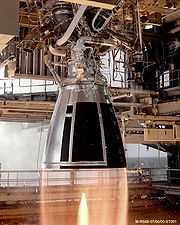
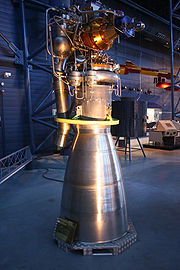
A rocket engine, or simply "rocket", is a jet engine
Jet engine
A jet engine is a reaction engine that discharges a fast moving jet to generate thrust by jet propulsion and in accordance with Newton's laws of motion. This broad definition of jet engines includes turbojets, turbofans, rockets, ramjets, pulse jets...
Rocket Propulsion Elements; 7th edition- chapter 1 that uses only propellant
Propellant
A propellant is a material that produces pressurized gas that:* can be directed through a nozzle, thereby producing thrust ;...
mass for forming its high speed propulsive jet
Jet (fluid)
A jet is an efflux of fluid that is projected into a surrounding medium, usually from some kind of a nozzle, aperture or orifice. Jets can travel long distances without dissipating...
. Rocket engines are reaction engine
Reaction engine
A reaction engine is an engine or motor which provides propulsion by expelling reaction mass, in accordance with Newton's third law of motion...
s and obtain thrust in accordance with Newton's third law. Since they need no external material to form their jet, rocket
Rocket
A rocket is a missile, spacecraft, aircraft or other vehicle which obtains thrust from a rocket engine. In all rockets, the exhaust is formed entirely from propellants carried within the rocket before use. Rocket engines work by action and reaction...
engines can be used for spacecraft propulsion
Spacecraft propulsion
Spacecraft propulsion is any method used to accelerate spacecraft and artificial satellites. There are many different methods. Each method has drawbacks and advantages, and spacecraft propulsion is an active area of research. However, most spacecraft today are propelled by forcing a gas from the...
as well as terrestrial uses, such as missile
Missile
Though a missile may be any thrown or launched object, it colloquially almost always refers to a self-propelled guided weapon system.-Etymology:The word missile comes from the Latin verb mittere, meaning "to send"...
s. Most rocket engines are internal combustion engine
Internal combustion engine
The internal combustion engine is an engine in which the combustion of a fuel occurs with an oxidizer in a combustion chamber. In an internal combustion engine, the expansion of the high-temperature and high -pressure gases produced by combustion apply direct force to some component of the engine...
s, although non combusting forms also exist.
Rocket engines as a group have the highest exhaust velocities, are by far the lightest, but are the least propellant efficient of all types of jet engines.
Terminology
Chemical rockets are rockets powered by exothermicExothermic
In thermodynamics, the term exothermic describes a process or reaction that releases energy from the system, usually in the form of heat, but also in the form of light , electricity , or sound...
chemical reactions of the propellant.
Rocket motor (or solid-propellant rocket motor) is a synonymous term with rocket engine that usually refers to solid rocket engines.
Liquid rocket
Liquid rocket
A liquid-propellant rocket or a liquid rocket is a rocket engine that uses propellants in liquid form. Liquids are desirable because their reasonably high density allows the volume of the propellant tanks to be relatively low, and it is possible to use lightweight pumps to pump the propellant from...
s (or liquid-propellant rocket engine) use one or more liquid propellants that are held in tanks prior to burning.
Hybrid rocket
Hybrid rocket
A hybrid rocket is a rocket with a rocket motor which uses propellants in two different states of matter - one solid and the other either gas or liquid. The Hybrid rocket concept can be traced back at least 75 years....
s have a solid propellant in the combustion chamber and a second liquid or gas propellant is added to permit it to burn.
Thermal rocket
Thermal rocket
A thermal rocket is a rocket engine that uses a propellant that is externally heated before being passed through a nozzle, as opposed to undergoing a chemical reaction as in a chemical rocket.Thermal rockets can give high performance....
s are rockets where the propellant is inert, but is heated by a power source such as solar
Solar thermal rocket
Solar thermal propulsion is a form of spacecraft propulsion that makes use of solar power to directly heat reaction mass, and therefore does not require an electrical generator as most other forms of solar-powered propulsion do. A solar thermal rocket only has to carry the means of capturing solar...
or nuclear power
Nuclear thermal rocket
In a nuclear thermal rocket a working fluid, usually liquid hydrogen, is heated to a high temperature in a nuclear reactor, and then expands through a rocket nozzle to create thrust. In this kind of thermal rocket, the nuclear reactor's energy replaces the chemical energy of the propellant's...
or beamed energy.
Monopropellant rocket
Monopropellant rocket
A monopropellant rocket is a rocket that uses a single chemical as its propellant.-Chemical-reaction monopropellant rockets:...
s are rockets where the propellant is one chemical, typically hi-test (85%+) hydrogen peroxide, which is decomposed by a catalyst producing steam and oxygen. There is no flame.
Principle of operation

Fluid
In physics, a fluid is a substance that continually deforms under an applied shear stress. Fluids are a subset of the phases of matter and include liquids, gases, plasmas and, to some extent, plastic solids....
exhaust. This fluid is nearly
Water rocket
A water rocket is a type of model rocket using water as its reaction mass. The pressure vessel—the engine of the rocket—is usually a used plastic soft drink bottle. The water is forced out by a pressurized gas, typically compressed air...
always a gas which is created by high pressure (10-200 bar) combustion of solid or liquid propellants
Rocket propellant
Rocket propellant is mass that is stored in some form of propellant tank, prior to being used as the propulsive mass that is ejected from a rocket engine in the form of a fluid jet to produce thrust. A fuel propellant is often burned with an oxidizer propellant to produce large volumes of very hot...
, consisting of fuel
Fuel
Fuel is any material that stores energy that can later be extracted to perform mechanical work in a controlled manner. Most fuels used by humans undergo combustion, a redox reaction in which a combustible substance releases energy after it ignites and reacts with the oxygen in the air...
and oxidiser components, within a combustion chamber
Combustion chamber
A combustion chamber is the part of an engine in which fuel is burned.-Internal combustion engine:The hot gases produced by the combustion occupy a far greater volume than the original fuel, thus creating an increase in pressure within the limited volume of the chamber...
.
The fluid exhaust is then passed through a supersonic propelling nozzle
Propelling nozzle
A propelling nozzle is the component of a jet engine that operates to constrict the flow, to form an exhaust jet and to maximise the velocity of propelling gases from the engine....
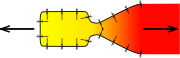
which uses heat energy of the gas to accelerate the exhaust to very high speed, and the reaction to this pushes the engine in the opposite direction.
In rocket engines, high temperatures and pressures are highly desirable for good performance as this permits a longer nozzle to be fitted to the engine, which gives higher exhaust speeds, as well as giving better thermodynamic efficiency.
Introducing propellant into a combustion chamber
Rocket propellant is mass that is stored, usually in some form of propellant tank, prior to being ejected from a rocket engine in the form of a fluid jet to produce thrust.Chemical rocket propellants are most commonly used, which undergo exothermic chemical reactions which produce hot gas which is used by a rocket for propulsive purposes. Alternatively, a chemically inert reaction mass can be heated using a high-energy power source via a heat exchanger, and then no combustion chamber is used.
Solid rocket
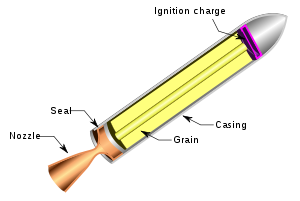
A solid rocket or a solid-fuel rocket is a rocket engine that uses solid propellants . The earliest rockets were solid-fuel rockets powered by gunpowder; they were used by the Chinese in warfare as early as the 13th century and later by the Mongols, Arabs, and Indians.All rockets used some form of...
propellants are prepared as a mixture of fuel and oxidizing components called 'grain' and the propellant storage casing effectively becomes the combustion chamber. Liquid-fueled rockets
Liquid rocket
A liquid-propellant rocket or a liquid rocket is a rocket engine that uses propellants in liquid form. Liquids are desirable because their reasonably high density allows the volume of the propellant tanks to be relatively low, and it is possible to use lightweight pumps to pump the propellant from...
typically pump separate fuel and oxidiser components into the combustion chamber, where they mix and burn. Hybrid rocket
Hybrid rocket
A hybrid rocket is a rocket with a rocket motor which uses propellants in two different states of matter - one solid and the other either gas or liquid. The Hybrid rocket concept can be traced back at least 75 years....
engines use a combination of solid and liquid or gaseous propellants. Both liquid and hybrid rockets use injectors to introduce the propellant into the chamber. These are often an array of simple jets- holes through which the propellant escapes under pressure; but sometimes may be more complex spray nozzles. When two or more propellants are injected the jets usually deliberately collide the propellants as this breaks up the flow into smaller droplets that burn more easily.
Combustion chamber
For chemical rockets the combustion chamber is typically just a cylinder, and flame holderFlame holder
A flame holder is a component of a jet engine designed to help maintain continual combustion.All continuous-combustion jet engines require a flame holder. A flame holder creates a low-speed eddy in the engine to prevent the flame from being blown out...
s are rarely used. The dimensions of the cylinder are such that the propellant is able to combust thoroughly; different propellants require different combustion chamber sizes for this to occur. This leads to a number called
 :
:
where:
 is the volume of the chamber
 is the area of the throat
L* is typically in the range of 25–60 in (0.635–1.5 m).
The combination of temperatures and pressures typically reached in a combustion chamber is usually extreme by any standards. Unlike in air-breathing jet engines, no atmospheric nitrogen is present to dilute and cool the combustion, and the temperature can reach true stoichiometric. This, in combination with the high pressures, means that the rate of heat conduction through the walls is very high.
Rocket nozzles
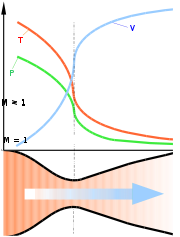
In rockets the hot gas produced in the combustion chamber is permitted to escape from the combustion chamber through an opening (the "throat"), within a high expansion-ratio 'de Laval' nozzle
Rocket engine nozzles
A rocket engine nozzle is a propelling nozzle used in a rocket engine to expand and accelerate the combustion gases produced by burning propellants so that the exhaust gases exit the nozzle at hypersonic velocities.-History:...
.
Provided sufficient pressure is provided to the nozzle (about 2.5-3x above ambient pressure) the nozzle choke
Choked flow
Choked flow is a compressible flow effect. The parameter that becomes "choked" or "limited" is the velocity or the mass flow rate.Choked flow is a fluid dynamic condition associated with the Venturi effect...
s and a supersonic jet is formed, dramatically accelerating the gas, converting most of the thermal energy into kinetic energy.
The exhaust speeds vary, depending on the expansion ratio the nozzle is designed to give, but exhaust speeds as high as ten times the speed of sound of sea level air
Speed of sound
The speed of sound is the distance travelled during a unit of time by a sound wave propagating through an elastic medium. In dry air at , the speed of sound is . This is , or about one kilometer in three seconds or approximately one mile in five seconds....
are not uncommon.
Adiabatic process
In thermodynamics, an adiabatic process or an isocaloric process is a thermodynamic process in which the net heat transfer to or from the working fluid is zero. Such a process can occur if the container of the system has thermally-insulated walls or the process happens in an extremely short time,...
) the pressure against the nozzle's walls forces the rocket engine in one direction while accelerating the gas in the other.
Propellant efficiency
For a rocket engine to be propellant efficient, it is important that the maximum pressures possible be created on the walls of the chamber and nozzle by a specific amount of propellant; as this is the source of the thrust. This can be achieved by all of:- heating the propellant to as high a temperature as possible (using a high energy fuel, containing hydrogen and carbon and sometimes metals such as aluminium, or even using nuclear energy)
- using a low specific density gas (as hydrogen rich as possible)
- using propellants which are, or decompose to, simple molecules with few degrees of freedom to maximise translational velocity
Since all of these things minimise the mass of the propellant used, and since pressure is proportional to the mass of propellant present to be accelerated as it pushes on the engine, and since from Newton's third law the pressure that acts on the engine also reciprocally acts on the propellant, it turns out that for any given engine the speed that the propellant leaves the chamber is unaffected by the chamber pressure (although the thrust is proportional). However, speed is significantly affected by all three of the above factors and the exhaust speed is an excellent measure of the engine propellant efficiency. This is termed exhaust velocity, and after allowance is made for factors that can reduce it, the effective exhaust velocity is one of the most important parameters of a rocket engine (although weight, cost, ease of manufacture etc. are usually also very important).
For aerodynamic reasons the flow goes sonic ("chokes
Choked flow
Choked flow is a compressible flow effect. The parameter that becomes "choked" or "limited" is the velocity or the mass flow rate.Choked flow is a fluid dynamic condition associated with the Venturi effect...
") at the narrowest part of the nozzle, the 'throat'. Since the speed of sound
Speed of sound
The speed of sound is the distance travelled during a unit of time by a sound wave propagating through an elastic medium. In dry air at , the speed of sound is . This is , or about one kilometer in three seconds or approximately one mile in five seconds....
in gases increases with the square root of temperature, the use of hot exhaust gas greatly improves performance. By comparison, at room temperature the speed of sound in air is about 340 m/s while the speed of sound in the hot gas of a rocket engine can be over 1700 m/s; much of this performance is due to the higher temperature, but additionally rocket propellants are chosen to be of low molecular mass, and this also gives a higher velocity compared to air.
Expansion in the rocket nozzle then further multiplies the speed, typically between 1.5 and 2 times, giving a highly collimated hypersonic exhaust jet. The speed increase of a rocket nozzle is mostly determined by its area expansion ratio—the ratio of the area of the throat to the area at the exit, but detailed properties of the gas are also important. Larger ratio nozzles are more massive but are able to extract more heat from the combustion gases, increasing the exhaust velocity.
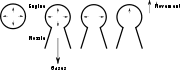
Nozzle efficiency is affected by operation in the atmosphere because atmospheric pressure changes with altitude; but due to the supersonic speeds of the gas exiting from a rocket engine, the pressure of the jet may be either below or above ambient, and equilibrium between the two is not reached at all altitudes (See Diagram).
Back pressure and optimal expansion
For optimal performance the pressure of the gas at the end of the nozzle should just equal the ambient pressure: if the exhaust's pressure is lower than the ambient pressure, then the vehicle will be slowed by the difference in pressure between the top of the engine and the exit; on the other hand, if the exhaust's pressure is higher, then exhaust pressure that could have been converted into thrust is not converted, and energy is wasted.To maintain this ideal of equality between the exhaust's exit pressure and the ambient pressure, the diameter of the nozzle would need to increase with altitude, giving the pressure a longer nozzle to act on (and reducing the exit pressure and temperature). This increase is difficult to arrange in a lightweight fashion, although is routinely done with other forms of jet engines. In rocketry a lightweight compromise nozzle is generally used and some reduction in atmospheric performance occurs when used at other than the 'design altitude' or when throttled. To improve on this, various exotic nozzle designs such as the plug nozzle
Plug nozzle
The plug nozzle is a type of nozzle which includes a centerbody or plug around which the working fluid flows. Plug nozzles have applications in aircraft, rockets, and numerous other fluid flows.-In Rockets:...
, stepped nozzles
Stepped nozzles
A stepped nozzle is a de Laval rocket nozzle which has altitude compensating properties.The characteristic of this kind of nozzle is that part of the way along the inside of the nozzle there is a straightening of the curve of the nozzle contour, followed by a sharp step outwards.At low altitude...
, the expanding nozzle
Expanding nozzle
The expanding nozzle is a type of rocket nozzle that, unlike traditional designs, maintains its efficiency at a wide range of altitudes. It is a member of the class of altitude compensating nozzles, a class that also includes the plug nozzle and aerospike...
and the aerospike
Aerospike engine
The aerospike engine is a type of rocket engine that maintains its aerodynamic efficiency across a wide range of altitudes through the use of an aerospike nozzle. It is a member of the class of altitude compensating nozzle engines. A vehicle with an aerospike engine uses 25–30% less fuel at low...
have been proposed, each providing some way to adapt to changing ambient air pressure and each allowing the gas to expand further against the nozzle, giving extra thrust at higher altitudes.
When exhausting into a sufficiently low ambient pressure (vacuum) several issues arise. One is the sheer weight of the nozzle -- beyond a certain point, for a particular vehicle, the extra weight of the nozzle outweighs any performance gained. Secondly, as the exhaust gases adiabatically expand within the nozzle they cool, and eventually some of the chemicals can freeze, producing 'snow' within the jet. This causes instabilities in the jet and must be avoided.
On a De Laval nozzle, exhaust gas flow detachment will occur in a grossly over-expanded nozzle. As the detachment point will not be uniform around the axis of the engine, a side force may be imparted to the engine. This side force may change over time and result in control problems with the launch vehicle.
Thrust vectoring
Vehicles typically require the overall thrust to change direction over the length of the burn. A number of different ways to achieve this have been flown:- The entire engine is mounted on a hingeHingeA hinge is a type of bearing that connects two solid objects, typically allowing only a limited angle of rotation between them. Two objects connected by an ideal hinge rotate relative to each other about a fixed axis of rotation. Hinges may be made of flexible material or of moving components...
or gimbalGimbalA gimbal is a pivoted support that allows the rotation of an object about a single axis. A set of two gimbals, one mounted on the other with pivot axes orthogonal, may be used to allow an object mounted on the innermost gimbal to remain immobile regardless of the motion of its support...
and any propellant feeds reach the engine via low pressure flexible pipes or rotary couplings. - Just the combustion chamber and nozzle is gimbled, the pumps are fixed, and high pressure feeds attach to the engine.
- Multiple engines (often canted at slight angles) are deployed but throttled to give the overall vector that is required, giving only a very small penalty.
- High-temperature vanes protrude into the exhaust and can be tilted to deflect the jet.
- Engines are fixed, and vernier thrusterVernier thrusterA vernier thruster is a thruster used on a spacecraft for attitude control. It is a smaller thrust motor than main attitude control motors and is used for fine adjustments to the attitude or velocity of a spacecraft...
s are used to steer the vehicle.
Overall rocket engine performance
Rocket technology can combine very high thrust (meganewtons), very high exhaust speeds (around 10 times the speed of sound in air at sea level) and very high thrust/weight ratios (>100) simultaneously as well as being able to operate outside the atmosphere, and while permitting the use of low pressure and hence lightweight tanks and structure.Rockets can be further optimised to even more extreme performance along one or more of these axes at the expense of the others.
Specific impulse
The most important metric for the efficiency of a rocket engine is impulse per unit of propellantPropellant
A propellant is a material that produces pressurized gas that:* can be directed through a nozzle, thereby producing thrust ;...
, this is called specific impulse
Specific impulse
Specific impulse is a way to describe the efficiency of rocket and jet engines. It represents the derivative of the impulse with respect to amount of propellant used, i.e., the thrust divided by the amount of propellant used per unit time. If the "amount" of propellant is given in terms of mass ,...
(usually written
 ). This is either measured as a speed (the effective exhaust velocity
  in metres/second or ft/s) or as a time (seconds). An engine that gives a large specific impulse is normally highly desirable.
The specific impulse that can be achieved is primarily a function of the propellant mix (and ultimately would limit the specific impulse), but practical limits on chamber pressures and the nozzle expansion ratios reduce the performance that can be achieved.
Net thrust
Below is an approximate equation for calculating the net thrust of a rocket engine:
where:
 exhaust gas mass flow
 effective exhaust velocity
 actual jet velocity at nozzle exit plane
 flow area at nozzle exit plane (or the plane where the jet leaves the nozzle if separated flow)
 static pressure at nozzle exit plane
 ambient (or atmospheric) pressure
Since, unlike a jet engine, a conventional rocket motor lacks an air intake, there is no 'ram drag' to deduct from the gross thrust. Consequently the net thrust of a rocket motor is equal to the gross thrust (apart from static back pressure).
The
 term represents the momentum thrust, which remains constant at a given throttle setting, whereas the
  term represents the pressure thrust term. At full throttle, the net thrust of a rocket motor improves slightly with increasing altitude, because as atmospheric pressure decreases with altitude, the pressure thrust term increases. At the surface of the Earth the pressure thrust may be reduced by up to 30%,depending on the engine design. This reduction drops roughly exponentially to zero with increasing altitude.
Maximum thrust for a rocket engine is achieved by maximizing the momentum contribution of the equation without incurring penalties from over expanding the exhaust. This occurs when
 . Since ambient pressure changes with altitude, most rocket engines spend very little time operating at peak efficiency.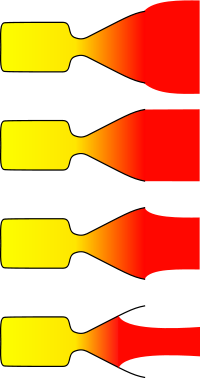
Vacuum Isp
Due to the specific impulse varying with pressure, a quantity that is easy to compare and calculate with is useful. Because rockets chokeChoked flow
Choked flow is a compressible flow effect. The parameter that becomes "choked" or "limited" is the velocity or the mass flow rate.Choked flow is a fluid dynamic condition associated with the Venturi effect...
at the throat, and because the supersonic exhaust prevents external pressure influences travelling upstream, it turns out that the pressure at the exit is ideally exactly proportional to the propellant flow
 , provided the mixture ratios and combustion efficiencies are maintained. It is thus quite usual to rearrange the above equation slightly:
and so define the vacuum Isp to be:

Where:
 the speed of sound constant at the throat
 the thrust coefficient constant of the nozzle (typically about 2)
And hence:

Throttling
Rockets can be throttled by controlling the propellant combustion rate (usually measured in kg/s or lb/s). In liquid and hybrid rockets, the propellant flow entering the chamber is controlled using valves, in solid rocket
Solid rocket
A solid rocket or a solid-fuel rocket is a rocket engine that uses solid propellants . The earliest rockets were solid-fuel rockets powered by gunpowder; they were used by the Chinese in warfare as early as the 13th century and later by the Mongols, Arabs, and Indians.All rockets used some form of...
s it is controlled by changing the area of propellant that is burning and this can be designed into the propellant grain (and hence cannot be controlled in real-time).
Rockets can usually be throttled down to an exit pressure of about one-third of ambient pressure (often limited flow separation in nozzles) and up to a maximum limit determined only by the mechanical strength of the engine.
In practice, the degree to which rockets can be throttled varies greatly, but most rockets can be throttled by a factor of 2 without great difficulty; the typical limitation is combustion stability, as for example, injectors need a minimum pressure to avoid triggering damaging oscillations (chugging or combustion instabilities); but injectors can often be optimised and tested for wider ranges. Solid rockets can be throttled by using shaped grains that will vary their surface area over the course of the burn.
Energy efficiency
Compression ratio
The 'compression ratio' of an internal-combustion engine or external combustion engine is a value that represents the ratio of the volume of its combustion chamber from its largest capacity to its smallest capacity...
. Rocket nozzles give an excellent approximation to adiabatic expansion which is a reversible process, and hence they give efficiencies which are very close to that of the Carnot cycle
Carnot cycle
The Carnot cycle is a theoretical thermodynamic cycle proposed by Nicolas Léonard Sadi Carnot in 1824 and expanded by Benoit Paul Émile Clapeyron in the 1830s and 40s. It can be shown that it is the most efficient cycle for converting a given amount of thermal energy into work, or conversely,...
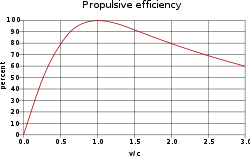
. Given the temperatures reached, over 60% efficiency can be achieved with chemical rockets.
For a vehicle employing a rocket engine the energetic efficiency is very good if the vehicle speed approaches or somewhat exceeds the exhaust velocity (relative to launch); but at low speeds the energy efficiency goes to 0% at zero speed (as with all jet propulsion
Jet propulsion
Jet propulsion is motion produced by passing a jet of fluid in the opposite direction to the direction of motion. By conservation of momentum, the moving body is propelled in the opposite direction to the jet....
.) See Rocket energy efficiency for more details.
Thrust to weight ratio
Rockets, of all the jet engines, indeed of essentially all engines, have the highest thrust to weight ratio. This is especially true for liquid rocket engines.This high performance is due to the small volume of pressure vessel
Pressure vessel
A pressure vessel is a closed container designed to hold gases or liquids at a pressure substantially different from the ambient pressure.The pressure differential is dangerous and many fatal accidents have occurred in the history of their development and operation. Consequently, their design,...
s that make up the engine -- the pumps, pipes and combustion chambers involved. The lack of inlet duct and the use of dense liquid propellant allows the pressurisation system to be small and lightweight, whereas duct engines have to deal with air which has a density about one thousand times lower.
Of the liquid propellants used, density is worst for liquid hydrogen
Liquid hydrogen
Liquid hydrogen is the liquid state of the element hydrogen. Hydrogen is found naturally in the molecular H2 form.To exist as a liquid, H2 must be pressurized above and cooled below hydrogen's Critical point. However, for hydrogen to be in a full liquid state without boiling off, it needs to be...
. Although this propellant is marvellous in many ways, it has a very low density, about one fourteenth that of water. This makes the turbopumps and pipework larger and heavier, and this is reflected in the thrust-to-weight ratio of engines that use it (for example the SSME) compared to those that do not (NK-33).
Cooling
For efficiency reasons, and because they physically can, rockets run with combustion temperatures that can reach ~3500 K (~5800 °F)(~3227 °C).Most other jet engines have gas turbines in the hot exhaust. Due to their larger surface area, they are harder to cool and hence there is a need to run the combustion processes at much lower temperatures, losing efficiency. In addition duct engines use air as an oxidant, which contains 80% largely unreactive nitrogen, which dilutes the reaction and lowers the temperatures. Rockets have none of these inherent disadvantages.
Therefore in rockets temperatures employed are very often far higher than the melting point of the nozzle and combustion chamber materials, two exceptions are graphite
Graphite
The mineral graphite is one of the allotropes of carbon. It was named by Abraham Gottlob Werner in 1789 from the Ancient Greek γράφω , "to draw/write", for its use in pencils, where it is commonly called lead . Unlike diamond , graphite is an electrical conductor, a semimetal...
and tungsten
Tungsten
Tungsten , also known as wolfram , is a chemical element with the chemical symbol W and atomic number 74.A hard, rare metal under standard conditions when uncombined, tungsten is found naturally on Earth only in chemical compounds. It was identified as a new element in 1781, and first isolated as...
(~1200 K for copper), however both are subject to oxidation if not protected. Indeed many construction materials can make perfectly acceptable propellants in their own right. It is important that these materials be prevented from combusting, melting or vaporising to the point of failure. This is sometimes somewhat facetiously termed an 'engine rich exhaust'. Materials technology could potentially place an upper limit on the exhaust temperature of chemical rockets.
Alternatively, rockets may use more common construction materials such as aluminium, steel, nickel or copper alloys and employ cooling systems that prevent the construction material itself becoming too hot. Regenerative cooling, where the propellant is passed through tubes around the combustion chamber or nozzle, and other techniques, such as curtain cooling or film cooling, are employed to give longer nozzle and chamber life. These techniques ensure that a gaseous thermal boundary layer
Boundary layer
In physics and fluid mechanics, a boundary layer is that layer of fluid in the immediate vicinity of a bounding surface where effects of viscosity of the fluid are considered in detail. In the Earth's atmosphere, the planetary boundary layer is the air layer near the ground affected by diurnal...
touching the material is kept below the temperature which would cause the material to catastrophically fail.
In rockets, the heat fluxes that can pass through the wall are among the highest in engineering, fluxes are generally in the range of 1-200 MW/m^2. The strongest heat fluxes are found at the throat, which often sees twice that found in the associated chamber and nozzle. This is due to the combination of high speeds (which gives a very thin boundary layer), and although lower than the chamber, the high temperatures seen there. (See rocket nozzles above for temperatures in nozzle).
In rockets the coolant methods include:
- uncooled (used for short runs mainly during testing)
- ablativeAblationAblation is removal of material from the surface of an object by vaporization, chipping, or other erosive processes. This occurs in spaceflight during ascent and atmospheric reentry, glaciology, medicine, and passive fire protection.-Spaceflight:...
walls (walls are lined with a material that is continuously vaporised and carried away). - radiative coolingRadiative coolingRadiative cooling is the process by which a body loses heat by thermal radiation.- Earth's energy budget :In the case of the earth-atmosphere system it refers to the process by which long-wave radiation is emitted to balance the absorption of short-wave energy from the sun.The exact process by...
(the chamber becomes almost white hot and radiates the heat away) - dump cooling (a propellant, usually hydrogenHydrogenHydrogen is the chemical element with atomic number 1. It is represented by the symbol H. With an average atomic weight of , hydrogen is the lightest and most abundant chemical element, constituting roughly 75% of the Universe's chemical elemental mass. Stars in the main sequence are mainly...
, is passed around the chamber and dumped) - regenerative cooling (liquid rocketLiquid rocketA liquid-propellant rocket or a liquid rocket is a rocket engine that uses propellants in liquid form. Liquids are desirable because their reasonably high density allows the volume of the propellant tanks to be relatively low, and it is possible to use lightweight pumps to pump the propellant from...
s use the fuel, or occasionally the oxidiser, to cool the chamber via a cooling jacket before being injected) - curtain cooling (propellant injection is arranged so the temperature of the gases is cooler at the walls)
- film cooling (surfaces are wetted with liquid propellant, which cools as it evaporates)
In all cases the cooling effect that prevents the wall from being destroyed is caused by a thin layer of insulating fluid (a boundary layer
Boundary layer
In physics and fluid mechanics, a boundary layer is that layer of fluid in the immediate vicinity of a bounding surface where effects of viscosity of the fluid are considered in detail. In the Earth's atmosphere, the planetary boundary layer is the air layer near the ground affected by diurnal...
) that is in contact with the walls that is far cooler than the combustion temperature. Provided this boundary layer is intact the wall will not be damaged.
Disruption of the boundary layer may occur during cooling failures or combustion instabilities, and wall failure typically occurs soon after.
With regenerative cooling a second boundary layer is found in the coolant channels around the chamber. This boundary layer thickness needs to be as small as possible, since the boundary layer acts as an insulator between the wall and the coolant. This may be achieved by making the coolant velocity
Velocity
In physics, velocity is speed in a given direction. Speed describes only how fast an object is moving, whereas velocity gives both the speed and direction of the object's motion. To have a constant velocity, an object must have a constant speed and motion in a constant direction. Constant ...
in the channels as high as possible.
In practice, regenerative cooling is nearly always used in conjunction with curtain cooling and/or film cooling.
Liquid fueled engines are often run fuel rich
Air-fuel ratio
Air–fuel ratio is the mass ratio of air to fuel present in an internal combustion engine. If exactly enough air is provided to completely burn all of the fuel, the ratio is known as the stoichiometric mixture, often abbreviated to stoich...
, which results in lower temperature combustion. Cooler exhaust reduces heat loads on the engine allowing lower cost materials, a simplified cooling system, and a lower performance engine.
Mechanical issues
Rocket combustion chambers are normally operated at fairly high pressure, typically 10-200 bar (1 to 20 MPa, 150-3000 psi). When operated within significant atmospheric pressure, higher combustion chamber pressures give better performance by permitting a larger and more efficient nozzle to be fitted without it being grossly overexpanded.However, these high pressures cause the outermost part of the chamber to be under very large hoop stress
Hoop stress
Circumferential stress is a type of mechanical stress of a cylindrically shaped part as a result of internal or external pressure.The classic example of circumferential stress is the tension applied to the iron bands, or hoops, of a wooden barrel...
es – rocket engines are pressure vessel
Pressure vessel
A pressure vessel is a closed container designed to hold gases or liquids at a pressure substantially different from the ambient pressure.The pressure differential is dangerous and many fatal accidents have occurred in the history of their development and operation. Consequently, their design,...
s.
Worse, due to the high temperatures created in rocket engines the materials used tend to have a significantly lowered working tensile strength.
In addition, significant temperature gradients are set up in the walls of the chamber and nozzle, these cause differential expansion of the inner liner that create internal stresses.
Acoustic issues
In addition, the extreme vibration and acoustic environment inside a rocket motor commonly result in peak stresses well above mean values, especially in the presence of organ pipeOrgan pipe
An organ pipe is a sound-producing element of the pipe organ that resonates at a specific pitch when pressurized air is driven through it. Each pipe is tuned to a specific note of the musical scale...
-like resonances and gas turbulence.
Combustion instabilities
The combustion may display undesired instabilities, of sudden or periodic nature. The pressure in the injection chamber may increase until the propellant flow through the injector plate decreases; a moment later the pressure drops and the flow increases, injecting more propellant in the combustion chamber which burns a moment later, and again increases the chamber pressure, repeating the cycle. This may lead to high-amplitude pressure oscillations, often in ultrasonic range, which may damage the motor. Oscillations of ±200 psi at 25 kHz were the cause of failures of early versions of the Titan II missile second stage engines. The other failure mode is a deflagration to detonation transitionDeflagration to detonation transition
Deflagration to detonation transition refers to a phenomenon in ignitable mixtures of a flammable gas and air when a sudden transition takes place from a deflagration type of combustion to a detonation type of combustion...
; the supersonic pressure wave formed in the combustion chamber may destroy the engine.
The combustion instabilities can be provoked by remains of cleaning solvents in the engine, reflected shock wave, initial instability after ignition, explosion near the nozzle that reflects into the combustion chamber, and many more factors. In stable engine designs the oscillations are quickly suppressed; in unstable designs they persist for prolonged periods. Oscillation suppressors are commonly used.
Periodic variations of thrust, caused by combustion instability or longitudinal vibrations of structures between the tanks and the engines which modulate the propellant flow, are known as "pogo oscillation
Pogo oscillation
Pogo oscillation is a potentially dangerous type of self-excited combustion oscillation in liquid fuel rocket engines. This oscillation results in variations of thrust from the engines, causing variations of acceleration on the rocket's structure, giving variations in fuel pressure and flow rate....
s" or "pogo", named after the pogo stick
Pogo stick
A pogo stick is a device for jumping off the ground in a standing position with the aid of a spring, used as a toy or exercise equipment. It consists of a pole with a handle at the top and footrests near the bottom, and a spring located somewhere along the pole...
.
Three different types of combustion instabilities occur:
Chugging
This is a low frequency oscillation at a few Hertz in chamber pressure usually caused by pressure variations in feed lines due to variations in acceleration of the vehicle. This can cause cyclic variation in thrust, and the effects can vary from merely annoying to actually damaging the payload or vehicle. Chugging can be minimised by using gas-filled damping tubes on feed lines of high density propellants.
Buzzing
This can be caused due to insufficient pressure drop across the injectors. It generally is mostly annoying, rather than being damaging. However, in extreme cases combustion can end up being forced backwards through the injectors – this can cause explosions with monopropellants.
Screeching
This is the most immediately damaging, and the hardest to control. It is due to acoustics within the combustion chamber that often couples to the chemical combustion processes that are the primary drivers of the energy release, and can lead to unstable resonant "screeching" that commonly leads to catastrophic failure due to thinning of the insulating thermal boundary layer.
Such effects are very difficult to predict analytically during the design process, and have usually been addressed by expensive, time consuming and extensive testing, combined with trial and error remedial correction measures.
Screeching is often dealt with by detailed changes to injectors, or changes in the propellant chemistry, or vaporizing the propellant before injection, or use of Helmholtz dampers within the combustion chambers to change the resonant modes of the chamber.
Testing for the possibility of screeching is sometimes done by exploding small explosive charges outside the combustion chamber with a tube set tangentially to the combustion chamber near the injectors to determine the engine's impulse response
Impulse response
In signal processing, the impulse response, or impulse response function , of a dynamic system is its output when presented with a brief input signal, called an impulse. More generally, an impulse response refers to the reaction of any dynamic system in response to some external change...
and then evaluating the time response of the chamber pressure- a fast recovery indicates a stable system.
Exhaust noise
For all but the very smallest sizes, rocket exhaust compared to other engines is generally very noisy. As the hypersonicHypersonic
In aerodynamics, a hypersonic speed is one that is highly supersonic. Since the 1970s, the term has generally been assumed to refer to speeds of Mach 5 and above...
exhaust mixes with the ambient air, shock wave
Shock wave
A shock wave is a type of propagating disturbance. Like an ordinary wave, it carries energy and can propagate through a medium or in some cases in the absence of a material medium, through a field such as the electromagnetic field...
s are formed. The Space Shuttle
Space Shuttle
The Space Shuttle was a manned orbital rocket and spacecraft system operated by NASA on 135 missions from 1981 to 2011. The system combined rocket launch, orbital spacecraft, and re-entry spaceplane with modular add-ons...
generates over 200 dB(A) of noise around its base.
The Saturn V
Saturn V
The Saturn V was an American human-rated expendable rocket used by NASA's Apollo and Skylab programs from 1967 until 1973. A multistage liquid-fueled launch vehicle, NASA launched 13 Saturn Vs from the Kennedy Space Center, Florida with no loss of crew or payload...
launch was detectable on seismometer
Seismometer
Seismometers are instruments that measure motions of the ground, including those of seismic waves generated by earthquakes, volcanic eruptions, and other seismic sources...
s a considerable distance from the launch site. The sound intensity
Sound intensity
Sound intensity or acoustic intensity is defined as the sound power Pac per unit area A. The usual context is the noise measurement of sound intensity in the air at a listener's location.-Acoustic intensity:...
from the shock waves generated depends on the size of the rocket and on the exhaust velocity. Such shock waves seem to account for the characteristic crackling and popping sounds produced by large rocket engines when heard live. These noise peaks typically overload microphones and audio electronics, and so are generally weakened or entirely absent in recorded or broadcast audio reproductions. For large rockets at close range, the acoustic effects could actually kill.
More worryingly for space agencies, such sound levels can also damage the launch structure, or worse, be reflected back at the comparatively delicate rocket above. This is why so much water is typically used at launches. The water spray changes the acoustic qualities of the air and reduces or deflects the sound energy away from the rocket.
Generally speaking noise is most intense when a rocket is close to the ground, since the noise from the engines radiates up away from the plume, as well as reflecting off the ground. Also, when the vehicle is moving slowly, little of the chemical energy input to the engine can go into increasing the kinetic energy of the rocket (since useful power P transmitted to the vehicle is
 for thrust F and speed V). Then the largest portion of the energy is dissipated in the exhaust's interaction with the ambient air, producing noise. This noise can be reduced somewhat by flame trenches with roofs, by water injection around the plume and by deflecting the plume at an angle.
Testing
Rocket engines are usually statically tested at a test facilityRocket engine test facility
A rocket engine test facility is a location where rocket engines may be tested on the ground, under controlled conditions. A ground test program is generally required before the engine is certified for flight...
before being put into production. For high altitude engines, either a shorter nozzle must be used, or the rocket must be tested in a large vacuum chamber.
Safety
RocketRocket
A rocket is a missile, spacecraft, aircraft or other vehicle which obtains thrust from a rocket engine. In all rockets, the exhaust is formed entirely from propellants carried within the rocket before use. Rocket engines work by action and reaction...
s have a reputation for unreliability and danger; especially catastrophic failures. Contrary to this reputation, carefully designed rockets can be made arbitrarily reliable. In military use, rockets are not unreliable. However, one of the main non-military uses of rockets is for orbital launch. In this application, the premium has typically been placed on minimum weight, and it is difficult to achieve high reliability and low weight simultaneously. In addition, if the number of flights launched is low, there is a very high chance of a design, operations or manufacturing error causing destruction of the vehicle. Essentially all launch vehicles are test vehicles by normal aerospace standards .
The X-15 rocket plane achieved a 0.5% failure rate
Albert Scott Crossfield
Albert Scott Crossfield was an American naval officer and test pilot.-Biography:Born in Berkeley, California, Crossfield grew up in California and Washington. He served with the U.S. Navy as a flight instructor and fighter pilot during World War II...
, with a single catastrophic failure during ground test, and the SSME has managed to avoid catastrophic failures in over 350 engine-flights.
Chemistry
Rocket propellantRocket propellant
Rocket propellant is mass that is stored in some form of propellant tank, prior to being used as the propulsive mass that is ejected from a rocket engine in the form of a fluid jet to produce thrust. A fuel propellant is often burned with an oxidizer propellant to produce large volumes of very hot...
s require a high specific energy (energy per unit mass), because ideally all the reaction energy appears as kinetic energy of the exhaust gases, and exhaust velocity is the single most important performance parameter of an engine, on which vehicle performance depends.
Aside from inevitable losses and imperfections in the engine, incomplete combustion, etc., after specific reaction energy, the main theoretical limit reducing the exhaust velocity obtained is that, according to the laws of thermodynamics, a fraction of the chemical energy may go into rotation of the exhaust molecules, where it is unavailable for producing thrust. Monatomic gases like helium have only three degrees of freedom, corresponding to the three dimensions of space, {x,y,z}, and only such spherically symmetric molecules escape this kind of loss. A diatomic molecule like H2 can rotate about either of the two axes perpendicular to the one joining the two atoms, and as the equipartition law of statistical mechanics demands that the available thermal energy be divided equally among the degrees of freedom, for such a gas in thermal equilibrium 3/5 of the energy can go into unidirectional motion, and 2/5 into rotation. A triatomic molecule like water has six degrees of freedom, so the energy is divided equally among rotational and translational degrees of freedom. For most chemical reactions the latter situation is the case. This issue is traditionally described in terms of the ratio, gamma, of the specific heat of the gas at constant volume to that at constant pressure. The rotational energy loss is largely recovered in practice if the expansion nozzle is large enough to allow the gases to expand and cool sufficiently, the function of the nozzle being to convert the random thermal motions of the molecules in the combustion chamber into the unidirectional translation that produces thrust. As long as the exhaust gas remains in equilibrium as it expands, the initial rotational energy will be largely returned to translation in the nozzle.
Although the specific reaction energy per unit mass of reactants is key, low mean molecular weight in the reaction products is also important in practice in determining exhaust velocity. This is because the high gas temperatures in rocket engines pose serious problems for the engineering of survivable motors. Because temperature is proportional to the mean energy per molecule, a given amount of energy distributed among more molecules of lower mass permits a higher exhaust velocity at a given temperature. This means low atomic mass elements are favoured. Liquid hydrogen (LH2) and oxygen (LOX, or LO2), are the most effective propellants in terms of exhaust velocity that have been widely used to date, though a few exotic combinations involving boron or liquid ozone are potentially somewhat better in theory if various practical problems could be solved.
It is important to note in computing the specific reaction energy, that the entire mass of the propellants, including both fuel and oxidizer, must be included. The fact that air-breathing engines are typically able to obtain oxygen "for free" without having to carry it along, accounts for one factor of why air-breathing engines are very much more propellant-mass efficient, and one reason that rocket engines are far less suitable for most ordinary terrestrial applications. Fuels for automobile or turbojet engines, utilize atmospheric oxygen and so have a much better effective energy output per unit mass of propellant that must be carried, but are similar per unit mass of fuel.
Computer programs that predict the performance of propellants in rocket engines are available.
Ignition
With liquid and hybrid rockets, immediate ignition of the propellant(s) as they first enter the combustion chamber is essential.With liquid propellants (but not gaseous), failure to ignite within milliseconds usually causes too much liquid propellant to be within the chamber, and if/when ignition occurs the amount of hot gas created will often exceed the maximum design pressure of the chamber. The pressure vessel will often fail catastrophically. This is sometimes called a hard start
Hard start
A hard start is a rocketry term referring to an overpressure condition during start of a rocket engine at ignition. In the worst cases this takes the form of an explosion.-Rocket ignition:...
.
Ignition can be achieved by a number of different methods; a pyrotechnic charge can be used, a plasma torch can be used, or electric spark plugs may be employed. Some fuel/oxidizer combinations ignite on contact (hypergolic), and non-hypergolic fuels can be "chemically ignited" by priming the fuel lines with hypergolic propellants (popular in Russian engines).
Gaseous propellants generally will not cause hard start
Hard start
A hard start is a rocketry term referring to an overpressure condition during start of a rocket engine at ignition. In the worst cases this takes the form of an explosion.-Rocket ignition:...
s, with rockets the total injector area is less than the throat thus the chamber pressure tends to ambient prior to ignition and high pressures cannot form even if the entire chamber is full of flammable gas at ignition.
Solid propellants are usually ignited with one-shot pyrotechnic devices.
Once ignited, rocket chambers are self sustaining and igniters are not needed. Indeed chambers often spontaneously reignite if they are restarted after being shut down for a few seconds. However, when cooled, many rockets cannot be restarted without at least minor maintenance, such as replacement of the pyrotechnic igniter.
Plume physics
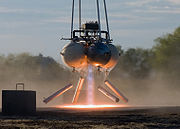
Carbon rich exhausts from kerosene
Kerosene
Kerosene, sometimes spelled kerosine in scientific and industrial usage, also known as paraffin or paraffin oil in the United Kingdom, Hong Kong, Ireland and South Africa, is a combustible hydrocarbon liquid. The name is derived from Greek keros...
fuels are often orange in colour due to the black body radiation of the unburned particles, in addition to the blue Swan bands. Peroxide
High test peroxide
High-test peroxide or HTP is a high -concentration solution of hydrogen peroxide, with the remainder predominantly made up of water. In contact with a catalyst, it decomposes into a high-temperature mixture of steam and oxygen, with no remaining liquid water...
oxidiser based rockets and hydrogen rocket plumes contain largely steam
Steam
Steam is the technical term for water vapor, the gaseous phase of water, which is formed when water boils. In common language it is often used to refer to the visible mist of water droplets formed as this water vapor condenses in the presence of cooler air...
and are nearly invisible to the naked eye but shine brightly in the ultraviolet
Ultraviolet
Ultraviolet light is electromagnetic radiation with a wavelength shorter than that of visible light, but longer than X-rays, in the range 10 nm to 400 nm, and energies from 3 eV to 124 eV...
and infrared
Infrared
Infrared light is electromagnetic radiation with a wavelength longer than that of visible light, measured from the nominal edge of visible red light at 0.74 micrometres , and extending conventionally to 300 µm...
. Plumes from solid rocket
Solid rocket
A solid rocket or a solid-fuel rocket is a rocket engine that uses solid propellants . The earliest rockets were solid-fuel rockets powered by gunpowder; they were used by the Chinese in warfare as early as the 13th century and later by the Mongols, Arabs, and Indians.All rockets used some form of...
s can be highly visible as the propellant frequently contains metals such as elemental aluminium
Aluminium
Aluminium or aluminum is a silvery white member of the boron group of chemical elements. It has the symbol Al, and its atomic number is 13. It is not soluble in water under normal circumstances....
which burns with an orange-white flame and adds energy to the combustion process.
Some exhausts, notably alcohol
Alcohol
In chemistry, an alcohol is an organic compound in which the hydroxy functional group is bound to a carbon atom. In particular, this carbon center should be saturated, having single bonds to three other atoms....
fuelled rockets, can show visible shock diamond
Shock diamond
Shock diamonds are a formation of stationary wave patterns that appears in the supersonic exhaust plume of an aerospace propulsion system, such as a supersonic jet engine, rocket, ramjet, or scramjet, when it is operated in an atmosphere...
s. These are due to cyclic variations in the plume pressure relative to ambient creating shock waves that form 'mach disks'.
The shape of the plume varies from the design altitude, at high altitude all rockets are grossly under-expanded, and a quite small percentage of exhaust gases actually end up expanding forwards.
Physically powered
| Type | Description | Advantages | Disadvantages |
|---|---|---|---|
| water rocket Water rocket A water rocket is a type of model rocket using water as its reaction mass. The pressure vessel—the engine of the rocket—is usually a used plastic soft drink bottle. The water is forced out by a pressurized gas, typically compressed air... |
Partially filled pressurised carbonated drinks container with tail and nose weighting | Very simple to build | Altitude typically limited to a few hundred feet or so (world record is 623 meters/2044 feet) |
| cold gas thruster Cold gas thruster A cold gas thruster is a rocket engine/thruster that uses a gas as the reaction mass.A cold gas thruster usually simply consists of a pressurized tank containing gas, a valve to control its release and a nozzle, and plumbing connecting them... |
A non combusting form, used for vernier thruster Vernier thruster A vernier thruster is a thruster used on a spacecraft for attitude control. It is a smaller thrust motor than main attitude control motors and is used for fine adjustments to the attitude or velocity of a spacecraft... s |
Non contaminating exhaust | Extremely low performance |
Chemically powered
| Type | Description | Advantages | Disadvantages |
|---|---|---|---|
| Solid rocket Solid rocket A solid rocket or a solid-fuel rocket is a rocket engine that uses solid propellants . The earliest rockets were solid-fuel rockets powered by gunpowder; they were used by the Chinese in warfare as early as the 13th century and later by the Mongols, Arabs, and Indians.All rockets used some form of... |
Ignitable, self sustaining solid fuel/oxidiser mixture ("grain") with central hole and nozzle | Simple, often no moving parts Moving parts The moving parts of a machine are those parts of it that move. Machines comprise both moving and fixed parts. The moving parts have controlled and constrained motions.... , reasonably good mass fraction, reasonable Isp Specific impulse Specific impulse is a way to describe the efficiency of rocket and jet engines. It represents the derivative of the impulse with respect to amount of propellant used, i.e., the thrust divided by the amount of propellant used per unit time. If the "amount" of propellant is given in terms of mass ,... . A thrust schedule can be designed into the grain. |
Throttling, burn termination, and reignition require special designs. Handling issues from ignitable mixture. Lower performance than liquid rockets. If grain cracks it can block nozzle with disastrous results. Grain cracks burn and widen during burn. Refuelling harder than simply filling tanks. |
| Hybrid rocket Hybrid rocket A hybrid rocket is a rocket with a rocket motor which uses propellants in two different states of matter - one solid and the other either gas or liquid. The Hybrid rocket concept can be traced back at least 75 years.... |
Separate oxidiser/fuel; typically the oxidiser is liquid and kept in a tank and the fuel is solid. | Quite simple, solid fuel is essentially inert without oxidiser, safer; cracks do not escalate, throttleable and easy to switch off. | Some oxidisers are monopropellants, can explode in own right; mechanical failure of solid propellant can block nozzle (very rare with rubberised propellant), central hole widens over burn and negatively affects mixture ratio. |
| Monopropellant rocket Monopropellant rocket A monopropellant rocket is a rocket that uses a single chemical as its propellant.-Chemical-reaction monopropellant rockets:... |
Propellant (such as hydrazine, hydrogen peroxide or nitrous oxide) flows over a catalyst and exothermically decomposes; hot gases are emitted through nozzle. | Simple in concept, throttleable, low temperatures in combustion chamber | catalysts can be easily contaminated, monopropellants can detonate if contaminated or provoked, Isp Specific impulse Specific impulse is a way to describe the efficiency of rocket and jet engines. It represents the derivative of the impulse with respect to amount of propellant used, i.e., the thrust divided by the amount of propellant used per unit time. If the "amount" of propellant is given in terms of mass ,... is perhaps 1/3 of best liquids |
| Liquid Liquid rocket A liquid-propellant rocket or a liquid rocket is a rocket engine that uses propellants in liquid form. Liquids are desirable because their reasonably high density allows the volume of the propellant tanks to be relatively low, and it is possible to use lightweight pumps to pump the propellant from... Bipropellant rocket |
Two fluid (typically liquid) propellants are introduced through injectors into combustion chamber and burnt | Up to ~99% efficient combustion with excellent mixture control, throttleable, can be used with turbopumps which permits incredibly lightweight tanks, can be safe with extreme care | Pumps needed for high performance are expensive to design, huge thermal fluxes across combustion chamber wall can impact reuse, failure modes include major explosions, a lot of plumbing is needed. |
| Dual mode propulsion rocket Dual mode propulsion rocket Dual mode propulsion systems combine the high efficiency of bipropellant rockets with the reliability and simplicity of monopropellant rockets. Dual mode systems are either hydrazine/N2O4, or MMH/hydrogen peroxide... |
Rocket takes off as a bipropellant rocket, then turns to using just one propellant as a monopropellant | Simplicity and ease of control | Lower performance than bipropellants |
| Tripropellant rocket Tripropellant rocket A tripropellant rocket is a rocket that uses three propellants, as opposed to the more common bipropellant rocket or monopropellant rocket designs, which use two or one fuels, respectively... |
Three different propellants (usually hydrogen, hydrocarbon and liquid oxygen) are introduced into a combustion chamber in variable mixture ratios, or multiple engines are used with fixed propellant mixture ratios and throttled or shut down | Reduces take-off weight, since hydrogen is lighter; combines good thrust to weight with high average Isp Specific impulse Specific impulse is a way to describe the efficiency of rocket and jet engines. It represents the derivative of the impulse with respect to amount of propellant used, i.e., the thrust divided by the amount of propellant used per unit time. If the "amount" of propellant is given in terms of mass ,... , improves payload for launching from Earth by a sizeable percentage |
Similar issues to bipropellant, but with more plumbing, more R&D |
| Air-augmented rocket Air-augmented rocket Air-augmented rockets use the supersonic exhaust of some kind of rocket engine to further compress air collected by ram effect during flight to use as additional working mass, leading to greater effective thrust for any given amount of fuel than either the rocket or a ramjet... |
Essentially a ramjet where intake air is compressed and burnt with the exhaust from a rocket | Mach 0 to Mach 4.5+ (can also run exoatmospheric), good efficiency at Mach 2 to 4 | Similar efficiency to rockets at low speed or exoatmospheric, inlet difficulties, a relatively undeveloped and unexplored type, cooling difficulties, very noisy, thrust/weight ratio is similar to ramjets. |
| Turborocket | A combined cycle turbojet/rocket where an additional oxidizer such as oxygen Oxygen Oxygen is the element with atomic number 8 and represented by the symbol O. Its name derives from the Greek roots ὀξύς and -γενής , because at the time of naming, it was mistakenly thought that all acids required oxygen in their composition... is added to the airstream to increase maximum altitude |
Very close to existing designs, operates in very high altitude, wide range of altitude and airspeed | Atmospheric airspeed limited to same range as turbojet engine, carrying oxidizer like LOX Lox Lox is salmon fillet that has been cured. In its most popular form, it is thinly sliced—less than in thickness—and, typically, served on a bagel, often with cream cheese, onion, tomato, cucumber and capers... can be dangerous. Much heavier than simple rockets. |
| Precooled jet engine / LACE Liquid air cycle engine A Liquid Air Cycle Engine is a type of spacecraft propulsion engine that attempts to increase its efficiency by gathering part of its oxidizer from the atmosphere... (combined cycle with rocket) |
Intake air is chilled to very low temperatures at inlet before passing through a ramjet or turbojet engine. Can be combined with a rocket engine for orbital insertion. | Easily tested on ground. High thrust/weight ratios are possible (~14) together with good fuel efficiency over a wide range of airspeeds, mach 0-5.5+; this combination of efficiencies may permit launching to orbit, single stage, or very rapid intercontinental travel. | Exists only at the lab prototyping stage. Examples include RB545 RB545 The RB545 was an air-breathing rocket engine that was proposed to propel a British space shuttle to orbit using a single stage. Rolls-Royce was involved; while British Aerospace worked on the vehicle.-Design:... , SABRE, ATREX ATREX The ATREX engine developed in Japan is an experimental precooled jet engine that works as a turbojet at low speeds and a ramjet up to mach 6.0.... |
Electrically powered
| Type | Description | Advantages | Disadvantages |
|---|---|---|---|
| Resistojet rocket Resistojet rocket A resistojet is a method of Spacecraft propulsion that provides thrust by heating a fluid. Heating is usually achieved by sending electricity through a resistor consisting of a hot incandescent filament, with the expanded gas expelled through a conventional nozzle.Resistojets have been flown in... (electric heating) |
A monopropellant is electrically heated by a filament for extra performance | Higher Isp Specific impulse Specific impulse is a way to describe the efficiency of rocket and jet engines. It represents the derivative of the impulse with respect to amount of propellant used, i.e., the thrust divided by the amount of propellant used per unit time. If the "amount" of propellant is given in terms of mass ,... than monopropellant alone, about 40% higher. |
Uses a lot of power and hence gives typically low thrust |
| Arcjet rocket Arcjet rocket Arcjets are a form of electric propulsion for spacecraft, whereby an electrical discharge is created in a flow of propellant . This imparts additional energy to the propellant, so that one can extract more work out of each kilogram of propellant, at theexpense of increased power consumption and ... (chemical burning aided by electrical discharge) |
Similar to resistojet in concept but with inert propellant, except an arc is used which allows higher temperatures | 1600 seconds Isp Specific impulse Specific impulse is a way to describe the efficiency of rocket and jet engines. It represents the derivative of the impulse with respect to amount of propellant used, i.e., the thrust divided by the amount of propellant used per unit time. If the "amount" of propellant is given in terms of mass ,... |
Very low thrust and high power, performance is similar to Ion drive. |
| Pulsed plasma thruster Pulsed plasma thruster Pulsed plasma thrusters are a method of spacecraft propulsion also known as Plasma Jet Engines in general. They use an arc of electric current adjacent to a solid propellant, to produce a quick and repeatable burst of impulse... (electric arc heating; emits plasma) |
Plasma is used to erode a solid propellant | High Isp Specific impulse Specific impulse is a way to describe the efficiency of rocket and jet engines. It represents the derivative of the impulse with respect to amount of propellant used, i.e., the thrust divided by the amount of propellant used per unit time. If the "amount" of propellant is given in terms of mass ,... , can be pulsed on and off for attitude control |
Low energetic efficiency |
| Variable specific impulse magnetoplasma rocket Variable specific impulse magnetoplasma rocket The Variable Specific Impulse Magnetoplasma Rocket is an electro-magnetic thruster for spacecraft propulsion. It uses radio waves to ionize and heat a propellant and magnetic fields to accelerate the resulting plasma to generate thrust... |
Microwave heated plasma with magnetic throat/nozzle | Variable Isp Specific impulse Specific impulse is a way to describe the efficiency of rocket and jet engines. It represents the derivative of the impulse with respect to amount of propellant used, i.e., the thrust divided by the amount of propellant used per unit time. If the "amount" of propellant is given in terms of mass ,... from 1000 seconds to 10,000 seconds |
similar thrust/weight ratio with ion drives (worse), thermal issues, as with ion drives very high power requirements for significant thrust, really needs advanced nuclear reactors, never flown, requires low temperatures for superconductors to work |
Preheated
| Type | Description | Advantages | Disadvantages |
|---|---|---|---|
| hot water rocket Hot Water Rocket A steam rocket is a thermal rocket that uses water held in a pressure vessel at a high temperature, such that its saturated vapor pressure is significantly greater than ambient pressure... |
Hot water is stored in a tank at high temperature/pressure and turns to steam in nozzle | Simple, fairly safe, under 200 seconds Isp | Low overall performance due to heavy tank |
Solar thermal
The Solar thermal rocketSolar thermal rocket
Solar thermal propulsion is a form of spacecraft propulsion that makes use of solar power to directly heat reaction mass, and therefore does not require an electrical generator as most other forms of solar-powered propulsion do. A solar thermal rocket only has to carry the means of capturing solar...
would make use of solar power to directly heat reaction mass, and therefore does not require an electrical generator as most other forms of solar-powered propulsion do. A solar thermal rocket only has to carry the means of capturing solar energy, such as concentrators and mirror
Mirror
A mirror is an object that reflects light or sound in a way that preserves much of its original quality prior to its contact with the mirror. Some mirrors also filter out some wavelengths, while preserving other wavelengths in the reflection...
s. The heated propellant is fed through a conventional rocket nozzle to produce thrust. The engine thrust is directly related to the surface area of the solar collector and to the local intensity of the solar radiation and inversely proportional to the Isp.
| Type | Description | Advantages | Disadvantages |
|---|---|---|---|
| Solar thermal rocket Solar thermal rocket Solar thermal propulsion is a form of spacecraft propulsion that makes use of solar power to directly heat reaction mass, and therefore does not require an electrical generator as most other forms of solar-powered propulsion do. A solar thermal rocket only has to carry the means of capturing solar... |
Propellant is heated by solar collector | Simple design. Using hydrogen propellant, 900 seconds of Isp Specific impulse Specific impulse is a way to describe the efficiency of rocket and jet engines. It represents the derivative of the impulse with respect to amount of propellant used, i.e., the thrust divided by the amount of propellant used per unit time. If the "amount" of propellant is given in terms of mass ,... is comparable to Nuclear Thermal rocket, without the problems and complexity of controlling a fission reaction. Ability to productively utilize waste gaseous hydrogen Hydrogen Hydrogen is the chemical element with atomic number 1. It is represented by the symbol H. With an average atomic weight of , hydrogen is the lightest and most abundant chemical element, constituting roughly 75% of the Universe's chemical elemental mass. Stars in the main sequence are mainly... —an inevitable byproduct of long-term liquid hydrogen Liquid hydrogen Liquid hydrogen is the liquid state of the element hydrogen. Hydrogen is found naturally in the molecular H2 form.To exist as a liquid, H2 must be pressurized above and cooled below hydrogen's Critical point. However, for hydrogen to be in a full liquid state without boiling off, it needs to be... storage in the radiative heat environment of space—for both orbital stationkeeping Orbital stationkeeping In astrodynamics orbital station-keeping is a term used to describe the orbital maneuvers made by thruster burns that are needed to keep a spacecraft in a particular assigned orbit.For many Earth satellites the effects of the non-Keplerian forces, i.e... and attitude control. |
Only useful once in space, as thrust is fairly low, but hydrogen has not been traditionally thought to be easily stored in space, otherwise moderate/low Isp Specific impulse Specific impulse is a way to describe the efficiency of rocket and jet engines. It represents the derivative of the impulse with respect to amount of propellant used, i.e., the thrust divided by the amount of propellant used per unit time. If the "amount" of propellant is given in terms of mass ,... if higher–molecular-mass propellants are used. Using higher–molecular-weight propellants, for example water, lowers performance. |
Beamed thermal
| Type | Description | Advantages | Disadvantages |
|---|---|---|---|
| light beam powered rocket Beam-powered propulsion Beam-powered propulsion is a class of aircraft or spacecraft propulsion mechanisms that use energy beamed to the spacecraft from a remote power plant to provide energy... |
Propellant is heated by light beam (often laser) aimed at vehicle from a distance, either directly or indirectly via heat exchanger | simple in principle, in principle very high exhaust speeds can be achieved | ~1 MW of power per kg of payload is needed to achieve orbit, relatively high accelerations, lasers are blocked by clouds, fog, reflected laser light may be dangerous, pretty much needs hydrogen monopropellant for good performance which needs heavy tankage, some designs are limited to ~600 seconds due to reemission of light since propellant/heat exchanger gets white hot |
| microwave beam powered rocket Beam-powered propulsion Beam-powered propulsion is a class of aircraft or spacecraft propulsion mechanisms that use energy beamed to the spacecraft from a remote power plant to provide energy... |
Propellant is heated by microwave beam aimed at vehicle from a distance | microwaves avoid reemission of energy, so ~900 seconds exhaust speeds might be achieveable | ~1 MW of power per kg of payload is needed to achieve orbit, relatively high accelerations, microwaves are absorbed to a degree by rain, reflected microwaves may be dangerous, pretty much needs hydrogen monopropellant for good performance which needs heavy tankage, transmitter diameter is measured in kilometres to achieve a fine enough beam to hit a vehicle at up to 100 km. |
Nuclear thermal
| Type | Description | Advantages | Disadvantages |
|---|---|---|---|
| Radioisotope rocket/"Poodle thruster" Radioisotope rocket The radioisotope rocket is a type of rocket engine that uses the heat generated by the decay of radioactive elements to heat a working fluid, which is then exhausted through a rocket nozzle to produce thrust... (radioactive decay energy) |
Heat from radioactive decay is used to heat hydrogen | about 700–800 seconds, almost no moving parts | low thrust/weight ratio. |
| Nuclear thermal rocket Nuclear thermal rocket In a nuclear thermal rocket a working fluid, usually liquid hydrogen, is heated to a high temperature in a nuclear reactor, and then expands through a rocket nozzle to create thrust. In this kind of thermal rocket, the nuclear reactor's energy replaces the chemical energy of the propellant's... (nuclear fission energy) |
propellant (typ. hydrogen) is passed through a nuclear reactor to heat to high temperature | Isp Specific impulse Specific impulse is a way to describe the efficiency of rocket and jet engines. It represents the derivative of the impulse with respect to amount of propellant used, i.e., the thrust divided by the amount of propellant used per unit time. If the "amount" of propellant is given in terms of mass ,... can be high, perhaps 900 seconds or more, above unity thrust/weight ratio with some designs |
Maximum temperature is limited by materials technology, some radioactive particles can be present in exhaust in some designs, nuclear reactor shielding is heavy, unlikely to be permitted from surface of the Earth, thrust/weight ratio is not high. |
Nuclear
Nuclear propulsionNuclear propulsion
Nuclear propulsion includes a wide variety of propulsion methods that fulfil the promise of the Atomic Age by using some form of nuclear reaction as their primary power source.- Surface ships and submarines :...
includes a wide variety of propulsion
Spacecraft propulsion
Spacecraft propulsion is any method used to accelerate spacecraft and artificial satellites. There are many different methods. Each method has drawbacks and advantages, and spacecraft propulsion is an active area of research. However, most spacecraft today are propelled by forcing a gas from the...
methods that use some form of nuclear reaction
Nuclear reaction
In nuclear physics and nuclear chemistry, a nuclear reaction is semantically considered to be the process in which two nuclei, or else a nucleus of an atom and a subatomic particle from outside the atom, collide to produce products different from the initial particles...
as their primary power source. Various types of nuclear propulsion have been proposed, and some of them tested, for spacecraft applications:
| Type | Description | Advantages | Disadvantages |
|---|---|---|---|
| Gas core reactor rocket Gas core reactor rocket Gas core reactor rockets are a conceptual type of rocket that is propelled by the exhausted coolant of a gaseous fission reactor. The nuclear fission reactor core may be either a gas or plasma... (nuclear fission energy) |
Nuclear reaction using a gaseous state fission reactor in intimate contact with propellant | Very hot propellant, not limited by keeping reactor solid, Isp Specific impulse Specific impulse is a way to describe the efficiency of rocket and jet engines. It represents the derivative of the impulse with respect to amount of propellant used, i.e., the thrust divided by the amount of propellant used per unit time. If the "amount" of propellant is given in terms of mass ,... between 1500 and 3000 seconds but with very high thrust |
Difficulties in heating propellant without losing fissionables in exhaust, massive thermal issues particularly for nozzle/throat region, exhaust almost inherently highly radioactive. Nuclear lightbulb variants can contain fissionables, but cut Isp Specific impulse Specific impulse is a way to describe the efficiency of rocket and jet engines. It represents the derivative of the impulse with respect to amount of propellant used, i.e., the thrust divided by the amount of propellant used per unit time. If the "amount" of propellant is given in terms of mass ,... in half. |
| Fission-fragment rocket Fission-fragment rocket The fission-fragment rocket is a rocket engine design that directly harnesses hot nuclear fission products for thrust, as opposed to using a separate fluid as working mass... (nuclear fission energy) |
Fission products are directly exhausted to give thrust | Theoretical only at this point. | |
| Fission sail Fission sail The fission sail is a type of spacecraft propulsion proposed by Robert Forward that uses fission fragments to propel a large solar sail-like craft... (nuclear fission energy) |
A sail material is coated with fissionable material on one side | No moving parts, works in deep space | Theoretical only at this point. |
| Nuclear salt-water rocket Nuclear salt-water rocket A nuclear salt-water rocket is a proposed type of nuclear thermal rocket designed by Robert Zubrin that would be fueled by water bearing dissolved salts of Plutonium or U235... (nuclear fission energy) |
Nuclear salts are held in solution, caused to react at nozzle | Very high Isp Specific impulse Specific impulse is a way to describe the efficiency of rocket and jet engines. It represents the derivative of the impulse with respect to amount of propellant used, i.e., the thrust divided by the amount of propellant used per unit time. If the "amount" of propellant is given in terms of mass ,... , very high thrust |
Thermal issues in nozzle, propellant could be unstable, highly radioactive exhaust. Theoretical only at this point. |
| Nuclear pulse propulsion Nuclear pulse propulsion Nuclear pulse propulsion is a proposed method of spacecraft propulsion that uses nuclear explosions for thrust. It was first developed as Project Orion by DARPA, after a suggestion by Stanislaw Ulam in 1947... (exploding fission/fusion bombs) |
Shaped nuclear bombs are detonated behind vehicle and blast is caught by a 'pusher plate' | Very high Isp Specific impulse Specific impulse is a way to describe the efficiency of rocket and jet engines. It represents the derivative of the impulse with respect to amount of propellant used, i.e., the thrust divided by the amount of propellant used per unit time. If the "amount" of propellant is given in terms of mass ,... , very high thrust/weight ratio, no show stoppers are known for this technology |
Never been tested, pusher plate may throw off fragments Spall Spall are flakes of a material that are broken off a larger solid body and can be produced by a variety of mechanisms, including as a result of projectile impact, corrosion, weathering, cavitation, or excessive rolling pressure... due to shock, minimum size for nuclear bombs is still pretty big, expensive at small scales, nuclear treaty issues, fallout when used below Earth's magnetosphere. |
| Antimatter catalyzed nuclear pulse propulsion Antimatter catalyzed nuclear pulse propulsion Antimatter catalyzed nuclear pulse propulsion is a variation of nuclear pulse propulsion based upon the injection of antimatter into a mass of nuclear fuel which normally would not be useful in propulsion... (fission and/or fusion energy) |
Nuclear pulse propulsion with antimatter assist for smaller bombs | Smaller sized vehicle might be possible | Containment of antimatter, production of antimatter in macroscopic quantities isn't currently feasible. Theoretical only at this point. |
| Fusion rocket Fusion rocket A fusion rocket is a theoretical design for a rocket driven by fusion power which could provide efficient and long-term acceleration in space without the need to carry a large fuel supply. The design relies on the development of fusion power technology beyond current capabilities, and the... (nuclear fusion energy) |
Fusion is used to heat propellant | Very high exhaust velocity | Largely beyond current state of the art. |
| Antimatter rocket Antimatter rocket An antimatter rocket is a proposed class of rockets that use antimatter as their power source. There are several designs that attempt to accomplish this goal... (annihilation energy) |
Antimatter annihilation heats propellant | Extremely energetic, very high theoretical exhaust velocity | Problems with antimatter production and handling; energy losses in neutrino Neutrino A neutrino is an electrically neutral, weakly interacting elementary subatomic particle with a half-integer spin, chirality and a disputed but small non-zero mass. It is able to pass through ordinary matter almost unaffected... s, gamma ray Gamma ray Gamma radiation, also known as gamma rays or hyphenated as gamma-rays and denoted as γ, is electromagnetic radiation of high frequency . Gamma rays are usually naturally produced on Earth by decay of high energy states in atomic nuclei... s, muon Muon The muon |mu]] used to represent it) is an elementary particle similar to the electron, with a unitary negative electric charge and a spin of ½. Together with the electron, the tau, and the three neutrinos, it is classified as a lepton... s; thermal issues. Theoretical only at this point |
History of rocket engines
According to the writings of the Roman Aulus GelliusAulus Gellius
Aulus Gellius , was a Latin author and grammarian, who was probably born and certainly brought up in Rome. He was educated in Athens, after which he returned to Rome, where he held a judicial office...
, in c. 400 BC, a Greek Pythagorean
Pythagoreanism
Pythagoreanism was the system of esoteric and metaphysical beliefs held by Pythagoras and his followers, the Pythagoreans, who were considerably influenced by mathematics. Pythagoreanism originated in the 5th century BCE and greatly influenced Platonism...
named Archytas
Archytas
Archytas was an Ancient Greek philosopher, mathematician, astronomer, statesman, and strategist. He was a scientist of the Pythagorean school and famous for being the reputed founder of mathematical mechanics, as well as a good friend of Plato....
, propelled a wooden bird along wires using steam. However, it would not appear to have been powerful enough to take off under its own thrust.
The aeolipile
Aeolipile
An aeolipile , also known as a Hero engine, is a rocket style jet engine which spins when heated. In the 1st century AD, Hero of Alexandria described the device, and many sources give him the credit for its invention.The aeolipile Hero described is considered to be the first recorded steam engine...
described in the first century BC (often known as Hero's engine) essentially consists of a steam rocket on a bearing
Bearing (mechanical)
A bearing is a device to allow constrained relative motion between two or more parts, typically rotation or linear movement. Bearings may be classified broadly according to the motions they allow and according to their principle of operation as well as by the directions of applied loads they can...
. It was created almost two millennia before the Industrial Revolution
Industrial Revolution
The Industrial Revolution was a period from the 18th to the 19th century where major changes in agriculture, manufacturing, mining, transportation, and technology had a profound effect on the social, economic and cultural conditions of the times...
but the principles behind it were not well understood, and its full potential was not realized for a millennium.
The availability of black powder to propel projectiles was a precursor to the development of the first solid rocket. Ninth Century Chinese
Chinese people
The term Chinese people may refer to any of the following:*People with Han Chinese ethnicity ....
Taoist alchemists
Alchemy
Alchemy is an influential philosophical tradition whose early practitioners’ claims to profound powers were known from antiquity. The defining objectives of alchemy are varied; these include the creation of the fabled philosopher's stone possessing powers including the capability of turning base...
discovered black powder in a search for the Elixir of life
Elixir of life
The elixir of life, also known as the elixir of immortality and sometimes equated with the philosopher's stone, is a legendary potion, or drink, that grants the drinker eternal life and or eternal youth. Many practitioners of alchemy pursued it. The elixir of life was also said to be able to create...
; this accidental discovery led to fire arrow
Fire Arrow
Fire arrows are an early form of gun powder rocket which were attached to a stick. The Chinese are credited with the first use of fire arrows in a military application, they may have developed fire arrows from their use of fireworks.- Design :...
s which were the first rocket engines to leave the ground.
Rocket engines were also brought in use by Tippu Sultan, The king of Mysore. These rockets could be of various sizes, but usually consisted of a tube of soft hammered iron about 8" long and 1½ - 3" diameter, closed at one end and strapped to a shaft of bamboo about 4 ft. long. The iron tube acted as a combustion chamber and contained well packed black powder propellant. A rocket carrying about one pound of powder could travel almost 1,000 yards. These 'rockets', fitted with swords used to travel long distance, several meters above in air before coming down with swords edges facing the enemy. These rockets were used against British empire very effectively.
Slow development of this technology continued up to the later 20th Century, when the writings of Konstantin Tsiolkovsky
Konstantin Tsiolkovsky
Konstantin Eduardovich Tsiolkovsky was an Imperial Russian and Soviet rocket scientist and pioneer of the astronautic theory. Along with his followers the German Hermann Oberth and the American Robert H. Goddard, he is considered to be one of the founding fathers of rocketry and astronautics...
first talked about liquid fuelled rocket engines
Liquid rocket
A liquid-propellant rocket or a liquid rocket is a rocket engine that uses propellants in liquid form. Liquids are desirable because their reasonably high density allows the volume of the propellant tanks to be relatively low, and it is possible to use lightweight pumps to pump the propellant from...
.
These independently became a reality thanks to Robert Goddard. Goddard also used a De Laval nozzle for the first time on a rocket, doubling the thrust and multiplying up the efficiency by several times.
During the late 1930s, German scientists, such as Wernher von Braun
Wernher von Braun
Wernher Magnus Maximilian, Freiherr von Braun was a German rocket scientist, aerospace engineer, space architect, and one of the leading figures in the development of rocket technology in Nazi Germany during World War II and in the United States after that.A former member of the Nazi party,...
and Hellmuth Walter
Hellmuth Walter
Hellmuth Walter was a German engineer who pioneered research into rocket engines and gas turbines...
, investigated installing liquid-fuelled rockets in military aircraft (Heinkel He 112
Heinkel He 112
The Heinkel He 112 was a fighter aircraft designed by Walter and Siegfried Günter. It was one of four aircraft designed to compete for the Luftwaffes 1933 fighter contract, which was eventually won by the Messerschmitt Bf 109...
, He 111
Heinkel He 111
The Heinkel He 111 was a German aircraft designed by Siegfried and Walter Günter in the early 1930s in violation of the Treaty of Versailles. Often described as a "Wolf in sheep's clothing", it masqueraded as a transport aircraft, but its purpose was to provide the Luftwaffe with a fast medium...
, He 176 and Messerschmitt Me 163
Messerschmitt Me 163
The Messerschmitt Me 163 Komet, designed by Alexander Lippisch, was a German rocket-powered fighter aircraft. It is the only rocket-powered fighter aircraft ever to have been operational. Its design was revolutionary, and the Me 163 was capable of performance unrivaled at the time. Messerschmitt...
). The turbopump was first employed by German scientists in WWII. Until then cooling the nozzle was problematic, and the A4 ballistic missile used dilute alcohol for the fuel, which reduced the combustion temperature sufficiently.
Staged combustion
Staged combustion cycle (rocket)
The staged combustion cycle, also called topping cycle or pre-burner cycle, is a thermodynamic cycle of bipropellant rocket engines. Some of the propellant is burned in a pre-burner and the resulting hot gas is used to power the engine's turbines and pumps...
(Замкнутая схема) was first proposed by Alexey Isaev
Aleksei Mihailovich Isaev
Aleksei Mikhailovich Isaev was a Russian rocket engineer.Aleksei Isaev began work under Leonid Dushkin during World War II, on an experimental rocket-powered interceptor plane. In 1944 he formed his own design bureau to engineer liquid-propellant engines...
in 1949. The first staged combustion engine was the S1.5400 used in the Soviet planetary rocket, designed by Melnikov, a former assistant to Isaev. About the same time (1959), Nikolai Kuznetsov
Nikolai Dmitriyevich Kuznetsov
Nikolai Dmitriyevich Kuznetsov was a Chief Designer of the Soviet Design Bureau OKB-276 which deals with the development, manufacture and distribution of equipment, especially aircraft engines, turbines and gearboxes.-Biography:...
began work on the closed cycle engine NK-9 for Korolev's orbital ICBM, GR-1. Kuznetsov later evolved that design into the NK-15 and NK-33
NK-33
The NK-33 and NK-43 are rocket engines designed and built in the late 1960s and early 1970s by the Kuznetsov Design Bureau. They were intended for the ill-fated Soviet N-1 rocket moon shot. The NK-33 engine achieves the highest thrust-to-weight ratio of any Earth-launchable rocket engine, whilst...
engines for the unsuccessful Lunar N1 rocket
N1 rocket
N-1 was a heavy lift rocket intended to deliver payloads beyond low Earth orbit, acting as the Soviet counterpart to the NASA Saturn V rocket. This heavy lift booster had the capability of lifting very heavy loads into orbit, designed with manned extra-orbital travel in mind...
.
In the West, the first laboratory staged-combustion test engine was built in Germany in 1963, by Ludwig Boelkow.
Hydrogen peroxide / kerosene fuelled engines such as the British Gamma of the 1950s used a closed-cycle process (arguably not staged combustion, but that's mostly a question of semantics) by catalytically decomposing the peroxide to drive turbines before combustion with the kerosene in the combustion chamber proper. This gave the efficiency advantages of staged combustion, whilst avoiding the major engineering problems.
Liquid hydrogen engines were first successfully developed in America, the RL-10
RL-10
The RL10 was USA's first liquid hydrogen fueled rocket engine. An updated version is used in several current launch vehicles. Six RL10 engines were used in the S-IV second stage of the Saturn I rocket. One or two RL10 engines are used in the Centaur upper stages of Atlas and Titan rockets...
engine first flew in 1962. Hydrogen engines were used as part of the Project Apollo
Project Apollo
The Apollo program was the spaceflight effort carried out by the United States' National Aeronautics and Space Administration , that landed the first humans on Earth's Moon. Conceived during the Presidency of Dwight D. Eisenhower, Apollo began in earnest after President John F...
; the liquid hydrogen fuel giving a rather lower stage mass and thus reducing the overall size and cost of the vehicle.
The Space Shuttle's SSME is the highest ground-launched specific impulse
Specific impulse
Specific impulse is a way to describe the efficiency of rocket and jet engines. It represents the derivative of the impulse with respect to amount of propellant used, i.e., the thrust divided by the amount of propellant used per unit time. If the "amount" of propellant is given in terms of mass ,...
rocket engine to fly.
See also
- NERVANERVANERVA is an acronym for Nuclear Engine for Rocket Vehicle Application, a joint program of the U.S. Atomic Energy Commission and NASA managed by the Space Nuclear Propulsion Office until both the program and the office ended at the end of 1972....
- NASANASAThe National Aeronautics and Space Administration is the agency of the United States government that is responsible for the nation's civilian space program and for aeronautics and aerospace research...
's Nuclear Energy for Rocket Vehicle Applications, a US nuclear thermal rocket programme - Project PrometheusProject PrometheusProject Prometheus was established in 2003 by NASA to develop nuclear-powered systems for long-duration space missions. This was NASA's first serious foray into nuclear spacecraft propulsion since the cancellation of the NERVA project in 1972...
, NASA development of nuclear propulsion for long-duration spaceflight, begun in 2003 - Jet dampingJet dampingJet damping or thrust damping is the effect of rocket exhaust removing energy from the transverse angular motion of a rocket. If a rocket has pitch or yaw motion then the exhaust must be accelerated laterally as it flows down the exhaust tube and nozzle...
an effect of the exhaust jet of a rocket that tends to slow a vehicle's rotation speed - Model rocket motor classificationModel rocket motor classificationMotors for model rockets and high powered rockets are classified by total impulse into a set of letter-designated ranges, from A , up to O as the largest...
lettered engines - Laser propulsionLaser propulsionLaser propulsion is a form of beam-powered propulsion where the energy source is a remote laser system and separate from the reaction mass...
- Rocket Propulsion Analysis
External links
- Designing for rocket engine life expectancy
- Rocket Engine performance analysis with Plume Spectrometry
- Rocket Engine Thrust Chamber technical article
- Design Tool for Liquid Rocket Engine Thermodynamic Analysis
- Rocket & Space Technology - Rocket Propulsion
- The official website of test pilot Erich Warsitz (world’s first jet pilot) inclusive videos of the Heinkel He 112 fitted with von Braun’s and Hellmuth Walter’s rocket engines (as well as the He 111 with ATO Units)