

Rocket propellant

Encyclopedia
Rocket propellant is mass that is stored in some form of propellant
tank, prior to being used as the propulsive mass that is ejected from a rocket engine
in the form of a fluid
jet
to produce thrust
. A fuel propellant is often burned with an oxidizer propellant to produce large volumes of very hot gas. These gases expand and push on a nozzle, which accelerates them until they rush out of the back of the rocket
at extremely high speed, making thrust. Sometimes the propellant is not burned, but can be externally heated for more performance. For smaller attitude control thrusters, a compressed gas escapes the spacecraft through a propelling nozzle.
Chemical rocket propellants are most commonly used, which undergo exothermic
chemical reaction
s to produce hot gas used by a rocket
for propulsive purpose
s.
In ion propulsion, the propellant is made of electrically charged atoms (ion
s), which are electromagnetic
ally pushed out of the back of the spacecraft. Magnetically accelerated ion drives are not usually considered to be rockets however, but a similar class of thrusters use electrical heating and magnetic nozzles.
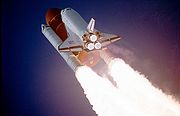 Rockets create thrust by expelling mass
backwards in a high speed jet (see Newton's Third Law
). Chemical rockets, the subject of this article, create thrust by reacting propellants within a combustion chamber into a very hot gas
at high pressure, which is then expanded and accelerated by passage through a nozzle at the rear of the rocket. The amount of the resulting forward force, known as thrust, that is produced is the mass flow rate
of the propellants multiplied by their exhaust velocity (relative to the rocket), as specified by Newton
's third law of motion. Thrust is therefore the equal and opposite reaction that moves the rocket, and not by interaction of the exhaust stream with air around the rocket. Equivalently, one can think of a rocket being accelerated upwards by the pressure of the combusting gases against the combustion chamber and nozzle. This operational principle stands in contrast to the commonly-held assumption that a rocket "pushes" against the air behind or below it. Rockets in fact perform better in outer space
(where there is nothing behind or beneath them to push against), because there is a reduction in air pressure on the outside of the engine, and because it is possible to fit a longer nozzle without suffering from flow separation.
The maximum velocity that a rocket can attain in the absence of any external forces is primarily a function of its mass ratio
and its exhaust velocity. The relationship is described by the rocket equation: . The mass ratio is just a way to express what proportion of the rocket is propellant (fuel/oxidizer combination) prior to engine ignition. Typically, a single-stage rocket might have a mass fraction
of 90% propellant, 10% structure, and hence a mass ratio of 10:1 . The impulse delivered by the motor to the rocket vehicle per weight of fuel consumed is often reported as the rocket propellant's specific impulse
. A propellant with a higher specific impulse is said to be more efficient because more thrust is produced while consuming a given amount of propellant.
Lower stages will usually use high-density (low volume) propellants because of their lighter tankage to propellant weight ratios and because higher performance propellants require higher expansion ratios for maximum performance than can be attained in atmosphere. Thus, the Apollo-Saturn V
first stage used kerosene
-liquid oxygen
rather than the liquid hydrogen
-liquid oxygen used on its upper stages Similarly, the Space Shuttle
uses high-thrust, high-density solid rocket booster
s for its lift-off with the liquid hydrogen-liquid oxygen Space Shuttle Main Enginess used partly for lift-off but primarily for orbital insertion.
Rockets work because every action has an equal and opposite reaction (according to Sir Issac Newton's third principle). In order for the rocket to rush forward, something has to rush backwards. That thing is the propellant. The propellant is a material that spews out of the back of the spacecraft giving it thrust, or a push forward.
Often the propellant is a kind of fuel which is burned with an oxidizer to produce large volumes of very hot gas. These gasses expand until they rush out of the back of the rocket, making thrust. Sometimes the propellant is not burned, but pushed directly out of the spacecraft, making thrust. In ion propulsion, the propellant is made of electrically charged atoms, which are magnetically pushed out of the back of the spacecraft. For smaller attitude control thrusters, a compressed gas is pushed out of the spacecraft.
, and were used primarily for fireworks
displays and as weapon
s. They were fueled with black powder, a type of gunpowder
consisting of a mixture of charcoal
, sulfur
and potassium nitrate
(their version of black powder). This formulation is now used in Black Powder Rocket Motors. Rocket propellant technology did not advance until the end of the 19th century, by which time smokeless powder
had been developed, originally for use in firearms and artillery pieces. Smokeless powders and related compounds have seen use as double-base propellants.
(APCP). This mixture is primarily ammonium perchlorate
powder (an oxidizer), combined with fine aluminium
powder (a fuel), held together in a base of PBAN
or HTPB (rubber-like fuels). The mixture is formed as a liquid, and then cast into the correct shape and cured into a rubbery solid.
and LG-118A Peacekeeper (MX). In the 1980s and 1990s, the USSR/Russia also deployed solid-fueled ICBMs (RT-23, RT-2PM, and RT-2UTTH), but retains two liquid-fueled ICBMs (R-36 and UR-100N). All solid-fueled ICBMs on both sides have three initial solid stages and a precision maneuverable liquid-fueled bus used to fine tune the trajectory of the reentry vehicle.
Their simplicity also makes solid rockets a good choice whenever large amounts of thrust are needed and cost is an issue. The Space Shuttle
and many other orbital launch vehicle
s use solid-fueled rockets in their first stages (solid rocket booster
s) for this reason.
than liquid-fueled rockets. It is also difficult to build a large mass ratio solid rocket because almost the entire rocket is the combustion chamber, and must be built to withstand the high combustion pressures. If a solid rocket is used to go all the way to orbit, the payload fraction is very small. (For example, the Orbital Sciences Pegasus
rocket is an air-launched three-stage solid rocket orbital booster. Launch mass is 23,130 kg, low earth orbit payload is 443 kg, for a payload fraction of 1.9%. Compare to a Delta IV Medium, 249,500 kg, payload 8600 kg, payload fraction 3.4% without air-launch assistance.)
A drawback to solid rockets is that they cannot be throttled in real time, although a predesigned thrust schedule can be created by altering the interior propellant geometry.
Solid rockets can often be shut down before they run out of fuel. Essentially, the rocket is vented or an extinguishant injected so as to terminate the combustion process. In some cases termination destroys the rocket, and then this is typically only done by a Range Safety Officer
if the rocket goes awry. The third stages of the Minuteman and MX rockets have precision shutdown ports which, when opened, reduce the chamber pressure so abruptly that the interior flame is blown out. This allows a more precise trajectory which improves targeting accuracy.
Finally, casting very large single-grain rocket motors has proved to be a very tricky business. Defects in the grain can cause explosions during the burn, and these explosions can increase the burning propellant surface enough to cause a runaway pressure increase, until the case fails.
, proposed liquid hydrogen and liquid oxygen as propellants, the first liquid-fueled rocket, launched by Robert Goddard on March 16, 1926, used gasoline and liquid oxygen. Liquid hydrogen was first used by the engines designed by Pratt and Whitney for the Lockheed CL-400 Suntan reconnaissance aircraft in the mid-1950s. In the mid-1960s, the Centaur and Saturn upper stages were both using liquid hydrogen and liquid oxygen.
The highest specific impulse chemistry ever test-fired in a rocket engine was lithium
and fluorine
, with hydrogen
added to improve the exhaust thermodynamics (making this a tripropellant
). The combination delivered 542 seconds (5.32 kN·s/kg, 5320 m/s) specific impulse in a vacuum. The impracticality of this chemistry highlights why exotic propellants are not actually used: to make all three components liquids, the hydrogen must be kept below -252 °C (just 21 K) and the lithium must be kept above 180 °C (453 K). Lithium and fluorine are both extremely corrosive, liquid lithium ignites on contact with air, fluorine ignites on contact with most fuels, and hydrogen, while not hypergolic, is an explosive hazard. Fluorine and the hydrogen fluoride
(HF) in the exhaust are very toxic, which damages the environment, makes work around the launch pad difficult, and makes getting a launch license that much more difficult. The rocket exhaust is also ionized, which would interfere with radio communication with the rocket.
, which is an expensive high energy hydrocarbon fuel which was used on Soyuz U2 until 1995.
than solid rockets and are capable of being throttled, shut down, and restarted. Only the combustion chamber of a liquid fueled rocket needs to withstand combustion pressures and temperatures and they can be regeneratively cooled by the liquid propellant. On vehicles employing turbopump
s, the propellant tanks are at very much less pressure than the combustion chamber, and thus can be built far more lightly than a solid propellant rocket case, permitting a higher mass ratio. For these reasons, most orbital launch vehicles use liquid propellants.
The primary performance advantage of liquid propellants is due to the oxidizer. Several practical liquid oxidizers (liquid oxygen
, nitrogen tetroxide, and hydrogen peroxide
) are available which have much better specific impulse than the ammonium perchlorate
used in most solid rockets, when paired with comparable fuels. These facts have led to the use of hybrid propellants: a storable oxidizer used with a solid fuel, which retain most virtues of both liquids (high ISP) and solids (simplicity).
While liquid propellants are cheaper than solid propellants, for orbital launchers, the cost savings do not, and historically have not mattered; the cost of propellant is a very small portion of the overall cost of the rocket.
Some propellants, notably Oxygen and Nitrogen, may be able to be collected
from the upper atmosphere, and transferred up to low-Earth orbit for use in propellant depot
s at substantially reduced cost.
s), moderately cryogenic (liquid oxygen
), or both (liquid fluorine
, FLOX- a fluorine/LOX mix). Several exotic oxidizers have been proposed: liquid ozone
(O3), ClF3
, and ClF5
, all of which are unstable, energetic, and toxic.
Liquid fueled rockets also require potentially troublesome valves and seals and thermally stressed combustion chambers, which increase the cost of the rocket. Many employ specially designed turbopumps which raise the cost enormously due to difficult fluid flow patterns that exist within the casings.
GOX (gaseous oxygen)
was used as one of the propellants for the Buran program for the orbital maneuvering system.
usually has a solid fuel and a liquid or gas oxidizer. The fluid oxidizer can make it possible to throttle and restart the motor just like a liquid fueled rocket. Hybrid rockets are also cleaner than solid rockets because practical high-performance solid-phase oxidizers all contain chlorine, versus the more benign liquid oxygen or nitrous oxide used in hybrids. Because just one propellant is a fluid, hybrids are simpler than liquid rockets.
Hybrid motors suffer two major drawbacks. The first, shared with solid rocket motors, is that the casing around the fuel grain must be built to withstand full combustion pressure and often extreme temperatures as well. However, modern composite structures handle this problem well, and when used with nitrous oxide
and a solid rubber propellent (HTPB), relatively small percentage of fuel is needed anyway, so the combustion chamber is not especially large.
The primary remaining difficulty with hybrids is with mixing the propellants during the combustion process. In solid propellants, the oxidizer and fuel are mixed in a factory in carefully controlled conditions. Liquid propellants are generally mixed by the injector at the top of the combustion chamber, which directs many small swift-moving streams of fuel and oxidizer into one another. Liquid fueled rocket injector design has been studied at great length and still resists reliable performance prediction. In a hybrid motor, the mixing happens at the melting or evaporating surface of the fuel. The mixing is not a well-controlled process and generally quite a lot of propellant is left unburned, which limits the efficiency and thus the exhaust velocity of the motor. Additionally, as the burn continues, the hole down the center of the grain (the 'port') widens and the mixture ratio tends to become more oxidiser rich.
There has been much less development of hybrid motors than solid and liquid motors. For military use, ease of handling and maintenance have driven the use of solid rockets. For orbital work, liquid fuels are more efficient than hybrids and most development has concentrated there. There has recently been an increase in hybrid motor development for nonmilitary suborbital work:
ling liquid propellants to give a propellant that will not significantly leak, and to have a much lower vapor pressure.
s use the compressed gas, typically air, to force the water out of the rocket.
Solar thermal rocket
s and Nuclear thermal rocket
s typically propose to use liquid hydrogen for an Isp (Specific Impulse)
of around 600–900 seconds, or in some cases water that is exhausted as steam for an Isp of about 190 seconds.
Additionally for low performance requirements such as attitude jets, inert gases such as nitrogen have been employed.
function of the energy released per unit of propellant mass (specific
energy). Unburned fuel or oxidizer drags down the specific energy.
However, most rockets run fuel-rich.
The usual explanation for fuel-rich mixtures is that fuel-rich
mixtures have lower molecular weight exhaust, which by reducing
 increases the ratio
which is approximately equal to the theoretical exhaust velocity.
This explanation, though found in some textbooks, is wrong. Fuel-rich
mixtures actually have lower theoretical exhaust velocities, because
 decreases as fast or faster than
  .
.
The nozzle of the rocket converts the thermal energy of the
propellants into directed kinetic energy. This conversion happens in
a short time, on the order of one millisecond. During the conversion, energy
must transfer very quickly from the rotational and vibrational states
of the exhaust molecules into translation. Molecules with fewer atoms
(like CO and H2) store less energy in vibration and
rotation than molecules with more atoms (like CO2 and
H2O). These smaller molecules transfer more of their rotational and
vibrational energy to translation energy than larger molecules, and
the resulting improvement in nozzle efficiency is large enough
that real rocket engines improve their actual exhaust
velocity by running rich mixtures with somewhat lower theoretical
exhaust velocities.
The effect of exhaust molecular weight on nozzle efficiency is most
important for nozzles operating near sea level. High expansion
rockets operating in a vacuum see a much smaller effect, and so are
run less rich. The Saturn-II stage (a LOX/LH2 rocket)
varied its mixture ratio during flight to optimize performance.
LOX/hydrocarbon rockets are run only somewhat rich (O/F mass ratio of
3 rather than stoichiometric
of 3.4 to 4), because the energy release
per unit mass drops off quickly as the mixture ratio deviates from
stoichiometric. LOX/LH2 rockets are run very rich (O/F mass
ratio of 4 rather than stoichiometric 8) because hydrogen is so light
that the energy release per unit mass of propellant drops very slowly
with extra hydrogen. In fact, LOX/LH2 rockets are
generally limited in how rich they run by the performance penalty of
the mass of the extra hydrogen tankage, rather than the mass of the
hydrogen itself.
Another reason for running rich is that off-stoichiometric mixtures
burn cooler than stoichiometric mixtures, which makes engine cooling
easier. And as most engines are made of metal or carbon, hot
oxidizer-rich exhaust is extremely corrosive, where fuel-rich exhaust
is less so.
American engines have all been fuel-rich.
Some Soviet engines have been oxidizer-rich.
Additionally, there is a difference between mixture ratios for optimum Isp and optimum thrust.
During launch, shortly after takeoff, high thrust is at a premium.
This can be achieved at some temporary reduction of Isp by increasing the oxidiser ratio
initially, and then transitioning to more fuel-rich mixtures. Since engine size is typically scaled for takeoff thrust
this permits reduction of the weight of rocket engine, pipes and pumps
and the extra propellant use can be more than compensated by increases of acceleration towards
the end of the burn by having a reduced dry mass.
Due to lower Isp, dense propellant launch vehicles have a higher takeoff mass, but this does not mean a proportionately high cost; on the contrary, the vehicle may well end up cheaper. Liquid hydrogen is quite an expensive fuel to produce and store, and causes many practical difficulties with design and manufacture of the vehicle.
Because of the higher overall weight, a dense-fuelled launch vehicle necessarily requires higher takeoff thrust, but it carries this thrust capability all the way to orbit. This, in combination with the better thrust/weight ratios, means that dense-fuelled vehicles reach orbit earlier, thereby minimizing losses due to gravity drag
. Thus, the effective delta-v requirement for these vehicles are reduced.
However, liquid hydrogen does give clear advantages when the overall mass needs to be minimised; for example the Saturn V vehicle used it on the upper stages; this reduced weight meant that the dense-fuelled first stage could be made significantly smaller, saving quite a lot of money.
Tripropellant rocket
s designs often try to use an optimum mix of propellants for launch vehicles. These use mainly dense fuel while at low altitude and switch across to hydrogen at higher altitude. Studies by Robert Salkeld in the 1960s proposed SSTO using this technique. The Space Shuttle
approximated this by using dense solid rocket boosters and hydrogen at high altitude.
:Category: Rocket fuels
Propellant
A propellant is a material that produces pressurized gas that:* can be directed through a nozzle, thereby producing thrust ;...
tank, prior to being used as the propulsive mass that is ejected from a rocket engine
Rocket engine
A rocket engine, or simply "rocket", is a jet engineRocket Propulsion Elements; 7th edition- chapter 1 that uses only propellant mass for forming its high speed propulsive jet. Rocket engines are reaction engines and obtain thrust in accordance with Newton's third law...
in the form of a fluid
Fluid
In physics, a fluid is a substance that continually deforms under an applied shear stress. Fluids are a subset of the phases of matter and include liquids, gases, plasmas and, to some extent, plastic solids....
jet
Jet (fluid)
A jet is an efflux of fluid that is projected into a surrounding medium, usually from some kind of a nozzle, aperture or orifice. Jets can travel long distances without dissipating...
to produce thrust
Thrust
Thrust is a reaction force described quantitatively by Newton's second and third laws. When a system expels or accelerates mass in one direction the accelerated mass will cause a force of equal magnitude but opposite direction on that system....
. A fuel propellant is often burned with an oxidizer propellant to produce large volumes of very hot gas. These gases expand and push on a nozzle, which accelerates them until they rush out of the back of the rocket
Rocket
A rocket is a missile, spacecraft, aircraft or other vehicle which obtains thrust from a rocket engine. In all rockets, the exhaust is formed entirely from propellants carried within the rocket before use. Rocket engines work by action and reaction...
at extremely high speed, making thrust. Sometimes the propellant is not burned, but can be externally heated for more performance. For smaller attitude control thrusters, a compressed gas escapes the spacecraft through a propelling nozzle.
Chemical rocket propellants are most commonly used, which undergo exothermic
Exothermic
In thermodynamics, the term exothermic describes a process or reaction that releases energy from the system, usually in the form of heat, but also in the form of light , electricity , or sound...
chemical reaction
Chemical reaction
A chemical reaction is a process that leads to the transformation of one set of chemical substances to another. Chemical reactions can be either spontaneous, requiring no input of energy, or non-spontaneous, typically following the input of some type of energy, such as heat, light or electricity...
s to produce hot gas used by a rocket
Rocket
A rocket is a missile, spacecraft, aircraft or other vehicle which obtains thrust from a rocket engine. In all rockets, the exhaust is formed entirely from propellants carried within the rocket before use. Rocket engines work by action and reaction...
for propulsive purpose
Spacecraft propulsion
Spacecraft propulsion is any method used to accelerate spacecraft and artificial satellites. There are many different methods. Each method has drawbacks and advantages, and spacecraft propulsion is an active area of research. However, most spacecraft today are propelled by forcing a gas from the...
s.
In ion propulsion, the propellant is made of electrically charged atoms (ion
Ion
An ion is an atom or molecule in which the total number of electrons is not equal to the total number of protons, giving it a net positive or negative electrical charge. The name was given by physicist Michael Faraday for the substances that allow a current to pass between electrodes in a...
s), which are electromagnetic
Electromagnetic
Electromagnetic may refer to:* Electromagnetism* Electromagnetic field* Electromagnetic force* Electromagnetic radiation* Electromagnetic induction* Electromagnetic spectrum...
ally pushed out of the back of the spacecraft. Magnetically accelerated ion drives are not usually considered to be rockets however, but a similar class of thrusters use electrical heating and magnetic nozzles.
Overview
Mass
Mass can be defined as a quantitive measure of the resistance an object has to change in its velocity.In physics, mass commonly refers to any of the following three properties of matter, which have been shown experimentally to be equivalent:...
backwards in a high speed jet (see Newton's Third Law
Newton's laws of motion
Newton's laws of motion are three physical laws that form the basis for classical mechanics. They describe the relationship between the forces acting on a body and its motion due to those forces...
). Chemical rockets, the subject of this article, create thrust by reacting propellants within a combustion chamber into a very hot gas
Gas
Gas is one of the three classical states of matter . Near absolute zero, a substance exists as a solid. As heat is added to this substance it melts into a liquid at its melting point , boils into a gas at its boiling point, and if heated high enough would enter a plasma state in which the electrons...
at high pressure, which is then expanded and accelerated by passage through a nozzle at the rear of the rocket. The amount of the resulting forward force, known as thrust, that is produced is the mass flow rate
Mass flow rate
Mass flow rate is the mass of substance which passes through a given surface per unit time. Its unit is mass divided by time, so kilogram per second in SI units, and slug per second or pound per second in US customary units...
of the propellants multiplied by their exhaust velocity (relative to the rocket), as specified by Newton
Isaac Newton
Sir Isaac Newton PRS was an English physicist, mathematician, astronomer, natural philosopher, alchemist, and theologian, who has been "considered by many to be the greatest and most influential scientist who ever lived."...
's third law of motion. Thrust is therefore the equal and opposite reaction that moves the rocket, and not by interaction of the exhaust stream with air around the rocket. Equivalently, one can think of a rocket being accelerated upwards by the pressure of the combusting gases against the combustion chamber and nozzle. This operational principle stands in contrast to the commonly-held assumption that a rocket "pushes" against the air behind or below it. Rockets in fact perform better in outer space
Outer space
Outer space is the void that exists between celestial bodies, including the Earth. It is not completely empty, but consists of a hard vacuum containing a low density of particles: predominantly a plasma of hydrogen and helium, as well as electromagnetic radiation, magnetic fields, and neutrinos....
(where there is nothing behind or beneath them to push against), because there is a reduction in air pressure on the outside of the engine, and because it is possible to fit a longer nozzle without suffering from flow separation.
The maximum velocity that a rocket can attain in the absence of any external forces is primarily a function of its mass ratio
Mass ratio
In aerospace engineering, mass ratio is a measure of the efficiency of a rocket. It describes how much more massive the vehicle is with propellant than without; that is, it is the ratio of the rocket's wet mass to its dry mass...
and its exhaust velocity. The relationship is described by the rocket equation:
. The mass ratio is just a way to express what proportion of the rocket is propellant (fuel/oxidizer combination) prior to engine ignition. Typically, a single-stage rocket might have a mass fractionMass fraction
In aerospace engineering, the propellant mass fraction is a measure of a vehicle's performance, determined as the portion of the vehicle's mass which does not reach the destination...
of 90% propellant, 10% structure, and hence a mass ratio of 10:1 . The impulse delivered by the motor to the rocket vehicle per weight of fuel consumed is often reported as the rocket propellant's specific impulse
Specific impulse
Specific impulse is a way to describe the efficiency of rocket and jet engines. It represents the derivative of the impulse with respect to amount of propellant used, i.e., the thrust divided by the amount of propellant used per unit time. If the "amount" of propellant is given in terms of mass ,...
. A propellant with a higher specific impulse is said to be more efficient because more thrust is produced while consuming a given amount of propellant.
Lower stages will usually use high-density (low volume) propellants because of their lighter tankage to propellant weight ratios and because higher performance propellants require higher expansion ratios for maximum performance than can be attained in atmosphere. Thus, the Apollo-Saturn V
Saturn V
The Saturn V was an American human-rated expendable rocket used by NASA's Apollo and Skylab programs from 1967 until 1973. A multistage liquid-fueled launch vehicle, NASA launched 13 Saturn Vs from the Kennedy Space Center, Florida with no loss of crew or payload...
first stage used kerosene
Kerosene
Kerosene, sometimes spelled kerosine in scientific and industrial usage, also known as paraffin or paraffin oil in the United Kingdom, Hong Kong, Ireland and South Africa, is a combustible hydrocarbon liquid. The name is derived from Greek keros...
-liquid oxygen
Liquid oxygen
Liquid oxygen — abbreviated LOx, LOX or Lox in the aerospace, submarine and gas industries — is one of the physical forms of elemental oxygen.-Physical properties:...
rather than the liquid hydrogen
Liquid hydrogen
Liquid hydrogen is the liquid state of the element hydrogen. Hydrogen is found naturally in the molecular H2 form.To exist as a liquid, H2 must be pressurized above and cooled below hydrogen's Critical point. However, for hydrogen to be in a full liquid state without boiling off, it needs to be...
-liquid oxygen used on its upper stages Similarly, the Space Shuttle
Space Shuttle
The Space Shuttle was a manned orbital rocket and spacecraft system operated by NASA on 135 missions from 1981 to 2011. The system combined rocket launch, orbital spacecraft, and re-entry spaceplane with modular add-ons...
uses high-thrust, high-density solid rocket booster
Solid rocket booster
Solid rocket boosters or Solid Rocket Motors, SRM, are used to provide thrust in spacecraft launches from the launchpad up to burnout of the SRBs. Many launch vehicles include SRBs, including the Ariane 5, Atlas V , and the NASA Space Shuttle...
s for its lift-off with the liquid hydrogen-liquid oxygen Space Shuttle Main Enginess used partly for lift-off but primarily for orbital insertion.
Rockets work because every action has an equal and opposite reaction (according to Sir Issac Newton's third principle). In order for the rocket to rush forward, something has to rush backwards. That thing is the propellant. The propellant is a material that spews out of the back of the spacecraft giving it thrust, or a push forward.
Often the propellant is a kind of fuel which is burned with an oxidizer to produce large volumes of very hot gas. These gasses expand until they rush out of the back of the rocket, making thrust. Sometimes the propellant is not burned, but pushed directly out of the spacecraft, making thrust. In ion propulsion, the propellant is made of electrically charged atoms, which are magnetically pushed out of the back of the spacecraft. For smaller attitude control thrusters, a compressed gas is pushed out of the spacecraft.
History
The earliest rockets were created hundreds of years ago by the ChineseChina
Chinese civilization may refer to:* China for more general discussion of the country.* Chinese culture* Greater China, the transnational community of ethnic Chinese.* History of China* Sinosphere, the area historically affected by Chinese culture...
, and were used primarily for fireworks
Fireworks
Fireworks are a class of explosive pyrotechnic devices used for aesthetic and entertainment purposes. The most common use of a firework is as part of a fireworks display. A fireworks event is a display of the effects produced by firework devices...
displays and as weapon
Weapon
A weapon, arm, or armament is a tool or instrument used with the aim of causing damage or harm to living beings or artificial structures or systems...
s. They were fueled with black powder, a type of gunpowder
Gunpowder
Gunpowder, also known since in the late 19th century as black powder, was the first chemical explosive and the only one known until the mid 1800s. It is a mixture of sulfur, charcoal, and potassium nitrate - with the sulfur and charcoal acting as fuels, while the saltpeter works as an oxidizer...
consisting of a mixture of charcoal
Charcoal
Charcoal is the dark grey residue consisting of carbon, and any remaining ash, obtained by removing water and other volatile constituents from animal and vegetation substances. Charcoal is usually produced by slow pyrolysis, the heating of wood or other substances in the absence of oxygen...
, sulfur
Sulfur
Sulfur or sulphur is the chemical element with atomic number 16. In the periodic table it is represented by the symbol S. It is an abundant, multivalent non-metal. Under normal conditions, sulfur atoms form cyclic octatomic molecules with chemical formula S8. Elemental sulfur is a bright yellow...
and potassium nitrate
Potassium nitrate
Potassium nitrate is a chemical compound with the formula KNO3. It is an ionic salt of potassium ions K+ and nitrate ions NO3−.It occurs as a mineral niter and is a natural solid source of nitrogen. Its common names include saltpetre , from medieval Latin sal petræ: "stone salt" or possibly "Salt...
(their version of black powder). This formulation is now used in Black Powder Rocket Motors. Rocket propellant technology did not advance until the end of the 19th century, by which time smokeless powder
Smokeless powder
Smokeless powder is the name given to a number of propellants used in firearms and artillery which produce negligible smoke when fired, unlike the older gunpowder which they replaced...
had been developed, originally for use in firearms and artillery pieces. Smokeless powders and related compounds have seen use as double-base propellants.
Description
Solid propellants (and almost all rocket propellants) consist of an oxidizer and a fuel. In the case of gunpowder, the fuel is charcoal, the oxidizer is potassium nitrate, and sulphur serves as a catalyst. (Note: sulphur is not a true catalyst in gunpowder as it is consumed to a great extent into a variety of reaction products such as K2S. The sulphur acts mainly as a sensitizer lowering threshold of ignition.) During the 1950s and 60s researchers in the United States developed what is now the standard high-energy solid rocket fuel, Ammonium Perchlorate Composite PropellantAmmonium Perchlorate Composite Propellant
Ammonium perchlorate composite propellant is a modern solid rocket propellant used in both manned and unmanned rocket vehicles. It differs from many traditional solid rocket propellants such as black powder or Zinc-Sulfur, not only in chemical composition and overall performance, but also by the...
(APCP). This mixture is primarily ammonium perchlorate
Ammonium perchlorate
Ammonium perchlorate is an inorganic compound with the formula NH4ClO4. It is the salt of perchloric acid and ammonia. It is a powerful oxidizer, which is why its main use is in solid propellants...
powder (an oxidizer), combined with fine aluminium
Aluminium
Aluminium or aluminum is a silvery white member of the boron group of chemical elements. It has the symbol Al, and its atomic number is 13. It is not soluble in water under normal circumstances....
powder (a fuel), held together in a base of PBAN
PBAN
Polybutadiene acrylonitrile copolymer, also noted as polybutadiene — acrylic acid — acrylonitrile terpolymer.This was the binder formulation widely used on the 1960-70's big boosters...
or HTPB (rubber-like fuels). The mixture is formed as a liquid, and then cast into the correct shape and cured into a rubbery solid.
Advantages
Solid-fueled rockets are much easier to store and handle than liquid-fueled rockets, which makes them ideal for military applications. In the 1970s and 1980s the U.S. switched entirely to solid-fueled ICBMs: the LGM-30 MinutemanLGM-30 Minuteman
The LGM-30 Minuteman is a U.S. nuclear missile, a land-based intercontinental ballistic missile . As of 2010, the version LGM-30G Minuteman-III is the only land-based ICBM in service in the United States...
and LG-118A Peacekeeper (MX). In the 1980s and 1990s, the USSR/Russia also deployed solid-fueled ICBMs (RT-23, RT-2PM, and RT-2UTTH), but retains two liquid-fueled ICBMs (R-36 and UR-100N). All solid-fueled ICBMs on both sides have three initial solid stages and a precision maneuverable liquid-fueled bus used to fine tune the trajectory of the reentry vehicle.
Their simplicity also makes solid rockets a good choice whenever large amounts of thrust are needed and cost is an issue. The Space Shuttle
Space Shuttle
The Space Shuttle was a manned orbital rocket and spacecraft system operated by NASA on 135 missions from 1981 to 2011. The system combined rocket launch, orbital spacecraft, and re-entry spaceplane with modular add-ons...
and many other orbital launch vehicle
Launch vehicle
In spaceflight, a launch vehicle or carrier rocket is a rocket used to carry a payload from the Earth's surface into outer space. A launch system includes the launch vehicle, the launch pad and other infrastructure....
s use solid-fueled rockets in their first stages (solid rocket booster
Solid rocket booster
Solid rocket boosters or Solid Rocket Motors, SRM, are used to provide thrust in spacecraft launches from the launchpad up to burnout of the SRBs. Many launch vehicles include SRBs, including the Ariane 5, Atlas V , and the NASA Space Shuttle...
s) for this reason.
Disadvantages
Relative to liquid fuel rockets, solid rockets have a number of disadvantages. Solid rockets have a lower specific impulseSpecific impulse
Specific impulse is a way to describe the efficiency of rocket and jet engines. It represents the derivative of the impulse with respect to amount of propellant used, i.e., the thrust divided by the amount of propellant used per unit time. If the "amount" of propellant is given in terms of mass ,...
than liquid-fueled rockets. It is also difficult to build a large mass ratio solid rocket because almost the entire rocket is the combustion chamber, and must be built to withstand the high combustion pressures. If a solid rocket is used to go all the way to orbit, the payload fraction is very small. (For example, the Orbital Sciences Pegasus
Pegasus rocket
The Pegasus rocket is a winged space launch vehicle capable of carrying small, unmanned payloads into low Earth orbit. It is air-launched, as part of an expendable launch system developed by Orbital Sciences Corporation . Three main stages burning solid propellant provide the thrust...
rocket is an air-launched three-stage solid rocket orbital booster. Launch mass is 23,130 kg, low earth orbit payload is 443 kg, for a payload fraction of 1.9%. Compare to a Delta IV Medium, 249,500 kg, payload 8600 kg, payload fraction 3.4% without air-launch assistance.)
A drawback to solid rockets is that they cannot be throttled in real time, although a predesigned thrust schedule can be created by altering the interior propellant geometry.
Solid rockets can often be shut down before they run out of fuel. Essentially, the rocket is vented or an extinguishant injected so as to terminate the combustion process. In some cases termination destroys the rocket, and then this is typically only done by a Range Safety Officer
Range Safety Officer
In the field of rocketry, Range Safety Officer is a generic term referring to an individual who monitors the performance of rockets in flight, and who is responsible for their remote destruction if it should be judged that they pose a hazard...
if the rocket goes awry. The third stages of the Minuteman and MX rockets have precision shutdown ports which, when opened, reduce the chamber pressure so abruptly that the interior flame is blown out. This allows a more precise trajectory which improves targeting accuracy.
Finally, casting very large single-grain rocket motors has proved to be a very tricky business. Defects in the grain can cause explosions during the burn, and these explosions can increase the burning propellant surface enough to cause a runaway pressure increase, until the case fails.
History
Though early rocket theorists, such as Konstantin TsiolkovskyKonstantin Tsiolkovsky
Konstantin Eduardovich Tsiolkovsky was an Imperial Russian and Soviet rocket scientist and pioneer of the astronautic theory. Along with his followers the German Hermann Oberth and the American Robert H. Goddard, he is considered to be one of the founding fathers of rocketry and astronautics...
, proposed liquid hydrogen and liquid oxygen as propellants, the first liquid-fueled rocket, launched by Robert Goddard on March 16, 1926, used gasoline and liquid oxygen. Liquid hydrogen was first used by the engines designed by Pratt and Whitney for the Lockheed CL-400 Suntan reconnaissance aircraft in the mid-1950s. In the mid-1960s, the Centaur and Saturn upper stages were both using liquid hydrogen and liquid oxygen.
The highest specific impulse chemistry ever test-fired in a rocket engine was lithium
Lithium
Lithium is a soft, silver-white metal that belongs to the alkali metal group of chemical elements. It is represented by the symbol Li, and it has the atomic number 3. Under standard conditions it is the lightest metal and the least dense solid element. Like all alkali metals, lithium is highly...
and fluorine
Fluorine
Fluorine is the chemical element with atomic number 9, represented by the symbol F. It is the lightest element of the halogen column of the periodic table and has a single stable isotope, fluorine-19. At standard pressure and temperature, fluorine is a pale yellow gas composed of diatomic...
, with hydrogen
Hydrogen
Hydrogen is the chemical element with atomic number 1. It is represented by the symbol H. With an average atomic weight of , hydrogen is the lightest and most abundant chemical element, constituting roughly 75% of the Universe's chemical elemental mass. Stars in the main sequence are mainly...
added to improve the exhaust thermodynamics (making this a tripropellant
Tripropellant rocket
A tripropellant rocket is a rocket that uses three propellants, as opposed to the more common bipropellant rocket or monopropellant rocket designs, which use two or one fuels, respectively...
). The combination delivered 542 seconds (5.32 kN·s/kg, 5320 m/s) specific impulse in a vacuum. The impracticality of this chemistry highlights why exotic propellants are not actually used: to make all three components liquids, the hydrogen must be kept below -252 °C (just 21 K) and the lithium must be kept above 180 °C (453 K). Lithium and fluorine are both extremely corrosive, liquid lithium ignites on contact with air, fluorine ignites on contact with most fuels, and hydrogen, while not hypergolic, is an explosive hazard. Fluorine and the hydrogen fluoride
Hydrogen fluoride
Hydrogen fluoride is a chemical compound with the formula HF. This colorless gas is the principal industrial source of fluorine, often in the aqueous form as hydrofluoric acid, and thus is the precursor to many important compounds including pharmaceuticals and polymers . HF is widely used in the...
(HF) in the exhaust are very toxic, which damages the environment, makes work around the launch pad difficult, and makes getting a launch license that much more difficult. The rocket exhaust is also ionized, which would interfere with radio communication with the rocket.
Current Types
The most common liquid propellants in use today:- LOXLiquid oxygenLiquid oxygen — abbreviated LOx, LOX or Lox in the aerospace, submarine and gas industries — is one of the physical forms of elemental oxygen.-Physical properties:...
and keroseneKeroseneKerosene, sometimes spelled kerosine in scientific and industrial usage, also known as paraffin or paraffin oil in the United Kingdom, Hong Kong, Ireland and South Africa, is a combustible hydrocarbon liquid. The name is derived from Greek keros...
(RP-1RP-1RP-1 is a highly refined form of kerosene outwardly similar to jet fuel, used as a rocket fuel. Although having a lower specific impulse than liquid hydrogen , RP-1 is cheaper, can be stored at room temperature, is far less of an explosive hazard and is far denser...
). Used for the lower stages of most Russian and Chinese boosters, the first stages of the Saturn VSaturn VThe Saturn V was an American human-rated expendable rocket used by NASA's Apollo and Skylab programs from 1967 until 1973. A multistage liquid-fueled launch vehicle, NASA launched 13 Saturn Vs from the Kennedy Space Center, Florida with no loss of crew or payload...
and Atlas VAtlas VAtlas V is an active expendable launch system in the Atlas rocket family. Atlas V was formerly operated by Lockheed Martin, and is now operated by the Lockheed Martin-Boeing joint venture United Launch Alliance...
, and all stages of the developmental Falcon 1Falcon 1The Falcon 1 is a partially reusable launch system designed and manufactured by SpaceX, a space transportation company in Hawthorne, California. The two-stage-to-orbit rocket uses LOX/RP-1 for both stages, the first powered by a single Merlin engine and the second powered by a single Kestrel engine...
and Falcon 9Falcon 9Falcon 9 is a rocket-powered spaceflight launch system designed and manufactured by SpaceX. Both stages of its two-stage-to-orbit vehicle use liquid oxygen and rocket-grade kerosene propellants...
. Very similar to Robert Goddard's first rocket. This combination is widely regarded as the most practical for boosters that lift off at ground level and therefore must operate at full atmospheric pressure.
- LOXLiquid oxygenLiquid oxygen — abbreviated LOx, LOX or Lox in the aerospace, submarine and gas industries — is one of the physical forms of elemental oxygen.-Physical properties:...
and liquid hydrogenLiquid hydrogenLiquid hydrogen is the liquid state of the element hydrogen. Hydrogen is found naturally in the molecular H2 form.To exist as a liquid, H2 must be pressurized above and cooled below hydrogen's Critical point. However, for hydrogen to be in a full liquid state without boiling off, it needs to be...
, used in the Space ShuttleSpace ShuttleThe Space Shuttle was a manned orbital rocket and spacecraft system operated by NASA on 135 missions from 1981 to 2011. The system combined rocket launch, orbital spacecraft, and re-entry spaceplane with modular add-ons...
orbiter, the Centaur upper stage of the Atlas V, Saturn VSaturn VThe Saturn V was an American human-rated expendable rocket used by NASA's Apollo and Skylab programs from 1967 until 1973. A multistage liquid-fueled launch vehicle, NASA launched 13 Saturn Vs from the Kennedy Space Center, Florida with no loss of crew or payload...
upper stages, the newer Delta IV rocketDelta IV rocketDelta IV is an active expendable launch system in the Delta rocket family. Delta IV uses rockets designed by Boeing's Integrated Defense Systems division and built in the United Launch Alliance facility in Decatur, Alabama. Final assembly is completed at the launch site by ULA...
, the H-IIAH-IIAH-IIA is an active expendable launch system operated by Mitsubishi Heavy Industries for the Japan Aerospace Exploration Agency . The liquid-fueled H-IIA rockets have been used to launch satellites into geostationary orbit, to launch a lunar orbiting spacecraft, and to launch an interplanetary...
rocket, and most stages of the European ArianeAriane (rocket)Ariane is a series of a European civilian expendable launch vehicles for space launch use. The name comes from the French spelling of the mythological character Ariadne....
rockets.
- Nitrogen tetroxide (N2O4) and hydrazineHydrazineHydrazine is an inorganic compound with the formula N2H4. It is a colourless flammable liquid with an ammonia-like odor. Hydrazine is highly toxic and dangerously unstable unless handled in solution. Approximately 260,000 tons are manufactured annually...
(N2H4), MMHMonomethylhydrazineMonomethylhydrazine is a volatile hydrazine chemical with the chemical formula CH3 NH2. It is used as a rocket propellant in bipropellant rocket engines because it is hypergolic with various oxidizers such as nitrogen tetroxide and nitric acid...
, or UDMHUDMHUnsymmetrical dimethylhydrazine is a toxic volatile hygroscopic clear liquid, with a sharp, fishy, ammoniacal smell typical for organic amines. It turns yellowish on exposure to air and absorbs oxygen and carbon dioxide. It mixes completely with water, ethanol, and kerosene. In concentration...
. Used in military, orbital, and deep space rockets because both liquids are storable for long periods at reasonable temperatures and pressures. N2O4/UDMH is the main fuel for the Proton rocketProton rocketProton is an expendable launch system used for both commercial and Russian government space launches. The first Proton rocket was launched in 1965 and the launch system is still in use as of 2011, which makes it one of the most successful heavy boosters in the history of spaceflight...
. This combination is hypergolic, making for attractively simple ignition sequences. The major inconvenience is that these propellants are highly toxic, hence they require careful handling.
- MonopropellantMonopropellantMonopropellants are propellants composed of chemicals or mixtures of chemicals which can be stored in a single container with some degree of safety. While stable under defined storage conditions, they react very rapidly under certain other conditions to produce a large volume of energetic gases...
s such as hydrogen peroxideHydrogen peroxideHydrogen peroxide is the simplest peroxide and an oxidizer. Hydrogen peroxide is a clear liquid, slightly more viscous than water. In dilute solution, it appears colorless. With its oxidizing properties, hydrogen peroxide is often used as a bleach or cleaning agent...
, hydrazineHydrazineHydrazine is an inorganic compound with the formula N2H4. It is a colourless flammable liquid with an ammonia-like odor. Hydrazine is highly toxic and dangerously unstable unless handled in solution. Approximately 260,000 tons are manufactured annually...
, and nitrous oxideNitrous oxideNitrous oxide, commonly known as laughing gas or sweet air, is a chemical compound with the formula . It is an oxide of nitrogen. At room temperature, it is a colorless non-flammable gas, with a slightly sweet odor and taste. It is used in surgery and dentistry for its anesthetic and analgesic...
are primarily used for attitude control and spacecraft station-keeping where their long-term storability, simplicity of use, and ability to provide the tiny impulses needed, outweighs their lower specific impulse as compared to bipropellants. Hydrogen peroxide is also used to drive the turbopumps on the first stage of the Soyuz launch vehicle.
Historical propellants
These include propellants such as syntinSyntin
Syntin is a hydrocarbon with the molecular formula C10H16 used as a rocket fuel. It is a mixture of cis and trans isomers. It has a density of 0.851 g/mL, and a boiling point of 158 °C...
, which is an expensive high energy hydrocarbon fuel which was used on Soyuz U2 until 1995.
Advantages
Liquid fueled rockets have higher specific impulseSpecific impulse
Specific impulse is a way to describe the efficiency of rocket and jet engines. It represents the derivative of the impulse with respect to amount of propellant used, i.e., the thrust divided by the amount of propellant used per unit time. If the "amount" of propellant is given in terms of mass ,...
than solid rockets and are capable of being throttled, shut down, and restarted. Only the combustion chamber of a liquid fueled rocket needs to withstand combustion pressures and temperatures and they can be regeneratively cooled by the liquid propellant. On vehicles employing turbopump
Turbopump
A turbopump is a gas turbine that comprises basically two main components: a rotodynamic pump and a driving turbine, usually both mounted on the same shaft, or sometimes geared together...
s, the propellant tanks are at very much less pressure than the combustion chamber, and thus can be built far more lightly than a solid propellant rocket case, permitting a higher mass ratio. For these reasons, most orbital launch vehicles use liquid propellants.
The primary performance advantage of liquid propellants is due to the oxidizer. Several practical liquid oxidizers (liquid oxygen
Liquid oxygen
Liquid oxygen — abbreviated LOx, LOX or Lox in the aerospace, submarine and gas industries — is one of the physical forms of elemental oxygen.-Physical properties:...
, nitrogen tetroxide, and hydrogen peroxide
Hydrogen peroxide
Hydrogen peroxide is the simplest peroxide and an oxidizer. Hydrogen peroxide is a clear liquid, slightly more viscous than water. In dilute solution, it appears colorless. With its oxidizing properties, hydrogen peroxide is often used as a bleach or cleaning agent...
) are available which have much better specific impulse than the ammonium perchlorate
Ammonium perchlorate
Ammonium perchlorate is an inorganic compound with the formula NH4ClO4. It is the salt of perchloric acid and ammonia. It is a powerful oxidizer, which is why its main use is in solid propellants...
used in most solid rockets, when paired with comparable fuels. These facts have led to the use of hybrid propellants: a storable oxidizer used with a solid fuel, which retain most virtues of both liquids (high ISP) and solids (simplicity).
While liquid propellants are cheaper than solid propellants, for orbital launchers, the cost savings do not, and historically have not mattered; the cost of propellant is a very small portion of the overall cost of the rocket.
Some propellants, notably Oxygen and Nitrogen, may be able to be collected
Propulsive Fluid Accumulator
A Propulsive Fluid Accumulator is an artificial Earth satellite which collects and stores oxygen and other atmospheric gases for in-situ refuelling of high-thrust rockets. This eliminates the need to lift oxidizer to orbit and therefore brings significant cost benefits.- Propulsive Fluid...
from the upper atmosphere, and transferred up to low-Earth orbit for use in propellant depot
Propellant depot
An orbital propellant depot is a cache of propellant that is placed on an orbit about the Earth or another body to allow spacecraft to be fuelled in space. Launching a spacecraft separately from some of its propellant enables missions with more massive payloads...
s at substantially reduced cost.
Disadvantages
The main difficulties with liquid propellants are also with the oxidizers. These are generally at least moderately difficult to store and handle due to their high reactivity with common materials, may have extreme toxicity (nitric acidNitric acid
Nitric acid , also known as aqua fortis and spirit of nitre, is a highly corrosive and toxic strong acid.Colorless when pure, older samples tend to acquire a yellow cast due to the accumulation of oxides of nitrogen. If the solution contains more than 86% nitric acid, it is referred to as fuming...
s), moderately cryogenic (liquid oxygen
Oxygen
Oxygen is the element with atomic number 8 and represented by the symbol O. Its name derives from the Greek roots ὀξύς and -γενής , because at the time of naming, it was mistakenly thought that all acids required oxygen in their composition...
), or both (liquid fluorine
Fluorine
Fluorine is the chemical element with atomic number 9, represented by the symbol F. It is the lightest element of the halogen column of the periodic table and has a single stable isotope, fluorine-19. At standard pressure and temperature, fluorine is a pale yellow gas composed of diatomic...
, FLOX- a fluorine/LOX mix). Several exotic oxidizers have been proposed: liquid ozone
Ozone
Ozone , or trioxygen, is a triatomic molecule, consisting of three oxygen atoms. It is an allotrope of oxygen that is much less stable than the diatomic allotrope...
(O3), ClF3
Chlorine trifluoride
Chlorine trifluoride is an interhalogen compound with the formula ClF3. This colourless, poisonous, corrosive and very reactive gas condenses to a pale-greenish yellow liquid, the form in which it is most often sold...
, and ClF5
Chlorine pentafluoride
Chlorine pentafluoride is an interhalogen compound with formula ClF5. It was first synthesized in 1963.Its square pyramidal structure with C4v symmetry was confirmed by its high resolution19F NMR spectrum.-Preparation:...
, all of which are unstable, energetic, and toxic.
Liquid fueled rockets also require potentially troublesome valves and seals and thermally stressed combustion chambers, which increase the cost of the rocket. Many employ specially designed turbopumps which raise the cost enormously due to difficult fluid flow patterns that exist within the casings.
Gas propellants
A gas propellant usually involves some sort of compressed gas. However, due to the low density and high weight of the pressure vessel, gases see little current use, but are sometimes used for vernier engines, particularly with inert propellants.GOX (gaseous oxygen)
Oxygen
Oxygen is the element with atomic number 8 and represented by the symbol O. Its name derives from the Greek roots ὀξύς and -γενής , because at the time of naming, it was mistakenly thought that all acids required oxygen in their composition...
was used as one of the propellants for the Buran program for the orbital maneuvering system.
Hybrid propellants
A hybrid rocketHybrid rocket
A hybrid rocket is a rocket with a rocket motor which uses propellants in two different states of matter - one solid and the other either gas or liquid. The Hybrid rocket concept can be traced back at least 75 years....
usually has a solid fuel and a liquid or gas oxidizer. The fluid oxidizer can make it possible to throttle and restart the motor just like a liquid fueled rocket. Hybrid rockets are also cleaner than solid rockets because practical high-performance solid-phase oxidizers all contain chlorine, versus the more benign liquid oxygen or nitrous oxide used in hybrids. Because just one propellant is a fluid, hybrids are simpler than liquid rockets.
Hybrid motors suffer two major drawbacks. The first, shared with solid rocket motors, is that the casing around the fuel grain must be built to withstand full combustion pressure and often extreme temperatures as well. However, modern composite structures handle this problem well, and when used with nitrous oxide
Nitrous oxide
Nitrous oxide, commonly known as laughing gas or sweet air, is a chemical compound with the formula . It is an oxide of nitrogen. At room temperature, it is a colorless non-flammable gas, with a slightly sweet odor and taste. It is used in surgery and dentistry for its anesthetic and analgesic...
and a solid rubber propellent (HTPB), relatively small percentage of fuel is needed anyway, so the combustion chamber is not especially large.
The primary remaining difficulty with hybrids is with mixing the propellants during the combustion process. In solid propellants, the oxidizer and fuel are mixed in a factory in carefully controlled conditions. Liquid propellants are generally mixed by the injector at the top of the combustion chamber, which directs many small swift-moving streams of fuel and oxidizer into one another. Liquid fueled rocket injector design has been studied at great length and still resists reliable performance prediction. In a hybrid motor, the mixing happens at the melting or evaporating surface of the fuel. The mixing is not a well-controlled process and generally quite a lot of propellant is left unburned, which limits the efficiency and thus the exhaust velocity of the motor. Additionally, as the burn continues, the hole down the center of the grain (the 'port') widens and the mixture ratio tends to become more oxidiser rich.
There has been much less development of hybrid motors than solid and liquid motors. For military use, ease of handling and maintenance have driven the use of solid rockets. For orbital work, liquid fuels are more efficient than hybrids and most development has concentrated there. There has recently been an increase in hybrid motor development for nonmilitary suborbital work:
- The Reaction Research SocietyReaction Research SocietyThe Reaction Research Society is the oldest continuously operating amateur experimental rocket group in the United States. Founded by George James on 6 January 1943, originally as the Southern California Rocket Society, the organization's name was changed to the Glendale Rocket Society two months...
, although known primarily for their work with liquid rocket propulsion, has a long history of research and development with hybrid rocket propulsion.
- Several universities have recently experimented with hybrid rockets. Brigham Young UniversityBrigham Young UniversityBrigham Young University is a private university located in Provo, Utah. It is owned and operated by The Church of Jesus Christ of Latter-day Saints , and is the United States' largest religious university and third-largest private university.Approximately 98% of the university's 34,000 students...
, the University of UtahUniversity of UtahThe University of Utah, also known as the U or the U of U, is a public, coeducational research university in Salt Lake City, Utah, United States. The university was established in 1850 as the University of Deseret by the General Assembly of the provisional State of Deseret, making it Utah's oldest...
and Utah State UniversityUtah State UniversityUtah State University is a public university located in Logan, Utah. It is a land-grant and space-grant institution and is accredited by the Northwest Commission on Colleges and Universities....
launched a student-designed rocket called Unity IV in 1995 which burned the solid fuel hydroxy-terminated polybutadiene (HTPB) with an oxidizer of gaseous oxygen, and in 2003 launched a larger version which burned HTPB with nitrous oxide. Stanford UniversityStanford UniversityThe Leland Stanford Junior University, commonly referred to as Stanford University or Stanford, is a private research university on an campus located near Palo Alto, California. It is situated in the northwestern Santa Clara Valley on the San Francisco Peninsula, approximately northwest of San...
researches nitrous-oxide/paraffinParaffinIn chemistry, paraffin is a term that can be used synonymously with "alkane", indicating hydrocarbons with the general formula CnH2n+2. Paraffin wax refers to a mixture of alkanes that falls within the 20 ≤ n ≤ 40 range; they are found in the solid state at room temperature and begin to enter the...
hybrid motors.
- The Rochester Institute of Technology was building a HTPB hybrid rocket to launch small payloads into space and to several near Earth objects. Its first launch was scheduled for Summer 2007.
- Scaled Composites SpaceShipOne, the first private manned spacecraft, is powered by a hybrid rocket burning HTPB with nitrous oxide. The hybrid rocket engine was manufactured by SpaceDevSpaceDevSpaceDev, a part of the "Space Systems Business" of Sierra Nevada Corporation, is prominent for its spaceflight and microsatellite work. It designed and built the hybrid rocket motors for Paul Allen's Tier One suborbital SpaceShipOne space program operated by Scaled Composites...
. SpaceDev partially based its motors on experimental data collected from the testing of AMROC's (American Rocket Company) motors at NASA's Stennis Space Center's E1 test stand. Motors ranging from as small as 1000 lbf (4.4 kN) to as large as 250,000 lbf (1.1 MN) thrust were successfully tested. SpaceDev purchased AMROCs assets after the company was shut down for lack of funding.
- The Delchev Motor utilises a binary fuel system consisting of SucroseSucroseSucrose is the organic compound commonly known as table sugar and sometimes called saccharose. A white, odorless, crystalline powder with a sweet taste, it is best known for its role in human nutrition. The molecule is a disaccharide composed of glucose and fructose with the molecular formula...
(or other fuel) dissolved in a 30% aqueous solution of Hydrogen PeroxideHydrogen peroxideHydrogen peroxide is the simplest peroxide and an oxidizer. Hydrogen peroxide is a clear liquid, slightly more viscous than water. In dilute solution, it appears colorless. With its oxidizing properties, hydrogen peroxide is often used as a bleach or cleaning agent...
. The fuel is atomized by injection into an expansion chamber above a catalyst bed of Manganese Dioxide, and on contacting the catalyst, rapid decomposition of the Hydrogen Peroxide occurs, supporting the combustion of the SucroseSucroseSucrose is the organic compound commonly known as table sugar and sometimes called saccharose. A white, odorless, crystalline powder with a sweet taste, it is best known for its role in human nutrition. The molecule is a disaccharide composed of glucose and fructose with the molecular formula...
. A distinct attraction of the Delchev Motor is that spilled fuel is rendered inert by flushing with a relatively small amount of water, and no toxic residue results.
Gel propellant
Some work has been done on gelGel
A gel is a solid, jelly-like material that can have properties ranging from soft and weak to hard and tough. Gels are defined as a substantially dilute cross-linked system, which exhibits no flow when in the steady-state...
ling liquid propellants to give a propellant that will not significantly leak, and to have a much lower vapor pressure.
Inert propellants
Some rocket designs have their propellants obtain their energy from non chemical or even external sources. For example water rocketWater rocket
A water rocket is a type of model rocket using water as its reaction mass. The pressure vessel—the engine of the rocket—is usually a used plastic soft drink bottle. The water is forced out by a pressurized gas, typically compressed air...
s use the compressed gas, typically air, to force the water out of the rocket.
Solar thermal rocket
Solar thermal rocket
Solar thermal propulsion is a form of spacecraft propulsion that makes use of solar power to directly heat reaction mass, and therefore does not require an electrical generator as most other forms of solar-powered propulsion do. A solar thermal rocket only has to carry the means of capturing solar...
s and Nuclear thermal rocket
Nuclear thermal rocket
In a nuclear thermal rocket a working fluid, usually liquid hydrogen, is heated to a high temperature in a nuclear reactor, and then expands through a rocket nozzle to create thrust. In this kind of thermal rocket, the nuclear reactor's energy replaces the chemical energy of the propellant's...
s typically propose to use liquid hydrogen for an Isp (Specific Impulse)
Specific impulse
Specific impulse is a way to describe the efficiency of rocket and jet engines. It represents the derivative of the impulse with respect to amount of propellant used, i.e., the thrust divided by the amount of propellant used per unit time. If the "amount" of propellant is given in terms of mass ,...
of around 600–900 seconds, or in some cases water that is exhausted as steam for an Isp of about 190 seconds.
Additionally for low performance requirements such as attitude jets, inert gases such as nitrogen have been employed.
Mixture ratio
The theoretical exhaust velocity of a given propellant chemistry is afunction of the energy released per unit of propellant mass (specific
energy). Unburned fuel or oxidizer drags down the specific energy.
However, most rockets run fuel-rich.
The usual explanation for fuel-rich mixtures is that fuel-rich
mixtures have lower molecular weight exhaust, which by reducing
increases the ratio which is approximately equal to the theoretical exhaust velocity.
This explanation, though found in some textbooks, is wrong. Fuel-rich
mixtures actually have lower theoretical exhaust velocities, because
decreases as fast or faster than .The nozzle of the rocket converts the thermal energy of the
propellants into directed kinetic energy. This conversion happens in
a short time, on the order of one millisecond. During the conversion, energy
must transfer very quickly from the rotational and vibrational states
of the exhaust molecules into translation. Molecules with fewer atoms
(like CO and H2) store less energy in vibration and
rotation than molecules with more atoms (like CO2 and
H2O). These smaller molecules transfer more of their rotational and
vibrational energy to translation energy than larger molecules, and
the resulting improvement in nozzle efficiency is large enough
that real rocket engines improve their actual exhaust
velocity by running rich mixtures with somewhat lower theoretical
exhaust velocities.
The effect of exhaust molecular weight on nozzle efficiency is most
important for nozzles operating near sea level. High expansion
rockets operating in a vacuum see a much smaller effect, and so are
run less rich. The Saturn-II stage (a LOX/LH2 rocket)
varied its mixture ratio during flight to optimize performance.
LOX/hydrocarbon rockets are run only somewhat rich (O/F mass ratio of
3 rather than stoichiometric
Stoichiometry
Stoichiometry is a branch of chemistry that deals with the relative quantities of reactants and products in chemical reactions. In a balanced chemical reaction, the relations among quantities of reactants and products typically form a ratio of whole numbers...
of 3.4 to 4), because the energy release
per unit mass drops off quickly as the mixture ratio deviates from
stoichiometric. LOX/LH2 rockets are run very rich (O/F mass
ratio of 4 rather than stoichiometric 8) because hydrogen is so light
that the energy release per unit mass of propellant drops very slowly
with extra hydrogen. In fact, LOX/LH2 rockets are
generally limited in how rich they run by the performance penalty of
the mass of the extra hydrogen tankage, rather than the mass of the
hydrogen itself.
Another reason for running rich is that off-stoichiometric mixtures
burn cooler than stoichiometric mixtures, which makes engine cooling
easier. And as most engines are made of metal or carbon, hot
oxidizer-rich exhaust is extremely corrosive, where fuel-rich exhaust
is less so.
American engines have all been fuel-rich.
Some Soviet engines have been oxidizer-rich.
Additionally, there is a difference between mixture ratios for optimum Isp and optimum thrust.
During launch, shortly after takeoff, high thrust is at a premium.
This can be achieved at some temporary reduction of Isp by increasing the oxidiser ratio
initially, and then transitioning to more fuel-rich mixtures. Since engine size is typically scaled for takeoff thrust
this permits reduction of the weight of rocket engine, pipes and pumps
and the extra propellant use can be more than compensated by increases of acceleration towards
the end of the burn by having a reduced dry mass.
Propellant density
Although liquid hydrogen gives a high Isp, its low density is a significant disadvantage: hydrogen occupies about 7x more volume per kilogram than dense fuels such as kerosene. This not only penalises the tankage, but also the pipes and fuel pumps leading from the tank, which need to be 7x bigger and heavier. (The oxidiser side of the engine and tankage is of course unaffected.) This makes the vehicle's dry mass much higher, so the use of liquid hydrogen is not such a big win as might be expected. Indeed, some dense hydrocarbon/LOX propellant combinations have higher performance when the dry mass penalties are included.Due to lower Isp, dense propellant launch vehicles have a higher takeoff mass, but this does not mean a proportionately high cost; on the contrary, the vehicle may well end up cheaper. Liquid hydrogen is quite an expensive fuel to produce and store, and causes many practical difficulties with design and manufacture of the vehicle.
Because of the higher overall weight, a dense-fuelled launch vehicle necessarily requires higher takeoff thrust, but it carries this thrust capability all the way to orbit. This, in combination with the better thrust/weight ratios, means that dense-fuelled vehicles reach orbit earlier, thereby minimizing losses due to gravity drag
Gravity drag
In astrodynamics and rocketry, gravity drag is a measure of the loss in the net performance of a rocket while it is thrusting in a gravitational field...
. Thus, the effective delta-v requirement for these vehicles are reduced.
However, liquid hydrogen does give clear advantages when the overall mass needs to be minimised; for example the Saturn V vehicle used it on the upper stages; this reduced weight meant that the dense-fuelled first stage could be made significantly smaller, saving quite a lot of money.
Tripropellant rocket
Tripropellant rocket
A tripropellant rocket is a rocket that uses three propellants, as opposed to the more common bipropellant rocket or monopropellant rocket designs, which use two or one fuels, respectively...
s designs often try to use an optimum mix of propellants for launch vehicles. These use mainly dense fuel while at low altitude and switch across to hydrogen at higher altitude. Studies by Robert Salkeld in the 1960s proposed SSTO using this technique. The Space Shuttle
Space Shuttle
The Space Shuttle was a manned orbital rocket and spacecraft system operated by NASA on 135 missions from 1981 to 2011. The system combined rocket launch, orbital spacecraft, and re-entry spaceplane with modular add-ons...
approximated this by using dense solid rocket boosters and hydrogen at high altitude.
See also
- ALICE (propellant)ALICE (propellant)ALICE is a rocket propellant which consists of nanoaluminum powder and water. After mixing, the material is frozen to keep it stable. Hence, the name ALICE, for ALuminum ICE rocket propellant.-References:* * * * * -External links:...
- TrinitramideTrinitramideTrinitramide is a compound of nitrogen and oxygen with the molecular formula N3. The compound was detected and described in 2010 by researchers at the Royal Institute of Technology in Sweden....
- Timeline of hydrogen technologiesTimeline of hydrogen technologiesTimeline of hydrogen technologies — A timeline of the history of hydrogen technology.-1600s:* 1625 - First description of hydrogen by Johann Baptista van Helmont...
:Category: Rocket fuels
- Comparison: Aviation fuelAviation fuelAviation fuel is a specialized type of petroleum-based fuel used to power aircraft. It is generally of a higher quality than fuels used in less critical applications, such as heating or road transport, and often contains additives to reduce the risk of icing or explosion due to high temperatures,...
- Nuclear propulsionNuclear propulsionNuclear propulsion includes a wide variety of propulsion methods that fulfil the promise of the Atomic Age by using some form of nuclear reaction as their primary power source.- Surface ships and submarines :...
- Ion thrusterIon thrusterAn ion thruster is a form of electric propulsion used for spacecraft propulsion that creates thrust by accelerating ions. Ion thrusters are categorized by how they accelerate the ions, using either electrostatic or electromagnetic force. Electrostatic ion thrusters use the Coulomb force and...
External links
- NASA page on propellants
- Rocket Propellants (from Rocket & Space Technology)
- Detailed list of rocket fuels, practical and theoretical
- Rocket Man Short essay by S. Abbas Raza about development of solid rocket fuel at 3 Quarks Daily