

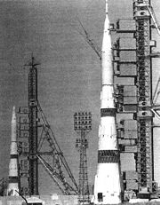
N1 rocket

Encyclopedia
N-1 was a heavy lift rocket intended to deliver payloads beyond low Earth orbit
, acting as the Soviet counterpart to the NASA Saturn V
rocket. This heavy lift booster had the capability of lifting very heavy loads into orbit, designed with manned extra-orbital travel in mind. Development work started on the N-1 in 1959.
The N1-L3 version was developed to compete with the United States
Apollo
Saturn V
to land a man on the Moon. The basic N1 launch vehicle had three stages, which carried the L3 lunar payload into Low Earth orbit
. The L3 contained an Earth departure stage and a lunar landing assist stage, in addition to the single-cosmonaut LK Lander
spacecraft, and a two-cosmonaut Soyuz 7K-L3
lunar orbital spacecraft.
N1-L3 was underfunded, undertested, and started development in October 1965, almost four years after the Saturn V. The project got badly derailed by the death of its chief designer Sergei Korolev in 1966. After four failed launch attempts, the program was suspended in 1974, and in 1976 was officially cancelled. The N1 program (along with the rest of the Soviet manned moon programs
) was kept secret almost until the collapse of the Soviet Union
in December 1991; information about the N1 was first published in 1989.
Design Bureau. The original design proposed a 50 metric tons (110,231.1 lb) payload intended as a launcher for military space station
s and a manned Mars flyby using a nuclear engine upper stage. The N1 was the largest of three proposed designs; the N2 was somewhat smaller and intended to compete with Vladimir Chelomei
's proposed UR-200
, and the much smaller N3, which would replace Korolev's "workhorse" R-7 rocket. At this point the N-series was strictly a "paper project".
In December 1959 a meeting was called with all of the chief designers, who presented their latest designs to the military. Korolev presented the N-series along with a much more modest series of upgrades to the R-7. Vladimir Chelomei
, Korolev's rival, presented his "Universal Rocket" series, which used a common lower stage in various clustered configurations to meet a wide variety of payload requirements. Mikhail Yangel
, perhaps the most successful of the three but with little political power, presented the small R-26 intended to replace the R-16, the much larger R-36 ICBM, as well as the SK-100, a space launcher based on a huge cluster of R-16's. In the end the military planners selected Chelomei's UR-100
as the new "light" ICBM, and Yangel's R-36 for the "heavy" role. They saw no need for any of the larger dedicated launchers, but also gave Korolev funding to develop the Molniya
(8K78) adaptation of the R-7.
In March 1961, during a meeting at Baikonur
, designers discussed the N1 design, along with a competing Glushko
design, the R-20. In June, Korolev was given a small amount of funding for N1 development between 1961 and 1963. In May 1961 a government report, On Reconsideration of the Plans for Space Vehicles in the Direction of Defense Purposes, set the first test launch of the N1 rocket for 1965.
, that was designed for Earth orbit rendezvous
. Several launches would be used to build up a complete moon package, one for the Soyuz, another for the lunar lander, and additional launches with cislunar engines and fuel. This approach makes the least demands on the launch vehicle, as the payload mass is reduced for any one launch. This is at the expense of requiring a rapid launch rate to ensure that the modules are built up before running out of consumables while waiting on-orbit. Even using this profile the lunar boosters and fuel were too large for any existing Soviet launcher. Korolev thus proposed development of the N1 with a 50 MT (110,231.1 lb) payload much smaller than the N1 design that would eventually be delivered.
To power the new design, Valentin Glushko
, who then held a near-monopoly on rocket engine design in the Soviet Union, proposed a new engine, the RD-270
, running on unsymmetrical dimethylhydrazine (UDMH) and nitrogen tetroxide (N2O4). This formula is hypergolic (i.e. its components ignite on contact, reducing the complexity of the combustion system), and was widely used in Glushko's existing engine designs used on various ICBMs. The propellant pair UDMH/N2O4 has a lower specific impulse
than kerosene
/liquid oxygen
,however because the RD-270 uses the much more efficient Full flow staged combustion cycle as opposed to the simple gas generator cycle used on the American F-1 rocket engine the specific impulse of RD-270 was higher than the comparable American F-1. Korolev also felt that the toxic nature of the fuels and their exhaust presented a safety risk for manned space flight.However Glushko pointed out that the US titan rockets used to launch Gemini spacecraft also used identical propellants so these concerns were unwarranted.What is more given the fact that the Americans had a 5 year head start with the American F-1 engine development and still facing combustion stability problems it was unrealistic to expect him to miraculously virtually overnight deliver a similar engine with practically no money,primitive computer technology and a very inferior kersosene fuel prone to coking at high temperatures as opposed to the rocket grade fuel used in the Saturn V.There were strong personal resentments between the two, Korolev holding Glushko responsible for his near death at Kolyma Gulag and failure of his first marriage as a result and Glushko considering Korolev to be irresponsibly cavalier and autocratic in his attitudes towards things outside his competence in this case rocket engines and refused outright to work on LOX/Kerosene engines and Korolev in general.He instead teamed up with other rocket designers to build the very successful Proton rocket.Later he did build a LOX/Kerosene engine even more powerful and advanced than the F-1 known as the RD-170 however its development took over ten years despite it being 20 years after the American F-1 due to the relative backwardness of the USSR's industrial base as foreseen by Glushko and thus probably vindicated his decision not to support the development of such an engine for the N-1 rocket.
The difference of opinions led to a falling out between Korolev and Glushko. In 1962 a committee that was appointed to break the logjam agreed with Korolev. Since Glushko refused to work on such a design, Korolev eventually "gave up" and decided to enlist the help of Nikolai Kuznetsov
, the OKB-276 jet engine
designer. Kuznetsov, who had limited experience in rocket design, responded with a fairly small engine known as the NK-15, which would be delivered in several versions tuned to different altitudes. To achieve the required amount of thrust, it was proposed that a large number of NK-15s would be used in a clustered configuration around the outer rim of the lower-stage booster. The "inside" of the ring of engines would be open, with air piped into the hole via inlets near the top of the booster stage. The air would be mixed with the exhaust in order to provide thrust augmentation
, as well as additional combustion with the deliberately fuel-rich exhaust. The ring-like arrangement of so many rocket engine nozzles on the N1's first stage could have been an attempt at creating a crude version of a toroidal aerospike engine
system; more conventional aerospike engines were also studied.
Meanwhile, Chelomei's OKB-52 proposed an alternate mission with much lower risk. Instead of a manned landing, Chelomei proposed a series of circumlunar missions which he felt would be able to beat the US. He also proposed a new booster for the mission, clustering three of his existing UR-200 designs (known as the SS-10 in the west) to produce a single larger booster, the UR-500. However, these plans were dropped when Glushko offered Chelomei the RD-270, which allowed the construction of a much simpler "monoblock" design, also known as the UR-500. He also proposed adapting an existing spacecraft design for the circumlunar mission, the single-cosmonaut LK-1. Chelomei felt that improvements in early UR-500/LK-1 missions would allow the spacecraft to be adapted for two cosmonauts.
The Soviet military, specifically the Strategic Missile Forces, was reluctant to support what was essentially a politically-motivated project with little military utility, but both Korolev and Chelomei pushed for a lunar mission. For some time, between 1961 and 1964, Chelomei's less aggressive proposal was accepted, and development of his UR-500 and the LK-1 were given a high priority.
reversed the Soviet lead in human space exploration by 1966, Korolev was able to persuade Leonid Brezhnev
to let him pursue his plans to make a lunar landing before the US. Since there were a number of unknowns in the Earth orbit rendezvous profile that could not be tested in time, a direct ascent
profile similar to Apollo was selected. This required much larger boosters.
Korolev proposed a larger N1, combined with a new lunar package known as the L3
. The L3 combined the lunar engines, an adapted Soyuz spacecraft
(the LOK
) and the new LK lunar lander
in a single package. Chelomei responded with a clustered UR-500-derived vehicle, topped with the L1 spacecraft already under development, and a lander of their own design. Korolev's proposal was selected as the winner in August 1964, while Chelomei was told to continue with his circumlunar UR-500/L1 work.
When Khrushchev was overthrown later in 1964, infighting between the two teams started anew. In October 1965 the Soviet government ordered a compromise; the circumlunar mission would be launched on Chelomei's UR-500 using Korolev's Soyuz spacecraft in place of their own Zond design, aiming for a launch in 1967, the 50th anniversary of the Bolshevik Revolution. Korolev, meanwhile, would continue with his original N1-L3 proposal. Korolev had clearly won the argument, but work on the L1 continued anyway, as well as the Zond.
Korolev died in 1966 due to complications after minor surgery, and the work was taken over by his deputy, Vasily Mishin
. Mishin did not have Korolev's political astuteness or power, a problem that led to the eventual downfall of the N1, and of the lunar mission as a whole.
 The N1 was a very large rocket, standing 105 metres (344.5 ft) tall—among the world's largest launch vehicles, somewhat smaller than the Saturn V
in height and mass, but greater in lift-off thrust, but with significantly less payload capability. The N1-L3 consisted of five stages in total, three for immediate boost into orbit (the N1), and another two for the lunar portion (the L3). Fully loaded and fueled, the N1-L3 weighed 2788 metric tons (6,146,487.9 lb). The lower three stages were shaped to produce a single truncated cone just over 10 m wide at the base, while the L3 section was cylindrical at about 4.4 m wide. The conical shaping of the lower stages was due to the arrangement of the tanks within, a smaller spherical kerosene tank on top of the larger liquid oxygen tank below.
The first stage, Block A, was powered by 30 NK-15 engines arranged in two rings, the main ring of 24 at the outer edge of the booster, the inner of 6 at about half diameter. The engines were the first ever staged combustion cycle
engines. The control system was primarily based on differential throttling of the engines, the outer ring for pitch and yaw, the inner six on gimballing mounts for roll. The Block A also included four grid fins, which were later used on Soviet air-to-air missile
designs. In total, the Block A produced 43 meganewtons (9,666,784.6 lbf) of thrust. This exceeded the 33.7 meganewtons (7,576,061.4 lbf) thrust of the Saturn V.
The second stage, Block B, was powered by 8 NK-15V engines arranged in a single ring. The only major difference between the NK-15 and -15V was the engine bell and various tunings for air-start and high-altitude performance. The upper stage, Block V (V being the third letter in the Russian alphabet), mounted four smaller NK-21 engines in a square.
During the N1's lifetime, a series of improved engines was introduced to replace those used in the original design. The first stage used an adaptation of the NK-15 known as the NK-33
, the second stage a similar modification known as the NK-43, and finally the third stage used the NK-31. The resulting modified N1 was known as the N1F, but did not fly before the project's cancellation.
In comparison with the American Saturn V
, the N1 is slightly shorter, more slender overall, but wider at the base. Generally the N1 produced much more thrust than the Saturn V. It used only kerosene
fuel in all three of its stages, and had somewhat lesser overall performance than the Saturn; the N1 stack was intended to place about 90 metric tons (198,416 lb) of payload into Low Earth orbit
, whereas the Saturn V could orbit about 119 tonnes (131.2 ST). The US's experience with higher energy liquid hydrogen
as fuel gave them the confidence to use it on the Saturn upper stages, which significantly reduced the upper stages' take-off weight and increased the payload fraction
. The Saturn V also had a superior reliability record: it never lost a payload in 13 operational launches, while four N1 launch attempts all resulted in failure, with two payload losses.
The US spent more money developing the Saturn V. Development of the Saturn V also began almost four years sooner, in January of 1962.
As a result of its technical difficulties, in turn due to lack of funding for full-up testing, the N1 never successfully completed a test flight. All four unmanned launches out of 12 planned tests ended in failure, each before first-stage separation. The longest flight lasted 107 seconds, just before 1st stage separation. Two test launches occurred in 1969, one in 1971 and the final one in 1972.
Mishin continued with the N1F project after the cancellation of plans for a manned moon landing in the hope that the booster would be used to launch a large space station
comparable to the US Skylab
. The program was terminated in 1974 when Mishin was replaced by Glushko. Two N1Fs were being readied for launch at the time, but these plans were cancelled.
The program was followed by the "Vulkan" concept for a huge Proton-like hypergolic-fueled vehicle, and then in 1976 by the commencement of the Energia
/Buran program.
, when the remaining hardware was seen publicly on display.
The advanced engines for the N1F escaped destruction. Although the rocket as a whole was unreliable, the NK-33
and NK-43
engines are considered rugged and reliable when used as a standalone unit. About 150 engines survived, and in the mid-1990s, Russia sold 36 engines to Aerojet General for $1.1 million each. This company also acquired a license for the production of new engines.
Supplied through Aerojet, three of the engines were incorporated into Japanese rockets J-1
and J-2. The US company Kistler Aerospace worked on incorporating these engines into a new rocket design, with which Kistler sought to eventually offer commercial launch services, before declaring bankruptcy. In Russia, N1 engines were not used again until 2004, when the remaining 70 or so engines were incorporated into a new rocket design. , the project has been frozen due to the lack of funding. The current design of Orbital Science
's Taurus II
launch vehicle includes two NK-33s as the first stage engines.
letter Ze
for "Z" and the number "3". Sometimes both forms are used within the same Russian website (or even the same article). English sources refer only to N1-L3. It is clear from the writing of a leading project designer that the correct designation is L3, representing the third stage of Soviet lunar exploration. Stage 1 would be an unmanned circumlunar flight; stage two would be a manned circumlunar flight, and stage 3 would be the manned landing.
Low Earth orbit
A low Earth orbit is generally defined as an orbit within the locus extending from the Earth’s surface up to an altitude of 2,000 km...
, acting as the Soviet counterpart to the NASA Saturn V
Saturn V
The Saturn V was an American human-rated expendable rocket used by NASA's Apollo and Skylab programs from 1967 until 1973. A multistage liquid-fueled launch vehicle, NASA launched 13 Saturn Vs from the Kennedy Space Center, Florida with no loss of crew or payload...
rocket. This heavy lift booster had the capability of lifting very heavy loads into orbit, designed with manned extra-orbital travel in mind. Development work started on the N-1 in 1959.
The N1-L3 version was developed to compete with the United States
United States
The United States of America is a federal constitutional republic comprising fifty states and a federal district...
Apollo
Project Apollo
The Apollo program was the spaceflight effort carried out by the United States' National Aeronautics and Space Administration , that landed the first humans on Earth's Moon. Conceived during the Presidency of Dwight D. Eisenhower, Apollo began in earnest after President John F...
Saturn V
Saturn V
The Saturn V was an American human-rated expendable rocket used by NASA's Apollo and Skylab programs from 1967 until 1973. A multistage liquid-fueled launch vehicle, NASA launched 13 Saturn Vs from the Kennedy Space Center, Florida with no loss of crew or payload...
to land a man on the Moon. The basic N1 launch vehicle had three stages, which carried the L3 lunar payload into Low Earth orbit
Low Earth orbit
A low Earth orbit is generally defined as an orbit within the locus extending from the Earth’s surface up to an altitude of 2,000 km...
. The L3 contained an Earth departure stage and a lunar landing assist stage, in addition to the single-cosmonaut LK Lander
LK Lander
The LK was a Soviet lunar lander and counterpart of the American Lunar Module . The LK was to have landed up to two cosmonauts on the Moon...
spacecraft, and a two-cosmonaut Soyuz 7K-L3
Soyuz 7K-L3
The Soyuz 7K-LOK, or simply LOK was a Soviet spacecraft designed to launch men from Earth to circle the moon and developed in parallel to the 7K-L1. The LOK would carry two cosmonauts into orbit around the Moon, acting as "mother" spacecraft for the LK Lander, which would land one member of the...
lunar orbital spacecraft.
N1-L3 was underfunded, undertested, and started development in October 1965, almost four years after the Saturn V. The project got badly derailed by the death of its chief designer Sergei Korolev in 1966. After four failed launch attempts, the program was suspended in 1974, and in 1976 was officially cancelled. The N1 program (along with the rest of the Soviet manned moon programs
Soviet Moonshot
The Soviet manned lunar programs were a series of programs pursued by the Soviet Union to land a man on the Moon in competition with the United States Apollo program to achieve the same goal set publicly by President John F. Kennedy on May 25, 1961...
) was kept secret almost until the collapse of the Soviet Union
Soviet Union
The Soviet Union , officially the Union of Soviet Socialist Republics , was a constitutionally socialist state that existed in Eurasia between 1922 and 1991....
in December 1991; information about the N1 was first published in 1989.
Early work
Development began under the direction of Sergei Korolev at his OKB-1S.P. Korolev Rocket and Space Corporation Energia
OAO S.P. Korolev Rocket and Space Corporation Energia , also known as RKK Energiya, is a Russian manufacturer of spacecraft and space station components...
Design Bureau. The original design proposed a 50 metric tons (110,231.1 lb) payload intended as a launcher for military space station
Space station
A space station is a spacecraft capable of supporting a crew which is designed to remain in space for an extended period of time, and to which other spacecraft can dock. A space station is distinguished from other spacecraft used for human spaceflight by its lack of major propulsion or landing...
s and a manned Mars flyby using a nuclear engine upper stage. The N1 was the largest of three proposed designs; the N2 was somewhat smaller and intended to compete with Vladimir Chelomei
Vladimir Chelomei
Vladimir Nikolayevich Chelomey was a Soviet mechanics scientist and rocket engineer from Ukraine.-Early life:Chelomey was born in Siedlce, Russian Empire into a Ukrainian family...
's proposed UR-200
UR-200
The UR-200 was an intercontinental ballistic missile developed by OKB-52 of Vladimir Nikolaevich Chelomey in the Soviet Union. It was known during the Cold War by the NATO reporting name SS-10 Scrag and internally by the GRAU index 8K81...
, and the much smaller N3, which would replace Korolev's "workhorse" R-7 rocket. At this point the N-series was strictly a "paper project".
In December 1959 a meeting was called with all of the chief designers, who presented their latest designs to the military. Korolev presented the N-series along with a much more modest series of upgrades to the R-7. Vladimir Chelomei
Vladimir Chelomei
Vladimir Nikolayevich Chelomey was a Soviet mechanics scientist and rocket engineer from Ukraine.-Early life:Chelomey was born in Siedlce, Russian Empire into a Ukrainian family...
, Korolev's rival, presented his "Universal Rocket" series, which used a common lower stage in various clustered configurations to meet a wide variety of payload requirements. Mikhail Yangel
Mikhail Yangel
Mikhail Kuzmich Yangel , was a leading missile designer in the Soviet Union....
, perhaps the most successful of the three but with little political power, presented the small R-26 intended to replace the R-16, the much larger R-36 ICBM, as well as the SK-100, a space launcher based on a huge cluster of R-16's. In the end the military planners selected Chelomei's UR-100
UR-100
The UR-100 was an intercontinental ballistic missile developed and deployed by the Soviet Union from 1966 to 1996. УР in its designation stands for "универсальная ракета"...
as the new "light" ICBM, and Yangel's R-36 for the "heavy" role. They saw no need for any of the larger dedicated launchers, but also gave Korolev funding to develop the Molniya
Molniya (rocket)
Molniya 8K78 was a modification of the well-known R-7 Semyorka rocket and had four stages.This derivative of the original three stage Vostok rocket was especially designed to bring high flying satellites into orbit or to launch probes to other planets. The first launch of this rocket was on...
(8K78) adaptation of the R-7.
In March 1961, during a meeting at Baikonur
Baikonur
Baikonur , formerly known as Leninsk, is a city in Kyzylorda Province of Kazakhstan, rented and administered by the Russian Federation. It was constructed to service the Baikonur Cosmodrome and was officially renamed Baikonur by Russian president Boris Yeltsin on December 20, 1995.The shape of the...
, designers discussed the N1 design, along with a competing Glushko
Valentin Glushko
Valentin Petrovich Glushko or Valentyn Petrovych Hlushko was a Soviet engineer, and the principal Soviet designer of rocket engines during the Soviet/American Space Race.-Biography:...
design, the R-20. In June, Korolev was given a small amount of funding for N1 development between 1961 and 1963. In May 1961 a government report, On Reconsideration of the Plans for Space Vehicles in the Direction of Defense Purposes, set the first test launch of the N1 rocket for 1965.
Moon missions
When the US announced the goal of landing a man on the Moon in May 1961, Korolev proposed a lunar mission based on a new spacecraft, eventually known as SoyuzSoyuz spacecraft
Soyuz , Union) is a series of spacecraft initially designed for the Soviet space programme by the Korolyov Design Bureau in the 1960s, and still in service today...
, that was designed for Earth orbit rendezvous
Earth orbit rendezvous
Earth orbit rendezvous is a type of space rendezvous and a spaceflight methodology most notable for enabling round trip human missions to the moon...
. Several launches would be used to build up a complete moon package, one for the Soyuz, another for the lunar lander, and additional launches with cislunar engines and fuel. This approach makes the least demands on the launch vehicle, as the payload mass is reduced for any one launch. This is at the expense of requiring a rapid launch rate to ensure that the modules are built up before running out of consumables while waiting on-orbit. Even using this profile the lunar boosters and fuel were too large for any existing Soviet launcher. Korolev thus proposed development of the N1 with a 50 MT (110,231.1 lb) payload much smaller than the N1 design that would eventually be delivered.
To power the new design, Valentin Glushko
Valentin Glushko
Valentin Petrovich Glushko or Valentyn Petrovych Hlushko was a Soviet engineer, and the principal Soviet designer of rocket engines during the Soviet/American Space Race.-Biography:...
, who then held a near-monopoly on rocket engine design in the Soviet Union, proposed a new engine, the RD-270
RD-270
RD-270 - is a single chamber liquid bipropellant rocket engine designed by Energomash in 1960-1970. It was to be used on the first stages of proposed heavy-lift UR-700 and UR-900 rocket families. It has the highest thrust among single chambered engines of USSR and Russia, 640 metric tons at the...
, running on unsymmetrical dimethylhydrazine (UDMH) and nitrogen tetroxide (N2O4). This formula is hypergolic (i.e. its components ignite on contact, reducing the complexity of the combustion system), and was widely used in Glushko's existing engine designs used on various ICBMs. The propellant pair UDMH/N2O4 has a lower specific impulse
Specific impulse
Specific impulse is a way to describe the efficiency of rocket and jet engines. It represents the derivative of the impulse with respect to amount of propellant used, i.e., the thrust divided by the amount of propellant used per unit time. If the "amount" of propellant is given in terms of mass ,...
than kerosene
Kerosene
Kerosene, sometimes spelled kerosine in scientific and industrial usage, also known as paraffin or paraffin oil in the United Kingdom, Hong Kong, Ireland and South Africa, is a combustible hydrocarbon liquid. The name is derived from Greek keros...
/liquid oxygen
Liquid oxygen
Liquid oxygen — abbreviated LOx, LOX or Lox in the aerospace, submarine and gas industries — is one of the physical forms of elemental oxygen.-Physical properties:...
,however because the RD-270 uses the much more efficient Full flow staged combustion cycle as opposed to the simple gas generator cycle used on the American F-1 rocket engine the specific impulse of RD-270 was higher than the comparable American F-1. Korolev also felt that the toxic nature of the fuels and their exhaust presented a safety risk for manned space flight.However Glushko pointed out that the US titan rockets used to launch Gemini spacecraft also used identical propellants so these concerns were unwarranted.What is more given the fact that the Americans had a 5 year head start with the American F-1 engine development and still facing combustion stability problems it was unrealistic to expect him to miraculously virtually overnight deliver a similar engine with practically no money,primitive computer technology and a very inferior kersosene fuel prone to coking at high temperatures as opposed to the rocket grade fuel used in the Saturn V.There were strong personal resentments between the two, Korolev holding Glushko responsible for his near death at Kolyma Gulag and failure of his first marriage as a result and Glushko considering Korolev to be irresponsibly cavalier and autocratic in his attitudes towards things outside his competence in this case rocket engines and refused outright to work on LOX/Kerosene engines and Korolev in general.He instead teamed up with other rocket designers to build the very successful Proton rocket.Later he did build a LOX/Kerosene engine even more powerful and advanced than the F-1 known as the RD-170 however its development took over ten years despite it being 20 years after the American F-1 due to the relative backwardness of the USSR's industrial base as foreseen by Glushko and thus probably vindicated his decision not to support the development of such an engine for the N-1 rocket.
The difference of opinions led to a falling out between Korolev and Glushko. In 1962 a committee that was appointed to break the logjam agreed with Korolev. Since Glushko refused to work on such a design, Korolev eventually "gave up" and decided to enlist the help of Nikolai Kuznetsov
Kuznetsov (aircraft engines)
The Kuznetsov Design Bureau was a Soviet design bureau for aircraft engines, administrated by Nikolai Dmitriyevich Kuznetsov. It was created for developing German WW2 jet engine technology headed by a group of deported Junkers engineers under Ferdinand Brandner.The Kuznetzov Bureau first became...
, the OKB-276 jet engine
Jet engine
A jet engine is a reaction engine that discharges a fast moving jet to generate thrust by jet propulsion and in accordance with Newton's laws of motion. This broad definition of jet engines includes turbojets, turbofans, rockets, ramjets, pulse jets...
designer. Kuznetsov, who had limited experience in rocket design, responded with a fairly small engine known as the NK-15, which would be delivered in several versions tuned to different altitudes. To achieve the required amount of thrust, it was proposed that a large number of NK-15s would be used in a clustered configuration around the outer rim of the lower-stage booster. The "inside" of the ring of engines would be open, with air piped into the hole via inlets near the top of the booster stage. The air would be mixed with the exhaust in order to provide thrust augmentation
Air-augmented rocket
Air-augmented rockets use the supersonic exhaust of some kind of rocket engine to further compress air collected by ram effect during flight to use as additional working mass, leading to greater effective thrust for any given amount of fuel than either the rocket or a ramjet...
, as well as additional combustion with the deliberately fuel-rich exhaust. The ring-like arrangement of so many rocket engine nozzles on the N1's first stage could have been an attempt at creating a crude version of a toroidal aerospike engine
Aerospike engine
The aerospike engine is a type of rocket engine that maintains its aerodynamic efficiency across a wide range of altitudes through the use of an aerospike nozzle. It is a member of the class of altitude compensating nozzle engines. A vehicle with an aerospike engine uses 25–30% less fuel at low...
system; more conventional aerospike engines were also studied.
Meanwhile, Chelomei's OKB-52 proposed an alternate mission with much lower risk. Instead of a manned landing, Chelomei proposed a series of circumlunar missions which he felt would be able to beat the US. He also proposed a new booster for the mission, clustering three of his existing UR-200 designs (known as the SS-10 in the west) to produce a single larger booster, the UR-500. However, these plans were dropped when Glushko offered Chelomei the RD-270, which allowed the construction of a much simpler "monoblock" design, also known as the UR-500. He also proposed adapting an existing spacecraft design for the circumlunar mission, the single-cosmonaut LK-1. Chelomei felt that improvements in early UR-500/LK-1 missions would allow the spacecraft to be adapted for two cosmonauts.
The Soviet military, specifically the Strategic Missile Forces, was reluctant to support what was essentially a politically-motivated project with little military utility, but both Korolev and Chelomei pushed for a lunar mission. For some time, between 1961 and 1964, Chelomei's less aggressive proposal was accepted, and development of his UR-500 and the LK-1 were given a high priority.
Space race
Since the US Project GeminiProject Gemini
Project Gemini was the second human spaceflight program of NASA, the civilian space agency of the United States government. Project Gemini was conducted between projects Mercury and Apollo, with ten manned flights occurring in 1965 and 1966....
reversed the Soviet lead in human space exploration by 1966, Korolev was able to persuade Leonid Brezhnev
Leonid Brezhnev
Leonid Ilyich Brezhnev – 10 November 1982) was the General Secretary of the Central Committee of the Communist Party of the Soviet Union , presiding over the country from 1964 until his death in 1982. His eighteen-year term as General Secretary was second only to that of Joseph Stalin in...
to let him pursue his plans to make a lunar landing before the US. Since there were a number of unknowns in the Earth orbit rendezvous profile that could not be tested in time, a direct ascent
Direct ascent
Direct ascent was a proposed method for a mission to the Moon. In the United States, direct ascent proposed using the enormous Nova rocket to launch a spacecraft directly to the Moon, where it would land tail-first and then launch off the Moon back to Earth...
profile similar to Apollo was selected. This required much larger boosters.
Korolev proposed a larger N1, combined with a new lunar package known as the L3
Soyuz 7K-L3
The Soyuz 7K-LOK, or simply LOK was a Soviet spacecraft designed to launch men from Earth to circle the moon and developed in parallel to the 7K-L1. The LOK would carry two cosmonauts into orbit around the Moon, acting as "mother" spacecraft for the LK Lander, which would land one member of the...
. The L3 combined the lunar engines, an adapted Soyuz spacecraft
Soyuz spacecraft
Soyuz , Union) is a series of spacecraft initially designed for the Soviet space programme by the Korolyov Design Bureau in the 1960s, and still in service today...
(the LOK
Soyuz 7K-L3
The Soyuz 7K-LOK, or simply LOK was a Soviet spacecraft designed to launch men from Earth to circle the moon and developed in parallel to the 7K-L1. The LOK would carry two cosmonauts into orbit around the Moon, acting as "mother" spacecraft for the LK Lander, which would land one member of the...
) and the new LK lunar lander
LK Lander
The LK was a Soviet lunar lander and counterpart of the American Lunar Module . The LK was to have landed up to two cosmonauts on the Moon...
in a single package. Chelomei responded with a clustered UR-500-derived vehicle, topped with the L1 spacecraft already under development, and a lander of their own design. Korolev's proposal was selected as the winner in August 1964, while Chelomei was told to continue with his circumlunar UR-500/L1 work.
When Khrushchev was overthrown later in 1964, infighting between the two teams started anew. In October 1965 the Soviet government ordered a compromise; the circumlunar mission would be launched on Chelomei's UR-500 using Korolev's Soyuz spacecraft in place of their own Zond design, aiming for a launch in 1967, the 50th anniversary of the Bolshevik Revolution. Korolev, meanwhile, would continue with his original N1-L3 proposal. Korolev had clearly won the argument, but work on the L1 continued anyway, as well as the Zond.
Korolev died in 1966 due to complications after minor surgery, and the work was taken over by his deputy, Vasily Mishin
Vasily Mishin
Vasily Pavlovich Mishin was a Soviet engineer and a prominent rocketry pioneer....
. Mishin did not have Korolev's political astuteness or power, a problem that led to the eventual downfall of the N1, and of the lunar mission as a whole.
Description
Saturn V
The Saturn V was an American human-rated expendable rocket used by NASA's Apollo and Skylab programs from 1967 until 1973. A multistage liquid-fueled launch vehicle, NASA launched 13 Saturn Vs from the Kennedy Space Center, Florida with no loss of crew or payload...
in height and mass, but greater in lift-off thrust, but with significantly less payload capability. The N1-L3 consisted of five stages in total, three for immediate boost into orbit (the N1), and another two for the lunar portion (the L3). Fully loaded and fueled, the N1-L3 weighed 2788 metric tons (6,146,487.9 lb). The lower three stages were shaped to produce a single truncated cone just over 10 m wide at the base, while the L3 section was cylindrical at about 4.4 m wide. The conical shaping of the lower stages was due to the arrangement of the tanks within, a smaller spherical kerosene tank on top of the larger liquid oxygen tank below.
The first stage, Block A, was powered by 30 NK-15 engines arranged in two rings, the main ring of 24 at the outer edge of the booster, the inner of 6 at about half diameter. The engines were the first ever staged combustion cycle
Staged combustion cycle (rocket)
The staged combustion cycle, also called topping cycle or pre-burner cycle, is a thermodynamic cycle of bipropellant rocket engines. Some of the propellant is burned in a pre-burner and the resulting hot gas is used to power the engine's turbines and pumps...
engines. The control system was primarily based on differential throttling of the engines, the outer ring for pitch and yaw, the inner six on gimballing mounts for roll. The Block A also included four grid fins, which were later used on Soviet air-to-air missile
Air-to-air missile
An air-to-air missile is a missile fired from an aircraft for the purpose of destroying another aircraft. AAMs are typically powered by one or more rocket motors, usually solid fuelled but sometimes liquid fuelled...
designs. In total, the Block A produced 43 meganewtons (9,666,784.6 lbf) of thrust. This exceeded the 33.7 meganewtons (7,576,061.4 lbf) thrust of the Saturn V.
The second stage, Block B, was powered by 8 NK-15V engines arranged in a single ring. The only major difference between the NK-15 and -15V was the engine bell and various tunings for air-start and high-altitude performance. The upper stage, Block V (V being the third letter in the Russian alphabet), mounted four smaller NK-21 engines in a square.
During the N1's lifetime, a series of improved engines was introduced to replace those used in the original design. The first stage used an adaptation of the NK-15 known as the NK-33
NK-33
The NK-33 and NK-43 are rocket engines designed and built in the late 1960s and early 1970s by the Kuznetsov Design Bureau. They were intended for the ill-fated Soviet N-1 rocket moon shot. The NK-33 engine achieves the highest thrust-to-weight ratio of any Earth-launchable rocket engine, whilst...
, the second stage a similar modification known as the NK-43, and finally the third stage used the NK-31. The resulting modified N1 was known as the N1F, but did not fly before the project's cancellation.
In comparison with the American Saturn V
Saturn V
The Saturn V was an American human-rated expendable rocket used by NASA's Apollo and Skylab programs from 1967 until 1973. A multistage liquid-fueled launch vehicle, NASA launched 13 Saturn Vs from the Kennedy Space Center, Florida with no loss of crew or payload...
, the N1 is slightly shorter, more slender overall, but wider at the base. Generally the N1 produced much more thrust than the Saturn V. It used only kerosene
Kerosene
Kerosene, sometimes spelled kerosine in scientific and industrial usage, also known as paraffin or paraffin oil in the United Kingdom, Hong Kong, Ireland and South Africa, is a combustible hydrocarbon liquid. The name is derived from Greek keros...
fuel in all three of its stages, and had somewhat lesser overall performance than the Saturn; the N1 stack was intended to place about 90 metric tons (198,416 lb) of payload into Low Earth orbit
Low Earth orbit
A low Earth orbit is generally defined as an orbit within the locus extending from the Earth’s surface up to an altitude of 2,000 km...
, whereas the Saturn V could orbit about 119 tonnes (131.2 ST). The US's experience with higher energy liquid hydrogen
Liquid hydrogen
Liquid hydrogen is the liquid state of the element hydrogen. Hydrogen is found naturally in the molecular H2 form.To exist as a liquid, H2 must be pressurized above and cooled below hydrogen's Critical point. However, for hydrogen to be in a full liquid state without boiling off, it needs to be...
as fuel gave them the confidence to use it on the Saturn upper stages, which significantly reduced the upper stages' take-off weight and increased the payload fraction
Payload fraction
In aerospace engineering, payload fraction is a common term used to characterize the efficiency of a particular design. Payload fraction is calculated by dividing the weight of the payload by the weight of the otherwise empty aircraft when fully fueled...
. The Saturn V also had a superior reliability record: it never lost a payload in 13 operational launches, while four N1 launch attempts all resulted in failure, with two payload losses.
The US spent more money developing the Saturn V. Development of the Saturn V also began almost four years sooner, in January of 1962.
Problems
Complex plumbing was needed to feed fuel and oxidizer into the clustered arrangement of rocket engines. This proved to be extremely fragile, and was a major factor in the design's launch failures. Furthermore the N1's Baikonur launch complex could not be reached by heavy barge. To allow transport by rail, all the stages had to be broken down and re-assembled. As a result, the complex and destructive vibrational modes (which ripped apart propellant lines and turbines) as well as exhaust plume fluid dynamic problems (causing vehicle roll, vacuum cavitation, and other problems) were not discovered and worked out before flight.As a result of its technical difficulties, in turn due to lack of funding for full-up testing, the N1 never successfully completed a test flight. All four unmanned launches out of 12 planned tests ended in failure, each before first-stage separation. The longest flight lasted 107 seconds, just before 1st stage separation. Two test launches occurred in 1969, one in 1971 and the final one in 1972.
Mishin continued with the N1F project after the cancellation of plans for a manned moon landing in the hope that the booster would be used to launch a large space station
Space station
A space station is a spacecraft capable of supporting a crew which is designed to remain in space for an extended period of time, and to which other spacecraft can dock. A space station is distinguished from other spacecraft used for human spaceflight by its lack of major propulsion or landing...
comparable to the US Skylab
Skylab
Skylab was a space station launched and operated by NASA, the space agency of the United States. Skylab orbited the Earth from 1973 to 1979, and included a workshop, a solar observatory, and other systems. It was launched unmanned by a modified Saturn V rocket, with a mass of...
. The program was terminated in 1974 when Mishin was replaced by Glushko. Two N1Fs were being readied for launch at the time, but these plans were cancelled.
The program was followed by the "Vulkan" concept for a huge Proton-like hypergolic-fueled vehicle, and then in 1976 by the commencement of the Energia
Energia
Energia was a Soviet rocket that was designed by NPO Energia to serve as a heavy-lift expendable launch system as well as a booster for the Buran spacecraft. Control system main developer enterprise was the NPO "Electropribor"...
/Buran program.
N1 vehicles
- N1 1M1 - Static test model, two first stages painted gray, third stage gray-white and L3 white.
- N1 1L and 2L - test vehicles
- N1 3L - first launch attempt, engine fire, exploded at 12 km
- N1 4L - never launched, parts used for other launchers
- N1 5L - partially painted gray; early launch failure destroyed pad
- N1 6L - launched from the second pad 110, deficient roll control, destroyed at 1 km
- N1 7L - all white, last launch attempt; pogo failure, cutoff at 40 km
- N1 8L, 9L and 10L
Remains
The two flight-ready N1Fs were scrapped and their remains could still be found around Baikonur years later used as shelters and storage sheds. The boosters were deliberately broken up in an effort to cover up the USSR's failed moon attempts, which was publicly stated to be a paper project in order to fool the US into thinking there was a race going on. This cover story lasted until glasnostGlasnost
Glasnost was the policy of maximal publicity, openness, and transparency in the activities of all government institutions in the Soviet Union, together with freedom of information, introduced by Mikhail Gorbachev in the second half of the 1980s...
, when the remaining hardware was seen publicly on display.
The advanced engines for the N1F escaped destruction. Although the rocket as a whole was unreliable, the NK-33
NK-33
The NK-33 and NK-43 are rocket engines designed and built in the late 1960s and early 1970s by the Kuznetsov Design Bureau. They were intended for the ill-fated Soviet N-1 rocket moon shot. The NK-33 engine achieves the highest thrust-to-weight ratio of any Earth-launchable rocket engine, whilst...
and NK-43
NK-33
The NK-33 and NK-43 are rocket engines designed and built in the late 1960s and early 1970s by the Kuznetsov Design Bureau. They were intended for the ill-fated Soviet N-1 rocket moon shot. The NK-33 engine achieves the highest thrust-to-weight ratio of any Earth-launchable rocket engine, whilst...
engines are considered rugged and reliable when used as a standalone unit. About 150 engines survived, and in the mid-1990s, Russia sold 36 engines to Aerojet General for $1.1 million each. This company also acquired a license for the production of new engines.
Supplied through Aerojet, three of the engines were incorporated into Japanese rockets J-1
J-I
The J-I was a Japan Aerospace Exploration Agency solid rocket expendable launch vehicle. It flew only once, in 1996, in a partial configuration, to launch the demonstrator Hyflex...
and J-2. The US company Kistler Aerospace worked on incorporating these engines into a new rocket design, with which Kistler sought to eventually offer commercial launch services, before declaring bankruptcy. In Russia, N1 engines were not used again until 2004, when the remaining 70 or so engines were incorporated into a new rocket design. , the project has been frozen due to the lack of funding. The current design of Orbital Science
Orbital Sciences Corporation
Orbital Sciences Corporation is an American company which specializes in the manufacturing and launch of satellites. Its Launch Systems Group is heavily involved with missile defense launch systems...
's Taurus II
Taurus II
Taurus II is an expendable launch system being developed by Orbital Sciences Corporation. It is a two stage vehicle designed to launch payloads weighing up to into low-Earth orbit...
launch vehicle includes two NK-33s as the first stage engines.
Launch history
- February 21, 1969 – Vehicle serial number 3LDue to unexpected high-frequency oscillations in the gas generator, one of the pipes broke apart and a fire started. This fire reached the engine control system which at the 68.7 s of flight sent the command to shut down the engines. The rocket exploded at 12,200 m altitude, 69 seconds after liftoff. The emergency rescue system was activated and did its job properly, saving the mockup of the spacecraft. All subsequent flights had freon fire extinguishers installed next to every engine.
- July 3, 1969 – Vehicle serial number 5L At liftoff a loose bolt was ingested into a fuel pump, which failed. After detecting the inoperative fuel pump, the automatic engine control shut off 29 of 30 engines, which caused the rocket to stall. The rocket exploded 23 seconds after shutting off the engines, destroying the rocket and launch tower in the biggest explosion in the history of rocketry and also the largest manmade non-nuclear explosion ever (nearly 7 kilotons of TNT equivalent.) The destroyed complex was photographed by American satellites, disclosing that the Soviet Union was building a Moon rocket. The rescue system saved the dummy spacecraft again. After this flight, fuel filters were installed in later models.
- June 26, 1971 – Vehicle serial number 6L experienced an uncontrolled roll immediately after liftoff beyond the capability of the control system to compensate; the vehicle was destroyed 51 seconds after liftoff at 1 km altitude. This vehicle had dummy upper stages without the rescue system. The next, last vehicle had much more powerful stabilization system with dedicated engines (in the previous versions stabilization was done by directing exhaust from the main engines). The engine control system was also reworked, increasing the number of sensors from 700 to 13,000.
- November 23, 1972 – Vehicle serial number 7L the engines ran for 106.93 seconds after which pogo oscillationPogo oscillationPogo oscillation is a potentially dangerous type of self-excited combustion oscillation in liquid fuel rocket engines. This oscillation results in variations of thrust from the engines, causing variations of acceleration on the rocket's structure, giving variations in fuel pressure and flow rate....
of the first stage caused engine cutoff (a problem which also plagued the engineers of the US Saturn VSaturn VThe Saturn V was an American human-rated expendable rocket used by NASA's Apollo and Skylab programs from 1967 until 1973. A multistage liquid-fueled launch vehicle, NASA launched 13 Saturn Vs from the Kennedy Space Center, Florida with no loss of crew or payload...
) at 40 km altitude; a programmed shutdown of some of the engines to prevent over-stressing of the structure led to an explosion of the oxygen pump on the engine number 4. The vehicle disintegrated.
Confusion on L3 designation
There is a great deal of confusion among Russian online sources as to whether N1-L3 (Russian: Н1-Л3) or N1-LZ (Russian: Н1-ЛЗ) was intended, because of the similarity of the CyrillicCyrillic alphabet
The Cyrillic script or azbuka is an alphabetic writing system developed in the First Bulgarian Empire during the 10th century AD at the Preslav Literary School...
letter Ze
Ze (Cyrillic)
Ze is a letter of the Cyrillic alphabet.It commonly represents the voiced alveolar fricative , like the pronunciation of ⟨z⟩ in "zoo".Ze is romanized using the Latin letter ⟨z⟩....
for "Z" and the number "3". Sometimes both forms are used within the same Russian website (or even the same article). English sources refer only to N1-L3. It is clear from the writing of a leading project designer that the correct designation is L3, representing the third stage of Soviet lunar exploration. Stage 1 would be an unmanned circumlunar flight; stage two would be a manned circumlunar flight, and stage 3 would be the manned landing.
See also
- Comparison of super heavy lift launch systems
- Soviet MoonshotSoviet MoonshotThe Soviet manned lunar programs were a series of programs pursued by the Soviet Union to land a man on the Moon in competition with the United States Apollo program to achieve the same goal set publicly by President John F. Kennedy on May 25, 1961...
- Nova rocket
- Ares VAres VThe Ares V was the planned cargo launch component of the Constellation program, which was to have replaced the Space Shuttle after its retirement in 2011. Ares V was also planned to carry supplies for a human presence on Mars...
External links
- Astronautix history of the N-1
- N-1 Launch Vehicle
- Statistics and information. Interactive model.
- Video footage of an N-1 exploding in flight
- Raketno-kosmicheskii kompleks N1-L3 (in Russian)
- Interview with Vasily Pavlovich Mishin (in Russian)
- Kistler Aerospace Corporation the U.S. company developing an NK-33 based rocket
- drawing