
All Topics  
Carnot cycle


   Email Print
   Bookmark   Link


Carnot cycle


The Carnot cycle is a particular thermodynamic cycle
Thermodynamic cycle

A thermodynamic cycle is a series of thermodynamic processes transferring heat and work, while varying pressure, temperature, and other state variables, eventually returning a system to its initial state....
, modeled on the hypothetical Carnot heat engine
Carnot heat engine

File:Carnot-engine-1824.pngA Carnot heat engine is a hypothetical engine that operates on the reversible Carnot cycle. The basic model for this engine was developed by Nicolas L?onard Sadi Carnot in 1824....
, proposed by Nicolas Léonard Sadi Carnot
Nicolas Léonard Sadi Carnot

Nicolas L?onard Sadi Carnot was a France physicist and military engineer who, in his 1824 Reflections on the Motive Power of Fire, gave the first successful theoretical account of heat engines, now known as the Carnot cycle, thereby laying the foundations of the second law of thermodynamics....
 in 1824 and expanded upon by Benoit Paul Émile Clapeyron in the 1830s and 40s.

Every thermodynamic system exists in a particular state. A thermodynamic cycle occurs when a system is taken through a series of different states, and finally returned to its initial state. In the process of going through this cycle, the system may perform work on its surroundings, thereby acting as a heat engine
Heat engine

A heat engine is a physical or theoretical device that converts thermal energy to mechanical output. The mechanical output is called Mechanical work, and the thermal energy input is called heat....
.

A heat engine acts by transferring energy from a warm region to a cool region of space and, in the process, converting some of that energy to mechanical work.


Discussion
Ask a question about 'Carnot cycle'
Start a new discussion about 'Carnot cycle'
Answer questions from other users
Full Discussion Forum


Recent Posts


Encyclopedia


The Carnot cycle is a particular thermodynamic cycle
Thermodynamic cycle

A thermodynamic cycle is a series of thermodynamic processes transferring heat and work, while varying pressure, temperature, and other state variables, eventually returning a system to its initial state....
, modeled on the hypothetical Carnot heat engine
Carnot heat engine

File:Carnot-engine-1824.pngA Carnot heat engine is a hypothetical engine that operates on the reversible Carnot cycle. The basic model for this engine was developed by Nicolas L?onard Sadi Carnot in 1824....
, proposed by Nicolas Léonard Sadi Carnot
Nicolas Léonard Sadi Carnot

Nicolas L?onard Sadi Carnot was a France physicist and military engineer who, in his 1824 Reflections on the Motive Power of Fire, gave the first successful theoretical account of heat engines, now known as the Carnot cycle, thereby laying the foundations of the second law of thermodynamics....
 in 1824 and expanded upon by Benoit Paul Émile Clapeyron in the 1830s and 40s.

Every thermodynamic system exists in a particular state. A thermodynamic cycle occurs when a system is taken through a series of different states, and finally returned to its initial state. In the process of going through this cycle, the system may perform work on its surroundings, thereby acting as a heat engine
Heat engine

A heat engine is a physical or theoretical device that converts thermal energy to mechanical output. The mechanical output is called Mechanical work, and the thermal energy input is called heat....
.

A heat engine acts by transferring energy from a warm region to a cool region of space and, in the process, converting some of that energy to mechanical work. The cycle may also be reversed. The system may be worked upon by an external force, and in the process, it can transfer thermal energy from a cooler system to a warmer one, thereby acting as a heat pump
Heat pump

A heat pump is a machine or device that moves heat from one location to another location using mechanical work. Most heat pump technology moves heat from a low temperature heat source to a higher temperature heat sink....
 rather than a heat engine.

The Carnot cycle is the most efficient cycle possible for converting a given amount of thermal energy into work or, conversely, for using a given amount of work for refrigeration purposes.

The Carnot cycle

The Carnot cycle when acting as a heat engine consists of the following steps:

  1. Reversible isothermal expansion of the gas at the "hot" temperature, TH (isothermal heat addition). During this step (A to B on Figure 1, 1 to 2 in Figure 2) the expanding gas causes the piston to do work on the surroundings. The gas expansion is propelled by absorption of quantity Q1 of heat from the high temperature reservoir.
  2. Isentropic
    Isentropic process

    In thermodynamics, an isentropic process or isoentropic process is one during which the entropy of the system remains constant. It can be proved that any Reversible process adiabatic process is an isentropic process....
     (Reversible adiabatic) expansion of the gas.
    For this step (B to C on Figure 1, 2 to 3 in Figure 2) we assume the piston and cylinder are thermally insulated, so that no heat is gained or lost. The gas continues to expand, doing work on the surroundings. The gas expansion causes it to cool to the "cold" temperature, TC.
  3. Reversible isothermal compression of the gas at the "cold" temperature, TC. (isothermal heat rejection) (C to D on Figure 1, 3 to 4 on Figure 2) Now the surroundings do work on the gas, causing quantity Q2 of heat to flow out of the gas to the low temperature reservoir.
  4. Isentropic compression of the gas. (D to A on Figure 1, 4 to 1 in Figure 2) Once again we assume the piston and cylinder are thermally insulated. During this step, the surroundings do work on the gas, compressing it and causing the temperature to rise to TH. At this point the gas is in the same state as at the start of step 1.


Carnotcycle1

Properties and significance


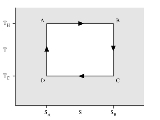
The temperature-entropy diagram


The behaviour of a Carnot engine or refrigerator is best understood by using a temperature-entropy (TS) diagram, in which the thermodynamic state is specified by a point on a graph with entropy
Entropy

In many branches of science, entropy is a measure of the disorder of a system. The concept of entropy is particularly notable as it is applied across physics, information theory and mathematics....
 (S) as the horizontal axis and temperature (T) as the vertical axis. For a simple system with a fixed number of particles, any point on the graph will represent a particular state of the system. A thermodynamic process will consist of a curve connecting an initial state (A) and a final state (B). The area under the curve will be:

which is the amount of thermal energy transferred in the process. If the process moves to greater entropy, the area under the curve will be the amount of heat absorbed by the system in that process. If the process moves towards lesser entropy, it will be the amount of heat removed. For any cyclic process, there will be an upper portion of the cycle and a lower portion. For a clockwise cycle, the area under the upper portion will be the thermal energy absorbed during the cycle, while the area under the lower portion will be the thermal energy removed during the cycle. The area inside the cycle will then be the difference between the two, but since the internal energy of the system must have returned to its initial value, this difference must be the amount of work done by the system over the cycle. Referring to figure 2, mathematically, for a reversible process we may write the amount of work done over a cyclic process as:

Since dU is an exact differential
Exact differential

In mathematics, a differential dQ is said to be exact, as contrasted with an inexact differential, if the differentiable function Q exists....
, its integral over any closed loop is zero and it follows that the area inside the loop on a T-S diagram is equal to the total work performed if the loop is traversed in a clockwise direction, and is equal to the total work done on the system as the loop is traversed in a counterclockwise direction.

The Carnot cycle


Evaluation of the above integral is particularly simple for the Carnot cycle. The amount of energy transferred as work is


The total amount of thermal energy transferred between the hot reservoir and the system will be


and the total amount of thermal energy transferred between the system and the cold reservoir will be

.


The efficiency is defined to be:

where
is the work done by the system (energy exiting the system as work),
is the heat put into the system (heat energy entering the system),
is the absolute temperature of the cold reservoir, and
is the temperature of the hot reservoir.
is the entropy of
is the entropy of
This efficiency makes sense for a heat engine
Heat engine

A heat engine is a physical or theoretical device that converts thermal energy to mechanical output. The mechanical output is called Mechanical work, and the thermal energy input is called heat....
, since it is the fraction of the heat energy extracted from the hot reservoir and converted to mechanical work.

Carnot's theorem

It can be seen from the above diagram, that for any cycle operating between temperatures and , none can exceed the efficiency of a Carnot cycle.

Carnot's theorem is a formal statement of this fact: No engine operating between two heat reservoirs can be more efficient than a Carnot engine operating between those same reservoirs. Thus, Equation 3 gives the maximum efficiency possible for any engine using the corresponding temperatures. A corollary to Carnot's theorem states that: All reversible engines operating between the same heat reservoirs are equally efficient. Rearranging the right side of the equation gives what may be a more easily understood form of the equation. Namely that the theoretical maximum efficiency of a heat engine equals the difference in temperature between the hot and cold reservoir divided by the absolute temperature of the hot reservoir. To find the absolute temperature in kelvins, add 273.15 degrees to the Celsius temperature. Looking at this formula an interesting fact becomes apparent. Lowering the temperature of the cold reservoir will have more effect on the ceiling efficiency of a heat engine than raising the temperature of the hot reservoir by the same amount. In the real world, this may be difficult to achieve since the cold reservoir is often an existing ambient temperature.

In other words, maximum efficiency is achieved if and only if no new entropy is created in the cycle. Otherwise, since entropy is a state function
State function

In thermodynamics, a state function, state quantity, or a function of state, is a physical quantity of a system that depends only on the current Thermodynamic state, not on the way in which the system got to that state....
, the required dumping of heat into the environment to dispose of excess entropy leads to a reduction in efficiency. So Equation 3 gives the efficiency of any reversible
Reversible process (thermodynamics)

In thermodynamics, a reversible process, or reversible cycle if the process is cyclic, is a process that can be "reversed" by means of infinitesimal changes in some property of the system without loss or dissipation of energy....
 heat engine
Heat engine

A heat engine is a physical or theoretical device that converts thermal energy to mechanical output. The mechanical output is called Mechanical work, and the thermal energy input is called heat....
.

Efficiency of real heat engines

Carnot realized that in reality it is not possible to build a thermodynamically reversible engine, so real heat engines are less efficient than indicated by Equation 3. Nevertheless, Equation 3 is extremely useful for determining the maximum efficiency that could ever be expected for a given set of thermal reservoirs.

Although Carnot's cycle is an idealisation, the expression of Carnot efficiency is still useful. Consider the average
Average

In mathematics, an average, or central tendency of a data set refers to a measure of the "middle" or "Expected value" value of the data set....
 temperatures,


at which heat is input and output, respectively. Replace TH and TC in Equation (3) by <TH> and <TC> respectively.

For the Carnot cycle, or its equivalent, <TH> is the highest temperature available and <TC> the lowest. For other less efficient cycles, <TH> will be lower than TH , and <TC> will be higher than TC. This can help illustrate, for example, why a reheater or a regenerator can improve thermal efficiency.

See also: Heat Engine efficiency
Heat engine

A heat engine is a physical or theoretical device that converts thermal energy to mechanical output. The mechanical output is called Mechanical work, and the thermal energy input is called heat....
 and other performance criteria
Heat engine

A heat engine is a physical or theoretical device that converts thermal energy to mechanical output. The mechanical output is called Mechanical work, and the thermal energy input is called heat....


See also

  • Carnot heat engine
    Carnot heat engine

    File:Carnot-engine-1824.pngA Carnot heat engine is a hypothetical engine that operates on the reversible Carnot cycle. The basic model for this engine was developed by Nicolas L?onard Sadi Carnot in 1824....
  • Reversible process (thermodynamics)
    Reversible process (thermodynamics)

    In thermodynamics, a reversible process, or reversible cycle if the process is cyclic, is a process that can be "reversed" by means of infinitesimal changes in some property of the system without loss or dissipation of energy....
  • Carnot cycle graphs (above) should not be confused with Karnaugh map
    Karnaugh map

    The Karnaugh map, also known as a Veitch diagram , is a tool to facilitate the simplification of Boolean algebra integrated circuit expressions....
    s in boolean logic and digital electronics.


External links

  • article on the Carnot cycle.