

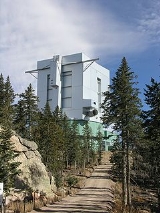
Large Binocular Telescope

Encyclopedia
Large Binocular Telescope (LBT) is an optical telescope for astronomy located on Mount Graham
(10700 feet (3,261.4 m)) in the Pinaleno Mountains
of southeastern Arizona
, and is a part of the Mount Graham International Observatory
. The LBT is currently one of the world's most advanced optical telescopes; using two 8.4 m (27 ft) wide mirrors can give the same light gathering ability as a 11.8 m (39 ft) wide single circular telescope and detail of 22.8 m (75 ft) wide one. Either of its mirrors would be the largest optical telescope in continental North America. Strehl ratios of 60-90% at H band and 95% at M band have been achieved by the LBT.
; University of Minnesota
, University of Notre Dame
, University of Virginia
, the LBT Beteiligungsgesellschaft in Germany
(Max Planck Institute for Astronomy
in Heidelberg, Landessternwarte
in Heidelberg, Leibniz Institute for Astrophysics Potsdam (AIP), Max Planck Institute for Extraterrestrial Physics
in Munich
and Max Planck Institute for Radio Astronomy
in Bonn
); The Ohio State University; Research Corporation in Tucson.
The telescope design has two 8.4 metres (27.6 ft) mirrors mounted on a common base, hence the name "binocular
". LBT takes advantage of active
and adaptive optics
, provided by Arcetri Observatory. The collecting area is two 8.4 meter aperture mirrors, which works out to about 111m2 combined. This area is equivalent to an 11.8 metres (38.7 ft) circular aperture, which would be greater than any other single telescope, but it is not comparable in many respects since the light is collected at a lower diffraction limit and is not combined in the same way. Also, an interferometric
mode will be available, with a maximum baseline of 22.8 metres (74.8 ft) for aperture synthesis imaging observations and a baseline of 15 metres (49.2 ft) for nulling interferometry. This feature is along one axis with the LBTI instrument at wavelengths of 2.9 - 13 micrometres, which is the near infrared.
, who claimed the mountain is sacred, and from environmentalists who contended that the observatory would cause the demise of an endangered subspecies of the American Red Squirrel, the Mount Graham Red Squirrel
. Environmentalists and members of the tribe filed some 40 lawsuits—eight of which ended up before a federal appeals court—but the project ultimately prevailed after an act of the United States Congress
.
The telescope and mountain observatory survived two major forest fires in eight years, the more recent in the summer of 2004. Likewise the squirrels continue to survive, though experts believe their numbers fluctuate dependent upon nut harvest without regard to the observatory.
. The second primary mirror was installed in January 2006 and became fully operational in January 2008.
The first binocular light images show three false-color renditions of the spiral galaxy NGC 2770
. The galaxy is 88 million light years from our Milky Way, a relatively close neighbor. The galaxy has a flat disk of stars and glowing gas tipped slightly toward our line of sight
.
The first image taken combined ultraviolet and green light, and emphasizes the clumpy regions of newly formed hot stars in the spiral arms. The second image combined two deep red colors to highlight the smoother distribution of older, cooler stars. The third image was a composite of ultraviolet, green and deep red light and shows the detailed structure of hot, moderate and cool stars in the galaxy. The cameras and images were produced by the Large Binocular Camera team, led by Emanuele Giallongo at the Rome Astrophysical Observatory.
In binocular aperture synthesis
mode LBT will have a light-collecting area of 111 m 2, equivalent to a single 11.8 metres (38.7 ft) surface and will combine light to produce the image sharpness equivalent to a single 22.8 metres (74.8 ft) telescope. However, this requires a beam combiner that was tested in 2008, but has not been a part of regular operations. It can take images with one side at 8.4 m aperture, or take two images of the same object using different instruments on each side of the telescope.
rather than correcting atmospheric distortion further downstream in the optics - was inaugurated. Using one 8.4 m side, it surpassed Hubble sharpness (at certain light wavelengths), achieving a Strehl ratio
of 60-80% rather than the 20-30% of older adaptive optic systems, or the 1% typically achieved without adaptive optics for telescopes of this size. Adaptive optics at a telescope's secondary (M2) was previously tested at MMT Observatory
by the Arcetri Observatory and University of Arizona team.
TV show Really Big Things
, National Geographic Channel
Big, Bigger, Biggest http://channel.nationalgeographic.com/channel/series/big-bigger-biggest and the BBC
program The Sky At Night
.
The BBC Radio 4
radio documentary "The New Galileos" covered the LBT and the JWST.
was used to discover a galaxy cluster
2XMM J083026+524133 in 2008, over 7 billion light years away from Earth
. In 2007 the LBT detected a 26th magnitude afterglow from the gamma ray burst GRB 070125
.
Mount Graham
Mount Graham is a mountain in southeastern Arizona in the United States, in the Coronado National Forest. It is the highest mountain in the Pinaleño Mountains. As the name "Mount Graham" is often used by locals to refer to the entire mountain range, the peak itself is frequently referred to as...
(10700 feet (3,261.4 m)) in the Pinaleno Mountains
Pinaleno Mountains
The Pinaleño Mountains, or the Pinal Mountains, are a remote mountain range in southeastern Arizona. They have over of vertical relief, more than any other range in the state. The mountains are surrounded by the Sonoran-Chihuahuan Desert. Subalpine forests cover the higher elevations...
of southeastern Arizona
Arizona
Arizona ; is a state located in the southwestern region of the United States. It is also part of the western United States and the mountain west. The capital and largest city is Phoenix...
, and is a part of the Mount Graham International Observatory
Mount Graham International Observatory
Mount Graham International Observatory is a division of Steward Observatory the research arm for the Department of Astronomy at The University of Arizona. It is located in southeast Arizona's Pinaleno Mountains near Mount Graham....
. The LBT is currently one of the world's most advanced optical telescopes; using two 8.4 m (27 ft) wide mirrors can give the same light gathering ability as a 11.8 m (39 ft) wide single circular telescope and detail of 22.8 m (75 ft) wide one. Either of its mirrors would be the largest optical telescope in continental North America. Strehl ratios of 60-90% at H band and 95% at M band have been achieved by the LBT.
Project
LBT, originally named the Columbus Project. it is a joint project of these members: the Italian astronomical community (represented by the Istituto Nazionale di Astrofisica, INAF); the University of ArizonaUniversity of Arizona
The University of Arizona is a land-grant and space-grant public institution of higher education and research located in Tucson, Arizona, United States. The University of Arizona was the first university in the state of Arizona, founded in 1885...
; University of Minnesota
University of Minnesota
The University of Minnesota, Twin Cities is a public research university located in Minneapolis and St. Paul, Minnesota, United States. It is the oldest and largest part of the University of Minnesota system and has the fourth-largest main campus student body in the United States, with 52,557...
, University of Notre Dame
University of Notre Dame
The University of Notre Dame du Lac is a Catholic research university located in Notre Dame, an unincorporated community north of the city of South Bend, in St. Joseph County, Indiana, United States...
, University of Virginia
University of Virginia
The University of Virginia is a public research university located in Charlottesville, Virginia, United States, founded by Thomas Jefferson...
, the LBT Beteiligungsgesellschaft in Germany
Germany
Germany , officially the Federal Republic of Germany , is a federal parliamentary republic in Europe. The country consists of 16 states while the capital and largest city is Berlin. Germany covers an area of 357,021 km2 and has a largely temperate seasonal climate...
(Max Planck Institute for Astronomy
Max Planck Institute for Astronomy
The Max-Planck-Institut für Astronomie is a research institute of the Max Planck Society. It is located in Heidelberg, Baden-Württemberg, Germany near the top of the Koenigstuhl, adjacent to the historic Landessternwarte Heidelberg-Königstuhl astronomical observatory.The institute was founded in...
in Heidelberg, Landessternwarte
Landessternwarte Heidelberg-Königstuhl
The Heidelberg-Königstuhl State Observatory is an historic astronomical observatory located near the summit of the Königstuhl hill in the city of Heidelberg in Germany...
in Heidelberg, Leibniz Institute for Astrophysics Potsdam (AIP), Max Planck Institute for Extraterrestrial Physics
Max Planck Institute for Extraterrestrial Physics
The Max Planck Institute for Extraterrestrial Physics is a Max Planck Institute, located in Garching, near Munich, Germany.In 1991 the Max Planck Institute for Physics and Astrophysics split up into the Max Planck Institute for Extraterrestrial Physics, the Max Planck Institute for Physics and the...
in Munich
Munich
Munich The city's motto is "" . Before 2006, it was "Weltstadt mit Herz" . Its native name, , is derived from the Old High German Munichen, meaning "by the monks' place". The city's name derives from the monks of the Benedictine order who founded the city; hence the monk depicted on the city's coat...
and Max Planck Institute for Radio Astronomy
Max Planck Institute for Radio Astronomy
The Max Planck Institute for Radio Astronomy is located in Bonn, Germany. It is one of 80 institutes in the Max Planck Society .-History:...
in Bonn
Bonn
Bonn is the 19th largest city in Germany. Located in the Cologne/Bonn Region, about 25 kilometres south of Cologne on the river Rhine in the State of North Rhine-Westphalia, it was the capital of West Germany from 1949 to 1990 and the official seat of government of united Germany from 1990 to 1999....
); The Ohio State University; Research Corporation in Tucson.
The telescope design has two 8.4 metres (27.6 ft) mirrors mounted on a common base, hence the name "binocular
Binoculars
Binoculars, field glasses or binocular telescopes are a pair of identical or mirror-symmetrical telescopes mounted side-by-side and aligned to point accurately in the same direction, allowing the viewer to use both eyes when viewing distant objects...
". LBT takes advantage of active
Active optics
Active optics is a technology used with reflecting telescopes developed in the 1980s, which actively shapes a telescope's mirrors to prevent deformation due to external influences such as wind, temperature, mechanical stress...
and adaptive optics
Adaptive optics
Adaptive optics is a technology used to improve the performance of optical systems by reducing the effect of wavefront distortions. It is used in astronomical telescopes and laser communication systems to remove the effects of atmospheric distortion, and in retinal imaging systems to reduce the...
, provided by Arcetri Observatory. The collecting area is two 8.4 meter aperture mirrors, which works out to about 111m2 combined. This area is equivalent to an 11.8 metres (38.7 ft) circular aperture, which would be greater than any other single telescope, but it is not comparable in many respects since the light is collected at a lower diffraction limit and is not combined in the same way. Also, an interferometric
Interferometry
Interferometry refers to a family of techniques in which electromagnetic waves are superimposed in order to extract information about the waves. An instrument used to interfere waves is called an interferometer. Interferometry is an important investigative technique in the fields of astronomy,...
mode will be available, with a maximum baseline of 22.8 metres (74.8 ft) for aperture synthesis imaging observations and a baseline of 15 metres (49.2 ft) for nulling interferometry. This feature is along one axis with the LBTI instrument at wavelengths of 2.9 - 13 micrometres, which is the near infrared.
Mountain controversy
The choice of location sparked considerable local controversy, both from the San Carlos Apache TribeSan Carlos Apache Indian Reservation
The San Carlos Apache Indian Reservation, in southeastern Arizona, United States, was established in 1871 as a reservation for the Chiricahua Apache tribe. It was referred to by some as "Hell's Forty Acres," due to a myriad of dismal health and environmental conditions.-Formation:President U.S....
, who claimed the mountain is sacred, and from environmentalists who contended that the observatory would cause the demise of an endangered subspecies of the American Red Squirrel, the Mount Graham Red Squirrel
Mount Graham Red Squirrel
The Mount Graham Red Squirrel is an endangered subspecies of the American Red Squirrel native to the Pinaleño Mountains of Arizona. It is smaller than most other subspecies of Red Squirrel, and also does not have the white-fringed tail that is common to the species...
. Environmentalists and members of the tribe filed some 40 lawsuits—eight of which ended up before a federal appeals court—but the project ultimately prevailed after an act of the United States Congress
United States Congress
The United States Congress is the bicameral legislature of the federal government of the United States, consisting of the Senate and the House of Representatives. The Congress meets in the United States Capitol in Washington, D.C....
.
The telescope and mountain observatory survived two major forest fires in eight years, the more recent in the summer of 2004. Likewise the squirrels continue to survive, though experts believe their numbers fluctuate dependent upon nut harvest without regard to the observatory.
First light
The telescope was dedicated in October 2004 and saw first light with a single primary mirror on October 12, 2005 which viewed NGC 891NGC 891
NGC 891 is an edge-on unbarred spiral galaxy about 30 million light-years away in the constellation Andromeda. It was discovered by William Herschel on October 6 1784. The galaxy is a member of the NGC 1023 group of galaxies in the Local Supercluster...
. The second primary mirror was installed in January 2006 and became fully operational in January 2008.
The first binocular light images show three false-color renditions of the spiral galaxy NGC 2770
NGC 2770
NGC 2770 is a type SASc spiral galaxy located about 88 million light years away, in the constellation Lynx.It has been referred to as the 'Supernova Factory' as three supernovas have occurred there recently: SN 1999eh, SN 2007uy, and SN 2008D...
. The galaxy is 88 million light years from our Milky Way, a relatively close neighbor. The galaxy has a flat disk of stars and glowing gas tipped slightly toward our line of sight
Line-of-sight propagation
Line-of-sight propagation refers to electro-magnetic radiation or acoustic wave propagation. Electromagnetic transmission includes light emissions traveling in a straight line...
.
The first image taken combined ultraviolet and green light, and emphasizes the clumpy regions of newly formed hot stars in the spiral arms. The second image combined two deep red colors to highlight the smoother distribution of older, cooler stars. The third image was a composite of ultraviolet, green and deep red light and shows the detailed structure of hot, moderate and cool stars in the galaxy. The cameras and images were produced by the Large Binocular Camera team, led by Emanuele Giallongo at the Rome Astrophysical Observatory.
In binocular aperture synthesis
Aperture synthesis
Aperture synthesis or synthesis imaging is a type of interferometry that mixes signals from a collection of telescopes to produce images having the same angular resolution as an instrument the size of the entire collection...
mode LBT will have a light-collecting area of 111 m 2, equivalent to a single 11.8 metres (38.7 ft) surface and will combine light to produce the image sharpness equivalent to a single 22.8 metres (74.8 ft) telescope. However, this requires a beam combiner that was tested in 2008, but has not been a part of regular operations. It can take images with one side at 8.4 m aperture, or take two images of the same object using different instruments on each side of the telescope.
Adaptive optics
In the summer of 2010, the "First Light Adaptive Optics" (FLAO) - an adaptive optics system with a deformable secondary mirrorSecondary mirror
A secondary mirror is the second deflecting or focusing mirror element in a reflecting telescope. Light gathered by the primary mirror is directed towards a focal point typically past the location of the secondary. Secondary mirrors in the form of an optically flat diagonal mirror are used to...
rather than correcting atmospheric distortion further downstream in the optics - was inaugurated. Using one 8.4 m side, it surpassed Hubble sharpness (at certain light wavelengths), achieving a Strehl ratio
Strehl ratio
The Strehl ratio, named after the German physicist and mathematician Karl Strehl , is a measure for the optical quality of telescopes and other imaging instruments...
of 60-80% rather than the 20-30% of older adaptive optic systems, or the 1% typically achieved without adaptive optics for telescopes of this size. Adaptive optics at a telescope's secondary (M2) was previously tested at MMT Observatory
MMT Observatory
The MMT Observatory is an astronomical observatory on the site of Fred Lawrence Whipple Observatory . The Whipple observatory complex is located on Mount Hopkins, Arizona, USA in the Santa Rita Mountains...
by the Arcetri Observatory and University of Arizona team.
In the media
The telescope has also made appearances on an episode of the Discovery ChannelDiscovery Channel
Discovery Channel is an American satellite and cable specialty channel , founded by John Hendricks and distributed by Discovery Communications. It is a publicly traded company run by CEO David Zaslav...
TV show Really Big Things
Really Big Things
Really Big Things is a documentary series about massive man-made marvels like big machines, giant telescopes, skyscrapers and other massive structures...
, National Geographic Channel
National Geographic Channel
National Geographic Channel, also commercially abbreviated and trademarked as Nat Geo, is a subscription television channel that airs non-fiction television programs produced by the National Geographic Society. Like History and the Discovery Channel, the channel features documentaries with factual...
Big, Bigger, Biggest http://channel.nationalgeographic.com/channel/series/big-bigger-biggest and the BBC
BBC
The British Broadcasting Corporation is a British public service broadcaster. Its headquarters is at Broadcasting House in the City of Westminster, London. It is the largest broadcaster in the world, with about 23,000 staff...
program The Sky At Night
The Sky at Night
The Sky at Night is a monthly documentary television programme on astronomy produced by the BBC. The show has had the same permanent presenter, Sir Patrick Moore, from its first airing on 24 April 1957, making it the longest-running programme with the same presenter in television history.The...
.
The BBC Radio 4
BBC Radio 4
BBC Radio 4 is a British domestic radio station, operated and owned by the BBC, that broadcasts a wide variety of spoken-word programmes, including news, drama, comedy, science and history. It replaced the BBC Home Service in 1967. The station controller is currently Gwyneth Williams, and the...
radio documentary "The New Galileos" covered the LBT and the JWST.
Discoveries
LBT, with the XMM-NewtonXMM-Newton
The XMM-Newton is an orbiting X-ray observatory launched by ESA in December 1999 on a Ariane 5 rocket...
was used to discover a galaxy cluster
Galaxy cluster
A galaxy cluster is a compact cluster of galaxies. Basic difference between a galaxy group and a galaxy cluster is that there are many more galaxies in a cluster than in a group. Also, galaxies in a cluster are more compact and have higher velocity dispersion. One of the key features of cluster is...
2XMM J083026+524133 in 2008, over 7 billion light years away from Earth
Earth
Earth is the third planet from the Sun, and the densest and fifth-largest of the eight planets in the Solar System. It is also the largest of the Solar System's four terrestrial planets...
. In 2007 the LBT detected a 26th magnitude afterglow from the gamma ray burst GRB 070125
GRB 070125
GRB 070125 is a gamma-ray burst that occurred on 2007 January 25. It is unique in that it did not occur in a galaxy, but in intergalactic space...
.
Instruments
Some current or planned LBT telescope instruments:- LBC - optical and near ultraviolet wide field prime focus cameras. One is optimized for the blue part of the optical spectrum and one for the red.
- PEPSI - A high resolution and very high resolution optical spectrograph and imaging polarimeter at the combined focus.
- MODS - two optical multi object and longslit spectrographs plus imagers. Capable of running in single mirror or binocular mode.
- LUCIFER - two multi-object and longslit infrared spectrographs plus imagers. The imager has 2 cameras and can observe at both seeing limited and diffaction limited with adaptive optics.
- LINC/Nirvana - wide-field interferometric imaging with adaptive optics at the combined focus.
- LBTI/LMIRCAM - 2.9 to 5.2 micron fizeau imaging and medium resolution grism spectroscopy at the combined focus.
- LBTI/NOMIC - N band nulling imager for the study of protoplanetary and debris disks at the combined focus.
- FLAO - first light adaptive optics to correct atmospheric distortion
- ARGOS - multiple laser guide star unit capable of supporting ground layer or multi conjugate adaptive optics.
LBT consortium
Partners in the LBT project- Arizona (25%)
- The University of Arizona - Tucson
- Arizona State UniversityArizona State UniversityArizona State University is a public research university located in the Phoenix Metropolitan Area of the State of Arizona...
- Tempe - Northern Arizona University -Flagstaff
- Italy (25%)
- Istituto Nazionale di Astrofisica
- Osservatorio Astrofisico di Arcetri - Florence
- Osservatorio Astronomico di Bologna - Bologna
- Osservatorio Astronomico di Roma - Rome
- Osservatorio Astronomico di Padova - Padua
- Osservatorio Astronomico di Brera - Milan
- Germany (25%)
- Max-Planck-Institut für Astronomie - Heidelberg
- Landessternwarte - Heidelberg
- Leibniz-Institut für Astrophysik Potsdam - Potsdam
- Max-Planck-Institut für Extraterrestrische Physik - Munich
- Max-Planck-Institut für Radioastronomie - Bonn
- Research Corporation (12.5%)
- The Ohio State UniversityOhio State UniversityThe Ohio State University, commonly referred to as Ohio State, is a public research university located in Columbus, Ohio. It was originally founded in 1870 as a land-grant university and is currently the third largest university campus in the United States...
- University of Notre DameUniversity of Notre DameThe University of Notre Dame du Lac is a Catholic research university located in Notre Dame, an unincorporated community north of the city of South Bend, in St. Joseph County, Indiana, United States...
- University of MinnesotaUniversity of MinnesotaThe University of Minnesota, Twin Cities is a public research university located in Minneapolis and St. Paul, Minnesota, United States. It is the oldest and largest part of the University of Minnesota system and has the fourth-largest main campus student body in the United States, with 52,557...
- University of VirginiaUniversity of VirginiaThe University of Virginia is a public research university located in Charlottesville, Virginia, United States, founded by Thomas Jefferson...
- The Ohio State University
- The Ohio State UniversityOhio State UniversityThe Ohio State University, commonly referred to as Ohio State, is a public research university located in Columbus, Ohio. It was originally founded in 1870 as a land-grant university and is currently the third largest university campus in the United States...
(12.5%)
Other MGIO facilities
- Mount Graham Submillimeter TelescopeHeinrich Hertz Submillimeter TelescopeThe Submillimeter Telescope , formerly known as the Heinrich Hertz Submillimeter Telescope, is a submillimeter wavelength radio telescope located on Mount Graham, Arizona. It is a 10-meter-wide parabolic dish inside a building to protect it from bad weather. The building front doors and roof are...
- Vatican Advanced Technology TelescopeVatican Advanced Technology TelescopeThe Vatican Advanced Technology Telescope, aka the VATT, is a 1.8 meter Gregorian telescope observing in the optical and infrared. It is part of the Mount Graham International Observatory. It is situated on Mount Graham in southeast Arizona, and it achieved 'first light', the first starlight to...
See also
- List of astronomical interferometers at visible and infrared wavelengths
- List of largest optical reflecting telescopes
- List of largest optical telescopes historically
- Mount Graham International ObservatoryMount Graham International ObservatoryMount Graham International Observatory is a division of Steward Observatory the research arm for the Department of Astronomy at The University of Arizona. It is located in southeast Arizona's Pinaleno Mountains near Mount Graham....
- Safford, ArizonaSafford, Arizona- History :Safford was founded by Joshua Eaton Bailey, Hiram Kennedy and Edward Tuttle, who came from Gila Bend, in southwestern Arizona. They left Gila Bend in the winter of 1873-74; their work on canals and dams having been destroyed by high water the previous summer...
External links
- Website of the LBT
- LBT Observer's Wiki
- LBT Large Binocular Camera
- LBT Beteiligungsgesellschaft
- Discovery Park – Guided MGIO tours for the public
- AO LBT comparison
