


Spotting scope

Encyclopedia
A spotting scope is a small portable telescope
with added optics to present an erect image
, optimized for the observation of terrestrial objects. They are used for birdwatching and other naturalist
activities, for hunting, verifying a marksman's shots, surveillance
, and for any other application that requires more magnification
than a pair of binoculars
, typically on the order of 20× to 60×.
The light-gathering power and resolution of a spotting scope is determined by the diameter of the objective lens, typically between 50 and 80 mm (2 and 3.1 in). The larger the objective, the more massive and expensive the telescope.
The optical assembly has a small refracting
objective lens, an image erecting system that uses either image erecting relay lenses or prisms, and an eyepiece
that is usually removable and interchangeable to give different magnifications. Other telescope designs are used such as Schmidt
and Maksutov
optical assemblies. They may have a ruggedised design, a mounting for attaching to a tripod
, and an ergonomically
designed and located knob for focus control.
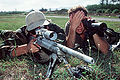 Eyepieces are usually interchangeable to give different magnifications, or may consist of a single variable "zoom" eyepiece to give a range of magnifications. Magnifications of less than 20× are unusual, as are magnifications of more than 60× since it can lead to poorer image brightness, a narrow field of view
, and show too much image shake, even on a tripod. The eyepiece mount layout can be "straight-through" (the eyepiece is on the same axis as the body of the scope), or "angled" (the eyepiece is at an angle of about 45 degrees to the body of the scope).
Telescope
A telescope is an instrument that aids in the observation of remote objects by collecting electromagnetic radiation . The first known practical telescopes were invented in the Netherlands at the beginning of the 1600s , using glass lenses...
with added optics to present an erect image
Erect image
An erect image, in optics, is one that appears right-side up.Some telescopes and other devices, such as the camera obscura present an inverted image on the viewing surface. Various means are used to achieve an erect image. A common example of an erect image is the image of a person in a standard...
, optimized for the observation of terrestrial objects. They are used for birdwatching and other naturalist
Naturalist
Naturalist may refer to:* Practitioner of natural history* Conservationist* Advocate of naturalism * Naturalist , autobiography-See also:* The American Naturalist, periodical* Naturalism...
activities, for hunting, verifying a marksman's shots, surveillance
Surveillance
Surveillance is the monitoring of the behavior, activities, or other changing information, usually of people. It is sometimes done in a surreptitious manner...
, and for any other application that requires more magnification
Magnification
Magnification is the process of enlarging something only in appearance, not in physical size. This enlargement is quantified by a calculated number also called "magnification"...
than a pair of binoculars
Binoculars
Binoculars, field glasses or binocular telescopes are a pair of identical or mirror-symmetrical telescopes mounted side-by-side and aligned to point accurately in the same direction, allowing the viewer to use both eyes when viewing distant objects...
, typically on the order of 20× to 60×.
The light-gathering power and resolution of a spotting scope is determined by the diameter of the objective lens, typically between 50 and 80 mm (2 and 3.1 in). The larger the objective, the more massive and expensive the telescope.
The optical assembly has a small refracting
Refracting telescope
A refracting or refractor telescope is a type of optical telescope that uses a lens as its objective to form an image . The refracting telescope design was originally used in spy glasses and astronomical telescopes but is also used for long focus camera lenses...
objective lens, an image erecting system that uses either image erecting relay lenses or prisms, and an eyepiece
Eyepiece
An eyepiece, or ocular lens, is a type of lens that is attached to a variety of optical devices such as telescopes and microscopes. It is so named because it is usually the lens that is closest to the eye when someone looks through the device. The objective lens or mirror collects light and brings...
that is usually removable and interchangeable to give different magnifications. Other telescope designs are used such as Schmidt
Schmidt-Cassegrain telescope
The Schmidt–Cassegrain is a catadioptric telescope that combines a cassegrain reflector's optical path with a Schmidt corrector plate to make a compact astronomical instrument that uses simple spherical surfaces.-Invention and design:...
and Maksutov
Maksutov telescope
The Maksutov is a catadioptric telescope design that combines a spherical mirror with a weakly negative meniscus lens in a design that takes advantage of all the surfaces being nearly "spherically symmetrical". The negative lens is usually full diameter and placed at the entrance pupil of the...
optical assemblies. They may have a ruggedised design, a mounting for attaching to a tripod
Tripod
A tripod is a portable three-legged frame, used as a platform for supporting the weight and maintaining the stability of some other object. The word comes from the Greek tripous, meaning "three feet". A tripod provides stability against downward forces, horizontal forces and moments about the...
, and an ergonomically
Ergonomics
Ergonomics is the study of designing equipment and devices that fit the human body, its movements, and its cognitive abilities.The International Ergonomics Association defines ergonomics as follows:...
designed and located knob for focus control.
Field of view
The field of view is the extent of the observable world that is seen at any given moment....
, and show too much image shake, even on a tripod. The eyepiece mount layout can be "straight-through" (the eyepiece is on the same axis as the body of the scope), or "angled" (the eyepiece is at an angle of about 45 degrees to the body of the scope).